Michael Hyatt's Blog, page 189
August 18, 2012
How Leaders Are Using Games to Drive Behavioral Change


This is a guest post by Travis Dommert. He is president of irunūrun, the greatness app. By combining social elements and gamification features, irunūrun helps people achieve their potential in work and life through focus, consistency, and accountability. Travis also writes on the irunūrun blog.
What does leadership have to do with playing a game? If your leadership style still reflects the industrial revolution, perhaps very little.

Photo courtesy of ©iStockphoto.com/ranplett
Fifty years ago, leadership was often about command and control. Business leaders were like generals, directing their troops into battle. “Don’t ask why, just follow orders—or we’ll replace you with someone who will!” Loyalty, respect, and fear created compliance.
But with the strengths movement of the last two decades, we know there is a better way. Treat people like the individuals they are. Align their responsibilities with their talents and equip them to pursue their potential. Voila! Exponential gains in productivity, engagement, and results, right?
Well, not so fast. Uncovering one’s talents may be easier than ever before thanks to tools like The Birkman, Strengths Finder, and Myers-Briggs or leading talent development firms like Talent Plus, Talent Quest, or Gallup.
But here’s the rub: talent itself only suggests potential. For talents to become strengths and for strengths to yield impact, you have to get people using them—consistently and relentlessly.
That means sustainable behavior change. And, how do we change behavior? “Tell them to do it, or else!” (Uh oh. Sounds like we just regressed fifty years!)
There is a better way: games.
Games are fun. Games allow people to achieve a feeling of significance among their peers by mastering skills through repetition. Games allow the players to encourage and police each other, relieving the leader from much of the heavy lifting. Bottom line: games are great for creating sustainable behavioral change.
And, all the while we’ve been learning about strengths, another trend has been under way—the application of game theory and game mechanics to solve business problems. It is a method known today as gamification.
Gamification started with driving consumer behavior. (Remember collecting bottle caps, UPC codes, or game pieces to earn prizes?) Today, smart companies are using gamification inside the firm.
In his recent article in Forbes, Dan Woods describes gamification as “a CEO’s best friend.”
Want to reinforce behaviors consistent with your mission, vision, and values? Create a game. Want to get your sales force making more calls? Create a game. Want to elevate key service behaviors? Gamify it. Encourage a healthy lifestyle? Yep, gamification.
Here are five steps to adding games to your leadership toolbox.
Objective. Identify exactly what behaviors you want to reinforce. The game is about action, not just results, so think behaviors. By whom, when, how, and for how long? Be sure to include your team members in this process. They will play harder if they have a role in defining the desired behaviors. (Also, be careful! Games are powerful. Test your game for at least a month with a pilot group before releasing it organization-wide.)
Rewards. People want to know what they are playing for. Recognition alone may be enough, so a trophy may do the trick. But if you have the budget, consider a little office bling—perhaps an upgraded phone, monitor or chair. Just beware of big incentives. The reward shouldn’t tempt participants to sacrifice their integrity to win.
Consequences. I know, consequences may not be popular. But the truth is some people are much more motivated by a consequence than a reward. Have fun with it. Be sure it fits your culture—something light-hearted with just enough edge to dissuade anyone from warming the bench while the more competitive players pursue the rewards. Performing a show tune at the annual meeting should do the trick.
Accountability. Keep the game visible as much as possible—both the progress and the results. Whether you utilize a flip chart or a web-based gamification app, keep game play out in the open.
Communicate. Andy Stanley says leaders need to repeat their message twenty-one times before people hear it once. The same is true with your game. You can’t just kick it off and announce the winner months later. You must revisit the game at least every week. Integrate it into your messages, your e-mails, your meetings.
Since the invention of pong, games have driven behavior change. Ironically, from the beginning, games (especially video games) have drawn fire for being so addictive. If you need to drive behavior change in your organization, unlock the extraordinary power of games to grow your people.
Question: How could games be used in your organization to drive positive behavior? You can leave a comment by clicking here.







August 17, 2012
SCORRE Conference [Event]

This is THE conference to attend if you want to take your speaking to the next level. The full conference runs October 17–20, 2012. I will be speaking twice but will be there for the entire conference. I hope to see you there.
Date:
October 20, 2012
Time:
09:00-10:00 a.m.
Event:
SCORRE Conference
Topic:
TBD
Sponsor:
Dynamic Communicators International
Venue:
Park Hyatt Beaver Creek
Location:
Avon, CO
Registration:
Click here to register.
More Info:
Click here for more information.



August 16, 2012
Take Your Business to the Next Level with Dave Ramsey
Dave Ramsey and I have been personal friends for more than fifteen years. I was his publisher at Thomas Nelson for almost a decade. I love his message and the impact it has had on my family and millions of people around the world.
If you can’t see this video in your RSS reader or email, then click here.
I was especially excited when Dave invited me to speak at his upcoming EntreLeadership Master Series in Orlando on October 14–20, 2012. This is something I have wanted to attend since participating in his one-day EntreLeadership event in Houston a few years ago.
Unfortunately, when I checked my calendar, I discovered I was already booked to speak at two other events that same week.
Rats. I’ll have to miss the event this year. This is the only conference still on my bucket list.
But you don’t have to. This conference could be the most important experience you ever have in terms of your personal leadership development—especially if you own or manage a small business.
Why? Because being a business leader is often a difficult and lonely journey.
It’s difficult because most of us have never been trained in how to build a successful small business. It’s lonely because we are often so focused on our own survival we don’t have time to connect with those who could help us take it to the next level.
The EntreLeadership Master Series is a seven-day event that addresses both of these issues in a fun, energetic learning environment. Dave shares the “playbook” he used to take his business from a card table in his living room to become a major national brand.
Frankly, this is the stuff you should have learned in business school. Dave will teach you how to:
Inspire and empower your people to take ownership and drive growth.
Build employee loyalty and eliminate gossip.
Take care of your team and best serve your customers.
Set and reach goals you might have thought were impossible.
Build a profitable, financially solid business.
Dave shares practical wisdom from the trenches based on his twenty-plus years building a dynamic, growing company. This is not armchair theory. This is practical, from-the-trenches wisdom you need to succeed in today’s competitive environment.
Here are five reasons why you should come to EntreLeadership Master Series:
Instruction. You’ll hear from Dave and other outstanding speakers.
Coaching. You’ll have the opportunity to be coached by executives from Dave’s own team (Executive and Platinum Access only).
Entertainment. The conference is held in the beautiful Walt Disney World Resort in Orlando.
Fellowship. You’ll experience the joy of connecting with other like-minded entrepreneurs. You’ll also be able to interact with Dave and his team.
Motivation. You’ll be challenged and inspired to take your business—and your life—to the next level.
Just because your business is small doesn’t mean you shouldn’t have access to world-class training and coaching. This is your opportunity to get it.
Come spend seven days with Dave in Orlando.
This conference is limited to just 200 people. As a result, it will sell out quickly. You can register by going to the EntreLeadership Master Series website or calling (888) 227–3223. If you mention you read about the conference here, you’ll get a $500 discount.
By the way, I will be doing a live chat with Chris LoCurto, host of the EntreLeadership Podcast, today at 9:00 a.m. Central. Come stop by for an hour to kick off your workday and learn from fellow leaders.
Question: What would a conference like Dave’s make possible for your business? What about your personal life? You can leave a comment by clicking here.



August 15, 2012
#022: My Best Advice for First-Time Authors, Part 2 [Podcast]
In this episode, I continue with my best advice for first-time authors, which I began last week. Even if you’ve never thought about writing a book or don’t think you could, this episode is for you.

Let me provide a quick review of the last episode to give you some context if you are just tuning in. There are at least four reasons why you should consider writing a book:
Click to Listen
[image error]
Podcast: Subscribe in iTunes | Play in browser | Download
Reason #1: It can add value to others. Everyone is an expert at something. You may not be aware of it. Or you have forgotten that you know what you know. But you have something that could add value to others.
Reason #2: It can establish you as an authority. Nothing credentials you like a book. Not even a Ph.D. Having a book makes you an authority (at least in terms of the perception).
Reason #3: It can advance your career. It can help you launch a brand new one. A book often goes where you can’t go. It opens doors. It starts conversations. It creates opportunities.
Reason #4: It can create an additional income stream. Even if the book itself doesn’t generate a lot of money, it can be used to sell back-end services and other products.
The problem is that it can be tough to get published. My premise in the last episode was that becoming a published author begins by taking five steps:
Step #1: Educate yourself.
Step #2: Start building your platform.
Step #3: Write a killer book proposal.
Step #4: Consider your publishing options.
Step #5: Find a good literary agent.
I want to spend the bulk on this session, answering questions from my listeners.
Listener Questions
Andy Traub asked, “What does a really good publishing deal look like?”
Bernd Geropp asked, “What should I consider when choosing an agent?”
Brad Blackman asked, “What is the process for getting a non-traditional book like a coffee table book published.”
Debra Smouse asked, “Should you let a publisher know that you have a body of work you want to publish?”
Derek Ouellette asked, “Is it more difficult to get published by U.S. publishers if you are Canadian?”
Donna Nabors asked, “Under what circumstances would you recommend self-publishing?”
Tor Constantino asked, “Is it worth the hassle to get an agent and go through the process of traditional publishing?”
J.E. Scott asked, “What comes first: building a tribe via the methods you describe in your book or seeking marketing assistance from a professional firm?”
Jason Salamun asked, “Should a first-time author begin writing his or her book as they are building a platform or wait until it’s already built?”
Joanne Kraft asked, “How much travel is too much as an author?”
John Richardson asked, “To get the word out on my book, should I release the book about a week before I go live on my site? Also, can POD publishers ramp up quickly if there is an initial spike in sales?”
Julie Sunne asked, “How important is it to obtain an agent as a first-time author if I can meet acquisitions editors face-to-face at different conferences?” She also asked, “What type of platform is best? Social media, speaking, magazines … what?”
KC asked, “What do you think about e-books? Giving them away for free, building an audience? Length, etc.?”
Kimanzi Constable asked, “Is a book tour worth it as a first-time author?”
Kurt Bubna asked, “How do you press on and deal with publisher rejections without getting discouraged in the process?”
Michele Dickens asked, “Should I just pour out my story or try to get an outline first?”
Ryan Dobbs asked, “How important are endorsements and how can they be used to build a first-time author’s platform?”
Special Announcements
If you are ready to get serious about building your platform and taking your blogging to the next level, you can’t do better than launching a self-hosted WordPress blog. That’s what nearly all professional bloggers use. That’s what I use at MichaelHyatt.com. However, if you are a little technically-challenged and have been afraid to try and install WordPress, I have great news.
A few weeks ago, I produced a free screencast called “How to Setup a Self-Hosted WordPress Blog in 20 Minutes or Less.” This short video will take you through the process step-by-step. Trust me, anyone can do this. In the last ten days, I’ve had almost 200 people use this video to launch their blog.
Episode Resources
In this episode I mentioned several resources, including:
Conference: The SCORRE Conference
Book: Platform: Get Noticed in a Noisy World by Michael Hyatt
eBooks: Writing a Winning Fiction Book Proposal by Michael Hyatt
eBooks: Writing a Winning Non-Fiction Book Proposal by Michael Hyatt
Company: WestBow Press
Book: How to Blog a Book by Nina Amir
Post: “Creating an Annual Time Block”
Post: “Put the Big Rocks in First”
Screencast: How To Launch A Self-Hosted WordPress Blog In 20 Minutes Or Less [Screencast]
Show Transcript
You can download a transcript of this episode here.
Subscription Links
If you have enjoyed this podcast, please subscribe:

iTunes

Zune

RSS
Your Feedback
If you have an idea for a podcast you would like to see or a question about an upcoming episode, e-mail me.
Also, if you enjoyed the show, please rate it on iTunes and write a brief review. That would help tremendously in getting the word out! Thanks.
Question: What additional questions do you have about getting published? You can leave a comment by clicking here.



August 13, 2012
Why I Will Be Posting Less
You have to remain flexible with social media. What works six months ago, may not work today. What works today, may not work six months from now. I believe this principle even applies to blogging frequency.

Photo courtesy of ©iStockphoto.com/Joe_Potato
In my book, Platform: Get Noticed in a Noisy World, I said “there is a direct correlation between frequency and traffic” (see p. 99). I then suggest that the more you post, the greater your traffic.
This is especially true when you are a new or relatively new blogger. I know it was true of me, and many other bloggers would agree. It was the single biggest factor in seeing my blog traffic grow dramatically in 2010.
However, I started questioning the relevance of this principle when I read a post entitled, “How Often Should You Blog? (Hint: The Answer Might Surprise You)” by Ali Luke. She says:
Over the past couple of years, there’s been a shift in the blogging world. More and more prominent bloggers-on-blogging are moving away from daily posting—and reassuring their readers that you don’t have to post every day in order to be successful.
She then goes on to quote Darren Rowse of Problogger who says,
I once surveyed readers here on ProBlogger about the reasons they unsubscribed from RSS feeds, and the number one answer was ‘posting too much.’ Respondents expressed that they developed ‘burnout’ and would unsubscribe if a blog became too ‘noisy.’
When I read this, I was reminded of a principle I first read about in The 4-Hour Body by Timothy Ferris. It’s called the minimum effective dose (MED). He defines it as
…the smallest dose that will produce the desired outcome. Any thing beyond the MED is wasteful. To boil water, the MED is 212°F (100°C) at standard air pressure. Boiled is boiled. Higher temperatures will not make it ‘more boiled.’ Higher temperatures just consume more resources that could be used for something more productive. (p. 17)
When I finished Luke’s article I thought, If I could get the same traffic with half the posts, I would gain back several hours each week that could be invested in other activities. Specifically, I could:
Research and write higher quality posts
Guest post on other blogs
Write new e-books and books
Develop new courses
To be clear, posting frequently is one of the best ways for new bloggers to build traffic. But for bloggers who are a little further along, with a deeper archive of content, I don’t think it is necessarily true.
I decided to ask my readers.
On Saturday, I posted a quick survey on my blog. I said, “I am thinking about reducing the number of times I post per week, in order to free up time to work on other types of content. Currently, I post five days a week. How often would you like to see me post?” I gave five options: one, two, three, four, or five times a week.
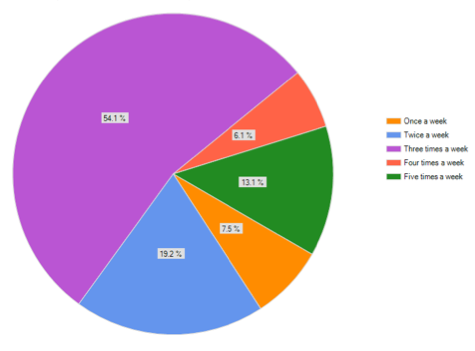
To my surprise 81 percent of my readers voted three times a week or less. (You can see the full panel of results here.) In other words, I am apparently creating more content than the majority of my audience wants to consume.
Here were some of the reasons they gave:
“I love your posts, but I just don’t have the time to keep up.”
“I need more time between posts to process what I have read and apply it.”
“I think it would enable you to bump the quality of your posts even higher.”
“If this would give you additional time to create other kinds of content, I am all for it.”
“This is a case where I think less is more.”
So, based on this feedback, I am changing my blogging strategy effective immediately. Here’s my plan:
Post two original blog posts per week, one on Monday and one on Friday. (I am moving my guest posts to Saturday.)
Post my podcast on Wednesday, along with the “show notes,” just as I am doing now.
Fill in on Tuesdays and Thursdays with mini-posts: quotes, links, videos, photos, etc. These will be short and irregular.
My plan is to give this a one-month test and see how my readers like it and also monitor how it impacts my traffic. I wouldn’t be surprised if it actually goes up. We’ll see.
Questions: Is your blogging frequency something you need to re-visit? Are you posting too much? too little? You can leave a comment by clicking here.



August 10, 2012






7 Steps to Finding a Better, Third Option
This is a guest post by Jeremy Statton. He is an orthopedic surgeon and a writer. You can download a free copy of his eBook Grace Is . Connect with him on Twitter or his blog, Living Better Stories.
We are a culture that is accustomed to thinking in terms of two options:
Republicans versus Democrats
Cowboys versus Indians
Mac versus PC.
Yin versus Yang.
Yankees versus Red Sox.

Photo courtesy of ©iStockphoto.com/tc397
When we view a problem, or the solution to a problem, we typically divide it into two different categories.
You are given a choice of either A or B.
Unfortunately, when we limit ourselves to only two options, we are limiting the possibilities of our solution. The best decisions often come not out of a selection of two choices, but instead out of the discovery of a better, third option.
When two different sides disagree, both are often right. Both have a valid perspective. Both represent possible solutions.
And both are wrong. All at the same time.
If you can find a way to combine the best elements of the seemingly two different solutions into one remedy, then you have found the third option.
This third option is much more than a compromise which gives up something to quickly settle a dispute. The third option represents an elegant solution to a problem. It is the discovery of something better than the first two presented.
Getting there, though, requires skill and work.
When two sides disagree, here are seven steps to help you find the third option:
Be humble. The entire process depends on humility. The only way to find the third option is when two disagreeing sides lay down their egos and work together. Pride always looks for the self-serving solution. Ulterior motives are often in play. The focus has to be solving the problem for the good of everyone involved.
Embrace the tension. Most of us fear conflict. When tension arises we try to quickly solve the problem and make it disappear. Instead of running from it, embrace it. Learn to identify this tension as an opportunity to find a third option.
Learn to listen. If you enter the discussion convinced that you are right, then you have closed the door on any other possible options. The first step in finding a better solution is understanding those that disagree with you. Only through listening can you understand them and what motivates their point of view.
Refuse to compromise. Finding the third option isn’t about caving in to the demands of others. If you are convinced that you are right on a certain aspect of the solution, then don’t give in. Make your point without unwavering. Everyone needs to hear your opinion.
Liberate your team. Freedom to disagree without repercussion is the most important part of finding the third option. As a leader, it is your responsibility to create a culture where everyone feels free to express their opinion.
Sleep on it. When debating a solution, the intensity of the moment may sway your opinion. Don’t feel like you have to discover the answer at once. Give yourself and your team time to digest the arguments. The third option may not be immediately obvious.
Learn through mistakes. The enemy of good is better. Don’t waste too much time searching for the third option. At some point make the best decision you can and then carry it out. Often we find even better solutions to our problems once we put them into practice.
Great leaders understand that the world isn’t best viewed in terms of black and white. When a disagreement arises, they will lead their team beyond the tension and into a better, third option.
Questions: Do you limit yourself to two options? What has worked for you to find a better solution? You can leave a comment by clicking here.



August 9, 2012
Are You Investing Your Best Resources in the Wrong People?
Is is easy to see other people making this mistake. It is more difficult to catch yourself doing it. I’ve been guilty plenty of times.

Photo courtesy of ©iStockphoto.com/weka
For example, a few years ago, while I was still CEO of Thomas Nelson, I met with an important author. In the course of the meeting, I learned he was unhappy with the cover design we had done for his previous book.
Being the people-pleaser I am, I thought I could fix his problem. “I will take personal responsibility for this next cover,” I announced. “I will work with you directly to make sure we get a cover you love.”
I then hired a designer I knew who had delivered stellar results for another one of our authors. In a few weeks, the designer delivered six superb cover comps. I made a few suggestions, the designer revised his work, then I submitted them to the author.
He didn’t like any of them.
I spent an hour on the phone with him, as he berated the designer. Undaunted, I rolled up my sleeves and spent the afternoon personally searching through a stock photo library, trying to find just the right image—not exactly the best use of my time as a CEO.
But finally I found a photo I loved. This is it, I thought. Perfect!
I went back to the designer and had him create several more comps based on the new photo. I submitted the new batch to the author, confident he would love one of the options. I followed up with a phone call.
He hated them all.
Again, he criticized the designer. He then came after me. “If you would just spend the money and hire a decent designer, we could get onto more important things.” He lectured me like this was the first time I had ever done this.
Silly me. I hired another designer and went through one more round with him. We produced twenty-one cover comps in all. He didn’t like any of them.
Finally, we acquiesced and used a cover designed by his team. I wish I could show it to you, especially compared to the others.
With that, I woke up to the fact that I had invested all this time, money, and emotional energy and had not moved the needle one bit. It was a total waste. He was incorrigible.
The resources I wasted on him would have been better spent elsewhere.
We finished out our contract with him but passed on offering him another one. We had had enough. We let him go to another publisher.
Leaders often make this same mistake in various areas of their lives. For example,
A mother invests all of her emotional energy in a difficult child to the neglect of the quiet, compliant one. The difficult child gets worse and the complaint one begins acting up to get attention.
A corporate executive spends most of her time helping under-performing salespeople rather than provide leadership and inspiration to her top producers. She then wonders why she can’t keep her best people.
A pastor expends so much of his time trying to fix broken people that he doesn’t have the energy to develop the leaders who could help shoulder the burden. He constantly grumbles about his workload.
What can you do if you are in this situation?
Make sure you are investing your best resources—including your time and energy—in your best people. Here’s how:
Acknowledge that your resources are limited. Your time, money, and energy are finite resources. It’s easy to forget this and overcommit. But it’s a zero-sum game. Every time you say “yes” to one person, you are saying “no” to others.
Become aware of where your resources are going. It’s easy to think the situation is temporary or an exception. But is it? This is the little lie that keeps us stuck if we aren’t careful. Look back over your calendar and make an honest assessment. It will reveal the truth.
End unproductive or unhealthy relationships. This is the hard part. If you can’t end them, then at least establish boundaries. If you need inspiration or moral support, read Henry Cloud’s excellent book, Necessary Endings: The Employees, Businesses, and Relationships That All of Us Have to Give Up in Order to Move Forward .
Identify the people you should be investing in. This is the most important step. Change your focus. Who are the individuals you have overlooked? Who are the people who should be getting the bulk (or at least more) of your resources? Who are the ones who represent the future?
Schedule time on your calendar to serve these people. Good intentions are important, but they are not enough. Like the old adage says, “What gets scheduled gets done." The opposite is also true, “What doesn’t get scheduled doesn’t get done.”
Yes, Jesus spent time with broken people. He healed the sick. He comforted the broken-hearted. He ministered to the outcasts.
But he spent the bulk of his resources on just twelve people. He proactively invested in them, knowing that his mission was, humanly speaking, dependent on their success.
Question: Where do you need to shift your focus and allocate your resources differently? You can leave a comment by clicking here.




August 8, 2012
#021: My Best Advice for First-Time Authors, Part 1 [Podcast]
In this episode, I share my best advice for first-time authors. Even if you’ve never thought about writing a book or don’t think you could, this episode is for you.

There are at least four reasons why you should consider writing a book:
Click to Listen
[image error]
Podcast: Subscribe in iTunes | Play in browser | Download
Reason #1: It can add value to others. Everyone is an expert at something. You may not be aware of it. Or you have forgotten that you know what you know. But you have something that could add value to others.
Reason #2: It can establish you as an authority. Nothing credentials you like a book. Not even a Ph.D. Having a book makes you an authority (at least in terms of the perception).
Reason #3: It can advance your career. It can help you launch a brand new one. A book often goes where you can’t go. It opens doors. It starts conversations. It creates opportunities.
Reason #4: It can create an additional income stream. Even if the book itself doesn’t generate a lot of money, it can be used to sell back-end services and other products.
The problem is that it can be tough to get published. As the former Chairman and CEO of Thomas Nelson, I received—and still receive—a lot of email from would-be authors who are trying their best to get published. Most of them are frustrated, because they can’t seem to get anyone interested in their book idea or manuscript.
In this episode, I want to demystify the process a bit. I want to give you the same advice I would offer to a close friend over coffee.
Episode Outline
My premise for this episode is that becoming a published author begins by taking five steps. This isn’t everything you will need to do. These are just the first five. The problem is that most would-be authors try to skip these steps. As a result, they don’t make any progress.
Step #1: Educate yourself.
Read books.
Follow industry blogs.
Read industry publications.
Attend industry events.
Step #2: Start building your platform.
Reason #1: You will be more attractive to publishers.
Reason #2: You will be more likely to succeed.
Reason #3: You will more quickly find your voice.
Step #3: Write a killer book proposal.
You need this even if you self-publish.
Don’t be surprised if this takes a while—it’s hard work!
Just get started and keep working on it.
Have someone review it.
Step #4: Consider your publishing options.
Option #1: Traditional Publishing
Option #2: Assisted Self-Publishing
Option #3: Do-It-Yourself Self-Publishing
Step #5: Find a good literary agent.
Benefit #1: Access
Benefit #2: Leverage
Benefit #3: Focus
Listener Questions
Annette Trucke asked, “What were the mistakes you made along the way that you would avoid at all costs?”
Brent Mayes asked, “How do I build a platform for two separate projects?”
Dallon Christensen asked, “How detailed should your outline be before you begin writing.”
David McLaughlin asked, “When do you fine-tune your writing—as you go or as a separate process?”
Dayna Bickham asked, “Do you have any resources for writing or formatting an e-book only project?”
Jaime Tardy asked, “Should I hire a designer to make my manuscript pretty before I submit it?”
Sherry Meyer asked, “Where are publishers in terms of signing memoirs today from first-time authors?”
Special Announcements
If you are ready to get serious about building your platform and taking your blogging to the next level, you can’t do better than launching a self-hosted WordPress blog. That’s what nearly all professional bloggers use. That’s what I use at MichaelHyatt.com. However, if you are a little technically-challenged and have been afraid to try and install WordPress, I have great news.
A few weeks ago, I produced a free screencast called “How to Setup a Self-Hosted WordPress Blog in 20 Minutes or Less.” This short video will take you through the process step-by-step. Trust me, anyone can do this. In the last ten days, I’ve had over 150 people use this video to launch their blog.
I will be speaking in Ft. Worth, Texas tomorrow, August 9, 2012 for Cendera Funding as part of a lecture series called, “Business with Purpose.” I will do two sessions: “The 5 Marks of Authentic Leadership” and “Platform: Get Noticed in a Noisy World.” If you are in the area, come join me.
If you are interested in having me speak for your event, check out my speaking page.
Episode Resources
In this episode I mentioned several resources, including:
Blog: Chip MacGregor
Blog: Jane Friedman
Blog: Mike Shatzkin
Blog: Rachelle Gardner
Blog: Yates & Yates
Book: 2012 Guide to Literary Agents by Chuck Sambuchino
Book: 2012 Writer’s Market by Robert Lee Brewer
Book: Bird by Bird by Anne Lamott
Book: The Christian Writer’s Market Guide 2012 by Jerry B. Jenkins
Book: On Writing by Stephen King
Book: Platform: Get Noticed in a Noisy World by Michael Hyatt
Book: The War of Art by Steven Pressfield
Company: WestBow Press
Conference: American Christian Fiction Writers (ACFW)
Conference: BookExpo America (BEA) / BlogWorld
Conference: Digital Book World Conference
Conference: International Christian Retail Show (ICRS)
Conference: O’Reilly Tools of Change Conference
eBooks: Writing a Winning Fiction Book Proposal by Michael Hyatt
eBooks: Writing a Winning Non-Fiction Book Proposal by Michael Hyatt
Post: “Formatting Your Manuscript for Your Editor” by Jamie Chavez
Post: “Literary Agents Who Represent Christian Authors” by Michael Hyatt
Software: Calibre
Software: iWork Keynote
Software: iWork Pages
Software: Scrivener
Website: PublishersLunch
Website: Publishers Weekly
Show Transcript
You can download a transcript of this episode here.
Subscription Links
If you have enjoyed this podcast, please subscribe:
iTunes
Zune
RSS
Your Feedback
If you have an idea for a podcast you would like to see or a question about an upcoming episode, e-mail me.
Also, if you enjoyed the show, please rate it on iTunes and write a brief review. That would help tremendously in getting the word out! Thanks.
Question: What additional questions do you have about getting published? You can leave a comment by clicking here.



August 7, 2012
My Favorite WordPress Plugins: Updated
Since posting my screencast on How to Install WordPress in 20 Minutes or Less, numerous people have written to ask, “What WordPress plugins should I install?”

Photo courtesy of ©iStockphoto.com/gwmullis
That depends on what you are trying to accomplish. However, I thought I would post my current list in order to stimulate your thinking plus getting a few ideas from you.
One of my favorite things about WordPress as a blogging platform is the ability to extend its features through plugins. Unfortunately, the more plugins you use, the more it slows down your blog. As a result, features have to be balanced with speed.
Admittedly, I use more plugins than I probably should. Nevertheless, I am currently using the following and am happy with the performance:
Plugin
Description
Add Post Footer
Adds the “Disclosure of Material Connection” content to the end of my posts, as I recommend in Appendix A of Platform . However, you can use it to add any static content to the end of your posts.
Akismet
Checks your comments against the Akismet web service to see if they look like spam or not and then flags them accordingly. It is amazingly accurate. Unfortunately (but understandably) they now charge for it. It is worth it.
All in One SEO Pack
Optimizes your WordPress blog for search engines (Search Engine Optimization). It allows you to customize the meta data for each post.
Attention Grabber
Adds a simple drop-down banner at the very top of my site. Right now, I am using this to advertise my Writing a Winning Book Proposal e-books.
Better Adjacent Post Links
Adds two enhanced commands to replace WordPress’ “Previous post” and “next post” functions.
Blubrry PowerPress
Embeds my podcast into specific blog posts (show notes). You can pick from a variety of player styles and display the one you want in your post.
Disqus Comment System
Replaces the native WordPress commenting system. It has a number of features that I like better. It is arguably the most popular commenting plugin available.
Drop Caps
Adds drop caps to your posts and pages. It comes with some cool CSS styling and lots of options.
GigPress
Provides a database for entering, managing, and displaying speaking engagements. I no longer use it. I had a custom module written. However, it is a great option for speakers and artists.
Google XML Sitemaps
Generates a special XML sitemap which will help search engines to better index your blog.
MaxBlogPress Ninja Affiliate
Manages, tracks, cloaks and shortens an unlimited number of affiliate links from one central location.
Nivo Slider
Displays featured content in a slider display box. I don’t use it for that. I only use it to display quotes on my Speaking page.
nRelate Related Content
Continuously analyzes your blog content and displays other related posts from your blog at the bottom of each post. This is designed to keep people on your site by providing other related content.
Public Post Preview
Provides a way for you to give a link to others for public preview of a post before it is actually published. I use this for guest posters.
Redirection
Manages all your “301 redirects,” so that readers don’t get a “page not found error” (404 error).
RSS Footer
This plugin makes it easy to add a line of content or even ads to the end of all the articles in your feeds.
Scribe SEO
Quickly checks your content against SEO best practices utilizing the Scribe Content Optimizer. A “must have” if you are serious about increasing your blog’s traffic.
SexyBookmarks
Provides an attractive, easily-configurable social bookmarking menu to your posts and pages. You can add virtually any social service, including Twitter, Facebook, Email a Friend, StumbleUpon, et.c
Smart Ads
Automatically adds advertisements before and after your post’s single page content—or even in the middle of a post.
VaultPress
Backs up everything on your WordPress blog, several times a day. It was created by Automattic, the people who created WordPress.
W3 Total Cache
Improves the user experience of your blog by improving your server performance, caching every aspect of your site, reducing the download time of your theme, images, etc.
WordPress.com Stats
Provides simple, concise stats with no additional load on your server by plugging into WordPress.com’s stat system.
WP Categories and Posts
Adds in a template tag you can use to display categories and sub-categories and the posts underneath those categories. I use it for my Archives page.
WP Greet Box
Displays a different greeting message to your visitors depending on which site they are coming from. Very cool.
I also use BuySellAds to manage my advertising. It is super easy to use, but it is not technically a plugin.
Also, you can find an almost-complete directory of WordPress plugins here.
Question: What plugins are you using that other bloggers should consider? You can leave a comment by clicking here.