Michael Hyatt's Blog, page 193
July 9, 2012
How a Shift in Your Vocabulary Can Instantly Change Your Attitude


I am currently on vacation. During this time, I am completely offline. I am getting some rest, feeding my soul, and enjoying time with my family. While I am away, I thought I’d share with you my top posts of all time. Whether you have read this particular post or not, I think you will find the content relevant and useful. I am excited to share it with you again!
This past year I have noticed how my vocabulary impacts my attitude. Words have power. They impact others, of course, but they can also have an impact on us.

Photo courtesy of ©iStockphoto.com/gawrav
For example, several weeks ago, I was headed out of town to a speaking engagement. A friend called and asked me where I was going. I said, “Oh, I’m headed to San Jose. I have to speak at a convention.” I said it with a little resignation in my voice.
When I hung up, it hit me. I don’t have to speak. I get to speak. That instantly changed my attitude.
How many people would gladly do this for free—or even pay for the opportunity? Yet I was getting paid to do it.
The first expression (i.e., I have to do it) is the language of duty. Nothing wrong with that. I am all for responsibility. But too often, we say it with a sigh, like it’s a sentence—or we are a victim.
The second expression (i.e., I get to do it) is the language of privilege. It is as if we have been given a gift, and we are relishing the opportunity.
This subtle shift may seem small, but it has had a big impact on my attitude. I am choosing the language of privilege every chance I get.
I don’t have to workout this morning; I get to workout. What a privilege to be healthy and be able to care for my body.
I don’t have to write a new blog post. I get to write one. What a privilege to have readers that actually care what I have to say.
I don’t have to meet with the guys in my mentoring group; I get to. What a privilege to meet with eight young men who want to learn and grow.
I don’t have to go to church today; I get to go to church. What a privilege to belong to a church where I can worship God and where I have such good friends.
I don’t have to stop by the grocery store on my way home; I get to stop by the grocery store. What a privilege to live in a place and at a time where we don’t have to forage for food.
You get the idea.
You can make this shift, too. Here are three suggestions:
Become aware of your vocabulary. This is a little like my post last week on the difference between try and do. The first step is to actually become aware of the words you are using.
Start using get to rather than have to. You don’t need to become compulsive about this, but start intentionally using the language of privilege rather than duty.
Notice the difference it makes in your attitude. For starters, it can suddenly make you grateful. Rather than dreading or resenting an activity, you can be thankful for it.
A few days ago, I was talking to an author friend, who was lamenting the fact that he had to actually write his book, now that he had a contract.
I stopped him and said, “No, Josh, you get to write this book. This has been a goal of yours for as long as I have known you. You are living your dream, buddy!”
Instantly, his attitude shifted. “You’re right. I get to write this book.”
Question: What do you GET to do today? You can leave a comment by clicking here.







July 7, 2012
Why Speaking Well of Your Spouse Is So Important
I am currently on vacation. During this time, I am completely offline. I am getting some rest, feeding my soul, and enjoying time with my family. While I am away, I thought I’d share with you my top posts of all time. Whether you have read this particular post or not, I think you will find the content relevant and useful. I am excited to share it with you again!
As a leader, the health of your marriage directly affects the impact of your leadership. (Click here to tweet that.) I have witnessed this time and time again. Being effective at work or in ministry begins by being effective at home.

Photo courtesy of ©iStockphoto.com/courtneyk
Early in our marriage, Gail and I attended a church led by a dynamic, thirty-something pastor. He was an extraordinary communicator. He was a wise and empathetic counselor. As a result, the church grew rapidly.
But as we got better acquainted with him and his wife, we started noticing a disturbing trend in the way they related to one another. They would often make disparaging remarks about the other in public.
At first, it seemed cute. Their comments seemed playful and humorous. Everyone laughed. But over time, they became more and more pointed, thinly masking their frustration with one another.
We ultimately left that church. But several years later we learned they suffered an ugly divorce, both admitting to multiple affairs. They lost their family, and, of course, their ministry. To this day, it grieves me to think about it.
Conversely, I noticed that Sam Moore, my predecessor at Thomas Nelson, always spoke highly of his wife. He would often say, “I hate to leave her in the morning, and I can’t wait to see her in the evening.” They have been married now for nearly 60 years. Last time Gail and I were with them, they were holding hands. It was obvious they were still in love.
In reflecting on these two experiences, I am convinced that praising your spouse in public is one of the most important investments you can make—in your family and in your leadership. (Click here to tweet that.)
This is important for at least five reasons:
You get more of what you affirm. Have you ever noticed that when someone praises you, you want to repeat the behavior that caused it? This is just human nature. It can be a form of manipulation if it isn’t genuine. But it can be a powerful way to motivate others when it is authentic.
Affirmation shifts your attitude toward your spouse. Words are powerful tools. They can create, or they can destroy. They can build up, or they can tear down. I believe most people have a drive to align their actions—and their attitudes—with their words. If you start speaking well of someone, you start believing what you say.
Affirmation helps strengthen your spouse’s best qualities. Encouragement is also a powerful force for good. All of us need positive reinforcement. This is why when we are losing weight and people notice, it gives us the strength to stick with the program. This is true in every area of life.
Affirmation wards off the temptation of adultery. When others see you are happily married, they are less likely to proposition you. It’s like a hedge that protects your marriage from would-be predators. You simply stop being a target.
Affirmation provides a model to those you lead. To be a truly effective leader, you must lead yourself, and then you must lead your family. Your marriage is a powerful visual of how you treat the people you value the most. (Click here to tweet that.) When you speak highly of your spouse, your followers are more likely to trust you. It takes your leadership to another level.
Affirming your spouse in public is an investment that pays big leadership dividends. (Click here to tweet that.) In a world where fewer and fewer marriages last, it can be a difference-maker.
Question: How have you seen this play out in the lives of those who have led you? You can leave a comment by clicking here.



July 6, 2012
4 Ways to Turn Twitter.com into Your Social Media Powerhouse
This is a guest post by Leo Widrich. He is the Co-founder of BufferApp, a Twitter app I use daily and can’t live without. You can read his blog and follow him on Twitter. If you want to guest post on this blog, check out the guidelines here.
There is this one problem I have, that might have occurred to you too as well. Having to log into ten different services on ten different sites every morning to get my social media day started is difficult and tedious.

Photo courtesy of ©iStockphoto.com/gmutlu
So recently, I thought, What if you could do it all from one place? Not from a dashboard with hundreds of bells and whistles, but from a clean and easy-to-use interface.
How about Twitter.com? Yep, the original!
Although Twitter.com is a super-clean interface, I wasn’t spending much time there. I had become dependent on other great Twitter apps instead. But now, I have returned to it. Here are four ways you can do this as well.
Save your best reads for later. Pocket, formerly known as ReadItLater, is a very handy tool that lets you save any article you find on the web for later reading. You will be able to access those articles from any device—offline or online—and without any clutter on the page.
All you have to do is install the Chrome extension and it will put a nice Pocket icon right into your stream on Twitter.com:
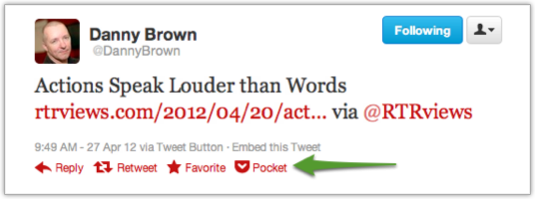
Whenever you click it, the article is saved to your list and you can conveniently read it later on. This really couldn’t be any more seamless:
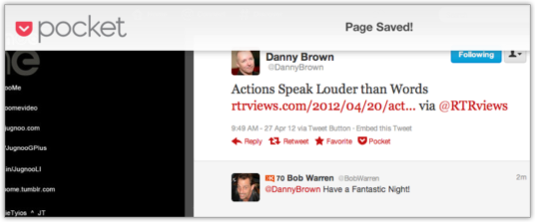
Since Pocket launched, this has definitely made my day-to-day discovery of great articles a lot easier and focused.
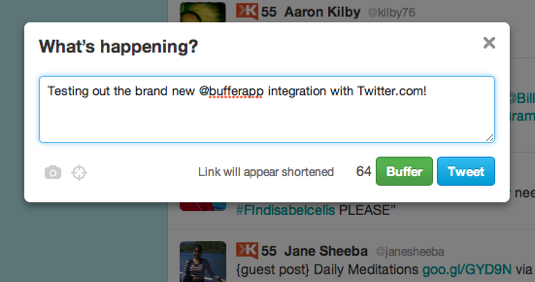
Post your tweets at a better time. At Buffer, we’ve recently also announced a brand new integration with Twitter.com, that will make queuing up your Tweets and retweets a lot easier. All you have to do is install the Buffer browser extension and you’re good to go.
Now, whenever you are writing a new Tweet from Twitter.com, you can add it straight to your Buffer, to be posted at a more optimal time for your followers:
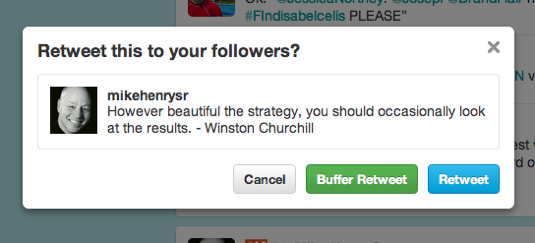
The good thing is, that you can do the exact same thing with retweets. Hit the retweet button and add it straight to your Buffer. The way I use this is to spend a few minutes to browse my Twitter stream, Buffering all the best Tweets in my stream without ever flooding my followers with too many updates in a row:
There are also plenty of other places where you can now Buffer from, it even works with clicking the “Tweet” button on any website. Just Buffer it.
Read posts right in your Twitter stream. Embedly is one of my most recent discoveries, and I am extremely excited about it. If you install the browser extension for Chrome, you will get an option to read all the great articles posted to Twitter, right from Twitter.com.
Simply click the “view Preview” button on any Tweet and without having to leave the site, you can take a peak if the article you were about to click is any good:
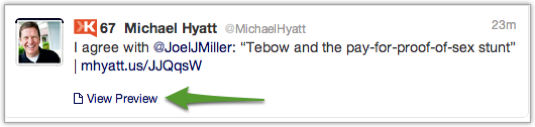
Once expanded, you will get all media displayed, such as pictures and videos. All this of course alongside a great excerpt from the post:
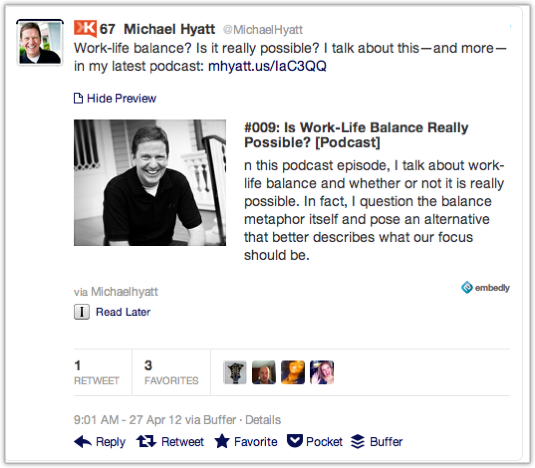
I just love this extension, because it helps me spend less time on clicking through and then coming back. Instead I just browse on Twitter.com as usual, clicking “view Preview” and moving on quickly.
Get a Better Grasp of Your Followers. Use Klout. As you may know, there has been a lot of discussion around Klout in the past few months. There were a lot of great arguments for and against using it. One quote a Twitter friend of mine @arkarthick once said stuck in my mind:
Klout is useful as a reference, not as an authority.
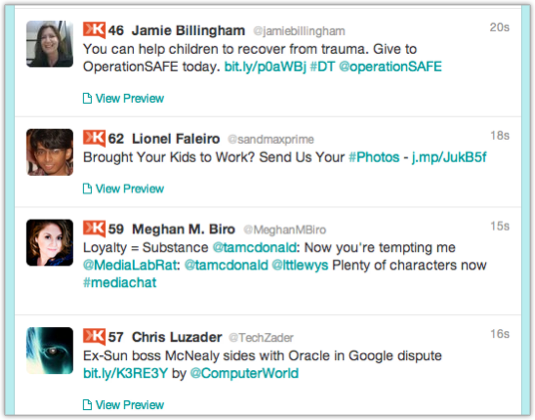
With this mindset, being able to glance over your Twitter stream if you only have a few minutes time per day with Klout installed becomes very powerful.
You can quickly decide how you can best spend time interacting with your stream with a helpful reference from Klout:
That’s it. These simple tools turn Twitter.com into a super efficient, still clean, yet very powerful social media powerhouse.
This is what I am now doing, especially since TweetDeck’s upgrades haven’t really been what I’d hoped for. Instead, using the tools I’ve outlined above, I have gradually been able to turn my Twitter.com experience into a more and more personalized place for my browsing habits. The move has been very refreshing.
Questions: Have you tried some of the extensions above to supercharge your Twitter.com experience yet? Are there any other extensions you are using to make Twitter even more powerful? You can leave a comment by clicking here.



July 5, 2012
Is Heaven for Real? An Interview with Author Todd Burpo
I am currently on vacation. During this time, I am completely offline. I am getting some rest, feeding my soul, and enjoying time with my family. While I am away, I thought I’d share with you my top posts of all time. Whether you have read this particular post or not, I think you will find the content relevant and useful. I am excited to share it with you again!
With more than seven million copies in print, Heaven Is for Real by Todd Burpo is one of the bestselling non-fiction books of all time. Tomorrow (Friday, July 6th) at 9pm EST, Barbara Walters will feature Todd and his son, Colton, in a special called, “Heaven: Where Is It? How Do We Get There?”
If you can’t see this video in your RSS reader or email, then click here.
Todd is the pastor of a small Wesleyan church in Imperial, Nebraska, just 150 miles from my hometown in Kimball, Nebraska. He is also a wrestling coach and a volunteer fireman. He operates a garage door company with his wife, Sonja, who is also a children’s minister, busy pastor’s wife, and mom.
Heaven Is for Real is a true story about Todd and Sonja’s son Colton. At the age of four, he almost died during an emergency surgery. While unconscious, he claims to have gone to heaven and had some extraordinary experiences.
When I read the book prior to publication, I was, frankly, skeptical. I didn’t know how the book would fit with my theology. I also didn’t have much confidence in the recollection of a four-year old little boy.
But I couldn’t put it down. In fact, I read through it in one sitting. Millions of others have had a similar experience. It has a four-and-a-half star rating on Amazon with almost 3,000 reader reviews. Colton’s experiences are compelling. It is a book of hope that demonstrates this life is only part of the picture.
In this video interview, I ask Todd to recount the story of Colton’s illness and experiences in heaven. He only scratches the surface, but it will give you an idea of why the book has been so hugely successful. I also asked him the value he thinks that the book offers to pastors and others in a leadership role. This is a book you will want to read and pass on to others.
Questions: Have you read this book? What did you think? You can leave a comment by clicking here.




July 4, 2012
Yes, You Can Stay on Top of E-mail
I am currently on vacation. During this time, I am completely offline. I am getting some rest, feeding my soul, and enjoying time with my family. While I am away, I thought I’d share with you my top posts of all time. Whether you have read this particular post or not, I think you will find the content relevant and useful. I am excited to share it with you again!
A while back, one of my friends asked, “How do you get through all of your email. It’s killing me. I just can’t seem to get on top of it.” I know the feeling.

Photo courtesy of ©iStockphoto.com/eyeidea
Actually, I get asked this question a lot. Despite all the current technology and software tools available, many people are falling further behind with each passing day. They just can’t seem to keep up with the avalanche of digital messages hitting their inbox.
But it is really possible to get caught up on your email and stay caught up? Yes. I’ve done so for years, even as the demands of my job have increased. I’m not bragging; it’s just a fact. But I should warn you: there is no easy fix. Taking control of your inbox means changing your behavior. You must be willing to make the investment.
When you are not on top of your email, you feel out of control. Becoming an email ninja is therefore an essential survival skill. But in my opinion, making the investment is well-worth the effort.
When you are not on top of your email, you feel out of control. It is like a dripping faucet that gnaws quietly away at your psyche and your self-confidence. It can also torpedo your career, since people tend to associate responsiveness with competence. Therefore, becoming an email ninja is an essential survival skill.
If I had to boil it all down to four behaviors, I would recommend the following:
Empty your inbox everyday. This must be your goal. You want to be able to go to sleep with every message processed. That doesn’t mean you answer every message. However, it does mean that you have processed every message. There’s a big difference, as I will explain in a minute.
Don’t get bogged down, keep moving. The key is that once you start processing your inbox, you must move quickly. Read each message once and answer this question: “Is this message actionable?” In other words, “Am I being asked to do something?” If so, there are only three possible actions:
Do—take action on the task now. I follow David Allen’s two-minute rule. If I can do what is being requested in less than two minutes, I do it immediately. This gets stuff off your to-do list before it ever gets on it. This has the added advantage of making you look responsive.
Delegate—pass the task along to someone else. I’m not talking about “passing the buck.” But oftentimes someone else is better equipped to fulfill the sender’s request. Dawson Trotman once said, “I purposed never to do anything others could or would do when there was so much of importance to be done that others could or would not do.” In other words, try to focus on where you add value and offload everything else.
Defer—consciously decide you will do the task later. This only applies to asks you cannot complete in two minutes or less or can’t delegate to someone else. You can either add the task to your to-do list or schedule an appointment with yourself to complete it. Fortunately, in Entourage, I convert an email message to a task or an event (i.e., appointment) with a single keystroke.
If the action is not actionable (i.e., the sender is not requesting that you do something), or not actionable any longer because you have taken action on it, then you have two options:
Delete—determine if you might need the information later. If not, delete it. My own assumption is that if it’s really important, someone, somewhere else in the world, has a copy of it.
File—if you think you might need the information, file it. But do not create an elaborate set of file folders. This is the single most important piece of advice I can give you. Just file everything in one folder called “Processed Mail.”
If it is more complicated than this, it will lead to procrastination. Trust me on this. You will have to decide, Should I file this under Tami because it is from her or under Max because it is about him? And then what happens if the email covers more than one subject? Do you make copies of the email and put one copy under each folder? Things can get complicated fast.
Forget all of that. File your email in one folder and let your email or system software (e.g., “Spotlight”) find it when you need it. The search capabilities of almost every modern email program will enable you to put your hands on any message whenever it is necessary. It may take you a few minutes longer to find the message using this method, but this is offset by the hours you waste trying to figure out how to file your messages.
When you first begin processing email as I have described, it will feel slow and cumbersome. You will have to think about each step. But, this won’t last long. You will eventually be able to move through these steps without consciously thinking about what you are doing. Responding in this manner will become second nature. For example, I can usually process about 100 message an hour, which is my typical, daily volume.
Use keyboard shortcuts and avoid the mouse. The mouse is a horribly inefficient input device. Nearly every mouse action has a keyboard equivalent. In Mac OS X, you can even create keyboard shortcuts for any menu item in any software package. (Check under | System Preferences | Keyboard & Mouse | Keyboard Shortcuts.)
My personal goal is to never use the mouse. Every time I do, I must take my hands off the keyboard. It doesn’t sound like that would cost you much time, but it adds up. KeyCue is a Mac program that will help you learn the shortcuts for any program. It is worth the investment. Alternatively, you can check the program’s help file and look up “keyboard shortcuts.”
Let email rules filter the low-priority stuff. If you haven’t discovered email rules, you’re missing a great time-saver. (In Outlook, they are under the Tools menu. In Apple Mail, they are part of the Preferences panel.) They sounds a little geeky, but they are not that difficult to use. Like everything, it will take a little investment, but it will save you hours of time.
For example, I have a rule that moves email messages I am just copied on to a “CC Mail” folder. I assume that these are lower priority messages. I don’t want them cluttering up my main inbox. I get to them when I can, but it is not high priority.
I also have Bacn folder for email newsletters, receipts, and other automatically-generated reading material. (“Spam” is unsolicited bulk email. “Bacn” is solicited bulk email.) Entourage has a Mailing List Manager that makes this a breeze. And, like CC mail, it keeps it out of my inbox.
Don’t give into despair. You can keep up with email. You don’t have to be a geek. But you will have to make some new commitments and learn some new behaviors. But in the end, a little extra effort will save you time and give you the satisfaction that you are in control of your workflow.
Question: How are you doing with your email? Are you making progress? What additional advice would you give? You can leave a comment by clicking here.




July 3, 2012
If You Missed “A Day About Books” with John Maxwell and Me
A few weeks ago, I had the privilege of speaking at John Maxwell’s first-ever publishing conference, “A Day About Books.” We had almost 800 people in attendance. Numerous people told me it was the best writing conference they had ever attended. If you weren’t able to join us, I have some great news. (More about that in a minute.)

Here’s what we covered:
John Maxwell spoke on how to get a big idea for your next book. He then shared his own writing journey and the exact process that has enabled him to write 73 books and sell more than 24 million copies. I personally took pages of notes.
Charlie Wetzel, John’s long-time collaborator, shared how he and John work together to hone and polish every book, how they engineer it from the beginning with the marketing in mind, and what you need to consider if you want to work with a writer.
I talked about why you need a platform if you are going to succeed as an author and then laid out my five-step formula for building one, based on my experience in building my own platform. I shared how I used these exact principles to get my new book on the New York Times, Wall Street Journal, and USA Today bestseller lists.
We concluded the day with a Q&A with the entire audience. John, Charlie, and I answered as many questions as we could squeeze in. We discussed every aspect of publishing, from the psychological challenges we all face in creating our art to the pros and cons of self-publishing.
As I mentioned at the first of this e-mail, I have some great news. John’s team recorded every minute of this conference on video. And now they are making it available to you—for a limited time.
You can secure your virtual seat now to enjoy every minute of this remarkable conference:
It’s unedited … in its entirety—just like you were with us in West Palm Beach.
Includes a PDF workbook from the event to follow along with John.
Gives you access for a full 30 days. You can watch it as many times as you want.
You can find out more by CLICKING HERE. Don’t miss this unique opportunity. This is a limited-time offer and it is a rare chance to learn from those who have spent their careers writing and publishing books.
(Please share this with other aspiring authors you think could benefit from this conference.)


The 5 Marks of Authentic Leadership
I am currently on vacation. During this time, I am completely offline. I am getting some rest, feeding my soul, and enjoying time with my family. While I am away, I thought I’d share with you my top posts of all time. Whether you have read this particular post or not, I think you will find the content relevant and useful. I am excited to share it with you again!
Many people have written on what it means to be a leader. Almost everyone identifies influence as the primary characteristic. By definition, this means that leadership and position are two different things. You can have a title, and a position of power, but this does not mean that you are a leader. Even people without these things can exert influence and thus leadership.

Photo courtesy of ©iStockphoto.com/PeskyMonkey
But leadership is more than influence. It certainly includes influence, but it is more. I believe it includes at least five characteristics. When I speak on this topic, I call these “the five marks of authentic leadership”:
Authentic leaders have insight. Sometimes we refer to this as vision, but that usually has exclusive reference to the future. While leaders must have vision, they need more. They need wisdom and discernment.
They need to be able to look at complex situations, gain clarity, and determine a course of action. In the Bible, “[The] men of Issachar … understood the times and knew what Israel should do” (1 Chronicles 12:32). This is what I mean by insight.
Authentic leaders demonstrate initiative. They go first. They don’t sit on the sidelines. They don’t ask others to do what they are unwilling to do themselves. Instead, they lead by example. Lt. Col. Hal Moore is a great example of this. Famously depicted by Mel Gibson in the movie, We Were Soldiers, Lt. Moore told his troops, before leaving for Vietnam,
We are going into battle against a tough and determined enemy. I can’t promise you that I will bring you all home alive. But this I swear, before you and before Almighty God: that when we go into battle, I will be the first to set foot on the field, and I’ll be the last to step off. And I will leave no one behind. Dead or alive, we will all come home together, so help me God.”
Authentic leaders exert influence. It’s no coincidence that influence and influenza (the flu) come from the same root word. Real leaders are contagious. People “catch” what they have. People are drawn to their vision and their values. They are able to gather a following and move people to act. To change metaphors, they are like human wave pools, creating a ripple effect wherever they go.
Authentic leaders have impact. At the end of the day, leaders make a difference. The world is changed because of their leadership. They are able to create real and lasting change. Unless something has shifted, they aren’t leaders. They are only entertainers. There is a big difference. The measure of leadership cannot be found in the leader; it is found in the impact the leader has on his or her followers.
Authentic leaders exercise integrity. Not every leader is benevolent. Adolf Hitler was a leader, as was Mao Zedong and Josef Stalin. They had insight, initiative, influence, and impact. Yet their lives were not integrated with the highest values. Integrity—or the lack thereof—ultimately determines the quality of a person’s impact. In a sense, this is the foundation of authentic leadership.
Leaders must be deliberate and intentional if they are to be successful. These five qualities can guide us as we grow in our ability to lead.
Question: Do these attributes mark your leadership? Where can you improve?



July 2, 2012
Slay Your Dragons Before Breakfast
I am currently on vacation. During this time, I am completely offline. I am getting some rest, feeding my soul, and enjoying time my family. While I am away, I thought I’d share with you my top posts of all time. Whether you have read this particular post or not, I think you will find the content relevant and useful. I am excited to share it with you again!
I awoke this morning to the dragon’s hot breath on my face. I was disoriented, not quite knowing where I was. I struggled to open one eye. Then another.

And there he was. A dragon. A very big dragon. With three heads. Sitting in my bedroom, like so many mornings before, he was waiting. His heads swerved back and forth, dancing in the dim light. Each head alternately belching fire and hissing smoke.
I groaned. Here we go again, I thought. If only I could shut my eyes and will him away. No such luck. His presence only grew more menacing.
I knew that I had to act. I leapt from the bed and ran straight at him. I have learned by experience that my only chance at victory is to slay the dragon while it is still dark. Before the first rays of sunshine strengthen his already substantial advantage.
Fortunately, once again I prevailed. But my victory is short-lived. I will face him again tomorrow. And the day after that.
Although this sounds like a fairy tale, it’s not. It’s my reality, day after day.
I face a dragon named Lethargy every morning. It has three heads: Pneuma (spiritual), Soma (physical), and Nous (intellectual).
If I don’t slay this dragon before breakfast, he usually gets the best of me. After breakfast—when the day’s activities are crowding into my life—my chances of doing battle and winning drop dramatically. Sometimes I can emerge victorious. But rarely.
My chances are better if I get in my basic disciplines before I get assaulted with the demands of the workday.
So, before breakfast, I complete the following:
Read the Bible.I use this weapon to cut off the dragon’s middle head. I don’t know why it is so hard to defeat, but it is. A thousand and one distractions vie for my attention. That’s why I grab a cup of fresh tea, head to my favorite den chair, and begin reading at once.The Scriptures prime the pump and strengthen my resolve. If I can cut off the middle head of spiritual lethargy, the other two go down much easier. Currently, I am reading through the Bible in a year, using The NKJV Daily Bible (Kindle Edition).
Engage in exercise.I use this weapon to cut off the dragon’s left head: physical lethargy. Sometimes, I think this is even more important than the middle head. Why? Because if I am not exercising regularly, it negatively impacts every other area of my life. It becomes more difficult to manage stress. I find that I just don’t have the energy to fight the other beasts I encounter.Currently, I am doing cardio four mornings a week for one hour and strength training two days a week for one hour. Weather permitting, I run outside. Otherwise, I am in the gym. Gail and I usually go together. It’s helpful to have an accountability partner.
Listen to books. I use this weapon to cut off the dragon’s right head: intellectual lethargy. I learned a long time ago that “leaders read and readers lead.” By definition a leader (as opposed to a mere manager) stays out in front of his people. To lead, you have to set the pace. You have to be a thought leader.The problem I have is that it is difficult for me to sit still. I have a hard time finding a long enough stretch in the day to sit down and really read. I keep getting interrupted—or distracted.
However, by downloading books from Audible.com onto my iPhone, I can listen to books while I’m working out. Honestly, there are days when I hate to stop running or exercising because I am so engrossed in my book. It makes the time fly by.
Though I don’t do it before breakfast, I have one other discipline that I try to practice daily: prayer. I find that the best time for me to pray is in the car. This was easy when I had a commute. It usually took 35–40 minutes, so I had plenty of time. Now, I take advantage of any trip in the car. It’s become my rolling ”prayer closet.”
So what are your biggest dragons? What is your strategy for defeating them before breakfast?



July 1, 2012
On Vacation [Announcement]

On Vacation
I am on vacation beginning on Monday, July 2nd. I will be offline while I am away. No e-mail, Twitter, or Facebook.
Instead, I will be reading, relaxing, and enjoying time alone with Gail. My goal is to “refill the tank,” so to speak, so I can continue to share what I am learning.
I have scheduled blog posts to run while I am away. I am pulling these from the archive. They are my top ten posts of all time. I have revised them to make sure they are still relevant. I think you will enjoy them.
(I did pre-schedule a few Twitter and Facebook posts to announce my blog posts. However, I am not online, so don’t be offended if I don’t reply!)
See you on the other side.



June 30, 2012
How to Speed Up Your iPhone If It Starts Slowing Down
Is your iPhone starting to bog down? Is it running slower and slower. Is this an Apple conspiracy to get you to buy their next phone?

Photo courtesy of ©iStockphoto.com/MacXever
Probably not.
This morning, my wife Gail complained to me that her iPhone seemed to be getting slow. She asked if I was experiencing the same thing.
“Now that you mention it,” I said, “yes!”
Both of us then did what we do when we want to solve a problem—we crowd-sourced it. We asked our Twitter followers for their advice.
We combined a few answers and then tried it on our own phones. We noticed an immediate improvement. We also asked our followers to validate our solution. Most reported similar results. Your mileage may vary.
Here’s what you can do to speed up your iPhone when it gets bogged down:
Delete all your text messages. Go to the Messages application. Display the screen that lists all of the people with whom you have exchanged messages. Press the “Edit” button and then delete every conversation. Or, alternatively, you can swipe your finger to the left on each name and then press the “Delete” button.
Shut down all open applications. Double-click your Home button to display your open applications. Now press on one—it doesn’t matter which—until it begins to shake and a red minus button appears in the upper left-hand corner. Press that button to close the app. Repeat this with every open app. (One person told me this step was unnecessary, but two Apple Geniuses advised it.)
Reset your iPhone. Now hold the Home button down with your left thumb while simultaneously pressing the Power button with your right index finger. Keep pressing for 12–15 seconds, until the Apple logo appears.
That’s it!
Questions: Did this speed up your iPhone? Have you found anything else that was helpful? You can leave a comment by clicking here.