Michael Hyatt's Blog, page 184
October 22, 2012
The 3 Components of Job Satisfaction


Recently, a woman approached me after I finished a keynote presentation. In the speech, I had mentioned the importance of living with intention.

Photo courtesy of ©iStockphoto.com/TheCrimsonMonkey
She got stuck on that thought and realized she had not been intentional, particularly as it related to her career.
As it turns out, she was a doctor with a very successful business. She was making more money than she had dreamed possible. She had a very busy practice. But she was deeply unsatisfied.
“If I’m honest, I think I became a doctor because my father was a doctor. It was expected. I didn’t think I had a choice,” she confessed.
Her eyes welled with tears.
“But I hate it,” she continued. “I only get to spend a few minutes with each patient. I feel like a factory worker on a conveyor belt. It’s all I can do to make myself go to work.”
She was good at what she did. Her practice was exploding. But she had lost her passion.
As I later reflected on her situation, I realized job satisfaction requires three components.
You must be passionate. This is where it begins. What do you care about? What moves you? What problems do you want to solve or issues you want to address? If your heart is not in your work, you have a job but not a calling.
You must be competent. Passion alone is not enough. You have to be good at what you do. Being good-enough will not give you the satisfaction you desire. You have to excel at your craft and be awesome. Mastery is the goal.
You must create a market. To enjoy a successful career, people must be willing to pay you for what you do. You don’t have to get rich, but there must be a market for your product or service. Otherwise, your career is not sustainable.
If you have all three of these components, you experience satisfaction. Few things in life are more rewarding.
I envision it as three overlapping circles. (Jim Collins has a similar model in Good to Great as it applies to companies.) At the intersection of all three is true success.
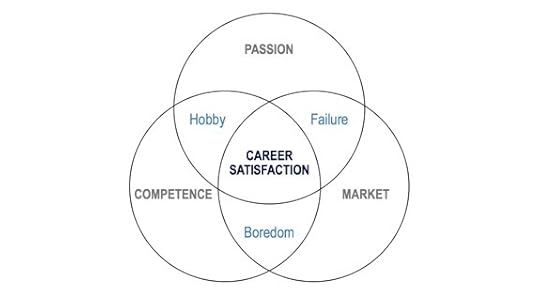
Be wary of only having two:
If you have passion and competence without a market, you have a hobby. We all know people like this. Living in Nashville, I know musicians who love what they do, are accomplished on their chosen instrument, but can’t pay the bills.
If you have passion and a market without competence, you have failure. If you aren’t willing to put in the hours honing your craft, it will eventually catch up with you. You will struggle to get hired or simply be flushed in the next round of layoffs.
If you have competence and a market without passion, you have boredom. This was the doctor’s problem. On the surface she had it all. But in her heart, she was missing the one piece she needed to find satisfaction in her work.
You can get by for a time with only two of the three elements I have described. But if you want to succeed at the deepest level, you must incorporate all three.
Questions: Do you possess all three of these components? What is missing? What could you do to become more satisfied in your work? You can leave a comment by clicking here.








October 20, 2012
How to Retrieve What You’ve Read—Almost Instantly
This is a guest post by Dwayne Morris. He is a writer, speaker and consultant, who also serves on the staff of his local church. You can read his blog or follow him on Twitter.
“Readers are leaders and leaders are readers.” I can remember when and where I heard that phrase for the first time. It was at a Campus Crusade meeting on a Thursday night in Hardin Hall on the campus of Clemson University.
Photo courtesy of ©iStockphoto.com/filadendron
I’m not sure why those words are burned into my mind, but this quote took my leadership to the next level. Soon after, I started soaking up anything I could find on the topic of leadership.
As I began this component of my leadership development, I reasoned, “Why would anyone read this stuff without the means of sharing and revisiting it from time to time?” I could not understand why anyone would read through a book without a pen and/or highlighter.
To read a book just to say you read it simply baffled me. I understand we all have different learning styles, but unless you have a photographic memory, there is no way you can retrieve what you have read in less than sixty seconds. I knew I needed a way to keep the golden nuggets of leadership within reach.
The next defining moment in my “readership journey” came when I met Steve Wright. Steve is an author, speaker, Student Minister and all things leadership. He shared with me how most of his creativity and teaching material came from what he was reading.
He also divulged his system of reading and filing. This compelled me to create my own methodology for capturing what I was reading and then put it in a format that would allow me to retrieve it quickly. Here’s the method to my madness:
Read good books. This may be a no-brainer, but I don’t read arbitrary books. If someone hasn’t recommended a title or author, I don’t touch it. This is where crowd-sourcing is a key component to my leadership development. Hence, I’m currently finishing up Platform: Get Noticed in a Noisy World.
Never read without a pen and/or highlighter. If you are reading good books and your intent for reading is to learn, then you need to be ready to mark those nuggets when you find them.
I understand this might push some of my OCD friends over the edge, but trust me, the librarian will not show up on your door step demanding a fee for damaged books. Not to mention that studies have revealed that you tend to read faster when you use a pen to help pace your eyes along the text.
Finish the book and rewind. When I complete a book, I’m only halfway to the finish line. My next step is to go back to the beginning and revisit the principles, illustrations, and examples that caught my attention the first time through.
As I re-read those sentences or paragraphs, I search for a key word that would identify the topic it addresses and circle it. If I am not able to find that word, I will write a word in the margin.
Create your own index. This is the extra mile. Now that I have done the work to read, mark and identify, I need a tool to help me get to it as fast as you can. I will ask my assistant, Vickie, to flip through the pages of my work and begin composing a list of the key words I have attached to the information.
She will also attach page numbers to the key word. If I have used that word in several areas, she just adds those page numbers in sequence. In the end, I will have a list of key words and all the pages attached to those words and will arrange them in alphabetical order. (Note: I use MS Excel. MS Word will work as well.)
Cut and paste. Hold on, you are almost finished. My last step is to look at the book I have processed and determine how many blank pages are in the front and back, covers included. I also measure the dimensions of those pages. This is critical as I want the pages of my index to fit inside the book.
I will modify the settings for my margins to match the dimensions for the book. Once this is done, I determine how many pages my index created and make sure I have enough blank pages in the book. If not, I will adjust font size and even font type to make sure all of my index pages will fit. Finally, I’ll grab some rubber cement and paste these pages on the blank pages of my book.
But wait, there’s one more step. As I began this process, it occurred to me that I needed a Master Index of the books I complete. This allows me to see all of the books I have read that mention a particular topic. So if I need material on Social Media, I can see which books and authors reference Social Media.
The bottom line here is that you must have a means to retrieve what you read. It helps you stay sharp and it elevates your value to others who know you are a disciplined reader and can share what you learn.
Question: Do you have a method for retaining and retrieving what you read? You can leave a comment by clicking here.


October 19, 2012
People Will Never Forget How You Made Them Feel [Quote]


I have learned that people will forget what you said, people will forget what you did, but people will never forget how you made them feel.””

Maya Angelou
Worth Repeating: More Than 5,000 Classic and Contemporary Quotes (Grand Rapids, MI: Kregel, 2003), 310



October 18, 2012
How Are People Left When You Leave Their Presence?
As leaders, we have an impact on others—whether we realize it or not. This is one of the five marks of authentic leadership.

Photo courtesy of ©iStockphoto.com/[photographer]
But that impact is a double-edged sword. It cuts both ways. It is either positive or negative. It is rarely neutral.
This means we don’t just mindlessly waltz into a meeting and waltz out. Everything we say has an impact.
When we leave, people are left either …
Energized or depleted
Encouraged or discouraged
Inspired to tackle the next challenge or wanting to quit
Even the things we don’t say—our attitude, our facial expressions, and our body language—have an impact.
How do you leave people?
The good news is that YOU get to decide what that impact will be. But first you have to become aware of your power. It is greater than you can possibly imagine.
Recognize it. Honor it. Use it for good.
Question: What effect are you having on those around you? You can leave a comment by clicking here.



October 17, 2012
An Interview with Andy Stanley About Making Better Choices in the Context of Uncertainty [Video]

If you can’t see this video in your RSS reader or email, then click here.
In this backstage interview at the Chick-fil-A Leadercast 2012, I asked Andy Stanley about making better choices in the context of uncertainty. I asked him about how he personally does this and what he has learned over the years. We also discussed his new book, Deep and Wide: Creating Churches Unchurched People Love to Attend.
This would be another great interview to watch with your team, take notes, and then discuss.



October 13, 2012
Never Waste a Good Fiasco
This is a guest post by Tyler Ellis. He serves on staff with Newark Church of Christ as a Campus Minister at the University of Delaware. He is also author of the upcoming book, Questions Everything. You can read his blog and follow him on Facebook and Twitter.
Fiascos are inescapable. A change of circumstance. A wild goose chase. An obstacle that thwarts what you had envisioned.

Photo courtesy of ©iStockphoto.com/pixdeluxe
Flights get delayed.
Guest speakers cancel.
Donors drop support.
The flu comes around.
Equipment breaks down.
These occurrences bring much stress as we face the unknown. For this reason, leaders will often go out of their way to predict potential hang-ups, to avoid them at all cost.
This is understandable. It would be irresponsible not to.
However, appropriate risks must be taken. Like a sailor who determines to sail around the world, he can study weather patterns and learn to follow the stars, but if he becomes paralyzed for fear of a storm, he’ll never leave the shore.
Just as storms can make sailors better sailors, fiascos can make leaders better leaders.
Just think back to the last time something “went wrong” in your line of work. Can you put your finger on a few blessings in disguise that would not have come about otherwise?
In every fiasco there seven possible opportunities:
The opportunity to be humble. Humility is especially difficult to keep when things always go your way. As leaders, we’re not immune to becoming smug and proud. We can become “ball hogs.” We can develop unrealistic expectations, take things for granted, and forget to give credit to whom credit is due.
A good fiasco reminds us we have limitations, there are things beyond our control, and not everything relies on our own human ingenuity. It brings us to our knees and beacon us to pray for help while we’re there.
The opportunity to set a good example. Every situation is a test you will pass or fail by the attitude you possess. When things “go wrong,” your behavior will show your true character. It’s an unparalleled opportunity to set the pace for better or for worse.
The opportunity to laugh at yourself. A great example of a leader who laughs is Dave Ramsey of Financial Peace University. Instead of hiding the fiascos he’s experienced over the years, Dave is open about them and pokes fun at himself for learning some things the hard way. I think that’s one of the things that’s enabled him to help so many of us reach financial freedom.
Life’s too short to take ourselves too seriously.
The opportunity to have life-changing conversations. When things “go wrong,” people talk. These moments invite people to give feedback, ask questions, share concerns, express feelings, confront problems, brainstorm ideas, and offer suggestions.
Given the valuable lessons that can be learned, these discussions often prove to be worth the pain it took to have them.
The opportunity to share an adventure. As a College Minister, I’m always on the look-out for a bonding experience. A chance for students to make new friends. And nothing does this better than a fiasco.
Like the time I took students to Washington DC and the bus broke down because I accidentally filled the tank with regular gas instead of diesel; or the time our venue on campus was suddenly unavailable and we went to a coffee shop instead; or the time one of my students got his car stuck in the sand during one of our beach retreats, and we had to dig it out using a clipboard and a Frisbee.
Memories are made, pictures are taken, inside jokes are retold, and unlikely friendships are established. A fiasco is your friend because a fiasco makes you friends.
The opportunity for people to shine. Unexpected situations often require people to step up to new challenges. These moments prove a person’s resilience, creativity, and ability to improvise and work with others. You’re likely to discover something you didn’t know about yourself or someone else—something that serves to be a vital breakthrough.
The opportunity to see the big picture. Whether you’re writing a book, recording an album, planning a fund raiser, or building an orphanage, you’ll face what feels like an endless list of decisions to make, papers to sign, and responsibilities to delegate.
With all these details, it’s not uncommon for leaders to lose sight of the good they had originally hoped to accomplish through their particular undertaking.
When a fiasco enters the equation, it not only challenges your determination to fulfill your dream, but it helps you see your dream in light of eternity. It can shift your priorities and balance your time, to give family and faith a more prominent place in your life.
Never underestimate the power of a good fiasco. When you consider its potential, you will welcome its blessing.
What’s the last fiasco you experienced and how was it a blessing in disguise? You can leave a comment by clicking here.



October 12, 2012
What It Really Takes to Get Published [Podcast]

“What It Really Takes to Get Published”
by Jeff Goins
Listen to this podcast on my website…
An Interview with Michael Hyatt
October 3, 2012
This is an interview I did with my friend, Jeff Goins. He interviewed me about what it really takes to get published. We also discussed my new audio course, Get Published, and why every entrepreneur should consider writing a book.



October 11, 2012
An Interview with Patrick M. Lencioni About Corporate Culture [Video]
If you can’t see this video in your RSS reader or email, then click here.
In this backstage interview at the Chick-fil-A Leadercast 2012, I asked Patrick M. Lencioni about corporate culture and how leaders can use it to drive performance. His new book, The Advantage: Why Organizational Health Trumps Everything Else In Business , is focused on this topic.
This would be a great interview to watch with your team, take notes, and then discuss. There are few things more important than intentionally creating your organization’s culture.



October 10, 2012
#028: Become More Productive by Reengineering Your Morning Ritual [Podcast]
In this episode, I talk about early morning rituals and how they can set you up to be more productive, more successful, and more healthy. They might even enable you to make more money!

Photo courtesy of ©iStockphoto.com/warrengoldswain
According to a 2007 poll conducted by Gallup:
55 percent of U.S. adults consider themselves “morning people.”
15 percent consider themselves “afternoon people.”
20 percent consider themselves “evening people.”
6 percent consider themselves “late night people.”
Click to Listen

Podcast: Subscribe in iTunes | Play in browser | Download
Make more money.
Be more productive.
Be healthier and live longer.
Be happier and more satisfied in their lives.
The good news is that if you aren’t a morning person, you can become one. (See, for example, “10 Benefits of Rising Early and How to Do It.”)
But what about the “ritual” part of the equation? If you are like some people, the word ritual may have a negative connotation.
If you look it up on Dictionary.com, the first definition is this: “an established or prescribed procedure for a religious or other rite.”
The problem is that we typically think of it in a religious sense. I am not using it in this sense, though for me, even there, it has a positive connotation.
I define ritual as “a prescribed procedure for achieving a specific result.” In other words, it’s kind of like a recipe.
For example, as a golfer, I have a ritual for hitting drives that are long and straight (most of the time). Does my ritual always produce the intended result? No. But it increases the probability of achieving the intended result.
An early morning ritual can do the same thing for your productivity and the effectiveness. It won’t guarantee your results, but it will set you up for the possibility of success.
By the way, the truth is that you ALREADY have a ritual. Rituals are inescapable. The only question is whether or not you are intentional about your early morning ritual and whether or not your ritual is producing the results you want in your life.
Anyone can design a more effective early morning ritual by following these seven steps.
Acknowledge that you already have a ritual.
Document your existing ritual.
Evaluate whether or not it is producing the results you want.
Determine the results you want (and don’t want).
Reengineer your current ritual.
Implement your ritual.
Tweak your ritual as necessary.
Reengineering your morning ritual can be a simple way to become more productive and set yourself up for success.
Listener Questions
Andrew Mason asked, “What do you do when your morning gets derailed?”
Hank Osborne asked, “What if you are a night owl?”
Leslie Samuel asked, “How do I keep from getting side-tracked by e-mail first thing in the morning?”
Matt McWilliams asked, “How do you adjust your routine when you travel?”
Tor Constantino asked, “What do you need to do the night before?”
Travis Dommert asked, “How have you maintained your early morning rituals?”
Special Announcements
I am excited to announce the publication of my brand new audio course entitled, “Everything You Need to Know to Get Published.” If you have ever thought about writing a book (or even if you have written a book) this course is for you.
In 21 audio sessions, I cover everything I have learned about publishing in my thirty-plus years in the industry as a publisher, former literary agent, and two-time New York Times bestselling author.
I am offering a special $100 discount to my blog readers and podcast listeners. If you order now, I’ll also throw in four FREE bonus products worth more than $150.00.
Click here to find out more.
I will be in Vail, Colorado next week, speaking at the Launch and SCORRE Conferences:
October 14–17: The Launch Conference is a conference that my partner Ken Davis and I put on about the BUSINESS of public speaking. This year we will also be joined by New York Times bestselling authors, Lysa TerKeurst and Dan Miller. It’s too late to get tickets, but we are recording it on video and hope to be offering an online course soon.
October 17–20: We will roll from Launch right into the SCORRE Conference. This is about the ART of public speaking. This is one of the most powerful—and useful—conferences I have ever attended. Ken Davis, Curtis Fletcher, Michele Cushatt, and I (along with a team of certified coaches) teach you how to have greater impact with your speaking.
This conference is sold out, but make plans NOW to attend the next conference April 7–11, 2013 in Rome, George at the beautiful WinShape Retreat Center. We will be opening that conference for registration in a few weeks, so stay tuned.
If you want to explore the possibility of having me speak at your event, visit my speaking page.
Episode Resources
In this episode I mentioned several resources, including:
Article: Poll: Most Adults Are Morning People
Article: Morning People Are Actually Happier Than Night Owls
Post: The Practice of Stillness
Software: Day One Journal
Software: Kindle for Mac
Book: One Year Bible
Show Transcript
You can download a complete, word-for-word transcript of this episode here, courtesy of Ginger Schell, a professional transcriptionist, who handles all my transcription needs.
Subscription Links
If you have enjoyed this podcast, please subscribe:

iTunes

Zune

RSS
Your Feedback
If you have an idea for a podcast you would like to see or a question about an upcoming episode, e-mail me.
Also, if you enjoyed the show, please rate it on iTunes and write a brief review. That would help tremendously in getting the word out! Thanks.
Questions: What is your new, reengineered morning ritual? You can leave a comment by clicking here.



#028: Become More Productive by Reengineering Your Morning Ritual
In this episode, I talk about early morning rituals and how they can set you up to be more productive, more successful, and more healthy. They might even enable you to make more money!
Photo courtesy of ©iStockphoto.com/warrengoldswain
According to a 2007 poll conducted by Gallup:
55 percent of U.S. adults consider themselves “morning people.”
15 percent consider themselves “afternoon people.”
20 percent consider themselves “evening people.”
6 percent consider themselves “late night people.”
Click to Listen
Podcast: Subscribe in iTunes | Play in browser | Download
Make more money.
Be more productive.
Be healthier and live longer.
Be happier and more satisfied in their lives.
The good news is that if you aren’t a morning person, you can become one. (See, for example, “10 Benefits of Rising Early and How to Do It.”)
But what about the “ritual” part of the equation? If you are like some people, the word ritual may have a negative connotation.
If you look it up on Dictionary.com, the first definition is this: “an established or prescribed procedure for a religious or other rite.”
The problem is that we typically think of it in a religious sense. I am not using it in this sense, though for me, even there, it has a positive connotation.
I define ritual as “a prescribed procedure for achieving a specific result.” In other words, it’s kind of like a recipe.
For example, as a golfer, I have a ritual for hitting drives that are long and straight (most of the time). Does my ritual always produce the intended result? No. But it increases the probability of achieving the intended result.
An early morning ritual can do the same thing for your productivity and the effectiveness. It won’t guarantee your results, but it will set you up for the possibility of success.
By the way, the truth is that you ALREADY have a ritual. Rituals are inescapable. The only question is whether or not you are intentional about your early morning ritual and whether or not your ritual is producing the results you want in your life.
Anyone can design a more effective early morning ritual by following these seven steps.
Acknowledge that you already have a ritual.
Document your existing ritual.
Evaluate whether or not it is producing the results you want.
Determine the results you want (and don’t want).
Reengineer your current ritual.
Implement your ritual.
Tweak your ritual as necessary.
Reengineering your morning ritual can be a simple way to become more productive and set yourself up for success.
Listener Questions
Andrew Mason asked, “What do you do when your morning gets derailed?”
Hank Osborne asked, “What if you are a night owl?”
Leslie Samuel asked, “How do I keep from getting side-tracked by e-mail first thing in the morning?”
Matt McWilliams asked, “How do you adjust your routine when you travel?”
Tor Constantino asked, “What do you need to do the night before?”
Travis Dommert asked, “How have you maintained your early morning rituals?”
Special Announcements
I am excited to announce the publication of my brand new audio course entitled, “Everything You Need to Know to Get Published.” If you have ever thought about writing a book (or even if you have written a book) this course is for you.
In 21 audio sessions, I cover everything I have learned about publishing in my thirty-plus years in the industry as a publisher, former literary agent, and two-time New York Times bestselling author.
I am offering a special $100 discount to my blog readers and podcast listeners. If you order now, I’ll also throw in four FREE bonus products worth more than $150.00.
Click here to find out more.
I will be in Vail, Colorado next week, speaking at the Launch and SCORRE Conferences:
October 14–17: The Launch Conference is a conference that my partner Ken Davis and I put on about the BUSINESS of public speaking. This year we will also be joined by New York Times bestselling authors, Lysa TerKeurst and Dan Miller. It’s too late to get tickets, but we are recording it on video and hope to be offering an online course soon.
October 17–20: We will roll from Launch right into the SCORRE Conference. This is about the ART of public speaking. This is one of the most powerful—and useful—conferences I have ever attended. Ken Davis, Curtis Fletcher, Michele Cushatt, and I (along with a team of certified coaches) teach you how to have greater impact with your speaking.
This conference is sold out, but make plans NOW to attend the next conference April 7–11, 2013 in Rome, George at the beautiful WinShape Retreat Center. We will be opening that conference for registration in a few weeks, so stay tuned.
If you want to explore the possibility of having me speak at your event, visit my speaking page.
Episode Resources
In this episode I mentioned several resources, including:
Article: Poll: Most Adults Are Morning People
Article: Morning People Are Actually Happier Than Night Owls
Post: The Practice of Stillness
Software: Day One Journal
Software: Kindle for Mac
Book: One Year Bible
Show Transcript
You can download a complete, word-for-word transcript of this episode here, courtesy of Ginger Schell, a professional transcriptionist, who handles all my transcription needs.
Subscription Links
If you have enjoyed this podcast, please subscribe:
iTunes
Zune
RSS
Your Feedback
If you have an idea for a podcast you would like to see or a question about an upcoming episode, e-mail me.
Also, if you enjoyed the show, please rate it on iTunes and write a brief review. That would help tremendously in getting the word out! Thanks.
Questions: What is your new, reengineered morning ritual? You can leave a comment by clicking here.