Michael Hyatt's Blog, page 180
December 15, 2012
6 Ways to Transform Conflict


Lawrence W. Wilson is a thinker, author, and senior pastor from Fishers, Indiana. He writes about the challenge of Christian leadership in a postmodern world. You can connect with him through his blog, Suburban Pastor, or on Twitter.
Conflict is an almost daily event in organizational life. Wherever two or three are gathered, one is likely to disagree!

Most people choose one of two classic ways of handling conflict: management or resolution:
Conflict management assumes that conflict is a constant feature of group life. The idea is to keep it within boundaries, not to eliminate it.
Conflict resolution sees conflict as an interruption of normal life. The idea is to find a solution—usually a compromise—as quickly as possible.
In most cases, neither approach adequately deals with the issue. I learned that the hard way several years ago when dealing with a conflict between several employees in our church’s preschool and the school’s director. As pastor, I was called into help find a solution.
At first I tried conflict management, listening patiently to each party and coaching them individually on how to accept one another’s differences. But the complaints and ill will only increased.
Then I switched to conflict resolution mode, calling a meeting to identify a compromise. I asked everyone to listen non-defensively and state his or her grievances in a straightforward matter. We identified problems, named solutions, and by meeting’s end there seemed to be unanimity. I thought it was a perfect meeting.
Within three weeks, however, the director and a third of the staff had resigned, leaving the preschool in a tailspin. Obviously, the conflict had not been either managed or resolved. It simply went underground where it gained strength and then exploded.
Conflict Transformation is a third way to view conflict. It sees conflict not as a problem to managed or resolved but as an opportunity to strengthen the common life of any group.
Here are six keys to moving from a management or resolution mind-set to conflict transformation.
View conflict as opportunity. We usually see conflict as a problem and, therefore, dread dealing with it. Learn to see conflict for what it is, a valuable look beneath the surface of your organization.
Respect your adversary. Pride is the primary obstacle to transforming conflict. When you are sure you’re right, the other person is wrong, and—even worse—see them as the problem, the conflict is sure to escalate or stalemate.
Identify primary issues. Married couples don’t really fight about money. Control is the true concern. Always look beyond the presenting issue to name the real problem.
Envision a shared future. Begin with the question “How can we create something better for both of us?” If you can’t envision your adversary as part of your future, you can’t transform your conflict.
Know when to quit. A conflict cannot be transformed unless both parties are willing to negotiate in good faith. If the other party is committed to being contentious, you may need to walk away—or at least maintain a holding pattern. Conflict transformation is not the same as capitulation.
Capture the learning. Conflicts are symptoms of underlying tension, so they are likely to resurface at some point. How will you capture—and communicate—the lessons from the current conflict so they help you navigate a future one?
Conflict is inevitable, but fallout from that conflict can often be avoided. By opening your mind to see possibilities other than either winning or losing, you may be able to transform your current conflict and the culture of your organization.
Question: What approaches have you found helpful in dealing with conflict? You can leave a comment by clicking here.








December 12, 2012
Join Me for This Book Signing
Today and tomorrow, I am involved in a video shoot for a new membership site I am launching next year. (I can’t wait to tell you about it.)
If you can’t see this video in your RSS reader or email, then click here.
Yesterday, we realized that we didn’t have any footage of me signing books—something the director wanted to use as “B-roll.”
So, over the last twenty-four hours, we scrambled and put together a book signing for Thursday night, December 13th, at 5:30 p.m. It will be held at Landmark Booksellers, in downtown Franklin, Tennessee. I will be there for an hour or so, along with my wife Gail, and several members of my team.
If you live in the area and can make it out, I would love to meet you and sign your book. We will be shooting video the whole time, and you might just make it into the final product.
If this works, it will be a great case study in mobilizing a platform. If it doesn’t, it will be really embarrassing!



This Could Really Be Embarrassing
Today and tomorrow, I am involved in a video shoot for a new membership site I am launching next year. (I can’t wait to tell you about it.)
If you can’t see this video in your RSS reader or email, then click here.
Yesterday, we realized that we didn’t have any footage of me signing books—something the director wanted to use as “B-roll.”
So, over the last twenty-four hours, we scrambled and put together a book signing for Thursday night, December 13th, at 5:30 p.m. It will be held at Landmark Booksellers, in downtown Franklin, Tennessee. I will be there for an hour or so, along with my wife Gail, and several members of my team.
If you live in the area and can make it out, I would love to meet you and sign your book. We will be shooting video the whole time, and you might just make it into the final product.
If this works, it will be a great case study in mobilizing a platform. If it doesn’t, it will be really embarrassing!


No Podcast for This Week [Announcement]

No Podcast for This Week
I wanted to let you know that there won’t be a podcast this week. I am working hard with my team to finish a couple of really exciting projects. I made the choice to invest my hours there and skip the podcast for this week.
Thanks for your support. I look forward to connecting with you next week.



December 11, 2012
How to Become a Morning Person
Recently, someone listened to my podcast entitled “Become More Productive by Reengineering Your Morning Ritual.” They wrote to me and said, “I really would like to be a morning person. Do you have any advice for becoming one? Is that even possible?”

First of all, yes, it is possible. This is not like trying to become a professional basketball player if you are only 5'6" tall. This is more like trying to change a belief system and a set of habits. You can do it if you are intentional.
Why would you want to do this? I listed some of these reasons in my podcast, but let me repeat them. They are pretty compelling.
“Morning people” tend to:
Make more money.
Be more productive.
Be healthier and live longer.
Be more happy and satisfied in their lives.
But how do you actually become a morning person if you aren’t one now? Here are nine steps you can take starting today:
Change your story. So many people say, ”I’m not a morning person,” as though it were an immutable fact. Could it be that there is no biological evidence for this? What if you discovered that this was merely a preference and years of practice? What would happen if you changed the story and began telling yourself, “I am a morning person.” Usually, we adjust our behavior to fit our story.
Determine what’s at stake. Whenever I want to change anything in my life or accomplish a significant goal, I start by articulating to myself why it is important. Write down on a sheet of paper what becoming a morning person would make possible. Then, conversely, write down what is at risk if you don’t. This is great to do when you are motivated; however, its real value is to keep you going when you’ve lost that first blush of enthusiasm.
Plan your sleep. Like changing any other habit, you have to set yourself up for success. You probably can’t keep going to bed at the same time you are now and get by on less sleep. Your body will resist. Instead, if you know you need seven hours of sleep, and you know you’d like to get up at 5:00 a.m., calculate backwards to determine what time you must be asleep. For example, I get up at 5:00 a.m. and need seven hours sleep. That means I have to be in bed asleep by 10:00 p.m.
Use an alarm. After years of waking up early, this has become an engrained habit for me. I wake up at 5:00 a.m. without an alarm. It is amazing how consistent this is—sometimes when I don’t want it to be. But if you haven’t been a morning person until now, you will likely need to use an alarm. It’s part of training yourself mentally and physically. Whether you use the alarm on your smart phone or a dedicated one, put it on the other side of the room—so you have to get up to turn it off.
Turn on all the lights. The environment provides subtle clues to your body, so it knows how to respond. When it gets dark, your body naturally begins preparing itself for sleep (unless you have conditioned it otherwise). When it gets light, you naturally begin waking up. If you want to jumpstart this process and signal to your body that it is time to get up, simulate full daylight. Turn on all the lights in the room.
Set out your clothes. If you are groggy when you get up, the fewer decisions you need to make the better. So, make the decision about what to wear the night before. If you get dressed immediately, it is also less likely that you will take off your clothes and get back into your bed. Since I exercise in the morning, I put out my workout clothes, including my shoes. I put them on and lace them up!
Drink a cup of coffee. At various times, I have eliminated coffee from my diet. However, after considerable research, I’m convinced it is fine in moderation. In fact, it’s probably beneficial. Regardless, it is definitely beneficial for me first thing in the morning. I used a Cuisinart SS–700 to make it, because I can brew one cup at a time.
Enlist an accountability partner. Whether it is a mentor or a peer, find someone who understands the value of accountability. Explain your goal, tell him (or her) why it is important to you, and then give him permission to hold your feet to the fire. When I was in college, a friend and I wanted to get up early to study for a class. So we called one another at 5:00 a.m. to make sure the other was awake. We did pretty well in the class too.
Commit to 21 days. According to many psychologists, this is how long it takes to form a habit. I recommend you become a morning person for three weeks and then decide whether or not this will become a permanent part of your life. If not, you at least gave it a try. If so, you now have a new habit that can serve you well for the rest of your life.
To be honest, the real issue here is not becoming a morning person per se. What I really want to communicate is you have more power than you think. You don’t have to be stuck in a rut. If you are intentional, you can build the habits necessary to accomplish your goals—even if it means becoming a morning person.
Question: What other suggestions would you have for someone who wants to become a morning person? You can leave a comment by clicking here.



December 6, 2012
Being Fearless Is Overrated [Quote]


I don’t know how else to make a movie except to try and find some aspect of the experience that I haven’t done before. Because if I’ve done it before, I’m fearless. And I don’t work well when I’m fearless.
I’m not as good a filmmaker if I know exactly what I’m doing every step of the way. But when I don’t have all of my comforts with me, then I get really really insecure, and that insecurity opens me up to possibilities.
I need to get to the set in the morning feeling a little upset to my stomach. If I feel a little bit unsettled, I feel more able to take risks to rescue myself.”

Steven Spielberg
Oprah’s Next Chapter (In Making the Movie, Lincoln)



December 5, 2012
#035: The Importance of the Leader’s Heart [Podcast]
We live in a very externally-focused culture. However, there is an internal issue which is largely ignored: the condition of your heart.

Photo courtesy of ©iStockphoto.com/Johan63
The corporate world is increasingly aware of the fact that you can’t improve productivity without increasing engagement. In other words, people have to show up at work with more than their education, experience, and skills. They have to come with their heart.
Click to Listen
Podcast: Subscribe in iTunes | Play in browser | Download
In this podcast I share five truths about your heart. If you understand these truths—and apply them—you will maximize your influence as a leader.
Truth #1: Your heart is the essence of your identity.
Truth #2: Your heart is the most valuable leadership tool you have.
Truth #3: Your heart directly impacts your influence.
Truth #4: Your heart is either healthy or unhealthy.
Truth #5: Your heart is under constant attack.
It’s important that you keep your heart healthy. There are four disciplines that can help you do that.
Discipline #1: The Discipline of Reflection
Discipline #2: The Discipline of Rest
Discipline #3: The Discipline of Recreation
Discipline #4: The Discipline of Relationships
Listener Questions
Victor Manzanilla asked, “What is the biggest temptation a leader faces after he becomes successful?”
Nellie Felipe asked, “As a leader, how do you maintain a fresh vision, fresh hope, fresh energy, so your people will be renewed daily?”
Heather Boggini asked, “What advice do I have for the female entrepreneur who is reentering the workforce after staying out to raise a family?”
Special Announcements
If you are looking for a Christmas gift for an author, entrepreneur, or sales person, let me suggest that you get them a copy of my newest book, Platform: Get Noticed in a Noisy World. It has been on the New York Times, Wall Street Journal, and USA Today bestseller lists. It has a 4.8 reader review rating (out of 5.0) on Amazon. It is the perfect gift for anyone trying to build a personal brand or gain visibility for a product, service, or cause.
I am off the road until January. However, I do have some speaking slots still available for the spring. If you are interested in having me come speak to your company or organization, you can learn more at my speaking page.
My next podcast will be on the topic of “How to Develop More Discipline.” If you have a question on this subject, please leave me a voicemail message. This is a terrific way to cross-promote YOUR blog or website, because I will link to it, just like I did with the callers in this episode.
Episode Resources
In this episode I mentioned several resources, including:
Book: Platform: Get Noticed in a Noisy World
Conference: Platform Conference
Essay: C.S. Lewis, “On the Value of Old Books,” an introduction to On the Incarnation by St. Athanasius
Podcast #28: Become More Productive by Reengineering Your Morning Ritual
Post: The Importance of a Leader’s Heart
Post: Three Reasons Why You Must Guard Your Heart
Post: The Four Disciplines of the Heart
Post: The Practice of Stillness
Speech: The Leader’s Heart: Unleashing the Most Important Leadership Tool You Have
Show Transcript
You can download a complete, word-for-word transcript of this episode here, courtesy of Ginger Schell, a professional transcriptionist, who handles all my transcription needs.
Subscription Links
If you have enjoyed this podcast, please subscribe:

iTunes

Zune

RSS
Your Feedback
If you have an idea for a podcast you would like to see or a question about an upcoming episode, e-mail me.
Also, if you enjoyed the show, please rate it on iTunes and write a brief review. That would help tremendously in getting the word out! Thanks.
Question: What are you doing to cultivate and protect your heart? You can leave a comment by clicking here.



December 4, 2012
Are You Ready for the Mobile World? [Snippet]

Are You Ready for the Mobile World?
I’ve known for several years that more and more people are accessing my blog via their mobile devices. What I didn’t realize is how fast it is happening!
Here is a table showing the percent of readers who accessed my site via a mobile device over the last three years:
Month or Event
Percent
November 2010
7.6%
November 2011
19.0%
November 2012
29.0%
Black Friday Weekend
33.7%
I wouldn’t be surprised if more than 50 percent of my readers use mobile devices to access the site next year. Thankfully, we built mobile functionality into my new GetNoticed! WordPress theme. I think it’s time to start thinking “mobile first.”
What about you? How does your blog or website look on mobile devices? You can leave a comment by clicking here.



December 3, 2012
Join Me for the Platform Conference, February 11-13, 2013
I’m pleased to announce registration is now open for the first-ever Platform Conference, which will be held in Nashville, Tennessee, February 11–13, 2013. This is a conference you don’t want to miss!
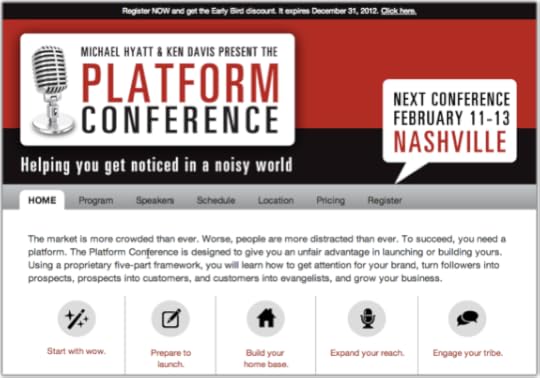
This event has been a dream of mine since before I wrote my book, Platform: Get Noticed in a Noisy World. In fact, I had the idea for the conference before I even thought about writing the book.
I wanted to create a world-class event where people could learn from experts in the industry, network with like-minded professionals, and leave with the tools they need to launch their platform or take it to the next level.
Why do you need a platform? Because the market is more crowded and noisy than ever. Worse, people are more distracted than ever. To succeed, you need a platform.
The Platform Conference is for anyone who wants to get their message, product, service, brand, or cause noticed. That includes authors, bloggers, recording artists, business owners, entrepreneurs, sales people, mortgage brokers, pastors, or corporate brand managers.
We have an amazing roster of speakers:
Ken Davis—motivational speaker, bestselling author, and my business partner in Dynamic Communicators International
Pat Flynn—entrepreneur, blogger, podcaster, and founder of Smart Passive Income
Jeff Goins—blogger, speaker, writing coach, and author of Wrecked
John Saddington—entrepreneur, blogger, and founder of TentBlogger and Standard Theme
Carrie Wilkerson—author, speaker, business coach, and founder of The Barefoot Executive
Cliff Ravenscraft—founder of the GSPN.TV, business coach, and the world’s leading authority on podcasting
Stu McLaren—entrepreneur and co-founder of WishList Member, the leading membership site software in the world
Michele Cushatt—popular speaker, speaking coach, author, and emcee for all our DCI events
Andrew Buckman—WordPress expert, software developer, and my partner in the GetNoticed! theme for WordPress
I will also be speaking twice and hanging out with the attendees the whole time.
We are structuring the conference around the framework I provide in my book:
Start with wow
Prepare to launch
Build your home base
Expand your reach
Engage your tribe
We will hold the conference in Nashville’s famous Sound Kitchen music studio, regarded by many to be the best recording studio in Nashville.
The good news is that this unique venue will provide an incredible atmosphere of professionalism and intimacy. The bad news is we only have 150 seats available. We have already sold more than half of them. The rest will go quickly.
If you are interested in attending, I urge to to register today, while you still can. The early bird pricing expires on December 31st. My team and I are doing everything we can to make this an extraordinary, super-practical experience.
I look forward to seeing you there!
Question: What do you hope we cover at the conference? We’d love your input! You can leave a comment by clicking here.



December 1, 2012
Why Courage Requires Fear
This is a guest post by Jared Latigo. He is a designer, father, husband, writer, and aspiring speaker. You can read his blog or follow him on Twitter.
I’ve recently come in contact with a lot of information regarding courage. It’s a particularly interesting subject to me in many aspects of life.

Photo courtesy of ©iStockphoto.com/thinair28
Being a father, husband, entrepreneur—and generally living in a crazy world—the opportunity to exercise courage seems to present itself on a daily basis. If we’re to be leaders on top of all that, we better understand how this thing works.
Michael Hyatt has said,
“Courage is the willingness to act in spite of your fear.”
As he points out in his article, courage and fear have a connection, which lays the foundation for what I want to say in this post.
Courage is not the absence of fear but rather requires fear.
There is no need to be courageous if you aren’t afraid of something. Luckily, we’re afraid of plenty of things throughout the course of our day and lives. We wouldn’t be human if we weren’t.
Courage Cannot Be Separated From Action
To illustrate this point further, let me share some information I heard from the “Men of Honor” simulcast put on by Sherwood Baptist Church, makers of the movie Courageous. Ed Litton, pastor of a sister church, spoke at the event and he hit the nail on the head:
We were made to be courageous.
In trials, our first response is to run.
We were made for trouble.
Stand for what matters.
Courage cannot be separated from action.
So how does this tie into fear? Fear is something that we all have struggled with at some point in our lives. I remember being afraid of what was going to happen as I became a father. I’ve never had any formal “father training.”
I thought, How am I qualified to do this? But my son was born and he’s almost three now. He has yet to steal a car!
I also remember getting married. I was excited, sure—no, I was ecstatic! I had been looking forward to it for years, because I knew when I met my now wife that she was the one.
It wasn’t until I was standing at the altar that I become seriously scared. It was one of the most memorable moments of my life, because I had to overcome the fear of committing my life to her … forever.
Even though I knew it was a truly remarkable thing, that didn’t make me any less scared. (That and I had fractured my nose the night before so this would be the first time she’d seen me with my eyes way too far apart.) I was scared, and it took serious courage to keep my knees from collapsing.
So courage feeds off fear.
What Is Fear?
Ed Litton says,
“Fear is just a call to exercise courage.”
Without fear, we can’t have courage. We cannot act courageous in any situation unless we have something to protect, something to honor, something to prove, or something to commit to. Fear is a call to action and that action should be courageous.
But lets keep in mind that there needs to be a healthy level of fear. “All things in moderation” is a saying I try to apply to most areas of my life. Don’t let fear take over and cause inaction. That would be cowardly.
The Call to Courage
Be courageous today. Look fear in the eye and shoot it down. Don’t let it take over. Don’t let it win.
As leaders of our homes, businesses, churches, workplaces, etc., we need to understand how important it is to have courage. We were made to be courageous.
Questions: So tell us. What is something that you feared that you were able to overcome by being courageous? And what was the outcome? You can leave a comment by clicking here.