Michael Hyatt's Blog, page 178
January 16, 2013
#037: 8 Leadership Lessons from Martin Luther King, Jr. [Podcast]


On the third Monday of each January in the U.S., we celebrate Martin Luther King, Jr. Day. As you know, he was the chief spokesman for nonviolent activism in the civil rights movement of the 1960s.
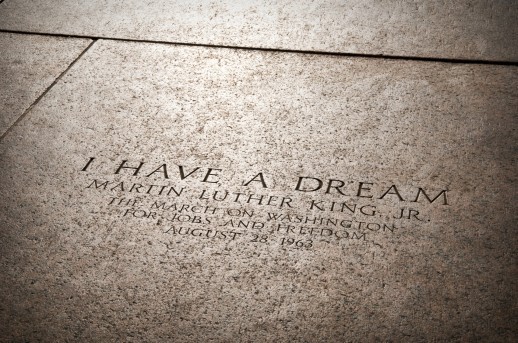
Dr. King was an eloquent preacher and gave a famous speech, “I Have a Dream,” that defined the aspirations of that movement, not only for his generation but for generations to come.
I think it is particularly appropriate, in view of the upcoming holiday, to devote a podcast episode to the this speech. I urge you to take time to watch this speech and experience what Martin Luther King, Jr. Day is all about.
While the speech is a masterpiece of rhetoric—one of the top ten best speeches ever given, in my opinion—I believe it also provides eight key insights into what it takes to be a truly great leader.
Click to Listen
Podcast: Subscribe in iTunes | Play in browser | Download
Insight 1: Great leaders do not sugar-coat reality.
Insight 2: Great leaders engage the heart.
Insight 3: Great leaders refuse to accept the status quo.
Insight 4: Great leaders create a sense of urgency.
Insight 5: Great leaders call people to act in accord with their highest values.
Insight 6: Great leaders refuse to settle.
Insight 7: Great leaders acknowledge the sacrifice of their followers.
Insight 8: Great leaders paint a vivid picture of a better tomorrow.
Listener Questions
Alex Barker asked, “What do you think Dr. King would want to teach us if he were alive today?”
Christopher Scott asked, “How do you cast vision for volunteers?”
Cor Chmieleski asked, “How do you pursue a vision undeterred while remaining receptive to the input of those you are leading?
Kim Goad asked, “What if you are fresh out of a vision and need inspiration?”
Matthew Green “How important do you think it is for leaders to work on character, integrity, and discipline—something that no one may ever see?”
Phil Mershon asked “How can you lead team members to perform at their best without micro-managing them
Rob Still asked, “What does Dr. King have to teach us about overcoming discouragement, especially when our ideas are rejected by those in power and authority”
Special Announcements
On Thursday, January 17, we will be opening the membership to Platform University. This is a project I and my team have been working on for months.
My book, Platform: Get Noticed in a Noisy World, only scratched the surface. Platform University is going to pick up where that left off and dive deeper, bringing you the insights and tools you need to build a platform that gets you, your brand, your cause noticed.
I strongly encourage you to visit Platformuniversity.com to learn more. We have already posted two videos that will give you some important background and a sense of what is to come. And tomorrow, we will be posting the third video there that explains it all.
We still have a few tickets left for the Platform Conference, which will be held here in Nashville on February 11–13, 2013—just about a month away. This conference is for anyone who wants to jump start their platform or take it to the next level.
If you are an author, public speaker, blogger, recording artist, business owner, entrepreneur, sales person, mortgage broker, pastor, or corporate brand manager, this conference is for you!
My next podcast will be on the topic of “taking control of your inner story.” If you have a question on this subject, please leave me a voicemail message. This is a terrific way to cross-promote YOUR blog or website, because I will link to it, just like I did with the callers in this episode.
Episode Resources
In this episode I mentioned several resources, including:
Book: Good to Great by Jim Collins
Podcast: Episode #26, “How To Lead In Turbulent Times”
Post: “Four Things Your People Need in Tough Times”
Post: “Two Things Great Leaders Must Do in Turbulent Times”
Video: “I Have A Dream” by Dr. Martin Luther King, Jr.
Audio: “I Have A Dream” by Dr. Martin Luther King, Jr.
Show Transcript
You can download a complete, word-for-word transcript of this episode here, courtesy of Ginger Schell, a professional transcriptionist, who handles all my transcription needs.
Subscription Links
If you have enjoyed this podcast, please subscribe:

iTunes

Zune

RSS
Your Feedback
If you have an idea for a podcast you would like to see or a question about an upcoming episode, e-mail me.
Also, if you enjoyed the show, please rate it on iTunes and write a brief review. That would help tremendously in getting the word out! Thanks.
Question: What do you appreciate about Martin Luther King’s leadership? You can leave a comment by clicking here.








January 14, 2013
Courage Is Not the Absence of Fear
I don’t like conflict. In fact, sometimes I think I am conflictaphobic. (I just made that word up.) I will do almost anything to avoid it.

As a result, especially early in my career, I would keep my real opinions to myself. I didn’t want to get in trouble. I thought that if I just complied with the system and kept my mouth shut, I would get ahead.
This was a pretty good strategy for a while. But it didn’t really work once people were counting on me to lead.
Why didn’t I want to speak up? I could feign altruism by saying, “I didn’t want to hurt other people’s feelings.” But that would be a lie. The truth is that I was afraid. It was all about me.
I didn’t want to be embarrassed.
I didn’t want to lose face.
I didn’t want to be wrong.
I didn’t want others to think less of me.
So, I kept quiet. Funny thing is I kept finding myself in situations where I had to speak up. If I didn’t, someone would pay an awful price for my personal comfort.
Years ago, soon after I became head of one of our publishing divisions, I had to confront one of my authors. He was pleasant and cooperative when I spoke with him. But he was demanding, uncooperative, and downright nasty to my staff. Finally, one of them came to me in tears and said, “I’m sorry, but I just can’t take it any more.”
I had to make a choice.
I could let it go, hoping he would improve without intervention … or I could speak up. I wrestled with it all night. I tossed and turned. I got sick to my stomach. I played out every scenario.
Finally, things came into focus: I could either be brave and call him on it, or I could be a coward and stop growing as a leader.
Thankfully, I decided to confront him. The next morning I called his cell phone. I was shaking so much, I could barely hold the phone.
I went over the facts. I told him that his behavior was unacceptable. I explained that he would call each of my staff and apologize. He would then send flowers to the person he had offended the most. And if he didn’t? I would stop publication of his book and send him packing.
I was dead serious, and he knew it. To my surprise, he did exactly what I had asked.
I learned an important lesson that day. Courage is not the absence of fear. Courage is the willingness to act in spite of my fear.
My people also learned an important lesson. They learned that I was willing to stand up for them, even at the expense of my own comfort. It drew us closer together as a team.
Frankly, I still find it difficult to be brave. I don’t consider myself to be a courageous person. But now having several of these experiences under my belt, it is a little easier. Now I just notice the fear, pull up my big boy pants, and lean into the situation.
If I can do it, you can, too.
Question: Where do you need to find the courage to speak up? What’s holding you back? You can leave a comment by clicking here.



January 12, 2013
Jerry Seinfeld on How to Write a Joke
Great artists make their art look easy. But don’t kid yourself. Great art takes work.
In this short video, Jerry Seinfeld explains how it took him two years to write “The Pop Tart Joke.”



Jerry Seinfeld on How to Write a Joke [Video]
Great artists make their art look easy. But don’t kid yourself. Great art takes work.
In this short video, Jerry Seinfeld explains how it took him two years to write “The Pop Tart Joke.”
January 11, 2013
My 7 Biggest Platform-Building Blunders
Last week, I shared with you the first video in my new three-part video series, “Behind the Platform.” Today, I am releasing the second video—and, like the first one, it’s free.
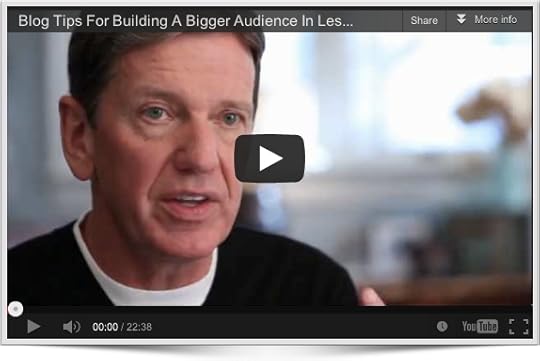
In this video I reveal the dumbest, most costly mistakes I made in building my platform, especially in the early years. If I had known then, what I know now, I would be so much further ahead today.
But, alas, that’s the nature of hindsight. It’s 20/20.
The good news is that you can learn from my mistakes. You may make different mistakes (in fact, you probably will), but you don’t have to make these mistakes.
This video alone could save you years of wasted effort, not to mention tens of thousands in lost dollars. Why wander around in circles, wondering why your platform is not growing, when the fixes are so easy?
If you’re serious about growing your platform in 2013, you have to watch this video. And, if you want to really get the most out of the video, download the free study guide that goes along with it (located on the same page as the video).
As I said, you can watch this video for free. (The other two are free too; you just have to opt-in.) Next week, I will share the details of Platform University and why it may be just what you need to turbo-charge your platform-building efforts this year.
By the way, I usually ask you to comment here—and you can if you want. But I’d be grateful if you would leave me a comment under the video when you click over to watch it. Thanks.



January 9, 2013
#036: How to Develop More Discipline [Podcast]
Discipline is a particularly relevant topic this time of year, since most of us are struggling to maintain our New Year’s resolutions. In this podcast, I share five specific steps to developing more of it.

If you’re like me, your resolve has already been tested, and you might even be thinking about giving up. Well don’t throw in the towel just yet! I have some practical advice in this episode I think you will find very helpful.
Click to Listen
Podcast: Subscribe in iTunes | Play in browser | Download
If you’re like me, you struggle with discipline. You have great intentions, but just as you get a little momentum, something derails you. My friend Andy Andrews asks this question, “Can you make yourself do something you don’t want to do in order to get a result you really want?”
Over the years, I have found that I can become disciplined in any area of my life by taking five specific steps. Whether it is trying to get in shape, maintain a blog, or develop a great marriage, the psychology is the same.
Determine your goal.
Your goals need to be S.M.A.R.T. This is an acronym that provides a checklist for making sure that what you have is indeed a goal and not merely an aspiration. It stands for:
Smart
Measurable
Actionable
Realistic
Time-bound
List your reasons
Identify likely obstacles.
Develop new behaviors.
Stay focused.
Listener Questions
Rebecca Livemore asked, “How do you differentiate between a lack of discipline and a legitimate need for rest?”
Brad Blackman asked, “Would you recommend adding only one discipline at a time or is it okay to try and add multiple disciplines?”
Aslam Najeebdeen asked, “I find I often abandon my new habits after four or five days. What are some tips for keeping the new habit going?”
Derek Duncan asked, “As a Christian, how do we allow for grace in the practice of discipline?”
Julie Welles asked “I’m struggling with my blog. How do you discipline yourself to write so prolifically?”
Tessa Hartiman asked, “How important is developing discipline for novice writers?”
Paul Lundberg asked, “I love scheduling and planning. I’m pretty good at planning. But I am not good at all when it comes to executing the day or week I’ve planned. How can I stay more focused on what I have planned to do?”
Todd Liles asked, “How do you discipline yourself when you are absolutely dog-tired?”
Victor Manzanilla asked, “What is a ‘keystone habit’ (a la The Power of Habit ) for your spiritual life?”
Special Announcements
We still have a few tickets left for the Platform Conference, which will be held here in Nashville on February 11–13, 2013—just about a month away.
My next podcast will be on the topic of “8 Leadership Lessons from Martin Luther King, Jr.” These are some principles I gleaned from watching again his famous “I Have a Dream” speech, which he gave back on August 28, 1963.
If you have a question on anything related to leadership—especially casting vision—please leave me a voicemail message. This is a terrific way to cross-promote YOUR blog or website, because I will link to it, just like I did with the callers in this episode.
Episode Resources
In this episode I mentioned several resources, including:
Author: Andy Andrews
Book: The Power of Habit by Charles Duhigg
Book: The War of Art by Steven Pressfield
Podcast: Episode #6, “The Power of Incremental Change
Podcast: Episode #13, “Building Your Platform, Part 1
Podcast: Episode #14, “Building Your Platform, Part 2
Post: Is It Time for Calendar Triage?
Software: Evernote
Software: LoseIt
Software: Nozbe
Website: PlatformUniversity.com
Show Transcript
You can download a complete, word-for-word transcript of this episode here, courtesy of Ginger Schell, a professional transcriptionist, who handles all my transcription needs.
Subscription Links
If you have enjoyed this podcast, please subscribe:
iTunes
Zune
RSS
Your Feedback
If you have an idea for a podcast you would like to see or a question about an upcoming episode, e-mail me.
Also, if you enjoyed the show, please rate it on iTunes and write a brief review. That would help tremendously in getting the word out! Thanks.
Question: Where do you need more discipline? What do you need to do next to cultivate it? You can leave a comment by clicking here.



January 8, 2013
My Take on the iPad Mini After 7 Weeks
I bought the original iPad, the iPad 2 (though I protested), and even the iPad 3. However, I eventually stopped using each of them. I could not find a compelling reason to carry it over my MacBook Air, other than to read books. For that function, I used a Kindle.
My biggest complaint with the iPad was it was just too big and too heavy, especially for reading. I know, this would be a laughable complaint just a few short years ago. But compared to a book, it was uncomfortable.
However, with the announcement of the iPad Mini, I decided to give it another go.
The scratch that still itches for me is my workflow for taking notes in face-to-face meetings. Hauling out my laptop feels too intrusive. Writing in a Moleskine or EcoSystem notebook and then scanning the pages is too much work.
I chose the black, 64GB, Wi-Fi + cellular iPad Mini. It arrived at my home a day earlier than Apple promised, which was a nice surprise. The packaging (as usual) made for a great first impression.
There were three attributes that stood out immediately:
The Size. The size just feels right—a little bit wider and a bit shorter than a Moleskine notebook. At 10.7 oz, it’s more than three ounces lighter than Platform , my most recent book. It’s less than half the weight of the my iPad 3.
The Speed. The speed of the Mini is comparable to the iPad 2 and 3. It seems plenty zippy to me. Applications load quickly, and I have not experienced any lag, other than a slight delay when opening apps.
The Screen. If you are used to the retina display of say, the iPhone 5, or the iPad 3, you will notice a difference. But if you are comfortable with the screen of a newer model MacBook Air (not retina), it is comparable. The colors are vivid and bright.
Overall, the machine is beautiful. I immediately took to it.
I have been consistently getting ten hours of battery life per charge—the same as my iPad 3. Unfortunately, Apple changed the power connector to the the Lightning model used with the iPhone 5. I already had several of the 30-pin connectors, which I couldn’t use.
However, I appreciated the fact that I had immediate access to more than 275,000 iPad apps. This insured I had zero learning curve. All my favorite apps were available on the Mini.
In fact, when I signed into my iCloud account, all my apps were downloaded to the Mini. I soon felt right at home. In addition, whenever I download a new app, it is downloaded on my Mini and my iPad 3. This is a preference setting you can turn on or off.
Though I don’t use them regularly, the Mini also has two cameras. The front-facing FaceTime HD camera sports 1.2 MP photos, 720p HD video, face detection, and FaceTime calling over Wi-Fi. The back-facing iSight camera creates 5MP photos and has auto-focus, face-detection, and a 2.4 aperture.
So the big question was whether or not I would actually use the Mini.
This brings me back to where I started. I am now reading all my books on the Mini. I have ditched my Kindle and haven’t looked back. (I am, however, using the Kindle app on the Mini.)
I am also taking the Mini whenever I leave my office or home to run errands. I use it while standing in line, waiting at the doctor’s office, or sitting at a restaurant. Cellular Internet access makes this remarkably convenient and surprisingly fast.
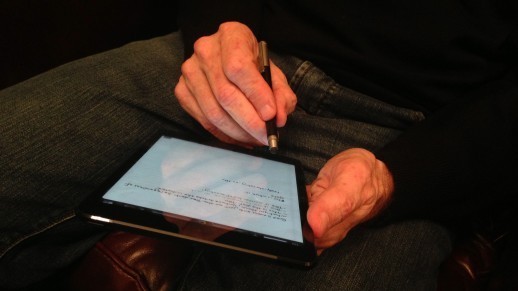
Best of all, I am using the Mini in meetings to take hand-written notes. I am really impressed with how far the note-taking apps have come since I last evaluated them. I downloaded all the major ones and tested them.
I’ve settled (for now) on the Moleskine Journal app and the Bamboo stylus. With it, I can export my notes to Evernote and the text is even searchable, though that takes about 24 hours to be processed through Evernote’s servers.
Does Apple have room for improvement? Certainly.
I really wish they had included a retina display. This obviously wasn’t a technological challenge, since they are already using this display on smaller devices (the iPhone 5) and larger ones (the iPad 3 and 4). Undoubtedly, Apple choose to forgo retina to keep the price point down and make the Mini more competitive.
But other than that, I am pleased with my purchase. The Mini has become an important part of my workflow and made me more productive. This is what the iPad should have always been.
Question: What do you like or not like about the iPad Mini? You can leave a comment by clicking here.



January 7, 2013
On Talker’s Block [Quote]


No one ever gets talker’s block. No one wakes up in the morning, discovers he has nothing to say, and sits quietly, for days or weeks, until the muse hits, until the moment is right, until all the craziness in his life has died down.”

Seth Godin
The Icarus Deception: How High Will You Fly? (New York City: Portfolio, 2012), 166



January 5, 2013
My Teenage Daughter, Migrant Farm Workers, and the Real Power of Personal Productivity
This is a guest post by Bill Zipp. He is a speaker, coach, and consultant. He helps busy leaders do what matters most in business and in life. Bill is also the author of the popular ebook, The Smart Leader’s Guide to Personal Productivity, available FREE to my readers.
There I sat with my thirteen-year-old daughter on a dirt floor eating rice and beans with some of the poorest people on the planet.

We traveled over forty hours in a cramped van to the southern half of Baja Mexico to provide humanitarian aid to migrant farm workers laboring there. A trip that would have never happened except for the real power of personal productivity.
I’ve raised three active children. As a dad it was critically important to me that they see how the rest of the world really lives. So my wife and I made sure they traveled internationally as many times as we could afford.
But here was my baby, my third-born daughter, living as an only child in an empty house as the other two moved-on to college. I wanted to take some extra time just to be with her. How could I do that?
Here are two simple habits that helped me answer the question:
Habit One: Weekly Examination
Every Sunday morning I have a scheduled appointment with myself where I review the top priorities of my life and make my plans for the upcoming week. This habit’s become a central part of my life, and, frankly, I can’t imagine living without it.
During that time I reflect on my answers to these four questions:
What I kind of person will I be?
What kind of relationships will I have?
What kind of work will I do?
How am I going to give back?
I then review my goals for the year in each of these areas and set plans for the week that move me closer to fulfilling those goals.
And that’s how I ended up in Baja Mexico.
I asked myself what kind of relationship I wanted with my thirteen-year-old-daughter and how I was going to show her how to give back to a needy world.
A mere few minutes later, as we went to church as a family, the opportunity to go on a mission trip to serve migrant farmer workers was announced, and we immediately signed up.
I believe that Socrates once said that the unexamined life is not worth living. I would like to modify his words slightly: The unexamined week is not worth living. For our life is made up of the days in our week, and the effectiveness of those days is dependent on their honest examination.
Habit Two: Proactive Scheduling
For a solo consultant, taking two weeks out of the country on a mission trip is not an easy thing to do.
First, there’s the work that would be lost just before the summer slowdown, then there’s the complete disconnection from the outside world, and finally there’s the work that would have to be squeezed in both before and after the trip.
But like the habit of having a weekly appointment with myself, another habit has served me well over the years: proactive scheduling.
If you had an important doctor’s appointment on Friday, how would make sure you got there? You would put it in you calendar, of course. Nothing really magical about that. The fact that a doctor’s appointment is scheduled on Friday allows the other activities in your day, and even your week, to fit around that appointment.
I call this phenomena Bill Zipp’s Law of Scheduling. The law reads like this:
Unscheduled events will conform to scheduled events.
The law of scheduling also applies for planning on a larger scale, as in this trip with my daughter. Almost immediately, once I placed it on my calendar, other commitments in my life began to fit around it.
As my clients heard what I was doing with my daughter, their response was amazing. Each of them applauded my efforts and bent over backwards to accommodate my schedule. One person actually offered to financially support the trip!
Rarely do we need to make either/or choices in life, almost always there’s a both/and solution. We must have the courage to look for it.
Jim Collins refers to this as the “Genius of the AND" in his classic book Built to Last,
Instead of being oppressed by the ‘Tyranny of the OR,’ highly visionary companies liberate themselves with the ‘Genius of the AND’—the ability to embrace both extremes of a number of dimensions at the same time. Instead of choosing between A or B, they figure out a way to have both A and B.
The same could be said about a life that’s built to last.
Eating rice and beans on a dirt floor in Mexico would never be considered an elegant dining experience. But it’s the meal my daughter remembers more than any other meal we’ve had together almost a decade later.
That’s the real power of personal productivity. Not seeing how much stuff you can cram in a day, but arranging the stuff so you can do the things that matter most.
Just ask my daughter.
Question: What would greater productivity make possible for what matters most in your life? You can leave a comment by clicking here.



January 3, 2013
A Secret Project I’ve Been Working on for Months
With the publication of my new book last year, I introduced to you the importance of building a platform and shared a framework for doing so. It was an exciting time. The book hit the New York Times, USA Today, and Wall Street Journal bestseller list.
More meaningful to me, I received thousands of e-mails and social media messages from readers who were inspired to start building their platform. Evidently, my book created the possibility and pointed the way.
But that was just the beginning …
This year I want to provide even more help to those who are truly committed to growing their platform and impacting the world. I can’t wait to share with you what we’ve created. We’ve been working hard for months on this project. We’re just about ready to unveil it.
But first, I thought I’d share some of the backstory behind what really happened in the early years of building my platform—and how it grew to the point it is today with over 350,000 monthly readers.
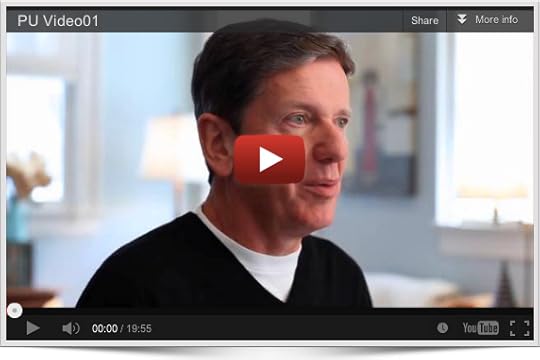
To do that, we’ve created a three-part video series called, “Behind the Platform.” I really think it will inspire you. Best of all, it’s free! If you like it, you can opt-in to receive the other two videos. You are also welcome to share them with your friends.
In this first video, I talk about:
My early days in publishing and my love affair with books
How I accidentally started blogging and why the initial days didn’t look very promising
What it was like to become the CEO of Thomas Nelson in 2005
My secret struggle with fear and self-doubt
The triple tsunami that threatened to tank my company—and our industry
How these very obstacles become the catalyst for changes we needed to make
How they also setup the career move I had always dreamed of making
A showdown with my board and a choice I needed to make
What really motivated me then—and what still motivates me today
And more …
As I said, you can watch the first video for free. (The other two are free too; you just have to opt-in.)
By the way, I usually ask you to comment here—and you can if you want. But I’d be grateful if you would leave me a comment under the video when you click over to watch it. Thanks.
Finally, I want to thank the team that has made the dream of Platform University come alive:
Stu McLaren, co-founder of WishList Member. He’s the one who had the original vision for this project, created the team, and overseen every aspect of the creative development.
Dean Rainey, who was our producer/director for the videos in this project. He is a master story-teller with a long pedigree of big league experience.
Megan Miller, my oldest daughter and the project manager on my side. She has handled the thousands of administrative details that a project like this requires.
Others also contributed, notably, Che Wai Wong, our cinematographer; John Morris, our web developer, and James Dalman, our designer, and last but not least, my managers, Joy Groblebe and Brian Scheer.
Thanks, guys! I love working with you.