
Cynthia Sally Haggard's Blog: Cynthia Sally's Blog, page 15
June 17, 2024
An Essay I wrote about traveling the day I left for Europe
I am one of those people who loves to travel. I make my travel plans a year ahead.
Once I have found the perfect tour with the perfect travel company (I like Odysseys Unlimited) I then have plenty of time to dream and niggle those travel plans until I find the perfect add-ons for my overseas trip.

After all, it doesn’t make sense to show up jet-lagged to The Tour of a Lifetime. And so I need somewhere to park myself for a few days while I recover from my trans-Atlantic journey, the perfect hotel at a reasonable cost, somewhere quiet and scenic with wonderful rooms, fabulous views, and plenty of yummy meals. (I like the Italian lakes.)
Then I have to visit family and friends in Europe, so that involves even more planning.
It is only when I am kneeling in front of my suitcase wondering how on earth I’m going to fit everything in, that doubts assail me. Why am I going? What happens if something goes wrong? Am I really going to waltz off to Italy all by myself? Get on a plane to Istanbul? Travel from Istanbul to England? And get myself back home at the end of it all?
It is so easy to worry, and as a young woman I spent way too much time thinking about all the possible things that could go wrong. But as I shut my suitcase with a contented sigh, realizing that I have someone managed to have a 19 lb cabin bag and a 43 lb suitcase, all of my worries fade.
I am going on holiday.
I am going to have a wonderful time.
I really need this break.
The post An Essay I wrote about traveling the day I left for Europe appeared first on Cynthia Sally Haggard.

June 14, 2024
VANISHING ACTS by Jodi Picoult ~ A Book Review
I love Jodi Picoult’s punning titles and I loved the way this novel began with the protagonist, Delia, six years old, being part of her father’s magic act: “The first time I disappeared I was six years old,” she says in the memorable opening line.

Delia Hopkins lives in New Hampshire with her widowed father Andrew, daughter Sophie and bloodhound Greta. She performs search-and-rescue operations. Too early on in the novel, the climax arrives, in the shape of a policeman coming to arrest Andrew Hopkins, a well-thought-of, well-liked pillar of the small New Hampshire town in which they live. His crime? Kidnapping Delia when she was 4 years old.
What a pity this climax arrived so early, as it squandered the tension that could have been milked from that event. Of course, this novel would have benefited from being cut up and reorganized, so that the reader doesn’t realize exactly what happened to Delia, or why, until two-thirds of the way through the novel.
As this is a Jodi Picoult novel, it will surprise no-one that it ends up in a courtroom. Some readers have complained about a couple of story threads that were not really necessary to the story, such as the prison interlude (inflicted upon Andrew as he awaits trial) or the Native American episode (when the characters first arrive in Arizona.) However, the prison interlude raises the stakes sky-high for Andrew, who knows he will be murdered if he returns to jail. And IMHO, the Native American episode was the most enjoyable part of the book, as I loved the character of Ruth-Anne, who brought out the best in Delia.
Which brings me to the character of the protagonist, Delia Hopkins. True to most Jodi Picoult heroines, she is somewhat boyish, free from artifice, plain-spoken, strong-minded, and has an interesting job. She adores her daughter Sophie. She is close to her father, Andrew. So what’s not to like about her?
As the novel wound on, and more characters were introduced I found Delia increasingly annoying, to the point where I just wished she would go away. There is a three-way relationship with Delia (naturally) being courted by two extremely handsome young men (Eric and Fitz), who for the most part behave extremely well. Each of them is obsessed with her. Each vies for her attention. Each has loved Delia for most of their lives, for 20 years, since they were friends together in the local public school.
Although Jodi Picoult paints a convincingly portrait of Delia’s beauty (raven-dark hair, brown eyes, which some cover artists have ruined by showing a girl in blond plaits), I honestly think there has to be something very special about a woman who can hold the attention of TWO men like Eric and Fitz for such an astoundingly long time.
But Delia is both boring and bratty. It becomes increasingly obvious there is very little nuance in the way Delia thinks about things. (At 32, she is still childishly self-absorbed.) She finally meets her mother Elise. That first meeting is “perfect,” matching her childishly high expectations. But after her father defensively drops the bombshell that his ex-wife was an alcoholic, Delia turns nasty. She marches back to her mother’s house and confronts her in the rudest possible way, showing little empathy or compassion for a woman who has experienced a devastating loss, but has managed to remain sober for 25 years.
Her mother behaves perfectly, but Delia is always bristly and rude. Of course, the author tries to make Delia more likable with her “revelation” that Elise’s boyfriend Victor molested her when she was four years old, a piece of information that manages to save Andrew from prison. But this tidbit just seems too convenient to be true, a useful ploy to rescue likable Andrew from almost certain death.
So when, near the end of the novel, this love-triangle finally shifts, it is hard to be interested. As one reviewer put it, these two men have loved Delia “soggily” since childhood, and I can’t for the life of me think why. There is nothing about Delia that is elevated or inspiring. She is not kind-hearted. She is not spiritual. She is not especially insightful. She doesn’t display much emotional intelligence. In short, she has little to recommend her except that author Jodi Picoult wants her to be beloved. But wishing doesn’t usually make things so. Three stars.
The post VANISHING ACTS by Jodi Picoult ~ A Book Review appeared first on Cynthia Sally Haggard.June 7, 2024
Back from Europe ~ And here is a Book Review of The Plain Truth by Jodi Picoult
Before I begin reviewing this seventh novel by Jodi Picoult, I would like to say how much I enjoyed the narration of this book. Christina Moore and Suzanne Toren were pitch perfect in conveying the way Americans normally speak in the present day (hard-boiled and harsh) with the way that the Amish speak (slow, sweet and German-accented.) In addition, Simon & Schuster Audio did a superlative job with the production and editing, so that it was easy to sit back and become totally absorbed in this very interesting tale.
First off, how I love Jodi Picoult’s punning titles! After the opaque and too-long title of her first novel (SONGS OF THE HUMPBACK WHALE) we then had HARVESTING THE HEART (about a cardiologist and his neglected wife) PICTURE PERFECT (the story of a Hollywood actor who is secretly abusing his wife) and KEEPING FAITH (a divorce story where the fought-over child is named Faith.)
Now we have THE PLAIN TRUTH, which seemed simple enough to me until I realized that this tale of an Amish community in Lancaster County Pennsylvania is about people who live “plain.” Meaning that they are honest to a fault, take responsibility for their sins (both real and imagined) and try to live a Christian life.
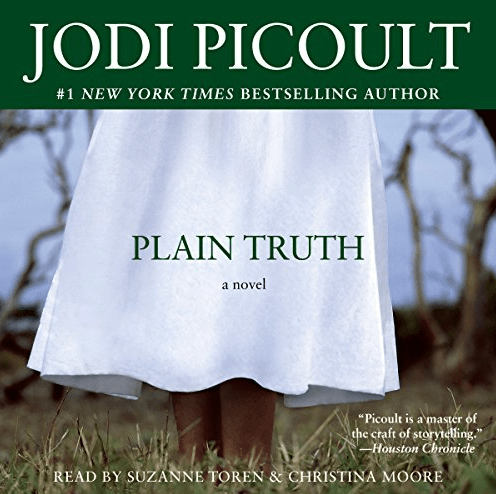
So when gentle, sweet Katie Fisher, aged 18, is accused of murdering her baby, the ripples of that accusation shock everyone who has known her in this close-knit community. Many who know her well (her brother and suitor) state that this is impossible. People who know her less well (the “Englischers” as the Amish call them,) see plenty of reason why she would want to kill.
I am not going to give away the plot so as not to spoil this for those of you who want to experience this piece. I will only say that from the beginning I have been struck by the empathy of Ms. Picoult’s writing. It is stunning that she was able to get under the skin and into the minds of a community of people who think and see things very differently from your average American living in Philadelphia (or any big city) in the 1990s. Five stars.
The post Back from Europe ~ And here is a Book Review of The Plain Truth by Jodi Picoult appeared first on Cynthia Sally Haggard.April 12, 2024
A powerful novel about difference
AN INCOMPLETE REVENGE is a novel about difference, and the consequences of that perception in the minds of the people who make up the surrounding community.
Wouldn’t it be nice if people were thrilled about difference? If they saw foreigners as intriguing or cool? If they wanted to talk to people who are not like themselves so that they could learn more about the world we live in? If they were eager to befriend such people to bring the richness of diversity into their own lives?
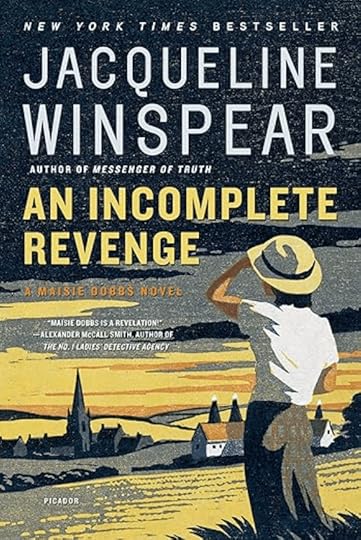
Unfortunately, as we all know, these reactions are not typical. Instead, people who are perceived as being different are usually victimized in some way.
In this story, one of Maisie’s friends Priss is at a loss as to what to do about her three boys. The family, although English, has been living in Biarritz, and so her boys speak French fluently. Priss, still grieving over the deaths of her three brothers during the Great War, decides one day that it would be a marvelous idea to bring the family back to England. Being posh, this necessitates that they will go to boarding school.
But the English boys at this posh venue are not thrilled about having three boys in their midst who speak French. And so when Priss goes there to visit her three sons, she discovers that they are sporting bruises, black eyes and other signs of beating. The headmaster believes that each boy should “march to the same drum.” And so Priss wisely decides to take them away and put them in an international school instead where “everyone is different.”
Similarly, Maisie Dobbs learns that the housekeeper at Chelstone ~ the country house of the Comptons ~ used to order only from a Dutch-owned bakery in the local village, because it was the best bread she could find. The owner, who calls himself Jacob Martin because he wants to fit in, has two children. The girl, being extremely good-looking is more-or-less accepted by her English counterparts. But the boy is not accepted. It seems that his problems started when one of his classmates discovered that his family spoke Dutch at home. Instead of being intrigued or thrilled, the boy showed his disdain by teasing. The teasing, turned into bullying and soon the young man (who Dutch name is Pim van Maarten) had no friends left. Naturally, he got into bad company. After one thieving escapade turned sour, his aristocratic companion was detained for only a few days. But Pim was sent to Borstal (the equivalent of Juvenile Detention) and then “released to the army” at the tender age of 13 so that he could fight in the trenches of the First World War.
Somehow, he managed to survive. But when he returned to the village at the age of 16 or 17, he found his family dead, his home a burned-out shell. The villagers covered up their crime by claiming that the family home had been hit during a Zeppelin raid. In fact, during a period of profound grief that turned into mass hysteria, they’d turned on the Dutch family, burning them alive in their own home.
This is a powerful novel by Jacqueline Winspear about the costs of being tribal, bigoted and unwelcoming to those who are not like you. Five Stars.
The post A powerful novel about difference appeared first on Cynthia Sally Haggard.April 5, 2024
A masterclass on how to write the perfect opening
The opening chapter of Roseanna M. White’s JEWEL OF PERSIA is a masterclass on how to write the perfect opening.
First of all, there are only a few characters ~ two girls and two men. Since one of the men doesn’t say a word, that leaves on three characters. But the real energy of this opening chapter comes from the dialogue between an Unknown Persian Nobleman and 16-year-old Kasia (pronounced kah-ZEEH-ah).

Kasia and her 12-year-old friend Esther are taking an unplanned break by dipping their toes into the freezing water of the river. They are laughing at their situation, when two men silently appear. Immediately, Kasia gets out of the river to stand in front of her young friend in order to protect her from the men.When she eventually looks up, the tall man steps forward.
Secondly, the engine of the scene is a marvelous piece of dialog, which is not only witty but has great dialog tags that help you to follow along ~
“My apologies for startling you. We should have continued on our way after we realized your cry was not for help. But I was intrigued. You often wade into the river swollen from mountain snows?”
Esther gripped Kasia’s tunic and pulled her back half a step to whisper “Kasia. Just give your apologies so that we can go.”
Sage advice. Except she doubted a man of import would take kindly to his questions going unanswered.
“Not often, lord, no. I rarely have the time and I should not have taken it today. My parents will are expecting me home. If you will excuse me.”
~ And so it continues for the rest of Chapter One.
The writing is so persuasive that it can be easy to notice that this whole thing strains credulity. If you are surprised that a nobleman could be such a gentleman, you are not alone. If you are incredulous that Xerxes the Great who pitted the might of the Persian Empire against the Greeks at Thermopylae, and destroyed Athens is a hen-pecked husband in thrall to a 16-year-old concubine from the wrong side of Susa, then I have to agree with you.
While I thought the portrait of Xerxes in this volume charming, I feel obliged to say that it does not bear any semblance to reality. It really isn’t likely that the “King of Kings” ~ who could have any woman he liked ~ would be so gallant. It is far more likely that he had the personality of Henry VIII (who murdered two of his wives.) Four stars.
The post A masterclass on how to write the perfect opening appeared first on Cynthia Sally Haggard.March 29, 2024
Mental illness has a way of taking up all of the space that a family can hold.
Molly (Mary) and Peggy (Margaret) Gainsborough are the much-painted daughters of artist Thomas Gainsborough (1727-1788). Born in 1750 and 1751 respectively, the two sisters grow up together and seem very close.
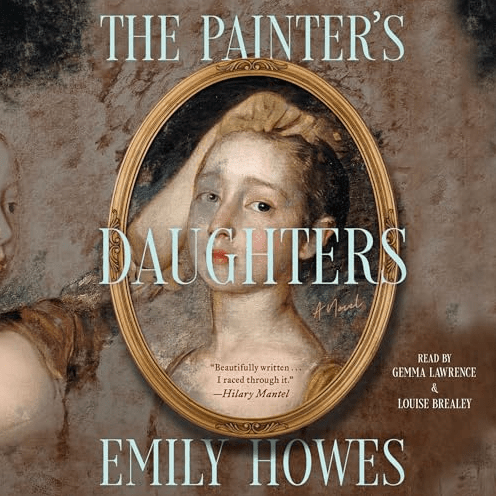
But Molly, the elder daughter, has problems. She is prone to sleep-walking. She blanks out, forgetting where she is, and what she is in the middle of. She frequently says things that make no sense. And every so often, she loses it completely, screaming and struggling with the very people who love her the most and are trying to help.
Mental illness has a way of taking up all of the space that a family can hold. And when you have a situation with an absent parent (a father who is a famous painter with many demands on his time), and another parent who simply cannot cope (a mother who has a tendency to become self-indulgently hysterical) then something has to give. That something is Peggy, the younger daughter, who is what we would now call a “parentified child.” This is the child who has no childhood. The child who suffers from an overwhelming sense of duty. The child who picks up the burdens that the adults should be carrying.
And so Peggy looks after her elder sister, covering up for all her slips, so that the family will not be disgraced by the “mad” daughter who could bring disaster on her family at a time when her father is building his career, which means inducing the wealthy and aristocratic to come to his home for their paintings.
Peggy does such a good job of protecting her sister that her parents really don’t see what is going on. They believe that it is Peggy who is causing all the chaos, while Molly, much quieter than her spirited younger sister, is seen as the epitome of the perfect young lady. Everything appears to be under control (almost) when both sisters fall in love, and long buried emotions and resentments erupt, threatening scandal.
 Frederick, Prince of Wales (1707-1751)
Another thread of the story takes place a generation earlier in 1727, when a 20-year-old barmaid takes a fancy to Frederick, Prince of Wales (1707-1751) who is the son and heir of George II and the father of George III. Their coupling leads to the usual typical situation. But Peg the barmaid, is not your usual type of woman, and through sheer grit and determination she makes sure that her illegitimate daughter Margaret has £200 a year to live on for the rest of her life. This was an enormous sum of money in the 1700s, and was the only thing that kept the Gainsborough family afloat thirty years later.
For (of course) both story lines are connected. Molly and Peggy’s mother was called Margaret Burr before her marriage. But it seems that she may have been related to the Duke of Beaufort (according to Wikipedia.) In this novel, however, Emily Howes posits that her father ~ who would have been Molly and Peggy’s grandfather ~ was actually Frederick, Prince of Wales. And just as Frederick’s eldest son and heir George III (1738-1820) suffered from Porphyria, a condition that led to his being declared unfit to govern in 1810, so poor Molly Gainsborough suffered from it also.
The great strength of this novel is in the way the author allowed time for all the various emotions to unspool on the page. A truly wonderful take on the eighteenth century as well as the anguish that mental illness can cause a family. Five stars.
The post Mental illness has a way of taking up all of the space that a family can hold. appeared first on Cynthia Sally Haggard.March 22, 2024
An entrancing garden created by an enchanting person
THE FORGOTTEN GARDEN begins in around 1897, when ten-year-old Eliza Makepeace and her twin brother Sammy are trying to survive the brutal conditions of living in poverty in London. Their mother has recently died and both children are obliged to earn money so that they can pay their monthly rent to their landlady, who possesses the Dickensian name of Mrs. Swindle.
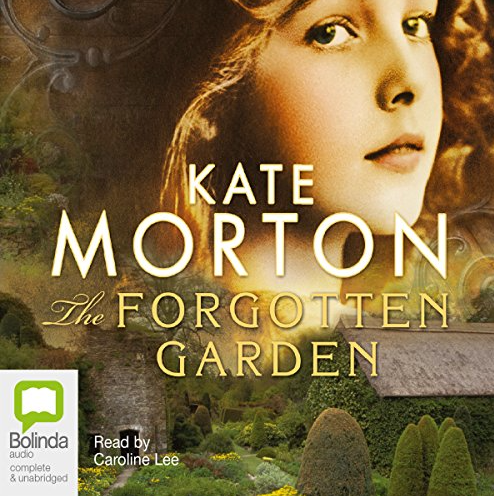
However, tragedy strikes when Sammy is killed by a spooked horse, leaving Eliza devastated by her brother’s loss. However, just as a “well-meaning” parish lady shows up, intent on caging Eliza in the local workhouse, her mother’s aristocratic family the Montrachet’s appears and takes her back to the family estate in Cornwall where her Aunt and Uncle are supposed to bring her up so that she can become a model English Miss and catch a husband.
Needless to say, things do not go according to plan.
Along with that narrative thread are two others. Nell is an Australian woman born in around 1909, who learns on her 21st birthday that she is not actually related to her mother and father. Instead, she showed up in Australia in 1913, on board a boat from England. The kindly harbormaster Hugh O’Connor, finding this waif of a three-year-old girl standing quite alone takes her home. And she never leaves. But when she receives the devastating news that her parents are not actually related to her, she goes to England in 1975 determined to find out more. However, this plan is ditched when her feckless daughter Leslie, dumps her eight-year-old daughter Cassandra into her care, and Nells’ life becomes consumed with caring for her granddaughter.
Thirty years later, in 2005, Cassandra goes to England to pick up where her grandmother left off, and finds a complicated tangle of a tale that consists of plenty of lies and secrets. But this 20-hour behemoth of a story comes to a satisfying conclusion, when Cassandra finally figures out exactly who Grandmother Nell is, and why “The Authoriess” (Eliza Makepeace) abandoned her on that ship that went to Australia.
This is an unputdownable book (yes I stayed up until 3 am to finish it.) Five Stars.
The post An entrancing garden created by an enchanting person appeared first on Cynthia Sally Haggard.March 15, 2024
The Talisman Ring is like a Comic Opera
Having read seven novels of Georgette Heyer, in my quest to gradually work through all of her novels, I already knew that her volumes sparkled with wit, not unlike Jane Austen’s.
However, this novel is the funniest I’ve experienced. It reminds me of those eighteenth century comic operas like Mozart’s Abduction from the Seraglio, which has a cast of bandits, strong female characters, and an abduction scene. In THE TALISMAN RING we have a band of smugglers, strong female characters, and a murder to be solved.
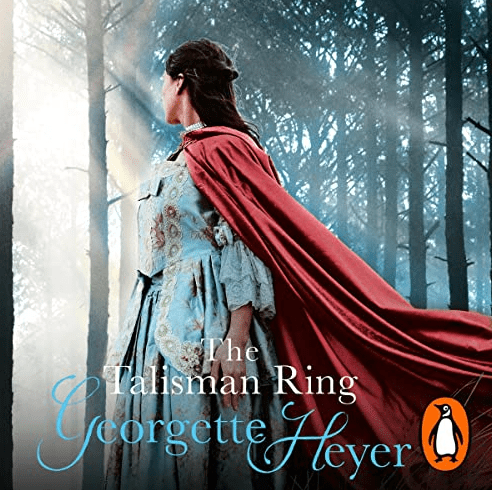
When Sylvester, Baron Lavenham lies dying at the great old age of eighty in 1793, he exacts a promise from his great-nephew Sir Tristram Shield to marry his granddaughter Eustacie de Vaubon.
Poor Eustacie is a scion of a French noble family and had looked forward to a splendid match with a French duke. Alas, the French Revolution interrupted her dreams, and she was obliged to leave France with her maternal grandfather Sylvester to live in the less exciting atmosphere of England.
Eustacie, being French, understands very well what a mariage de convenance means. There is to be no love within such a union. The couple will tolerate each other until the arrival of the heir and spare, and then they will go their separate ways, finding lovers amongst other married couples of the British aristocracy.
But Eustacie is a spirited 18-year-old who has read rather too many of Mrs. Radcliffe’s novels (satirized in Jane Austen’s Northanger Abbey) to be content with such an emotionally arid arrangement. She wants to marry for love, and so instead of allowing her fiancé Sir Tristram to “carry her off” to Bath where she can play endless games of backgammon with his dear mama, she escapes one night and…falls in with a den of thieves.
But all is not as it seems. Although some of these men are rough, and one of them wants to strangle her, the leader of this little band turns out to be her “romantic” cousin Ludovic, the Lost Heir to the Lavenham estate.
Ludovic is not supposed to be lurking in the depths of the Sussex woods. He is not even supposed to be in England as there is a price on his head because most think he murdered someone. But Ludovic is one of those people we would now describe as “thrill seekers.” He is completely unfazed by the danger he faces, and like many a young man in his early twenties takes rather too many risks. It is only thanks to his strong-minded friends and relatives than he manages to avoid the gallows.
If you are intrigued, and want to read an early novel of Georgette Heyer’s that blends romantic comedy with thriller, you should definitely read THE TALISMAN RING. Five stars.
The post The Talisman Ring is like a Comic Opera appeared first on Cynthia Sally Haggard.March 8, 2024
Ms. Atkinson’s prose style froths with the fizz of the 1920s
I am an avid reader and have been so since I was nine years old. Indeed, I read so much and talked so much about books that my stepfather once remarked I should be a novelist!
Fast forward fifty years and I have actually managed to become an author. But I read books a little differently now, casting my writer’s eye over plot and prose style and character more critically than when I was a girl.
So, it was with great trepidation that I opened this volume, because I wasn’t really in the mood to hear something about the 1920s (I listened to the audio recording), I had never heard of this author before, and so had no idea what to expect. All I knew was that SHRINES OF GAIETY had received a great deal of praise.
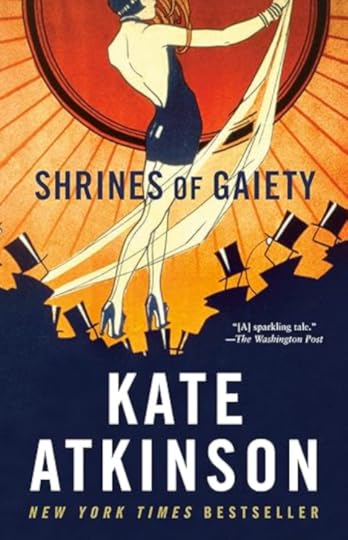
However, it was not long before I realized what a wonderful writer Kate Atkinson is. Coming off a ill-paced novel with a wooden narrative style, I felt completely safe with Ms. Atkinson, sure that she would make no such slip-ups to ruin my enjoyment (she didn’t.) As I listened to more and more of this novel I became fascinated both by her descriptions of the crazy gaiety of the 1920s, and well as the seamier underbelly of London. Ms. Atkinson’s prose style frothed with the fizz of the 1920s, and also was supple enough to compass, in painful detail, what it was like to be a teenaged girl wandering the streets of London, prey to hunger, thirst and the gropes of any man who happened by. Her descriptions of the Thames were magnificent, so lifelike that the river almost became a character in its own right.
I would describe Ms. Atkinson as a bold writer. She rarely tells you what to think (always a sign of great confidence in an author.) She cuts scenes before they come to a natural end. And she is not above letting two main characters just hang, at the end of the novel, with no decision made about their futures! I loved the fact that I had no idea what was going to happen, and the endings were not something I would have guessed.
Some readers complained that there was no protagonist in this novel, but that didn’t bother me in the least. I loved all the strong female characters as well as the unpredictable men they spent time with. If you love the 1920s, and want to read a vivid recreation of the parties and scandals in shining prose that doesn’t sound like something off the back of a cereal box, then this is the novel for you! Five stars.
The post Ms. Atkinson’s prose style froths with the fizz of the 1920s appeared first on Cynthia Sally Haggard.March 1, 2024
A truly wonderful novel with a clever plot
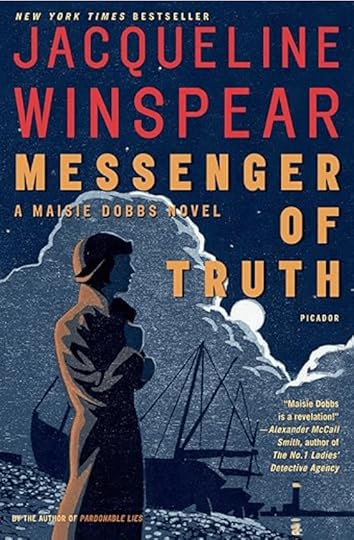
MESSENGER OF TRUTH by Jacqueline Winspear is a truly wonderful novel. Ms. Winspear is known for her detailed descriptions of dress and setting which draw the reader into the world of 1931, and this novel doesn’t disappoint. But what is even more wonderful are the way her characters speak. I am not sure how old Ms. Winspear is, and of course, it would be impertinent to ask. But as someone born in Britain in 1960, I am very familiar with the generation of the Great War. The characters of Maisie Dobbs, Georgina Bassington-Hope and Billy Beale reminded me of my grandparents, my music teachers and many of my mother’s friends. It is such a treat to hear their speech patterns resurrected in Ms. Winspear’s books!
But what is so remarkable about MESSENGER OF TRUTH is the clever plot, which is derived from the setting of this novel in the art world of the 1930s.. Not only do we have detailed descriptions of paintings that were fashionable before, during and after the Great War, but it was marvelous to see the way in which Ms. Winspear teased the reader about the “triptych” that was to have been unveiled at an art gallery in London.
I won’t tell you anything more about it here, so as not to spoil it for those of you who have not yet read this novel. But when you finally “see” it the at the end of the novel, you realize right away why the artist, Nick Bassington-Hope, was murdered. Five Stars.
The post A truly wonderful novel with a clever plot appeared first on Cynthia Sally Haggard.Cynthia Sally's Blog

- Cynthia Sally Haggard's profile
- 129 followers

