
Cynthia Sally Haggard's Blog: Cynthia Sally's Blog, page 17
December 15, 2023
The County of Suffolk binds two eccentric novels together
Today, I’m going to review two books, because one of the books is so frequently mentioned in the other.
I’ll start with W.G. Sebald’s THE RINGS OF SATURN.

It is August 1992, when the protagonist (which the book cover blurb helpfully points out both is and is not Sebald) takes a dreary perambulation around the wilds of Suffolk. For those who do not know, Suffolk is the southernmost county in that eastern bulge of the UK which points towards the Low Countries (North-Eastern France, Belgium and the Netherlands.)
This part of the UK is quiet. It is flat, some would say, almost featureless. It is a wonderful place for birding. In the winter, it is assailed by fierce winds that cut to the bone, that come from Siberia (I am not joking.) Because there are no motorways in this part of the country, it is economically stagnant. On the other hand, Suffolk boasts its share of picturesque villages such as Lavenham, Kersey and Cavendish. It is the perfect place to escape from the stresses of the 21st century. But it also has more than its share of failing businesses, hotels with an air of desuetude, and a prevailing dreariness.
What makes THE RINGS OF SATURN for people who love the eccentric, is the stream-of-consciousness thoughts of the protagonist, who ~ while dealing with dirty British Rail windows (so dirty one can hardly see out), too-quiet boarding houses and hotels, and the silence of an empty countryside ~ meditates on Rembrandt’s famous painting The Anatomy Lesson, Sir Thomas Browne’s skull, the once-thriving silk industry of Norwich, and the dowager Empress Tzu Hsi.
If you love that sort of thing, you are in for a treat. Otherwise, the lack of paragraphing will send you to sleep. (But perhaps this is the perfect book for insomniacs?)
The second book, John Le Carré’s SILVERVIEW, mentions THE RINGS OF SATURN frequently, one might also say obsessively. Which is why I am reviewing them together.

SILVERVIEW is the last novel by John Le Carré, and although the blurb doesn’t say so, IMHO, it remains unfinished. There is no ending, the novel simply stops. The scenes, while beautifully written, seem scattered. There is almost no organization, things just happen in a quasi-random way. Loose threads are not woven together. There is no arc of tension, something that Le Carré was a master of.
In short, while the writing is (of course) magnificent, what we are actually reading is a first draft. As every writer knows, the first draft is where you just get the material onto the page, before you organize it into a story.
In the case of SILVERVIEW, John Le Carré has set his thoughts down so that the novel is mostly there. But unfortunately he died before he had the opportunity to put on his editor’s hat and create the flow, the pacing, the arc of tension that turns scattered thoughts into a piece of art.
As it stands, SILVERVIEW is a wonderful first draft. But it is not a finished novel.
The post The County of Suffolk binds two eccentric novels together appeared first on Cynthia Sally Haggard.

December 9, 2023
Were the princes murdered? Or spirited out of the country?
 Philippa Langley MBE, March 2015
My sister contacted me recently, telling me I had to read this book, by Philippa Langley, about the Princes in the Tower.
For those who do not know, Philippa Langley was the inspiration behind the project to find the remains of King Richard III, which was eventually found beneath a car park in the City of Leicester, UK. For her role in this find, the Queen awarded her an MBE in 2015.
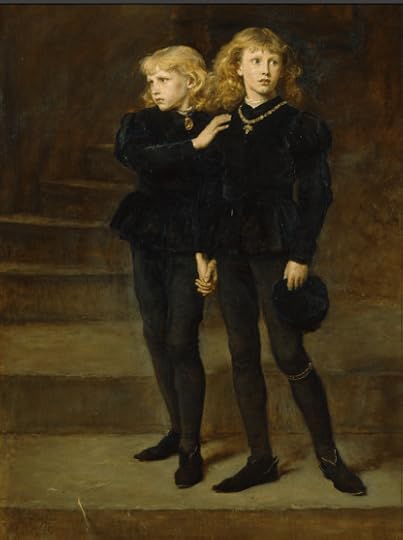 The Princes in the Tower, 9-year-old Richard Duke of York (left) and 12-year-old Edward V (right). Painted by John Everett Millais in 1878.
The Princes in the Tower are the long-disappeared sons and heirs of Edward IV, elder brother of Richard III. They were Edward Prince of Wales (born 2 November 1470) and Richard, Duke of York (born 17 August 1473.) When their father King Edward died suddenly on 3 April 1483, they were 12 and 9 years old. We know that Prince Edward was in the Tower of London shortly after his arrival in London on 19 May 1483. His younger brother Richard joined him on 16 June 1483. The boys were lodged in the Royal Apartments, the plan being that they would stay there until Edward’s coronation on 22 June 1483.
However, Edward V (as he is now known) was never actually crowned, because on 22 June, the day of his coronation, news broke that he, his brother and his five sisters were bastards, his father having married his mother while another wife was still alive.
Edward’s first wife was Lady Eleanor Talbot, the youngest daughter of the Earl of Shrewsbury. In 1449, when she was about 13 years old, she was married off to Sir Thomas Butler, son of Ralph Butler, Lord Sudeley. When Thomas died suddenly, her father in law Ralph took back one of the two manors he settled on her, even though he didn’t have legal authorization to do so. When Edward IV became King on 4 March 1461, he seized both manors. Fearing a life of penury, Lady Eleanor went to the King to plead her cause. Not only did he give her back both manors, but he was so enchanted that he actually married her ~ without telling a soul. It is not clear when Edward and Eleanor married, but it would have been some time between 4 March 1461, when he became King, and May 1464, when he married Elizabeth Woodville, another (beautiful) Lancastrian widow pleading for the return of her confiscated estates.
In any event, the fact that Lady Eleanor was still alive in May 1464, invalidated Edward’s marriage to Elizabeth Woodville, making bastards of the ten children that Edward and Elizabeth had together. Lady Eleanor died in 1468, taking her secret to the grave. And so it was not until 22 June 1483 that this matter came to light. As Richard of Gloucester (Richard III’s title before he became King) was the senior Yorkist heir, various dignitaries petitioned for him to become King of England. And so he was crowned at Westminster Abbey on 6 July 1483.
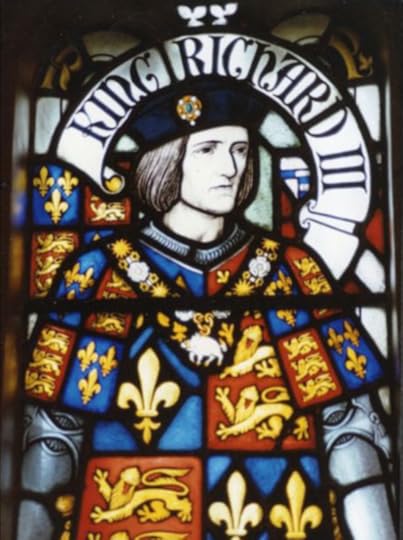 Stained glass depiction of Richard III (1483-1485) in Cardiff Castle.
On 19 July 1483, the newly-minted King Richard III set off for the North of England on a Royal Progress. This was what we would nowadays call a tour, in which the monarch would go to important places like the City of York, to meet the local dignitaries, discuss local grievances, hold assizes and talk about policy. Richard’s power base was in the North of England, so it is natural that he would want to head up there as soon as he could.
Around this time, the Princes in the Tower disappeared. Accounts of the time describe how they were seen playing outside, but then were taken inside never to be seen again. Most historians assume they were murdered, on Richard III’s orders, possibly by James Tyrell. But is that what actually happened?
Ms. Langley posits that instead they were taken out of the country. This seems plausible because both boys had a price on their heads. If Richard III was content to let them be, there were others who would have been delighted to see them dead, including Richard’s cousin the Duke of Buckingham and Lady Margaret Beaufort, who was the mother of Henry Tudor, Earl of Richmond, the Lancastrian Pretender to the Throne of England, then living in Brittany, at the court of Francis II.
Various attempts were made to spirit both boys out of the Tower of London around 21 July, but all attempts failed. On 2 November 1483, Buckingham was executed for treason in Salisbury and some time between that date and Christmas, Richard must have returned to London. Therefore the dates that the boys were actually spirited away would most likely have been between 21 July and early November.
Philippa Langley persuaded a group of Dutch researchers to comb through the Dutch archives and one of them found a first-person account from Prince Richard, in which he says that after waiting several weeks, his head was shaved, he was put into dirty clothes and the Percy brothers took him to St. Katherine’s dock where they boarded a ship to France. Prince Richard spent the next 8 years traveling from pillar to post, going to Paris, Rouen and various other places before winding up in Portugal. It is not yet known who these Percy brothers were, but they probably associated with King Richard in some way.
What actually happened to Edward V is a lot less clear as the boys were separated early on (probably as a precaution.) It seems likely that Edward was also spirited out of the country, but he may have spent time in the Channel Islands instead.
 Henry VII (1485-1509) painted by an unknown Netherlandish artist in 1505, when he was about 48 years old.
In any event, when Henry Tudor, the Lancastrian Pretender defeated Richard III at the Battle of Bosworth on 22 August 1485, he became King Henry VII of England. Instead of making a triumphant progress to London, he flew to the North of England, to Sheriff Hutton where he found 18 Plantagenet heirs, including his future wife Elizabeth of York.
But where were Edward IV’s sons and heirs? Henry tried, but couldn’t find them. What was Henry to do? He had made a solemn (and very public) promise to wed Elizabeth of York, so that he could unite the Houses of Lancaster and York. But his future wife had been declared a bastard. And so, in order to marry her, he had to overturn Titulus Regius, Richard III’s act of 1484, which declared her and all of her siblings to be bastards.
On the other hand, if Elizabeth of York was no longer a bastard, what did that make her brothers? Edward V had reached his majority (on 2 November 1484) and could now ~ at the age of 15, claim the Throne of England, while his brother Richard, Duke of York would be the Heir Presumptive.
It now seems as if the last battle of the Wars of the Roses, the Battle of Stoke, fought on 16 June 1487, may have been Edward V’s stab at claiming the throne of England. Someone calling himself Edward V was crowned in Dublin on Sunday 27 May 1487, and then proceeded to invade England. The battle was a close call, but eventually Henry VII’s army prevailed.
Henry VII’s spin doctors went to town with a story about a boy named Lambert Simnel, who was the 10-year-old son of ~ a baker, a tradesman or even an organ builder ~ whom Henry graciously pardoned by sending him to work in the kitchens as a turnspit.
But why would the Yorkists spend money, raise men, and organize a fleet of ships for a 10-year-old cook? Henry put it about that Lambert Simnel was trying to impersonate the 10-year-old son of the Duke of Clarence, another brother of Edward IV. This story seems to have been concocted because Henry could drag out of prison the poor 10-year-old Plantagenet heir Edward of Warwick that he had shut up in the Tower for the past two years.
But would men really risk their lives and livelihood for a baker’s son?
 The image of Edward V (left) is taken from the stained glass window at the church in Coldridge. The image of Richard IV (right) is taken from a contemporary sketch.
It seems much more likely that the actual person they were fighting for was Edward V, now 16 going on 17 years old, who was setting out to claim his throne.
No-one knows what actually happened to Edward V. He could have died in battle and been buried in a mass grave. Or perhaps he went to live in the remote village of Coldridge in Devon, on land owned by his half-brother the Marquess of Dorset. There is a glorious stained glass window dedicated to Edward V dating from 1511. Why would Edward V abandon his claim to the throne if he were still alive? The Battle of Stoke was a brutal battle, so perhaps he was so badly injured he could no longer speak.
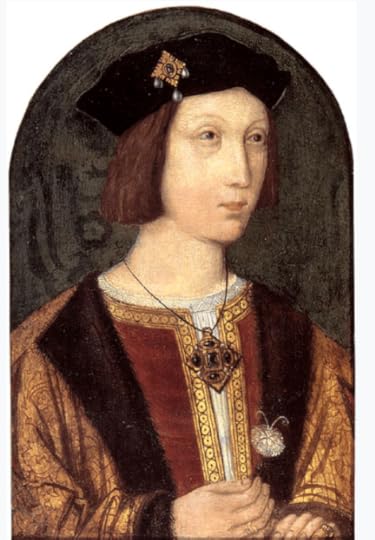 Arthur, Prince of Wales (1486-1502), painted in 1500 when he was around 14 years old.
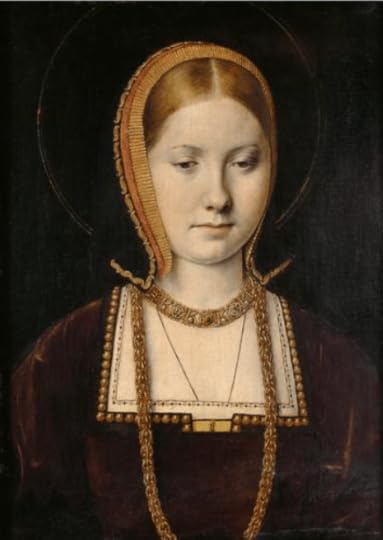 A possible portrait of Katherine of Aragon (1486-1536), painted by Michael Sittow in 1502, when she was around 16 years old.
A few years later, in 1493, Richard Duke of York appeared at his Aunt Margaret’s court in Burgundy. Staking his claim to the throne as Richard IV, he mounted another campaign against Henry VII. Most foreign royalty supported him, perhaps because he was also a Burgundian prince on his mother’s side of the family. Eventually, Henry VII captured him and he was executed on 23 November 1499 along with his cousin Edward, Earl of Warwick. so that Henry’s heir Prince Arthur could marry Katherine of Aragon with no Plantagenets heirs left to make trouble for the House of Tudor.
If you are one of those people who think a great injustice was done to Richard III, and you love historical crimes, you will adore this book! Five stars.
The post Were the princes murdered? Or spirited out of the country? appeared first on Cynthia Sally Haggard.December 1, 2023
A gem of a memoir, with so much left unsaid
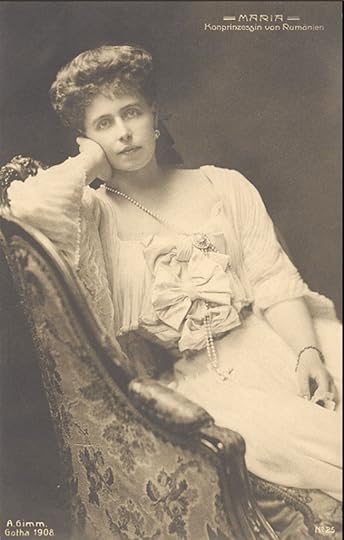 Ileana’s mother Queen Marie of Romania, taken in 1908 when she would have been in her early thirties.
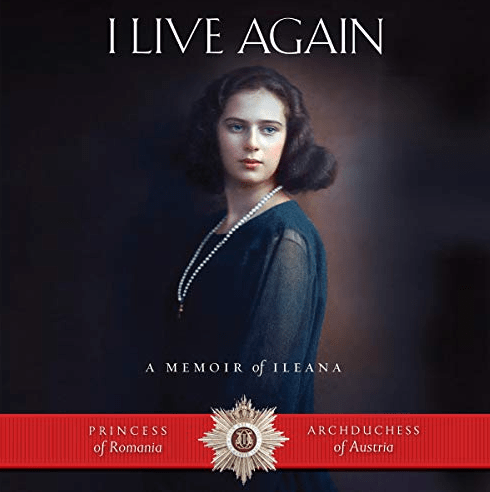
I LIVE AGAIN is the memoir of Princess Ileana of Romania (1909-1991), daughter of Marie of Edinburgh (1875-1938) who was Queen of Romania due to her marriage to Ferdinand I of Romania.
In 1931, Ileana married Archduke Anton of Austria (1901-1987), becoming an Austrian Archduchess.
The bulk of I LIVE AGAIN deals with Ileana’s war work as a nurse at various hospitals in Vienna, Brasov and Bran, the village where Dracula’s castle is located. (Ileana inherited Bran Castle when her mother died in 1938.) It is a fascinating and grimly realistic account of working with people who had unspeakable injuries, during a time of great hardship when medical supplies and food became scarcer and scarcer. To make matters worse, the Soviet Union tightened its grip on Romania, finally taking over in December 1947. As a result of the forced abdication of King Michael of Romania (1921-2017) the entire Royal Family had to leave Romania. And so Ileana and her family fled to Switzerland, then Argentina, before finally making a life in the United States. (I LIVE AGAIN is written in Newton Massachusetts and was published in 1951.)
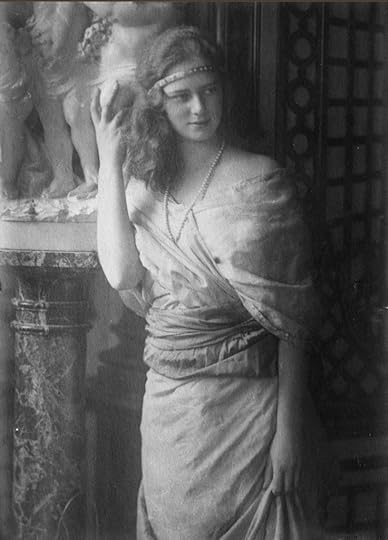 Princess Ileana as a young woman
Yet so much is left unsaid. We know little of her husband Archduke Anton. She doesn’t describe how they met, what she thought of him, why they decided to marry or their early married life in Austria, when they had six children in eleven years.
We know hardly anything about other family members. She doesn’t talk much about sisters Elisabeth or Marie or brother Nicholas. Eldest brother Carol (1893-1953) who ruled as King of Romania from the death of his father in 1930 to his forced abdication in 1940 doesn’t exist as far as these pages are concerned. Perhaps because he was a poisonous character who hated his youngest sister? According to Wikipedia, he was responsible for her marriage to Archduke Anton, because he wanted to get her out of the country as she was so popular with the Romanian people. Once married, she and her husband were refused permission to even visit Romania.
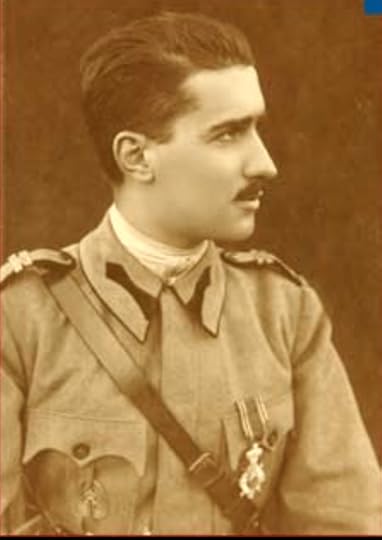 Prince Barbu Stirbey (1872-1946), Ileana’s father. He was a Romanian nobleman, from a long line of boyars in Wallachia.
So why would Carol II of Romania hate his youngest sister? Perhaps because she was her mother’s favorite child? (Mother and daughter seem to have been unusually close, at least according to these memoirs, with none of the misunderstandings, hurtful comments and hurt feelings that characterize typical mother-daughter relationships.) Or could it be that Ileana was illegitimate? Could it be that she was not actually the daughter of Ferdinand I of Romania, but of Prince Barbu Stirbey (1872-1946)? Certainly most believe that younger brother Mircea (1912-1916) was Stirbey’s son, so it is quite possible that Ileana was Stirbey’s daughter.
If so, was this widely known? And if widely known, how come she was married off to an Austrian Archduke? Wouldn’t he have balked at having an illegitimate wife? Wouldn’t he have worried that his gloriously beautiful wife might behave exactly like her mother and have illegitimate children of her own?
But this memoir is silent about such matters. Nevertheless, this volume is well-worth reading. Five Stars.
 The post A gem of a memoir, with so much left unsaid appeared first on Cynthia Sally Haggard.
November 25, 2023
Three Bright Young Things amidst the Rumbling Approach of World War II
Even though the structure of Marie Benedict’s THE MITFORD AFFAIR is to rotate voices amongst Nancy, Diana and Unity, three of six eccentric sisters who flourished during the inter-war years, the protagonist is really Nancy Mitford.
This volume starts strong with Nancy Mitford’s well-known charm, wit and acute observations of society around her. But as Diana and then Unity come out into society, her voice is overlaid by theirs.
So who were these women?
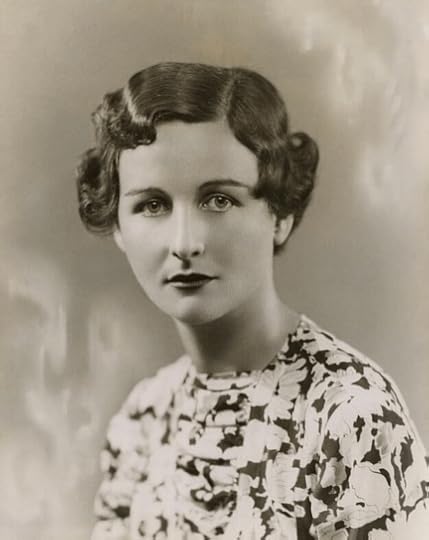 Author Nancy Mitford in 1932, when she would have been about 28 years old.
Nancy Mitford (1904-1973) is a celebrated author, best known for her tomes on Frederick the Great and Madame de Pompadour. I encountered her as a teenager when I read her book Voltaire in Love, which is one of my favorite biographies (and I don’t like biographies as a general rule.) Her writing is breezy, charming and succinct. She has a real talent for bringing the past to life and for glossing over all the boring bits. She is also a novelist. In THE MITFORD AFFAIR we hear about her early novels Wigs on the Green and Pigeon Pie, but her best work comes later, at the end of the war, with Love in a Cold Climate and the Pursuit of Love, both satirical exposes of the upper classes.
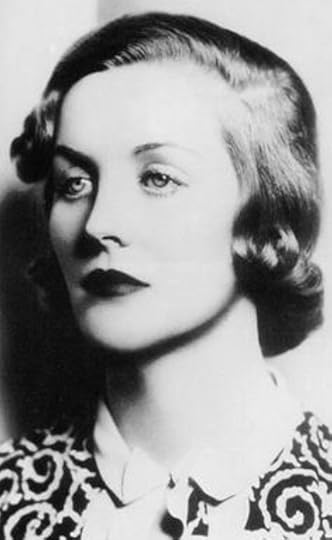 Diana Mitford, the Society Beauty, taken some time in the 1930s, when she would have been in her twenties.
Diana Mitford (1910-2003) is the Society Beauty. At age 19, she married Bryan Guinness, heir to the Guinness fortune and became fabulously wealthy. After giving him two sons, her attention strayed from her husband and became caught by the charismatic Oswald Mosley, Leader of the British Union of Fascists (BUF). The seemingly apolitical Diana became a staunch supporter of Mosley, becoming his mistress and later his wife. In THE MITFORD AFFAIR, she is depicted as being the brains behind the BUF, making numerous journeys to Berlin to cut deals with Hitler. As in her other novels (LADY CLEMENTINE comes to mind) author Marie Benedict goes overboard in giving her female protagonists more agency and more intelligence than they may have possessed. In the process, the actions of the men become too muted. Just as Churchill in LADY CLEMENTINE comes across as weak and stupid, so does Oswald Mosley in THE MITFORD AFFAIR. In both cases, I think the men were more intelligent and decisive than Ms Benedict gives them credit.
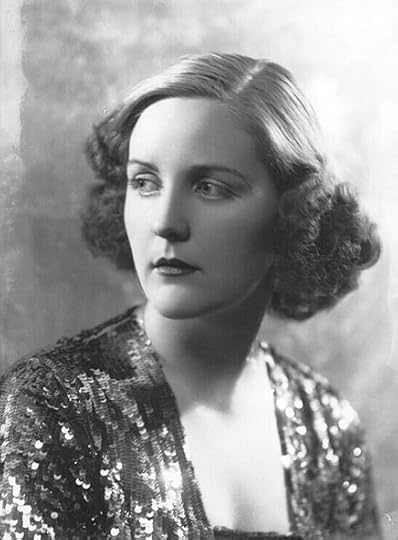 Unity Mitford, taken in 1937 when she would have been about 23 years old.
Then there is Unity Mitford (1914-1948.) Tall and blonde she comes across as the Ideal in Aryan Womanhood. But it becomes clear in Ms. Benedict’s sensitive handling of this character that there is something very wrong with Unity. It is not just that she is gruff and charmless in an era when there was enormous societal pressures not to act that way. It is also evident that Unity has the mind of a child. She thinks in extremes, and has no grasp of the complexities of life. So when, at the age of 25, she is informed that Britain will go to war with Germany, she crumbles. And never recovers.
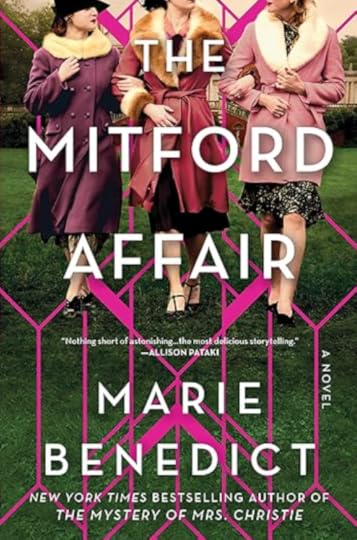
If you want to read a gem of a novel about the Bright Young Things and the rumbling approach of World War II, read THE MITFORD AFFAIR. You won’t be disappointed. Five Stars.
The post Three Bright Young Things amidst the Rumbling Approach of World War II appeared first on Cynthia Sally Haggard.November 17, 2023
A Postcard from Lockdown on the Galápagos ~ or is it?
This is the first novel I’ve ever read about the COVID-19 crisis, and in Jodi Picoult’s hands those now far-distant-almost-forgotten-bad-memories become real and vivid.

Jodi Picoult does what every great author does ~ puts her characters into impossible situations to give the reader the pleasure of watching them escape.
So we have two ambitious millennials ~ Finn, a doctor in NYC, who in March 2020 is on the front lines of the COVID disaster as New York City reels from the impact of the early wave of the disease. And then there is his girlfriend Diana, a rising star at Sotheby’s who finds herself trapped on a remote island in the Galapagos due to lockdown.
Like most young people who are college-educated and ambitious, Finn and Diana have A PLAN. They plan to marry within the year. They plan to go to every UNESCO heritage site. They are planning which house to live in, how many children to have and when, and what kind of dog they should purchase. They have a bucket list of destinations they wish to travel to, and the Galapagos Islands is the first of many. Finn and Diana have been dreaming about this vacation for four years, but on 15 March 2020, COVID rears its ugly head.
Finn, the doctor, cannot go, but he tells Diana to go without him and enjoy herself.
Which is how she arrives on the island of Isabela the day that all the tourists leave. Why Diana doesn’t turn around and take the boat back to the mainland with them is a question she will ask herself often. But she doesn’t. And so gets trapped on Isabela island when the Government of Ecuador declares a complete lockdown due to COVID.
The hotel is closed, she has limited funds, and speaks no Spanish. But a local family is kind to her, starting with the grandmother (Abuela) and troubled grand-daughter Beatrice. For some reason, Diana is able to reach Beatrice and spends a good deal of time with her, concerned about the 14-year-old’s mental health. She is kind to a bullied boy, drawing a likeness of him. As a result, she is able to barter her drawings for food. Eventually, even Beatrice’s hostile father Gabriel softens, and of course they enter into a relationship.
And so Jodi Picoult leads us down the garden path of Diana’s romance with Gabriel and her growing involvement with his family, before she pulls the rug out from under us.
Back in New York City, Diana is not nearly as kind to boyfriend Finn as she was to the family on Isabela. Like The Book of Two Ways, Jodi Picoult’s previous novel, Wish You Were Here turns into a novel with colliding storylines, in which the female protagonist becomes extremely unlikable, as several readers noted. However, that should not put you off this book, which is a gem, and shows Ms. Picoult at the height of her powers. Five Stars.
The post A Postcard from Lockdown on the Galápagos ~ or is it? appeared first on Cynthia Sally Haggard.November 10, 2023
A remarkable survivor of abuse sparkles at George II’s court
Henrietta Howard (1689-1767) was born wealthy into the gentry, into the Hobart family which boasted a line of distinguished lawyers and politicians. However, her early life was not easy.
In 1698, when Henrietta was about eight years old, her irascible father incited a duel, in which he was killed. This event plunged the family ~ Henrietta, her brother and two sisters into straightened circumstances. When her mother died four years later, Henrietta was left an orphan at the aged of twelve.
However, in those days, children of genteel families were made wards of court of other families who had the means and the station to help them make “good” marriages. And so Henrietta became a ward of Henry Howard, 5th Duke of Suffolk (1627-1709), eventually marrying Henry’s youngest son Charles, 9th Duke of Suffolk (1685-1733) in 1706, when she was around sixteen years old. The couple had only one child, a son Henry, 10th Duke of Suffolk (1710-1745.)
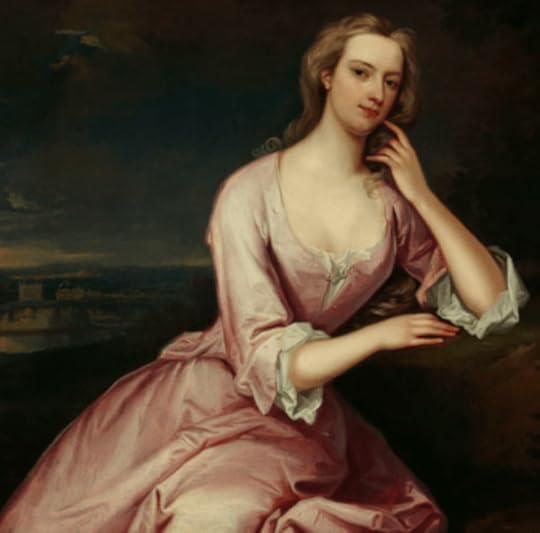 Henrietta Howard circa 1724 when she was about 35 years old. The portrait shows her hair to be a very light brown almost blond color. Actually, she had lightened her dark brown tresses to please her lover King George II. (Some things never change.) Painted by Charles Jervas (1675-1739.)
If Henrietta hoped that by making a dynastic marriage with the Howard family, she would be set for life, she was to be bitterly disappointed. Charles Howard was a compulsive gambler and an alcoholic. He managed to gamble away his wife’s dowry so that within a few years they were reduced to penury. And when drunk, he was vicious. He beat his wife so badly, that Henrietta became deaf at an early age.
But Henrietta had spirit, and was determined to escape her brutal marriage. She persuaded her husband to travel to Hanover to acquaint themselves with the Elector of Hanover (1660-1627) and his family, as Elector George was the Heir Presumptive of the Throne of England, becoming George I in 1714 on the death of Queen Anne. While there, Henrietta made friends with George’s son, also called George (1683-1760) and his highly intelligent wife Caroline (1683-1737.) This proved to be a stroke of genius on Henrietta’s part, for she proved to be so agreeable ~ listening with polite and apparently fascinated attention while George rambled on about various military campaigns ~ that he made her his mistress. While Caroline was not thrilled about this, nevertheless she liked Henrietta, who was famous for being discreet.

All of this meant that by the 1720s, Henrietta was gradually able to free herself from her marriage. George (now the Prince of Wales) gave her a generous income, and Caroline gave her a place at court. And so Henrietta began secretly planning a country house for herself, now known as Marble Hill, located in what was the pleasant Surrey countryside near Twickenham.
Matters were greatly improved when George and Caroline became King and Queen of England in 1727, and the King increased her income. IN 1731, Charles succeeded his brother as Earl of Sussex and Henrietta was elevated to Mistress of the Robes. In that same year, Finally, Henrietta finally persuaded her husband to draw up a formal deed of separation, which ended their toxic marriage of twenty-five years. The cost was that Henrietta was never allowed to see her son again.
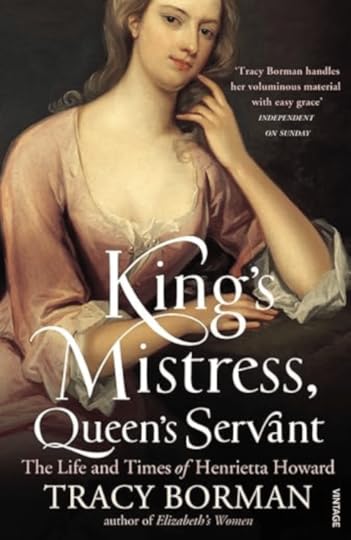
In 1733, must to Henrietta’s relief, her husband died and she was at last free. The first thing she did was call in the architects to make a dream a reality, and the building of Marble Hill House began. After two years of “mourning” her husband, Henrietta finally married for love finding in her second husband George Berkeley (1693-1746) the passion and devoted love that had been so absent in her first marriage.
If you want to learn more about his fascinating woman who was a champion for women’s rights long before most people knew there was such a thing, then read Tracy Borman’s King’s Mistress, Queen’s Servant. You won’t be disappointed! Five Stars.
The post A remarkable survivor of abuse sparkles at George II’s court appeared first on Cynthia Sally Haggard.November 3, 2023
A gripping novel about a stubborn woman who won’t behave herself ~ set in 1860s Paris

When 18-year-old Mimi Bisset discovers a lost giraffe and rides it bareback to the circus, the denizens of Montmartre cannot get enough of her. For who else but Mimi would be bold enough to tame a wild beast so that it would actually allow her to ride it?
Mimi seems like a carefree girl on the verge of womanhood, but her life has been very difficult. Born into the slums of Montmartre in 1840s Paris, she has no idea who her father is and lost her mother a few years back.
But what really eats at Mimi is her little girl, born when she was just 16, and given up to a wealthy family so that she can enjoy the comfortable life that Mimi is not able to give her.
Mimi works in the laundry, along with other struggling girls. She loves her community ~ the dark humor, the bawdy jests and the love that these people bring her. But saving the giraffe changes her life forever. The Circus Master ~ impressed by her boldness ~ asks her to join the circus and she becomes a celebrated trapeze artist.
And that is how she meets The Impressionists ~ a group of artists in 1860s Paris who want to move on from the Neoclassical portraits so beloved by The Academy, to explore light and movement. After Mimi has a serious accident, they take her under their wing and she becomes first muse and then mistress to the brilliant Edouard Manet.
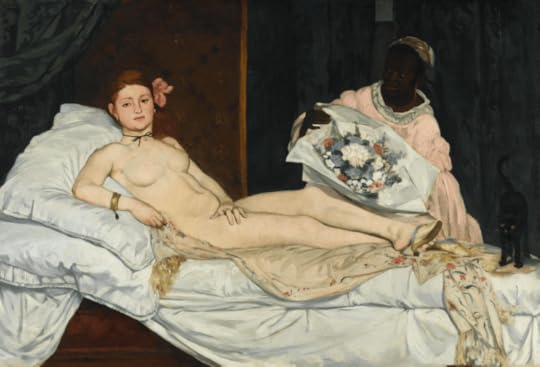 Manet shocked the Paris art world in 1863 with this frank portrayal of a prostitute who gazes at her audience with a degree of boldness that was unacceptable for “nice” women.
 Mimi is desperately in love with Manet but he comes from a good family and is married. What is he going to think about her illegitimate daughter?
If you love gripping page-turning novels about stubborn women who don’t behave themselves, then this is a treat for you! Five Stars.
The post A gripping novel about a stubborn woman who won’t behave herself ~ set in 1860s Paris appeared first on Cynthia Sally Haggard.October 27, 2023
What would you do if your uncle traded in black market fakes?
Having just finished Luanne G. Smith’s THE RAVEN SPELL, I was amused to find myself again transported back in time to London of the past, to a teenaged girl left to manage a shop in Susan Stokes Chapman’s novel PANDORA. However, we are in the late 1700s not the late 1800s, and the shop that Dora manages is full of antiques rather than curiosities.
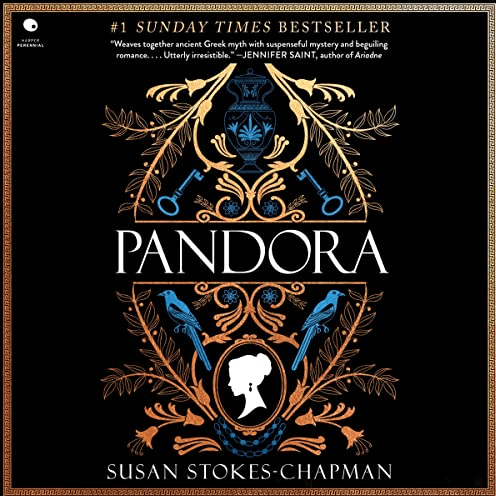
Until, you being to realize that these “antiques” are in fact fakes, and that Dora’s uncle Hezekiah is running a profitable black market enterprise. Or it was profitable once. Just as in THE RAVEN SPELL, Dora’s parents are dead. Just as in THE RAVEN SPELL her parents were charismatic people who ran a legit enterprise that was genuinely profitable. But business is falling off at the Hezekiah’s shop, which turns him mean and vicious.
One day, Dora realizes that something genuinely valuable has arrived in the basement under the shop. It turns out to be a magnificent (and very large) Greek storage jar. But why isn’t her uncle selling it from their shop? Why is it in the basement? And why does her uncle spend so much time down there?
Be prepared to be thrilled not only by the balls and parties of the bon ton but by a genuine murder mystery wrapped up in the stolen antiquities trade. Five stars.
The post What would you do if your uncle traded in black market fakes? appeared first on Cynthia Sally Haggard.October 20, 2023
Is Edwina safe? ~ Volume 2 The Raven Song
Following the shocking death of her sister at the end of Volume 1 ~ The Raven Spell ~ Edwina Blackwood travels north to escape London. Although the author never says so, it becomes apparent that she winds up in Edinburgh. (As I experience this tale in audio form, I was able to detect all the Scottish accents.)
First, she is sent to the huge country house of Sir Henry Elvanfoot, the Wizard of the North. Naturally he has surrounded his mansion with every supernatural charm he can think of, so Edwina is safe. But then there is that invitation to the Midsummer Ball held by an Elven Queen and how could one possibly say no?
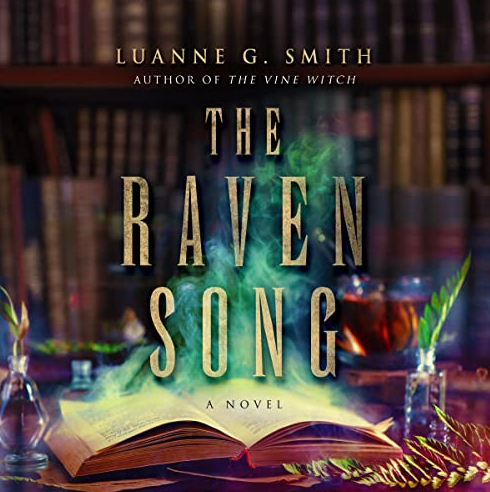
And so Edwina ventures out of her protective cage, and (of course) is captured by those who have Evil Designs on her. For Edwina is no ordinary witch but has Special Powers. Some believe she is fairy-touched. Which is why everyone ~ from the Elven Queen on down ~ is so fascinated by her. Who is Edwina, really? What is her calling in life? And where are her parents who disappeared so mysteriously all those years ago? And then there is the death of her sister. What was all that about? Was Mary murdered? Or did something else happen?
Author Luanne G. Smith deftly ties up all of these ends in a way that offers a glorious ending. Five Stars.
The post Is Edwina safe? ~ Volume 2 The Raven Song appeared first on Cynthia Sally Haggard.October 12, 2023
What would you do with a sister who steals memories from the dead?
I don’t know exactly what drew me into this volume ~ something about those two teenaged Victorian girls (17 and 19) who spend their nights foraging for treasure on the sandy shores near their home, and their days managing a shabby curiosity shop.
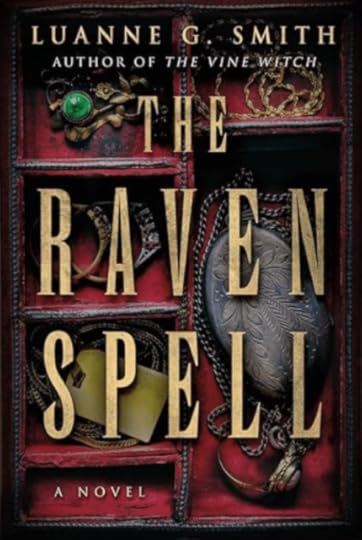 The cover of this delightful novel shows the window display of Mary & Edwina’s shop which sells curiosities ~ such as hatpins, lockets, rings and books…as well as some magickal items…
The elder sister (naturally) makes the best of things ~ her absent parents, the burden of managing a business, and the task of corralling her fey younger sister who has a habit of wandering off, but whom she nevertheless adores.
But one evening, they discover a dead man on the beach and Mary (the younger sister) persuades the elder sister that since he is dead it is perfectly fine to steal his memories from him. Reluctantly Edwina (the elder sister) agrees, and soon the bluish memories arising from the “dead” body are contained within a marble-sized bauble.
Satisfied, Mary follows her sister home. But things are not quite as they seem. Because the dead man is not actually dead but is now wandering around not knowing who he is. Edwina, feeling responsible, tries to help by giving his memories back. Unfortunately, she gives back the wrong memories, from one of her sister’s baubles belonging to another person. And so the poor man ~ his name is Ian ~ re-lives a horrible death that never actually happened to him.
Raven Spell is the first of two volumes, and so many threads are left to be tied up. But if you enjoy novels set in London during the Victorian era (1837-1901) with a quirky cast of characters battling murderers and Dark Magic, then this is the story for you. Five Stars.
The post What would you do with a sister who steals memories from the dead? appeared first on Cynthia Sally Haggard.Cynthia Sally's Blog

- Cynthia Sally Haggard's profile
- 129 followers

