
Cynthia Sally Haggard's Blog: Cynthia Sally's Blog, page 14
July 19, 2024
Adventures in Istanbul Part 3 ~ The Hagia Sophia & Ataturk
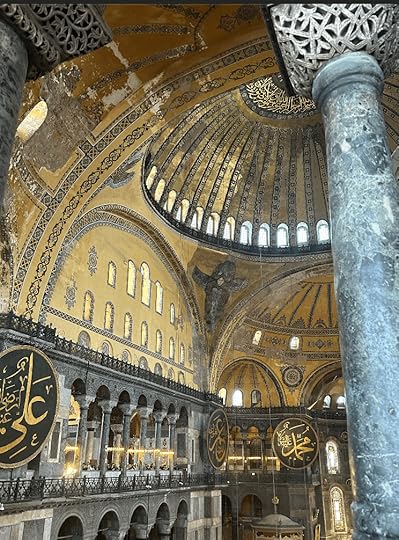
The Hagia Sophia (pronounced Ay-ah Soh-feeh-yah) is enormous, and was, in fact, the world’s largest interior space for nearly a thousand years. But what is even more staggering is that it is so old, standing here in Istanbul for nearly 1,500 years.
Built between 532 and 537 by the Emperor Justinian I (ruled 527-565), it was originally the heart of Eastern Christianity until the Fall of Constantine in 1453.
At this point, perhaps I should mention that the city we now know as Istanbul actually has three names. Originally, it was called Byzantium when it was founded in 780 BCE by Greeks from Megara. In 330 CE the Emperor Constantine made it his new Imperial Capital, and so it became known as Constantinople. In 1453, the victorious Turks renamed it Istanbul, a name related to Constantinople, perhaps a corruption of that name.
In any event after the Turkish victory of 1453, under the young (but brilliant) Sultan Mehmed II, it became a mosque. Interestingly enough, the shape of the building made it perfect for being a mosque, for unlike the famous gothic churches of Western Europe which are tall, narrow and hierarchical, the shape of the Hagia Sophia is round and egalitarian.
The Hagia Sophia remained a mosque until 1934, when its function changed under the rule of Mustafa Kemal Ataturk (circa 1881-1938.)
Ataturk was a remarkable man. He was a highly-westernized Turkish gentleman who had spent a great deal of time in Paris, and although nominally a Muslim was, in fact, an atheist. He became leader of the Secular Republic of Turkey in 1923, remaining in power until his too-early death in 1938.
Ataturk rose to prominence when he secured the Turkish victory at Gallipoli in 1915 during World War I. Unfortunately, Turkey was not on the winning side when the war ended in 1918, and so, by the Treaty of Sèvres, Turkey was dismembered and handed out to the Victorious Allies ~ Greece, Italy, France and Great Britain.
But Ataturk was there, and he almost single-handedly overturned that treaty. After a string of military victories against the Occupying Powers, he persuaded the Allies to return to the negotiating table and fashion a new treaty, the Treaty of Lausanne of 1923, which secured the borders of present-day Turkey.
As an atheist, Ataturk had no interest in the Hagia Sophia remaining a mosque. So in 1934, he issued a decree, declaring that it should be opened to the public as a museum. It continued in this new guise until 2020, when the new Sultan of Turkey (I refer to him as such, due to his untrammeled power) Recep Tayyip Erdogan reversed that 1934 decree, and it became a mosque again.
There was an outcry from the Secular and Christian worlds, which included Turkish opposition figures, UNESCO, the World Council of Churches and the International Association of Byzantine studies. But Sultans of Turkey do not have to pay attention to foreign voices, or even their own opposition. With the amount of power Erdogan had amassed by 2020, he could afford to ignore these voices as he cozied up to the Religious Right in a bid to hold onto Power.
And so, today, The Hagia Sophia is a Mosque. Which means that if you are a woman you need to wear below-the-knee clothing and a scarf in order to visit.
 The post Adventures in Istanbul Part 3 ~ The Hagia Sophia & Ataturk appeared first on Cynthia Sally Haggard.


July 15, 2024
A SPARK OF LIGHT by Jodi Picoult ~ A Book Review

As I experienced this novel as an audiobook, I would like to address those issues first before moving on to the content of this thought-provoking novel.
It is amazing to me that a “professional” outfit like Random House Audio can actually make a book more difficult to understand than the author intended. In this novel, Jodi Picoult already places great demands on the reader (I’ll come back to that in a moment.) So it does not help to have no space at all between the various narrative voices.
This could be easily fixed by inserting a one- or two-second pause so that it is obvious to the listener which voice has ended and which one has begun. I urge Random House Audio to go through and fix this problem. They really should not be charging the public money for such shoddy work! (I would like to point out that when I insisted on such spacing in the audio version of my first novel Thwarted Queen, it won an IPPY Gold Medal for Audiobook. So I do know what I’m talking about!)
Having had my rant, I now want to commend narrator Bahni Turpin for her marvelous evocation of the various characters, getting their accents pitch-perfect. It was a real responsibility for just one person, and what she did was a real tour de force!
Now to the content of the novel.
At the very beginning of her career, in her debut novel Songs of the Humpback Whale, author Jodi Picoult had one of her characters narrate the events backwards! Back in 1992, Ms. Picoult simply didn’t have the technique to handle such a challenge. Here, she handled a similar challenge much more adroitly.
At the beginning of A Spark of Light we are thrown into a hostage situation with a murderous angry man waving a gun around. At that point, all we know is that Olive (the old lady) is dead, her blood spilling all over the floor, and that the abortion doctor (Dr. Ward) has been shot in the leg and may have to face amputation if he doesn’t receive medical attention stat. Then there is Becks, who has been shot through the chest, which inhibits her ability to breathe, and her teenaged niece Wren, who has bravely (or perhaps foolishly) just stabbed the gunman in the hand with a scalpel. There are two other women, Joy who has just (this very day) had an abortion, and Janine who is a spy for the anti-abortion activists (she is wearing a blond wig.) Last, is Izzy, the red-headed nurse (engaged to someone who is too posh for her), who tirelessly works away at the wounded, confronting the gunman at every turn to get better medical care for these people in the waiting room who have become her patients. Somehow, she manages to persuade him not to shoot her dead. Of course, I loved Izzy!
Over the course of this novel, Ms. Picoult lets us into these characters’ thoughts and feelings as they reminisce about their childhoods, how they came to be pregnant, and how they wound up at an abortion center. From this beginning in Chapter One (which starts at 5 pm), we move forward to round out the hour, ending with the gunman pointing his gun toward 15-year-old Wren. What a cliffhanger! Is Wren dead? What about her father Hugh McElroy, who is coming to rescue her? What about the gunman? Is he on the loose?
However, the trouble with this cliffhanger IMHO is that the rest of the novel takes place between this event and its eventual resolution in the Epilogue, letting too much time pass for it to be compelling. I, at least became so swept away by all the stories that Jodi Picoult has to tell about her various characters, that all of the tension generated by the cliffhanger in Chapter One seeped away. Which was a pity.
From the opener, each chapter spools back hour by hour, until we get to 8 am, before the tragic events of the day unfold. By structuring the novel this way, Jodi Picoult gives herself two enormous challenges:
(a) She must not confuse the reader, and
(b) she must still produce an arc of tension.
Speaking for myself, I found this structure interesting to experience, but I still got lost (not helped by the unprofessional production of Random House Audio). Although there really was no arc of tension, perhaps the point of this structure was to give the reader/listener the verisimilitude of being in an inherently unstable and unpredictable situation, making the plight of these desperate people all the more real. By spooling backward, Jodi Picoult was also able to reveal just how horrifying the situation actually was, much worse than the appalling opening chapter.
Five Stars.
The post A SPARK OF LIGHT by Jodi Picoult ~ A Book Review appeared first on Cynthia Sally Haggard.July 12, 2024
Adventures in Istanbul Part 2 ~ A Cruise of the Bosphorus
On the first day of our tour, Odysseys Unlimited planned a cruise along the Bosphorus. That turned out to be a smart choice as it is only from the water can you truly see how huge Istanbul actually is.
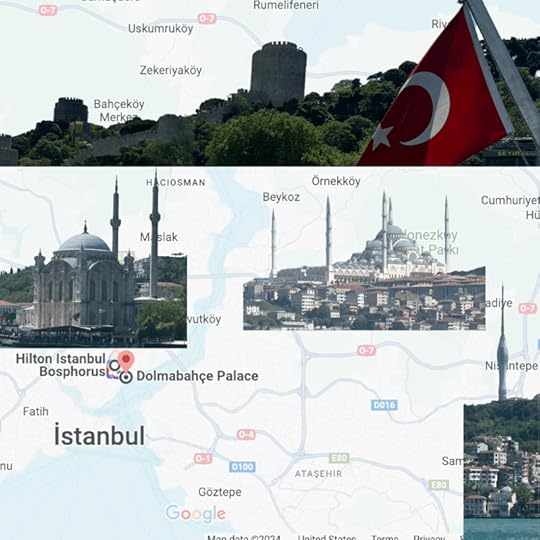
We started from Dolmabahhce (dol-mah-BAH-jay) Palace, the residence of the last sultans, and went north, past the delightful Ortaköye Mosque, built by the same sultan (Abdulmejid I) who built the palace, both completed in around 1856. Then we crossed under the first of three bridges that link the European or west side of Istanbul with the Asian or east side. This bridge is the oldest and southernmost of the three suspension bridges that span the Bosphorus, and was completed in 1973.
The second bridge, called the Fatih Sultan Mehmet Bridge or Sultan Mehmet the Conqueror Bridge was named after Sultan Mehmet II who conquered Istanbul in 1453 at the age of only twenty-one. Unlike his predecessors, Mehmet II appreciated how difficult it was going to be to lay siege and capture Istanbul, and so he made meticulous plans. (It might interest readers to know that Mehmet II grew up with Vlad Dracula in city of Edirne, where the sultans lived before they moved to Istanbul.) This enormous bridge was completed in 1988.
The third bridge, one of the tallest in the world, is located near the entrance to the Black Sea from the Bosphorus Strait. It was completed in 2016.
Like Americans, Turks like things to be on a larger-than-life scale. Apart from the three bridges I’ve mentioned there was also an enormous mosque (the largest in Turkiye) and a huge communications tower. They are the Chamluca Mosque completed in 2019 and the Chamluca Tower completed in 2020. Both are hard to miss.
 The post Adventures in Istanbul Part 2 ~ A Cruise of the Bosphorus appeared first on Cynthia Sally Haggard.
July 8, 2024
SMALL GREAT THINGS by Jodi Picoult ~ A Book Review
This book took a long time a-coming, which is not surprising when you realize that in this novel, Jodi Picoult takes on the fraught issue of race.
The protagonist is Ruth Jefferson, an African-American nurse who is superb at her job (delivering babies) and devoted to her patients.

The antagonist is Turk Bower, a White Supremacist.
When Turk demands that Ruth NOT touch his newborn baby boy, Ruth’s supervisor complies. But this puts Ruth in an impossible situation.
What is she to do when the baby suddenly goes blue and stops moving?
Should she touch it, as her training demands?
Or should she stand there, seeing the child suffer, as she obeys her supervisor’s (and the baby’s father’s) directive?
What would you do?
Find out in this gripping, well-paced novel.
The post SMALL GREAT THINGS by Jodi Picoult ~ A Book Review appeared first on Cynthia Sally Haggard.July 5, 2024
Adventures in Istanbul Part I ~ The Suleiman Mosque
The Suleiman Mosque is one of those must-see sights in Istanbul. It represents the pinnacle of Ottoman architecture and commands a marvelous view over the Golden Horn from its position on the Third Hill.
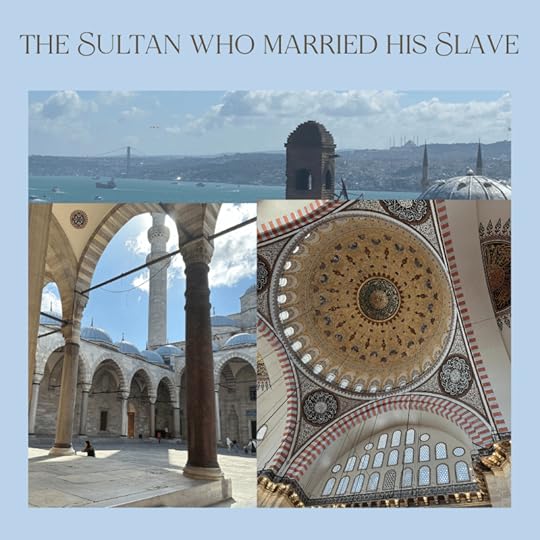
After Crown Prince Mustafa’s untimely death on the orders of his father Suleiman the Magnificent, that sultan ordered architect Mimar Sinan to build a mosque to his memory. He was so delighted by the result that he commissioned to build a mosque and mausoleum for himself and his wife Hürrem Sultan, also known as Roxelana.
Mimar became the chief Ottoman architect, engineer and mathematician for sultans Suleiman the Magnificent, Selim II and Murad III. Like Suleiman’s wife Roxelana, Mimar was not an Ottoman Turk, nor a Muslim. Instead, he was born in Cappadocia in central Turkiye, around 1490, into a Greek Orthodox Christian family and given the name Joseph.
It is probable that his family gave him to the Ottoman Turks to become a member of the Janissary, an elite unit that was part of the sultan’s household troops. Apparently, the opportunities for a bright boy from a poor family made mothers fall over themselves in trying to get their sons an interview with the Janissary commanders whenever they arrived in these villages. Mimar must have passed such an interview, and then later on his talents for mathematics and engineering were encouraged.
Hürrem Sultan’s story is no less amazing. Born in around 1504 in what is now Ukraine as Alexandra Anastasia Lisowka, the daughter of an Orthodox priest, she was captured in a slave raid and taken to Istanbul. She entered the Imperial Harem where she was given an education in letters, manners, music, conversation and poetry. There she acquired her name Hürrem which means joyful in Turkish, because of her habit of laughing, dancing and playing music. By her mid teens she had caught the eye of the new Sultan Suleiman the Magnificent, and at the age of seventeen presented him with their first child, a son called Mehmed.
Hürrem was a rule-breaker. First of all she persuaded Suleiman to allow her to give birth to more than one son, a flagrant violation of the old imperial harem principle, one concubine mother — one son, which was designed to prevent both the mother’s influence over the sultan and the feuds of the blood brothers for the throne. However, after Hürrem gave birth to her first son Mehmed in 1521 (who died in 1543) and she then had four more sons, destroying Suleiman’s Chief Concubine’s status as the mother of the sultan’s only son.
Secondly, she somehow persuaded Suleiman to do the unthinkable. Around 1533, Suleiman married Hürrem in a magnificent formal ceremony. Never before had a former slave been elevated to the status of the sultan’s lawful spouse, a development which astonished observers in the palace and in the city. The wedding celebration took place in 1534.
Of course, Suleiman was crazy about her. However, the viperish power dynamics of the harem made Hũrrem cruel, and she was responsible for the murder of Suleiman’s eldest son Mustafa, because he preceded all of her sons. This caused Suleiman to fall into a depression, and as an act of atonement he commissioned Mimar to build the mosque I mentioned at the beginning of this piece.
The post Adventures in Istanbul Part I ~ The Suleiman Mosque appeared first on Cynthia Sally Haggard.July 1, 2024
LEAVING TIME by Jodi Picoult ~ A Book Review
LEAVING TIME is one of those punning titles that I love about Jodi Picoult novels. To me, a woman who grew up in Britain, it sounds as if Ms. Picoult is talking about a public house (or pub), those last orders for drinks. But this whole novel is all about leaving, loss and grief, and there is one specific incident at the heart of the novel, when so much tragedy occurs, that “Leaving Time” becomes an apt way to describe it.
The novel opens in the voice of 13-year-old Jenna whose mother disappeared 10 years before shortly after a tragic accident. One moment, Alice Metcalf was in hospital recovering from her wounds. The next, she checked herself out and went…god knows where.
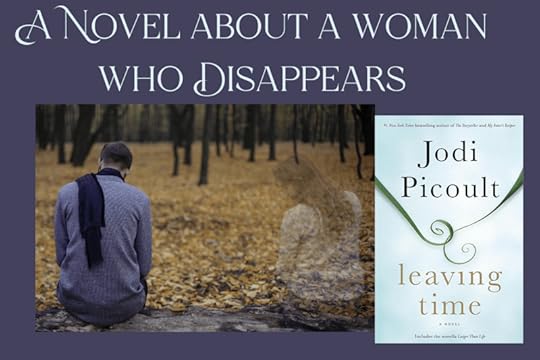
Jenna, a smart and astute 13-year-old is determined to find her mother, whom she believes to be still living. But how is she going to locate her? She lives with her grandmother, who is determined NOT to revisit the past, her father is institutionalized in a mental hospital, she lives in Boone New Hampshire and most adults are going to be skeptical of a 13-year-old.
And so she turns to a disgraced psychic and a burned-out jaded former PI.
It is going to be hard for me to continue talking about this novel, without revealing the plot twist that upends it, so I will simply say that if you are tired of Jodi Picoult novels that end in the courtroom, and want something in which the characters themselves becomes their own detectives, this novel is for you. Five stars.
The post LEAVING TIME by Jodi Picoult ~ A Book Review appeared first on Cynthia Sally Haggard.June 28, 2024
Adventures in Lake Maggiore
For Lake Garda, I elected to stay at the northern tip so that I could get over my jet lag against the wonderful backdrop of the Alps. For Lake Maggiore, I decided to stay in Stresa, near the southern tip of the lake. Much to my surprise I got a beautiful view of the Alps there too.
Unfortunately, the weather wasn’t good for the few days I was there. I only had one day of sunshine which I used to explore Isola Bella, famous for its palazzo and gardens that were home to the Borromeo family. Usually, in such places in England, you have a choice of whether you want to see the palace, or the gardens, or both. This being Italy, you only had one ticket that consisted of the palace and the gardens. The palace was predictably dreary with over-done furniture, too much bling, and gloomy rooms. I walked through it as quickly as my knee would allow me (am still recovering from a strained knee) until I got to the gardens, which were something else. Set against the backdrop of Lake Maggiore and the nearby Alps they were a delight to behold as the image illustrates.
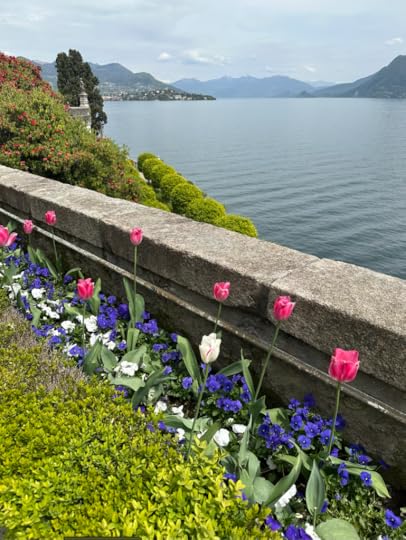 One day of sunshine for my trip to Isola Bella.
The following day was May 1 and much to my surprise the woman who ran Hotel Du Parc in Stresa (where I was staying) suggested that I go on the Centi Valli tour, in which you take a train from Stresa to Domodossola, change onto a narrow-gauge railway that goes 1,400 feet up into the Alps before descending into Locarno Switzerland. Then you spend a few hours there before coming back to Stresa on the ferry.
It sounded like a wonderful idea. However, two things contributed to it being an exhausting, tedious day. First of all, a thunderstorm erupted, and it gushed buckets of rain. Secondly, it was May 1 in Europe, and although I should have known this, it didn’t occur to me that this tour would be offered when all of the shops in Domodossola Italy and Locarno Switzerland would be closed. I mean, why offer this tour, when you can’t do anything when you get there?
So instead of enjoying myself browsing charming boutiques, I had to while away my time inside the few cafes that were open (playing games on my iPhone) while I waited for the only ferry back to Stresa to leave. When it did leave it was, of course, on holiday hours which meant a tedious 3-hour journey across the lake in pouring rain, which ruined the view.
So, if you happen to be in Europe on May 1, contact your hotel or make plans to deal with the fact that you might have nothing to do!
The post Adventures in Lake Maggiore appeared first on Cynthia Sally Haggard.Adventures in Lake Maggiore
For Lake Garda, I elected to stay at the northern tip so that I could get over my jet lag against the wonderful backdrop of the Alps. For Lake Maggiore, I decided to stay in Stresa, near the southern tip of the lake. Much to my surprise I got a beautiful view of the Alps there too.
Unfortunately, the weather wasn’t good for the few days I was there. I only had one day of sunshine which I used to explore Isola Bella, famous for its palazzo and gardens that were home to the Borromeo family. Usually, in such places in England, you have a choice of whether you want to see the palace, or the gardens, or both. This being Italy, you only had one ticket that consisted of the palace and the gardens. The palace was predictably dreary with over-done furniture, too much bling, and gloomy rooms. I walked through it as quickly as my knee would allow me (am still recovering from a strained knee) until I got to the gardens, which were something else. Set against the backdrop of Lake Maggiore and the nearby Alps they were a delight to behold as the image illustrates.
One day of sunshine for my trip to Isola Bella.The following day was May 1 and much to my surprise the woman who ran Hotel Du Parc in Stresa (where I was staying) suggested that I go on the Centi Valli tour, in which you take a train from Stresa to Domodossola, change onto a narrow-gauge railway that goes 1,400 feet up into the Alps before descending into Locarno Switzerland. Then you spend a few hours there before coming back to Stresa on the ferry.
It sounded like a wonderful idea. However, two things contributed to it being an exhausting, tedious day. First of all, a thunderstorm erupted, and it gushed buckets of rain. Secondly, it was May 1 in Europe, and although I should have known this, it didn’t occur to me that this tour would be offered when all of the shops in Domodossola Italy and Locarno Switzerland would be closed. I mean, why offer this tour, when you can’t do anything when you get there?
So instead of enjoying myself browsing charming boutiques, I had to while away my time inside the few cafes that were open (playing games on my iPhone) while I waited for the only ferry back to Stresa to leave. When it did leave it was, of course, on holiday hours which meant a tedious 3-hour journey across the lake in pouring rain, which ruined the view.
So, if you happen to be in Europe on May 1, contact your hotel or make plans to deal with the fact that you might have nothing to do!
The post Adventures in Lake Maggiore appeared first on Cynthia Sally Haggard.June 24, 2024
THE TENTH CIRCLE by Jodi Picoult ~ A Book Review
Hmmm. I feel a bit mixed about this one.

The positives for me were the link to Dante (one of my favorite authors) and how Jodi Picoult’s wonderful imagination created a Tenth Circle of Hell for the self-deceptive, for the people who lied to themselves, who pretended that everything was just fine when it was not, thereby avoiding asking themselves tough questions, and stifling their spiritual growth.
I was also grateful that we were spared yet another series of courtroom scenes with their clunky dialogue and predictable tag-lines (“he moved towards the jury”) which have ruined the endings of too many of Jodi Picoult’s novels (including VANISHING ACTS and PERFECT MATCH.)
So that was on the plus side. The minus side was (again) the pacing. As in VANISHING ACTS, the major crisis of the novel (Trixie’s rape) is presented way too early, squandering the tension of the novel. And, as many readers have remarked, the novel ends too abruptly, making the ending hard to believe.
I read somewhere in an interview with Jodi Picoult, that it takes her NINE MONTHS to write her novels. Wow! I thought at the time. That is truly amazing.
But as the novels have gone on, as their formulas have become clichés, as their pacing has becoming more and more problematic, I think that Ms. Picoult’s many problems with her novels is that she simply doesn’t spend enough time editing them.
If she writes her novels in 9 months, she must write wonderful first drafts, way above the quality of most writers in terms of fluency and content. And presumably it is these first drafts (with a little tweaking) that she puts out there for her readers to buy.
But at a certain point, authors have to put on their editor’s hats:
They have to build the narrative arc.They have to build tension.They have to make the beginning provocative, by cutting up the story up into pieces and feeding it to the reader bit by bit in tantalizing morsels.People love Jodi Picoult novels because she writes about cops, firemen, teachers, lawyers and others who knit our modern American small towns together. Readers see themselves, their lives, their emotions reflected in a Jodi Picoult novel.
But her lack of editing destroys the pacing. There is little tension in Ms. Picoult’s most recent novels, THE TENTH CIRCLE and VANISHING ACTS, because she does her big reveal (Trixie’s rape, Delia’s kidnapping by her father) way too early, just as you would if you were writing that first draft. This lack of tension is why so many readers find these novels boring. Which is a great pity.
The post THE TENTH CIRCLE by Jodi Picoult ~ A Book Review appeared first on Cynthia Sally Haggard.June 21, 2024
Adventures in Lake Garda
Jet lag has really turned into an issue for me. A few years ago, I decided to take the Bernini Train Tour from Milan to St. Moritz. Unfortunately, the date I picked was the day after I’d landed in Italy. Everything went well until lunchtime. For some reason I don’t remember I decided to take a stroll solo after lunch. I was sure I could make it back to the restaurant with no problem.
Needless to say, I couldn’t find my way back. So I told myself to go to the train station and just get on the train. But (this being Italy) there were two train stations. Naturally, I found the wrong one!
Everything ended happily, but I didn’t have the pleasure of seeing San Moritz. From then on, I decided to find a safe place to park myself for a few days while I got over my jet lag.
This year, I decided to stay in Nago at the northern tip of Lake Garda. I knew it would be quiet, and would be near the Alps, but had no idea how magnificent those views would be.
I was so lucky in my choice of hotel. The Garda Hotel Forte Charme in Nago tells its visitors that it have the best views of Lake Garda. Which is quite true. And if you ask for an upgrade, you might even get the best view of the lake!
On my second night here I (of course) was suffering from a bout of insomnia, so I got up and peeked through my window. What I saw caused me to grab my iPhone and take pictures. The result is the image I’m sharing with you here ~ Dawn over Lake Garda, with the moon shining on the lake.
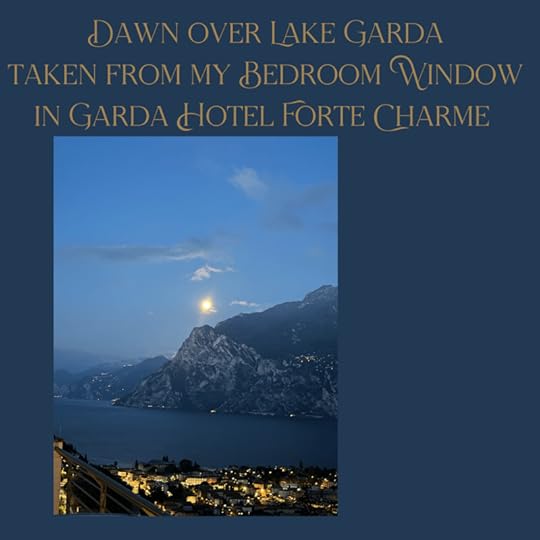
The staff here couldn’t have been nicer. I spent a couple of days touring the lake by ferry and speed boat, and a couple of days resting up (I have strained my knee) and making use of their sauna.
Now that I have got over my jet lag, I will be leaving tomorrow for Stresa, a bustling town on the southern tip of Lake Maggiore.
Stay tuned for my adventures there!
The post Adventures in Lake Garda appeared first on Cynthia Sally Haggard.Cynthia Sally's Blog

- Cynthia Sally Haggard's profile
- 129 followers

