
Cynthia Sally Haggard's Blog: Cynthia Sally's Blog, page 12
September 25, 2024
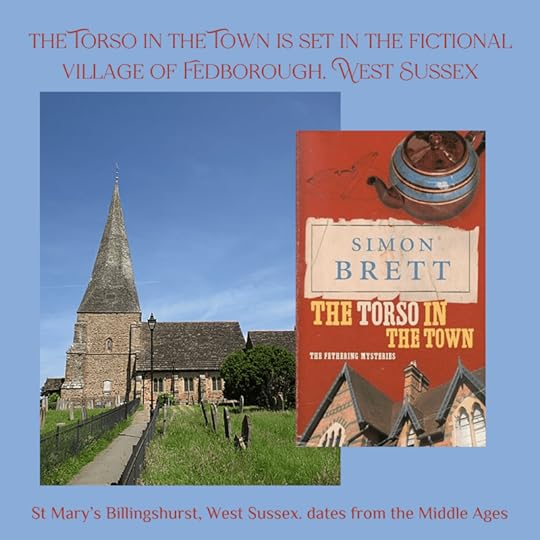
The Torso in the Town ~ Fethering #3 by Simon Brett
In Volume 3 of the Fethering Mystery series, our two sleuths Carole Seddon (proper and rather puritanical) and her next-door neighbor Jude (not-so-proper and free-flowing) are at a dinner party in the nearby town with some incredibly snobbish people (this is set in the early 2000s) when they discover the mummified torso of a woman.
Who could it be? Of course Jude and Carole are dying to know.
As usual, the plotting was deft and I loved the way in which the actual reasons for the murder (as well as the actual people engaged in it) are not discovered because the police stop bothering about the case once their chief suspect dies.
Those of you who have read the first two books of this series will know that Simon Brett enjoys teasing the reader about Jude. Until this volume, we had little idea of who she is, where she came from, whether she married or not, and what kind of work she engaged in. In THE TORSO IN THE TOWN, we learn that Jude is divorced and that she has not one, but two last names: Nichol and a Greek-sounding name beginning with an M. (As I experienced this as an audiobook, I don’t know how to spell it.)
As the blurb notes, this book is not just a murder mystery. It is also a send-up of contemporary Britain. As a person who grew up in 1960s and 1970s Britain this surprised me, as the snobbishness, tribalism and fascination with the social pecking order struck me as very quaint indeed. I left Britain in 1982 and have not lived there for over 40 years. Although I have made many visits, I believed that our generation was more democratic than our forebears. So to hear some of these characters make offensive comments that used to trip off the lips of my grandmother and great-aunts seemed almost surreal.
The other great thing about this volume was the way in which Simon Brett writes so empathically about women. One of my favorite scenes is when Jude is having lunch in a pub and eavesdropping on a couple of men. I loved the way in which Mr. Brett delineated how male laughter sounds to a woman, and how male bonding behavior can seem so repulsive.
So, even if you are not a great fan of murder mysteries, who might want to give this one a whirl. Especially if you are planning on visiting Britain in the near future. Five stars.
 The post The Torso in the Town ~ Fethering #3 by Simon Brett appeared first on Cynthia Sally Haggard.


September 20, 2024
Adventures with Cecylee Part I ~ The Portrait
When I research my novels, I travel to the places where they are set to imbibe the scents, sights, and atmosphere of each place. I always find something I don’t expect.
Take my first novel Thwarted Queen, which is a fictionalized autobiography told mostly in the voice of Lady Cecylee Neville, the youngest daughter of Ralph, Earl of Westmorland and his second wife Countess Joan.

We know only two facts about Cecylee’s youth. The first is that she was born in May 1415, although people cannot agree whether she was born on May 3 (also the birthday of one of her daughters) or on May 31. The second is that on St Luke’s Day 1424, she was betrothed to Richard Duke of York. St Luke’s Day is October 18, and so Cecylee would have been nine years old at the time, while Richard would have just turned thirteen.
It was a splendid match as, upon receiving his inheritance, Richard would be the richest peer in the realm. He was also going to be powerful as he was the closest male relative to the King Henry VI of England, who in 1424, was a mere toddler. Thus Richard of York was also Heir Presumptive to the throne of England.
The collage above shows Cecylee’s girlhood home Castle Raby. But what is so surprising is the image of Cecylee herself, which I touched up and edited from a painting of her in the chapel of Castle Raby.
As it would have been unheard of for a young lady to have had a full length portrait done of herself in the fifteenth century, it is no surprise that this painting, and the accompanying ones of her father and mother and other relatives, were commissioned in 1901 by Henry Vane, the 9th Baron Barnard whose family still owns Castle Raby. The website of Castle Raby describes the ruinous state of the chapel by the late nineteenth century and explains how Lord Barnard, in the course of his renovations, uncovered the medieval arcade and commissioned those portraits. The artists used tomb effigies and stained glass windows as inspiration.
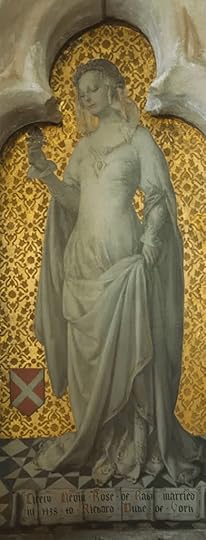
Although many believe that Cecylee and Richard were actually married in 1424, I believe this happened much later, mainly because their first child was not born until 1438. In my novel Thwarted Queen, I put the date of their marriage around 1437, when Cecylee was about twenty-two years old. Interestingly enough, this is borne out by Cecylee’s portrait, whose original is shown just above. The text at the bottom states “Cicely Neville Rose of Raby married in 1438 to Richard Duke of York.” Presumably Lord Barnard agreed with me that Cecylee was married in her early twenties, rather than when she was a child of nine.
Even though this wonderful image was painted 500 years after Cecylee’s death, it so clearly delineates Cecylee’s beauty, with her large eyes demurely lowered, her small nose and her lips curved into a faint smile. It is easy to see why Richard of York was crazy about her, and why she was known as The Rose of Raby.
Cecylee went on to become the mother of two Kings of England ~ Edward IV (1442-1483) and Richard III (1452-1485) ~ as well as great-grandmother to the Tudor Bluebeard Henry VIII (1491-1547).
If this has whetted your appetite for Thwarted Queen, please click on the image below.
 The post Adventures with Cecylee Part I ~ The Portrait appeared first on Cynthia Sally Haggard.
September 18, 2024
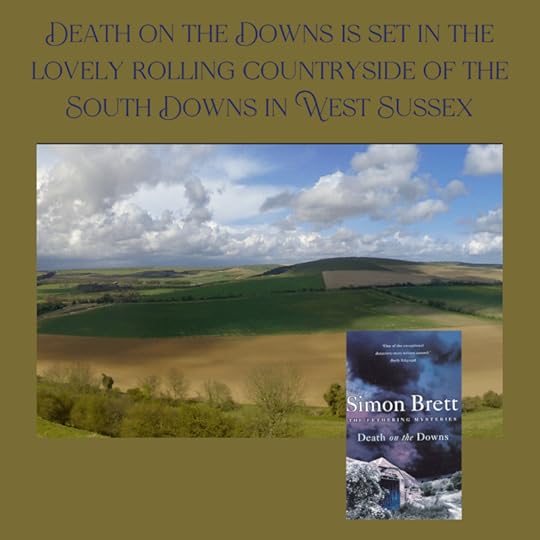
Death on the Downs ~ Fethering #2 by Simon Brett
Although set in 2000, this novel begins in October 1987, with a man who hates his wife, and a convenient storm.
Graham Forbes has spent many years abroad for his work in the British Council, especially in Indonesia where he met his wife Irene, a Chinese woman with a breathtakingly lovely face. He is the chair of the local village council, which strives to keep Weldisham’s historical buildings intact. He is known for his dinner parties, and for being a suave and sophisticated host. So, no-one would take him for a murderer. But that is just what he became in October 1987.
Thirteen years later, in 2000, Carole Seddon, an avid walker, has decided to spend one February afternoon walking on the outskirts of Weldisham when she is caught in a torrential downpour. Her nearest place of shelter is a dilapidated barn. As she sinks gratefully onto a mass of straw, it suddenly gives way, revealing a set of bones. Carole, shocked and upset, immediately calls the police. And that is when the sins of the past start to catch up with Graham Forbes.
One of the things I most enjoy about Simon Brett’s books is their detailed description of place. I knew West Sussex well as a child, as I often went there to visit my father and stepmother in Chichester. The countryside, with its rolling South Downs, flint cottages, and the occasional castle always struck me as benign. It never occurred to me that there were scary chalk pits, cliffs, and hidden caves that could be used to imprison people. But that is exactly what happens to poor Carole, who has become too inquisitive for her own good.
As ever, in Mr. Brett’s deft hands, loose ends are tied up, people are rescued from peril and everything ends (mostly) happily. If you are looking for a new set of whodunnits, you could do worse that the Fethering Mystery series.
 The post Death on the Downs ~ Fethering #2 by Simon Brett appeared first on Cynthia Sally Haggard.
September 13, 2024
My Trip to Sicily Part IV ~ Agrigento
Agrigento in southern Sicily was founded in around 532 BCE by Greek colonists from Gela, Crete and Rhodes. It has had many names. Its original Greek one was Akragas, which may refer to its location on a high plateau overlooking the sea. That name then became romanized into Agrigentum, giving us the name we have today.
One of the most famous sites of this ancient town is the mis-named Valley of the Temples, which is actually on a ridge. As you walk along you are treated to the sights of not just one or two but seven Greek temples, which seem to have been built in the 5th century BCE. The most complete temple is called the Temple of Concordia but the others were just as fascinating. I was lucky enough to pass one of these temples on a gorgeous day in April 2012 when it was shrouded by white blossoms. It is one of my favorite images of this trip and so I have included it in this post.
 The post My Trip to Sicily Part IV ~ Agrigento appeared first on Cynthia Sally Haggard.
September 11, 2024
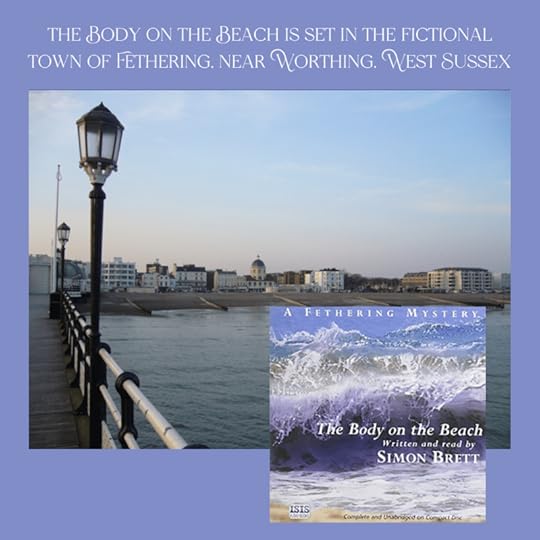
The Body on the Beach ~ Fethering #1 by Simon Brett
When a British writer creates a murder mystery series with alliterative titles, it is clearly meant to be funny. And so, when I picked up THE BODY ON THE BEACH I believed it would be an entertaining…beach read.
However, that is not quite true, for it turned out to be much more than that.
It begins in a comic vein. Carole Seddon, a retired lady in her fifties, is not exactly enjoying her over-quiet life in Fethering, a charming resort town on the south coast of England, which (if you happen to be British) you will realize is the sort of place that people will flock to after their retirement, But she nevertheless is well contented with her lot. For Carole’s life is one of sensible containment. In her view, one must never ask for too much, or one will be disappointed. One should invest one’s money sensibly. One should never be extravagant, so one buys clothes that while not exactly in style will last for years. The only extravagant thing her parents bequeathed to her is her name, with the extra “e” on the end. And so you can see that Carole would not enjoy her retirement as that would be too strong an adjective for her extremely well-regulated emotional life.
Enter Jude, the new next-door neighbor. We don’t know what Jude’s age is, but somehow I have the impression she is younger than fifty-plus Carole. We also don’t know what Jude’s surname (last name) is, as she unaccountably fails to reveal it. The conservative ladies of the prosperous village of Fethering find her first name, Jude, so disconcerting that when they pronounce it they furl it in quotation marks. (It turns out that Jude is short for Judith.) As the reader will discover, Jude is an expert at keeping her secrets, which is quite an achievement in a gossipy little village.
The book opens with a body found on the beach by Carole Seddon, while out walking with her dog Gulliver. It will surprise no-one that Carole lives a life of fixed routines, and so when she returns home, the first thing she does is to give Gulliver a good bath, and then, noticing that the naughty dog has left muddy footprints all over her kitchen floor, she proceeds to give it a good clean. And so it has to be a good hour before she contacts the police. Carole, always conscientious, provide the authorities with a detailed account of the body, including his missing tooth and two strange holes found in his neck. Unfortunately, by the time the police arrive, this corpse has vanished. And so they insult Carole (in a very British way) for wasting police time and never return. But Carole did see the body on the beach. Fortunately, her new neighbor Jude believes her, and so the two ladies put their heads together to solve the crime, as obviously the police are not going to do it for them.
What makes this volume great is Simon Brett’s sensitive portrayal of heartbreak and the ruination of life via substance abuse. Of course, the body that Carole found that fateful morning was a person, with a hero-worshipping son and a long-suffering wife who are waiting for him to return. Of course, the wife is fobbed off by the police when she reports him missing, and so she has no idea that her husband is now dead. When the son realizes that this body is his father, he nearly has a nervous breakdown. And it is that way of drawing out the complex emotions of grief, especially for a young man on the cusp of adulthood, that makes this volume so compelling.
Sooo, if you like British humor, and you are looking for a bit of whimsy to your crime dramas as well as unexpected depths, this is the book for you.
 The post The Body on the Beach ~ Fethering #1 by Simon Brett appeared first on Cynthia Sally Haggard.
September 6, 2024
My Trip to Sicily Part III ~ Siracusa, Sicilia
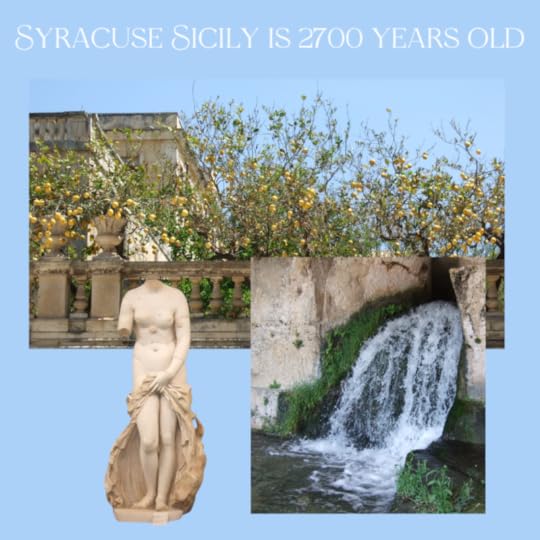
Syracuse Sicily, which is also known as Siracusa in Italian and Saragusa in Sicilian, is 2,700 years old. Founded in 734 BCE by Greek colonists from Corinth, it became the most important city in Magna Graecia, that collection of colonies that extended west into present-day southern Italy and east into present-day Turkiye.
And so we have some very impressive ruins in this city. When I went there on my solo trip of Sicily in 2012, I stayed at a hotel in Ortygia, the beautiful baroque part of the city located right on the Ionian sea. The chief thing I remember were all the lemons in the main piazza, peeking out between the leaves of small trees in large terracotta pots, or sunning themselves over the walls of the nearby baroque mansions
Of course I visited the Greek theatre (Teatro Greco), set up high above the city so that those sitting in those ancient seats have a splendid view of the sea. Then there is the Ear of Dionysus (Orecchio di Dioniso), a cave with glorious acoustics.
Siracusa is a lovely place to visit. If you travel to Sicily you should definitely stop there.
 The post My Trip to Sicily Part III ~ Siracusa, Sicilia appeared first on Cynthia Sally Haggard.
My Trip to Italy Part III ~ Siracusa, Sicilia
Syracuse Sicily, which is also known as Siracusa in Italian and Saragusa in Sicilian, is 2,700 years old. Founded in 734 BCE by Greek colonists from Corinth, it became the most important city in Magna Graecia, that collection of colonies that extended west into present-day southern Italy and east into present-day Turkiye.
And so we have some very impressive ruins in this city. When I went there on my solo trip of Sicily in 2012, I stayed at a hotel in Ortygia, the beautiful baroque part of the city located right on the Ionian sea. The chief thing I remember were all the lemons in the main piazza, peeking out between the leaves of small trees in large terracotta pots, or sunning themselves over the walls of the nearby baroque mansions
Of course I visited the Greek theatre (Teatro Greco), set up high above the city so that those sitting in those ancient seats have a splendid view of the sea. Then there is the Ear of Dionysus (Orecchio di Dioniso), a cave with glorious acoustics.
Siracusa is a lovely place to visit. If you travel to Sicily you should definitely stop there.
The post My Trip to Italy Part III ~ Siracusa, Sicilia appeared first on Cynthia Sally Haggard.
September 4, 2024
The Spanish Bride by Georgette Heyer ~ A Book Review
THE SPANISH BRIDE is not your typical regency romance. For one thing, the marriage that usually culminates a courtship comes near the beginning of the novel, so there is no arc of tension about this relationship. The other feature of this volume is that it deals with the gritty reality of warfare, at a time when the British were engaged in a dogged dragged-out fight to remove the French from the Iberian Peninsula.
In short, THE SPANISH BRIDE is based upon a true story. When Captain Harry Smith meets a Spanish lady in distress, he immediately decides to marry her. His friends are dismayed, for Captain Harry, at the age of twenty-five, is a rising star in the officer corps, and his friends believe that a wife will hinder his progress.
Then there is the matter of the lady in question. For Juana María de los Dolores de León, a descendant of Juan Ponce de León, is of the Hildago class, meaning that she is an aristocrat. What will her family think of her marrying one of those godless English protestants? At the age of only fourteen, she would have to abide by her father’s wishes.
But this is 1812, and we are in the middle of the Peninsular war. Juana has no relatives left and is in certain danger of being harmed, maybe even killed, as the out-of-control men of the British army (who have not been paid for months) rampage through the town of Badajos. And so, Juana and her only remaining relative – an older sister – throw themselves on the mercy of some British officers. One of them, Captain Harry Smith, falls head-over-heels with the sparkling Juana. And because it is not seemly to have an aristocratic fourteen-year-old girl as a camp follower, he decides to marry her. Juana is such a charmer that even Lord Wellington himself offers to give her away at the wedding!
And so the novel begins. Marches, counter-marches, sieges, hunger, dysentery and all the other sordid realties of life that happen when tens of thousands of men march hundreds of miles in all kinds of weather can seem like boring fare for aficionados of regency romance.. But Georgette Heyer is such a talented author that her wonderful characters and amazing descriptions hold this novel together. My favorite piece of the novel that wasn’t connected to Harry and Juana’s romance was about the fight in the Pyrenees as the British army methodically drove the French back into France. I’ll never forget her descriptions of the exhaustion of the men, and how they nevertheless managed to charge up steep inclines to dislodge the French.
If you are looking for something different in regency romance novels, this one is for you! Five stars.
 The post The Spanish Bride by Georgette Heyer ~ A Book Review appeared first on Cynthia Sally Haggard.
August 30, 2024
My Trip to Sicily Part II ~ Taormina
Spending the first few days of my Sicilian holiday in Taormina turned out to be a wise move. I went there because I’d heard that it was beautiful and ~ strangely enough ~ because it was popular with tourists.
I don’t often go to places that are popular with tourists as I hate crowds. But I was traveling solo, a woman alone, in a totally unfamiliar environment. It also didn’t help that I stuck out like a sore thumb in Sicily, because I look Northern European. So while I blend in when visiting countries such as Norway, Germany or the Netherlands, it is completely obvious that I am a foreigner in southern Italy. Which can be a problem if sometime decides to target you for your money, or because they believe that you have come all this way to Sicily to have an affair with them!
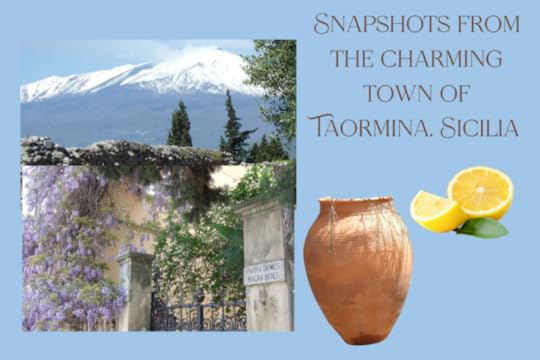
But in Taormina, I was able to relax as I took in the incredible beauty of Sicily, from the snow-covered peaks of Mt. Etna (with its sulky spill of smoke off to one side), an enormous jar from a nearby park, the local fresh fruit market, and a local mansion that proclaimed (in Latin) PARVA DOMUS MAGNA QUIES, which translates as small house, great peace.
Wandering around taking it all in was reassuring, as I found the young men to be extremely polite (probably because I was old enough to be their mothers.) The men who were my age were another matter ~ but I managed. I was careful to wear clothes that looked ladylike, bring a photo album which featured my husband, and even claimed to be older than I was.
If you have never been to Sicily before, you are in for a treat.
 The post My Trip to Sicily Part II ~ Taormina appeared first on Cynthia Sally Haggard.
August 26, 2024
GOD’S HOTEL by Victoria Sweet MD ~ A Book Review
This is a most unusual book. I guess the genre it fits into most comfortably is Memoir, since it is a first-person account of the twenty years that author Victoria Sweet spent as a physician at San Francisco’s Laguna Honda Hospital.
For those who don’t know, Laguna Honda hospital was founded in 1866 during the California Gold-Rush as an Almshouse, that is to say a charitable Institution which provided housing and care to the poorest and neediest people. Dr. Sweet’s patients were the sickest patients, the rejects from the County Hospital. They often had mental illnesses. They often abused drugs. And they often had complex medical conditions that required devoted nursing.
What makes this book so interesting is that Dr. Sweet’s life story is interwoven with her attempts to use the long-forgotten natural medicine of the Middle Ages, as filtered through the brilliant mind of Abbess Hildegard von Bingen (1098-1179.)
For example, when Dr. Sweet was confronted by a patient with a massive bed-sore, she used Hildegard’s concept of Viriditas to heal her. This is how she described her patient’s condition ~
Terry’s bedsore was the worst I’d ever seen. It was huge, enormous and deep. It went from the middle of her back all the way down to her tailbone and it spanned both of her sit bones. The skin was completely gone, of course, but so were the fat and the muscles that cover the spine. In their place was an unidentifiable mass of decayed and decaying and infected tissue from the failed skin graft, and at the bottom of this wide, deep hole I could see bone—Terry’s spine (p. 105.)
Terry’s bedsore was terrifying, because her body had lost its wholeness, its natural protection. A healthy body covered in skin is impervious to fluids and germs. Extra protections come in the form of fat under the skin which cushions the muscles, the muscles which protect the bones, and the bones which protect the spinal cord. Terry had nothing to protect herself from viruses or bacteria.
Because Terry’s bedsore was so substantial, it would take years to heal. And so, Dr. Sweet asked herself, what would Hildegard do? Unlike today, when doctors tend to see our bodies as machines, Hildegard thought of them as gardens, which needed tending. And so, she concluded that Hildegard, the gardener-doctor, would remove obstructions to Terry’s Viriditas, or Terry’s natural ability to heal. She would remove the mass of dead tissue, every single piece of it. She would remove any pressure on Terry’s body, which meant that Terry had to spend her entire time face-down on a gurney. Anything that interfered with the circulation of her blood, such as nicotine, would have to be removed. Dirt, unkemptness, stale clothes, unnecessary medications, fear depression and hopelessness, all of these were in the way and would have to be removed.
It took two and a half years, but eventually Terry was able to fly to Arkansas to spend the rest of her life living with her brother. People in the Middle Ages would have called Terry’s recovery a miracle. But, as we can see from the pages of this volume, it required a lot of caring, a lot of keen observation and a great deal of hard work.
Five stars for a thought-provoking and inspiring book.
 The post GOD’S HOTEL by Victoria Sweet MD ~ A Book Review appeared first on Cynthia Sally Haggard.
Cynthia Sally's Blog

- Cynthia Sally Haggard's profile
- 129 followers

