
Cynthia Sally Haggard's Blog: Cynthia Sally's Blog, page 10
November 29, 2024
The Treffrys and the Rashleighs
My paternal grandmother’s maiden name was Stephanie Treffry. Her surname, Treffry is Cornish with Tre meaning farm and Ffry meaning variously, nose, hill or hill-spur. So you could translate Treffry into Hill-Spur Farm.
The Treffrys have been in Cornwall since about 1260, where they lived at a place called Treffry near Lanhydrock. In Britain they form part of the Landed Gentry, which provides the ruling classes for the local inhabitants in the shape of Squires, and Justices of the Peace.
If you visit Fowey in south Cornwall, you will find the Treffry estate called Place. It is hard to miss as there are various Italianate turrets that tower over the hilly village. If you go to the church of St Fimbarrus, you will see that one quarter of the church is taken up with monuments to various Treffrys. The other quarter (facing the Treffry monuments) is taken up with monuments to the Rashleigh family. The placement of these monuments, which glare at each other across the central aisle of the church, provides the faintest suggestion that the two families did not always get on.
According to Grandma Steffi, the Rashleighs were actually a branch of the Raleigh family, whose most famous member was Sir Walter Raleigh (1553-1618), swashbuckling adventurer who was given a grant by Queen Elizabeth I to explore the Virginia Colony. But I am not sure she was right. True, both the Rashleighs and the Raleighs came from Devonshire. But whereas the Raleighs were landed gentry from the Yeo Valley near Barnstaple in North Devon, the Rashleighs seem to have been merchants from the Taw Valley near Wembworthy in mid-Devon.
One Philip Rashleigh (died 1555) migrated from Devon to Cornwall, where he bought the manor of Trenant in 1545 from King Henry VIII, shortly after the Dissolution of the Monasteries. The Manor of Trenant is located near Fowey, and was originally part of the Priory of Tywardreath. Philip Rashleigh’s youngest son John purchased the estate of Menabilly, also near Fowey, and his branch of the family became successful and powerful merchants during the reign of Elizabeth I.
Possibly the Treffrys did not take kindly to their new neighbors gaining such power. After all, the Treffrys had lived in Fowey at least ninety years longer than the Rashleighs. In 1457, Dame Elizabeth Treffry was responsible for repulsing a French invasion of Fowey. (My grandmother was never quite sure whether she poured molten lead on the heads of the French soldiers as they clambered up the castle walls, or boiling oil.) In any event, the Treffrys became the heroes of the day. In the previous century, a Sir John Treffry had fought with distinction at the Battle of Crécy in 1346. And so the head of the family is always called “de Cressy Treffry.”
Perhaps the real problem between the Rashleighs and the Treffrys was that the tiny village of Fowey was too small for two such powerful families!
Do you have any amusing family stories you wish to share? If so, please click here and I will feature it in an upcoming post.
 The post The Treffrys and the Rashleighs appeared first on Cynthia Sally Haggard.


November 27, 2024
THE VANISHED DAYS by Susanna Kearsley ~ A Book Review
Though she writes about Scotland during the Jacobite era (1688 to 1745), Susanna Kearsley is a Canadian author who lives near Toronto. Obviously, she has Scottish ancestors, some of whom must have been players in the Jacobite rebellion. I have not read her first two novels – Undertow published in March 1993 or The Gemini Game published in March 1994 – so I can’t comment on this work. But starting with Mariana (1995), and following along with The Splendour Falls (1996), Named of the Dragon (1998), The Shadowy Horses (1999), Season of Storms (2001), The Winter Sea (2008), The Rose Garden (2011), The Firebird (2013), A Desperate Fortune (2015), and Bellewether (2018), I have read every Susanna Kearsley book out there. And they are all wonderful. So when I learned that a new one had appeared, I opened it in great anticipation.
I hate writing negative reviews, but I would be lying if I didn’t tell you all how disappointing this book is. And I don’t understand quite why it is so bad. For, as you can see Ms. Kearsley is an experienced writer, not a newbie.
So what is wrong with The Vanished Days?
In my opinion, the main problem has to do with pacing.
Yes, of course you need to create slow, intimate moments between your reader and your character, where you allow emotions to unspool on the pages. You need glorious descriptions. You need to linger. But you don’t want to do that all the time. You want to leaven your slow moments, with fast ones. You want to skim over needless detail. You want to edit out all the boring bits. But in this volume, the reader is obliged wade through too many weeds, before getting to the heart of the novel.
It takes Ms. Kearsley the first third of the novel – with all of its background detail, digressions and meanderings – to start the engine of the novel! That is 5 hours and 43 minutes of stuff that the reader is obliged to wade through before something actually happens. What happens? Something tragic happens to ten-year-old Lily, the heroine of this piece. Before this gut-wrenching incident, I got so weary, I nearly abandoned the novel.
Once something does happen – at the ten hour mark – things begin to get more interesting. But there are still too many problems. Ms. Kearsley is too fond of information dumps, given in the form of long speeches her characters make to each other about Scottish politics. This is calculated to make the reader fall asleep.
Then there is That Scene. Or rather there are two scenes which are extremely confusing.
The first one occurs when the narrator, Sergeant Adam Williamson, describes how Matthew Brown suddenly appears while he is in the middle of talking with Lily (now in her early thirties.) And how Lily “with love in her eyes” rushes past Adam to embrace Matthew, her long-lost beau. This is all the more frustrating for Adam because he had just been kissing Lily passionately. But Adam’s reaction is so strange. He merely shrugs his shoulders and lets her go. I don’t know of any man who would allow that to happen without registering some sort of protest.
Which brings us to That Scene, ~ SPOILER ALERT ~ in which we realize that Adam Williamson the narrator is in fact Matthew Brown the romantic lead. Wait a minute, I can hear nearly every reader saying. If Lily recognized that it was Matthew Brown who was heading the enquiry to investigate her case, if it was Matthew who realized she was trying to con money out of the government via a sham marriage certificate, why was she so anxious? True enough, she was caught in a snare between being hanged for her “crimes” and ruining the reputation of the young woman (Maggie) in her care. But surely Matthew would have that all sorted for her. After all, they had loved one another for years, and Matthew is a clever and resourceful character. And surely, she would have recognized him, even after ten years of not seeing him, and even if his name were completely different?
I have seen many writers execute plot twists with successful aplomb. But this one thudded with a clunk. And I don’t understand why such a skilled and talented author let that happen. Surely Ms. Kearsley is an experienced enough writer not to make rookie mistakes?
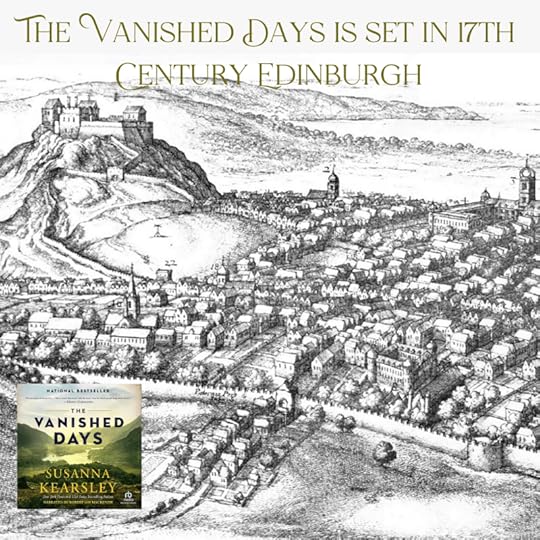 The post THE VANISHED DAYS by Susanna Kearsley ~ A Book Review appeared first on Cynthia Sally Haggard.
November 22, 2024
Adventures with Cecylee Part III ~ The Lockup
Lady Cecylee Neville, the protagonist of my first novel Thwarted Queen, was the youngest daughter of Ralph, Earl of Westmorland, and his second wife Joan de Beaufort.
Earl Ralph was a shrewd operator. As a relatively young man, he became a protégé of John of Gaunt, Duke of Lancaster, and so, when his first wife died in June 1396, he married John’s nineteen-year-old daughter Joan in November of that year. His second wife had royal blood flowing through her veins as her father John of Gaunt was the third son of King Edward III (1312-1377).
When Richard, Duke of York was orphaned in 1415, Earl Ralph acquired his wardship. This meant that he had total legal control over four-year-old Richard who would not achieve his majority until 1432, when he turned 21. In October 1424, as was his right, Earl Ralph betrothed his nine-year-old daughter Cecylee to thirteen-year-old Richard. This was a splendid match for not only would Richard be rich once he received his inheritance, he was also the closest male relative to the King of England, making him Heir Presumptive to the throne.
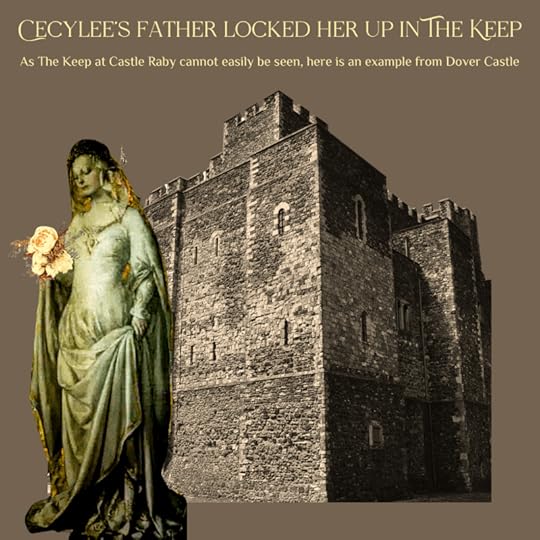
However, Earl Ralph had a problem. As Warden of the Western Marches charged with repelling the maraudering Scots, Earl Ralph was obliged to keep a standing army at Castle Raby, the family seat. But he couldn’t allow his lovely daughter to be pestered by young men. After all, it wouldn’t be seemly for the would-be wife of the Duke of York and Heir Presumptive to the Throne to be caught in a rough soldier’s embrace. And so he locked her up in The Keep.
In Thwarted Queen, I have Cecylee confront her father over the issue of her personal freedom, and get severely punished for her insolence.
Earl Ralph put his most trusted men on the ground floor of The Keep, while his daughter resided in the top of the tower. The main room was large, having plenty of room for a canopied bed, chests, chairs and tables. Off to one side is a much smaller room where her damsel would sleep. There are windows, but they are very high up, making it difficult to see out of the window without standing on a chair. And so Cecylee was caged up, waiting for the time when her marriage to Richard of York could finally take place.
If this has whetted your appetite for Thwarted Queen, please click here.
 The post Adventures with Cecylee Part III ~ The Lockup appeared first on Cynthia Sally Haggard.
November 20, 2024
THE BEEKEEPER’S APPRENTICE by Laurie R. King ~ A Book Review
THE BEEKEEPER’S APPRENTICE strains credulity. If I ever thought that someone as self-centered as Sherlock Holmes would ever take on an apprentice, I would naturally have assumed it to be a young man, as Holmes consistently feels uncomfortable in the presence of women, or, at least, treats them in a very patronizing manner.
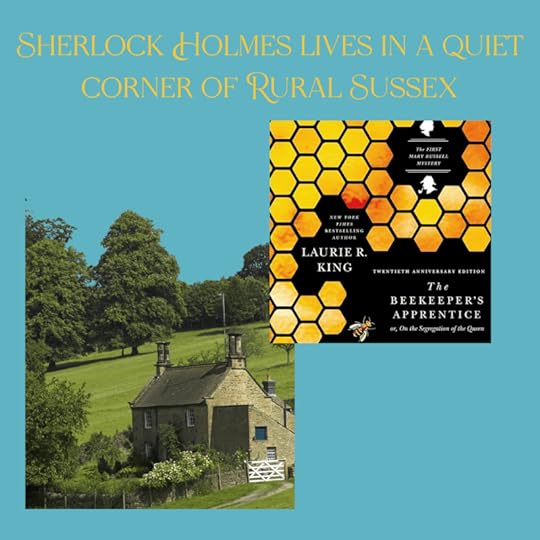
But perhaps I was wrong about that. Taking her cue from Holmes’ evident admiration of Irene Adler, author Laurie R. King presents Holmes with a young lady whose mind is just as brilliant as his. The opening scene of THE BEEKEEPER’S APPRENTICE is priceless. There is Sherlock Holmes, world-famous detective (now retired) sitting on the ground ins some obscure corner of Sussex watching bees, when a young lady, her nose in a book, nearly steps on him.
Being British he merely clears his throat.
She looks up, irritated. Why has his absorption with watching blue-spotted bees caused him to be in her way?
How did you know that? he asks.
It’s obvious, isn’t it? she replies impatiently. And proceeds to give an account of her reasoning in a way that matches Holmes’ own thought-processes.
Holmes is rarely flabbergasted. But this young person has surprised him. Like most smart people he is lonely, because he cannot find someone on his level to discuss things with. But this young person has just remedied that unfortunate situation. Of course Holmes believes her to be a young man as she is garbed in her late father’s clothe, her long hair hidden beneath a cap. So when she pulls off her cap, letting her fair hair stream down he is astounded.
And so begins their relationship, with 54-year-old Holmes acting as mentor to a 15-year-old spitfire of a girl.
This volume is a marvelous evocation of the 1910s, mostly through Ms. King’s adroit use of language. She never makes a mistake. There are no jarring anachronisms. Instead the reader can lean back and enjoy the banter between Holmes and his new friend.
But the book would not sing without the character of Mary Russell. She gives new life to Holmes, who was slowly dying of boredom (literally.) And as she grows older and becomes more poised and confident, she stands up to Holmes’ paternalistic instincts, insisting on being a partner in his endeavors.
 The post THE BEEKEEPER’S APPRENTICE by Laurie R. King ~ A Book Review appeared first on Cynthia Sally Haggard.
November 15, 2024
MAIDEN TOMB Cover Reveal
Thank you all for participating in my survey and choosing a wonderful cover
for my new novel MAIDEN TOMB,
which will drop 4 February 2025 on Amazon!
The post MAIDEN TOMB Cover Reveal appeared first on Cynthia Sally Haggard.Adventures in the Balkans 2010
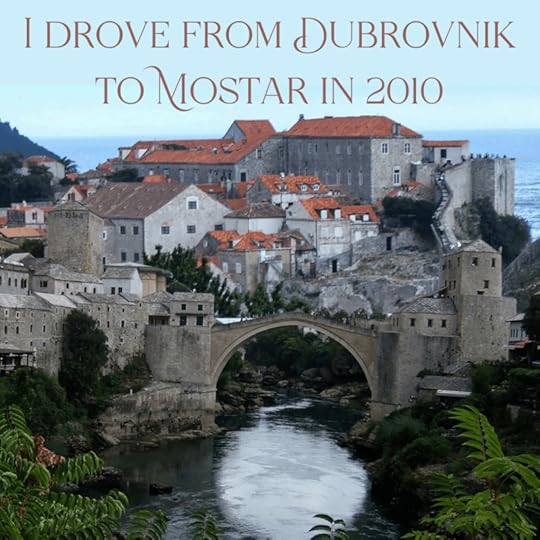
If you recognize the upper part of the image, that is because some scenes from Game of Thrones were set in Dubrovnik, Croatia. The bottom part of the image features the famous bridge in Mostar, Herzegovina, which was built in the 1500s.
~~~~~~~~~~~~~~~~~~~~~~~~~~~~~~~~~~~~~~~~~~~
Many years ago, my husband and I visited Mostar in Herzegovina. As many of you know, the town is Mostar is famous for its storied bridge, commissioned by our friend Suleiman the Magnificent (1494-1566), whose tomb I visited recently in Istanbul.
During the Bosnian War of 1990s, this bridge was destroyed. However, by the time my husband and I arrived in Mostar in 2010, it had been restored to its former glory.
My husband lives on inspiration so nothing about this trip was exactly planned. We left Dubrovnik, where he had been attending a conference, and drove north from Croatia to Herzegovina. Somehow – I don’t remember how – we found a Muslim family who agreed to let us stay for a few days in their B & B.
I don’t know much about Muslims, but I tend to think of them as being very conservative. So imagine my surprise when I discovered a television in our bedroom, which allowed us to watch the Italian Fashion Week from Milan. Obviously, their target audience was not conservative Muslims living in Mostar!
The next morning, my husband and I went downstairs to breakfast. I may not have mentioned this before, but he is unable to function without his coffee. But it can’t just be any coffee. It has to be an espresso, preferable made to the exactly standards of a Milanese caffè. So, imagine his disappointment to discover a machine, which only delivered Nestlé coffee!
The young man who was serving breakfast, was very polite, but his English was not up to my husband’s demands. So his uncle appeared. When my husband explained the problem, this older gentleman offered to have his wife make Turkish coffee. Immediately, my husband brightened.
“By why,” he asked, “if they could provide Turkish coffee did they have a machine that provided only Nestlé?”
“It’s the German tourists,” explained the gentleman. “That is what they like.”
Ten minutes later, he reappeared with a brass tray on which stood a Turkish coffee pot emanating coffee fumes, with a brass bowls of sugar cubes squatting beneath some tongs, and two bone china cups and saucers.
I have never tasted Turkish coffee before and was rather taken aback by its power. But my husband was in seventh heaven. Inspired by the assault on his senses of the black liquid he was imbibing, he engaged the uncle in a long conversation about the history of Mostar and recommendations for what to visit.
We had a wonderful stay.
 The post Adventures in the Balkans 2010 appeared first on Cynthia Sally Haggard.
November 13, 2024
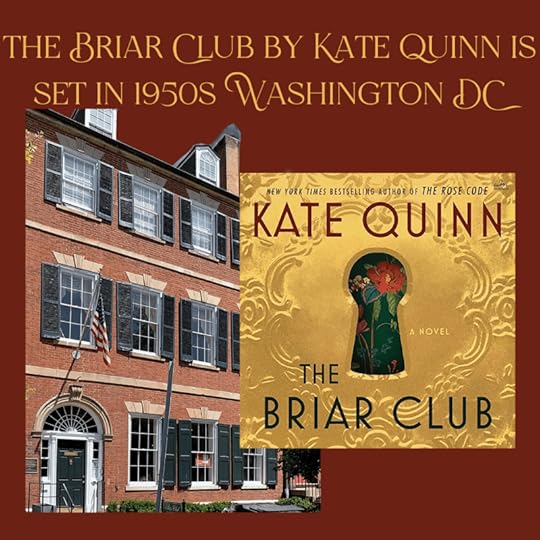
THE BRIAR CLUB by Kate Quinn ~ A Book Review
If, like me, you go to Google Maps to find Briar and Wood streets in the Foggy Bottom neighborhood of Washington DC, you would be disappointed. For they do not exist. But it has to be said that the old neighborhood has undergone huge changes since the 1950s, when THE BRIAR CLUB is set. The biggest change is the creation of the I-66 highway which travels from Washington DC, through the Northern Virginia suburbs to Front Royal, where it connects with I-81.
I-66 starts in Foggy Bottom, snaking south from K Street, across Virginia Avenue past 25th street, G, F, E and D Streets to begin at the back of the Kennedy Center before flowing over the Teddy Roosevelt Bridge. It doesn’t take much to see that a huge amount of real estate is involved in collecting all that traffic and moving it over the Roosevelt Bridge to Virginia, real estate where old neighborhoods vanished forever when I-66 was constructed in the 1960s and 1970s.
So you can view this book as a homage to the sleepy city that Washington DC was in the 1950s, before it was connected to the rest of the country by the new highways that have sprung up in the last 70 years.
The great strength of this books is the way it is written. It starts with the murder(s) that happen on Thanksgiving Day 1954, when the inhabitants of Briarwood House (so called because it is on the corner of Briar and Wood) are about to enjoy their Thanksgiving turkey. However, Kate Quinn cleverly neglects to say who is murdered. Instead, she takes you into Pete’s head, the son of the family responsible for being the Man of the House at the age of 13, due to an absent father. We hear all about Grace March’s arrival at this downtrodden boarding house four years before from Pete’s point of view. Next is Nora, a proper young Irish woman who is appalled at her attraction for a gangster. Then there is Reka, an elderly Hungarian woman, who has fierce opinions, Fliss, a young English woman with an absent husband who is just overwhelmed with baby care, Bea, a former professional sports-woman, and Claire, a friendly con woman with light fingers. The best is saved for last when we finally get to know Grace, the mysterious yet kind woman who transforms a dreary boarding house into a venue for laughter, love and life, and her polar opposite, the rather poisonous Arlene.
All of these characters jump off the page, mainly because we are given approximately 20,000 words in their point of view which ensures that we know them well. What a clever piece of writing! If you are interested in what it was like to be a woman in McCarthy-era America, you should read this gem.
 The post THE BRIAR CLUB by Kate Quinn ~ A Book Review appeared first on Cynthia Sally Haggard.
November 8, 2024
Marie Blaise and the Franco-Prussian War
The history of Alsace-Lorraine is turbulent. It is the most German part of France, right up against the German border, and so it is no surprise that German traditions have spilled west into Alsace-Lorraine.
My husband’s great-grandmother, Marie Blaise, witnessed the arrival of the German army in 1870, during the Franco-Prussian war. If you look at photos of this event, you see these large German men – looking even larger under their plumed helmets – riding huge horses. To a young girl, they would have seemed terrifying. And she was right to be alarmed, for the photos of the Franco-Prussian show an unbelievable level of destruction, which is sadly all-too-familiar to us today.
Having taken over Alsace-Lorraine, the Germans demanded that everyone change their names to make them seem German. And so poor Marie’s last name would have become Bletz, rather than Blaise.
The final insult was requiring its French-speaking inhabitants to speak German. But like so many, her parents refused to kow-tow to the Germans, leaving for Paris to open a bistrot instead.
 The post Marie Blaise and the Franco-Prussian War appeared first on Cynthia Sally Haggard.
November 6, 2024
THE CRIME AT BLACK DUDLEY by Margery Allingham ~ A Book Review
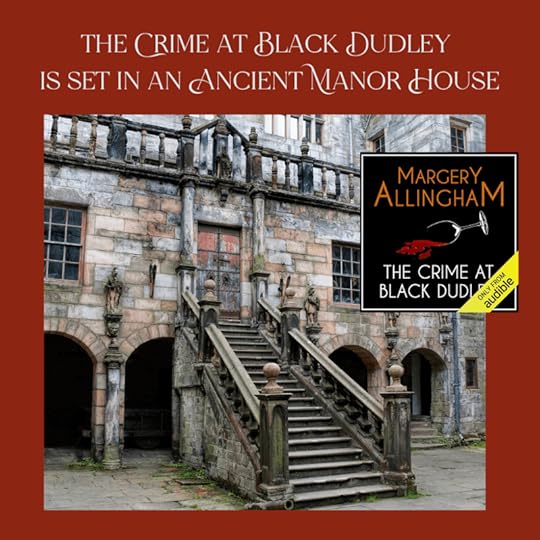
THE CRIME AT BLACK DUDLEY is a typical Country House Cozy, where the house – with its hidden passages, cupboards that lead to priest holes, and sullen aura – becomes another character. And, like many talented whodunit writers, the person who actually committed the crime is the last person you would suspect.
We arrive on Friday evening to a house party at the aged mansion of Black Dudley, just as the guests are getting to know one another. Everyone is bubbling with the fun of it all, and they sit down to dinner. After dinner, someone notices an amazing piece of art – a magnificent dagger that is intricately designed. No-one seems to know when the Petrie family – who own Black Dudley- acquired it. But it seems to be Venetian, and it may date from the 1300s. The host, Wyatt Petrie, retrieves the dagger and it somehow comes about that the guests agree to a charade whereby the lights are extinguished and the dagger is passed around the various guests. At some point the game ends when the gong is sounded, and whoever is still holding the dagger loses and has to pay a forfeit. The forfeit can be money. It can be kisses. Or it can be some daring act. But no-one wants to be seen with the dagger when the lights come up.
It all seems harmless enough. However, the protagonist of this story Dr. George Abbershaw, not fancying being in the dark, in a creepy house with a dagger on the loose, strolls out to take a look at all the cars occupying the garage. George is fond of cars, and is not surprised to meet another guest – Albert Campion – loitering there. They make a surprising discovery, for one of the cars that seems extremely old-fashioned, turns out to have a state-of-the-art Rolls Royce chassis and motor underneath. Whose car could it be?
However, this mystery is chased out of their minds when they both return to the mansion, only to find that Colonel Coombe – an uncle-by-marriage to the host Wyatt Petrie – has suddenly died. His private physician claims that he has been carried off by a heart attack, but George Abbershaw – a pathologist by trade – doesn’t believe him.
And so the engine of the story starts. The very next morning, after breakfast, our guests find that they have actually been imprisoned at Black Dudley and cannot leave. And this fact leads us into places that are darker than the usual cozy. But at least, the reader gets a happy ending.
This story was published in 1929, and it shows it. The story gets off to a slow start, and also takes its time in ending. Despite that, I think you will find that Margery Allingham is a talented writer, with a great ear for the speech of others.
 The post THE CRIME AT BLACK DUDLEY by Margery Allingham ~ A Book Review appeared first on Cynthia Sally Haggard.
November 1, 2024
The Ball Family ~ Relatives of George Washington’s Mother
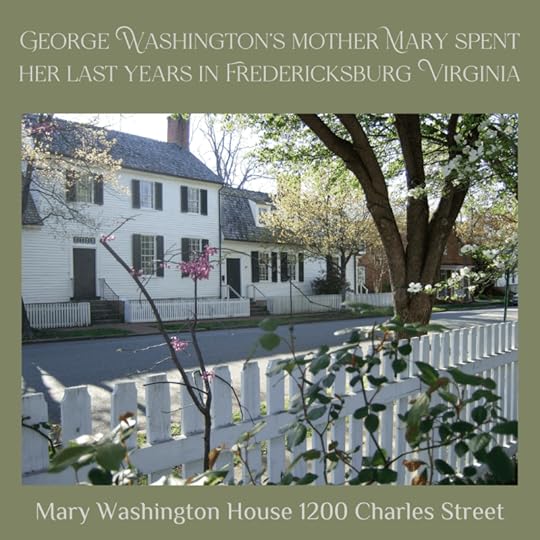
In 1772, when she was around sixty-five years old, Mary Ball Washington moved to 1200 Charles Street in the charming town of Fredericksburg. It was not far from the property that she had managed most of her adult life, being only two miles away from the land that is now called Ferry Farm.
Mary Ball Washington was the only daughter of Joseph Ball and Mary Johnson. This was a second marriage for both of her parents, and Mary was the only child of that union.
Mary’s father was an English-born justice, who became an important member of the planter class in Lancaster County Virginia. Born in 1649 in Halifax, West Yorkshire, in the same year that Charles I was executed by Oliver Cromwell, Ball would have spent his first years in a Puritan Theocracy, in an England where singing, dancing, or any form of entertainment were banned. With the arrival of Charles I’s son Charles II, in 1660, the pendulum swung the other way, for Charles II was notorious for his extravagant dress, his gambling, and his mistresses (he had at least fourteen illegitimate children).
What young Joseph Ball would have made of this is hard to say. His own father, William, moved to the colonies in 1657 before the accession of Charles II, to become a trader and planter, eventually settling in Lancaster County in the community of Millenbeck.
Joseph Ball did not follow his father. Perhaps his (mother’s?) family thought him too young. After all, he would have been only seven going on eight in 1657. And so he remained in England until the 1670s. Of course we do not know the exact date that he left England. However, he was in Lancaster County Virginia by 1680, when his father died.
Like many young men who have to make their way, Joseph Ball did not marry until he was in his thirties. His marriage must have occurred around 1682 – when he would have been around 33 years old – because his first child was born in 1683. HIs wife Elizabeth Romney gave him five children before dying some time in the early 1700s.
Joseph Ball’s most famous child Mary, was born in around 1708, and so he must have married his second wife Mary Johnson shortly after his first wife’s death.
By this time, the children of his first marriage were all adults, and presumably settled. So when he died in 1711 at the age of 62, it was his youngest – four-year-old Mary – who bore the brunt of that unfortunate event. When Mary’s mother died ten years later in 1721, she was made a ward of George Erskine, whose sister Jane had married into the Washington family. Which is how Mary Ball met Augustine Washington, and how our first president George Washington (1732-1799) came to be.
 The post The Ball Family ~ Relatives of George Washington’s Mother appeared first on Cynthia Sally Haggard.
Cynthia Sally's Blog

- Cynthia Sally Haggard's profile
- 129 followers

