
Cynthia Sally Haggard's Blog: Cynthia Sally's Blog, page 6
May 30, 2025
GEORGE, NICHOLAS, WILHELM ~ THREE ROYAL COUSINS AND THE ROAD TO WORLD WAR I by Miranda Carter
A Fascinating Account of Three Infantile Men
I do not usually care for biographies, they often seem to consist of the boring trivia of a person’s daily life. But GEORGE, NICHOLAS, WILHELM: THREE ROYAL COUSINS AND THE ROAD TO WORLD WAR I is different. Miranda Carter deftly weaves together the biographies of the three cousin-emperors who together stood on the brink of the abyss in 1914: George V of England, Nicholas, the last Tsar of Russia, and Wilhelm, the last Kaiser of Germany.
What I really enjoyed about this book was the way in which it was told. Ms. Carter chose her details judiciously, so that instead of feeling swamped by the minutiae of the privileged lives of three people who ironically tended to focus on trivial details themselves, she gives you the right sweep of psychology, politics and detail to make you understand very clearly why two of these three men were an utter disaster as autocratic heads of state, while at the same time, breathing a sigh of relief that the third (Georges V of England) was hemmed in by his parliament.
The tragedy that happened at the Ipatiev House in July 1918 haunts us still. It is hard to read about four innocent girls and their brother being gunned down by the soviets, but I didn’t realize how mild-mannered, relentlessly polite “Nicky” had turned into such a monster against his own people. Nor did I realize that his hated wife had such power towards the end of their reign, that she was dismissing ministers right and left, in a fashion that would have been comical had it not been so tragic.
I also had no idea that Kaiser Wilhelm was a closet homosexual, or that he was so infantile. And what fascinated me about this book was the culture of late 19th-century Europe that promoted the infantilization of children of both sexes to such a degree that it is fair to say that in a very real way, none of these men ever grew up. It would be fascinating to read a sociological history that explains how this culture of infantilization came about. Five stars.
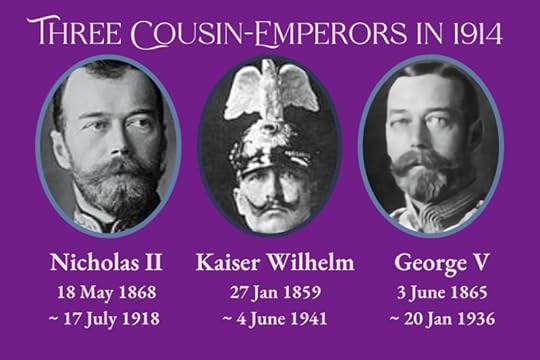 The post GEORGE, NICHOLAS, WILHELM ~ THREE ROYAL COUSINS AND THE ROAD TO WORLD WAR I by Miranda Carter appeared first on Cynthia Sally Haggard.


May 27, 2025
Third Day in Lisbon
Today started well enough. It was another gorgeous sunlit day, that began chilly We went on a walking tour of downtown Lisbon with a local guide. She took us to San Geronimo Convent, the Discoverer’s Monument (shades of Stalin) and the Belem Tower. Then we got back on the bus and went to Restauradores Square, and Rossio square, both of which I’d seen yesterday.
She made various suggestions for lunch, and pointed to a street of restaurants. I sat down at the first one I came too, but really should have spent more time looking. Yes, it was cheaper than yesterday’s. Yes, the fish was beautifully cooked, but it was so full of bones it was hard to eat.
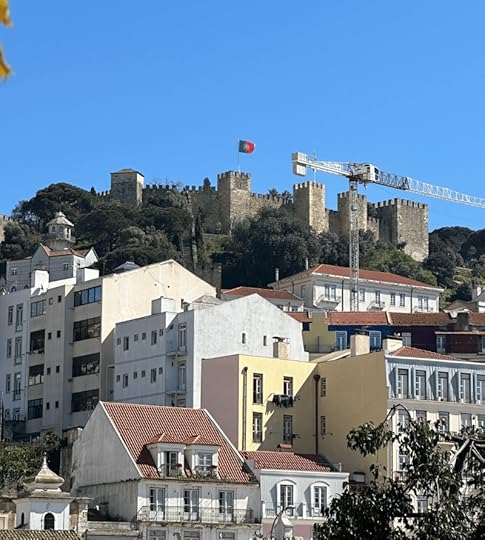
After lunch, I decided to try and get to St George’s Castle, which I’d somehow missed on my walk around Alfama. The guide had told us to go to the blue house in Figueira Square, follow the tram tracks until the end of the track, and then turn right.
There were two problems with this advice. Firstly, there were two blue houses in Figueira Square, not one. Secondly, after picking the wrong house, the tram line forked, so on the grounds that I had to eventually turn right, I picked the left fork.
As before, I found myself lost in the maze of streets of Alfama. Unlike yesterday, the area I was in today was a lot less pleasant, with no lovely buildings, but rather doorway after doorway of people who seemed poor, immigrant and not in good health (coughing). Given the way I look and the way I was dressed (straw hat) I screamed tourist. I felt very uncomfortable walking through this area, although no-one was rude or aggressive. However, I didn’t know what to do, so I continued. After about 30 minutes of this, with the sun pouring down on my head and the temperature rising to 80 degrees, I decided to call it quits. It was impossible to see the castle, because I was too close to it. So as soon as I found a street with lots of traffic on it, I made for it. Peering at my iPhone, I deduced what the correct direction was, and walked with great relief along a straight street. Eventually, I made it back to Figueira Square.
I glanced at my watch, and it showed the time to be 2:30. So I decided to make my way to the iron elevator, go up it, and explored Caixa, which the guide had descrbed as a cool place. I walked through Figueira and Rossio squares, and got to a place where the elevator wasn’t that far away. But by this time, I was exhausted, my feet were swelling, and I was boiling under that sizzling 80 degree heat. So I called that quits too, and made my way back to the pick-up point at Restauradores Square.
And that is when everything began to go wrong. To start with, I arrived at 2:50, expecting the 3:00 bus. But when it didn’t show, I realized that the hotel shuttle doesn’t come at 3 pm. By that time, I was feeling dreadful. There were very few places to sit, and the sun was pouring down from a cloudless sky onto a large square with no shade. Finally, I found a bus stop so I could sit down, and thank heavens managed to catch a breeze from the river. I considered getting a metro back to the hotel, but was in too bad a shape to contemplate it.
And so I waited. And waited. At around 3:30, when the bus should have arrived, a woman suddenly asked me if I was waiting for the Corinthia Hotel shuttle. When I said I was, she introduced herself as Valerie.
Well Valerie and I stood there chatting, until about 3:50, when two people from our group appeared. Turned out that the shuttle bus had been unable to get through to Restauradores Square, because the road was closed. And so the driver had left them off six blocks to the north and they’d walked down. I tried to call the hotel, but no-one picked up. So I then told Valerie and the others that we should take the metro back.
The couple disappeared to enjoy their time in Lisbon, while Valerie and I made for the metro. We managed to pay our fares (I with my credit card) and then the train arrived soon after we arrived on the platform. But it was completely jammed. Valerie wondered whether we should wait, but I’d had enough, so I persuaded her to get on. Eventually, we managed to find seats, and when we got to our stop, which is the Zoo stop called Jardim Zoologico de Lisboa, we got off, along with hordes of people.
After tapping my credit card, we were out in the station forecourt. But Valerie said we were on the wrong floor, so we walked down a level, and walked out to the road. It turned out that Corinthia Hotel was just across the street.
I was so happy to be back! What a relief to be back in my room, where I could wash my hair and have a cool shower. I finished the day off by packing, for we are going to Evora tomorrow, and our large suitcases have to be out by 8.
 The post Third Day in Lisbon appeared first on Cynthia Sally Haggard.
May 23, 2025
MARMEE by Sarah Miller
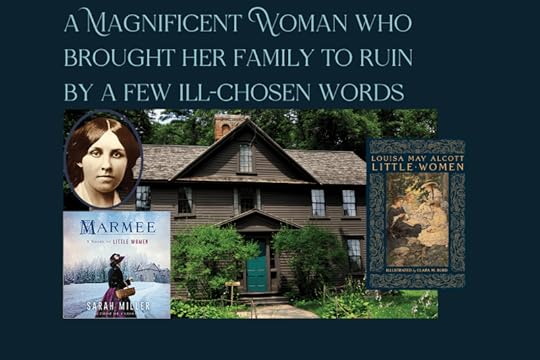
MARMEE by Sarah Miller is a re-telling of Louisa May Alcott’s LITTLE WOMEN from the point of view of MARMEE, the much-admired and much-sainted mother of Meg, Jo, Beth and Amy.
I am one of those readers who was completely captivated by this book to the extent that I would have given it more than 5 stars if I could.
How I loved Marmee’s voice. The poor woman is so compassionate towards everyone, and her cross to bear is that she is married to a man who is just as compassionate as she. But instead of raiding the pantry as Marmee does, he raids his salary to help others, meaning that he sends his wife less and less each month. How is a single woman with her husband away at the front going to be able to feed and clothe six people? When her husband only sends 39 dollars (instead of his actual salary of $150), because he “knows” that she “will not mind” that he spent the remainder of his salary on boots, blankets and cloaks for his men.
Thankfully, Jo, Beth and Hannah (Marmee’s beloved maid-of-all-work who has been with her forever and knows all her secrets) don’t care how they look. But what is she going to do about Meg, who is expecting a silk parasol for her birthday? Or Amy, who requires finery AND art supplies?
Fortunately Marmee is extremely resourceful, but she could not have pulled off such a miracle without the kindness of her wealthy next-door neighbor, Mr. Laurenace.
And so we are off into the world of Little Women. We learn about Marlee’s dreams of a union between Laurie and Jo. Of her delight at Meg’s wedding to John Brooks. Of her equal delight when Amy is invited abroad on a European tour (and how she soothes Jo’s ruffled feathers before Amy appears.). We learn that Meg irritates her with her love of finery. That Amy irritates her with her snobbery. That she sees Beth ask an angel. And that plain-spoken Jo is the daughter she feels greatest kinship with.
It is fascinating to see the “backstory” of Little Women being so well laid out. We learn that Marmee has an even worse temper than Jo. And that she brought her family to ruin by a few ill-chosen words.
Marmee bears a constant load of pain, grief and regret, and yet she is a magnificent woman. If you loved the original novel by Louisa May Alcott, you will love this. Five stars.
 The post MARMEE by Sarah Miller appeared first on Cynthia Sally Haggard.
May 20, 2025
Second Day in Lisbon
The reason why I do tours, is because trying to navigate a city I don’t know in a language (Portuguese) that I don’t speak can be very taxing.
This second day in Lisbon proves my point.
I took Corinthia Hotel’s free shuttle down to Restauradores (Restoration), the heart of old town Lisbon with a plan of finding the Tourist Office first. There was a tourist office in the square, but it was closed. I went to the Police Office of Tourism next door, and the woman there told me it was on the other side of the street, near a kiosk.
I crossed the very busy street, and spoke to a man in a large kiosk. He told me it was in the next square, pointing south.
This took me to Rossio Square, the largest in Lisbon. I peered around, but it was hard to find anything by sight, so I began the task of walking around the square, looking for a kiosk. I did find a kiosk, and two young women who wanted me to get on a hop-on, hop-off bus. I asked about the tourist office, and they really weren’t sure where it was. One of the women used her iPhone to find out, and discovered it to be in Praça Duque da Terceira. So I plugged that into my iPhone and took off, once they’d given me one of their brochures. I really didn’t want it, but recognized it as an informal kind of payment for their cooperation.
My walk took me out of Rossio Square to the south, where it gave onto Commercial Square (absolutely gi-enormous) which gave onto the river, which was so wide at that point it looked like the sea. I looked around and spied the Tourist Office sign (an i) and made a beeline for it. Then I queued up and talked to another young woman, who was singularly unhelpful. No, she couldn’t help me evade tourists, because there were always tourists in Lisbon. No, there weren’t any special neighborhoods with winding streets, because all of Lisbon was medieval.
I sat down at a nearby table in the office, trying to decide what to do. I looked at the map and saw that the Fado Museum was nearby, so walked in that direction. (Fado means Fate, and is a kind of haunting song that rose up in the 1860s as a kind of working-class resistance during a turbulent time in Portugal’s history.) That turned out to be a lucky choice, for by following the map I found myself on Rua dos Bacalhoeiras where an older woman handed me a menu outside Cais na Preguiça a 4.7 star Portuguese seafood restaurant.
It was a bright and sunny afternoon, the food was marvelous and I loved the red Sangria I had with it. After lunch, I found my way to the Fado Museum, which was as interesting as I hoped it would be.
Afterwards, I needed to get back to Restauradores Square to get back on the free shuttle to Corinthia Hotel.
And that is where things went very wrong.
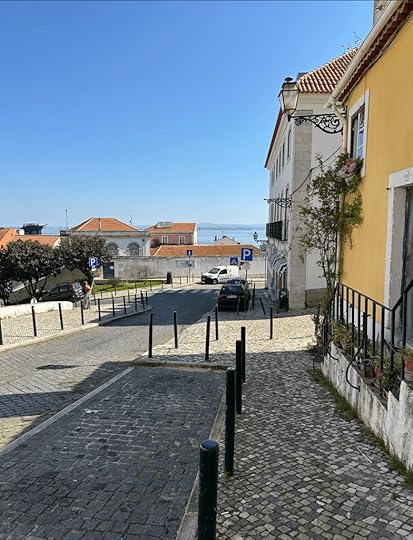
Somehow, I got lost in the maze of hilly streets that make up the Alfama neighborhood, and I think I must have walked in a large circle, before being funneled back into Commercial Square. By walking north, I found Restauradores Square, where I’d started my day. But I was exhausted.
This is why I do tours.
 The post Second Day in Lisbon appeared first on Cynthia Sally Haggard.
May 16, 2025
AMERICAN EMPRESS by Nancy Rubin
Marjorie never did have much luck with husbands…
Marjorie Merriweather Post (1887-1973) led a long and interesting life that encompassed two world wars, three daughters and four marriages. I generally do not enjoy reading biography as too often it can be a dry recital of the trivia of someone’s life, but I have to say that Nancy Rubin in her biography of Mrs. Post, titled AMERICAN EMPRESS, has done a wonderful job in making it interesting.There was much I did not know about Mrs. Post. I didn’t realize that she grew up in Battle Creek Michigan, or that her father was an entrepreneur. All I knew about her was her wonderful collection of Russian porcelain and religious icons that are in the museum that used to be her home, here in Washington DC.
It is odd to reflect now, here in the 21st century, how people used to rush into marriage. Mrs. Post was married four times. I could understand why she married Edward Close (she was only eighteen), E. F. Hutton (he was the love of her life) and Joe Davies (he was interesting). But I must say I didn’t see the point of her marriage to Herbert May. But then women were made to feel that they couldn’t go out if they didn’t have some sort of male companion, and although her daughters encouraged her not to marry her male escorts, she herself was of an era when rigid notions of male-female relations prevailed.
Marjorie never did have much luck with husbands. She divorced two of them for infidelity, and the other two because, in their different ways, they cramped her style. Many of her friends speculated about why she was never happy for long in her marriages. One of her friends remarked, “Marjorie, you could run General Motors. You could run U.S. Steel. You could run anything. You’re the smartest woman I know. But why do you have so much trouble with husbands?”
“Clare, I honestly don’t know. Ain’t it hell?” Marjorie is reported to have replied.
But the answer of course is that from the fact that you have formidable organizational skills and a steel-trap mind – as Marjorie did – it doesn’t at all follow that you will have a happy marriage. Because what is needed is a totally different kind of intelligence, what we now refer to as EQ or emotional intelligence. This is not to say that Marjorie didn’t have any EQ – she had good relationships with all three of her daughters – but she didn’t have enough of it to offset all of her millions.
Because those millions, in my opinion, lay at the heart of all of her problems with her husbands.
 The post AMERICAN EMPRESS by Nancy Rubin appeared first on Cynthia Sally Haggard.
May 13, 2025
Lisbon ~ First Impressions
On my first afternoon in Lisbon, I was suffering (not surprisingly) from jetlag. Not having slept a wink on my journey from Washington-Dulles to Paris, and then Paris to Lisbon, naturally, I felt like falling asleep at 3 o’clock in the afternoon. Faced with the need of stalling sleep for at least another four hours, I elected to go on a walk.
The people at Guest Services at the Corinthia Hotel Lisbon, where I was staying, were more than happy to help. On learning that I wanted to walk in a natural park-like area, the young woman recommended that i visit the Montsanto Park. To get to it, I had to exit the hotel to the left, and then take the first left and continue to the park.
Naturally, there were problems. For starters, there were no road signs. So that meant I had no idea which road I was on, because there were no street signs. Somehow, I managed to walk in the right direction and find the park!
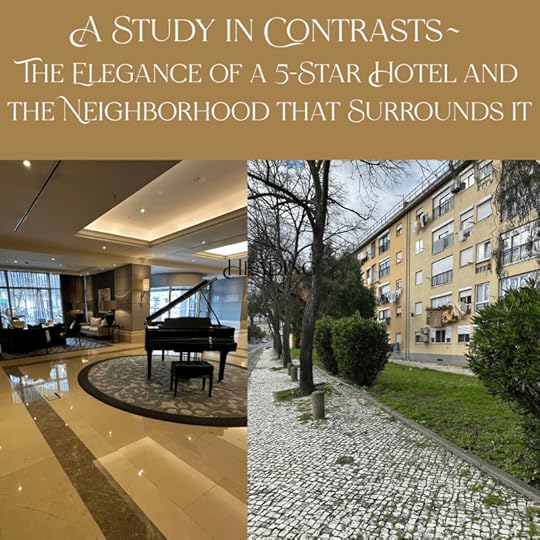
But as I walked, it struck me how very odd the location of the Corinthia Hotel is. If you have the pleasure of visiting it, you will see that it is a luxury 5-star hotel, complete with four restaurants, a bar, various sitting areas, and a piano.
So what is a Five-Star Hotel doing in a location that is bisected by not one, but two major highways and railroad tracks?
Of course such areas are inhabited by people who do not have much money. These areas also have dead zones, where nature has taken over neglected spaces. As I continued my walk under a massive highway, and past the dead zones on either side, I encountered huge apartment buildings filled with washing lines, and copious amounts of washing.
I paused, taking it all in.
If this were the United States, these areas would be positively dangerous, inhabited by gangs who engage in turf warfare, with regular shootouts.
If I were in the UK, these buildings would be Brutalist drab, grey and forbidding, exhuding hopelessness, and blight.
But in Portugal the government (or whoever owns these buildings), had at least bothered to give the exteriors a more pleasant aspect by painting them in shades of yellow, pink, and red. The paint jobs looked relatively recent, and the outsides of the buidlings, while not luxurous, at least conveyed a spirit of livability. Of course these building had a view of the local railroad, whose train cars appeared with grinding regularity. Next to the train tracks was a major artery, with cars and truck whizzing their way in and out of Lisbon. Unlike the US, the communtiy had made the area as pedestrian friendly as possible. I counted at least three walkways that took you over the highway and train tracks, making it easy for the inhabitants of these enormous apartment blocks to take the dog for a walk in Montsanto Park, on the opposite side of the tracks and highway.
Nothing was luxurious about this area. And yet the inhabitants were afforded a means of walking to and from a local natural resource. This is something that countries such as the US ~ subservient to the needs of the car ~ need to think about. For the fact that you can take your dog for a walk to the local wilderness area means that those people (dog-walkers, runners and people like me who enjoy walking) will take advantage of those pedestrian bridges. And the fact that we citizens are claiming such unpromising spaces means that we keep the crime rate down by our very presence.
 The post Lisbon ~ First Impressions appeared first on Cynthia Sally Haggard.
May 9, 2025
THE LAST AGENT IN PARIS by Sharon Maas
THE LAST AGENT IN PARIS is a spellbiinding story about an unusual young woman, and the dangerous career she chooses for herself.
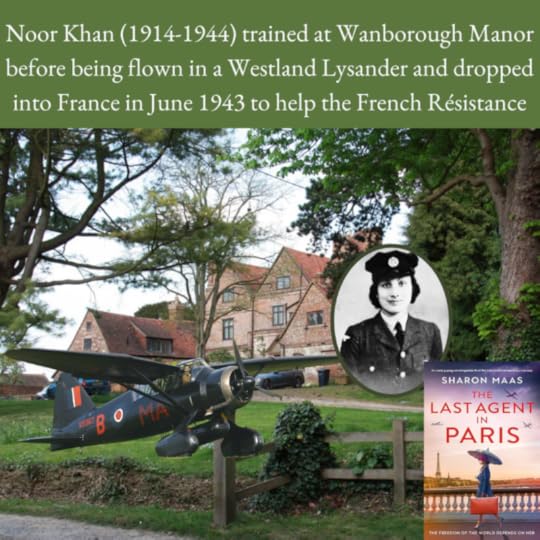
Noor-un-Nisa Inayat Khan (1914-1944) was the daughter of an Indian man and an American woman.
Her father, Inayat Kahn, born in Baroda, India, came from a line of Indian Muslims whose forebears included classical musicians and nobles. One of his ancestors was Tipu Sultan (1751-1799), who ruled Myesore. He was a noted teacher of Sufism.
Her American mother, Ora Ray Baker, came from Albuquerque New Mexico, meeting Inayat Khan as a teenager when he was on his travels. The couple conducted a long-distance relationship and only married once she’d turned twenty-one in 1913. Their eldest child, Noor, arrived the very next year. On her marriage to Khan, Ora Ray cut her ties to her family an adopted the name Amina Begum. She is known for spreading Sufism into the Western World.
Noor’s parents led a peripatetic life, which meant that Noor herself was born in Moscow. Eventually, the family settled in Paris, where Inayat Khan created a communtiy of Indian Muslim expats who came to him for spiritual guidance and music lessons.
After the fall of Paris in 1940, Noor and her family left for England. It was there, in 1941, that she was offered the dangerous position of British resistance agent. Her job was to be a wirelss operator in a team of three, the person who sent messages to London. These operatives were tasked with spying and sabotage in countries occupied by the Axis powers, especially those occupied by Nazi Germany. Noor was sent to France because she was fluent in French.
Apparently, the typical life-span of one of these agents was six weeks. But Noor must have been very good at her job because she managed to survive for several months. Dropped on the night of 16 to 17 June 1943, she was not captured by the Nazis until 13 October of that year, a period of four months. And even then, she was found because someone betrayed her. The person in question, Renée Garry was the sister of Émile Henri Garry, the head agent in the Cinema/Phono network, and the person who was Noor’s organiser. So his sister was not an obvious person to commit that kind of treachery, even for a large sum of money. But the Germans were rounding up the British and French spies one by one and sending them East.
Noor was eventually executed along with three other women at dawn on the morning of 13 September 1944 in Dachau Concentration Camp. Émile Henri Garry was executed at Buchenwald at roughly the same time.
I have never read any of Ms. Maas’ work before, and I was pleased to discover her. The idea of telling the reader about Noor’s arrest in the Prologue is a smart move, as it gives the reader a clear idea of where this novel is going, the beginning of the arc of tension that keeps them turning those pages. Maas’ descriptions of Noor’s early life, including the way her father used her to calm a dangerous crowd in Moscow, were superlative.
If you enjoy Second World War literature, you should definitely read this novel.
 The post THE LAST AGENT IN PARIS by Sharon Maas appeared first on Cynthia Sally Haggard.
May 6, 2025
Adventures in Norway 2013
In July, 2013, my husband and I spent a month in Norway before flying to St. Petersburg in Russia to attend a conference held under the auspices of the Norwegian government. (Stay tuned for the next post.)
July is a wonderful time to be in Norway for the days are long and warm. During the summer soltice, the sun sets at around midnight and reappears at 3 am. And so, while my husband was arguing his philosophy and philosophy of linguistics with various colleagues at the University of Oslo, I put on my hiking boots and walked.
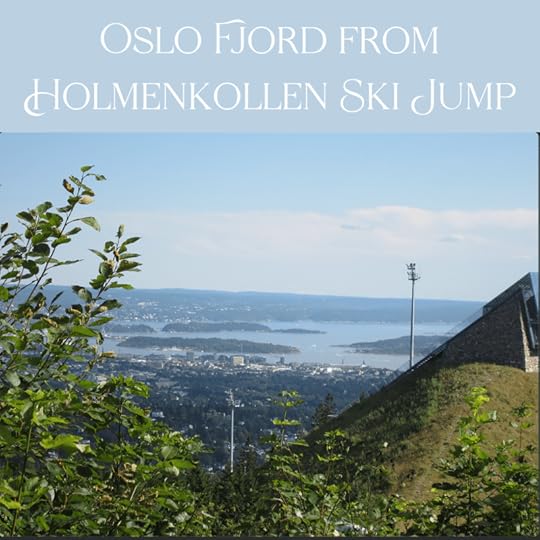
One of my favorite trips was to take the train from cental Oslo, way up to the top of Holmenkollen, which rises 1,600 feet above sea level. There is a charming restaurant there (Frognerseteren Vinstua Restaurant) which provides Norwegian fare. Unless you are very brave, you should avoid the brown cheese (known variously as brunost, gjetost or geitost.) But Lingonberries served on top of a creamy substance that resembles porrige (or oatmeal) is delightful. As are the varous open-faced sandwiches.
Once you’ve enjoyed yourself there, instead of taking the train back, you can (if you don’t have bad knees) do my favorite walk and walk down Holmenkollen, while takiing in the fabulous views of the Oslo fjord. Of course I did not walk all the way down Holmenkollen. I used to take Holmenkollenveien (Holmen Kollen Way) down to Holmen Kollen T (the subway station), which is on the right just after passing Holmen Kollen Restaurant on the left. The distance is about 2.4 km or 1.5 miles. Then I would let the train take me all the way back to downtown Oslo.
If you choose to visit Oslo, you will find it a very walkable place with excellent public transportation. I look back on my various visits there between 2011 and 2014 with great fondness.
 The post Adventures in Norway 2013 appeared first on Cynthia Sally Haggard.
March 25, 2025
Adventures in Germany 2013
I was inspired to go on this tour of Germany by an article in the New York Times, which described traveliing along the Märchen or FairyTale route. Something about that piece sparked my interest, and so began my fascination with Fairy Tales which continues to this very day into my latest novel MAIDEN TOMB.
Arriving in Frankfurt Airport in early May 2013, I made my way to Kassel, continuing my tour to Göttingen, Hannoversch Munden, Würzburg, and Mannheim. If this sounds a bit off the beaten track, it is. The very pleasant woman at the hotel in Kassel, told me that they didn’t get many foreign visitors who were just tourists. Instead, they were set up for people to have business meetings. Of course I should have rented a car. I made things so much more difficult for myself by sticking to public transportation, even though in Germany it is reliable and runs on time. However, I do remember a lovely bus-ride through the German countryside to the Dornröschenschloss (Little Thorny Rose Castle) in Sababurg in the province of Hesse-Kassel.
However, I ran into a big problem on my way to Stockholm to meet up with my husband. I was visiting my mother, and had decided to do a lot of cooking for her. So I brought along my favorite recipe book and a book-opener, which consists of a leather horizontal thingy, which is weighted at each end with lead to keep a book open. Somehow, they hadn’t discovered this on my way into Germany, probably because I put it in my checked baggage. But here it was, in my carryon. Oh dear, what a lot of trouble I got myself into!
I tried to explain what it was, but the person checking my bag at Frankfurt called the police. Of course, this being Germany, they arrived pronto within ten minutes. Again, I explained what it was for, that it was a book opener, because I had a hardback recipe book that I wanted to use to cook for my mother.
I should mention at this point that I was dealing with a language barrier. I really don’t speak German, and these police officers didn’t speak English. All I knew was that they were giving me skeptical looks. I realized I was in deep trouble when one of the police officers picked it up by one end and twirled it around his head. Of course, he thought it was a weapon. I was so shocked as it had never occurred to me that my book-opener could be used to hurt someone.
And so I was charged with possessing an illegal weapon, and my book-opener was promptly confiscated. I didn’t mind about that so much, because I figured they were going to do that anyway. But I was upset about the charge, and the fact that they had my passport, which meant that if I didn’t sign on the dotted line at the bottom of some document they had (which was in German, so I didn’t understand it) I wouldn’t be able to get on my plane.
Of course I signed, but I have never forgotten how hard I had to work to quell my panic, smile sweetly, and be polite to a bunch of strangers who seemed determined to think the worst of me. But I got my passport back and was able to make the flight. Nowadays, I am much more careful about what I put in my carryon.
Another lesson I learned from this trip was that I really shouldn’t travel around by myself because I miss too many things. And so, the very next year, I joined my first tour group and had a wonderful time. Stay tuned for that story!
 The post Adventures in Germany 2013 appeared first on Cynthia Sally Haggard.
March 21, 2025
THE SECRET WAR OF JULIA CHILD by Diana R Chambers
Writing a novel about a famous person like Julia Child is a gift, especially if you are writing about the person’s life before they became famous. This is because the audience’s knowledge of what happened in the future can drive the momentum of the story forward, without the author having to do such a heavy lift.
And so author Diana R. Chambers made a smart choice when she decided to write about beloved television host Julia Child before she became famous for The French Chef.
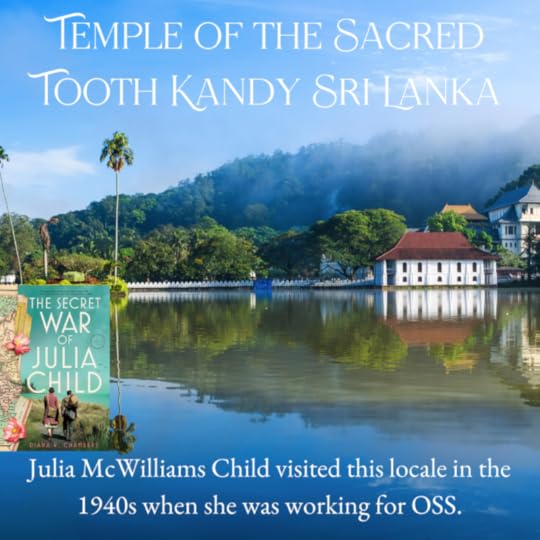
In THE SECRET WAR OF JULIA CHILD, we learn about thirty-something Julia McWilliams career at the Office of Strategic Services (OSS), which she joined in 1942. Typical of the time, Julia was hired to do a little light dusting in the form of typing and filing. (Later in life, she always claimed to be “just a file clerk.”) She was extremely fortunate that her boss, William J. Donovan, saw her driving ambition as well as her keen intelligence, so that her filing job morphed into a top-secret security clearance job for someone entrusted with spying and uncovering traitors.
What a life it was for a smart, self-driven young woman! For Donovan earned the nickname “Wild Bill Donavan” for the number of rather startling stories about him. Nevertheless, President Roosevelt valued his insights and in 1941, tasked him with founding the OSS, which was the first iteration of the CIA.
In a way, this volume almost wrote itself. But I still thought it could have been vastly improved by having a narrative arc. In my opinion, a proper spine of tension would have prevented the ending from being so abrupt.
The post THE SECRET WAR OF JULIA CHILD by Diana R Chambers appeared first on Cynthia Sally Haggard.Cynthia Sally's Blog

- Cynthia Sally Haggard's profile
- 129 followers

