
Cynthia Sally Haggard's Blog: Cynthia Sally's Blog, page 11
October 30, 2024
BY ANY OTHER NAME by Jodi Picoult
“What’s in a name? That which we call a rose
By any other name would smell as sweet”
~ Romeo & Juliet by “William Shakespeare”
BY ANY OTHER NAME is a tremendous novel. Taking as its premise that William Shakespeare could not possibly have written 37 plays, 156 sonnets and two (or three) long poems – The Rape of Lucrece, Venus & Adonis and The Lover’s Complaint – while he was employed as a full-time actor, with a side-hustle of businessman, Jodi Picoult posits that the famous plays were authored by many hands. The Henry plays were probably written by a stable of writers organized by the Earl of Oxford, while Mary Sidney, sister of poet Sir Philip Sidney, provided some of the other writing. But the star of this novel is the first female poet to publish her own work in England, (Salve Deus Rex Judaeorum in 1611): Aemilia Bassano, also known as Emilia Lanyer (1569-1645). Her Italian family probably came from Bassano del Grappa in the Veneto, and were the court musicians to Henry VIII and Elizabeth I.
According to Ms. Picoult, Emilia is probably responsible for most of the Italian-themed plays such as The Taming of the Shrew, The Two Gentlemen of Verona, The Comedy of Errors, Romeo & Juliet, The Merchant of Venice, Much Ado About Nothing, and Othello the Moor of Venice. She may have also written As You Like It, (with its strikingly feminist heroine Rosalind), although Mary Sidney (1561-1621) is another contender, as the first performance may have been given at Wilton House, a focus for her literary activity.
Ms. Picoult also argues that Emilia Bassano wrote A Midsummer Night’s Dream and Hamlet. It is easy to see that A Midsummer Night’s Dream might have come from a woman’s pen. But Hamlet? However, events of Emilia’s early life support that contention. She was a ward of Susan Bertie Countess of Kent, whose brother Peregrine Bertie journeyed to Denmark in 1582. Bertie’s purpose was to invest the King Frederick II with the Order of the Garter. In return, he hoped that the Danes would protect English merchant ships from being molested while in Danish waters.
Records show that he arrived in Elsinore on 22 July 1582 and left on 27 September of that year. Suppose twelve or thirteen-year-old Aemilia Bassano accompanied him? This may have been a distinct possibility as Susan Bertie embarked on a second marriage that very same year.
How interesting to think that a moody teenaged boy may have been based upon the memories of a teenaged girl!
If you enjoy this sort of thing, you are in for a treat! Five Stars.
 The post appeared first on Cynthia Sally Haggard.


October 26, 2024
Adventures with Cecylee ~ Part II The Wall Walks
Lady Cecylee Neville, the protagonist of my first novel Thwarted Queen, was the youngest daughter of Ralph, Earl of Westmorland, and grew up in the family home at Castle Raby, now in County Durham. Built by the Saxons, and rebuilt near the end of the fourteenth century by Cecylee’s grandfather John, Castle Raby is a castle of towers. There are Clifford’s Tower, located just inside the gatehouse, built to withstand attack, the kitchen tower, Mount Raskelf Tower (named after family lands in Yorkshire), the chapel tower and Bulmer’s Tower.
This last has an unusual five-sided plan, not unlike similar five-sided towers found in Denmark and used to stand apart from the rest of the castle. In Thwarted Queen I imagine it used as a keep where everybody went when the castle came under attack. It seems to be the oldest part of the castle, possibly built in Anglo-Saxon times, perhaps to a Scandinavian design to ward off the Vikings.
It is named after Bertram de Bulmer, a powerful magnate who lived at the time of King Stephen (1096-1154). In 1176, Bertram’s daughter Emma de Bulmer, heiress to the Bulmer estates, married Geoffrey de Neville. In turn, their daughter Isabel de Neville, heiress to the Bulmer and Neville estates married Robert Fitz Maldred, who owned Raby Castle. For some reason, their children took their mother’s surname of Neville, thus founding the great Neville family of the Middle Ages, whose members included Warwick the Kingmaker (1429-1471), one of Cecylee’s nephews.
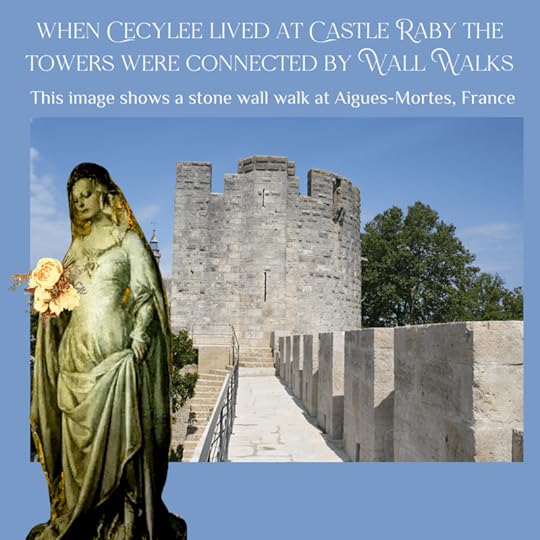
When Cecylee lived there, Castle Raby was full of armed men. Her father Earl Ralph was made Warden of the Western Marches by Henry IV, and his task was to repel the Scots during numerous border raids. When I visited it back in 2007, the docent told me that there used to be wooden walkways that went from the tops of one tower to the next, which Earl Ralph’s men would patrol constantly, on the lookout for danger. The wooden walkways allowed the men to get from one tower to the next quickly and efficiently, without having to descend twisting staircases to the mud of the courtyards, and climb all the way back up again. In Thwarted Queen, I have a scene where Cecylee herself had to walk on these walkways. Imagine what it must have been like to wear a henin (cone-shaped headdress) with a silken veil fluttering off the end, as you made your way from one tower to another in a stiff breeze!
If this has whetted your appetite for Thwarted Queen, please click here.
 The post Adventures with Cecylee ~ Part II The Wall Walks appeared first on Cynthia Sally Haggard.
October 23, 2024
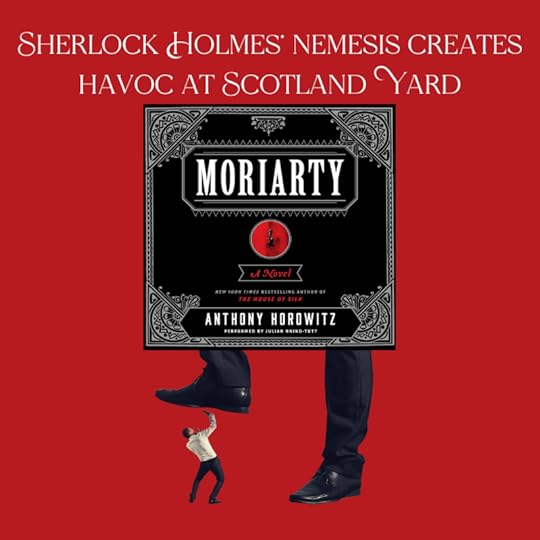
MORIARTY by Anthony Horowitz ~ A Book Review
MORIARY is a very different book than THE HOUSE OF SILK. Whereas THE HOUSE OF SILK focuses on Sherlock Holmes and his side-kick Dr. Watson, MORIARTY focuses on—well, on Moriarty. Except that he isn’t there, at least not until the very end.
Obviously, with the title of Sherlock Holmes’ famous nemesis, Moriarty must be around somewhere, but readers will enjoy trying to guess who, if anyone in the large cast of characters, he is.
As many have noticed, Anthony Horowitz is a brilliant writer. My husband loves his FOYLE’S WAR series for their moral dilemmas. I loved reading the MAGPIE MURDERS series, especially the first one where we find out about half-way through the novel that we have actually been immersed in a manuscript. I loved that out-of-body sensation as Horowitz deftly executed his plot twist.
And now, in MORIARTY we see Mr. Horowitz’s formidable writer’s craft in full play as he occupies the reader with the first-person point-of-view of Frederick Chase, Senior Investigator for Pinkerton’s of New York. Everything about this novel is filtered through the mind of Mr. Chase – his long journey from New York to find out what happened to Jonathan Pilgrim, his chance meeting at the Reichenbach Falls with Athelney Jones, a Scotland Yard detective, and what happens thereafter.
The two gentlemen strike up a friendship and travel back to England together to get rid of evil criminal genius Devereux before he can wreak more havoc on the streets of London. Unfortunately, Mr. Devereux is an American citizen, currently residing at the American Legation, so Chase and Jones are going to have to come up with a clever scheme of winkling him out so that he can be held accountable for his actions.
The novel is a little slow-going at the start, but really catches fire when Perry, a very plump young man, appears on the scene. After that, the novel is hard to put down. Four Stars.
 The post MORIARTY by Anthony Horowitz ~ A Book Review appeared first on Cynthia Sally Haggard.
October 18, 2024
Adventures in Wales ~ Chirk Castle
North Wales is surprisingly close to Liverpool. In fact the Wirral Peninsula is bordered by the Mersey to the East, the Irish Sea to the North and the Dee to the West. If you are visiting relatives in Wallasey, and they live in a house that sits high up on the Wirral Peninsula, you can see the lights of Liverpool by turning your head to the right and the Welsh Mountains by turning your head to the left.
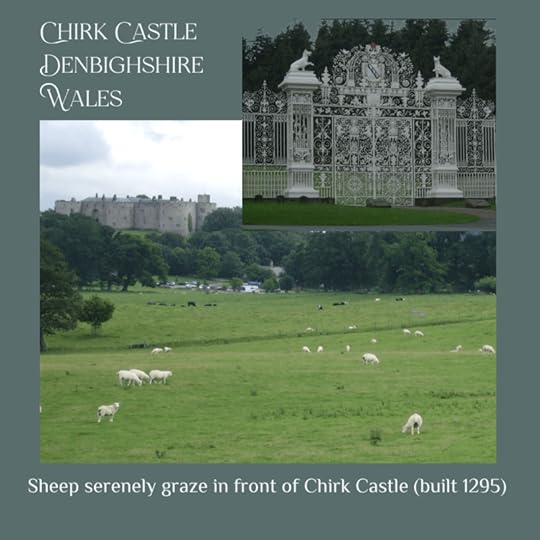
So it is not hard to reach Wales by car. In about an hour or so you can find yourself wending your way along narrow Welsh lanes hemmed in by the vibrant greens of trees and shrubs. So when you come to a pair of showy white gates (as seen in the image) the sight makes you stop. Further along you will find a field full of sheep with a castle in the background.
You have arrived at Chirk Castle built in 1295 by Roger de Mortimer. At that time, England was ruled by Edward I (1239-1307), known as The Hammer of the Scots. Before he turned his attentions to Scotland, Edward was busily crushing the life out of Wales. Chirk castle guards the entrance to the Ceirog valley and is part of a chain of castles that he built in North Wales. These include Beaumaris, Caernarfon, Conwy and Harlech and they are massive. Driving up to Conwy, you are struck by the hugeness of the castle that dominates the tiny town.
Was Edward I trying to send a message to the Welsh?
 The post Adventures in Wales ~ Chirk Castle appeared first on Cynthia Sally Haggard.
October 16, 2024
Among the Mad ~ Maisie Dobbs #6
What I love about Jacqueline Winspear’s novels is that she doesn’t just portray the froth and fun of the 1920s and 1930s. She also probes deeper into the lives of the men and women who inhabited those times to give us a full picture of what it was like to be alive then.
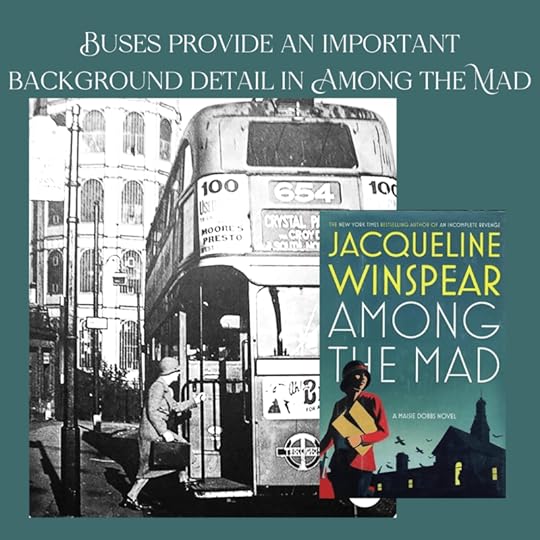
I love her descriptions of life in London at that time, with its “cold-water flats”, old-fashioned buses that you could climb onto from the back (the bus conductor would walk up and down to issue you with a ticket) and the sense of a nation brought low, of the poverty that everyone suffered due to the enormous economic costs of the Great War plus the Depression that followed at the end of the twenties.
And so we have Miss Maisie Dobbs, still single, living alone in a flat in London, where she cooks herself an enormous pot of soup once a week, so that she can have a quick supper after a long day’s work.
We are in the Christmas season of 1931, and even though the Great War has now been over for thirteen years, still there are so many people who have never got over their experiences of this horrifying war. It will surprise no-one to learn that veterans were treated badly. During the war, people who had what we now call PTSD, were patched up and sent back to fight. Yes, their physical body may have been well enough to go back to France, but from the point of view of mental health, they were completely shot (pun intended.) I know that everyone was desperate to replace the approximately 9.7 million military men who had been killed, but I still think that sending such a person back to the front is the height of cruelty.
In this novel, we have one such man. An army veteran injured in both body and soul. He feels that he cannot get the government to listen to his plight. It is not clear whether the issue is just about his pension (which presumably he hasn’t received) or something else. But this man is determined to make the British government in Whitehall listen. And so he makes terrorist threats, saying that he will detonate a bomb in London.
Unfortunately, this man is brilliant enough to devise new kinds of horror. We are not just talking about Molotov cocktails or IEDs. We are talking about new forms of mustard gas and chlorine gas, which could cause devastation amongst crowds of people celebrating Christmas and the New Year. And so Maisie finds herself working during the Holiday Season of 1931 to 1932, as a consultant for Scotland Yard as the police try to catch this man before he causes massive amounts of death.
As always, Maisie comes up trumps and the whole affair ends very satisfactorily. But the reader is haunted by Ms. WInspear’s expressive writing that delineates the pain and suffering of so many of those war wounded whom the government chose to ignore. Five Stars.
 The post Among the Mad ~ Maisie Dobbs #6 appeared first on Cynthia Sally Haggard.
October 11, 2024
Travels in Big Sur in 2009 ~ From One Misty Land to Another
As you may have realized, I was not born in the US of A. Instead I come from a Land of Mists. If you travel in the early morning or late evening between October and March in my homeland you will have to get used to driving through patches of cloud that hang in the still air.
When I started to explore Northern California, I was met with a similar phenomenon. In the summer there is that daily enormous fog bank known as The Fog. Once inside, you notice how the fog or the mist is thread-like and moving quickly, pushed along by the winds.
It is amusing how my husband (who grew up in San Francisco) and myself (who grew up in England) use language differently. My husband refers to the thread-like phenomenon of Northern California as fog, whereas to me, it seems more like a mist. That is because in England, fog means a very thick cloud that you can barely see through, whereas mist is semi-transparent.
In any event, I have enjoyed our many trips to Northern California over the years with my husband acting a tour guide. We have been to Big Sur many times, and have had the pleasure of visiting The Big Sur Inn and Nerpenthe. Some of these trips occur during misty conditions ~ or are they foggy ones? No matter, as you can see from these images, the place becomes magical when it is semi-opaque.
 The post Travels in Big Sur in 2009 ~ From One Misty Land to Another appeared first on Cynthia Sally Haggard.
October 9, 2024
The House of Silk by Anthony Horowitz ~ A Book Review
In THE HOUSE OF SILK, Anthony Horowitz writes a story that Conan Doyle could never have written, and has added all the details that Doyle left out of his original stories.
Like most writers of his time, Arthur Conan Doyle (1859-1930) was very comfortable writing about the aristocracy. He relished setting his most famous stories, like the Hound of the Baskervilles, in gorgeous country homes. He enjoyed writing about people who were schooled to be polite and genteel: the ladies and gentlemen of polite society.
And there he left things. He never delved deeper. Never examined what those aristocratic men actually got up to when out and about in a huge city with all of its crawling tentacles of temptation. He also never examined the lives of the people who served the rich, all those men and women from poor families who had ill relatives to care for, and who worked so hard for not much pay.
Enter Anthony Horowitz who has updated Conan Doyle to include detailed descriptions of the crushing poverty of most of those who inhabited London, especially the children. Mr. Horowitz recreates a forgotten world in which there were too many children in threadbare rags milling about the sour corners of a great city. Children who were orphaned. Children who ran away. Children who were thrown onto the mercy of the streets. All of these children were little people whom the rich chose to ignore and forget. And yet the rich men, strolling the streets in their starched collars, well-pressed trousers, leather shoes, silken top hats, cloaks and canes would often use them to play gopher, pressing a (small) coin into a grimy hand any time they needed to get a message to someone.
It was bad enough that these children lived in vermin-ridden unsanitary conditions, that they were vulnerable to wasting away from cholera, tuberculosis or typhoid. But what was so much worse was the way in which they were victimized by adults.
This is not an easy book to read. But if you want something that provides more depth to the Sherlock Holmes stories, this book is for you. It is a terrific read by a brilliant writer. Five Stars.
 The post The House of Silk by Anthony Horowitz ~ A Book Review appeared first on Cynthia Sally Haggard.
October 4, 2024
Travels in France in 2008
England is famous for its palaces, castles and gardens. But, as I discovered when I visited northern France in 2008, France has its share of these places to visit. And if you visit Northern France, you will discover that not only is the countryside similar to that of Southern England, but the weather is too. It can pour in Northern France just as well as it can in England!
On yet another Cecylee tour with my long-suffering husband, I visited Rouen (where Cecylee lived between 1441 and 1445), the famous gardens at Claude Monet’s home in Giverny, and the chateaux of Ussé, Azay-le-Rideau, Chambord, Blois, and Saumur.
However, unlike Southern England which is plush with its stone cottages draped with thatched roofs, manicured gardens and tea-rooms everywhere you look, France, by contrast, seems poor. When my husband and I visited Saumur in the Loire valley, we were very surprised to find a lifeless town center with only one cafe that was, naturally, closed. The lovely chateau of Ussé is frowned over by the local nuclear power station. And when you drive through Normandy and Anjou, you are met by too many neglected medieval buildings with their dirt-encrusted walls and plaster dripping onto the narrow streets.
One thing that will surprise English tourists is how many of the English royalty lived and died in France. Henry I (youngest son of William the Conqueror) died in Lyons-le-Forêt Normandy in 1135. Eleanor of Aquitaine, Queen of England from 1153 to 1204, is buried at Fontévraud
Abbey in Anjou. With her are her English husband Henry II (died 1189), their son Richard the Lionheart (died 1199) and Queen Isabella of Angoulême, wife of Henry and Eleanor’s youngest son John the Bad (ruled 1199 to 1216.)
If you are interested in medieval English history, you should find a way of visiting Northern France. You won’t regret it.
 The post Travels in France in 2008 appeared first on Cynthia Sally Haggard.
October 2, 2024
Murder in the Museum ~ Fethering #4 by Simon Brett
This volume is Number Four of Simon Brett’s alliterative murder mysteries set in the prosperous and benign-seeming county of West Sussex. Here, he takes us into the world of trustees ~ amateur volunteers ~ who are charged with running an estate, which in this novel consists of a country house and its grounds. Add to this that the house was home to a beloved author Esmond Chadleigh, and that the money is running out fast and you have the perfect setting for tension and drama.
One of the things I love about Simon Brett’s writing is how empathetically he writes about women. The strong characters in this novel are all women, from doughty but too-proper-for-her-own-good Carole Seddon, Bohemian neighbor Jude, young but accomplished Director of the Trust Gina, and Ex-Director Sheila Cartwright whose bullying makes Gina’s life a misery. And then there is American Professor Marla Teichbaum, a glamor puss, who is writing a biography of Esmond Chadleigh.
The other thing I love about Simon Brett’s writing is his close observation of middle-class mores in Britain. As the elder daughter, my mother impressed upon me all the things you were supposed to know about entertaining, from complex place-settings, to how to receive guests who’ve dropped in for a chat. Unlike the United States, in Britain, there are elaborate tea-making rituals. If you offer food, you must remember to prepare it in the kitchen, and bring it out on a tray to the sitting room. In an ideal world, you have a nest of tables at the ready so that each guest has a small table beside her chair on which to place her tea (served in a bone-china cup and saucer), and a matching plate with a small fork and a napkin. I think you have to be British for all this domestic detail to make you laugh, but laugh I did, as I’d forgotten all of these things that I knew by the time I turned eleven.
Needless to say a body turns up almost immediately in the kitchen garden. But one of my favorite scenes is where Sheila Cartright dresses down a gentleman who is Esmond’s grandson. I couldn’t help feeling glee as this powerful gentleman was crushed underfoot by a Boodica of a woman, even though I winced at his public humiliation, and the way she ruthlessly took away his life’s work, the writing of the Official Biography of Esmond Chadleigh.
Shortly thereafter, she is shot. Obviously the gentleman in question must have done it. Except, in Simon Brett’s hands, the murderer was someone you would never expect.
If you want to learn more about British society in the 2000s, this is the book for you. Five Stars.
 The post Murder in the Museum ~ Fethering #4 by Simon Brett appeared first on Cynthia Sally Haggard.
September 27, 2024
Long’s Peak Colorado ~ Walking on the Ceiling of the World
Hiking in the Rockies feels like walking on the ceiling of the world. You are so high up that you are looking down on mountain peaks. The wind pushes at you and you have to walk bent against it. But it is glorious.
Until it is not.
One day, my husband and I decided to hike up to Long’s Peak. Clouds like colophons hung above it. White and fluffy they formed clear emblems, signs that stood out against a background of deep azure. Two of them stood together dropping in the still air above the mountain. The morning fresh and bright was no harbinger of things to come
That was at nine in the morning. By twelve the clouds moved in. By one the storm rolled off the mountain, striking sparks of lightening upon the unwary, who enjoying their climb went above the timberline to the boulder field of the Diamond face.
“No! No! Don’t go there,” said the hikers scampering down the mountainside. “There’s lightning! It’s dangerous!” they called as they scurried down the hill toward a blanket of trees.
So my husband and I turned reluctantly away from the beauties of Alpine plants, the high air, the rocky platform for viewing of surrounding mountains. We trudged downhill as the hail struck, fierce pellets of ice knifing us hard. After twenty minutes it morphed to rain. The dusty track turned viscous-squishy, churning mud onto legs and trouser bottoms.
At length we came to the Ranger’s hut.
“That was the worst hike I’ve experienced,” said my husband, “ever.”
 The post Long’s Peak Colorado ~ Walking on the Ceiling of the World appeared first on Cynthia Sally Haggard.
Cynthia Sally's Blog

- Cynthia Sally Haggard's profile
- 129 followers

