Byron Edgington's Blog, page 4
August 14, 2013
Welcome home...
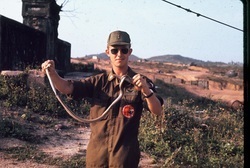 That’s yours truly, the author, with a cobra. It’s not a pet. You’d think after a year flying combat in Vietnam, with all the harrowing close calls, the near misses, encounters with live ammo and exposure to my own demise a number of times I’d be smart enough to leave a snake alone. Well, the snakes ate the rats in the company compound, so I did leave them alone. As noted in my book,
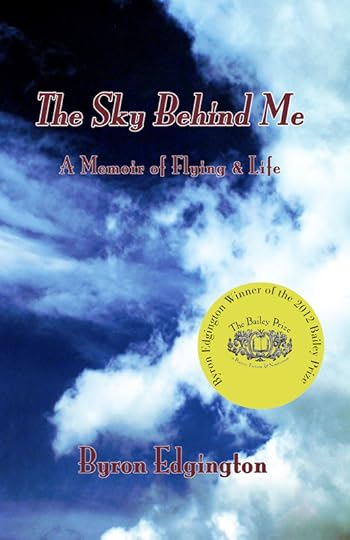
The Sky Behind Me, a Memoir of Flying and Life
I remember many times being awakened by a rat scurrying across my blanket at night and escorting the fellow off onto the floor with a thud and a disparaging squeal–from both of us. I never once removed a snake from my bed. So why the picture? It’s metaphor in today’s post. Symbolism for the serpentine way the war in Vietnam affected me and my fellow veterans, and still does lo these many, many years, and many gray hairs and life experiences later. It’s like that snake; I can’t seem to let it go, and I can’t put it down. And it does keep the rats away at times. Let me explain.
That’s yours truly, the author, with a cobra. It’s not a pet. You’d think after a year flying combat in Vietnam, with all the harrowing close calls, the near misses, encounters with live ammo and exposure to my own demise a number of times I’d be smart enough to leave a snake alone. Well, the snakes ate the rats in the company compound, so I did leave them alone. As noted in my book,
The Sky Behind Me, a Memoir of Flying and Life
I remember many times being awakened by a rat scurrying across my blanket at night and escorting the fellow off onto the floor with a thud and a disparaging squeal–from both of us. I never once removed a snake from my bed. So why the picture? It’s metaphor in today’s post. Symbolism for the serpentine way the war in Vietnam affected me and my fellow veterans, and still does lo these many, many years, and many gray hairs and life experiences later. It’s like that snake; I can’t seem to let it go, and I can’t put it down. And it does keep the rats away at times. Let me explain.I was in Peru Indiana recently, a little town forty miles north of Indianapolis, where fellow veterans are reconstructing a Vietnam era Huey. The organization is called American Huey 369. It’s a 501 (C)3 set up for the express purpose of reconstructing, preserving, demonstrating and flying the iconic helicopter of the Vietnam war, the Bell UH-1 Huey. I wandered around the rebuilt Huey, ran my hand over her Olive Drab skin, admired the restoration the organization’s done, an amazing job. I climbed into the cockpit again, settled into the left seat, put my feet on the pedals, took the cyclic in my hand. I don’t have to mention how the memories flooded into my brain, the countless missions, the danger I felt in that seat, the smells of combat-weary grunts, the stink of cordite when I landed in hot landing zones, the stench of death when I lifted body bags out of those same jungle LZs. The crackle and snap of machine gun fire from every direction, and the zip of tracer rounds whipping past the cockpit. The rumbling whine of that trusty Lycoming engine, 1,300 horsepower behind me keeping the blades flashing overhead. I sat in that cockpit a good long while, in the calm, quiet early morning in Peru Indiana.
When I climbed out, a woman greeted me. “Welcome home,” she said. She was the wife of a veteran, and it was obvious that she’d used the phrase more than once. I thanked her, but I wondered, did I ever really come home from that war? Did any of us?
Aside from Philip Caputo’s great Vietnam book A Rumor of War , published in 1977, there were few books about that conflict until much later. Tim O’Brien’s The Things They Carried was printed in 1990. John Del Vecchio’s The 13th Valley in 1999. Karl Marlantes’ epic Matterhorn not until 2011. A friend asked recently if I’d experienced any aftereffects from Vietnam, the prevalent PTSD, flashbacks of my time there, problems adjusting afterward. It’s a question I’ve asked myself, do I still carry that snake around? Do the things I carry about Vietnam still affect who I am? My own memoir came out last year, fully 41 years after I left Vietnam. There must be some reason for it, and I believe I know what it is.
Sitting in that Huey cockpit last week I was ambivalent about all of it: the war, of course; the reaction to it of my colleagues, some of whom are still fighting it; the public’s dismissal of it back then, the war’s fading memories, its relegation to the dubious category of misadventure. I was embarrassed to have served there, it’s that simple. Though my Vietnam experience gave me a marvelous career, I knew as I sat in the cockpit of a UH-1 forty odd years ago that my presence in Vietnam was not welcome, that our cause was misguided, that we’d lost our way. I knew we would lose. Something else that affects me: I have a tough time looking back, living in a past that was not all that affirming, not nearly so glorious as some have convinced themselves it was. I don’t do ‘my country right or wrong’ very well, and I’m afraid it shows. Sure, there were heroes. Men (and women) who saved others at the peril of their own lives in Vietnam, as in all wars. American troops fought in Vietnam as they always have, doing the job, dying along the way despite their feelings one way or another for the ideology or righteousness of the conflict.
In the picture I’m holding the snake at arm’s length, as you can see. As if I’m afraid to let it go, or at least not sure how to go about doing that. It’s entirely possible that I’ll never figure it out, that the snake is with me forever, keeping the rats at bay, but too close to be a pet. And I suppose, regarding the war in Vietnam, it may be the same for all of us.


August 8, 2013
I love Harry Reasoner
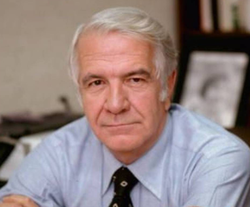 I love Harry Reasoner. Okay, Harry’s been dead for 22 years as of August 6th, but I still love the guy. I said I’d share insights about my personal behavior today, well here goes. As writers say, just open a vein.
My old (dead) pal Harry (Truman) Reasoner wrote a piece in 1977 about why helicopters are different from planes. For one reason or another, perhaps because Harry was an erudite and fascinating human being, he loved helicopters and those of us who took them into the air. Most of my rotor-wing colleagues have read this piece. For those of you who have not, here’s what Harry wrote: “The thing is, helicopters are different from planes. An airplane by its very nature wants to fly and, if not interfered with too strongly by unusual events or by a deliberately incompetent pilot, it will fly. A helicopter does not want to fly. It is maintained in the air by a variety of forces and controls working in opposition to each other and, if there is any disturbance in this delicate balance, the helicopter stops flying; immediately and disastrously. There is no such thing as a gliding helicopter. This is why being a helicopter pilot is so different from being an airplane pilot, and why in generality, airplane pilots are open, clear-eyed, buoyant extroverts, and helicopter pilots are brooding introspective anticipators of trouble. They know if something bad has not happened it is about to.”
Where to start. Being the second of ten, I started early in my effort to differentiate myself. You know that old Gary Larson cartoon with thousands upon thousands, a veritable sea of penguins? The one where a lone penguin stands up and sings ‘I gotta be me!’? Know that cartoon? That lone penguin is me. I am different, perversely dogged in my pursuit of being different. This also explains why I write. Surrounded by that many other human beings I had to write because I couldn’t get a word in edgewise. Maybe it’s why Harry Reasoner wrote, too.
Helicopters do not want to fly, it’s true. They rely on arcane physical and aerodynamic principles that, on paper at least, appear not to support the ability to defy gravity. Does anyone really know what dsymmetry of lift is? Translating tendency? Blade compressibility? Not knowing too much about these terms, yet taking off anyway, explains who I am as well. I have a great deal of trust, perhaps too much at times, in the underpinnings of science, the physical principles that have worked in the past, what might be called evidence based proof. Fearful, anxious people are what frighten me, not observable, calculable things. I used to fly an Air Medical helicopter on frigid winter nights in Iowa, often traveling hundreds of miles over a frozen landscape in the dead of night. People asked if that frightened me. Those same people traveled over icy, two-lane roads, at night, much too fast, with no seat belts, cars whipping past the other direction, and often while the driver was impaired. And they thought I was afraid?
Moving on. The only argument I have with my pal Harry Reasoner— hey, good friends squabble at times— is his contention that helicopters don’t ‘glide.’ Not so. Helicopters glide quite nicely when necessary. It all comes down to pilot competence, much more so than in an airplane. Here again, I was good enough to understand how this was done. In my book, The Sky Behind Me, a Memoir of Flying and Life, I write about just such an incident. The engine in my Huey coughed and quit once, giving me first-hand experience in the subtle art of ‘gliding’ a helicopter. The ‘glide,’ otherwise known as autorotation, yet another aerodynamic principle I don’t truly understand, put me in a farm field, helicopter and occupants unscathed. Harry, if you’re reading this, e-mail your editor. What’s e-mail? Oh, yeah, Harry dial up your editor.
Next, about principles and controls in opposition to each other, I plead guilty. I do kick things over in my head a time or two, try not to be dogmatic, try to see and hear others’ point of view. It’s not always easy, but I try. I’ve always believed that this thing called life isn’t a zero-sum game, that if we learn from other people, listen to the forces that seem to work in opposition to each other, we can all fly quite nicely. Indeed, it’s possible that the more clash and clang involved, the higher we may go. Currently, we seem unwilling to allow the forces we confront to work their thesis-antithesis-synthesis magic, and instead stay stuck on the ground throwing mud at each other.
Lastly, Harry is (was) pretty much right about the disposition of helicopter pilots Vs plane pilots. Stiff-wing pilots do tend to be outgoing, buoyant extroverts, optimists, convinced that every takeoff will be followed by a good, safe, or at least survivable landing. Helicopter pilots are indeed, for the most part, brooding introspective anticipators of trouble. I am indeed a brooder, just ask my sweet wife. I do anticipate trouble. Not morbid or defensive about it, I just look well ahead. My first instructor, a fellow named Wayne Alexander, told me to always stay a mile ahead of the aircraft. I did that when I flew. Now I do it in the family car. And I know that if something bad hasn’t happened, it is indeed about to. Not a negative, or a pessimistic person, just realistic. I’ve learned from a lot of experience, that life is a dynamic, ever-evolving affair. And the more we assimilate that into our thinking, the better prepared we’ll be to enjoy the good stuff. Oh, and I also believe that it’s all good stuff. It’s how we view the ‘stuff’ that matters.
One more ‘reason’ I love Harry Reasoner is that, like me, Harry went back to college and finished late. He earned his BA degree from Minnesota at age 66. I earned mine from Ohio State when I was much, much younger, at 63. Here’s what Harry said as commencement speaker that June day in 1989.
“People say, what are you gonna tell those kids? What do you mean, kids? Those are my classmates. I intend to voice my and their concern about the mess you older people have left us in.”
Like Harry, I refer to that same ‘mess,’ the disdain on the political right for environmental activism; the snail’s-pace movement toward equal rights for all; mankind’s adherence to religious dogma in the face of scientific evidence; our inability to stop killing each other at the slightest provocation.
Helicopters are different from planes. That’s a very good thing. Helicopters don’t carry hundreds of passengers hundreds of miles. Planes don’t hover worth a squat. We’re all different from one another, and that’s a very good thing. Thanks, Harry, for pointing that out.
August 6, 2013
Readin', Ritin' and Wreal Estate
 Silly me, I thought I was a writer. Nope. The writing appears to be the simple part, the exercise of plastering words on pages to tell some of kind of story, happy or sad, cheerful or mad. That part I can sort’a do, and well I should be able to after calling myself a wordsmith for many years, having one book to show for the effort. The promoting? I’m a novice, a rookie, an amateur just getting familiar with the myriad angles, corners, dead-ends and sub-basements of the book selling business.
 Here’s what I’ve discovered. When I was in real estate several years ago, for a very short time, thank goodness, I heard a colleague say: “The only people making money in real estate are the ones selling stuff to realtors.” It was puzzling to me at the time, as I struggled to get my brand out there, capture customers, make those cold calls, establish a presence in a field that was inundated with others doing exactly as I was doing to make ends meet, to be successful. I was a pilot before that. I figured, heck, I’ve flown over plenty of real estate, I ought to be able to sell some of it. Well, the real estate venture is behind me, and now I’m happy to report that I’m a highly–successful… Well, I’m a writer.
Now I find myself trying to get my brand out there, capture customers, make cold calls to bookstores & promotional outlets, establish a presence in a field inundated with others doing exactly as I’m doing to push their products. To say it’s daunting is like saying the pope is catholic, or at least has catholic tendencies.
But something else I’ve noticed. Another similarity between real estate and writing (Wreal estate? Riting?) is that there are indeed people making money by selling stuff to wannabe writers. In the last few months I’ve created an author profile on Biblio Publishing, Goodreads, LinkedIn, Amazon Authors, Author’s Den, Indies Unlimited, Open Library, Shelfari, Library Thing, Google+, Red Room and Published.com. Plus my own author website. Is any of this working? Well, as a wordsmith, I have to ask myself: what does ‘working’ mean? Am I selling books through these sites? Are readers finding The Sky Behind Me on these sites? Are royalty checks overflowing my mailbox? Is the promotional effort working? The answers are–no, not sure, no and not sure. I suspect that without a presence on all these websites and sales portals the book would languish. But the initial question is still valid. What does success mean? Is the effort working? I’m happy to say that it is working, for me. For the three years I was in real estate, I landed exactly two listings, sold exactly two homes. One of those properties I sold to my wife! (long story, don’t ask. There’s more than one way to get a commission. They ought to call it surreal estate).
Here’s my conclusion. For aspiring writers, or aspiring real estate agents, I suppose, the definition of success is where you start. Want to sell twenty homes your first year? Good luck with that. The expectations will kill you, so maybe knock that down to two? Maybe three? Want to write that smash best-selling YA novel, romance potboiler, mystery smash and sell fifty thousand books? Good luck with that. According to Seth Godin on Bertram’s Blog there could have been 15 million new books in 2012. That’s ‘illion, with an M. and the average indie writer sells fewer than fifty books.
The bottom line for me is the writing. As I say in my tag line, It’s not the landing; it’s the taking off again that matters. Price is not the prize, since no one can define the prize for anyone but themselves; it’s the journey toward it. It’s the writing, knowing that someday lightning will strike. E-books may be that lightning for many authors, of course. The digital book has become 20% of book sales, and the profit margins, again if profit is the end point for an author, those margins are attaining hypnotizing levels, delirious levels considering the cost of inventory for an E-book, which is essentially zero. According to Mark Coker, founder of Smashwords, “the #1 Smashwords bestseller, measured in dollars, sold 37 times more than the book ranked #500, and #500′s sales would put a smile on most authors’ faces. Coker was writing in the Huffington Post. His survey included tips on how to sell more E-books, some of which are obvious, some not so much. To whit: Longer Books Sell Better; Shorter Book Titles Appear to Have Slight Sales Advantage; $2.99 is the Most Common Price Point; Lower Priced Books (usually) Sell More Copies. These are just a few of the considerations for marketing books, and they are just for E-books. Mr. Coker does have a vested interest in self-published authors being successful, of course, so the data must be viewed with that in mind, but his numbers, if true, seem to show a trend away from traditional publishing venues to self-publishing as a norm. Prior to the eighteenth century when few were literate, the novel didn’t even exist. Indeed, the word novel comes to us from the Latin Novus, meaning ‘new.’ When people began reading, and the ‘novel’ idea that we could determine our own fate, the age of enlightenment, writers came into their own. At first this ‘novel’ practice was limited to the educated of society, then it slowly crept out into the, well, the less well educated. Now writing and publishing is open to anyone with ten fingers (or eight) and a desktop computer. It’s a new age, indeed. Now all we have to do is define success. At least it’s not real estate.
July 29, 2013
Memoir as Travelogue
 No author of memoir wants their book shelved with travelogues, or AAA guides, but with my book,
The Sky Behind Me, a Memoir of Flying and Life
that could happen. The book covers a lot of territory, from growing up in Ohio, to Vietnam, Alaska, Panama, Iowa, Indiana and even more exotic places like Guiana and Michigan! My career took me places I never imagined seeing, exposed me to all manner of whimsical, frightening, eerie and engaging experiences that might not occur on the most expensive high-impact tour.
No author of memoir wants their book shelved with travelogues, or AAA guides, but with my book,
The Sky Behind Me, a Memoir of Flying and Life
that could happen. The book covers a lot of territory, from growing up in Ohio, to Vietnam, Alaska, Panama, Iowa, Indiana and even more exotic places like Guiana and Michigan! My career took me places I never imagined seeing, exposed me to all manner of whimsical, frightening, eerie and engaging experiences that might not occur on the most expensive high-impact tour.So I suppose the book could be seen and read as travelogue, though it was never intended as such. To expand on that theme a bit, here are a few of the must-see, must do items intrepid reader-travelers might consider based on reading The Sky Behind Me. These are bucket list items if you will, places to visit that will satisfy anyone’s urge to see what’s ’round the bend.
First on anyone’s list is Kauai. If there’s only one trip to Hawaii per lifetime, this is the island to visit. Oahu is beautiful, busy, loud, well-peopled, heavily trafficked and filled with historic sites, not just of Hawaiian antiquity but American history as well. Pearl Harbor, Barber’s Point, Waikiki, Diamond Head, all are Oahu sites that should be seen. Maui is beautiful, rugged, sophisticated and serene. Sunrise at Haleakala is a once in a lifetime experience. There’s a reason native Hawaiians named it ‘Hale’ ‘Akala’, The House of the Sun. Molokai is rural and rustic, with one traffic light and little else. the Big Island of Hawaii is lava central, shaky with earthquakes, smoldering with new real estate being created all the time and almost devoid of beaches.
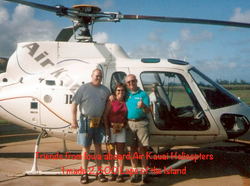
But Kauai is simply a small chunk of paradise in the middle of the Pacific. Beautiful beaches, perfect temperature, a gentle tradewind, daily rains off and on for five minutes at a time, rainbows around every bend and so many outdoor activities it’s hard to decide which to do. Waimea Canyon Hike? Snorkel at Tunnel’s Beach? Golf in Poipu? Eat Saimin at Hamura in Lihue? Surf, paddleboard, outrigger canoe? One item that goes without saying: take a helicopter tour of this island. More than 75% of Kauai can’t be seen by road travel, and there are places a helicopter will take you that will take your breath away. Maunawaipuna falls was featured in Jurassic Park. It’s 250 feet high, draped like a bridal veil and can’t be seen except by air or a (very long) hike on private property. The deepest, lushest folds of Waimea Canyon will leave you with goosebumps. The NaPali Coast may well be the most beautiful place on earth, with sheer cliffs coated with rich foliage and flowers of every description, jagged rock like a fortress towering 1,000 feet above the roaring Pacific surf. On the north shore of Kauai, Hanalei town is a storybook place where time seems to stands still, and anyone can discover their inner artist. No one hurries in Hanalei.
So if you’re planning a trip to Kauai, get in touch and I’ll be happy to advise you further. In the meantime, a good place to start is to read The Sky Behind Me. You might find it under travelogues.
July 25, 2013
Small presses are back
 Small presses are coming into their own–again. Since the founding of the Republic, small presses have been part of our national conversation, the source of much of our information about who we are, and where we’re going. Small presses have always been part of our national narrative. And in these days of massive conglomerations between the big houses like Penguin/Random House, McMillan, Simon & Shuster, HarperCollins and Hachette Group, small presses like Biblio Publishing might seem as outdated as a buggy whip. Not so. In the past several years the small houses have been emerging with more titles, better distribution resources and more direct connection with authors.My publisher, Biblio Publishing is an example. When I began looking for a reputable publisher for my first book length work,
The Sky Behind Me, a Memoir of Flying and Life
I went through the motions–query letters to editors and agents, samples to various on-line and live publishing houses, web-based literary groups offering advice & counsel. I spent a lot of time, resources, stamps & stationery and patience waiting for replies and positive feedback. The choice of a small press became easy once I looked at the advantages. With Biblio I had complete control of my work. I can make changes any time I need to, sit across the desk from my publisher & editor and make sure the book is right, hear suggestions and input on promotional ideas and placement and have more help than I anticipated in marketing the book. Plus, I’ve been exposed to other authors using the same publisher, with the opportunity to review their work and help them promote their books. Any author knows that half the promotional challenge is assisting other authors. It sounds counter-intuitive, but it’s not. We’re all in the same leaky little boat, so any help is appreciated, and being with a small press accentuates that. I’ve had the opportunity to read and review interesting works, such as Frank Shatz’s
Reports From a Distant Place
; Bill Brady’s
World War Two: Cause and Effect
and more to come from my press.
Small presses are coming into their own–again. Since the founding of the Republic, small presses have been part of our national conversation, the source of much of our information about who we are, and where we’re going. Small presses have always been part of our national narrative. And in these days of massive conglomerations between the big houses like Penguin/Random House, McMillan, Simon & Shuster, HarperCollins and Hachette Group, small presses like Biblio Publishing might seem as outdated as a buggy whip. Not so. In the past several years the small houses have been emerging with more titles, better distribution resources and more direct connection with authors.My publisher, Biblio Publishing is an example. When I began looking for a reputable publisher for my first book length work,
The Sky Behind Me, a Memoir of Flying and Life
I went through the motions–query letters to editors and agents, samples to various on-line and live publishing houses, web-based literary groups offering advice & counsel. I spent a lot of time, resources, stamps & stationery and patience waiting for replies and positive feedback. The choice of a small press became easy once I looked at the advantages. With Biblio I had complete control of my work. I can make changes any time I need to, sit across the desk from my publisher & editor and make sure the book is right, hear suggestions and input on promotional ideas and placement and have more help than I anticipated in marketing the book. Plus, I’ve been exposed to other authors using the same publisher, with the opportunity to review their work and help them promote their books. Any author knows that half the promotional challenge is assisting other authors. It sounds counter-intuitive, but it’s not. We’re all in the same leaky little boat, so any help is appreciated, and being with a small press accentuates that. I’ve had the opportunity to read and review interesting works, such as Frank Shatz’s
Reports From a Distant Place
; Bill Brady’s
World War Two: Cause and Effect
and more to come from my press.In addition, I’ve reviewed other small press products recently: Chaunce Stanton’s Blank Slate Boarding House for Creatives ; and Marian Allen’s The Fall of Onagros: Sage, Book 1. Both excellent books. All the aforementioned are reviewed on my website. So next time you’re looking for books, for gifts, educational material or just for a good reading experience, think about a small press publication. It’s kind of the American way of printing.
July 18, 2013
What do you want?
 What do you want? It's a scary question to a lot of people. Posing it puts a lot of us on the spot, causing us to tug at our chins, our mental gears churning, embarrassment seeping in that we can't just spit it out. We come up with lame responses like 'world peace,' or 'to be happy,' or 'a million dollars.' Asked to be very specific, we draw a blank, assuming it's a trick question.
What do you want? This is the basic, the fundamental question everyone with a product or service must ask as well. It's been said that most people don't get what they want, because they don't know what they want. I believe that. I believe that most of us bounce through life reacting to things in our environment, struggling to get through every day, every hour, never quite getting the exact thing that makes us perfectly happy. So today's post is a direct request to those who read my blog: What do you want to see here? What content would keep you coming back? Posts on flying and its satisfactions? Posts on the spiritual aspects of aviation? What about the combination of flying and inspiration? What do you want to see here, and how often? Would you read a blog post every day, or is that too often? Weekly? Twice a month? One reason I ask today is that I'm considering a newsletter. I'm thinking of a name for it--SkyWriter--a monthly publication that contains whatever readers want to see, delivered in a short, easy to read format right to your in-box. So, what do you want?
Also, don't forget that subscribers to this blog are now eligible to receive The Sky Behind Me, a Memoir of Flying and Life at 50% off, for paper and digital editions. For those who have read my aviation/life memoir thank you, and reviews are always welcome.
July 17, 2013
Blog Subscribers Only--Half Price Book.
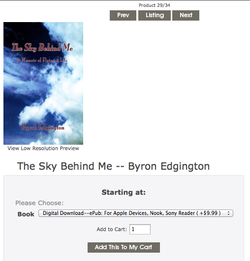 Thank you for subscribing to The Sky Behind Me Blog, my other site.
 In appreciation for signing up, and for reading my posts, for a limited time The Sky Behind Me, a Memoir of Flying and Life is available to you for half price. The offer applies to both paperback and digital editions, and is extended to blog subscribers only.
Just go to Biblio Publishing and use the discount code: 'SkyBlog' during the checkout process.
Thank you in advance for purchasing The Sky Behind Me, and reviews are always welcome.
Byron Edgington and the Biblio Publishing Team.
July 16, 2013
Add Value: The Sky Behind Me at half price
 Regardless of the business we find ourselves in, Tinker, Tailor, Soldier, SkyBlogger we should always try to add value, especially to those who make an effort to connect with us. Any entrepreneur worth a nickel–and that describes most of us–knows that interacting with customers isn’t about persuading them to reach for their wallets. It’s about serving a need. It’s asking for what customers seek–answers to questions, entertainment, affirmation, confirmation or just something that makes their day a bit brighter. When I flew for a living, regardless of the kind of flying I did or the ‘customer’ involved, I always tried to add value to the flight: I ascertained peoples’ fears; always read body language and stayed responsive to changes; always remembered that I had a set of controls, and they were along for the ride. Even in Vietnam–especially there–I paid attention to the primary goal we all shared, which was to stay alive and make it home to family and friends.
So here’s today’s added value. For a limited time, subscribers to The Sky Behind Me Blog may purchase The Sky Behind Me, a Memoir of Flying and Life from Biblio Publishing for 50% off, both paperback and digital editions. Just subscribe to the blog, follow this link and when buying the book use the product code ‘SkyBlog’ at checkout to get the book at half price. This goes for current subscribers too, of course, and thank you for reading The Sky Behind Me Blog.
July 15, 2013
Lies, Damned Lies & Statistics
 Airplanes crash. It’s true. As they say in the trade, gravity ain’t just a good idea, it’s the law. In my forty year career in the cockpit of various helicopters, I was always aware of the possibilities, the simple reality that while cruising above the earth’s surface, like all my colleagues in aviation, I was out of my natural element. Regardless how well I understood the risk, how proficient I was at moving the sticks around or how well I knew the flight regulations, none of that knowledge or competence erased simple physics.
But I also understood better than those who don’t fly, that aviation, instead of being a ‘dangerous’ endeavor, is most often safer than traveling in a ground vehicle, especially in a passenger car. In the air I was surrounded (mostly) by professional pilots, always in direct communication with them, often tracked by an FAA radar site with attendant flight following if I wished to use it. Chances were very good that my flying cohorts were sober, cautious, eminently qualified to be operating their machines and (again, mostly) wide awake. We hear the usual horror stories about aviation accidents, inexplicable crashes, dead passengers and twisted metal when something goes horribly wrong in the air, and some people jump to the conclusion that ‘flying is deadly,’ and best avoided. Then those same individuals jump into their motor vehicle, disregard the seat belts, shake off the effects of their three, or six, or nine beers, turn the key and drive home–often too fast– three feet away from other vehicles traveling the opposite direction, some equally impaired. I once flew a young woman to the hospital who had a medical problem requiring a higher level of care than her small hospital could provide. The woman was terrified to fly. The trip was forty minutes by helicopter, and her knuckles were white the entire time. Shortly after I lifted off and pointed the nose toward home she signaled for my flight nurse’s attention and yelled in his headset. “Lower! Lower!” The nurse keyed his mike and relayed her message. She wanted me to fly lower, because “…she’s afraid of heights,” he said. Always mindful of my patient/passengers’ fears and sensibilities, however irrational, I dropped from fifteen-hundred feet down to five hundred. It made sense to her, and she relaxed, somewhat, for the duration of the flight. The numbers didn’t add up to me; but they did to her.
Speaking of irrational numbers, statistics can be used for anything, as Mr. Twain so wonderfully put it, even as the apotheosis of lying. But a look at hard accident data of flying in the recent past, Asiana 214 at SFO notwithstanding, and the record is pretty impressive. Indeed, considering the number of survivors from the accident, Asiana 214 was a pretty impressive crash all by itself, if that can be said. The fact that 304 of 307 passengers & crew left the plane alive speaks volumes about current engineering and crash survivability of modern aircraft.
But what do the numbers say? How many airplane crashes are there, anyway? It depends, of course, on what kind of flying we’re talking about. In the airline industry, which is 99% of the traveling public’s exposure to aviation, the accident rate over the past ten years has been remarkably low. If you book a flight today on any scheduled American commercial carrier, your odds of dying in a crash are 1 in 4.7 million. Traveling on a non-scheduled, or commuter carrier: 1 in 1.8 million. Odds of being hit by lightning are higher at around 1 in 300,000. Going by car instead? In 2012 there were 34,080 highway accident fatalities in the U.S. It may be apples & oranges, or damned lies, as Mr. Twain said, but regardless, that translates to an airplane crash with 300 fatalities every 3.5 days.
So if you’re traveling beyond 500 miles this summer, leave the car in the garage and fly instead. It’s a whole lot safer, no matter how high you go.
July 13, 2013
Book review: The Fall of Onagros, Sage Book One
 The Fall Of Onagros by Marian Allen
My rating: 5 of 5 stars
Byzantine, mysterious, convoluted and delightful, this is a book that crosses more boundaries than the Fiddlewood River. I’ll say this up front: This reviewer doesn’t particularly care for the fantasy fiction royalty romance genre, and I loved this book. Enough that I’m disappointed to have to wait for its sequel.
Landry is installed on the unsteady throne, replacing his long-lost spouse, Karol who is Kinninger of Layounna. Once Landry reconciles himself to Karol’s apparent death, he does his own shape-shifting, becoming as devious as he needs to be to keep the lid on things. Landry teases out, for example, the conflict between his Chief Sword, Guthrie and Rhu the Lord Chamberlain, a common clash that will be run its course. Corvina, Landry’s conniving mother, or moder, is more than happy to help Landry, partly because she knows her son is ineffectual without her. When Landry decides to take a mate, he chooses Elsie, Darcy the roll-keeper’s (secretly-stolen) daughter. Elsie has no desire to marry Landry, and with the help of clever ‘varier’ Brady she leaves the castle’s intrigues and plotting behind. That’s where Sage, which is book one ends, but the astute reader will have imagined much of the proceeding plot lines and revelations waiting ahead.
Extremely well crafted, Sage is plotted and woven and formatted like a tapestry hung on a castle wall, a decorative brocade that contains threads and connections and linkage so intricate it’s both predictable and revealing at once, not an easy literary feat to pull off. The dialogue between characters is written just as readers might expect royal inhabitants of Layounna to speak. Here is Andrin, a Waymaster: "The answers must be ferreted out by active search and asking, or waited for, or done without." And like this passage, much of the text is as near to poetry as prose might get: ‘The sun rose, and she was a sea of blood. He fell into the sea and the sea sang in his ears and broke upon the sand with the sound of children's cries.’ This is great writing, and writing to match the story, full of wonderful images, good use of alliteration and careful simile.
Sage contains timely foreshadowing throughout. It makes good use of certain animals and insects to push it close to allegory— bees, phoenix, dragon, tortoise and unicorn. It even has the requisite sorcerer/magician/storyteller/court jester, an exotic blacksmith named Farukh. Plus, it has a chicken named Chandler. What’s not to like? The unicorn being a vital part of any medieval/fantasy/romance might seem banal in any other book. In Sage, its appearance late in the tale makes it seem inevitable.
This is not a simple book to read and to follow. It’s filled with plot devices such as dreams, shape-shifting ‘variers’ and many colorful characters. But it draws a reader into its complications right away, puts main characters up a tree in the early going and maintains the suspense throughout. There may be too much going on for readers expecting an easy time, but for those who revel in deeply plotted and intricate stories the more complicated the better. It is also, it must be added, first of a trilogy, and that fact explains much of the complexity.
As for technical glitches, there aren’t many to report. The four dot ellipsis might give way to three, depending on the style manual used. There may perhaps be one too many critters ‘serving The Way’: Unicorn, Tortoise, Phoenix, Dragon. This is trilogy, so maybe three? Also, the description of those animals’ capacities is out of order in the text, again a very minor thing. The reference to Wild Ass Land may not work, as readers may misread the label, the verbiage seeming out of place. In chapter four, Karol takes refuge with Moder Zglaria. In my opinion, this scene needs a close call of sorts, more danger and tension when Karol’s presence is nearly discovered. Also, using synecdoche adds whimsy to any story— soldiers labeled ‘Swords,’ for example— so perhaps more of that? Personal preference here.
Sage is a wonderful romp of a story. The character’s names are delightful—Karol, Andrin, Biddi, Trahern, Darcy, even a town named ‘Bought for three goats.’ Wonderful! Great expressions throughout: “Tortoise will not be mocked!” ‘Like a bundle of sticks tied together with elbows.’ I particularly loved the Nishian custom of older women as first wives for young men, to train them to be proper husbands. Great idea, I think. Indeed, the Moder as Ruler theme is intriguing all by itself. For those who enjoy religious allusion, there are many in Sage, including a frantic search by a jealous king for a rumored infant that threatens to take his throne. Sage has something for everyone. If Marian Allen delivers books two and three even close to book one, she’s made a fine addition to this genre.
Byron Edgington, author of The Sky Behind Me, a Memoir of Flying and Life
View all my reviews