Byron Edgington's Blog, page 2
November 12, 2013
From Where I sit
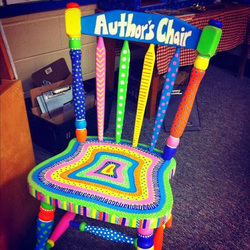 From where I sit the writing life is very much like working in a vacuum. Most days I feel like the ex-pat artists and bohemians of nineteen-twenties Paris must have felt, closeted away in their chilly garret, alone with only their thoughts and idle fantasies to keep them company. Like them, I wonder who’s ‘out there,’ or if anyone is as I plug away at posting mere words on the page. The writing game begins to resemble the SETI efforts of modern space-faring scientists, the Search for Extra Terrestrial Intelligence, the difference being that my search is in my back yard by comparison. Call it SIROT, the Search for Intelligent Readers Out There. Okay, admittedly I do get comments from Out There, but there are only so many pairs of Ugg boots I can wear at one time, only so many Fakely sunglasses I need, partly because the ones that slip through the spam filter and show up on my blog’s comment section aren’t prescription, and these days I have more lines in my lenses than Angelina has stretch marks.
So for all my faithful readers, all three of you, I’m asking that you pass this blog along, a shameless effort at self-promotion, but with a difference. In today’s post I’m blatantly asking for comments, real ones, not for more Uggs, thank you ever so much, but real feedback on what readers want and expect in a writing/promotion blog? Humor? Writing tips? Reading tips? Cooking tips? Links to a government website that actually works? I spend my days in my author’s chair, waiting, waiting…. Is anyone out there?


November 7, 2013
Goodreads Book Giveaway
.goodreadsGiveawayWidget { color: #555; font-family: georgia, serif; font-weight: normal; text-align: left; font-size: 14px; font-style: normal; background: white; } .goodreadsGiveawayWidget img { padding: 0 !important; margin: 0 !important; } .goodreadsGiveawayWidget a { padding: 0 !important; margin: 0; color: #660; text-decoration: none; } .goodreadsGiveawayWidget a:visted { color: #660; text-decoration: none; } .goodreadsGiveawayWidget a:hover { color: #660; text-decoration: underline !important; } .goodreadsGiveawayWidget p { margin: 0 0 .5em !important; padding: 0; } .goodreadsGiveawayWidgetEnterLink { display: block; width: 150px; margin: 10px auto 0 !important; padding: 0px 5px !important; text-align: center; line-height: 1.8em; color: #222; font-size: 14px; font-weight: bold; border: 1px solid #6A6454; border-radius: 5px; font-family:arial,verdana,helvetica,sans-serif; background-image:url(https://www.goodreads.com/images/layo... background-repeat: repeat-x; background-color:#BBB596; outline: 0; white-space: nowrap; } .goodreadsGiveawayWidgetEnterLink:hover { background-image:url(https://www.goodreads.com/images/layo... color: black; text-decoration: none; cursor: pointer; } Goodreads Book Giveaway
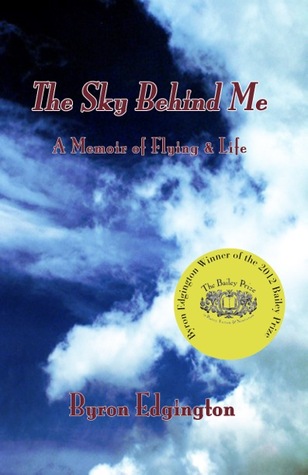 The Sky Behind Me by Byron Edgington
The Sky Behind Me by Byron Edgington Giveaway ends December 22, 2013.
See the giveaway details at Goodreads.
Enter to win Enter to win a free copy of The Sky Behind Me, a Memoir of Flying and Life. The giveaway will only be open for entries starting midnight on Wednesday, November 20 through midnight on Sunday, December 22, so enter early, and thanks!November 4, 2013
'To be' or to have a better verb...
 Want your writing to fly off the page? Here's a tip: track down all the 'to be' verb forms and find better, stronger, more aggressive verbs. The following is part of chapter 2: 'Takeoff' taken from my soon to be published writing handbook--Air-Craft and The Writing Craft. While reading successful authors' works, notice how they avoid 'to be' forms to make their writing take off and keep their readers interest.
 ➤ Track down all the ‘to be’ verbs and change them. Variations of the verb ‘to be’ make weak, wimpy writing. They make the writing sound like a dishrag on paper. Take a look at these sentences and spot the differences in strength and power.
☹ Mary was unhappy.
☺Mary wore her unhappiness like a shawl.
☹ That is the spoon he mentioned.
☺That resembles the bent, rusted spoon he talked about.
☹ The truck in the hit and run was a black Ford.
☺A black Ford pickup tore from the scene of the hit and run.
These examples are simple, but you get the idea. Rearranging verb choices is hard work, and is even harder over the length of a novel. Being aware of all the ‘to be’ forms is perhaps the toughest thing there is, because we acquire the habit early.
Now, let me rewrite that paragraph, eliminating the ‘to be’ forms.
These examples seem simplistic, but they work to explain the difference. Rearranging verb choices demands hard work, and makes us change habits that we latched onto long ago. Strengthening verb choices this way forces writers to stay alert to better verb forms, and new ways of sending the message. Better? I hope so. Great verbs equal great writing.
October 31, 2013
Take a hike!
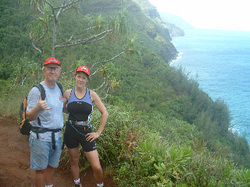 “I never found a companion that was so companionable as solitude.” So sayeth Henry David Thoreau. Thomas de Quincey, fellow poet, estimated that William Wordsworth walked 180,000 miles across his beloved Lake District. James Joyce gave a backhanded nod to walking when he described Dublin as the “the centre of paralysis.” Writing being a solitary endeavor, it seems only natural that solitude would benefit a writer, and indeed, for this writer at least, that is true. When the next verb, participle or article won’t pop into my brain fully formed, and even when the ideas and steady flow of a piece are working well I often take a hike. There’s a city park not far away, an abandoned stone quarry, an oval lake of perhaps ten acres circled by a footpath that, according to the small wooden sign, is 1.2 miles around. I walk that path nearly every day, weather permitting. I go alone. Most days, before I’m a fraction of the way along, I’ve broken a jam, reconsidered a phrase or gained an insight to what’s important in a piece of writing. (Or some other pressing item) Often along the way, ideas bubble up on their own, new sides of an issue I’d not considered, different ways to look at something, a new perspective. Times like those I understand perfectly what Thoreau was saying: Solitude is such an agreeable companion, and much more conducive to deep thought and introspection than time spent with others, even people we revere. I’m not the only writer who uses this mechanism to ease the process along. Karen Berger, who calls herself the HikerWriter, is one of many authors who specialize in hiking and writing. Goethe, Joyce Carol Oates, Gretel Ehrlich, Will Self, Lain Sinclair, all endorsed the value of walking to their writing. Ehrlich called it “an ambulation of mind.”
Thoreau’s kind of solitude is more important all the time. When traffic noise and crowds and electronic babble and the machinery of modern life cackle at us in a constant din, we need those footpaths more than ever. And not just writers, either. Feeling overwhelmed with the cacophony of life? Take a hike.
October 30, 2013
To Publish, or Not To Publish...
 I used to swear up, down and sideways that I’d never under any circumstances pay to have my work published. Not gonna do it. It’s plenty good enough that some major house, prominent agent or both will be enlightened enough to see the value in what I’ve written and gladly pay me for the privilege. Well... ‘Never’ being a somewhat longer time than, well, than any amount of time I might have left, I’ve had to reassess that pronouncement. Here’s the rationalization that allows me to keep writing, and to keep staring back at the fellow in the mirror who seems to shave every morning the same time I do. I don’t pay to publish my work; I pay to have someone else publish my work.
Okay, that sounds like the old Vanity Press copout, I suppose. The old writer-wannabe impulse giving in to market forces that keep rejecting whatever words of wisdom the damn fool market isn’t wise enough to see for what they’re worth: my words are, in a word, worthwhile.
It’s a common human conceit to regard our own product, whatever it may be, as the best, fastest, most innovative, cleverest and beyond necessity thing to come along since Plato was a pup. Market forces being what they are, clever people have created venues that not only reinforce our opinions of our own craft, they extend the attractive life ring we need just in time to rescue us before we dip below the waves for the last time, our clever idea/widget/tool/solution/book etc. sinking with us, lost for all time. And do we ever grab that ring! Cripes almighty, we leave knuckle marks in its welcoming surface, expensive knuckle marks in many cases.
Some of those life ring entities that have arisen to rescue authors drowning in the vast and stormy sea of publishing are such outright self-pub sites as Createspace, Lulu, selfpublishing.com, Amazon for Kindle etc. But there are a few cropping up lately that take a hybrid approach to self-publishing. Companies such as Greenleaf Book Group in Austin offer the same quality product in a manuscript that the majors have always offered, while requiring authors to be heavily involved in their own promotion, including the financial aspects of it. Another, newer site that is in Beta mode as this is written is Line by Lion, which offers a middle route to publication. Line by Lion seeks to represent what they refer to as 'houseless' authors. As their Indiegogo site says: "... there are many fabulous authors with quality, finished works and careers on the rise who are set back when their publishing house closes" In other words, Line by Lion offers a refuge for writers who may have had a house contract. L by L is seeking funding now, and I'm hoping they get it because the idea is sound.
Authors may decry this business model as predatory or oppressive, but it seems to me that this arrangement merely acknowledges the reality of modern publishing. That with E-books rapidly replacing hold-in-your-hand books, and fewer readers buying books at all, publishers’ profits are vanishing. Unless your name is John Grisham, Dan Brown or Jeanette Walls the days of a publishing house paying for reading tours, expensive promotional campaigns and huge print runs are over.
So do I pay for publishing my own work? If I want readership, do I have a choice?
October 23, 2013
Writer's block: 2 cures
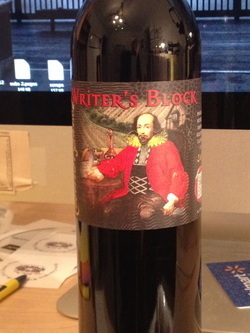 Whenever I find myself sitting in front of the computer with a dumb look on my face (okay, dumber than usual) for several minutes, there aren’t many things that snap me out of it and prod me back into the writing. This morning, October 23rd, I believe I’ve found two such cures for the torpor that’s otherwise known as writer’s block. The first cure for changing my mood was a non-prescription dose of changing weather. “Is it raining?” my sweet wife said, as she lay half-awake in her nest of the bed. “No, it’s not rain,” I said. “Generally speaking, rain isn’t white.” (I hear the wife groan like that on occasion, a response she picked up when we left Hawaii). Changing weather will do it, erase the blockage that is. Why am I surprised that on the twenty-third day of October there should be snow on the ground? Its presence has the effect of changing my mood, of giving me an odd kind of hope that we’re not stuck in some kind of national block, that instead of staring into our collective TV screens with looks of disbelief at the shenanigans going on around us, that things do change, even if the change comes along in the form of chilly weather.
The second block-buster if you will is featured above. I discovered this wine at a market close by, and had to have it. Many writers un-block themselves with a liquid diet, of course. I don’t take such drastic measures, but the bottle now occupies a spot near my computer just in case. I was careful to leave the opener downstairs, that way, if worse comes to worst and I simply can’t start the flow again (of words that is, relax), I imagine that by the time I get to the kitchen for the opener I’ll have forgotten what it is I wanted.
October 16, 2013
Welcome to the new world of PCS
 I’m a writer. Because I traffic in words, phrases, sentences and paragraphs, perhaps more than most people I take notice of what’s going on in the language and lexicon that passes for communication these days. And quite frankly I’m perplexed. This post will have the patina of political posturing because, well, so much of our national dialogue does these days, (and because I love alliteration. ‘patina of political posturing, is that great or what?) There, I said it, part of my motivation is and has always been to play with the language and see where it takes me. In today’s post I propose that everyone does it, that is to say that everyone ‘plays with the language’ out of some reactionary response to whatever issue they bump into, and we do it without thinking. I admit that I do the very same thing myself, guilty, yes, true, I throw myself on the mercy of the tribunal. I often spit out words before parsing them. Except when I write them down. I think my itch to scratch language chiggers and chafes is courtesy of Miss Parker, my second grade teacher, who once wrote on her chalkboard the first words that electrified me: ‘Horton Hears a Who.’ Not alliteration precisely, but those three (okay, four) words jerked me awake after lunch. Thereafter I was hooked on words. Fast forward, ahem, a lot of years, to our eroded language miasma. In a recent Huff Post piece, with accompanying video, I saw and read a prime example of what I’ve labeled our new age ‘Pre-Cognitive Speech.’ Yes, I submit that we’ve now crossed the river and into the weeds, from the PC (Politically Correct) into the ethereal (and perhaps more detrimental) realms of PCS (Pre-Cognitive Speech). The Huff Po article/video was a perfect illustration of this sad development in human linguistic progress (Regress?). In it, a fellow named Larry Klayman ‘called out’ our president to ‘put down the quran, and leave town…’ Now either Mr. Klayman is egregiously ill-informed about Mr. Obama’s religious preferences, or he knows how to get himself on Huff Po. I suspect the latter to be true. But here’s the thing; his words are not only inflammatory— which ostensibly harms no one, he was on the National Mall, after all, not in a crowded theater— but his words were solidly in the realm of PCS. Again as a writer, allow me to parse his PCS pronouncement: “I call upon all of you to wage a second American nonviolent revolution, to use civil disobedience, and to demand that this president leave town, to get up, to put the Quran down, to get up off his knees, and to figuratively come up with his hands out,”
Where to start. Call upon? Is he visiting? Or planning to fall into their collective lap? Language police, myself included, write instead, ‘Call on.’ A second revolution? Okay, this may be nit-picky, but this is a favorite nit of mine, so I’m gonna pick it. The American revolution never ended, and with any luck never will, so please you chucklehead T-partiers stop with the silly references to revolution. We’re not a country; we’re an idea, and ideas never end. Oh, and the first ‘revolution’ was pretty violent, so we can’t ‘wage a second non-violent one’ just yet. ‘This president leave town’? Okay, that’s progress; they’re at long last acknowledging that Barack Obama is a legitimate president. It only took five years. ‘To get up’? I thought he already left town? Oh well, I’ll skip the lack of continuity. Miss Parker gave me that leeway in second grade, it’s the least I can do for Mr. Klayman. ‘Put the Quran down.’ Why would a Christian president have a Quran? And why would it matter? ‘Come up with his hands out.’ Ugh, as Miss Parker would say. Shouldn’t it at the very least be grammatically coherent? ‘Come out with his hands up’? As my good friend Kevin says, “Puuuuleaze!”
End of today’s rant. Thanks for taking time to read it. Now get off your knees, stay in town and try to avoid the PCS in all conversations today. Oh, and thanks to Miss Parker wherever you are.
October 14, 2013
Ignore the trolls today
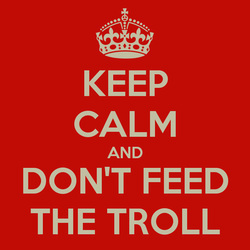 I saw this worthwhile advice on a recent social media site, and though it appears to have no immediate application to writing, I decided to use it today anyway. Mondays seem to be the day of the week when we allow the trolls to have free rein, forcing their negative attentions and opinions on us because they know we’re vulnerable. In some disciplines Monday has a reputation for influencing outcomes. The stock market, for example, even has a name for this: the ‘Monday effect,’ has been shown to sway stock prices downward, with no explanation other than the day of the week. Freelance writers refer to a Monday stall, a miasma that hampers their ability to write anything worth reading until, well, until Tuesday. On her blog, Make a Living Writing, Carol Tice posted a five-step plan to solve the Monday morning writers’ blues. I say, let’s blame it on trolls and their conniving. This Monday, here’s a chance to break the cycle and take back what is arguably the best day there is, Monday, since it marks a fresh start each and every week. This certainly applies to writers who wrack up a list of obligatory tweaks, scratches and rewrites that come due on that day.
Another great piece of advice I heard once was this, from Amy Hatvany, Best Kept Secret among others: Ms Hatvany says: “What other people think of you is none of your business.” This is especially true on Monday when, let’s face it, we’re all a bit frazzled trying to get back in the swing, and having lost momentum on whatever project we’re in the middle of. This is where the trolls come in. Trolls are people whose main goal in life is to upset others. They actively seek ways to distress us, call attention to our human foibles and quirks, and generally drag us down if they can. Trolls find something negative in every situation. They complain about the sunrise because it’s too bright; they whine about the sunset because it’s not bright enough. We all know one or two trolls. There’s a reason they’re considered evil and disruptive; Trolls do all they can to cause real damage. In writing, they scribble gratuitously negative reviews, just because they can. Here’s one writer’s volley against them in reference to book reviews. Doris-Maria Heilmann, author of 111 Tips to Creating Your Book Trailer had this to say on a recent Google+ post: ‘Many authors have been victim of the “review trolls.” She cites a book by author Taylor Evan Fulks who wrote My Prison Without Bars: The Journey of a Damaged Woman to Someplace Normal.
Heilmann goes on to thank author and blogger Carolynne Keenan ‘for fighting these trolls, and for being passionate about curbing bullying.’ So the issue is a real one for writers, too. Next time you hear a troll trashing someone, especially a writer, ignore the rant and have a great Monday.
October 2, 2013
September 30, 2013
The Three 'Tells' Promotional tips for indie authors.
 Are you like me? Do you have a great idea for a story, essay, article, book or series so you scribble the thing, tweak it to death, massage it a bit more then shove it out the door like a kid late for school only to watch it flounder around looking for the bus full of readers? Do you do that, too? When I was in Journalism school, way back in the twentieth century when there were journalists who could reasonably expect to make a living writing things, I was taught the three ‘tells’ of good journalism: Tell them what you’re going to tell them; tell them; then tell them what you told them. So now that I’m a freelance writer, with a book of my own and several attempts at others, what did I do? That’s right; I forgot all about the three ‘tells.’ That’s just silly. Consider your new book a piece of news and go from there. Here are some tips: In Austin last week I attended the Greenleaf Book Group first annual author summit. It was a great conference, filled with high-quality speakers, beneficial information, terrific networking opportunities and much more. Plus it was in weird old Austin, so what’s not to like? One of the important takeaways from the Greenleaf summit was the emphasis on pre-publicity for works in progress, and the necessity for announcing a new release. Here are some startling, perhaps sobering figures. According to the folks in Austin there are 3,000 (yes, thousand) new titles published EVERY DAY in America. Every day, three thousand new books gush into the river of available content, like lost children on the first day of school looking frantically for the school bus full of readers. So what’s an independent author to do to get ones own book recognized, perused, considered and bought in that flood tide of new titles? Well, the three ‘tells’ are as good a place as any to start, partly because few authors make this critical move. Few authors think to put their own title, a soon-to-be-book-release out there in view far enough in advance, if at all. Heck, I didn’t announce
The Sky Behind Me
until a week after it was published!
Are you like me? Do you have a great idea for a story, essay, article, book or series so you scribble the thing, tweak it to death, massage it a bit more then shove it out the door like a kid late for school only to watch it flounder around looking for the bus full of readers? Do you do that, too? When I was in Journalism school, way back in the twentieth century when there were journalists who could reasonably expect to make a living writing things, I was taught the three ‘tells’ of good journalism: Tell them what you’re going to tell them; tell them; then tell them what you told them. So now that I’m a freelance writer, with a book of my own and several attempts at others, what did I do? That’s right; I forgot all about the three ‘tells.’ That’s just silly. Consider your new book a piece of news and go from there. Here are some tips: In Austin last week I attended the Greenleaf Book Group first annual author summit. It was a great conference, filled with high-quality speakers, beneficial information, terrific networking opportunities and much more. Plus it was in weird old Austin, so what’s not to like? One of the important takeaways from the Greenleaf summit was the emphasis on pre-publicity for works in progress, and the necessity for announcing a new release. Here are some startling, perhaps sobering figures. According to the folks in Austin there are 3,000 (yes, thousand) new titles published EVERY DAY in America. Every day, three thousand new books gush into the river of available content, like lost children on the first day of school looking frantically for the school bus full of readers. So what’s an independent author to do to get ones own book recognized, perused, considered and bought in that flood tide of new titles? Well, the three ‘tells’ are as good a place as any to start, partly because few authors make this critical move. Few authors think to put their own title, a soon-to-be-book-release out there in view far enough in advance, if at all. Heck, I didn’t announce
The Sky Behind Me
until a week after it was published!Here are a few useful guidelines: According to Marika Flatt, founder of PR By The Book. Got platform? Yes, the ‘P’ word. It’s all about platform these days, so at the very least set up a G+ account, a FaceBook page for your book, a Twitter account. Post on Pinterest if you have cover art. Make regular announcements on Reddit and whatever other social media you have access to. Start a blog about the book at least 5 months before launch date. Establish a website early. Any website should have these key pages: Blog, Press, About the Author, About the Book, Appearances, Reviews, Contact. If you have cover art it could make a good background for the site. Post the work to NetGalley. It’s free to sign up, and offers a great tool to have early reviews of your book. List your personal contacts and social media friends and acquaintances, then contact them all with regular updates. Offer a free (fill in the blank) for the first (or first ten) readers etc. Consider a virtual book tour, and announce its pending date. Blog reviews about other authors’ work and ask them to return the favor using PDfs or galleys. Post these interactions to your social media sites and your website.
The bottom line is, get started early–six months pre-pub is not too early–and keep the postings coming. If you have the ability and resources, hire a publicist to either handle all the above or walk you through the process. The important thing is to avoid what I usually do, write the book, publish the thing, then start telling the world about what a wonderful, compelling, gripping and vital piece of literary art it is, as the bus full of readers disappears into the distance. Speaking of the journalistic rules, yet to come this week will be other vital promotional and editorial tips gleaned from the Austin summit. Stay tuned for hints on word of mouth promotion, branding, differentiation in the marketplace (do you have a favorite water?) and much more. See you then.