Byron Edgington's Blog, page 3
September 16, 2013
The Writer's Tool Box
 When I was in college at Ohio State, I took several creative writing classes. One non-fiction class that I was sorry to see conclude was taught by a fellow named Lee Martin, author of The Bright Forever, for which Lee was a runner-up for the 2006 Pulitzer Prize in fiction. A few of Lee Martin’s other titles include From Our House, Break the Skin, Quakertown and River of Heaven. Lee Martin always brought his ‘writer’s tool box’ to class. (He also brought windup toys every day, but that’s another topic altogether.) Lee’s tool box included four insertions that, if used correctly and well, allow a writer to break through the most durable word-jam and pry a piece of writing open, or at least allow it get off dead plumb. Here they are:
1-- “...at that moment I…” This tool always makes me stop and think about where the piece is. In other words, where am I going? It allows me to summarize a little, to make sure I’m on track and headed the right direction. 2-- “I didn’t know until then…” Ditto, a good chance to regroup, plus a great way to insert a new fact or meaningful item into the text. 3-- “It never occurred to me that…” Perhaps an even better way to redirect the vector of the story, or to bring the reader (and maybe even the author) up to speed on where the story is going. 4-- “I didn’t know that…” A useful tool to explain to the reader that things weren’t clear to the author either.
These tools are more useful for non-fiction, but they may be put to use in fiction, too, as a device the protagonist has at his/her fingertips to move the story forward. I don’t know if there’s a connection or not, but after using three of Lee’s tools in a piece of my own titled Body Language, a non-fiction tale based on one of my flying tours of Kauai, the story was picked up by Gemini Magazine and published under the title ‘After the Rain.’ For those struggling writers like myself, looking to unbottle the genie and write sentences that make the writing god weep in ecstasy, there’s no lack of people and websites and venues and resources out there to guide us along the way. The old adage is: ‘those who can, do; those who can’t, teach. In my case I was fortunate to have instructors like Lee Martin, a teacher who actually can—and does.
As for my own ability to write rather than teach, here for what they’re worth are my responses to a few writing queries posted to a writing group I belong to on G+, and additional insights from fellow writers.
This from Jane Turley, a wise and witty woman (WWW?) who posts at The Witty Ways of a Wayward Wife. ‘Oh. Dear. God. I am in serious trouble, readers.’ Three things about Jane’s clever post: one, she’s using the most mundane topic there is in the whole wide world (what is it with all the ‘W’s today?) to weave her wonderful tale, and that is laundry; two, she begins her blog post with one of my all time favorite writing devices, the one-word sentence. ‘Oh. Dear. God.’ Now, it’s really easy to overdo this, but an author who can pull it off has a shiny new tool. Third, it isn’t hard to find something to write about, it’s just behind the door of the utility room, as Jane Turley shows us here. Laundry? Sure. Next we have a very clever author who actually gave up a thriving medical practice (okay, he retired, but still…) to blog and write. Mr. Timothy Hurley, no relation to Jane Turley, is author of Shortstack Funny Stories. He blogs at The Lunatic Assylum. Hurley’s focus is often current events, and a perusal of his posts quickly demonstrates that he doesn’t hesitate to use his laser wit, much like he used a scalpel in a previous life, to wring out the best and most whimsical drippings from any topic. There is humor, and there is sarcasm, and the combination of the two is, again, easy to overdo, but a great tool in the right hands. Chaunce Stanton, author of recently published The Blank Slate Boarding House for Creatives, is a period piece about warring magicians in which Mr. Stanton novelizes the clash of artistic sensibilities and magic. The intersection of history and art is also a great writing device, and it’s put to good use here. But Stanton’s other, perhaps better, writing tool is one he uses in an earlier book titled ‘Baby Proof: A Humorous How-To Guide for Bad Grandmothers.’ Here we have a book about a twist that turns a rock-solid social truism on its head. Bad grandmothers? Impossible? Well, maybe not. It’s up to us writers to unearth the unearthly, and make it real, a tool we shouldn’t hesitate to utilize. Finally, here is Marian Allen, author of the wonderful Sage Trilogy that’s a must if you’re looking for a highly textured, wonderfully complex but satisfying fantasy read. Marian Allen’s blog is titled, oddly enough, Marian Allen— Fantasies, mysteries, comedies, recipes. A recent post mentions a timely tool: memoir as a source of writing prompts. We tend to forget that, as Ms Allen says, “...let’s take memoirs as a starting point, go through writing one’s life, and end with writing from life.’ The key part of this is writing from life. There are those who say ‘write what you know,’ of course. This poses a challenge to young writers, those too recently out of the gate to actually ‘know’ much. But I remain convinced that anyone who’s graduated from, oh, say, third grade has a story to tell. It doesn’t have to be Hemingway or Oates or Faulkner. But it has to be real, and if not true then true-able, if that’s a word. I guess it is now. Which brings me to my, perhaps painful conclusion today. A tool I admire and have used a time or three myself is the made-up word/phrase/verb/ending etc. An example is ‘true-able,’ which, as I write this, is less than an hour old. Made up words are an art form. In yesterday’s New York Times Magazine’s ‘That should be a word’ section we find ‘Stuckler,’ meaning someone backed into a corner by a previous hardened belief. Recently I searched for a word meaning a repository for old jokes until needed again, and crafted my own, ‘Humordor.’ I love authors who verb-alize, that is, make up their own verbs as they scribbilate along. Okay, it’s an awful example. Make your own. Phrasing can be fun, and a great way to avoid using cliche’s. Hard as a rock could become ‘hard as pea-gravel’ or hard as cold/fresh/icy/buttered concrete.’ Buttered? You get the idea. Endings can be a fun, satisfying writing tool as well. It’s too easy to overdo ellipses… But they can create suspense, and ease clunky transition troubles. A sudden complete reversal in an ending can be a great device, of course, as anyone who’s seen The Crying Game will attest. In any case, just creating one’s own writer's tool box may be useful when the laundry is piling up, Syria is making headlines, grandmothers are being arrested for stealing candy from infants and the lunatics are taking over the asylum, in other words, writers are hard at work.


September 9, 2013
 This morning I went downtown Columbus to the State House to witness a turning point. Starting today, September 9th 2013,
 September 6, 2013
Pathology & Author-ity
 Pathology. The definition, from Merriam Webster’s on-line dictionary is ‘deviation from propriety or from an assumed normal state.’ From the Greek word for ‘the study of emotions,’ pathology is something normal people, so not writers, in other words, try to avoid.
 Author-ity: Alas, from the same source, Ms Webster’s excellent dictionary, defined as : ‘power to influence or command thought, opinion, or behavior.’ From middle English and Latin, Auctoritat, meaning opinion, it is, of course, the root of our word ‘author.’
Similarities exist. Being an author, I can speak with some author-ity on this topic. Indeed, it pains me more than I care to admit just how similar the two states, pathology and author-ity can be at times. Like the evil twin, pathology does overwean among writer/authors at times, imbuing us with certain behaviors many ‘normies’ may find, indeed do find annoying at best, repulsive at worst. Let me itemize a few of the authorial pathologies (see how easy that is?) for you and see what you think.
In order for a real writer/author to begin his or her day, it’s necessary to dwell on the writerly task at hand before all else. No preparing the caffeinated potion first, no shooing the little grocery grabbers off to school and whatnot, not even first making time— or heaven forfend making love— with the housemate. No, the writerly urge is all, or at least the literary planned pursuit is all. Is this pathology? You tell me.
Once up and about, caffeine prepared and literary plan somewhat settled in our minds, do we writer/authors actually propel ourselves into said task? No, we do not. In a classic symptom referred to as approach/avoidance, we repel the burdensome writerly urge to do such practical and abundantly necessary things as rearranging our sock drawer, brushing the cat, rearranging the cat’s sock drawer, brushing the cat’s socks. The screaming, shouting propulsion toward the writing desk is powerful as ever; we resist it like we do our out of work in-law. Is this pathology? Not certain what else to call it, actually.
Once the desk is finally occupied, the keys tap-tap-tapping away, do we write happily along, elegant sentences flowing from our fingertips, phrases that sing, paragraphs that would make Faulkner weep and Rowling discard her manuscript? No, we do not. Instead we writer/authors tap—skip—tap—erase—rewrite—tap—ponder—agonize—self-abuse—tap again, then skulk to the sock drawer once again to make sure those argyles are alined just so, tube sox not touching the knee sox. Pathology? Dr. Freud, answer your page, please.
The thing is, we writer/authors are a crazy, fragile, needy, self-absorbed and emotionally-teetery bunch. Our craft is words, those ephemeral digits we’ve collectively assigned meanings to, the most insubstantial of elements of any art form. We aren’t throwing clay pots, slapping paint on a canvas or carving wrought iron into durable, massively-heavy monuments. We’re throwing words at a blank piece of paper— or at ghostly, electronic thus equally ephemeral LCD screens. Writing is the most ethereal art there is, with the possible exception of artisanal sneezing. And we are fragile, emotionally teetery creatures. How long do we struggle with no end, no apparent purpose in sight or mind? How often and how much do we torture ourselves to produce one decent paragraph? One halfway commendable sentence? How long do we fret and frown over the placement of a sniveling comma, the tiniest of punctuators? Any wonder a hallmark of writer/authors from time out of mind has been our affinity for things that arrive in bottles? How much alcohol has been consumed by writer/authors since mead first flowed, and Beowulf was scratched into animal hides? Many gallons, I think. Pathology, pure and simple.
How much angst do we absorb in the name of ‘our story,’ ‘our book,’ ‘our latest piece for that on-line diurnal blog entry’? How much pain do we endure meeting a deadline, however self-imposed and arbitrary? And how little praise does it take to propel us back to the writing again? Not much. Embarrassing is what it is. We writer/authors are pathetic. We’re so pathological we writer/authors can’t even decide whether we’re writers or authors!
Pathology & Author-ity go hand in hand. But words must be written, sentences wrought, paragraphs carved, just as socks must be sorted and cats brushed. The grocery grabbers can fend for themselves.
September 3, 2013
Sitting is the new smoking
 Is writing killing you? It might be. I used to fly helicopters for a living. When I was a young pup I flew Hueys in Vietnam, amassing 1,200 hours of logged combat time. In Alaska I flew over forest fires, dowsing them from a helicopter, herding bears in my spare time. I once flew across O’Hare International at 500 feet during rush hour, in a tiny JetRanger, while hundred-ton aluminum behemoths landed and took off all around me. In Iowa I flew 3,200 emergency patient missions in all manner of weather, day and night, winter and summer. I survived all of that exposure. I’ve often told people, half in jest, that of my two careers, flying and writing, writing is harder. Turns out it may be more dangerous as well.
Sitting is the new smoking, as they say. And we writers do a lot of it. Sitting that is. As I write this, I’m ensconced at my writing desk, slouching, back bent over the keyboard, arms extended in a rather unnatural position that fatigues me after a very short time. We humans were not designed to sit for long periods of time, and because we do so without even thinking, our bodies are showing the patterns that we might expect. We’re getting fat, or I guess the politically correct term might be adiposally challenged. One in three Americans is now technically obese. We’re having much more back trouble than we once had. Back injuries are now the number one OSHA reported workplace illness.
Here’s a startling statistic: between 1980 and 2000 average American exercise rates stayed the same, sitting time increased 8% and the rate of obesity doubled. And it appears that the problem may increase geometrically since another study showed that obese people sit 2.5 times longer than people of normal weight, so compounding is inevitable. The key phrase in that mix, to me, is that exercise rate stayed the same. It appears that regardless how much we think exercise offsets our sedentary habit, such as sitting at a writing desk, our risk is still high. Sitting 6 hours per day, not unusual for any writer, makes ones risk of dying within 15 years 40% above that of non-sitting people. Maybe Papa Hemingway was onto something. It wasn’t just his hemhorroids that were killing him. He stood to write because he knew what all that sitting was doing to him. We won’t go into his suicidal behavior here. Just don’t kill yourself, okay? We need all the writers we have, and more.
Speaking of dying, many writers’ favorite topic it seems, people with writing jobs have twice the amount of cardiovascular disease as people with standing jobs.
Why does sitting raise our exposure to poor health? Here’s an incomplete list: sitting shuts down or lowers electrical activity in our leg muscles, causing potential long-term harm, the so called restless leg syndrome frequent flyers acquire; when we sit our caloric consumption drops to approximately 1 calorie per minute, which explains a lot of the obesity; the enzymes that help break down dietary fat drop 90%; so called good cholesterol drops 20%; after 24 hours insulin effectiveness drops 24%, raising risks of diabetes.*
So what to do? Quit writing? Not gonna happen. But there is hope for a stronger, healthier writer. Here’s a very short list of recommendations to keep us healthier, more alert, thinner and living longer as we peck away at the Great American Novel ➤ Set a timer on Mister Computer: 30 minutes is ideal. Get up, do a stretch, do a dozen jumping jacks. Walk around the office, or better yet upstairs and down five times. ( climbing steps increases energy use 220% over sitting, walking 150%)
➤ Lean back in your chair: sitting at a 90 degree angle is better than slumping forward over the keyboard, but not by much. Leaning with your back at a 135 degree angle is much better. Sitting puts twice the strain on our backs as standing or lifting. Use a lumbar support, a towel will do, arms should be at desk level and don’t cross your legs.
➤ Writer Gwen Bristol created a clever bike/seat doodad that she uses for exercise while writing. There are standing computer desks on the market that, though a bit spendy, address the sitting issue right away.
➤ I’m waiting for a colleague to announce The Healthy Writers’ Cookbook, or The Writing Diet, but have not seen it yet. Please respond if this book is available. In the meantime, here are a few tid-bits to consider, again from Gwen Bristol: nibble on kale leaves, cranberries, celery or kale chips, nuts, grapes (red ones have tannins that may help) and any kind of green or yellow veggie.
➤ No Smoking–good god, what are smokers thinking? Death wish? Anti-social? Heavily invested in tobacco stocks? I don’t get it, sorry but smoking is just dumb.
➤ Some related health tips for writers: get an eye exam on a regular basis. Computer eye strain is a real thing with us worsdsmiths. Kill the fluorescents. Incandescent bulbs are better, and lower wattage is better than higher. Minimize glare in your workspace. Keep drapes closed, and use soothing colors on walls. Upgrade your computer if you can afford to. Newer LCD displays are easier on the eyes than old style CRTs.
Finally, get up and move around when the timer goes off, stand up to write if possible, don’t chase off the blank-sheet terror with heavy, high calorie foods, keep up the exercise routine, whatever it might be and keep on writing. Maybe write that best-selling Writers’ Cookbook?
*sources:
http://bjsm.com/content
http://bis.gov/tus/charts
http://www.ajcn.org
http://fitness.families.com
http://www.businessweek.com
August 29, 2013
Writers: Rights, responsibilities and reinventing the flat tire.
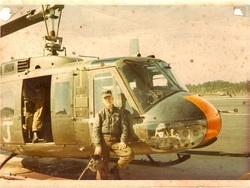 War with Syria? American intervention in the middle east? Once again the news is full of grim reports concerning possible western intervention in a war-torn country that is at best marginally threatening to its neighbors, much less to us ten thousand miles away. In my lifetime I’ve read about the ‘Gulf of Tonkin’ incident, the ‘Pueblo’ matter with North Korea, Libyan conflict, battle in Kosovo, the Falklands, a hostage crisis in Iran, WMD in Iraq and subsequent bungling into war there. The Gulf of Tonkin affair eventually involved me, when President Johnson used that chimerical engagement between the all-powerful United States Navy and a few North Vietnamese fishing boats to nudge the U.S. into war in Vietnam. We stand on another precipice, this time waiting to see what another U.S. administration will do, a non-ally having crossed ‘a red line’ in its alleged use of chemical weapons. This is all too familiar. Our recent debacle in Iraq had all the same markers, all the same pressures to act, all the same admonitions not to. Regardless, it appears we are, once again, about to use our military power to punish another country for its actions, albeit the flagrant action of using banned weapons against its own people. We are, in other words, about to reinvent the flat tire, to make war just because we can, just because our rhetoric has given us no room to maneuver.
What does this have to do with writing? According to Bowker’s Books in Print…estimates indicate that the number of books published in 2010 jumped…to over 3.1 million in 2010. Of these, 2.776 million were “non-traditionally” published books. Admittedly, very few of those 3 million books will have much distribution. Perhaps 1% will arrive in bookstores, or be available for purchase. Even so, one percent of 3 million, 3 thousand books, is a lot of books, a lot of information. If only ten percent are non-fiction, 300 books of so called non-fiction can impart a lot of information. It seems to me as one of those writers that we have a lot of rights, more than ever before in the history of publishing, to get our work in front of people and to brand ourselves as a voice in the marketplace of ideas. We also have a responsibility in this crowded modern literary agora to be cautious about what we write, in non-fiction at least, to avoid adding to the babble that often passes for truth.
In a recent work of fiction, Sage Book 3, Silver and Iron by talented writer Marian Allen, two of her characters are in conversation. Salali chats with Farukh about this and that, her long lost love, to the point where, as the author writes, “sound takes the place of truth.” As a writer, the line resonates with me, because so much of what we do can easily become such sound replacing truth. It appears that’s what our leadership fails to grasp at times, that sound is not, in fact equal to truth. It’s our responsibility as writers, even lowly, obscure writers of limited edition, independently published works to at least not add to the rhetoric, and at most to do the hard work of tracking down the truth and making it echo back.
August 27, 2013
Book Trailer on YouTube
My book trailer for The Sky Behind Me, a Memoir of Flying and Life is now on YouTube. Watch and enjoy, and feedback/reviews/comments are always welcome.
Thanks.
Thanks.
August 26, 2013
How to write good
 (Art) demands of us that we too see things as ends, not as means —Randall Jarrell.
Poets have a way with words. Okay, that’s obvious, but for writers like myself it’s important to look into the essence of what those poetry dudes & dudettes really mean, because as we all know they never come out and say it.
If I interpret him correctly, Mr. Jarrell seems to be saying that, literature being art, we should read for the sake of reading. Beyond that, and by extension, he may be saying that writers should write for the sake of writing.
I came across this particular Randall Jarrell fragment in this Sunday’s New York Times book review end notes. It was part of an article by a woman named Priscilla Gilman, author of “The Anti-Romantic Child: A Memoir of Unexpected Joy.” Ms Gilman’s son Benj has an interesting ailment called hyperlexia, a syndrome that manifests itself in extremely early ability to read. It seems Benj was reading reasonably sophisticated text at age two! Gilman writes that this was, at first, a source of great joy to her. As a professor of English at Yale, she exulted in her young son’s precocious behavior, until she learned of the dark side of the syndrome. Benj would read mostly by rote. He does read and comprehend, but he derives little satisfaction from reading, and instead uses his exotic ability as a source of comfort in a somewhat dark, sinister world. Benj reads to keep the bad stuff away.
Maybe we all do this to some extent. In my case, perhaps I write for the same reason, to keep away stuff that I’d just as soon not live over again, stuff that happened of the once-is-enough-thank-you-so-much variety. The war comes to mind.
But something else as well, and this has been a recent development. My writing, or part of it, has become not therapy, it never was that, but self-promotion. Now, we’re all self-promoters, of course. Regardless of what business or field or endeavor we find ourselves in we are all marketers. You may call yourself a tinker, tailor, soldier spy, but you’re actually in marketing. Despite what you tell people at parties, on the golf course or in the checkout aisle, you’re in marketing, and your product is yourself.
Especially so if you are, like me, a writer. But the more I pursue this definition, the faster I chase after the writer/marketer branding, the less I enjoy the craft of writing. The more I push the websites, the trailers, the promotional gimmicks the less I enjoy what I’m doing. I chart my day in a kind of rote manner— there’s that word again— by following a careful script: hit the blog with something, check the analytics, key on the hit counter on one author website after another, the visits on Author’s Den or Indie Authors. Get on G+ and FaceBook and Goodreads and Shelfari and check in, so as not to miss anything that’s happening out there on planet Sellazillion. Tweet something! I begin to acquire the promo disease, call it Hyper-hucksteritis, the constantly-selling aura that we believe we must acquire to be successful tinkers, tailors soldiers, spies, and yes, writers. I find myself reading, not for pleasure, but to write a review of the book in question— to promote my own writing. I may order a subscription to a comic book or two just for the pleasure of reading again. No one writes reviews of comic books. Hmmm… I could be the first… See what I mean?
Randall Jarrell was a poet. I’ve known a few poets. Never saw a fat poet. Never saw one that owned a home outright, shopped at Bergdorf’s or drove a Lexus. But they keep after it, Keep writing, poetizing, textualizing their worlds, despite earning little or no hard currency for the effort. There must be a message in the activity of poets, even though they never come out and say it.
Toni Morrison was a poet, too. Once she was asked why she wrote ‘Beloved,’ She said she wrote it because she wanted to read it. So how to write good may be answered this way: write for myself, let my heart guide the pen and the words will flow. See the words as ends, not as means and they’ll be happier words. Almost poetic, isn’t it?
August 22, 2013
Author (self) interview
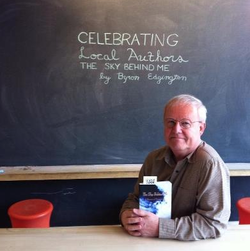 GWP: So, you’ve yet to find anyone interested in conducting an author interview? (My Ghost Writer Person settles onto the chair opposite me, notepad in hand, iRecord app furtively running on her iPhone)
BE: No, which is why, in my craven desire for publicity, and to hopefully lavish my excellent work, I mean inflict my writing on the reading public, I decided to contact you. Since you’re my biggest fan besides my wife, and astonishingly similar to myself in so many ways, my expectations are quite high for a successful session. By the way, thanks for taking time from your busy schedule to do this. It must be difficult juggling an interview career with your gutter cleaning and drain clearing company, though I do see the similarities with writing.
GWP: Yes, Leave’Em&Love’Em Plumbing is a hectic endeavor, but the business can manage without me for one afternoon, I hope, so… Shall we get started?
BE: Looking forward to it. Might I expect the usual questions?
GWP: Yes, starting with this: why do you write? And a follow-up question if I may, what would you do if you couldn’t write?
BE: I write because as the second of ten kids I couldn’t get a freakin’ word in edgewise. It was like animal house and the food fight every night, except the flying food came from mom and dad, the only safe way to get it to us. Writing for me is like singing in the shower. When I’m all lathered up it sounds really good. Then I rinse off, and always discover one last filthy stain, or a horrible streak of goo in my draft, and I wonder why the heck I ever thought I could be a writer? Plus I always get dirty again, so… If I couldn’t write I’d be a professional curling star. Who knew waving a broom around on the ice could be so sexy? Those guys rock. Know what I’m saying?
GWP: Uh, I think so, yes… Moving along, what’s the hardest part about writing?
BE: Besides these banal interviews? I’d have to say dealing with BISS.
GWP: I give up.
BE: Butt In Seat Syndrome. It’s the only thing that works. Especially these days, it’s much too easy to follow the rabbit trails— G+, FaceBook, Reddit, Pinterest, Twitter… are those folks called Twits? Anyway, social media may be the death blow to good writing skill, simply because they’re too frickin’ easy to get lost in when you should be writing. Blogging ain’t writing, by the way, in case you wondered. On the other hand, those who can avoid the social sites will no doubt pull in front, since they’re the writers who will succeed. It’s a craft. I truly believe there’s a writing muscle, and with exercise it gets stronger and more supple.
GWP: Favorite author?
BE: Besides myself?
GWP: Uh, yes, please.
BE: I respond that way for a reason. When I flew for a living, I heard a fellow pilot once say, ‘if you don’t think you’re the best in the game, you’re in the wrong game.’ Same with writing. You gotta believe you’re the best writer in your niche, your area of expertise, or you will not succeed. Other favorites include Melville, Harper Lee, Steinbeck, Gordon S. Wood for non-fiction and the old Maine Live Lobster master storyteller himself Stephen King. Nothing beats a good story, that’s the secret.
GWP: Favorite stories?
BE: To Kill a Mockingbird is possibly the closest thing we have in our national narrative to perfection. That beautiful little book does what a good story should. It shows us who we are, and who we aspire to be. Beyond that, Moby Dick. Melville’s classic contains the DNA of who we are as Americans, the burning desire to travel, to not be someplace but to be someplace else, the relentless pursuit of our own white whale, and the passion that drives us mad until we destroy ourselves chasing it, white culture as a blessing and a burden, diversity as strength, even the earliest writings of our troubled history with racism, sexism, elitism, capitalism and homosexuality. Moby Dick has it all. Without it, there may not have been a Huck Finn, or Farewell to Arms, Gatsby, or even Mockingbird. Plus, with his Bartleby the Scrivener, Melville created the apotheosis of the reluctant writer. There are numerous days when I, too, turn away from the writing, with “I’d prefer not to.” Good old Bartleby.
GWP: What are you working on? And how do you find inspiration?
BE: The Sky Behind Me is happily published, doing reasonably well and I’m happy with the product itself. The book truly is a good story of loss, hope and redemption, things rarely seen in such graphic fashion in memoir. In progress, a novel about the Air Medical business and the people who make it work. I’m writing ‘The Final Sky,’ working title, as a love story, since that’s what Air Med is in so many ways. The people who gravitate to Air Med are not ambivalent about life. They tend to be passionate people, and that attribute is a double-edged sword in their potentially perilous world. Here again will be a story of loss, hope and redemption. I find inspiration every morning the sun comes up, so most mornings. With age comes a kind of sacred understanding of the gift of time. GB Shaw was right; youth is wasted on the young.
GWP: Let’s return to loss and redemption. Do I sense a theme?
BE: I plead guilty to the charge of following my own passion. Like a lot of people— perhaps all people— I’ve experienced the loss of a dream, scrambled to replace what was lost, and found something better by an order of magnitude than the original dream, and been redeemed by it. And I’m convinced it was that loss, not the family food fights that gave me the need to write.
GWP: Last thoughts for aspiring writers?
BE: Call yourself a writer. Own it. Write every day. Railroad crossings used to have a sign that said ‘watch, look & listen.’ Good advice for writers. Do all those things with intensity. Henry James once said, ‘if you must take notes on what struck you, perhaps it didn’t strike you.’ Kill your adverbs. Read it aloud. And finally, don’t under any circumstances put it out there with your name on it until it’s polished so high it shines like a diamond in a goat’s ass. Then go sing in the shower.
August 20, 2013
Common Core Standards: Return to Literature?
 Writers need readers. One of the reasons we writers sit in our lonely garrets day after day, night after night, with little sustenance beyond gallons of weak coffee and poor imitations of Proustian Madeleines, followed by the occasional potty break, or to take a turn at Words With Friends, is to string words together in a way that makes sense. Writing is something we do out of necessity, to either help us make sense of a world that seems to make less of it every day left to its own devices, and to add our words to the cultural narrative. Sometimes we’re more imaginative in finding ways not to write: rearranging our sock drawers, watching Geico ads on YouTube (The camel/hump day ad is a stitch, I’m responsible for a large percentage of views) or taking our turn at Words With Friends. One of my G+ acquaintances calls herself the ProcrastiWriter, so it ain’t just me, the ailment is widespread.
One of the reasons writing is so frustrating is because we’re social creatures stuck in a solitary endeavor. Often, I feel like I’m working in a vacuum. When I get that feeling, I’ll sometimes procrastinate more by running the vacuum.
But the pressing problem writers see is that no one seems to read anymore. If something written is longer than 140 characters, it’s not likely to command readers’ attention. If it’s Moby Dick, forget it. Mr. Melville has a distinction in the literary world. He may have been personally responsible for helping to define a classic as a ‘great book that no one has read.’ Plus, his Bartleby the Scrivener sums up for all time the writers’ schizophrenic dilemma: as much as I need to write, often “I’d prefer not to.”
And the non-reading problem is getting worse, it seems. The reason I’m speculating about this today is that hope may be on the horizon for us writers. A handful of States have banded together to form what’s called the Common Core Standard. The CCS is just what it says, a common curriculum standard, a base of knowledge that students in American schools must meet prior to entering college. And good news, hallelujah, the Core has a strong reading/writing literacy section. Here’s a quote from it: “Students who meet the Standards readily undertake the close, attentive reading that is at the heart of understanding and enjoying complex works of literature.” (Italics mine)
Aha, ‘complex works of literature. Here’s a phrase that’s near and dear to every writer’s heart. The phrase is interesting for a couple of reasons. First, because whoever established these standards did in fact use the word heart. I like that. Of course I’m biased, but as a writer, I like the linkage between reading and the heart. After all, the last three letters of heart spell out… I’ll let you take over here. Second because the Standards don’t mention any particular works. This is important. The open-ended nature of the phrase gives teachers wide latitude in selecting whatever literary masterpiece they may wish their students to grapple with, be it Chronicles of Narnia, Lolita (though that may raise a few eyebrows) Moby Dick, To The Lighthouse, whatever, or even, though a bit of a stretch, admittedly, someday a book of my very own.
Of course certain political groups are in open rebellion against the Common Core Standards. As Bill Keller writes in the New York Times, these hard-core conservatives claim that the CCS are a government takeover of the school system, the brainwashing of precious young minds, even a pathetically misguided attempt to disparage the current administration by calling the Standards ‘Obama-Core.’ It must be stated here that the CCS initiative originated with the States and the National Governor’s Association, and is endorsed by several conservatives including Mike Huckabee of Arkansas, Bill Bennett and Gov. Bobby Jindal of Louisiana. Perhaps those malcontents who disparage Common Core, such as Glenn Beck and Michelle Malkin may have benefited from them in their own educational passage back in the stone age?
For writers, the Common Core Standards are good news. In an age when Twitter has codified an abbreviated language, and when hold-in-your-hand books are being relegated to history’s closet like dial phones and dial up internet, exposing kids to ‘complex works of literature’ may revive a love of reading. Could happen. If for no other reason than such works are becoming exotic. And kids love exotic. I’d hold off on Lolita; there’s exotic, then there’s, well…
August 15, 2013
George W. Bush and other mistakes
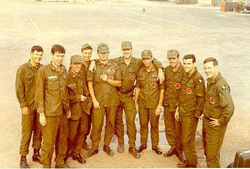 I received an e-mail recently from a fellow Vietnam vet and former pilot, a guy who’s political views are somewhat different from my own. Isn’t this a great country where we can take to the internet, the new public campfire, and say whatever we like, and no one stifles us, or erases what we say, or brings legal action for what we write, unless we advocate a government overthrow or shout movie! in a crowded firehouse. What a great place to live. The e-mail in question was proof that we can say and show anything we wish. The picture displays our past eleven presidents, all in some military uniform or other, with the last one being President Obama dressed in the uniform of Jihadi. Cute, I thought. I really hoped the right wing cranks had moved on to something else, something important like jobs or the economy, but perhaps not.
In any case, speaking of uniforms, the picture above was taken in Vietnam sometime in 1970. I’m third from the left, which is not as far left as I should have been standing according to my wife. I wore that uniform proudly for damn near thirty years. Not the same one, of course, or the health department would have been involved. In my book, The Sky Behind Me, a Memoir of Flying and Life I refer to some of the adventures I had with various National Guard units I served with after Vietnam, the summer camps and extra missions that kept my flying skills up and allowed me to serve in a capacity that suited me, so to speak. In every unit I served with there was the occasional slacker. There was a fellow in the Kentucky Guard where I was posted for two years, a guy who showed up late quite often, if he arrived at all. He had powerful relatives in Kentucky, so he assumed that the rules of deportment and accountability didn’t apply to him. The man was an outcast. None of the enlisted troops, and very few of the officer corps had anything to do with him. Just so, in Ohio, a fellow aviator showed a similar casual attitude about drill weekends and deployment, tolerated because his father had been a sergeant major in the Army, and the young fellow knew good old dad was there to keep him out of scrapes. In Iowa a similar situation. One of my flying colleagues was the son of a general. He made it to drills most days, some not at all, and he drifted around from unit to unit, never quite fitting in.
Then there was George W. Bush. Here’s a fellow who’s powerful dad got him into the Texas Air Guard during the Vietnam war when there were no slots available in the Texas Guard. Not one slot was open, but George junior managed to get one anyway. Then dad, George senior, got young George into flight school, again, with no slots available. W learned to fly jets. He never deployed, never flew in harm’s way, and yes, showed up for drills and Guard functions less than half the time. In fact, unit records show that George W. Bush never fulfilled his National Guard requirement.
The e-mail really got my motor running, because the fellow who sent it, a Viet vet helicopter pilot and long term National Guard member like myself supports and endorses Mr. Bush. Why? As the nuns used to tell me, “it’s a mystery.” What I say about it is this: George W. Bush was a disgrace to the uniform I wore proudly all those years. His so called service was a mistake, just like the ill-advised invasion of Iraq that he pushed us into, partly because he had no perspective on what war truly was, thus no understanding of its true costs and responsibilities. His attitude in 1970 was cavalier and dismissive about military service, and it was in 2003 as well.
I wrote the fellow back and asked him to please not show George W. Bush in uniform ever again. We’ll see what his response is.