Byron Edgington's Blog, page 6
June 27, 2013
Takeoff
 Takeoff. It's an odd expression to describe the act of leaving the ground, departing the surface where we're (relatively) safe and things are more or less certain, for the uncertainty of the sky and all the potential hazards lurking in the ethereal realm. Ask any pilot and they'll say takeoff is the best part of a flight. I try to describe this exhilarating sensation, the energizing, exultant act of lifting from the earth into the welcoming sky in
The Sky Behind Me
. Though I tried, I likely failed to capture the raw power, the giddy intensity of it, the physical and emotional rush that takeoff always held for me. Engine at max power, rotors biting, gripping air, gravity straining against the effort, body pressing into the seat, the aircraft shudders off the ground and angles skyward. Every sense is on high alert; every twitch in the airframe, every tick in a gauge demands attention. The panel comes alive, needles climbing, lights flashing, wind hissing louder and louder, gushing past the cockpit. Speed builds up, faster, faster still, the ground falling away, then gravity loses and we fly. It's as if we were meant to; as if the earth itself, our protector and friend has been our restraint.
Takeoff. It's an odd expression to describe the act of leaving the ground, departing the surface where we're (relatively) safe and things are more or less certain, for the uncertainty of the sky and all the potential hazards lurking in the ethereal realm. Ask any pilot and they'll say takeoff is the best part of a flight. I try to describe this exhilarating sensation, the energizing, exultant act of lifting from the earth into the welcoming sky in
The Sky Behind Me
. Though I tried, I likely failed to capture the raw power, the giddy intensity of it, the physical and emotional rush that takeoff always held for me. Engine at max power, rotors biting, gripping air, gravity straining against the effort, body pressing into the seat, the aircraft shudders off the ground and angles skyward. Every sense is on high alert; every twitch in the airframe, every tick in a gauge demands attention. The panel comes alive, needles climbing, lights flashing, wind hissing louder and louder, gushing past the cockpit. Speed builds up, faster, faster still, the ground falling away, then gravity loses and we fly. It's as if we were meant to; as if the earth itself, our protector and friend has been our restraint.Writers and poets have used taking off metaphorically for a long time. Takeoff captures our collective wish to 'slip the surly bonds of earth,' as John Gillespie Magee, Jr. wrote in his poem 'High Flight.' Odd, too that 'taking off' are words used for the act of disrobing, removing restrictive clothing, or uniforms, or protective attire. Those words are used as well when certain legal restrictions are 'taken off,' when a group of people previously attired in restrictive raiment find themselves freed from the strictures that attire imposes. So it's not a stretch to link the act of taking off to fly to the momentous Supreme Court decision yesterday, erasing the federal DOMA. The Court removed the uniformly restrictive barrier our LGBT friends and neighbors had been forced to wear, keeping them grounded, without access to civil marriage and the chance to fly that it provides.
Gravity holds us in a grip that took us, as a species, nearly 10,000 years to overcome. Even today the power of gravity constrains us in ways we've yet to imagine and address. But when the restrictive covenants of inertia and gravity press us to fear change, to be wary of alterations in the social landscape, like the act of removing restraints on our friends and neighbors, then as human beings we act as we always have to take off those restrictions. It's what we do. We take off.
When the engine of social change operates most powerfully, that's when we're able to fly, to reach heights we were destined to attain. This is such a time, a chance to show, once again, that takeoff is the best part of flight. Yesterday's ruling fuels the engine of social change that is about to come. This takeoff will be exhilarating not just for our LGBT friends and families, but for us all.


June 25, 2013
Decorative English
 I love the English language. In what other tongue can we say ‘the principal taught important principles’? Or ‘there’re two apples left, and they’re theirs’? or ‘Too many of your shots go to the right, but the last two were okay’? ‘I used to use bran cereal, it’s what I was used to.’ See what I mean? It’s a great language, though I’m not certain how anyone learns it. And many don’t, of course. Lots of folks go through life ignoring the fact that Illusion and Allusion are not interchangeable; That and Which, likewise; Lay and Lie, ditto. Those pesky intransitive verbs, man, what a pain.
Recently I had a fun experience; I was suspended by a webmaster. Now you haven’t lived till you’ve been suspended by a webmaster, so I’m now able to cross another item off my bucket list. I did land in FaceBook jail once for adding too many friends, but that’s kinda different. Here’s what happened. The site was for writers. I subscribed to it (okay, it was free) and started adding my drivel, posting messages, interacting with other members. Over time I noticed that the site itself used rather atrocious language, had many typos and syntactical errors (…we hope you take a time…I am thanking you now etc.) and in general the site’s content paid little attention to the niceties and nuance of the language. It contained what a good friend refers to as Decorative English. I began telling the webmaster about this, gently reminding him/her/it that indeed on a writing website there should perhaps be somewhat better, well, writing? This went on for several days, my pointing out various typos, grammatical errors, miscellaneous literary liberties that I thought ought to be addressed. The upshot of the tale is that I received an e-mail the other day suspending me. They took offense. Didn’t care for my editorial additions. Guess I’ll always be a language noodge. It bugs me when people say irregardless because it’s not a word. It bothers me when folks mispronounce short-lived, using a short ‘I’ rather than a long ‘I.’ (short-lived, rhymes with short-hived, you can look it up.) Alas, I’m suspended from my language police post UFN. Maybe I love English too much?
June 24, 2013
To leak, or not to leak...
 Former, now officially fired, NSA contractor Edward Snowden had been living in Hong Kong. But it seems that Mr. Snowden has leaked away from the former British Crown Colony and fled to Moscow of all places seeking asylum. The developing international U.S. Vs former employee Snowden job is getting more interesting as each plane takes off and lands with him aboard, leaving diplomatic niceties and legal protocols in its wake turbulence. Not since Dan Ellsberg leaked the Pentagon Papers have we had such a pursuit by this country against a fellow considered by some to be a whistle blower, by others a traitor, and with so little ground in between. Mr. Snowden caused a kerfuffle recently by allowing information to leak out, out of his own mouth via e-mails etc. that is, which revealed the depth and breadth of the government's intrusion into our privacy. Proponents and opponents have quickly lined up in the debate that's ensued over this dustup, and once again the fog we see rising is taking on political as well as ideological colorations. My belief is that Mr. Snowden's offense is simply this: He announced that our privacy is more compromised than we ever thought, and this fact has outraged us because of its glaring truth. In other words he told us something we've collectively known all along, but were unprepared to admit. Indeed, we surrender our privacy and secrecy every day. I'm doing so as I write these lines. In an age of hyper-data mining, computerized records of every facet of our lives, from day of birth to long after we're cold and dead, if anyone truly believes a scrap of personal information is any longer unknown or unknowable, that person is at least terribly naive, possibly a danger to himself and others.
I agree that what Snowden did was illegal. He was a government employee, and as such he had a duty to not act on his own to disclose sensitive information. His was a legal, binding employment contract if nothing else, so the government has not only a right but a responsibility to prosecute him. But the other side of this tale, as the Pentagon Papers case proved, is that such revelations do in fact cause us as a nation to wake up to the realities around us, in this case warning all of us to be cautious with what we share, and where, and when. Such revelations stir public discussion, and that is, for my money, always a good thing. I believe I'll stop writing now.
June 21, 2013
Separation of church and state
 When I was in Vietnam way back in the last century I was told my presence there was important to free the South Vietnamese people from the evil clutches of Godless Communism. The adjective Godless was always used in front of the 'C' word, meaning Communism. Eventually that evil 'C' word, Communism, was replaced by an even more sinister 'C' word, The Big 'C,' meaning Cancer. But back then, as described in the initial chapters of
The Sky Behind Me
, along with half a million of my closest friends and compatriots, I was ensconced in Vietnam to help repel those evil Commies. Referring to America's presence in that little country, a running snarky comment at the time was that we'd deployed there to, quote, "Kill a Commie for Christ." Indeed, many of our wars and dustups with other countries have contained a vestige of religious conflict. The American Civil War gave us what is perhaps our national military anthem, the Battle Hymn of the Republic: "Mine eyes have seen the glory..." Both World Wars have sent our brave soldiers off against enemies advertised as lacking our shared religious beliefs in some fundamental way. The war in Vietnam even contained seeds of religious conflict, northern hostility to catholics chief among them. When it comes to our nation's wars, it appears our devotion to the policy of separation of church and state becomes blurred and somewhat casual. As a twenty-one year old helicopter pilot I lacked the sophistication to see those religious undercurrents in my personal experience with war, but they were there nonetheless.
When I was in Vietnam way back in the last century I was told my presence there was important to free the South Vietnamese people from the evil clutches of Godless Communism. The adjective Godless was always used in front of the 'C' word, meaning Communism. Eventually that evil 'C' word, Communism, was replaced by an even more sinister 'C' word, The Big 'C,' meaning Cancer. But back then, as described in the initial chapters of
The Sky Behind Me
, along with half a million of my closest friends and compatriots, I was ensconced in Vietnam to help repel those evil Commies. Referring to America's presence in that little country, a running snarky comment at the time was that we'd deployed there to, quote, "Kill a Commie for Christ." Indeed, many of our wars and dustups with other countries have contained a vestige of religious conflict. The American Civil War gave us what is perhaps our national military anthem, the Battle Hymn of the Republic: "Mine eyes have seen the glory..." Both World Wars have sent our brave soldiers off against enemies advertised as lacking our shared religious beliefs in some fundamental way. The war in Vietnam even contained seeds of religious conflict, northern hostility to catholics chief among them. When it comes to our nation's wars, it appears our devotion to the policy of separation of church and state becomes blurred and somewhat casual. As a twenty-one year old helicopter pilot I lacked the sophistication to see those religious undercurrents in my personal experience with war, but they were there nonetheless.In Syria today the state is under siege. Civil war, so called, is ravaging that small country, and many thousands have died. Most world leaders seem to agree that the president of Syria, a fellow named Assad who is an Alawite must go, that he's guilty of atrocities against his own people, and that his presence is preventing the transition to a peaceful, sectarian Syria waiting to be born.
Here's a radical--and I admit entirely unworkable--solution to the Syrian tragedy: Keep Assad, the devil we know, because he's the least of several evils. The Free Syrian Army and other rebellious groups like them talk a good game, a new Syria, democratic governance, open elections, a Syria that is diverse and fair. Pressed on the issue, however, those groups always revert to the religious identifications and differences as fundamental to their cause. Assad is a bad dude, no question, but he managed to keep religious conflict immersed and that is no small thing in a part of the world that seems to thrive on it. Until real separation of church and state arrives, no nation will be free of such divisive wars and disruptions. The divisive and rigid dictates of religious belief fuel these conflicts and have for a long time. When we finally free ourselves of the big 'C,' the Cancer of rigid religious ideology we will experience turmoil and killing with no cure in sight.
June 20, 2013
Plus ca change...
 The fellow on the left in the picture is an old enemy of mine. He’s a former North Vietnamese trooper, Communist soldier in other words, which explains why he’s on the left though my wife is convinced no one’s left of me. In any case, the fellow was once posted where I was in Vietnam, albeit wearing a different uniform and with a somewhat different goal. Mine was to put in my year in Vietnam and go the hell home; his was to take careful aim at my Huey, pull the trigger of his AK and prevent me from making the trip.
The picture was taken in 1991 on my return to Vietnam. In the shot we’re at a shrine of sorts at Cuc Phuong national park 80 miles outside of Hanoi. Through an interpreter he and I shared some old memories, a war story or two and a couple of heartfelt laughs at the absurdity and irony of it all. Our visit lasted perhaps ten minutes. He thanked me for coming back to see ‘his beautiful country’ which indeed it is. I thanked him for being a lousy shot and for allowing me to return. Some of the recollections and war stories I’ve included in The Sky Behind Me, and as you may imagine there are many more I’ll never share with anyone. The more things change the more they remain the same. Old enemies become fellow tourists. When we get to know real people, even through an interpreter, we have a harder time judging or dehumanizing them in any way. We’d much rather share a park bench, a laugh or two and find some reason to say thanks for something they’ve done.
About the hat. It’s not his. It’s mine. He said he lost his.
June 19, 2013
Book promotion
 There’s writing, then there’s promoting. Every author runs into this conundrum: we create what we believe is a masterpiece, a work of great art, the epic novel, a classic for all time, or at least a passable bathtub read only to discover that the really hard work is about to begin. No writer worth a nickel is any good at promoting their work, even though our job description might be ‘self-promoter,’ or as George Carlin used to say, ‘dig me’! We’re no good at it; we’d rather be writing than selling stuff. If we wanted to sell stuff we’d have done better as kids with the Burpee seeds, and subscriptions to Life or Look or Popular Mechanics. In my case I couldn’t deal with the polling the neighborhood slog, asking people to please buy stuff, or take a look, or at least open the friggin’ door. When they did open up I’d be tongue tied, frozen in place, like a statue trying to sell ‘Grit,’ whatever the heck that was, but I’m dating myself.
You say, ‘there must be an app for that.’ You’re right, of course, there is indeed an app for selling books, several in fact. There are websites and apps and resources galore to help writers get our stuff out there so it’ll sprout like so many Burpee seeds and make us bloom into the next Jonathan Franzen, or Jeannette Walls, or whoever wrote The Pet Goat , thus securing his/her authorial name in the literary history books. Recently I perused one of these so called writers’ websites, a venue that offers all manner of authorial advice, a blog, a forum, many side offerings like reviews, editing, cover art, formatting, you name it. The site shall remain nameless here to keep me from being sued for defamation. Suffice to say that the ad copy on the site’s many pages was riddled with typos, grammar errors and odd word placements, what a good friend used to call ‘decorative English.’ I have a suspicion it was invented in a place where ESL is taught profusely. Let me just say that it was not a venue that inspired confidence. Maybe it’s just me, but when I wish to consort with literary colleagues I like for them to display a bit of literary competence. Weird, I know.
We writers are like other people who are desperate to sell their wares, we’re vulnerable to the various shadowy and often sinister snake-oil sales people out there who’d like nothing better than to separate us from a bit (or a lot) of our cash. Like vultures, these non-writer types can sense our eagerness to have a customer–any customer–look over our product, or consider it, or just open the friggin’ door and they’re more than eager to help us make that door open. Some days as a writer I feel like that kid again, freezing on a stoop, terrified to ring the doorbell for fear someone will indeed open it, and I’ll have to launch into my spiel: “Please buy my book! Please! You’ll love it, I promise! Mom did! You’ll love it, really! Perhaps not as much as I do, but still…”
Writing is a great life, but promoting the forthcoming product is cold reality, and I hate it. So please buy my book and I’ll leave you alone. Thank you. You can close the door now.
June 17, 2013
Tom Wolfe was right...
 As much as we might wish to recreate a part of our past, it never works out. A recent return visit to Kauai proved it for my wife and me. As I wrote in
The Sky Behind Me
, Kauai is a magical little island, filled with the most exquisite of nature's wonders, exotic plant life, ideal temperatures, a steady trade wind that cools the land all day and night and a relaxed, almost forced indolence that takes some getting used to. Kauai is as close to paradise on earth as there might be.
As much as we might wish to recreate a part of our past, it never works out. A recent return visit to Kauai proved it for my wife and me. As I wrote in
The Sky Behind Me
, Kauai is a magical little island, filled with the most exquisite of nature's wonders, exotic plant life, ideal temperatures, a steady trade wind that cools the land all day and night and a relaxed, almost forced indolence that takes some getting used to. Kauai is as close to paradise on earth as there might be.But going back wasn't as enthralling or comfortable as we'd hoped. We looked forward to revisiting old spots--favorite hole-in-the-wall greasy spoons like Hamura's on Kress Street in Lihue for Saimin and Lilikoi pie for dessert, Kilauea Point on the North shore and the lighthouse there, Maha'ulepu Beach with its savage coast and its singing rocks that chant their mournful hymn with the crushing tide. They were all different. And the difference was seeing all the abundance and exotic bounty through the eyes of a tourist as opposed to viewing it as a resident. We experienced a twist on the old adage, 'nice place to visit, but...' Kauai, it turns out, is a nice place to live but I have no wish to visit. In the book, I touched on the slow, leisurely pace and seeming indifference to outside interests among the local people. Hawaii has an education system that commonly scores near the bottom among the fifty states. I mentioned the antagonism local Hawaiians have to the pace and frenetic activity of folks in LA, or New York, or even Ohio. Bumper stickers on the island say 'slow down, this ain't the mainland.' Living there, the laid-back attitude and languorous pace was pretty easy to take; it went along with the rest of the experience. Being immersed in it as a tourist after seven years away gave me a new understanding of it, an insight that, for all its beauty and appeal, island life doesn't suit me. I need the intellectual stimulation and continual mental challenge of life in a city with its demands, variable seasons and inevitable chilly winds.
Everyone should see Kauai. But living there takes an ability to slow down that I seem to lack. Aloha means hello, and goodbye as well. Guess I'll always be a haole.
May 31, 2013
...Can't Treat Stupid.
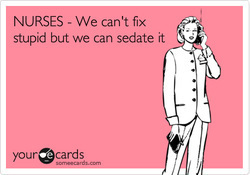 Now, I'm a pretty compassionate guy, and I'm the first the admit that I've done some pretty stupid things in my own life, so keep that in mind for today's reasonably snarky post. You'll have to forgive the sentiment portrayed by the picture. Trust me, medical folks really do use this phrase among themselves, and quite often, especially in pre-hospital and ER settings.
When I flew patients as an Air Med pilot, I saw every facet of humanity from tragic, to heartbreaking, from weird and confusing to the almost unbelievable. A lot of the stories can be found in The Sky Behind Me. Here's a preview of some that are not in the book, and not because they're unprintable, but to shield the patients in question from further embarrassment.
'Howard' (a made-up name) was badly damaged when a tree jumped in front of his Trans Am one dark and drunken night. He was violent, vocal and quite moist in his interactions with us. In the helicopter, at a thousand feet, halfway home, Howard threatened to jump out. The flight nurse and I considered his request, but dismissed it: too much paperwork.
'Noah,' another made-up name had been enjoying an adult beverage or six whilst motor-boating on a sunny, patriotic Fourth. At the wheel, his spouse revved the little Evinrude, and the rude little motor caused the boat to lurch forward, just doing its job. Noah departed overboard and underboat, where Mister Prop caught him mid-belly and laid him wide open. Still quite sedated from his analgesic beverages, Noah greeted us in the ER where we packed him up and flew him away to where surgeons might tend to his churned- up lower extremities.
Speaking of going overboard from modern vehicles, 'Norma,' made up name, yes, had no idea, no idea I tell you, that letting a two-year old come along on the family riding mower might injure the child. No idea the little one might slip off and under the blades. Yes, mom was drinking and driving, the lawn mower in this case, and a child paid the price.
Between testosterone, alcohol and gunpowder it's hard to say which drug is the more dangerous. But it's truly irritating when misuse of either affects others, especially kids. The drug in question was the black powder loaded into a .22. Guns are fascinating to eleven-year-old males, and indeed to their adult counterparts as well, so one would think such a fascinating and dangerous item might be locked away, or at least unloaded when kids are about, but one would sometimes be wrong. The patient's ten-year-old pal caused the gun to fire, and the round hit the eleven-year-old in the head. In this particular case a happy ending ensued. To the astonishment of all, the lad survived his ordeal and went on to graduate from a computer tech school, where I'm quite certain he's much smarter than yours truly in the mind-numbing intricacies of a computer.
We humans do manage to maim ourselves and our pups in various and sundry ways, some of them quite stupid. Part of our condition, I suppose, and not likely to ever change. So take it from me, a fellow stupid human, former Air Med pilot and occasional user of analgesic liquids. Buckle up, keep kids away from lawn mowers and guns, don't stand up in the boat and watch for jumpy trees.
May 30, 2013
To Fly
 Is there anyone out there, male or female, who hasn’t at one time or another made a paper airplane? I’m guessing there are very few people of any age or gender who have not. And the reason we make such delicate, simple craft with very limited functionality is that we all feel the need to fly. From the first time we see our feathered friends taking off, soaring above the eaves, fluttering off power lines in flocks and skimming trees looking for the highest branch, we feel a kind of envy. Flying vocabulary is part of our narrative: we tell our kids about the ‘birds and the bees,’ not the goats and the pigs; we say that people take off in a new job, and soar with expectation; when groups form for any purpose, social, political, religious, we say they flock together. When kids we taught the birds & bees to leave home, we live in an empty nest, a place we’ve been careful to feather with an egg during our working years. Everyone wants to fly, it seems.
My first recollection of actual flight is in a seaplane with my Dad, during a vacation in Maine in 1955. I am seven. (Yes, I’m that old.) We board the little Cessna at a lake in the middle of ski country. The pilot pumps the throttle a couple of times. Then he twists a key, just like in our Pontiac and the prop jerks, almost stops, jerks again then revs with alarm, sawing at the crisp morning air. The engine roars, the fuselage vibrates. The instrument panel quivers as the little plane lunges forward away from the dock. I smell the sharp, oily tang of avgas, and the musty aroma of the worn leather seats. The pilot looks left and right, then he jams the throttle forward and the engine screams. The plane rocks and wobbles on the choppy lake, gaining speed, bumping and clunking along, bouncing me in my seat. I’m not the least bit afraid; I’m loving every moment. Streaks of water spray the windscreen, and droplets stream back along the plastic windows. With one last clunk the pontoons lift. We take off and the air is instantly smooth. We make a wide circle, wings angling up then down, the pilot’s hands barely moving. He points at things below, explains the various gauges and needles and instruments. He’s done this a long time, I can tell. I see the small town beside the lake. People really are like ants. Cars and buildings look like my Lionel train board. From the sky everything looks peaceful, serene, orderly. At least I imagine it that way. I watch the pilot ease the wheel around left and the plane banks, then levels. Too soon, he pulls the throttle back and the engine sound ebbs. RPM sagging, the plane descends toward the lake once more.
I’m sad that the flight is almost over. Flaps angle out from the wings and drop into place, and before I know it the pontoons skim the water and splash in, wobbling and weaving, and the vibrations begin again. Only on the ground, it seems, do the vibrations come. We taxi to the dock, and my first flight is done. Years later I’ll remember that first flight and how I came full circle. It was a short tour of a lake in Maine. I’ll end my flying days as a tour pilot, showing people the serenity that flight offers, the orderly world below if we could only see it, and helping other people realize their dream of flight.
May 29, 2013
Aviation & Medicine: Safe Practices and Transparency
 I picked the symbol for this post with some care. Crossed bandages over a rather distressing wound renders all kinds of images: a medical coverup of treatment gone horribly wrong; a gaping scar that refuses to heal; too little care taken to address an alarming medical problem. It could also be crossed rotor blades, the airfoil of a helicopter, and the Air Medical aviation business. The matchup of medicine and aviation saves countless lives every day in this country. But both operations, flying and healing, have a persistent, nagging, almost shameful safety record. Both entities are beset with ongoing errors in the conduct of their operations. Both entities look high and low for solutions to this conundrum, that those seeking to help patients often harm them instead.
I flew Air Medical aviation for many years. In that time I was witness to many of the sins of omission and commission that plagued the Air Med business, often–too often– putting a helicopter in the dirt, and harming or killing crews and patients. At the same time I saw the errors and omissions on the medical side of the business, mistakes that humans or the system we’ve created often make. Both sides of the business, Air and Medical have dealt with the problem in their own way. Still mistakes occur. Between 2002 and 2005, for example, 55 Air Medical accidents killed 54 crewmembers and patients, and seriously injured 18 others. On the medical side, last year alone an estimated 1.5 million patients were injured by medication errors alone, and nearly 90,000 patients died from some of those errors. In a recent piece for the New York Times, My Near Miss , a contribution by Dr. Daniel Ofri reveals one of his close calls during his residency, a missed head bleed in an older patient that could have been disastrous but wasn’t, simply because another person caught his error. Ofri claims that medicine still has too little transparency, too much hubris when it comes to self reporting, so too few errors are passed along between practitioners to fully address the dilemma.
One of the solutions to flying mistakes and challenges is an anonymous reporting system established by the National Transportation safety Board, (NTSB). The system allows pilots to self-report when regulations are inadvertently broken, airspace violated, aircraft operations are unsafely performed or unsafe practices are witnessed. The NTSB system could work in a hospital setting as well, to allow physicians to self-report without fear of repercussions from colleagues, family, employer or medical board. In aviation, the NTSB system isn’t perfect, but it’s a resource that has likely ushered in changes that have made a difference. Peer reviews have been part of medicine for a long time, but they happen after the fact, and often inculcate a doctor just by inference to patient and procedure under review. An anonymous venue could be an added layer of protection. Safety is a rather ephemeral goal; we know we’re safe only when nothing happens. So in either case, aviation or medicine, systems to eliminate errors will work if they’re put in place and used, whether we know they’re working or not.