Byron Edgington's Blog, page 7
May 28, 2013
Happy Birthday GKC
 GK Chesterton was born on this date in 1874. So what? GK has long been one of my favorite writers, thinkers, essayists, gadflies and wits. It seems we have no such social commentators these days, no irascible contrarians who manage to irritate everyone alike on both sides of the political/social/religious/pedestrian debate. Instead we have nitwits like Rush Limbaugh and Glenn Beck and their ilk, people who don’t hold a candle to GK. Here’s a GK quote to contemplate: “The thing I hate about an argument is that it always interrupts a discussion.” These days someone with this kind of erudition would be jeered and then ignored. When I was in Vietnam, way back in the twentieth century, I served with a fellow named Frank Tigano. We called Frank ‘the Foot,’ because he had a charming way of always putting that lowermost appendage in his mouth, toes and all. Frank had his buttons ‘embroiled’ on his uniforms. He wanted to ‘hit the air running.’ Frank once shared with me that his mother had a bad case of ‘very close veins.’ In other words, Frank was no GK Chesterton. But it is of such verbal and literary nuance and recreation that wisdom is formed, and one reason I adore the English language so much, and the GKCs who make it sing and whistle. It’s also the innocent and not so innocent act of using words to inject a semblance of truth that attracts me equally to the Franks and GKCs of the world. Here’s another Chesterton: “I owe my success to having listened respectfully to the very best advice, and then going away and doing the exact opposite.” Regardless of how one feels about the author of such a gem, the inherent bite of that expression sticks with us like butterscotch on a blintz. We may not understand it, but we know there’s value in it.
So GKC, even from beyond the grave, keep ‘em coming. One last morsel for our Irish readers: “The great Gaels of Ireland are the men that God made mad,
For all their wars are merry, and all their songs are sad.” As an Irishman myself, I can relate.
Happy 139th Birthday GKC.


May 27, 2013
Random Thoughts: Memorial Day
 On this day of remembrance, I feel as if we’ve forgotten. Forgotten the ‘why’ of our wars. the who’s and the wherefores. I hear people thank me for my own service in Vietnam all those years ago, and I know that most people can’t begin to understand the savagery, the chaos and stupidity of war, because most Americans have not seen it first hand as I have, and as my fellow combat veterans have. I appreciate the thank you’s I get, and I would do again what I did all those years ago. But I feel we truly have forgotten critical policy factors that might one day diminish the need to thank our veterans. Here are random thoughts today, from a veteran of a long-concluded war about where we are as a people, and a possible way forward that will conclude some future wars before they start:
First, President Obama was right to conclude that the war on ‘terror’ must end. Labeling a war against an undefinable, inscrutable entity dooms that war to failure at the outset. It’s like starting a war against poor taste. According to whom? And most important to this discussion, with such a label, how do we know if we’ve won? I sometimes joke that the trouble with doing nothing is, you never know when you’re finished. A little flip perhaps in such a serious context, but ‘terror’ cannot be defined, so everyone defines it to their satisfaction. As much blowback as I get from such claims, there are many in the world community who feel that some of America’s actions constitute terrorism. Who decides?
Second, bring back conscription. For everyone, male and female alike, including the sons and daughters of those who would commit us to military action. Currently only .5% of our population serves in the military. The disconnect between our armed forces and the rest of us is an ever widening gap, and as most people lose contact with soldiers and the very machinery of warmaking, the more apathy seeps in. With conscription, most people will know, or know of, someone serving in the military. Such immediacy will apply the brakes to armed conflict through congressional contact, and local disruptions to careers and families, making us far more reluctant to commit to combat. For more on this, better metrics, and much better writing read Rachel Maddow’s brilliant book, Drift.
Amend or redraft the War Powers Act so we return to the mandate any president has to notify Congress before committing troops to war, not afterward. That simple act would make our military ventures much more transparent, giving any such action the scrutiny it needs. Had this been in place our disastrous involvement in Iraq would never have happened, and a president who lacked the vision and decency to see war for what it is would have been stopped.
Along those lines,unless families demand privacy, open up Dover AFB to any and all who wish to see the caskets coming home. Make it mandatory for presidents and Congressional leaders to visit that solemn airfield whenever their constituents arrive in their silver, flag-draped boxes. It should tell us something about presidential integrity that George Bush never visited Dover, never made the one-hour trip from the White House to greet a fallen soldier. Not once.
Finally, let’s get in the habit of thanking our troops by sending them into harm’s way less often, and bringing them home sooner.
Happy memorial Day to my fellow vets, and thanks indeed for your service.
May 22, 2013
God Hates Gags
 Like many people, almost 25% of the US population, I am or used to be a catholic. I grew up surrounded by the rituals and requirements of the church, holy days, meatless Fridays, Lenten fasting, Sunday high mass with the smells and the bells. Winter didn’t mean cold and snow and early dark; winter meant the approach of Christmas, and the celebration of midnight mass. Spring may have been just a season elsewhere, but in our house Spring meant the Triduum, and Good Friday and Holy Saturday and a glorious Easter Sunday when real life began anew.
 I was a choir boy, and my function was to carry the crozier ahead of the rest of the boys each Sunday. I attended catholic school as well, first at IC then St. Andrew. I was immersed in the teaching and oversight of the catholic church. Catholicism was in my bones, part of my understanding of why I was put on this earth. “To love God and serve him, and be happy with Him in the next life,” as my Baltimore Catechism stated.
In class I had nuns. The sisters taught me all through grade school, their habited presence adding a touch of mystery to the persistently and purposely mysterious church. Just as I was taught to never inquire what Sister Mary Julius’ head looked like under her wimple, I knew to not ask about a lot of things. Water to wine? Body of Christ in the eucharist? Infallibility of the pope? Virgin birth? These were to remain mysteries. I was never told outright to not ask about the efficacy of those items of dogma, I just knew my questions wouldn’t produce durable answers, that the asking itself was considered disloyal somehow, approximately sinful. Questions about simpler, less dogmatic things produced a standard response: "It’s a mystery." Questions about minor church beliefs like actionable sins, mortal or venial, the existence of Limbo, the afterlife itineraries of Jews and Baptists and Muslims and assorted other heathens, even these seemingly innocuous queries received the same answer: "It’s a mystery." It was my first exposure to a ritualized gag rule, an order under pain of mortal sin to accept and stay silent. A popular TV show in the fifties was ‘Father Knows Best.’ To me that meant the church father and his colleagues. Accept, believe, don’t ask questions.
In short, at a time of explosive scientific and cultural and social exploration and progress, I’d acquired, thanks to the catholic church, a default antipathy to such inquiries and the uncomfortable cognitive dissonances they caused. Virgin birth? How can this possibly be? Three gods in one? Is the trinity not just a variation of ancient Greek polytheism? Christmas in December with shepherds in fields, an appropriation of pagan beliefs from time out of mind? I tried to make the uncomfortable fall into place as belief; tried to square the circle that insisted on remaining square. Faith? Important, to be sure, but the nagging continued, especially in light of the insistence, reinforced by the church itself, that I had ‘free will,’ that as a human being I was responsible for what happened to me, that sin and its effects fell on my shoulders. I could decide; I just couldn't ask.
The message was loud and clear. Faith required me to believe without question, to hear what the priest and nuns taught me to believe, and accept it as truth, unvarnished and unquestioned. I looked up to those purveyors of truth; respected their wisdom, their insights, their quiet assurance and simplicity. I listened to them, not because I was ordered to, but because they had moral authority. They were icons of wisdom and purity and truth.
When I was abused by one of them in a catholic seminary in Newark Ohio at fourteen that vision took a major blow. When the events were ignored, my abuser kept in his responsible position, not chastised in any way, it took another. This one was the turning point in my blind acceptance of church teaching. The gag loosened just a bit. I began questioning the moral authority of the church. It’s been a long, painful journey, but I’ve come to believe my own truth. That those people, the catholic clergy, are just like everyone else. They’re sinful, prideful people with their own demons and temptations and shameful behaviors. Like the rest of us they’re covered in what they call sin, both mortal and venial. They feel the same passions, they lie, and cheat and steal. They likely refuse to pay parking tickets, and disdain library fines, just like us. They lust for others, and fantasize about physical actions that every human with a temperature knows and craves. They’re human beings, people who live gagged, and tense, under the same forced silence I knew as a choir boy, a silence that barely, just barely holds their own truth at bay. The trouble, and they know it, is that God hates gags. Their truth cries inside them, straining to burst out, the tension compelling them to do reprehensible things, like lash out at people who dare speak their own truth, people like Carla Hale.
I now know what was under Sister Julius’ black and white headgear. Under that wimple was not a black and white automaton, but a real woman with the same human contradictions and faults as my own. They’re all like that, every member of the clergy, those individuals who insist on appearances of saintly, elevated behavior while wallowing in the standard human depredations we all do. Because of this, and because they refuse to face the truth, I believe they lack moral authority over any of us.
Recent evidence supports this. Carla Hale is now unemployed because, faced with the impossible choice of revealing herself as a lesbian, or diminishing the love of her life, she chose the former. She revealed herself as a human being. Ms Hale was fired for removing her gag and telling the truth. For an institution that claims truth for itself this was intolerable. Hale’s actions hold the same potential danger for openness and exploration those reckless scientists and heathen explorers did in the fifties and beyond. She spoke the truth as she saw it, and she paid the price.
For anyone still calling him or herself catholic, take this as a cautionary tale. I was likely too open, too accepting of catholic dogma and ex cathedra pronouncement for my own good. But I learned my lesson; free will isn’t free. Telling our own truth has its price. Here’s one of my own truths, something I know in my soul: Holding the clergy responsible for their actions must be an outcome of the recent reprehensible act of the diocese of Columbus in firing Carla Hale. Call it quid pro quo if you like, but truth must beget truth in this instance. God hates gags. Truth has an irreverence to it, it nags and builds and refuses to be kept inert, wriggling like a restless, precocious child into the light. Truth always— always— comes out.
Unlike the cowardly parishioner who penned the poison letter that cost Carla Hale her position, and Watterson High School a fine teacher and mentor, I proudly sign my name. God hates gags. Truth will come.
Byron Edgington
Columbus Ohio May 21st 2013
edgington.29@osu.edu
May 21, 2013
Distribution
 My publisher is working on a distribution deal for
The Sky Behind Me, a Memoir of Flying and Life
. This is a good thing. It’s also an oddly distressing thing. To know one’s work will be sent into the cold, harsh world without protection of any kind except for its own inherent value in the marketplace is a bit sobering. As I told my publishing gurus, I believe in the book, but I have no illusions about selling a million copies. Ain’t gonna happen, unless some quirk of fate selects it for laser focus, and that’s like lightning striking three times in the same spot. No illusions. Selling books isn’t why I wrote it anyway, though any author who claims no interest in sales is lying, something writers are particularly good at anyway. But soon the book will be available quite literally worldwide. With that realization a new perspective creeps in: the further away from me the work gets, the more apparent its flaws, real or imagined appear to be. Like looking through a telescope the wrong way, as the book–my book–runs off to faraway places I see things in it I could have written better, phrased better, given more (or less) attention to. In any case, away it goes, like pushing my child out onto the gritty, unforgiving playground, the book must cross the high bars and compete in the sandbox on its own. Parenthood is hard work. Parenting literary offspring may be harder. (Free sample of The Sky behind Me… here. Help yourself.)
My publisher is working on a distribution deal for
The Sky Behind Me, a Memoir of Flying and Life
. This is a good thing. It’s also an oddly distressing thing. To know one’s work will be sent into the cold, harsh world without protection of any kind except for its own inherent value in the marketplace is a bit sobering. As I told my publishing gurus, I believe in the book, but I have no illusions about selling a million copies. Ain’t gonna happen, unless some quirk of fate selects it for laser focus, and that’s like lightning striking three times in the same spot. No illusions. Selling books isn’t why I wrote it anyway, though any author who claims no interest in sales is lying, something writers are particularly good at anyway. But soon the book will be available quite literally worldwide. With that realization a new perspective creeps in: the further away from me the work gets, the more apparent its flaws, real or imagined appear to be. Like looking through a telescope the wrong way, as the book–my book–runs off to faraway places I see things in it I could have written better, phrased better, given more (or less) attention to. In any case, away it goes, like pushing my child out onto the gritty, unforgiving playground, the book must cross the high bars and compete in the sandbox on its own. Parenthood is hard work. Parenting literary offspring may be harder. (Free sample of The Sky behind Me… here. Help yourself.)May 20, 2013
Hats
 We all wear many hats. Depending on the mood, the day, the event, weather, style required and/or tribal association, we all slap on headgear that says something about who we are. And the choice of hat for that day/week/season can have all manner of unseen consequences and serendipitous outcomes. The hat seen here was a gift from my daughter in recognition of my long-term affiliation with the helicopter business, and specifically my days as the lead pilot for an Air Medical program in Iowa City. I was proud to be not just any propellerhead, but Chief Propellerhead. There was a certain amount of dignity and prestige in that designation, and despite the silly remarks I got, I wore the hat with distinction. My wife seemed to wander off, and to walk several steps behind me when I wore it, but I’m sure she was just window shopping, or perhaps admiring the looks I got from other people. She’s very proud to be the wife of the Chief Propellerhead, you see. Yes, I’m sure she is.
In all seriousness, hats really do mark us in some ways. This morning I wandered out of the house wearing a hat with the logo of the Human Rights Campaign. The ubiquitous yellow ‘equal’ sign on a blue field is quite distinctive. As a member of this fine organization, the HRC, I wear the insignia with honor, despite the fact that the logo sports the colors of a certain school up north with which my alma mater, Ohio State, shares a certain rivalry. I wore the HRC hat this morning when visiting a nearby grocery. As I loaded the car afterward a fellow stopped me and asked where I got the hat. I told him about the HRC on-line store, and asked him about his interest. One thing led to another, and, as these encounters often do, this one led to a discussion of careers. He was in health care. I mentioned my years in aviation, a topic he had some familiarity with and interest in. He queried me about the sad safety record of Air Medical flying, and I filled in a few gaps for him, my personal opinions on how to fix things. I found myself speaking, once again, as Chief Propellerhead. It was proof to me that our choice of which hat to wear can have fascinating results. I gave the fellow a copy of The Sky Behind Me just for taking up his time, and he was on his way.
So before you shlep out of the house in the morning, take a minute to think about which hat you want to present to the world. Or just pick one at random and see where it takes you. Just for taking so much of YOUR time, here’s a free sample of the book. Enjoy, and who knows, I might create hats to go with the book.
May 16, 2013
Marriage Equality: Cleared for Takeoff
 This may seem like a strange post on a blog about an aviation book, but there is a connection. Call it the same connection that must exist between physical forces before an aircraft of any kind will defy gravity and take to the air. We helicopter pilots know this connection, this balance only too well. It involves the opposing forces of gravity and lift. When the two forces are synchronized, an aircraft will fly. To climb or descend, a pilot uses those same physical forces to adjust altitude, either more or less, depending on what’s required. We could say gravity always wins. Aviators claim that landings are mandatory; takeoffs are optional, but gravity only wins because a pilot (and to some extent his/her fuel supply) allows it to.
What’s this got to do with marriage equality? Think of the growing acceptance in this country of civil marriage equality, so called gay marriage, as the desire for LGBT people to fly like the rest of us. The opposing force of gravity for them has been opposition from those of us who weren’t aware of the inequality for one reason or another, those who didn’t care about marriage rights (or rites), or those who actively opposed such ‘gay marriages’ on religious principles. Take Minnesota as an example. In the last day or so the legislature in Minnesota has endorsed civil marriage equality. The I-35 bridge was lit to reflect this change in state law, and soon LGBT people in Minnesota will able to marry the person they love, to take off and fly just like their straight friends and family and neighbors have been able to do forever. The physical forces have alined in Minnesota, and equality has succeeded. I flew a helicopter for a very long time, more than 12,000 hours logged time in the cockpit. Some of that time was in combat, in a war long ago and far away, attempting to share with the Vietnamese people the same equality of rights I enjoyed as an American. The trend is clear and undeniable; our gay and lesbian friends and family members will very soon have the same right to marry we take for granted. When I see fellow Americans gain their equal rights, in this case marriage rights, I know the years I spent in uniform meant something, that what I did mattered. It’s always good to see that physical forces eventually even out, allowing all of us to fly.
May 13, 2013
Dead seals in Hawaii...why?
 The feature story in Sunday’s New York Times Magazine was about the mysterious killing of monk seals in Hawaii. The seals are on the federal endangered species list, but in the past year or so four of them have been slain, two on Molokai, two on Kauai. Here’s my take on why this seal-icide is happening.
My wife and I lived on Kauai for almost three years. It was not unusual to visit a beach, especially a south shore beach, and find the standard yellow police tape cordoning off a section of sand, monk seal sound asleep within its perimeter. Not unusual, either, to see a gaggle of tourists snooping around the yellow tape, like nosy Parkers at a crime scene, snapping pictures that would be used to cure a neighbor’s insomnia back home in Tulsa, or Toledo, or Trenton. The seals don’t do much. Like cats, or newborn humans actually, they sleep mostly, occasionally snort to indicate you’re getting too damn close and back off, or once in a great while raise a whiskered snout and have a look see, as if posing for folks in Tulsa or Toledo. Then why are monk seals being killed?
I believe it’s because the local people feel threatened. Let me explain. Hawaiian people don’t like us Haoles very much. (That’s How-Lees for the puzzled among you, and it means foreigner). Hawaiians have a darn good reason to dislike the haoles, too, as they have been treated rather harshly by them for a few hundred years. It’s the typical invader pressuring the locals off their sacred land scenario, and Hawaiians have a lot of resentment about it. I detail this tension between Hawaiians and the haoles in my book if you’d like more detail. (New feature: a Free Download–check it out). But why kill monk seals? The poor seals were there first, but no matter. They, too, have begun taking over, this time local fishing grounds, and their behavior is seen as matching the haole’s’. Then along comes the Federal government and protects the seals. Since there were no equivalent legal measures to protect Hawaiians when they were endangered, they quite naturally wonder what’s going on? I guess I would, too.
It’s quite sad, because the Hawaiian people I knew were, if anything, overly protective of their wildlife and cultural artifacts. Killing seals, or anything else for that matter, is not something they’d ordinarily do. Many times on Kauai, long about three a.m., I wished they’d be willing to kill a few roosters, but that’s another story. There are many sides to this issue, not least of which is a gap between cultural values relating to education, religion, tourism and even capitalism itself and the use of the sacred Aina for profit. I’m afraid the monk seals are literally caught in the crosshairs of Hawaiians’ frustration with the latest incursion on their lives, and are paying for it with theirs.
May 9, 2013
Flying 'Good'
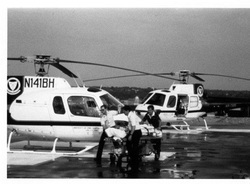 This picture was taken in 1984 on the helipad of the University of Iowa Hospitals & Clinics in Iowa City, Iowa. In the shot, I've just landed with a patient, and I'm assisting the medical staff into the hospital with them. I don't recall where the patient was flown from, or their condition, or much else about the shot, really. But I do remember how I felt that day, because it was the same feeling I had every day I flew Air Medical. It was a mixture of exhilaration and pride: that I was doing so much for someone else, flying 'good,' and that I was so competent at the flying itself. I doubt that I'm alone in this, but it's my sense and belief that we all feel and behave and sleep and get along better when we operate outside ourselves helping other people.
 Yesterday was Equality Ohio Lobby Day here in Columbus, a day my fellow LGBT rights activists and I dropped in on our legislators for a bit of face time, to advise them of pending legislation that it's important for them to support. In Ohio today a worker, regardless how competent, valuable, insightful or of whatever duration with the company can be summarily fired for being, or suspected of being LGBT. The Equal Housing and Employment Act--EHEA--would provide protections to those people. This kind of law is on the books in 21 states, but not in Ohio. It's needed here and elsewhere for many reasons, not least of which is that it's simply wrong to fire someone based on who they are.
Attending Lobby Day felt a lot like landing patients on that helipad all those years ago. I was there to make a difference, working outside myself, helping other people in their struggle to attain what they need. The differences, of course, are many. For one thing my LGBT friends don't need my help; they're perfectly capable, more so really, than I am to push through legal protections etc., and to land all the rights and privileges the rest of us take for granted. Still, it feels good to be a presence in this 'rescue' mission as well, another bit of good flying, or flying good, that's almost equally rewarding.
May 4, 2013
May 4th 1970
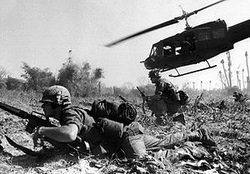 May 4th 1970, 43 years ago today, I was in Vietnam, a Warrant Officer helicopter pilot. My day was filled depositing troops with loaded weapons into hot landing zones. Afterward I'd resupply those troops, reposition them, bring them beans and bullets and mail and ordinance, the stuff soldiers need to fight a shooting war. I'd had a quiet day, hadn't drawn fire, just went about my flyboy business and landed at home plate, another day marked off my calendar, another day closer to the Freedom Bird. As mentioned in The Sky Behind Me, after the war closed down for the day I went to the club for a beer or four, and heard the news. Back home in Ohio four Kent State students had been shot and killed by National Guard troops--with loaded weapons--on the campus outside Akron. Hearing the news that night I was stunned. The feeling was surreal, that I'd had an uneventful day in the field, even though I was in a war zone, while college students were being gunned down at home in Ohio. I didn't have a lot of military experience; my time in the Army at that point amounted to 8 weeks of basic training, a year in flight school, and just shy of a month in Vietnam. But even a rookie pilot like me with that little experience, even I knew those Guard troops should never have been issued live ammunition. Putting them on that campus made sense, to be a presence, to curtail efforts at violent demonstration, and to protect state property. But loading those M-14s was dereliction, pure and simple. We all wondered, as we sucked beers that night in the club 12,000 miles away, and in a real war zone, who was responsible for that order? What official put those kids--we were kids at that age, I'm sorry it's just true--who put them in harms way that afternoon with loaded weapons? Looking back on that long-ago day I see reflections of our current wrestling match with lethal weapons, who should have access to them, why they're used and by whom. It's sobering to think that so little has changed in our culture in forty-three years that the ingredients of violence are still intact, and that loaded weapons are still added to the volatile mix.
May 2, 2013
Entitle-Tude
 I'm a compassionate guy. I really am. Ask anybody and they'll tell you I wouldn't speak ill of anyone, don't disparage people randomly, step sideways to avoid ants and small children. And I know how much simple pleasure there is out there for the taking, the blandishments of modern life, alcohol, cigarettes, rich fatty foods, red meat and calorie-laden desserts, I know all about that stuff. I indulge them myself from time to time. I don't exercise as much as I should. I eat too much ice cream and drink too much wine, sit around too much (hey, I'm a writer, I call it work). But I also know about the ravages of all this modern richness, the indulgent lifestyle we immerse ourselves in at the expense of our health. I saw the end results of our over-fed, under-exercised, sedentary, TV-numbed life that too many Americans adopt too early in life. For twenty years I flew folks to a hospital after their heart attacks, strokes, intoxicated driving mishaps, cancer-related medical crises. Many of those health crises are connected to choices we make about the indulgences listed above. And then what do we do? We demand that the system patch us up, fix our self-inflicted wounds, our heart attacks, strokes, cancer-related medical crises. We're entitled to the care; we're Americans, after all, living in a country that provides all that richness and wealth and indulgence to us. Entitled, to the care and remedy available to address our most egregious health problems so we can resume our smoking and drinking and dietary impulses without hindrance.
But even when I was flying all those patients, and happy to do so I should add, something nagged at me. It's never a good idea, or a compassionate first thought, to focus on financial matters in the middle of a health crisis. But dammit, someone must pay the freight for all this indulgence, the often poor choices we make that result in sickness and morbidity down the road. The payer is--all of us. There's no getting around it. We're all in this leaky little boat together, and no matter how one feels about health care policy, or dietary science & its pronouncements or sociology, when the health care bill comes due, we're all on the hook for it. Many times I'd land at the hospital with a patient who had clearly ignored all manner of health-related items in their personal lives: they smoked (a lot), drank too much (often driving afterward--or during--which brought them to me), they chose to ignore good food offerings for junk, they plugged their brain into a television ten hours a day and became ballast for the La-Z-Boy. The nagging thought that pushed into my head all those times was that those patients chose their situation. No one forced them (or any of us) to live the way they did, or eat that way, drink that way, smoke cigarettes, etc. etc. It was a choice. I avoid the preaching mode. No one really likes a preacher except perhaps the preacher's wife. And I confess, again, that I've been there. I was a pack-a-day smoker for ten years.
It's what I call the entitle-tude that's the real problem. It seems to me that with any entitlement there must be commensurate responsibility, and this crisis--for health care in America is in crisis--this is no exception. I'm not sure that health insurance policies shouldn't contain reasonable restrictions on coverage for those who choose to keep smoking, those whose BMI is above a certain point, those who refuse to follow dietary guidelines. I know; the nanny state. It's always politics. But it's truly conservative politics. We make choices; we should be responsible for those choices, not entitled to whatever interventions society heaps on us like that extra bowl of ice cream.