Byron Edgington's Blog, page 5
July 11, 2013
Blog is my Co-Pilot
 I’m having a good time with The Sky Behind Me, my recent aviation memoir. As mentioned before, the best part of having a book in the public sphere has been the interaction it’s provided. It certainly isn’t the $$. That might be enough to take me and the missus out for dinner, provided Burger King will have us, and no tipping is required. No, the best part is truly the re-connections that have come my way in the meantime. Old friends from Iowa City AirCare; colleagues (also old) from my military flying days; people who had no idea that I was even still alive and kicking, or kicking anyway, and from all over the world. One from Kuala Lumpur for Pete’s sake. That’s way far!
The next best part has been the chance to reflect other people’s work, to share reviews, and add content to their blogs and other publications to help them out. Here are a few of the sites I’ve visited and connected with recently. Airplanology is a creation of a fellow named Ben who earned his wings in 2010, and writes with much enthusiasm about ‘things with wings.’ The other two sites are data-heavy and newsy, but full of good content as well. There are others.
The flying community is pretty large, diverse and enthusiastic. And it does seem to contain a number of writers. It’s from a long, colorful history, I suppose: Ernest K. Gann; Jerrie Mock; Beryl Markham; St. Ex; Wolfgang Langewiesche; Richard Bach; Isak Dinesen, and the list goes on.
We’ve had great reader/co-pilots, too. Some of the folks who’ve read The Sky Behind Me have been more than generous with their time and attention, and I’ll take this opportunity to thank them all. For the reading, and the reviews. Plus, those of you who’ve purchased a copy and read it, thanks to you as well. I never really flew solo all those years. I was always the only pilot, at least in my commercial flying, but there were always others tagging along with me, co-pilots in everything but title. So here’s to all the honorary pilots out there. We’re all just going through our lives, trying to keep the machine wings-level, avoiding storms as we might, plowing through them if not. Every day’s a new takeoff; every evening a new landing, with all that life has to offer along the way to our final approach. Those of us who write it down rely on the rest of you more than you know.


July 10, 2013
Ridiculous to Sublime
 During my 20 years as a pilot for AirCare, The University of Iowa Hospitals & Clinics in Iowa City, I had the opportunity to see the full spectrum of health care in this country, the ridiculous and the sublime, in nearly equal measure. Many stories, taken from both elements, are detailed in
The Sky Behind Me
. As a pilot, I had the task of getting the medical team to their patient, then returning them safely to their destination, wherever that might be, as expeditiously as possible. In between missions I wandered the hospital halls, solved crossword puzzles, kept up on weather trends, and thought about various missions ridiculous and sublime. Perhaps a bit too much, in some cases.
During my 20 years as a pilot for AirCare, The University of Iowa Hospitals & Clinics in Iowa City, I had the opportunity to see the full spectrum of health care in this country, the ridiculous and the sublime, in nearly equal measure. Many stories, taken from both elements, are detailed in
The Sky Behind Me
. As a pilot, I had the task of getting the medical team to their patient, then returning them safely to their destination, wherever that might be, as expeditiously as possible. In between missions I wandered the hospital halls, solved crossword puzzles, kept up on weather trends, and thought about various missions ridiculous and sublime. Perhaps a bit too much, in some cases.As for the ridiculous, I provide a caveat: I found it remarkably easy to become judgmental about people, even in their time of dire emergent need. If they’d worn a seat belt, I’d think, or slowed down. If they’d given up the booze, the meth, taken better care of themselves. Lost weight, eaten better, seen a dentist, or dietitian or dermatologist. It was far too easy to put aside the simple humanity those patients’ situations demanded, in favor of the criticism and rebuke I often had to force back. I wondered about the state of health care in America, too. Why do some patients arrive at hospitals by helicopter when their status doesn’t require that expensive mode of transport? Why are certain patients taken from loved ones, then flown miles away to die alone? Why does the system aim so many resources at end of life patients, people who may not even desire the undignified and expensive interventions? Then there were missions that made all those others fade into insignificance. Those missions on which everything came together, patient status, weather, flight crew, time, everything meshed for an opportunity to experience the sublime. Those missions didn’t occur every day; but they came along often enough that the flying was more than a job, it was a calling.
I helped save Daniel’s life one chilly night, when he would have died otherwise. His wife had been told to tell him goodbye. It’s in the book, and the mission still gives me a warm glow just thinking about it. There’s a young man who was terribly injured in a farm accident when he was seven, and not expected to live. He’s got a youngster of his own these days. The older woman who’d flown twice before for the same heart condition. When I walked into the small ER that night, she looked at me and said: “Oh, good, you’re the best pilot!”
Many times, landing atop the hospital, morning sun cresting the Iowa horizon, my relief pilot waiting on the helipad I’d think of the lives saved, people helped, the dreams restored the previous night’s shift and I’d smile despite my fatigue. Those times were sublime, too.
July 9, 2013
Did cultural factors play a part in the Asiana 214 crash?
 Yesterday I wrote about the technical aspects of Sunday’s crash of Asiana flight 214 at SFO. As I wrote yesterday I repeat today: this is pure speculation on my part, so perhaps worthless to any accident cause and/or resolution. The crash at San Francisco did, however, remind me in its details and outcome of a few flying accidents I’ve read about over the years. By reading various reports, such as those from the National Transportation Safety Board, NTSB, Pilots familiarize themselves with the misfortunes of their colleagues, to learn from them, and to possibly avoid the mistakes and scenarios that put the other fellow in the dirt. It’s not a morbid thing, or a way to burnish our own cockpit creds. For me at least, as I wove my way toward the end of a successful, accident-free flying career, those reports reinforced for me that there are no new ways to have an aviation accident. No novel flight profiles pop up, no warp occurs in the laws of physics to create brand new hazards for those who make their living in the vineyard of the sky.
And one of the things that always jumps off the page of any NTSB report I ever read is the communication breakdown that seems a part and parcel of every single crash.
An example is an accident at Washington National Airport in January 1982. ‘Palm 90′ took off that frigid day with ice on its control surfaces. The thin film of ice degraded the lifting ability of the wings, and clogs of ice in the pitot tube, the exterior orifice that delivers speed information into the cockpit gave the pilots inaccurate data. Reading the cockpit communication from that crash is chilling: the pilot not on the controls knows there’s something amiss, he just can’t force himself to abandon the takeoff, to simply communicate his apprehension to his colleague. ‘God, look at that thing–That don’t seem right, does it? Uh, that’s not right–Yes it is, there’s eighty–Naw, I don’t think that’s right. Ah, maybe it is–Hundred and twenty– I don’t know…’ The next sound on the recording is the plane’s impact into the 14th Street bridge across the Potomac. Nowhere in the taping does either pilot discuss stopping to figure out the anomaly in front of them.
Yet another accident happened on Tenerife in the Canary Islands in March 1977. The pilot of a KLM 747 attempted to take off on a fog-shrouded runway. Too late to stop, he saw a Pan-Am 747 taxiing toward him on the same runway. Again, miscommunication caused the collision of two jumbo jets, killing 583 people, the worst accident in aviation history.
Another happened on Guam in August 1997 when a Korean Airlines 747, flight 801 crashed into a hillside short of the Agana Airport. The pilot insisted that he was in position to land, and despite the subtle hints from his co-pilot that the plane is too low, and even with a low-altitude aural warning, the pilot flew the plane into the ground.
In the Korean Air crash on Guam an accident factor emerged that may have played a role in Sunday’s accident at SFO. Cultural biases against questioning the authority of an elder, or someone in charge seems to have led to the Guam accident. The right seat pilot threw several hints and subtle verbal cues to his captain, but he couldn’t force himself to question the man’s judgement or authority. The young fellow quite literally watched his captain fly into the ground rather than cause embarrassment to him in the cockpit. The student/co-pilot chose to risk his very life rather than make his captain look bad. Reading the text, and watching the video of Sunday’s Asiana accident I can’t help wondering if a breakdown in communication, a hesitation to speak up due to cultural restraint might well be a factor in putting that plane in the dirt as well.
July 8, 2013
Asiana 214: Poor weather might have prevented this crash.
 Asiana Flight #214 left Seoul South Korea Sunday with 291 passengers and 16 crewmembers. With the destination San Francisco International Airport, the big Boeing approached over San Francisco Bay nearly eleven hours later. The PF, or Pilot Flying in flyboy lingo, was an experienced aviator with more than 10,000 hours in jets, but only 43 hours logged in the 777. It was also his first ever landing at SFO. Weather was CAVU, more pilot jargon meaning Clear And Visibility Unlimited. In other words, weather was no factor.
It’s always easy to speculate on the cause, or causes of an aircraft accident: pilot fatigue, inexperience, missed details, passed over checklist items, the list goes on and on. From appearances, and from where I sit 3,000 miles away in the comfort of my home office, here’s my personal speculation on the crash of flight #214. I don’t know. I was never in the cockpit of anything that big and heavy. Never had the responsibility for 300 other souls after flying across that much water, for that many hours into an airport where I’d never landed before. So this is pure speculation, and I hope something else replaces it with hard data. But I suspect the approach over water with that heavy airplane, in clear conditions, by a pilot with all those jet hours led both pilots in the front office down the path of complacency.
Depending on how much fuel was packed into it on takeoff, and how long it’s been in the air, the 777 lands, typically, at around 300,000 pounds. That’s not only a lot of weight, it’s a lot of momentum. Modern turbofan engines are very efficient, very durable and extremely dependable. Feed jet engines like the two Pratt & Whitneys on the 777 fuel and air and they will run for a very long time with little or no maintenance. But jet engines also have their quirks, and one of them is that they take a while to ‘spool up.’ There’s a lag time from pushing the throttles forward to engine response. In the family car, which weighs a ton, two at most, the piston engine responds instantly. Mash the gas pedal and the power is there right away. Not so in a jet engine. Push power forward and the big turbine winds up to speed, often taking several seconds to reach needed power. Meanwhile a pilot has 300,000 pounds of metal descending perhaps a bit more quickly than he or she might prefer and a lag time in arresting that descent. Flight 214′s pilot had not flown into SFO before. The attempted landing on Sunday to runway 28 Left was over water for the last several miles. It was what pilots refer to as a visual approach, in other words, an approach without the use of instrument landing equipment, either ILS or radar. Runways always offer a guide called VASI, or Visual Approach Slope Indicator, a kind of light signal that shows pilots their position on an imaginary ‘glide slope’ to the runway’s end. But any approach over open water can be tricky. Water can distort a pilot’s depth perception by eliminating motion cues, its flat surface, especially on a windless day, giving no hint of forward movement relative to surroundings.
So we have pilot wearing a 300,000 pound airplane on his back, landing at a new field for the first time, with very little time logged in that particular aircraft type. He’s flown over a lot of water already, is likely fatigued, nervous as any pilot in training would be, and descending over yet more water. The descent rate is too high, the PNF, Pilot Not Flying, tries to add power to correct it, the engines start spooling up, but not nearly fast enough to stop the descent, and the aircraft lands short of the runway.
Only speculation, as I say. But my guess is that if the weather had been crummy, thus requiring an instrument approach, and if the PNF had been on the controls with the rookie pilot, and if the PF’s view was inside the cockpit instead of staring at a body of water, the landing would have been uneventful. I feel bad for the poor pilot. His life is ruined, at least for a while, and the memory of his final approach into SFO will haunt him forever.
July 7, 2013
A book review:
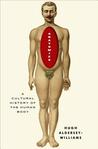 Anatomies: A Cultural History of the Human Body by Hugh Aldersey-Williams
My rating: 4 of 5 stars
Very engaging, informative even fun reading about our body, the entity that encapsulates us, keeps us (relatively) free from harm, disease-free and durable until the allotted three score and ten. Many items of minutiae uncovered by Mr. AW's deep research--the history of circulation of the blood, for example. Was it Harvey? Or was it a Muslim physician 300 years prior? A bit of cultural bias perhaps? Fascinating stuff appears, such as the seemingly insignificant detail that grave robbers snatching bodies for early surgeons were careful to leave personal property behind in the grave, as this belonged to the family of the deceased, and its taking could land them in jail. Another detail is in the form of a question: when blood banks are desperate for donations, why do we toss all that blood product away from a recently dead person? Cultural bias here again; the transfusion-desperate public wouldn't hear of taking such blood, though an hour prior to the donor's death they'd welcome it. Good insight, I thought.
If the reader is interested in obscure details about the human body and our wearing of it, this is your book. The only criticism I might have of the work is that toward the end it bogs down a bit, discussing some of the religious and political aspects of bodies Vs the science of dissecting them. Plus, the content dealing with life extension to 1,000 years or more might be a book in and of itself.
Anatomies could be a useful guide for those wishing to donate their remains to science, or for those wishing nothing of the kind. Byron Edgington, author of The Sky Behind Me, a Memoir of Flying and Life
View all my reviews
July 5, 2013
Book Binding
[image error] One of the most satisfying things about having a book out there floating around is the way it’s resurrected old connections. Since publication last November,
The Sky Behind Me
has sold well, and received several fine reviews. Thanks to all my readers, and reviewers, it means a lot. But the connections have been pretty amazing: a fellow pilot from Vietnam contacted me after nearly forty years; then another one, a man who was my executive officer in the company; several more colleagues from aviation, and the Air Medical field and even a man whose book about his escape from the Nazis in WW-2 tracked me down to swap reviews. Frank Shatz wrote
Reports from a distant place
, an astonishing tale of narrow escape and dangerous travel to get out of Nazi Germany. Another writer, Bill Brady contacted me. Bill’s book,
World War Two, Cause and Effect
is one of the more thoroughly researched and documented non-fiction books I’ve read about the War.
The other day I received an e-mail that came through my website. It was from a woman named Carol. Her family lived up the street from me when I was growing up on Riverview Drive in Columbus. Carol had heard her brothers Jim and Bill talking about my book, and e-mailed me. I haven’t seen Carol for..? Jeez, I hate to think how many years. A lot. It’s this kind of connecting, call it book binding that makes all the promotional headaches and tedium worth it when I’d rather be writing.
The other day I received an e-mail that came through my website. It was from a woman named Carol. Her family lived up the street from me when I was growing up on Riverview Drive in Columbus. Carol had heard her brothers Jim and Bill talking about my book, and e-mailed me. I haven’t seen Carol for..? Jeez, I hate to think how many years. A lot. It’s this kind of connecting, call it book binding that makes all the promotional headaches and tedium worth it when I’d rather be writing.
July 4, 2013
Notable deaths on the 4th of July
 Most people know that John Adams and Thomas Jefferson died on the 4th of July, 1826, the fiftieth anniversary of the Declaration of Independence. The two grand old men of the earliest age of America died within an hour of each other, Jefferson first, then Adams, not knowing who would go first, though both men knew their final hour was near.
But other historically notable folks died on the 4th of July as well. Lincoln’s Vice-President, Hannibal Hamlin was one of them, passing away in 1891. Another U.S. President, James Monroe died July 4th 1825. Paul Joseph Revere, grandson of Paul Revere of Midnight Ride fame, and a Union General in the Civil War died July 4th 1863 at the battle of Gettysburg. Yet another American patriot and soldier, Benjamin O. Davis, Air Force General, and member of the famed Tuskegee Airmen died July 4th 2002. Other notables leaving us on the 4th include Charles Kuralt, Eva Gabor, Barry White, Pancho Gonzalez and Marie Curie (from radiation exposure).
Why the morbid mention of people famous for dying? No particular reason, just that in my twisted brain death may be the ultimate Independence. We writers look at all sides of the issue, after all. Plus, not that there’ a connection, at least I hope there isn’t, but I’ll be 65 soon, Medicare eligible. Soon I’ll be authorized to participate at the monthly lunch at MCL Cafeteria, the MediCare Lounge as a friend calls it. Sorry for the obits. Have a happy 4th!
July 3, 2013
The Blue and the Gray
[image error] One hundred fifty years ago today, near Gettysburg Pennsylvania, a bunch of guys wearing blue clashed with a bunch of guys wearing gray. The only way those troops on Culp’s Hill, or the bloody angle or on Little Round Top knew who to aim their muskets at when the killing began was the color of those outfits. If your coat was blue, aim at the gray guy; gray coat, aim at blue, then squeeze the trigger. In the last hundred-fifty years things have become a bit more complicated. Indeed, with modern warfare and its technological aspect uniform coloration is beyond ancient history; the color coding now is found only on circuit boards.
In the only war I have personal experience with–or care to ever again, thank you–took place as far from Gettysburg Pennsylvania as it’s possible to be and still occupy the same planet. Vietnam itself is, of course, a land of riotous color, every imaginable shade of green, ochre-hued earth churned up by tons of ordnance and a rainbow of tints on the clothing of the populace, many hues and shades worn for reasons I never understood. I wore the standard Olive Drab of the GI in country, a muted shade that offered at least a chance to hide in the event of being shot down. My ‘enemy,’ the North Vietnamese, wore uniforms of much the same coloration. Like me, their intent was to hide as long as possible in jungle redoubts, not to charge in colorful outfits across open fields and up scarred hillsides into the teeth of enemy muskets. War itself has become more complex, less colorful somehow, and the reasons for it likewise. Wars have always been waged for ideas, I suppose. The American Civil War was no exception: men in blue fought to preserve the red, white and blue of union; men in gray fought to uphold states’ rights, and for the enslavement of black men. Each side’s battle flags dripped with colorful banners of engagements won, units decorated for courage and sacrifice defending ‘the colors.’
One hundred fifty years after Gettysburg, perhaps it’s time to find a new color, a shade of acceptance that will allow us to see each other better in the jungle of humanity that has more color and diversity than ever before.
In the only war I have personal experience with–or care to ever again, thank you–took place as far from Gettysburg Pennsylvania as it’s possible to be and still occupy the same planet. Vietnam itself is, of course, a land of riotous color, every imaginable shade of green, ochre-hued earth churned up by tons of ordnance and a rainbow of tints on the clothing of the populace, many hues and shades worn for reasons I never understood. I wore the standard Olive Drab of the GI in country, a muted shade that offered at least a chance to hide in the event of being shot down. My ‘enemy,’ the North Vietnamese, wore uniforms of much the same coloration. Like me, their intent was to hide as long as possible in jungle redoubts, not to charge in colorful outfits across open fields and up scarred hillsides into the teeth of enemy muskets. War itself has become more complex, less colorful somehow, and the reasons for it likewise. Wars have always been waged for ideas, I suppose. The American Civil War was no exception: men in blue fought to preserve the red, white and blue of union; men in gray fought to uphold states’ rights, and for the enslavement of black men. Each side’s battle flags dripped with colorful banners of engagements won, units decorated for courage and sacrifice defending ‘the colors.’
One hundred fifty years after Gettysburg, perhaps it’s time to find a new color, a shade of acceptance that will allow us to see each other better in the jungle of humanity that has more color and diversity than ever before.
July 1, 2013
Life Du Soleil
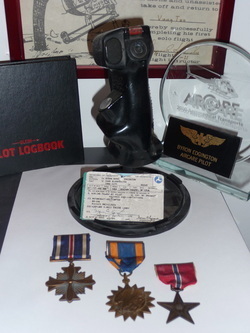 A recent Huff Post report is about a performer with Circ Du Soleil who was killed in Las Vegas. The woman fell fifty feet to the stage just as the performance ended. A tragedy for her family, and for those around her, no doubt. She was young, vibrant, energetic and clearly in better physical shape than 99.99999....% of the rest of the known world population or she would not have been in that prestigious troupe. I'm sure she'll be missed, safety concerns will be raised, equipment examined and the show itself scanned for ways it might be made safer for the athletes involved.
The other side if the story is that the young woman died doing what she loved. In the photo above I've included a number of items gathered during my forty year career in the cockpit. In my book, The Sky Behind Me , I refer to the control stick shown here, an actual cyclic that was removed from an AStar I flew for many, many patient transports in Iowa as an Air Med pilot. The inscription in the book reads: "I may have held the stick in my hand for forty years, but in actuality it was the other way around." There's something to be said for doing what we love, regardless of how dangerous, threatening or unpredictable it is. No one gets out of this alive. I don't pretend to know what the young Circ performer thought as she plunged to her death. But she certainly understood the perils she faced, every time the show began. I am sure of this: she thought of those risks, and she dismissed them, a necessity for her in order to do what she was trained to do, and what she loved.
Just so, every time I took off I was aware of the potential for peril, from weather hazards, mechanical malfunctions, unpredicted anomalies, midair collision, even dangers from various medical processes conducted inside my cabin on patients as I flew them to a hospital. One night many years ago a fellow weighing more than 250 pounds, and wildly combative from a head injury, broke his restraints and began thrashing around the cabin. I was at two thousand feet at the time, fully dark outside, with one flight nurse on board, a woman who was petite to begin with, and eight months pregnant. Fortunately for us he settled down, and the remainder of the flight was uneventful but I was heading for the ground in the meantime. Some of the dangers we face cannot be predicted, but must be addressed as they arise.
I'm sure Circ Du Soleil will go on, the show in question will continue and the young woman who was killed will be mourned. But she died doing what she loved, and had reached the pinnacle of success in her chosen field. I know just how she felt as she went into her final act, even if she didn't know it was to be her curtain call and last bow.
June 28, 2013
Takeoff Part 2
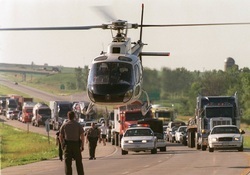 In yesterday’s post I discussed the sublime, energizing emotionally satisfying feeling of taking off in an aircraft, slipping ‘the surly bonds of earth.’ The language of the piece matched the subject: lofty, soaring, almost poetic words, or as close to poetry as I’m likely to get. Despite my first name, my connection with poets and their products is decidedly limited.
Today’s post is the opposite side of that feeling, the takeoff filled with anxiety and dread, the liftoff into a sky clouded with uncertainty. The takeoff with a badly injured, grievously ill or terribly wounded emergency patient. In 20 years of Air Medical aviation I made this takeoff thousands of times, and each liftoff had its own element of uncertainty, its own unknown outcome. Each of those Air Med takeoffs was emotionally charged, filled with the adrenaline of medical necessity and urgency, so they were all somewhat different than the ethereal, the poetic launch of yesterday’s missive.
There are more of the emergency liftoff examples than I have room for here, or can even recall. But some stand out, a few takeoffs that reminded me of just how deep was my responsibility to the patients I carried, and their families. One I mentioned in The Sky Behind Me happened on a winter night in 1984. In the interest of patient privacy details are omitted, but my patient that night was a seven-year old farm kid from Northern Iowa who’d been gravely injured. My flight nurse and I met him at the tiny hospital. He was barely alive–loss of blood, multiple trauma, orthopedic injuries and exposure. He was not expected to live through the night, and his folks were told as much. Taking off that frigid night I launched into a sky filled with stars, headed to Iowa City, with the child close enough beside me in the cockpit I could reach across and touch him. My own seven-year old was home snug in her bed that night, so the connection I felt with the boy’s parents ran deep. I understood how they must have felt. Watching my child lift off into that star-scattered night, thinking I may not see her alive again was not something I could contemplate.
I landed at the hospital with the boy at ten o’clock. From the helipad he went directly to surgery where his lacerations and fractures were mended. He left the OR around three a.m., and spent several days in an ICU.
The upshot of the tale is that the boy survived. He left the hospital weeks later with his parents and went home. Years later, I got a letter from him. In it he thanked me for saving his life, and announced that he was about to become a father himself. He remembered nothing of the takeoff, or the flight, or landing, and that was a good thing. I did nothing heroic or particularly different than any of my colleagues would have done that chilly night. My takeoff was the same as any other. But the outcome was different; the boy pulled through, while many of my Air Med patients did not. Each one was indeed different, and exactly the same.Each one contained its own specific set of unknowns, medical particulars and family dynamics. Each takeoff had its very own drama, the challenge to make some one else’s life and experience a bit better. Every takeoff mattered.