Michelle Ule's Blog, page 55
February 17, 2017
Macy Halford: My Utmost: A Devotional Memoir
 My Utmost: A Devotional Memoir
by Macy Halford was published February 7, 2017.
My Utmost: A Devotional Memoir
by Macy Halford was published February 7, 2017.It’s the first new book on Oswald Chambers in more than two years.
(Drs. Jed and Cecile Macosko published A Daily Companion to My Utmost for His Highest in late 2014).
I devoured the memoir in three nights and enjoyed it a great deal.
I’ve been waiting for this book since I first heard about it in 2013.
Halford had access to information I did not, so I wanted to see what she found.
It’s a memoir
For those who love Oswald Chambers, it’s important to remember Halford’s book is a memoir.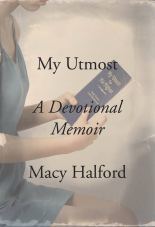
Memoir differs from biography–and while she includes biographical information, the story is Halford’s not Oswald’s or Biddy’s.
Here’s an explanation from literary agent Barbara Doyen
“A memoir is a special kind of autobiography, usually involving a public portion of the author’s life as it relates to a person, historic event, or thing. The text is about the personal knowledge and/or experiences of the author.
“In contrast, an autobiography covers the author’s entire life to the present, and is expected to include details about his or her public and private life. A biography is someone’s life story written by another person.”
As memoir, this is the story of how and what Halford learned about the devotional book she had loved since her teen years.
She described seeing both her mother and grandmother spend “quiet times” in the evening on their beds reading the Bible and savoring My Utmost for His Highest.
Those “holy” moments lingered in her memory and as a result she picked up the devotional, too, and has read it daily ever since.
Growing up in Texas, she traveled to college in New York City and remained there until her mid-thirties.
As she graduated in history, found work and ultimately became a book reviewer for The New Yorker magazine, her relationship with her childhood faith morphed.
My reaction as a Christian
This memoir follows Halford’s maturity from childhood faith to seeing Christianity through a more sophisticated eye.
Several times I caught my breath, “no, don’t go that way.”
More than once I shook my head–the descriptions of her childhood church were so different from anything I’ve experienced.
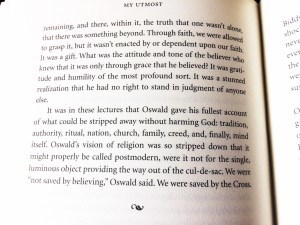
But, that’s the draw of memoir–you have to read it all the way to the end, where you find the resolution. The photo at left explains where Halford finally found her faith, via Oswald.
My reaction as Biddy Chambers’ biographer
My biography of Mrs. Oswald Chambers will be published in October, 2017.
My book is a biography, the story of Biddy’s life from birth to death, along with an examination of how she produced My Utmost for His Highest.
I don’t discuss my personal reactions to the story.
Reading Halford’s memoir felt odd as I encountered stories about Oswald I didn’t know, recognized quotations she interpreted differently, and marveled at some of the information she found that I never saw.
Even I learned from My Utmost as she explored the influence of Oswald’s life on the readings in My Utmost for His Highest.
Sometimes I laughed aloud, other times I once again felt the poignant weight of facts I knew.
Halford did a fine job.
I read the last few chapters to my husband–another Oswald Chambers fan–savoring her insights with him.
If you love My Utmost for His Highest as much as Macy Halford and I do, you may very well enjoy this interactive jewel.
Tweetables
A memoir of faith, love and My Utmost for His Highest. Click to Tweet
Memoirs are not biographies, but both can love Oswald Chambers. Click to Tweet
How the love of My Utmost for His Highest took a woman on a spiritual journey. Click to Tweet
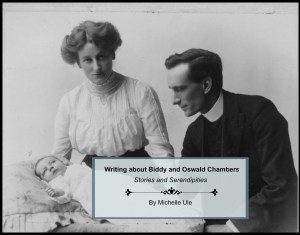
Sign up for the newsletter at: http://eepurl.com/2l7F9
Those interested in Oswald and Biddy Chambers might enjoy short monthly stories about God’s leading in writing Mrs. Oswald Chambers (to be released in October 2017 by Baker Books).
February’s appropriate story: “In which Oswald Chambers presents an opportunity to write a romance novel.”
Sign up for my newsletter here.
The post Macy Halford: My Utmost: A Devotional Memoir appeared first on Michelle Ule, Author.


February 14, 2017
My Own Wrinkle in Time
 “Why, you had your own wrinkle in time,” my friend exclaimed.
I’d recounted a story in which he had given me a surprising gift
We’re both fans of Madeleine L’Engle‘s Newberry award winning novel A Wrinkle in Time, but his words caught me by surprise.
I hadn’t thought of it that way before, but he was correct (you can read the story here).
As I marveled, I remembered another wrinkle and how it blessed me and a stranger.
I hope it helps you, too, watch for similar wrinkles in your life.
Hawai’i
Several years ago, my daughter and I spent time together on O’ahu.
We’d lived on Pearl Harbor for four years when she was a toddler. My husband retired from the Navy just before she turned five.
She didn’t remember much about our life there.
The two of us drove about the island as I told story after story. “How come you know where all the libraries are?” she asked at one point.
“Don’t you remember spending time there? You were always with me.”
A withering look came my way.
One afternoon found us at Bellow’s Beach, a beautiful site reserved for military people during the week. We parked at the same spot as always (for me) and settled in on a beautiful day–with just a handful of other vacationers.
I don’t know how many times I’d watched my children boogie boarding in the perfect waves while I sat in the shade.
That day the two of us body surfed and boogie boarded until I retreated to my chair and she built a sand castle.
Another couple settled not far away and let their little girl loose. The 18 month-old in a pink swimsuit with a plastic bucket and shovel toddled past and began to dig.
Tears
Time folded over itself as I sat there and tears suddenly filled my eyes. It could have been my little girl–in fact, it often was.
We’d sat at that spot, she’d stumbled along the beach and her brothers shouted from the sea.
But on that day, only the waves and the seabirds called.
I opened and shut my eyes twice.
My daughter called from her sand castle, “come help!” The little girl turned in her direction.
Photos
As the child’s father stood, I spoke. “Make sure you take lots of pictures.”
He held up his phone.
“My daughter walked this same beach seemingly just the other day.” I pointed at her. “She’ll graduate from college in June. Time has flown.”
His eyes widened and he took pictures as fast as he could.
My daughter lifted her hand to the toddler and laughed–at herself in a wrinkle of time?
No–it was my wrinkle.
She just saw a kindred spirit in an adorable pink bathing suit.
I’m a history lover who lives in stories. I’m a genealogist who remembers the names.
Wrinkles in time humble and thrill me–and I love when I can remember a blessed time in my past life.
How about you?
Tweetables
A wrinkle in time on a Hawaiian beach. Click to Tweet
What do wrinkles in time look like in real life? Click to Tweet
Take the photos before those toddlers go to college! Click to Tweet
Those interested in Oswald and Biddy Chambers might enjoy short monthly stories about God’s leading in writing Mrs. Oswald Chambers (to be released in October 2017 by Baker Books).
Sign up for the newsletter at: http://eepurl.com/2l7F9
February’s appropriate story: “In which Oswald Chambers presents an opportunity to write a romance novel.”
Sign up for my newsletter here.;
The post My Own Wrinkle in Time appeared first on Michelle Ule, Author.
February 10, 2017
The Revivalist and Oswald Chambers
 first published articles in The Revivalist and Bible Advocate magazine in 1907.
The magazine, which is still in print, ran a special edition about Oswald Chambers in January-February 2017.
It’s packed with beautiful photos and information.
You can read it here.
Why an American magazine?
Oswald first met editors of The Revivalist magazine during his first visit to America in winter 1905-1906.
He’d come to God’s Bible School in Cincinnati, Ohio at the urging of his Japanese evangelist friend Juji Nakada.
While Nakada went off on a preaching trip around the US, Oswald remained to teach a course on Biblical Theology.
(I’ll write more about Oswald Chambers in America in July)
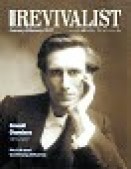
Cover of the 2017 magazine
Like many Christian preachers, he was keen to write as well as teach.
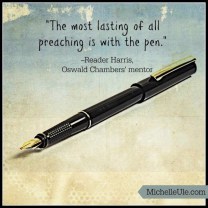
His own mentor, Reader Harris of the League of Prayer, used to say, “The most lasting of all preaching is with the pen.”
(See page 15 of The Revivalist for more on Reader Harris, here).
It only made sense he’d meet the editors and arrange to write articles.
What did he write about?
The subjects on which he spoke were the focus of some of his articles: Jesus, the Bible, how to live as a Christian.
After the camp meetings in the summers, he wrote about those.
As Oswald was extremely busy, writing articles became easier when he married the super-stenographer Biddy.
She took down his messages, typed them up, corrected spelling and syntax and mailed them to The Revivalist.
The linked 2017 magazine includes excerpts and reprints from those first 1907 articles.
During World War I, the messages Oswald spoke at Zeitoun YMCA camp served to spark a type of revival among the ANZAC troops.
Many of those lectures appeared in The Revivalist–almost every month.
Oswald’s work also appeared regularly in the League of Prayer’s magazine Tongues of Fire (later known as Spiritual Life).
Through the magazines and prayer letters sent by Biddy, they kept their supporters on events at Zeitoun during the war.
When Biddy toured League of Prayer centers in 1919, many people she met were familiar with and asked about the YMCA ministry in Egypt.
God’s Bible School, which produces The Revivalist, is pleased to have been part of Oswald’s ministry 110 years ago, as well as today.
Tweetables
Honoring Oswald Chambers and his first published works. Click to Tweet
The Revivalist Magazine and Oswald Chambers’ first articles. Click to Tweet
A terrific overview with photos of Oswald Chambers in The Revivalist. Click to Tweet
Sign up for the newsletter at: http://eepurl.com/2l7F9
Those interested in Oswald and Biddy Chambers might enjoy short monthly stories about God’s leading in writing Mrs. Oswald Chambers (to be released in October 2017 by Baker Books).
February’s appropriate story: “In which Oswald Chambers presents an opportunity to write a romance novel.”
Sign up for my newsletter here.
The post The Revivalist and Oswald Chambers appeared first on Michelle Ule, Author.
February 7, 2017
On Saying Thank You
 “Tell everyone you meet, ‘thank you.'”
Not a bad idea, but it wasn’t mine.
As I sat in my pink chair praying about an upcoming trip, that sentence popped into my mind.
Since no one else was home, obviously, it came from God.
Easy. I could do that.
But I thought the message silly. I always expressed my thanks to people who deserved it.
God wasn’t done: “Look the ticket taker on the Puget Sound ferry in the eye and say thank you.”
Make eye contact. Okay.
“Thank everyone. Particularly those who need it.”
Why wouldn’t I? 1 Thessalonians 5:18 spells it out clearly:
“Give thanks in all circumstances; for this is God’s will for you in Christ Jesus.”
Thank you, travel assistants.
Southwest Airlines held the plane two minutes so we could make it.
I rented the car effortlessly.
We thanked my brother-in-law for a night’s rest.

By Tim Marshall (Unsplash.com)
Everyone took it in stride, but what would happen at the ferry terminal?
“Thank you, so much,” I said waiting to take my ticket until the person behind the window looked at me.
Nothing extraordinary, light did not shine down, angels didn’t sing.
“You’re welcome.”
Dismissed. I shook my head and returned to the car.
We traveled to Bremerton, no problems, and waved to the ferry operators when we drove off.
What was that all about?
It doesn’t matter. I just did what I was told to do.
Thank you, unhappy workers
Making eye contact and deliberately thanking people is a habit after all these years.
Whenever I visit a local story with miserable employees, I try to make friendly remarks while being checked out.
I wait for them to look at me when they pull off the receipt.
Then I smile and say thanks.
They usually smile back.
It’s a small thing, but I believe it helps cheer them up.
Thank you for your patience
The Thessalonian passage echoes through my life–particularly that last clause: in all circumstances.
Unfortunately, I am not perfect.
I frequently lose my patience in poorly handled business situations.
My caustic and cynical tongue knows how to lash.
But I’m supposed to be thankful.

W Scribner (Wikipedia Commons)
I’m supposed to model Christ to all I meet–and be thankful.
Fortunately, I’m experienced in confessing sin and apologizing.
More than once, I’ve made a sarcastic remark to a hapless employee on the phone, or more recently at the inept pharmacy.
If my husband is there, he always reminds me to “be nice to the help.”
He’s right. It’s not their fault the system is stacked against them and me.
When I catch myself being harsh, I apologize: “I’m so sorry, I know this is not your fault. Forgive me.”
Many people have laughed and all have accepted my apology.
I make sure to thank them, “for your patience and so much for your help,” when I hang up or finish.
How’s it working out?
God loves a thankful heart.
Scripture is full of verses about being thankful.
When I confess my lack of thankfulness and look for reasons to be thankful, Colossians 3:15 steps in:
“Let the peace of Christ rule in your hearts, to which indeed you were called in one body. And be thankful.”
It’s easier to be at peace if you practice thankfulness.
Especially to those who don’t always get it.
Tweetables
Giving thanks by God’s direction–even on the ferry. Click to Tweet
Apologizing and being thankful in stressful situations. Click to Tweet
Blessing others by being thankful in all circumstances. Click to Tweet
The post On Saying Thank You appeared first on Michelle Ule, Author.
February 3, 2017
Mr. & Mrs Luther in Fact and Fiction
 Mr. and Mrs. Martin Luther have been the subject of two important books in the last year.
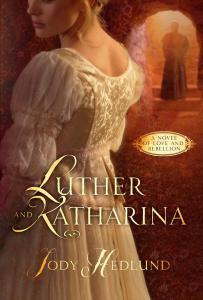
The first, Luther and Katharina: a Novel of Love and Rebellion by Jody Hedlund, won last year’s Christy Award for the best historical fiction of the year.
It’s a novel, therefore it’s fiction.
The second came out in January 2017: Michelle DeRusha’s Katharina and Martin Luther: The Radical Marriage of a Runaway Nun and a Renegade Monk.
DeRusha’s book is a biography, therefore fact.
What does the intersection between fact and fiction mean for the reader?
As both a biographer and a novelist, I’ve walked a fine line between using fiction to improve my biography and tripping over fact while keeping my historical fiction interesting.
So, I present these two books about Martin and Katharina Luther for your examination. I liked them both–for different reasons.
Whether they are reading fiction or nonfiction, a reader needs to be able to trust the writer got the facts correct.
As a reader, I’ve tossed aside many an historical romance because the author didn’t do enough homework to make the story real.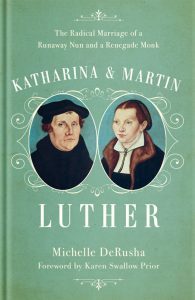
(Girls running between houses and calling each other on the phone to chat for long periods of time in 1901?
(Unlikely. I usually allow one or two errors like that, but each one makes me suspicious of what else the writer has distorted).
You need to use historical fact when writing historical fiction. A biographer or nonfiction writer should use elements of fiction–particularly description–to tell their stories well.
The quality of the writing is always important–no matter what type of book you’re reading.
Challenges with the Luthers
While books about Martin Luther number in the hundreds, Katharina von Bora is another story.
Only eight letters she wrote still exist, according to biographer Michelle DeRusha.
None were to her husband and most were written after her husband’s death.
To compile an authentic story of her life required DeRusha to infer much about Katharina from her husband’s letters to her.
(Sort of like only hearing half of a phone conversation).
DeRusha researched the type of life she would have led as a nun to provide context and background to who Katharina became when she married Martin Luther.
She did a great job and I learned a lot about the Luthers, the reasons for the Reformation and the horrors of life in medieval Germany.
In so doing, DeRusha painted a wider picture of the Luther marriage than has been written before.
Based on meticulous research; it’s all true.
Lots of room for embroidery
 DeRusha’s challenges were Jody Hedlund’s beginning.
Hedlund not only had to understand the same facts about medieval life–including German and medieval vocabulary for everyday devices.
Like DeRusha, Hedlund read biographies and poured over historical documents to get a feel for the life and times of Katharina von Bora.
She had several questions running through her mind as she researched and used that curiosity to fashion Katharina’s character in her novel.
(Hedlund was particularly intrigued Katharina had been a nun and thus had taken a vow of celibacy. How did she end up getting married?)
Once she reached a certain spot in her research, Hedlund began writing an inspirational romance novel–which is what she’s known for.
Focusing on the relationship between Martin and Katharina, she fashioned a romantic tale of attraction that was denied, responsibility assumed and drama that didn’t end.
The book is dashing and exciting; thrilling and romantic–words one does not usually associate with Martin Luther.
My reaction to the two books
They’re a good pair to read together.
Historical Fiction
I read Hedlund’s Luther and Katharina: a Novel of Love and Rebellion first and while I enjoyed it, several scenes made my historian eyebrows go up.
She’s writing a romance, so the genre requires the chapters to weave between the hero and the heroine’s point of view.
No problem there, but in chapter 12, Katharina is kidnapped by her former abbot–who wants her and all his former nuns back under his oversight, care, nunnery and potentially venial interest.
There’s no record that happened–though Hedlund undoubtedly based the scene on what happened to other nuns.
To me, though, exciting and romantic though it was, it had a taint of “Martin Luther Superhero.”
It happened a second time, which bothered me.
Other than that, Hedlund’s book brought the times alive and gave the characters who can often seem flat in history books.
That, indeed, is why we read historical fiction.
Biography
An historian and biographer, I felt more at home with DeRusha’s Katharina and Martin Luther: The Radical Marriage of a Runaway Nun and a Renegade Monk.
She managed to include romance in her biographer as well.
Martin and Katharina loved each other–not at first, but came to a deep and close marriage.
DeRusha provided similar insight into the time and culture. I appreciated her explanation of the religious background to understand why Martin Luther’s life was at risk.
I trusted DeRusha’s research and knew the information I read was true.
Final thoughts?
Read them together.
Michelle DeRusha loved Jody Hedlund’s book about Martin and Katharina.
Her own book hasn’t been out long enough for Jody Hedlund to weigh in.
My Lutheran Bible study ladies, however, can hardly wait to get their hands on DeRusha’s book.
Tweetables
Fact, fiction and Mr. and Mrs. Luther. Click to Tweet
Comparing a biography and a novel about the Luther marriage. Click to Tweet
Deciphering the Luther courtship in fact and fiction. Click to Tweet
The post Mr. & Mrs Luther in Fact and Fiction appeared first on Michelle Ule, Author.
January 31, 2017
Martin Luther and Modern Times
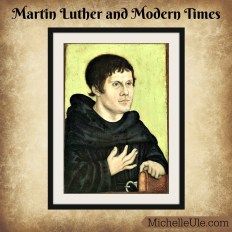 Martin Luther nailed his 95 theses to the Wittenberg Church door 500 years ago.
The actual date is October 31, but throughout 2017 Lutherans–of which I am one–will be remembering the monk and his actions.
Celebrating for the most part.
I don’t actually know a lot about Martin Luther, the person, but I’m learning.
Was he a bad guy or a good guy?
The family in which I grew up “participated” in a church tradition that did not revere Martin Luther.
But when in my teens I first understood the plan of salvation–Jesus as a personal savior who died for my sins–it was in a Lutheran church setting.
I began attending Trinity Lutheran Church and fell in love with the singing during the service.
Particularly when it slipped into four-part harmony.
Luther was partly responsible for that.
Literacy and the Bible
Because Martin Luther believed people should be able to read God’s word in their own language, he stressed the importance of literacy.
The point of literacy was Bible reading.
Having never been introduced to a Bible study before, I loved the fact a book could share God’s words.
I could pick it up and read it anytime, especially since I am literate.
The first Bible study I joined happened to be on the book of Romans–which is the text from which Luther finally grappled to an understanding of Law and Grace.
It changed his life and mine, too.
Denominations
While obviously a Lutheran church, Trinity didn’t place any emphasis on the founder, or at least I didn’t notice.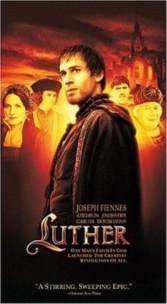
I just soaked up the truth of God’s word and my life changed for the better.
Jesus called me, not Protestantism or even Reformed theology.
I liked how Trinity Lutheran Church taught the Bible, sang, worshipped and loved each other.
But I didn’t need to be a Lutheran, per se, as much as I needed to be a follower of Jesus.
Amen.
Focusing on Jesus, not a particular denomination, is how I sought God. Through all our Navy moves, we attended the church God sent us to for His purposes at a given time or place.
Three of my children, however, went through Lutheran confirmation and have read and studied Luther’s Small Catechism (as did my husband as a child).
Recent popular media
We’ve worshipped with a Lutheran Church Missouri Synod congregation for the last 15 years, so when the movie Luther released in 2003, we attended with interest.
The film does a fine job of putting the Reformation into the context of the times. I learned a lot from it.
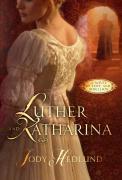 In 2016, Jody Hedlund wrote the Christy award-winning novel Luther and Katharina: a Novel of Love and Rebellion.
It’s an historical romance which puts a dramatic emotional spin on events leading up to a former monk marriage to former nun Katharina von Bora.
I didn’t know much about the relationship, which is why I read the well-written novel. Hedlund used artistic license to tell an exciting romantic story.
As a researcher, I prefered Michelle DeRusha’s commitment to the (few) facts available. Her biography, Katharina and Martin Luther: The Radical Marriage of a Runaway Nun and a Renegade Monk released on January 31, 2017.
From DeRusha’s book, I learned far more about the political and spiritual state of affairs in 1517.
It helped me put Martin Luther’s life into perspective.
I came to see Luther’s goal was not to protest the Roman Catholic Church at the time, but to reform it.
DeRusha helped me see why.
Martin Luther was a quirky, brilliant, focused, determined, God-loving man with many flaws and failures to his credit.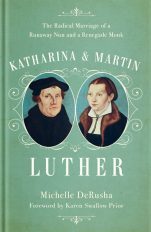
His goal, like the Trinity Lutheran Church of my youth, was to point me–and you–to Jesus.
Thanks be to God.
Tweetables
Martin Luther and modern times. Click to Tweet
Martin Luther’s focus on Jesus, Law and Grace. Click to Tweet
500 years after Wittenberg, who was Martin Luther? Click to Tweet
The post Martin Luther and Modern Times appeared first on Michelle Ule, Author.
January 27, 2017
Shorthand and Oswald Chambers
 Shorthand, or stenography, is the key to all the works of Oswald Chambers.
Why?
Because all his books were the result of his wife Biddy “taking down” everythingi he said in his lectures.
She then turned those notes into the 30 books, including My Utmost for His Highest, that make up the Oswald Chambers canon.
Almost all those books were published after Oswald’s 1917 death.
What is shorthand?
Shorthand is a method of using symbols based on phonetics, to rapidly record what someone says.
In 2017, we use our phones to record things we want to remember.
We then have them transcribed into written words on a page if we’re interested in editing, say, for a writing project.
Court reporters traditionally have sat near the judge and typed up everything said “for the record.”
In days gone by, reporters used handheld recording devices–and many probably still do–but 100 years ago, none of that existed.
While people have been making notes using symbols since writing began, Isaac Pittman devised a regulated way to do so in the mid-nineteenth century.
It caught on and became an avenue for many to work in business.
(In the United States, a rival method, Gregg shorthand, became favored by the late-nineteenth century).
How does it work?
A stenographer uses squiggles, lines, marks and other hieroglyphics they know, to record on paper what a speaker says.
As Wikipedia explains:
“One characteristic feature of Pitman shorthand is that unvoiced and voiced pairs of sounds (such as /p/ and /b/ or /t/ and /d/) are represented by strokes which differ only in thickness; the thin stroke representing “light” sounds such as /p/ and /t/; the thick stroke representing “heavy” sounds such as /b/ and /d/.”
It takes education–in a sense like learning a foreign language–but a good stenographer can take down shorthand symbols at about 125 words per minute.
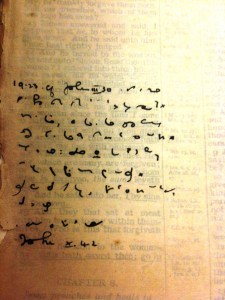
Notes in Biddy’s Bible
The average speaker talks about 100-125 words per minute.
A stenographer generally wrote on a lined tablet with a line down the middle–shorthand went down one side and then back to the top of the page for the next line.
The idea was to save time–not flip the wired page until necessary.
In the case of Biddy Chambers, she “took down” at 250 words per minute–or twice as fast as the average person speaks.
As she grew more proficient, she developed abreviations of her own.
She used a fountain pen or a yellow Dixon pencil and a notepad.
That’s it.
Who can read shorthand?
Not me.
As I researched Mrs. Oswald Chambers, I hunted for people who could explain shorthand to me–what you have to learn–and read it.
No one in 2016 knew Pittman shorthand, which is what Biddy used.
Biddy wrote some of her Bible notes in shorthand–which means just about no one can read them now.
It was an excellent method of keeping her thoughts private.
How did Biddy get so proficient and why?
You’ll have to read the book to find out.
Try your hand here:
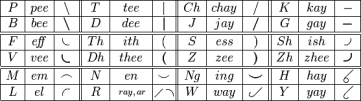
By Xanthoxyl (Creative Commons)
Tweetables
Why shorthand was important to Oswald Chambers. Click to Tweet
Who can read shorthand? Mrs. Oswald Chambers. Click to Tweet
What is shorthand? Click to Tweet
Interested in Oswald and Biddy Chambers? I’ll be telling stories about the amazing ways God led me through
Sign up at http://eepurl.com/2l7F9
the writing of two books about them, starting in my January newsletter–one story a month for 2017, free.
If you’d like to follow the serial–the same chronological way it unfolded for me–sign up for my newsletter here.
The post Shorthand and Oswald Chambers appeared first on Michelle Ule, Author.
January 24, 2017
How I Recognize God’s Voice
 I heard God’s voice today.
Oh, not in an audible way, but in a clearly recognizable way.
This is how.
As a writer, I understand “voice” is a term for how I differentiate my characters from each other in a manuscript.
Readers should be able to read my dialogue and recognize which character is speaking without being told–because they should sound different from each other.
Their statements are consistent with who they are and how they behave.
The same is true with God.
The Bible is our text book, our guide, our conduit into hearing and recognizing God’s voice.
Since Jesus and the Holy Spirit are also God, their three voices are consistent–from Genesis to Revelation.
The similarity and consistency of God’s voice in three persons is one of the reasons we’re told to “interpret Scripture with Scripture.”
God tells us He does not change.
For that reason, God’s voice may be spoken with a different “accent,” but the intention and meaning are the same from beginning to end.

A representation; this is not me.
How I heard God’s voice in a blog post.
While still lying in bed this morning, I asked God to be at work in my life today.
I want to be His hands, His feet, His servant and to understand what is said to me by others through the filter of His ears and His mind.
By giving the day to God, I can move forward expectant that whatever happens comes through His direction.
Today I started at the computer, and one of the first things I read came from a former pastor.
Reverend Paul Anderson wrote the following blog post, How to Overcome Presumption, and it caught my attention:
“The God who says, “Behold I do a new thing,” is not obligated to the past. Yesterday does not determine tomorrow. But we who fall into routines can make them into ruts—and miss the Spirit.
“How foolish to think that God will automatically bless our plans because we have creative ideas.
“Good ideas often prove a hindrance to the kingdom of heaven coming into our midst.
“David didn’t need a good idea to defeat the Philistines. He did something far better than to check with his generals—he wisely consulted God. We need to do the same.”
So what?
I highlighted what was important to me. You’ll see why.
How Oswald and Biddy spoke God’s voice to me
When I got to the My Utmost for His Highest reading for January 11, my eyes focused on this line:
“A lack of progress in our spiritual life results when we try to bear all the costs ourselves.”
The chord this line struck in my heart actually has nothing to with the theme of the devotional.
(Hasn’t someone made a remark that turned on the proverbial light bulb and something completely unrelated suddenly makes sense to you?)
Can you guess the parallel I saw with Anderson’s blog post?
How the Bible spoke in God’s voice to me (duh)
My Old Testament reading this morning was from Judges 7.
[image error]
Something unexpected so God gets the glory (Cliparts.co/)
It’s the chapter after Gideon‘s famous encounter with God over wet and dry fleeces.
In chapter 7, Gideon and his men sought to destroy rampaging Midianites. He started with 10,000 men and God whittles the number down to 300.
Here’s God’s direction in verse 2 of a dramatic story:
“The people with you are too many for me to give the Midianites into their hand, lest Israel boast over me, saying, ‘My own hand has saved me.’”
Three very different readings all had a message I needed to hear.
Why?
God responds to our circumstances–whether we recognize it or not
I didn’t tell you all the things I prayed about this morning.
I’m working on a project today that involves researching how to do something.
My plans included reading recommendations from “experts,” thinking about how to proceed with their advice, and then executing the plan.
I’ve been planning to do this for some time since consulting experts always seems a good idea (I’ve been saving countless blog posts).
Except–is that what God seems to be telling me to do today?
When I read the Judges passages, I actually stopped to ask God if I should bother reading all those business recommendations.
Would reading them distract me from what God seems to be directing me to do in this circumstance?
What would you do if God spoke to you like this?
Coincidence?
Some might argue three very different readings from which I heard the same message three times, is a coincidence.
Check out my final reading about Zacchaeus in Luke 19 if you want to believe that.
I’m going to take to heart what looks to me like an admonition to consult with God first and follow His direction.
If nothing else, it will save a lot of time, frustration and achieve His goals, not mine.
And that, Readers, is how I heard God’s voice today.
For those familiar with His voice, does this sound like a familiar path to you?
Tweetables
How I heard God’s voice today. Click to Tweet
How God speaks through blogs, books and the Bible. Click to Tweet
Hearing God’s voice–how? Click to Tweet
Interested in Oswald and Biddy Chambers? I’ll be telling stories about the amazing ways God led me through
Sign up at http://eepurl.com/2l7F9
the writing of two books about them, starting in my January newsletter–one story a month for 2017, free.
If you’d like to follow the serial–the same chronological way it unfolded for me–sign up for my newsletter here.
The post How I Recognize God’s Voice appeared first on Michelle Ule, Author.
January 20, 2017
How I Read My Utmost for His Highest
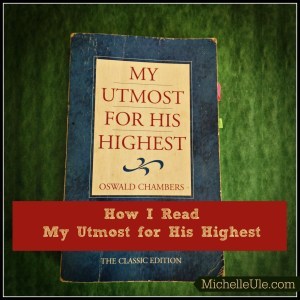 I’ve been reading
My Utmost for His Highest
since before the turn of the century.
I’ve been reading
My Utmost for His Highest
since before the turn of the century.This is how I use it.
As a Devotional
I’d never used a devotional book before I opened My Utmost for His Highest.
I’ve written about Christian devotionals here, including a bit of history.
Devotional writers generally take a passage of the Bible and talk about it–perhaps telling a personal story or an application.
Often a devotional reading includes a question or something to think about.
For me and My Utmost for His Highest, my reaction to the reading usually provides the question.
As in–what does OC (Oswald Chambers) mean and does this apply to me?
As a Brain Teaser
My Utmost for His Highest is like an appetizer before I start reading my normal Bible passages.
(In my case, that’s one Old Testament chapter, one Psalm or Proverb, and one New Testament passage daily. I rotate through the Bible all year long).
It presents a picture of God‘s interaction with believers.
I often have to really think about what it’s trying to say.
(Hint: read the title and examine the Bible passage!)
As a Challenge
My Utmost for His Highest often challenges me about my own perspectives and actions.
I have a “nail me to the wall,” response to the readings frequently enough that I speak out loud to the reading.
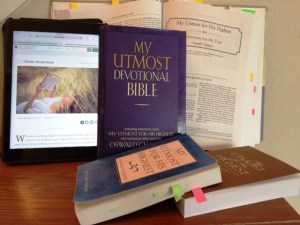
Plenty of versions to choose from at my house!
As in, “Really, OC?”
Many of the readings describe or admonish us in how to live in a world that doesn’t understand Christians.
OC and Biddy ran a Bible Training College for would-be missionaries; the readings often talk about missionary-related topics.
Because believers are supposed to spread the good news of Jesus, all those missionary-related devotionals apply to us, too.
As an Opportunity to See God in a Different Light
I see God differently as a result of reading My Utmost for His Highest.
OC presents God in an uncompromising way–not a negative one–but plainly.
This is who God is–how do I respond to Him?
The day I’m writing this post, January 19, My Utmost for His Highest begins with this statement:
“Whenever God gives a vision to a saint, He puts him, as it were, in the shadow of His hand, and the saint’s duty is to be still and listen.”
To the point, a declarative statement about my role as a follower of Jesus.
I read that sentence and asked myself: how does this apply to me? Is my responsibility to God to listen?
Ah, yes.
But, in that line alone, what do OC and Biddy want me to understand?
God gives visions to His followers.
He protects me–hiding me under the shadow of his hand
Soas to enable me to be still–feeling safe–and thus able to hear His direction.
This sounds like an excellent plan to me–especially today.
As a Conversation
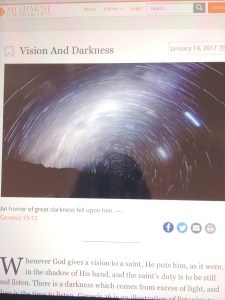
I usually read My Utmost for His HIghest on my IPad–classic edition
I use My Utmost for His Highest as part of my “quiet time” with God.
When it spurs questions–and I ask them of God.
Sometimes it makes me reconsider the passage OC used to construct his point.
Occasionally it goes over my head and means nothing.
(On those days, I move along to the Bible).
Most days, My Utmost for His Highest is simply a blessing to my soul.
How about you?
Tweetables
How I use My Utmost for His Highest. Click to Tweet
Conversation, Questions and Confusion: My Utmost for His Highest. Click to Tweet
How do you react to My Utmost for His Highest? Click to Tweet
Interested in Oswald and Biddy Chambers? I’ll be telling stories about the amazing ways God led me through
Sign up at http://eepurl.com/2l7F9
the writing of two books about them, starting in my January newsletter–one story a month for 2017, free.
If you’d like to follow the serial–the same chronological way it unfolded for me–sign up for my newsletter here.
The post How I Read My Utmost for His Highest appeared first on Michelle Ule, Author.
January 17, 2017
Playing Poohsticks and Raising Children
 “Let’s visit the bridge and play Poohsticks,” I suggested to my husband.
We were out for a walk after nearly a week of monsoon rain in Northern California.
We could hear the seasonal creek rushing from two blocks away.
“That creek won’t be high enough,” my husband laughed. But we peered over the barrier anyway.
It reminded us of raising children and we felt a little younger ourselves.
What are Pooh Sticks?
Poohsticks is a simple game Winnie the Pooh himself invented and described in The House at Pooh Corner.
I hadn’t been raised in a Pooh-reading household, so I only encountered the game while reading to my own children.
We tried it the next time we crossed a footbridge over a body of flowing water.
The young boys found a substantial twig–though not a branch–and tossed it into the river.
They turned around and walked to the other side.
Whoever’s twig came out from under the bridge won.
Simple.
Cheap, easy, entertaining and they played it over and over and over whenever we had free time on a bridge over flowing water.
We’ve played it all over the world.
(It’s gone a little upstream, now, and there is apparently an International Competition. But we’ve lived happily without knowing).

Checking out a potential game spot
Poohsticks in Washington
To the delight of our three sons, we moved to our own quarter-acre wood in Washington State when they were still young.
It came with a creek!
Tall cedar evergreens crowded our little forest and provided many twigs–though often a piece of shaggy bark served the purpose as well.
The water ran year long but wasn’t very deep–though there was the year they stumbled on a salmon beating its way far from Dyes Inlet.
I bought them washable tennis shoes three days after we moved to the property. They clearly would spend plenty of time in the creek bed.
We put a cedar plank across the deepest pool: Poohsticks began and they taught the neighbors with gusto!
(We also had a memorable cub scout event where, using a page from Curious George Rides a Bike as a template, the boys made paper boats and raced them down the same stream. Perfect!)
Poohsticks in Alaska
On a camping trip in Alaska, the boys taught the game to their Connecticut godbrother.
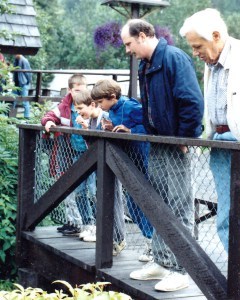
Who won?
(It’s true, I went camping in Alaska with my husband, father-in-law and four boys under 11. Anything remotely fun was game).
In some obscure village, we three adults watched four boys race back and forth dropping their sticks in the water.
Shouts of triumph rose each time, though the four year-old seldom won.
They used strategy–where to place the stick, how big a stick, which current moved quickest–and ignored the astonishing scenery and native culture.
I’m pleased to say other tourists stopped to watch and even egg them on.
Poohsticks Today
We didn’t drop any sticks yesterday–the creek bed was too overgrown.
But we remembered the happy shouts of boys who have grown up into a fast moving world.
One is a diplomat, one a machinist, the oldest a project manager and the baby a college professor.
They all know from experience how to watch the currents–whether in their job, their computer programs or their world.
They’re careful where they drop their hopes.
It wasn’t just Poohsticks that taught them–but the joyful memory of playing together helps.
We, and society, have Winnie the Pooh and his silly old bear game to thank for that.
Tweetables
Poohsticks and childhood–thanks to a silly old bear. Click to Tweet
More life lessons gleaned from Winnie the Pooh. Click to Tweet
A simple game with lifelong lessons: Poohsticks. Click to Tweet
Denizens of the Hundred Acre Wood demonstrate how to play:
Interested in Oswald and Biddy Chambers? I’ll be telling stories about the amazing ways God led me through the writing of two books about them, starting in my January newsletter–one story a month for 2017, free.
If you’d like to follow the serial–the same chronological way it unfolded for me–sign up for my newsletter here.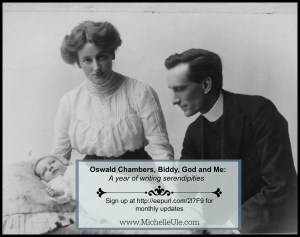
The post Playing Poohsticks and Raising Children appeared first on Michelle Ule, Author.