Michelle Ule's Blog, page 56
January 13, 2017
Why I Learned So Much About Biddy Chambers
 Why do I know so much about Biddy Chambers?
Other than the fact I wrote her biography?
Two years ago I finished writing another book in which Biddy plays a major role–and in writing that novel, I became intrigued by her. Biddy and Oswald Chambers were “marquee” characters–real life people who moved through a story I created.
The story took place during World War I–just a narrow four years in the life of my characters.
My novel heroine’s life changed through meeting Oswald and Biddy. To that end, I needed to make sure I knew them, too.
Background
While I had read David McCasland’s Oswald Chambers: Abandoned to God prior to beginning my novel, I knew little about Biddy herself.
Oswald, “OC,” was the draw and while I tried to do my homework, I didn’t pay much attention to Biddy at first.
My epic novel has plenty of characters; it can be tricky to keep track of so many people.
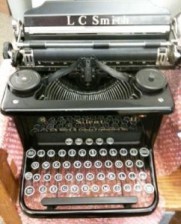
If she owned a typewriter, she must have been real!
Biddy’s role, basically, was that of OC’s wife.
Many people besides me have foolishly underestimated her.
Doing the research
As a bestselling historical fiction author, I always do a great deal of research in writing my books.
I trained as a newspaper reporter in college and my mentors at UCLA drilled journalism ethics into me.
If I couldn’t respectfully articulate both sides of a story, I was not in a position to write it yet.
We stuck to the facts–laying them out as clearly as we could–and left it to the reader to draw their own conclusions.
Even in a novel, I had to get the background right or I didn’t feel I could write an “honest” story.
Examining Facts
Several months into writing the novel, I spent two days at Wheaton College’s Special Collections Library in the Oswald Chambers Papers.
I started with the photos–I knew I would have to describe a YMCA camp during World War I in Egypt.
Since my heroine first meets OC and Biddy at the Bible Training College (BTC) in London, I also examined those photos.
OC was front and center in most pictures, of course, but my eyes inevitably shifted to the woman standing beside him.
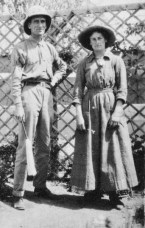
Does this woman look tired to you? (Wheaton Library)
She often looked more ruffled and tired than he did–and I began to wonder about her.
I photocopied letters she had written describing life in the camp.
Since a half-dozen BTC students in London ended up in Egypt, I explored them as auxiliary characters for my novel.
A Character Alters the Novel
It took me a year to draft my novel. Many surprising things happened over the course of that year–including changes in the storyline.
The original story and my heroine’s arch followed original synopsis with little deviation.
But as often happens for novelists, as I got deeper into the story, dialogue and character interaction deepend and pointed in directions I hadn’t expected.
Several characters stepped out of the shadows and wrestled control of minor themes.
They began to influence my heroine’s reactions and broadened the novel in ways that made me catch my breath.
Two women in particular, disrupted the story in a powerful way: my heroine’s mother and her surprising friend Biddy.
Under the Influence
Ten months into writing the novel, I loved Biddy and wanted more for her than a footnote in Oswald Chambers’ life.
I was reading everything I could get my hands on about both Biddy and OC because I needed to write dialogue that sounded like them.
There wasn’t much about Biddy other than what I saw at Wheaton.
When I had an opportunity to meet someone with publishing influence, I asked, “have you thought of having a biography written about Biddy?”
“No,” he said, “but maybe you’re the one to do it?”
I laughed that day. Three years ago was a novelist.
But I’m a biographer today.
Tweetables
How does a biographer get interested in a subject? Click to Tweet
How writing a novel tricked me into writing a biography. Click to Tweet
Why a novelist knows so much about Biddy Chambers? Click to Tweet
Interested in Oswald and Biddy Chambers? I’ll be telling stories about the amazing ways God led me through the 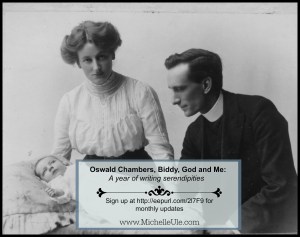 writing of two books about them, starting in my January newsletter–one story a month for 2017, free.
If you’d like to follow the serial–the same chronological way it unfolded for me–sign up for my newsletter here.
The post Why I Learned So Much About Biddy Chambers appeared first on Michelle Ule, Author.


January 10, 2017
Trustee from the Toolroom as Comfort Novel
 I reread
Trustee from the Toolroom
by Neville Shute yesterday.
I reread
Trustee from the Toolroom
by Neville Shute yesterday.It had been a long time but I was ill and needed a comfort novel to fill a stormy day.
All the unread books on hand were nonfiction and non-compelling. I needed to escape my life, not slug it out. (Much less use my aching brain!)
So, I settled into the recliner with a novel I first read thirty years ago and have loved ever since.
What’s a comfort novel?
I’ve written about comfort novels before, basically books you’ve read over and over again for joy.
Maybe it’s the story, maybe the characters, but something brings you back to these books when you haven’t got anything else to read.
Or, you find yourself missing them.
I have a shelf of them at my house–but I’d read them all recently (it’s been a trying year . . . ).
Neville Shute writes realistic stories with heroic engineers (I have one myself) that always feature a “guy romance” theme.
Perfect for a flood watch day in Northern California!
A focused engineer (or do I repeat myself?) as hero
Trustee from the Toolroom is the story of a logical, reasonable former toolroom engineer who has a quest thrust upon him.
(By a naval officer, no less. How can it be any better than that?)
Our hero Keith Stewart has retired from his job engineering devices for a toolroom and instead makes tiny machines and writes about them for a magazine, Miniature Mechanics.
He’s a thoughtful pudgy man living an orderly life with his gentle wife, a part-time clerk in a linen shop in a low income part of London circa 1955.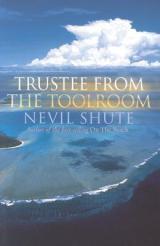
It takes place in the years following WWII when foreign currency restrictions were tight in England.
After being forced to retire early from the Royal Navy, Keith’s brother-in-law asks him to help with a project.
He needs a copper box cemented into the hull of his sail boat– the involuntarily retired Commander and his wife (Keith’s sister) plan to sail to Vancouver Island.
They want to start a new life for themselves and their ten year-old daughter.
Keith helps out, keeps his mouth shut and with his wife takes care of their niece while the retired Navy couple sail away on the ship.
They’ll make arrangements for the daughter to join them in Canada, once they’re settled.
The dilemma
The story’s crisis is, they don’t make it to Canada.
Caught in a hurricane, the sailboat scuttles on an isolated reef in the South Pacific and the couple perish.
When their lawyer calls Keith with the news, he asks what happened to their assets?
The bank reports they cleaned out their accounts before they left.
It’s a felony to take that amount of cash out of the country.
 And by the way, does Keith know what happened to the £25,000 in diamonds the Commander purchased a few months before?
The satisfaction
I’m not spoiling this wonderful story for readers who haven’t read it yet!
Only to say that it’s the tale of a humble man who doesn’t realize his perceived weaknesses are his greatest strengths.
How does Keith get to an isolated island in the South Pacific and back to England with his duties performed?
His adventures–from simply getting a passport and methodically thinking (like a good engineer) what to do are fun and suprising.
I know his type of character well.
In the end, it’s a Neville Shute story, reality plays a role but the reader comes away thankful an engineer was made trustee for an orphaned niece–and could be counted on to do the right thing.
Trustee from the Toolroom made a perfect comfort novel–for both an ailling woman and a retired Naval engineer (whose ancient catamaran has never been in the ocean) on a rainy weekend.
Tweetables
An engineer’s comfort novel by Neville Shute. Click to Tweet
An engineer, the South Pacific and honor: Trustee from the Toolroom Click to Tweet
A fine old novel to read on a rainy day. Click to Tweet
The post Trustee from the Toolroom as Comfort Novel appeared first on Michelle Ule, Author.
January 6, 2017
Why Write a Biography of Biddy Chambers?
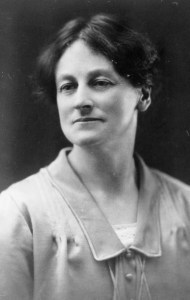
Biddy Chambers 1935 (Wheaton College Special Collections Library)
As I’ve spent the better part of the last two years researching and writing a biography of Biddy Chambers, I’ve often been asked why?
Or, who was she?
People who know of or have read My Utmost for His Highest usually nod when I mention Biddy was Mrs. Oswald Chambers.
Often their eyebrows rise when I explain Biddy compiled and published My Utmost for His Highest ten years after Oswald died.
Indeed, Oswald published only three books before his 1917 death.
The rest of the thirty books published after his death were all compiled, edited and produced by Biddy Chambers.
Her name does not appear anywhere in the books beyond an occasional introduction from “B.C.”
What makes her worthy of a biography?
I believe Biddy’s life has many examples and ideas to offer to modern Christians.
Her faith and willingness to put action behind it.
Biddy Chambers exhibited a solid Christian faith in the face of extreme challenges:
*She sailed alone to America to work at a time when that wasn’t common.
*Biddy married a penniless Oswald when he had no “prospects.” (His description)
*With no prior training, she managed a Bible Training College for four years, freeing her husband to teach.

She gave birth while running a college. (Wheaton College)
*She supported Oswald when he left safe London to serve in Egypt during a war.
*With a two year-old child, Biddy sailed to Egypt in the midst of U-boat attacks to join her husband in ministry.
*With little assistance beyond her friend Mary, Biddy provided hospitality to an entire camp of soldiers on the edge of Cairo’s desert with primitive housekeeping tools.
*She traveled further up the road to Ismailia camp where she and Mary served tea to 400 men the day after they arrived. They continued the tradition for the entire summer.
Her choice not to despair
Oswald’s death left Biddy a penniless widow with a four year-old, living in the middle of an ANZAC camp in Egypt during a World War.
She did not despair; she chose to remain and supervised the YMCA mission camp at Zeitoun. (The YMCA’s leader recognized her abilities and asked her to stay).
Biddy used her time in Egypt to publish her husband’s ideas for the benefit of the soldiers. The YMCA produced 10,000 copies of the pamphlets monthly until the end of the war.
She returned to an England reeling from the war and turned her back when offered a secure position at another Bible Training college.
Knowing her calling was to produce Oswald’s books, she chose to do the work in poverty–without a publisher.
She founded and led a boutique publishing house for 49 years–producing all her husband’s books.
When she needed money, Biddy opened a boarding house for Oxford students while she typed away on what ultimately became My Utmost for His Highest.
Biddy welcomed interruptions, cared for ailing family members, moved to London and survived the blitz of yet another war.
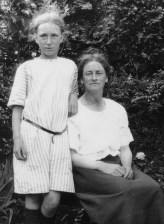
Biddy and Kathleen; circa 1923 (Wheaton College)
Her singleness
As Biddy never remarried, she sets an example for a rich single life.
She worked, raised a child as a single parent, continued ministering to missionaries and cultivated her intellectual life.
Many women, including Christian women, could use an example of how to life an authentic and full life without a husband.
Her spiritual example
Daughter Kathleen said her mother never complained at the twists and turns of her life.
Through all her challenges, she maintained a practical and cheery disposition to follow God’s leading in her life.
Biddy’s faith remained practical and strong. We all could learn from that example.
Evangelical Christianity in 2017 sags under the onslaughts of hypocrisy, weak faith disciplines and disappointments.
Biddy’s life can provide an example of how to continue forward despite circumstances—living out the truths her husband preached and she provided to the reading world.
The world looks as crazy in 2017 as it did in 1917. Christians are faced with different challenges than Biddy, but the need to remain faithful to God remains essential.
Biddy’s life story can provide examples of how to live your life to God’s highest, no matter the circumstances.
Tweetables
Here’s the clickable link address: http://eepurl.com/2l7F9
Why write a biography of Oswald Chambers’ wife? Click to Tweet
What Oswald Chambers’ wife can teach modern believers. Click to Tweet
Oswald Chambers’ wife’s example of living her Utmost to God’s Highest. Click to Tweet
Interested in Oswald and Biddy Chambers? I’ll be telling stories about the amazing ways God led me through the writing of two books about them, starting in my January newsletter–one story a month for 2017, free.
If you’d like to follow the serial–the same chronological way it unfolded for me–sign up for my newsletter here.
The post Why Write a Biography of Biddy Chambers? appeared first on Michelle Ule, Author.
January 3, 2017
The End as a Beginning
 Even as I type the glorious words “the end” at the bottom of the page, I know it’s actually just the beginning.
Here are the steps I take when beginning a manuscript revision that can only start when I think I’m finished.
Recognize I’m not done yet.
Sure, I’ve said it was the end, but for the author on a first draft it never is.
The first draft is where I get the story down, in all it’s messy, sprawling brilliance.
Some of the writing is so beautiful I could weep.
A lot of it isn’t.
But at least I’ve got a place to start.
Planning the rewrite.
You cannot begin to rewrite until you know what’s in the manuscript, so I start by running a word census on my manuscript.
Using a Word macro my husband wrote for me, I look at the 25 or so most used words, paying close attention to those I typically overuse like “that, just, back, go,” and so forth.
You probably know which words you tend to overuse.
I then examine all the sentences in which those words appear and frequently rewrite them.
I pay close attention to the verb “was” and beef up sentences with a different verb.
This often takes a couple days on a lengthy manuscript.
Of course I run spellcheck–often.
Printing the entire manuscript.

It’s important to get away from the computer screen–to see the manuscript differently and also to rest your eyes and fingers.
There’s something about using your hands to read that activates other corners of the brain and enables you to catch things you might have missed on the computer screen.
As a good ecologist, I bristled at using up all that paper, so I use the backside of an old manuscript I’ve already read.
(As long as the page numbers are in a different font–say bold on the second manuscript–I never get confused).
I read it on paper with my pencil in hand and scribble, write in the margins, cut out sentences, rearrange sentences, reformat paragraphs, and generally make a mess of the whole thing.
It’s so satisfying.
Input the changes
This often takes longer than I expect and yet moving between paper and pencil to computer screen also engages parts of the brain that were lolling around before and not paying attention.
I can see things I missed on the screen AND on the paper when I’m moving between them.
So I make corrections and the writing improves.

Multi-device-editing
Read it in ebook format
I then read the entire manuscript in ebook format on my Ipad.
There’s something so gratifying about reading my words in what appears to be a book (indeed, it is an ebook).
I read with a notebook and pen at my side. When I see something that needs to be changed, I scribble a few words on the page, then move on.
I can locate the problems sentences by activating the “find” feature when I return to my Word document.
The “problem” notes fill a lot of pages–because my eyes tend to skim over the mistakes on a computer screen–which is why I read the manuscript in a different format!
Or, as in the photo, I read it in the ebook with my laptop on my lap and make the corrections immediately.
Not done yet
When I get the manuscript to a point that feels close to done, I ask a few friends to read it.
My ever-loving-patient-saintly-hero of a patron of the arts gets the first chance.
I have a young assistant with a degree in English who has been reading all along and said yesterday as she finished marking up chapter 18, “I can hardly wait until you’re done and I can get a feel for the entire thing.”
Exactly.
Give it time
It takes a while to edit and clean up a manuscript. I’ve just finished one and it’s not due for three and a half months.
That gives me plenty of time to improve it, but in this case, I’m also going to need those months to organize other items needed for a nonfiction book.
In the meantime, I’ll be keeping my (mechanical) pencil sharpened!
What do you do when you after you type “the end” on your manuscript?
Other than celebrate, of course!
Tweetables
6 tips for manuscript help after typing “the end.” Click to Tweet
What to do after you type “the end.” Click to Tweet
Finished writing and now I’m editing: 6 tips how. Click to Tweet
Interested in Oswald and Biddy Chambers? I’ll be telling stories about the amazing ways God led me through the writing of two books about them, starting in my January newsletter–one a month for 2017, free.
If you’d like to follow the serial–the same chronological way it unfolded for me–sign up for my newsletter here.
The post The End as a Beginning appeared first on Michelle Ule, Author.
December 30, 2016
2017 with Oswald and Biddy Chambers
 As many of you know, I’ve spent 18 months writing a biography of Biddy, Mrs. Oswald Chambers.
I loved the entire experience of researching and writing about the life of an amazing woman who lived in extraordinary times.
Mrs. Oswald Chambers releases in October, 2017–the month before the 100th anniversary of Oswald Chambers’ death.
I’ve also written an essay for Discovery House’s summer 2017 release: Utmost Ongoing: Reflections on the Legacy of Oswald Chambers.
Some two-dozen authors wrote about the most significant My Utmost for His Highest reading in their personal lives.
I described my life-changing reaction to August 28: What’s the Point of Prayer?
The Upcoming Year
 I believe both these books are significant for both lovers of My Utmost for His Highest and people interested in deepening their spiritual life through the examples of Biddy and Oswald Chambers.
To that end, I’ll be devoting Fridays throughout 2017 to thoughts about either Biddy or Oswald (or both), and interesting stories from their life and work.
I encourage you to comment and share these posts because of what we can learn about God and what it means to follow Jesus.
According to Brother Andrew, even Biddy’s secular neighbors recognized her as being like Elijah, “she walked with God.”
I’ll interview pertinent authors, share stories of my research and explain the biographical influences on various readings from My Utmost for His Highest.
In addition, I’ll tell stories about the Chambers’ lives that did not make it into my book.
I’ll also follow in the footsteps of several students to demonstrate how Oswald’s profound teachings about the spiritual life carried into their lives and the world.
As my husband likes to say, “wouldn’t you like to know what it was like to study under Oswald Chambers and what you did with your life after that?”
God’s hand in the writing
My personal stories behind the writing of Mrs. Oswald Chambers have been of great spiritual encouragement to me.
Time and again, I received information, stumbled on a truth, heard from someone, and even met a stranger at a train station, that enhanced both my faith and the writing of this book, as well as my (as yet unsold) World War I novel.
At one point, I staggered downstairs to my husband’s study. “You’re not going to believe what happened this time. It’s almost like I’m being led to write this book!”
The wise man who has walked through this entire process, laughed. “You think so?”
Many friends have listened wide-eyed as I’ve marveled. “You’re not going to believe the latest.”
To that end, I’ll be telling the stories once a month in 2017 through my newsletter.
If you’d like to follow the serial–the same chronological way it unfolded for me–sign up for my newsletter here.
The first story comes out in January 2017.
The stories will only be available for free until January 2018.
Oswald, Biddy and their final New Year’s Eve.
Through the seven years of their marriage, Oswald and Biddy spent the final days of the calendar year praying and considering what God was calling them to do or be in the following year.
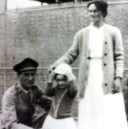
Summer 1917
On December 31, 1916, soldiers, civilians and the world at large were weary of the grim, seemingly never-ending war.
Oswald closed the year at a watch-night service sponsored by the YMCA at Cairo’s Ezbekieh Gardens. He spoke on “Finish 1916,” writing on his ubiquitous blackboard:
“The Irreparable Past–Sleep On Now. The Irresistible Future–Arise Let Us be Going. Matthew 26:45-46.”
At the stroke of midnight, he turned over the blackboard to his printed words:
“1917, A great New Year to you all ‘And God shall wipe away all tears,’ Revelation 21:4.”
They dreamed, of course, for the end of that ghastly war.
Peace, no more pain, grief nor tears, came with the joy of heaven on November 15, 1917 for Oswald Chambers.
It took a lot longer–with many more challenges– for Biddy.
Mrs. Oswald Chambers tells the story of one woman’s extraordinary skill, determination and love for her God. Using all those traits in combination with her confidence the words Oswald spoke on God’s behalf were important, Biddy compiled one of the best selling devotionals of all time.
Join me as I tell 12 stories and their influences on my life and the biography, Mrs. Oswald Chambers.
A blessed and joyous 2017 to you all.
Tweetables
A year of faith-growing stories about Oswald and Biddy Chambers Click to Tweet
New Year’s Eve 1916 with Oswald Chambers Click to Tweet
2017 with Biddy and Oswald Chambers. Click to Tweet
You can sign up for my newsletter at http://eepurl.com/2l7F9
The post 2017 with Oswald and Biddy Chambers appeared first on Michelle Ule, Author.
December 27, 2016
Putting Things into Context–or the Answer to Why?
 I spend a lot of time thinking about how to put things into context.
It helps me sort out what is happening and what things mean.
My husband and children roll their eyes when I “over explain,” (their words) why we’re doing something.
I never understood why they wouldn’t want to know the why.
Doesn’t everyone want to know why they’re doing something so they can put it into the context of their day?
Apparently not.
A family of origin problem?
After years of puzzlement, I decided my need for context came from my childhood.
One of my parents tended toward the “wildcard” approach to life.
While one tried valiantly to remain organized–just so things could get done and dinner served–the other didn’t always cooperate.
That parent meant well, but preferred to keep options open.
Which means even the best laid plans would often switch.
It drove me crazy and the “whys” would need to be swallowed in the face of changing circumstances.
Parenting in Context
As a parent, I determined I would not do that to my children.
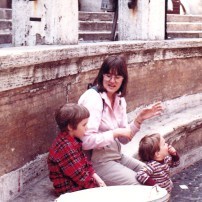
This is how the Trevi Fountain works.
(Unfortunately, after all these years, I see that I, too, often succumb to the “keeping options open” plan. I’m sorry, kids).
So, I would explain why I thought we needed to do something–trying to win them to my side, as it were–and then do it.
When I changed my mind (!) or circumstances altered, I always explained why plans were changing–so as to keep my reasons for changing in context.
Really, they were excellent reasons!
Ah, but it is something else?
Last summer I attended the Leverage speaker training conference and needed to take the StrengthFinders test prior to the event.
I’d not heard of this test before–certainly I’d done the Myers-Briggs testing, but nothing to determine my personal strengths.
From the website:
“Gallup created the science of strengths. From more than 50 years of research to our bestselling books, Gallup’s StrengthsFinder assessments have helped millions of people discover what they do best.”
I took the $15 version and was provided with a list of my five strengths.

This sign makes little sense out of context.
Leverage wanted to capitalize on that information to help me see where my strengths lie as a speaker.
It was fascinating.
And, perhaps no surprise, my number one strength was CONTEXT.
Or, as StrengthFinders described that characteristic:
“People who are especially talented in the Context theme enjoy thinking about the past. They understand the present by researching its history.”
I laughed when I read the top five, perfect for a woman who writes inspirational fiction and biography: context, individualization (“intrigued with the unique qualities of each person”), communication (obvious), belief (I’m a Christian) and responsibility (the role of a Navy wife, first born, etc. ).
Now that I’ve put those basic characteristics of my life into context, is it any wonder I like to “over explain” to my family and friends?
I don’t think that way at all. I just want people to understand–whatever it is I’m trying to convey.
Tweetables
Putting something into context or over explaining? Click to Tweet
Can being able to put events into context really be a strength? Click to Tweet
Parenting in context involves over explaining, or at least answering “why?” Click to Tweet
The post Putting Things into Context–or the Answer to Why? appeared first on Michelle Ule, Author.
December 23, 2016
An Angel Quiz for Christmas
 How about an Angel Quiz if you’ve run out of ideas for Christmas entertainment?
In the past, I’ve hosted Angel parties where people brought an exchange gift with an angel theme.
I’ve served angelic food like Angel food cake and meringues as soft as angel’s wings.
We played a version of the trading game, sang angel-related songs and told stories about angels.
Of course we mentioned the famed angels from Advent who appeared to Zacharias, Mary, Joseph and the Shepherds.
It’s fun for all ages.
Because I’m bookish and interested in research, we also took an angel quiz.
Angel Quiz
Angels are Jesus’ brothers and sisters.
Angels are God’s ministers
God loves angels better than He loves us
Satan was an angel
“Angel” means messenger
“Hell’s Angels” originally were Christian motorcycle riders
Seraphim are angels with six wings
“Angel kisses” are moles
You can tell an angel by their wings
The Book of Revelation has the most mention of angels

Hagar saw an angel in the desert
Angels sing sweetly o’er the plain
Herald angels sing “Hark”
Angels intercede for us with God.
God only created 144,000 angels
“Charlie’s angels” are assistants of Saint Charles
Angels sometimes appear in dreams
Angels wear white clothes
Theologians calculated 2,459 angels can dance on a pin
Angels announce themselves by saying “we’re back”
Angels were at the creation of the world
Choirs of angels sing in exuberance
Michael is the only archangel
Angels have halos
Angels appeared to shepherds when Jesus was born
Some angels use swords
Angels can warn of danger
Baseball-playing angels are found in the book of Isaiah
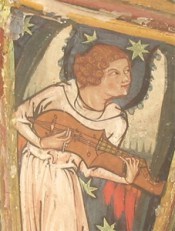 Did I mention it’s a true/false quiz?
The answers appear beneath the Tweetables.
Enjoy!
Tweetables
How about an angel quiz? Click to Tweet
Tips for an angel-themed party. Click to Tweet
How many angels CAN dance on the end of a pin? Click to Tweet
True: 2,4,10,11,13, 17, 22,24,25,26,27
False: all the rest.
How many angels CAN dance on the head of a pin?
No one knows.
The post An Angel Quiz for Christmas appeared first on Michelle Ule, Author.
December 20, 2016
Four Candles for Advent Love
 Advent Love is marked on the fourth Sunday with all four candles lit.
At our house, we light all four and another big one in the middle on Christmas day–signifying Jesus has come.
(We also put a candle on the Ule Log and sing Happy Birthday in honor of the Christ child).
What does love have to do with the expectation of Christ coming?
Everything.
Jesus is all about love.
Advent love is about the Messiah–the Savior–coming into the world
God cannot look upon sin; in order for men and women to be with him eternally in heaven, they could not be part of sin.
Jesus explained it this way in John 3:16:
“For God so loved the world, He sent his only son that whosoever believes in Him should not perish but have eternal life.”
When God looks on believers, he sees us through a Jesus-lens: that of souls whose sins are forgiven because of Jesus’ death on the cross.
Why a baby?
Followers of Jesus worship a God who also was man.
We do not worship a God who is unfamiliar with our lives.
Jesus allowed himself to become a baby borne by a woman.
The God who created the Universe, experienced the helplessness of all (wo)mankind when he took on flesh.
He knows what it is to be dependent on a man and a woman to survive.
Jesus had to learn to walk, to talk and to think with a man’s brain.
He grew up with siblings, interacted with parents and family members in his community.
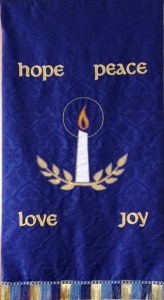 Love cannot look upon Sin
As experienced by Jesus, God knows and understands the frailties and temptations we all face.
The only difference is Jesus did not sin. As Hebrews 4:14-15 explains:
“Seeing then that we have a great High Priest who has passed through the heavens, Jesus the Son of God, let us hold fast our confession. For we do not have a High Priest who cannot sympathize with our weaknesses, but was in all points tempted as we are, yet without sin.”
I’ve always loved this Scripture passage because it gives me the freedom to be totally honest with God.
I can tell him the sinful urges of my life, I can confess without worry–because I’m not telling God anything He doesn’t already know about me, or about life.
He won’t condone my choice to sin, but He will understand–because He has been tempted in that regard, too.
Advent Love
Advent love means God loved me–and you–enough to humble himself and provide a means by which I can know Him and live with Him forever.
That means is the forgiveness that God grants me–and you–sinners both, whenever we ask.
The Advent love of the present Christmas is to celebrate Jesus’ birth–the Savior come into the world.
The Advent love of the future is my death and ushering into heaven because of that birth so long ago.
It is for these reasons that we light four candles leading up to Christmas day–the day love was born with human flesh.
Thanks be to God.
So Light a Candle?
The children sang this song last week at church, expressing love, joy, peace and hope.
Merry Christmas. The Savior has come!
Tweetables
Advent love represented by the fourth candle. Click to Tweet
John 3:16 demonstrates Advent love. Click to Tweet
Advent love comes to earth as a baby. Click to Tweet
The post Four Candles for Advent Love appeared first on Michelle Ule, Author.
December 16, 2016
A Cookie Party for Christmas
 My daughter has held a cookie party to celebrate Christmas for the last 16 years.
It started when she was in fourth grade. She invited four or five friends to join her the last day of school before Christmas break.
I picked them up, we went to the movies and then came home to bake Christmas cookies and spend the night.
The party has morphed over the years–sometimes a movie, sometimes a sleepover, but it’s always a cookie party.
Since high school the party has included guys and in the last few years since college graduation, some of the guest have brought wine.
Decorating cookies remains front and center, but now when they finish, they sit around the fire and sing Christmas carols–in four-part harmony
What type of cookie?
We use family favorites:
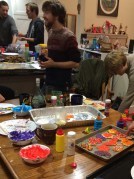
It’s quite an operation!
We make the dough ahead of time.
Once the majority of the guests who have RSVP’d arrive, we serve dinner: usually something salty with a big salad.
Once dinner is done, the heavy duty baking and decorating begin.
I did a lot of this work until they were old enough to handle it all themselves.
Decorating

It’s wonderful they’re adults now!
While we provide a number of different doughs and cookies, the most fun comes from the decorating.
It’s been fun watching small girls, tweens, high schoolers, college kids and now young adults decorate sugar cookies.
The designs are much more accomplished these days!
They talk and share stories while they decorate.
(And yes, I do eavesdrop while passing through with more of whatever they need).
The royal icing that uses meringue powder provides the best artistry.
Naturally, we have sprinkles and other decorations.
Practical tips
Once my daughter and her friends were old enough, they took over everything but dinner.
While we started with simple sugar cookies, as they grew older we added more varieties of cookies.
The guests roll out the cookie dough, brandish cookie cutters, bake the cookies and even make the fudge.
The air is full of sugar!
The guests bring cookie cutters, some of the needed ingredients, drinks, food, whatever.
Everyone goes home with a plate full of cookies, after I get first choice for my family.
They now do all the clean up and I now return in the morning to a clean kitchen.

This guy is an artist; his cookies were beautiful!
The evening and the cookies are gifts to my daughter’s friends and their family.
But these years, it’s all about touching base with the people she grew up with.
Merry Christmas!
Have a cookie!
Tweetables

Made in my kitchen!
What cookies are good for Christmas? Click to Tweet
16 years of Christmas cookie parties. Click to Tweet
Christmas cookies and reunions. Click to Tweet
The post A Cookie Party for Christmas appeared first on Michelle Ule, Author.
December 13, 2016
Three Candles for Advent Joy!
 Advent joy is looking forward to the birth of the Messiah.
Most people understand Christmas and joy–with the music and the parties and the gifts, it’s a happy time.
Advent joy, however, is about looking forward to joy to come.
It starts in the past.
Old Testament
Isaiah 9:2 prophesied about the Messiah God would send into the world someday. Looking forward from a grim time, Isaiah encouraged the Israelites:
The people who walked in darkness
Have seen a great light;
Those who dwelt in the land of the shadow of death,
Upon them a light has shined.
God’s people had a long time to wait for the Redeemer of the world–the Messiah who would save their souls from sin and death through his death.
As mentioned before 400 years elapsed between the final book of the Old Testament and the first of the New. The people clung to their hope and faith the Messiah was  coming, but it had to get difficult.
Advent Joy–the first time
The virgin Mary was the first person to learn God was sending the Messiah–in nine months.
Imagine Mary’s wonder, awe and joy at the Angel Gabriel’s news in Luke 1:46-47:
“My soul magnifies the Lord,
And my spirit has rejoiced in God my Savior.”
When she visited her cousin Elizabeth, even the baby in the old woman’s womb leaped for joy!
And once Jesus was born, the skies about Bethlehem exploded with rejoicing angels!
Advent Joy in the past
The church fathers understood the need to focus on the anticipated Christ Child‘s birth and when they arranged (for lack of a better word), the church’s calendar year with advent in mind.
While Lent is a six-week period of fasting and thinking of Christ’s death on the cross, Advent is a period of reflection and anticipation of Jesus’ arrival on earth.
Good news! The Lord is come! No more let sin and sorrow grow nor thorns infest the ground (an allusion to the results of sin that drove ADam and Eve from the Garden of Eden).
Jesus comes to make his blessings flow–far as the curse (sin again) is found!
Excellent reasons to rejoice–and the church fathers wanted us to celebrate!
 Advent Joy in the present
The Advent wreath with its four candles marking the Sundays leading up to Christmas, uses a pink candle on the third Sunday.
Here’s one explanation from the Church Home Network:
“When the season of Advent was instituted the church viewed it as a mini-Lent, a time for reflection and repentance (thus the purple). In so doing, the church adopted the first four candles of Lent and changed the third candle of Advent to pink in honor of the Lenten tradition.
“This is why we have a pink candle in our Advent Wreaths.
“To further heighten the sense of anticipation of Christ’s coming during Advent, the church named each candle in the wreath — the first being hope, the second peace, the third joy, and the fourth love (there are a number of other traditional names as well, though these are some of the most ancient).
“It has always seemed fitting to me that the pink candle is the candle of joy, the one that speaks to us with its twinge of color.”
Advent Joy to come?
Jesus will return someday in the future.
We’re all looking forward to joy on that day.
Tweetables
Advent Joy: past, present and to come. Click to Tweet
What’s the deal with a pink Advent candle? Click to Tweet
Advent started when Adam and Eve left the garden. Click to Tweet
The post Three Candles for Advent Joy! appeared first on Michelle Ule, Author.