
Michelle Ule's Blog, page 53
April 28, 2017
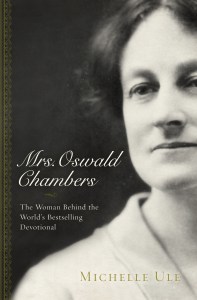
When a Novelist Writes a Biography
 What happens when a novelist writes a biography?
I can’t speak for other biographers or novelists, I can only describe my challenges and joys.
Here are four.
Stick to the facts, ma’am
When I began writing the biography of Mrs. Oswald Chambers, I already had written a novel in which Biddy is a character.
My as-yet-unpublished-novel is about a woman who attended Oswald Chambers’ Bible Training College.
There, she interacts with Oswald, Biddy, Eva Spink, Kathleen Chambers and others.
I already planted dialogue in the mouths of real people. (Note: I paid special attention, however, to what they would have said).
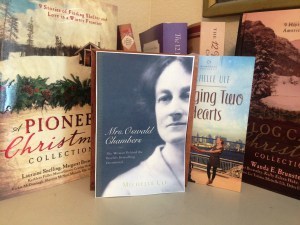
My books–with Biddy’s just a photo!
In writing the biography, I couldn’t do that.
I caught myself frequently and had to return to straight facts.
Often, however, I “painted” a scene taken directly from Oswald Chambers: His Life and Works.
To do so, I relied on photographs, the stories Biddy compiled about her husband, and the memories of others.
I did include fictional scenes in the biography–but they are used to set the stage for documented facts.
Keep track of your sources
All writers need to keep track of the books and articles they use.
On a biography, however, the need is imperative.
If someone challenges you on a fact, you have to be able to explain where you got it.
As a genealogist, I’m used to citing my references, so I noted them in the first draft of Mrs. Oswald Chambers, and transferred them to endnotes later.
Others will have an opinion
Knowing others had an opinion about Biddy was both good and bad.
They could provide insight I lacked or didn’t know.
Sometimes their facts were wrong and I had to gently correct.
Other times, they didn’t want me to tell some of their stories.
It took far more diplomacy to write a biography than I expected.
In a biography, you can’t control your characters
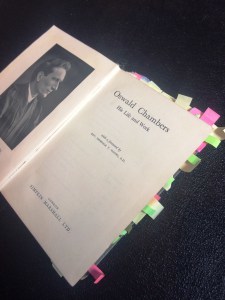
Every post-it marked a citation!
A novelist often can’t control her character either, but that’s part of the fun and creativity.
In a biography, you’re stuck with the good, the bad, the ugly and the inexplicable.
If you’re lucky, you might be able to find someone who can explain why your heroine did what she did.
But more likely, you have to think, pray, consider, look and conjecture the why.
Biddy did several things I’d like to ask her about (maybe I will if she looks me up in heaven), I had to guess why.
Endnotes helped me explain the conclusions I reached.
So, how was it writing a biography?
My junior high history teacher, Mrs. Julie Klocki, admonished us one day:
“I don’t know why you waste your time reading fiction. History is not even more unbelievable, but it’s also true!”
I still love to read and write fiction.
But I love reading, writing and studying history.
Memoir and biography are among my favorite genres.
I am so thankful, humbled and pleased to have written Biddy Chambers’ biography.
Tweetables
What happens when a novelist writes a biography? Click to Tweet
4 differences between writing a novel and a biography. Click to Tweet
What did a novelist learn while writing Mrs. Oswald Chambers? Click to Tweet
The post When a Novelist Writes a Biography appeared first on Michelle Ule, Author.


April 25, 2017
Hiking Diamond Head

Original photo by JG Klein, (Used by permission; Wikipedia Commons)
My eyes always went to Diamond Head when we traveled toward Honolulu.
Our family lived on O’ahu for four years and the craggy extinct volcano rearing over Waikiki Beach was my daily reminder we lived on an island.
I’ve seen it in all sorts of dramatic lights and enjoyed the view each time.
We visit it every time we return “home.”
Hiking Diamond Head then
While living at Pearl Harbor, we hiked the crater regularly, always taking visitors up for the spectacular view.
Twenty years ago, the hike required preparation.
You had to wear tennis shoes and carry a flashlight.
(Finding the flashlights were usually the most complicated part of the process.)
We toted our daughter up in a backpack in the early years and cheered when, at three, she made the hike, mostly, on her own two feet.
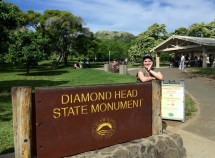
She can hike herself up now!
We drove to the crater, parked the car beside a dozen or so others, and started hiking.
There must have been some sort of restroom. We carried our own water
No fee, which made it the cheapest attraction on the island.
Hiking Diamond Head now
My daughter and I returned in March 2017 and found the hike more complicated.
The lot was full when we arrived at 10 o’clock to pay the parking fee.
Tourists milled outside the crater, through the tunnel, at the parking kiosk, on the Waikiki trolley and climbed out of taxis.
Our mouths dropped open in surprise.
There’s a fine restroom now, a tourist shop, water fountain and shaved ice trucks.
“What time should we return?” I asked.
The friendly man in the kiosk said, “after 2:30 but before 4:30 or by eight o’clock tomorrow morning.”
We went to the beach and returned the next morning at eight o’clock.
The state monument opens at 6 am and closes 12 hours later.
The Hike
 After finding a parking spot, we topped off our water bottles and began the hike on a cement walk way.
Buses of teenagers must have arrived early because as we strolled, they barrelled down the pathway, obviously returning from the top.
New this year, tall grasses, nearly as high as my elbow, rippled in the breeze.
I stopped in surprise. These were not native grasses, and sure enough, a sign asked us to be careful.
The view from the top is 200 feet above you, but it takes awhile to climb that high.
The cement walkway meanders through the meadow in a slow rise. Eventually it reaches the dirt/rock trail itself, which has a railing, but it’s steep.
The trail switchbacks up the hillside and is NOT smooth. You step up uneven terrain, rocks, slabs and the occasional pebble.

Slow, but doable, even with a cane!
Two people can walk side by side, but not well.
Hikers coming down share the trail.
Many people huff and puff.
On that particular day, we passed lots of students, people poorly shod, families, international travelers and a few determined elderly people.
The steep steps
By the time even fast hikers start to feel winded, you reach the first stairway: 74 concrete steps straight up.

Almost there!
It’s narrower, you have to stop for people headed down, but when you finally get to the last step, you can pause for a great view of the crater.
And then you get to walk through a 225 foot long tunnel tilting up.
Twenty years ago it wasn’t lighted (thus the need for a flashlight). It is now.
It’s cool in the tunnel, lots of girls giggle as they stumble up the rough walkway.
You can see the light at the end, which encourages you.
Until you reach the sunlight once more and look right.
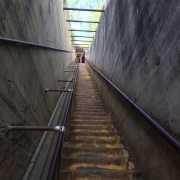
Yep. 99 more steps.
Sigh.
There are benches to sit on and catch your breath, with a view to the ocean, on the left.
My daughter, an EMT, waited for me at the top. I took my time.
Other people who didn’t expect this, may have sobbed . . .
Just when you’re applauding yourself for making it up the 99 steep stairs, you discover a narrow, dark, cramped spiral staircase.
It was tricky when she rode on our backs and we had to scramble out the bunker’s observation slits.
They’re still there and it’s still the exit to outdoors, but once up top the view is magnificent!

East to Koko Head

Waikiki
On our way down recently, we caught sight of Moloka’i across the ocean.
We’d never seen it before on a Diamond Head Hike.
The whole outing took us one hour.

That’s Moloka’i in the distance.
Tweetables
What’s it like to hike Hawaii’s Diamond Head? Click to Tweet
The Diamond Head hike with photos. Click to Tweet
The Diamond Head hike; step by step. Click to Tweet
The post Hiking Diamond Head appeared first on Michelle Ule, Author.
April 21, 2017
Who was Marian? Ancestry Part 3
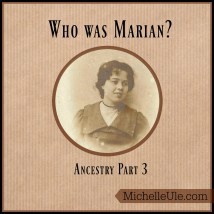 We weren’t positive her name was Marian Lemaine.
The Marian was certain, but her last name was vague–maybe Lemon, perhaps Lehman?
Her goddaughter didn’t know for sure.
Marian was important to Mrs. Oswald Chambers, but we knew little about her.
I needed to find out.
This how I did it using Ancestry.com
Basic facts
We knew she must have lived near Woolwich, England about 1900 (see photo on right. She’s sitting beside Biddy in the original).
She probably was born about 1884 to be our heroine’s friend.
Marian traveled to Brooklyn, New York in 1908.
She probably worked as a typist or a stenographer.
Biddy visited her in 1908.
Go.
Immigration Information
The information US immigration required of visitors in 1908 was a goldmine.
US immigration wanted to know how much money visitors carried, where they planned to stay and even took down biographical information (height, hair color, complexion, eye color, profession).
I began with Biddy’s voyage to America.
Examining her records enabled me to learn many facts.
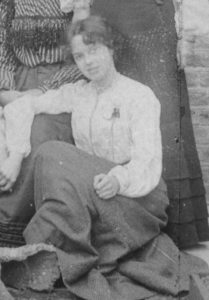
About 17 in this photo
I also discovered a name and address for where she was staying–I assumed with Marian and her uncle.
Her “friend Miss Leman” was at 41–or perhaps 71?–Columbia Heights; Brooklyn, New York.
Perfect. I just needed to find out who lived there in 1908.
A hop to Google maps showed me the apartment would have been in census district 1.
Thus began the tedious work.
I scoured the 1910 Brooklyn census, district 1–looking for a British woman born about 1884.
Brooklyn is covered in apartments even now; there were many names on the 1910 US census–but I methodically went through them hunting any Marian, born in England.
It took me several evenings of aching eyes to discover a possible woman: Marian Moore born in 1883 England who had been married for a year–to a stenography teacher!
I hunted Edward, the American husband, through the census records, available in the United States through 1940.
They moved several times and their family grew.
Passport Information
Ancestry algorithms can suggest other possible people, or records in which you can find the person you’re currently examining.
While exploring Edward, I discovered he had a passport application displayed on Ancestry.
Click.
There he was–even a photo!
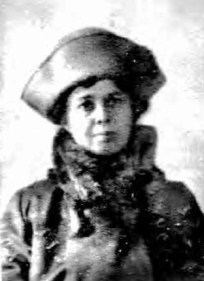
Marian’s 1924 passport photo (Ancestry.com)
The next passport application was Marian–and guess who she looked like!
I’d found her!
You didn’t hear the screaming that night?
A month of methodical searching turned up a woman about whom we had known next to nothing.
Now we know who she is.
When I reexamined Biddy’s papers returning to England in 1908, Marian was listed just below her–they had shared a cabin.
Marian had been there all along–I just didn’t recognize her name owing to illegible handwriting by the port agent.
Gracious family assistance
Ancestry also allows you to contact people who have provided information.
Marian’s great-grandson had signed up and when I wrote, he answered questions and filled in several puzzles.
He even sent photos of an adorable young woman who lived happily ever after in America–and who probably only saw our heroine a few times after that 1908 trip.
Because of what he told me, we know more about Marian, and can put events in Biddy’s life into context.
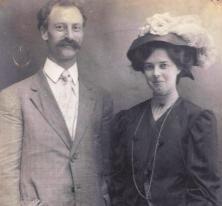
Edward and Marian on their 1909 wedding. (Courtesy Moore family)
Marian is far more alive to me now than she was the first time I saw that photo at the top!
Tweetables
Diligence and primary sources unlock a mystery. Click to Tweet
The elusive Marian found in Ancestry.com. Click to Tweet
Using Ancestry.com’s algorithms for discovery. Click to Tweet
The post Who was Marian? Ancestry Part 3 appeared first on Michelle Ule, Author.
April 18, 2017
A Helicopter Ride in Kaua’i
 So we rode a helicopter in Kaua’i.
It was not on my bucket list.
I never wanted to take a helicopter ride.
It was the easiest way for me, however, to see something on my bucket list: the Na Pali Coast.
Our daughter thought it sounded like a lot of fun.
So up we went.
Literally.
Take off.
I’ve flown airplanes for years. You always have a sense the pilot is preparing for take off.
You can hear the engines rev, feel the acceleration and the hurtling through space.

Indiana Jones was shot here.
As the nose tilts up, you feel the steep rise and can see the same out the window.
Often it’s bumpy until you get to cruising altitude and everything smooths out.
It’s not like that in a helicopter.
We crab walked under the spinning blades and climbed in.
Bending over was not necessary, but it felt safer!
Once all five of us were strapped in, the helicopter maneuvered to the right facing the distant hills.
While I waited for the sense we were taking off, I glanced to my right out the window.
We were already fifty feet off the ground.
I hadn’t even noticed!
Helicopter and height
The pilot skirted the rim of the steep hillsides south of the Lihue airport, happily chatting in his microphone.
We all wore headphones to keep to a dull roar some of the noisy whirring above our head.
With all the noise, we couldn’t speak to each other or hear the screams. (Joke).
It felt like we were sitting in chairs gently gliding along the sharp ridges, so close surely we could reach out and touch them.
(Speaking of touching things, we chose a helicopter tour that had doors).

View over the pilot’s shoulder.
I tried hard not to think about how much air was beneath my feet to the ground.
(The reverse of what I experience in caves where I deliberately don’t think about how much rock is above my head).
In an effort to keep the acrophobiac terror under control, I didn’t look down either.
The view straight ahead over the pilot’s shoulder was splendid, anyway.
Waterfalls and a canyon
A helicopter ride in Kaua’i is the best and most efficient way to see the many waterfalls that dot the island.
We circled the famous Jurassic Park waterfall (from the movie), but there were so many others to admire, we didn’t need to land.
(You can’t land there at the present time).
 Everywhere I looked water sprouted from the green hillsides.
Lovely.
We wended up through the Waimea Canyon, a beautiful and colorful land best seen by air.
We’d visited there many years ago, but the helicopter provided a far better panorama than anything we saw from the narrow road.
I waved at hikers–who didn’t see me, of course.
Na Pali Coast
A tilt and a twist and we reached the blue coast.
My stomach did some squirming along this stretch of the trip, but I held it together.

Waimea waterfalls.
(Look at the horizon; don’t look down!)
The horizon presented beautiful views.
We saw catamarans and sailing ships, steep cliffs, beautiful empty beaches and a stunning sky.
Such a glorious afternoon for a helicopter ride!

Na Pali Coast
The pilot circled back several times so riders on both sides of the helicopter could admire the views.
We chose the final flight of the day, 4 o’clock, for better use of the sun on the cliffs.
Sunshine Helicopters also suggested the first flight of the day as golden for light.

Circling back
As we flew along the north shore near Princeville, we saw the coast we drove along the day before.
The reefs were obvious–the pilot claimed they could be seen from the space shuttle.
We saw taro fields, spiked mountain tops, more waterfalls and took a spin through the extinct volcano crater in the middle of the island.

Reefs visible from space?
By the end of our 50 minute cruise I wasn’t bothered by the amount of air under my feet.
My stomach still lurched.
I still savored the views.
And was perfectly happy when I stood on land again.
A helicopter ride on Kaua’i was magical.
We’re glad we went.
See?

Tweetables
A beautiful helicopter flight around Kaua’i. Click to Tweet
Photos from a helicopter ride in Kaua’i. Click to Tweet
The post A Helicopter Ride in Kaua’i appeared first on Michelle Ule, Author.
April 14, 2017
What does Biddy Mean?
That’s one of the most frequent questions people ask about Mrs. Oswald Chambers.
The answer is pretty simple, but let’s see if you can guess.
What does the noun Biddy mean?
According to Merriam-Webster’s dictionary, “biddy” can mean:
a hired girl or cleaning woman
usually disparaging : woman; especially : an elderly woman
It can also refer to a young hen.
These definitions don’t really apply to the woman whose parents named her Gertrude Annie Hobbs.
Her family called her “Gert” or “Truda,” until Oswald Chambers bestowed a on her.
She was 25 years-old and it stuck for the rest of her life.
Oswald Chambers and nicknames
Oswald Chambers had a keen sense of humor and loved to give nicknames to the people close to him.
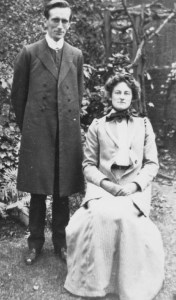
Biddy and Oswald circa 1912
While the principal of the Bible Training College (BTC), he nicknamed several students:
Gladys Ingram became “Gladiolus,” and that’s how he often referred to her in letters.
He sometimes called his friend Charles Rae Griffin, “Radiant” Griffin.
Eva Spink easily morphed into Sphinx or Spinkie.
As Oswald and Biddy named their daughter Kathleen, they chose to call Gertrude Kathleen Ballinger, “Bill.”
It made differentiating the two easier in conversation.
Why Biddy?
Oswald and Gert Hobbs spent ten days together traveling from England to America in 1908.
What had originally begun as a favor to Gert’s mother (to keep an eye on her daughter traveling alone), soon changed to a joy for Oswald.
They two shared long conversations over meals, tea, and while walking the decks on a summer voyage.
Oswald kept stumbling over the witty young woman’s name.
His favorite sister was Gertrude. He needed to differentiate the two in his mind.
He proposed a nickname to the woman–who possessed an equally keen sense of humor.
How about “Beloved Disciple?”
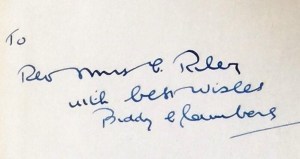
1959 signature (Courtesy Marlene Ankerberg)
What would you do if someone suggested calling you “Beloved Disciple?”
How could Gert say no?
But “Beloved Disciple,” is a mouthful and so he shortened it to “B.D.”
If you say “B.D.” frequently, you can hear how it easily slides into “Biddy.”
And that’s who Gertrude Annie Hobbs Chambers referred to herself for the rest of her life.
As did her mother, sister, brother, friends and everyone else for the last 109 years.
When she compiled her husband’s books and wrote introductions, including to My Utmost for His Highest, she signed herself “B.C.”
Of course, she lived up to the name, Beloved Disciple, for both her husband and her God.
Tweetables
Where did Biddy Chambers’ name come from? Click to Tweet
Nicknames and Oswald Chambers: the source of Biddy’s name. Click to Tweet
Was Mrs. Oswald Chambers’ name really Biddy? Click to Tweet
Every month in 2017, I’ll be telling the stories about God’s leading and my blessed–and astonished–reactions while writing Mrs. Oswald Chambers
The next newsletter comes out April 18: In which my husband’s business trip results in a shocking surprise.
If you’re interested in reading about all those amazing coincidences, sign up for my newsletter here.
The post What does Biddy Mean? appeared first on Michelle Ule, Author.
April 11, 2017
Jesus’ Ministry During Holy Week
 Jesus’ ministry during the final week of his life was directed at one group of people in particular.
Can you think which group it was?
Here’s a hint: He didn’t come to condemn, He came to save the world. (John 3:17)
Jesus’ ministry to those who hated him.
A close examination of that final week in Jesus’ ministry shows a particular interest in reaching the Sadducees and the Pharisees.
But he came to save the lost?
Who was more lost than those who studied scripture their wholes lives yet missed the Messiah?
Oh, sure, Jesus spoke to other Jews and Gentiles–anyone within hearing distance, but he paid close attention to the learned.
They were blind–deliberately in many cases–but Jesus wanted them in heaven.
Jesus did not ignore those who persecuted Him. He engaged them. Here’s a breakdown:
Palm Sunday
Jesus rode into Jerusalem on Palm Sunday and the crowd went wild, laying clothes and palm branches before his donkey.
“And some of the Pharisees called to Him from the crowd, “Teacher, rebuke Your disciples.”
” But He answered and said to them, “I tell you that if these should keep silent, the stones would immediately cry out.”” (Luke 19:39-40 NKJV)
Why did the Pharisees want the disciples rebuked?
They didn’t like how Jesus–who had raised Lazarus from the dead not a few days before–looked like a conquering king coming to lay claim to their power, particularly at the Temple.
The high priest had declared Jesus should die for the good of the Jews (or at least those in power).
[image error]
Entry of the Christ in Jerusalem by Jean-Léon Gérôme (Wikipedia Commons)
The Pharisees wanted to squash any enthusiasm for Jesus’ ministry.
Monday
Upon Jesus’ return Monday morning, he went straight to the Temple. It was Passover week, the city was jammed.
Once there,
“The blind and the lame came to Him in the temple, and He healed them. But when the chief priests and scribes saw the wonderful things that He did, and the children crying out in the temple and saying, “Hosanna to the Son of David!” they were indignant and said to Him, “Do You hear what these are saying?”
“And Jesus said to them, “Yes. Have you never read, ‘Out of the mouth of babes and nursing infants/ You have perfected praise’?”(Matthew 21:14-17)
Displaying his healing powers on Temple grounds pointed to the inability of the high priest and his associates to do the same.
They didn’t like being shown up, much less hearing shouts of praise. (Think of King Saul watching David enter Jerusalem to shouts of praise),
Outraged by the money changers with Temple walls, Jesus’ ministry also involved clearing them out and not allowing anyone to bring back saleable items.
He’d done it before, but this time, indignation ruled the Temple authorities. Jesus’ ministry went right to the point, their disdain for God’s house.
Jesus called them on their poor spiritual leadership (which was always His complaint against them):
“Is it not written, ‘My house shall be called a house of prayer for all nations’? But you have made it a ‘den of thieves.’
“And the scribes and chief priests heard it and sought how they might destroy Him; for they feared Him, because all the people were astonished at His teaching.” (Mark 11:16-18)
[image error]
Jesus casting out money changers from the Temple by Giotto, (Wikipedia)
It may seem harsh, but what else could Jesus do to provoke their attention?
Until the Temple authorities were willing to acknowledge their own responsibility for not honoring God, how could their change?
Remember, they were planning to kill Jesus.
But he kept coming back to confront them with truth about their hearts.
Tuesday
Authorities awaited Jesus at the Temple.
They demand to know by whose authority Jesus cleared the Temple.
“If you tell Me, I likewise will tell you by what authority I do these things: The baptism of John—where was it from? From heaven or from men?”
“And they reasoned among themselves, saying, “If we say, ‘From heaven,’ He will say to us, ‘Why then did you not believe him?’ But if we say, ‘From men,’ we fear the multitude, for all count John as a prophet.” So they answered Jesus and said, “We do not know.”
“And He said to them, “Neither will I tell you by what authority I do these things.” (Matthew 21: 24-27)
Jesus spent considerable time afterwards telling parables. He wanted those with eyes to see the truth and to give one more chance to those determined to be blind.
His parables were pointed: the two sons, the vinedressers in the vineyard, the parable of the wedding feast. He also answered questions the leaders designed to trip him.
Jesus’ answers enraged them.
Jesus then turned the tables and spoke from his heart, in Matthew 23:37-39:
[image error]
The Pharisees Question Jesus (Wikipedia)
“O Jerusalem, Jerusalem, the one who kills the prophets and stones those who are sent to her! How often I wanted to gather your children together, as a hen gathers her chicks under her wings, but you were not willing! See! Your house is left to you desolate; for I say to you, you shall see Me no more till you say, ‘Blessed is He who comes in the name of the Lord!’”
He longed to gather them into the Kingdom of God, but they rejected him.
They had hardened their hearts and Jesus’ ministry to them–his attempt to draw them to the authentic Messiah standing before them–had failed with some, but not with all.
Wednesday
On Wednesday, Jesus remained with his disciples in nearby Bethany.
The Temple authorities sought out Judas and made arrangements to kill Jesus.
Jesus knew but did nothing to step their actions.
Thursday
[image error]
Plate 18, the Macklin Bible after Loutherbourg. Bowyer Bible. Arrest of Christ (Wikipedia)
The Last Supper occurred on this day.
When Judas left to help the Temple authorities in their plot against him, Jesus let the man go.
Later that night in the Garden of Gethsemane, when Peter cut off the ear of the High Priest’s servant, Jesus healed it.
There in the Garden, Jesus’ ministry reached out again:
“But Jesus said to him, “Put your sword in its place, for all who take the sword will perish by the sword. Or do you think that I cannot now pray to My Father, and He will provide Me with more than twelve legions of angels? How then could the Scriptures be fulfilled, that it must happen thus?”
” In that hour Jesus said to the multitudes, “Have you come out, as against a robber, with swords and clubs to take Me? I sat daily with you, teaching in the temple, and you did not seize Me. But all this was done that the Scriptures of the prophets might be fulfilled.” (Matthew 26: 52-56)
A Pharisee or Sadducee willing to hear what Jesus actually said, had another opportunity to change.
They had to be willing to look at the scriptures from a different point of view, and then all of Jesus’ ministry would become clear.
But they chose not to.
Good Friday
Events of Good Friday are well known. Notice that when Jesus appeared before the Sanhedrin, he used a term underscoring who he was:
“Again the high priest asked Him, saying to Him, “Are You the Christ, the Son of the Blessed?”
“Jesus said, “I am. And you will see the Son of Man sitting at the right hand of the Power, and coming with the clouds of heaven.” (Mark 14: 61-62)
He engaged them, yet again, but they refused to consider Jesus as the Messiah.
The authorities turned Jesus over to the Romans, who, of course, crucified him.
But even on the cross as the soldiers gambled for his clothes, Jesus appealed to God: “Father, forgive them, for they do not know what they do.”
He forgave the thief on the cross who recognized Jesus as the Messiah.
Who knew what other witnesses thought?
After the Resurrection
Many people became believers at Pentecost and afterwards–thousands, and among them were many Pharisees, according to notes in my Lutheran Study Bible.
Acts 6:7 notes many priests ultimately recognized the man they persecuted really was the Messiah.
“Then the word of God spread, and the number of the disciples multiplied greatly in Jerusalem, and a great many of the priests were obedient to the faith.”
That last week of reaching out to Pharisees and Sadducees, eventually bore fruit.
Jesus’ ministry to even those who hate him continues to this day.
Some need to recognize the resurrection of the Messiah as truth before they can bow their knees.
All come to God in their own time and way–but even as Jesus demonstrated during his last week on earth–he desires all to be saved.
Easter is the real truth of Jesus’ ministry.
Tweetables
Dealing with Jesus’ enemies in his final week. Click to Tweet
What did Jesus think of the Pharisees and Sadducees? Click to Tweet
Jesus: reaching with love to those who hate during Holy Week. Click to Tweet
The post Jesus’ Ministry During Holy Week appeared first on Michelle Ule, Author.
April 7, 2017
Who Is This Mystery Woman? Ancestry Part 2
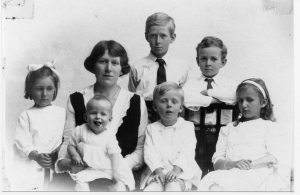
Who is the mystery woman with all these children? (Wheaton; Special Collections)
Who is this mystery woman with all those children?
Researchers at Wheaton College didn’t know when they included her photograph into Oswald Chambers’ Special Collection Library.
I didn’t know at first either, until I took a closer look.
See that startled little girl on the left?
That’s Kathleen Chambers, Oswald and Biddy Chambers’ daughter.
How old do you think Kathleen is?
Starting there will give you the first clue.
Analyzing the photo
If the photo was in Wheaton’s collection, it was important.
Kathleen looks about four years old.
As Biddy’s biographer, I know Kathleen lived in the YMCA camp at Zeitoun, Egypt in 1917, when she was four years old.
I can also count.
Five other children are in the photo.
They can only be the children of George Swan, one of the directors of the Egypt General Mission (EGM).
The YMCA camp at Zeitoun was located inside the EGM compound.
Mr. and Mrs. Swan had many children.
I didn’t know there were five when I started–I only knew about John David and baby Hugh Christopher.
Born the same year as Kathleen and her chum, John David probably is the second boy to the right of the mother.
(Or is he the one sitting next to the girl?)
But what were the names of the other children?
What was the mystery woman’s name–other than Mrs. Swan?
Ancestry. com was fundamental to discovering their names.
It took me 15 months.
The family
Central to learning about them, I started with their father/husband.
George Swan is a common name, but the man was an early 20th century missionary to Egypt.
A Google search took me to the book he wrote: Lacked Ye Anything? A Brief History of the Egypt General Mission.
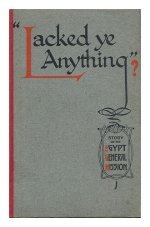
Swan wrote this book in 1932. I haven’t been able to read it.
I couldn’t obtain a copy of it, but pulled up enough through various Google Book searches to learn something.
Back to Ancestry.com. Using their search engines, I turned up little.
Why?
George and John David Swan are common names and they didn’t live in England for the 1911 census (the latest one you can examine).
Egypt doesn’t have census records listed on Ancestry.com.
I let it go for a few weeks.
I’d return when a new search item occurred to me.
One day, I discovered immigration records.
I figured David Swan went to boarding school eventually, like many missionary and military children whose parents served abroad.
By then I’d learned one of his brothers was Douglas.
I found them on immigration forms–which provided more information.
As I watched their travels between Port Said and England, I learned the name of the younger brother and before long, I knew them all:
Barbara, Douglas, Martin, John David and Hugh Christopher.
Great!
But as I wrote my book and included bits of information about Biddy’s friendship and the generosity of Mrs. Swan, I wondered what her name was.
That, for some reason, was much harder.
The mystery woman’s first name.
Ancestry asks for information to narrow the algorithms’ search.
Birth date, birthplace, marriage date, marriage locations, names of parents, siblings and spouses, all play a role.
Mrs. Swan’s first name was one of the loose ends as I completed Mrs. Oswald Chambers.
I made one last attempt before abandoning the hunt.
I searched for John David, whom I knew became a doctor in England.
His death information turned up, but not much else.
George Swan’s name went into the search engine, I guessed at a birth year–1870?–and location.
When I returned to Google, this time a recent article appeared and included a photo of George Swan.
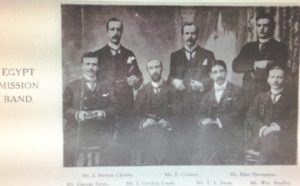
George Swan (front left) and the EGM founders. (Lacked Ye Anything? photo off internet)
The ebook was $105!
By parsing through various searches, I discovered the author’s email address and sent him a simple question: “Do you know Mrs. Swan’s first name?”
A long shot, for sure.
Except, that photo of George Swan intrigued.
He and a brother, T. E., were born in Belfast.
Back to Ancestry I went!
George turned up when I put in Belfast.
Several links appeared to British immigration–glorious primary source materials!.
George’s name appeared in 1948 immigration reports into England.
Listed just below George was his wife: Dora H. Swan.
The mystery woman is Dora, Biddy’s friend in Egypt.
You didn’t hear me screaming?
15 months of research for one tiny name.
For this genealogist/researcher–bliss!
Postscript: The article author wrote back. He had examined his records and learned Mrs. George Swan’s name was Dora.
Confirmed!
Tweetables
15 months of searching on Ancestry.com for a first name. Click to Tweet
A genealogist shows how to find facts on Ancestry.com Click to Tweet
A mystery woman and lots of children: but what was her name? Click to Tweet
Every month in 2017, I’ll be telling the stories about God’s leading and my blessed–and astonished–reactions while writing Mrs. Oswald Chambers
The next newsletter comes out April 18: In which my husband’s business trip results in a shocking surprise.
If you’re interested in reading about all those amazing coincidences, sign up for my newsletter here.
The post Who Is This Mystery Woman? Ancestry Part 2 appeared first on Michelle Ule, Author.
April 4, 2017
Mom’s Charm Bracelet of Memories
 When I opened the velvet box and saw a silver charm bracelet, my eyes widened.
“Where did you find Mom’s charm bracelet from Europe?”
My brother grinned.
“It’s a funny thing about siblings. We know things that no one else knows.
“When I saw this charm bracelet at the antique shop, I knew you’d love it.”
I peered closer at the tiny charms.
The colosseum from Rome, a gondola from Venice and the Eiffel tower from Paris caught my eye.
But we never went to Berlin that summer., so I didn’t recognize Brandenburg gate nor the silver bear. I frowned. “This isn’t Mom’s. Where is it?”
He shrugged. Maybe our younger brother knew. We hadn’t seen the jangly silver bracelet in the 21 years since she died.
A charm bracelet as a souvenir?
In 1970 when my mother used a year’s worth of teacher salary to launch our family on a 10-week camping trip through Europe, charm bracelets were popular.
All her friends who had gone to Europe before had such bracelets with tiny charms reflecting the countries they visited.
One charm per country.
In our case, we visited thirteen countries that summer.
“That’s all Mom and Michelle did, hunt for charms,” my brother explained to his wife and daughter.
“It was crazy,” I agreed. “We spent only one hour in Belgium,our sole purpose to find a charm.”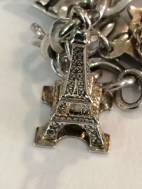
Bruges, Brussels, Flanders, the Lowlands, all ignored as we sought a jewelry store.
“In fact, the only reason we went to Lichtenstein, hours out of the way, was to buy a charm for the bracelet.”
We may have bought chocolate bars there as well.
Or a version of Pokemon?
It all rushed back, those searches for the right tiny object to represent a nation.
In the end, we resorted to buying whatever made sense and tossed out a limit.
So, we did have Rome’s Colosseum and the gondola. I’m pretty sure we had Big Ben for England and a windmill with operating sail for Holland.
The Little Mermaid statue from Copenhagen represented Denmark.
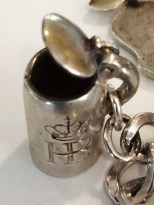
We also visited Munich!
As we wandered through tourists sites in all the countries, we admired the views, took in the history and seemingly climbed every church tower in Germany.
She must have bought a Leaning Tower of Pisa–because I remember my father and I both feeling tempted to step off the top. In 1970, the tower didn’t have a railing.
We were both shaking after he shouted at us to “get down, now!”
We stopped at tourist kiosks and shops hunting the charm that best represented our memories.
It had to be sterling silver–the only indulgence for my mom that summer–and it had to mean something to her.
Charming memories
Turning over this gift, I examine the cowbell.
The antique bracelet’s charm reads “Danmark.”
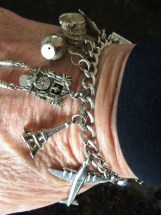 Mom’s had a clapper in it, too, but came from Norway.
It clatters and shines in the light–this one has an airplane.
That trip to Europe in 1970 was the first time my brothers and I rode on an airplane.
It’s not Mom’s, but it could be.
I’m going to call that youngest brother and see if he knows where the family’s silver memory is from that long ago trip.
But first, I’m going to dig up the diary I wrote that summer and really remember what it felt like to be tall, gawky young teenager with braces on her teeth who wore horn rimmed glasses.
That summer was memorable for a lot of reasons, but the most important one was that was the year I saw my mother as a person apart from her relationship-defining title “Mom.”
Of course I didn’t dare call the charm seeking woman Jeanette.
But when she put on that charm bracelet and watched it dance with memories, that’s who Mom really became: herself.
Thank you to my brother.
Tweetables
A European charm bracelet evokes memories. Click to Tweet
The surprise of Mom’s charm bracelet after 20 years. Click Tweet
Charming memories of Europe in a silver bracelet. Click to Tweet
The post Mom’s Charm Bracelet of Memories appeared first on Michelle Ule, Author.
March 31, 2017
Daily Light: The Chambers’ Favorite Devotional
 Daily Light on the Daily Path
was Biddy and Oswald Chambers‘ favorite devotional.
Daily Light on the Daily Path
was Biddy and Oswald Chambers‘ favorite devotional.Throughout their seven year marriage, the couple read the book each morning.
It served as a touchstone to their day and relationship.
Both read it all the way to the end of their lives.
What is Daily Light?
As a devotional, Daily Light (as it is generally called) consists of two readings for each day of the year.
“Morning” includes a short snippet of Scripture, no more than two sentences long, followed by three short paragraphs from the Bible.
“Evening” follows the same pattern.
Everything is from the Bible–there are no other comments or explanations of the passage.
Oswald and Biddy loved it because it consisted of God‘s word, nothing else.
Who wrote Daily Light?
The Bagster family of England produced the Daily Light in the 1870’s.
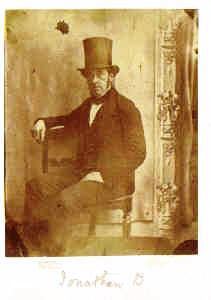
Jonathan Bagster
Jonathan Bagster (1813-1872) came from a publishing family.
He had many children and the family shared corporate devotions every evening after dinner.
Acting as “editor-in-chief,” Jonathan challenged his family by selecting a passage of Scripture.
Using the concept of “scripture interpreting scripture,” he asked his family to contribute verses that illustrated the passage.
He gave them time to pray and think before calling them back to hear their suggestions.
The family–thirteen people–then discussed the different passages and prayed together about them.
Often, they went back and forth for days debating which verses explained the set scripture best.
They put the manuscript aside and a few weeks later pulled it out to reconsider. Jonathan’s daughter Anne acted as his assistant.
Eventually, they divided the readings into Morning and Evening.
Following Jonathan’s death in 1872, his son Robert completed the manuscript and arranged for publication.
The book has never been out of print.
Biddy, Oswald and Daily Light.
Oswald and Biddy Chambers read the devotional daily and often referenced it in their letters.
As it is solely God’s word, they found it helpful in confirming decisions.
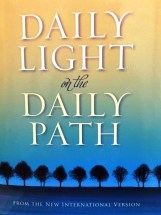
My version
One morning while sitting on the Egyptian desert sand watching the sun rise, Oswald prayed about his family’s circumstances.
Biddy and their daughter Kathleen, along with companion Mary Riley, were still in England awaiting word from him as to when they should buy tickets to sail to Egypt.
World War I was fifteen months old and the seas crawled with German U-boats.
Oswald had special permission for them to join him at the YMCA‘s Zeitoun camp.
But the time didn’t seem right until November 17, 1915, when he wrote in his diary:
“I have decided to write today for Biddy and Miss Riley to come right away. I got two wonderful verses this morning about the matter for which I thank God. Mark 9:8 and Psalm 37:4.”
The next day, after consulting with a friend about a house, he wrote
“If you knew how next to impossible it had seemed [Biddy’s coming out], you would see as clearly as I do the hand of God in it. The Daily Light text when I came back [that evening] was just like God, full of the most ineffable tenderness to touch me–‘Behold, heaven and the heaven of heavens cannot contain Thee; how much less this house that I have builded.”
To Oswald, God’s words in Daily Light confirmed the decision he made in faith for his family to come.
Biddy and Daily Light encouragement.
Even after her husband’s death, Biddy continued to read the Daily Light.
One of the most meaningful readings for her came on November 30, 1917.
Biddy returned to Zeitoun after two weeks of mourning and the reading affirmed her choice to stay in Egypt and continue ministering at the camp.
From Mrs. Oswald Chambers:
Biddy took a deep breath and recalled the morning’s readings from the Daily Light:
“My presence shall go with thee,” and “Jesus Himself came and stood in the midst of them.”
The affirming words of scripture reinforced by her devotional reading meant the world to Biddy that day–and for many years to come.
Tweetables
Oswald Chambers’s favorite devotional: Daily Light. Click to Tweet
13 people scouring the Bible to write 1 devotional: Daily Light. Click to Tweet
What devotional did Biddy and Oswald Chambers use? Click to Tweet
The post Daily Light: The Chambers’ Favorite Devotional appeared first on Michelle Ule, Author.
March 28, 2017
Is Humility Good for the Soul?
 Humility is good for my soul, thank you very much.
How about yours?
I get lots of practice being humble–when I’m not vexed, frustrated or calling for my engineer husband.
My Bible study ladies have been laughing at me lately as, each Tuesday morning, I’ve tried to follow directions for the DVD player and the smart television.
I was only trying to show a video of Handel’s Messiah before we begin our discussion.
In an eight-week course, I’ve only been successful on the first try once.
Humility linked to inability?
I’m the niece of two electricians and the granddaughter of two very clever men who could fix anything.
My teacher mother believed and insisted, “If you can read, you can do anything.”
I can read.
Many accomplishments are beyond my grasp.
Mom didn’t lie, she was just recounting her experiences with her handy father.

Compared to me, even a child is an appliance superhero! (Photo by Brandon Morgan; Unsplash)
She prefered not to think about the technical skills my unhandy father didn’t posses.
I obviously take after him in this department.
At this moment, I can seldom even get the garage door to open with a simple click.
Save me in my humility
I’ve told my husband he cannot die before me.
Who will fix all these objects that never work for me?
Imagine this: years ago, we bought an old house in the country.
My husband loved that house and all the clever ways another engineer had arranged basic devices like the septic system.
“Look,” my husband crowed, “Wendell left a schematic of where to find the septic system.”
Where was my engineer when the septic system failed?
Out to sea.
As usual.
Fortunately, once they arrived, the plumbers could follow the crossed lines and measurements–but not until I had dug up nearly the entire back yard hunting the tank.
Did I mention it was snowing that day in Connecticut?
(A septic tank, I might add, was an unknown concept to a woman from Los Angeles).
The plumbers laughed when they saw our handiwork (the boys used their Tonka trucks to help). “Why did you do all this work?”
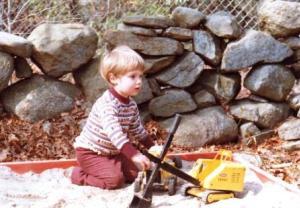
He wore a jacket that day in the snow; used same truck.
Humility. The dispatcher refused to send the men out in the snow unless I uncovered the tank.
I merely followed her orders.
One nudged the other, “Must be a Navy wife, no one else would have done this.”
They loved the schematic and understood the hieroglyphics perfectly.
I didn’t care as long as the toilet worked.
Humility before children
During that same tough year my engineer was out to sea 75% of the time, everything in the house broke.
Even the telephone.
One day, I opened the toolbox to extract a screwdriver. Surely, I could tighten the screws on the pot handle?
My engineer’s children hovered beside me, anxious to help.
“I can do that,” my oldest son exclaimed. “My father is an engineer. I know how to work a screwdriver.”
My father was a geographer. He could tell me where to find a hardware store.
The four year-old fixed the pot handles.
Humility is having a pre-schooler outperform you in a simple task.
I told myself it was good for my soul to not be able to do everything.
Or, as the late budget counselor Larry Burkett used to say,
“Opposites attract in marriage. If you and your spouse have the same abilities and skills, one of you would be superfluous.”
Who is superfluous in this day and age?
Sometimes it feels like the person who can spell superfluous!
Humility is good for my soul
Electronic gear, computers, appliances, my phone–all defeat me on a regular basis.
When the hero comes home I cheer (as do the electronic devices) and admire his talents.
I need him to complete me.
But even more, my soul needs to be humble and recognize I am not the be-all end-all in every corner of my life.
I have my strengths, sure, but I need others in my life.
As Romans 12;4-8 (NKJV) reminds us in a different context:
“For as we have many members in one body, but all the members do not have the same function, so we, being many, are one body in Christ, and individually members of one another.
“Having then gifts differing according to the grace that is given to us, let us use them: if prophecy, let us prophesy in proportion to our faith; or ministry, let us use it in our ministering; he who teaches, in teaching; those who exhort, in exhortation; those who give, with liberality; he who leads, with diligence; he who shows mercy, with cheerfulness.”
There’s nothing in there about electronics and appliances, but it serves the same concept: we need each other.
Including small children.
Tweetables
Humility is good for my soul. Click to Tweet
Even a child can work a tool better than me. Humility! Click to Tweet
The post Is Humility Good for the Soul? appeared first on Michelle Ule, Author.



![[image error]](http://commons.wikipedia.org/wiki/File:Giotto_-_Scrovegni_-_-27-_-_Expulsion_of_the_Money-changers_from_the_Temple.jpg)
![[image error]](http://commons.wikipedia.org/wiki/File:Brooklyn_Museum_-_The_Pharisees_Question_Jesus_%28Les_pharisiens_questionnent_J%C3%A9sus%29_-_James_Tissot.jpg)
![[image error]](http://commons.wikipedia.org/wiki/File:Plate_18_of_22_for_the_Macklin_Bible_after_Loutherbourg._Bowyer_Bible._Arrest_of_Christ.gif)