
Michelle Ule's Blog, page 60
August 30, 2016
12 Brides of Summer: Susan Page Davis
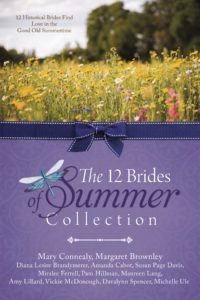
Susan Page Davis wrote the Blue Moon Bride for The 12 Brides of Summer
Blue Moon Bride is a sequel to last Christmas’ The Christmas Tree Bride, though it introduces two new characters who cross paths via the Union Pacific Railroad.
Susan explained how the stories are connected:
“In my Christmas novella, The Christmas Tree Bride, the main character, Polly, received a Christmas card from her friend Ava.
“The card had a colored picture of a Christmas tree and caused Polly to long for New England, the friends and family she’d left behind, and also for a yule tree.”
As Blue Moon Bride opens, Ava Neal is nursing a disappointment when her younger sister marries in 1871 New England.
When her father consoles her about her marital chances disappearing, she asks to travel to Cheyenne, Wyoming on the train to visit Polly.
The railroad has only been open four years, but her determination to travel it speaks of a strong willed young woman eager to see more of the world.
Along the way, she encounters far more adventure than she’d ever expected.
Joe Logan loves to draw, but he also need money to eat. When a courier opportunity arises to take a package–probably containing jewelry–all the way across country to San Francisco, he jumps at the chance to get ahead financially.
After the train crosses the Mississippi River at St. Louis and leaves a lot of civilization behind, he meets the fetching Miss Neal. They’re sitting together not far from Cheyenne when bandits board the train.
Joe manages to save Ava’s one piece of sentimental jewelry, while being deprived of his own package and the chance of further employment.
Stranded in Cheyenne without a job, the only consolation is he might be able to see Ava again.
But then he uses his drawing skill to help the local marshal and a surprising chain of events unfold for a young man without prospects from Hartford, CT.
How does a blue moon fit into the story?
[image error]
The Union Pacific 618 Photo by Evan Jennings,
You’ll have to read it to find out.
Susan enjoyed writing both novellas:
“They’re light and fun, and they speak to that romantic dream inside all of us.”
But they also broach interesting topics:
“The first story was more about Polly’s yearning and nostalgia. Blue Moon Bride is more about Ava’s independence.”
Susan approached the sequel with an interesting twist on research:
“When the editor asked for summer bride stories, I thought of the full moon, and then the blue moon. I looked up the years I could use on a historical calendar site, and I found that July, 1871 did have a blue moon—that is, a second full moon in the month.”
She also did a lot of research about early Cheyenne, Wyoming, and railroad detectives during the period.
Susan has written numerous projects over the years, in a variety of genres: children’s, mystery, historical, romantic suspense. She’s teamed with her daughter, Megan Elaine Davis to write Mainely Mysteries in the past, but in 2015, co-wrote with her son Jim.
In writing an historical novel set at sea in the 1840s and involving a trip to Australia, the Davis mother-son team is learning about each other, and how to work with differing schedules to put together a compelling story.
“So far, working together has been a joy. Yes, we’ve had some disagreements. This usually leads to both of us scrambling to research a term or event.”
Susan had a busy 2015, releasing a number of books including The Outlaw Takes a Bride, The Not-So Civil War, Lights and Shadows (both from Guideposts); and The 12 Brides of Christmas Collection (deluxe volume edition).
Who is Susan Page Davis?

Susan Page Davis is the author of more than fifty published novels and novellas. Her historical novels have won numerous awards, including the Carol Award, the Will Rogers Medallion for Western Fiction, and the Inspirational Readers’ Choice Contest.
She has also been a finalist in the More than Magic Contest and Willa Literary Awards. Susan lives in western Kentucky. She’s the mother of six and grandmother of nine.
Visit her website at: www.susanpagedavis.com
Susan blogs on the twenty-third of the month at Heroes, Heroines and History, www.hhhistory.com
In addition, you can find Susan on
The Christmas Tree Bride can be purchased here.
Tweetables
Who is Susan Page Davis? Click to Tweet
Yearning, nostalgia, the old West and a blue moon. Click to Tweet
Meeting bandits and an artist. Summer romance! Click to Tweet
The 12 Brides of Summer Collection can be purchased at all major booksellers, as well as here.
For those looking for a complete collection of The 12 Brides of Christmas novellas, you can find the book here.
[image error]
The post 12 Brides of Summer: Susan Page Davis appeared first on Michelle Ule, Author.


August 26, 2016
Eyeglasses for Nicaragua Kids
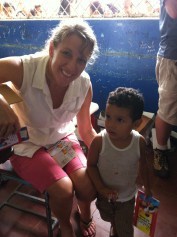 Our church’s eyeglasses mission visited the Rio San Juan region of Nicaragua for the tenth straight year in 2016.
The Rio San Juan area, the poorest region of the second poorest country in Central America, has only limited medical facilities.
Using a mobile autorefractor, the experience of our leader John, and the organizational skills of in-country citizens Rafael and optometrist Dolores, the our group of 8-12 usually sees about 1000 people.
St Mark Lutheran Church’s mission is the only opportunity for most of the region’s 30,000 population (average income $450 per year) to get their eyes examined.
Over the last 10 years, John estimates we have given out 20,000 pair of eyeglasses.
How it works
Local authorities send out radio messages announcing the St. Mark’s mission coming to a specific location.
People arrive from miles around, often early in the morning.
Once a person signs in, they are given a simple exam that determines their dominant eye.
(For volunteers like me who have limited mechanical skills and some Spanish-speaking ability, this was the perfect job. Izquierda? (Left?) Derecho? (Right?) I laughed and smiled a lot, using my hands as well)
They then visit the autorefractor, a whirring plastic contraption manned by a volunteer beaming a thin light into their eye to measuring how light changes when it bounces off the back wall of the eyeball.
The volunteer marks a number provided by the machine on the card and the patient visits John and Rafael, working together.
The two men do a physical exam, sometimes using an eye chart, and then write a prescription estimate on the card.
They direct patients with severe cataracts or pterygiums to the Managua optometrist, Dolores, who makes a professional examination.
(On years when a opthamologist travels to the region to work in a surgical ward, these folks are followed up for cataract surgery.)
Everyone proceeds with their cards to the “happy room,” (or this year, the “happy space”) to be fitted with eyeglasses.
Fitting eyeglasses onto children, men and women, is the most special part of the job.
Seeing the wonder on the faces of people who haven’t seen tree leaves or the wrinkles on their hands for years, brings joy to everyone.
Watch for it in the video below.
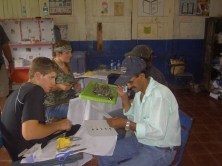
Reading the Bible with new specs!
2016 mission
This year the group spent all three days in the village of Sabalo proper, working in a covered sports area.
They saw 1080 people in three days.
While the Peace Corps usually provides up to five translators, this year only one could come.
Fortunately, three of the young women had either taken Spanish in school or used it for work.
They all were amazed at how quickly vocabulary returned and they were able to communicate.
Local residents stepped in as well, the unofficial mayor of the town translated, as did a school child.
(The lone Peace Corps worker also gave a crash vocabulary course at the lodge each night!)
A lot of them were kids; giving eyeglasses to school children changes their lives for good.
The volunteers pay their way and the glasses–purchased in Nicaragua–are given away for free.
(My husband and I served on the mission in 2011. You can read all 17 of my posts about that trip starting here.)
Our group stays at Sabalos Lodge on the river, not far from the town of Sabalos.
Devotions in the evening after dinner followed by sharing the day’s adventures and remembering the happy room stories are a highlight of the trip.
The Gifts
The St. Mark volunteers also bring gifts for the patients.

Happy visitor
Edna, a woman at our church, made many, many small dolls of cloth.
“They may have been the only soft toys the children ever had,” one volunteer said.
The children also receive bouncing balls and a Bible story book written in Spanish.
We also give away Bibles to anyone who wants one.
Peter, after making sure his patient could see the leaves on the trees and the wrinkles on his hands, asked him to read the opening lines of a Bible text.
The man leaned forward and began to read aloud.
“Great. Those eyeglasses seem to be working fine.”
He continued to read.
Peter doesn’t speak Spanish, so the mayor stepped in. “Alto.”
The man nodded, he had heard, but he kept reading, engrossed in seeing the Word of God for perhaps the first time.
Peter laughed. “It’s the first time I’ve ever had to ask someone to stop reading the Bible.”
The man, like so many others, was thankful to have such precious gifts–the ability to see and a Bible to read.
Thanks be to God.
Here’s a video of this year’s mission:
Tweetables
A 2016 eyeglass mission to Nicaragua. Click to Tweet
First time glasses: tree leaves and hand wrinkle joy! Click to Tweet
10 years, 20K pair of glasses in Nicaragua. Click to Tweet
The post Eyeglasses for Nicaragua Kids appeared first on Michelle Ule, Author.
August 23, 2016
12 Brides of Summer: Amy Lillard
With summer heating up, Amy Lillard has written The Wildflower Bride for (now bestselling!) The 12 Brides of Summer Collection.As a sequel to last winter’s The Gingerbread Bride, The Wildflower Bride follows the fortunes of the second sister, Grace Sinclair
Older sister Maddie is married in the opening scene, set in the 1875 Ozarks, and we get to celebrate with the family.
Maddie makes a gorgeous bride and Grace rejoices with her, all the while wishing someone as handsome as Harlan would sweep her off her feet. But she knows everyone in Calico Falls and so has resigned herself to staying home and helping her widowed pastor father with his congregation.
Then she gets a look at the best man.
[image error]
Oliver tartan kilt (Wikipedia)
Wearing a kilt, no less.
And her heart sinks.
Just hired at his dream job as an assistant pastor, Ian McGruer is on top of the world standing up for his closest friend, even if he has had to travel all the way from upstate New York.
And then he sees the girl.
Could that really be the hand of God tugging at both Grace and Ian?
But hasn’t God already determined where they’ll live and minister?
Does God remember how far apart Arkansas and New York are?
And what do wildflowers have to do with it all?
Writing the story
Amy Lillard has had a busy 2015 with several new releases, but she relished writing of The Wildflower Bride and revisiting Calico Falls, “after all, her sister got a chance at happily ever after. Grace deserved one too.”
She enjoyed exploring a new angle on a love story.
“The Gingerbread Bride is all about trusting God, but The Wildflower Bride is about understanding what God’s plan really is.
“I had a great time writing Grace and Ian’s story. It is a love at first sight-but you’re all wrong for me- story. Each one of them feels God has a different plan for their lives and it doesn’t include moving away from their home in order to be with each other.”
It took a little research to put the story together, mostly for the wedding scene and the question of whether Scottish men wore kilts to weddings in the 1800’s.
“It was great fun reading about all the kilt standards, plaids and tartans and all things Scottish.”
The original idea started with the title.
“I loved the idea of wildflowers in the mountains. From that came the field of wildflowers between the two houses (their home and the house that Harlan is building for Maddie). Just the thought of wildflowers makes me smile and that’s what I wanted from this story: I wanted to give my readers a smile.”
You can purchase an ebook copy of The Gingerbread Bride for 99 cents: here.
 Who is Amy Lillard?
Published author, expert corn bread maker, and Squirrel Princess. Amy is a native of Mississippi who currently lives in Oklahoma with her husband and son. She writes both historical romances and contemporary novels, including two Oklahoma Amish novels releasing in 2015: Courting Emily and Lorie’s Heart.
For more information about Amy, please visit her website: amywritesromance.com
You can also find Amy on
Tweetables
Trusting God or understanding his plan? Click to Tweet
A best man in a kilt? What else is there to say? Click to Tweet
Who is Amy Lillard? Click to Tweet
The 12 Brides of Summer Collection is available at all booksellers, or here.
For those looking for a complete collection of The 12 Brides of Christmas novellas, you can find the book here.
[image error]
The post 12 Brides of Summer: Amy Lillard appeared first on Michelle Ule, Author.
August 19, 2016
Am I a Pharisee?
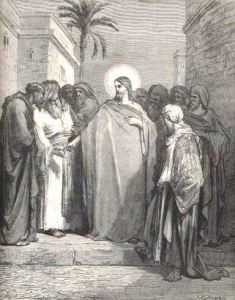
Jesus and the Pharisees by Gustave Doré (Wikimedia Commons)
Am I a Pharisee like those Jewish scholars in the Gospels?
Sometimes I can see where they’re coming from when they challenge Jesus again and again in Matthew, Mark, Luke and John’s books of the New Testament.
Not all the time; but they’re such splendid targets to disdain.
Except when their misunderstandings and words echo in my heart and life.
Then I cringe–and ask God to forgive me!
What’s a Pharisee?
The word means “set apart, separated,” and indicates a Jewish scholar (always a man) during the “second Temple,” period in Jerusalem.
Most of us are familiar with the term because Pharisees were frequent sparring partners of Jesus.
It was an unfair match since Jesus could read the true attitude of their heart and–in his love for them–never let them off the hook.
He called them again and again back to the Old Testament stories and Scriptures they loved–and which they examined for jots and tittles–because they so much wanted to be right.
Distinguished by their love of learning and commitment to the law of Moses, the Pharisees looked for the coming of the Messiah.
_-_James_Tissot.jpg)
Woe unto You, Scribes and Pharisees by James Tissot (Wikipedia Commons)
They were the acknowledged experts on when he would come and how they would know it was him.It was all laid out, passages like Isaiah 53 and Psalm 69, along with a host of others. (See the list of 40 fulfilled messianic prophecies here).
Unfortunately, despite their years spent examining the Torah, they didn’t recognize him when he walked about them and fulfilled the law they purported to love.
The attitude of the heart.
God (Jesus/Holy Spirit) looked at the attitude of the heart when He dealt with the Pharisees.
He examined my heart attitude today as well.
They loved God, as do I.
They wanted to serve God, as do I.

Pharisees accusing Jesus (Wikipedia Commons)
They wanted to ensure true religion was being proclaimed–which is why they grilled Jesus time and again throughout all four Gospels.I understand that desire–which is why I spend my time studying the Bible.
But unlike them, I focus on several points, including a passage out of their Scripture from Micah 6:8–a passage they would have known:
He has shown you, O man, what is good;
And what does the Lord require of you
But to do justly,
To love mercy,
And to walk humbly with your God?
Unfortunately, they were not humble, they did not show mercy and while they may have been better than some, their desire for position, power and honor meant they did not always behave toward their fellow Jews, much less the Gentiles, in a just fashion.
I try very hard not to be like the Pharisees in this department.
I’m also, of course, responsible for applying this one–a direction they rejected–from Jesus:
“Teacher, which is the great commandment in the law?”
Jesus said to him, “‘You shall love the Lord your God with all your heart, with all your soul, and with all your mind.’ This is the first and great commandment.
And the second is like it: ‘You shall love your neighbor as yourself. On these two commandments hang all the Law and the Prophets.” (Matthew 22:36-40; NKJV)
Asking questions, to make sure
I always give them points for at least asking Jesus to clarify–because that’s where I often find myself.
God, himself, tells us “come now, let us reason together.” He’s not expecting blind faith.
But, when Jesus, time and again, demonstrated his Messiah-characteristics–healing the sick, bringing people back to life, knowing the truth of their hearts–they were given plenty of opportunity to recognize him.
How much did he need to show them, so they could recognize who Jesus really was?
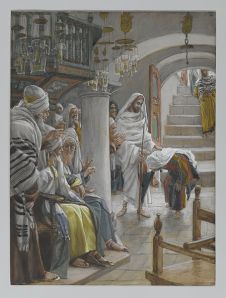
Jesus heals a woman and they choose not to rejoice. James Tissot (Wikipedia Commons)
The Pharisees blinded their eyes, they chose not to see. Believing Jesus as the Messiah would take away their power, their status and their authority.
They loved “the things of the world” more than they wanted to worship the Messiah.
I’ve asked questions like theirs, myself.
Time and again, Jesus/God/Holy Spirit has reached out to me, shown Himself for Who He is, and encouraged my oft-times fledgling faith.
How many blessings and examples of His goodness do I need?
Thanks be to God that when I behave like a Pharisee, something happens in my heart.
I get a check, a question, a gentle chide of remembrance of all the ways God has answered my questions in the past.
How can I possibly deny the Messiah?
How could they?
A love that never ends
Pride pushed a Pharisee to his decision two thousand years ago.
But Jesus kept reaching out, beckoning all the Pharisees and scribes to set aside their preconceived notions and open their eyes–all they had to do was follow Him.
My pride sometimes struggles, too.
But then I remember just who Jesus focused on during his last week on earth.
His followers stayed with him, even those who wandered off (think Peter) eventually came back.
Jesus appealed to the scribes and the Pharisees, all the way to the end.
He loved them so much, he took their blindness and sinful pride to the cross, where he died on their behalf–and mine as well.
The result?
Some of the Pharisees in Jerusalem at that time recognized their Messiah.
You can read about a number of them in the book of Acts, starting with Gamaliel–teacher of the Apostle Paul, who was a Pharisee himself.
Acts 6 and Acts 15 also refer to believers who were Pharisees.
There’s always time for a repentant person to recognize and be accepted by the Messiah.
I’m so glad some of them, like me, laid down their pride.
Am I a Pharisee?
Anytime I decide not to love and not to believe Jesus, I adopt the attitude of a Pharisee.
Fortunately, Jesus’ death on the cross provides a way for me to love justice, mercy, humility and those around me.
Even the most hardened Pharisee among us, can do the very same.
Thanks be to God.
Tweetables
Am I a Pharisee and other horrors? Click to Tweet
Did any Pharisees in the Gospels see truth? Click to Tweet
How not to be a Pharisee in two simple verses. Click to Tweet
The post Am I a Pharisee? appeared first on Michelle Ule, Author.
August 16, 2016
12 Brides of Summer: Vickie McDonough
The (now best selling!) 12 Brides of Summer Collection includes a traditional summer activity in The County Fair Bride by Vickie McDonough.Vickie wrote The Fruitcake Bride with a sequel in mind. Finding the story was easy and fun.
“My heroine in The County Fair Bride is Prudy Willard, who was the antagonist in The Fruitcake Bride. She’s been away for a while and gone through a big change.”
A year and a half after she made a fool of herself trying to catch Pastor Clay, Prudy has returned to 1891 Advent, Texas to help care for her ailing father. She’s still embarrassed about what happened before and is nervous about seeing Pastor Clay and his wife Karen again.
Changes have occurred in Advent. The town has grown and with her mayor father ill, a handsome newcomer has stepped in as interim mayor.
“Prudy isn’t too happy with this interloping Adam Merrick taking her father’s job and decides to offer her “assistance” to make sure he’s doing things properly. Needless to say, Adam doesn’t appreciate her help.”
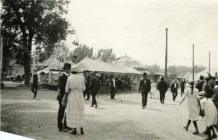
(Courtesy Longmont, CO Museum)
The theme of The Fruitcake Bride was trusting God when things don’t go as planned, Vickie said.
“In The County Fair Bride, Prudy learns she needs to change and trust God, and that she can’t always change things herself.
Sometimes we need to yield our plans to God’s plans for us.”
Vickie enjoyed writing this story. “It was fun giving snooty Prudy her own story and redeeming her.”
How did such a proud woman become a County Fair Bride?
You’ll have to read it to find out!
The Fruitcake Bride, which enables readers to see how badly Prudy behaved before she changes, is still available as an ebook for 99 cents: here.
Who is Vickie McDonough?
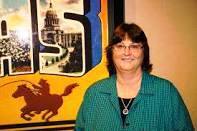
Vickie McDonough
Vickie McDonough is the author of 40 novels and novellas. More than a million copies of books with her name on them have sold.
Vickie has been married 40 years. She and her husband live in Oklahoma and have four grown sons, one daughter-in-law and a precocious granddaughter. When she’s not writing, Vickie enjoys reading, antiquing, watching movies, and traveling.
In addition to the 12 Brides of Summer, Vickie has written two other projects with Michelle Ule and Margaret Brownley, including A Pioneer Christmas Collection and The 12 Brides of Christmas.
For more information about Vickie and her books, visit her website: www.vickiemcdonough.com
You can also find her on
Tweetables
Vickie McDonough: over a million readers can’t be wrong! Click to Tweet
A Country Fair: the best place for summer romance? Click to Tweet
Learning to trust God and not take matters into your own hands. Click to Tweet
[image error]
The post 12 Brides of Summer: Vickie McDonough appeared first on Michelle Ule, Author.
August 12, 2016
A Writer’s Emotions and The End
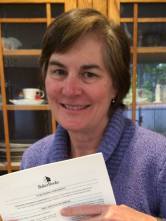
Signing the contract
When I typed The End last night, I began to shake.
Finished, done, completed–at least the rough draft.
I sat back in my computer chair, put my hands to my face and sobbed.
While a writer is like God as she writes her book, plans her story, incorporates facts and hunts for words, this writer doesn’t always feel like God.
Certainly as a biographer, I’ve been more in control of Biddy Chambers’ life story than I have with some of my novels, but not exactly.
Just the facts
I’ve had the facts for a year, ever since a week-long trip to Wheaton College’s Special Collections Library when I scanned documents from their Oswald Chambers collection.
Indeed, I stood at a desk and scanned for five straight days.
I scanned so much, my scanner died on day two and I had to buy a new scanner.
(Total miracle–I, the inept woman who struggles with all the appliances in her house– was able to download the driver and get the new scanner to work!)
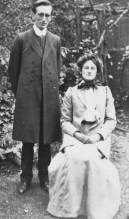
OC and Biddy; Wheaton Special Collections
(Okay, I admit, I started crying in helpless fury at one point and a German researcher stood up to help–but then it worked!)
I brought everything home and then I read it and learned about the woman I proposed to write about.
Oh, my. Biddy was far more complex and her story even more thrilling than I realized when I began.
Her life lay before me and I saw exactly where this one would go and how rich a life she led.
I just had to write it.
Except, there’s all this other stuff
When David McCasland wrote Oswald Chambers’ definitive biography, Oswald Chambers: Abandoned to God in the 1990s, he spent several years researching.
He interviewed people who had known OC (as we affectionately call him around here) and Biddy, as well as their only child, 80-or-so year-old Kathleen Chambers.
Ever generous, McCasland left all his research at Wheaton, which is what I searched in summer 2015.
With one small exception, no one else has written much in the interim and no one knew anything about Biddy.
I began with a question: Who was this woman who pulled off such an amazing feat–to compile, edit and publish 31.5 books with OC’s name as author after his 1917 death?
Genealogy steps in
As a genealogist, I started in the logical spot: I did a full genealogical work up of her family.
Oh, my.
Kathleen had much of it wrong.
Or, if not wrong, inconclusive. I visited a lot of rabbit trails.
But along the way, I became an expert on Biddy Chambers’ ancestors.
I know their names, some of their proclivities, their fears and I was surprised by who they were.
And Google
Google, again, got tired of me as I mercilessly poured through old documents, weather forecasts, cyber-moldering books and odd factoids.
I give up. I have no idea how many searches I initiated with those guys from Silicon Valley.
They were polite, but they’re glad I’m done.
(Ha! Who believes that?)
McCasland didn’t have search engines a general ago; I discovered much he simply couldn’t have found.
Wow.
Me, an expert?
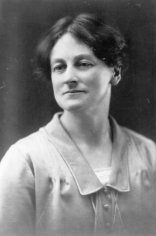
Biddy circa 1935; Wheaton Special Collections Library
I’ve written before about the surprise of discovering I’m an expert. I hadn’t expected that.
But ask me anything, domestic, about Oswald Chambers or Biddy and I probably know the answer.
As a result, the two became real to me–and my family and some of my long-suffering friends.
(Do I still have friends?)
I now “pull a Biddy,” when I decide to believe something about God that doesn’t make sense, or when I choose to have faith.
Even my husband, a true OC fan, wearied of hearing about his opinion “the good is often the enemy of the best,” when we house hunted three years ago.
We speak of them in shorthand, now, and discuss them as often as we tell family stories.
They’ve become part of our life.
And that’s why “the end,” hit me so hard.
How can this be the end?
It’s not, of course. I have months of work ahead of me to clean up the writing, make sure I got all the stories inserted, and work with the publishing process.
But the sweetness of it being just me and the Chambers family, deciphering what is important to tell and what is superfluous, has come to an end.
The story is done, it’s just editing now and I’ll miss the fun of learning something new about them every time I . . . google . . .
Of course, like Biddy did for 49 years after her husband’s death, I’ll live with OC’s words each day at www.utmost.com.
They’re Biddy’s words, too, because she put them together.
And I’ll always love her for it.
I’ll be writing more and in far greater detail the rest of 2016 and all of 2017.
Mrs. Oswald Chambers–Biddy’s life but also a story of Oswald Chambers’ domestic life and how that translated into their personal Christian walk–will be published by Baker Books in the fall of 2017.
Watch for more information here on my website, or sign up for my periodic newsletter here (this month it will feature OC and Biddy’s love story)
You’ll forgive me–I think I need to cry a little more
Tweetables
An author’s tears, Mrs Oswald Chambers and the words “the end.” Click to Tweet
How does the biographer say goodbye to Oswald and Biddy Chambers? Click to Tweet
Mr and Mrs Oswald Chambers–just starting to tell their story. Click to Tweet
The post A Writer’s Emotions and The End appeared first on Michelle Ule, Author.
August 9, 2016
12 Brides of Summer: Mary Connealy
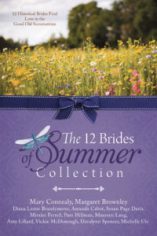
A Bride Rides Herd is the perfect title for The 12 Brides of Summer novella by Mary Connealy.
Betsy Tanner is busy riding herd on a number of children and Matt steps in to help–since he’s related to them, too.
While not a sequel to last Christmas’ The Advent Bride, A Bride Rides Herd follows up on stories from several of Mary’s full length novel series and two books in particular: Calico Canyon and Husband Tree.
Mary couldn’t help herself.
“Once I thought of revisiting the old families from the Lassoed in Texas series, the Montana Marriages series and the Sophie’s Daughters series, I just got really excited. I love all of those folks!”
Mary explained how the stories all fit together. Fans will recognize and be excited to see what happens A Bride Rides Herd follows up on stories from several of Mary’s full length novel series and two books in particular: Calico Canyon and Husband Tree.
Mary couldn’t help herself.
“Once I thought of revisiting the old families from the Lassoed in Texas series, the Montana Marriages series and the Sophie’s Daughters series, I just got really excited. I love all of those folks!”
Mary explained how the stories all fit together. Fans will recognize and be excited to see what happens next:
“The first born son of Grace Reeves (Daniel already had five sons when Grace married him) finds and married The Husband Tree heroine Belle Tanner’s youngest daughter, Betsy.
Matt Reeves and Betsy Harden run the gauntlet of ranching and childcare (Betsy’s babysitting for three little girls with way too much Reeves blood flowing in their veins), because Betsy’s big sister Sarah married Mark Reeves and left Betsy to babysit while Mark and Sarah went on a cattle drive.
Matt and Betsy fall in love right under the drawn gun of famously overprotective Belle and Silas Harden.”
Obviously, the story is set in the same American west as Mary’s other books and that’s pretty much where it resembles her Christmas story.
The American West
“It’s similar in the sense it’s in the American west. And there are children running amok through the stories and there are plenty of sparks flying. But this is a more true western, set on a ranch, than The Advent Bride novella.” next:
“The first born son of Grace Reeves (Daniel already had five sons when Grace married him) finds and married The Husband Tree heroine Belle Tanner’s youngest daughter, Betsy.
Matt Reeves and Betsy Harden run the gauntlet of ranching and childcare (Betsy’s babysitting for three little girls with way too much Reeves blood flowing in their veins), because Betsy’s big sister Sarah married Mark Reeves and left Betsy to babysit while Mark and Sarah went on a cattle drive.
Matt and Betsy fall in love right under the drawn gun of famously overprotective Belle and Silas Harden.”
Obviously, the story is set in the same American west as Mary’s other books and that’s pretty much where it resembles her Christmas story.
“It’s similar in the sense it’s in the American west. And there are children running amok through the stories and there are plenty of sparks flying. But this is a more true western, set on a ranch, than The Advent Bride novella.”
The Advent Bride is available for 99 cents here.
Who is Mary Connealy?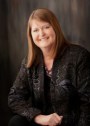
Rita Finalist Mary Connealy writes romantic comedy with cowboys. She has been a finalist for a Christy Award and Inspirational Readers Choice Awards and a two time winner of the Carol Award. She’s the author of over 47 books with more than three quarters of a million books in print. Her latest series, The Cimarron Legacy, begins with book #1 No Way Up releasing in July.
Mary is also the author of the Wild at Heart series, Kincaid Brides series, Trouble in Texas Series, also; Lassoed in Texas, Montana Marriages, and Sophie’s Daughters series and many other books.
Mary lives on a ranch in eastern Nebraska with her very own romantic cowboy hero.
You can find her in a variety of places:
Facebook
Twitter
Seekerville;
Petticoats & Pistols
My Blog
My Website
My Newsletter
Tweetables
Who is Mary Connealy? Click to Tweet
The bride rides herd on what? Click to Tweet
An historical Brady bunch causes havoc for a spinster and a cowboy Click to Tweet
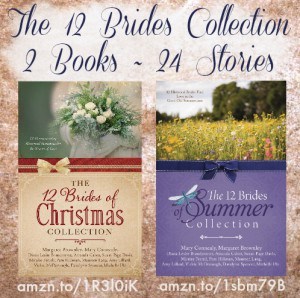
The post 12 Brides of Summer: Mary Connealy appeared first on Michelle Ule, Author.
August 7, 2016
12 Brides of Summer: Margaret Brownley
Best-selling author Margaret Brownley contributed the Dog Days of Summer Bride to The 12 Brides of Summer Collection.
Unlike the other novellas in The 12 Brides of Summer, the Dog Days of Summer Bride is not a sequel to Margaret’s 12 Brides of Christmas story. She explains why:
“It’s hard for me to write sequels because when I finish a story it’s done. All the loose ends are tied up and all the sub-plots complete. Some writers come up with fantastic sequels and I admire that talent. I’m afraid any sequel I write would fall flat.”
Instead, she’s spun a trademark fun tale that matches its title:
Music teacher Miralee Davis hasn’t got a beau but she does have a dog—sometimes. His name is Mozart, but she calls him Mo. He would be the perfect canine companion except for one very disturbing fault; Mo disappears every week like clockwork for three or four days. That wouldn’t be so bad if he didn’t come back looking like a ragamuffin and smelling like yesterday’s fish dinner.
Blacksmith Jed Colbert’s dog Dynamite (Dyna for short) has the same disturbing habit. Only when Dyna returns home he puts the male species to shame by smelling like a dandy.
Neither Jed nor Miralee know they share the same dog until . . . Mozart/Dynamite digs up a stash of stolen loot. The reward will go to the dog’s owner—if only Miralee and Jed could agree on who that owner is. And that’s not all they disagree on
It’s going to take an act of Congress for these two sometime pet owners to see eye-to-eye—and maybe even a little help from a certain matchmaking dog who now answers to the name Dyna-Mo.
Wikipedia Commons
Where did she come up with that idea?“I tried to think of something that went with the summer theme and dog days popped into my head. I’ve had animals in my stories; a love-sick mule and an eccentric cat, but never a dog. I played the “what-if” game and came to a question that intrigued me: what if two people unknowingly owned the same dog?
I went to bed with that burning question in my mind and woke up at four a.m. with my story. It was so much fun to write. Two strangers owning one dog leads to so many fun complications. The dog in question is a black and white cow dog with a very special mission in mind.”
Margaret enjoys writing historical fiction because of the opportunities to do research and learn about past times. She also pays close attention to what her readers like and that informed the writing of The Dog Days of Summer Bride.
“The one thing I noticed from reviews of The Nutcracker Bride [Part of The 12 Brides of Christmas Collection] is that readers loved learning about the history of nutcrackers. Keeping that in mind I included some interesting facts in my story about the dog days of summer and how it got its name.”
Margaret does enjoy story sequels if someone else puts them together:
“My all time favorite move sequel was Toy Story 3. Bawled my head off. I guess I wasn’t ready to let Andy go off to college. Come to think of it, I felt the same way about my own children. I’m anxiously waiting for Finding Nemo two. They better not send Nemo off to college, that’s all I’ve got to say.”
Who is Margaret Brownley?
Best-selling author Margaret Brownley has penned nearly forty historical novels including Undercover Bride, book two in her Undercover Ladies series. Her books have won  numerous awards, including Readers’ Choice and Award of Excellence.
She’s a former Romance Writers of American RITA® finalist and has written for a TV soap and is currently working on a new series.
Not bad for someone who flunked eighth grade English. Just don’t ask her to diagram a sentence.
This is the fourth series Margaret and Michelle Ule have contributed to, including The Log Cabin Christmas Collection, The Pioneer Christmas Collection and The 12 Brides of Christmas Collection.
You can find Margaret here:
Website: www.margaret-brownley.com
Tweetables
Who is Margaret Brownley? Click to Tweet
Who owns this dog? and other @margaretbrownly absurdities! Click to Tweet
Summer’s Dog Dayz ends in romance. Click to Tweet
The 12 Brides of Summer is available at all the usual book selling spots or here.
And for those looking for a complete collection of The 12 Brides of Christmas novellas, you can find them here.
The post 12 Brides of Summer: Margaret Brownley appeared first on Michelle Ule, Author.
August 5, 2016
Safeguards: Bible and Imagination
 What safeguards do imaginative teachers and writers use when turning to the Bible?
I talked about imagination and the Bible in my last post here.
But because we believe the Bible is truth, it’s important to accurately understand it and to be careful not to let our imaginations run wild.
Can heresy can come from an imagination that is not safeguarded from too much creativity, shall we say?
I asked two bestselling Biblical novelists, Tessa Afshar and Jill Eileen Smith, what safeguards they use to ensure their writing is “biblically sound.”
Research is paramount
They both went to same objective standard: research as the key.
Tessa explained it this way:
“We need to understand what is actually present to the best of our ability; this requires historical study, and understanding what was going on at the time, so we comprehend the context of a verse or story.”
The author of more than a dozen novels about women in the Old Testament, Jill starts with research to write well and accurately:
“Creativity and imagination have to be coupled with research. We can’t imagine what “might have been” or envision the setting if we know nothing about that setting.
“Creativity began for me when I started teaching Bible studies and I had to dig deeper.
“Part of digging deeper is to try and understand the life and times, the culture, the era, the geography of the land, the Law of Moses and how it affected daily life (if the Law was given during the time of the story), etc.”
Only once research is done does Jill feel comfortable applying it to the Biblical text on which she bases her story.
Experience and Study
Tessa has a degree in divinity from Yale; she’s studied academic Bible texts and works in Christian ministry.
Jill also read countless books, studied maps and has written about Bible times for many years. Her familiarity means, for her,
“it’s not hard to envision Jesus speaking to his disciples, for instance, and walking along the Sea of Galilee and pointing to a city and saying, “A city on a hill cannot be hidden,” because the cities on hills were right there for all to see.”
Jill has sampled food the Israelites may have eaten (Wild locusts anyone?), and made dishes from a Bible cookbook. She’s attended Jewish Seder meals to better understand the Last Supper.
Christy award winner Tessa grew up in the Middle East and brings an innate cultural background and understanding to her stories. Jill has been to Israel.
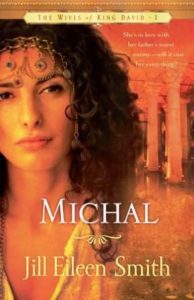
For both writers, a deep understanding of the Bible itself informs their writing and their ability to write Biblical stories with spiritual confidence.
Jill’s first book told the story of King David’s wife Michal:
“I could not imagine Michal’s story, for instance, without studying 1 and 2 Samuel and all about her father, her brothers, her sister, and David.
“It meant even reading genealogies and ages of characters and sometimes doing the math to calculate who lived when.
“To imagine accurately, I needed to be sure it [the story] squared with the whole of Scripture.
“If you get to know a map of Israel, where the tribes were located, where the other enemy tribes settled, you can better understand a lot of Old Testament settings.”
She stressed the importance of understanding the times and the mindset in which the people lived. Their culture was different than 21st century America.
“I don’t change what happened [in the Biblical narrative].
“I only imagine, based on research how it might have come about and from my experience why it could have happened in an imaginative way.”
Without doing the necessary research, Jill pointed out, you can’t know what the original meant. It’s important to read and imagine the Bible stories within their natural context.
Bible knowledge
A thorough knowledge of the Bible enables a writer to “use Scripture to interpret Scripture.”
Jill finished by laughing,
“I don
‘t know nearly as much as I once thought I did.”
“Faith and hope and going back to the Scripture keeps me on track.
“Not straying from what I know from Scripture is true is the only safeguard I probably have.”
Both Tessa and Jill have editors and publish with well-known publishers in the Christian world.
Safeguards are part of their natural life and that of their publishers.
Just as they should be part of ours.
The best way to harness and safeguard our recognition of what is true and right and salutary, is to spend more time in the Word of God than in imagining what it actually says.
The Holy Spirit will guide us in all truth.
We just have to ask.
Tweetables
Biblical novelists on how to use imagination. Click to Tweet
Safeguards for writing Biblical fiction? Click to Tweet
Safeguards: Bible and Imagination Click to Tweet
The post Safeguards: Bible and Imagination appeared first on Michelle Ule, Author.
August 2, 2016
Imagination and the Bible
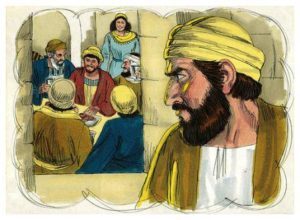
The Prodigal son’s older brothers; Distant Shores Media/Sweet Publishing (Wikipedia Commons)
I use my imagination all the time when reading the Bible.
I put imagination to good use when I teach Bible study.
But what does that mean?
For me, it started when our youth pastor, Paul Anderson, asked, “imagine how the older brother feels,” when discussing the parable of The Prodigal Son.
I was a new-to-Christianity 15 year-old and in the six minutes we were given to write our answer, I poured out a page of ideas and description taken from what I imagined the older brother was feeling and thinking as he stomped away from his father.
When Pastor Paul read the papers, he got what he asked for: one word answers like angry, frustrated, bitter, jealous.
When he opened my page, his eyebrows went up and he read a story.
He didn’t know me well and looked surprised, but grinned. He was the only one who knew who had written it.
I was surprised at the others’ thin answers, but shrugged. I’ve always liked a writing prompt.
Putting yourself into the Bible passage.
I still use that technique when I lead Bible study — I try to take my students into the context of the story to give them a fuller sense of what also may be going on and how this teaching can be applicable to them.
I ask the question: “What would it have been like if you had actually been there?”

A pair of Biblical sandals
Jesus knew what it felt like to have the sun beating down on his head, to scuffle through dusty paths and end up with a pebble in his sandal.He lifted his eyes to hills and saw people desperate for help.
He got hungry.
He got thirsty.
There is no temptation common to man that Jesus did not feel.
We forget the humanity of the Son of God to our peril.
Ours is a God “with flesh on,” who knows what it is to how blood pump through the veins and sun burn the skin.
Is this a legitimate exercise to apply to the Bible?
How does a Bible teacher use imagination when preparing a Bible study?
I asked a novelist and Bible teacher, Tessa Afshar (MDiv. Yale).
Her answer is illuminating, as she notes there are differences between writing a novel and preparing a Bible study.
“The Bible is silent about certain things. It may be what a person feels, their motivation, their background. Many things are left out.
“Trying to imagine how a person in the Bible is feeling is a good way of getting closer to that character as long as we make a distinction between our imagination and what is in fact available to us biblically.
“You can’t make an argument from silence. The stuff that is ultimately Truth, is the stuff that is revealed.”
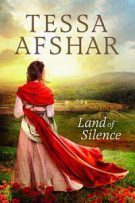 Tessa writes Biblical fiction and applies her imagination all the time, but she’s more strict when preparing a Bible study:
“I like to line up the facts in front of me, then try to understand the emotional impact from there.
“For example, my last book was about the woman with the issue of blood. What do we know about her, biblically? We know she was sick for 12 years. She went to lots of doctors. They couldn’t heal her. They charged her so much money, she went broke.
“The nature of her illness made her an outcast. She was considered unclean. Few people would have touched her.
“Now, you can ask yourself (activate your imagination), how would a person like this feel? What would she battle against?”
Tessa’s questions about the text ask the reader to consider what they would feel like in the situation to get a better grasp of how and why this parable or the story would be meaningful to them.
It’s a way of making the Bible come alive and connecting with God better.
But can you trust your imagination when reading the Bible?
Tessa has an answer:
“I think the more biblical facts you have as guard rails, the less you will be likely to allow your imagination to go too far.”
Where do the safeguards come from when imaginatively reading Scripture?
Biblical novelists Tessa Afshar and Jill Eileen Smith will have answers next time.
Tweetables
Using imagination with Bible reading. Click to Tweet
How to apply imagination to the Bible. Click to Tweet
Can you imagine how Jesus felt? Click to Tweet
The post Imagination and the Bible appeared first on Michelle Ule, Author.



![[image error]](http://en.wikipedia.org/wiki/File:Union_Pacific_Logo.svg)
![[image error]](http://commons.wikipedia.org/wiki/File:Heber_UP618.JPG)
![[image error]](http://commons.wikipedia.org/wiki/File:Kilted.jpg)
![[image error]](http://commons.wikimedia.org/wiki/File%3AGranite_Enjoying_A_Stick_2.JPG)