
Michelle Ule's Blog, page 64
April 29, 2016
Native Americans and the Gospel: A Flight of Arrows
 Lori Benton is a fine writer whose most recent novel, A Flight of Arrows, fascinated me with its approach to the Christian gospel message.
Since I do not believe Jesus Christ looked nor acted like a 21st century American, I’ve long been intrigued by how people portray him and his message in other cultures.
You can read my reaction to the Quechuan descriptions of the Gospel in Slash Marks the Very Good Trail, and how an Alaskan missionary commemorated Jesus’ message on a totem pole.
Lori recently answered a series of questions I posed about the writing of the book, set in 1777 upstate New York:
What sort of research did you do to determine HOW Native Americans of that time and place would respond to the Gospel?
“The same sort of research I do for any other aspect of my novels—a great deal of reading! I recommend anyone interested in learning more about this subject read Forgotten Allies by Joseph T. Glatthaar and James Kirby Martin.”
In particular, the word choices caught my attention–were those what was used or did you put those words into their mouths?
Some of both.
“As often as I could I would borrow the recorded words of Oneida believers and put them, or words similar, in the mouths of my characters.
“But as it is with sort of historical person you are trying to portray, the more you read and absorb their own words (from historical documents, journals, etc.), the easier it becomes to imagine similar characters saying similar words.You find the rhythm and the language and it begins to flow. You begin to think in their manner of expression.
“In the case of the Oneida, this comes after having researched not only their Christian beliefs at that time, but their traditional beliefs and their culture as well. I wanted to understand the life and mindset these men and women came from, as well as the new life in Christ they embraced. Or understand it as well as a person living in the 21st century can.
“The rest is filled by empathy and imagining what it is like to be another person, something all fiction writers have to master to some degree.”
How did you “translate” the Gospel into Oneida terminology for A Flight of Arrows?
“Through my research. Oneida believers of that time were often educated and literate. They left records of their beliefs, or others made records of their sermons and speeches. Yes, there were Oneidas who preached in their own, and other, churches in the 18th century.”
In the novel, settlers and Oneidas are divided and united by a choice a desperate soldier made 20 years before. The second book in the Pathfinder series presents the spiritual growth found by both sets of individuals after a recognition of the Gospel portrayed in the first book of the three-part series, The Wood’s Edge.
I appreciated Lori’s honesty in showing how reading the Bible and confronting difficult, grim circumstances as a result, played out in the character’s lives.
Different from many novels, the simple acceptance of the truth by the Oneidas in particular, touched me. I knew missionaries such as David Brainard had worked with native Americans in the area, but was Lori’s depiction of spiritual growth authentic? Did the native Americans have churches in their villages–which were relatively sophisticated even by the standards of the European settlers?
“I tried not to present these characters in any way that wasn’t substantiated by my research, particularly the example of individuals recorded in history.
“Some Iroquois towns had their own churches, yes. There were as many variations and “flavors” of Christianity among them as among any people group.”
The Cherokees during the same time period lived in villages with churches in what was in many ways a superior culture to the Europeans around them.
Lori’s desire in writing about the exercising of faith was to present an accurate account and the best way to do that was through her own relationship to God.
“There is a lot of fervent prayer behind it. I really, really wanted to present this aspect of the novel respectfully, accurately, and unflinchingly. At times it seemed overwhelmingly beyond

me to do so.
“I try not to lose sight, daily, of my need for God’s inspiring Spirit to help me write my novels, from finding the right research sources to the daily choice of one word after the other.”
As with any novel that has inspiration at its heart, A Flight of Arrows relied on the author’s sensitivity to both the culture and God. Did writing the book affect her faith?
“I think it’s more a matter of my personal faith having had an impact on how I presented the cultural implications of the Gospel upon characters like Good Voice and Stone Thrower and Two Hawks.
“Specifically, I don’t believe accepting Christ as Savior means a person has to renounce their entire culture, whatever that may be, and mold themselves into a certain way of speaking, dressing, eating, and day to day living in order to be acceptably “Christian.”
“Otherwise I think we’d all be wearing togas or robes or whatever they wore in the first century AD.
“I do believe there are aspects of every culture, in every time period (including our secular culture in the United States), that do not glorify God, and a person must take seriously that we are to be sanctified, set apart, for God’s pleasure and purpose, and be clear about what that means between them and God.
“Sometimes this means refraining from some aspect of our culture we formerly embraced or thoughtlessly participated in. But it doesn’t mean we completely cease being who we are.
“It means that first and foremost our citizenship is in heaven. We are new creations in Christ, a new people in our hearts and minds. Whether we wear a toga, a breechclout, or a pair of Levis isn’t important.”
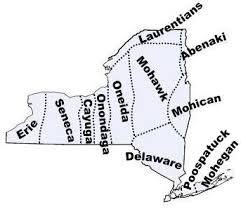 A Flight of Arrows can be read without a knowledge of its predecessor, The Wood’s Edge, not to mention the multi-Christy award winning Burning Sky, but Lori’s books are so splendid and written in such a beautiful way, why cheat yourself of an enjoyable experience?
Tweetables
Oneidas and Christianity during the Revolution. Click to Tweet
Cultural sensitivity, Oneidas and A Flight of Arrows. Click to Tweet
Author Lori Benton on spiritual authenticity and A Flight of Arrows. Click to Tweet
The post Native Americans and the Gospel: A Flight of Arrows appeared first on Michelle Ule, Author.


April 26, 2016
Genealogy: Searching for the Posey House
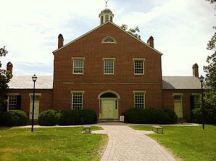
Not the Posey House, but close! (Wikipedia–Port Tobacco Courthouse)
While on my five-year genealogy hunt one day, I took my innocent children and niece on a search for the Posey house.
I’d stumbled upon a photo of it during a hurried three-hour session in the Allen County Genealogical Library in Fort Wayne, Indiana.
On that particular summer, my family was recovering from 20 years of a military life following my husband’s retirement and we stopped to visit friends from Los Angeles to Maine.
In about five weeks.
(Hey, after four years in Hawai’i we needed to blow all the carbon out of our poor van’s exhaust pipe!)
We’d spent two days with friends attending Concordia seminary and while my husband and children helped them move into an apartment, I spent three hours in a terrific treasure trove of material.
Among all that rich material was a drawing and a reference that it was standing near Port Tobacco, Maryland.
Still standing from 1640?
It was allegedly the oldest house in Maryland.
Fascinating.
And we were going that way.
Three weeks later, my husband long flown back to California to work, the Library of Congress intern (niece), two teenagers (boys), elementary school student (boy) and preschooler (girl) found themselves with me driving over the Governor Nice Bridge into Maryland.
We stopped at the visitor’s center and I asked about the house–which I’m going to call the Posey House just to preserve privacy.
The two docents weren’t sure but when I showed them the drawing and gave them the alternate name, they thought a local historian might know.

An old house for sure!
They called him on the phone.
He did know it.
He gave me convoluted directions that involved approximate mileage, a pink former electrical shop and a rutted clay road going up into the woods. “Good luck. It’s back there, but may be overgrown. You’ll see the sign and then you’ll know you’re there.”
Everyone in the car under 25 looked skeptical. They wanted to play with old friends in Annapolis.
But I had the keys and off we went.
Once the mileage approximated the historian’s guest, we kept our eyes peeled for anything on the broad highway.
Wait, was that it?
We had to turn around and backtrack, but there was a small cinderblock building painting a fading pink with a vague sign. A clay road climbed the embankment behind it into the woods.
Why not?
We bumped up and then down the road, passing several lovely old mansions tucked into the thick Maryland woods. The road came to an end at a split rail fence and there was the sign.
We’d found it!
I saw a woman working in a flower bed. I got out with my camera.
She was understandably suspicious, but I explained what I was searching for, who I was and pointed to my Hawai’i license plates. I’d obviously traveled a long distance.
I distinguished myself by knowing a great deal about the Posey family (of course–Francis Posey was my immigrant ancestor, arriving in Maryland in 1627. He son probably built the house).
She allowed me to take some photos and the kids got out and stood in front for a shot taken by my niece.
I appreciated her letting us do that and gazed a long time at the tiny middle section of the house that allegedly had stood for more than 300 years.
As I turned to return to the car, my five year began to dance.
She had not used the rest area . . .
The Posey house owner looked decidedly put out and I didn’t blame her. I hushed my daughter, but the woman threw up her hands. “All right, she can come into the house and use the facilities.”
I brought my camera and took some photos of the interior.
We profoundly thanked her.
I stood beside the van as my daughter climbed in, waved at the woman and looked around at the breeze dancing the woodland leaves.

The land, we knew, was Posey property long ago.
Eight generations back, my ancestors had lived on this land–though probably not this little house (research done today suggests the oldest section dates from circa 1750 at the earliest).
Francis Posey had sailed a ship from a nearby dock to attend the Maryland Legislative Assembly as the Port Tobacco delegate.
Benjamin and Bennett Posey had lived nearby and known the property when their parents both died prior to the Revolutionary War. They’d joined the Continental Army from this neighborhood.
One day after the war ended, they rode away to their destiny farther west and never returned.
I was the first one in that long line of descendents–along with the children–to come back.
Curious how genealogy allows time to fold over on itself and you catch just a glimpse of the past.
Thank you to that unknown woman who owned the Posey House and the kindness of strangers who provided directions.
Tweetables
A dancing five year-old and a peek inside history. Click to Tweet
The kindness of strangers and historical roots. Click to Tweet
Genealogy and the family vacation. Click to Tweet
The post Genealogy: Searching for the Posey House appeared first on Michelle Ule, Author.
April 22, 2016
A Dream of Loved Ones–For Comfort

She was prettier in the dream.
I knew it was a dream as I stood on the balcony overlooking the sweeping view of the Los Angeles harbor.
My parents loved that view.
I turned and recognized the french doors leading into their condominium.
The door stuck slight on the thick carpeting, as always, when I pushed it open.
I cocked my head in surprise when the UCLA grandfather clock ticked in the wrong corner.
That clock stands in my son’s house.
But then in an unexpected mirror, I caught a glimpse of her and willed time to stop.
Surely if I didn’t move, I could freeze the moment and maybe get a good long look–like a draw of water after a long parched walk.
But then she came around the corner of the kitchen and smiled.
I moved slowly.
When I reached her, Mom pulled me close.
I nestled my face in the crook of her neck and sobbed.
We stood together until my crying was done.
When I stepped back to look at her again, she was gone.
But sitting before me was my father wearing his sky-blue polo shirt with UCLA written in gold script above the pocket.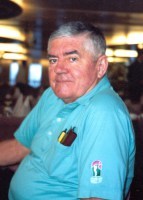
Full of face and cheerful like I hadn’t seen him in so very long, he smiled in his old teasing way.
“Dad, what are we doing here?”
He gestured, and two energetic white poodles ran in–unheard of in their home–followed by two little girls and a realtor showing the condo to their mother.
I gazed about, puzzled. Hadn’t I packed up everything and moved it?
When the pups approached, I scratched their ears and smiled at the girls. “Would you like to see what my children loved about this place?”
I opened a secret cupboard that had never been there before, and found it stuffed with odds and ends–markers, an old family quilt, linens.
The girls ran off and I started pulling out items. This cupboard needed to be emptied if the condo was for sale.
When I looked up, my father had disappeared and my very-much-alive brother stood at the sink with a glass of water.
“I thought we sold this house a long time ago,” I said.
He shrugged. “We did.”
I felt the dream seeping away as they always do and tears slipping down my face as I woke.
I wanted to hold on to the vision, to bury my face in it, to savor it.
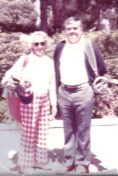
The happiest days
I miss my parents so very much.
When I began to sob, the kitten we adopted a month after my mother died, jumped on to the bed and yowled.
She’s a vintage cat now, 20 years old.
I wished I was still in the dream.
But I know why that dream of comfort came today.
A vision and Biddy Chambers
I’m writing a biography of Biddy Chambers and I’ve been working on the chapter immediately following Oswald’s death in 1917.
Biddy traveled to Luxor to mourn following the Cairo burial.
When 18 year-old Bessie Zwemer came to visit, they sat outside along the Nile and talked about Oswald.
He had been instrumental in Bessie’s spiritual growth. The daughter of missionaries whom Oswald had nicknamed Bulger was devastated God would have taken him.
As they sat in the lengthening dusk talking about Oswald, Bessie gasped. “Do you see him here just now?”
Biddy looked toward a nearby table. “Who?”
“Oswald, sitting at the table as natural as ever, though more radiant. He spoke to me. He said, ‘Bulger, let not your heart be troubled. It’s all right; you can’t understand God’s ways but get down into His love. Don’t lose your grip. Be radiant for Him.”
Biddy smiled sadly. She hadn’t seen anything, but Biddy told the girl she believed Bessie had seen a vision.
When my young assistant read that scene, she shook her head. “I don’t believe, theologically, there’s such a thing as ghosts, do you?”
No, but I explained loved ones can appear in dreams as a comfort to us.
Bessie thought she had seen a vision. Biddy knew the girl mourned and seeing what comfort it brought Bessie, Biddy agreed.
It was the loving thing to do.
I saw my late parents early this morning in a dream.
I’m still crying for missing them.
But I’m so glad they came and brought me comfort.
Really, isn’t that what sweet dreams are for?
Tweetables
Dreams and loved ones: for comfort. Click to Tweet
Grief and the comfort of dreams and visions. Click to Tweet
Mom and Dad tears–it was only a dream. Click to Tweet
The post A Dream of Loved Ones–For Comfort appeared first on Michelle Ule, Author.
April 19, 2016
Barnabas the Encourager
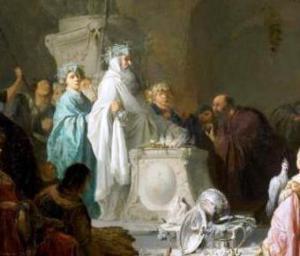
Paul and Barnabas healing at Lystra (detail); Willem de Poorter (Wikipedia Commons)
Do you, like the Apostle Paul, have an encourager in your life?
Someone who can lift you up when the chips are down and help you start all over again?
Who whispers in your ear: “You can do it, you can do it, I know you can!”
In this post, I provided a biography of Paul’s companion Barnabas, but the more I thought about Barnabas, I realized other important facts.
What would you do if while talking about Jesus to a bunch of folks, you watched them grow unsettled and angry?
Oh, not all of them of course, you pressed on with the good news because you could see in faces and hear in questions, that some people genuinely wanted to know about Jesus’ death and resurrection to take away the sin of the world.
No big deal?
Eternity rested on it.
But a group of others–who specifically are described as being jealous–didn’t like your message. They didn’t want other people to even hear what you had to say because it might require them to consider the truth of Jesus and thus lose face, power and money.
(Which begs the question why would you trust people for whom pride, power and money are the most important things?)
So, these self-focused individuals decided to beat you up, chase you away or maybe, for good measure, kill you.
If you were Paul, a small, possibly lame man with a big brain and a large mouth, wouldn’t you want an encourager beside you?
We know what Paul went through because he catalogued the grim list:
But in all things we commend ourselves as ministers of God: in much patience, in tribulations, in needs, in distresses, 5 in stripes, in imprisonments, in tumults, in labors, in sleeplessness, in fastings; 6 by purity, by knowledge, by longsuffering, by kindness, by the Holy Spirit, by sincere love, 7 by the word of truth, by the power of God, by the armor of righteousness on the right hand and on the left, 8 by honor and dishonor, by evil report and good report; as deceivers, and yet true; 9 as unknown, and yet well known; as dying, and behold we live; as chastened, and yet not killed; 10 as sorrowful, yet always rejoicing; as poor, yet making many rich; as having nothing, and yet possessing all things. (2 Corinthians 6:4-10 NKJV)
Note that fifth word: we.
Paul didn’t go through all that alone.
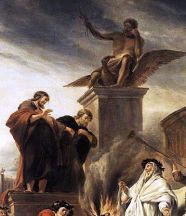
Lystra again; Barnabas to the left, undoubtedly praying by Nicolaes Berchem (Wikipedia Commons)
Bible studies teach all the time that Barnabas’ name means “encourager,” but I’ve never heard anyone point out that while Paul suffered so much, Barnabas was in the middle of it with him.
His clothes were torn, he was beaten, stoned, chased, screamed at, lied about and persecuted.
Yet, he remained by Paul’s side through that entire first missionary journey, enduring the price required to tell people God loved them.
When the situation turned as dreadful as it so often did for Paul, Barnabas stood with him and perhaps said,
“That was interesting. Shall we be on our way and try again?”
A learned man who knew the Torah inside and out, Barnabas ministered beside Paul, stood with him and up for him, and encouraged him to keep going.
May we all have people in our lives like that.
Surely we do, if we know how to recognize them.
Patron of the arts as encourager
For my part, I’m surrounded by encouragers, starting with my patron of the arts, er, husband.
He’s supported me and encouraged me through our whole life together and certainly on my writing career.
But I’ve had Navy wife pal encouragers, who stood with me in some of the worst moments of my life. They’ve hugged me, helped me, and cried with me.
Sad, yes, but encouraging that I was not alone in whatever challenge I faced at the moment.
They were there when the submarine and my husband were not.
My parents supported and encouraged me; my prayer partner does the same. Even the children are old enough now to cheer me on.
Not everyone has been as fortunate as me, but the Bible tells us
God is faithful, who will not allow you to be tempted beyond what you are able, but with the temptation will also make the way of escape, that you may be able to bear it. (1 Corinthians 10:13 NKJV)
Sometimes “being able to bear it” means someone is helping you carry that load.
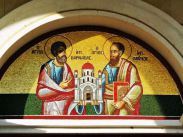
The encouragement of each other built the church for eternity. By Молли (Wikipedia)
Encouragers are special but we all have the ability to open our hearts and minds, to pray, to come alongside and help bear the burdens others struggle with.
Be a Barnabas for a friend.
It’s important to note Barnabas did NOT always agree with Paul. They parted company when Paul refused to be an encourager to a young man who had disappointed him.
What might appear to be a failure, was by God’s grace, a means of doubling the Gospel’s spread into Asia Minor.
Countless more people were encouraged into eternity as a result.
Who’s the biggest encourager in your life?
Tweetables
Barnabas as a beaten yet not defeated encourager. Click to Tweet
Encouragers may not always agree with us. Click to Tweet
Being an encourager sometimes means getting beaten up yourself. Click to Tweet
The post Barnabas the Encourager appeared first on Michelle Ule, Author.
April 15, 2016
Who was Barnabas?
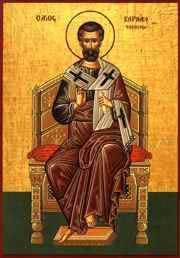
Portuguese icon of Barnabas [Public Domain]
Barnabas was an important member of the early Church and I’ve been running into him lately as I study the book of Acts.
His name is generally understood to mean “son of encouragement,” and he certainly played that role for the Apostle Paul and others.
But who was he and where did he come from?
Barnabas wasn’t the name given by his parents at his birth. They called him Joses (Joseph) and he came from Cyprus of Levite parents.
His father, therefore, was a priest who carried out temple duties. (The supposition is the family lived in Jerusalem but then relocated to Cyprus–whether before or after Barnabas’ birth, no one knows).
Barnabas came from a learned household and thus he would have known the Old Testament Scriptures well. He could recite the Torah (the first five books of the Old Testament) verbatim.
At some point, Barnabas wound up in Jerusalem following Jesus’ resurrection. It’s not known when he became a believer, but he sold his land and gave the proceeds to the apostles in Jerusalem (Acts 4:36), setting the example that Ananias and Sapphira didn’t follow in Acts 5.
%2C_1637.jpg)
Paul and Barnabas at Lystra by Bartholomeus Breenbergh [Public domain; Wikimedia]
It appears (based on Galatians 2:13) that he never married.Fellowshipping with the apostles, living in communion with all the saints, Barnabas was in Jerusalem when Saul began his rampaging persecution of the Christians.
Barnabas saw the wonders God performed. His encounter with the risen Christ may not have been in person, but through faith. His was a rugged faith, sustained even after Stephen’s martyrdom in Acts 7.
Indeed, Barnabas did not flee Jerusalem during the persecution, but remained with the “senior” Apostles. He was in town, therefore, when the astonishing news reached them that Saul the persecutor had recanted and now proclaimed Jesus Christ as Lord.
Bible scholars know Saul studied the Scriptures for three years before he began his missionary journeys. Many suspect that time out of the public eye may have been after Saul saw the light in Damascus and before he came to Jerusalem seeking an audience.
If that fits into the timeline, it had been three years since Saul’s murderous rampage.
When Saul sent a message to the apostles asking for a meeting, they demurred. Brave Barnabas, however, met with Saul and served as the mediator between Saul and the apostles. (Acts 9:27)
So was Barnabas amiable or a practical investigator?
Whichever, Barnabas had a position of trust–spiritual as well as personal–with the other followers of Jesus. When the apostles received news of a possible revival in the area of Antioch (now Antakya, Turkey) 300 miles north of Jerusalem, they sent Barnabas as a fact-finder.
Since he had correctly identified Saul as one of them, he should be able to recognize if a bonafide work of the Holy Spirit had broken out in the north.
“When he came and had seen the grace of God, he was glad, and encouraged them all that with purpose of heart they should continue with the Lord. For he was a good man, full of the Holy Spirit and of faith. And a great many people were added to the Lord.” (Acts 11:23-24)
Barnabas, obviously, was also an evangelist.
His willingness to listen and weigh carefully may have been the reason the apostles decided Barnabas should travel with Saul–now called Paul–as he shared the gospel of Jesus Christ.
If anyone could keep that firebrand loose-cannon Paul in line it was Barnabas.
The two men traveled together on a missionary trip, including Barnabas’ cousin John Mark as a fellow traveller. (Mark didn’t finished the trip thus disappointing Paul, which caused “trouble” later).
They visited cities along the southern coast of what is now Turkey, with occasional forays into the interior. The churches in Galatia knew him.
Barnabas also was on hand in Antioch, Pisidia when the entire town came out to hear Paul speak. Like Paul, he shook the dust off his feet as he left that city.
Much has been made of Paul’s ability to speak in the synagogues as he traveled. Paul’s exceptional learning was important while preaching the gospel, but Barnabas’ Jewish credentials should not be forgotten. He knew the Scriptures just as well as Paul did and had walked in faith longer.
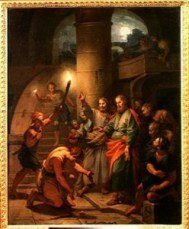
“The Deliverance of St. Paul and St. Barnabas” by Claude-Guy Halle [Public domain]
Paul needed Barnabas–as a companion, a fellow believer, and a more balanced personality. The two worked well together.The devout Barnabas was appalled when people in Lystra who had seen them pray for a man to be healed decided they were Greek gods.
When they called Barnabas “Zeus,” and Paul “Hermes,” (would this have been because Barnabas was a bigger physical man than Paul?), the two men both tore their clothes and cried,
“Men, why are you doing these things? We also are men with the same nature as you, and preach to you that you should turn from these useless things to the living God.”
Barnabas did not forget his place in the kingdom of God.
He was willing to take on Peter and the other apostles as they all grew in a deeper understanding of the fledgling faith. He and Paul both spoke at the Jerusalem Council. They had seen the devotion of “non-Jewish” believers. They knew God welcomed Jews and Gentiles both into his kingdom on account of Jesus’ death on the cross.
Division between Barnabas and Paul
While the two men traveled and worked well together, they parted ways on a subsequent mission trip, Barnabas suggested inviting his cousin Mark along again. (Acts 15:39-40)
When Paul refused to budge, Barnabas and Mark set off together for Cyprus leaving Paul to travel with Silas through Syria and Cilicia.
What looked like a failure actually ended up being a success as the gospel was preached in twice the places.
The Scriptures do not mention what became of Barnabas after his separation from Paul. Some believe he was martyred, others believe he ended his life in Cyprus, probably martyred.
He’s considered the patron saint of Cyprus by the Greek Orthodox Church.
Barnabas’ influence on Christianity cannot be denied. Without his courage in giving Paul a chance to demonstrate his love for Jesus . . . God would have had to work in another way.
Bible studies like to remind us all of the value of an encourager.
Barnabas, acting in faith and a keen leading of the Holy Spirit, is an excellent example may of us should emulate.
Tweetables
Who was Barnabas of the New Testament? Click to Tweet
An encourager or a saint? Barnabas. Click to Tweet
A risk taker led by the Holy Spirit: Barnabas. Click to Tweet
The post Who was Barnabas? appeared first on Michelle Ule, Author.
April 12, 2016
A Story Idea in 3 Blocks or 1 Minute.

What if? by By Elvert Barnes (Wikimedia Commons
I got a story idea this morning on the way to church.
It hit me and came in only three blocks (my husband was driving).
Writers always get asked where story ideas come from.
This is an example of how my brain worked this very morning.
Driving along and letting my brain roam.
Seeing something odd–in this case a man wearing a long black raincoat walking in the bike lane against traffic.
Noticing he had walked away from a bicycle–which was parked with its kickstand down.
Idle thought–when had I last seen a bike parked with a kick stand?
Second idle thought–wouldn’t that long raincoat get in the way of pedaling the bike?
Where would he have been going on an overcast Sunday morning at eight o’clock?
He didn’t look like he cared he wasn’t wearing a helmet.
One block past, another bike rider–also sans helmet–was riding along, slowly.

This was NOT the bike. (Wikipedia Commons)
He wasn’t wearing a raincoat.
Were they together?
Who first thought of using a wheel to move faster?
How long ago was that?
Bicycles began to be popular circa 1880. Who invented the first popular bike?
Was it challenging to ride bicycles on cobblestones?
Two blocks past–were the tires originally wood?
Who would have made the first tires for bicycles in rural America?
Were blacksmiths involved in putting together tires and if so, what did they think of the first person to come to them with a bicycle idea?
What would it have been like to have helped put together an early bicycle in a small town?
What would that man, working outside, have thought the first time he saw a bicycle ridden away–probably on a dirt path?
Would it have made him want to learn to ride one as well, and to explore the world?
Or would a bicycle manufacturer have been content merely to build bicycles for others to ride?
If it wasn’t originally his idea would he have tinkered with the concept?
Then what?
Three blocks and my mind was afire.
But I was going to church, so I filed it away.
Don’t have three blocks? How about one minute?
I come up with another idea in less than a minute yesterday.
A friend asked if I would be interested in contributing for a novella collection centering on stories set on a body of water during the 19th century.
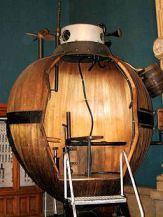
The actual Turtle submarine (Wikipedia Commons)
I loved the idea, given my past, of writing a short romance about one of the first developers of an American submarine. Either the Turtle or the Hunley.
Think of the drama as a determined engineer tries to put together his warship while his girlfriend watches in dismay.
He could die!
It could sink (it’s supposed to sink!), but he might not survive!
(Wait, this idea may be hitting too close to the girl I once was . . . That means I could write with genuine feeling!)
I loved the idea.
But, alas, I’m too busy right now to write for the collection.
Still, the germ of the story idea came in no time.
All I needed was a little time, access to Google (that’s them screaming–“not her again!”) and I’m ready to write.
How about you?
Set a timer.
Can you come up with a story idea in less than a minute?
What if I gave you three blocks?
Tweetables
A story idea in a minute? Click to Tweet
Plotting an idea in three blocks. Click to Tweet
How the mind dreams up a story: a description. Click to Tweet
The post A Story Idea in 3 Blocks or 1 Minute. appeared first on Michelle Ule, Author.
April 8, 2016
Shock and Faith: Saul and Ananias
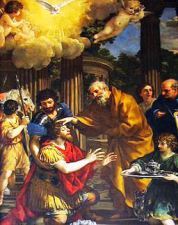
By Pietro De Cortana (Wikipedia)
Who was more shocked, Saul or Ananias after that fateful trip to Damascus?
Both of them displayed shock, faith and courage in following what God had just dumped into their lives.
For his part, Saul/Paul of Tarsus was on a zealous mission to defend the God whom he believed members of The Way–Christians–were blaspheming.
He had received warrants to arrest those infidels, handcuff them into chains and drag them back 135 miles to religious authorities in Jerusalem.
A noted Jewish scholar, well trained in the school of Hillel, Saul saw the trip as his duty. He needed to protect innocent Jews from the Jesus Way.
God, who loved Saul, saw the situation differently.
Saul on the road to Damascus
The story is well known. As Saul and his friends stalked up the road, God intervened:
Suddenly a light from heaven flashed around him. He fell to the ground and heard a voice say to him, “Saul, Saul, why do you persecute me?”
“Who are you, Lord?” Saul asked.
“I am Jesus, whom you are persecuting,” he replied. “Now get up and go into the city, and you will be told what you must do.”
The men traveling with Saul stood there speechless; they heard the sound but did not see anyone. Saul got up from the ground, but when he opened his eyes he could see nothing. So they led him by the hand into Damascus. For three days he was blind, and did not eat or drink anything.
The light was bright enough, Saul fell to the ground. The friends recognized something significant had happened.
Saul called the voice “Lord,” not necessarily because he recognized God, but out of awe for whomever was speaking to him.
(Notice the voice did not say, “fear not,”so he knew the speaker was not an angel.)
It was Jesus.
Jesus, the man whose followers Saul was seeking to destroy.
Jesus, whom priests Saul knew in Jerusalem thought might be the Messiah, even though Saul refused to believe it himself.
[image error]
the Conversion of Saul by Michelangelo. (Wikipedia)
The men with him heard the rumble of a voice, but apparently not the exact words.
What was Saul to do?
Be thankful he hadn’t been struck down for blasphemy?
He obeyed.
But when he opened his eyes, Saul could not see.
His friends had to lead him into town. They lodged with a friend named Judas, who probably was expecting the men and their mission and therefore would not have been a Christian.
We don’t know how long it took Saul and his companions to reach Damascus.
Meanwhile in Damascus
Ananias, a “a devout man according to the law, having a good report of all the Jews,” albeit a Hellenized Jewish Christian, was worshipping Jesus one morning not long after.
God gave him a vision.
Ananias recognized God wanted him to find Straight Street, a major thoroughfare, and visit the home of Judas–who would not have been a friend of The Way.
Once there, Ananias was to lay hands on a man named Saul.
Fearful he had heard correctly, Ananias asked God for clarification:
“I have heard many reports about this man and all the harm he has done to your holy people in Jerusalem. And he has come here with authority from the chief priests to arrest all who call on your name.”
But the Lord said to Ananias, “Go! This man is my chosen instrument to proclaim my name to the Gentiles and their kings and to the people of Israel. I will show him how much he must suffer for my name.”
God asked Ananias to find a man who had come from Jerusalem with the express purpose of arresting him, hauling him back to Jerusalem before the authorities and probably requiring his life.
Could God really be asking that of Ananias?
What would you do if God asked you?
[image error]
Roman triumphal arch on Street Called Straight, Damascus (Wikipedia)
Shocked, but a man of faith, Ananias found Judas’ house.
Sitting quietly, blind and with both shock and faith warring through his soul, Saul waited.
God had given him three days to contemplate how much he had misunderstood.
Ananias placed his hands on Saul’s head:
“Brother Saul, the Lord—Jesus, who appeared to you on the road as you were coming here—has sent me so that you may see again and be filled with the Holy Spirit.”
Immediately, something like scales fell from Saul’s eyes, and he could see again.
He got up and was baptized, and after taking some food, he regained his strength. — Acts 9:13–19, NIV
Many people see this story of conversion as happening on the road to Damascus.In truth, it happened when Saul participated in the sacrament of prayer, obedience and baptism.
The Holy Spirit had convicted him over three days, but once the opportunity came to submit to baptism, the Holy Spirit entered Saul and his life changed.
Saul loved God, he met Jesus, the Holy Spirit entered his soul and nothing in history was ever the same again.
It took courage and faith to get over the shock of what God had done in Saul’s life on that road.
It took courage and faith to get over the shock of what God had called Ananias to do in prayer.
A willingness to obey God, even if it didn’t make any logical sense changed history.
May God grant us all the faith to overcome shock to obey God and rejoice over how He works in spite of us.
Thanks be to God.
Tweetables
Shock, awe and faith on the road to and in Damascus Click to Tweet
2 men of courage and faith: Saul of Tarsus and Ananias. Click to Tweet
Overcoming shock with faith to change history. Click to Tweet
The post Shock and Faith: Saul and Ananias appeared first on Michelle Ule, Author.
April 5, 2016
Who was the Apostle Paul?
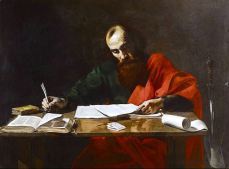
Attributed to Valentin de Boulogne [Wikimedia Commons]
Just who was the Apostle Paul of the New Testament?
I’m leading a Bible study this spring on Paul’s character and after examining the New Testament itself, I’ve been poking around the Internet.
I’ve been surprised.
His was Saul, which means “prayed for,” which translates to Paul in Latin. Since S/Paul was a Roman citizen, he used the names interchangeably for where it made the most sense.
Any Bible scholar knows Paul was a “Pharisee of the Pharisees,” circumcised on the eighth day and the son of a Pharisee (Philippians 3:5).
Born in Tarsus–a large metropolitan trading city on the coast opposite Cyprus’ northeastern corner–Saul grew up in a devout family in a university town.
He had siblings–mention is made in Scripture to his sister’s son–and he was related to Andronicus and Junia who became Christians before he did. (Romans 16:7)

Russian Icon; St. Paul
His family was religious and made sure Saul was well educated. He also learned the tentmaking trade. (2Timothy 1:3; Acts 18:1-3)Growing up in such a crossroads, Saul spoke Hebrew, Koine Greek, Latin and possibly Aramaic. He understood and could speak knowledgeably on Stoic philosophy.
Paul’s superior education.
At a young age, perhaps after his bar mizvah, the family sent Paul to Jerusalem to study with the foremost scholar of the day: Gamaliel, the grandson of Rabbi Hillel.
Gamaliel was a Sanhedrin authority and the school–Hillel–where he taught was noted for including classical training in addition to the detailed Jewish curriculum.
Gamaliel and the Hillel family were from the tribe of Benjamin, like Paul’s family.
(Some also believe Paul may have been a distant relative of the Herodians, based on Romans 16:11.)
Paul took his scholarship seriously and was well known as a brilliant man and scholar.
Some non-Biblical sources described Paul’s appearance as unappealing: a short man with a twisted leg, a unibrow on a florid face.What hair he had on his balding head was reddish; he walked bent over and that may very well have been the thorn in his side.
Whether or not he ever saw Jesus in the flesh while studying in Jerusalem, Paul never said.
He first appears in the book of Acts when the deacon Stephen is stoned to death for blasphemy. Paul may have been a member of the Sanhedrin, determined to prosecute those who defied the Jewish Law.
Paul did not actively participate in the stoning, but took care of the clothing of those who needed a free arm to throw stones. Zeal for God consumed the man and within a few months, Paul approached the religious leaders in Jerusalem asking for warrants enabling him to travel to Damascus to seek out members of “the Way,” who followed Jesus.
He wanted to bring them back in chains to be prosecuted. (It may be worth knowing that while Paul himself never killed anyone, he was involved in arresting Christians in Jerusalem, many of whom were imprisoned and later killed by authorities).
Liking his zeal, members of the Sanhedrin provided the warrants and Paul set off with friends on the 135 mile journey.
Why did Paul go to Damascus?
Some believe Damascus interested him because of the many “Hellenized,” Jews who had become Christians and lived there. These would have been people like him–Jews raised in Greece, speaking Greek, who would have shared his cultural background.
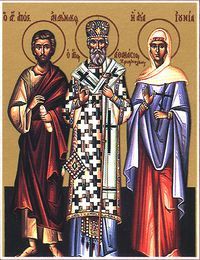
The Eastern Orthodox Church venerates Andronicus, Athanasius of Christianopoulos and Saint Junia
People like his kinfolk Andronicus and Junia.
Scholars believe the trip took place about six months after Stephen’s death, circa 35 BC.
As an overachiever, Paul believed he could do good things for the God he worshipped once he rounded up those apostates and dragged them back to Jerusalem to stand trial.
God, of course, had something else in mind.
I’ll examine the actions of two faithful and brave men, next time.
Tweetables
What did Saul of Tarsus look like? Click to Tweet
Why did the Apostle Paul go to Damascus? Click to Tweet
Classically trained, supernaturally led: Saul of Tarsus Click to Tweet
The post Who was the Apostle Paul? appeared first on Michelle Ule, Author.
March 31, 2016
WWI: Zeppelins and Terror

Publicity Dept., Central Recruiting Depot. Restored by Adam Cuerden. (Wikimedia Commons)
Zeppelins were important to the German army during World War I.
They used them as a terror weapon against civilians.
They also used them, some, to actually fight, but not much. Mostly, they were aimed at innocent civilians.
Count Ferdinand von Zeppelin was the inventor circa 1874 in Germany, making a “rigid” airship. With the idea patented in 1895, Zeppelins began flying passengers–up to 10,000 of them safely by the start of World War I.
Then, military leaders figured out how to use them as bomb delivery systems, sort-of.
At the start of the war, only 10 years after the development of manned flight by the Wright brothers, they were difficult to knock out of the sky, despite their gas-filled bladders keeping them aloft.

They traveled by night, but think how horrifying it would have been to see a shadow like this in the early 20th century. Photo by Oskar Barnack. (Wikipedia Commons)
Small engines drove them through the sky. 518 feet long (longer than a US football field),zeppelins could travel up to 52 mph at the start of World War I. Gas volume was nearly 755,000 cubic feet.Early in the war, the German army and navy (both had zeppelins) learned the ships were vulnerable to ground fire if flown near the ground, so they flew at high altitudes. Nevertheless, the German military lost many ships in 1914 and began 1915 with only four Zeppelins available to the army.
Kaiser Wilhelm did not allow the military to bomb the home city of his cousin, King George V, because it was not “gentlemanly conduct,” until 1915. Even then, zeppelins could not drop bombs on palaces, churches or historic buildings.
Zeppelins attack
The first zeppelin attack came at King’s Lynn. This is how I described the incident in my as yet-unpublished WWI novel:
Raw described the scene in the market town of King’s Lynn. Rubble littered the flooded streets as the rain poured. Stunned survivors in black mackintoshes staggered amid the debris, picking through homes now slumped into piles of broken brick and sodden possessions.
When Claire poked her head into a crumbling house, she smelled clean rain, stinking mud and a tang of sulfur and petroleum. She pulled her cloak closer against the chill and tugged her hat down to her eyebrows. The weather made the appalling destruction worse.
The effect on those on the ground?
“We heard the slow rumble, high above, like thunder only not so sharp or loud. Most did not know what it could be, and then a long gray-white cylinder appeared in the sky, dropping flashes of light. The bombs hit the ground and the noise, ach, the noise; it filled your ears and your mind and threw you to the ground.”
He gulped. “Then the screaming. The air choked with dust and propellant smell. It was a miracle only two died, but that’s little comfort to the families.”
How had the zeppelin found the market town?
“The lights,” an elderly woman said. “Constable Jones said the enormous balloon followed the train tracks along the coast until they came to the lighted city and dropped the bombs. I’ll live in the dark from now on rather than be a target in the electric light.”
Descriptions by the zeppelin pilots detailed how the entire country was lit up, making it easy to find targets.
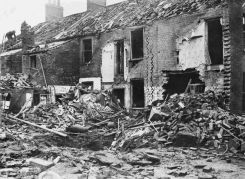
King’s Lynn the day after
The only thing slowing the terror down was foul weather making it difficult for the dirigibles to cross the Channel.
By 1916, the British had developed airplanes that could fly high enough to combat the zeppelins, and they also had invented incendiary bullets.
By September 2, 1916, the British had learned how to effectively war against the ships.
Sixteen zeppelins headed to London that night; one of the flight captains, Ernst Lehmann, described what he saw
“The entire city lay under a luminous mist dotted everywhere with incessant flickering and flashes of bursting projectiles.”
But enemy searchlights seemed more powerful and the ground guns bigger than when the zeppelins bombed during the spring.
“We could see many explosions on the ground, evidently from other ships, but they were hidden from view by the haze, bursting shells and searchlight beams. It was like hanging above a lighted stage in a theater with the rest of the house darkened.”
As Lehmann watched, a single engine biplane flew high above another zeppelin and emptied a drum of ammunition into a small area in the hull.
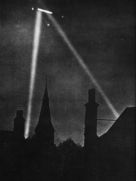
First Zeppelin raid on London
“It immediately began to glow pink. The glow quickly spread forward until the entire interior was lit–resembling a Chinese lantern. Then, suddenly, the tail section burst into flames and the airborne whale began a slow death dive. The falling inferno lit up the countryside for sixty miles around.”
No one survived from the zeppelin–they didn’t carry parachutes to conserve on weight.
Flying so high and in such frigid temperatures as a result, zeppelin operators and bombers were not able to precisely bomb selected targets. Most went astray.
Still, the low slow growl of their engines terrified the populace, particularly in London. They did not win the war, but they served an important purpose: reminding civilians that war could always come to them.
The lesson was applied in a much more dangerous way during World War II’s Battle of Britain.
I grew up seeing the Goodyear blimp flying by almost noiselessly. Moored not far from home, it was friendly and gentle.
Not so for Londoners during WWI.
Tweetables
Zeppelins over London during WWI. Click to Tweet
Effective or merely weapons of WWI terror? Click to Tweet
Longer than a football field, zeppelins were terrifying during WWI. Click to Tweet
The post WWI: Zeppelins and Terror appeared first on Michelle Ule, Author.
March 29, 2016
How a Map Can Make a Difference
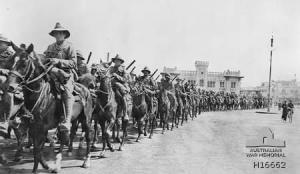
Where is this building on the map below? (Australian War Museum photo)
I’ve just found a map that makes everything clear.
I’ve only been trying to figure out the location of the YMCA camp at Zeitoun, Egypt to to the nearby ANZAC army camp for three years.
Today, while I was hunting “Suez Canal Authority Headquarters Ismailia WWI,” on Google, it turned up.
The map has nothing to do with what I hunted, but I’ll take it.
Did you hear me screaming?
The work, of course, is not done. Now I have to take the photos I have and figure out, from other clues, where things are in relation to everything else.
The map isn’t dated, which is challenging, but I know the New Zealand camp at Zeitoun was set up in January 1915 and operated there until July 1919, so I can’t be too far off.
Here’s the map:
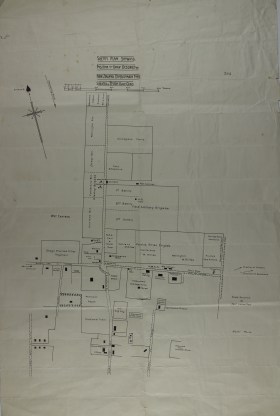
Journey of the Ontagos website (https://journeyoftheotagos.wordpress....)
Here are some photos. Can you figure out where these spots are ON the map?
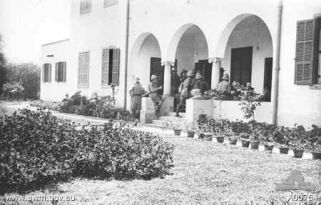
Digger History (http://www.diggerhistory.info/pages-c...)
This is the Imperial School of Instruction, Zeitoun.
I don’t know what the building behind the horses in the photo at the top of the page, but it may be the same Imperial School of Instruction.
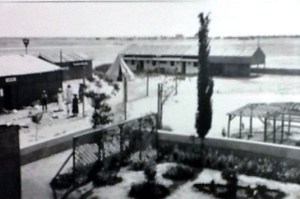
EGM compound (Wheaton Special Collections Library)
The next photo was taken from the Egyptian General Mission headquarters building–which on the map appears to be in the wrong place–it should be at the north end of the “vacant fenced” area.
The term “vacant fenced” indicates the map was drawn in 1915 because that area is the EGM compound and is where the YMCA tents were erected.
The long-roofed bungalow behind the narrow tree faces north.
I know all this because the Chambers family lived and worked on the compound from January 1916 until July 1919.
One of their friends, Miss Katherine Ashe, wrote about the compound, indicating some directions:”The little house faces due North–so that from the front the sunsets were a delight continually.”
As they lived outdoors on the veranda, they could see east and west for both the sunrise and sunsets, which everyone wrote about in glorious detail.
Oswald himself wrote that the EGM compound “happens to be in the camp lines so we will be under military guard.”
I knew they were a mile walk from where everyone caught the trolley into Ezbekieh Gardens in downtown Cairo (down the street from the world famous Shepheard’s Hotel), as well as being close to the railway station.
You can see the arrow midway on the left side of the map.
To the east, complete desert. Seeing the map, it now makes sense.
The map indicates YMCA, which suggests it was done prior to Oswald’s October 1915 arrival in Egypt. While he was there, the YMCA “hut” always was inside the compound.
Seeing the compound amid the camp suggest they probably had access to water (the water mains are clear on the map) and possibly electricity–which explains how Biddy and her helpers were able to serve cold drinks and ice cream in the canteen.
Here’s another photo, probably facing southwest? It was taken from the front of the bungalow:
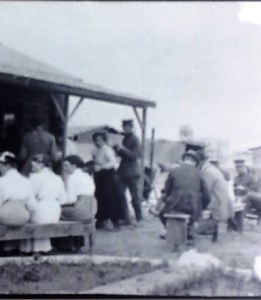
This is the corner of the bungalow, circa 1915, facing southeast (Wheaton Special Collections Library)
What does it all mean?
I can write with confidence, now that I know how everything does or does not, fit together.
Of course, it also means I get to rewrite what I’ve already written now that I know the truth.
As the daughter of a geographer, I love maps.
Tweetables
Finding a map forces rewriting! Click to Tweet
Comparing maps to photos to figure out WWI locations. Click to Tweet
A long-sought map explains WWI camp information. Click to Tweet
One more photo: this one facing south, I think!
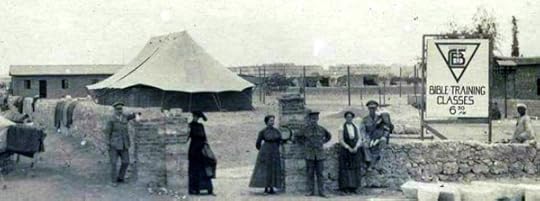
Photo courtesy Birmingham (UK) Special Collections Library: YMCA
The post How a Map Can Make a Difference appeared first on Michelle Ule, Author.



![[image error]](http://commons.wikipedia.org/wiki/File:4paul1.jpg)
![[image error]](http://commons.wikipedia.org/wiki/File:Roman_triumphal_arch%2C_Damascus.jpg)