Michelle Ule's Blog, page 51
July 7, 2017
In America with Biddy and Oswald Chambers
Oswald Chambers visited the United States four different times. Biddy visited twice.
They loved Americans and they enjoyed traveling in the country.
The new world gave Oswald and Biddy their first international publication opportunities.
His first two books, Biblical Psychology in 1912, and The Sermon on the Mount in 1915, were published by God’s Bible School’s Revivalist Press.
They were the only books with his name on them as author that Oswald ever saw in print.
Oswald in America
Oswald first voyaged to America in November 1906 with his Japanese missionary friend Juji Nakada.
Once landed in New York, they traveled to Cincinnati, Ohio, where Oswald taught at God’s Bible School for six months.
He enjoyed meeting the good folks at the school and established lifelong friendships with several.
Oswald taught at several camp meetings during his time, at least one in North Carolina, with a final ten-day camp at God’s Bible School.
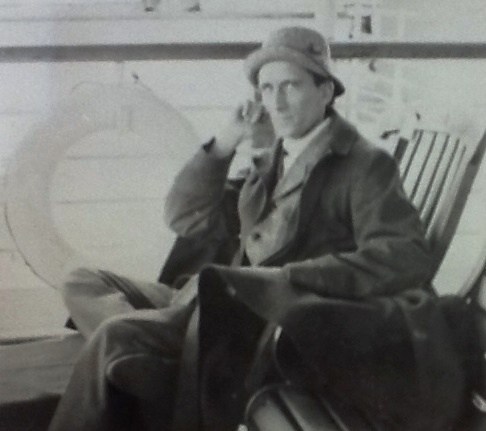
OC returning to England 1910
After his six months of teaching concluded, God’s Bible School provided him with a $500 honorarium.
Oswald and Nakada rode a train across the American continent to Seattle where they caught a ship to Japan.
About the country he wrote to his sister:
“The scenery is superb . . . the Rockies–I cannot hope to describe these to you. Massive, unspeakable heights, all snow-clad. The air raw, piercing and cold; mighty pine trees are clustered in thousands all around; sublime rivers and waterfalls, and daring ingenious railways.
“I have a continual 103rd Psalm in my heart.”
He returned again to speak at Holiness camp meetings up and down the eastern seaboard in 1908, 1909 and 1910.
Biddy in America
Biddy’s first voyage to New York took place in May, 1908 and it changed her life.
While she knew Oswald Chambers before, they became far better acquainted over the ten days they traveled. The two fell in love.
They parted once arrived in New York and Oswald went on to God’s Bible School while Biddy moved in with her friend Marian in Brooklyn.
She got a job and loved working with Americans, as Biddy’s daughter Kathleen explained:
“She thought it was absolutely wonderful because the bosses came in before she did and they worked hard all day long. When it came time to stop work, everybody went home. She loved being in America.”
It’s not clear how long Biddy intended to stay, but based on Oswald’s expected proposal, she traveled back to England with Marian in the fall.
A honeymoon in America
Mr. and Mrs. Oswald Chambers returned to New York in June 1910 and spent the next four months traveling. They traveled as far north as Maine, south to New Jersey and west to Ohio.
Oswald taught at the camp meetings associated with the Holiness Movement and God’s Bible School.
They spent one week alone at Thomas Seifferth’s Meadow Lawn house in Plaaterkill Valley. Oswald used the time to dictate a book that became The Place of Help many years later. As Biddy explained:
“We spent a little while in the exceedingly grand and beautiful Catskill mountains, amidst scenery which left us with the sense of worship expressed by Isaiah, ‘The whole earth is full of His glory.’”
The couple liked Americans and made many friends both in the United States and elsewhere.
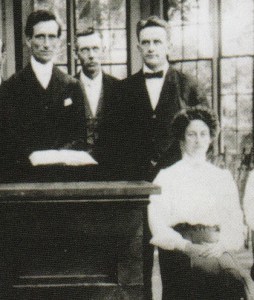
They spent their honeymoon in America at camp meetings with others! (Wheaton College Special Collections)
Among the Americans who meant much to them were Mr. and Mrs. William Jessop, YMCA director in the Middle East during WWI; Samuel and Amy Zwemer, missionaries to Egypt; and Mr. and Mrs. Charles (Lettie) Cowman of the Oriental Missionary Society.
Oswald envisioned life after World War I as an opportunity to serve missionaries with visits and encouragement. He anticipated once the war finished, he and Biddy would open a Bible school.
Where?
He thought if not in England, then possibly in America or Japan.
It all, of course, would depend upon where God ultimately led them.
His most significant work, My Utmost for His Highest, was compiled and published by Biddy in the United States in 1934.
(If any one owns a copy of that first American edition, I’d love to see a photo of it).
Tweetables
What brought Oswald Chambers and Biddy to America? Click to Tweet
Biddy and Oswald Chambers loved Americans–and their work ethic! Click to Tweet
A working and spiritual profitable honey in America for Mr. and Mrs. Oswald Chambers. Click to Tweet
The post In America with Biddy and Oswald Chambers appeared first on Michelle Ule, Author.


July 4, 2017
A 4th of July in Maine
As I told the kids at the time, “this is a real, old-fashioned, American 4th of July. Enjoy it.”
Staying with friends not far from Portsmouth Naval Shipyard, we began the morning with a drive to the coast.
We hiked at Rachel Carson National Wild Refuge, admiring the views and the salty air.
For some reason, the thought of standing on the shore in Maine and feeling the breeze lift my hair, always appeals to me.
Maybe it’s the romance of Maine for a girl from Los Angeles? Who knows.
On that day, the kids–who had just spent four years in Hawai’i followed by a drive across the United States–were missing the beach, so they loved it.
Lobster
The next stop was a lobster shack where we bought, yes, live Maine lobsters.
My five year old’s eyes went very big and round as our friend Tom collected them.
“Are they alive?” she whispered to me.
I nodded, a bit unnerved myself.
When we returned to the house, Tom and his wife Jennifer put two large pots of water to boil on the stove.
“Aren’t you supposed to be tickling them so they relax and fall asleep?” I asked. I’d seen Annie Hall back in the dark ages.
They shook their heads and laughed.
All the children watched with mouths open!
Why yes. With corn on the cob, hot dogs, apple pie and strawberries, the meal delighted us all.
Games
Of course the seven boys played baseball. Maybe the two little girls did the same.
I wore my famous Statue of Liberty hat–which I’d recently purchased at the Statue of Liberty.
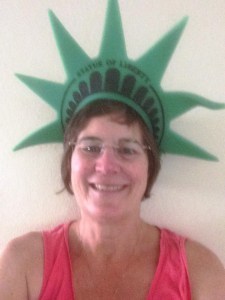
Still fits!
I still wear it on the 4th of July all these years later.
No fireworks at the house, but sat together telling stories with old friends and waited for dusk to settle.
We led the children in America the Beautiful as well as The Star Spangled Banner.
(The naval officers elected not to stand).
The boys may have hiked in the woods–such a novelty after life in Honolulu–and we all admired the fire flies.
We’d never seen them before that trip.
The green
I thought my heart would burst with joy when we stopped to park at a white steepled church on the town green not far from their home.
We nestled on the grass and leaned back to watch the sky.
The fireworks came late as they do in New England summers.
My children had never been so close to them before.
Oohs, ahhs, and a satisfied hush at the end.
Surely we finished with homemade ice cream?
A magical Maine 4th of July is not to be forgotten.
Happy birthday, America!
Tweetables
What does an old-fashioned Maine 4th of July look like? Click to Tweet
Hiking, lobster, fireworks: a 4th of July in Maine. Click to Tweet
The post A 4th of July in Maine appeared first on Michelle Ule, Author.
June 30, 2017
Google Maps–Valuable for Research, Too!
Not just for driving instructions–though that’s important–but to understand how places play into history.
Ir proved invaluable while I researched Mrs. Oswald Chambers.
Here are ways Google maps answered questions.
Putting locations into neighborhood context
Several times in writing my book, I tried to figure out why someone lived where they did.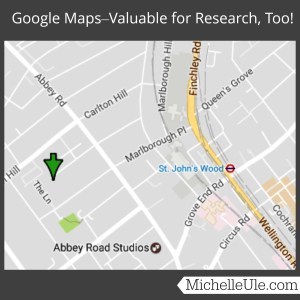
When investigating the family home of Mary Riley, a close friend of Biddy and Oswald Chambers, I looked up the address on Google maps–street view.
The house was one of many in a row on a cramped street.
Even though the Riley family lived there 100 years ago, the townhouse looked old enough–other than the garage and cars!
Sometimes if you investigate through plain Google, you’ll see the house is for sale on Zillow.
When I moved to the English equivalent, I discovered the former Riley home is worth far more than I expected.
Mary’s father was a groomsman. How could he afford to live in such an affluent neighborhood and why?
I switched from “street view,” back to Google maps–traffic view.
When I pulled back the map from the Riley’s dead end street, I discovered the house backed onto a mansion’s acreage.
Returning to Ancestry.com to examine the 1911 census records, I learned the mansion owner sold horses and ran a track in his backyard.
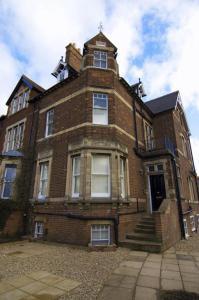
Biddy compiled My Utmost for His Highest here
That explained why the Rileys lived there.
100 years ago, the rowhouse probably wasn’t an expensive home, and servants could have lived on the street.
(As a side note, it’s also only a few blocks from Abbey Road where the Beatles crossed!)
Showing where someone worked.
The Reverend Phillip Hancock family sent me searching around the world (Egypt, Persia, California, England).
I had their British address on a 1952 death certificate signed by Rev. Hancock.
Using Google maps, I traced the home to twenty miles from Biddy Chambers’s home, but didn’t understand why the family lived there.
Shouldn’t Phillip have been pastoring a church?
Nothing appeared likely on the traffic map–though there was an Anglican Church not far away.
Hancock was a Presbyterian minister.
But one day, I decided to admire the house from street view.
What a surprise!
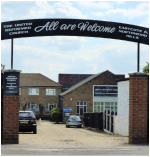
The Hancock family lived in the manse next door.
The house stands right next to a welcoming sign to the United Reformed Church of Eastcote.
Non-map Google took me to the church website where I learned it was once St. Andrew’s Presbyterian Church.
A history of the church mentioned Rev. Phillip Hancock as the clergyman there 1947-1956.
On a whim, I wrote to the church secretary who not only knew of Hancock, but contacted an old church member who remembered him!
On location
Of course we used Google maps to find Oswald Chambers sites while in London.
It led us right to #45 Clapham Common, confirmed as the Bible Training College by a blue plaque on the wall.
While we did not visit Biddy’s home in Muswell Hill, I did check the map for directions, just in case.
Combined with Zillow, I learned the house was for sale in 2013 and I examined the interior through the listing.
Post-location
I didn’t hunt for Biddy’s Oxford home when I spent a day there in 2013, but I saw a photo.
Once again, armed with a 100 year-old address, I put the number into Google maps–street view–and watched a house appear.
It’s traveler’s apartments now, but the bulky interior can’t have changed all that much.
If I ever return to Oxford, I’ll have to rent a room.
My father was a geographer; I’ve always loved maps.
It’s amazing how helpful a good map can be where you’re trying to understand a way, a place and a sense of a life.
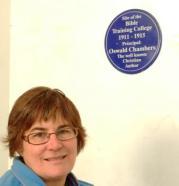
Found the BTC!
Tweetables
Using Google maps for research. Click to Tweet
Solving research problems with Google maps–street view. Click to Tweet
Research problem solved with Google maps. Click to Tweet
The post Google Maps–Valuable for Research, Too! appeared first on Michelle Ule, Author.
June 27, 2017
8 Favorite Christian Biographies
As a newly-minted biographer, surely I have some favorite Christian biographies?
Of course.
While some of these books slide between biography and memoir, they’ve all been important in my spiritual development.
(See this post for the difference between biography and memoir).
Here’s a short list in alphabetical order, of eight favorites and why I like them.
Bonhoeffer
I read Dietrich Bonhoeffer‘s The Cost of Discipleship as a 20 year-old in Europe. I’d been a Christian four years and was fascinated by the green book that sat on the shelf in our church’s bookstore.
The printing was small, the paragraphs long, the concepts dense. But some of the ideas stuck and shaped my Christian walk.
You can read my post about it here.
I picked up Eric Metaxas‘ biography when it came out in 2010. Like many, I wanted to know how a theologian justified participating in a plot to kill Adolph Hitler during WWII.
In addition to answering my question, Metaxas painted a picture of a multi-cultured and very interesting man.
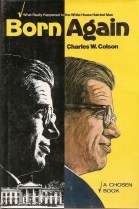
The classic cover–that I read!
Born Again
I read this book in the heady days after author Charles Colson became a Christian and went on to found Prison Fellowship.
As a teenager and very young Christian, it impressed me with the importance of being humble, confessing sin and the value of turning your back on political power.
To this day, I follow Prison Fellowship and read Breakpoint every morning for insight.
Evidence Not Seen
I first heard author Darlene Diebler Rose’s story of her time in a Japanese concentration camp on the Focus on the Family radio show.
Even as I write, I can hear Rose’s voice in my head telling the inspiring memories of how God met them time and again in appalling circumstances.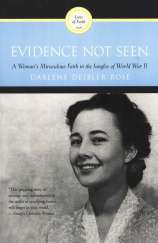
She came through committed to her God, full of praise and went on to a successful life serving God on the mission field.
God’s Smuggler
I came to Brother Andrew’s story/biography just recently, but loved it. (He wrote it with John and Elizabeth Sherrill)
The man who smuggled Bibles into closed countries for years, knew Biddy Chambers–which is what caught my interest.
(He provided keen insight about her when responding to my email questions!)
Again, I adored hearing how God worked through the seemingly impossible situations of his youth, to direct him into an important ministry of hope.
You can hear him talk about it, too, here.
The Hiding Place
Corrie ten Boom‘s story has been popular with people I know forever.
An oversized personality, Corrie taught many of us the depth of God’s forgiveness of any sin.
You know? How He threw it away into the deepest part of the ocean and then posted a sign: “No fishing?”
Oswald Chambers: Abandoned to God
I’ve written extensively about David McCasland’s biography of Oswald Chambers.
Suffice it to say my husband and I both were astonished about how little we knew about the “author” of a devotional we read daily.
(Much less that his wife compiled it ten years after he died!)
This book changed my writing life for five years as I wrote two books in which Chambers is a character!
The Tapestry
I’ve written here and here about author Edith’s Schaeffer’s effect on my life.
This is her story, up until the early 1980s when I read it.
She describes her youth in China (the daughter of a medical missionary), her marriage to Francis Schaeffer and then the story of L’Abri.
Along the way, she provides countless descriptions of God answering prayer in extraordinary ways.
I sit writing this as a result of insight I gleaned from her about the will of God.
Through Gates of Splendor
Elisabeth Elliott’s writing and her speaking program Gateway to Joy, both influenced my life in extraordinary ways.
From Elisabeth, I learned the disgust of self-pity, the need to be obedient despite the cost (there’s that theme again) and how God often asks us to do the impossible.
But He always provides what we need to follow His lead.
This is actually the story of her husband Jim’s life and what happened to her as a result of that dreadful day in Ecuador more than 50 years ago.
 Unbroken
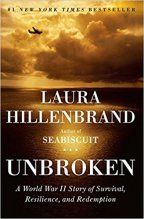
Bestseller Laura Hillenbrand didn’t intend to write a Christian biography when she wrote Louie Zamperini‘s story.
But Zamperini’s extraordinary life and devotion to God took over before she finished.
It’s one of the best books, hand’s down, I’ve read in the last decade.
What are some of your favorite Christian biographies and why?
Tweetables
Eight favorite Christian biographies and why. Click to Tweet
Unbroken, Abandoned, Tapestry, Born Again, Hiding Places–which biography to read? Click to Tweet
A Christian biographer’s 8 favorite Christian biographies. Click to Tweet
And don’t forget my REAL favorite biography: Mrs. Oswald Chambers, coming in October 2017 from Baker Books. 
June 23, 2017
Genealogy and Biography Writing
What started as a simple question: just how are we related to Abraham Lincoln, blossomed into a passion.
At one point my husband asked how long I was going to be stuck on this subject?
“Only until we jump the ocean,” I explained. “I can’t read my Italian relatives’ handwriting now, I can’t imagine reading it 200 years ago.”
Oh, how little I knew.
While my mother was born in Sicily and thus I’m a first generation American, my father’s family reached all the way back to the dawning of colonists on the continent.
Who knew?
No one in my immediate family.
The quest for genealogy information
I visited genealogy libraries in Hawai’i (where I lived at the time–perfect for examining colonial Virginia history, ha!), San Francisco, Fort Wayne, Washington D. C. and the granddaddy of them all in Salt Lake City.
The DAR research libraries in Honolulu and Washington D. C. provided terrific information, along with the LDS Family History Library at Waipahu where I ordered and examined material on microfilm and microfiche.
Invaluable clues broke open the research at the DAR in DC, but only because I’d picked up one photo at the Allen County Library in Fort Wayne’s Genealogy Center.
I spent hours in Fort Wayne hunting and that one clue made all the difference.
I’ve written before of the breakthrough frenzy at the DAR that came in my last half-hour there.

18 hours later, I exited a babbling idiot–but with information! By Ricardo630 (Wikimedia Commons)
Gleaning through mountains of material was the key.
I spent 18 hours over two days in the Salt Lake City LDS Family History Library consulting the indexes of every genealogy book in the counties where my lines lived.
My husband finally dragged me out, babbling, on the second day.
I drew the line on research there, and finished my book, Pioneer Stock. (Think we could be related? Check out my genealogy page here.)
What does American genealogy research have to do with writing the biography of an English woman, Mrs. Oswald Chambers?
Nothing.
Everything.
Halfway through those five years I asked myself why I was wasting so much time investigating people long dead.
It meant nothing to my real life of four kids, Navy guy husband, Hawaiian sunshine and greater family issues.
How did all that time in libraries glorify God?
Shouldn’t I have been volunteering for the church’s VBS program? (I did–recreation).
Maybe I couldn’t answer the question then, but I can now.
I learned many research techniques during that five year apprenticeship/writing experience.
Research techniques are applicable to both genealogy and biography.
Document, document!
You can meet distant relatives while working on genealogy.
Some of them are the unwitting key to questions about your own grandparents, etc.
Several distant cousins worked with me on specific questions.
One, Glenn Gohr–my fifth cousin twice removed we figured out–was an experienced genealogist even twenty years ago and is an archivist at an historical center.
 We shared a lot of information together over the internet, debating who was related to whom and why we thought so.
One day he sent me a note: “You’re a fine writer, Michelle, but you need to document your research.”
I felt humiliated–as a former reporter, I should have known to do so.
I started that day.
When I finally self-published Pioneer Stock, it had more than 900 endnote citations.
I’m thankful for Glenn’s admonition because it was crucial when I wrote Mrs. Oswald Chambers.
A biography requires details and you need to let others know where your information and sometimes your conjectures come from.
Mrs. Oswald Chambers “only” has 250 endnote citations.
Because of the genealogy research, however, I felt completely comfortable with keeping track and using them.
I also learned other techniques I used extensively while writing Mrs. Oswald Chambers.
Triangulation, however, deserves a blog post all its own. (It’s complicated, but it will come!)
End result?
Abraham Lincoln’s lineage always will be murky.
Because the family name is Nancy Hanks, I may or may not be the fourteenth president’s second cousin four times removed.
But who’s counting?
Hunting for the possible connection taught me enough skills to discover information no one knew before about Biddy Chambers.
Plus, I wrote my own family history.
I didn’t waste five years at all.
Tweetables
How genealogy research helps write a biography. Click to Tweet
Using genealogy techniques to write Mrs. Oswald Chambers. Click to Tweet
The post Genealogy and Biography Writing appeared first on Michelle Ule, Author.
June 20, 2017
Appreciating the National Parks with a Novel Series
If you love history, national parks, romance and the surprising political events that touch the parks, you may enjoy her books.
Barnett is certainly enthusiastic:
“I’ve always had a passion for our national parks and for wilderness, and I actually had the honor of working at Mount Rainier when I was in graduate school. The parks are filled with such beauty, history, and potential dangers—could there be a better place to set a story?”
Barnett set the first book in her series, The Road to Paradise, in Mt. Ranier National Park in Washington State.
Rangers 90 years ago were strong men accustomed to fighting fires and patrolling back country trails. Adding a well-educated, flower-loving, city woman to the mix created immediate conflict.
In addition, local businessmen suggested building golf courses, toboggan runs and ski jumps.
Reflecting the story of the park’s early years made for a poignant read, coupled with relief cooler heads ultimately prevailed!
Life as a National Parks ranger
Barnett spent a summer working in Mt. Ranier as a ranger. Her love for the parks shines through in her books and words.
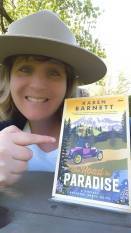
Karen Barnett in her ranger hat with her new book.
“Mount Rainier was an automatic choice for me since I’ve always felt like a piece of my heart still lives there. Even during my ranger days, I imagined stories that could take place in the park.
“Working as a park ranger gave me a deep appreciation for the need to protect these fragile natural areas. There is a profound sense of honor in the job. It doesn’t take long to realize that as soon as you don the uniform, people—kids, especially—look up to you.
“It’s often said that rangers are paid in sunrises and sunsets, and that’s somewhat accurate. The pay scale is pretty low, the hours aren’t great, and the duties aren’t always rewarding. But most people who become rangers wouldn’t trade those experiences for anything.”
What makes the stories vintage?
“The Vintage National Parks novels are historical romances with a touch of suspense, featuring some of our nation’s most scenic treasures and the people who care for these places.
“All three books are set in the 1920s and 30s, somewhat of a magical period for our parks
“The next two books will be set at Yosemite and Yellowstone. They both have unique histories, landscapes, and stories to tell—and since they’re two of the most popular parks, many people have strong emotional ties to these places. I hope that will help readers connect with the stories at a deeper level than they might otherwise.
She set The Road to Paradise in 1927, a time when officials wrangled over the type of development allowed into the national parks.
The argument–which goes on today–centered on whether national parks should be maintained as pristine wilderness or developed for the sake of tourist dollars?
Yosemite’s 1929 story involved tourists in the park spending months living there. Events changed by the Great Depression–the time period for Yellowstone’s tale. In the third book, Barnett features the work of the Civilian Conservation Corps and its effect on the park.
Enjoyable research

You can follow Barnett’s buddy, Ranger Bear at rangerbear_adventures on Instagram!
Barnett watched documentaries and reviewed online databases for historical information and photographs.
She also took trips to both Mt. Ranier and Yosemite National Parks, with Yellowstone on the docket for summer, 2017.
To ensure historical accuracy, Barnett spent time in the Mount Ranier archives, reading reports written by rangers in the 1920’s to understand the type of work they did during that era.
She’s also enjoyed the “incredible” research library at Yosemite. “I had a great time digging through the park archives and looking at old back and white photographs and microfiche documents that rarely see the light of day.”
The former naturalist laughed, “You can’t beat on-the-ground research, so it was a joy to visit each place and walk the trails and smell the air.”
Indeed, Barnett encourages readers to visit the majestic parks and see God at work within the wildness of His creation.
Loving the natural park life
Barnett still owns her park service hat, and loves to visit national parks–whether on research or for pleasure.
“I visited Yosemite last summer and it quickly soared to the top of my all-time favorite places list. People often describe the first sight of Yosemite Valley as almost a religious experience, and I’d have to agree.
“I’ll be revisiting Yellowstone National Park this summer. I can’t wait!”
101 years of the great outdoors
2017 marks the 101st anniversary of the national parks service.
I’ve visited many of them from Hawai’i to Alaska to Maine.
I can’t pick a favorite with so many happy memories.
But how about you? Which national park is your favorite?
Tweetables
Appreciating the US national parks with a novel series. Click to Tweet
Mt Ranier history in novel format! Click to Tweet
Mt. Ranier and The Road to Paradise. Click to Tweet
Every month in 2017, I’m telling the stories about God’s leading and my blessed–and astonished–reactions while writing Mrs. Oswald Chambers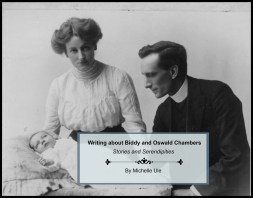
June’s newsletter came out June 20: How an Australian surprised me out of mourning Oswald Chambers.
Sign up for my newsletter here.
The post Appreciating the National Parks with a Novel Series appeared first on Michelle Ule, Author.
June 16, 2017
Oswald Chambers’ Bible: Clippings, Quotes and Outlines
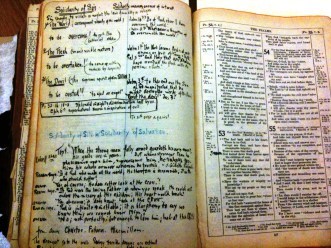
A black leather Bible he bequeathed to his student Eva Spink prior to leaving for World War I in Egypt, Oswald’s King James Version was well worn.
(Eva treasured the gift the rest of her life. It wasn’t his only Bible, of course; leaving for a war meant he downsized his possessions.) 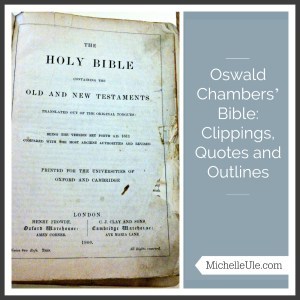
The Bible was a living document to him and Oswald used it every day for his devotions, study and as he lectured.
He was the principal of a Bible Training College (BTC) he founded and his wife Biddy ran.
Oswald Chambers’ Bible lecture notes
Oswald spoke extemporaneously on the League of Prayer circuit and while teaching at the BTC.
That does not mean, however, he did not pray, plan and outline his talks.
You can see outlines in these photos taken of his Bible.

Clippings in Oswald Chambers’ Bible
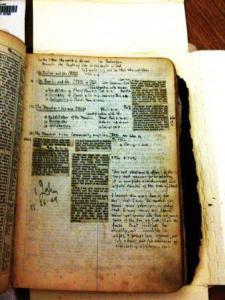
Oswald Chambers honored the Bible, but wasn’t above cutting it up in his studies.
Years later, his daughter Kathleen remembered, “He used to have one Bible and cut it up and stick in the one he did special studies with.”
The interviewer commented, “Some people would think that was heretical.”
Kathleen agreed: “Completely.”
But it served his purpose. Here’s a photo of one page with the clippings pasted in.
Oswald Chambers quotes about the Bible.
Obviously, as the principal of the Bible Training College, Oswald thought and talked about the Bible all the time. Here are a few select quotes from his books.
“The Bible deals with what no ordinary mind sees—the scenery behind the things that are seen.” (Baffled to Fight Better)
“In the Bible it is never—Should a Christian sin? The Bible puts it emphatically—A Christian must not sin.” (My Utmost for His Highest, August 15)
“The Bible reveals that apart from the Spirit of God men have no moving emotion towards God, they are described as “dead.” (Biblical Ethics)
“We are not asked to believe the Bible, but to believe the One Whom the Bible reveals (cf. John 5:39–40 ).” (My Utmost for His Highest; May 6)
“If the Bible agreed with modern science, it would soon be out of date, because, in the very nature of things, modern science is bound to change. Genesis 1 indicates that God created the earth and the life on the earth in order to fit the world for man.” (Biblical Psychology)
“We make prayer the preparation for work, it is never that in the Bible. Prayer is the exercise of drawing on the grace of God.” (My Utmost for His Highest, June 26)
“Faith in the Bible is faith in God against every thing that contradicts Him—‘I will remain true to God’s character whatever He may do.’ “Though He slay me, yet will I trust Him”—this is the most sublime utterance of faith in the whole of the Bible.” (My Utmost for His Highest, October 31)
To read about Biddy Chambers’ Bible, click here.
Tweetables
What did Oswald Chambers think about the Bible? Click to Tweet
What kind of Bible did Oswald Chambers use? Click to Tweet
Oswald Chambers’ Bible: clippings, quotes and drawings. Click to Tweet
Every month in 2017, I’ll be telling the stories about God’s leading and my blessed–and astonished–reactions while writing Mrs. Oswald Chambers
The next newsletter comes out June 20: How an Australian surprised me out of mourning Oswald Chambers.
Sign up for my newsletter here.
The post Oswald Chambers’ Bible: Clippings, Quotes and Outlines appeared first on Michelle Ule, Author.
June 13, 2017
Research Library–a Dangerous Spot?
I, for one, have felt my life potentially in danger while visiting three.
Let this be a warning to you. Researchers may look nerdy and pale, but behind our flashing glasses we could be superheroes.
Here are three tales.
A Midwest Research Library.
I spent a week there, scanning documents and photos.
I’ve never lived in the Midwest and am unused to extreme weather in the summertime.
But it caught up with me one day.
Three of us worked at long tables filled with material.
A young library worker was filling in for the archivist at lunch.
In the silent room, a ping sounded, she looked at her phone and gasped.
“Oh, no! We’re supposed to be in the basement!”
The German man looked over the top of his glasses and the New Englander of Japanese descent startled.
I asked the obvious question: “Why?”
She bit her lip. “There was a severe tornado watch and I didn’t check my phone. I was supposed to take you downstairs immediately. This is the all clear.”
We all turned to the windows. It was windy.
“I’m driving into the city after this,” I said. Am I safe in the car?”
She smiled eagerly. “I’m sure you are.”
I survived.
A Big City Library
Fifteen minutes after I arrived at a research library in a big city, the loudspeaker announced,
“This is a drill. We are practicing. This is a drill. An active shooter is on campus. Please hide, immediately.”

In the stacks
I grabbed the six hundred page dissertation on the shelf in front of me.
Down in the basement, all I could hear was the air conditioning hum. I’d seen no one else on the floor.
I found a door with a lock and a closet behind with another lock. Inside the cement cell were six chairs. Perfect.
I locked the second door and set up my scanner and the books–for two hours.
At one point, I heard someone moving around outside in the stacks and my heart raced. Was this part of the drill?
I stayed quiet, wished I had stuck my sweater beneath the door to hide any possible light and waited, holding my breath.
When would the all clear sound?
In the cement bunker, I couldn’t pick up a cell signal nor send a text. I drank my water, ate my granola bar and shook my head.
After two hours and with my appointment with the archivist upon me, I snuck out of my hiding place.
Upstairs I whispered to a woman happily working on her computer, “Is it safe to come out yet?”
At her horror, I laughed. They hadn’t announced the all clear over the loud speaker–90 minutes before.
We were all safe.
The librarian, however, wanted to know where I’d hidden so successfully!
A rival university research library
I’m a graduate of the University of California, Los Angeles, the second of three generations of UCLA graduates in my family.
My parents raised me to be suspicious of “the other college,” also known as the crosstown rival.
But their library system, which is wonderful for online researchers, had an important volume I needed to examine.
My daughter is a graduate student there, so I visited in search of my book.
Which turned out to be on microfiche. They had to search for it.
“It will take a little time,” the kind woman said on the phone. “Let me call you back when I’ve got it.”
I gave her my phone number and sat back to admire the gorgeous library.
And then I realized the danger.
The ringtone on my cell phone is the UCLA fight song, “Sons of Westwood.”
Everyone in Los Angeles recognizes that song.
This particularly cross town rival has a white horse statue displayed in the quad outside the gorgeous research library.
The halls would soon echo with the music that always compels me to action.
I hurried outside to a quiet corner where I adjusted the phone’s volume to low.
As soon as those opening notes sounded, I answered the phone: danger averted.
Alas, they couldn’t find the microfiche, but I escaped with my life!
June 9, 2017
Biddy Chambers’ Bible–A Scofield Reference
I’d forgotten all about it.
(So you won’t find it discussed–her Bible–in Mrs. Oswald Chambers.)
As it happens, I’ve seen Biddy’s Bible, paged through it, took photos and marveled, at Wheaton College‘s Special Collections Library.
No surprise, she wore it out.
What version was Biddy Chambers’ Bible?
Wheaton has a copy of her 1909 Scofield Reference Bible.
First published in 1909, the Scofield version was the first Bible that included annotations and cross references.
Today, comments are commonplace, but at the time it was a revolutionary idea.
Using the King James Version, American Bible student Cyrus Scofield organized it. He sought to explain Bible passages for students, not be controversial. His version, however, did popularize dispensationalism, particularly among fundamentalists.
In the photo below, you can see two sections of Biddy’s worn out Bible.
She owned an earlier Bible before the Scofield, of course, but this is the one we still have and in it she wrote notes.

What kind of notes were in Biddy Chambers’ Bible?
Ah, there’s an interesting question.
All sorts.
Biddy actively engaged with the Scriptures. On one page she wrote:
“I wish and pray the Lord would harden my face and make me to learn to go with my face against the storm.”
Biddy wrote many of her notes in simplified shorthand, or a mixture of the two. It certainly preserved her privacy.

Writing in your Bible
While many people write notes in their Bible to mark meaningful dates or verses, I’m not one of them.
I realized years ago that if I underlined passages, I tended to read them and neglect the rest.
The notes were a distraction.
Biddy didn’t do that often, but it was interesting to see where she responded to Hebrews 12, three different years:
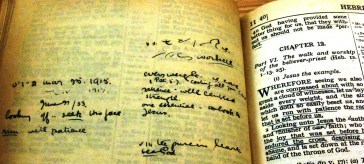
The dates were March 1-2, 1915, some time in 1917 and June 1933.
All of those periods were a time when Biddy chose to make a deliberate decision–as to how she would react.
The Bible passage from the Scofield Reference Bible is familiar to most Bible students.
“The walk and worship of the believer-priest. IV. Jesus the example. 1 WHEREFORE seeing we also are compassed about with so great a cloud of witnesses, let us lay aside every weight, and the sin which doth so easily beset us, and let us run- with patience the race that is set before us, 2 Looking unto Jesus the author and ‘finisher of our faith; who for the joy that was set before him endured the cross, despising the shame, and is set down at the right hand of the throne of God. (Scofield Reference Bible, 1909).”
In March 1915, Biddy and Oswald concluded (after much prayer) that Oswald should apply to the YMCA to be a chaplain.
Biddy’s note didn’t indicate when in 1917 this passage was meaningful to her, but she did underline in her note “run patience the race.”
In June 1933, she was dealing with her mother’s slow decline and changes at work in her publication practices–including My Utmost for His Highest being published in the United States for the first time.
What did the notes in Biddy Chambers’ Bible mean?
Only she knew–and it should be kept that way.
What about you? What types of things do you write in your Bible?
Tweetables
Examining Biddy Chambers’ Bible. Click to Tweet
What kind of Bible did Biddy Chambers own–and write in? Click to Tweet
(I’ll be writing about Oswald Chambers’ Bible next week.)
The post Biddy Chambers’ Bible–A Scofield Reference appeared first on Michelle Ule, Author.
June 6, 2017
The Family’s Slides–and What to Do with Them
 Sorting my family’s ancient slides took a few days to accomplish.
My brother unearthed them from the attic and we were curious to know what was in them.
The other brother bought a single slide viewer–no one had a projector anymore–and I went through the batch.
Our slides were kept in a long box (not the round slide box used in carousel projectors), about four dozen per box.
We had about a dozen boxes and several dozen more in smaller stacks.
It took several days.
Here are suggestions for sorting your family’s old slides.
 Decide in advance what you’ll do with the slides.
“I don’t think anyone but the three of us and maybe Bonina will care about these photos,” my one brother said. “So we should throw out most of them.”
He’d gotten a sneak peak. When I looked through them, I agreed.
“You can get better photos of the Grand Canyon off the Internet,” my other brother said. “Toss them.”
That simplified the job considerably.
Look at all the slides
As I’ve posted before, the job may be tedious, but it’s important you look at everything.
You simply don’t know what you’ll find.
Hidden among the infinite number of photos of Half Dome in Yosemite, I found shots of my pregnant mother.
Here were my grandparents young and svelte.
There were the other grandparents, actually appearing together in a photo.
I had to look at every photo to find the gems.
After a while, I easily knew what to toss and what to keep.
People are most important
After some 70 slides, I realized I only wanted to look at faces. I didn’t care about much else.
Shots of the construction of the Vincent Thomas bridge in 1960?
 I’m an historian. My brother teaches history.
“Better keep those,” he said. “The historic society might like them, or our local Facebook page.”
“But it’s a slide,” I said. “Too hard to post on Facebook.”
I couldn’t toss those, I kept them in their own pile.
It was the people, however, that we cherished.
I couldn’t throw away anything with either of my parents in them–they’ve been dead too long.
Review the background
People were important, but so were some of the background.
“Here’s our living room,” I said to my daughter. I turned the single slide viewer so she could admire the fireplace.
“Here’s the front yard, look at all that mud!”
She smiled politely, but my brother took a close look.
“What am I doing holding a puppy?” I asked my brother. My parents never let us have a dog.
Neither of us knew.
Give the job to the oldest and mark the slides
If I couldn’t remember what the slide depicted or who the people were, my younger brothers wouldn’t have a chance.
Using a fine tipped Sharpie, I wrote what I knew with the year on each slide (also noted which end was up).
I explained several family facts to my brother that he didn’t know.
Some were important, most were nostalgic, but at least they’re now viewable.
Now the slides are sorted, what’s next?
My brothers will go through the sorted boxes–reduced to seven in neat order–and decide what’s important.
We’ll have them transferred into disks we can access from our computers.
I’ll further cull slides from there–and make books for us.
Some I’ll print. We could each finally have a baby book, now!
What have you done with your family’s slides–or if you’re young, do you know what slides are?
Tweetables
Sorting the family slides–a how to. Click to Tweet
What to do with the old family slides. Click to Tweet
What do I do with my father’s 1000 slides? Click to Tweet
The post The Family’s Slides–and What to Do with Them appeared first on Michelle Ule, Author.