Shorthand and Oswald Chambers
 Shorthand, or stenography, is the key to all the works of Oswald Chambers.
Why?
Because all his books were the result of his wife Biddy “taking down” everythingi he said in his lectures.
She then turned those notes into the 30 books, including My Utmost for His Highest, that make up the Oswald Chambers canon.
Almost all those books were published after Oswald’s 1917 death.
What is shorthand?
Shorthand is a method of using symbols based on phonetics, to rapidly record what someone says.
In 2017, we use our phones to record things we want to remember.
We then have them transcribed into written words on a page if we’re interested in editing, say, for a writing project.
Court reporters traditionally have sat near the judge and typed up everything said “for the record.”
In days gone by, reporters used handheld recording devices–and many probably still do–but 100 years ago, none of that existed.
While people have been making notes using symbols since writing began, Isaac Pittman devised a regulated way to do so in the mid-nineteenth century.
It caught on and became an avenue for many to work in business.
(In the United States, a rival method, Gregg shorthand, became favored by the late-nineteenth century).
How does it work?
A stenographer uses squiggles, lines, marks and other hieroglyphics they know, to record on paper what a speaker says.
As Wikipedia explains:
“One characteristic feature of Pitman shorthand is that unvoiced and voiced pairs of sounds (such as /p/ and /b/ or /t/ and /d/) are represented by strokes which differ only in thickness; the thin stroke representing “light” sounds such as /p/ and /t/; the thick stroke representing “heavy” sounds such as /b/ and /d/.”
It takes education–in a sense like learning a foreign language–but a good stenographer can take down shorthand symbols at about 125 words per minute.
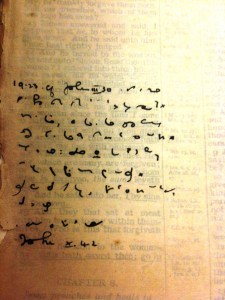
Notes in Biddy’s Bible
The average speaker talks about 100-125 words per minute.
A stenographer generally wrote on a lined tablet with a line down the middle–shorthand went down one side and then back to the top of the page for the next line.
The idea was to save time–not flip the wired page until necessary.
In the case of Biddy Chambers, she “took down” at 250 words per minute–or twice as fast as the average person speaks.
As she grew more proficient, she developed abreviations of her own.
She used a fountain pen or a yellow Dixon pencil and a notepad.
That’s it.
Who can read shorthand?
Not me.
As I researched Mrs. Oswald Chambers, I hunted for people who could explain shorthand to me–what you have to learn–and read it.
No one in 2016 knew Pittman shorthand, which is what Biddy used.
Biddy wrote some of her Bible notes in shorthand–which means just about no one can read them now.
It was an excellent method of keeping her thoughts private.
How did Biddy get so proficient and why?
You’ll have to read the book to find out.
Try your hand here:
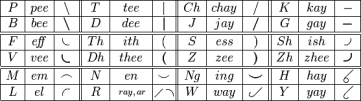
By Xanthoxyl (Creative Commons)
Tweetables
Why shorthand was important to Oswald Chambers. Click to Tweet
Who can read shorthand? Mrs. Oswald Chambers. Click to Tweet
What is shorthand? Click to Tweet
Interested in Oswald and Biddy Chambers? I’ll be telling stories about the amazing ways God led me through
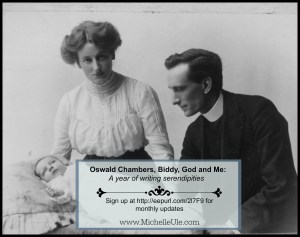
Sign up at http://eepurl.com/2l7F9
the writing of two books about them, starting in my January newsletter–one story a month for 2017, free.
If you’d like to follow the serial–the same chronological way it unfolded for me–sign up for my newsletter here.
The post Shorthand and Oswald Chambers appeared first on Michelle Ule, Author.