
Yanis Varoufakis's Blog, page 113
December 7, 2017
O Βασίλης Βασιλικός για τους “Ανίκητους Ηττημένους”
Στην βιβλιοπαρουσίαση του βιβλίου μου “Ανίκητοι Ηττημένοι” ο Βασίλης Βασιλικός είπε τα πιο κάτω λόγια. Σε συνδυασμό με την, παράλληλη, ανακοίνωση του Κώστα Γαβρά (ότι εργάζεται πυρετωδώς για την μεταφορά του βιβλίου στην κινηματογραφική οθόνη), τα λόγια του Βασίλη Βασιλικού με αφήνουν βουβό και βαθειά υπόχρεο.
Αγαπητοί φίλες και φίλοι,
Η παρουσία μου απόψε εδώ μου θυμίζει τον στίχο του Εγγονόπουλου ή μπορεί να είναι και του Εμπειρίκου «Τι ζητάς στη Λάρισα , εσύ, ένας Υδραίος;» Πράγματι είναι η πρώτη φορά που παρευρίσκομαι στην παρουσίαση ενός καινούργιου βιβλίου που δεν ανήκει στο χώρο της λογοτεχνίας. Αν δέχτηκα, είναι γιατί το διάβασα σαν ένα μυθιστόρημα. Με παρέσυρε σαν πλοκή που ήξερα βέβαια όπως όλοι μας την κατάληξη από την την παραμόρφωσή της από τα Μέσα Μαζικής Αποβλάκωσης όπως τα χαρακτηρίζει επανειλημμένα ο συγγραφέας, αλλά εκείνο που με παρέσυρε στην ανάγνωση ήταν η ίδια η γραφή του. «Μια μέρα στη ζωή του Ιβάν Ντενίσοβιτς» λεγόταν η νουβέλα του μεγάλου Ρώσσου συγγραφέα Σολζενίτσιν. «Εξι μήνες στη ζωή του …» θα ήταν ο τίτλος που θα έδινα στο συναρπαστικό μυθιστόρημα του Γιάνη Βαρουφάκη. Κι όταν λέω «μυθιστόρημα» δεν εννοώ καθόλου την μυθοπλασία. Μυθιστόρημα συναποτελεί ο Μύθος με κεφαλαίο Μ και η Ιστορία με κεφαλαίο Ι. Και πάλι με Μύθο δεν εννοώ το μύθευμα. Αλλά τον Μύθο που πλάθουν οι άνθρωποι για μία έννοια ή ένα τίτλο που δεν γνωρίζουν. Όπως εμείς, οι απλοί πολίτες, που μιλάμε συνεχώς για την Ευρωπαϊκή Ενωση και ουσιαστικά δεν ξέρουμε τίποτα για το πώς αυτή λειτουργεί. Ξεχνάμε βέβαια ότι η ίδια η Ευρώπη ανήκει σε ένα πανάρχαιο μύθο: την αρπαγή της από τον Δία μεταμορφωμένο σε ταύρο. Αλλά αυτό ήδη το έχει καλύψει ο ίδιος ο συγγραφέας με το προηγούμενο βιβλίο του «Η αρπαγή της Ευρώπης». Σε κείνο όμως το βιβλίο δεν μπήκε στο Λαβύρινθο της Κνωσού. Με το «Ανίκητοι Ηττημένοι» περιγράφει ακριβώς αυτόν το λαβύρινθο όπου ο Μινώταυρος (Σόϊμπλε) και η Αριάδνη (Μέρκελ) συγκατοικούν με τη διαφορά ότι η τελευταία δεν έχει μίτο (νήμα, κλωστή) για να βγει. Όπως κι εμείς, οι φτωχοποιημένοι, δεν μπορούμε να «βγούμε στις αγορές». Μια έκφραση που απεχθάνομαι σαν συγγραφέας. Αφου η Αγορά για μας με κεφαλαίο άλφα δεν είναι μάρκετ ή σούπερ ή μήνι μάρκετ, αλλά η Αρχαία Αγορά του Δήμου, δηλαδή η ίδια η Δημοκρατία.
Κι ας αρχίσω από το οξύμωρο του τίτλου. Είναι δυνατόν να υπάρχουν ανίκητοι ηττημένοι; Ως τώρα, στο λογοτεχνικό τοπίο μας, υπήρχε μόνο « Η ποίηση της Ηττας» όπως χαρακτηριζόταν η μετακατοχική και κυρίως μετεμφυλιακή ποίηση με κύριους εκφραστές τον Μανώλη Αναγνωστάκη και τον Τίτο Πατρίκιο. Διαβάζοντας όμως το βιβλίο του Βαρουφάκη πρώτα στα Αγγλικά, πριν τέσσερεις μήνες με τον τίτλο «Adults in the room” (Ενήλικοι στο Δωμάτιο) και τώρα στην εξαιρετική ελληνική του μετάφραση κατάλαβα γιατί οι ηττημένοι μπορεί να είναι ανίκητοι. Διότι ηττημένος ήταν ο ίδιος ο ελληνικός λαός που παρόλες τις διαχρονικές ήττες του και πτωχεύσεις του μέσα στα τρεις χιλιάδες τελευταία χρόνια που εξακολουθεί να υπάρχει παραμένει ανίκητος αφού μιλά την ίδια γλώσσα και κατοικεί στον ίδιο χώρο. Η πίστη του συγγραφέα στον ανώνυμο λαό που διαποτίζει όλο το βιβλίο του τον μεταμορφώνει και τον ίδιο σε ανίκητο, παρ’ ότι ηττημένο, αφού μεταλαμπαδεύει την προσωρινή ήττα του εν Ελλάδι ή Μνημονιστάν, όπως την αποκαλεί στο βιβλίο του, ιδρύοντας ένα πανευρωπαϊκό κίνημα το Diem 2025. Από την εξάμηνη εμπειρία του ως υπουργός Οικονομικών μιας πτωχευμένης χώρας διαπιστώνει ότι το πρόβλημα, πέραν της χώρας του, είναι στη ρίζα του πανευρωπαϊκό. Και εκτινάσσεται με τους στίχους του Παναγούλη μελοποιημένους από τον Μίκη «Πάλης ξεκίνημα, νέοι αγώνες, οδηγοί της ελπίδας …» ξανά τον προσκαλούν.
Διαβάζοντας το βιβλίο του, θυμήθηκα ένα ακόμα ποίημα του Αλέξανδρου Παναγούλη από τη φυλακή. Την « Μπογιά». Θα σας το διαβάσω. Και αν αντικαταστήσετε τη φυλακή με την αίθουσα όπου συνεδριάζει το Γιούρογκρουπ και τους δεσμοφύλακες με τους δανειστές μας, θα καταλάβετε γιατί:
Η ΜΠΟΓΙΑ
Ζωντάνεψα τους τοίχους/ Φωνή τους έδωσα/ πιο φιλική να είναι συντροφιά/ Κι οι δεσμοφύλακες ζητούσαν/να μάθουν πού βρήκα τη μπογιά.
Οι τοίχοι του κελιού/ το μυστικό το κράτησαν/ κι οι μισθοφόροι ψάξανε παντού/ όμως μπογιά δεν βρήκαν.
Γιατί στιγμή δεν σκέφτηκαν/ στις φλέβες μου να ψάξουν»
Το «Ανίκητοι Ηττημένοι» είναι γραμμένο με το αίμα του Γιάνη. Πονάει γράφοντας το. Το καταλαβαίνω σαν συγγραφέας που είμαι κι εγώ. Θα προτιμούσε ίσως να μην το γράψει ποτέ. Αλλά δεν επιτέπονταν αυτό όταν γίνεσαι από την «τρόικα του εσωτερικού», και τα Μαζικά Μέσα Αποβλάκωσης το εξιλαστήριο θύμα, ότι για όλα εσύ μόνο φταις. ΄Όταν σε μεταμορφώνουν, δηλαδή, σε αποδιοπομπαίο τράγο. Και πάλι θα αναφερθώ στον Παναγούλη. Ξέρετε τι λέγαν στην εμιγκράτσια για τον Αλέκο μετά την αποτυχημένη του απόπειρα ενάντια στον αρχιδικτάτορα Παπαδόπουλο, αριστεροί κυρίως, αλλά και άλλοι αυτοεξόριστοι; Τον αποκαλούσαν, μετά την απόπειρα, ως πράκτορα της CIA. Και στις πρώτες εκλογές της Μεταπολίτευσης κινδύνεψε να μη βγει ούτε καν βουλευτής.
Εγώ θέλω να ευχαριστήσω τον κύριο Βαρουφάκη για το βιβλίο που έγραψε. Πρώτα πρώτα έμαθα πως λειτουργεί η τρικέφαλη Ευρωπαϊκή Ενωση, της οποίας το ένα κεφάλι και το ισχυρότερο δεν αποτελεί θεσμοθετημένο τμήμα της. Το Brussels Group συγκεκριμένα και το παρακλάδι του Euro Working Group. Γιατί όταν ο πρόεδρος του πρώτου που πρόσφατα μας επισκέφτηκε περιχαρής , σαν τον Στρατηγό Βάν Φλήτ που ήρθε στο τέλος του Εμφυλίου να συγχαρεί τον Παπάγο για τη νίκη του, όταν λοιπόν ο μη ιπτάμενος Ολλανδός και πρόεδρος του Brussels Group κύριος Ντάισελμπλουμ απαίτησε σε μια από τις τελευταίες συνεδριάσεις να φύγει από την αίθουσα η ελληνική αντιπροσωπεία της διαπραγμάτευσης κι ο επικεφαλής της υπουργός Οικονομικών, δηλαδή ο Βαρουφάκης, ζήτησε να μάθει από το αρμόδιο νομικό τμήμα βάσει ποιου άρθρου είχε αυτό το δικαίωμα, η απάντηση που έλαβε από τη νομική υπηρεσία ήταν ότι καθώς το Γιούρογκρουπ ήταν ένα άτυπο όργανο, χωρίς ιδρυτικό καταστατικό, ο πρόεδρος του μπορούσε να ενεργεί κατά βούλησιν! Δεν δεσμευόταν από καμιά ρήτρα.
Τέλος πάντων. Η ουσία είναι ότι όταν μπαίνεις σε ένα χώρο που δεν ανήκεις οι μόνιμοι κάτοχοι του χώρου σε βλέπουν ως εξωγήινο. Κι όταν χωρίς να το επιδιώκεις καταλαβαίνουν πως ξέρεις καλύτερα απ’ αυτούς τον Παγκόσμιο Μινώταυρο και έχεις μάλιστα συγγράψει το Games People Play, δηλαδή την «Θεωρία Παιγνίων» στα οικονομικά, σε απορρίπτουν μετά βδελυγμίας. Τέσσερα χρόνια είχαν συμπληρωθεί από το πρώτο μνημόνιο όταν εμφανίστηκε ο άνθρωπος με το σακίδιο στην πλάτη και χωρίς προηγούμενη εμπειρία πολιτικού ή κρατικού υπαλλήλου. Μοναδικός του στόχος ήταν εξ αρχής , πριν οποιαδήποτε νέα διαπραγμάτευση, η αναδιάρθρωση του χρέους. Κάτι που και προ τετραετίας ο τότε επικεφαλής του ΔΝΤ ο Ντομινίκ Στρως-Καν είχε συμβουλεύσει τον ΓΑΠ πριν υπογράψει κανένα μνημόνιο με την Ευρωπαϊκή Ενωση και με το δικό του Ταμείο να προεξασφαλίσει την αναδιάρθρωση . Κι αυτό οι Ευρωπαίοι Εταίροι μας δεν ήθελαν τότε ούτε να το ακούσουν. Γι’ αυτούς το πρωταρχικό τους μέλημα ήταν να δανείσουν στην Ελλάδα λεφτά που θα επέστρεφαν ως αποπληρωμή των δανείων που της είχαν δώσει οι τράπεζες της Γαλλίας και της Γερμανίας και κινδύνευαν να χρεοκοπήσουν. Οπερ και εγένετο. Ακολούθησε το δεύτερο μνημόνιο τον Φεβρουάριο του 2012 και το 2015 με τη νέα κυβέρνηση ο Βαρουφάκης επανέλαβε ως προτεραιότητα την αναδιάρθρωση. Κι άρχισαν τα όργανα για το Τετέλεσται του Εσταυρωμένου που η νέα κυβέρνηση τον βρήκε επί του σταυρού να πνέει να λοίσθια ενώ το Ιερατείο της προηγούμενης προανήγγειλε το success story της Ανάστασης Του.
Το συναρπαστικό βιβλίο που σήμερα έχω την τιμή να μετέχω στην παρουσίαση του είναι καθόλα βατό και στον πιο ανειδίκευτο στα οικονομικά αναγνώστη. Γιατί εστιάζεται πάνω στους ανθρώπους κι όχι στους αριθμούς. Δημιουργεί μυθιστορηματικούς χαρακτήρες με την διεισδυτικότητά του στην ψυχολογία τους . Σαν γεννημένος πεζογράφος ο συγγραφέας του, με πλούσια αναγνωστική παράδοση της παγκόσμιας λογοτεχνίας, με χιούμορ εδώ κι εκεί που σε ανακουφίζει και με εικονοποία αξιοζήλευτη, με κέρδισε με την ειλικρίνεια του και, με την κατανόηση του Αλλου, του διαφορετικού, κυρίως του αντίπαλου. Χωρίς καμιά εκδικητική διάθεση για «ξεκαθάρισμα λογαριασμών», με πρότυπο τη σεξπηρική τραγωδία του «Μάκβεθ» και μότο τη φράση του Νίτσε «όταν κοιτάξεις το εσωτερικό της Αβύσσου για ώρα πολλή, στο τέλος η Αβυσσος θα κοιτάξει μέσα σου». Και για να θυμηθούμε τον Ελύτη «ένα το χελιδόνι κι η άνοιξη ακριβή, για να γυρίσει ο ήλιος θέλει δουλειά πολλή».
Σας ευχαριστώ.
Βασίλης Βασιλικός


‘Adults in the Room’ and ‘And the Weak Suffer What They Must?’ reviewed by B. Baumer for the INDYPENDENT
Along with French economist Thomas Piketty, former Greek finance minister Yanis Varoufakis is making economics sexy again. Journalists enjoyed snapping photos of Varoufakis, clad in a black leather coat, commuting to the finance ministry’s offices on his Yamaha motorcycle. But his short tenure in the Greek government was marked by clashes with the country’s creditors and ultimately with the leadership of Syriza, the left-wing party that came to power in Greece in early 2015.
Varoufakis, a self-described “erratic Marxist,” also happens to be a gifted storyteller who can deftly relate personal experiences to larger themes without sacrificing analytical rigor. It’s not something you would expect to find in your average finance minister, but he is no ordinary government bureaucrat.
He opens Adults in the Room, his memoir about his short time in government, by describing a late-night meeting in a Washington bar in which former U.S. Treasury Secretary Larry Summers asks him if he would behave as an insider or outsider. It is a sly narrative construct, as Varoufakis tells all from the outsider-insider perspective and recounts the negotiations over Greece’s debt with the “Troika”: the International Monetary Fund, the European Commission and the European Central Bank (ECB).
Varoufakis names the individual actors in the Greek tragedy, but where he really shines is in explaining the central economic and political forces that created Europe’s economic crisis.
Greece’s population is 10.75 million but its public debt is around 330 billion euros ($390 billion). He argues that Greece is in a modern-day debtor’s prison and cannot pay its sovereign debt without a serious restructuring. Adults in the Roomtakes pains to describe his attempts to end the country’s “fiscal waterboarding” at the hands of the Troika. Varoufakis demanded new debt terms and some debt cancellation — “haircuts” for the banks and other institutions that held Greece’s bonds. One problem was that the ECB’s charter explicitly prohibited debt cancellation and bailouts, thus stacking the deck against the debtor nation.
An outsider’s tale of crashing the ultimate insiders’ club.
Once in power, Varoufakis got creative. He offered to convert Greece’s unsustainable debt payments to perpetual bonds that paid lower but perpetual interest, and the country would be able to choose when to pay off the principal, sometime in the distant future. Another novel but workable idea was that Greece would swap its largest debt obligations for new 30-year bonds that had crucial provisions: Annual payments would be suspended until Greece’s national income increased, and would then be linked to its economic growth.
It would have been a win-win solution for both sides, but the Troika rejected all of Varoufakis’ proposals. It held the upper hand: It could close Greece’s banks and turn off the liquidity spigot. Varoufakis wanted Greece to play hardball and default on its ECB debt if that happened. He was convinced German Chancellor Angela Merkel did not want to force Greece to leave the Eurozone, the 19-nation group that shares a common European currency. He believed a “Grexit” would have spurred a stampede out of the Eurozone by other debtor countries like Italy, Spain and Portugal. However, the Syriza government lost its nerve and did not default. The chapter “Lions Led By Donkeys” details what happened when the Troika shut Greece’s banks down and the Syriza government capitulated.
Adults in the Room unflatteringly portrays Greek Prime Minister Alexis Tsipras and how he cracked in the face of intense diplomatic pressure, bank closures and the threat of being kicked out of the Eurozone. When Tsipras agreed to impose a new round of austerity on his country in order to procure a new loan from the Troika, Varoufakis resigned and sped away on his motorcycle. He was finance minister for just five and a half months.
The title of the latter is derived from an infamous scene in the Greek historian Thucydides’ recounting of the Peloponnesian War, in which the Athenians demand that their weaker rivals unconditionally surrender or else face complete annihilation, because “the strong do as they like while the weak suffer what they must.” More than 2,000 years later, Varoufakis contends, this same merciless logic can be found in today’s neoliberal global economy. He does us the favor of showing us how we came to this moment.
In his retelling, the United States shifted in the 1970s from an industrial powerhouse that ran large trade surpluses to a debtor nation, within which economic and political power shifted from industrialists to Wall Street.
“The trick for America to gain the power to recycle other countries’ surpluses… was to persuade foreign capitalists to voluntarily send their capital to Wall Street,” he writes. Wall Street offered high returns on investment in the form of higher interest rates to attract Japanese, German and eventually Chinese capital. Higher interest rates meant American manufacturers’ costs jumped and consumer purchasing power nosedived.
Then the party stopped with the financial crash of 2008. Varoufakis thinks the United States can no longer effectively manage the global economy. The Great Recession decimated Americans’ already stagnant incomes, so they do not have the purchasing power to absorb surpluses and recycle money that they did in previous generations.
Varoufakis warns that unstable, debt-ridden countries are a breeding ground for fascism. While Greece’s neo-Nazi Golden Dawn party is hobbled by murder trials and corruption charges, elsewhere the far right is capitalizing on economic insecurity by blaming immigrants for society’s problems.
Varoufakis, like Piketty, advocates a federal European Union system that would socialize debts, stabilize debtor countries’ economic growth and democratize the EU bureaucracy. After his stint as finance minister, he came away convinced that no one country by itself could successfully challenge Europe’s powers that be. He cofounded DiEM25 (Democracy in Europe Movement 2025) — “a pan-European, democratic, humanist movement” — that seeks to transform the European project while preventing it from sliding into a 21st-century version of fascism.
It won’t be an easy task. But from his writing, it is clear Varoufakis knows exactly who and what he is up against.
Reviewed:
‘Adults in the Room: My Battle with the European and American Deep Establishment’
By Yanis Varoufakis
Farrar, Straus and Giroux, 2017
‘And The Weak Suffer What They Must?’
By Yanis Varoufakis
Nation Books, 2016
BENNETT BAUMER Nov 21, Issue 230 For The Indypendent site click here.
A Life in the Day – Sunday Times, 26th November 2017
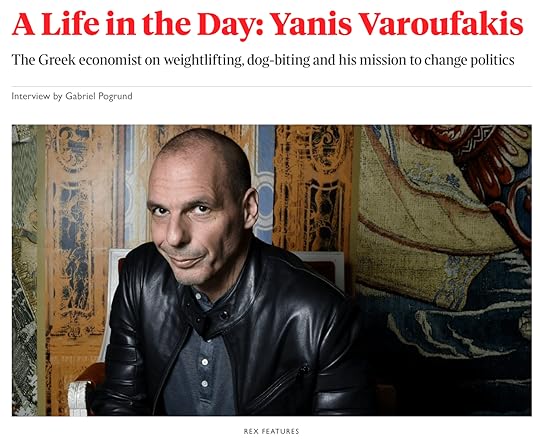
On the occasion of the publication of ‘Talking To My Daughter about the Economy: A brief history of capitalism‘, the Sunday Times published this interview, in the context of their series ‘A Day in the Life of…’ Apologies for the lifestyle-like style and content…
Interview by Gabriel Pogrund
Best advice I was given A statistics professor told me: “Say what will happen or when it will happen. Never predict both as you’ll end up with egg on your face”
Advice I’d give To be moderate, you have to constantly subvert the dominant paradigm
What I wish I’d known That the worst enemy lies within your own camp
Born in 1961 in Athens, Varoufakis, 56, served in Greece’s government as the minister of finance during the 2015 bailout crisis, before resigning in protest over austerity measures. He has a flat in Athens and a villa on the island of Aegina, which he shares with his wife, Danae Stratou, an artist, and her two children. Varoufakis has a daughter with his first wife. He is the author of several books on the global economy.
Rising early is the only way I can work. I wake at 5.30am and put the coffee machine on. By the time it’s ready, I’ve finished my press-ups: three sets of 80. I’ve been doing them for 50 years.
Before I get to my desk, my Labrador, Mowgli, and I have a big hug. I bite him, he bites me.
Then, for two or three hours, I’ll write intensively, the equivalent of a whole day’s work. In my most recent book, I wrote to my 12-year-old daughter about capitalism. My personal tragedy is I’ve never lived with Xenia. She lives in Australia with her mother, and so the clock’s always ticking: counting down when we’re together, or until we’re together. As a child, she would fall asleep as I read her bedtime stories on Skype, but this book brought me closer to her without a ticking clock.
After I finish writing at 10am, my wife, Danae, and I have breakfast: tea and Greek yoghurt with chopped-up fruit. This is a special part of my day. Every time, it feels like a first date.
Before I actually knew Danae, I’d fallen in love with her work. I came across an exhibit in Athens and assumed she was a 90-year-old woman — it was a mature piece of art and the name sounded old-fashioned. Then I met her and thought: “Now I’m in trouble!”
Nothing happened because we were both married, but two years later, we met by chance in a London restaurant. The rest is history.
My big project at the moment is the Democracy in Europe Movement [DiEM25]. Our aim is to spread a new politics through the democracy-free zone that is the EU. It will probably fail, but we don’t give a damn. It’s fun trying. For the European elections, we’re putting up transnational candidates: Greeks in Germany, Italians in France. I’ll probably have to stand. I’m dumbfounded by career politicians, though, and think anyone keen to be a minister should be disqualified.
At 1pm, I’ll have lunch. Danae and I have something cold: our latest craze is black lentils with Greek white goat’s cheese, cherry tomatoes and salad. I used to cook, but my time in government ended that. I lost the luxury of time. Reflecting on that period, I’d say my relationship with Alexis Tsipras [the Greek prime minister] is beyond repair. To justify his U-turn [over the EU’s austerity package], he has to tell himself stories that, deep down, he knows are false.
I’m not enthusiastic about the EU, but my view remains that, instead of leaving, one should stay and veto the hell out of everything until we can have a serious conversation about reform.
Corbyn and I are very close and I’m pleased he’s come to my original position: that in terms of Brexit, Britain should have a long transition period and give itself a chance to prepare. Then you can leave but maintain good links, and potentially come back in if the EU shows it’s transformed itself.
After an afternoon of reading and writing, I’ll go to the gym at 7pm. If I don’t go, my back starts to hurt. I used to bench-press 150kg. Now I can’t do more than 90.
Two or three nights a week, we’ll go out with friends, whether it’s the theatre or a film or to eat.
For dinner, we’re keen on simple grills with meat or fish and a big salad with balsamic and figs and tomatoes. Danae has a glass of wine. I enjoy a shot or three of raki.
At the end of the evening — and that can be anywhere from 9pm to 3am — we crash on the sofa, listen to music and fall asleep.
Talking to My Daughter About the Economy: A Brief History of Capitalism by Yanis Varoufakis is out now (Bodley Head £15)
Carry On Brexit: Is the long haul just beginning? – The Spectator podcast (audio)
December 5, 2017
BBC1 Question Time, debating Trump, Brexit bill, UK regional development & Yemen, 30th November 2017
David Dimbleby presents topical debate from Scarborough, with a panel including Conservative MP and prisons minister Sam Gyimah, Labour’s Chuka Umunna, Ukip’s new leader Henry Bolton, deputy editor of The Sunday Times, Sarah Baxter and the economist and Yanis Varoufakis, DiEM25 co-founder & former finance minister of Greece.
For the whole program watch below:
December 4, 2017
A Tale of Two Faltering Unions (UK and EU); and what DiEM25 proposes in response – Address at the Oxford Guild, Oxford University, 28/11/2017 (Audio + Full Transcript)
Yanis Varoufakis, co-founder of DiEM25, former Minister of Finance for Greece and high profile economist, academic and writer, addressed The Oxford Guild on Tuesday 28th November in the Said Business School Amphitheatre. He discussed the state of the European Union, of the United Kingdom, the political landscape globally and the political/economic/social agenda of DiEM25 across the EU and the UK. The event was organised in association with the Economics Society and was free and open to all.
[The transcript of my talk was kindly prepared by Rosemary Blecher for openDemocracy.net, where it was first published. Thanks are also due to Anthony Barnett, whose splendid book THE LURE OF GREATNESS: England’s Brexit and America’s Trump influenced my thinking.
Good evening everyone. Thank you so much to the Oxford Guild for inviting me. Allow me to begin with something that I could have written, but didn’t. I’ll just read it out:
“I am such a passionate believer in Europe that I accept the accusation of being a troublemaker. But I’m not awkward. I just want Europe to work!”
I didn’t say that: Margaret Thatcher said that in 1990. But I am very happy to endorse her sentiments. And the reason why I came up with this quotation is because walking into the building I was told “ This is the Margaret Thatcher Annexe. It won’t please you very much Mr.Varoufakis. But what can we do about it? ” My response was, “ The state of politics in this country and in Europe has deteriorated to such an extent that even though I spent my youth never missing a demonstration against Mrs. Thatcher, I have to say that I miss her!” Make what you wish of this.
Just for a moment let us go back to June 23, 2016 – the referendum. The thing that I lament the most about the referendum is that it was such a wasted opportunity to have a proper, frank and useful debate. Both sides of the argument infantilised the electorate and they made it impossible for such a conversation to take place. Both sides made profound, fundamental errors.
If you think about it, both treated the European Union as if it was a club, with Britain a member considering whether it is worthwhile renewing his or her membership. A club is a given, either the service it provides justifies the membership fee and all the trouble you have to go through in order to maintain your links with the club, or not. But that is not what the European Union is like. The European Union is a work in progress. And to be more precise, speaking of June, 2016, it is a disintegrating, frazzling at the edges, or fraying-at-the-edges union. But I’m afraid the same can be said about the United Kingdom. Thus the title I came up with as a summary of what I want to talk to you about tonight: a tale of two faltering unions, with Brexit on the one hand and the attitude of Brussels towards Britain on the other, as indications of the deep malaise both in Europe and in the United Kingdom.
Bretton Woods
Now, let’s start with the European Union. The great fallacy with the EU – at least within the dominant paradigms of the élites of Europe, of Germany, of France, continental Europe – is that the EU was a remarkable achievement of Europeans, European design and implementation. It was no such thing. It was an American design and an American implementation. Americans got French and German heads together – banged them – and said, “You are going to form a union, and we’re going to set the parameters for it as part of the Bretton Woods system”, the attempt to create a stable, global capitalist economy after 1944 – 5. By 1946, the New Dealers in power inside Washington DC decided that this global system that they were creating – think about it, it was extremely ambitious, right? – here you had a common currency area, not just of continental Europe, but also of Britain, the United States, of Japan and even India. That was what the Bretton Woods fixed exchange rates would achieve. With fixed exchange rates you have one currency area, the IMF managing the exchange rates and revising them when need be, and you had the United States, dollarizing Europe. That was the purpose of the fixed exchange rate. So it was a massively centrally-planned global economy. And it was the plan that gave rise to the golden era of capitalism: two decades of steady growth, minimal unemployment, minimal inflation and hugely shrinking inequality. It was what created the baby boomers, and what created the sense that capitalism had civilised itself.
But of course that system had collapsed by 1971 for a very simple reason. The pillar on which that system was sitting was American surpluses. America had exited the second world war as the only creditor nation, as the only surplus producer and really it was acting by recycling its surpluses to Europe and to Japan to prop up these parts of the global system that it had created. But by the late 1960’s the United States had no surpluses, and therefore, pragmatic Americans as they always are, they jettisoned the system that they had created. The result was the Nixon shock in 1971 and a brave new phase of post-war capitalism which was exactly the inverse of the Bretton Woods system.
The inverse of Bretton Woods
So what happened in the 1970’s going into the 1980’s was that the US was getting deeper and deeper into debt, with the twin deficits of the budget deficit and the trade deficit. And the trade deficit of the US was operating like a huge vacuum cleaner which was sucking into the territory of the US the net exports of Holland, of Japan, of Germany, and later of China – creating the demand for the gleaming factories in those countries, and who was paying for the deficit which was getting larger and larger? Very simple. German industrialists, Japanese industrialists, Chinese industrialists, who were recycling their surpluses, their profits through Wall Street, into the American economy, which was then of course closing the loop of aggregate demand.Well, what happens when you gives $5 billion a day to a banker? They do things with it.
Now of course the problem with this was that on the back of this tsunami of capital which was flowing into Wall St. every day – about $5 billion net a day for thirty years – well, what happens when you gives $5 billion a day to a banker? They do things with it. It is called financialisation. So, deregulation and derivatives and all that was a natural repercussion of this new-fangled global recycling mechanism.
Unfortunately, they did a little more of it than the planet could take, and just to give you two figures to bear in mind, in 2001, global GDP (forget the zero’s) was around 50. The total size of the derivatives was 70. By 2007 and the collapse, global GDP had gone from 50 to 70. And the derivatives had gone from 70 to 750. So of course they collapsed like all good bubbles or pyramids, or sandcastles do.
The tragedy is that after that collapse, the American economy could no longer stabilise aggregate demand in Europe, in China, or even in the United States. So you have this ongoing crisis.
The euro
From 1971 when Bretton Woods collapsed, the Europeans had tried to replenish the fixed exchange rate regime. That’s the beginning of the euro. The reason why Europe had to do this was because Europe was set up by the Americans as a cartel of heavy industry. Remember the first name of the European Union? The European Communities of Coal and Steel – a bit like OPEC. A cartel of coal and steel that then co-opted carmakers, then the French farmers, who had to be given a cut of the oligarpolistic profits of German, French, Dutch, North Italian industries in order to allow for free trade to take place – it is called the common agricultural policy by the way.Remember the first name of the European Union? The European Communities of Coal and Steel – a bit like OPEC.
Then the banking community was co-opted as well, and then of course with financialisation, the banking sector became the driving force of the European Union.
Now of course we Europeans on the other side of the Channel would like to imagine that this was a fantastic European creation. And indeed there was always a triumphalism in continental Europe about this creation – with good cause because it was a magnificent and highly ambitious project, including for example the fact that you can travel all the way from Greece to France without stopping at borders, with the single market, with the Erasmus programme which I think is a really magnificent programme – the fact that we have had peace in Europe for 70 years given the bloodthirsty continent that we live on – these are all remarkable and genuine achievements.
But to think that this was a pan-European democracy, and that it was a European project designed and delivered by Europeans is a complete delusion of us continental Europeans.
So the point I am going to make, in relation to the United Kingdom or Britain, is that Britain was always going to be the odd man or woman out. Because British capitalism, from its beginnings in the industrial revolution, was never built along the lines of a cartel.
There was spontaneous order from the beginning. Industry, capital, capital accumulation occurred without a central design. It was not the result of a certain Bismarck who decided that he was going to industrialise his country. It emerged in a kind of Burkean or Humean or Adam Smithian spontaneous order. Blending together the state planned capitalism of continental Europe with the spontaneous capitalism of Britain was always going to be very difficult. And of course by the time that the European Union was being created, British capitalism was on its last legs, or it was fading very rapidly – with the state-planned capitalism model taking over globally (from Japan and the United States, under the central design of the military-industrial complex, to China, the EU etc.).
So at the very moment that the European Common Market launched, creating this fantasy in the élite minds of Europeans about how clever we Europeans are, Dean Ascheson, US Secretary of State in the 1950’s, early 1960’s, said that Britain had lost an empire, but had not found a role for itself. When Britain came into the Common Market, the predecessor of the European Union, in this country it was felt, more or less, as part of a historic defeat: whereas for the continental European élites, it was a triumph.
Euroskepticism
And that is to do with this fundamentally different structure of British capitalism vis-à-vis European Union capitalism. So let us be clear, there are good reasons for being eurosceptic in this country, but that does not necessarily mean that Brexit was a good idea.
I campaigned against it in this country and do not regret it even though we lost. But you know heroic defeats are becoming ‘my thing’! (Laughter.) I believe in this country, however, they can be appreciated. I remember from when I was living here back in the 80’s, Eddie the Eagle and other such failures, like… Nick Clegg, Ed – you know – there have always been a lot of heroic failures in this country! So maybe I too will have a sympathetic ear in this place!
Today, if you compare these two unions, the United Kingdom and the European Union, what you have is a very sad, pathetic vista on both sides of the English Channel. You have the EU, which is celebrating the overcoming of a crisis, the eurocrisis in particular, which is actually getting worse.
And you have a UK which is celebrating its newfound confidence by cutting off its nose to spite its face, through Brexit. Because let’s face it, the three circles of Winston Churchill that portrayed his ambition for a dominant Britain – the three circles being Europe, the NATO treaty or the Anglo-American connection and the Commonwealth – those three circles – have shifted so much that Britain can no longer pretend, if you want, to be at the centre of all three circles.
What now?
Forty years of membership of the European Union has allowed a particular development model, or economic model in Europe and in the United Kingdom to emerge, which, if you will allow me to be slightly vulgar about it, is nothing more than a rentier economy.
Ever since deindustrialisation was a choice by Margaret Thatcher in the 1980’s with the cultivation of financialisation, you have effectively had a country structurally in trade deficit to the rest of the world, which is being propped up by financial flows and by financialisation. When you cultivate that kind of economy for 40 years, you cannot suddenly cut it off from the European Union and pretend that you are going to rule the waves again to reconstitute the British Empire. I mean, you can pretend that, but it is pretty catastrophic for this country!!
At the same time, you have a European Union that is so grossly unappealing, because it is failing in its duty to itself to recognise the systemic crisis that it has entered into ever since the financial crisis of 2008 exposed the fragility of its monetary and all but absent fiscal institutions, that it is impossible in this country, in the context of a referendum like that of June 2016, to make the argument that we need passionately to support the European Union and to remain in the European Union because it is the best thing since sliced bread.My line was very simple: “The European Union sucks, and you have to stay in it!”
So when I was appearing in various audiences up and down the country, in England and Wales and Scotland and even in Northern Ireland, my line was very simple: “The European Union sucks, and you have to stay in it!” – which is not a very easy sell you know! But it was the truth. I remember when Jeremy Corbyn was asked – I don’t remember by which journalist on television, between 1 and 10 how enthusiastic are you about the state of the European Union, and therefore how enthusiastic are you in your support of ‘Remain’? – what did he say, “4”? I would have said “2”. I’m a Greek Patriot, but if you asked me how enthusiastic I was about the current Greek state, I would probably say 1. But that is not an argument for dissolving the Greek state! It is an argument for fixing it! Similarly, in so far as we consider ourselves true Europeanists, we have a duty to be highly critical about this European Union, but then to ask ourselves this question. Is it in the interests of the many to disintegrate it? This is not the same question as ‘are we enthusiastic about the European Union?’
Antidemocratic concoctions
So allow me now to briefly say a few words about the EU and the UK on a constitutional basis. Because one of the strongest arguments, actually, the strongest argument in favour of Brexit, is the argument that the EU is a profoundly antidemocratic concoction – I agree with this argument – I think it is. Britain has a long tradition of parliamentary democracy and it is essential therefore to restore sovereignty to the House of Commons to preserve the parliamentary traditions of this country.
Now that is a very powerful argument, and anyone who dismisses it on the basis that sovereignty no longer matters needs to be taken to task by every democrat in the world. The argument that sovereignty does not matter any more because our states are powerless to influence the big, bad world that we live in – that is an argument that must be treated with the contempt that it deserves. Little Iceland, compared to little Greece – well actually Iceland is much littler – managed to restructure its debt and to escape the debtor’s prison that my country finds itself in – because they had sovereignty. Sovereignty is not to be dismissed and should never be confused with power. Sovereignty is about being able to make decisions on your own on the basis of a democratic process, to the extent that your limits of power permit you, and it is not to be scoffed at.Sovereignty is not to be dismissed and should never be confused with power.
In the EU on the other hand, we have a process by which we have deferred to the European Union; we have taken sovereignty from our parliamentary systems in our democratic states and transferred it to a democracy-free-zone in Brussels. And that is a very good argument for Brexit.
But it is not a clinching argument. And there are two reasons for that. Firstly because the United Kingdom’s ‘constitution’ “sucks”, as much as the European institutions “suck”. I’m afraid I have to be very brutish on this. There is nothing to be proud of regarding the UK constitution. And allow me to link this – this is a controversial point that I shall make – with the observation that England (excepting London) has been completely disenfranchised in the last twenty years. Brexit is an English phenomenon. And to a great degree it reflects the fact that most of the English, outside of London, have been disenfranchised by the political system, by the United Kingdom constitution. Tony Blair’s devolution sounded like a good idea. And it was. But sometimes taking a few steps in the right direction is worse than taking no steps.
Tony Blair’s devolution sounded like a good idea. And it was. But sometimes taking a few steps in the right direction is worse than taking no steps. Because the Scottish have a parliament and they have a government. The Welsh have their Assembly. The Northern Irish have, whatever they have. OK? England doesn’t. So if you live in the north of England and you have suffered the travails of deindustrialisation since the late 1970’s, early 80’s, and you have no way of expressing yourself in the way that people further up north in Scotland have through their own parliament – there is no way of being an English patriot today in a manner that is sensible and non-inflammatory and non-jingoistic. Because there is no way that it can be expressed.
Sovereignty lost
So this is why I was saying right at the beginning that the Brexit referendum was first and foremost a terribly lost opportunity to rethink the constitution of the United Kingdom. Let’s face it, you can see this now with the Great Repeal or Withdrawal Bill. You are coming out of the EU, and those who brought you out of the EU on the basis of a promise to restore sovereignty to the House of Commons in accordance with the best traditions of the UK constitution – unwritten but nevertheless glorious! – are now brutally finishing off the very concept of parliamentary sovereignty by denying the House of Commons first, the opportunity to debate what kind of Brexit Britain wants, and secondly, the transcription of EU law into British law. The Cabinet are going to be able to transcribe EU law to create UK laws, by-passing the House of Commons in the name and supposedly the interests of ‘restoring sovereignty’.The Cabinet are going to be able to transcribe EU law to create UK laws, by-passing the House of Commons in the name and supposedly the interests of ‘restoring sovereignty’.
So sovereignty is being sidelined. It is being depleted, both in the European Union – look at my country: our sovereignty has been completely and utterly demolished by the troika and the European Central Bank. And similarly here. Your House of Commons is being treated as a discarded rag by this Government in this rush towards a wholly uncertain Brexit.
So what should we do? Well allow me to suggest that on both sides of the English Channel, we need to chart a new course for an uneasy British public, and uneasy publics in France, in Germany, in Greece, in Spain. And this, we had better look at as a joint project.
Now, unlike many of the Remainers, I believe that as democrats we must respect Brexit. We played, and we lost. And the idea that Brexit will be reversed because the British people were not sufficiently informed, or they were influenced by Vladimir Putin or some such nonsense! – this is contemptuous of British democracy. I do not want to see Britain crushed, by Michel Barnier and Brussels, and I do not want to see the people of Britain being treated like the Irish in 2004 when they had a referendum on the Lisbon Treaty, and Brussels and the Irish Government told them, “That was the wrong verdict: vote again until you get it right!”
 Yanis Varoufakis at a press conference presenting the pan-European ‘Democracy in Europe Movement 2025’ (DiEM 25) in Berlin, Germany, 09 February 2016. BERND VON JUTRCZENKA/Press Association. All rights reserved.But what should we do? Now I am going to speak about our Democracy in Europe Movement, DiEM25, only in the sense of what we are proposing. What we are proposing, starting with Britain because this is where we are, we are at Oxford tonight and Brexit is in the air, twenty four hours a day, seven days a week, for years now – this is one of the arguments I have been telling various audiences, “Forget about Brexit, because you are not going to get out of the European Union just by voting to leave. It is a bit like Hotel California’s last verse. You can check out any time you like, but you can never leave. You will be more stuck in Brussels and the machinations of the machinery of Brussels aftervoting for Brexit than you would had you not voted for Brexit.” Lo and behold, this is exactly what has happened.
So, allow me to tell you my thinking and DiEM25’s thinking on what should happen now.It is a bit like Hotel California’s last verse. You can check out any time you like, but you can never leave.
No negotiations
First, end this phoney negotiation with Michel Barnier and Mister Juncker. What on earth are you doing, Prime Minister, talking to Juncker and Barnier? These people are grey-suited bureaucrats without a mandate to have any discussion with you. They can have dinner with you. They will bitch about you after the dinner, which they do invariably. But even if they agree with you they cannot give you that which you want. And what do you want? You want a long-term agreement with the EU that secures certain privileges of access to the single market without actually being in the single market.You want a long-term agreement with the EU that secures certain privileges of access to the single market without actually being in the single market.
For some reason this is what Theresa May wants, and she is never going to get this from Barnier and Juncker even if she hypnotises them both. They don’t have the mandate to have this discussion. Barnier said as much: he comes in with a list of boxes and he has to check the boxes. He can’t go outside this particular template so he comes and says, “There will be a two-phased negotiation!” – OK, remember? “Phase one – Ireland, money and people – you give us the dough, 60, 80, 90 billion whatever; you settle the Irish border question; and EU court jurisdiction over EU citizens in Britain. You have to give us that before we move to the second phase.” So this is like me coming to you and saying, “ First you give me everything we want and then we will discuss what you want.” This is a declaration of hostilities. This is what I would do in a negotiation if I want to kill it. If I want to make sure that there will be no negotiation. So end this negotiation. And there is only one way of ending it in a manner that is consistent with the spirit of Brexit and with small ‘c’ conservatism – here I am as a left-winger lecturing a conservative prime minister on small ‘c’ conservatism, but that is the state of affairs at the moment, this is how serious things have become….
The way to do it
Tell Mr.Barnier to go home. End these negotiations. And file immediately for an European Economic Area, Norway-style agreement for a five-year period after the end of the two-year post-Article 50 triggering period.
The Norway-style agreement has the following advantages. Firstly, it does respect Brexit, because Britain is outside like Norway is outside the EU. Secondly, you do come out of the common agricultural policy, the fisheries policy. You come out of the Customs Union but you stay in the Single Market – so you solve the Irish question, because there will be no need for a border. You sort out the fact that for six years if you are counting 2018, the contributions to the EU will continue like Norway contributes, having access to the Single Market. And most profoundly, you give the House of Commons a period of six years in which to discuss firstly what future arrangements it wants with the European Union; secondly, how to transcribe EU law into British law without transferring legislative powers from the House of Commons to the Cabinet; and also to reconfigure the UK constitution in such a way that allows the United Kingdom to become reinvigorated politically, and allows the anger in England over its marginalisation within the political process to subside.
This is the way to do it. Not by means of creating ruptures in free trade, creating huge queues at Dover, ending the supply chains from Nissan and Toyota and so on, while making promises to Nissan and Toyota that your government cannot fulfil because your budgetary constraints prohibit you from fulfilling them.
And finally, if Theresa May were to make this move towards a transition period which is small ‘c’ conservative, Angela Merkel and Emmanuel Macron would breathe a sigh of relief because the problem, most probably in the case of Germany at least, goes to the next Chancellor, and now Angela Merkel will be able to have a decent conversation with Theresa May without these leaks that the Brits have not done their homework, and they are ill-prepared, and a bunch of idiots or whatever.
So this is what we are proposing, and we are proposing this in the context of what I was saying earlier – that the European Union itself is a work in progress. It will not be the same in five or six years’ time. Why? Because it is not sustainable the way it is today. You don’t have to take my word for this: listen to Emmanuel Macron. He gave this Sorbonne speech which was actually quite good, in which he said, the model by which the European Union has been proceeding in the last seven decades is kaput. It is finished. We cannot continue like this any more. We need to reconfigure the monetary union. We need to reconfigure our single market. And most importantly, we have to democratise it, and move away from the cartel-like structure that we have now.You don’t have to take my word for this: listen to Emmanuel Macron. He gave this Sorbonne speech which was actually quite good.
Of course he is not going to be listened to by Berlin. But if he is not listened to within the next six years, there will be some other ruptures to the EU – we do not know what the situation will be. So buying time, having a small ‘c’ conservative transition is essential for reconstituting the UK constitution, and for allowing for the maximum degree of certainty in business dealings between the UK and the EU, while energising the House of Commons and restoring sovereignty to it, so that they can make the decisions about the long-term relations between the European Union and the UK.
Simulating a federation
Now moving on, and this is how I am going to close, to what DiEM25 is proposing for the European Union… I am going to frame our proposal by juxtaposing against it the two dominant points of view today. What are the two dominant points of view? ‘Business as usual’ which is what comes from Brussels and from Berlin: no change, pure denial. The German position is a liquidationist position, so if there is a bankruptcy of the state in Greece, let’s liquidate it. If there is a bankruptcy of a certain bank in Italy, let’s liquidate it.Now the problem with this is, to liquidate something you need a state that comes to the aid of the victims of the liquidation.
Now the problem with this is, to liquidate something you need a state that comes to the aid of the victims of the liquidation. So when the United States federal government liquidated the debt of General Motors in 2009, it had the mechanisms by which to ensure that the creditors of General Motors did not go to the wall. When they liquidated the huge losses of Wall Street, they created TARP, the Troubled Assets Relief Programme. So it is impossible on the one hand to liquidate and on the other hand to refuse Macron the federal mechanisms which are necessary to absorb the shock waves from the liquidation.
So the conundrum is this. The German position is untenable, but also the alternative position – that of Macron, is also untenable now. Macron is now asking for a federation-lite, but still a federation. But if you go to Europeans and you say to them, we want more Europe, more Brussels, they freak out. For them, more Europe only means more authoritarianism, and more of the same austerity-driven, incongruous policies.
So our third alternative as DiEM25 is, “Let’s simulate a federation!” Simulate a federation? Yes, what is a federation good at? At creating a genuine banking union. This is what FDR did in the 1930’s. At creating a degree of mutualised debt so that you can restructure the debt of the more bankrupt states within the Union in a manner that stops them from crushing their private sectors and perpetuating the crisis. Creating an anti-poverty programme across the Union which is what Lyndon Johnson did in the 1960’s with the Great Society programme which massively reduced poverty in the United States, helping to stabilise the country. We can simulate all these, as well as a massive investment-led green recovery programme, by using existing institutions like the European Investment Bank, and the European Central Bank. I won’t bother you now with the technicalities, but our proposal is, simulate a federation in order to stabilise Europe so that we can then have a discussion, across the continent and here, about what future constitutional arrangements we want as democrats to live in.
My hope would be for a second referendum in Britain – not to annul the first one – Brexit has to be respected as I said – but if the continent gets its act together, and Britain gets its act together and England is re-enfranchised, my dream is that by 2025, (hence DiEM25), Britain can have a second referendum and decide to come back into a civilised European Union.
I don’t believe that that this will happen (laughter). But it is essential that we put out there both in Britain and the European Union, a blueprint of how it couldhappen, and that those who are against it happening will have the political and moral burden for this on their shoulders, and those of us who work together across Europe to bring about that which may not come about, will be those who have created the networks and the political solidarity as Europeans which will be absolutely necessary in order to be able to pick up the pieces in the end.
The great conundrum
This is a great country that is imperilled by the illusion that it is a great power. Similarly across the channel, the European Union is a great power, imperilled by the delusion that it operates like a coherent country.
The great conundrum – allow me to rephrase the conundrum that I started my talk with – is this. This is a great country. I am a European and an Anglophile. The institutions that you have in this country like the BBC, the British Council, the Tate Gallery – don’t laugh – they are immensely important institutions. They are far more important than any industry you have – you have no industry left! You have the music industry, the Tate, the British Council – this is your heavy artillery. This is where you are punching above you weight around the world! Your industry is finished. I hope that it revives itself. Some suggestions around Theresa May and the new industry policy in the last few days have not been bad. Of course, she needs to fund it: the funding that was mentioned is pitiful! But anyway, I am digressing…
This is a great country that is imperilled by the illusion that it is a great power. Similarly across the channel, the European Union is a great power, imperilled by the delusion that it operates like a coherent country. These two incongruities have to meet half way. And regardless of what Brexit takes place, hard, soft, Norway-style or not, it is essential – and this if you want is what DiEM25 is about – that we remain very closely coordinated, those of us who consider ourselves to be progressive democrats, internationalists, against militant parochialism on the one hand, and the deep establishment in Brussels who simply want to perpetuate business as usual, on the other. That we just join forces, so that you can have, for instance, a new patriotism in England which gives the English enough confidence to want to be active Europeanists – thank you very much!
December 2, 2017
Πλειστηριασμοί: η ειδεχθής όψη της Πτωχοτραπεζοκρατίας – ΕφΣυν 2 Δεκεμβρίου 017
Οταν «ανοίγεσαι» υποθηκεύοντας κάτι που έχει αξία για σένα, παίρνεις το ρίσκο να το χάσεις. Εκτός βέβαια αν είσαι… τράπεζα. Αντίθετα με τον κοινό πολίτη, οι πτωχευμένες τράπεζες διασώζονται με τα χρήματα των πολιτών, ενδυναμώνονται πολιτικά από αυτή την ανακεφαλαιοποίηση (κυρίως μέσα από τη χειραγώγηση της κοινής γνώμης, ελέω των ΜΜΕ και των πολιτικών δυνάμεων που ελέγχουν), και, στο τέλος, απαιτούν (και εξασφαλίζουν) το δικαίωμα να βγάζουν στο σφυρί τα σπίτια και τα μαγαζιά των πολιτών που τους διέσωσαν.
Να τι εννοώ με τον όρο Πτωχοτραπεζοκρατία: Ενα καθεστώς όπου όσο πιο πτωχευμένη είναι μια τράπεζα τόσο πιο μεγάλη η εξουσία της επί της υπόλοιπης κοινωνίας και, συνεπώς, η δυνατότητά της, αντί να ρευστοποιηθεί, να οικειοποιείται βίαια τις περιουσίες άλλων ρευστοποιώντας τες.
Στη δική μας περίπτωση, στην Ελλάδα της τετραπλής χρεοκοπίας (πτωχευμένο κράτος, πτωχευμένες τράπεζες, πτωχευμένες επιχειρήσεις και πτωχευμένες οικογένειες), το καθεστώς της Πτωχοτραπεζοκρατίας δεν κρατά καν τα προσχήματα του ορθολογικού φιλελευθερισμού, με τους πλειστηριασμούς (που τώρα ξεκινούν) να αποτελούν την ειδεχθέστερη όψη του.
Ας δούμε, κατ’ αρχάς, τα πράγματα ψυχρά: Η γενικευμένη πτώχευση της χώρας δημιούργησε (περίπου): (1) 100 δισ. ευρώ «κόκκινο» χρέος των τραπεζών προς το κράτος, (2) 100 δισ. ευρώ «κόκκινο» χρέος των ιδιωτών προς τις τράπεζες, και (3) 100 δισ. ευρώ χρέος των πολιτών προς το κράτος.
Παράλληλα, το κράτος χρωστά 300 δισ. στην τρόικα (και κάτι λίγα επί πλέον στις τράπεζες), όταν το συνολικό ετήσιο εισόδημα όλων των Ελλήνων δεν ξεπερνά τα 175 δισ. Το να προσποιούμαστε ότι αυτά τα χρέη θα αποπληρωθούν με κάποιον τρόπο θα ήταν ένα ωραίο ανέκδοτο αν δεν οδηγούσε, σταθερά και συστηματικά, τη χώρα στην ερημοποίηση και τον λαό μας στην αναξιοπρέπεια.
Κι όμως: Η τρόικα, που στην Ελλάδα επιβάλλει το καθεστώς της Πτωχοτραπεζοκρατίας (σε συνεργασία με σειρά κυβερνήσεων τις οποίες υποτάσσει), επιμένει: Τα χρέη αυτά θα αποπληρωθούν, υποτίθεται, μέσα από νέο δανεισμό (τις δόσεις των μνημονιακών δανείων) και ρευστοποιήσεις!
Πρώτα φόρτωσαν στο πτωχευμένο κράτος το μεγαλύτερο δάνειο στην ανθρώπινη ιστορία (ώστε να διασώσουν τις γαλλογερμανικές, αρχικά, και ελληνικές, κατόπιν, τράπεζες) και αμέσως μετά άρχισαν τις ρευστοποιήσεις. «Ρευστοποίησαν» τις συντάξεις και τους μισθούς, κατόπιν τις εργασιακές σχέσεις, τη δημόσια περιουσία, τις μικρομεσαίες επιχειρήσεις (μέσω εξοντωτικών φόρων και ασφαλιστικών εισφορών), ενώ τώρα περνούν στη ρευστοποίηση των ακινήτων.
Τίποτα δεν καταδεικνύει καλύτερα τον ανορθολογισμό, την αναποτελεσματικότητα και τον απαράμιλλο κυνισμό της τρόικας από τους πλειστηριασμούς που μόλις ξεκίνησαν.
Ας ρίξουμε μια ματιά: Οι τράπεζες κρατούν τα λιγότερο «κόκκινα» δάνεια και ξεφορτώνουν τα «κατακόκκινα» δάνεια που βαραίνουν τα λογιστικά τους βιβλία σε χαμηλές τιμές (π.χ. ένα δάνειο 100 χιλιάδων, που έχει προ πολλού πάψει να εξυπηρετείται, πωλείται για 8 χιλιάδες) σε ξένα κερδοσκοπικά «οχήματα» τα οποία ελπίζουν είτε να τα μεταπωλήσουν ακριβότερα είτε, πιο ρεαλιστικά, να προχωρήσουν σε πλειστηριασμό που θα αποφέρει περισσότερα από το κόστος απόκτησης. Αυτομάτως αυξάνεται η προσφορά ακινήτων, με αποτέλεσμα οι ήδη χαμηλές τιμές τους να μειωθούν κι άλλο.
Αποτέλεσμα; Τα περιουσιακά στοιχεία των τραπεζών που συμπεριλαμβάνουν υποθηκευμένα ακίνητα τα οποία συνδέονται με τα λιγότερο «κόκκινα» δάνεια (τα οποία παραμένουν στα βιβλία τους) χάνουν αξία, με συνέπεια τα κεφαλαιακά αποθέματα των τραπεζών να μειώνονται κι άλλο.
Με την αγωνία να τα αναπληρώσουν, οι τράπεζες θα αναγκαστούν να πουλήσουν κι άλλα «κόκκινα» δάνεια σε ταμεία, οι πλειστηριασμοί θα πολλαπλασιαστούν, οι τιμές των ακινήτων θα συμπιεστούν κι άλλο, κ.ο.κ. Κλασική περίπτωση σκοτοδίνης που γίνεται χειρότερη όσο περισσότερο εφαρμόζεται η πολιτική της τρόικας για να τερματιστεί. Ο ανορθολογισμός και η αναποτελεσματικότητα στην πράξη.
Εχοντας βάλει μπροστά τη διαδικασία των πλειστηριασμών υπέρ των τραπεζών, η τρόικα ανακοινώνει από τώρα το επόμενο στάδιο: Πλειστηριασμοί ακινήτων για χρέη στην εφορία, στο ΙΚΑ κ.λπ.!
Και σαν να μην έφτανε αυτό, διττός όρος της επόμενης μνημονιακής «αξιολόγησης» είναι (α) η ολοσχερής κατάργηση της προστασίας κύριας κατοικίας (δηλαδή κατάργηση της σχετικής διάταξης του Νόμου Κατσέλη, που η τρόικα ποτέ δεν χώνεψε), και (β) η εκκίνηση των δημοπρασιών από την καταρρακωμένη τιμή αγοράς αντί για την «αντικειμενική» αξία του ακινήτου.
Το τροϊκανό αντεπιχείρημα προς όποιον καταδικάζει τον μακροοικονομικό ανορθολογισμό των πλειστηριασμών, που οδηγεί σε επιτάχυνση της οικονομικής και κοινωνικής κρίσης, είναι ηθικοπλαστικό:
Οι πλειστηριασμοί επιβάλλονται καθώς αλλιώς καταργείται η έννοια της ευθύνης του δανειολήπτη, δημιουργώντας κίνητρα για «μπαταχτσήδες» και εκθέτοντας τους δανειολήπτες που πλήρωσαν κανονικά τα δάνειά τους ως «ανόητους». Υπό κανονικές συνθήκες, το επιχείρημα αυτό έχει λογική. Ομως οι συνθήκες στην ελληνική κοινωνία δεν είναι κανονικές εδώ και καιρό.
Από τα κάτι λιγότερο από 100 δισ. ευρώ που χρωστούν ιδιώτες στο κράτος, 3,5 εκατομμύρια Ελλήνων δεν έχουν φορολογική ενημερότητα λόγω χρεών μόνον… 2 δισ. ευρώ. Τα υπόλοιπα 98 δισ. είναι τα χρέη ήδη πτωχευμένων ιδιωτών και της ολιγαρχίας. Κι όμως, τρόικα και κυβέρνηση έχουν αποδεχθεί ότι τα 98 δισ. της ολιγαρχίας και των επιχειρήσεων εξαφανίστηκαν, αλλά βάζουν στο στόχαστρο τα σπίτια εκατομμύρια Ελλήνων που απλά δεν μπορούν να ανταποκριθούν λόγω κρίσης.
Κάτι αντίστοιχο συμβαίνει και με τα «κόκκινα» δάνεια προς τις τράπεζες: η συντριπτική τους πλειονότητα αφορά συνανθρώπους μας που δεν επέλεξαν να μην πληρώνουν, αλλά που απλά δεν μπορούν να πληρώσουν. Πολίτες που υπέστησαν το ωστικό κύμα της κρίσης και οι οποίοι τώρα θα πεταχτούν από τα σπίτια τους ώστε να κερδίσουν ξένα κερδοσκοπικά αρπακτικά, την ίδια ώρα που ούτε καν οι τράπεζες δεν ξεφεύγουν από τη χρεοκοπία τους.
Αρκετά όμως καταγράψαμε τι συμβαίνει. Ωρα να πούμε τι πρέπει να γίνει. Η πρόταση του DiEM25, το οποίο το νέο έτος θα δημιουργήσει νέο κόμμα στην Ελλάδα, είναι σαφής και εντάσσεται στο πλαίσιο της Νέας Συμφωνίας για την Ελλάδα που προτείνουμε:
Διακοπή όλων των πλειστηριασμών έως τη δημιουργία νέου θεσμικού πλαισίου.
Νέο θεσμικό πλαίσιο για τις πωλήσεις «κόκκινων» δανείων σε «ταμεία» που (α) να αποκλείει την πώληση δανείων που αφορούν κύρια κατοικία και (β) να δίνει το δικαίωμα στον οφειλέτη να αγοράσει το ακίνητο στην ίδια τιμή που κατέβαλε στην τράπεζα το «ταμείο» που το αγόρασε για να το βγάλει στο σφυρί.
Ιδρυση δημόσιας εταιρείας διαχείρισης μη εξυπηρετούμενων δανείων (ΕΔΜΕΔ – bad bank) στην οποία σταδιακά περνούν τα «κόκκινα» δάνεια των τραπεζών, με αντάλλαγμα υποσχετικές του Δημοσίου (IOUs) (σαν αυτές που από το 2008 κρατούν τις τράπεζες ζωντανές). Στόχος της ΕΔΜΕΔ είναι η διατήρηση στα βιβλία της των ακινήτων έως ότου η αγορά ακινήτων ανανήψει.
Για τις κύριες κατοικίες να ορίζεται στους οφειλέτες από την ΕΔΜΕΔ ενοίκιο που θα προσδιορίζεται από τις δημοτικές αρχές με κοινωνικά και τοπικά κριτήρια. Οταν οι τιμές αυτών των ακινήτων υπερβούν την αξία του συσσωρευμένου χρέους των οφειλετών, η ΕΔΜΕΔ θα τους δίνει τη δυνατότητα είτε να πουλήσουν την κατοικία τους (κρατώντας την υπεραξία) είτε να την αγοράσουν με νέο αναδιαρθρωμένο στεγαστικό δάνειο.
Keynote on ‘Europe and its Neighbours’, Chatham House event at the Royal Society of the Arts, London – 20th November 2017 (audio), followed by conversation with Quentin Peele
“Britain is a great democracy imperilled by the delusion that it is a great power. The EU is a great power imperilled by the delusion that it is a great democracy. To stabilise our common neighbourhood, in the East, the Middle-East and Africa, both Europe and the UK must overcome their delusions and work toward simulating a federation.”
BBC1 Question Time, debating Trump, Brexit bill, UK regional development & Yemen, 30th November 2017
David Dimbleby presents topical debate from Scarborough, with a panel including Conservative MP and prisons minister Sam Gyimah, Labour’s Chuka Umunna, Ukip’s new leader Henry Bolton, deputy editor of The Sunday Times, Sarah Baxter and the economist and Yanis Varoufakis, DiEM25 co-founder & former finance minister of Greece.
November 30, 2017
A Tale of Two Faltering Unions (UK and EU); and what DiEM25 proposes in response – Address at the Oxford Guild, Oxford University, 28/11/2017 (Audio)
Yanis Varoufakis, co-founder of DiEM25 , former Minister of Finance for Greece and high profile economist, academic and writer, addressed The Oxford Guild on Tuesday 28th November in the Said Business School Amphitheatre. He discussed the state of the European Union, of the United Kingdom, the political landscape globally and the political/economic/social agenda of DiEM25 across the EU and the UK. The event was organised in association with the Economics Society and was free and open to all.
Yanis Varoufakis's Blog

- Yanis Varoufakis's profile
- 2451 followers

