Cindy Thomson's Blog, page 7
December 1, 2023
Listening to Voices From the Past
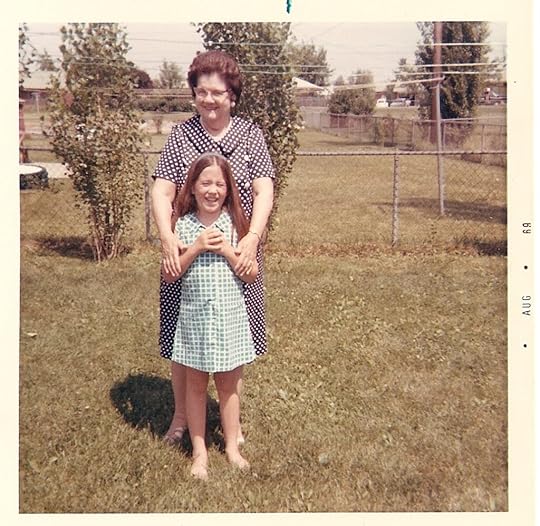
My grandmother was born on December 10, 1900. Her ancestors were Welsh, although I doubt she knew that. They came over in the 17th century. She did have a desire to remember the past. She collected names and dates and photographs, and lucky me I inherited those and traced the family tree.
We called her grandmother by her own request–not grandma or worst of all in her mind, granny. (I still remember my little cousin Jenny getting in trouble for that one!) The title “Grandmother” fit her because she was old school, not a cuddly granny-type. Her name was Margaret and as far as I know she never went by a nickname.
She died in 1977. I remember her voice, although barely. She always sent me $5 in a card for my birthday. She said she had so many grandchildren she couldn’t show favor, and I suppose she didn’t as far as I know. I also remember some of the things she said, not all of them nice. But in her defense she suffered from cancer during a time when there was little effective treatment available. Old people can be grouchy. Sometimes they have reason.
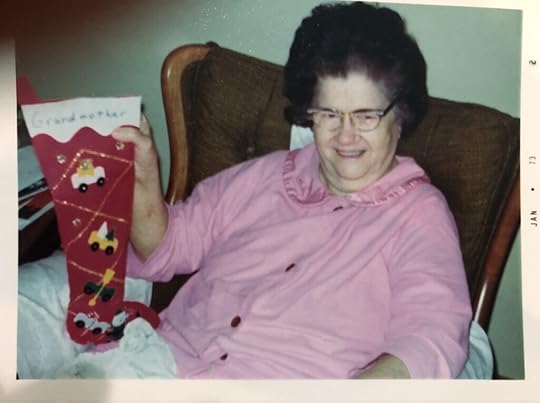 Note the name on her stocking.
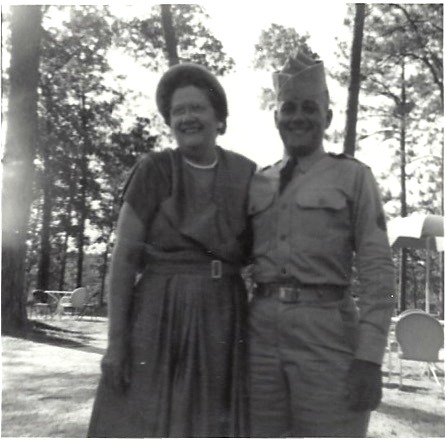 My grandmother and her son, my dad, Lloyd Jr.
A few years after she died I had a dream. I was standing in front of her like I so often did for photographs. She was wearing her usual large fake pearl necklace and earrings and a homemade dress. She was an excellent seamstress, a skill I didn’t inherit. My mother told me my grandfather wouldn’t let her buy cheap jewelry but after he died she did. In my dream she lacked her usual stoic manners. She seemed regretful and told me that she loved me. I don’t remember her ever saying that to me when she was alive. She may have but I don’t remember it.
The kinds of things I remember her saying included overhearing her tell my mother (her daughter-in-law) that I was fat and that she needed to do something about that. She complained when we had an ant infestation in the house and feared she would wake up with them in her bed.
To me she seemed very proper, but that was probably a child’s perception as my dad’s cousin has told me about the fun Margaret and her siblings had playing cards and just having fun. A few years ago I saw a home movie where she sat in front of the Christmas tree to watch me open presents. That stunned me because I never remember my grandmother sitting on the floor! But there it was, proof than indeed she had!
My genealogy research has helped me to put her life in perspective. She had two sons serving in two different theaters during WWII, and they were so young! She and my grandfather once received word that my father was missing because his ship had been sunk in the Pacific. In fact, he had been transferred earlier to another ship but communication wasn’t fast back then and I can only imagine the worry!
Margaret’s own father was an alcoholic and wandered in and out of their lives when she was growing up. He continued this even after his children had their own families. My dad told me once he remembered as a boy finding his grandfather sleeping off a bender in the family bathtub. By the time I came along all that was old news but I have to wonder how much of it never left her.
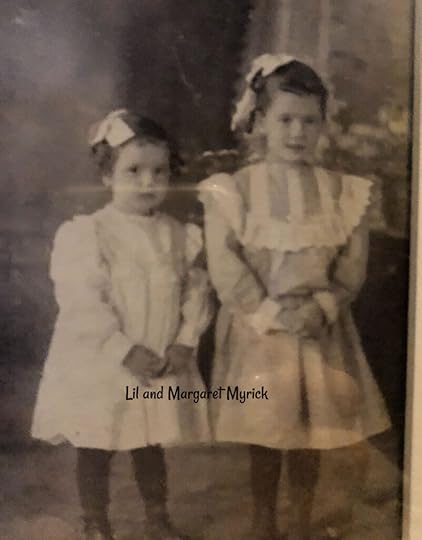 My grandmother with her younger sister about 1905-1906.
Which brings me to my point. The dream made me forget the trivial stuff, the things that truly do not matter, the things that are better off forgotten, and the things I may or may not have remembered correctly and focus instead on the fact that Margaret did love me. It also served to remind me that I want to live so that when people think of me they remember a voice of love rather than that of crabbiness.
Do I believe she spoke to me from beyond the grave? Not really. But I do believe she spoke to me from the past–from my memories, and I believe that was a gift from God.
What voices from the past do you hear? My advice is to learn to listen to the voices that build you up and instruct you and to ignore the rest.


November 6, 2023
Fairy Bushes
 ©CindyThomson2023
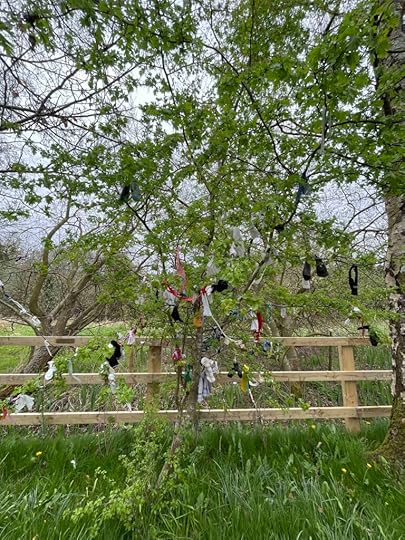
There are fairy bushes or trees growing in Ireland. That probably doesn’t surprise you, I bet. If you are superstitious, you will not cut one down or disturb it in any way. These trees are usually hawthorns. Apparently the folks at the Saint Patrick Centre are not superstitious because they transplanted this one in their rooftop garden. Maybe the fairies won’t mind since the garden is a collection of all things Irish.
One fairy tree caused a major highway to be re-routed, which according to one report I read delayed the project by ten years. Ten years! I can’t imagine why going around it took so long, but then I’m not superstitious, so…. READ ABOUT IT HERE
A man named Eddie Lenihan, a storyteller who apparently believes what he preaches, objected when the road was planned because an important fairy tree was in the way. He said it was the meeting point for fairies from Munster when they are preparing to battle the fairies in Connaught. The road was moved and apparently the fairies now can enjoy the ease of travel along the nearby highway like everyone else. Hmm…wonder how the fairies in Connaught feel about that. If Lenihan was actually helping the Munster fairies out, maybe he should watch out for those Connaught fairies who might be seeking revenge.
But since this all took place many years ago, maybe it’s all settled. So, if you thought belief in the fairies was an ancient practice, think again!
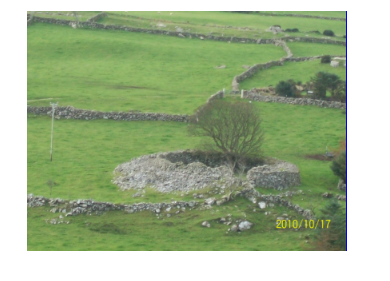
We took the photograph below while we were driving somewhere in the vicinity of the Antrim coast in the north. Obviously these farmers went to a lot of trouble to stay clear of this tree!
 ©CindyThomson2010
October 17, 2023
Thinking About Dreams
On this day many years ago I woke up after having what I thought at the time was an odd dream. I dreamt about my oldest sister. I had no reason to be dreaming about her. I’d seen her about a month earlier after her granddaughter spent a few days with me. My sister had struggled with obesity all her life. In my dream, she was thin, walking without any difficulty, and extremely happy and radiant.
When I woke up I thought the dream was so odd that I immediately told my husband about it. Late that evening I got a call from my father. My sister had passed away suddenly without warning.
And I knew.
God was showing me my sister in Heaven. No physical impairment. Beautiful. So happy.
 Photo by Jackson David on Unsplash
I believe God speaks to us in dreams sometimes. Not every time. I’ve since had others in my family pass away and I didn’t receive a comforting dream like this. Maybe one is enough.
Dreams are in the Bible, and it’s clear God uses them to communicate sometimes. Who could forget Joseph’s dreams and his ability to interpret dreams? The ancient Celts believed dreams were significant as well. I’ve blogged about St. Patrick’s dream and St. Enda’s dream, one of my most popular posts on this blog.
I cherish this dream about my sister. It brought me great comfort. I’d love to hear about your significant dreams. Care to share them here?
October 7, 2023
Catherine O’Leary’s Cow
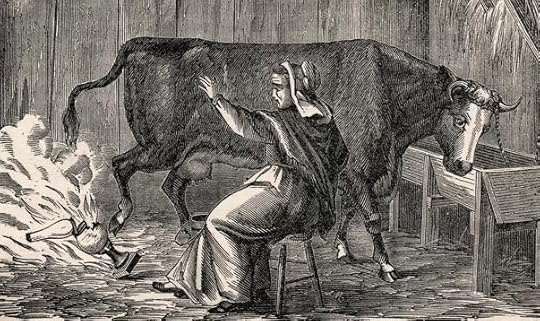 Illustration of how Mrs. O’Leary’s cow may have started the Chicago Fire that appeared in Harper’s magazine in 1871. Photo in public domain.
On this day in 1871 Chicago burned. How someone could blame a woman (an Irish woman no less) for leaving a lantern burning in a barn is a perfect example of casting the blame elsewhere. Chicago had a population explosion, resulting in haphazardly built immigrant buildings made of wood. And the sidewalks and bridges were wooden along with some streets.
If you’d like to see what a wooden street looked like there is still one on the north side of Chicago called Wooden Alley. It’s made of wood “bricks.”
 Jim Roberts, CC BY-SA 4.0 https://creativecommons.org/licenses/by-sa/4.0, via Wikimedia Commons
The river was full of wooden vessels and businesses were in the practice of dumping grease in the water. It had hardly rained a drop for months. Only one water station existed for over 300,000 residents. Chicago in 1871 was ripe for disaster and that’s what happened–four miles burned. Three hundred people died in the fire and thousands were displaced–perhaps as much as one-third of the population.
How did Mrs. O’Leary and her cow get blamed for this? Blame the media. A newspaper journalist later admitted creating the tale, but not until more than twenty years had passed. Apparently, however, Catherine O’Leary and her husband Patrick were chastised and family members say Mrs. O’Leary was vilified for the rest of her life. (Reminds me of Fred Merkle, player for the New York Giants baseball team who bore the blame for the Giants losing the pennant in 1908 when he failed to complete a play. He never lived it down, even when he stopped playing. He even thought they’d engrave his error on his tombstone.)
There was speculation that another man dropped a match in the O’Leary’s barn. But the real blame should rest on the lack of city planning. Unfortunately sometimes tragedy has to hit before safety measures and just plain good sense take affect.
In the late 1990’s Chicago exonerated Catherine O’Leary. Too little much too late for her, however.
September 30, 2023
Rejoice! Re:Joyce! Frank Delaney Is in the House
Today I’m privileged to have a guest post by my friend Jamie Chavez.
I am a fan of Irish writers, contemporary and not so: Oscar Wilde, William Butler Yeats, James Joyce, Samuel Beckett, Flann O’Brien, Fergal Keane, Seamus Heaney, William Trevor, John Banville, Roddy Doyle, Patrick McCabe, Nuala O’Faolain, Tana French … I could go on (and no doubt will in future posts). As Wikipedia reminds us, for a comparatively small island, Ireland has made a pretty large contribution to world literature. You were exposed to some of these in school, I’m sure, and while being force-fed a short story or poem or play in a high school English class isn’t the best way to learn to love Irish literature, there’s good reason to do so.
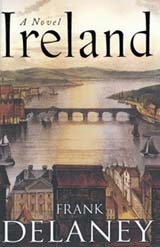
So let me tell you about Frank Delaney. I was given the first in his “Novel of Ireland” series some years ago. Called, simply, Ireland, the story is set in 1951 and is about the last surviving seanchaí (itinerant storyteller) in the country. Frankly, it took me some time to warm to the book, but when I turned the final page, kids, I was knocked out. There’s a lot more than meets the initial eye, and I was impressed by both the finely crafted tale and the gorgeous writing. Other books in this series are Tipperary, Shannon, Venetia Kelly’s Traveling Show, and The Matchmaker of Kenmare (I haven’t yet read the last two, but I delighted in the series’ first three).
Born in County Tipperary, Delaney moved to England as a young man, where he had a distinguished twenty-five-year career as a creator of BBC documentaries on both literary and Irish subjects. He also began writing books, was a panel judge for many literary prizes, and is still a well-known lecturer. He moved to the United States in 2002.
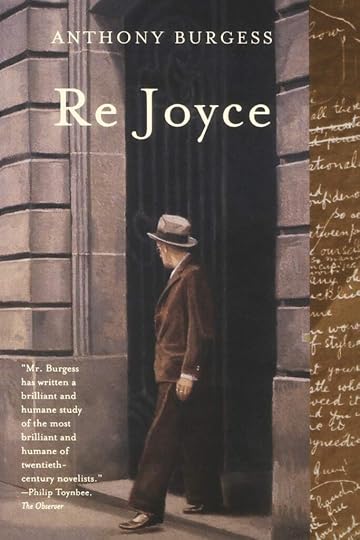 Amazon Affiliate Link Used
But it is Delaney’s most recent project I’m betting will charm you as it does me. Called Re:Joyce, it is a deconstruction of James Joyce’s famous novel Ulysses in five- to seven-minute line-by-line podcasts. They’re fun, they’re smart and entertaining, and they’re everything you need to work your way through this stream-of-consciousness literary masterpiece. Like the novel itself, this is an ambitious project. It’s taken Delaney a year to get through the first chapter, and his website says he’ll see you there, every Wednesday, for the next twenty-two years. (He’s sixty-eight years old as of this writing, but I wouldn’t bet against him.)
Honestly, I haven’t read Ulysses—it’s 265,000 words, y’all (of Joyce’s works I’ve read only Dubliners and A Portrait of the Artist as a Young Man)—but I have listened to quite a few of Delaney’s podcasts and they’re enchanting. Here’s the episode from June 16, which celebrates Bloomsday, a celebration of the life of James Joyce and an informal reenactment of the events of the single day that passes in the thousand or so pages of Ulysses.
Enjoyce!
Cindy’s note: I’ve read Ulyssess! I consider it part of my life I’ll never get back again. I should have had this book while I was reading it!
Jamie Chavez is an editor, writer, and blogger.
This article reprinted by permission, © 2011.
September 27, 2023
The River of Life
 Nova Scotia ©CindyThomson2023
Some thoughts today on the Celtic view of rivers and flowing water. Pre-Christianity, the Celts named their rivers for goddesses because they were life-giving, like a mother. The image of God’s spirit flowing like a river is, in my opinion, a powerful one. If you think of God like a river, instead of a far-off deity that we hope to see one day in heaven, you get the idea that He is present in our lives. And if you think of traveling in that river, going where it takes you, your whole view of life can change.
Like the air we breathe, that river is vital. We cannot exist without it. We cannot exist without God. He made us, the Creator of all.
Sometimes I struggle to find the words I’m reaching for. If you are not a writer, you may not understand that. If you are a writer, you undoubtably do. I’m struggling today, so I’ll pause and let the River of Life flow over me, and I know, in due time, I’ll be refreshed.
Today I’ll listen, watch, observe, and seek to hear God’s voice. Well, really I need to do that every day.
Just some thoughts…
September 14, 2023
Walking in the Land of the Living
I am among the gazillion people who, when looking for inspiration, turn to the Book of Psalms.
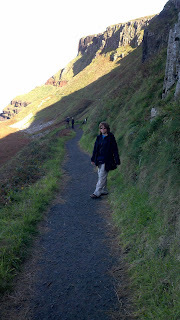 That’s me walking at Giant’s Causeway in Northern Ireland in 2013 ©CindyThomson2013
For you, LORD, have delivered me from death,
my eyes from tears,
my feet from stumbling,
that I may walk before the LORD
in the land of the living.
~Psalm 116:8-9 NIV
Walking in the land of the living…I know, it has a spiritual meaning–spiritually alive rather than spiritually dead. But taking the Celtic view here (and none other, of course) the physical and the spiritual are not actually separate. The land of the living is right around me, and walking in nature certainly makes me aware that I am right now in the land of the living.
 That’s me walking on a Florida Beach ©CindyThomson
I sometimes image I can breathe a whole better in a natural setting. That could be physically true–even though ragweed is a thing–but it’s absolutely spiritually true. God is the source of the air I breathe and who was it that said you are never so close to God as when in a garden? Maybe lots of people, but here’s one:
“Kiss of the sun for pardon. Song of the birds for mirth. You’re closer to God’s heart in a garden than any place else on earth.” — Dorothy Frances Gurney
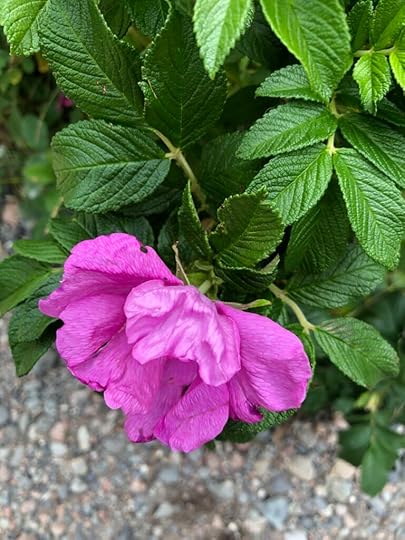 @CindyThomson2021
September 6, 2023
Irish Organizations in America
 AJ Photographic Art at https://flickr.com/photos/82448203@N04/13202190293
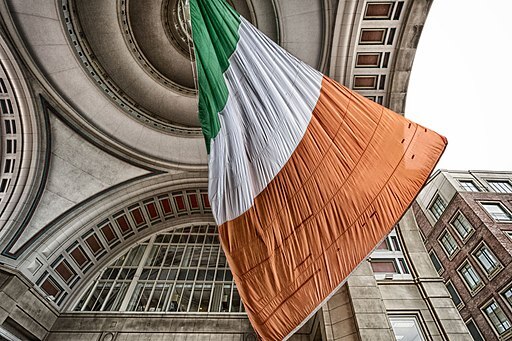
When the 18th century Irish settled in America, it wasn’t long before they formed organizations to aid those who came after them. The first organization (that was recorded) was called the Charitable Irish Society and was formed on St. Patrick’s Day in 1737 in Boston. Their purpose was two fold: First: to cultivate a spirit of unity and harmony among all resident Irish and their descendants in the Massachusetts Colony and to advocate socially and morally the interests of the Irish people and their cultural heritage. Second: to alleviate suffering, and to aid such of its members or other worthy recipients as by the vicissitudes of fortune might be deserving of its charity. (From: http://www.charitableirishsociety.org/ )
Soon to follow was the Ancient and Most Benevolent Order of the Friendly Brothers of Saint Patrick founded in New York in 1767 and the Society of the Friendly Sons of St. Patrick for the Relief of Emigrants from Ireland founded in 1771 in Philadelphia. http://www.friendlysons.com/(Now referred to as Sons and Daughters!)
An interesting thing to note is that these early organizations did not discriminate according to religious affiliation. In fact, these particular groups still don’t. According to the Friendly Son’s web site: The Society has always been non-denominational, welcoming members from all religious backgrounds. Citizens of the United States of Irish lineage, over eighteen years of age and of good moral character are eligible for membership. (It is an organization for men only, however.) UPDATE: SINCE I WROTE THIS POST BACK IN 2011, IT’S NOW OPEN TO WOMEN
There are many charitable groups based on heritage, and some are Protestant and some Catholic, so it surprised me to discover that this idea was not originally sectarian. I did, however, discover in my research that some of the charity groups for immigrants that were run by the church offered help to anyone, whether they attended the group’s church of choice or another one.
Does anyone else find that interesting given Irish history?
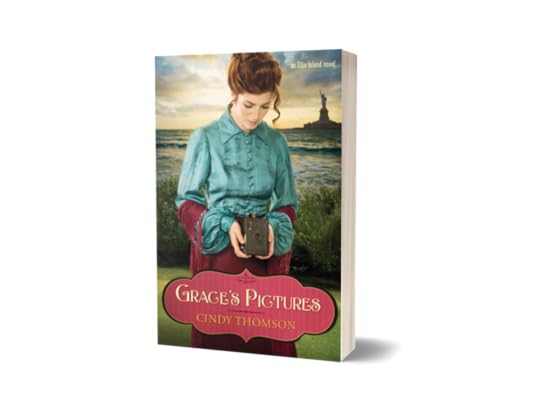
These organizations were a part of my research for Grace’s Pictures.
 Grace’s Pictures Book Cover
September 1, 2023
Happy Labor Day from The Carmina Gadelica
No matter what type of work you do, I pray it’s fulfilling, fruitful, and long-lasting.
The hurricane that just hit Florida had us wondering … would my mother-in-law’s place be impacted again. My husband and his brother just finished a lot of grueling work on it. Well, thankfully her place was far south of the damage, but as you’ve seen on the news, others have a lot of repair and cleanup to do. Rebuilding is worthy work. Creating is worthy work. Anything that leaves the world better than you found it, is worthy of your efforts. And many times it’s the process rather than the end product that you gain the most from. Something to ponder.
The Carmina Gadelica, via Wikipedia, is a collection of prayers, hymns, charms, incantations, blessings, literary-folkloric poems and songs, proverbs, lexical items, historical anecdotes, natural history observations, and miscellaneous lore gathered in the Gaelic-speaking regions of Scotland between 1860 and 1909 by Alexander Carmichael (1832–1912).
 Photo credit: United Soybean Board https://www.flickr.com/photos/uniteds... No changes. Via Flickr
May God bless your labor!I will go out to sow the seed,
In name of Him who gave it growth;
I will place my front in the wind,
And throw a gracious handful on high.
Should a grain fall on a bare rock,
It shall have no soil in which to grow;
As much as falls into the earth,
The dew will make it to be full.
~From the Carmina Gadelica, THE CONSECRATION OF THE SEED
August 13, 2023
Ireland’s Matron Saint Gets Her Day in 2023!
This is the talk I gave at festivals in the summer of 2023
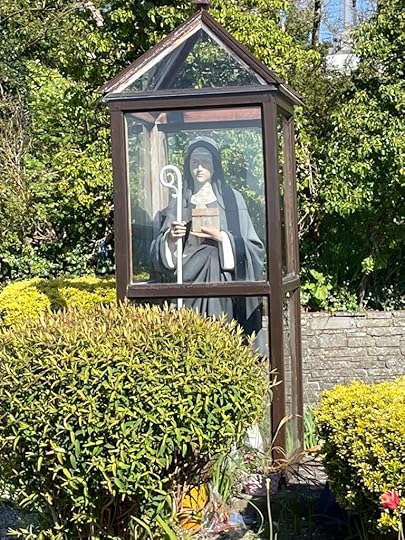 Ballysteen, Ireland. St. Brigid’s Well near the Cliffs of Moher. ©2023 Cindy Thomson
St. Brigid is one of the three patron saints of Ireland. The other two are St. Patrick and St. Columba (or Columcille in Irish.) She lived from about 451 to 525 (or 524 if you ask the people in Ireland. Next year in February there will be celebrations marking the 1500th anniversary of her birth.) Here’s a brief summary from my book, The Roots of Irish Wisdom:
No figure is more revered in Ireland with as much controversy surrounding the question of her existence than Brigid (Bride, Brigit, Bright, Bridget). There was a popular goddess named Brigid (which translates to “exalted one”), and some of her attributes were assigned to the Christian who became St. Brigid when Christianity took over the island. We have no writings from Brigid and no contemporary accounts of her life. Despite the shadow of doubt this casts over Brigid’s life, people in Ireland and in many other places in the world cherish her. What we do have is stories—lots of stories about her deeds and merits. It’s not surprising that all we have is what has been handed down orally; as is the case with most of the old legends, the ancient texts that refer to Brigid were transcribed oral tales, perhaps at times embellished by the author. They were only recorded on vellum after many generations had recited them in tales and ballads.
There were two well-known ancient biographies of Brigid: The Life of St. Brigit the Virgin by the seventh-century scribe Cogitosus, a monk at Kildare, the site of Brigid’s duel monastery; and Beatha Bhrighdi (The Life of Brigid) in the Leabhar Breac (The Speckled Book), dating to the fifteenth century. Other accounts other life were written, which sometimes contradict each other.
The Roots of Irish Wisdom: Learning from Ancient Voices by Cindy Thomson. p.19-20.
So why are we talking about this now? In 2023 St. Brigid’s Day became a national holiday in Ireland. That’s 120 years after St. Patrick got his day in 1903! Ireland has been slow when it comes to granting women certain rights and respect. The Magdalene Laundries are an example. These were institutions where young girls were sent if they were unwed mothers, accused of petty theft, thought to be promiscuous, or too pretty, or for various other ridiculous reasons. Lest you think this was something from the 1800s, it was, but the last one did not come until the 1990s! The government, who along with the church benefitted from this unpaid labor and for too long ignored it, did issue a formal apology in recent years. You can read more about that if you’re interested here.
These days everyone in Ireland is interested in St. Brigid. St. Brigid crosses are now in higher demand in tourist shops in Ireland.
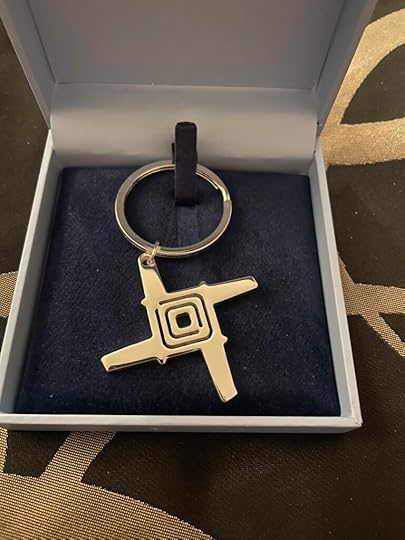 St. Brigid cross keychain gifted me by Prime Tours. ©2023 Cindy Thomson
I know this because a shopkeeper in Ireland told me so while my best friend Sandy and I were shopping in Galway for a St. Brigid’s cross necklace for her. Brigid’s following in Ireland and abroad is growing due to a focus on women’s rights and empowerment, environmental awareness, peacemaking, and caring for the downtrodden. She walks in two worlds as saint and goddess.
Let’s look at all that.
An artist going by the name of Friz, created a mural on the side of a building in Dundalk, County Louth, near the reported site of Brigid’s birth and where an annual pilgrimage takes place on St. Brigid’s Day (as it has for centuries.)
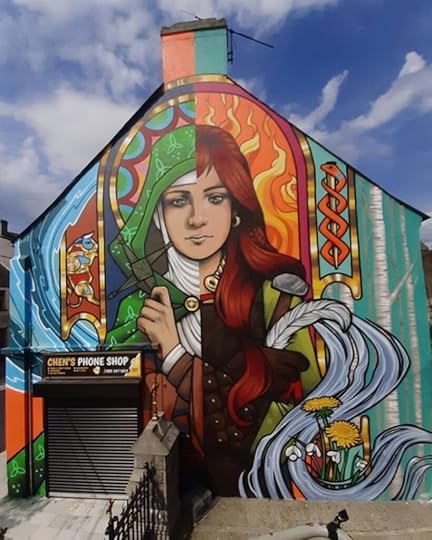 Image from: https://www.seekdundalk.ie/friz-upcom...
Some of the details featured and attributed to either the saint or goddess or both, with as the artist says a nod to the Book of Kells:
Water/Rod of Asclepius (snake) from Greek Mythology, healing and medicineHoly wells and the power of healingFire/Smoke/Hammer/leather apron and glove: patron saint of blacksmithingFeather quill: patron saint of poetsSt. Brigid’s CrossSt. Brigid’s CloakDandelion/snowdrops/birch trees: She was born on the first day of spring in IrelandBelt and rosarybull/cowstorc necklaceBe sure to visit the artist’s website: https://thisisfriz.com
Many legends and stories were passed down and that’s what inspired me to write my novel, Brigid of Ireland. Let’s look at some of them:
Brigid and NatureThe ancient Celtic people were attuned to nature. They had to be due their dependance on the land. Brigid worked in a dairy. The animals listened to her. She once saved a man who had accidentally killed a king’s pet fox. As she was going to plead his case, another fox jumped into her wagon with her. It turned out this fox could do all the same tricks the king’s fox could do. Pleased, he released the accused man. However, later the fox ran away back to his den. Brigid was born on the first day of spring, a season of new life and renewal. Today, more than ever, people are becoming aware of our affect on the environment. Climate change is in the news. Brigid, for many people, represents caring for the earth.
Brigid was a PeacemakerAs many saints were. Clan disputes were frequent and Brigid was called upon to mediate. She created what we would call win-win situations, so both sides left happy. This was described as her causing so much confusion both sides thought they won. There is a legend about Brigid giving away her father’s sword. If you haven’t heard it, I blogged about it here. The fact that she gave the sword to a man because he could then use it to by bread was symbolic of turning swords into plowshares, a concept today that finds favor with many.
Brigid was CompassionateShe was always giving, saying, “What’s mine is yours.” A powerful example for the world today and at least some to strive toward. There was poverty in her day that is a bit hard to conceptualize for most of us. The people then were either part of a wealthy family, part of a royal family, a slave, or homeless. Brigid was a friend to those without connections. (This is where I began my novel Brigid of Ireland.)
Brigid Practiced HospitalityGenerous to a fault because it sometimes got her into trouble. She gave away so much food that was always restored (a miracle). Hospitality believes there is worth in every person. In Brigid’s faith it meant she saw Christ in every person. The Celtic belief was that if you sent blessings out, blessings would return to you.
Brigid was a Woman of ContemplationToday we might call this self-care, taking time for yourself, renewing your spirit. For Brigid there was a deep and mysterious presence of God everywhere. Pausing, reflecting, and contemplating on that is what allowed her to do the things she did. I thought of self-care when I read this poem by John O’Donohue found in the book Rekindling the Flame, A Pilgrimage in the Footsteps of Brigid of Kildare by Rita Minehand, CSB.
Brigid’s MantleA Blessing of Solitude
May you recognize in your life the presence,
power and light of your soul.
May you realize that you are never alone,
that your soul, in its brightness and belonging,
connects you intimately with the rhythm of the universe.
May you have respect for your own individuality
and difference,
May you realize that the shape of your soul is unique,
that you have a special destiny here, that, behind the facade of your life, there is something
beautiful, good and eternal happening.
May you learn to see yourself with the same delight,
pride, and expectation
with which God sees you in every moment.
John O’Donohue from Anamcara: Spiritual Wisdom from the Celtic World
The legend of how Brigid obtained the land to build her monastery can be found here.
A Saint For EveryoneSpread Thy Mantle
O Brigid, Mary of the Gael,
May thy protection never fail.
Spread thy mantle over me,
Where’re I pass, where’re I be;
Weather foul or weather fair,
Keep me in your loving care,
Till I rest, my journey o’er
With God and thee for evermore.
From Rekindling the Flame, p. 58.
From Rekindling the Flame:
People are searching for a spirituality that is inclusive of all creation…she [Brigid] is attracting substantial scholarship and understanding. She reaches across the divides of faith, having merged Christian saint and Celtic goddess.
Darach MacDonald in his book, Ireland’s Pilgrim Paths, said about St. Brigid, “More recent scholarship has sifted through the political chaff and winnowed out some kernels of truth, as well as plausible explanations of why accounts of Brigid’s life … incorporate clear elements that echo pagan beliefs and traditions in a Christian context. Rather than being deceptions designed to fool people into false belief, the merging of Christian interpretation with pagan tradition created a continuum in the expressions of the spiritual life of the people.” He points out that Brigid sat on the boundaries of those two eras. She was a Christian but Christianity had not yet taken a firm hold on the island. That’s the symbolism of the tale that she was born on the threshold of the house, neither inside nor outside. These kinds of portals to the Celtic were thin places where the spiritual and the natural world merged imperceptibly.
After the Norman conquest anything the church viewed as pagan was destroyed, including the perpetual flame Brigid’s nuns had kept burning. That must have been devastating to the people, although they did continue some of their traditions in their homes. Brigid’s flame was ceremonially relit in the 1990s.
Two churches in Kildare bear her name: Catholic and Anglican. This year they celebrated St. Brigid’s Day with a joint service. In a country where it’s well-known that religion divides the people, this is significant and amazing.
Rev. Philip McKinley, curate of St. Brigid’s Cathedral in Kildare said, “She’s a very, very modern saint that speaks to the really cutting-edge issues of our day—gender equality, environmental issues, social care, poverty, peacemaking.”
Perhaps finding again the things Brigid represents is driving her new popularity and returning Ireland, and perhaps the world, back to its spiritual roots.