Cindy Thomson's Blog, page 4
October 16, 2024
Tribute to my father

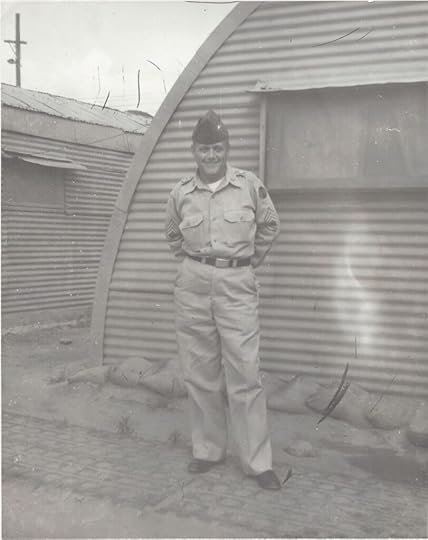
On October 17, 2010, my husband and I were wandering the paths of Northern Ireland, photographing rainbows. Later when we got back to our B&B I received an email from my sister telling me that my father had passed away. She noted the exact time. We had known it was coming for the last couple of days. We were unable to get home early. Despite the pain of all that, I realized that we hadn’t seen the rainbows Ireland is famous for until the very hour my father passed.
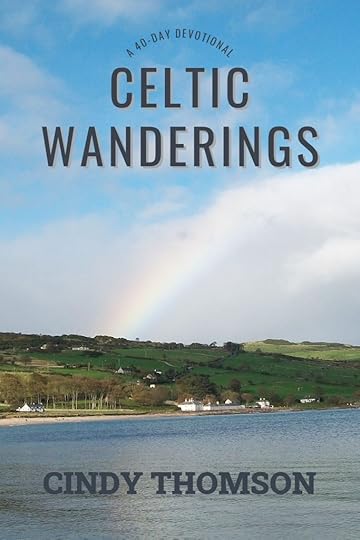 The cover of this book is special to me. It features a rainbow we saw the hour my father passed away.
On the plane on the way home, I wrote the following that was read at the funeral. I recently realized this was on an old blog of mine that I’m working to clean out and close, so I’m posting it here on the 14th anniversary of his death.
I’m proud to say that my dad was a member of the greatest generation—raised during the Depression, lived through WWII, and worked 65 years until he was forced by health problems to retire at age 80. Although he was a tough old Army sergeant, he had four daughters who called him Daddy.
He had a huge heart. He observed family gatherings from his recliner and we will never forget some of what he said:
Shut the door. Were you born in a barn?
When’s dinner? My stomach thinks my throat’s cut.
Where did [insert name] go? Is [insert name] with you?
(He was always keeping track of everyone.)
Did you get something to eat? Have some more!
Watch those kids. They’ll run out the door and into the street.
Take my car. It’s full of gas.
Thinking about those things now makes me realize the important role of guardian he played for our family.
My dad was a war hero.
He enlisted in the Navy on May 6, 1942 at age 17. He once answered some questions from me in an email. Here are his own words: “I enlisted because our country had been attacked and in such a cruddy way that I thought that we needed to do those people in. Two thousand of our sailors were entombed in the Arizona and that was too much for me to swallow.”
You’ve probably heard his war stories. Early on the stories were about the places he’d been, the people he encountered, and the men he worked with. In later years he began to have flashback type dreams. He remembered something from early in the war.
He worked on an LCI (Landing Craft Infantry) a type of ship that delivered the infantry to a beachhead. The ramps were at that time operated manually. Again in his own words: “I was the guy who went down the Starboard ramp and removed the cable. Another guy went down the Port side.” He remembered a particular time when the troops were under heavy fire. Men were shot and fell into the water. He thought if he could just pull them to the beach, a medic could get to them and at least they’d have a chance. His job was to remove the cable and run back up the ramp so it could be closed. But this time he was delayed because he started pulling the injured men onto the beach. He got in trouble for that. But he was trying to save lives at the risk of his own. That illustrated to me what a hero he was.
He saw 26 months of straight combat. That is so hard to imagine today. He stayed in the military, choosing to enlist in the Army after the war. He was a 20-year veteran, spent the first two years of my life in Korea while we stayed state side. We lived through a devastating earthquake when he was stationed at Fort Richardson in Anchorage, Alaska, and he was involved in search and rescue there. He was honorably discharged on January 1, 1965, at Fort Richardson.
But I, of course, already thought of my dad as a hero. He encouraged me my whole life. He thought I could do anything so long as I just tried. I’ve been blessed to have had a father like that.
The last time I talked to him he said he was glad I was going on my trip. He passed away at an hour when I was in Ireland photographing a full rainbow. A rainbow is God’s promise that there is more to come. I’m happy for him that he has no pain now, that he’s safe in the arms of his Savior.
Now it’s up to us to make sure our cars are full of gas and that we shut our doors to keep in the heat. We will have to make sure the children don’t run into the street. We will have to keep track of everyone and make sure everyone has eaten.
We may never be faced with pulling someone onto a beach while under attack. But we can reach out to someone who is drowning in life’s troubles so that they will at least have a chance. If we do this, he has taught us well.
In 1996 my dad wrote down his memories, mostly of WWII. He wrote a farewell near the end that I feel is appropriate to read now.
“To those who carry on I will say one thing. If you have God on your side you can—and you will— survive anything. Goodbye my dears—please pass the torch on to our succeeding generations—your story will be precious to them.”


October 14, 2024
The Round Tower and the Witch’s Stone
Fewer than two dozen round towers stand mostly intact in Ireland today. It’s estimated that about 120 were built. They are associated with monasteries between the 9th and 12th centuries. They were likely bell towers but may have also served as safe towers where monks could hide when under attack. Some say the door was so high to keep intruders out. The monks would climb up a ladder and then haul the ladder in with them. Maybe so but the intruders might have ladders as well. Despite that, it wouldn’t have been easy with that rounded solid surface. In any case, they are magnificent monuments to the past. I marvel at how those were built in ancient times with such skill that about twenty are still standing.
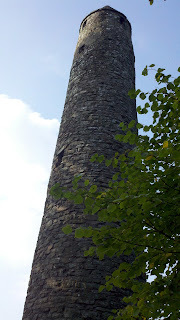 In County Antrim, Northern Ireland. ©CindyThomson
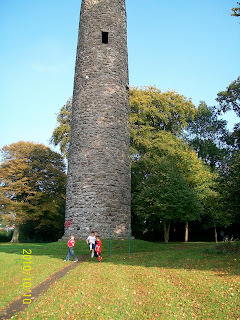 ©CindyThomsonRound Tower in County Antrim
We visited the round tower in Antrim on our first trip to Ireland in 2010. It’s described as one of the best examples of a round tower in Northern Ireland and it was indeed in excellent condition. The tower, 93 feet high, is all that’s left of an early 10th century monastery. The tower is in the middle of a park. Tom snapped a picture of some soccer (football) players in front of it (above). When they knew we were taking pictures, they hurried off. The photo gives a good perspective on how high that door is. On the back side (pictured below) there is a door/window that is not so high.
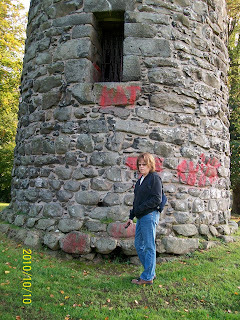 ©TomThomson. That’s me and I’m only 5’1″
There are a couple of interesting things about this site. One, unfortunately, is that it bears quite a bit of graffiti, or it at least it did when we visited.
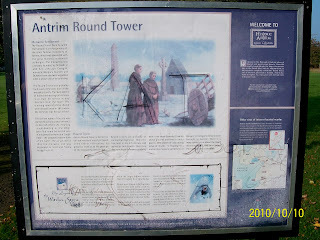 ©CindyThomson
Below are some closeups of the stone wall and window. We are a little nerdy, being so fascinated by stuff like that. But in case you are too, here you go:
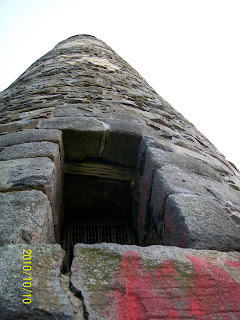 ©CindyThomson
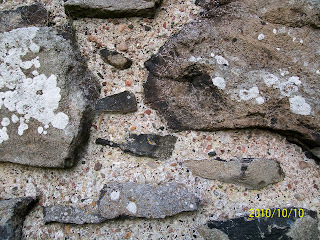 ©CindyThomson
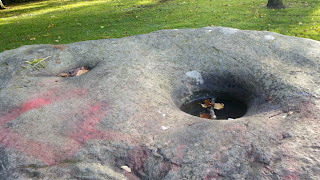
Another interesting thing about this site is the legend of the Witches Stone. There is a large stone near the tower with two holes or indentations. One thought is that it was used by the monks to prepare their meals and to grind grain. But the Irish, storytellers with great imaginations that they are, couldn’t leave it at that. The legend says that a witch, dismayed at the Christian monks building the tower, climbed up and flung herself off the top. She landed on the stone, leaving an impression of one knee and one elbow. These holes are said to be always filled with water. As you can see, they were when we were there (well, you can see one of them, anyway.) It’s called a bullaun stone. A sign at the site states that the witch must have glided part of the way since the stone is a distance from the tower. Well, those kinds of details never hender a good Irish tale!
August 30, 2024
September 2024 Newsletter Giveaway
*If you are reading this, you have followed the link from the Rafflecopter giveaway.
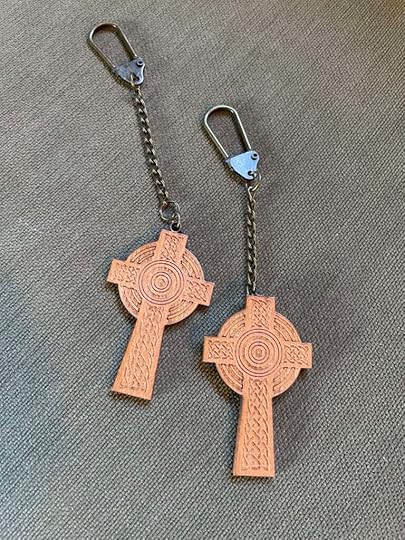
Leave a comment here by answering the following and be entered to win one of two Celtic Cross keychains.
US shipping only
!. What do you like to see in an author’s newsletter? (Choose all that apply and add additional info if you’d like)
New ReleasesFun GiveawaysInside look at author’s writing processUpdate on author’s writing progressPersonal news about author’s lifeSeasonal poems or reflectionsHistorical tidbitsWhat the author is researching, including research tripsReading recommendationsBook Deals on author’s booksBook Deals on other booksOther2. What do you not like to see in an author’s newsletter? This could be mine or another author’s.
August 29, 2024
The Legend of the Mermaid
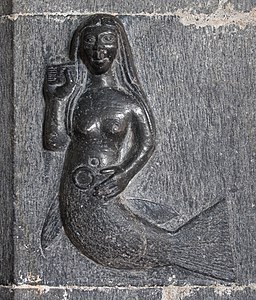 Andreas F. Borchert, CC BY-SA 3.0 DE https://creativecommons.org/licenses/by-sa/3.0/de/deed.en, via Wikimedia Commons
There is an Irish legend about a mermaid named Liban that appears the Book of the Dun Cow. This book, Lebor na h Uidre in Irish, is the oldest of the ancient book of legends believed to have been written in the late 10th to early 11th century. The photo above is of a wall in Clonfert Cathedral in Galway. Clonfert was founded by St. Brendan the Navigator, so this image appears here in honor of his famous voyage.
Liban the MermaidLiban was the daughter of a man named Eochaidh, who along with the rest of his family was drowned–probably a judgment for running off with his stepmother. Liban and her dog survived by the grace of God, but could not leave the water (Loch Neagh.) After a year she told God she wished to be like a salmon, and God granted her wish and turned her dog into the form of an otter. She roamed the water like that for 300 years, saying, “The wave is my roof and the shore my wall.” Then she happened upon the boat of Beoan mac Innle, a follower of St. Comgall. He heard her singing, and she appeared to him. She explained her situation and her desire to be brought to the saints. They caught her in a net, where, as you can imagine, she became a spectacle. There was disagreement over to whom she belonged. Comgall thought that because she was caught in his country, she should be his charge. Fergus, a fisherman it is assumed, thought that because he caught her in his net, she should be his. But Beoan said she was his because of his initial conversation with her. These men decided to let God make the decision and fasted and prayed. An angel appeared and said the matter would be settled this way: two stags would appear and they should hitch them to the chariot where Liban’s makeshift water tank was. They should let the deer pull her wherever she should go. The animals brought her to tech Dabheoc (a church.) There the clergy gave her a choice: she could be baptized and go immediately to heaven, or she could continue to live on for 300 more years and then go to heaven. She chose the first option and when she baptized she was named Muirghein or “sea birth.” In that place many miracles occurred because of her.
That’s the story. Kind of sad. It’s as though she’d had a curse on her and had to somehow get on dry land to reach the clergy where they could take it off so that she could finally die. I’m not sure what we’re supposed to learn from it. What do you think?
The Mermaid ChairThere is another legend, this one from Cornwell. There was a beautiful woman with a spectacular singing voice who attended church from time to time in Zinnor. No one knew where she’d come from. A young man fell in love with her and followed her one day when she left church. The two were never seen again. Years later fishermen saw a mermaid who asked them to raise their anchor because it was blocking her door and she couldn’t get to her children. Because spotting a mermaid was considered a bad omen, they complied and sailed away as quickly as they could. When they returned home and told the story, folks believed this was the missing woman who had enticed the young man to live with her in the sea. The photo below is of “the mermaid’s chair” where she sat while in church. Which came first, the legend or the chair? No one seems certain.
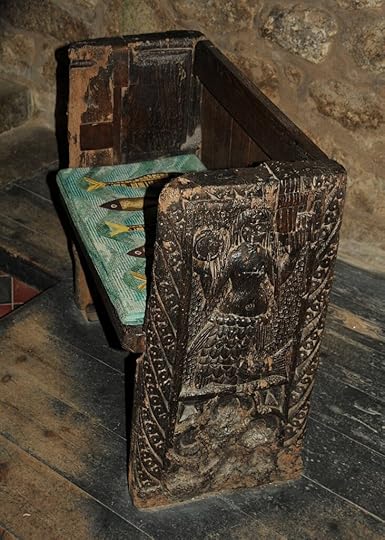 A 600-year-old chair depicting the Mermaid of Zennor, a figure in Cornish folklore, in St. Senara’s church, Zennor. August Schwerdfeger, CC BY 4.0 https://creativecommons.org/licenses/by/4.0, via Wikimedia Commons
This legend many believe is a warning not to be enticed by beauty. It’s interesting to me that both legends show mermaids looking for spiritual guidance and perhaps salvation.
The Swan Woman
Taken from The Wonders of Ireland by P. W. Joyce, 1911
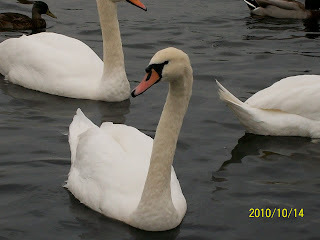 ©CindyThomson2010
Once there was a poet who, while journeying across the country, came across a flock of wild swans as he stood on the banks of the River Boyne. They flew very near him so he picked up a rock, took aim, and threw it. It struck one of them and knocked it to the ground. When he hurried to his prize, however, it was not a swan at all, but a lovely woman in white clothing, and she was perfectly well. She explained to him that some time ago she was sticken with a terrible illness. As she lay on her bed, a group of demons gathered her up and took her away. To her friends, however, she appeared to be dead. The demons took her on their wild flights and she had been flying with them ever since until the poet happened to strike her and bring her back.
He took her home and restored her to her friends.
This is one Irish story with a happy ending! But like every other Irish story, this one probably has a deeper meaning. What do you think?
O’Dangal’s Vision
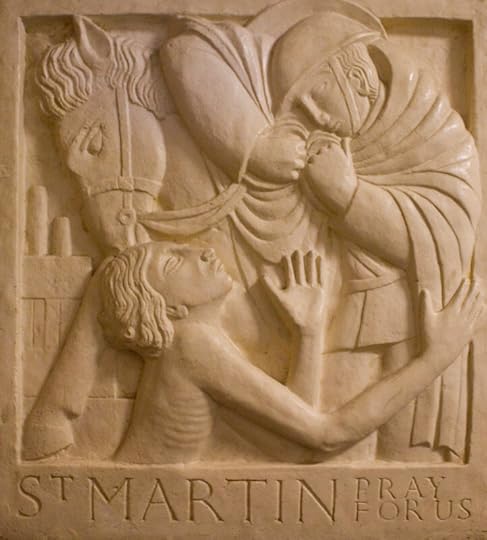 https://www.flickr.com/photos/paullew/ via Flickr, no changes were made.
I read about this in The Wonders of Ireland by P. W. Joyce, 1911.
During Ireland’s Golden Age of Christianity pilgrims would journey to religious centers such as Rome and Tours. They greatly venerated Martin of Tours, probably because of the association that they believed had existed between Martin and St. Patrick. One day while a man named O’Dangal approached Martin of Tours’a tomb he saw a great crowd of people. When he got closer he discovered that while there was a great deal of activity, he heard no sound. In the middle of the crowd he saw his mother passing out meat and milk to the poor. He knew his mother was in Ireland, however. He decided to test his vision and he sneaked up and took the lid to the milk vessel. Then he stood back and saw his mother searching about for it. He kept the lid, continued his journey, and then went home to Ireland.
He asked his mother what she had been doing on the very day he’d had his vision. She said she had called together the poor of her community and had passed out meat and milk. But strangely, she had lost the lid to her milk vessel. He produced it and she saw that this was indeed the missing lid.
This story was told to persuade the people that an arduous and dangerous journey to a holy site need not be made in order to do good–the work the venerated saint had done in his lifetime. Do good where you are.
This rhyme brings the point home:
To go to Rome
is much of trouble, little of profit:
The King whom you seek there,
Unless you bring him with you,
you will not find.
“Lord God, you were glorified by the life and death of Saint Martin.
Renew the wonders of your grace in our hearts
so that neither death nor life may separate us from your love.
Through Christ our Lord. Amen.” ~ This prayer accompanied the photograph above.
August 5, 2024
Celtic Song Part Two
This continues my talk featuring my book Celtic Song. You can find Part One here.
This poem is found on page 35 in the book.
The Sacred Three
My fortress be
Encircling me
Come and be round
My hearth and my home.
~From Anam Cara by John O’Donohue
These types of circling prayers did not originate with the Celts but the practice was embraced. Author Esther De Waal said, “Their prayers were songs, and as they crooned or intoned them, they seem close to the continuous prayer the Orthodox describe as a murmur in the heart.” ~Esther De Wall, God Under My Roof, found on page 37.
The Great CollectionsThe Carmina Gadelica or Song of the Gaels is the collection made by Alexander Carmichael. The longer title includes: Hymns and Incantations collected in the Highlands and Islands of Scotland between the 1860’s and early 1900s. It included both Christian and pagan beliefs. An example found on page 44:
Blessing of the Kindling
I will raise the hearth-fire
As Brigid would.
The encirclement of Brigid and Macha
On the fire, and on the floor,
And on the household all.
The Religious Songs of Connacht, published by Douglas Hyde in 1906. Another gathering of old songs. An example is found on page 47 of the book. Below is just a snippet:
The will of God be done by us,
the law of God be kept by us,
Our evil will controlled by us,
Our tongue in check be held by us
From Wales we have The Black Book of Carmarthan dating to the mid 13th century. It was translated by Oliver Davies and contains one of the earliest mentions of King Arthur. From page 54: “Davies says The Black Book can be divided between two types of poems: praise and penance. He goes on to say, ‘Praise was a fundamental part of the rhythm of life to which the authors of the penance poems aspired, for signing the psalms (the very word means praise) formed an extensive part of the daily monastic office.'”
We also have The Book of Talieson from the 14th century. Samples can also be found in my book.
The InstrumentsA brief mention:
The Harp, an 8 string instrument poets carried on their backs.
The fiddle. The oldest discovered dates to the 11th century and may have been a type of adapted harp.
Bagpipes are ancient, found in the Middle East but oldest mention of them in the Celtic regions comes from a British 11th century manuscript. In 2003 wooden pipes were discovered in County Wicklow. They might have been attached to a bag. They date to the late Bronze Age, are of descending size, tapered, and lack finger holes.
For more discussion and more examples of ancient instruments please see chapter 8 in the book.
Old Songs That Live OnIn Celtic Song I detail two songs: Auld Lang Syne and Be Thou My Vision. Chances are you are familiar with these. The words are quite ancient. Even though Auld Lang Syne is attributed to the 18th century Scottish poet Robert Burns, the words were probably older. He was the first to write them down. Burns said about the poem, “There was a fire of genius in it.”
Be Thou My Vision was translated in the 19th century and put to an old Irish folk tune. But the words date from about the 8th century.
A Last WordFrom page 89:
“It is my hope that this little bit of history has inspired you to look for the music of what happens. To listen carefully to hear the music of the past. To wonder at the beauty of keeping of a rhythm. To produce the music you feel in whatever medium you wish. To remember your ancient roots and the lessons the ancestors have set for you.”
Celtic Song, Part One
This is a talk I gave this summer based on my book, Celtic Song, From the Traditions of Ireland, Scotland, England, and Wales.
 Celtic Song, From the Traditions of Ireland, Scotland, England, and Wales You can buy direct from me. $14 US shipping included. Click on book cover above.
Celtic Song is not a book of musical scores. You will not find sheet music inside. What it is is a historical exploration of why music was so important to the ancient Celtic people and how it is passed down today. This historical exploration will look at Celtic poetry, sayings, prayers–all musical in their original expression. The book also takes a look at the ancient musical instruments and some of the old songs that are still sung today.
From page 1:
Let us go over the murmuring sea,
Away from the jarring world,
Back to the peace of the Irish hills,
In the mists of morning curled.
Let us hark to the song of the fairy folk
In a moonlit glen at eve,
And the half-heard patter of fairy feet
While their intricate dance they weave.
~From Celtic Memories, “The Exile” by Norreys Jephson O’Conor
As this poem sets our imaginations soaring, let’s think about why music was so popular then and now to the Celts. The tunes are lost, but the rhythm and beauty remain. Alexander Carmichael, a 19th century collector of some of these sayings and poems, once claimed that the people did their tasks in rhythm. Another thing that is well-known is that intervals of three were important. We know the people observed in nature the order of the seasons, the movement of the sun and moon. The cycle and rhythm of life was noted.
Speaking of nature, think a moment about the old hymn This Is My Father’s World. There is a line: “All nature sings, and round me rings, the music of the spheres.
The hymn was written in 1901, but goes back even farther than the Celts. the Greek philosopher Phthagorus (570-490 BCE) believed that music emanated from the heavenly bodies as they moved in space. And you know what? The ancients were right! NASA has recorded some of the sounds of the planets. I’m not scientifically minded, but it has something to do with the electromagnetic waves that are able to be heard by the human ear.
So the ancient Celts translated into their life and words rhythm or song.
As I mentioned, three intervals were important. They created what is called triads, the comparison of three related things. An example from page 9:
The three greatest gifts of music and song are:
The pleasure it brings the assembly,
The pleasure it gives the listener, and
The pleasure it brings to the maker.
PoetsPoets in Ireland were highly revered. The highest level of poet was called an ollav. He was sometimes equal to the king. Sometimes even rated above the king. He held the knowledge of history, genealogy, and the old tales in age before books. He was sometimes also feared for having the power of satire. That sounds amusing to us, but what it meant was that the people feared the poet’s words could bring about a curse on their cattle, destroy their crops, or otherwise affect their lives negatively. And so they were compelled to give the poet shelter and food, along with the poet’s entire traveling company. This got to be too burdensome. St. Columcille helped make peace, but that’s another story. (If you’d like to read some fiction about St. Columcille and his mother, check out Enya’s Son.)
Poets were important in all the Celtic regions. In Wales the earliest surviving literature is a book titled, The Early Poets, which dates to the 6th century.
Learning by HeartMemorization was important. Why? Here’s a quote from Christine Valters Painter (page 13-14 in the book). She is speaker about the Irish tour guides who led some of the tours she was on.
“Painter says that the guides recite memorized poems during their guided walks. ‘Indeed, it seems to be very much part of the ongoing Irish tradition to commit poems to heart, to bring them intimately into oneself for remembering. the words seem knitted into our guides’ consciousness in ways that makes the speaking of the words feel transcendent.’ Transcendent. Divine. Words given to us rather than words we produce. Many times these words have a rhythm or a pattern that helps to ingrain them into our consciousness.”
Think about it. How do children learn their ABC’s? Through a song. There is a rhythm that helps me when I’m trying to unscrew or screw something: Rightly tightly, lefty loosey. Learning by heart is important and useful. Traveling monks used to recite verses to pass the time. Today, if we’re delayed at our departure gate or traveling as a passenger we don’t recite things we’ve learned to ourselves. Not usually. We watch YouTube or read a book. I wonder…are we missing something?
Monks were scribes. They had books, but memorization was still important. In this example from page 19 in the book, note how the words have a rhythm.
Pangur Ban (Old Irish for White Cate)Translated by Robin Flower
I and Pangur Ban my cat,
Tis a like task we are at:
Hunting mice is his delight,
Hunting words I sit all night.
Better far than praise of men
Tis to sit with book and pen;
Pangur bears me no ill will,
He too plies his simple skill.
Tis a merry thing to see
At our tasks how glad are we,
When at home we sit and find
Entertainment to our mind.
Oftentimes a mouse will stray
In the hero Pangur’s way;
Oftentimes my keen thought set
Takes a meaning in its net.
‘Gainst the wall he sets his eye
Full and fierce and sharp and sly;
‘Gainst the wall of knowledge I
All my little wisdom try.
When a mouse darts from its den
O how glad is Pangur then!
O what gladness do I prove
When I solve the doubts I love!
So in peace our tasks we ply,
Pangur Ban, my cat, and I;
In our arts we find our bliss,
I have mine and he has his.
Practice every day has made
Pangur perfect in his trade;
I get wisdom day and night
Turning darkness into light.
The monk who wrote this strayed from his usual duties, showing us some creativity and humor. The ancient Celts memorized more than just religious texts. Columcille had not just religious training but he also learned old tales from a bard, or poet, in the druid tradition.
Psalters, books of Psalms, were common while the whole Bible was not. Psalms were written as songs and are a good example of how even though the tunes no longer exist, we can feel the musical expression through the words (even through translations!). Psalms were recited day and night and during tasks.
PrayersA lorica or breastplate prayer was a prayer for protection, distinct in its style or rhythm. Here is a portion of St. Patrick’s breastplate from page 30:
I arise today through God’s strength to pilot me,
God’s might to uphold me,
God’s wisdom to guide me,
God’s eye to see before me,
God’s ear to hear me,
God’s word to speak for me,
God’s hand to guard me,
God’s way to lie before me,
God’s shield to protect me.
Circling Prayers or Caim Prayers have a rhythm fit for walking or making rounds around sacred wells or other sacred spots. The Celts would walk sun-wise once, three times, or even twelve times around while reciting the prayer.
–Continued in Part Two
July 3, 2024
Research Trip to Johnson’s Island
Johnson’s Island is a very small island in Sandusky Bay in Lake Erie in Ohio. Never heard of it? Many people who live nearby haven’t either. As I was searching for inspiration for my next novel, I learned that a Confederate Prison was in place here during the Civil War. I went to nearby Fremont, Ohio, to the Rutherford B. Hayes library to do research about three years ago. Fremont, as you might have guessed, was the home to President Hayes. The house, the grounds, the library, are all impressive. It was a cool place to visit even without doing research. I’d heard there was a baseball game played at the Johnson’s Island prison and it sounded interesting. Details about everyday life were recorded in several prisoner’s diaries, but probably the most interesting was that of William Peel’s who died at the prison shortly before the war ended.
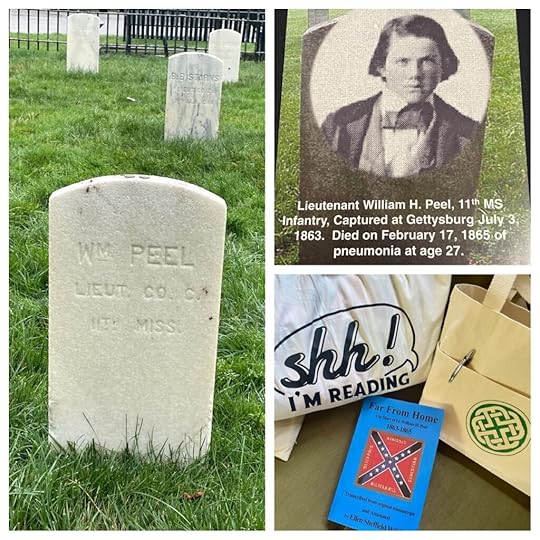
And then something happened, the mysterious germ of a thing that can launch a whole novel! At the library I poured through several diaries and accounts about Johnson’s Island. Then I spotted a mention about two black slaves involved in a snowball fight (which was one of the leisure activities the prisoners engaged in). Why would they have been there? They could not be enslaved in Ohio. So I kept digging through the information and I read that the slaves there had “refused emancipation.” Even the librarians were puzzled by that. So, of course, I researched some more.
Many slaves joined their masters as they went off to war, charged with keeping their masters safe and looking after them. So many of the men who fought in that war on both sides were very young and their parents probably wanted to safeguard them as best they could. Some of the slaves of course ran off once they were in the north. Many stayed behind enemy lines and did the mundane chores of laundry, cooking, chopping wood, and so forth. Some went into battle with their masters but did not, of course, bear arms. And so, some were captured along with their masters. There was some discussion in the Union army about what to do with them. Most were set free after taking an oath of allegiance to the U.S. government. And then there were the two or three at Johnson’s Island. Why did they stay?
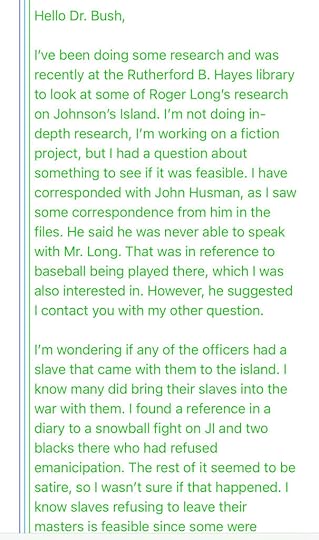
After I discovered this, I found that a man named David Bush had been leading an excavation at the island. He’d written a book and formed, or at least assisted in the formation, of a nonprofit called the Friends of Johnson’s Island. I emailed him back in June of 2021 after I visited the island.
Here is a portion of my email to David Bush:
He graciously emailed me right back.
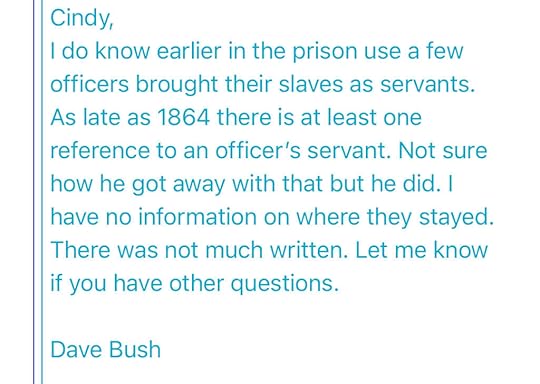
So it happened and the rest is left to my imagination, based on what we do know, of course. Unfortunately Dr. Bush passed away about six months later. His work and passion for the history of Johnson’s Island is still being carried on by the Friends of Johnson’s Island. When I found out they were hosting a “pop up museum” at the island on the last Saturday of June, I made plans to go. Yes, my first visit was three years earlier, and no, that novel isn’t finished. Life got in the way, and I’m currently working on edits for a different novel, but the opportunity was there and I will get back to this work-in-progress soon.
This event featured the display of some artifacts, a few talks, and a self guided tour of the prison site, a place I didn’t know you could visit on my first trip there. Here are some pictures. (We also did a self guided tour of Sandusky sites on the Underground Railroad. I’ve include a few pictures from that, but I took a lot more!)
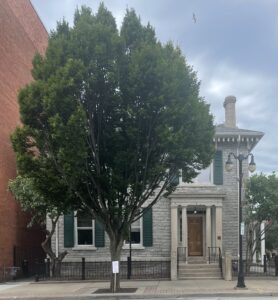 Lucas Beecher home. Lucas was a lawyer who represented a slave who won freedom. His cousin, Harriet was the author of Uncle Tom’s Cabin
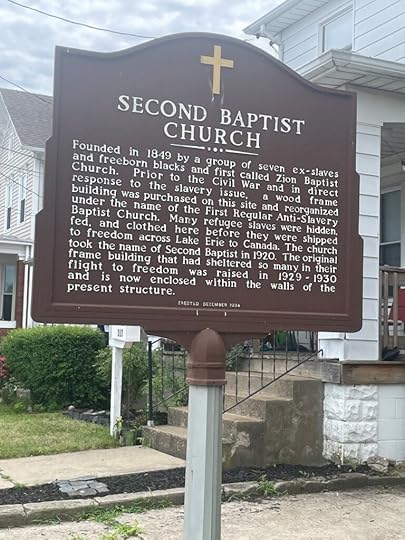 The church that stands on this site encloses the former church, a site on the Underground Railroad run by a black congregation.
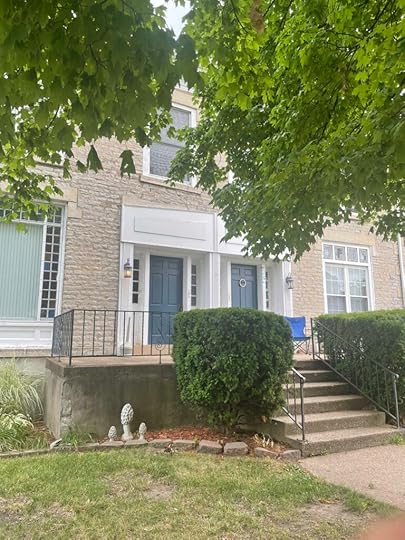 John and Samuel Irvine were brothers who lived in this double house and hid slaves. They once hid an escaping slave in a coffin.
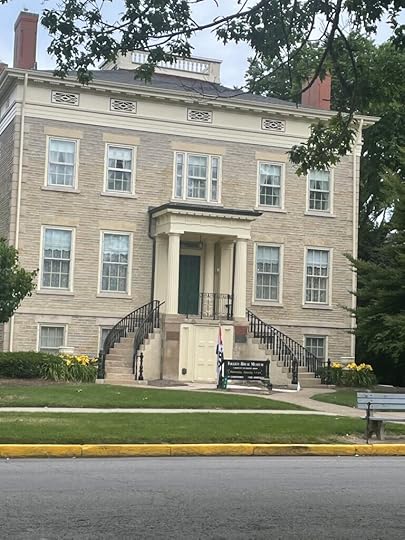 The Follett House was owned by a publisher who published the Lincoln-Douglas Debates. His second wife Eliza was known to give aid to runaway slaves. The house is now a museum run by the local library.
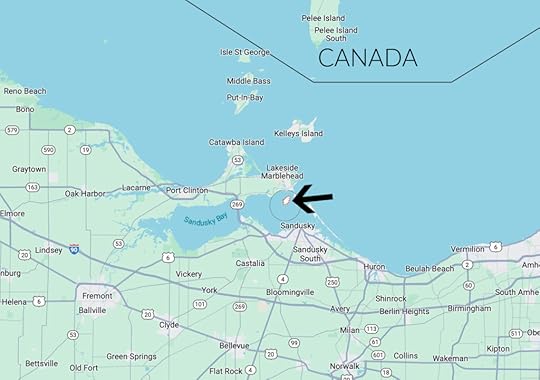
If you’re curious like me, you’ll want to see where Johnson’s Island is. This is northern Ohio bordering Lake Erie.
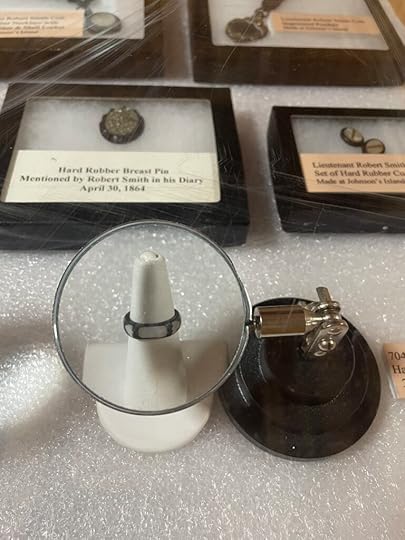 The prisoners carved jewelry out of hard rubber.
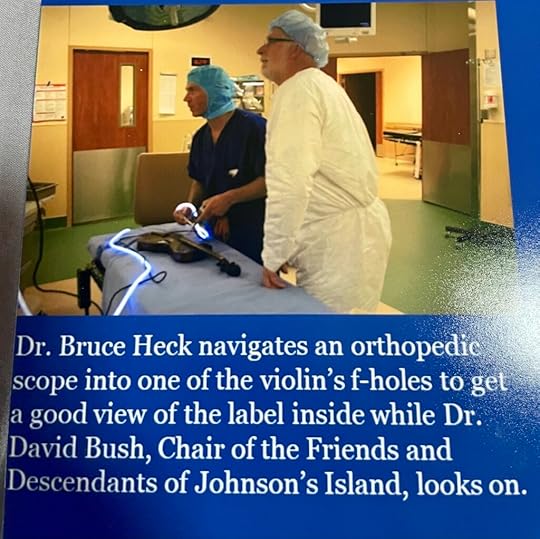 This photo shows Dr. Bush in white helping to investigate a violin that was made in the prison.
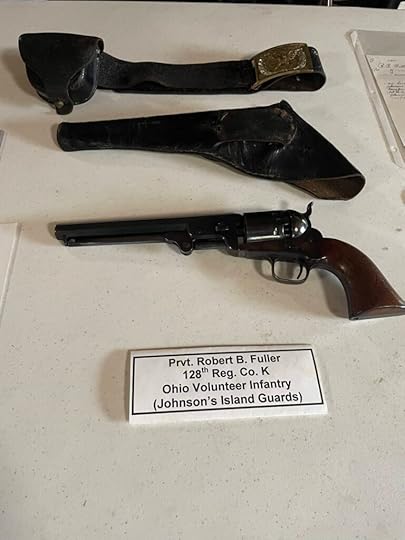 Owned by one of the Ohio Union guards.
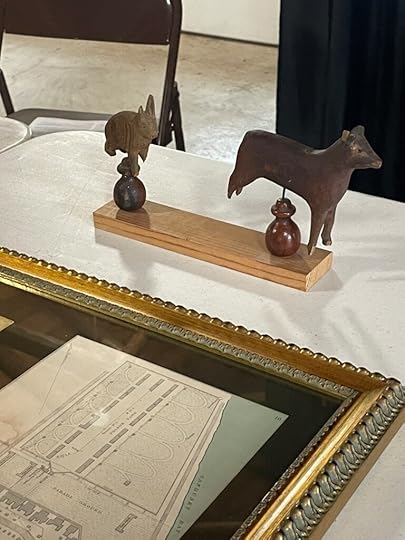 Examples of small carvings made the prisoners.
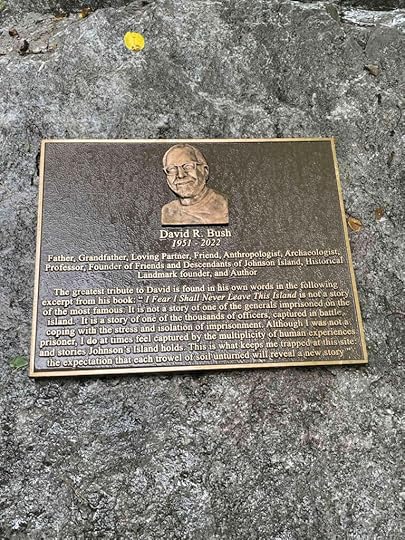 Memorial to Dr. Bush on the prison site.
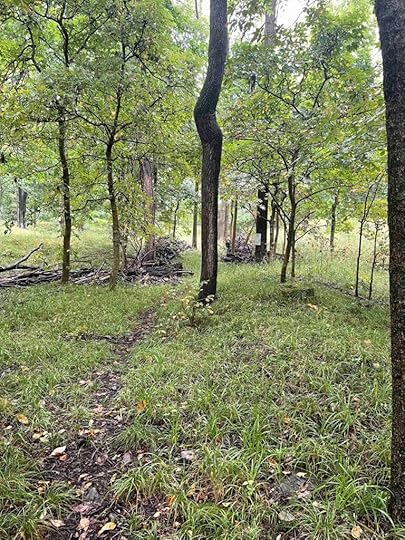 the earthen walls of one of the forts can still be seen in the woods.
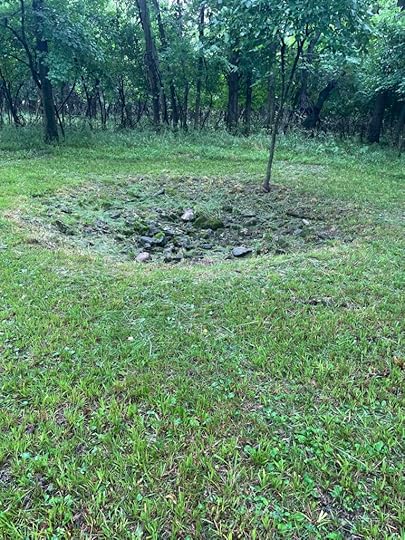 Remains of a well on the prison site.
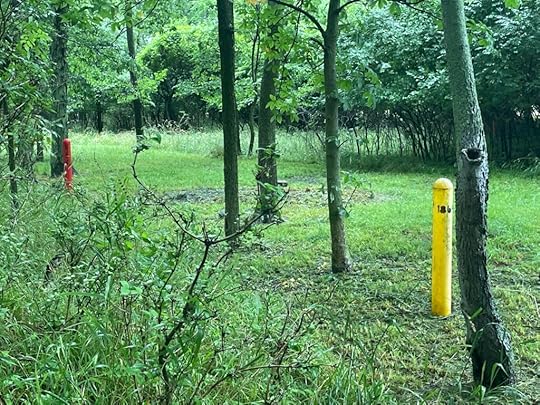 prison site
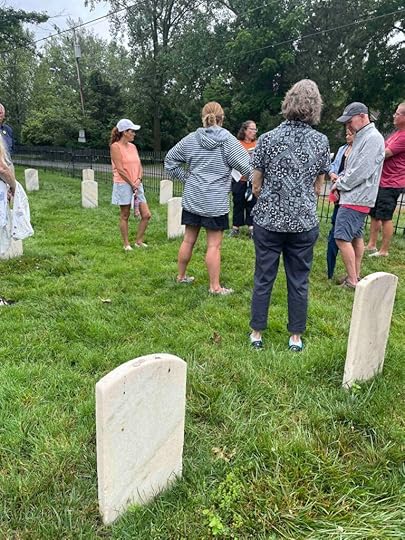 talk at the Confederate Cemetery
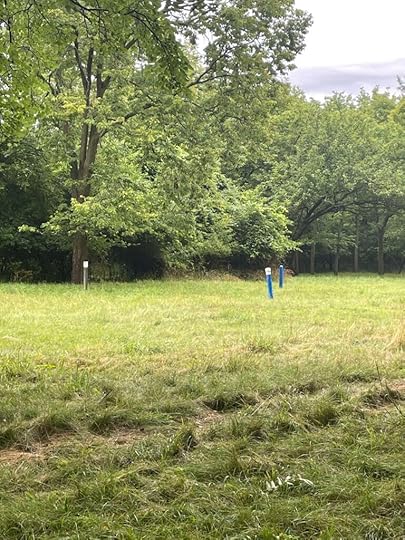 There are markers on the prison grounds to show where the buildings once stood. These mark the hospital.
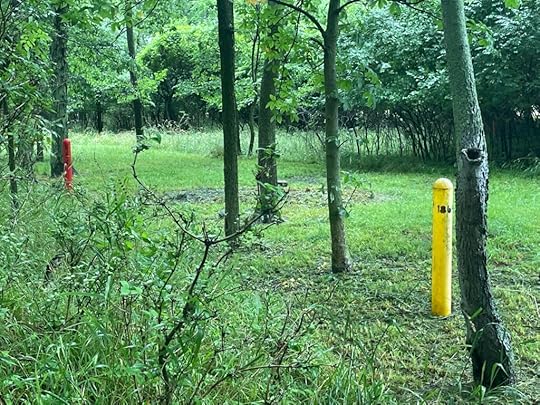 The yellow posts mark the prison walls. There are two sets as later the wall was moved to expand the space for the growing population. The red posts denote the dead line. Prisoners wandering beyond that deadline were subject to be shot.
There is a lot of fascinating history on this prison. Things like Mr. Johnson, who rented his island to the government, was the first suttler, or seller of general goods, to the prisoners who had money or the Union troops. He was fired for price gouging. He had used the island for farming and no one was living there when the government built the prison. The cemetery is maintained by the Daughters of the Confederacy. There were many escape attempts, a few successful. Winter was the best time to escape in one respect because the lake froze over and you could walk to Sandusky. On the other hand, winter was brutal. The quarters were built from green wood, which meant it shrunk, leaving gaps, which were nice and airy in the summer, but awful in the winter. The reason we have so much information on the prison life is because it was a prison for officers who were well-educated and often wrote home and kept diaries.
I hope you enjoyed my little blog tour of Johnson’s Island!
St. Abban
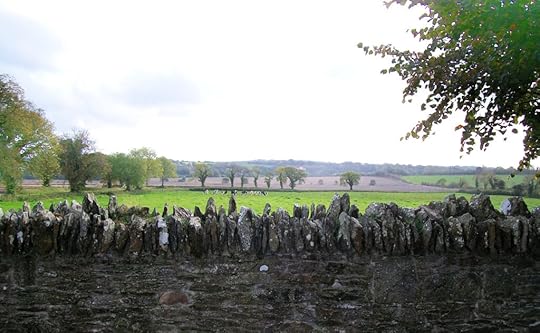 Cows in the Boyne Valley ©CindyThomson2010
He was tending the cows belonging to his foster family when he was but a lad. A wolf approached. Abban communicated with the animal and learned that he was starving. He allowed him to eat one of the calves. Later, the family was distraught over this. Abban told them that if God could create the calf, when one did not exist before, He could surely make another calf out of nothing now. And miraculously the calf was restored. Amazed, the family took Abban to the King, saying that they were agreed that Abban should worship the God who did this thing for him. So when Abban was twelve years old he went to live with his mother’s brother, Bishop Iubar, and thus began his religious training. He seemed to understand the nature of God while those around him were astonished by it. Of course they were amazed by the miracle, but to this young boy, it was nothing to marvel at. Of course God could do that. He’s God!!
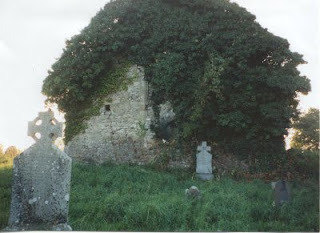 Unknown source, but you can see what the man in the video is referring to when you look at this photo, pre-restoration.
Killabban (literally the church of Abban) in County Laois, is supposedly where St. Abban is buried. But he is associated with many places in Ireland, so who can know? Abban lived in the 5th century, or maybe the 6th century, or maybe he lived to be 300. All that is said about him.
A medieval church dating a bit later was recently restored. Here’s a video about that, and below that I’ve posted a link where you can see an artist’s rendering of what the monastic community may have looked like.
Click here: Laois City Council site with artist’s interpretation.