Cindy Thomson's Blog, page 6
March 1, 2024
Happy St. David’s Day!
 Photo by Catrin Ellis on Unsplash
St. David is the patron saint of Wales. Wales is a Celtic country that gets little recognition. I remember listening to a baseball broadcast where the announcers were talking about one of their colleagues, Chris Welsh. They said, “He’s Irish, isn’t he?” “No, I think he’s Scottish.” His name is Welsh, for heaven’s sake!
Admittedly, I’ve given hardly any attention to this wee Celtic country on Celtic Voices (my former blog) either. Until now.
(Update: since I wrote this post in 2011 I’ve discovered I have a deep Welsh line in my family tree! My DNA shows a bit of Wales. I get it from both my father and my mother’s side. It’s my father’s side that I’ve found the ancestor.)
The people of Wales were early Christians, like the Irish. But unlike the Irish patron saint, St. Patrick, St. David is not well known. Other than the fact that his death is mentioned in a 10th century manuscript, there is not much documentation on the bishop’s life. But there are legends! The lives and stories of St. David were written down about 500 years after his death. Things like his mother was a nun who had been violated, his birth was foretold by St. Patrick thirty years earlier, his father was a king or a prince, he cured his teacher of blindness…
Ever wonder where the expression about March coming in like lion and out like a lamb came from? St. David’s birth, at the end of the month, was gentle like the dove often pictured on his shoulder. His death, on March 1st, came like a lion. Well, that’s one story anyway.
From The Catholic Encyclopedia:
One of his first acts was to hold, in the year 569, yet another synod called “Victory”, against the Pelagians, of which the decrees were confirmed by the pope. With the permission of King Arthur he removed his see from Caerleon to Menevia, whence he governed the British Church for many years with great holiness and wisdom. He died at the great age of 147, on the day predicted by himself a week earlier. His body is said to have been translated to Glastonbury in the year 966.
It is impossible to discover in this story how much, if any, is true. Some of it has obviously been invented for controversial purposes.
St. David’s Day is a matter of national pride for the people of Wales. It was not celebrated until the 18th century. Here are some ways to celebrate. Here’s a more information about St. David.
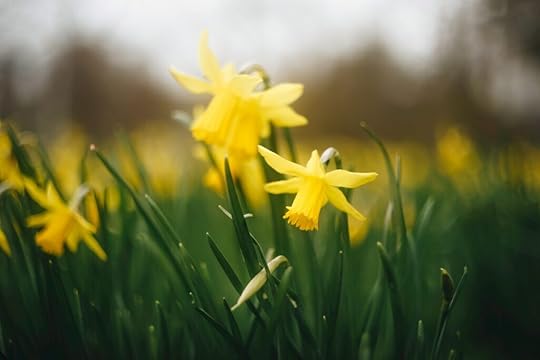 Photo by Joppe Spaa on Unsplash


February 4, 2024
Finding Brigid in Kildare
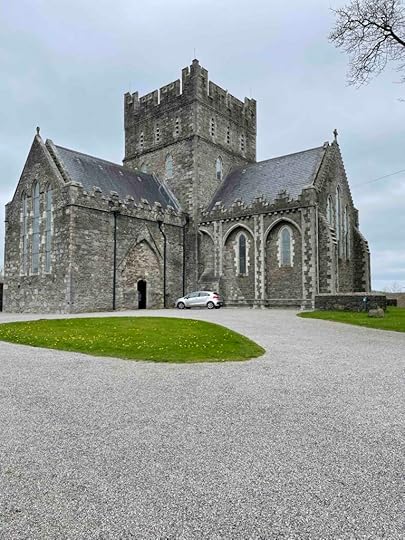 St. Brigid’s in Kildare ©CindyThomson2023
Kildare is the site where Brigid built her church. The current one is likely on or near the original spot. The area was already sacred, however. It was the site of an ancient sacred oak. Druids often worshipped beneath an oak. She built her church very near a fire that the local women tended for the gods and where Brigid joined them, worshipping her God.
Fire is associated with St. Brigid. Below is from the book, The Rites of Brigid, Goddess and Saint by Sean O Duinn.
The fire element in Brigid is shown in her connection with the Feast of Candlemas (Purification of the Blessed Virgin Mary/Presentation in the Temple) which takes place on the second of February, the day after that of Brigid. According to tradition, St. Brigid, put a ring of lighted candles on her head and led the Virgin Mary into the temple in Jerusalem.
This was also a time that people brought their candles to church to be blessed. And apparently some brought their Brigid’s crosses too.
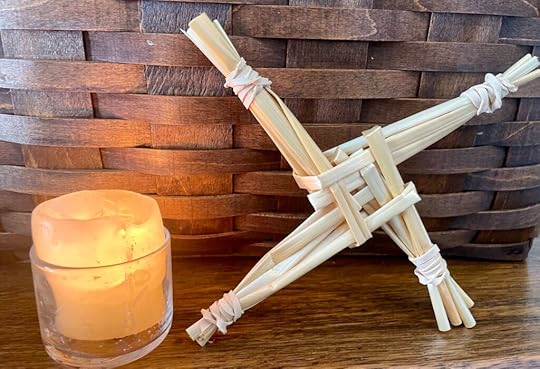 ©CindyThomson2023
There are a lot of traditions in Ireland regarding Brigid. This is a wonderful book to read if you want to know about them all. You may want to look for it in a library, however. Right now used copies on Amazon are seriously overpriced.
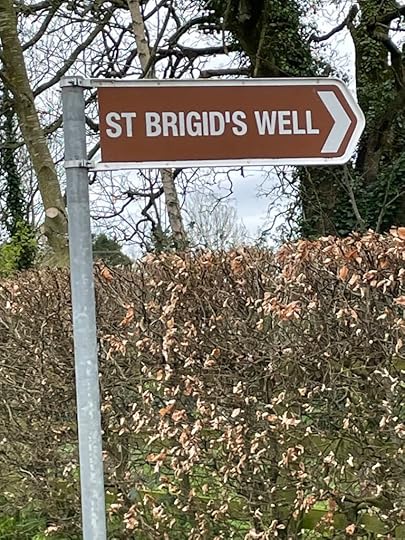 Kildare. ©CindyThomson2023
A short distance from the cathedral, which we were blessed to get a personal tour of in the off season, is St. Brigid’s well. There are thousands of holy wells across Ireland and many are dedicated to St. Brigid. This one we accessed by walking down a short, damp, grassy lane.
There is a well, a stream, a modern statue, a wishing tree or rag tree, and many offerings left by visitors. It’s a well groomed little park but it has been a sacred spot since before Christianity came to Ireland. Another representation of Brigid taking what was already sacred and worshipping her God there.
When we visited there were a few others besides our tour group there. One woman had come to take water from the well, a common practice. She couldn’t reach the water, however, so Tom did it for her. He turned down her offer to drink some of it for a blessing.
This well is a lovely place to visit, so simply yet beautiful.
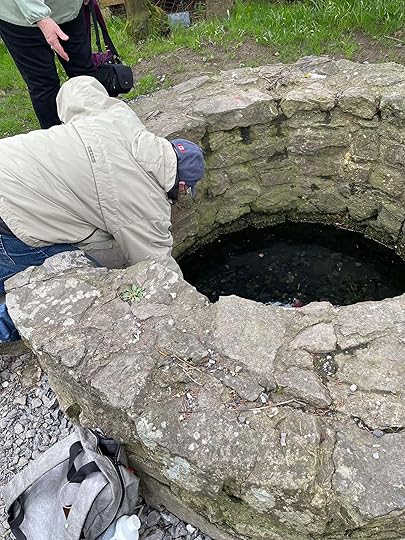 Tom getting water from St. Brigid’s well, Kildare. ©CindyThomson2023
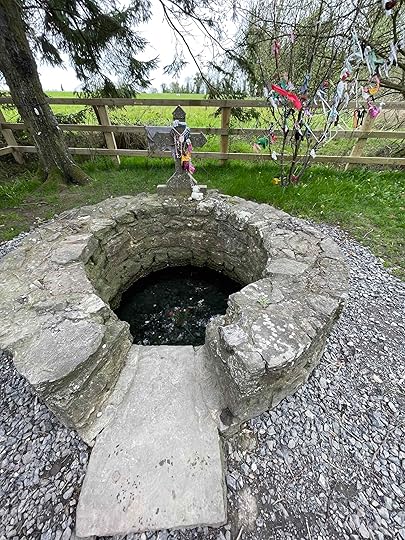 St. Brigid’s Well, Kildare. ©CindyThomson2023
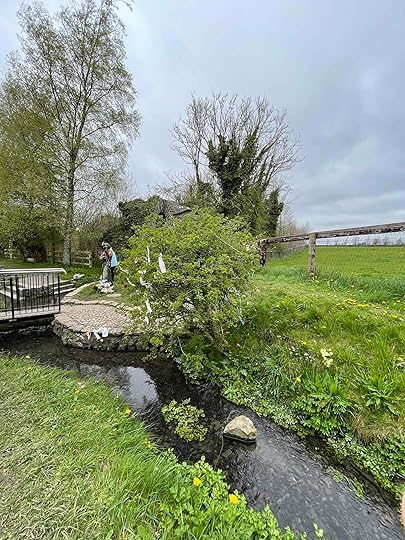 The stream at St. Brigid’s Well, Kildare. ©CindyThomson2023
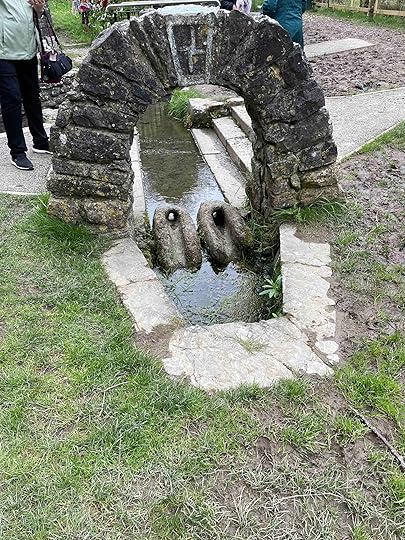 Stones referred to as St. Brigid’s knees. ©CindyThomson2023
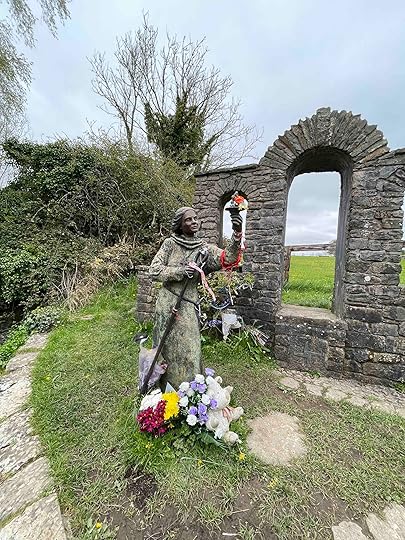 St. Brigid Statue at St. Brigid’s Well, Kildare. ©CindyThomson2023
February 1, 2024
St. Brigid and Groundhog’s Day
In my January newsletter I asked what U.S. observance had ties to St. Brigid’s Day. If you didn’t know, now you do, Groundhog’s Day. St. Brigid’s Day is Feb. 1, the traditional start of spring in Ireland. Brigid was a woman who obscured boundaries. It began with her birth. She was prophetzied to be born not inside and not outside the house. Read Brigid of Ireland if you want to see how that happened.
 Photo by Abigail Lynn on Unsplash
The season of Imbolc begins Feb. 1 with St. Brigid’s Day.
Yes, I know today is Groundhog Day. Both are associated with the coming of spring.
From The Celtic Year, A Celebration of Celtic Christian Saints, Sites, and Festivals by Shirley Toulson. (Amazon affiliate link used.)
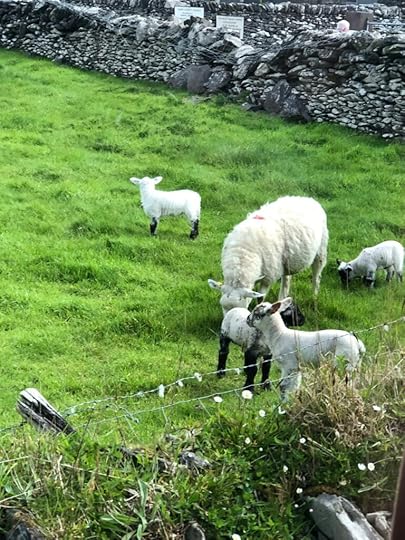
“It is a solemn and joyful time: the ending of the darkness as the seed of light which was planted at the solstice in the womb-like depths of such carefully constructed passage graves as New Grange, gradually pushes its way into the air. The weather in these islands may often be more cold and threatening now than ever it was at mid-winter, so that the survival of the new-born lambs is a great marvel, but even if there is not much warmth in the sun, the hours of daylight increase.”
 ©SandyBeck2023
That is the best and most poetic description of what Imbolc is that I have found.
For the ancient people the seasons were extremely important. They had to know when to plant and when to reap and when to plan for a long winter. They were extremely attuned to the sun and moon, and they were keenly aware of when the days grew longer. I wonder how many people today equate the coming of spring with the amount of daylight. We think about snow and cold and don’t think spring is truly on its way until these things have passed. Why else do we consult the groundhog? (Which is an ancient tradition, likely Celtic, but involving a hedgehog or a witch who woke up if the day was sunny and kept winter going. Take your pick of legends.)
How different would our attitudes be if we looked to the sun (or any other sign from nature) and gave thanks that yes, the seasons are changing, despite what the thermometer says?
January 31, 2024
Happy St. Brigid’s Day!

Now a national holiday in Ireland, St. Brigid’s Day is celebrated not like most saints on the day she died, but on the day of her birth, traditionally the first day of spring in Ireland. It’s said that you can tell when spring will arrive by watching the hedgehog. If he’s out and about, spring must surely be on the way. Sound familiar? Yes, it’s believe St. Brigid’s Day gave way to Groundhog Day in America. Feb. 1 there, Feb. 2 here.
Kildare means “Church of the Oak.” It’s the place where St. Brigid established her duel monastery (both men and women) on land granted to her by the king of Leinster.
Kildare was a sacred place long before Brigid came, and long before St. Patrick brought Christianity to Ireland. Oaks were sacred to the pre-Christian Celts, and Kildare was one of those treasured spots.
Brigid is said to have tended a sacred flame at Kildare. From The Roots of Irish Wisdom:
“It is said that the sisters tended a continuously burning fire there for centuries. In Brigid’s lifetime, she and nineteen other sisters perpetuated the fire. After Brigid’s death it is said that no one was needed to tend the fire on the twentieth night; it continued as if Brigid herself was tending it. The fire pit was surrounded by brush and no man was allowed to enter. Some sources say that in the year 1220, fearing the practice was pagan, an archbishop ordered the fire to be extinguished. It was soon relit and continued on until the Reformation, when it was smothered once again.”
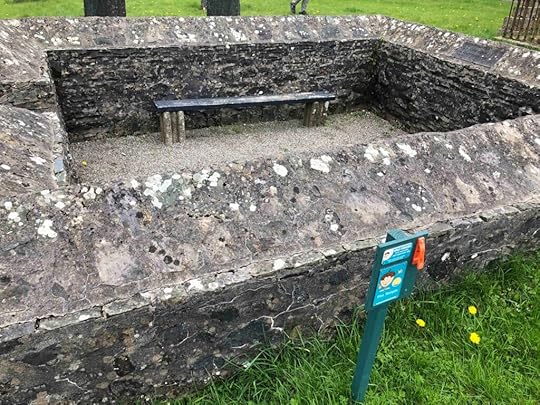 The fire ring where the perpetual fire was tended. Brigid built her church nearby. The church there now is likely in the same spot. ©SandyBeck2023
Today the flame is still burning. It was relit in 1993. You can read about that here. This year, 2024, the town of Kildare and other places significant to her are marking the 1500th anniversary of St. Brigid’s death. You can read about it here.
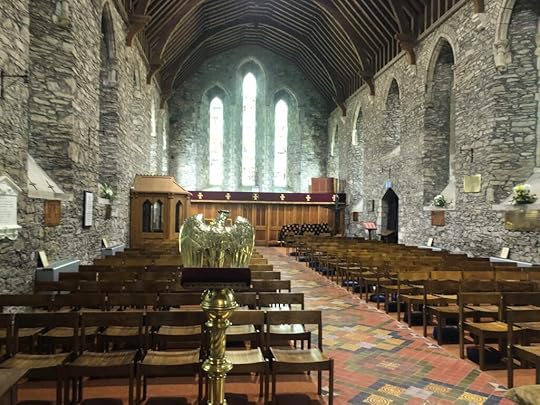 Inside St. Brigid’s Kildare. ©CindyThomson2023
It’s incredible that St. Brigid has seen such a massive revival in Ireland. St. Brigid crosses are now all the rage! It’s also incredible that it’s taken so long for most people to embrace her message of rights for women, a reverence for nature, caring for the poor, and generosity. It’s certainly what the world needs today.
 https://www.brigidoffaughart.ie/brigid-of-faughart-mural/
From my book, The Roots of Irish Wisdom:
By giving to others Brigid gave to her God. She is said to have believed that Christ was in the poor person, a belief held by all the Celtic Christians. They gave freely and without reservation as though giving to the Lord. Whether my house is dark or bright, I close it not on any wight, lest Thou, hereafter, King of Stars, against me close Thy Heavenly bars. If from a guest who shares thy board Thy dearest dainty thou shalt hoard, ’tis not that guest, O never doubt it, but Mary’s Son shall do without it. ~From the Celtic Psaltery by Alfred Perceval Graves
Mark the day by reflecting on these things and St. Brigid’s wish, traditionally attributed to her although we have no writings from her.
I should like a great lake of beer for the King of Kings.
I should like the angels of Heaven to be drinking it through time eternal.
I should likeexcellent meats of belief and pure piety.
I should like the men of Heaven at my house.
I should like barrels of peace at their disposal.
I should like for them cellars of mercy.
I should like cheerfulness to be their drinking.
I should like Jesus to be there among them.
I should like the three Marys of illustrious renown to be with us.
I should like the people of Heaven, the poor, to be gathered around from all parts.
Stay tuned for more posts about finding St. Brigid on our April 2023 tour!
January 30, 2024
Make a St. Brigid Cross
It’s the eve of St. Brigid’s Day and the day for making crosses. Traditionally the crosses were woven every year and a new one was placed over the door of the house or the barn for good luck and protection. In some areas the old ones were not taken down and you could find several stuffed in the rafters, thus determining the age of the house.
When we took a tour group to Ireland in April 2023, I had hoped to make authentic St. Brigid crosses with the group. We tried to get someone to help us but we discovered that no reeds were available that time of year. So I brought some materials with me and some of us did weave crosses in Ireland!
I’ll be making another so stay tuned to our Facebook group if you’d like to see it. I’ll do a giveaway with my newsletter subscribers.
On our trip to Inis Cealtra we took the group in two trips on the boat to the island. I went in the first one (I was too excited to wait, sorry) and my husband Tom was in the second. While they waited for the boat to return, Tom asked the guide if what he saw was rushes. She said yes, there were some growing here and there. She said he could pick them. This is what he did.
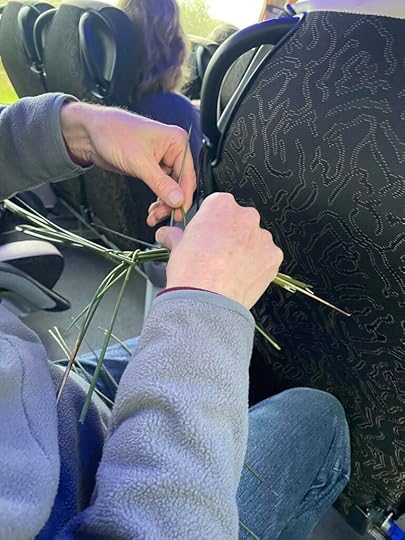 ©CindyThomson2023
Now it lives here:
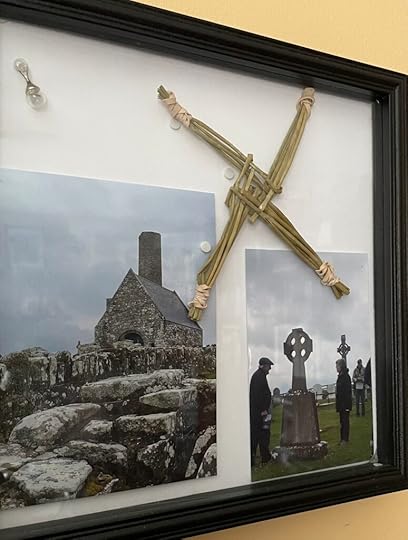 ©CindyThomson2023
You can see that my mounting let loose a bit but the cross is staying put. Before anyone asks, the little thing in the upper left has an Irish shamrock in it. Even in person you can’t tell what it is, but I try. 
Here are a few pictures from our St. Brigid’s Tour featuring the cross.
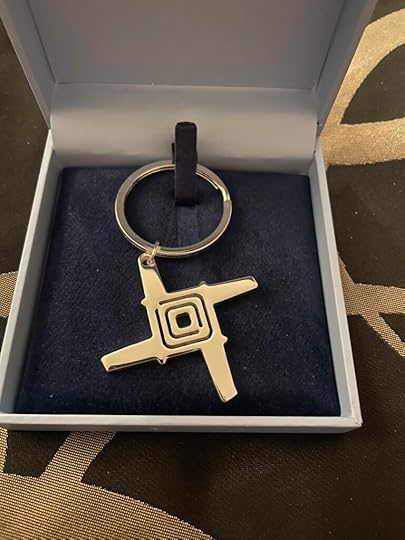 Newbridge silver keychain given to me at the end of the tour by Prime Tours.
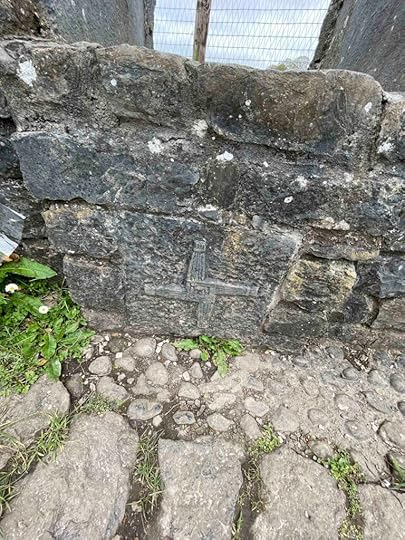 at St. Brigid’s well, Kildare. ©CindyThomson2023
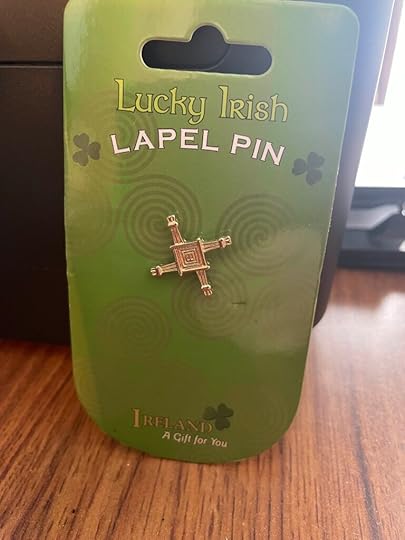 Pin given to me by Anthony McCann our bus driver
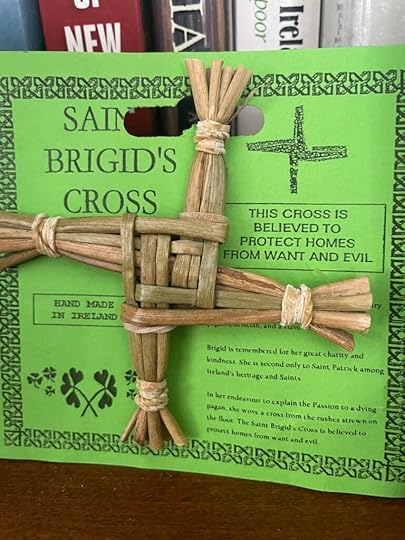 I picked this up in a shop in Galway. ©CindyThomson2023
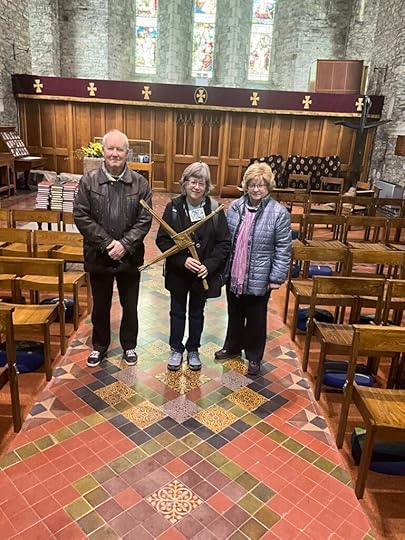 St Brigid Cathedral Kildare. Cindy with guides Paddy and Hazel. ©SandyBeck2023
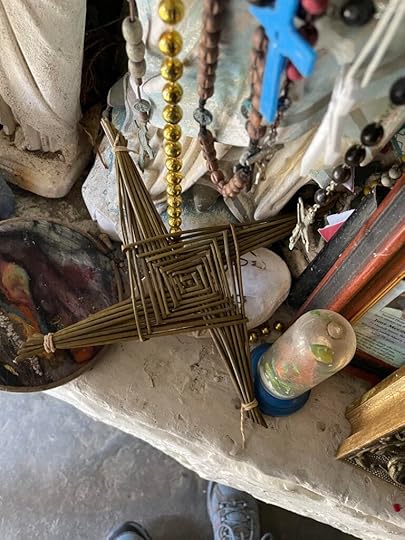 St. Brigid’s well near the Cliffs of Moher ©CindyThomson2023
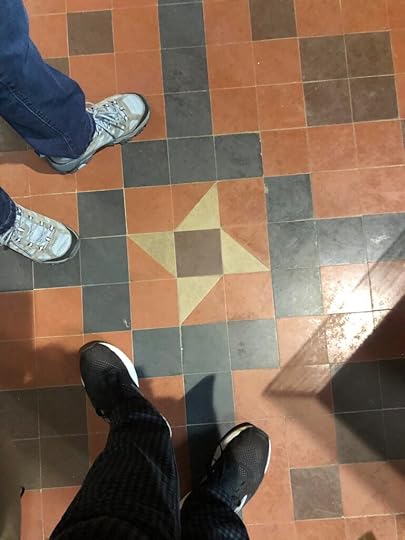 Floor of St. Brigid’s Cathedral, Kildare. ©SandyBeck2023
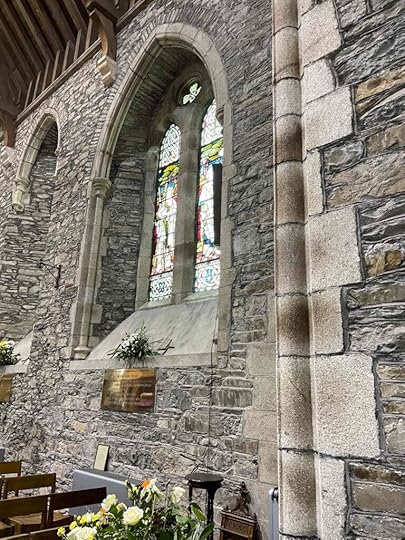 St. Brigid’s Cathedral Kildare. See the cross in the window? ©CindyThomson2023
Tomorrow I’ll share more about St. Brigid and our tour. In the meantime, if you’d like to weave your own cross there are lots of tutorials online. Here’s a good one:
January 3, 2024
My One Word in 2024
 Photo by Sincerely Media on Unsplash
If you’ve followed me for a while, you no doubt know I choose a word each year (based on where I believe God is directing me) instead of making a New Year’s resolution. For me, it’s much more meaningful. I got a text from cousin Susan asking what my word was (I didn’t yet know). Best friend Sandy said she hadn’t yet read my blog post about my word (it wasn’t written yet). Folks all over Facebook have been posting their 2024 words and asking what words others chose.
So, yeah, I needed a word, but it was late coming. My fault surely because I hadn’t spent time pondering and praying over it like I usually did. Plus, I was afraid my word was WRITE, and that made me feel a bit guilty as I haven’t been writing as much as I would like. Negative feelings, as I’ve been reminded lately by my pastors’ sermons (yes, I meant that to be plural. The pastors at our new church all keep to the same theme no matter who preaches that Sunday) are not from God. Turns out that word wasn’t either, not this year. But first, a look back at 2023’s word. I liked that word SEEK so much. It carried so much meaning and reminded me to seek God’s way and not my own. I don’t think I’ll be leaving that word behind. Seek first, seek the path, seek God’s will …
This year I felt a strong tug toward moving forward. Using the practice described by MyOneWord.org I thought about the person I felt God wanted me to be. Doing, acting, progressing, and yes, writing. How to describe that? I was stumped. Then it hit me on New Year’s Day. ENDEAVOR. It means to try hard to do or achieve something. As far as I could tell (I did not check them all), the word is used only in one English translation of the Bible as follows:
May your servants see your work.
Psalm 90:16-17 New King James Version
May their sons see your majesty.
May our Sovereign God extend his favor to us.
Make our endeavors successful.
Yes, make them successful.
Reflecting on this I see that my endeavors are nothing until God makes them successful. So, I ENDEAVOR to keep SEEKing him, working to the best of my ability, the ability God has given me.
What about you? Have you chosen a word for 2024 or are you seeking something this year and will be working toward it? Please share if you’d like in the comments.

December 31, 2023
Journeying into the New Year
As we approach the New Year, lots of people start thinking about goals and what they hope to accomplish in the next year. It’s good to experience a renewal, a time to make things right. For many years I’ve chosen a word for the year. I’ll post about that soon. I’m still a little unsure of what my word is supposed to be.
I’m finding myself being more drawn to the concept of journey, of seeking the path God has marked out for me (my word for 2023 was SEEK) and following the best I can, in faith because I cannot see how it ends. I may have hopes and dreams and even plans for the coming year, but only some things are within my control. The rest I will leave up to God. And that’s not an act of giving up. It’s a journey I choose to take with a little bit of wariness and a lot of anticipation. God’s plans are always better than my own.
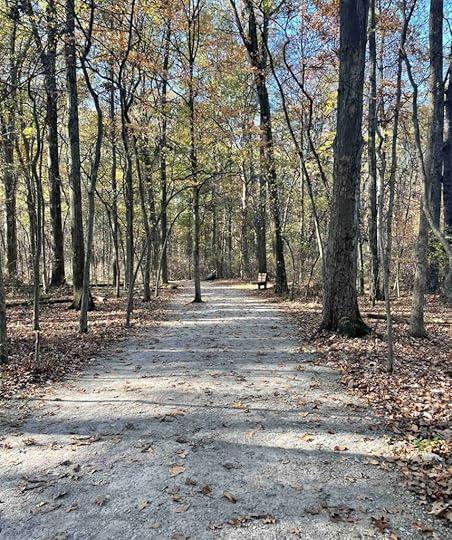 ©2023CindyThomson
From The Roots of Irish WisdomThe Roots of Irish Wisdom:
Alone with none but Thee, my God,
I journey on my way;
What need I fear when Thou art near,
Oh King of night and day?
More safe am I within Thy hand
Than if a host did round me stand.
~Attributed to St. Columba
December 6, 2023
The Writing Life
This post originally appeared on my previous blog March 30, 2011. When I recently re-read it, I realized that my past self had something to say to my present self!
I recently began watching a DVD titled A Celtic Pilgrimage with John O’Donohue. His message about the landscape and what it meant to him growing up is inspiring, but I was surprised–and delighted–to hear him talk about writing.
“I’m a writer. And writing is a wonderful adventure. But it’s also an extremely solitary and difficult task. Some days the lines come easily, but most days it’s a struggle. In the world of the mind you work and work and work and work and yet you see so little return for your work. Because it’s invisible work.” ~John O’Donohue
A Celtic Pilgrimage with John O’Donohue
He goes on to say that while you might work on something all week and not see progress and be tempted to say that you wasted a week, later the words come and that’s because what seemed like an unproductive week really was laying the groundwork. He says God works like that. We are tempted to see winter as completely dead and spring as alive.
 ©CindyThomson
But something is going on in the winter–preparation that enables spring to bring new life in nature. So it is with the words God has planted in our hearts to write. We have to get through the winter of writing, the time that seems unproductive but is really a time when ideas take root.
 ©2023CindyThomson
December 1, 2023
Listening
This post originally appeared in a previous blog site on Dec. 3, 2010.
 Amazon Affiliate Link Used
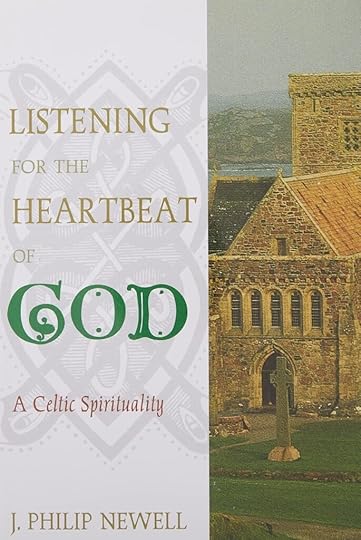
Later today I’ll be interviewing J. Philip Newell and that has prompted me to explore again his book Listening For The Heartbeat of God, A Celtic Spirituality. It’s not his latest book but it’s my favorite.
The book begins with an introduction that is not to be missed because it talks about the Synod of Whitby in 664. This was a turning point (and not a good one) for Celtic Christianity. I blogged about this event here. With that foundation Newell continues with a chapter on Goodness (referencing Pelagius).
Regarding goodness, where does it come from other than from God? Quoting Newell: “Thus the grace of salvation received through the Church is given not to replace our nature but to release what is most fundamental in all people, although bound by the oppression of sin and wrongdoing.” He contrasts this belief of Pelagius with Augustine’s (the characters involved in the debate at Whitby). What this is all referring to is the concept of original sin, something that was never part of the ancient Celtic Christian beliefs. However, Newell says, “Pelagius’ emphasis on the essential goodness of humanity did not involve a denial of the presence of evil and of its power over the human.”
Still referring to the Synod at Whitby, Newell discusses the Church’s following of Peter and the Celtic Church’s leaning toward John. John was the apostle who leaned toward Jesus at the Last Supper (as referenced in John 13:23-25.) He is the one listening for the heartbeat of God according to Newell. However, the Peter tradition is listening as well, in a different way. Peter, Jesus said, was the rock upon whom He built his church. In the concluding chapter in this book Newell says, “The Church would have been infinitely richer if it had embraced both Pelagius and Augustine, affirming the essential goodness in every life while remaining alert to the evils that can destroy us.”
I think that is food for thought if ever there was any. I’ll be sure to have something to say after I talk to Newell. Stay tuned!
The emphasis of the book is listening. Listening is a concept that is simple yet not fully practiced in my opinion.
The Gathering that Wounded Celtic Christianity
 Abbey Lane, Whitby, United Kingdom Photo by Abhishek Babaria on Unsplash
This post first appeared on my old blog Sept. 8, 2010.
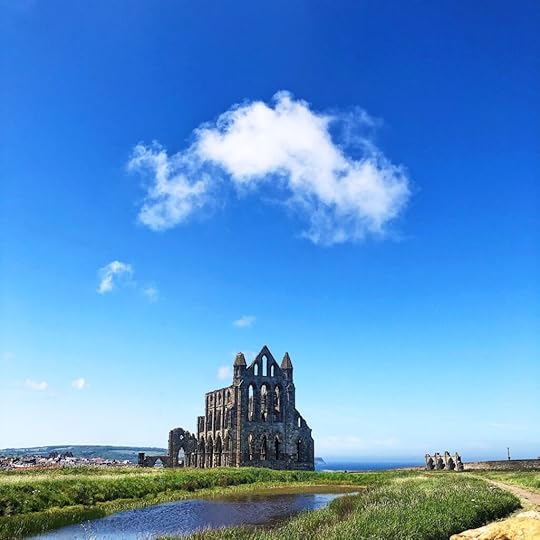
Whitby is a seaside community on the northeast coast of England. In ancient times this was in the kingdom of Northumbria and the king, Oswy, celebrated Easter the Celtic way. His wife, however, was of the Roman tradition. This caused them to fast, both from food and marital relations, at different times. It was a personal inconvenience for the king that ended up having major ramifications for the Celtic Christians. A meeting was held at the monastery of St. Hilda to decide the matter.
The Celtic tradition was defended by a bishop named Colman who claimed that the tradition of Columcille had been handed down by the apostle John. The Romans, on the other hand, looked to St. Peter as their church father. Jesus said that he would build his church on the rock, his name for Peter. In addition, the fact that Paul had preached in Rome gave the Romans, in their view, the authority to correctly interpret this matter. Bede, the great scribe who wrote the Ecclesiastical History of the English People, said that the Roman faction (voiced by Wilfrid) also noted that the rest of the Christian world celebrated Easter at the same time and it was only the British, Picts, and Irish—who after all lived on the most farthest islands in the ocean (read the most uncivilized) who celebrated Easter according to the Jewish calendar.
Wilfrid (a priest who spent most of his life trying to prove that Britains fully embraced the ways of the church in Rome and were not Celts) went on to explain that if the apostle John used the Jewish calendar it was so as to not offend the new Christians who had Jewish heritage. Surely, he contended, the practice was outdated.
The Celts would not have used a calendar developed by the Romans when the Romans had never been their rulers. They looked to history to date their observance of Easter. Admittedly, this seems like a minor point to debate. One can only believe that the true question was one of control and power. In the minds of the people who lived at that time, this debate was crucial. The Celts did not believe they were wrong, and the Roman world believed non-compliance meant these people were not true Christians.
The question of spiritual authority was the ultimate matter debated in this synod. Colman, when questioned by the king, admitted that Jesus had given Peter the keys to heaven as described in this passage in the Book of Matthew: “’And I tell you that you are Peter, and on this rock I will build my church, and the gates of Hades will not overcome it. I will give you the keys of the kingdom of heaven; whatever you bind on earth will be bound in heaven, and whatever you loose on earth will be loosed in heaven.’” When Colman was asked if Jesus had given St. Columcille, the founder of Iona and the spiritual father to all of Britain’s Celtic Christians, equal authority, Colman had to admit he had not.
Oswy ruled in favor of Peter and the Roman tradition because, he is believed to have said, Peter minded the gates to Heaven. King Oswy feared offending the saint would mean he would not be let in. Whatever the reason for the ruling, the result was that all the Celtic churches had to abide by the style of Christianity that was Roman. This was the Christianity that Pope Gregory I (“The Great”) had earlier sent Augustine to Kent to enforce.
Most scholars of the Celtic way believe this event served to end the strictly Celtic way of observing Christianity, at least in mass practice. The Celts held to their beliefs, however, and certain doctrines were not a part of their thinking, such as original sin.
I’m aware that not everyone will agree with what I’ve written. At least one editor has said that I’ve thrown Augustine under the bus. I’d love to hear what you think!