Cindy Thomson's Blog, page 2
April 15, 2025
Ireland’s Royal Heritage
When someone with Irish roots boasts that he is related to an Irish king, don’t be surprised. Ancient Ireland was divided into five kingdoms–five! The island is approximately the size of the state of Indiana, which of course is only one of fifty states in our “kingdom.” Each Irish kingdom had a provisional “king”, and there were local kings as well, which amounted to approximately 200 kings for a total population of just under 500,000 people (according to The Irish Mystique, America’s Enchantress England’s Secret Envy, Ireland’s Despair, by Max Caulfield.)
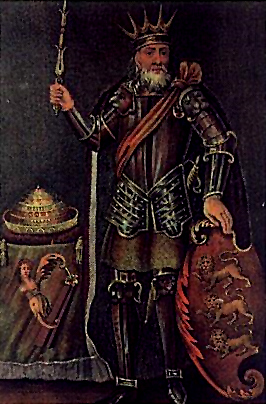 Brian Boru, High Kind of Ireland
IrishGenealogy.com.ar, Public domain, via Wikimedia Commons
To further confuse things, look at the status of the individual. In each kingdom there were freemen and women (commoners) and slaves. When surnames came into use (not until the 11th century) everyone took the surname of their chieftan, whether blood-related or not. So, having a kingly name like O’Neill or O’Neal, does not necessarily mean you are the descendant of a king.
But then again, with so small a population, and so many kings out there…..
Well, you know what the Irish say: Never let what really happened get in the way of a good story! 


Trinity College Dublin
Trinity College in Dublin, Ireland, was founded by Queen Elizabeth I in 1592 (the charter was granted in December 1591.) Dublin donated the grounds, the site of the ruined monastery, All Hallows, which had been founded in 1166 by Dermot MacMurrough (a most interesting character that I will have to blog more about someday.)
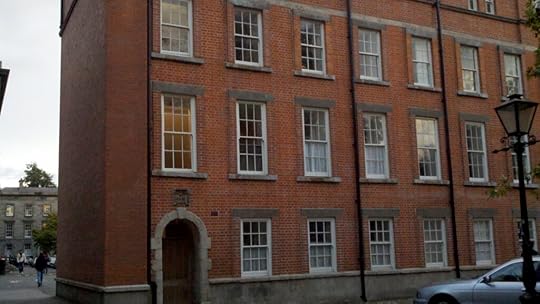 Rubrics at Trinity College. I think it’s now a dorm. ©CindyThomson2010
The oldest building still standing on the campus is called Rubrics and dates from the early 1700s. The original buildings are long gone.
The library at Trinity College is a must see stop on any tour of Ireland. Most people are interested in seeing The Book of Kells, as I was. But there is so much more not to be missed. These pictures are from my last visit in 2023.
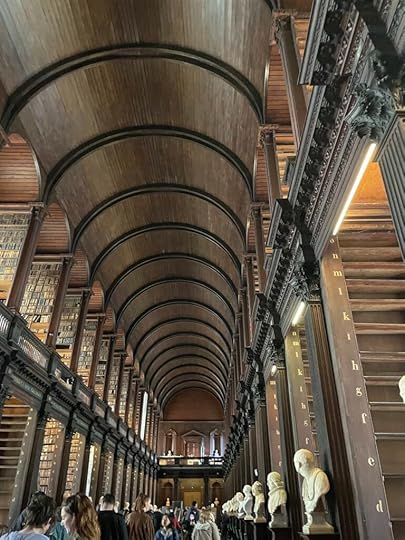 ©CindyThomson
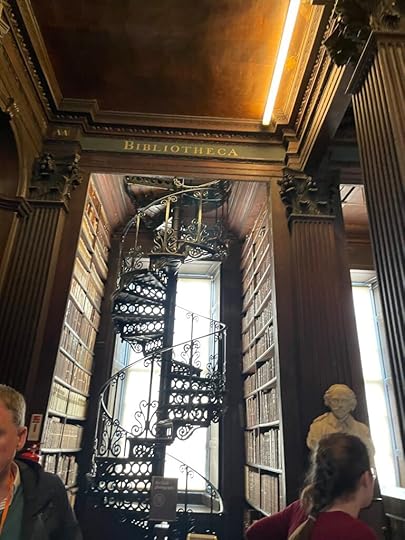 ©CindyThomson
So much of Ireland’s history is ancient so it’s a little unexpected to find the buildings at Ireland’s oldest college are more modern. However, modern in the case of the Old Library is 16th century.
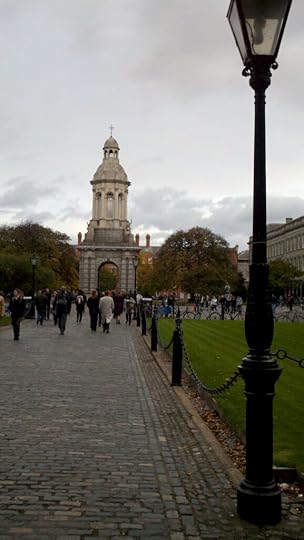 Outside Trinity College. ©CindyThomson2010
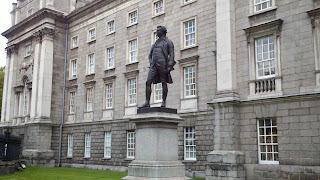 ©CindyThomson2010. Statue of Edmund Burke outside of Trinity College. Erected in 1868.
March 27, 2025
Sketching History
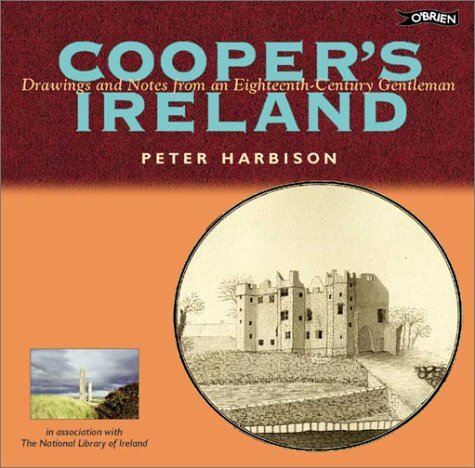 Amazon Affiliate Link Used
Austin Cooper, historian, lived from 1759-1830. His family now refers to him as the Antiquary to distinguish him from the many Austins in the family line.
Cooper was a Fellow of the Royal Society of Antiquaries in London, but perhaps his greatest contribution to preserving history was his drawings. He traveled about Ireland on official business (collecting taxes) and sketched the ancient ruins and prehistoric sites he saw, thus preserving on paper some of what can no longer be seen. In other cases we get a glimpse into what a site looked like before the last two hundred years or so took its toll.
Austin Cooper was not alone in his desire to record history, thankfully. There were contemporaries who were also drawing ruins. Austin’s descendants have worked to print and preserve some of these drawings. The collection was kept in the family near Dublin until about 1960 when a family member toted it to England. The National Library of Ireland eventually acquired Cooper’s work and O’Brien Press published a book in 2000, Cooper’s Ireland, Drawings and Notes from an Eighteenth-Century Gentleman.
There are drawings by Cooper in the National Library that are not in this book, and the library also has some 18th century drawings by others as well.
You might not be surprised to learn that I have a copy of the above work. It’s good to see these ancient sites in person but also good to see through the eyes of the past as I envision my stories. Take for instance Clonard Monastery, featured in my book Enya’s Son. Here’s Cooper’s sketch.
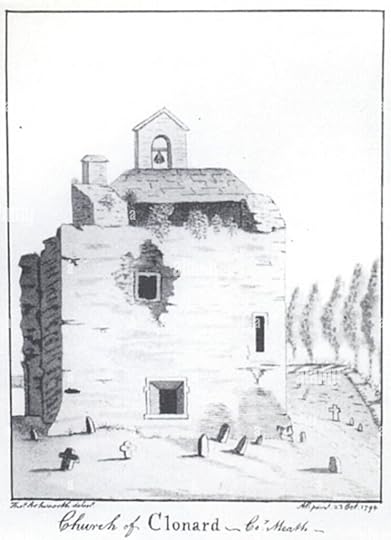 Public Domain
It still looks somewhat maintained in the sketch above despite its long history of being destroyed over the centuries. Founded by Finian early in the 6th century, Clonard became a center of learning as it stood on the banks of the River Boyne. Finian was said to have been schooled by St. Brigid. One of his students was St. Columcille, thus the reference in Enya’s Son. This is where Columcille copied the manuscript that launched a war. If you are not familiar with that story, you can read about it in The Roots of Irish Wisdom. Finian’s actual cell and monastery no longer exist, but the site was built on and rebuilt numerous times throughout history. Today there is a closed 19th century Anglican Church on the site, so Cooper would not have seen what we see there today. Wikipedia says some foundations and earthworks are all that can be seen today of the 12th century abbey.
You can read more about Austin Cooper and see some of his sketches on this blog by a member of his family.
March 26, 2025
Celtic Music from Adagio Trio
This is from a post on my old blog dating back to 2011. I’m delight to see this trio is still performing!
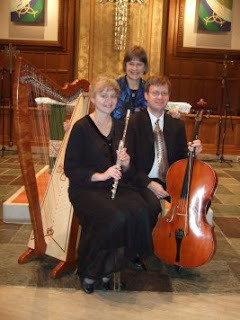 This is the photo that accompanied that original blog post
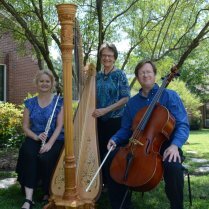 And they are still going strong today!
Today I’m bringing you a Q&A from a musical group called Adagio Trio. They have a Celtic CD out you might like to sample.
From their web site:
The Adagio Trio was founded in 1985 in Cincinnati, Ohio. Their unique combination of harp, flute, and cello provides a fitting compliment for meditation or relaxation. Their CDs have been used in various venues such as massage clinics, yoga and meditation classes, retreat centers, music therapy, hospice, etc. Most of their arrangements, such as “Ashokan Farewell”, “Shenandoah”, Ave Maria”, “Jesu, Joy of Man’s Desiring”, “Pachelbel Canon in D”, and “On Eagle’s Wings” are original arrangements. Adagio Trio has been featured on public radio stations throughout the country including Minnesota, Pennsylvania, Missouri, Ohio, Virginia, New York, Oregon, and California, and featured numerous times on WHRO radio in Hampton Roads and WGUC-FM in Cincinnati. In the first six weeks, their debut album “Stillpoint” sold over 1000 copies.
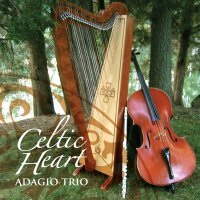
What led you to perform the Celtic music on Celtic Heart? And, how is this style of music uniquely suited to Adagio Trio?
We have always loved this style of music and wanted to learn more of how to play it. Kathy & Lin both have Irish ancestors and have loved Celtic music. We are not Celtic players, so we were all coached by local Celtic musicians so that our style sounded as authentic as possible. Our group of harp, flute and cello has a unique Celtic sound because the grouping is not typical. Unlike our other CDs, all of the pieces we arranged ourselves. We especially wanted to record this CD since our harpist, Lin had bought a William Rees Aberdeen Meadows Celtic harp in memory of her brother-in-law who was a lover of music and had died of cancer. The harp has such a different sound than the pedal harp. The flute and harp are traditional Celtic instruments, but the cello is not. I had to learn the fiddle style for some of the pieces on the CD.
Your music has brought comfort and relaxation to people who are recovering from medical problems as well as hospice patients. Did you set out to perform this kind of spiritually comforting music or did it happen by chance?
We did not intentionally try to create music for hospice or “spiritually comforting” music. However the type of music we chose was an expression of a variety of music that is uplifting and familiar. We tried to originally make a CD of music that we all enjoyed. When we started as a group in 1985, we were mostly a “gig” trio that played lots of weddings. Brides throughout the years had asked us about a CD, so we finally created our first recording “Stillpoint” in 1997. There are a few tracks on “Stillpoint” that are big requests at weddings such as “Pachelbel’s Canon” and “Jesu, Joy of Man’s Desiring”. As the first few recordings started to sell, others shared that our music had a calming effect. Hospices, massage therapists, and yoga centers have all used our music. We didn’t really see that coming. That prompted us to record more CDs since people were requesting it.
Have you always been musicians?
Yes. We all have played our instruments for a living for many years. Kathy and I both graduated from the Cincinnati Conservatory of Music in the 80s. That is where we met Lin, our harpist, who had already been freelancing in Cincinnati and now also plays for hospice patients and teaches Suzuki harp. Kathy and I live in Chesapeake, Virginia where I am the principal cellist of the Virginia Symphony, and she teaches and performs also in the area. Visit them here: https://www.adagiotrio.com Listen below!
February 28, 2025
Happy St. David’s Day!
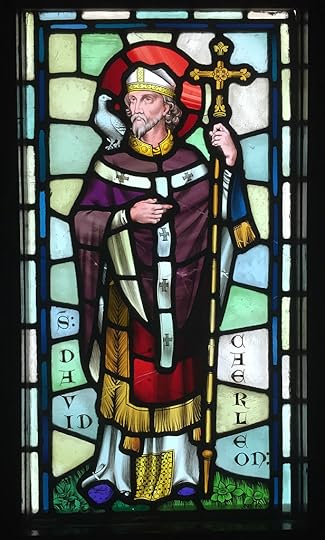 This file is licensed under the Creative Commons Attribution-Share Alike 4.0 International license.
This post originally appeared on my old blog in 2010. I’ll be visiting Wales in September so I’m excited to revisit this information!
Today is the feast day of the patron saint of Wales. His name in Welsh is Dewi and he lived from about 500-589. He was another of the great teaching monks of the 6th century.
His monastic rule was severe. The monks had to pull their own plows (no horses or oxen); they ate only bread and spent their non labor hours praying, reading, and writing.
As with most saints, there are miracles associated with St. David. A white dove sat on his shoulder, and when he preached and listeners complained that they couldn’t see him, a platform miraculously appeared and elevated him.
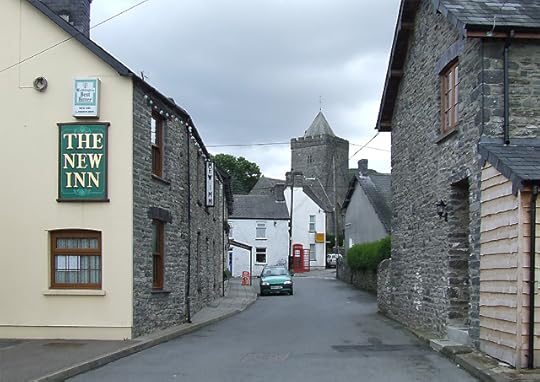 Roger Kidd, CC BY-SA 2.0 https://creativecommons.org/licenses/by-sa/2.0, via Wikimedia Commons
The picture above is Llanddewi Brefi, the village that is located on the spot where this miracle is supposed to have taken place.
St. David’s famous quote: “Do the Little Things in Life.”
St. David’s Day is a national holiday (or bank holiday as they call it in the UK). Celebrations in the country include parades, festivals, and lots of food. The daffodil is associated with the day (the flower is in season in March) as is the leek, the symbol representing St. David.
Patron saints seem to be a matter of national pride in Europe, and certainly in the Celtic countries. I think that’s a noble quest, but I also like to learn about these saints and see how they lived and how they honored God with their lives.
He was a church leader and official. He founded monasteries in Britain and Brittany during a time when pagan tribes ruled. His life was written by Rhygyfarch in the 11th century, although mention of him was made in 8th and 9th century manuscripts.
From Rhygyfarch’s Life:
“Saint David, the bishop, was made the chief overseer of all, the chief protector, the chief spokesman, from whom all received the rule and model of right living. He was the standard for all, he was consecration, he was benediction, he was absolution and correction, learning to readers, life to the needy, nourishment to orphans, support to widows, head to the country, rule to the monks, a way to seculars, all things to all men…”
The Real St. Patrick
This is an article I wrote for a magazine that decided to go with another writer’s article instead. At the time this really annoyed me because it had been assigned to me. So I posted it on my old blog and am re-posting it here.
The Real St. Patrick© 2007 Cindy Thomson, All Rights Reserved
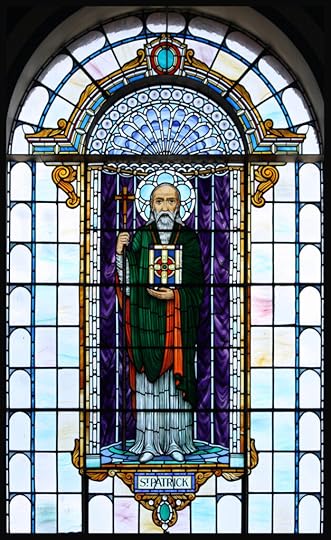 Photo by Lawrence OP via Flickr
He wasn’t Irish, and yet America’s biggest Irish celebration is held in his name. He wasn’t the first bishop sent to Ireland, yet he is responsible for launching the evangelical push that converted the pagan Irish to Christianity. He never drove the snakes out of Ireland—there weren’t any, at least not in the literal sense. He wasn’t a leprechaun, though his day is symbolized by smiling little men wearing short green pants and sporting a long white beard. The number of people who know so little about the real St. Patrick always surprises me. It’s probably not their fault. What most people know about him is delivered on cards and in fairy tales.
So what is true about St. Patrick? He is one of three patron saints of Ireland; the other two are Brigid and Columba. He was born in the late 4th century, most sources say 387, somewhere on the coast of Britain—perhaps in Wales or Scotland. As early as 431 Pope Celestine sent a bishop named Palladius to minister to the Christians in Ireland. Patrick came to Ireland when he was 16, but he came against his will.
Fortunately, we have his own words left to us in the form of his autobiography referred to as his Confessio, and his Epistola, an admonition of British mistreatment of Irish Christians. Patrick was kidnapped by Irish raiders searching for slave labor, a common practice in those days. He worked for six years as a shepherd, and in those lonely times—as he later explained in his Confessio—he began to pray in earnest and trust God. He escaped and made his way back to his homeland. Later he became a bishop and had a dream or a vision in which he heard the voice of the Irish calling to him to come and walk again among them. This is how Patrick, who wasn’t Irish, became the most revered Irish saint in the entire world. He did return, and apparently had several run-ins with pagan kings. Patrick stood up for his beliefs and was instrumental in guiding the Irish people to Christ. His predecessor, who was probably already in the country when Patrick returned, had been sent to minister to people who already believed; Patrick ministered to unbelievers.
Did Patrick convert all of Ireland? Hardly. That would have been a near impossible task in one man’s lifetime, especially since it was done without warfare, unlike Europe during the Crusades. Others came after him and carried on his work in Ireland and beyond: Brigid, Columba, Brendan, Aidan, and Columban to name a few. But St. Patrick is the name today that identifies all things Irish. The holiday is no longer just a religious observance. It is a day of cultural pride for all those with any hint of Irish blood in their ancestry.
Read the most famous of St. Patrick’s writings (although it was most likely written in a later time period): The Lorica
(Also referred to as St. Patrick’s Breastplate and the Deer’s Cry.)
—Cindy Thomson This story may not be copied without the permission of the author.
February 27, 2025
Celtic Voices
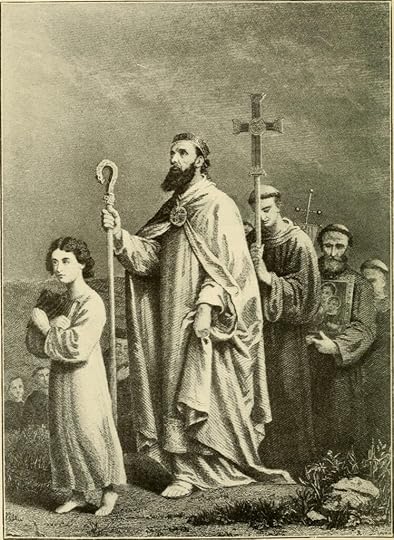 Internet Archive Book Images, No restrictions, via Wikimedia Commons. Image depicts St. Patrick going to Tara. From a book published in 1904.
Celtic Voices, the title I chose for my old blog, refers to the voices St. Patrick heard long ago. Many people credit Patrick for bringing Christianity to Ireland. In principle this is true, but technically there were Christians in Ireland before he came, first as a slave at the age of 16, and later as a willing minister. The reason Patrick returned to a land where years earlier he had escaped captivity had to do with a dream.
In the dream a man, perhaps an angel, came to him. Quoting from my book, The Roots Irish Wisdom:
“One night a man named Victoricus visited him in a dream, bearing many letters from Ireland. He gave one to Patrick that read ‘The Voice of the Irish.’ Immediately Patrick heard the voices of those he’d known in Ireland crying out together, ‘We beg you, holy youth, that you shall come and shall walk again among us.'”
The result of Patrick listening to those voices and acting on what he heard was that Ireland was blessed with a valuable patron saint who ministered to the lost, many of whom went on to develop learning centers (monasteries) and teach others, both in Ireland and on the European continent.
I think these kind of Celtic voices (not necessarily in dreams but in legends and stories) speak to us today.
Did you know St. Patrick wasn’t Irish? He was a Roman Britain born somewhere in Wales, Scotland, or Northern England.
February 2, 2025
Groundhog Day’s Irish Origin
A version of this post was originally published on an older blog in 2010.
 Marumari at English Wikipedia, CC BY-SA 3.0 http://creativecommons.org/licenses/by-sa/3.0/, via Wikimedia Commons
There is a good chance Groundhog Day came out of Ireland. Here’s why:
In ancient times there were no weathermen. The ancient people had to predict the weather themselves so they turned to nature to help them, specifically the hedgehog. On St. Brigid’s Day (Feb. 1), or Candlemas, they would spot those little fellows and determine that if they saw their shadows, more bad weather was in store, but if not, then spring was surely on its way. I doubt that these predictions helped them anymore than they help us today. It doesn’t seem to matter, here where I live, whether the groundhog (substituted for the European hedgehog) sees his shadow or not. Many times March is as wintery as January.
But in Ireland St. Brigid’s Day is the recognized start of spring. The first flower, snowdrops, are often seen by then. (Mentioned briefly in my novel Finding Juniper.) The lambing season has begun and it’s the traditional start of fishing season. Spring is most definitely on the way!
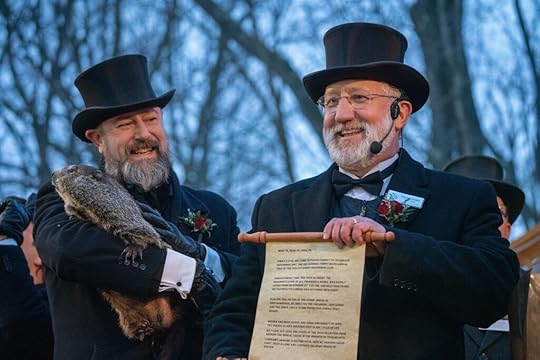 Anthony Quintano from Mount Laurel, United States, CC BY 2.0 https://creativecommons.org/licenses/by/2.0, via Wikimedia Commons
If you haven’t heard, in 2025, the groundhog (at least the one in PA) saw his shadow so we’re in for six more weeks of winter.
Maybe the real sign that spring is on its way is the appearance of these animals in the first place. When hibernating animals start waking up, the days are longer and winter is wanning. Shadow, smadow! Doesn’t matter.
But it’s still fun, right? I mean, is there any movie more fun than Groundhog Day?
January 31, 2025
Brigid Interpretations
A version of this post first appeared on my old blog in 2010.
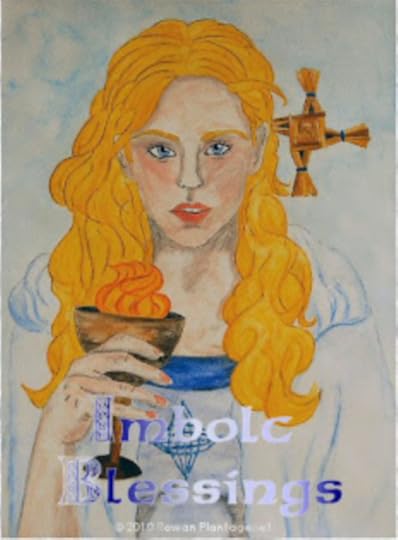 Used with permission (see post)
Brigid of Ireland is my interpretation of the saint’s early life. Others have their own interpretations. Below is the book trailer for a children’s book, The Life of Saint Brigid. It was written by Jane G Meyer, illustrated by Zachary Lynch. I love the message here for young girls.
In addition, I’m posting, with the artist’s permission, a drawing of Brigid by Ashmodai Bergisches from Germany (above.) It’s interesting that the artist interpreted her as a blonde, as I did in my novel. I had a reader ask me how I discovered what color her hair was. She had always believed it to be red. The truth is, no one knows! Remember we are talking about the late 5th-early 6th century here.
Here is another by an artist I met at the Milwaukee Irish Festival a few years ago, Andrea Bowes.
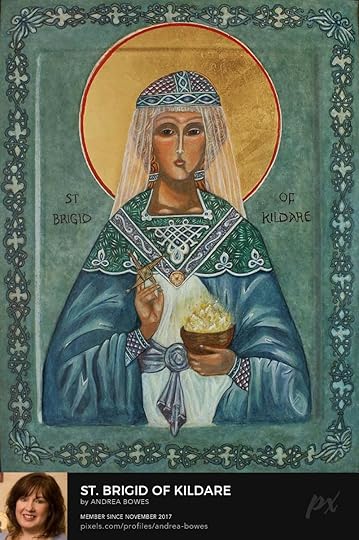
There are many interpretations, beliefs, and ways to celebrate Brigid’s life. I find them all fascinating.
January 25, 2025
One Legend About St. Brigid
This post first appeared on an older blog in 2010.
I’m going to share one of my favorite legends about St. Brigid, one of three patron saints of Ireland. (And yes, you can find this story in my novel, Brigid of Ireland.)
Brigid was known for her generosity. She gave away everything that she had whenever she met someone, and in that historical time period there were plenty of hungry, needy people around Ireland to share with. She was born a slave to her father (her mother was her father’s slave) and he soon grew impatient with the girl giving away his property. So one day he decided he would have to get rid of her–he would put her into the king’s service. They went by chariot and when they arrived at the castle belonging to the king of Leinster, he told her to wait while he went to fetch the ruler.
Meanwhile a leper (why do these stories always involve lepers???) came by to beg. She was away from her dairy. She had no butter, milk, or cheese to give him. She glanced around the chariot and the only thing she could find was her father’s sword–no ordinary sword, this one was encrusted with valuable jewels. She figured that the beggar could barter or sell the piece and get something to eat, so she handed it over to him just as her father and the king returned. They saw the man running off with the sword.
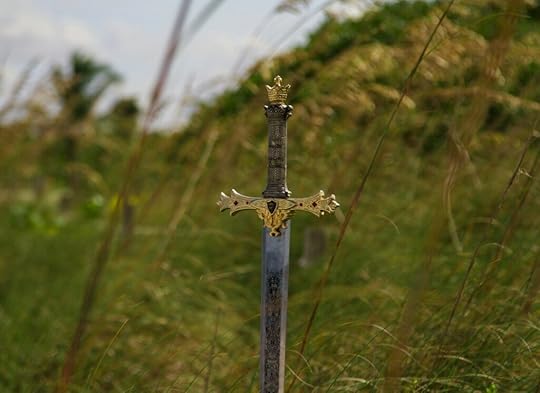 Photo by Ricardo Cruz on Unsplash
“There. Do you see that?” her father asked the king. “Do see why I have to get rid of her?”
 ©CindyThomson2023
The king asked Brigid what she had to say for herself.
She looked again at his magnificent castle and his fine clothing and answered, “If I had as much as you, that’s how much I would I give away.”
The king was so humbled by this that he granted Brigid her freedom.
A good thing, right? Well, not necessarily. At that time if you did not own property (cattle, livestock) or were connected to a family who did, or you were not connected the royal family somehow, or you were not a slave, you were out on your own, left to wander and fend for yourself. So, Brigid became one of those people she had previously been aiding.
(For my version of how she survived from there, see my book!)
Brigid was so generous she gave away things that could, at that time, have been essential for survival. And yet, God always provided, as He does. There are plenty of lessons to be learned by studying St. Brigid.