Cindy Thomson's Blog, page 5
July 3, 2024
The Scribe and His Cat
A monk sits among his brothers in a spacious hall filled with slanted writing desks. Although it is daytime, his desk bears its own candle for additional illumination. He has several pots of ink, the fruit of the labor of other monks who gather bark, berries, and minerals from the earth to produce vivid colors for his use. Likewise, the velum he writes on was painstakingly prepared by others.
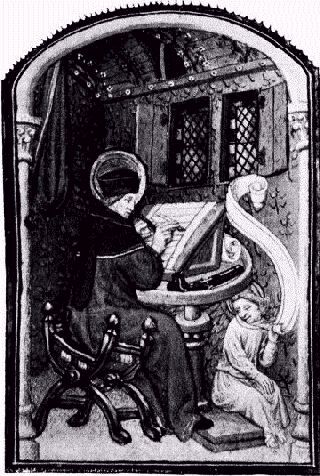 Public Domain, https://commons.wikimedia.org/w/index...
Because he has a steady hand and very good eyesight, the monk spent years training to be an illuminator and calligrapher. He works with others to produce a sacred manuscript to be used during mass. Around him ordinary scribes do the important work of copying scriptures and other works. Only by possessing these copies can monasteries flung across Ireland and Europe teach the thousands who come to them to learn. Sometimes even nobility and kings come to the monasteries for education and enlightenment. This work is important and valuable, and yet he is careful not to become prideful. He is only an instrument.
Words. The pictures they create in a person’s mind. The meaning they speak to one’s soul. The monks in the scriptorium copy, draw, paint, and compose, and in doing so they deliver the beauty of words to the people.
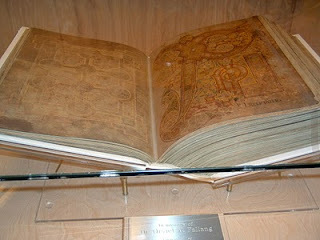 ©CindyThomson Book of Kells replica
It’s a great responsibility, working in a scriptorium. But that is not why the monk does it. God Almighty has asked this of him, given him the skill and steadiness. To refuse his calling would be an act of disobedience, and he has taken a vow to obey God and the abbot.
So here he sits while birds sing outside and children frolic in the sunshine. While farmers plow and harpers strum. Only while resting does he pause to consider something besides his brush.
A white cat wanders about the tables, occasionally rubbing his back against a scribe’s leg until a rustle in the corner captures the creature’s attention. Once the animal’s mind is set upon his prey, nothing, not even a human’s voice or the offer of a crumb of bread can divert him from his task. God created the cat to hunt mice. God created this monk to hunt words.
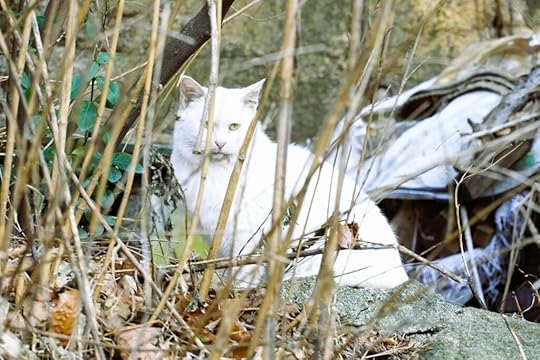 Photo by IRa Kang on UnsplashPangur Ban (Old Irish for White Cate)
Translated by Robin Flower
I and Pangur Ban my cat,
Tis a like task we are at:
Hunting mice is his delight,
Hunting words I sit all night.
Better far than praise of men
Tis to sit with book and pen;
Pangur bears me no ill will,
He too plies his simple skill.
Tis a merry thing to see
At our tasks how glad are we,
When at home we sit and find
Entertainment to our mind.
Oftentimes a mouse will stray
In the hero Pangur’s way;
Oftentimes my keen thought set
Takes a meaning in its net.
‘Gainst the wall he sets his eye
Full and fierce and sharp and sly;
‘Gainst the wall of knowledge I
All my little wisdom try.
When a mouse darts from its den
O how glad is Pangur then!
O what gladness do I prove
When I solve the doubts I love!
So in peace our tasks we ply,
Pangur Ban, my cat, and I;
In our arts we find our bliss,
I have mine and he has his.
Practice every day has made
Pangur perfect in his trade;
I get wisdom day and night
Turning darkness into light.


June 3, 2024
John O’Donohue on Grief
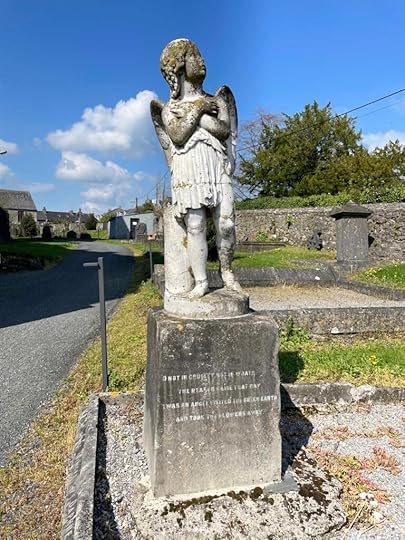 St. Canice Cathedral Graveyard, Kilkenny, Ireland ©CindyThomson2023
John O’Donohue is best known for his book, Anam Cara, A Book of Celtic Wisdom. He was a poet, philosopher, and scholar–from the back cover of the book. O’Donohue died unexpectedly in January 2008 just after his 52nd birthday. He was a former priest who left the priesthood to devote himself to writing and public speaking.
But in the words he left, I can see that he was more than all that. He offered a glimpse of Heaven and what God is like, and in that sense he was a messenger from God–not an angel but a brother who shared what God revealed to him. In the video below, he is reciting a poem he wrote called Beannacht, which means Blessing in Irish. Apparently he recorded this not long before his death.
I found the words to be comforting and a gentle hug to a grieving heart. My sister passed away last August and my dad last October. Grieving is not fun, and although it gets better, it never totally goes away. If you’ve lost a loved one, be sure and watch this.
May 28, 2024
Morning Prayer
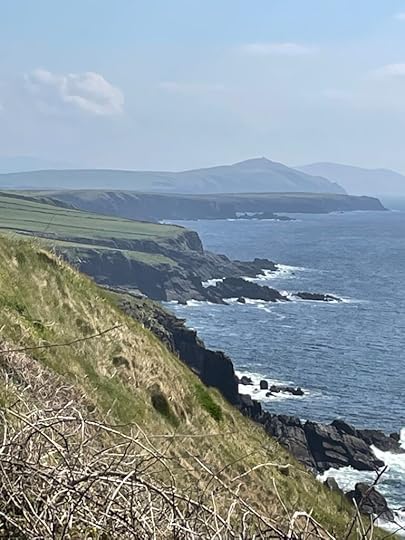 Dingle Peninsula ©CindyThomson2023From the Carmina Gadelica:
I will kindle my fire this morning
In presence of the holy angels of heaven,
In presence of Ariel of the loveliest form,
In presence of Uriel of the myriad charms,
Without malice, without jealousy, without envy,
Without fear, without terror
of any one under the sun,
But the Holy Son of God to shield me.
May your joys be as bright as the morning, and your sorrows be merely shadows that fade in the sunlight of love. May you have enough happiness to keep you sweet, enough trials to keep you strong, enough sorrow to keep you human, enough hope to keep you going.
May 26, 2024
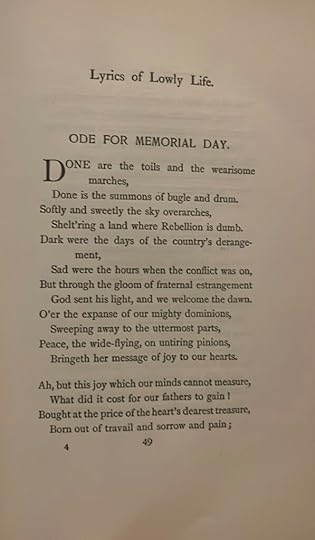
Ode For Memorial Day
This is from an old book I own, Lyrics of Lowly Life by Paul Lawrence Dunbar. The book was published in 1897. I ordered it after visiting his home in Dayton, Ohio, now a museum operated by the National Parks Service.
I’m not sure when it was written, but Dunbar was born in 1872, just seven years after the end of the Civil War. He dedicated this book to his mother, who of course lived through those terrible years. Both his parents were former slaves. As a black man, Dunbar was well aware of what slavery, discrimination, and hatred had cost: “the price of the heart’s dearest treasure.”
Memorial Day, first called Decoration Day, was established due to the large numbers who died in the Civil War, or Rebellion, as Dunbar refers to it here. The day honored those who died in that war (estimated to be over 600,000), and of course with the passage of time came to honor all those who have died in service to their country. Our way of life is made possible because of what it, “cost our fathers to gain.”
May 23, 2024
Learning from Ancient Artisans
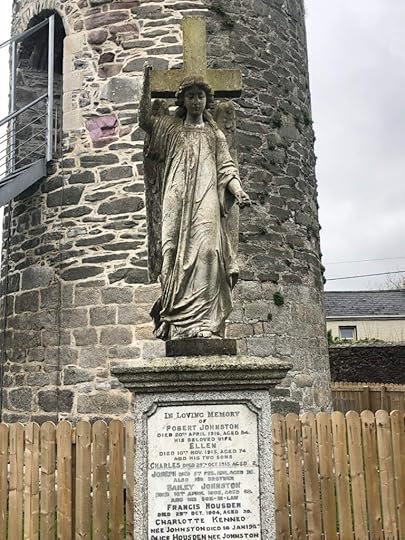 Grave marker, Kildare ©SandraBeck2023
An artisan (metal worker, stone carver, blacksmith…) was respected in ancient Ireland. The craftsman held an enviable position in society. The artisans serving some of Ireland’s beloved saints were even mentioned in a triad in the ancient books:
Three chief artisans of Ireland: Tassach with Patrick, Conlaed with Brigit, and Daig with Ciaran.
According to The Brehon Laws by Laurence Ginnell, 1894, whenever an artisan delivered his work he said a blessing on it. So strong was this tradition that if it wasn’t done, fines were leveled.
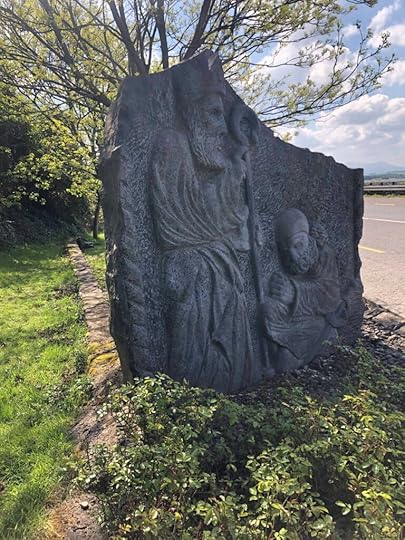 Modern stone carving near Rock of Cashel, County Tipperary ©SandraBeck2023
I have great respect today for modern artisans because they have a talent to do something I’m not able to do. It’s a gift of beauty that most people still admire today.
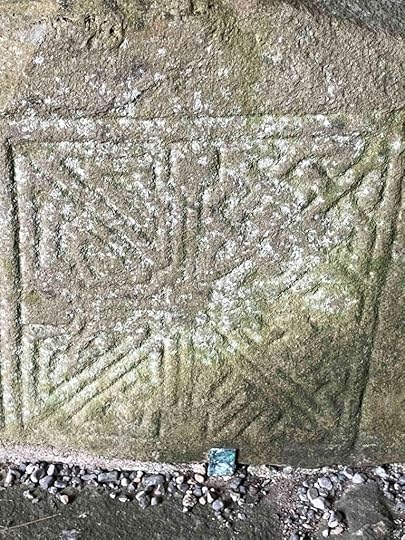 Celtic knot stone work, Inis Cealtra, County Clare
But I wonder how many people today bless their work before parting with it. That seems like a good ancient practice to take up today, even without the threat of fines. I wonder how different art appreciation might be if everyone asked God’s blessing on his/her artwork. Would more people get the intended message? Would more observers be moved or experience something spiritual when admiring the piece? Or would the artist or crafter be more inspired to keep working even if no one appreciated their art? What do you think?
April 30, 2024
Happy Beltaine!
May 1 is Beltaine, one of four major feasts of the Celtic calendar. Beltaine marks the end of the dark half of the year. Yay! It is also the traditional day of moving livestock to upper pastures, also called booleying. Read more about booleying here. Since I first posted this on another blog, I forgot all about this practice. Like so many Irish traditions, it’s multifaceted. Not only did people move for the summer, they brought a culture to hills with them. I encourage you to follow the above link from RTE to learn more.
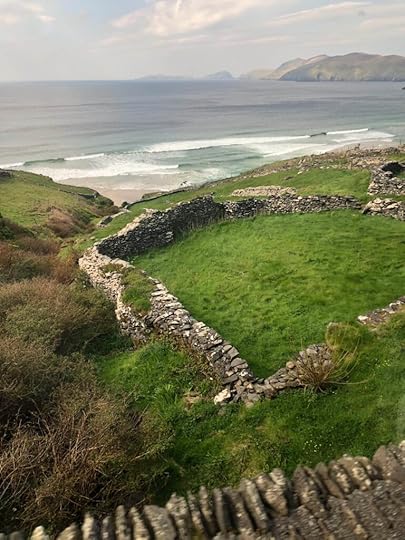 One can imagine cows here. ©2023SandraBeck
The Irish believe that Beltaine is a good time to start a project or hold a fair. It’s considered a bad idea to let someone take fire (as in lighting a torch) from your house on Beltaine. This could give the person control over the people in the house.
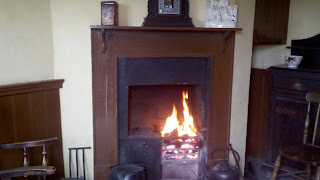 ©2010CindyThomson
Lighting bonfires on the eve of Beltaine (actually, the festivals always started at night) is long held. All fires were extinguished and the festival began when the king lit the first fire, which could be seen from a long distance because….well, there were no streetlights. This is apparently what got St. Patrick in trouble. He lit his Pascal fire before the king lit his Beltaine fire and God had to rescue Patrick and his followers by turning them into a herd of deer.
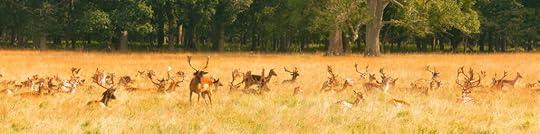 Photo by Riccardo Bonelli on Unsplash
Welcome back, sun! We have missed you! 
April 3, 2024
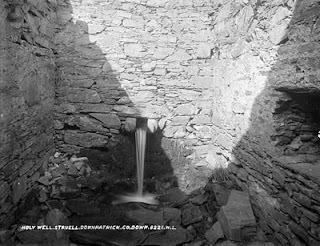
Struell Wells, Downpatrick
 ©CindyThomson
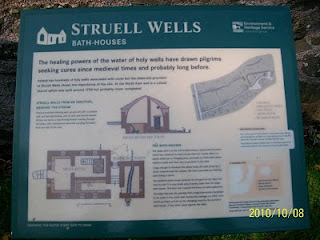
Downpatrick and nearby Saul are associated with Saint Patrick because the area is said to be the location where he first founded churches. That is why the claim that he also visited and bathed and blessed the wells at Struell in County Down is not far fetched, even if not proven.
What is known is that the wells were sites of pilgrimage from Medieval times. The day we visited Dr. Tim Campbell of the Saint Patrick Centre showed us around. It was a beautiful sunny day and we were the only visitors.
 ©CindyThomson
 ©CindyThomson
 ©CindyThomson
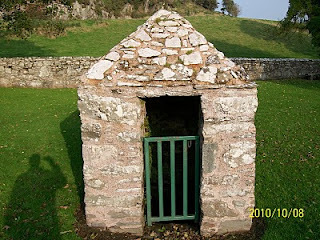
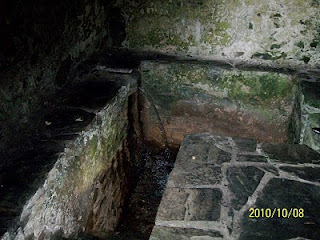
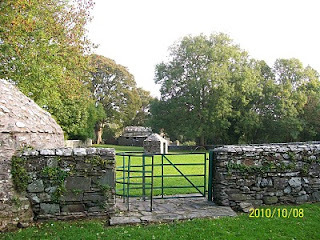
You can see the remains of a chapel built there in the 18th century and never finished (although I don’t have a picture of it here.) The springs were visited before the buildings were built around them. None of the buildings is thought to be older than 1600 AD. Like many of the holy sites in Ireland, this was a pagan holy site that was taken over by the early Christians. There is a men’s and women’s bath house, an eye healing well, and a drinking well. Inside the drinking well, which is roofed, you can see the wicker framework of the roof–well, at least we tried to see it. It was very dark in there! Tom took this picture. Remember, it’s an upside down view of the inside roof.
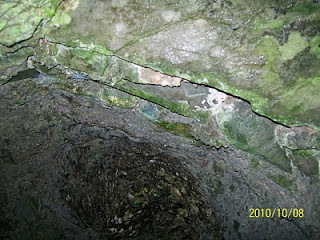 ©CindyThomson
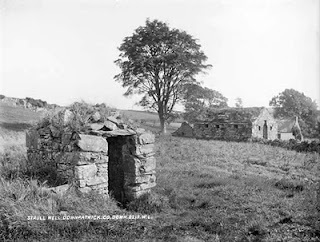
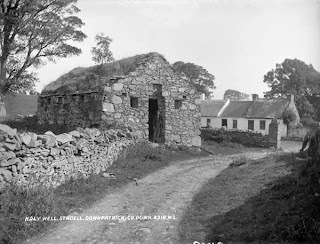
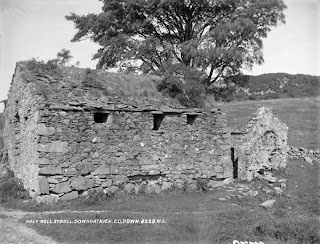
I discovered that the National Library of Ireland has late 19th to early 20th century images from glass negatives on their site. I found many of the sites that I visited in Ireland and I found it interesting to compare how much they changed (or in some cases didn’t change) in the last 100 or so years. Here are some of Struell Wells. (public domain pictures below)
Celtic Tree/Tree of Life
From The Roots of Irish Wisdom:
(on St. Ciaran of Clonmacnoise)
 Tree Vectors by Vecteezy
“Once, when he visited St. Enda on Aran, he had a vision of a great tree growing in the middle of Ireland with branches spreading to all four corners of the land. Enda believed that this meant that Ciaran would be that tree of great influence, and he was, in a matter of speaking, by founding Clonmacnoise.”
Trees were very important in ancient Ireland, so it’s no wonder this symbolic vision involved a tree. The pre Christian druids never built temples, but they did have sacred spaces where they worshipped–tree groves, usually oak or yew. Ancient Christian monasteries were usually surrounded by a sacred grove of yews, and this may have been left over from pagan times. According to one source, some of the yews still growing in Ireland and Britain might actually predate the coming of Christianity.
Below is a picture of one such tree.
 Cape Breton Island, Nova Scotia, Canada, ©CindyThomson2022
Brehon Law divided the trees into four classes (spelling out the penalties for felling each type unlawfully.)
Chieftans: oak, hazel, holly, yew, ash, pine, and apple.Peasant trees: alder, willow, hawthorn, rowan, birch, and elm.Shrub trees: blackthorn, elder, juniper, and reed, which was included because of its usefulness.Brambles: dog-rose, bramble, fern, and spindle.They aren’t all trees, but they were classed as such. Sometimes tribes had a certain tree associated with them, and homes were erected around one of these trees. What is it about trees? I live surrounded by mature trees and even though fall drowns me in leaves, I wouldn’t have it any other way. I feel relaxed among the trees. Mine include oak, maple, shag bark hickory, white ash, beech, pine, black cherry, linden, a baby dogwood, a baby hawthorn, and probably some others I haven’t identified.
The Celtic symbolism of the Tree of Life (pictured at the top) signifies the connection between the earth and the sky. It reminds us that we are connected both to heaven and earth. (I’m sure there are other symbolisms as is the case with all Celtic symbols, which are open to interpretation.) Like the legend of St. Enda’s tree, trees in general have great influence over me. What about you?
Nature and the Celts
Celtic scholar Oliver Davies, writing in his book, Celtic Christianity in Early Medieval Wales, explains the Celtic reverence for nature this way:
“Far from worshipping stones and rivers…the early Celts…were acknowledging the life force as it is manifested in these and other phenomena.”
 St. Mary’s River, Nova Scotia, Canada ©CindyThomson2022
Stand at the bank of a rushing mountain stream and watch and listen. Is there not life there? Does it not flow with an intensity and tenacity for survival that echoes that of humans? This acknowledgement of the life force of nature was present in the Celts long before Christianity arrived. Christianity defined the Source of this life force.
As Alister MacGrath, a world-renowned theologian, writes in his book, An Introduction to Christianity, [Amazon Affiliate link used]
“Theologically, Celtic Christianity also stressed the importance of the world of nature as a means of knowing God.”
He uses St. Patrick’s breastplate as an example.
The virtues of the star lit heaven,
The glorious sun’s life giving ray,
The whiteness of the moon at even,
The flashing of the lighting free,
The whirling wind’s tempestuous shocks,
The stable earth, the deep salt sea
Around the old eternal rocks.
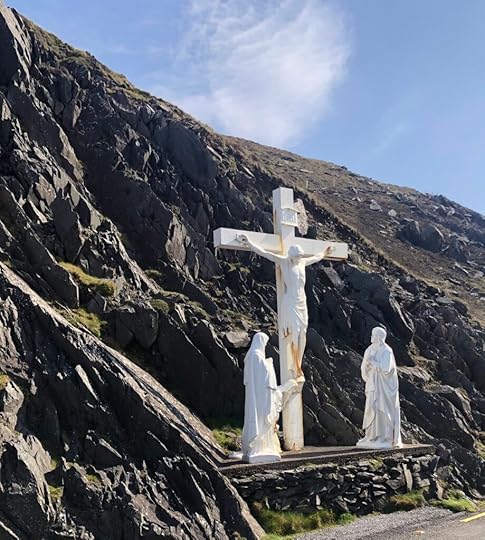 Slea Head, Dingle Peninsula, Ireland ©SandyBeck2023 used by permission
The importance of nature in one’s spiritual life is one of the things that we can learn to appreciate through the ancient Celtic example. As Davies says, “…nature appears as a theme to an unusual degree, and enjoys its own autonomy, rather than purely serving the human ends of atmosphere and mood as an imitation of the classical mise-en-scéne.” I believe Davies is referring to the modern tendency to see nature as only what is before our eyes and what exists to meet our physical needs. The Celtic view was quite different. Nature is a creation of God, and as such, God exists there. Even more, it is the revelation of God, the proof that he exists and continues to create with each new child born, each new spring flower, each dawning of a new day. The Celts believed that without God’s touch, without the presence of his essence, there would be no life. There is much to be learned from creation—much that is, to be learned about God from it.
March 17, 2024
Why St. Patrick Matters
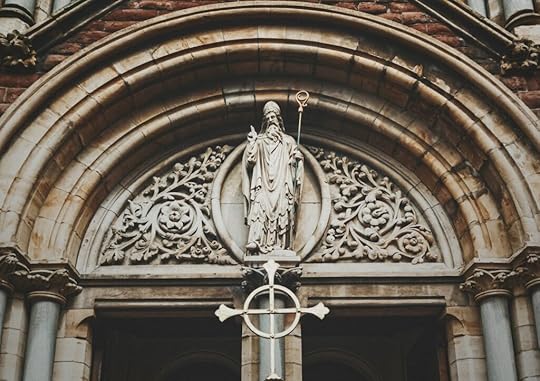 Photo by K. Mitch Hodge on Unsplash
‘Tis a grand day, to be sure. Are you wearing green? Are you going to a parade, or have you already been? Have you had your green beer, green frosted cupcakes, soda bread, Irish stew, corned beef and cabbage?
Fine then. Let’s talk about this celebration a moment. Why is it important? (And let there be no mistake, it’s important, especially for those of Irish decent and for Christians.)
St. Patrick’s Day is a national holiday in Ireland. People used to attend church on the patron saint’s feast day, and that’s about it. Pubs were closed on that day until the 1970’s. As I mentioned in my last post, it became a day of national pride as the shamrock was banned by the English government. Wearing your shamrock was one way to demonstrate this pride (or rebellion if you looked at it from the English side.)
It’s important to note that both Catholics and Protestants honor St. Patrick. He is the patron saint of all, and, as Tim Campbell of the Saint Patrick Centre likes to point out, he was cross-cultural. Patrick was from Roman Britain, not Ireland, and he came to Ireland after having been enslaved there, to reach out to the Irish. So whether you’re Catholic or Protestant, English or Irish, St. Patrick belongs to you. During a time when these groups shared little in common but hate and distrust, they’ve always held Patrick in common. Just as he reached across the Irish Sea over a thousand years ago, we can reach out to each other in the same spirit today to celebrate a common Christian heritage.
Patrick himself said, “…without regard to danger, I make known God’s gift and the eternal comfort he provides; that I spread God’s name everywhere dutifully and without fear so that after my death I may leave a legacy to so many thousands of people.”
He has left a legacy, not to thousands but millions, maybe billions over the centuries. But it all began with one person and is carried on by individuals.
Why is the day important? Sure there are parades and food and music, but what this celebration does is bring attention to the culture of Ireland. It’s been said that there only two types of people: those who are Irish and those who wish they were.
The first St. Patrick’s Day parade in New York City was held on March 17, 1762. As Irish immigration in this country increased, the Irish in America formed aide societies such as the Hibernians and Sons of St. Patrick. These Irish-American groups helped preserve Irish heritage, and the parades were (and are) a big part of that. In 1848 all these groups consolidated to form the New York City St. Patrick’s Day parade, which now has approximately 150,000 participants and 1.5 million spectators! The parade even has a mission statement:
HONOR SAINT PATRICK, THE FAITH OF OUR FATHERS, IRISH HERITAGE AND CULTURE.
There are parades all over this country. Dublin, Ireland’s parade will mark 30 years in 2025. There are parades in other Irish cities as well.
A rich Christian heritage comes from Ireland and belongs to everyone of the Christian faith. If you know me, you know I have a passion for writing about these ancient Irish Christians.
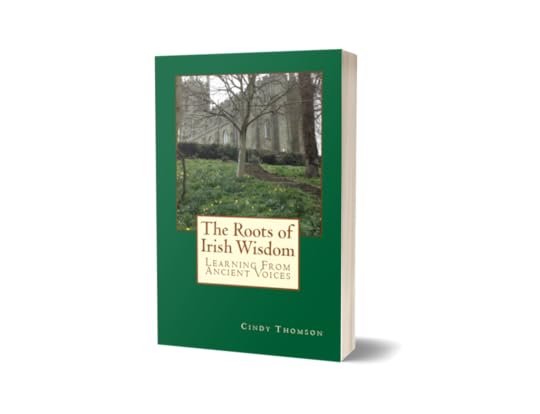
Their stories should never be forgotten, and the essence of how they lived, their relationship with each other and with God, are lessons that we can be inspired by as we seek our own spiritual paths. The celebration of St. Patrick’s Day brings all of that to light wherever the holiday is
celebrated.
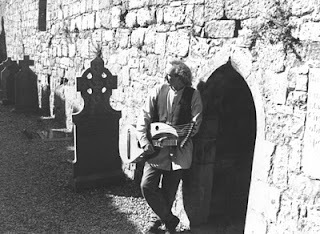
Musician John Doan. Click on the picture to go to his web site.
So, what does St. Patrick’s Day mean to you? How are you celebrating?