Cindy Thomson's Blog, page 11
December 14, 2022
Searching the Past
Amazon affiliate links appear in this post. As an affiliate I earn from purchases made through these links. While it doesn’t cost you any more, it does help support my writing.
As you probably know if you read my blog and/or have read my books, I’m keenly interested in the early Christian period in Ireland. I have a growing interest in learning more about that time period in the other Celtic countries as well.
According to Celtic Britain and Ireland, The Myth of the Dark Ages, by Lloyd & Jennifer Laing, Irish Academic Press, 1990, the study of the early Irish Christians did not begin in earnest until the 18th century. When you consider that St. Patrick came to Ireland near the turn of the 5th century, much historical data was probably lost. That’s why I found the early Christian period a fascinating time in which to set fiction. It’s history told orally and through folktales.
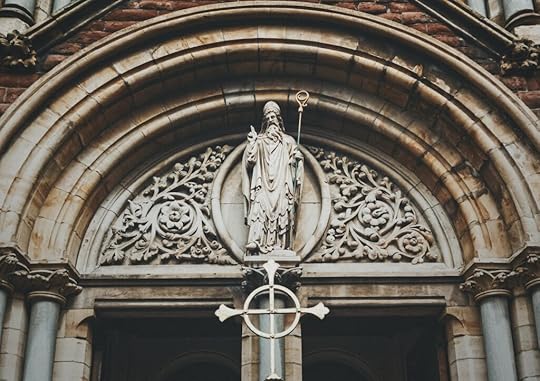 Photo by K. Mitch Hodge on Unsplash A statue of St. Patrick above the entrance to St. Patrick’s Roman Catholic Church in Belfast’s Cathedral Quarter in County Antrim.
In the early 19th century, Ireland’s primary historian was Sir George Petrie, who was also a painter. He made some historical drawings that have preserved some of Ireland’s history for us today. There are some books out there with his drawings, like this one. Austin Cooper also made drawings that preserved some of Ireland’s history.
I have a copy of this book.
Another illustrator from the 19th century was George Victor Du Noyer.
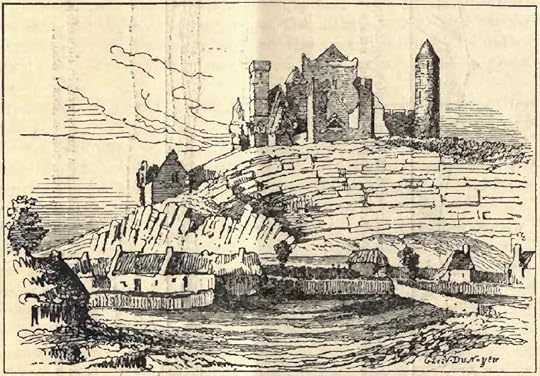 Mid-19th century drawing of the Rock of Cashel, County Tipperary, Ireland, showing geology of the rock outcrop, by Du Noyer. Public Domain. Drawing was made pre-1869 according to Wikipedia.
The Rock of Cashel above drawn by Du Noyer and below what it looks like today. There are no village houses below, the rocks surrounding it have been improved, and it seems that the round tower is missing but that’s just a different angle because there is a round tower and it’s the oldest structure on the site dating to the 12th century. It’s interesting to see another photo taken in 1970 before the restoration. Scroll down.
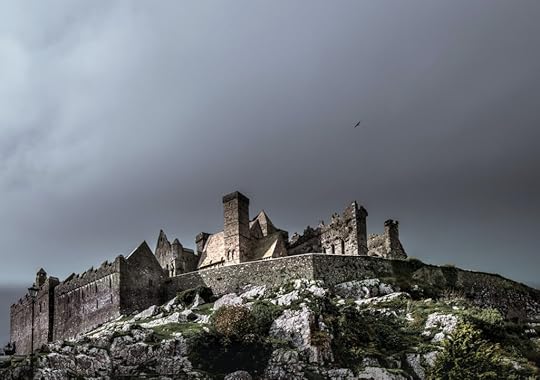
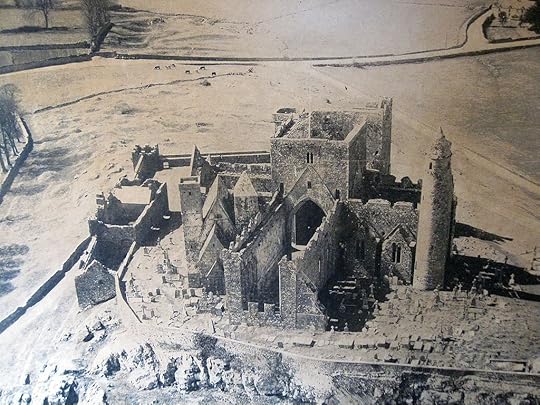 Rackmount-guy at English Wikipedia, CC BY 3.0 https://creativecommons.org/licenses/by/3.0, via Wikimedia Commons
There are many other examples that show why the sketches these men did in the 19th century are so valuable today. I need to write another post on that!
In their book, the Laings say: “It is not improbable that the considerable upsurge of interest in Early Christian Ireland in the mid-nineteenth century was the outcome of two trends–a growing national feeling and an interest in medieval antiquities…”
For whatever reason, much of what we know of Irish history comes out of that time and the work of Victorian-era historians. That’s probably too broad of a statement. Archeology is bringing more to light all the time and some of what the old histories tell us has to be reexamined. But I’m always reminding myself that just because an old book says it, doesn’t necessarily make it true. Even the belief that the Irish today are descended from the Celts is questionable. (That’s a whole other topic!)
History is not set in stone, so it seems. At least not the history that is written by people. That’s what makes the study so interesting, in my opinion. What do you think?


December 12, 2022
An Old Celtic Prayer
This is a general prayer from Douglas Hyde’s book, The Religious Songs of Connacht. He attributes it to a man named Michael Picoid. It was originally written in Latin. You can read my thoughts below.
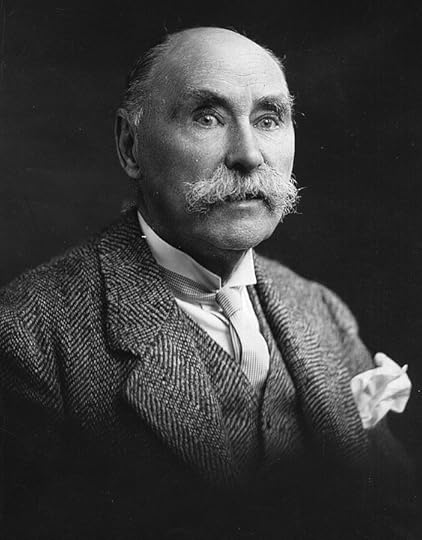 Douglas Hyde, Irish politician, head of state and Irish language activist, circa 1940. Public Domain
I believe in Thee ; strengthen my belief. I trust in Thee ; confirm my trust. I love Thee ; double my love.
I repent that I angered Thee, Increase my repentance.
I adore Thee as first-beginning of my life. I desire Thee as my last end. I give thanks to Thee as my ever-helper. I call upon Thee as my strong-defender.
Fill Thou my heart with awe without despair ;
With hope, without over-confidence ;
With piety without infatuation.
And with joy without excess.
My God ! consent to guide me by Thy wisdom;
To constrain me by Thy right ;
To comfort me by Thy mercy ;
And to protect me by Thy power.
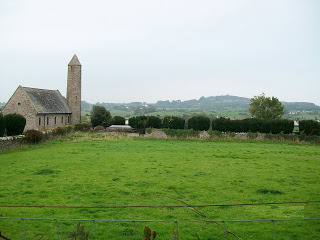 The church at Saul, County Down, Northern Ireland. Photo by Cindy Thomson
I hallow all my thoughts, words, deeds and sufferings to Thee
So that from hence-forward I may think on Thee,
May converse of Thee, may labour for Thee,
And may suffer for Thee.
O God ! I ask that Thy will be done,
Because it is Thy will,
And in the way Thou willest.
I beseech of Thee enlighten my understanding,
Wash my will, cleanse my body, hallow my soul
My God, give me strength
So that I may make expiation for my misdeeds,
So that I may win victory over my temptations,
So that I may right my strong evil-inclinations,
And so that I may practise the virtues
That are suitable to my state of life.
Fill my heart with affection for Thy goodness,
With hatred of my faults, with love for my neighbours,
And with contempt for the world.
That I may remember, O God, To be submissive to my superiors, To be at one with my inferiors, Faithful to my friends And charitable to my enemies.
~There is much more to this prayer. I’m skipping a few stanzas.
May I never forget To put heed in my prayers,Moderation in my ways,Earnestess in my care,And persevereness in the things I put before me.
~Skipping a bit more
Finally, may it be thy will To grant repentance to every sinner, Constant forward progress to the righteous,Peace to the living, And everlasting happiness to the faithful who have died.
I ask of Thee, O Lord, to grant all this Through the merit of our Lord Jesus Christ,Through the intercession of Our Blessed Lady, And of all saints, And through the will of our Holy Mother the Church.
~I could have skipped the last couple of lines, since they are decidedly Catholic
and I’m not, but that’s how the prayer was said, and I have great respect for that.
You, of course, may pray the prayer however you see fit.
I love the honesty in this prayer, the desire to be better, the pleading with God.
I’d love to hear your reaction.
December 9, 2022
A Look at Celtic Prayer
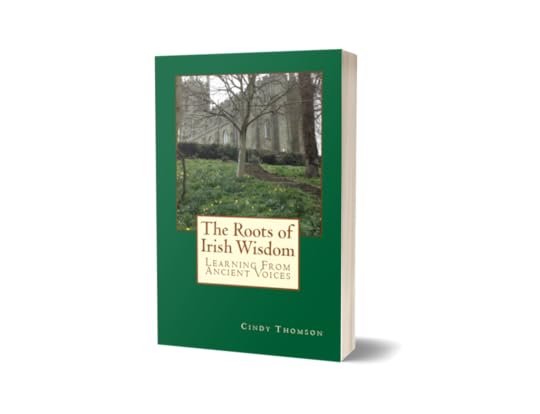
In 2010 I posted this (note that the book Celtic Wisdom is now The Roots of Irish Wisdom.)
From my book, CELTIC WISDOM, TREASURES FROM IRELAND “Prayer was not reserved primarily for church: it was a natural outpouring of the culture, a culture that saw power in the natural world, one that did not see a division between the spiritual and the secular, one that did not judge worthiness–Jesus died for all. The Irish prayers reflected the life of the people and were melodic, continual and close to the heart.” Here is one prayer quoted in the book:
God be in my head and in my understanding; God be in my eyes and in my looking; God be in my mouth and in my speaking; God be in my heart and in my thinking; God be at my end and at my departing.
These were simple prayers that made use of repetition for the purpose of memorization. But they were also heartfelt and have a kind of relevance that speaks to us today. If God is in the forefront of all you do, say, think…then you are sure to stay on the right track.
December 5, 2022
Celtic Prayers as Song
“Their prayers were songs, and as they crooned or intone them, they seem close to the continuous prayer the Orthodox describe as a murmur in the heart.”
~Esther De Waal, God Under My Roof
I first published this blog post in 2011. I had this idea in my head for quite sometime and it eventually developed into the book Celtic Song.
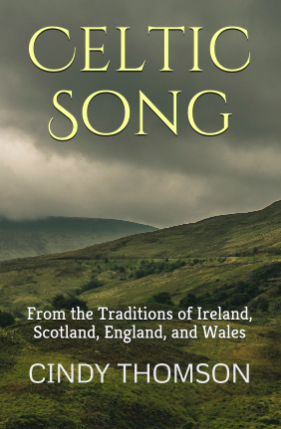 Celtic Song, From the Traditions of Ireland, Scotland, England, and Wales $14 US shipping included.
What a shame we don’t know the tunes the ancients used when they sang their prayers. But when we listen, carefully, we can hear the music of nature. I wonder if the Celts had music like that–birdsong, thunder, the crash of the waves, the sound of falling rain.
Did they use music like King David of the Bible did?
Then David and all the house of Israel played music before the LORD on all kinds of instruments of fir wood, on harps, on stringed instruments, on tambourines, on sistrums, and on cymbals.~2 Samuel 6: 5 NKJV
Music before the Lord. The Celts found God in nature. They surely played their instruments around their hearths, the way we picture traditional Celtic music being played, but I imagine they played outdoors as well, like the girl in this beautiful photograph.
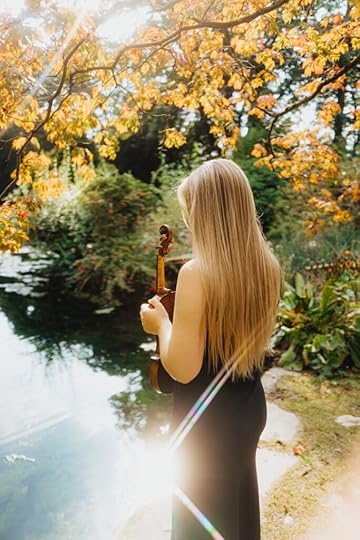 Photo by Sebastian Mark on Unsplash
The music of the spheres. Remember that old hymn?
This is my Father’s world,
and to my listening ears
all nature sings, and round me rings
the music of the spheres.
Would love to hear your thoughts in the comments.
December 1, 2022
Exclusive for Newsletter Subscribers: A Celtic Christmas
Greetings! If you found your way here, that means you are a valued newsletter subscriber. Thanks for reading. I’m sharing a wee story I wrote just for you!
There are festivals, market days, feasts of saints days. There are church calendar days that are important for remembering the saving grace of our faith. But to Brigid nothing meant more than Christmas. Emmanuel, God with us. God save us. The Word became flesh.
Tugging her dark woolen cape across her shoulders, she stepped out into the night. There would be no mass, no celebration, no worship tonight, the night of Christ. Not for her. Not for her followers. The flame needed tending.
Many of her sisters were sick and those who weren’t were exhausted from having to do the work of two or three women. Brigid understood the need for sacrifice. When someone needed something, God used her to bring it forth. Milk, butter, livestock. She’d asked for sustenance for her fellow human beings, asked for dead cattle to be restored, asked for the dying to receive grace. And God had heard and answered her prayers. She hadn’t minded doing these things. She’d always been willing to be a vessel for God. So why now was she disgruntled about skipping mass and tending the flame? She shouldn’t be. But she was.
 Photo by Paul Bulai on Unsplash
Arriving at the sisters’ perpetual fire, Brigid dismissed the lone woman there. “May the love of Christ warm you on this holy night,” she told her.
There was only a small fire burning. Brigid would need more timber. A lot more. The men at her monastery had scattered to the far corners of the province to eat and drink with others on this holy night. As abbess and bishop, Brigid had allowed their departure. Now, with a lack of wood and wolves howling in the distance, she questioned her decision.
In fact, why do this at all?
She reminded herself why she’d maintained the fire from the moment she built her church under the massive oak. To allow the pagans to join her. To let them know what they worshipped was more than they realized. To celebrate the God of life-saving fire, so important to keep the wild animals away and to have a source for cooking and heating their living spaces, to light the deepening darkness.
Ah, yes. Those things were still important. Gathering as many twigs and small branches as she could carry, she remembered a scripture that she now recited aloud to the unseen shrieking wind.
In Him was life, and that life was the light of men. The Light shines in the darkness, and the darkness has not overcome it.
John 1:5
The light of women, too.
With a heavy sigh, Brigid tossed her bundle on the small flame. With horror she watched as the pile smothered the fire. Out it went with a wee puff of smoke. She’d been careless. Tending meant to take care of, to take great care with something and not to do it begrudgingly. Quickly she glanced around. In the pitch black she couldn’t be sure no one watched. Even so, she had to start the fire again. Should she admit her mistake? Or would it be better to allow the myth of the perpetual flame to continue. For the good of everyone. She had a flint stone in her cloak pocket. That alone was a testament of unbelief, wasn’t it? Perhaps it had been a nudging from God, just in case she failed. Like now.
Before long Brigid had a torch burning. Lifting it to the dark night she saw faces, blinking eyes beneath hooded cloaks. People of the forest. People who depended on this fire. Too late. They’d seen her. As she turned to the pile of smoldering ashes, a wee light glowed from its depths. Not a reflection of her torch, but a spark from deep within the ruins. The light shines in the darkness, and the darkness has not overcome it. The fire hadn’t gone out despite her inability to see it. Despite her inadequacy and lack of tending to her task. Despite her lack of faith.
Lifting her torch over her head to make sure the others could see her, Brigid danced around the wee flame that quickly grew and burst through the sticks she’d thrown into the pile. With a great hunger the fire crackled and sizzled, sending a charcoal odor into the frigid air. The fire did not seem to consume her little offering. It had been enough. She was enough. Lifting her head and arms to the stars in the ebony sky, Brigid sang praises to the Keeper of the Light.
This had been a mass after all, for the people, for Brigid’s heart. A celebration of God With Us that she would never forget.
May the fire of this Christmas Eve burn perpetually in the hearts of all who think of her.
November 23, 2022
A Celtic Thanksgiving Prayer
 Photo by Libby Penner on Unsplash
Give us O God of the nourishing meal, well-being to the body, the frame of the soul.
Give us O God of the honey-sweet milk,
the sap and the savor of the fragrant farms.God in our waking, God in our speaking;
~From the Carmina Gadelica
God in our cooking, God in our eating;
God in our playing, God in our digesting;
God in our working, God in our Resting.
November 22, 2022
So Few Words
I’m all about words. I know about how many I need for my historical novels, about 95K. A good blog post, in my opinion, is no more than 600 words. About 250 fit on a page in Times New Roman font.
Maybe that’s why I struggle with poetry. Not writing it, because that I rarely try, but understanding it. You have to read between the words. There are exceptions. I love the poetry of Emily Dickinson and Robert Frost. I admire that they can use so few words to say so much. Words that touch the heart. Words we instantly recognize as true.
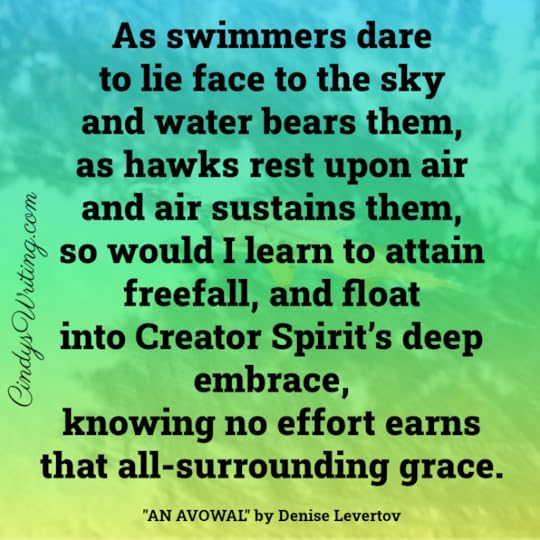
That’s why when I heard this poem during a meditation I was listening to, I knew I wanted to share it with you. So true. So meaningful. So beautiful. What do you think?
November 2, 2022
Ellis Island Old and New
This is as much for me as for you, but I hope you find it interesting. I’m comparing historical pictures of Ellis Island with ones I took back in 2011 (mostly, I’ve added a few others.) All of the historical photographs here came from the NYPL digital gallery.
Between 1892 and 1954 12 million immigrants passed through Ellis Island. There was a fire in 1897 and the immigration station burned to the ground. It was rebuilt with fire-safe brick, the brick you see today, a 125 year old building.
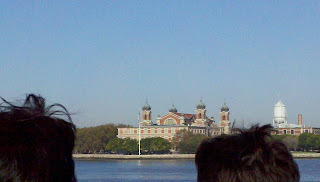 photo by Cindy Thomson
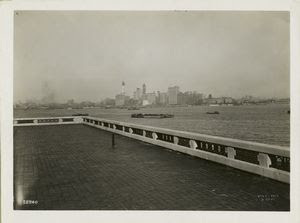 The Manhattan skyline viewed from Ellis Island.
 Photo by Cindy Thomson
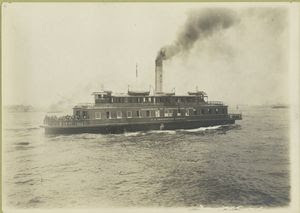 Ellis Island Ferry
 https://www.nps.gov/places/ferry-liberty-island-to-ellis-island.htm
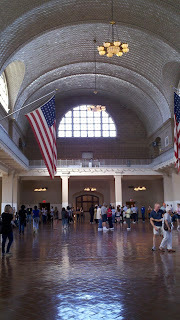 Photo by Cindy Thomson
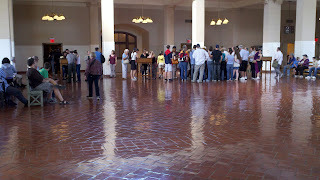 Photo by Cindy Thomson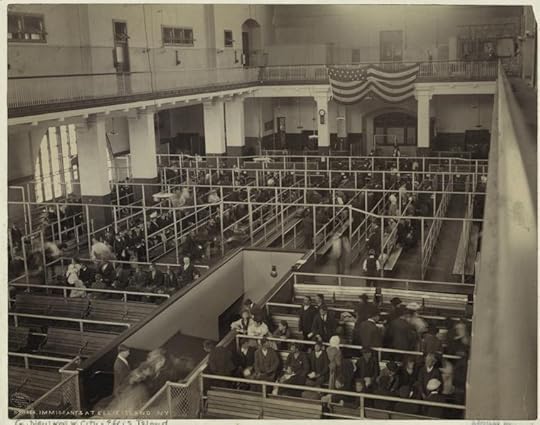
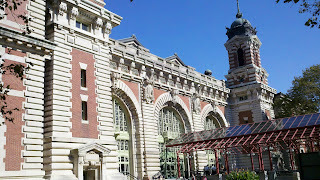 photo by Cindy Thomson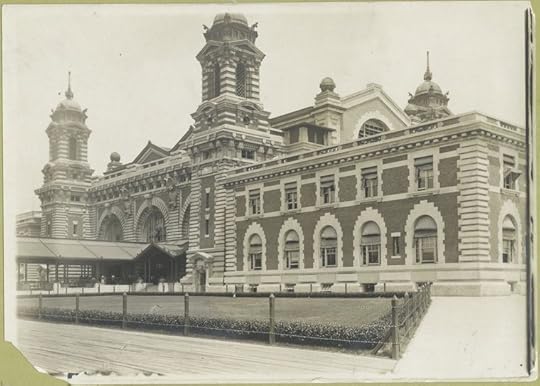
It’s interesting to note, however, that what we have today was restored after decades of neglect. There is still much to be restored on Ellis Island. You can help. Go to the Save Ellis Island web site and donate. Check to see if your employer is a matching donor as well.
November 1, 2022
Giveaway for the Trip!
Have you signed up for the Ancient Brigid tour to Ireland? If not, go here. The deadline is Dec. 1. On Dec. 2nd I will draw a winner from everyone who has signed up for this prize package, which includes:
A Longaberger Irish tote (so cute and with an outside pocket!)A travel journal (it’s looking a bit smushed but I promise you it’s unused.)A Celtic pin.A Celtic cork coasterA CindysWriting penA St. Patrick prayer cardA wee St. Brigid’s cross charmA one-on-one tea time with me in Ireland (we’ll schedule it away from the crowd!)(Delivery of this prize will be at our first meal on our trip!)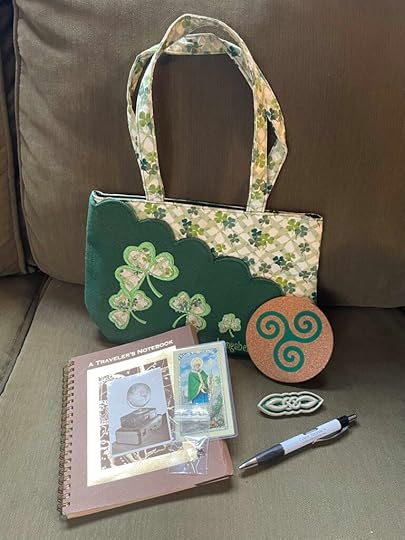
October 28, 2022
Happy Birthday, Lady Liberty!
The Statue of Liberty, originally called Liberty Enlightening the World, turns 136 today!
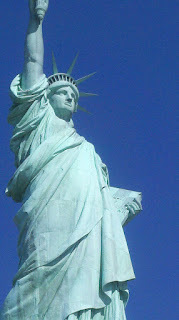 photo by Cindy Thomson
You probably learned the usual things about the statue in elementary school: she was a gift from the country of France, she stands in the harbor near Manhattan, immigrants saw her as they approached Ellis Island, and she’s memorized in a number of ways–on money, in movies…
You’ve probably also heard the poem, or at least part of it:
“Give me your tired, your poor,
Your huddled masses yearning to breathe free,
The wretched refuse of your teeming shore.
Send these, the homeless, tempest-tost to me,
I lift my lamp beside the golden door!”
You can read my previous post on The New Colossus, the 1883 poem by Emma Lazarus, who was not an immigrant, by the way.
Seeing the Statue of Liberty up close was one of highlights of my trip to New York City. It was a beautiful day with clear blue skies, as you can see in these pictures. None of my ancestors, so far as I can tell, came through Ellis Island and had the experience of seeing the statue as they approached America. But many Americans with Irish roots did. Several nationalities came during the time Ellis Island processed immigrants, and an experience I hadn’t anticipated was that when I was there, I too was surrounded by people from several ethnicities, speaking different languages. But we were all experiencing much the same thing, just like the ancestors who proceded us. This is a symbol of America, perhaps the greatest symbol.
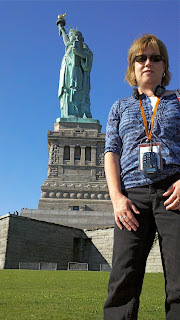 Me in 2011, taken by Tom Thomson
From the base of the statue to the torch is 151′ 11″. From the base of the pedestal to the tip of the torch, it’s 305′ 6″. It’s just amazing to stand at the base and look up. What an engineering feat! The interior is constructed the way skyscrapers were so it can withstand strong winds. And that was before skyscrapers were built! The inside of the statue is hollow. The exterior copper covering of the Statue of Liberty is 3/32 of an inch thick (less than the thickness of two pennies) and the light green patina is the result of natural weathering of the copper. During the time my Ellis Island novels are set my characters would have seen her mostly copper-colored.
The first immigrant passing through Ellis Island was Annie Moore, an Irish teenager. She is memorized at Ellis Island with a statue. One can only guess what she must have thought when she got her first glimpse at Lady Liberty.
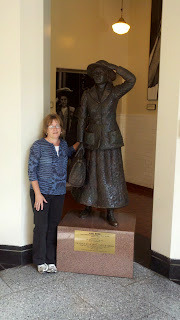 Me and Annie, Ellis Island Museum, taken by Tom Thomson
 View from Battery Island
Learn more about the statue here: http://www.nps.gov/stli/index.htm