Rosa Say's Blog: Managing with Aloha, page 9
December 25, 2016
Merry Christmas Kindness, Hana hou
Mele Kalikimaka ~ Merry Christmas Day!
I truly believe there is an infinite wisdom blessing us, having Christmas Day arrive as we end one year, and look forward to the next. It is a holiday which helps each one of us be a little wiser, and pause, seeking to genuinely be much kinder to each other.
“As an American who celebrates Christmas, when people wish me ‘Happy Holidays’ I smile and thank them… yes, I celebrate Christmas even though I’m agnostic. Jesus was a cool dude.”
—John Scalzi

PC: @theydrawandcook on Instagram
Ka lā hiki ola:
My hope with Aloha for you is that any pilikia (troubles or misfortune) brought by 2016 has faded away from your circumstance and your memories of it by now, and this, the most glorious birthday we celebrate, fills you with shiny hopes for the promise of 2017. Draw your loved ones close… my message for Christmas Day continues in this Special Edition of our Ho‘ohana Community newsletter.
Have a gloriously, ridiculously happy day.
With Aloha,
Rosa
“The world you see is just a movie in your mind.
Rocks don’t see it.
Bless and sit down.
Forgive and forget.
Practice kindness all day to everybody
and you will realize you’re already
in heaven now.
That’s the story.
That’s the message.”
—Jack Kerouac on Kindness, the Self Illusion, and the “Golden Eternity”


December 20, 2016
In “Being Human” we Relate with Aloha
As an author, and someone who genuinely feels she writes better than she talks, I loved the opportunity I was recently given, to present a keynote along with an essay my host published in a gift book given to all his conference participants.
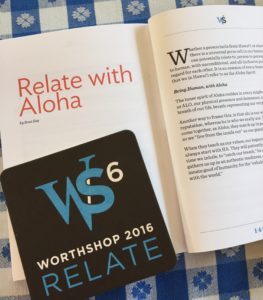
Worthbook, Essays from Worthshop Presenters, Compiled and Concepted by Matt Beall, Book Design by Winston Wellborn, Hawaii Life Real Estate Brokers
Part 2, Keynote.
What usually happens, is that people will listen to me speak, and then decide if they want to read my writing afterwards, either here on the blog or by purchasing my book. This time, they could read my essay beforehand, one I had expressly written to complement the keynote I would be giving. So cool.
Each time I speak, I assume my presentation has to be stand alone and fully packaged; I assume no one in the audience has ever heard of Managing with Aloha, much less read my book, this blog, or our newsletter. I assume we are meeting each other for the first time, and I’m hoping they leave our conversation knowing me, knowing Managing with Aloha, and sensing exactly how they can own it themselves and then run with it— I want them to relate to values-centered living, and begin to ‘work’ their values as well: Ethos: Be true to your Values.
That’s a lot to ask of the 18-minute time slots you usually have for keynotes when you feel there is so much to say (thanks for setting that bar TED Talks.) A lot to ask, indeed: Managing with Aloha’s Learning Landscape: “Know well.”
Back to our Good Beginnings
I do think my Mea Ho‘okipa at Hawai‘i Life Real Estate Brokers went above and beyond in publishing their Worthbook of speaker essays, and consequently, it’s no surprise that the results of their Worthshop conferences are so long-lasting. They definitely make an impression (this is the 2nd Worthshop conference I have participated in.)
I share this posting here on our Ho‘ohana Community’s blog for 3 reasons: 2 as related coaching tips, and 1 in the spirit of sharing that will hopefully take all of us back to our good, “with Aloha” beginning places.
Coaching Tip 1.
Learning today is challenging. As a manager, you can help.
We are bombarded with so much in trying our best to live well daily, and then learning more “when can, can.” That is our ‘being an adult’ circa now reality.
Recognize and acknowledge that adult learning is challenging. Wise Alaka‘i Managers will make the workplace learning landscape as easy, and as habit-forming as possible. Don’t just set expectations of WHAT you want your team to learn, concentrate on HOW they do so as well. Focus on the reasonable yet effective ways you expect them to learn and retain your continuous education, and construct clear paths they can take in using what they learn. Embrace projects and experiments, and you will be creating fertile ground for new ideas to incubate on an ongoing basis.
Coaching Tip 2.
Making an impression with events (and capitalizing on your investment) need not be tough too.
You need not foray into publishing, there are other ways to get the bang for your buck.
First, don’t be satisfied with having your events (or meetings, or projects) exist in the vacuum of stand-alone events: bookend them. Couple them to a ‘happens before’ and ‘happens afterward’ that is thoughtfully considered, deliberately planned, and smartly executed.
Second, keep those bookends simple, and do not overly complicate them. Know how effective conversations can be. Start conversations before, so they can cook and simmer in your event or meeting, and have a wrap-up/stage-next conversation afterwards.
As David Ogilvy said, “If you want ACTION, don’t write. Go and tell the guy what you want.” Here are 2 posts to review on effective conversations:
All Conversations Are Not Created Equal
Conversational Catch-up ~ with Aloha
Spirit of Sharing 3.
“Relate” was the overall theme of the Worthshop6 conference. Loved it!
Now that the Worthbook of essays given to all participants is out in the wild, i.e. in public domain, I can share my essay with you too. I wrote it for an audience professionally connected to the real estate industry, however I am sure you will relate to it as well, and remember Our Beautiful Basics of Aloha as your takeaway too.
To Relate with Aloha is what we all do. Here is my Worthbook essay.

Me, captured in action at VR Pro Day, a Worthshop pre-conference event. Speak To Your Intent!
Relate with Aloha
Whether a person hails from Hawai‘i or elsewhere, there is a universal germ cell in our humanity we can potentially relate to, person to person, human to human, with unconditional, and all-inclusive positive regard for each other.
It is an essence of every human being that we in Hawai‘i refer to as the Aloha Spirit.
Being Human, with Aloha
The inner spirit of Aloha resides in every single one of us, as ALO, our physical presence and demeanor, and HA, the breath of our life, breath representing our very DNA.
Another way to frame this, is that ALO is our signature and reputation, whereas HA is who we really are. When Alo and ha come together, as Aloha, they match up in perfect alignment, so we “live from the inside out” as our genuine selves.
When they teach us our values, our kūpuna, our elders, always start with HA. They will patiently explain that every time we inhale, to “catch our breath,” HA collects us, and gathers us up in an authentic readiness, complete with the innate good of humanity, for the “exhale of sharing ourselves with the world.”
Every breath.
Every single breath we take, we ‘catch’ and hold onto our innate goodness as human beings. [1]
We add to this our individual signatures of DNA representative of our ancestral wisdom and current learning; our intelligence, mentality and intention; our heart and our soulful spirit received within divinity—our mana, divine power and energy. [2]
Our Aloha Spirit then, is a powerful, energetic spirit graced with our biology, innate intuition, and our potential for relating to others in good intention. This spirit we collect, is an instantaneously renewed and sustained resource, one we fuel up with, in every single breath. Every single one.
We become who we are, when we breathe to create our spirit.
If they are to flourish and thrive, good people need the strength of good values.
As the kūpuna continue to teach, they explain that learning about values, accepting them, and standing up for them as our own, whether personal, professional, or community values, is really about making individual, conscious choices, and allowing our intelligence and emotional heart to kick in. We are good by nature, however we choose our behavior.
Altogether, those behavioral choices have to do with how authentic we are truly willing to be. Authenticity, is connecting our alo—our demeanor and presence seen and experienced by others—with our ha, which only wants to be sincere, genuine and real, and become that “exhale of sharing ourselves with the world.”
Notations above:
[1] In the Hawaiian way of thinking, people are born within goodness, and there is no such thing as a bad person, just bad behavior.
[2] A second assumption in the Hawaiian belief system, is that to be born, one must have received a measure of divinity from the gods upon birth—one’s mana.
Spirit and Empathy
Is spirit too touchy-feely for us?
For we rarely will speak of it tangibly or pragmatically, and when we do, we often confuse spirit with religious dogma, or with the supernatural, not our every-day natural state the kūpuna describe. Here are some definitions I was able to find:
spirit |ˈspirit| —noun
the nonphysical part of a person that is the seat of emotions and character; the soul : we seek a harmony between body and spirit.
such a part regarded as a person’s true self and as capable of surviving physical death or separation : a year after he left, his spirit is still present.
What we prefer to speak of, rather than spirit, is empathy:
empathy |ˈempəθē| —noun
the ability to understand and share the feelings of another.
When I found it, this definition surprised me, in that it dared to cite ‘feelings’ in such a matter-of-fact way. The most common definition of empathy, is given as “putting yourselves in the shoes of another person” assumedly to relate to them in circumstance:
What if I were wealthy enough to afford what they can afford?
Conversely, what if I were struggling to pay my rent too, and can’t really imagine paying a mortgage, or splurging on any luxuries?
What if I had grown up land-locked, or with prairies far as the eye can see, and never spent a single day of my life at the beach, or on a volcanic mountain’s hiking trail?
What if I’d been living the city life of an urbanite, walked everywhere or rode the subway, and never had to get a driver’s license?
What if I had children, and was suddenly forced to think about the school they’d soon attend, the sports they might play, and the community values they’d be growing up in?
Empathy is a wonderful thing. Empathy does in fact, make great connections between people in business enterprise, where we seek to relate a potential customer’s most pressing need to the suitable context of our business offerings. We want to knock their socks off, and make their dreams come true, by delivering an exceptional product which ticks off all their boxes, and suits them perfectly. More than that, it delights them.
So yes, be empathetic. I am not proposing an either/or situation to you, insisting you choose spirit, and your Aloha Spirit, over empathy. Choose both.
Relate to others with your Aloha Spirit and your empathy, for it’s a winning combination.
One factor I really like about empathy, is that it acts a lever for our caring and compassion. To empathize with another, we have to care about them enough to do so. Another desirable factor in empathy, is that we elevate it and aspire for it; we seek to learn more about empathy, and practice it more than we do, so we become better people.
The human life is not a solo proposition.
Relate with Aloha
Have your mantra be, “I will Relate with Aloha” meaning you will relate to others in spirit, and with empathy. As French philosopher Pierre Teilhard de Chardin so perfectly phrased it;
“You are not a human being in search of a spiritual experience.
You are a spiritual being immersed in a human experience.”
More often than not, to relate with empathy alone, is to relate for product’s sake, and for the suitability of the sale. To relate with empathy, is to get better at seeing how you are different, and to acknowledge your differences and work with them harmoniously. These are not a bad things, not at all. However they are not complete in the human transaction, the person to person experience.
To relate with Aloha, is to relate for people’s sake, and for the authenticity of shared spirit. To relate with the Aloha Spirit, is to experience how you are the same, in that you each share humanity, and a vulnerability working each and every day to realize individual mana, with its divine strength, power, and energy.
Relate with Aloha: Acknowledge and celebrate the gift of your Aloha Spirit. Relate to the Aloha Spirit in others, recognizing the humanity you share, and you will celebrate your gifts together.
After that, the product part, the service part—the empathy part—gets magically easier. Better yet, you will enjoy it immensely, for genuine authenticity has come out to play for both of you.
~ Rosa Say is a workplace culture coach, the founder of Say Leadership Coaching. Her seminal book, Managing with Aloha, was just released in the summer of 2016 as a Second Edition. Rosa lives on the Island of Hawai‘i with her ‘Ohana. Learn more about Rosa and the Managing with Aloha philosophy at RosaSay.com
Subscribe for our weekly newsletter:
Talking Story with the Ho‘ohana Community.
Our value immersion study for the months of November and December:
‘IMI OLA: We are meant to be Seekers.


December 14, 2016
Ho‘omaha Makahiki Kākou
At Christmastime we say, “Mele Kalikimaka” in Hawai‘i— Merry Christmas!
For the new year to come we say, “Hau‘oli Makahiki hou”— Happy New Year!
It’s that wonderful time; time to REST.
You’re probably thinking, “Are you kidding me? This time of the year is CRAZY.”
Precisely. That’s why it’s best we rest.
It can be crazy, given the way that life has a way of catching up with us at year end, pooling at our feet in traditional practices and obligations. Everyone will say, “Family comes first, and my boss will understand, for after all, he/she has family too!” yet our actions belie those words, and we work late nights or on weekends to meet the deadlines we’ve yet to meet. Or worse, we work to jump ahead, for a “head start on 2017, so I can hit the ground running.” The sacred holidays this time of year aren’t true celebrations. They are hurdles to conquer.
And what does your boss really think? What does he or she really want you to do?
I’d venture this guess: Knowing there’s no stopping the new year, they’d want you to be healthy when it arrives. Healthy, fresh, ready.
I’m the boss of me.
When I left corporate work and started Say Leadership Coaching, one of my first thoughts simultaneously filled me with joy, and shattered me in a nervous anticipation. I said to myself, “It’s finally gonna happen. I’m the boss of me now.” which I clearly understood as meaning, “It’s all on me.” as well. Scary, yet incredibly exciting.
One of my first decisions was about the maha in my business plan— when would my resting times be? Which, by extension also meant, when would our resting times be? How could I bring all my partnerships in alignment with what I knew to be better practices, especially when the calendar conspired against us? Case in point, Christmas and New Years, however there are other times as well.
Nānā i ke kumu was, and still is, the value-driver. To “look to the source” is often to stop, take pause, regroup, vacation or sabbatical so you can refresh, recharge, and rejuvenate yourself. Nānā i ke kumu is the value of personal well being, and like all other values, we must deliberately and consciously choose to practice it. We must be “the boss of me.”
This self-coaching is completely aligned with ‘IMI OLA, our value focus for the month of December, 2016 as well: ‘Imi ola, We are Meant to Be Seekers, for the basic coaching of ‘Imi ola is to “create your best possible life.”
Ho‘omaha Makahiki Kākou
Therefore, the last 2 weeks of December and 1st week of January is always Ho‘omaha for the Say Leadership Coaching ‘Ohana in Business. We stop our work, and go on vacation. We close our business doors those 3 weeks, and focus on our families, and on our rest, inspired by Nānā i ke kumu and our ethos, which says, “Be true to your values.”
For 2016-2017, our Ho‘omaha dates fall from December 18th through January 7th.
When people say, “Mele Kalikimaka!” or “Hau‘oli Makahiki Hou!” to us, we respond with “Ho‘omaha Makahiki Kākou” for two reasons. We say it for ourselves, creating the talk we wish to walk this time of year. We extend it as an invitation, for as Alaka‘i Managers and those who practice Managing with Aloha know, Kākou is the value of inclusiveness, and means, “We are in this together.” Ho‘omaha; rest with us, let’s make Nānā i ke kumu happen for us.
Makahiki notes this season, at the turn of the year. The world does indeed conspire now, however let’s focus on the goodness and the celebration of it, not the crunch and tiresome should-ing obligations of it. All those burdens can wait for our return to the hana of work, however the holidays do not wait and can pass us by if we don’t stop to capture them.
I’m the boss of me. Be the boss of you.
There aren’t any rules to Ho‘omaha, just the mālama guidance that it becomes an indulgence of Nānā i ke kumu for you.
For me, for instance, there are a select, precious few speaking or teaching engagements I will continue to do over the dates of Ho‘omaha, because I love doing them so much, and they do fulfill my Aloha Intentions. They rejuvenate me with the sources of what Living with Aloha in my work is all about. However I do take pause with my office hours; any tedium and routine of how I’m normally ‘at work’ the rest of the year ceases, delayed until the 2nd week of January. I write like crazy still, however I stop the work of publishing except for when I wish to talk story with you on the blog (I get impulsive here!)
To be practical about work, is to be reasonable about your own expectations, not just those of your boss. With Ho‘omaha, you may not stop your work completely, however you can “Ho‘ohana and not just hana.” Like me, you can make time for those facets of your work which bring you joy, and recharge you with positive energies.
So please stop. Take pause with me. Make your deliberate choices regarding what the coming weeks will be for you as 2016 morphs into 2017. Mai poina, don’t forget: Better managers are better people first and foremost. Better people are healthier people; they indulge in Ho‘omaha and Nānā i ke kumu on a regular basis.
Say it with me, so you can then walk the talk as well: Ho‘omaha Makahiki Kākou.
Doesn’t that feel great, now knowing what that means? Let’s do it.

Subscribe for our weekly newsletter:
Talking Story with the Ho‘ohana Community.
Our value immersion study for the months of November and December:
‘IMI OLA: We are meant to be Seekers.


December 6, 2016
There is no Vacuum in an Aloha workplace
Umair Haque shares a 2 minute read on Medium titled American Karma: “Moral Choice and Human Awareness” which includes this;
“What happened to America? The story is very simple. I can tell it in three sentences.”
“The right campaigned for a complete implosion of the state, and got it. The left campaigned for the enrichment of a very few, the winners, the talented, the fortunate, and got it. The result was a vacuum, of several kinds: a vacuum of society, an imploded middle class, and a destroyed American dream.”
“In that vacuum, extremism always arises. The story of demagogues rising in the vacuums left by failed leaders is as ancient as time and as ever present as the stars. It’s the story of Hitler, Stalin, Mao, etc.”
“Now the question on everyone’s lips is: how do we fix America?”
I will save you the click over there, by adding his answer (my bold):
“Now the practical solutions to extremism are just as simple as it’s causes. Investment in people, in the basics of life they are furious at not having. Thus a society contests the vacuum that the demagogue fills. That is how demagoguery is fought, not with condemnation, but with material progress for the abandoned.”
He is right, and he is wrong.
He is right about the danger which exists in a vacuum. Unfortunately, he’s wrong about the fix being “simple.” We’re in for a roller coaster of societal disruption.
I share his post with you as a real-life lesson learned, as a caution we Alaka‘i Managers should remember in our own culture building in the workplace. A vacuum created by not fulfilling the needs of our ‘Ohana in Business, is just as crippling as a vacuum in society as a whole.
On the other hand, corrections often happen at a grassroots level, where factors are completely within your control— just apply your Aloha Intentions.

Any vacuum in a workplace is a huge red flag.
There is no Aloha Spirit-sucking vacuum in a healthy workplace.
Assuring workplace health is Job One of the Alaka‘i Manager — review the chapter on Mālama in Managing with Aloha, and revisit any notes you made there about your Kuleana, responsibility, with your workplace’s stewardship.
Consider your workplace to be a microcosm of society as a whole, for that is what it will always be, no matter how incestuous and un-Kākou a company may be in recruitment, hiring, selection, and the forging of all partnerships. People come connected.
Connection to community, and today to a very global community, is the basic assumption we must always keep in mind as managers. Life is not a solo proposition, and people operate in circles of influence that are much larger than the protective shell or soothing nest of any workplace.
A workplace can be a refuge as a place of Aloha,
however it will never be an island.
That assumption is very much at play in every single one of our 9 Key Concepts in some shape or form, and particularly with Key 6, the ‘Ohana in Business as a culture you build, foster, nurture, and steward.
As proactive culture builders, we cannot ever forget that people come connected, and second, that silence usually begs to be filled.
Our vacuum-filler? Dedication to our values, mission, vision.
We are constant, and consistent about working on our value alignment.
Let’s revisit our basic definition of what culture is all about:
Great managers know that CULTURE is simply a group of people who share common values, and operate within those values.
Culture is learned. Culture represents a series of agreements based on value alignment, and results from honoring those agreements.
The great manager, and the great PERSON, manages their own behavior by tapping into their values as their source of human energy. It’s the way they “lead by example” conducting themselves with ALOHA distinction, and it’s the way they inspire the culture they operate within.
Be Alaka‘i. Build an Aloha Culture with your Aloha Intentions.
Yes… I repeat these concepts for you, because they have been proven to work for us.
What do people need from you? They need to feel they have your attention, and they need to feel you will not forget about them, or ever neglect them.
It may also help you to revisit Maslow’s Hierarchy of Needs. I have always felt his advice was sound, and readily applies to how a manager can work their way up the pyramid, from the basic fulfillment of foundational needs, to the higher levels of growth and development.

From Archive Aloha on TalkingStory.org: Sense of Workplace: It’s Milk, Maslow and You. Time for a refresh here on this blog too?
Related Reading: For those of you who have my book, I cover unintentional neglect in Chapter 13 on Ho‘ohanohano, under the heading, “Neglect is visible, and it hurts.”
Subscribe for our weekly newsletter:
Talking Story with the Ho‘ohana Community.
Our value immersion study for the months of November and December:
‘IMI OLA: We are meant to be Seekers.
Save


December 5, 2016
On Intention: Don’t “shut up”—Sound off
Derek Sivers, a thought leader I admire, is often quoted with this advice to “Zip it!”:
“Shut up! Announcing your plans makes you less motivated to accomplish them,”
…which goes contrary to what we hear about transparency, having accountability partners, invoking the Law of Attraction and such.
As Sivers explains it:
“Tests done since 1933 show that people who talk about their intentions are less likely to make them happen.
Announcing your plans to others satisfies your self-identity just enough that you’re less motivated to do the hard work needed.
In 1933, W. Mahler found that if a person announced the solution to a problem, and was acknowledged by others, it was now in the brain as a ‘social reality’ even if the solution hadn’t actually been achieved… Once you’ve told people of your intentions, it gives you a ‘premature sense of completeness.’”
Makes a lot of sense, I suppose. I can personally admit to having that “premature sense of completeness” happen to me… I’m sure I did that already… didn’t I? …only to find I didn’t.
Our Managing with Aloha intentions
As you can gather from reading my book and my web articles, INTENTION is a beloved, and near sacred word for me. I use it a lot. Just did last week: Speak to your Intent.
I believe in clarifying intention and honoring it, and in saying your intention out loud as a way we “Speak with Aloha” — the ALOHA expression of our self’s spirit-spilling, and one of our 5 Aloha Intentions.
As I wrote in my book, “One of the best ways to honor your good word, is to speak it, so you’ll be forced to make it so.” We focus on Language of Intention, our Key 5, and having a ‘good talk’ so we can walk that talk: Language of Intention Feeds the Culture Beast.
Intention reveals desire;
Action reveals commitment.
Hence, we’ve outlined our Aloha Intentions in the actionable way of ‘verbing’ them;
1. Living with Aloha —take action with your intentions in having a great life.
2. Working with Aloha —take action with your intentions in having worthwhile, satisfying work. Integrate your worklife into your ‘IMI OLA life.
3. Speaking with Aloha —take action with your intentions in speaking up, and communicating well with others in every way possible (this includes written and non-verbal communications).
4. Managing with Aloha —take action with your intentions in managing your own behavior (self-management), and value-aligning the expected behaviors of those who are in your charge and circle of influence as an Alaka‘i Manager (Aloha-valued management); be the ‘Best Boss.’
5. Leading with Aloha —take action with your intentions in manifesting future possibilities (vision), and creating fresh energies (mission): Human energy is, and always will be, our greatest resource.

“We are all gardeners, planting seeds of intention and watering them with attention in every moment of every day.” —Christen Rodgers
Sivers makes a valid, cautionary point, however, there is no way I’m going to stop talking about intention and what it does for us. Our pros with intention far outweigh Sivers’ con. Let’s run through a few of those pros;
A) To focus on one’s intention, is to work on clarity.
B) Clear intention will lead to optimally directed attention on what really matters; it streamlines priorities.
C) Intention keeps our eyes open. To live out your intention is to lessen the tendency toward habit, not falling back on routine or automatic pilot.
D) Clear intention fosters self-confidence, for we’ve taken the time to self-reflect on answering our own questions; we’ve given good thought to our initial impulses.
E) There is a direct connection between intention and value alignment, because intention has its’ roots in one’s intuition, belief and conviction.
F) Intending to act in some way, is the consequence of taking personal responsibility and being willing to be held accountable for that responsibility.
G) Intention leads to self-motivation, the only kind of motivation there is. The clarity in intention prepares us with the readiness to act.
H) Intention is the proactive receptacle for inspiration. When we are inspired, we are in-spirit— our Aloha Spirit seeks the outlet and best possible outcome of good intention.
I) Thus, intention fires us up with renewed energies. When we get super excited about our intention we also ask for help more easily, not seeing our requests as neediness or weakness—we are eager to share our excitement, and enroll others in our good intentions, feeling they will be good for them too, or light another fire for them in kind.
J) Intention is the good spark of incremental change. As human beings, we resist being changed, however we embrace change that we desire and initiate.
K) Perhaps most important of all, intention is self-generated, and you do not need any specific talent, skill, or knowledge to tap into it. In other words, intention is an innate quality of your Aloha Spirit.
Energy flows where intention has dared to go.
I could probably go on, however you really don’t need to read more about it, do you?
Indulge in having your good intentions, and allow them to lead you where they will.
Trust me, strengthening your powers connected to Aloha-inspired intention will assure you check off all those boxes which matter to you most.
Self-coaching tip:
There are undeniably strong connections between INTENTION and ‘IMI OLA, our value alignment focus this month. Go back to ‘Imi ola Freedom, the exercise we did in mid-November and review what you had come up with— any additional thoughts?
Related Reading in our Archive Aloha:
Aloha Intentions: Ke Ola Series 2
Jumpstart: The Simplest and Best Managing with Aloha Toolkit there is
Alaka‘i Managers Make Plans
To Manage with Aloha is to Hack Behavior
Speaking with Aloha: Energy, Managing, Leading

Subscribe for our weekly newsletter:
Talking Story with the Ho‘ohana Community.
And if you’re wondering about this… What if I’m not a manager?


December 2, 2016
Speak to your Intent
When people learn of my management trajectory during one of my speaking engagements, I will often get asked, “Well then, how did you become the person who could do public speaking?”
My answer: “It’s always been part of my management gig.”
All that really changed for me through the years, was the audience.
Speak to your Intent
Speaking ‘to’ people, usually amounts to speaking ‘up’ for people.
You think about what you want to say, then you think about how you can say it in the best possible way, then you say it— after you’ve asked permission of their attentions.
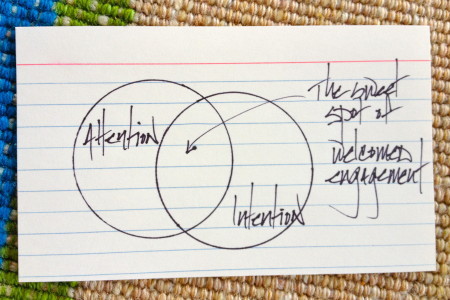
Click on the image to read The Real Rules of Engagement (Redux).
First, I’d speak to a handful of people on whatever team I was on.
Then, I’d speak to groups of up to a dozen or so in pre-shift meetings— early, daily practice for sure.
Then, I’d speak for my departmental meetings, and then, for my divisional meetings.
I would often speak at the weekly staff meetings held for all managers.
Then, I’d speak in our all-staff general meetings— in the hotel business, that usually meant for 500 people and more.
Training sessions kicked in all along the way. Not training I got on speaking; I’ve never had any of that. I mean training that I had to attend (where I could listen to how, and see how others did it) and training I had to give my employees on workplace skills, education and knowledge.
Sense of Place enlarges the conversation
Interspersed with my ‘management gig trajectory’ I’d speak to community groups, wherever our workplace ‘Ohana volunteered, and participated in civic engagement. I was called upon for those community leader presentations which often happen at local schools and rotary clubs.
When you’re a manager, learning to speak is about being willing to be the person who does it. Every ‘presentation’ starts simply, as a conversation which must happen.
Mālama your message.
Turning a must-have conversation into a presentation is the mālama of your intended message —it’s giving care to how you will say something, so your message is well received by those you wish to hear it, respond to it, and participate to it. You have to think beyond the conversation, to what you’re hoping will happen afterwards.
To grow as an Alaka‘i Manager, be the person who chooses to speak up. Speak to something, and speak for your peers and your people.
Intention is clarity, value alignment brings goodness
Speaking as I do now, for the presentations of Managing with Aloha, has been the easiest speaking I’ve ever done.
‘Tis true that I had years of workplace practice to prepare me —I made the choice to speak up, that I’m asking you to make— however that’s just part of it.
In all the speaking I did before my book was written, I flew another’s flag: I’d speak to the mission and vision of my employer at the time, and of their values; I spoke of their intention. Representing senior managers is what junior managers and supervisors must learn to do.
Now I speak to my own intention. It’s business, it’s professional, however it’s very personal, for Managing with Aloha is my all-in philosophy; Managing with Aloha is my heart and soul’s intention for morally good, Pono management practice, self first, others second.
You can get there too.
You need not write a book about it, then create a business built on it like I did. You simply need to have the clarity about what you wish to stand for.
That clarity, comes from the good intention of your calling: A Manager’s Calling, the 10 Beliefs of Great Managers.
Second, that clarity will come from your values: Ethos—Be True To Your Values.

The climate of a healthy workplace culture, is about shared values, i.e. that intersection where a person’s personal values will intersect with the organizational values of our workplace.
The ‘IMI OLA value alignment we’ve been working on in November and December can prove to be extraordinarily useful in this regard, just choose it. Choose to participate in it, and then choose to speak to it as a means of sharing your values with those you work with.
Again:
When you’re a manager, learning to speak is about being willing to be the person who does it. A ‘presentation’ is simply a conversation which must happen.
Learning to speak, and speak up, is very much a part of sharing your Aloha. Start there.
Are you a new reader? Revisit our ‘IMI OLA value alignment and #AlohaIntentions here: ‘IMI OLA Freedom: A Self-Coaching Exercise. I would also suggest the reading pathways linked up in this article: Huddles, Values and the Work Ethic we Value.

Subscribe for our weekly newsletter:
Talking Story with the Ho‘ohana Community.
And if you’re wondering about this… What if I’m not a manager?


November 27, 2016
Sunday Mālama: Living Mahalo with my Dailies
There is an annual ritual I observe each November 28th, the birthday of someone now in heaven who was exceptionally special to me. In his honor, I call it Stephen’s Day.
After Stephen died, I felt I needed to commemorate his birthday somehow, so I would always remember his approach to the ‘Imi ola life. I knew that keeping his spirit alive would make me better; it would keep me working on some of the things he had taught me to be grateful for during the time he blessed my days. Having his birthday fall at the end of November, a month I have traditionally associated with the diligent, focused practice of MAHALO (appreciation, gratitude, and thankfulness) seemed to be an added affirmation of my decision.
Years of faithfully celebrating Stephen’s Day have passed, and my practiced affirmation has become quite the gift in my life, for indeed, living within Mahalo is living within thankfulness for each element which makes your life precious to you.
Kēia Manawa, ‘in this present time’
Stephen was someone who could focus on the present moment clearly and with perceptive intensity, able to see the every little thing existing in the here and now. In Hawai‘i we call this kēia manawa, living in moments which seize the day with both hands, and with heart, mind, gut and soul. Kēia lā is encouragement— today you own the day.
Stephen never looked behind him, he could easily let things go and leave the past behind. What was over was done and “pau” —finished, meaning complete enough to move on. I’m certain he would have chosen the value pairing of Ka lā hiki ola, the dawning of a new day, and ‘Imi ola, create your best possible life, as his mantra.
Yet Stephen was never in a rush to have tomorrow come, confident in his knowledge that a single day is never long enough for us mere humans to fully milk it of all its possibility. Stall not however; have no hesitation or doubt that we are here on this earth to try. And try he did; Stephen lived his too-short life in an energetic and joyous way that made everyone else feel lucky to be on earth with him.
That said, Stephen was not obsessive about whatever he chose to do; in fact, he had relaxing down to an art form. His was a life of contentment. When you live in MAHALO as Stephen did, you die with no regrets because you never feel you have missed anything. You have lived in thankfulness for each element that made your life so rich in the moment of experiencing it precisely when offered to you.
Type A Dailies
Stephen was my hero and mentor in kēia manawa living, yet the difference between us was clear: I was type A to his type B. (See Type A and Type B personality theory on Wikipedia).
Thus, this has become my annual November 28th ritual, a writing exercise explored after devoting the early morning hours to a beach walk for sunrise —the beach, or better yet, out on the water, was Stephen’s favorite place to be:

Each November 28th I rewrite a list called My Dailies. I start from scratch and letting my spirit’s intention do any remembering of carry-over necessities — it’s curation by memory, intention by longing. Analog goodness is part of it, as my Dailies will fill a simple handwritten list on a single page in my journal, where I’ll be sure to reread them until memory and habit-building kick in.
My intention: My Dailies is a listing of everything I would want to do each and every day as part of kēia manawa living, if I could possibly fit them all in.
This is not an exhaustive list of everything I actually complete each day, and I do not duplicate the business-of-life stuff on my calendar or within my family time unless I am creating some new habit. My Dailies are for those empty pockets of time to be found in each day as possible opportunities. Whenever those “what shall I do next?” or “how can I fill this found time?” questions pop into mind, for they invariably will, I look at my Dailies and can simply choose something.
My Dailies is not a To Do list, but a To Be Better list. It’s a list that can direct my attention on a daily basis to better train it, getting right-now attention to match up with desired Ho‘ohana intention, and with positive Hō‘imi actions.
Manifest your possibilities
From year to year my Dailies will change, as surely as life twists and turns.
Sometimes they are short, deliberately disciplined, and intensely focused. In other Novembers they ramble long and wander, making room for questions in the margins. Some years I wallow in detail with next-stepping in mind, and get crazily ambitious.
There seems to be some cosmic element at play, for when my beach walk is over, I already know the kind of year it will be for me, as soon to be framed in the writing itself. I do stick to my one-page-only rule, but frankly, I have never had a day where I did everything on the page, and I doubt I ever will. If you add up all the minutes, it probably isn’t even possible.
Here’s the rub: Without my Dailies, I probably wouldn’t accomplish half the things I do each day. I certainly would not manifest as many possibilities as I do, and I would miss opportunities I now see more clearly because they seem to somehow conspire with the universe swirling around me. Possibilities present themselves to me, seeping into my attentions and intention. It’s a great feeling of purely being more aware.
There is also no doubt that my Dailies have made my nights better. I’m a true morning person, rising earlier than the rest of the family and then steadily losing steam as the day wears on. If not for the choices of much better goodness captured in my listing, I’m far too likely to switch on the TV and succumb to a debilitating case of couch potato inertia. Thus, the quickies on my Dailies are usually shorts like, “Read more of___,” “Cook more of___,” “Craft more of___,” and similar hobby-ish pursuits.
Another fringe benefit has been that having my Dailies written in late November has completely replaced any desire to jump on the New Years resolution bandwagon: By January 1st I am well on my way within the new habits I have chosen to award my attentions to.
Living Mahalo day by day
I adamantly resist any urge I might have to get a jump on this, with November 28th held sacred for writing my Stephen’s Day Dailies for the year to come. So to give you a few examples, here are a dozen entries I’ve made in years’ past. You are sure to recognize a few of our Managing with Aloha influences, and will catch my value alignment intersections.
1 — Stretch and Exercise: Without good health the rest of this list doesn’t matter, and I know that my health affects my head space (the quality of my thinking). Developing some new fitness habit can be a significant learning for me; I’m not someone with a long-standing workout routine which doesn’t change, for that would quickly bore me. As simple as it sounds, the year I wrote in “Stretch and Exercise” was fabulous: I’d stand in place and stretch whenever I looked in my journal, a minute or so being all it took. Merely stretching is highly underrated!
2 — Daily 5 Minutes: D5Ming is already cemented into my life as a daily practice, however I’ll often include it in my Stephen’s Day Dailies with specificity for some particular intention with one of my family relationships, friendships, or work partnerships. I can clearly remember how 2009 was about triggering my thinking related to virtual opportunities as opposed to face-to-face ones during the Great Recession.
3 — Ho‘ohana Projects: Am I attending to my longer-term projects or not? You have to choose the right work/right project to begin with, and that is where the value of Ho‘ohana comes into play so beautifully. To ho‘ohana is to have resolve and determination, and to seek mastery with personal efforts of your own deliberate, thoughtful choice. Mastery is in the repetition of detail, and in writing my Dailies one of those previously neglected or forgotten details often occurs to me, seemingly saying, “Hey, pay attention to me now, okay?”
4 —Alaka‘i Betterment: Working some part of our Alaka‘i 24 has been an energy burst I constantly seek to continue sparking — I believe in working at being a better, and more interesting human! In past years, I would refer to our Alaka‘i 24 as the 12 Rules of Management and 12 Rules of Leadership: Better Person, Better Manager, Better Leader. Alaka‘i Batch 24.
5 — Connect to Sense of Place: Get outdoors and feel where you are. Appreciate it. This is about wherever I might be, and not just when home on Hawai‘i island. Having this on my list ensures I do not miss things like this sunset seen on the Hualalai coastline:

6 — Write to Goal/Write to Learn: Writing does so much for my overall sense of well-being. There is simply no denying it, and I would not want to! I have my morning pages, my blogging, my gratitude journal and commonplace book, our newsletter, my coaching and curriculum product design, my correspondence and preferred in-writing ways to reach out to others. There is so much that writing enables and influences for me, and pockets of time that my Dailies will fill are quicker hits.
7 — Slow down, Stop and Savor: This has been on my list for a few years, worded in different ways. In 2007 I wrote, “Believe in your biology and cherish your brain” and my study of Daniel H. Pink’s A Whole New Mind was an added influence in 2008, particularly with the elements of play, story, and design he speaks of. Having this on my Dailies often coaches me to slow down at some point because otherwise, I tend to work like a bull in a china shop. I need to stop whatever I am doing more frequently and mind-sweep, seeking to respect every thought, and write everything down. Get quiet, be still, capture and savor. Deliberate and decide using the current filters I might be favoring (like Pink’s and others).
8 — Listen as the way I Read: This has been my self-coaching to listen to a few book chapters or podcasts. By nature I am highly visual and kinesthetic, and so I’ve had a longstanding goal to learn of any auditory capacity I am not using.
9 — ‘Ōpala ‘ole: This means, take out the trash; rubbish be gone! The minimalism movement has been a welcome influence on me, and I have found that cleaning something or decluttering my physical surroundings is wonderfully liberating. Little by little works, being less chore and more break time filler, so this has been a great way to fill a 10 or 20-minute’s opportunity. Material freedom, and discovering how little I can make do with has been one of my fascinations for a while now, and the more virtual my business becomes, the more I find I am enjoying (and needing) the physical exertion of my ‘Ōpala ‘ole movements.
10 — Type A Ma‘alahi: The persuasion toward calm contentment (which we just talked about this past week). This prompting amounts to more in-the-moment reflection time, as inspired by kēia manawa. What complexity did the day reveal that I can streamline and make more simple? I truly want to stop any fluffery and continually add to my Stop Doing List, shedding the less important for the more meaningful. What “should-ing” or busywork did the day reveal, keeping me from true accomplishment? Why did I do it, and how can I stop it, particularly when it was draining my energies instead of boosting them? How can Less be More?
11 — Attention to Strong Living: Reflect at day’s end for more accurate Strength Statements: What made me feel strong? This one is the counterpart to Ma‘alahi addressing my weaknesses in my Hawaiian way (MWA Key 7), with a more studied practice of what Marcus Buckingham teaches within his strengths revolution about capitalizing on our strengths. One of his books, Find your Strongest Life, was written for women, and I had wanted to internalize it as soon as I had read it: Me first, then perhaps it will filter into my coaching. Counterintuitively, Buckingham advocates a deliberate imbalance in the tactics we employ when living a strong life, since “Attention amplifies everything.” I certainly agree with him there!
12 — Nānā i ke kumu: Look to your source. Reflect at day’s end for Spirit. This one will normally relate to my own #VYMTVYL and #AlohaIntentions value alignment practices. Did I live my signature story of my Aloha? Each and every year the writing of my Dailies reveals a Hawaiian value to me I know I need to recommit to, and as I write this, I suspect that Ho‘ohanohano will be of the utmost importance to me in 2017, possibly in a value pairing with Ka lā hiki ola or ‘Imi ola.
Curating one’s life in meaningful ways
Stephen died in 1977, and my first Dailies were written that same year. Since then, they’ve provided me with a kind of annual chronicle of what was important to me each year. For instance, the years my children were born are all about my learning to be a mother, first for one child, and then for two. The year came that I taught them both to do their own dailies; this was such a great way to stop them from saying, “Mom, I’m bored!” on those long summer days! As they did with Stephen’s death, my Dailies have pulled me out of several rough patches when I lost other people who had been so important in my life, like my dad.
What do you think about this exercise? Are you game for adding Stephen’s Day to your calendar sometime too?
Try it during one of your weekends: Your Dailies are essentially desirable fillers for pockets of time you begin to see as opportunities, and there is no right or wrong to what you come up with, those fillers of wants, mini goals, or self indulgences are completely up to you.
My Stephen’s Day practice of penning Dailies has been MAHALO in sweet action: Live within thankfulness for each element which makes your life precious to you, by committing your attentions to doing more of it. Focus your attentions on your energy boosters, and away from your energy drainers.
If you’ve read this far, I’ll bet you already know what can be on your Dailies for the coming year. Kēia manawa; live in that presence of mind.
Listen to your muse, whether you think of it as Nānā i ke kumu or something else, for your inner voices have your well-being in mind, as does your Aloha spirit.

Subscribe for our weekly newsletter:
Talking Story with the Ho‘ohana Community.
Our value immersion study for the months of November and December:
‘IMI OLA: We are meant to be Seekers.
Postscript

Click on the image for the Sunday Mālama index of articles.
Sunday Mālama has been when I will share my off-the-workplace-highway scenic route kind of posts. Not as a normal weekly feature, but whenever they seem to be writing themselves.
You can access the Sunday Mālama archives via this category link, also residing on the right-hand sidebar.


November 24, 2016
Give thanks. Live Mahalo
For this day, and a refreshed perspective for the waning weeks of 2016, a gift:
What follows is Chapter 16 of Managing with Aloha’s Second Edition just released this past July, on Mahalo, the Hawaiian value of gratitude, appreciation, and thankfulness. It includes the Appreciation Story of the Alaka‘i Nalu, the Take Stock Exercise, and how to find your hidden gifts with Jake’s Mahalo Log.
Enjoy your reading, and many blessings to you and your ‘Ohana on this Thanksgiving Day.
With much Aloha,
Rosa

Coconut Bounty by Rosa Say
Chapter 16
Mahalo
Thank you, as a way of living
Live in thankfulness for the richness
that makes life so precious
Mahalo. Thank you, as a way of living.
With Mahalo, we give thanks for every element which enriches our lives by living in thankfulness for them. We relish them. We celebrate them joyously. Mahalo is the value that gives us an attitude of gratitude, and the pleasure of awe and wonder.
Say “thank you” often. Speak of your appreciation and it will soften the tone of your voice, giving it richness, humility and fullness. People need to hear it from you: Mahalo nui loa.
What makes you rich?
Ironically, when you live on an island in the middle of the Pacific Ocean, more than two thousand miles from the nearest continent, water is rare. You treasure all sources of fresh water and learn to conserve it. So it’s no surprise that the Hawaiian word for richness or wealth literally translates to “double water.” The word is waiwai, for wai is the word for fresh, drinkable water (kai is sea water).
Ho‘owaiwai is to enrich, to bring about prosperity and abundance. I share this context with you, for it says much about the basic simplicity and purity of life’s richness the value of Mahalo teaches us to treasure.
Like Aloha, Mahalo is a word of common use in the Hawai‘i of today where relatively few Hawaiian words are actually spoken. I lived more than 40 years of my own life in the islands before I came to realize that Mahalo was actually a value, one that meant much more than just the polite statement of “Thank you.”
When lived to its fuller potential, Mahalo is a value that creates habits of thankful living in us. Appreciation and gratefulness stroke deeper color and richer texture into our character. We give thanks by the acts of living thankfully, not simply by saying the words “thank you.” When we look around us, we are filled with wonder, and we sense the immense richness which already surrounds us.
We do not lament that which we may not have, for we are preoccupied with taking notice of what we do have. As we count our many blessings, we Mālama them and cherish them, we relish the bounty they bring to life, to our life. We celebrate them joyously.
Creating the habit of appreciation
As managers we make a frequent lament about our employees, “Why can’t they be more appreciative?” Or perhaps we’ve said, “Can’t they understand just how good they have it?” Sound vaguely familiar?
Well consider this: As a manager, appreciation is one of the most generous lessons we can teach and coach. It’s also a fairly easy one to incorporate.

The Alaka‘i Nalu, 2002
I’ve shared several stories of the Alaka‘i Nalu with you, the “leaders of the waves” at the Hualālai Resort. If I had to pick a favorite one, it would be the story of their “Mahalos” for I am certain that Mahalo gave them a gift of healing.
There was some pilikia, trouble, among the ranks at the time this group of athletes became my gift, and it was clear we had to ho‘oponopono, clear the air and make several things right. A Mālama Time would have been too much too soon, so to begin in a small yet consistently occurring way, we started a practice of “sharing our Mahalos” at the end of each operational weekly meeting. For several months, the only real homework they had for the week was to catch someone else on the team doing a favor for them. They were to say thank you then and there, and they were also to share their Mahalo story at the next weekly meeting in front of the entire group, adding a few words on why the favor given meant something to them.
One of the first things I discovered was that they didn’t know how to graciously accept it when someone said thank you. It was hard for them to just say “you’re welcome” and leave it at that—far easier to crack a joke or even look at someone else and say, “Yeah brah, you should do some of that too sometimes.”
They used sarcasm and humor to build up this defensive wall around them. In those early weeks, I had to ask them to just listen quietly and not respond at all other than nodding in acknowledgement that they’d heard all the words spoken.
More ground rules were spontaneously added as we went, such as picking a different person each week to break down the buddy-to-buddy game playing. With each wisecrack I’d have to say, “Either you start being sincere, or I add another rule you gotta remember.”
I also learned to model the behavior that I wanted, ending the meeting with my own Mahalo for each of them. “Mahea, thank you for taking the initiative to start early today without being asked to. Hui Wa‘a (the program name given to our Friday community paddle) was easier for all of us because you took the time to reassign last night’s late sign-ups. Daniel, thank you for taking care of those kids who got so badly sunburned at King’s Pond on Tuesday. I got a call from their parents about how thoughtful and patient you were, and your actions add to the reputation of the entire team.” It continued for each one in turn.
If their names were not spoken by one of their peers, the silent message hung uncomfortably in the room that they had not earned the recognition that week. To make something up was the gravest sin: This was a rule that was never spoken yet completely understood by all.
They caught on, and I’d have to say less and less about the ground rules as time went by. In fact, this became the best part of the meeting by far.
One week we went overtime on other business, and I nearly got a revolt when I tried to adjourn without giving them the time to speak they expected: Sharing their Mahalos became genuine, generous, candid, and thought-provoking for us all. Thereafter, I was sure I did not commit the cardinal sin of encroaching on their time to acknowledge each other.
They loved it when someone new joined the group or I’d invited a guest—they wanted to show off! They didn’t want to show off that they said, “thank you,” they sincerely wanted more people to hear how terrific their peers were, and how proud they were to be associated with them. It amazed me how articulate and giving they were when a newcomer was in the room.
They also started to show me how perceptive they were—they caught everything. In talking about what they noticed, they taught me to be a better manager and notice more too. They learned about each other because they began to understand what someone else appreciated—it differed greatly for each of them individually. They unknowingly shared intuitive revelations with me that made my own job of managing them far easier—they uncovered all the cause-and-effect relationships of the team for me in a short amount of time.
Over their time, the depth of the actions taken by this team was incredible—it became embarrassing to have someone say thank you for something minor or trivial, and hence the assumptions of basic good productivity in the team grew. They tried so much harder, and they were more aware of how their spoken words of thankfulness affected their peers. I was really proud of them.
There is a word for “thank you” in every culture around the globe. Adopting a practice similar to this one that worked so well for the Alaka‘i Nalu can serve any business well, for there are rewards inherent in it for both the person giving thanks and the one being acknowledged for their good deeds.
Give thanks by living thankfully
As a value in the Hawaiian culture, Mahalo digs deeper. It is living within an attitude of gratitude, living each day with a sense of thankfulness for all the elements which make life so precious. It is the fundamental realization of how much you have, simply because you are alive. You begin to relish your present. Both nostalgia for the past and anxiousness for the future lose their grip on your longing. Mahalo is living in a way that demonstrates you are humbled by this gift of the present, and are thankful for it, living your life in a way that celebrates it.
When you live Mahalo you don’t take anything for granted, and you Mālama what you have, taking better care of it.
Mahalo is the life perspective of giving thanks for what you have by using your gifts—and using all your gifts—in the best possible way. You draw from Ho‘ohana, and your inner passions, and live with intention. You begin to realize that it would be wasteful to not use whatever talent you were fortunate enough to be born with; it would be ungrateful and unappreciative. You begin to question what good is destined to emerge from the talent you have, and you explore all possibilities.
Mahalo goes beyond thinking or saying “thank you” for something you’ve been given; it is when you give thanks with more giving. You live in a manner that makes you deserving.
Nurses live in thankfulness for their empathy, when they treat patients in ways that are in tune with the nuances of pain, and with heightened perception for the type of care that is needed.
Professional athletes live in thankfulness for their physical strength, good health, endurance, and stamina when they compete in sports that entertain and inspire millions of spectators.
Environmentalists and scientists live in thankfulness for the wonder of creation and beauty of the planet we are so fortunate to call our home, and for their own sensitivity and awareness of the secrets she can reveal to them.
Managers? We live in thankfulness for the privilege and ability we have to affect the optimally rewarding productivity of other human beings.
Like every other living and breathing person on the planet, there is so much that I want:
I want to be more creative and artistic.
I want to know more about the stock market and electronic communications.
I want to remodel my kitchen and add a walk-in closet to my bedroom.
I want my children to find soulmates, and be happy forever.
I want an enlightened government, world peace, and harmony.
My list goes on and on. I admit that reflecting instead on what I already have and should be more thankful for, serves to make me a more reasonable person at times.
Does it quell my desire for more? No, for I’m far too human to stop wishing.
However, it helps me take stock of the building blocks already in place for me to buttress my dream-building on, and I celebrate those things and enjoy them. It helps me shift my focus from the unachievable to the possible, and I get to work at making it happen for me instead of just wishing it were so. I more readily see exactly where to start.
The good fortune of all managers
Every manager needs better tools of the trade. Every manager yearns for easier and simpler processes, for more generous financial budgets, for more employees, more hours in the day, more customers, more sales opportunities … another endless list.
Instead, take stock of what you already have, reflect on what these present assets have already done for you, and what they potentially can still do for you: You will then be living the value of Mahalo. Most probably you will also be learning to keep things simple and uncomplicated along the way.
One of the most obvious assets all managers have is this: They have employees—think ‘Ohana. If you are a manager who lives within the value of Mahalo, being thankful for what you already have, you are one who constantly takes inventory of the strengths of your ‘Ohana and you apply them to the job at hand—Lōkahi.
The most effective managers are the ones who do not foolishly go it alone: They get everyone involved in ways that are stimulating, challenging, and inclusive—Kākou. They trust their people because they know them well—‘Ike loa, and they dole out generous portions of meaningful assignments—Ho‘ohana, and the authority to effectively get them done—Kuleana.
They give advice vs. approval, forgiveness vs. permission. They have faith in the goodness of people—Aloha, and they find that results are achieved faster, in more nimble ways throughout their operations.

Seedling Starters by Rosa Say
Take stock of what you have
So let’s do it. Right now. Stop reading, and put this book aside to do a simple exercise. Grab a clean sheet of paper and make a list of those things you have in your job right now—not the things you still want, just those things, situations, or people you already have at hand and on your mind.
Thinking back to my last assignment managing the Alaka‘i Nalu, I’ll give you some of my own examples just to get your wheels turning:
A full crew for the next 42 days. No one is scheduled for vacation for another six weeks.
In addition, I have a new hire in training. He still has another 60 days in his introductory period.
One of my employees is in training for the Moloka‘i to O‘ahu canoe race, working out with her paddling club on a very focused competitive practice schedule each day after work.
The summer season: Weather-wise it’s the best time of the year to take our canoes on the water, and all are in repair and ready to go.
Advance reservations are light, and yet prospects are high that we’ll have potential customers on the resort to sell to.
Higher residential occupancy in these summer months means many of our residents will want their canoes delivered from our storage facility to their own homes for better daily accessibility.
You can be more basic if you want: Do you have your own office? Write that down. Do you have some budget money to spend before the quarter or fiscal year is over? Write that down. Is there an employee who seems to be in transition and needs more responsibility? Write that down. Is there another one on a high right now because you just gave a glowing annual review? Write that down. Is your own boss too busy and preoccupied right now to micromanage you? Write that down in a way that is positive, optimistic, and not cynical. You get the idea.
When your list is done, the next step will be this: Go back to your list and write a sentence behind each item that describes how you will use what you have in a way that celebrates your thankfulness for having it. Let’s go back to my example list for a moment to demonstrate:
A full crew for the next 42 days: No one is scheduled for vacation for another six weeks. Time for those back-burner projects, for example Sam can catch up on the wave-runner preventive maintenance that should be done.
In addition I have a new hire in training: He still has another 60 days in his introductory period. He’s an extra body and already doing very well. This gives me the ability to have Sam train someone else to back him up on equipment maintenance when I need him for the Red Cross certification program.
One of my employees is in training for the Moloka‘i to O‘ahu race, working out with her paddling club on a very focused competitive practice schedule each day after work. My own weekly meetings with the group could use a change-up. I’ll ask Mahea to do presentations in the next two meetings on what she is learning from their paddling coach (week 1) and on the strategy of the Molokai race in particular (week 2). This third-person teaching will help her own focus, be less physically demanding in light of her schedule, involve and excite her peers and free up some planning time for me.
The summer season: Weather-wise it’s the best time of the year to take our canoes on the water, and all are in repair and ready to go. I have a pretty aggressive forecast to meet this month—the weather is with me, and the crew is healthy and eager to capitalize on it. Ask them to help me figure out how to add some program times to the schedule. We can go for volume vs. variety since these canoe rides are the most highly requested programs we have now. They’re the experts and know better than I do how to make this happen. Assign coordinating this to Ikaika and Janelle, it’s what they do best.
Advance reservations are light, and yet prospects are high that we’ll have potential customers on the resort to sell to. Since business levels are not as high as I’d like them to be, I’ll start a promotional rotation where we double the crew at the afternoon ray feeding and can verbally sell our programs. Our prospects will be the lookie-loos who are there at the time. We can also concentrate on involving more parents in our daily keiki (children’s) program. Assign coordinating this one to Ed and Daniel, they’re really great at these types of things.
Higher residential occupancy in these summer months means many of our residents will want their canoes delivered from our storage facility to their own homes for better daily accessibility. The vacancies in the facility mean less expensive equipment is there to be moved. This is the easiest and best time to give it a spring cleaning top to bottom. However, the crew is best assigned to focus on the business at hand—contract the cleaning job out, and let higher business levels serve to cover the expense. Assign this to Puaita—he’ll know who to choose for the job, and when to engage with them as needed, so the job’s explained and done right.
Your turn.
Celebrate what you have by adding similar action-stimulating sentences to your own list. This is Mahalo at work for you. Grab a bookmark and finish this chapter when you are done with the list and you have made a few of your own assignments as an effective manager thankful for what you have, and for the employees you manage.
Take another look at my examples and see how much I delegated and how much will be accomplished when everything has been done. The gains in this approach for you as a manager are very clear.
What are you waiting for?

Fruitful Mahalo by Rosa Say
The Mālama connection to Mahalo
Mālama and Mahalo connect in a very meaningful way. Sometimes you need Mahalo to open your eyes to your good fortune before you can live thankfully for it, and then take care of it as you should.
One afternoon, a manager came to see me about one of his employees.Intending to just give me a heads up, he said he was about to embark down the road of progressive discipline with a stage one verbal warning. He felt the employee’s work performance was average to marginal, and in the two weeks prior, there had been the warning signs of attendance problems. He concluded by raising a huge red flag for me, saying, “If I just let things go and document it all, he’ll hang himself.”
Listening to his tone, I suspected the problem was the manager, not the employee.
In this particular case, the manager was relatively new to the department, and I knew the person he spoke of to be a longer-term employee who had done very well for us up to that point. This situation didn’t make much sense to me. Since he was so willing to invest in documenting something, I asked the manager to conduct a small experiment for me instead, and asked him, “Have you ever kept a Mahalo Log?”
I had the manager—let’s call him Jake—keep a log for me for a week, where each day he wrote down just one thing he noticed about this employee—let’s call him Bruce—that was good. It could be something small, it just needed to be good. I told him I expected at least one of those entries to be about a Daily Five Minutes he’d given to Bruce.
Bruce surprised Jake on the very next day. This was his log:
Day 1. Not only did Bruce come to work on time today, he was early. And he didn’t just stand around, he started early and on his own time.
Day 2. Bruce got a compliment from one of our guests today. They got lost, and he dropped what he was doing to escort them back to their room.
Day 3. In my Daily Five Minutes, I thanked Bruce for what he did yesterday, and he said he was surprised I actually had noticed it. Ouch.
Day 4. A new employee started today, and Bruce was the one who volunteered to work with him.
Day 5. Bruce skipped his lunch break today. He was getting behind training the new kid, and he didn’t want to leave his work for the next shift. The new kid is learning a lot from him.
We had set a follow-up appointment for the end of the week, and Jake showed me his Mahalo Log.
Without commenting on it, I asked what else they’d talked about in their Daily Five Minutes. He said Bruce told him he quit his other job—a second job Jake hadn’t even known he had—because it made him too tired for the job he had with us; that’s why he’d overslept so much and come to work late a few times. He said the money helped though, so would Jake call on him when someone had to work overtime?
Jake found out that Bruce was in his department’s circle of richness, for Bruce brought character and commitment to their department. The Mahalo Log became a new habit for Jake each time he suspected he judged someone too quickly. Right after that Daily Five Minutes with Bruce, he started saying thank you to people a little more often.
Give thanks. Live Mahalo
Continue to count your own blessings, and enjoy your own discoveries. Thankfulness is truly a mighty force, and sometimes, like Jake, we may find that it changes us, and it helps us become better.
When you teach the value of Mahalo to your employees, you help them enjoy the life they have. What a wonderful gift that is!

Archive Aloha:
Learn more about the Daily 5 Minutes.
Bookmark the Mahalo Index page of related articles.
Read the preview detailing how Managing with Aloha was updated in the Second Edition.
Subscribe for our weekly newsletter:
Talking Story with the Ho‘ohana Community.
Our value immersion study for the months of November and December:
‘IMI OLA: We are meant to be Seekers.


November 21, 2016
‘Imi ola Makes It Yours
I’ve been hearing several laments about 2016, about goals which remain unattainable, expectations gone awry, and sadness for people we have lost this year.
Yesterday, I ran across this artful coaching tacked onto one of my Pinterest boards, and thought it was worth sharing, especially in light of our current value study of ‘IMI OLA: This year remains in your hands, and it is far from over.
 Source: Luna Belle
From Managing with Aloha, Second Edition: ‘Imi ola Preamble
You have choices, and you are able to make the best choice,
designing the form your life will take.
‘Imi ola places the ability to achieve your purpose in your own hands,
giving you the clear understanding that you have the power to create your own destiny.
The value of ‘Imi ola seeks life at its very best.
Ma‘alahi Contentment
I love that this artful poster coaches us to “strive for contentment.” Good advice.
“You may feel there is much to be done, however, a feeling of contentment is possible when you feel the path ahead is one that is right for you, one where you will enjoy the journey… you know you are where you need to be. Contentment dishes up feelings of being at peace, of being calm, stress-free, and tranquil. It’s a feeling we call ma‘alahi in Hawai‘i.”
—page 235 in Managing with Aloha, Second Edition, within Chapter 18 on PONO.
Give yourself a break this Thanksgiving week. It’s okay to be happy with a calm life. Really.
Subscribe for our weekly newsletter:
Talking Story with the Ho‘ohana Community.
Our value immersion study for the months of November and December:
‘IMI OLA: We are meant to be Seekers.


November 14, 2016
Day 6: Silence is Deafening
This past week has been a reminder of two things I’ve learned about leadership over the years: One we see (and watch for), and the other we hear (much to our surprise, hearing it loud and clear.)
One;
Leadership is highly visible.
Two;
Silence from our Leaders is deafening.
Meanwhile, heads lean together and whisper or grumble, and everyone else has their own quiet conversations about what they see and hear. Assumptions run rampant, and usually, apprehension and fear will too.

Watercolor by Victoria Semykina, via Instagram
When “stuff happens” and you, as an Alaka‘i Manager feel you need to speak up, and be a voice of reason, a voice of calm, and sometimes, a voice of questioning dissent, please do. That voice inside your head (or bubbling in your gut) is more than likely the voice of your Aloha Spirit, wanting clarity.
If you need that clarity, chances are that others around you need it as well. Articulating clarity, is a key responsibility of managers and leaders. As we have said before, great managers aren’t answer-givers as much as they’re answer-finders.
Ready yourself to Speak with Aloha: Better Managers are Better People.
Indeed, do take the time to think about it first, and pause to choose your words carefully, but not for too long.
Always remember this: Silence, and especially uncomfortable silence, begs to be filled. It can be amazing, how much that silence can carry within it as strain and millstone, a burden which seems invisible, but is heavily laden with grit and grime. You know what I mean. Silence becomes volatile and alarming.
You may trip up when you speak. You might stammer, stutter, stumble and have to self-correct a time or two; so be it, for all humans do. The important thing to remember, is if not you, then who?
Lead with Aloha in those voids that managers will find they are in: Those voids are the job you signed up for.
Alaka‘i Managers are those who are willing to themselves embody a kind of ‘sense of place’ where uncomfortable conversations can be safely held. Their people will expect those managers will lead them to the best possible outcome once the hard things which must be said, are said, are heard, are acknowledged and dealt with, and handled with Aloha.
Yes. At times like these, management is hard and it can be messy. However if you are the person who aspires to be an Alaka‘i Manager, one who conducts themselves with the distinctions of Ho‘ohanohano, Mālama and Aloha, people will be so happy you’re on their team to speak with, and for them, and listen to them as they speak.
Here is a reminder of what we previously outlined as MWA Conversation 101. You can revisit the detail for each point here: Conversational Catch-up ~ with Aloha.
1 — Converse daily. Come up for conversational air.
2 — If you can talk about it instead of writing about it, do.
3 — Did you listen? What did you hear?
4 — Seek an agreement in each and every conversation you have.
5 — Enjoy it. Relish conversations and never dread them.
This really is not difficult. Like so much in management however, you get better at it with practice and consistency. Speaking with Aloha is less about technique, more about feeling.
As Maya Angelou famously wrote, “I’ve learned that people will forget what you said, people will forget what you did, but people will never forget how you made them feel.”
Get out there, and manage with your Aloha: I believe in you.
Postscript:
I must work my way through my messiness too. I have revised and cleaned up the essay I previously posted here called Our Values and the American Experiment: It is now on Medium if you would like to read it.
Related Reading in the Archives:
Hana ‘eleau: Working in the Dark
Kākou Communications and Our Tribe
1-Catch the Good, 2-Tell Them!
Be the Best Boss
The Acid Test of a Healthy Workplace Culture
Subscribe for our weekly newsletter:
Talking Story with the Ho‘ohana Community.
Our value immersion study for the months of November and December:
‘IMI OLA: We are meant to be Seekers.