Rosa Say's Blog: Managing with Aloha, page 8
February 17, 2017
Giving Meetings: From “Have to” to “Get to”
Meetings. We love ’em and we hate ’em.
Me too. I love ’em when I can give them. I usually hate ’em when I have to attend them.
Upon hearing that I love running meetings, managers will usually tell me something like, “That’s because you’re a teacher and coach Rosa. Having to hold meetings all the time gets to be such a burden. I just don’t know what to talk about.”
Well, let’s talk story about that.
In case you missed it, this posting is a follow-up to this one:
Managing with Aloha through the Lessons-Learned from Current Events, also the subject of my recent Ho‘ohana Community newsletter: Talking Story Skill-building with Current Events. Snippet:
People will often lament that meetings are boring, useless, time-sucking sacred cows, yet let’s get real about this: If true, the meeting itself isn’t the problem, because meetings don’t give themselves. The problem is us, as the meeting givers and takers we are.
The good news? It’s a very easy problem to solve. We just need to approach it as skill-building, with the added benefit of culture-shaping communication improvement. Set the goal:
“I will be a better meeting planner and giver, and
I will be a great meeting participant and follow-up champion.”
“Have to” versus “Get to”
There is an attitude change required of managers charged with holding regularly scheduled meetings, which by the way, I would require you to do if I was your boss, as a part of good workplace communications.
You can dread them, or you can decide they will totally work in your favor from now on. Go even farther than that, and decide they’ll be fun for you — make it happen.
Second, start to think of holding meetings as a privilege you get — for that is exactly what it is. You get the privilege of securing others’ time and attention. They honor you, with their willingness to connect with you, and better engage with you.
To get this attitude change, frame meetings in the proper perspective:
A meeting is simply a group affair — define it that way in your planning for it. You save a lot of time by communicating messages to a group rather than to individuals one at a time. Bonus: You can be confident they all heard the same thing, and you can immediately take note of any emotional reactions, those transparent cues on the health of the workplace environment.
Assure that your meetings are conversations — talk story! Too many meetings are broadcasts of the same stuff people should have been held accountable for reading in emails, memos and reports; no wonder they’re boring, and considered a waste of time. In contrast, people within a group should expect, and look forward to, meetings where they can speak up freely, communicate with each other, and get immediate whole-team feedback.
I like thinking about meetings as huddles: Huddles, Values, and the Work Ethic we value
Instead of dropping new bombshells on your group or team, consider meetings to be the best way you can communicate follow-up, something we managers don’t do enough of. You can use your meetings to brainstorm new project initiatives, but be wary of announcing “done deals” that your team is unprepared for. Follow-up is when decisions came about as a result of work progression, as opposed to decisions announced out of the blue.
Connected to the previous point, give yourself a break: Stop assuming you need a new agenda for every meeting you hold, you don’t. When you begin to reframe your meetings as suggested, you’ll lessen that burden you may now feel, because others are jumping in with more input for you, and you become a conversation facilitator. If you have a copy of Managing with Aloha, review the Mahalo story of the Alaka‘i Nalu which starts on page 214 (2nd Edition) under the heading of “Creating the habit of appreciation.”
Create more conversational dynamics. Conversing is an odd duck. We’ve all done it since we learned to talk, yet we never master it. Make it an expectation that everyone speaks up, and allow your meetings to be opportunities when people can practice doing so, and feel good about how safe you make it. Discuss, and yes, debate. Analyze to uncover root causes. Create a forum for communicating workplace experiences. Reward the behaviors you want to see repeated with sincere recognition, giving credit where credit is due. Bonus: Everyone will be practicing better listening as well.
Progress from “what it is” to “what it can be”
For many of you reading this, the meetings you now hold or attend have become sacred cows, routines riddled with auto-pilot, and historical artifacts in your organization. You might feel that the re-framing I suggest is daunting, and that I ask too much. Please challenge those assumptions.

Indexed, by Jessica Hagy
Start by shifting your own behavior.
Give well: Tweak your meetings when you give them. Openly set new expectations, and ask people to please get on board with you. I’ll bet their eagerness to do so will surprise and delight you.
Receive better: Shift your own expectations as a participant when you attend meetings run by others —if you passively sit there, you only have yourself to blame for wasting your time. A good self-coaching technique, is to attend every meeting with a question you would like to ask relating to the agenda in some way. Ask it of everyone there to gain input and feedback on something you’re working on that’s related to it, or initiates a thoughtful option.
You can make changes. Be Alaka‘i and lead by merit of your own good example.

Summary:
1. Turn meetings into interesting, engaging, culture-building group conversations.
2. Shift meeting agendas away from informational broadcasting and the “this will happen” mandate. Talk about what already happened, its impact, and how it points to what comes next. Assure that the progression of workplace productivity is rewarded and celebrated, and everyone collectively acknowledges and enrolls in the lessons-learned you go forward with.
3. Be a facilitator who coaches conversational engagement. Seek the partnership of those in the room, so you never go it alone. Do with, not for.
4. Proactively set better expectations from everyone involved. Meetings can be a fantastic vehicle for managers to secure more involvement, participation, and engagement. DO consider them team building exercises.
Let me know if I can help you,
Rosa
 Subscribe for our weekly newsletter:
Talking Story with the Ho‘ohana Community.
Preview the updates in Managing with Aloha, Second Edition, just released Summer, 2016
Managing with Aloha, Bringing Hawai‘i’s Universal Values to the Art of Business
Our value immersion study for the months of January and February 2017:
HO‘OMAU; Love the one you’re with.


February 14, 2017
Managing with Aloha through the Lessons-Learned from Current Events
The political drama surrounding General Michael Flynn’s resignation as White House national security adviser is having an effect on business and the workplace as well: We’re talking about it.

We seem to have reached a tipping point. It has amused me, how many of my previously silent business associates, those who had emphatically stated, “I will not talk politics” since election season, are suddenly writing coaching articles on Flynn as a case study.
Did General Flynn get “thrown under the bus” to stop other bleeding, as also happens in business more often than we care to admit to? Did he resign, was he asked to resign, or was he essentially fired with the ‘resignation correctness’ HR department lawyers have schooled every leadership exec on? Is there a bigger story here, of power mongering or corruption, communication compromises or whistle-blowing, that is more pervasive than we can risk exposing? Yeah, those things never happen in business… wrong!
These have been their baby steps in ‘talking politics,’ because Flynn is considered a less political protagonist of their coaching articles than our very explosive and controversial 45th president.
Here’s an example of an article making the rounds, written for Forbes by executive coach and educator John Baldoni, who says, “I write about the impact leaders have on those they lead:”
“While we speak a great deal about leader’s responsibility downward – that is, respecting men and women throughout the chain of command. Leadership also extends upward. A direct report who is creating friction cannot serve to his fullest abilities. When this occurs, he must step aside for the good of the leader in charge and the health of the organization as a whole.”
“Flynn stepping aside is not about politics; it’s about honor and integrity, two attributes of leadership that Flynn as an Army officer was bound to abide. Flynn can salvage a degree of respectability and exit now, sparing the nation and the president further embarrassment.”
Definitely baby steps, and diversionary ones at that. My take on what he’s saying? If you get thrown under the bus, it may be your own fault. Buck up and take it like a man.
That’s okay—as a beginning. I say welcome to the conversation. I’ve been waiting for you. Business is riddled with politics, and we all know it.
Welcome to the Talking Story conversation
I’ve long been someone who consistently encouraged my managers to discuss current events in the workplace, rather than stay away from them, to the inclusion of breaking the rule, “Don’t talk politics or religion.” I say go for it.
My primary reason for encouraging managers to ‘talk story’ about a variety of issues, goes directly to the heart of my beliefs about how values are illustrative of our convictions, and will therefore drive our behavior in a predictable manner. Our values are rarely segmented, segregated or separated, i.e. some held at work, others held at home, others in friendship etc. The values we deeply believe in, reside within us and our Aloha Spirit wherever we go, and in whatever we do. They combine and blend, variable to context. One value, will course through another, like blood does in our veins to and through all our organs, and notably, our brains.
Second, no matter the job, no matter the workplace, no matter the industry, no business enterprise exists in a vacuum: Every business has a Sense of Place connected to the community it resides in—even a business worked from home is affected by geographic location, and by the possibility of its global reach in today’s highly connected world.
Therefore, to freely talk about current events, is to freely discuss our values relative to those events, and to have another lens and context for our essential lifelong learning about our values. All the better—all the more important—when the values talked about are those your company and your team is mission-aligned with, i.e. they are values you WANT to talk about, and keep ever in mind at the active surfaces of the work you do.
—That “peaceful transition of power” in the January 20th inauguration? That was a talking story opportunity for the complexities of leadership in Alaka‘i.
—The Women’s March the following day? That was a talking story opportunity for the inclusivity and diversity of Kākou.
—The continued “We will resist” and “We will persist” protests? Those are talking story opportunities for the persistence and tenacity of Ho‘omau, and the engagement and ownership tenets of Kuleana.
All have been excellent opportunities for managers to talk with their own teams about constructively useful communication and involvement in their work culture, as compared to actions taken in the workplace which aren’t as beneficial.
Baby steps are a good thing. Take yours
Baby steps are about getting comfortable, and becoming more sure-footed over time and with practice.
Admittedly, subjects like politics and religion are what a manager can think of as Advanced Talking Story.
Related Reading: Talking Story is Thriving. It’s What We Do.

One of the first times I can recall writing about this for our Ho‘ohana Community was in 2007, when the U.S. Postal Service launched its Forever Stamp. I titled my blog post “Is Forever a Good Business Strategy?” and posed some questions we could talk about that were related to auditing how we make business plan decisions, for no business model will last forever, right?
Our discussion was pure business, with nothing political or religious about it.
Current events like that abound. They are the 90% to the 10% which are more opinion-riddled, argumentative, and potentially explosive.
That post launched an occasional series on what managers can, and probably should be talking about at work, during a time that became quite a crucible for us in business. As you will likely remember, 2008 was the tipping point year of what we would call our “Great Recession.” We dug into subjects like how digital learning replaces classroom training, about how organizational culture shifts with staffing cutbacks, about how time-honored skills were becoming obsolete, and more.
We even talked about how we could help graduates who had no jobs to go to, for we were running the risk of having a “Lost Generation.” Talking story for us back then, was largely about staying positive and as proactive as possible in beleaguered, budget-restricted, and negative-feeling workplaces.
Talking then, as now, was an inexpensive, practical, readily accessible, and exceptionally useful resource.
Have a Good Meeting Habit
Have your baby steps in talking about current events become your habit, a habit that will influence how you can have better meetings, meetings which talk about timely, thus relevant and worthwhile subjects. For my company, Say Leadership Coaching, that Forever Stamp discussion became very valuable to us in a coaching presentation we did for our clients on business models.
There is another terrific fringe benefit: Your meetings will be less routine, less energy-draining, and less boring. Managers constantly struggle with planning their scripts and agendas for regularly scheduled meetings when they don’t have to. There is so much to talk about when you loosen up, and challenge the self-imposed rules you’ve given yourself on your subject matter. Do so regularly, growing your baby steps, and you will soon have the opposite challenge, and a very good problem—fitting in all you’d like to discuss.
We need to think of meetings as the group versions of The Daily Five Minutes, for the effect is the same, just with more people: The more you do it, the more you groom your Circle of Conversational Comfort, and the wider you grow your Circle of Influence.
Anticipate this effect as well, and welcome it: The more you have conversational forums, the more you learn how to listen rather than how to set more agendas, for people get more comfortable and courageous about speaking up.
It’s all Personal. That’s the way Values work best, and always will
Both of my children graduated from college during the Great Recession. Both graduated with honors, yet they had no choice but to accept unpaid internships they hoped would lead to something better when the recession was over. It was personal for them, for me and their dad, and for many others in the Ho‘ohana Community with similar stories.
Now this? 2017? This is personal too, just a different kind of personal.
During the Great Recession, managers found they had to ‘be there’ for their staff and for their peers. They had to be willing to talk story, explore values, and be vulnerable enough to say, “I honestly don’t know the answer to this, but if we keep talking with each other openly and honestly, we’ll find an answer together.”
That’s what value-aligned conversations do for us. That’s what the Aloha Spirit gets us to do for each other.
We did it then, and we can do it again now.
Let me know if I can help you,
Rosa
Subscribe for our weekly newsletter:
Talking Story with the Ho‘ohana Community.
Preview the updates in Managing with Aloha, Second Edition, just released Summer, 2016
Managing with Aloha, Bringing Hawai‘i’s Universal Values to the Art of Business
Our value immersion study for the months of January and February 2017:
HO‘OMAU; Love the one you’re with.


February 5, 2017
Sunday Mālama: On Helping instead of Blaming
Here’s the ‘tldr’ for what follows:
Blaming someone, instead of helping them, is one of those choices we make. Not responses or instincts, choices. When we help instead, we have decided we will be better, and be “with Aloha.”
I’ve been doing my best to keep my politics off this blog, yet there are spillovers, and my Twitter profile proclaims, “Be fearlessly authentic in standing up for your values. ‘Don’t talk politics’ no longer applies. Clarity in values expression does. Be Aloha.”
In addition to our value of month studies of Ho‘omau, I have been intent on this: The 3 C’s of 2017: Change, Congruency, Critical Thinking.
Therefore, with that for context, welcome to the lastest issue of Sunday Mālama, when I allow myself to go off the beaten track of Managing with Aloha. As always, those who are still in the “Don’t talk money, sex, politics, or religion” or anything uncomfortable camp may feel free to skip this one.

1967 serigraph by Sister Mary Corita Kent
Change, when Challenging, and its Culprit
My reading choices and study time have expanded quite a bit in recent months, as I, someone who has ‘careered’ herself into becoming a workplace culture coach specializing in value alignment, continue my own studies in cultural anthropology and sociology. I’ve lived a lot of years and am well past the half-century mark now, yet it seems there’s still so much to learn.
The reason for lifelong learning is, as it has always been, the constancy of change. Life is not a static proposition with fixed parameters and variables. We ebb and flow into times of tempests and periods of calm. 2017 has started feeling like a full blown tempest of societal unrest.
The culprit is us. We humans are complex, and we can be a hot mess.
I’m a wife and mom too, and those two roles will always be first and foremost on my mind, and within my Kuleana, my sense of responsibility at its most basic level. So I am firmly planted in that time of my life where that philosophical question, “What will be the quality of life we leave to our children?” is never far from my mind, or in plans I make with my husband.
Getting Ahead, Generosity and Intolerance
This is how I remember ‘getting ahead’ from when I grew up, even as a teenager in the 70’s and throes of the Viet Nam War:
“Half a century ago, economic opportunity and upward mobility were available to many white Americans, regardless of where they lived and what kind of education they had. They could graduate from high school and find a job at a local factory and make a good wage, or graduate from college and sit behind a desk and make a slightly better wage. About 90 percent of kids born in the 1940s earned more than their parents did, according to work by Stanford economist Raj Chetty.”
—Alana Semuels, America’s Great Divergence, The Atlantic
It really did feel this way; we trusted in believing it. So we trusted in the ethic of hard work too, expecting there would be a payoff waiting at that light ending our tunnel. To ‘pay your dues’ first, and reap the rewards later, was a real thing.
My children, both now young adults 29 and 32, don’t feel this way, and never have. They say their circles of friends largely have the same beliefs, the primary one being that to get ahead in this world, the ethic of hard work still has some credence but it’s not enough, and you’re likely to need some help.
Be okay with getting some help. Accept it in humility and with grace.
Be more than okay with giving help. To give help to others is a good thing.
My kids are exceptionally generous. They give more to charity, and support more worthy causes than I ever did. To them, to “need some help” is much more normal than it was to me. To them, needing some help at some point in time is to be expected.
Semuels’ article on America’s Great Divergence covers more variables as to why and how “A growing earnings gap between those with a college education and those without is creating economic and cultural rifts throughout the country.” As I consider the “America 1st” tempest of so-called nationalism we’re in, my own thoughts gravitate toward how this generational difference in expectations of getting ahead, has ironically increased both intolerance and generosity at the very same time.
Children of some privilege, like my children, could grow up to be more generous. Depending on the whole of their family values, they could grow up to be quite happy with having ‘enough’ and then sharing their excess instead of banking more personal wealth.
Or not. Again, the whole of their family values matters.
Children with no privilege, particularly the privilege of higher education and its larger prospects, can grow up to be intolerant of sharing for a pretty simple reason: They cannot share what they feel they do not have, and have little chance of ever attaining.
Or not. Again, the whole of their family values matters. Stories abound of exceptional parenting, teaching, and coaching which has successfully overcome this trend.

One’s point of view makes all the difference.
Fly Like an Eagle by Thomas Hawk
On Point of View, Conservative versus Liberal
This will likely surprise those who feel they know me now in my current activism, yet it’s my whole truth: When I was in college (imagine 1972 – 1976… yeah.) I was sure I would turn out to be a lifelong Republican. This was me: (source of definitive quotes to follow)
“Conservatives believe in personal responsibility, limited government, free markets, individual liberty, traditional American values and a strong national defense. [They] believe the role of government should be to provide people the freedom necessary to pursue their own goals.”
“Republicans work tirelessly to cut government spending and to eliminate government waste. Republicans believe individuals should control both their own and their government’s pocketbook – the people should authorize all tax increases. Democrats believe that government knows what is best for individuals.”
That last line rung truest for me as a non-belief: No way would I ever believe any government would ever know what was best for me! Government’s role was to assure my freedoms, and that was it.
I especially hated the whole notion of welfare, because I believed that everyone should work hard to get ahead, when they physically could do so. Further, it was always possible as long as the desire and self-discipline of motivation, and the willingness to work hard, and have a consistently good work ethic, was within them.
And there’s the rub. It was possible then. I could blame feeling quite self-righteous because the world view of the time supported my opinion. The only people on welfare (or so I believed) were derelicts, degenerates and bums. My intolerance was strictly about work ethic, and judging someone unfavorably if they didn’t have it. And if they didn’t have it, it was only because they chose not to.
Looking back, I probably would have believed this too, as I do now, however there was no need for me to focus on it, and no need to ‘go soft’ on my expectations regarding the then-universality of getting ahead:
“Liberals believe in government action to achieve equal opportunity and equality for all. It is the duty of the government to alleviate social ills and to protect civil liberties and individual and human rights. [Liberals] believe the role of the government should be to guarantee that no one is in need.”
It’s different now. Before, our anti-welfare target was laziness. Now however, it is hopelessness.
Sadly, we have an abundance of social ills to alleviate, and a plethora of civil liberties and human rights to protect and defend. More people are in need in the America I know, than has ever been the case in my lifetime.
On Blaming instead of Helping
My intolerance now, is with blame, and how unjust it is to blame the less fortunate, less privileged, less educated, less ‘elite’ if you really must go there.
“Things That Are Not Elitist: Liking art. Reading books. Knowing history. Being aware of other cultures. Feeling compassion for others.”
—Joanne Harris
—and me.
I never became a Republican or a Democrat, protecting my right to independent thinking instead. I no longer want to abolish welfare as I once did; I just want it smartly given. I’m perfectly okay with giving the homeless free housing and medical assistance on my taxpayer’s dime; I just want them given a helpful hand too instead of a free ride in the way the Chinese proverb says— “You give a poor man a fish and you feed him for a day. You teach him to fish and you give him an occupation that will feed him for a lifetime.” (Sorry my fellow Christians, it’s not in the Bible).
The way I prefer to think about it though, has nothing to do with being left or right, liberal or conservative, Democrat or Republican. I want to grow old being as satisfied with good enough, and as tolerant, generous and charitable as my children.
To help others, is to be a better person, plain and simple, good and right.
Almost always, those who are quick to blame first (trolls on attack online also come to mind), don’t know the whole story, and need to learn it, or learn to be open-minded.
As ‘Ike loa has taught us in Managing with Aloha, education matters with learning to learn, and being patient enough to fully know something; the subject itself may turn out to be far less important.
Seek First to Understand
I keep coming back to this as well, which I first shared with you in this past Thursday’s newsletter:
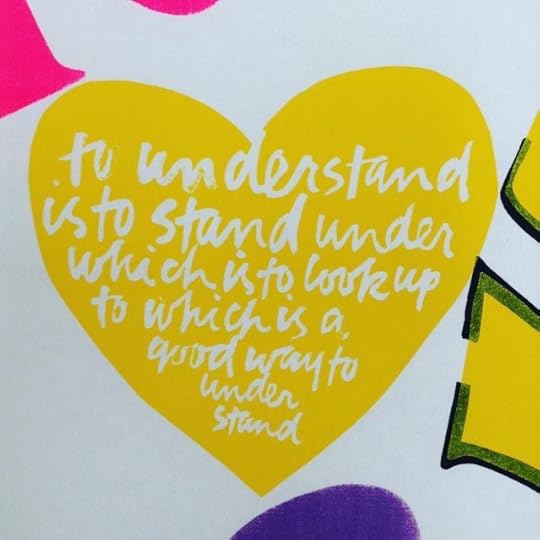
Sister Mary Corita Kent, “mad for each other.” 1967 serigraph.
“To understand
is to stand under
which is to look up to
which is a good way to understand”
To understand in this way, you have to go there, where you can stand under, and look up with an open-minded willingness to learn, and to stop blaming others for whatever misfortune they happen to have fallen prey to.
However, we don’t ‘go there’ as much as we need to.
When tempests get stormy, we look for safe harbors. As Alana Semuels described in her article, we gravitate toward others who are just like us: We ‘self-sort’ and voluntarily segregate:
“As college-educated people cluster in cities, they have less and less exposure to people in places like Connersville. And people in Connersville have less exposure to educated people like those who live in Indianapolis.
“I guess I surround myself with like-minded people,” Elle Roberts, a 28-year-old African American social activist who lives in Indianapolis, told me at a local wine bar. “People closest to me tend to be liberal, and we tend to congregate in urban areas.” Roberts, a graduate of Purdue University, moved to Indianapolis from a mid-sized town in northwest Indiana. I went with her to a poetry slam in the basement of a club in Indianapolis on a cold night where dozens of people, mostly minorities, were hanging out.”
“Connersville exists quite separately from this world. One Connersville resident, Brendon Friend, 22, told me he liked the area because “there aren’t many black people here.” In the small town, there are two places people go for entertainment at night: Mousie’s, a bar and restaurant that serves dollar drafts and and cheap wings on Mondays, and Pizza King, a family restaurant where teenagers congregate. Most of the people I met in Connersville told me they spent their leisure time either with family or outdoors; hiking, hunting, fishing, riding four-wheelers. Almost everybody I talked to owns their own house and car and had children young. “It’s just easy to live here,” Clay Smith told me “Everybody knows everybody.”
We can’t continue to let our self-sorting and voluntary segregation be this ‘easy.’ Diversity is something to be celebrated, not something to be avoided.
That may spin off into another Sunday Mālama… for now, work with me on stopping blame and fostering generosity instead. Be tolerant of getting a helping hand, and learn to extend yours in help to others as well. It’s Mālama. It’s Aloha. It’s who we are when within our Aloha Spirit.
Postscript

Click on the image for the Sunday Mālama index of articles.
Sunday Mālama has been when I will share my off-the-workplace-highway scenic route kind of posts. Not as a normal weekly feature, but whenever they seem to be writing themselves.
You can access the Sunday Mālama archives via this category link, also residing with my site footnotes.
Subscribe for our weekly newsletter:
Talking Story with the Ho‘ohana Community.
Preview the updates in Managing with Aloha, Second Edition, just released Summer, 2016
Managing with Aloha, Bringing Hawai‘i’s Universal Values to the Art of Business
Our value immersion study for the months of January and February 2017:
HO‘OMAU; Love the one you’re with.
Save
Save


February 1, 2017
Ho‘omau is the Rule Changer: On Mistakes, Norms, and Rules
One of the most dangerous, or at least frustrating situations that can happen in normally civil organizations, occurs when renegade rule changers arrive.
Conservative Patrick Ruffini comments on Democratic ‘obstruction:’
“They’re making all the same mistakes we made in 2009, in all of the same ways.”
Washington Post political columnist Dave Weigel:
“This is because they remember those ‘mistakes’ leading to a GOP landslide one year later.”
Reader Andreas Schou:
“Your ‘mistakes’ were unraveling every bipartisan norm our country operated by.
Democrats are operating by the rules you set.”
Hmm… Mistakes, Norms, Rules. Now there’s a Rule of 3 worth diving into.
Mistakes, Norms, Rules
‘Tis true that the political process has been on my mind, and in terms of a writer’s research, there are an abundance of very instructive quotes I can curate, tucking them into my commonplace book of findings right now, however they are also apropos to business and workplace culture building. Organizationally, the dysfunction of our federal governance is being revealed in astonishing ways, however that may be the subject of a future blog post.
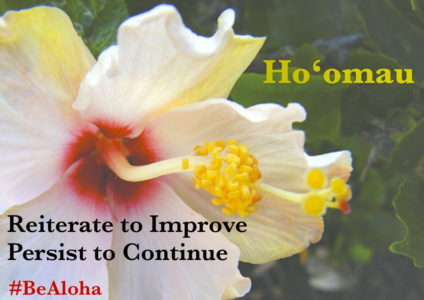
Ho‘omau; Love the one you’re with
Mistakes, norms, and rules are the stuff of Ho‘omau value alignment, and HO‘OMAU happens to be our value for the months of January and February. So here’s what I propose:
Let’s use the month of February to uncover and dust off any NORMS and RULES you now have in place and audit them with Ho‘omau. Use Ho‘omau to ask yourself, and your team, do we still accept and verify this as one of our norms or rules (and are we clear on the difference between those two states of being) or should we update and/or change it?
If you’ve already done this: Bring Constants and Change to Ho‘omau Agreement January 24, 2017, this February exercise will be a natural extension and help you be thorough. If not, bookmark this as next on your agenda.
From Values to Norms
Let’s step back first with a reminder about how our values function. VALUES drive behavior in implicit ways—desirable behavior is implied, but not plainly expressed. In this way, values honor an individual’s conscience when judging the context of a situation, and thus, respect intelligence, with trust that individual’s choices. This is actually the underlying assumption of the entire chapter on Ho‘omau in my book.
NORMS come into play when values consistently drive certain behaviors relative to frequently occurring situations. An example would be when a customer’s reaction to one of your products is reliably predictable, and you and your team have therefore been accustomed to handling it in a certain way, be it pointing out an unknown feature, teaching that customer better usage, or something else—all actions which align with Ho‘okipa as your value of customer service, and Mālama as your value of product stewardship.
From Mistakes to Norms
When we make MISTAKES, there is always an atmospheric question at play regarding risk (we have called it The Acid Test of Healthy Workplace Culture)—is it safe enough for me to make this mistake? In a healthy workplace culture, the answer will be yes 95% of the time—the other 5% has to do with workplace safety, and not putting others at risk irresponsibly, and it’s probably where rules should come into play (more on that in a moment).
Now, mistakes can also lead to aha! moments. (If you have it, read page 168, 2nd edition of my book: “Mistakes are very, very cool.”) It is very possible for a mistake to become a new norm, again assuming the action taken was still in alignment with your values—it’s an optional outcome, still good, maybe even better, that you hadn’t considered before.
“Three simple rules in life.
1. If you do not go after what you want, you’ll never have it.
2. If you do not ask, the answer will always be no.
3. If you do not step forward, you will always be in the same place.”

Initiative. Courage. Self-Reliance. Leadership. They are the urgings of ‘IMI OLA — seeking your best possible life.
Rules and “First Step Rules”
RULES are explicit where values are not: Explicit means they should be “stated clearly and in detail, leaving no room for confusion or doubt.”—dictionary. Again, safety issues are a good place to see the basics of rule-making, however rules come into play more often than that. Few for instance, will bother to revise Robert’s Rules of Order; we simply outline which of them we’ll adopt and use in our company or organization.
In Managing with Aloha culture-building, I’m a fan of First Step Rules. Those are Rules which help steer people on the right path in overwhelming situations, then segue from the explicit to the implicit—they allow people to be more creative in the totality of how a situation will be handled, welcoming more co-authorship and more of an individual touch. Examples of this would be the first step in handling a customer complaint, or the first step when a customer says, “I’d like to speak with your manager.” —They could be a salesman or applicant, and not be complaining at all.
Think about this for a moment as a customer. Would you rather be taken care of by someone who follows the rules ‘by the book’ or someone who knows the rules and generally follows them, however is also free to customize solutions to your specific needs?
Thought so.
So I hope this helps you with some baseline clarification on mistakes, norms and rules, and sends you on your merry way with some Ho‘omau housecleaning in February.
After all, February is also the month of LOVE, so let’s HO‘OMAU, and continue to “Love the ones we’re with.”
Have a great month,
Rosa
Related Reading: Obviously, I wrote these postings before I wrote this one, so bear with me if I must now correct them with edits for absolute consistency and clarity… Am what I talk about in these postings Norms or Rules, and will they help you audit all corners and lift all rugs in your company?
This post has the norms of SLC Conversation 101: Conversational Catch-up ~ with Aloha
The Gospel of MWA: The Calling of Great Managers
Our Alaka‘i 24 Affirmations: Better Person, Better Manager, Better Leader. Alaka‘i Batch 24
Scroll to The Manager’s Oath in this post: Managers Make Promises They Can Keep
Managerial Batching: 1, 2, 5 and 7 and On Batching: The Fewer the Better
The Real Rules of Engagement, Redux
Subscribe for our weekly newsletter:
Talking Story with the Ho‘ohana Community.
Preview the updates in Managing with Aloha, Second Edition, just released Summer, 2016
Managing with Aloha, Bringing Hawai‘i’s Universal Values to the Art of Business
Our value immersion study for the months of January and February 2017:
HO‘OMAU; Love the one you’re with.


January 24, 2017
Bring Constants and Change to Ho‘omau Agreement
Charles M. Bow, columnist with the New York Times, tweeted “Lord, I need to pace myself. Trump and his shenanigans are going to do me in if I don’t,” a sentiment I can totally relate to.
It’s no secret that I am a Trump resister turned #BeAloha activist, however it’s not just about Trumpism —it’s the overload I’m feeling in trying to keep up with the challenge of learning what America2017 will really turn out to be, and more. Change is firing on all cylinders, unless you’re living with your head under a rock someplace completely disconnected from the news of the day.
For instance… I’m fascinated by the whole existential drama the media now wallows in, since President Trump has declared war on most of them. I’m not a journalist, however as an author, blogger, newsletter writer, Ke Ola Magazine columnist, and the founder of Ho‘ohana Publishing, I do think of myself as a publisher, and can relate to their distress. And what a case study in articulating and asserting values, and rallying for value alignment! As former White House Press Secretary Ari Fleischer is trying to advise the press, “It doesn’t matter whether the president is praising or criticizing you; your job is to be neutral, fair, and accurate.”

From Human Rights Watch World Report 2017: Demagogues Threaten Human Rights, Trump, European Populists Foster Bigotry, Discrimination
After Trump’s “America first” fist-raising inauguration speech, I took the time to reeducate myself on what ‘populism’ in fact, really was all about. Objective research and reading was necessary. The word may sound like it’s ‘popular’ however it’s not exactly positive, and not what I want as a citizen. “A better antidote: responsive and responsible leaders.”—from the World Economic Forum, A 10-point guide to responsible leadership in the age of populism.
At The Atlantic, Derek Thompson gave me pause, in publishing “The Dark Side of American Optimism, and the Bright Side of Rising Pessimism about the American Dream.” Yikes! I used to think pessimism was always wrong, or at least ill-advised, however Thompson reminded me that there are no absolutes, and objective context is always necessary for sound judgement.
All to say, I am working on my skill building with “The 3 C’s of 2017: Change, Congruency, Critical Thinking” too, just as I asked you to do. It’s tough. Mostly, it’s time consuming.

A cartoon Ian Bremmer captioned, “Remember: People fall prey to their biases because they don’t want to put in the effort to overcome them. Not because they can’t.”
Sometimes, jumping into the fire is necessary for timely learning.
In my case, I’ve chosen to get more involved and hurl myself into the change spurred on by “the present regime” of our US governance, as astrophysicist Katie Mack refers to it. In response to the “alternative facts” controversy stirred up by Kellyanne Conway, Counselor to the President, Mack tweeted that “In the present regime, both science and basic observable fact are political. If you advocate reality, it’s impossible to sit this one out.”
I agree, for business became political as well, starting the day Trump had announced he’d run for office. As I pinned to my Twitter profile page, “Be fearlessly authentic in standing up for your #values. ‘Don’t talk politics’ no longer applies. Clarity in values expression does: #BeAloha.”
However I’ve certainly no plans with running for office! I believe that much is possible when you work from within your circle of influence, and there’s no place I’d rather be than stage-center with Managing with Aloha and the Ho‘ohana Community!
Which brings us right back here, and to HO‘OMAU, our value for the months of January and February 2017: Ho‘omau; Love the one you’re with.
The way I ‘pace myself’ is with the practices of value immersion and value alignment.
With value immersion, to ‘pace myself’ is to go ‘all-in.’ It’s keeping my thoughts about, and beliefs in Ho‘omau at the surface of whatever deep-dive my thoughts now engage in, political, newsy, work-related and otherwise:
“VALUE IMMERSION is flexible and adaptive when it has your constant attention: When confronting change, you realign and audit your value integrity in every strategic juncture.”
With value alignment, to ‘pace myself’ is to stop regularly, and question the healthiest, best context of those thoughts through my Ho‘omau filters.
Value alignment helps us shift information overload from the subjective to the objective, and from the not relevant to the relevant. Value alignment brings us to manageable, desirable agreement:
“VALUE ALIGNMENT frames our key objective — To align the actual behaviors of a workplace culture with the values we say we believe in from an intellectual and convicted point of view: We believe in this value deeply, and therefore, this is what we consistently do, or aspire to do; this is how we will behave.”
The value of HO‘OMAU in particular, helps us reckon with the very important agreement we’ll come to, balance if you prefer, between the Constants we uphold, and the Change we can then accept and incorporate into our lives—into living and working with Aloha.

A cartoon by Sandra Boynton she captioned, “Difficult things can be accomplished given enough enthusiasm.”
With Ho‘omau, define your Constants, and accept your Change.
Will having a brand new president, ‘rookie administration,’ and a Republican majority in both houses of Congress affect every American citizen? You bet, and it will affect us globally as well.
Will those things affect the majority of what determines the quality of the life you lead? Probably not.
One headline last week read, “Trump to kill Public Radio, National Endowment for the Arts, and National Endowment for the Humanities,” meaning they may lose budget dollars, or even their lifeline funding. However, will that stop everyone else from supporting Public Radio, the Arts and Humanities? Nope.
You make the choices which affect you most, and I would argue, are much more important. The Serenity Prayer advises us well;
“Lord grant me the serenity to accept the things I cannot change,
The courage to change the things I can,
And the wisdom to know the difference.”
Thinking about that caused me to send out this tweet a week ago: “I may need to revise these ‘3 C’s of 2017’ to ‘Congruency, Critical Thinking’ and COURAGE, Koa in Hawai‘i.”
Change is going to happen. What’s more important is how you deal with it.
I’ve been promoting the skill-building of Critical Thinking with you, because I firmly believe that’s where you will gain “the wisdom to know the difference.” I believe in the innate Aloha goodness of all human beings, and that we’re extremely capable— we are Ho‘omau tenacious, Ho‘omau resilient, and Ho‘omau flexible (another great Rule of 3 for Ho‘omau we can count on!).
When it comes to defining our Constants and accepting our Change, we’re in charge.
Don’t ever forget that.
Use your own Ho‘omau value immersion these first two months of the year, to define these two things for yourself:
1. What are the constants I will fiercely protect, and perhaps, work to improve upon?
2. What is the change I can get excited about, and rally behind with enthusiasm?
Answer them personally, professionally, or both, and you will find the process to have a steadying, and comforting effect on you. It’s a Ho‘omau kind of thing, and it’s fantastic.
Subscribe for our weekly newsletter:
Talking Story with the Ho‘ohana Community.
Preview the updates in Managing with Aloha, Second Edition, just released Summer, 2016
Managing with Aloha, Bringing Hawai‘i’s Universal Values to the Art of Business
Our value immersion study for the months of January and February 2017:
HO‘OMAU; Love the one you’re with.


January 16, 2017
Ho‘omau with the Rule of 3
“The rule of three or power of three is a writing principle that suggests that things that come in threes are funnier, more satisfying, or more effective than other numbers of things. The reader or audience of this form of text is also thereby more likely to remember the information.”
—Wikipedia
Once you start using The Rule of 3, you fall into using it quite often. I just did so last week, with “The 3 C’s of 2017: Change, Congruency, Critical Thinking,” a triplet I hope you’ll remember as one of our Managing with Aloha skill-building objectives.
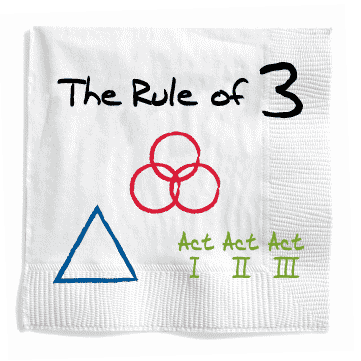
The Rule of 3 doesn’t just apply to writing however, It’s a powerful concept we can we can apply to our systems, processes, and habits.
For instance, let’s return to our current HO‘OMAU value study, “Love the one you’re with,” and those 6 principles of continuous improvement it had listed:
Iteration—improvements can be based on small changes, not major paradigm shifts or new inventions;
Cost Effectiveness—Incremental improvements are typically inexpensive to implement;
Inclusion—internally improving means rallying the talent and input of all staff; which leads to
Engagement—people take ownership and are accountable for improvements they co-author and steer;
Communication—continuous improvement calls for reflection, asking, “Is this working?” and demands feedback loops;
Tracking—we target improvement which is measurable and potentially repeatable. Small wins add up.
They naturally fall into two neat triplets, one which coaches the Continuity of Improvement, and another in regard to Kākou Communications:
On the Continuity of Improvement: ITERATE, AFFORD (i.e. Cost Effectiveness), TRACK
With Kākou Communications: INCLUDE, ENGAGE, REFLECT
Own your vocabulary as best for the work at hand — would you choose other words for each of these principles? For instance, your may prefer FINANCE instead of AFFORD. Align them with your other best practices. Think of them as the disciplines of better working habits.
When you apply the principles of continuous improvement to a project, consider if using these triplets can help you assign teamwork, with a ‘divide and conquer’ strategy in the beginning stages of your work — “we’ll work on the continuity logistics, and you can work on mapping our Kākou communications.” Thereafter, have the team come back together, to integrate the two.
As a result, you won’t just have theoretical principles to refer to, you’ll have a meaningful Ho‘omau-aligned work ethic in the making.
Review Kākou Communications here: Kākou Communications and Our Tribe. Excerpt:
There are 2 other factors connected to the value of inclusiveness that every manager and leader can love:
When you embrace inclusiveness and diversity, you get complete input and thorough feedback. Kākou promotes synergy as a habit of creation which seeks additional solutions and alternatives.
Cohesively shared information-giving will increase the amount of responsibility and buy-in others accept as their own because you included them. The person possessing Kuleana, the value of responsibility, will be quick to say, “I accept my responsibilities, and I will be held accountable.”
Subscribe for our weekly newsletter:
Talking Story with the Ho‘ohana Community.
Not shy about promoting this, because it works!
Jumpstart: The Simplest and Best Managing with Aloha Toolkit there is.
Our value immersion study for the months of January and February 2017:
HO‘OMAU; Love the one you’re with.


January 12, 2017
The 3 C’s of 2017: Change, Congruency, Critical Thinking
Change is happening all around us, and I would like to suggest a January conversation to you. Let’s talk story about our response to the whirlwinds of current change via the skill-building of Critical Thinking and the value-alignment of Congruency.
Value Preview: In this posting, we will also consider the value alignment of Managing with Aloha’s Aloha Spirit, Ho‘ohana, ‘Imi ola, Ho‘omau, Kākou and Lōkahi.
Change
So much has happened in our world over recent months. Subsequently, I believe that 2017 will prove to be different for us for a number of reasons, locally, nationally and globally. It will be a year wherein we more clearly understand how we have been, and will now be governed, and how much our laws and governance actually affect our lives.
These changes and our heightened awareness of them loom in health care, and are already crystal clear in business. I can’t recall a similar period within my own lifetime, where the propriety and ethics of government spilling into business concerns are the topic of prevailing, widespread conversations—and of alarm. We’ve been wary of Big Business for a long time; now people are getting frightened by it.
Are the rules really changing, or is it time we stop looking the other way, because ‘everyone’ actually refers to only the affluent or vocal?
What we do about these shifts and changes, will define what kind of citizens we decide to be, and how we will newly define our professionalism. None of us need be smalltime-hometown, ‘only at work’ players anymore if we choose to exercise our voices, and play a larger role. Our circle of influence is as large as we choose to make it; we live in an era, where the local, national, and global is more reachable than it ever has before, and we can be heard in each realm.
President Obama, for example, challenged us in his Farewell Address this past Tuesday, saying, “for all our outward differences, we all share the same proud title: Citizen. Ultimately, that’s what our democracy demands. It needs you. Not just when there’s an election, not just when your own narrow interest is at stake, but over the full span of a lifetime… Show up. Dive in.”
(Full transcript here, and annotated with fact-checking by NPR here. My take: It wasn’t really a ‘farewell speech.’ It was more of a ‘remember who we are’ speech, and a ‘remember what we are capable of’ speech.)
Congruency
This atmosphere was large part of why I so strongly felt that The “Take Time/ Make Space” HO‘OHANA Habit written for ManagingWithAloha.com had to be my 2nd posting of the year for you. For again, “Remember that this is a personal value of intention: You don’t have to possess ‘a job’ ‘a position’ or ‘a career’ to apply it to. Ho‘ohana is an attitude of intention and full presence in whatever you do.”

Image Credit: Clare Hollingworth, The Untold Story of the Woman Who Broke the News of World War II, Buzzfeed. Hers was a fascinating HO‘OHANA as a news reporter long before the dawn of social media and journalism as we know it today. She died this past Tuesday at age 105.
Since then, I’ve noticed several articles making the rounds on Congruency.
Here’s a short read, on Online Congruency by Joshua Fields Millburn, and,
A 1900-word essay, Shame on You by Firmin deBrabander for Aeon.
To be congruent, is to “be in agreement or harmony”—also the definition of our value of Lōkahi. We mostly speak of Lōkahi in connection with teamwork and conversational savvy (as with negotiations and reaching the agreement of consensus), however Lōkahi is also about being true to yourself and who you are. It’s being willing to fully express the alo + ha of your Aloha Spirit in authenticity displayed for others, yes, but also with a self-fulfilling accuracy, enabling you to live in harmony with your own spirit.
Is this a time for alarm, or is it a time for reinventing ourselves and being seekers?
It may be that past professionalism shackled us, and we now have the ‘new world opportunity’ to blend our personal and professional lives with the work/life integration of Pono we never entertained as our possibility before.
It remains an individual decision (at least for now.) And remember: Change is rarely an all or nothing proposition. As our current value study reminds us, we have constants with which we Ho‘omau, and “Love the ones we’re with.” That’s congruency too.
Critical Thinking
If we are to be successful in this Ho‘ohana exploration, decision-making and self-coaching, Critical Thinking is essential.
I found this page, published online by CriticalThinking.org to be excellent: Our Concept and Definition of Critical Thinking. It outlines the case for critical thinking, starting with a clearcut statement of the problem we face when we don’t learn this skill, and practice it. It outlines the tangible benefits of being a well-cultivated critical thinker.
Up to now, I’ve considered critical thinking to be a skill cultivated by lifelong learners; I’ve thought of it as an ‘Ike loa practice. Learning is a survival skill, and a self-developmental stretch for growth.
In recent months, I’ve become highly sensitive to how crucial this skill of grooming our critical thinking is, as citizens who rely so heavily on our media. We have allowed others to tell us what to think, and we can’t be this complacent anymore; we need to dig deeper as we inform ourselves fully, so we can take our Ho‘ohana actions responsibly.
So much of my own bias in thinking is affected by values, and so this sentence on that CriticalThinking.org page jumped out at me: “We are likely to make critical thinking a basic value in school [and in the workplace] only insofar as we make it a basic value in our own lives.” As I read through all of it, I kept making the connection to ‘Imi ola, our value to “seek our best possible life” and I’m convinced:
Critical Thinking is a skill for a better life.
At root, it is “the art of taking charge of your own mind.”
Talk story about Critical Thinking and Congruency in your own conversational circles this week. Be willing to explore your biases in your reaction to change, and in your impulsive decision-making. Explore how you can help each other shape the most meaningful Ho‘ohana personally, professionally, and as a citizen of the world in 2017.
It takes all of us to succeed in bolstering the Aloha Spirit individually first and foremost. As the Ho‘ohana Community, we know how much better it’s been when Kākou, worked on together.

Be Congruent with a focus on our Aloha Intentions.
Subscribe for our weekly newsletter:
Talking Story with the Ho‘ohana Community.
Not shy about promoting this, because it works!
Jumpstart: The Simplest and Best Managing with Aloha Toolkit there is.
Our value immersion study for the months of January and February 2017:
HO‘OMAU; Love the one you’re with.


January 4, 2017
The “Take Time/ Make Space” HO‘OHANA Habit
All the winter holiday-ing aside, what effect does this yearEnd/yearStart time have on your HO‘OHANA, your intention with work?
In early January, take some time to Make Space for Ho‘ohana Wayfinding.

Ho‘ohana is the value of worthwhile work. When you ho‘ohana, you are working with passion, with full intention and with definitive purpose. You work to bring productive energies to the life you lead, working with resolve, focus and determination. Remember that this is a personal value of intention: You don’t have to possess ‘a job’ ‘a position’ or ‘a career’ to apply it to. Ho‘ohana is an attitude of intention and full presence in whatever you do.
I’m one who absolutely wallows in the thinking and reflecting character of how the calendar now conspires, giving in to it completely. I go back, reading the curation I did over the course of the past year to reflect on lessons learned, and to feel everything good bubble to the surface of my consciousness. I make a few decisions on the way I wish to work going forward, rebooting the basic how-to’s of my Ho‘ohana to sharpen my focus.
It’s a “Take Time/ Make Space” Ho‘ohana habit which has proved very fruitful for me and for those in my coaching program, and I’d like to share more about it with you with a couple of coaching tips.

As an ‘IKE LOA-valued objective, be curated as an Alaka‘i Manager.
January’s Ho‘ohana Habit
I mostly think about my approach — the WAY I worked, and why.
How much of it was disciplined, and how much just happened as it did? Can I be more intentional, however NOT with some grandiose new plan. I love, and totally believe in what we are now doing with Managing with Aloha, so how can I tweak, and make small, but smart adjustments?
What worked best for you last year as you pursued your Ho‘ohana, actually worked, and how can you repeat it in consistent practice, to make it your habit?
There may very well be a grand plan for 2017 that awaits your attention, a plan that is inevitable, and hopefully, a plan you are very excited about, but jumping into it can wait for now… we continue to Ho‘omaha this week, and so this is about you, and your health and readiness for that plan.
SIDEBAR: Learn to ask Why. The time tested Why? What? For Who? Where? When? and How-to? framing of the work I do really helps me, placing Next? in my immediate sights in a practical yet relevant way. I shared the result of that process with you in my last post,
The Values That Matter, Yours and Ours.
Choose Values Over Resolutions
I stopped being a resolution writer a long time ago, years before my book articulated Managing with Aloha as a philosophy, allowing the value-mapping of our Value Your Month to Value Your Life habit to chart my course in a more organic and sequential way.
In working with values, I instantly loved how our month to month movement tends to flow… more babbling brook than jet stream current, with ample space for wayfinding that is naturally relevant to whatever the work at hand.
As a management style, wayfinding tends to make room for others as well. It allows for participation and collaboration, and hence, for KULEANA co-authorship and LŌKAHI teamwork, so we aren’t going solo more than is wise, and we’re primed for, and open to synergy.
As Gloria Steinem pointed out, “Decisions are best made by the people who are affected by them.” Being a good manager requires the constant awareness of, “Who else will be impacted by what I do, and by the decisions I convey?” In wayfinding, we welcome them into our systems and process, and via Ho‘ohana service intentions (more on that shortly), we welcome them into our habits.

Welcome others into your Ho‘ohana m.o. in the spirit of Lōkahi.
To Weave in Wayfinding, Make Space
When you work with a value of the month process, the objectives are always 1. an immersion of your attentions on that value, and then, 2. the value alignment which might be necessary to correct, improve, and grow. That requires space — available time, and the room to maneuver with skill and care.
Less is more. The biggest culprit in time management is usually over scheduling yourself; we bite off more than we can chew. Therefore, one of the best practices within January’s Ho‘ohana habit, is deciding what you will no longer do, and what you say “No” to in the coming year.
Too much space can have a debilitating effect on us as well, if a vacuum or void. However that rarely happens when your basic intention of working a value of the month immersion and alignment m.o. is your solid, central, trusted Ho‘ohana commitment. Any looking for space-fillers so momentum isn’t lost, becomes the ‘IMI OLA seeking we talked about this past November and December.
Your Ho‘ohana needs to work FOR you
The value of Ho‘ohana asserts itself each January, and with each fresh start of anything for that matter, because it drives so much. It is only 2nd to Aloha’s Beautiful Basics in the way it influences everything else we work on, and learn from in Managing with Aloha — “we work on work here” as our constant.
“The future of work” has been a hot topic in many circles, largely because of how technology and changing demographics is shifting professions. As the Ho‘ohana Community of Managing with Aloha practitioners, we now embark on our 13th year working on a future within the ALOHA / HO‘OHANA value pairing. We know how crucial the quality of work is, in helping us lead meaningful and fulfilling lives as we pursue our work.
We will work ON our Ho‘ohana all the year through; you can count on that! This January, I encourage you to think about how your Ho‘ohana can SERVE you; how it works FOR you, and the lifestyle which keeps you at your healthiest best. How can your approaches in the way you Ho‘ohana assure the work you have in your sights will always feel good to you?
Use January to focus on your work / life integration as your Ho‘ohana mastery.
In every speech and workshop I do, the message I seek to leave with people remains constant: Do Managing with Aloha for you first (self-manage, self-lead). Only then will you be successful with the management and leadership of sharing MWA’s Aloha Intentions with others.
Working with Aloha, our 2nd Aloha Intention, requires, and builds upon Living with Aloha. Like Aloha, Living with Aloha is first with good reason: Sunday Mālama: Better Managers are Better People.
— Rosa
Postscript:
As I was drafting and editing this posting, I received a question via email, and I think sharing my answer here may serve as a good example of how I took a good look at how I approach tweaking the way I Ho‘ohana:
The question was, “Rosa, you were quite vocal about politics during the 2016 elections season, and I know you aren’t happy with the result, yet you have quieted about it here [referring to our newsletter]. Have you decided to just let it go and move on?”
My response was, “No, I haven’t let it go. I’m among those who are choosing to ‘resist.’ I will never engage in civil disobedience, and I have written about how I think protest is relatively ineffective, but I still believe we have to speak up to effect and ‘Be the change we want to see in the world.’ I decided that my blog and my newsletter weren’t the places for my conversations on what I had dubbed “The American Experiment” though, and that I needed to focus on the goals I have for each of those venues as connected directly to Managing with Aloha (and as I also choose to do on Instagram). If you follow me on Medium, Twitter and Tumblr however, you will see that I continue to be quite vocal about the Resist Movement necessary in those places, for that is where the conversation happens in the social media I engage in. I will occasionally share something on LinkedIn as well, selective to business, and because of my feelings in regard to what the social Kuleana of business must be in the current atmosphere. In addition, I added every one of my representatives in local politics and in the U.S. Congress to my active contact list, so I can remain a vocal constituent who chooses to speak up, asking for transparency and reminding them that we elected them to execute the job of good governance: They work for us. I’ve had a lot of practice at being a manager and a boss! That said, I know I can be a much better citizen and constituent too, and that they need to hear from us if they are to work for us in the best possible way.”
I do get impulsive here and in our newsletter, and I share quite a bit in both because I trust in our Ho‘ohana Community. That flow, from impulsiveness to corrected-course decision-making, is all part of wayfinding too.
Related links within this posting by Title:
Curating Value Alignment (includes our vocabulary and toolkit)
Curate and Be Curated
On Intention: Don’t “shut up”—Sound off
You are Your Habits, so Make ‘em Good!
Ho‘omaha Makahiki Kākou (About our winter sabbatical)
Managing: Learn how to ask “Why?”
The Values that Matter: Yours & Ours
About the Managing with Aloha Philosophy
There is no Vacuum in an Aloha Workplace
‘Imi ola: We are meant to be Seekers
Our Beautiful Basics
“Keep Moving Uphill” with our 5 Aloha Intentions
Sunday Mālama: Better Managers are Better People
Better Person, Better Manager, Better Leader. Alaka‘i Batch 24
Subscribe for our weekly newsletter:
Talking Story with the Ho‘ohana Community.
Not shy about promoting this, because it works!
Jumpstart: The Simplest and Best Managing with Aloha Toolkit there is.
Our value immersion study for the months of January and February 2017:
HO‘OMAU; Love the one you’re with.


January 1, 2017
The Values that Matter: Yours & Ours
One of the things I love most about values, and by extension, my Ho‘ohana working with values-centered management practices via Managing with Aloha, is that they never get old. In that way, the “out with the old, and in with the new” mantra that is often heralded each January doesn’t seem to apply to our shared work as the Ho‘ohana Community. We rejuvenate our old and trusted standbys instead: We love the ones we’re with.
Most notably, we keep these in our Nānā i ke kumu stable of lovables, a “Sense of Place” we will constantly use to “look to our source” all the year through. They are indeed, our CONSTANTS.
Our 19 Values of Aloha
The Managing with Aloha Ethos and 3 Choices
A Manager’s Calling: The 10 Beliefs of Alaka‘i Managers
9 Key Concepts in Healthy Culture-Building
The Twelve Aloha Virtues
We embrace CHANGE as well, however we choose to be the ‘Imi ola seekers, designers, and co-authors of the change we set our sights on.
We think of these, as the Managing with Aloha “standard operating procedures” which help to keep us forward-moving yet focused, and we do not hesitate to take on meaningful projects: (Piloting Projects: Job One is You.)
Jumpstart: The Simplest and Best Managing with Aloha Toolkit there is. (which includes The Daily 5 Minutes.)
Alaka‘i Batch 24: Better Person, Better Manager, Better Leader. which can be used as Daily Affirmations.
#VYMTVYL: Value Your Month To Value Your Life and Value Your Month for One — You.
#BeAloha Coaching and our 5 #AlohaIntentions (as listed below) as our Kūlia i ka nu‘u practice.
This blog, and the Ho‘ohana Community weekly newsletter.
On Intention: Don’t “shut up”—Sound off
We do this, because they work and work well. They have proven their worth to us, and we feel that learning them and practicing them has given us a supreme readiness for the year to come.
The Values that Matter: Yours & Ours
Throughout 2017, I will continue to advise you to be true to your values.
The values that matter are the ones you choose as your own Mālamalama guides, and those that you share with the people you choose as your “company to keep” as your ‘Ohana in Business— your co-workers, your partnerships, and your chosen networks Kākou.
For instance, the value of Ho‘ohanohano has been speaking to my own Aloha Spirit for several months now, and I have chosen it as my personal Mālamalama guide for 2017 knowing I must rejuvenate my spirit by “honoring the dignity of others, conducting [myself] with distinction, and cultivating respectfulness”—always, and in every challenging situation I may face.
Second, most of us earn our keep by working for a company that asks us, as all organizations do, to be ambassadors of their mission and vision. They ask us to uphold their company values in every one of their professional expectations of you, and rightfully so. I do this too, with my company, Say Leadership Coaching. Those, will also be the values that matter for you.
Third, we share values as the Ho‘ohana Community as well, and in 2017 I will continue to offer you a bimonthly #VYMTVYL value-alignment practice that corresponds to our partnership with Ke Ola Magazine. This is the schedule you can look forward to:
January – February 2017: Ho‘omau – Renewal
March – April 2017: Kūlia i ka nu‘u – Excellence
May – June 2017: Ho‘okipa – Service
July – August 2017: ‘Ohana – Form & Function
September – October 2017: Lōkahi – Harmony
November – December 2017: Kākou – Inclusiveness & Diversity
You will recognize them as Chapters 4 through 9 in Managing with Aloha. As you know, those are not the all-inclusive meanings of those 6 values; the definitions I’ve noted will be our starting places. As usual, I encourage you to think of each 2-month period as a time we Ho‘ohana together, and a time we ‘Ike loa together — we co-work, co-author, and commit to being lifelong learners.
Let’s work on creating #2017Aloha together, shall we? Join the Ho‘ohana Community of Managing with Aloha, by subscribing to our weekly newsletter. Send me your questions and thoughts at any time.

HO‘OMAU; Love the one you’re with.
“As you review 2016, and look forward to 2017, don’t choose resolutions. Instead, think about your values. Values are more versatile than resolutions. They’re also more manageable.”
—David Kadavy, The Mission: Values Over Resolutions
Our Day 1 Ho‘omau: Love the one you’re with.
We begin with Ho‘omau in January and February of 2017, and our theme is “Love the one you’re with.”
You can read my Ke Ola Day 1 essay over on RosaSay.com and we will talk story about it, and about the other distinctive attributes of Ho‘omau over the first eight and a half weeks of 2017:
HO‘OMAU; Love the one you’re with.
Mahalo nui loa; thank you so much for continuing to read and share Managing with Aloha as you do — book, blog, and newsletter.
We Ho‘ohana Kākou — a very Happy New Year to you and everyone you hold dear in sharing your Aloha Spirit; Hau‘oli Makahiki Hou.
Rosa Say

Preview the Second Edition of Managing with Aloha here, just released in the Summer of 2016.


December 30, 2016
Each New Year a Gift
“Let us welcome the new year full of things that have never been.”
~ Rainer Maria Rilke, via “thin places”
At this time last year, I wrote:
As I write this, we’re about to turn another yearly page in our lives, the true goodness of Ka lā hiki ola in all its glory: Hope and promise in the “dawning of a new day.”
Are you overwhelmed with the change, or eager for the clean, fresh start?
Be eager.
Build on your past, but don’t get hung up on it, or delayed by it, scrambling to tie up loose ends: The future is always bigger, and very likely better, with the promise of much more abundance.
Something I’ve learned, as benefit of surviving my own page-turnings of past years, is that the future tends to be much more forgiving of us than we are of ourselves. It doesn’t beat us up for not doing something, though it did bear witness to our endless procrastination; it will simply wait for us in a kindly, and very hospitable expectation, knowing possibility always awaits.
Then the future offers us a gift, one far better than anything we recently had tucked under the Christmas tree: It gives us a brand new year, one still connected to all the deep relationships and lessons-learned of our past, yet one we can eagerly fill up with the abundance of our Aloha Spirit come out to play.
We have our constants, and always will.
Now, we can change. We can grow. We can be somehow different if we choose to.
I still feel this way, even though 2016 was a rough year by many accounts. I prefer to look at all the good that happened, just like Jesse did:
In #2016, I rebuilt my business, increased income, adopted a baby, celebrated 10yrs of marriage, launched a WP product shop, & beat opiates.
— Jesse Ⓦ Petersen (@jpetersen) December 30, 2016
We are blessed with our bounty of Beautiful Basics.
My New Year’s wish for you is simply this: Dwell within your Aloha Spirit, you (in-spirit with your ha) and all you (in-signature with your alo, shaped by your good intentions). Play within the guidance of your personal values, but do play.
 2017 is going to be absolutely magnificent.
Ka lā hiki ola tells me so, and I choose to believe it, knowing I can have no better affirmation.
In 2017 we, as the Ho‘ohana Community of Alaka‘i Managers and Managing with Aloha practitioners, will continue to focus on our 5 Aloha Intentions, knowing how much good they bring to us, and allow us to give to others:
On Intention: Don’t “shut up”—Sound off
Hau’oli Makahiki Hou, Happy New Year!
~ Rosa
Postscript:
Taking Jesse’s lead, in #2016 I published the 2nd Edition of Managing with Aloha for our 12th Anniversary as the Ho‘ohana Community! and /1 https://t.co/NDGNpmNv1t
— Rosa Say (@rosasay) December 30, 2016
Lived— Worked— Spoke— Managed— Led my ‘Imi ola with our 5 #AlohaIntentions seeking to #BeAloha and “Be a Better Person,” Learned much. /2
— Rosa Say (@rosasay) December 30, 2016
The Say ‘Ohana enjoyed an EPIC family vacation to Jackson Hole Wyoming, The Grand Tetons, and Yellowstone NP via our #NPS100 celebrations /3
— Rosa Say (@rosasay) December 30, 2016
SLC’s client list and customer connections grew better than I even imagined they could, and we relaunched the #TalkingStory newsletter. /4
— Rosa Say (@rosasay) December 30, 2016
So will there be more goodness both derived from, and given to others, in committing to #BeAloha as our values Ethos for 2017? You bet!!! /5
— Rosa Say (@rosasay) December 30, 2016
Goals may change, however our Values are forever. Choose them wisely and 2017 will shine. Ideas are as bountiful as your Aloha Spirit. /6pau
— Rosa Say (@rosasay) December 30, 2016
What about you?