Rosa Say's Blog: Managing with Aloha, page 2
October 11, 2019
Managing Basics: On Finishing Well
Preface: Originally posted for an October edition of our weekly newsletter, this addresses our Key Concept 4 within the Managing with Aloha philosophy; the Role of the Manager Reconstructed.
Good managers shift focus in October.
One of the first things which comes to the management mind when we mention “finishing well” is, how are we doing on the goals we’ve set? How much time do we reasonably have left? Who must I follow-up with, or report my progress (or not…) to?
If you’re a manager, and you set year-end as the deadline for your goals, your time is already up.
Do
your self-reckoning on the goals you set for yourself, and be okay with
finishing well by rewriting and restructuring them with a new deadline.
This is the time to focus on your others—your direct
reports, and your key peer and network relationships, by being the
manager who supports and coaches them in finishing well with their goals.
Aim for finishing all
2019 goals before the holidays. It’s kind and compassionate, however
it’s also realistic and feasible—buckle in for some deep, satisfying
work before you start dipping into that Halloween candy!
We tend
to be overly generous with ourselves when goal-setting is originally
penned, and there’s always a faster way to achieve our goals, especially
when we find the best way to achieve them, is to update and restructure
them. This can be creative and worthwhile work for the manager who
coaches others, and offers the understanding, support and partnership
necessary with freshening up any expectations still hanging over
people’s heads — be that manager.
Chances are, those in your key peer and network relationships are other managers who are facing this challenge as well. Forward this article to them with a note saying, We’re in this together! Let’s ho‘ohana kākou: Anything we can team up on, or clear up together? To update and restructure a goal can be creatively satisfying. To nail it early and collaboratively? Even better.
 Tea for two. Image by Julien de Salaberry.
Life, and work, will twist and turn in unexpected ways.
A lot happens over the course of a year, and there will be times when you’ve fallen short of delivering on a commitment you made, knowing full well that your ‘creative restructuring’ isn’t quite good enough—there’s someone else involved.
What is the best way to make up for it when this happens? Let’s take a few cues from Ho‘ohiki, the can-do attitude in keeping our promises;
—Own up to it, and let the person who had the expectation of you know that it didn’t happen (or won’t be happening when expected) if they haven’t discovered it on their own yet. Let them hear it from you and not someone else. They will appreciate knowing you haven’t forgotten them, and haven’t disregarded or minimized their interests.
—Apologize, and simply acknowledge that the present situation is not the best state of affairs. They don’t want to hear your excuses and justifications— even when they are valid. However if they do ask why, this is a time for the truth, and for humility. What they do want to hear from you next, is that you will still follow through: Make Follow-through your Superpower!
—Take care of it, and soon. Your apology doesn’t negate the fact that something still has to get done. Make a new agreement on when you’ll deliver, and make sure it happens—be smart about that new agreement.
—When you deliver, add more value. You’ve now got to make your delivery exceptional somehow. Expectations have grown. Get your cues from the other person, and ask them if there is anything else you can do, so the value you add will be meaningful to them.
Add your suggestions below: How do you finish well in regard to the goals you have set, and the promises you have made?
Archive Aloha on Managing Well:
New to Management: A Learn-the-Ropes ChecklistManaging: Let’s talk about the BasicsManaging Basics: Study Their Work
Archive Aloha on Ho‘ohiki —keeping promises:
On Ho‘ohiki: Keeping your promisesKa lā hiki ola and the ‘Can do’ attitude of Ho‘ohikiBanish your Possibility Robbers
 Subscribe to our weekly newsletter:
Talking Story with the Ho‘ohana Community.
Preview of Managing with Aloha, Second Edition, released Summer 2016
Managing with Aloha, Bringing Hawai‘i’s Universal Values to the Art of Business


September 29, 2019
Wellness—the kind that actually works
Brad Stulberg writes for Outside Online, “We’ve Reached Peak Wellness. Most of It Is Nonsense.” It is a very good add for our Sunday Mālama, and a timely follow-up to this: Skills for a Lifetime of Work.
Excerpt;
“Across the country, everyone is looking for a cure for what ails them, which has led to a booming billion-dollar industry—what I’ve come to call the Wellness Industrial Complex.”
“The problem is that so much of what’s sold in the name of modern-day wellness has little to no evidence of working. Which doesn’t mean that wellness isn’t a real thing. According to decades of research, wellness is a lifestyle or state of being that goes beyond merely the absence of disease and into the realm of maximizing human potential. Once someone’s basic needs are met (e.g., food and shelter), scientists say that wellness emerges from nourishing six dimensions of your health: physical, emotional, cognitive, social, spiritual, and environmental. According to research published in 1997 in The American Journal of Health Promotion, these dimensions are closely intertwined. Evidence suggests that they work together to create a sum that is greater than its parts.”
“Nourishing these interrelated dimensions of health, however, does not require that you buy any lotions, potions, or pills. Wellness—the kind that actually works—is simple: it’s about committing to basic practices, day in and day out, as individuals and communities.”
His coaching: Stop obsessing over hacks, and focus instead on evidence-based stuff that works. He offers a “how to get started.”
What he targets, syncs nicely with those areas we speak of as our ‘capacities for growth’ in Palena ‘ole, the 9th Key Concept of Managing with Aloha:
Palena ‘ole is the Hawaiian concept of unlimited capacity. This is your exponential growth stage, and about seeing your bigger and better leadership dreams come to fruition. Think “Legacy” and “Abundance” and welcome the coaching of PONO into your life as the value it is. We create our abundance by honoring human capacity; physical, intellectual, emotional, and spiritual. When we seek inclusive, full engagement and optimal productivity, any scarcity will be banished. Growth is welcomed and change is never feared; enthusiasm flourishes. PALENA ‘OLE is an everyday attitude in an ‘Ohana in Business, assuming that growth and abundance is always present as an opportunity. Given voice, Palena ‘ole sounds like this: “Don’t limit yourself! Why settle for ‘either/or’ when we can go for the ‘and’ and be better?”
—Site category for Key 9: Palena ‘ole
Stulberg cites ‘cognition’ in the place of our ‘intellectual capacity’ and adds a ‘social’ dimension of health. He also adds ‘environmental’ comparable to our talks within Managing with Aloha in regard to sense of place: A Sense of Place Delivers True Wealth.
 Good nutrition from the Auhili Garden
I like his advice;
PHYSICAL: Move Your Body and Don’t Eat Crap—but Don’t Diet Either
“Decades of research shows that just 30 minutes of moderate to intense daily physical activity lowers your risk for [illness.] Basically, anything that makes your breathing labored for a sustained period does the trick.”
…
“Try to do at least some of it outside. Researchers have found that people who spend at least two hours outdoors in green spaces every week have better mental and physical health than those who don’t.”
…
“The other aspect of physical health is nutrition. Here again, the best advice is the simplest: ignore diets and supplements and, instead, just aim to cut out junk like processed and fried foods.”
EMOTIONAL: Don’t Hide Your Feelings, Get Help When You Need It
“Another big issue with what passes for modern-day wellness is that it creates the impression that everyone is happy all the time and that you should be, too. But like selective sharing on social media, this is not the reality of being human.”
…
“People get sad. Psychologists tell us that hiding and repressing that only makes it worse. Studies show that the more you hold something back or try to force it away, the stronger it becomes. On the contrary, the more vulnerable you are—both with yourself and others—the better. Researchers at the University of Mannheim, in Germany, call this the “beautiful mess effect.” Through multiple experiments, they’ve found that even though sharing your feelings may seem like a weakness to you, to others it seems courageous and builds trust and connection. In other words: stop trying so damn hard to be invincible, and just be yourself. Most people will be receptive and caring. And those who aren’t? Screw ’em.”
…
“If something feels way off, don’t be scared to get help.”
SOCIAL: It’s Not All About Productivity; Relationships Matter, Too
Love this!—“The roots of a redwood tree only run six to twelve feet deep. Instead of growing downward, they grow out, extending hundreds of feet laterally and wrapping themselves around the roots of other trees. When rough weather comes, it’s the network of closely intertwined roots that allows the trees to stand strong. We are the same.”
…
“The mortality risks associated with loneliness [exceed] those associated with obesity and physical inactivity and [are] comparable to the risks of smoking. More recent research shows that digital connections can be beneficial in certain circumstances (e.g., to stay in touch with geographically distant friends and family), but they cannot replace in-person ones and the value of physical presence and touch.”
…
“An increased focus on ‘productivity’ and the ‘cult of busyness’ is crowding out time for developing meaningful relationships. This may be especially true among millennials. A recent poll from the market research company YouGov found that 30 percent of millennials say they feel lonely and 22 percent said they have zero friends. This is hugely problematic, and a trend we all, together, must work to reverse.”
COGNITIVE: Follow Your Interests, Do Deep-Focused Work
This phrase of “a fit mindset of passion is new to me—it does sync well with our recent discussion here: Self-development hits home.
“‘Find your passion’ is one of the most popular self-help phrases, but it’s quite misleading and sometimes even harmful. Researchers call this a fit mindset of passion, or the belief that you’ll find an activity or pursuit about which you are immediately passionate from the get-go. Although over 75 percent of people hold this mindset, it rarely leads to lasting passion. People with fit mindsets tend to overemphasize their initial feelings, search for perfection, and quit when the going gets tough.”
…
“Better than a fit mindset is a development mindset, in which you understand that passion takes time to emerge, thus lowering the bar for further engagement in something from ‘this is perfect’ to ‘this is interesting.’ Studies show that those who have development mindsets are more likely to end up with sustainable and energizing passions.”
…
He also talks about attention (our 2019 theme of Alonui):
“When you are working on something, regardless of what it is, eliminate distractions so you can give it your full attention: the more present and fully engaged you are with what’s in front of you, the happier you’ll be. It’s amazing how much just one or two blocks of undistracted work per day can do to improve your mood.”
SPIRITUAL: Cultivate Purpose, Be Open to Awe
“Organized religion is on the decline in America, especially for younger people… ‘for millennials and GenXers, the most common religion is no religion at all.’ This may not be problematic in itself, but for centuries, religion served as a driving purpose for many people. When nothing fills this vacuum, the effect can be a negative one.”
…
“People without a strong life purpose—defined as a sense of feeling rooted in your life and taking actions toward meaningful goals—were more than twice as likely to die between the years of the study (2006 to 2010) compared with people who had one, even after controlling for things like gender, race, wealth, and education level… Purpose may be the deepest driver of well-being there is.”
…
“Though purpose need not be based on organized religion, cultivating a cohesive sense of direction, core values, and connection with something beyond yourself is important. For some this takes the form of going to church, synagogue, mosque, or sangha. For others it’s about feeling connected to evolution, being a part of nature. … [researce] has shown time and time again that experiencing awe—watching a beautiful sunset, listening to moving music, witnessing a master at their craft—leads to self-transcendence and feelings of spiritual connection.”
…
“What won’t lead to spirituality and true well-being? Trying to find meaning in all the stuff that modern-day wellness implicitly and explicitly promotes, such as beauty, wealth, antiaging, and sex appeal.”
ENVIRONMENTAL: Care for Your Space
“Our surroundings shape us in so many ways. Yet we’re rarely intentional about them.”
…
“On a micro level, think about your acute environment daily. Is your phone always on? Are you constantly being interrupted by notifications? Are you in a space conducive to the goal you want to accomplish? Do you keep lots of junk food in the house? Do you surround yourself with junk content? The goal is to design your environment to support the behaviors you desire.”
…
“On a macro level, ask yourself these questions: Do I live in a place that feels unlivable? Does my commute totally suck my soul? I’m aware that I’ve got a lot of privilege to suggest moving geographically, but the kind of move I’m suggesting is one away from crazily expensive, competitive, and congested cities. I can’t tell you how many people I know who feel ‘trapped’ in big cities like New York or San Francisco. Move! There are plenty of places with lower costs of living, more access to nature, and good jobs. And wherever you are, take care of the planet. If we don’t, everything else in this article will eventually be moot.”
Here’s a bit of related reading on Derek Siver’s blog, in regard to your environmental sense of place:
—Moving for good “You are the way you are because of what you’ve experienced. Your country, family, town, random circumstances, and friends have shaped the way you think. If you had grown up on the other side of the world, you would have a different set of values and thought patterns.”
—I’ve moved from New Zealand to Oxford England “I rarely cry, but I cried a lot last month, leaving New Zealand. I’ve never loved and felt so connected to a place before. It wasn’t simple sadness that made me cry, but overflowing appreciation. I’d been feeling it for years, almost every day, amazed at not just the nature but the people and way of life.” —So why did he move?
—You don’t have to be local “You can focus your time locally or globally. If you’re local, you focus on your community, doing things in-person. But this means you have less time to focus on the rest of the world. If you’re global, you make things for the whole world. But this means you have less time to be part of your local community. Neither approach is right or wrong, but you need to be aware of the trade-off.”
Subscribe to our weekly newsletter:Talking Story with the Ho‘ohana Community.
Preview of Managing with Aloha, Second Edition, released Summer 2016
Managing with Aloha, Bringing Hawai‘i’s Universal Values to the Art of Business


September 26, 2019
Skills for a Lifetime of Work
Preface: My mind has been on Self-development Hits Home, which is about strengths management, and understanding the difference between your talents, skills, and knowledge. Therefore, articles on the web which touch on skill-building are catching my radar. I reference one of them in the beginning of this post, and continue the conversation for our managed with Aloha workplaces.
 He’s got skills!
Fisherman in Myanmar,
by Guille Álvarez @guillealvarez on unsplash.com
We develop our chosen work habits through skill-building.
Caught this on Thrive Global: 7 Work Habits to Develop By the Time You’re 30. —“Mastering these skills can be a game-changer for your career and your whole life.”
My notes from the article;
[a summary in my own words…the article linked above is a little longer]
Typically, in a person’s
—20’s, a career is about figuring out what a “work self” even is, taking risks, making mistakes, and enduring all the confusion that comes with being a relative newbie in the workforce.
—30s, on the other hand, are a time to put your stake in the ground and experience some hard-earned professional security.
In your 20’s:
1. Become a master at prioritization—you will have to master your own To Do list before you manage others and their lists.
2. Shore up your resilience—there is hardship in all worthwhile work, and you must be able to deal with stresses and bounce back from setbacks. Key: allow yourself the space to feel emotion around the setback, and then move on with a clear strategy for success.
3. Make time for lunch—energize, keep healthy, and stave off workaholic tendencies. lunchtime is a perfect, natural pause in the day to collect your thoughts, let ideas marinate, release stress, and be fully present.
4. Be comfortable with incompletion—declaring an end to your day, even if you haven’t finished everything on your to-do list, in order to make space for your life outside of work.
5. Take sleep seriously—it’s good for you. Failing to get proper sleep can have a variety of adverse effects at work, resulting in everything from decreased productivity to reduced empathy for others.
[We talk about sleep benefits in this newsletter: Knowing is Not Doing.]
6. Practice compassionate directness—Love this phrase! Getting comfortable with forthright, face-to-face communication is a necessary skill at work and in life.
7. Remember the basics—never forget, or take the time-tested rules of professionalism for granted. Things like looking people in the eye, showing up on time, and allowing others respectful time to speak as you listen also serve to fortify your character.
I liked the premise of the article’s framing.
Skill-building needs to be a lifetime endeavor for us, for we will indeed need different skills for the varying stages of our lives. The article suggests, for instance, that most of us will focus on raising our families in our 30’s, cultivating the skills necessary for meshing our work with our new lifestyles as parents. That certainly happened for me.
What if we extend this? What skills do you need in your 40’s, your 50’s, your 60’s, 70’s and beyond?
Here’s a skill-builder Atomic Habits author James Clear suggests;
“One of the most underrated career skills that isn’t really taught anywhere is editing your own writing. Great writing is actually re-writing. Simplifying paragraphs. Clarifying key points. Double-checking for typos.
Good writing will impress in any job.”
The differences in those decades of life look like a bell curve:
—The tails of the curve are more general: We share our skill-building requirements with many of our peers during our 20’s and 30’s, and we are likely to share them again in the later stages of life when we are no longer working, or work with much lighter schedules, say in our 70’s, 80’s, and 90’s.
—We hit the top of the bell in our 40’s, 50’s, and 60’s, and our skill-building is more specialized then, based on the work we have chosen as our Ho‘ohana career path of choice.
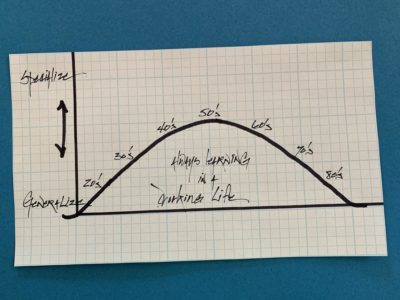 Skill building as we age.
The mantra is always the same however. Adapt, adjust, adapt again, adjust again, and get life to ‘fit’ you, as only you can best do for yourself in continually becoming a better person in life, and a more professional one in your work.
Reading, writing, and ‘rithmetic
Listing different skills isn’t that difficult, not when you’ve studied the work to be done: Managing Basics; Study the Work.
Managers will step in as workplace coaches, and serve their staff best, when they break general topic skills into more specific skills—just as James Clear did in the quote above, breaking ‘writing’ into ‘editing’ while recognizing that writing is actually part of the larger category of communication;
“Communication skills in the workplace can be broken down into three distinct categories: verbal, non-verbal, and written.
Verbal communication is communication that is spoken. However, it gets trickier, as effective verbal communication involves nuances such as the tone of your voice, enunciation, and inflection.
Non-verbal communication is communication that is transmitted and received via other mediums, such as touch and sight. The most common of these include eye contact, hand gestures, facial expressions, and body language.
Written communication is communication through the written word, including handwriting and typed text. Though it seems as if it should be included in non-verbal communication, HR managers like to differentiate here [when screening job candidates], as it is a major part of occupational dialogue.”
—Christian Eilers, Resumé Expert at Zety
Great information, but way too general for the every day working concerns of managers and staff, isn’t it. It’s more useful to look at communication this way;
Communication skills include:
Absorbing, sharing, and understanding information presented.Communicating (whether by pen, mouth, etc.) in a way that others grasp.Respecting others’ points of view through engagement and interest.Using relevant knowledge, know-how, and skills to explain and clarify thoughts and ideas.Listening to others when they communicate, asking questions to better understand.
… all which become much more relevant and useful in practical skill-building.
This is particularly so in our chosen Managing with Aloha realm of values-centered management, wherein we constantly work on value-alignment simultaneously (Key 3), recognizing that values drive behavior—those bullet points above are behaviors, just as all skills are.
For instance, my favorite ‘work habit’ phrase in the Thrive Global list of 7 above, is the “compassionate directness” of number 6., and it naturally leads us to recall the value of Ho‘ohanohano, wherein we’re guided toward conducting ourselves with professional distinction and personal Aloha.
It’s pretty comforting isn’t it, knowing how skill-building, the strengths-management of our Talents/ Skills/ Knowledge, and value-alignment all go hand in hand in fostering good management.
…and a good life: Values Represent the Good in Your Life.
Subscribe to our weekly newsletter:Talking Story with the Ho‘ohana Community.
Preview of Managing with Aloha, Second Edition, released Summer 2016
Managing with Aloha, Bringing Hawai‘i’s Universal Values to the Art of Business


September 15, 2019
Sunday Mālama: Self-development hits home
The ‘home’ of my post title is me, myself and I, and I’m writing this in the hope you start to think about your home-in-self-health that way too.
I had coffee and conversation with a business coach recently, and as we meandered through a myriad of subjects, we landed on talking about different self-development approaches. Here’s my personal take on it.
Self-development can be a big topic, but it doesn’t have to be. Not once you personalize it, and ask yourself, what’s in it for me?
—“What’s in it for me?” is a self-leadership question.
My own approach with self-development has changed over the years, and thank goodness it has.
When I was younger and less work-savvy, I considered self-development to be courses of study—it was schooling. It was going to classes, trainings and workshops. It was attending all the interesting conferences I could afford, or could talk my employer into sponsoring for me—I was in fact, that school nerd who would ask, “do you have a tuition reimbursement benefit here?” when I interviewed for jobs.
A different light bulb switched on for me when I began to study strengths management, and how managers can best groom strength-building in their staff.
Similar to a lot of other things in management technique, you can’t groom strengths in others, without using yourself as a guinea pig first. The best way to learn strength-building theory, is to do it for yourself and learn to apply it by merit of your own experience.
The gist of strength-building, and why it’s universally a good idea for all human beings, is this: your strengths get you to feel stronger. Okay, duh…what does that mean?
Your strengths are your best source of energy, and when you work within your strengths, you work happier, and you work feeling more fulfilled; as a result, you’re more successful.
When you’re forced to work with/on your weaknesses—because we all have those too—it drains energy out of you, it fails to make you happy or satisfied, and it ends up failing you most of all.
Strengths management guru Marcus Buckingham defines a strength this way: “Your strengths are defined by your actual activities. They are things you do, and more specifically, things you do consistently and near perfectly.” He describes the activities of a strength with the acronym SIGN:
S is for Success: Activities you are successful with; they make you feel powerful.
I is for Instinct: Activities you instinctively drawn toward doing; they have an “I just can’t help myself” quality to them.
G is for Growth: Activities which help you grow in happiness, and grow in focus as you are doing them.
N is for Needs: Whereas Instinct refers to how you feel before you do and activity, and Growth refers to how you feel during an activity, Needs refers to how you feel afterwards; you are fulfilled, because the activity just seems to fill an innate need of yours, and you feel restored.
So what does all this have to do with self-development?
My old approach was rife with should-ing: I took courses and such, that others felt would be good for me in some way. We might hit on a strength activity for me, but it was certainly hit or miss, for in focusing on things I knew next to nothing about, usually, the odds were we’d end up focusing on my weaknesses instead.
The right approach with weaknesses, is to steer clear of them. You design your own life, and your own work in the realm of your strengths instead.
I will still sign up for courses, workshops and conferences. The difference is, that I know better now, about choosing to develop my strengths instead of my weaknesses. I know myself better, and hence, I know what to look for in fulfilling my own needs. I only choose to work on my talents, and the skills and knowledge I’ll need to turn my talents into true strengths which continually improve.
—TALENT is innate for us; we were born with it.
—SKILLS are what we’ll learn about the activities we’re talented in, and want to keep doing.
—KNOWLEDGE opens more doors to us which are good for our talents (this is often a context question that helps with framing and relevance).
The majority of what I do however, isn’t in a class anymore. I tackle it on my own, because again, it’s about me, myself and I, whereas classes must be generalized for participants with a random sampling of strengths. I read more, and I watch more TED Talks, because I’ve now specifically chosen the exact subject matter. I have the self-awareness of my own strengths telling me what I need, and what I should indeed be working on.
I also choose my best how-I-work habits as those which give me the definite feeling that I am working within my strengths, and not my weaknesses. An example of a strength-building activity I share here on the blog with you at times, is RFL: Rapid Fire Learning. I do it, and do it without fail at the end of every month, because I know it strengthens me.
I also made absolutely sure, that Strengths Management was one of Managing with Aloha’s 9 Key Concepts, so that the Alaka‘i Managers who enroll in values-centered management, can become stronger, and facilitate strength-building in their staff.
If you’d like to go on this journey of self-development directed by your strengths, I highly recommend you pick up these books, and do the exercises they offer: Be your own curator. Get hardcovers or paperbacks, so you can write your personal strength-finding notes in them, and document your progress!
Now, Discover Your Strengths by Marcus Buckingham and Donald O. Clifton (read this one first; Amazon link)
Go Put Your Strengths to Work: 6 Powerful Steps to Achieve Outstanding Performance by Marcus Buckingham (read this second; Amazon link)
Postscript: Sunday Mālama has been when I will share my off-the-workplace-highway scenic route kind of posts. Not as a normal weekly feature, but whenever they seem to be writing themselves. Sunday Mālama can beg leisurely reading time, romping through a few of our older lessons-learned. These posts can also seem a bit unfinished, inviting you to finish them up for yourselves as you will.
You can access the Sunday Mālama archives via this category link, also residing with my site footnotes. In the vein of what I just wrote above on self-development, I would recommend these:
—Sunday Mālama: Nānā i ke kumu Layers
—Sunday Mālama: Debrief to Recharge your Aloha Spirit
—Sunday Mālama: Are your projects and your ideas in sync?
 Subscribe to our weekly newsletter:
Talking Story with the Ho‘ohana Community.
Preview of Managing with Aloha, Second Edition, released Summer 2016
Managing with Aloha, Bringing Hawai‘i’s Universal Values to the Art of Business


September 11, 2019
MWA Best Practice: Homework for the Workplace
Preface: I’ve asked the Ho‘ohana Community to share their best practices with me, as we tackle our Ho‘omau Kākou initiative on the 9 Key Concepts, and thanks to a project within my current work within Say Leadership Coaching I’ve been inspired recently to share one of my own with you: Assigning Homework.
Labor Day has come and gone, and school-goers, children and adults alike, are back on campus by now for the Fall semester. They shouldn’t be the only ones getting back into the discipline of doing homework—it should be a good practice in your workplace as well.
Approaches to giving homework constantly change in our schools, yet I highly doubt we will ever see it go away completely, for the primary objectives of practice and learning retention are good ones. The changes aimed at making it more meaningful and effective, and much less burdensome are great, for indeed, homework should elevate learning without making it a major bummer.
 The Joys of Homework
Photo by CayUSA on Flickr.
If there are teachers reading:
I am a big fan of flipping the old model most of us grew up with. The flip: old-style homework is actually done in the classroom, with you there to help students work through it when they need help, for you can do so much better than their parents can: We love our kids, and ache when we see them struggle, but we don’t have your teaching skills. With all the digital possibilities, and techno-habits kids prefer anyways, give them the lecture online for home viewing. Turn them onto resources like the Khan Academy and TED Talk videos. Have reading and other without-you-there assignments be the homework which is actually prework. I would imagine that this will give you less papers to grade as your solitary homework too!
Homework for the Workplace
The assignment of homework can facilitate the development of staff over and above their everyday work, so that the answers to questions like these get revealed in real-work, highly-relevant workplace scenarios:
—When are you expected to work with your manager on projects?
—Where does your individual ownership give way to partnership, and to the team dynamic?
—Over and above the day-to-day focus within the work which is done, what are the visionary, mission-driven possibilities elevated in the near future, and how do you engage with them?
—How do mavericks grow in your company? How are internal leaders identified and supported? How do your best ideas gain support, and then attain traction and velocity there?
These are the kinds of questions which every healthy workplace culture should have definitive answers for, answers which are aligned with the values that company stands for, particularly in the tertiary learning process. Your “definite answers” should be your past success stories; “This is how we’ve done it well…”
WORKPLACE HOMEWORK is the means by which assignments are made after any and all kinds of workplace training, with three specific objectives in mind:
1. The training must live on in workplace culture: It must be implemented and executed so there is continual improvement with standards, and with all-staff competency levels. Forward movement happens with immediacy and a positive expectancy. Initiative must be encouraged without regimented rule-making getting in the way. The follow-up message is clear: Training classes are never, ever a waste of time and energy.
2. The deliverables which result from training are participatory, where the initial class or workshop series was considered a launch: All stakeholders are involved, even those who hadn’t initially received the training, i.e. follow-up is Kākou, with the Language of We. For example, if the training was part of a problem-solving strategy, all who were effected by that problem must now participate in the strategy to solve it.
3. Staff steps up and takes ownership. Trainers and managers step back: Staff, particularly emerging internal leaders, get options they can sink their teeth into as they take the ball and run with it. Trainers and managers step back and let go, so they can focus on whatever comes next. They no longer own the training, however they continue to be the mentors, coaches and facilitators who lend support and encouragement.
 This is NOT what the MWA workplace version of homework looks like (or feels like):
 It is NOT pencil-pushing.
It is NOT isolated, and it is NOT handled alone.
So what does MWA Homework entail?
Mostly conversation. Conversation that includes everyone necessary, and expects tangible results—conversation which will lead to action.
As a MWA best practice, homework is largely about follow-up work done via crucial conversations. Homework assigned after training happens is successive, and the 3 objectives outlined above are achieved via debrief conversation, additional findings which inform good decision-making, enrolling others in compelling initiatives which result, and the making of fresh workplace agreements which lead to enhanced workplace standards of performance.
A mouthful, I know… Let’s take those one at a time: All are meant to bring people together in work which does not rest on its laurels, and takes nothing for granted—all work is on the table to be newly studied and explored, in a participatory way. Read those objectives above one more time before you read on.
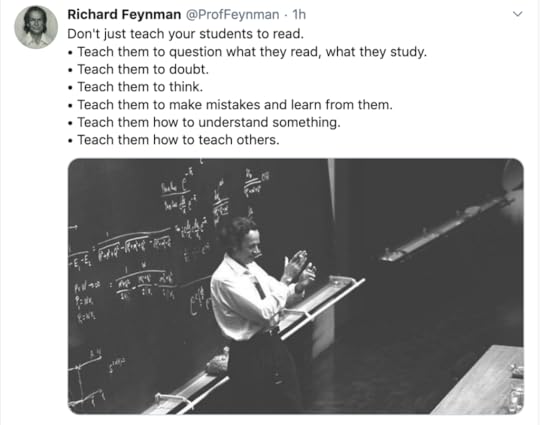 Richard Feynman (1918-1988) was a Nobel Prize-winning American physicist, particularly known for his contributions to quantum physics, quantum electrodynamics and particle physics, as well as quantum computing and nanotechnology.
Let’s say a training was just conducted with your staff on Customer Service—In SLC for example, our Services include a workshop on the 5 Elements of Ho‘okipa, the value of hospitality. We also offer a 2nd workshop on dealing with ‘challenging’ customers, which includes tips on problem solving with the customer relationship in mind. When we debrief the training with our clients, i.e. the managers charged with implementing the training, we give them some Train-the-Trainer tips, and teach them this process of successive homework:
HA1: Follow-up Conversation
“debrief conversation”
Homework Assignment #1 is to have a follow-up conversation with everyone who attended the training, or should have—they missed it for some reason, and must be brought up to speed. You meet in smaller groups, often departmental, conducive to engaging conversation. What did they like, or not like about it? What questions came up for them, which they may not have had the opening to ask yet? What intrigued them most? What do they feel is adoptable and adaptable, and a good idea for the organization? Where would they like to start?
The deadline for completing this assignment should be no more than one week after the training. Often, the manager(s) charged with holding these meetings need to compile them, and debrief even further, to make decisions on what they will specifically tackle as a result, and their best-possible operational timelines.
Homework Assignment #2 is given next, with a new deadline.
HA2: Finders Keepers
“additional findings which inform good decision-making”
Homework Assignment #2 is the fact-finding mission relevant to the decisions reached after Assignment #1. Were obstacles or any concerns brought up in the debrief conversations, and do they need to be addressed? The objective here is to study the work as it presently happens, look for specific opportunities inserting the new training, and to make sure there are no “Yeah, but(s)” as you proceed.
Related Reading: Managing Basics—Study the Work, and Banish your Possibility Robbers.
Again, this homework entails collaborative conversation as well. The best managers are supportive finders, not those who dole out quick answers. They treat decisions as catalysts for whatever work can happen next, and don’t consider their decisions to be pronouncements. They value trying, and they value doing, because they foster the workplace environment of Ho‘ohana: People Who Do Good Work.
Delegation may already be kicking in here in the manager’s objective to “step back” and this process of Finding can often happen simultaneously to fresh relationship-building, and the partnership of “enrolling others in compelling initiatives which result” which comes next.
A deadline is again important here, to keep energy levels high, and to send the message that “follow-up is indeed happening!”—and with a sense of urgency to boot.
HA3: Partnership
“enrolling others in compelling initiatives which result”
Homework Assignment #3 is two-fold:
First, it is about assembling a committee or task force as a new team, a group charged with taking this off the manager’s plate, and onto theirs. A new team might not be necessary, and it’s just a matter of moving down the chain of command in organizational structure.
Tip: Going through this successive homework process with a key training initiative is an excellent time to create an internal group of company Trainers if you do not yet have one.
Second, comes enrolling everyone else into the initiative being staged for execution. This is aimed at a complete understanding of your “Who”—who will be involved, and who will be affected?
Customer Service initiatives are a good example: Who is the customer? Are there different customer profiles to be addressed? Is there one initiative for internal customers (each other, all staff), and another for external customers (customers, clients, patients, patrons, vendors, suppliers, other community partners)? Is another deadline necessary here to be sure efforts are aligned in lock step, and no one feels left out?
HA4: Fresh Agreement
“the making of fresh workplace agreements”
Hopefully, you’re on a roll here, but please do not neglect to address this, as your next Homework Assignment, #4. “The making of fresh workplace agreements” is so important.
People often need time for individual planning, and for crossing their T’s and dotting their I’s before they wholeheartedly commit to new action. They clean their plates, and intentionally make space for your initiative. You have to give them this time, understanding and consideration, yet you also must give them another deadline—one everyone will honor.
Related Reading: Your Responsibilities—Kuleana Joy or Clutter?
In the instance of something like Customer Service, elevated service should be getting delivered as soon as training had happened, and the Partnership step above should entail a whole lot of catching success and celebrating your customer service stars and value ambassadors. However with other initiatives, those requiring systems and processes integration, you may need to have a launch date, pilot project, or other “go date” so no one is caught unaware or less than ready.
HA5: Elevated Competency
“enhanced workplace standards of performance”
I coach managers to adopt a relentlessly dedicated respect for competency as one of their primary missions—the continuous improvement of staff competency is their job, and it’s the target of all training, whether for skill-building, increased intellectual capital, or performance standards.
Therefore, it’s good to articulate and quantify your training as a new standard, or newly revised benchmark for your company and workplace: When you say, “We did it!” or “We’re doing it, and we’re doing it well!” What do you mean, exactly? Is there a specific way you can add it to your insider’s language and Language of Intention?
“When we say, Speak with Aloha, we mean, Get the values of Aloha into your language and all your communications. Talk the talk.”
—Managing with Aloha’s Lexicon Morphology, and the Conceptual Index we have created as our Resource.
This can often mean embracing the word ‘standard’ as a good thing, and moving beyond thinking a standard is a rule. It’s better to think of it as part of a checklist, and as a necessary ‘element’ of what you do. In some instances, step-by-step execution is critical, yet in others, like Customer Service, increased competency means there’s more flow involved… more repeating, more back-and-forth conversation, more pausing for listening and responding.
Remember: Follow-through is the manager’s super power.
… and utilizing the assignment of meaningful, process-improving, relationship-building, competency-lifting homework is the way you follow-through with training. Add it to your best practices.
Related Reading:
—Make Follow-through your Superpower!
Whether you call it Follow-up or Follow-through, great managers get it done as their Ho‘ohanohano signature of distinction.
—Debrief to Recharge your Aloha Spirit
Our discussion here has focused on group and team debriefings, and this article talks about the goodness of the debriefing practice on an individual level.
More on Training in the Archives:
— Your In-house Training: Do it!
— When the Student is Ready, the Teacher will Appear. “Whatever it is you want to do, find the person who does it best. Then see if they will teach you.”
MWA Best Practices will be a new series here on the blog, written in complement to my Series 3 for Ke Ola Magazine, Ho‘omau Kākou. Watch this space for more best practices in managing with leading, or better yet, subscribe to the weekly letter of the Ho‘ohana Community for alerts.
Subscribe to our weekly newsletter:Talking Story with the Ho‘ohana Community.
Preview of Managing with Aloha, Second Edition, released Summer 2016
Managing with Aloha, Bringing Hawai‘i’s Universal Values to the Art of Business


September 8, 2019
Culture in the Making: How Grass Roots Movements Happen
Management is about getting things done through other people; it doesn’t get any more basic than that.
You will best get things done through others by incorporating the values you share with them, values which embrace collaboration, and values which are fundamental good practices in the business environment.
Aloha is the most universal value of them all: Aloha is the rootstock of every other value we will learn about.
—From the Introduction to Managing with Aloha
It is Day 57 of the Kia‘i occupation at Pu‘uhuluhulu as I write this, and I’ve made a shift in my attentions to it. I’ve gone from learning more and taking a stand on the issue itself (though the learning is certainly continuing), to observing Kia‘i behaviors more closely in regard to the creating of a grassroots movement.
(The Kia‘i are the self-described ‘protectors’ of Maunakea.)
My fascination is growing, for we can rightly call this culture in the making.
Merriam-Webster defines grass roots as;
1 : the very foundation or source
// You must attack the problem at the grass roots
2 : the basic level of society or of an organization especially as viewed in relation to higher or more centralized positions of power
// was losing touch with the party’s grass roots
I still get distressed at the divisions I’m seeing in Hawai‘i now, for I hold strong to my hope Aloha Kākou and Pono will prevail and heal us, however the researcher and history buff within me is getting reawakened, given my ho‘ohana as a workplace culture coach.
I don’t agree with all of their messaging, and it bothers me when untruths are spread, however I must say I am very impressed with how the Kia‘i have fostered a grassroots movement centered on the reawakening of their ethnicity.
Some insist this is not a reawakening, for they’ll doggedly point to their longstanding cultural oppression under Hawaii’s colonization since the overthrow of the monarchy. Yet none of us lived back then, and this is indeed a new flashpoint for many who know the history and are dismayed by it, but will admit past ‘suffering’ is not what drives them now. Stories of individual enrollment in the cause are many, such as this one in Civil Beat (they are doing an outstanding job covering this):
Three Young Protesters, Three Different Paths To Mauna Kea
“They all felt stirrings of Hawaiian identity as youngsters, but these three protesters were shaped by pivotal experiences as young adults.”
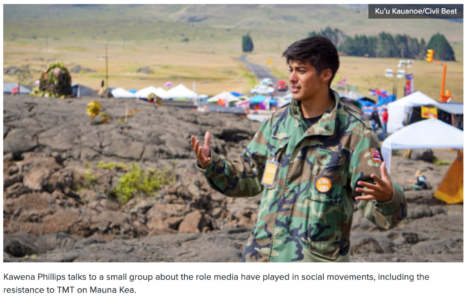
As you might imagine, I’ve been watching the values in play, and how they are articulated and shared. Their uniforming is but one example: Traditional Hawaiian garb is mixed in with modern-branded T-shirts and caps, and people drape themselves in flags, while ‘commercial colonialism’ is severely frowned upon; people are careful to only buy merchandise where 100% of the proceeds go to furthering the movement.
I’ve been listening to the ‘Language of We’ develop, in the exceptionally smart use of modern media (as with the hashtags in the screen grab below) and in their precise balance of still-dominant spoken English, and carefully selected diacritically-correct Hawaiian words in the communications chosen to be spreadable. Among all players, the Kia‘i control the narrative.
Two days ago, the Kia‘i movement was able to add the desecration of the Hawaiian flag to their core message of stopping the desecration of Maunakea, courtesy of the way the state handled the dismantling of an illegal building constructed at Pu‘uhululu—the State acted within their rights, but did so badly.
Respect for a flag should be held by everyone, and it was certainly disrespectful to use the Hawaiian flag as a barricade, nailing it in place with 2 by 4s, yet that has been overlooked;
 No matter what side of the #Maunakea issue you’re on, @puuhuluhulu
is giving a master class on grassroots organization and social media messaging. @TMTHawaii has improved, but @GovHawaii and @MayorHarryKim
and their teams continue to fail—even when factual truths are on their side.
I’ve been watching the Kia‘i brand of leadership. It’s been hard to individualize it most times, for there is no single leader or spokesperson, yet leadership is unquestionably in play within this movement.
As history has repeatedly shown, ego is remarkably missing from strong grassroots movements: there are leaders, but they’re fine with working within their own circles of influence and not being ‘the’ leader—they prefer it that way, in fact, and understand it is much more effective.
When you want significant change to happen, you must create a tribe, rally your troops—strategists, generals and warriors alike—and build an army: You cannot do it alone. You must find people who are passionate, who are driven by your mission, and who will put in the time and personal expense to advance that mission.
Shared leadership gives individuals the opportunity to duck under cover when they need to recharge. Shared leadership shares the burden of it, so those feeling stronger at any given moment can step forward and seize the reins. This passage in Managing with Aloha comes back to mind:
There is a saying we have in Hawai‘i that has been attributed to King Kamehameha when he spoke to his warriors before the fierce battles it took to unify his island kingdom. He asked them to remember that as long as they were Lōkahi, they were unified in their cause, and Kākou, they remained together as one in the battle, they could not easily be defeated.
The saying was, “Hāpai ka pōhaku aka mai hāpai ke kaumaha.” which means, “Lift the rock, but not the weight; don’t carry the burden.”
When all of us are together, and all hands grab hold of a boulder, it does not take as much individual effort to move it. The weight of the rock is the same, but it is not as heavy.
The burden is no longer too great to bear, for no one person alone need do so. We are Kākou, we are all together, and so we lift together. Any burden can be lighter if we tackle it together.
There is a lot of teaching going on in this brand of shared leadership, and learning is thriving.
One of the beautiful things happening now is the renewed reverence for the kūpuna, the elders. It’s not necessarily because of what they know, but because they are older and have seen so much in their lifetimes; there’s recognition of that value, and appreciation when they speak.
Learning need not include personal suffering, and the victim mentality still prevalent in this movement isn’t necessary however; there is much to learn about the Hawaiian culture, and tapping into its richness is more than enough. The kūpuna have much more experiential learning to share—and they are. Elevating Kapu Aloha, as the message which unifies the kūpuna as it regulates the behavior of the movement, has been a stroke of genius; it has even inspired the publishing of a Wikipedia page.
As they speak now, the kūpuna are simultaneously raising more leaders in the ranks of the youth, and youth of all ages, including adults-in-age who are newly learning their own Hawaiian culture.
 Instagram image by Jimmy Clark aka @singlefinner
This is an interesting read, on how prayer and religion factor into this movement: In Hawai‘i, ‘protectors’ fight telescope project with prayer, Jack Jenkins for Religion News Service (RNS)
I don’t agree with all tactics, and no movement can be perfectly executed when many leaders are involved and passions ignite, however this movement is certainly one to watch. We managers can learn a lot by watching these events unfold and applying them to the fledgling movements within our workplaces we want to support and encourage.
Related Reading:
RFL: A Serenity Prayer for MaunakeaGot Passion?In Culture-building, Start with CommunicationLanguage of Intention Feeds the Culture BeastFrom Internal Chatter to Language of IntentionThe ‘Ohana in Business Starts with “Why?”
Subscribe to our weekly newsletter:Talking Story with the Ho‘ohana Community.
Preview of Managing with Aloha, Second Edition, released Summer 2016
Managing with Aloha, Bringing Hawai‘i’s Universal Values to the Art of Business


August 29, 2019
RFL: A Serenity Prayer for Maunakea
We do not see things as they are. We see them as we are.
You make the choices which affect you most, and I would argue, are much more important in the grand scheme of things. The Serenity Prayer advises us well;
“Lord grant me the serenity to accept the things I cannot change,
The courage to change the things I can,
And the wisdom to know the difference.”
Here is my RFL for August, 2019:
The month has been a roller-coaster, and I need to preface my RFL list of 5 learnings with a bit of introduction.
I’ve never been one to shy away from taking a stand, even when they are controversial, and I risk knocking my life off-kilter a bit. I did so when Donald Trump was elected president, and most recently, I did so on July 18th: TMT and Hawai‘i—Where do we go from here?
That last one was published just 3 days into the Maunakea controversy, and it kicked up a storm of conversations for me in a variety of different places, online and off. Most have been respectful, a few were downright ugly, as can happen with controversy. Many of those respectful conversations continue, yet to be honest, even when respectful, controversial conversations are exhausting. I think about them, sleep on them, say the Serenity Prayer, and think about them some more long after the conversation itself has ended.
However, I still believe in taking a stand as a practice of clarity and courage.
Clarity, because you’d best reflect on your values, and think things through as completely as you can before you take a stand publicly. In doing so you learn more about an issue, and hopefully, will break away from any cognitive bias keeping you from being more thorough in your learning. You can learn about yourself as well. Hopefully, the stand you take is all about you, without a trace of ‘should-ing’ attached to it as your unauthentic burden. Taking a stand is an exercise in speaking up for your values, in asking good questions, in listening well, and in decision-making.
Courage, because controversy has a way of leading to confrontation once you put yourself out there and let others know of the stand you’re taking. You have to be willing to go the distance in seeing disagreements through to a good resolution, even if some prior relationships get altered or broken, for many times they will get strengthened, especially when unconditional Aloha for each other is in play as well. If not, you should have kept your stand to yourself, to be satisfied with having reached your own clarity, at least, or for the time being.
As Pico Iyer has noted, “The more we know about something, the less we’re likely to start lecturing about it. We can allow it the space and privacy that we don’t permit to what has not been properly assimilated.”
I lose count of the number of times I’ve wanted to publish an update to my July 18th letter, mostly to offer even more clarity, but primarily because my stand has changed as the Maunakea stalemate has continued. I know I will rile up a few who want me to stand firm with what I previously wrote, but my investigations have given me a better clarity: After learning much more about both environmental and cultural concerns, I now support TMT and believe it should be built, though with changes to the observatory decommissioning process, and with changes to how the mountain is protected and shared.
That’s become the operative word for me; SHARED. I’ve done a lot of soul-searching on two values I hold dear; ALOHA and KĀKOU.
I wrote about how each of those values are about sharing the Hawaiian culture throughout Managing with Aloha. I speak about that sharing, and teach it ALL THE TIME, and it bears the weight of my professional footprints. I must be true to my values.
I feel I have done an extraordinary amount of research and due diligence on this issue, to the point of my closest conversationalists about it saying, “Enough already!” I have also been reaching out to the other kūpuna I had studied with before Managing with Aloha was published (sadly, my then-kumu Dr. George Kanahele is no longer with us). Interestingly enough, every one of them so far feels the TMT project should be allowed to continue.
I’m holding off on publishing a more extensive update because this whole situation is far from over, and remains explosive and still-developing, yet I have come to firmly believe there is an ‘and’ solution to how we use Maunakea, celebrating the mauna with utmost respect and not desecrating it, wherein Aloha Intentions can prevail and be fostered. My weighing of the possibilities continues, and I don’t want to be premature in what I now say about it beyond what I just wrote above for you.
 Because some things are meant to be, and LEARNING is one of them.
I will however, reflect on the process of what I’ve learned so far via Managing with Aloha’s Rapid Fire Learning practice, for that’s the third thing about being willing to take a controversial stand: You’d best learn from it.
Learn more about the RFL process here: Rapid Fire Learning.
Sample others I have published here: The RFL Index.
RFL: The Maunakea Edition
ONE:
Good timing counts for a lot in leadership.
When should you be expedient in your decision-making (and decision declaring), and when should you bite your tongue and take the time to learn more?
Sometimes it is very useful to share your process of thinking things through with others: Austin Kleon calls it being a process nerd; he wrote a book about it called Show Your Work. Other times, it’s best to wait as you deliberate more fully. As one example, though I think he may be overly generous with this, Hawai‘i political commentator Stan Fichtman wrote a very interesting post about Governor David Ige “playing the long game” with Mauna Kea: Ige and Gerald Ford.
Bringing this back to my learning, my July 18th letter was very much a part of inviting my Ho‘ohana Community into the process of my thinking as the Pu‘uhuluhulu occupation had begun. Now, I’m playing the long game, and even I’m curious in how much more patience I can have!
This quote has helped me take pause: I printed it out and taped it to the cover of the laptop I normally publish from: “You don’t edit as you write; your goal is let the words flow so you have something to work with and strengthen. With leadership, it’s the opposite. You can’t vomit your worst all over people and expect them to stick around while you massage your message to strengthen it.”—Leadership coach Alli Polin
TWO:
When you’re willing to be wrong, a wealth of new possibilities can present themselves.
The solutions we have in mind become the result of whatever we consider to be the root causes of the problem we’re grappling with, and looking for a solution for. Redirect your thinking, and change your mind on those root causes, and possible solutions change.
In reference to Maunakea, I very purposely would shift conversations away from sovereignty and self-determination for Hawaiians initially, wanting instead to focus on the issue of desecrating a sacred place and Aloha ‘āina. It was never about science versus religion for me, though I found, and still find those conversations rather fascinating, and in entertaining them I learned more about the TMT project in particular, and its associated environmental facts and myths.
As time went on, and more conversations ensued, talking about sovereignty and self-determination became unavoidable—and necessary to assuring my full comprehension of what’s at stake here. Much as I support the Hawaiian culture, issues involved with sovereignty have not been conversations I enjoy, because I grapple to understand the wisdom of ‘the end game’ in many respects; I feel a sovereign nation must be ready with a self-sustaining economy to feasibly support itself and care for its people well. Yet in avoiding those conversations connected to Maunakea, I came to realize I was spinning my wheels in refusing to talk about self-determination as the real root cause in play here.
Part of my due diligence on the issue, dove back in to recalling the self-determination efforts of 2014, studying this article and others: Native Hawaiian ‘Aha Adopts Constitution for Self-determination.
THREE:
This one has hurt, I admit, but it is what it is: Ethnic sensitivities have ramped up considerably since I wrote Managing with Aloha, placing it in an unexpected cross hairs.
Protecting Maunakea has become a tipping point for the swelling nation-building efforts of native Hawaiians. The Hawaiians who call themselves Kū kia‘i mauna protectors and those within the ‘aha of self-determination and the Lāhui (Hawaiian nation), solidly and emphatically reject sharing their “we belong here” Hawaiian identity with residents of Hawai‘i who are not the descendants of the aboriginal Hawaiians. It does not matter how long non-ethnic Hawaiians and their ancestors have lived here and made Hawai‘i their home too, even when those roots predate the overthrow of the monarchy and statehood. Therefore, Hawaiians today solidly and emphatically reject this passage in my book as they find their own, modern voice:
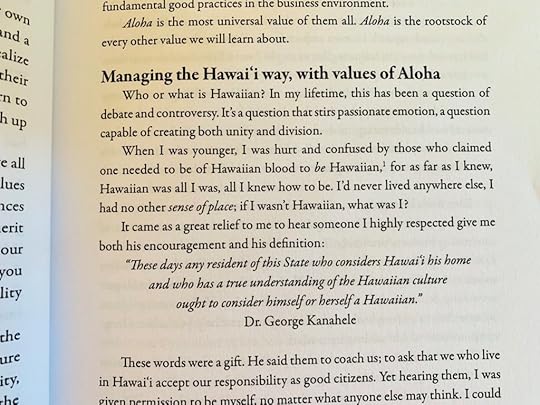 From the Introduction to Managing with Aloha
That passage is sixteen years old now, and the mood has shifted. People do get upset when I talk about sharing Hawai‘i and they feel justified in rejecting Kākou within this issue. The fact that the words I quote are Dr. George Kanahele’s, a native Hawaiian scholar and historian, and not my own, is a fact that holds no weight—his words may have been acceptable before, but not now, as modern nation-builders stubbornly speak of Pono as righteousness and not as rightness and balance (as I do in Managing with Aloha).
As an informational point here, Hawaiians are aboriginal to Hawai‘i and not actually indigenous, for they came from the Marquesas and/or Tahiti and arrived at Hawai‘i in those two migrations. The more important point for them however, is that they have nowhere else they can claim as their home except for the Hawaiian Islands, and they expect acquiescence from the rest of us so that can happen.
I’ve never claimed to be Hawaiian in my ethnicity, just in my residency, and have done my best to be honest and authentic as a 4th generation Hawai‘i resident who is not ‘of the blood’ but has learned much about Hawaiian values. Living in the Hawaiian Islands is the only life I can truly say I know, yet that’s not where the hurt is for me, for I love my own ethnic ancestry as well. The hurt has been in the insistence within this controversy, that if you are not a “true Hawaiian” in bloodline you have no voice in the matter, none—that is the first part of our ‘acquiescence to justice.’ Your kuleana doesn’t matter, even if you are an ally and supporter, for you are still “a foreigner” despite the length of your residential ancestry (my ancestors migrated here in the 1700s).
I can accept the definition of who ‘a Hawaiian’ is ethnically, but I cannot accept the rejection of Kuleana, Aloha, Kākou and Pono, for they are Hawaiian values.
Non-Hawaiian residents should not be regarded simply as “foreigners” or “illegal settlers” since the monarchy was overthrown. That overthrow was wrong, no question about it, but non-Hawaiian residents in Hawai‘i today deserve a voice in Hawai‘i issues—exactly which ones may be up for debate, but for goodness sake, let’s extend more aloha, dignity and respect to each other.
FOUR:
That said, I’ve learned quite a bit about being an ally, though it may currently be said to put non-Hawaiian residents in their place more often than not. Here is a good article which was shared with me, which was published by Amnesty International: 10 ways to be a genuine ally to indigenous communities.
Click in above for the detail to this list:
1. Listen to, and follow the community.
2. Centre the stories around community.
3. Know the historical and cultural context.
4. Never show up empty handed.
5. Always seek consent and permission.
6. Be responsible for yourself.
7. Know when to step back.
8. Saviors are not needed, solidarity is.
9. Be mindful of others’ time and energy.
10. Do no harm to the community.
I think this advice goes both ways in regard to allowing people their dignity, and assuring civility in discourse. Reality however, usually requires that the non-indigenous and/or non-aboriginal person have the larger dose of humility at first, much larger. Yet it remains my belief that at some point all relationships and ‘cultural brokerages’ in today’s world need to accept our connectedness and prospects of co-living cooperatively (Lōkahi). We can arrive at a win-win vision, where sculpting our future together acknowledges and embraces the fact that we will still have to live together, and will indeed benefit from that synergy. …yes, I am stuck on Kākou, for living on planet Earth is not a solo proposition. We learn from our histories, but we don’t continue to dwell within them.
FIVE:
In being “stuck on Kākou” I dug back into my research old and new on EDI: Equality, diversity, and inclusion, and I serendipitously stumbled upon these distinctions from Dr. Max Liboiron, urging us not to conflate inclusion with diversity. I like what she writes; the three quotes which follow, including the photo caption, are hers;
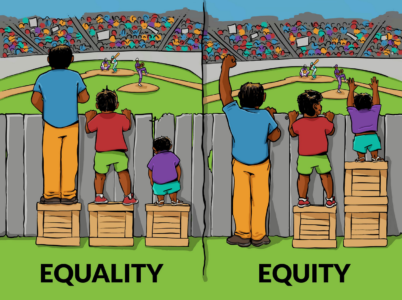 “Equity means fairness given difference and usually is about allocating resources and mitigating discrimination (right). It is different from equality (left), which means treating everyone the same (a form of fairness) and/or the freedom to act unhindered by crappy society.”
“Diversity means difference. It’s all those categories: disability, age, gender, race (or “visible minority” in Canadian labour law), country of origin, LGBTQ2+, Indigenous peoples…. Diversity without equity or inclusivity can be really crappy.”
“Inclusion is about creating environments for equity and diversity to flourish via respect, accessibility, removal of barriers, etc. It requires plans, reflexivity, learning, humility, etc. So do the other ones, but conflating inclusion with diversity is something I see a lot of.”
I give Maya Angelou the last word here, on Identity: “You may encounter many defeats, but you must not be defeated. In fact, it may be necessary to encounter the defeats, so you can know who you are, what you can rise from, how you can still come out of it.”
And there you have it; my RFL for August 2019.
There was more, but one of the things I love about our RFL practice, is how it gets us to condense our learning, and reflect on the biggies. I am also doing my best to practice number ONE in regard to the timing of leadership voice, and sharing one’s views—for now, these will only be published on my own blog. There is certainly more to learn, and weave in as this controversy continues, for I do believe we are at a significant inflection point and tidal shift: Sovereignty is still a long shot I think, but self-determination for Hawaiians may be inevitable… will it happen in our lifetimes?
Your turn: What is your Rapid Fire Learning for August?
Postscript: You may have noticed that I have switched to using Maunakea in my reference to the mauna, as does Ke Ola Magazine and others. Maunakea as a single word has been suggested by the UH Hilo School of Hawaiian Language. While Mauna Kea means “white mountain” and works as a description, Maunakea is now used by UH, the Office of Maunakea Management and the Hawai‘i Board on Geographic Names as it recognizes the name ‘Ka Mauna a Wākea’ in Native Hawaiian legend and tradition.
Subscribe to our weekly newsletter:Talking Story with the Ho‘ohana Community.
Preview of Managing with Aloha, Second Edition, released Summer 2016
Managing with Aloha, Bringing Hawai‘i’s Universal Values to the Art of Business


August 22, 2019
Managers do Design
Caught sight of this image on social media:
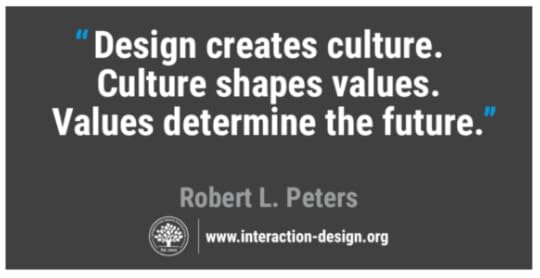 The IDF mission:
“We democratize learning by providing top-quality, online design courses
at a fraction of the cost of traditional education.”
I clicked in to find it was that day’s entry into The Daily Design Quote they do, and there was no article that went with it.
Quotes are often shared to inspire us, in the hope they’ll move us toward positive action—I share them with you all the time as well! So here’s my take on this one, from a management perspective.
Managers are designers too:
We design and “create culture” as well, for “Great managers know that CULTURE is simply a group of people who share common values, and operate within those values.”
—Language of Intention Feeds the Culture Beast.
—In Culture-building, Start with Communication.
We absolutely, positively know and can attest to “culture shapes values” as a fact of our work as managers. We often speak of it happening conversely, when values shape culture with founder values and conceptual values shaping and informing the workplace cultures we seek to build.
—The ‘Ohana in Business Starts with “Why?”
The statement “culture shapes values” complements culture-founding with culture-building: A founder’s or business owner’s values become the shared values of all stakeholders.
—Golden Rule Management.
—Kākou Communications and Our Tribe.
The statement “values determine the future” is, in essence, what Managing with Aloha is all about—it’s the essence of what we do as Alaka’i Managers. We manage knowing values are exceptionally good in the guidance they give us with inspiring and informing the visions we create. We also know that vision is about visualizing our future and getting it to happen:
“Your MISSION is what you do best every day, and your VISION is what the future looks like because you do that mission so exceedingly well.”
To sum it up, be that manager/designer!
Design to create good workplace cultures.
Foster healthy workplace cultures which promote meaningful values as shared values.
Own your values and represent them well. Create the future we want and need through the practice of value alignment. It’s the ethos of the Alaka’i Manager: Ethos—Be true to your values.
Subscribe to our weekly newsletter:Talking Story with the Ho‘ohana Community.
Preview of Managing with Aloha, Second Edition, released Summer 2016
Managing with Aloha, Bringing Hawai‘i’s Universal Values to the Art of Business


August 19, 2019
My Vision of A Living Wage
There were a couple of different reasons I left the hotel industry to work for the Hualalai Resort at historic Ka’ūpūlehu back in 1996. It would be a big change for me, for I had been employed by a hotel for 22 years.
One, was that I felt the business model of the hotel industry was seriously, and irreparably broken: It made money for hotel owners and a few executives (not even all of them), but not for the rank and file who assured the hotel operated, and who gave customers the “Aloha-filled customer service” those owners and executives marketed.
In many instances, the hotels I had worked for gave back to the community, but I wondered if it was sincere or simply more marketing, for shouldn’t a business operation take better care of the people it employed first?
Hualalai was offering me the Director of Retail position when they recruited me, and here’s what sealed the deal: They told me what my retail clerks were getting paid.
Hualalai retail clerks received nearly double the hourly rate of their hotel-employed counterparts because “it’s the right thing to do; they need to make a decent living just as much as anyone else does.”
I hadn’t yet heard what they would pay me; I didn’t have to before knowing I’d already made my decision to join them.
* To be clear, Hualalai focused exclusively on real estate at the time, as a resort development firm which owned the hotel on their resort as a separate holding; the hotel was managed by the Four Seasons. The business model of the resort differs today.
 Every once in a while I like to resurrect the ChangeThis manifesto I wrote for Managing with Aloha in 2004; it keeps me grounded: ChangeThis: Revisiting the manifesto.
A business without a valid business model isn’t just a business without a good roadmap, it’s a business without a conscience. Your intentions within your vision—good, values based intentions—are everything.
Our current value immersion in the Ho‘ohana Community, is on Ka lā hiki ola, the value of hope, optimism, and promise of tomorrow. Ka lā hiki ola is “the dawning of a new day.”
What would “the dawning of a new day” in the world of work really, truly be?
Dust off your vision. Revive it, or create a new one.
When you’re in business, you have to dream.
You have to practice indulging in what we call “having a vision” in biz-speak.
It’s a 2-value practice:
—in Ka lā hiki ola, “the dawning of a new day”
and
—in ‘Imi ola “seek your best possible life.”
My vision for the working world today, is very much the same as it was a good decade or so before I wrote Managing with Aloha if I’m honest, for we haven’t made enough headway with it. That means it’s roughly thirty years old or more.
That doesn’t mean I stop thinking about it. How old it is doesn’t matter. What matters is if I give up on it, or keep pushing for it.
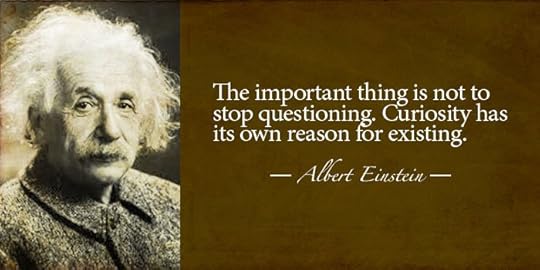 Einstein shares a good tip, in that one must remain curious about their vision, and why it hasn’t happened, at least not yet.
So I keep thinking about it, and keep theorizing on how it can become possible. I keep dreaming about it, and I keep scheming to make it a reality.
I’ve actually made my work-life vision a reality for my personal and professional world, but I keep dreaming and scheming because I want it for everyone else too.
Vision keeps HOPE alive and well.
Here’s my vision:
Everyone who works, gains a living wage: Their earnings sustain them in a good life.
A business model is not valid or feasible, unless a living wage is what it creates and sustains for everyone involved with that business.
Service jobs are admirable, appreciated and valued by others, and worth having because they earn a living wage too.
There is no “paying your dues” or “working your way up” into a living wage: You get it upon hire with every job, in every career, in every business model whether for-profit, non-profit, public or private sector. You even get it if you’re hiring yourself in an entrepreneurial, self-employed model—ignore the Shark Tank VCs who say otherwise.
Am I dreaming? Oh yeah, in today’s world I am, but that doesn’t mean it has to be this way. We can change the world one business model at a time: The Alaka‘i Benefactor: Sharing in the ‘Ohana in Business.
You with me?
A living wage is a ‘one job is enough wage.’ It is an equitable wage that is high enough to maintain a normal standard of living in your community, ‘normal’ meaning decent, dignified, and worth the work required.
Imagine if everyone had one.
You’ve heard all of this from me before. I’m bringing it up again because I’ve plugged back in. Fresh back from some vacation time, I’m tuning in to the machinations of the world again, and I don’t like what I’m hearing. Wish I was back in my vacation cocoon where my ignorance was bliss, but then again, worthwhile work is worth fighting for; it’s what Managing with Aloha is all about.
The cyclical nature of recessions is part of business talk now, and it’s reminding me of something I don’t want to see happen again: 2009 was a very, very tough year. High school and college graduates couldn’t find work in fields they’d hoped for or studied for. They got less picky as time stretched on, as they discovered there might not be any work at all for the time being.
Businesses “cut back” and people got laid off. Those who were still employed started to suffer from “survivor’s guilt” and put up with bare-bones business practices they shouldn’t have had to endure. Decent, ethical, should-be-normal / should-be-affordable culture-building practices like basic quality training programs fell to the wayside, and it took us several years to come back from their absence.
Government stepped in with “bail outs” that should never have had to happen (and I wish they hadn’t.)
Wikipedia Reference Links;
—TARP: Troubled Asset Relief Program
—Bush Bailout: Emergency Economic Stabilization Act of 2008
In terms of wages, we haven’t come back and we didn’t progress. Our legislators and congress people argue with business lobbyists about a minimum wage and scoff at the idea of a living wage as having one’s head in the clouds.
Broken business models have a way of being exponentially broken, and it’s not just when the economy tanks. Their markets succumb to what’s called “structural” inequities in articles like this one:
“The idea that taking our jobs or doing jobs we don’t want sort of individualizes the problem and pits workers against each other,” Stuesse said, “when in fact the incentive for employment of undocumented workers are structural and they have to do with the inequalities created by the global economy, with the fact that we allow capital to move freely, and labor can’t.”
—ICE raids cause labor decline in sector already seeking to fill thousands of positions, a Mississippi Today report
Huh? Blame game double-speak if you ask me.
I just can’t accept that, or that a living wage is unrealistic. I dream, and I persist in penning business visions, and I will continue to enlist your help.
Dream with me. Take action with me. We can do so much better.
Subscribe to our weekly newsletter:
Talking Story with the Ho‘ohana Community.
Preview of Managing with Aloha, Second Edition, released Summer 2016
Managing with Aloha, Bringing Hawai‘i’s Universal Values to the Art of Business


April 28, 2019
Sunday Mālama: Nānā i ke kumu Layers
Sense of Place and Time:
It’s the last Sunday of April 2019, the 2nd month of a value immersion we devoted to Nānā i ke kumu. This is a Sunday Mālama edit of the wrap-up I offered in our Ho‘ohana Community newsletter;
Nānā i ke kumu Layers
Let’s start by revisiting our basic refresher on the value of Nānā i ke kumu from Managing with Aloha:
This is the value of personal well being.
Literally translated, Nānā i ke kumu means “look to your source.”
Seek authenticity, and be true to who you are. Get grounded within your sense of self. Keep your Aloha at the surface of what you do daily, and celebrate those things that define your personal truths.
To value Nānā i ke kumu is to practice Mahalo for your sense of self: Do you really know how extraordinary and naturally wise you are? Find out. Become more self-aware. It’s the best discovery you’ll ever make.
When you immerse your thoughts into Nānā i ke kumu, you will often experience a kind of reckoning. This is a value which gets you to take inventory of ‘your source’—what’s in there, exactly?
Many of us have Nānā i ke kumu layers, which categorically, tend to be something like this; I’ll describe these possibilities from the deeper layers up to the just-below-the-surface ones.
—a layer of our core convictions, beliefs and values. Our baseline mana‘o—the ways we repeat ourselves to make this our cushy, soft and supple layer of self-supporting constants and non-negotiables. This is the source which tends to put us on a kind of automatic pilot, for these are convictions we feel are innate for us and ingrained in us. Some call this our ‘backbone’ or how we ‘get grounded.’ I like to think of this layer as our tangible spirit, and our mana of divine energy.
Values represent the good in your life (April 2018).
—a layer of stuff we learned on our own through “I lived this” experiences. Kūpuna I have learned from, have referred to this source as A‘o na‘au—the gut level intuition and wisdom we learned on our own, as opposed to wisdom handed down to us from our ancestors. This experiential learning causes us to make certain promises to ourselves as a source of reliability we tap into, so we never forget what we learned. We do this mostly because those experiences weren’t lived in any vacuum; other people were involved, and they helped define those experiences in a relational way.
On Ho‘ohiki: Keeping your promises (August 2012).
—a layer of crucibles. A crucible is “a situation of severe trial, or in which different elements interact, leading to the creation of something new.” Crucibles are both physical and emotional in ways which tested us. They may be downright painful, but they’re also enlightening. When we emerge from a crucible we feel changed for the better despite what we may have endured. Though not unscathed, we feel victorious. Crucibles also have a way of getting us to look back into our deeper layers: We’ll question those other layers, and we’ll update them or add to them by making new choices, choices we feel we have grown into.
—a layer of our self-efficacy. From Wikipedia: “Self-efficacy is an individual’s belief in their innate ability to achieve goals. Psychologist Albert Bandura defines it as a personal judgment of ‘how well one can execute courses of action required to deal with prospective situations’—this layer determines how well you approach your goals, tasks, and challenges. It feeds into your confidence and certainty that you can have initiative and be a self-starter.
Accept your Small Wisdoms with Grace (October 2012).
—a layer of what others taught us through years, stuff we took to heart as valuable advice we can rely on. We wove those sources into what we think about and believe, but we haven’t self-expressed all of them: We haven’t actually put much of this layer into definitive action yet. By ‘definitive,’ I mean actions that aren’t just copies—they have our signature on them
“Whatever it is you want to do, find the person who does it best.
Then see if they will teach you.”
—
When the disciple is ready, the master will appear
—a layer of your own bright thoughts and ideas, still untested. Still unscheduled and pending. This is our layer of “someday, maybe…” wishing and hoping. Nonetheless, this layer can be immensely inspiring and motivating, for we don’t think of it as unreachable, far in the future, or as a bucket list; we think of this layer as our source of inspiration; we think of it as our battery charger, and how we don’t allow ourselves to settle. This is a layer of inspiration we want made real as soon as we can manage it.
Backpacks and pencil boxes (January 2018).
If any of this occurred to you during our March-April 2019 value immersion with Nānā i ke kumu, well done!
“But Rosa,” you might be saying, “this looking within myself has been gut-wrenching: There’s so much more I want to do!”
My 65 years (more on that here) have taught me that there’s just one tonic and one antidote for that feeling:
—The tonic is commitment to your signature works—your Ho‘ohana.
—The antidote is your sense of urgency, when you redefine ‘urgent’ as those activities which align with your values.
Put them together, and you move from whatever is ‘Pending’ in your heart’s desire, to ‘Done’—or at least in that happy happy joy joy existence of being which we call ‘doing it!’
When you think of your own sources, those held within the richness of Nānā i ke kumu as your value of well being, is there any other layer you think of, which I may not have considered here? The comments are open for you—I would truly love to hear about it!
Nānā i ke kumu— Look to your source.
Subscribe to our weekly newsletter:
Talking Story with the Ho‘ohana Community.
Preview of Managing with Aloha, Second Edition, released Summer 2016
Managing with Aloha, Bringing Hawai‘i’s Universal Values to the Art of Business