Phil Simon's Blog, page 44
December 9, 2018
The Five Best Books I Read in 2018
when I decided to become a college professor, I knew that I’d still be able to retain much of the flexibility that I enjoyed as an independent speaker, writer, and advisor. Make no mistake: Being an effective professor requires a great deal of time and effort. Those who think that doing the job right entails just showing up to give a lecture are delusional. Still, my lifestyle allows things outside of work that give me a sense of balance—and reading is one of them.
Depending on what else is going with my professional life, I read anywhere from one to three books per month. I used to review them more frequently on my site and HuffPo but I’ve been slacking in that regard as of late.
Here are my five favorites from the past year in no particular order.
Understanding Our Children
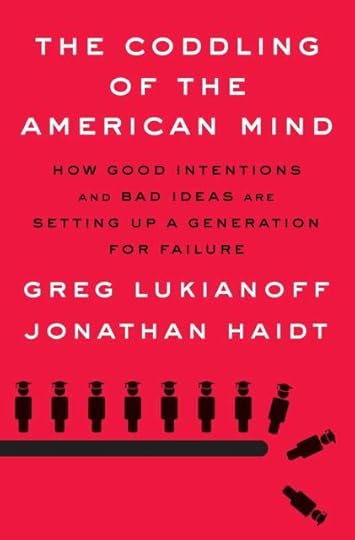 I often speak to my ASU colleagues and professor friends at other colleges and universities about the state of academia. It doesn’t take long for the subject to turn to students and how they’ve changed.
Wanting to know more, I blew through The Coddling of the American Mind: How Good Intentions and Bad Ideas Are Setting Up a Generation for Failure by Greg Lukianoff and Jonathan Haidt. The authors do a fantastic job of explaining how we are preparing the road for the child—not the reverse. Rather than just decry the status quo, however, they propose rational if difficult solutions. Put simply, there’s no quick fix to this nuanced problem.
Revisiting My Favorite TV Show
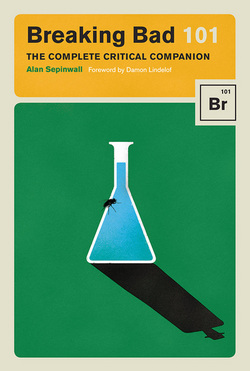 I can’t believe that I missed Breaking Bad 101: The Complete Critical Companion by rock-star TV critic Alan Sepinwall when it came out a little more than a year ago. I rectified that problem pretty quickly.
I had read many of Sepinwall’s reviews on Breaking Bad over the years but there was something special about seeing them all in one place. What’s more, the illustrations really jumped off of the page. Less than a day after receiving the book, I finished it. It’s that good.
Corporate Greed on Steroids, Part 1
 I had heard stories about foul play and questionable ethics at Theranos, but I didn’t realize how morally bankrupt its leaders were until I read Bad Blood: Secrets and Lies in a Silicon Valley Startup by John Carreyrou.
In a word, wow.
Elizabeth Holmes and Sunny Balwani belong in prison for their repeated and willful acts of corporate malfeasance. Anyone who argues against the very idea of government regulation should read this book.
Anti-Intellectualism on Steroids
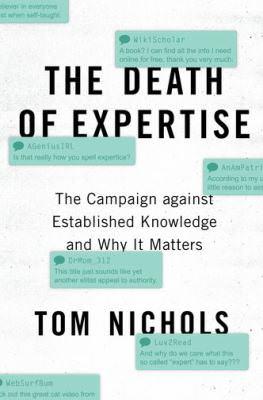 For centuries, many Americans and institutions have viewed intellectuals with more than a fair bit of skepticism. To say that the problem has exacerbated in the last decade is the acme of understatement. Exhibit A: Just look at the rise of the Anti-Vaxxers.
Against this backdrop, The Death of Expertise: The Campaign against Established Knowledge and Why it Matters by Tom Nichols is riveting. He meticulously explains the sources of the problem and offers some solutions that, by his own admission, are unlikely to really help given the current political environment.
Corporate Greed on Steroids, Part 2
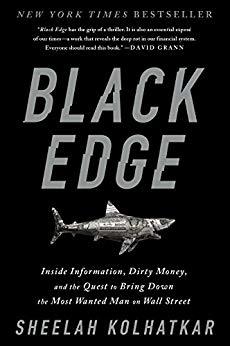 Books like Flash Boys shed light on the lengths to which hedge funds will go in pursuit of the almighty dollar. Michael Lewis’ book hardly portrays saints, but by comparison his characters appear far less evil than billionaire Steven A. Cohen.
Sheelah Kolhatkar’s Black Edge: Inside Information, Dirty Money, and the Quest to Bring Down the Most Wanted Man on Wall Street painstakingly details how Cohen built his empire—ethics be damned. Unfortunately, it’s not a piece of fiction.
Feedback
What books moved you this year?
The post The Five Best Books I Read in 2018 appeared first on Phil Simon.


November 14, 2018
Chemonics Receives Innovation Award
My full-time teaching schedule keeps me pretty busy. At the same time, though, I try to contribute to ASU in other ways. It’s a core tenet of my teaching philosophy. Today I’m pleased to report some good news. Before I do, though, here’s a little background.
Project Background
In July of 2017, my boss approached me about managing a project for Chemonics and I immediately said yes. In a nutshell, the project entailed building a database to track logistics and shipping data from African countries. I managed a small team of students who had impressed me early on in my 400-level classes.
 Chemonics had initially requested a simple Microsoft Access database as a proof of concept. Given the limitations of the tool and Chemonics’ business needs, I gently nudged them towards Microsoft SQL Server in Azure. Cloud computing just made sense in this case. Down the road, this approach would allow the organization to extend its database in ways that Access just can’t. What’s more, it allowed for development of mobile apps with Microsoft’s PowerApps and Blob for unstructured data such as photos and PDFs. Ultimately, the Chemonics folks agreed with my assessment. Full steam ahead.
Cloud computing just made sense in this case.
Over the course of five months, the team followed Scrum—a popular Agile software-development methodology. I served as the product owner and maintained the product backlog. For collaboration, we religiously used Slack, Trello, Skype, Google Docs. I can count on one hand the number of e-mails that I sent over the course of six-plus months and I never had to invoke my three-e-mail rule.
Going Above and Beyond
Aside from delivering more functionality than requested, we came in 40 percent under budget and ahead of schedule. As I write in Why New Systems Fail, that doesn’t happen very often. In early 2018, with oodles of capstone projects to find and supervise for the forthcoming semester, I ceded control of the project to my friend and colleague Hina Arora.
Today I’m pleased to announce that the project won an Industry Innovators Award. From the USAID announcement:
Chemonics won an Industry Innovators Award to recognize its collaboration with Arizona State University (ASU) to develop a transport management tool called TransIT, which is also being used on the GHSC-PSM project. Although transportation management systems are important for tracking where shipments are at any given time, whether they’ve been delivered, and costs at each stage, many commercial solutions are too costly or not flexible enough for diverse and low-resource environments. Together, Chemonics and ASU developed TransIT to offer a low-cost, flexible, customizable product that can be adapted to the needs of each country partner and its operations. This customized database aggregates end-to-end data—from distribution planning through delivery to the recipient—to track performance, location, and costs as commodities move through the in-country distribution network, which enables operations to run smoothly and on time.
Simon Says
Being recognized for good work never gets old. Beyond that, I particularly enjoyed giving my students and team members some real-world experience that complements what they learned in my class and at ASU.
The post Chemonics Receives Innovation Award appeared first on Phil Simon.
October 22, 2018
Making Class Memorable with Basketball-Inspired Python Example
“I cannot be a teacher without exposing who I am.”
—Paulo Freire
Introduction
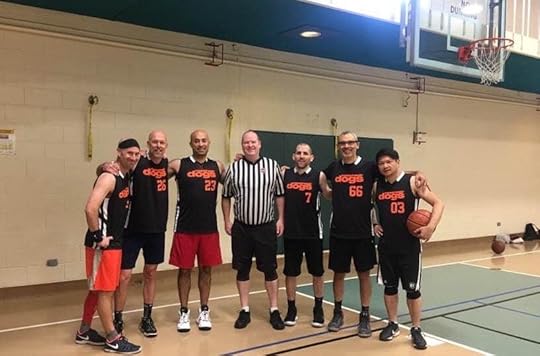
For the last twenty-something years with rare exception, my five best friends from Carnegie Mellon and I have upheld an annual tradition: we get together in a different city, catch up, eat well, and play three-on-three-basketball. The photo above comes from this year’s match in Colorado. (Note that the backboard’s no-dunking sign couldn’t be less relevant to these six individuals, but I digress.)
It’s an understatement to say that we take the hoops part of our weekends pretty seriously. If the uniforms don’t tip you off, let me give you a little more information. There’s the frequent smack talk that takes place during the planning stages. Of course, we film the series. Beyond that, we rent a gym to ensure that the weather isn’t a factor. For the past three years, we’ve hired a proper referee because we can’t be remotely objective in the heat of battle. As for our team name, it’s the same moniker as the one that we gave ourselves during our CMU years: Reservoir Dogs, a nod to Tarantino’s masterpiece.
Why not demonstrate an important programming concept in a memorable way?
My favorite part of the weekend is watching the game footage as my friend Chris tallies the stats. Over the years, we’ve had to create a few new categories because the six of us find traditional basketball measures lacking. For instance, no NBA stat accurately captures really bad shots. This led to the invention of uglies, a category that includes airballs, bricks, and other ill-advised shots.
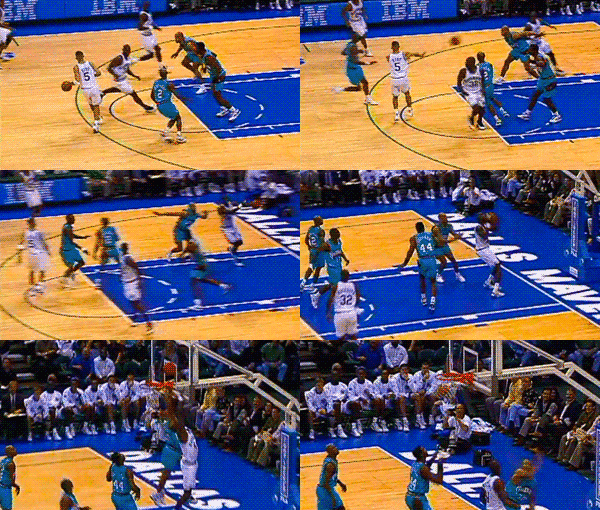 Shooting a decent percentage isn’t really an option for me, especially on a consistent basis. I’m downright thrilled to flirt with 30 percent in any given game. My assist numbers usually aren’t too shabby, but I’ll credit my teammates more than myself although occasionally I’ll channel my inner Jason Kidd.
Finding a Teaching Hook
I was thinking about this last week as I was demonstrating Python’s for loops to my students and now to nest them within each other. I had already shown them simple while loops a little “while” ago. (Not a bad pun, eh?) To this end, I wrote the following program to calculate per-game and total shooting percentages. Give it a try yourself if you like below.
The nested loops above (i and j) demonstrate how a programming language cycles through a previously unknown number of events (games and shots, respectively). It would not take that much effort for a curious student to tweak my code above for any number of different scenarios. Case in point: A couple of changes could turn the program above into a rudimentary weekly sales-conversion tool. (We cover customer relationship management [CRM] this week.)
Simon Says: Good professors find ways to make class memorable for their students.
No, this code isn’t terribly complicated and I don’t expect to use it in lieu of our paper-based method of keeping stats. What’s more, unless they work for a sports organization, I don’t expect my students to use anything exactly like this when they graduate. Still, it demonstrates an important programming concept in what I hope is a memorable way.
My favorite professors did the same for me. Why not pay it forward?
Feedback
What say you?
The post Making Class Memorable with Basketball-Inspired Python Example appeared first on Phil Simon.
October 14, 2018
Having Fun with Python in the Classroom
This semester I’m teaching four sections of Introduction to Information Systems: Honors. As is the case with most survey courses, CIS236 covers a great deal of material—and quickly at that. Think breadth, not depth. I joke with some of my friends that it’s easier for me to explain the topics that we don’t discuss over the 13-week semester.
I’m not the only professor teaching CIS236. Through our weekly coordination meetings and via Slack, My two colleagues and I dutifully coordinate with each other. We strive to guarantee a consistent student experience. Put differently, we want to ensure that all students who take the course learn the same things irrespective of who’s running any particular section.
Finding a Way to Personalize a Standard Class
Professors shouldn’t be afraid to bring a bit of themselves into the classroom.
Despite this ostensible limitation, I find that I can still show what I like to think is my unique personality in the classroom—specifically, my fondness obsession for my favorite TV show.
Cue the following scene—one of my five faves from the series:
 As I write this post, I am in the course of teaching the rudiments Python to my freshmen students. I’m no expert at it, but I don’t totally suck. Last December, I decided to spend a few weeks noodling with it. I plowed through Head First Python: A Brain-Friendly Guide (affiliate link) and I’m glad that I did.
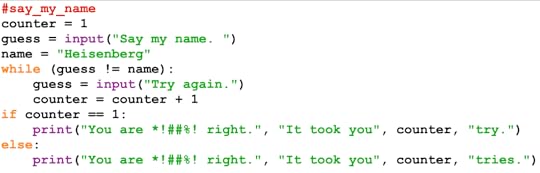
This week, I wrote the following Breaking Bad-inspired program. Sure, it’s simple, but it demonstrates a few essential programming concepts: if/then statements and while loops.
Here’s the code:
Here it is in action on IDLE, a popular integrated development environment (IDE) for Python on the Mac:
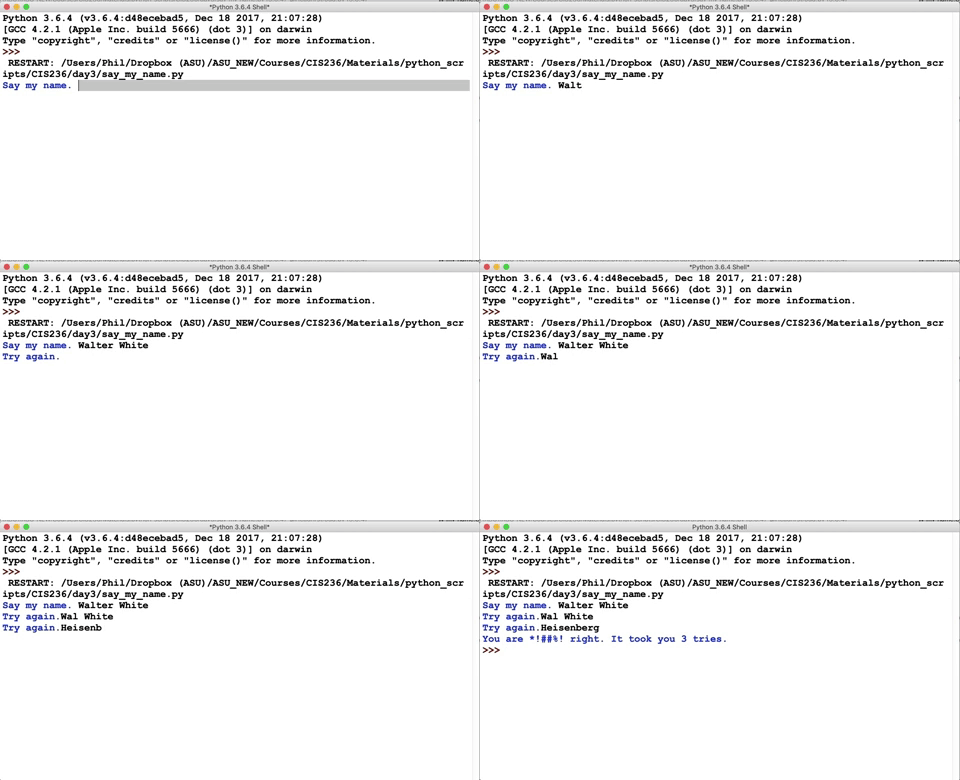
I suppose that, by taking this approach, I run the risk of spoiling the show for the students who haven’t seen this particular scene. Still, I can’t resist. Bringing my personality into the classroom is a big part of my teaching philosophy.
Beyond that, I firmly believe that my subjects (read: technology, coding, data, analytics, and information systems) need not be boring. On the contrary, they are downright fascinating.
Simon Says: Professors benefit from letting their personalities shine in the classroom.
Brass tacks: There’s always an opportunity to make classes fun and interactive—even with a potentially mundane subject such as data governance. If I’ve learned anything in my teaching career, it’s that a little personality from the professor goes a long way with most students.
Feedback
What say you?
The post Having Fun with Python in the Classroom appeared first on Phil Simon.
September 26, 2018
In Defense of Using PowerPoint in the Classroom
 Should universities ban professors from using PowerPoint in the classroom? It’s a provocative question and one that others have asked.
In academia today, you can find plenty of skeptics and naysayers in regard to the world’s most popular presentation program. Perhaps these folks are taking a cue from some of their counterparts in the corporate world. Depending on where you work, you can get yourself in trouble for bringing a deck of slides to a meeting. Amazon famously banned it years ago.
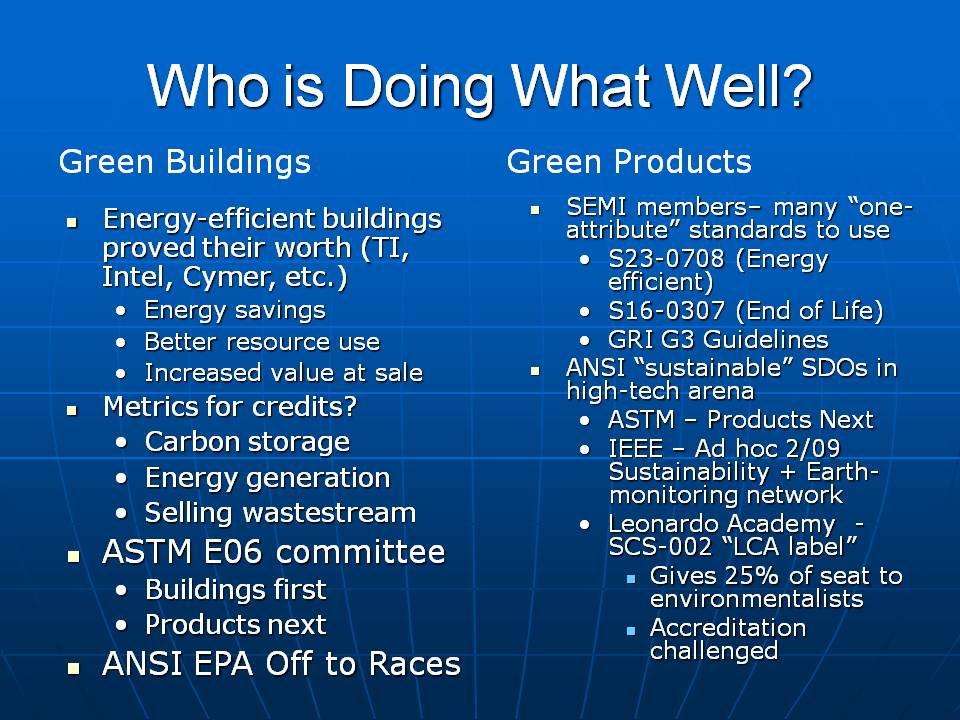
I can certainly see the logic in adopting this facile solution—at least up to a point. If I learned anything in my public-speaking days, it’s that many if not most presentations suck. By banning it, institutions will never subject their students to confusing and downright painful slides such as these:

Click each image to embiggen.
Imagine a professor or corporate bigwig talking “at” each monstrosity of a slide for fifteen minutes. It’s reasonable to assume that members of the tech-savvy iGen will whip out their phones and just tune out.
I know that I would—I’m much older than 20.
PowerPoint doesn’t prevent interesting professors from reaching their students. In other words, less-than-charismatic instructors will find other ways to bore their students. Put differently, a ban doesn’t solve the fundamental problem.
A Better Approach
Those who bash PowerPoint forget that it is just a tool. Like any tool, some people use it well and others use it poorly. Lamentably, plenty of professors fall into the latter category and, as a result, frustrate their students. Instructors often fail to think about their audiences. They cram far too much information into a single slide. Some routinely and lazily read off of their slides.
PowerPoint is not evil. It’s just a tool.
An outright PowerPoint ban is not just silly but counterproductive. That is, when used properly, it can assist professors in achieving their goals of propagating knowledge, stimulating class discussion, encouraging critical thinking, and the like. Don’t take my word for it, though. Samuel T. Moulton, Selen Türkay, and Stephen M. Kosslyn found that modern presentations—when designed intelligently—aren’t so bad after all. In fact, they may be more effective than even strictly “oral presentations.” The authors found that interactive talks tended to resonate with audience members more than static ones.
This means that designing an engaging lecture does not mandate abandoning PowerPoint. The two aren’t mutually exclusive. In fact, the latter can enable the former if you abide by a number of common-sense maxims.
Below are some sample slides from one of my forthcoming lectures in my CIS236 course. (Note that I take much more time advancing the slides when I lecture.)
I have found that using spartan slides (and many of them), interesting quotes such as the one above, animations for each bullet point, and the occasional video make for interesting slides and, more important, informative lectures. I eschew ready-made lectures and opt for a more personal approach. (Yes, this takes a great deal of time but no one can ever accuse me of mailing it in.) Next, I maximize figures so students need not squint. If textbook figure doesn’t represent well on a slide, I’ll use Canvas to create my own. Finally, I segment more involved figures to make students focus on a particular aspect.
Simon Says: Blame the Indian, not the arrow.
No tool guarantees that students will listen to their instructors—and this includes their human voices and the much-hyped Prezi. Be interesting and engaging as a professor in person and with your slides. I’ll bet that more students will pick up what you are putting down than not.
Feedback
What say you?
The post In Defense of Using PowerPoint in the Classroom appeared first on Phil Simon.
September 12, 2018
Four Myths about Slack
Introduction
 Now that I’m ensconced in the world of Slack, I thought that I’d take some time to dispel some of its misconceptions. In this post, I’ll address some of the biggest myths about Slack.
Myth 1: Slack is essentially the same as e-mail.
 This one really rankles me. Comparing Slack to e-mail is akin to saying that a driver is tantamount to a pitching wedge. Yes, technically both are golf clubs, but even trick-shot master Bubba Watson would never hit his driver out of a bunker. By the same token, you’d never hit wedge off of the tee on a par 5.
OK, enough golf analogies. When you receive an e-mail, you have to spend at least a few seconds processing its context—even with spam. In my pre-Slack days, typical e-mail-related questions included:
Is this person one of my current students?
If yes, which class is this student taking?
Is this an individual or team-related issue?
Is this spam?
What does this student want?
Enter Slack channels—effectively e-mail rules on steroids. Thanks to them, these first four questions simply don’t exist—and I benefit from not having to consistently think about them. Each message arrives with a great deal of its context already in place.
I’m no neuroscientist, but I strongly suspect that Slack channels decrease the amount of cognitive effort required to understand the context of each message. For instance, in my case, consider what I know when I receive a message in my Slack CIS236 HW6 channel:
The sender is a current student in my CIS236 class
That student wants me to answer a specific query related to that homework assignment
The question does not relate to a group project because I created separate channels for that specific purpose (assuming that the student uses channels properly)
This. Is. Enormous.
Because of Slack, I’m instantly able to (better) contextualize each student’s question. Even if I save ten seconds per query every day, that time adds up over the course of a day, a week, a month, and a semester. My brain doesn’t need to work as hard on little things. Put differently, I don’t need to expend any superfluous mental energy on the student’s message. I can immediately begin researching and answering that question. This is concurrently efficient and effective.
As I write here, you cannot easily poll people in an e-mail application. Outlook and Gmail don’t provide interesting insights on usage statistics. I could go on but I’ll get to the next myth about Slack.
Need help adopting Slack in your organization?
Hire me
.fullwidth-cta, .fullwidth-cta .arrow { -webkit-transition: all 0.2s; -moz-transition: all 0.2s; transition: all 0.2s; } .fullwidth-cta:hover { background: #dd8500; } .fullwidth-cta:hover .arrow { padding-left: 5px; }

Myth 2: Slack requires a great deal of technical sophistication.
Again, this one is patently false. Sure, I teach data- and tech-related subjects. To boot, since I was a kid, I have known my way around a computer. If I taught poetry, however, using Slack would still make sense. It requires zero programming chops. If you are familiar with social networks, then you can learn the essentials of Slack in minutes, not days or weeks. Case in point: Guess what the @-symbol does?
Myth 3: Slack obviates the need for in-person communication.
Slack channelsdecrease the amount of cognitive effect necessary to understand the context of each message.
Even though I don’t e-mail my students and vice-versa, I still apply my three-message rule. What’s more, sometimes text-based messages just don’t make sense—irrespective of the tool. Whether it’s on the phone or during office hours, certain scenarios mandate that it is best to go old school and talk.
Myth 4: Slack is perfect and solves all communication-related issues.
Slack is no panacea for miscommunication. As I write in Message Not Received, no tool is. Misunderstandings can and do still take place. (See the previous myth for one way to minimize these.)
With respect to technical issues, remember that Slack is software. As such, sometimes things break. Features that work on one operating system or in one browser may fail on another—at least in the short term. If you think that e-mail clients never experience issues, think again.
Simon Says: Don’t fall prey to the myths about Slack.
A pox on those who dismiss Slack for the reasons mentioned above. No, the tool isn’t perfect, but the juice is more than worth the squeeze.
Feedback
Am I missing any? Chime in below.
The post Four Myths about Slack appeared first on Phil Simon.
September 11, 2018
The Pros and Cons of Teaching Back-to-Back Sections
Introduction
This semester I’m teaching four 50-minute sections of CIS236: Honors Introduction to Information Systems on Monday, Wednesday, and Friday. This is quite the change from previous semesters. In the past, I taught two consecutive 75-minute sections Monday through Thursday. In this post, I’ll describe some of pros and cons of teaching back-to-back sections.
Pros
My day is compressed. I typically arrive on campus around 9 a.m. for my 9:40 class. I like to walk into each class at least 15 minutes beforehand to set up my gear and talk to students. I have found that they appreciate it, especially when they need answers to simple questions and they didn’t want to use Slack. I then teach my first two sections, grab a quick lunch, hold my formal office hours, teach my last two sections, and head home around 2:50 p.m.
On a strictly personal level, this is very efficient. I largely avoid traffic, but that’s hardly the only benefit.
Much like a good standup comedian, to some extent I can practice material on my first section. In this way, I can squash bugs that would appear in future lectures. For instance, I can refine a slide, retire a joke that didn’t fly, or clarify a point or concept. (It turns out that successful comedians such as Chris Rock routinely do this. For more here, check out Little Bets [affiliate link].)
We professors are just like everyone else: We need to deal with change.
I doubt that I start out at my peak level. I also suspect that I’m at performing at best in my third class. By that point, I know what has worked before and what hasn’t. (I’m interested in what my student-evaluation data has to say about this at the end of the semester.)
Cons
CIS236 is a survey course and, by design, we cover a great deal of material very quickly. I often joke that it’s easier for me to list the topics that we don’t cover over the course of 14 weeks.
 As a result, by the start of the fourth section at 2 p.m., I’m a little gassed and often need a 20-minute power nap when I get home. It reminds me of when I’d teach three- and four-day software classes at Lawson Software. I had to be “on” not only when I addressed the class, but during breaks as well. Attendees asked me rapid-fire questions and students do the same. In short, I didn’t have much time to recover and take a breath.
Tip: I find Oars and Alps Cooling + Cleansing Wipes (affiliate link) to be quite refreshing after my second section.
When I lecture, I use PowerPoint slides to communicate knowledge to my audience but also to keep me on track. I try hard not be stiff and often improvise how I make a point. Doing so helps keep the material fresh. (One of my new students already called me engaging and my early-semester evaluations were very positive.) At the same time, though, that approach comes with a cost because I’m not a spring chicken anymore. I occasionally forget if I mentioned something in this current section or the one before.
Simon Says: A compressed schedule is no picnic but it’s manageable.
My current teaching schedule isn’t objectively better or worse than its antecedents; it’s just different—and professors need to deal with change. I use Tuesdays and Thursdays to grade assignments and exams, prepare materials for future lectures, provide services for my clients, and recover.
Feedback
What say you?
The post The Pros and Cons of Teaching Back-to-Back Sections appeared first on Phil Simon.
September 7, 2018
What I’ve Learned from My Student Evaluations

Introduction
I recently received my student evaluations from the summer and dutifully updated my interactive dataviz. In this post, I’ll discuss what the data tells me about my teaching style and methods. (Note that you can mouse over each image below to enlarge it.)
I’m rapidly improving at teaching [image error]
August 14, 2018
Audiobook of Analytics: The Agile Way Is Now Available
Analytics: The Agile Way is now available as an unabridged audiobook. Check out a five-minute sample below or buy it here.
This is my second book that Wiley has offered in this format joining Message Not Received.
Props to narrator Greg Tremblay.
The post Audiobook of Analytics: The Agile Way Is Now Available appeared first on Phil Simon.
August 13, 2018
Thoughts on Teaching Older Students

Introduction
Today I officially start year three as a full-time faculty member at ASU. (Time flies.) I’ll be swamped with preparing for a new course and won’t have too much time to blog. Before I get knee-deep in the semester, though, I wanted to offer a few thoughts on something that most professors encounter at some point: teaching older students.
Because of FERPA, I am unable to access my students’ ages—not that I really need to view that information. Especially in my in-person classes, I can tell which ones of my students have followed the traditional college path and which ones are returning to get their degrees. Although the vast majority of students fall into the former bucket, each semester a handful of students come to the table with significant work experience.
Here are a few thoughts on how to effectively handle them—and make the class as pleasant and valuable as possible for students lacking significant work experience.
Identification: Start at the Get-Go
As part of my icebreakers on day one, I attempt to learn a little about my students—a process that I attempt to continue throughout the semester. When it becomes obvious to me that a student isn’t starting from square one, I make a mental note.
Acknowledge Their Experience
I strive in my classes to stress practice as much as theory. To this end, older students can actually increase professors’ street cred. I can think back to my own days as a student. Some professors merely pontificated about theoretical matters from their cushy ivory towers. It’s not that I didn’t believe my professors; it’s just that their message didn’t resonate with me as strongly as those with real-world experience.
Now consider the comments from older students. They often echo what professors are saying—and this makes for a better classroom dynamic. Unfortunately, I can’t produce any hard data on this, but intuitively I believe that this is the case.
Don’t Let Them Dominate the Discussion
In my teaching career, I found that “more experienced” students typically aren’t shy about sharing their tales from the corporate world. The vast majority of the time, their on-the-job experiences reinforce the material that I’m covering. For instance, in CIS440 we cover The Phoenix Project—a fictional book about a dysfunctional organization. I’ll often ask if this piece of fiction plays out in real life (re: if IT projects tend to break bad). As it happens, more mature students typically chime in with their own war stories. Translation: listen to what the professor is saying. He knows what he’s talking about.
Experienced students actually increase professors’ street cred.
For two reasons, it’s important to be careful here. First, most students lack real-world experience at this point and it’s natural that some may feel intimidated. (I know that the 21-year-old version of me would.) I assure them that it’s only a matter of time that even the greenest of students will see their fair share of tech- and data-related challenges in the workforce.
 Second, professors need to bring introverted students into the discussion as much as possible—especially in smaller classes. If necessary, I’ll take loquacious students aside and tactfully tell them that it’s my job to get all students involved—not just those with significant work experience. Put differently, I value their contributions but need to hear from everyone. To quote Spock, “Logic clearly dictates that the needs of the many outweigh the needs of the few.” A few times I have had to take these well-intentioned folks aside and remind them of this. In each case, that student has understood and altered his/her behavior.
Simon Says: Think of older students as potential assets, not detractors.
It’s misplaced for professors to think of mature students as threats or competition. In fact, these folks can serve as true assets in the classroom—particularly if the professor properly manages expectations and behavior.
Feedback
What say you?
The post Thoughts on Teaching Older Students appeared first on Phil Simon.