Phil Simon's Blog, page 47
May 11, 2018
My Latest HBR Article

 Over the years, I’ve been able to procure more than my fair share of high-level media placements. Collectively, they have helped me get to where I am today. Perhaps none is more prestigious, though, than the pieces that I have written for Harvard Business Review. (Click here for to watch my webinar on The Visual Organization.)
A few months ago, I saw a call for stories on data-driven ways that companies have solved problems. I approached the folks at HBR with a story on how one organization dealt with a particularly thorny data issue using Agile methods. After a bit of back-and-forth, the article—excerpted from Analytics: The Agile Way— is now live. Have at it.
How Nextdoor Addressed Racial Profiling on Its Platform https://t.co/SYyGdJPH51
— Harvard Biz Review (@HarvardBiz) May 11, 2018
The post My Latest HBR Article appeared first on Phil Simon.


April 21, 2018
Slack Channels of a College Professor
 It’s been a little more than six months since I penned a post about how I use Slack in the classroom. Thanks to some link love from The Chronicle, that post received a good deal of traffic.
I wrote then that I would revisit Slack in future posts. I was still noodling with the tool and hadn’t quite nailed it yet. Beyond that, Slack adds features and new apps sprout up all of the time.
Against that backdrop, I decided to break down how I use (never utilize) different channels in Slack for my courses. Note that, unless specified, all channels here are public to students enrolled, not the world at large.
announcements
This one is pretty obvious. When I want to do the following, I post a quick note here:
Update students on grading
Remind students that an assignment is due
Pass along general advice
ask_the_professor
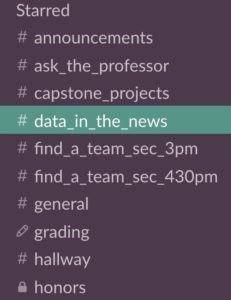 Students largely drive the content in this channel. Think of it as an analogue to Reddit’s AMA. Sometimes I’ll move students’ individual queries to this channel as long as they are not personal in nature.
capstone_projects
I’ll post information related to my capstone projects here. I spend a great deal of time networking and discussing different endeavors for my students. Keeping these in one place keeps me sane. This semester alone, I’m indirectly supervising 32 teams and 25 different projects. A consolidated approach here just makes sense.
data_in_the_news (or tech_in_the_news)
A large part of my teaching philosophy hinges upon staying current.
This one varies based upon my analytics and system capstone classes. As a sponge, I’ll often read interesting articles online. These pieces typically touch upon subjects that we’ve already covered. News breaks so fast today and a large part of my teaching philosophy hinges upon staying current.
find_a_team
Slack should not be a one-to-many application. Rather, students should engage with each other about topics important to them. At least early on, this typically involves finding a three- to seven-person teams for their capstone projects.
general
If it doesn’t fit into one of the channels above and below, then I’ll toss it here.
grading (private)
I invite my grading assistants to the Slack workspace early in the semester. Inasmuch they have taken my class(es) before, they are already familiar with Slack. Still, I won’t go back and forth with them via e-mail.
honors (private)
Each semester, I work with a select number of students on individual and group honors projects. To this end, I’ll set up an honors channel specifically for them.
jobs_and_internships
I’ll often hear about different professional opportunities. Why not pass them along? I’ll also post articles, videos, and tweets that contain valuable post-college advice.
Note that I encourage students to unsubscribe from this channel if they have already secured their next gigs. I remind them, though, that they’ll miss out on some of my other goodies.
polls
I’m a fan of Slack polls—both real-time and asynchronous. They represent a great way to get students’ pulse on a specific issue.
quick_links
I post my class schedules, group choices, and syllabi online. (Here is my colorful syllabi for my analytics capstone class.) Why not post them in a way that allows for quick, easy access?
section_x
Sometimes I need to post information specific to one section. (I teach two sections of each capstone course.) For instance, if I have to mention something to my students in the 3:00 pm class, why burden those in the 4:30 pm one?
tips_x
I’ll frequently post tips related to dataviz, technology, coding, website development, data cleansing, and other topics of interest to the students.
Simon Says: Embrace multiple Slack channels.
Perhaps you think that this is overkill. I don’t. Targeted communication is one of Slack’s greatest strengths.
I love Slack ability to separate messages based on topic. Students can read the material they want and ignore the rest. In other words, it’s the antithesis of e-mail.
Feedback
What say you?
The post Slack Channels of a College Professor appeared first on Phil Simon.
April 8, 2018
Characteristics of My Best Students

Introduction
Over the last two years of professing, I have certainly noticed traits that separate the good students from the bad ones. In this post, I’ll examine three characteristics of my very best students.
Participation
Being the curious sort, I started with a simple question: What’s the relationship between class participation and final grade?
By way of background, five percent of students’ grades in both of my courses stem from class participation. Yeah, it’s a subjective measure, but I try to mitigate that with rubrics in my syllabi. Here’s an example of one of them:
table.tableizer-table {
font-size: 16px;
border: 1px solid #CCC;
font-family: Helvetica, Arial, sans-serif;
}
.tableizer-table td {
padding: 4px;
margin: 3px;
border: 1px solid #CCC;
}
.tableizer-table th {
background-color: #DD8500;
color: #FFF;
font-weight: bold;
}
Grade
Description
50
Student attends all or nearly all classes on time (save for pre-approved absences). Student contributes to the class discussions regularly and in a meaningful way. Student regularly interacts with other students and professor on different Slack channels. Student always pays attention; s/he doesn’t just do work for other classes, surf the Interwebs, and play World of Warcraft. Prior to missing a class, student always fills out the absence form. Student responds promptly to my queries in Slack.
40
Student frequently attends class. Student contributes to the class discuss somewhat regularly and in a meaningful way. Student does everything in the “50” bucket but to lesser extents. Prior to missing a class, student always fills out the absence form. Student responds promptly to my queries in Slack.
30
Student sometimes attends class and contributes some of the time. Student sometimes zones out or clearly during class time. When student misses class, s/he usually doesn’t fill out the absence form. Student responds to my queries in Slack but it takes a few days.
20
Student sometimes attends class but does not contribute to the discussion. Student frequently arrives late and, in the process, distracts other students. Student often zones out, does work for other classes, surfs the Interwebs, or plays World of Warcraft. When student misses class, s/he usually doesn’t fill out the absence form. Student responds to my queries in Slack but it takes a few days.
0
Student rarely attends class. Student frequently arrives late. Student does not contribute to the discussion in a meaningful way. When student misses class, s/he rarely fills out the absence form. Student ignores my queries in Slack.
I then exported the grades from Blackboard to Excel for all of my 2017 classes. A simple scatterplot in Tableau reveals what I long suspected: students who show up and participate in class generally do much better than students who do not.
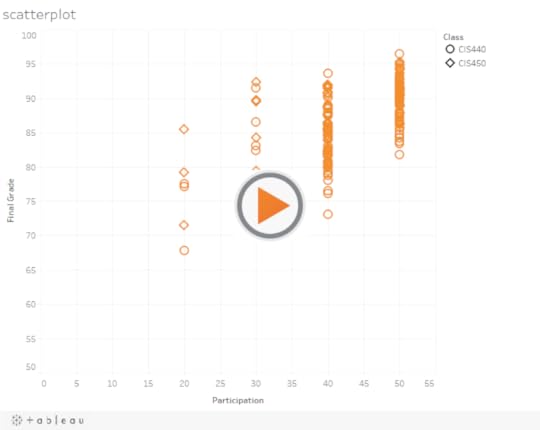
Are there outliers? Sure. I didn’t expect a one-to-one relationship. As you can see above, some students receive C’s despite their high attendance marks. It’s also interesting to note that, in some cases, students do well despite their poor participation grades. Interesting data point: the lowest grade that a “50 participation student” received is an 81.79.
Again, though, the correlation is largely positive—and this holds for both classes and for both terms in the dataset. (For the statistically inclined, the correlation coefficient between the two variables exceeds 0.63.) Note that the relationship isn’t causal. That is, it’s possible that students perform well because of their participation grades. The chain may go the other way, though. Students may participate because they are doing well. Finally, confounding variables may exist.
Stubbornness
I don’t grade for sticktoitiveness per se, but I’ve observed that my most stubborn students tend to do better than those who easily give up when faced with challenges. (Note here that I’m referring to the “good” stubbornness.)
Stubbornness correlates with success in the classroom.
I’m reminded here of Sasha Yotter, one of my best students in my first semester. For her individual project in my analytics capstone course, she used twelve different programs to open a 2-gigabyte dataset. Twelve! The first eleven didn’t work and she kept at it. What employer wouldn’t want to hire someone like that? (Her individual work as no anomaly. I detailed her group’s capstone project in Analytics: The Agile Way.)
By way of contrast, I can remember a student in the same class who inexplicably waited until the penultimate day of class before trying to open his dataset. (This is particularly vexing since I emphasize Agile methods such as Scrum throughout the course.) You can probably guess where he lies on the data visualization above.
Curiosity and Willingness to Learn New Tools
Again, I don’t employ a formal rubric for this, but curious students tend to do better than those who lack interest in finding new solutions. I’m talking here about students who try new things. They find new data sources. They play with advanced features of applications they know well—and learn new proprietary and open-source applications just because they can.
 Put differently, they explore. As I explain in my analytics class, there’s nothing wrong using a stalwart such as Excel to analyze and clean data and build visualizations. Many professionals use it as a Swiss Army knife. What’s more, I’d much rather see a student do a good job in Excel than a poor one in another application.
Still, Excel does not qualify a best-of-breed stats or dataviz tool. My best students get out of their comfort zones. They play with Tableau or SAS Enterprise Miner. They know or soon realize that that Excel can’t scrape data nearly as well as a library such as BeautifulSoup. At some point in their careers, they’ll have to learn a new application and/or programming language. Why not start now?
Simon Says
I try to stay in touch with my students as much as possible. I’ll be very interested to see if those who have exhibited the characteristics and behaviors above do as well as I think they will.
Feedback
What say you?
The post Characteristics of My Best Students appeared first on Phil Simon.
March 28, 2018
Four Courses I Would Love to Teach

Introduction
I find teaching in general to be rewarding. Based on my background and interests, being able to impart valuable lessons on analytics and system design to my ASU students gives me great joy. And there’s more: Because I teach capstone courses, I get to help students solve organizations’ real data- and tech-oriented problems.
It would be foolish for me to think, though, that I’ll always teach these courses. Times certainly change and colleges adapt their curricula as well based on new trends. ASU is a case in point. I’ve been contributing material to a new blockchain course.
Over the past few months, I’ve thought about additional courses that I’d love to develop and/or teach at some point in my career. Four come to mind, at least two of which already exist in some form at different universities.
Platform Thinking: Lessons from Amazon, Apple, Facebook, and Google
I’d have a blast developing and teaching this one. Imagine a course that explores how Amazon, Apple, Facebook, and Google have embraced platform thinking. I’d love to cover the benefits and drawbacks of true platforms—and there’s no shortage of the latter these days. Some prominent folks are even calling to break up the Gang of Four.
In fact, schools such as Boston University already teach a similar course.
Technology and Communication
All too often, we think that we’re communicating effectively when we are not. Sure, we send that e-mail or memo but did our recipient really understand our point?
Drawing upon lessons from Message Not Received, I’d really enjoy teaching a course on the perils of e-mail and jargon. Beyond stating the obvious problems with the status quo in corporate communication, I’d discuss solutions by way of case studies explained in the book.
Amazon: The Good, the Bad, and the Ugly
Perhaps no company is as controversial, powerful, innovative, and customer-centric as Jeff Bezos’ brainchild. I could envision a course that starts with the company’s modest beginnings and covers AWS, Alexa, as well as failures such as the Fire Phone. The way that the company uses data and tech continues to amaze me. What’s more, it’s certainly not an easy place to work.
Critical Thinking on Steroids
This course already exists at the University of Washington. If I were 21 again, I’d enroll immediately in Calling Bullshit: Data Reasoning in a Digital World.
The ability to think critically will only increase in the future.
I think more than ever about the downsides of all of this tech and data. Those who only see the upsides are fooling themselves. (Couldn’t resist.) The ability to think critically will only increase in the future. Those who dubiously answer questions with “I saw it on the Internet” will continue to appear ill-informed.
Simon Says
As I continue my academic career, I hope to explore these subjects in more depth.
Feedback
What say you?
The post Four Courses I Would Love to Teach appeared first on Phil Simon.
March 22, 2018
What if Facebook had charged its users?
As a kid, I enjoyed Woody Woodpecker. I was particularly fond of the following line:
 In light of Facebook’s greatest crisis to date and enormous loss of market value, I can’t help but think of that iconic cartoon quip. That is, what if Facebook had charged users all along? In fact, I argued more than five years ago that the company should begin charging its users in lieu of indirectly monetizing them via their data.
Of course, it’s a moot point now. That genie is out of the bottle. Boycotts and #DeleteFacebook are gaining steam. (I deleted my own account last night) Facebook’s senior leadership is in damage-control mode. We may well look back at recent events as a tipping point for Zuck et. al. The Cambridge Analytica scandal may irrevocably alter the company’s image and growth prospects. It may be the harbinger for regulation, and not just in the privacy-conscious EU.
Still, I wonder if the company would find itself in its current predicament if it had directly monetized its users.
It’s quite possible that the world would be a very different place right now.
On one hand, hackers and other bad actors still may have been able to access a great deal of information on 50 million Americans alone. So there’s that.
But we’re not talking about a proper security breach here. This wasn’t a hack à la Equifax. Rather, we have to consider the underlying business model of platform companies and their need to make money. As I write in The Age of the Platform, application programming interfaces (APIs) allow developers to do interesting things with a company’s core offerings. They effectively externalize innovation. Remember that Apple launched the iPhone in 2007 sans an app store. Steve Jobs was smart enough to realize that even his mighty, iconic juggernaut could not develop apps with the speed and depth of a vibrant developer community. As Cambridge Analytica demonstrates, not all apps are benign time-wasters such as Angry Birds.
Far from it.
Does this economic imperative excuse Facebook’s lax approach to privacy over the years? Of course not, especially since .
To be fair, though, consider the following. Is it possible for a publicly traded company sporting 2.2 billion users and outsize influence to completely police itself? We are learning the dangerous answer to that question. As many have pointed out in the past few weeks, Facebook, Twitter, and Google have become too powerful for even their founders to control. (Case in point: Twitter is asking its own users for help to make it less toxic.) Facebook’s imbroglio demonstrates the downsides of a platform being too open, but consider the alternative: By closing itself off to advertisers and third-party developers, $FB would not have ascended to such lofty levels.
Apple, Google, Microsoft Quotes by TradingView
Simon Says
News is unfolding quickly, but I can’t help but wonder what would have happened if Facebook would have allowed its users to become actual customers. Make no mistake: there’s a big difference. What if no developers could have accessed so much of our valuable data, no matter what their apps were trying to do?
The world would be a very different place right now.
Feedback
What say you?
The post What if Facebook had charged its users? appeared first on Phil Simon.
March 12, 2018
Dataviz: Interactivity Increases Understanding
Maybe 20 years ago I could forgive laziness with data visualizations. After all, the “best” tools of the time weren’t nearly as powerful, affordable, and user-friendly as they are today. It’s a big emphasis in The Visual Organization and I feel as strongly about it as I did when I first penned the book.
In my analytics course CIS450, I devote an entire class to dataviz midway through the semester. In it, I cover the good, the bad, and the ugly. I conclude the class with an exercise. For about 20 minutes, I let the students find horrible examples of charts and graphs online. (To avoid duplication of efforts, I ban the first ten results of Google.)
Invariably, the students will find something along these lines:
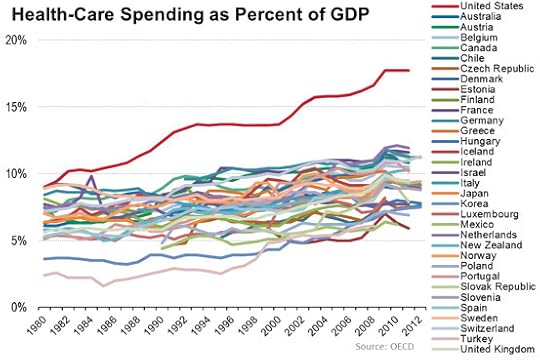
Terrible, right? The figure above manifests only one thing: The U.S. spends far more on healthcare than just about any country. That’s it.
A Better Tool Yields Better Understanding
Consider how much easier it is to understand interactive dataviz tools such as the one below from The Chronicle.
At a high level, a dataviz should convey, not confuse.
For perhaps thousands of schools, I can easily compare faculty salaries against a number of benchmarks. I can break down salaries by type of faculty and assess how schools value different positions. I could spend hours with this tool because it sates my curiosity and increases my understanding of how universities pay their faculty members.
Simon Says
With a nod to George Carlin, a dataviz should convey, not confuse. Rather than launch a static, incomprehensible tool, why not devote the time and resources to building one that accomplishes its goal?
Feedback
What say you?
The post Dataviz: Interactivity Increases Understanding appeared first on Phil Simon.
January 30, 2018
Why I Barely Tweet Anymore

A few years ago, you could find me tweeting very regularly. A few times my clients even paid me to tweet as part of “TweetChats”: public discussions over important business, tech, and data issues.
These days, you’ll barely find me sharing 140 280 characters with the world. A quick look at TweetStats confirms what I’ve suspected for months:
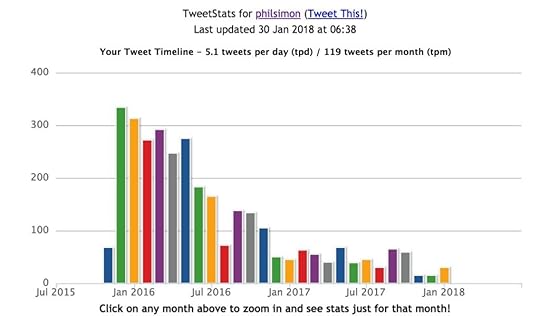
Priorities: My full-time teaching job
Occasionally I’ll share an interesting article with the world, but I’ve got plenty to do during the academic year. I’d much rather spend time learning new ways to use Slack than tweeting. Even if I had more free time, I doubt that I’d be an active user for other reasons.
I recognize the pointlessness of Twitter debates
Permitting twice as many characters doesn’t mean that Twitter is now the place for intelligent, nuanced, and intelligent discussion. Far from it. With more than 300 million monthly active users (although I’d bet that at least one-third are fake accounts and bots), Twitter promotes filter bubbles and echo chambers. Regardless of your beliefs, it doesn’t take much to find those in your camp and mute/ignore those who disagree with you. This just doesn’t seem that interesting to me.
Disgust over what Twitter has become
Using Twitter just isn’t a pleasant experience for me anymore.
It took far too long, but last year Twitter finally allowed users to block content that they found offensive. To be sure, no site or app can filter 100 percent of content that people find offensive, but the company waited far too long to address rampant trolling and intimidation. On the rare times that I’ll access Twitter via Hootsuite, I find myself regularly creating negative keywords to combat trolls.
Brass tacks: Twitter has become an unpleasant experience for me. It’s become a shit show.
Disgust over its leadership
I’d argue that Twitter’s cultural/media value far exceeds its economic value. Flaws aside, it still plays a critical and even outsize role in political discussions. Against that backdrop, you’d think that the company would employ a full-time CEO.
And you’d be wrong.
It’s ridiculous that Jack Dorsey splits his time between Twitter and Square. As I tweeted two years ago:
Twitter: A company with full-time problems and a part-time CEO. #justsayin‘
— Phil Simon (@philsimon) January 8, 2016
No doubt this is even more true today.
Simon Says
When a service or app brings me more despair than joy, it’s time to pack it in. I’d bet that Twitter’s management—or at least what’s left of it—realizes the company’s fundamental problems. Maybe that’s why its stock is up amid a new round of takeover rumors.
(And yes, I’m tweeting this post.)
Feedback
What say you?
The post Why I Barely Tweet Anymore appeared first on Phil Simon.
December 27, 2017
Reflections on 2017

For some strange reason, my best years tend to take place during turbulent times. Case in point: In 2008, as the financial crisis arrived in full force, I was completing what was by far my best year as a systems consultant and putting the polishing touches on the first version of Why New Systems Fail.
 In this vein, 2017 turned out to be remarkably similar. In a political environment that one can best describe as challenging, I’m pleased to have completed my first year as a full-time ASU faculty member. I know quite a bit more about how academia works and what it takes to reach students. to this end, I made some tweaks to my classes and my student evaluations rose across the board. To quote Homer Simpson, “Self-improvement has always been a passion of mine.”
Beyond my “normal” teaching responsibilities, I was plenty busy outside of the classroom:
I wrote my eighth book—Analytics: The Agile Way.
I recorded the online version of CIS450—the capstone course for ASU’s analytics program.
I managed a project for ASU. A three-person team built a database for a large international organization.
I founded 5marbles—a new software-development shop. I also pulled together a team of rockstar developers. I can’t wait to get started.
On the publishing front, I advised several authors and sold Motion Publishing.
I wrote a bunch of posts for the SAS Data Roundtable and IBM’s IT Biz Insider. Not surprisingly, I blogged less on this site.
I continued to interview people I find interesting on Huffington Post. (Interviewing Nick Bilton on his excellent new book American Kingpin was a particular highlight.)
I spoke at a few Arizona events and set up a few more for 2018.
I taught myself Python—although there’s plenty more for me to learn.
I read a bunch of books.
Simon Says: 2017 wasn’t too shabby.
I’m curious to see what 2018 brings, especially with 5marbles.
Feedback
What say you?
The post Reflections on 2017 appeared first on Phil Simon.
November 29, 2017
Introducing 5marbles
For a long time now, I’ve counted on income from several different sources. In no particular order, these planks in my platform were my full-time teaching gig, speaking, writing, book sales, and consulting.
In August, I sold Motion Publishing to Courtney Logan. To be sure, I had learned a great deal about the publishing industry since forming the company in 2010, but I had taken as far I could. I suspected that I would start another side project at some point but I didn’t know what or when.
Now I do.
The New Venture
 Today I am excited to announce the launch of my new software-development outfit 5marbles. The company will build databases, mobile applications, and websites using Agile methods—specifically Scrum. I’ve been teaching Scrum at ASU as part of the capstone course in information systems (CIS440) and even using it as part of a separate project that I’m currently managing for the university. Tools such as Slack, Trello, and others dramatically improve transparency, communication, collaboration, and other issues that hamper most IT projects. (I really wish that these existed during my ERP consulting days.)
The 5marbles’ team and I can’t wait to see where this goes. To read more about what 5marbles will do, click here.
The post Introducing 5marbles appeared first on Phil Simon.
October 10, 2017
Looking to Teach Somewhere Not Scorching This Summer

“It’s not the heat it’s the inhumanity.”
—Rush, “Ceiling Unlimited”
More than six years ago, I moved to Las Vegas from New Jersey. As I explain in this post, the move made sense for a number of reasons. During my five years in Sin City, I penned four books and worked as a full-time writer and public speaker. None of this would have been possible had I stayed in the Garden State. It was simply too expensive for me and I won’t live under constant financial duress.
I’ve endured six straight summers of increasing heat.
The most recent move to the Phoenix area has worked out well. I love my job as a college professor—so much so that I taught at ASU last summer. Doing so allowed me to kick the tires on Analytics: The Agile Way on a small group of ten students in my analytics class. Agile methods in action.
 I’ve thought long and hard about what I’d like to do in the summer of 2018. I would very much like to teach, but I’d prefer to escape the brutal Arizona summer. Going back to my Vegas days, I’ve endured six straight summers of increasing heat. I didn’t even pick up my tennis racket for four months here. (How there are no indoor courts in the Phoenix area is beyond me, but I digress.) This leads me to the idea of reaching out to other colleges and universities.
Good things came from my post announcing my desire to teach full-time at a proper university, so why not try a similar approach here?
Limitations and Preferences
I’m doing this above board. That is, I’ve already checked with the folks at the W. P. Carey School and ASU. (Better to ask for permission than forgiveness.) Here’s my list of limitations and preferences:
For-profit colleges and universities are off the table.
For obvious reasons, I don’t want to teach in another stifling climate.
I’m open to teaching an online course (as I have done several times already at ASU), but the goal is to escape Phoenix in July and August.
Ideally, my summer gig would be in the northeastern US. (I would like to be close to family and friends for a few months.)
I don’t expect to break the bank, but I don’t want to lose money on this gambit. As I know from my travels, living in San Francisco, Boston, and New York isn’t cheap.
It makes senses for me to teach an existing course—not develop a new one from scratch.
I’m open to teaching graduate and undergraduate students.
If nothing materializes for whatever reason, I might just grab an Airbnb somewhere interesting. I could see spending a chunk of next summer in Seattle or Portland.
I’ll share this post on my social networks. Feel free to shoot me a note if you want to connect privately.
The post Looking to Teach Somewhere Not Scorching This Summer appeared first on Phil Simon.