Phil Simon's Blog, page 48
September 28, 2017
How I Use Slack Inside of the Classroom
 For years I’ve clamored against the misuse and overuse of e-mail in corporate settings. As I write in Message Not Received, far too many folks use e-mail as a Swiss Army Knife when far superior, affordable, and easy-to-use alternatives exist. In other words, this is not 1998.
Sure, on a personal level and for simple, two-person tasks, Todoist gets the job done. That app, however, isn’t designed for small teams, never mind large groups of people.
As I entered my second year as an ASU professor, I wanted to shake things up inside the classroom. My friend and colleague Matt Sopha and I frequently talk about all things tech, and he had espoused the benefits of Slack. I did some research and, this semester, decided to give it a shot.
My rationale here was straightforward. First, I was curious to noodle with a tool that has received so much hype. Second, in all likelihood, my students will not use a proper learning management system (LMS) such as Blackboard after they graduate. They’ll almost certainly use a new collaboration tool at some point in their careers. Why not introduce one of the most powerful and popular ones while they are still in school?
I doubt that any company would hire a student specifically because of his or her experience with Slack. Still, if my students take jobs with organizations already using it, this means that they’ll have one fewer thing to learn upon starting.
General Announcements
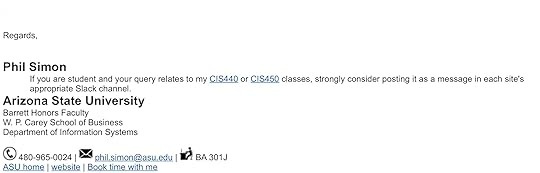
This one was a no-brainer. Slack makes it brain-dead simple to alert everyone in a class about a schedule change, newsworthy event, or tip. I also direct students to contact me via Slack, not e-mail. I’ll typically respond to individual student messages with a quick note “I am moving this to Slack.” I also reinforce Slack in class and in my e-mail signature:
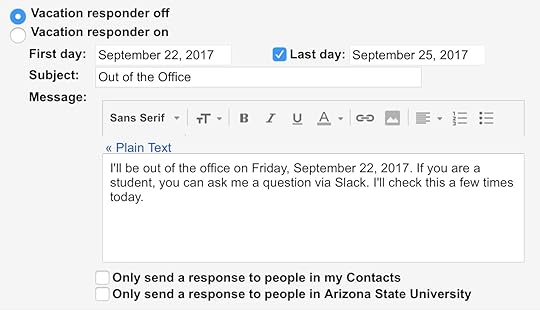
Consistency is king here. When I’m out of the office, via my out-of-office message, I make it clear that Slack is the best way to get a hold of me:
Reducing e-mail always helps, but from my previous research I knew that Slack offered many more benefits than this. I kept digging.
Private Channels and Targeted Messages
Why not introduce my students to one of today’s most powerful collaboration tools?
I used to hate having to remember which students worked on which capstone projects. Sometimes, I’d set up groups in Gmail but I never felt that that solution was ideal.
Enter private channels, one of the most useful features in Slack. It’s remarkably simple to limit my message, question, or tip to a group of students.
Polls
 It’s evident to me that Slack understand the power of platform thinking. Case in point: Its API allows developers to take Slack’s core product in new and exciting directions.
Often I need to solicit my students’ input on different subjects. This may involve the specific technologies to cover during one of my “tech demo days.”
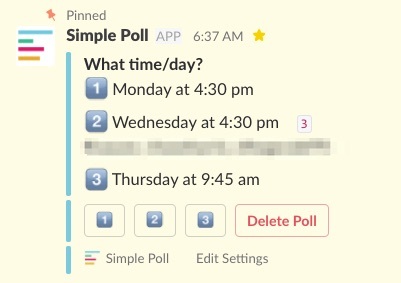
I can’t imagine trying to gather this information via e-mail or even in Slack as text-based responses. I’ve become a fan of SimplePoll, a tool that allows me to easily gather survey responses within Slack. This saves me time and allows for one-stop shopping.
In-Class Exercises
I’m a big fan of active learning. I’ll often devote one-half or one-third of my class to interactive exercises designed to maximize student involvement.
In my previous (re: pre-Slack) semesters, I encouraged students to create Google Docs or Sheets and share them with me. I would then go to Gmail and open the link. The whole process involved a great deal of bouncing around among apps.
Not anymore.
With my #classroom channel, I encourage students to enter responses to questions with pictures, links, and links Google Docs during class. (I use separate channels for each of my sections in my System Design Capstone class.) Below I’ve included a screenshot of our in-class exercise designed to explore how Amazon is attempting to combat fake product reviews:
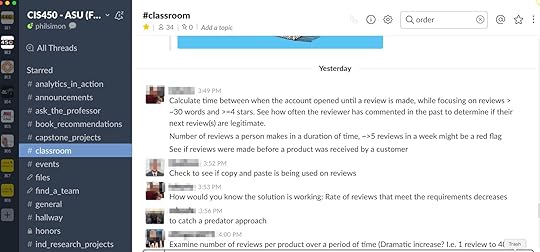
Rather than replacing class discussion, I find that Slack actually augments it. Students think carefully about what they submit in the channel. No one wants to scribe a silly response.
Not only is this method this easier for me to manage than my old method, it increases transparency and creates a record of the interaction. Students can see who contributed what and respond to that student directly—something that my old method did not easily permit.
Simon Says: Welcome to the new world.
I’m still experimenting with Slack. I hope to look back in this post in a year and see how the tool has evolved—and my use of it.
The Slack experiment has worked and I’m expanding it. Beyond my full-time teaching position, I still do some writing, speaking, and consulting on the side. I have already moved one of my clients to Slack. After a few questions, she has adapted to it.
Feedback
Any tips on how to use Slack in the classroom or at work? What say you?
The post How I Use Slack Inside of the Classroom appeared first on Phil Simon.


August 21, 2017
The Future of DevOps
Introduction
In my last post, I argued that DevOps is no panacea for bad tech, obstinate employees, and a toxic culture. Today I’ll look at the future of DevOps. In a nutshell, it’s bright.
Change Is Hard
I’m often critical of organizations and executives that cling to antiquated systems, infrastructure, and methods. In truth, however, I understand all too well the difficulty of making these types of wholesale changes. (I wasn’t always a college professor; I spent many years implementing enterprise systems.) There’s always risk with replacing a working—if deficient—application for a potentially better—but unproven—alternative. Brass tacks: Change is hard.
Ask CTOs in “tech-challenged” firms if they could wave magic wands and start from scratch. Knowing now what they didn’t know then, would they do things differently?
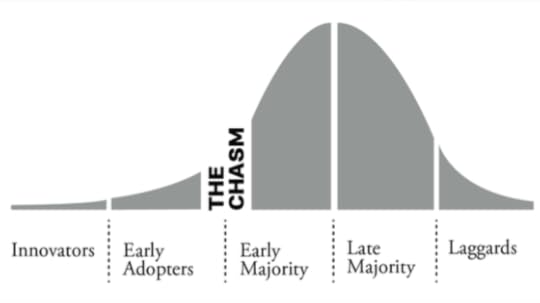
I suspect that all but the most hidebound execs would say yes. Given the risk of failure, few want to be known as the ones who saw new systems and infrastructure fail on their watch. When it comes to DevOps, cloud computing, and the like, most won’t be early adopters, but most will keep an eye on what’s happening. Perhaps they’ll be fast followers.
By 2020, cloud computing will drive nearly one-third of new enterprise apps.
The Winds Are Swirling
But what about applications with a modern-day flavor? That is, what about those that don’t need to replace older, clunky ones? Lest you think that we’re talking about a small number, consider the following fascinating statistic: by 2020, cloud computing will drive nearly one-third of new enterprise apps. To paraphrase Jeff Bertolucci:
These applications don’t just run in the cloud—they embrace its inherent scalability and anti-fragility. Thus, when apps experience stress and failure, the system actually becomes stronger over time. Cloud-based development results in applications that rapidly scale, dev teams can quickly add new features and respond to market changes.
As organizations and their employees become more comfortable with (more) modern tech practices and tools, they become prime candidates not just to try DevOps—but to successfully adopt it. It’s not hard to envision a virtuous cycle in which successes cascade throughout mature organizations. Case in point: Consider Brad Surak and his work at General Electric. (Surak currently serves as GE Digital’s COO.) He has been instrumental in getting GE to think less than a 125-year-old industrial powerhouse and more like a contemporary DevOps organization.
Simon Says: DevOps will become a hygiene factor.
Even successful organizations can’t fight change forever. As the ascents of Uber and Airbnb suggest, disruption happens faster than ever. (To be fair, research here is mixed.) Firms that can’t quickly respond to emerging consumer and tech trends run the risk of irrelevance, obsolescence, or even extinction.
I can see a future in which adopting DevOps is necessary but not sufficient for success. Put differently, as a classic hygiene factor, doing IT well won’t ensure a thing. Doing it poorly, though, is a recipe for disaster.
Feedback
What say you?
 This post was brought to you by IBM Global Technology Services. For more content like this, visit IT Biz Advisor.
The post The Future of DevOps appeared first on Phil Simon.
August 15, 2017
DevOps Challenges
Introduction
In my last post, I introduced DevOps and briefly explained its history and benefits. An organization cannot merely change the name of its IT department to DevOps and expect to immediately realized outsize rewards. On the contrary, firms often face considerable challenges on both the technology and people fronts as they embark upon the DevOps path.
Tech
Perhaps the key tenet of DevOps is continuous deployment/delivery. Few intelligent business and tech folks would argue that it’s never been more critical to anticipate and respond quickly to emerging trends. Still, no firm can do this merely by fiat. CXOs can implore their underlings to work hard as much as they want, but the simple truth is that aging infrastructure prevents many employees, groups, teams, and even entire organizations from quickly releasing new features and services. (For an example of how this recently hindered the airline industry, click here.)
Aging infrastructure hinders more than a few organizations’ attempts to embrace DevOps.
Put differently, consider XYZ, a fictitious mature organization that runs a bevy of self-hosted legacy applications stitched together with a patchwork of extract, transform, and load (ETL) routines. The term spaghetti architecture comes to mind. As a result, key systems fail on a relatively frequent basis. New features to existing applications take months to launch, never mind brand-new applications. Basic reporting remains a challenge and many systems ought to be at least refactored if not retired. Finally, all testing is manual.
A few years ago, XYZ management cautiously embraced cloud computing and ported a few applications over. This only meant more complexity and increased cost; think of it as addition by addition.
If you think that DevOps is a silver bullet here, think again. Unless and until XYZ cleans up its act and thinks about upgrading its infrastructure, cycle times will remain long. In short, DevOps is unlikely to make a bit of difference.
People
Even the “best” or “most current” tech, however, does not guarantee by itself that DevOps succeeds in any given enterprise. As I’ve said many times before, organizations’ muscle memory tends to be strong.
Plenty of old-school IT folks remain stuck in their ways and don’t easily accept new ways of doing things. For instance, some reject the very idea that core DevOps tenets such as automated testing frameworks can bear fruit. Deploying several times per day is anathema to them, as are Kanban Boards, burndown charts, and other Agile artifacts.
Simon Says
As powerful as DevOps is, it is no elixir. Without the right infrastructure, people, and culture, efforts to adopt it will likely die on the vine.
Feedback
What say you?
In part three of this series, I’ll offer a few thoughts on the future of DevOps.
The post DevOps Challenges appeared first on Phil Simon.
August 11, 2017
The Case for DevOps
Introduction
We’re long past the days in which a single, monolithic “IT Department” can address the entirety of an organizational and employee technology needs. More than ever, enterprises need to quickly and continuously deliver new functionality while concurrently paying attention to security, stability, interoperability, and reliability.
If that seems like a tall order today, you’re spot-on.
As a result, you may have heard the term DevOps—a portmanteau of development and operations. If you haven’t, then there’s a good chance that you will in the near future. But what is it? What are its benefits? And what about its limitations?
In this three-part series, I’ll cover its background, some of the challenges that its practitioners face, and a cautious look at its future.
DevOps: Brief History and Origins
The roots of the term DevOps stem from a 2009 conference in Ghent, Belguim. Fast forward eight years and it’s no overstatement to call its rise meteoric. A quick look at Google Trends demonstrates as much:
Exhibit B: Gartner reported that DevOps was by far the most popular search term for IT operations on its website in 2015.
As for why DevOps has exploded, the answer isn’t “rocket surgery.” The history of traditional phase-gate IT projects isn’t a particularly successful one. In fact, it’s riddled with failures, lawsuits, and general disappointment—a topic that I address in Why New Systems Fail.
Enter DevOps.
At a high level, it’s a reaction to previous IT delivery methods. As such, DevOps attempts to fuse several different practices, philosophies, and tools. It’s no coincidence that cloud computing and Agile software-development methods such as Scrum preceded DevOps. Organizations wanted to augment their ability to deliver applications, features, and technology services. DevOps represents nothing short of a fundamental rethinking of the way in which IT operates. (For a great read on the subject, check out The Phoenix Project by Gene Kim.)
DevOps fuses several different practices, cultural philosophies, and tools.
Benefits
In no particular order, organizations that embrace DevOps can expect to realize the following benefits:
Delivering quicker and more frequently. By definition the payoff for Waterfall-based projects takes place at the end, if all. Organizations can realize benefits far earlier than with waterfall methods.
Detecting issues and errors earlier. Let’s say that you’re thinking of purchasing a home. Isn’t it better to find a crack in the foundation as early as possible? What happens if you only discover it after you sign the mortgage? The same principle applies with software development.
Developing a more holistic view of the enterprise. As Esther Shein writes, organizations “mov[e] away from managing IT via functional disciplines like data center, security and app development.”
Achieving greater visibility and transparency. Incredibly, many organizations cannot document the state and progress of their IT efforts. With roots in manufacturing, quality assurance, and supply-chain management, DevOps seeks to minimizes waste.
Simon Says
Don’t expect DevOps to disappear anytime soon. The speed of business and tech isn’t slowing down. No, it’s not a panacea for bad management and awful ideas. Done right, though, DevOps makes for faster, better, and more transparent IT.
Feedback
What say you?
In part two of this series, I’ll discuss some of the challenges associated with DevOps.
This post was brought to you by IBM Global Technology Services. For more content like this, visit IT Biz Advisor.
The post The Case for DevOps appeared first on Phil Simon.
July 24, 2017
Enterprise IT Trends for 2018

Introduction
Here we are at the halfway point of 2017. Rather than wait until the end of the year to make a few predictions about the new year, I’ll offer up a few now.
IT Finally Gets Serious about Simplicity
For years, many CIOs have lamented the states of their systems and architectures, especially when exciting new technologies have shown so much promise. This is particularly true at mature organizations that appear to be reluctant to embrace the future. Convoluted systems and spaghetti architecture inhibit plenty of firms from acting and reacting quickly, something that is becoming increasingly costly. I expect more of the holdouts to not only think seriously about how to streamline operations and systems, but actually begin the process.
IT Continues to Get Out of the Data Business
The IT-Business Divide is lamentably alive and well in many organizations. If you are not familiar with the term, Thomas Redman penned a particularly good post for HBR on the topic not that long ago.
For now, here’s a simple definition: it is the exhausting and ultimately counterproductive internal bickering that routinely takes place between IT and everyone else about which entity “owns” the data. Google away and you’ll find countless articles about bridging the traditional IT-business divide. Along with unnecessarily complicated systems, this divide hamstrings many organizations.
Many intelligent folks believe that individual lines of business (LOBs) should take responsibility for their data, not a central IT department. Expect more CXOs to adapt to this line of thinking.
Containerization Continues to Gain Momentum
What do Microsoft, Google, Amazon, HP, IBM, Intel, Red Hat, and VMware agree upon?
Answer: The Open Container Project.
Containerization is Docker’s version of virtualization.
Containerization represents an evolution from service-oriented design, a topic that I cover in The Next Wave of Technologies. Its benefits include:
Easy scalability
Extremely lightweight, isolated execution environments
Abstraction of the host system away from the containerized application
Docker is arguably the big kahuna here. It’s not an overstatement to say that it’s revolutionizing application deployment. Not coincidentally, it’s also a big reason for Docker’s lofty valuation.
“Containerization is Docker’s version of virtualization,” says Ben Lamm, cofounder at Conversable. He continues:
It’s the same concept of what virtual machines used to do: it provides the opportunity to quickly create developer environments. It makes it easier to attract new developers. They can jump right in without having to download any dependencies that devices might need. It makes it easier for developers to get up and running and involved on a project. Finally and most important, it allows for multiple people working on a team to work in the same environment. That is, there’s no discrepancy that causes conflict. It removes the variation in development.
The benefits of preserving all the tools and elements of development environments in one place are hard to overstate—especially in the enterprise. Now that it’s become more mature, expect more inquiries on the feasibility of containerization in large firms.
Simon Says
Sure, many laggards will continue to drag their feet and cling to antiquated ways, but more and more leaders are coming around to these key trends.
Feedback
What say you?
This post was brought to you by IBM Global Technology Services. For more content like this, visit IT Biz Advisor.
The post Enterprise IT Trends for 2018 appeared first on Phil Simon.
July 17, 2017
What to Learn?

Introduction
“A good hockey player plays where the puck is. A great hockey player plays where the puck is going to be.”
—Wayne Gretzky
In my last post, I made the case that today’s professionals and college graduates will need to learn continuously. That is, their days of acquiring knowledge won’t cease when they accept their diplomas.
This begs the question: What types of skills should those seeking quality jobs attempt to acquire?
Looking for Answers
The facile answers are data and technology, but these are broad areas. Moreover, it’s downright silly to lump everything together in one or two buckets. For instance, the futures of Python and JavaScript are far brighter than that of COBOL, although current salaries with the latter are nothing to sneeze at. (In fact, to the extent that many organizations maintain legacy systems for decades after their heydays, there may be tremendous opportunity and value in learning antiquated skills. Think of this as zigging while others zag.)
Artificial intelligence, virtual reality, and augmented reality are all poised to explode.
Generally speaking, though, I can’t recommend clinging to the past. Rather, it’s usually wise to go to where the puck is going to be not where the puck was, to paraphrase hockey legend Wayne Gretzky. Against that backdrop, consider the following three areas.
Artificial Intelligence
The American author, computer scientist, inventor, and futurist Raymond Ray Kurzweil has been predicting for decades that machine intelligence will surpass that of man in the not-too-distant future. Whether singularity comes in 40 years or not at all, there’s little doubt that machines will continue to usurp the positions that humans now hold. Driverless cars are a case in point.
Rather than fight the future, why not embrace it? No, you don’t have to build your own Terminator, but you can immediately begin playing with different APIs that tap into AI such as those of IBM Watson. In fact, a few of my students have done just that.
Virtual Reality
There’s a reason that Facebook dropped nearly $2 billion for Oculus VR. VR is coming. One of my ex-students recently showed me a VR-based app for realtors that he has cobbled together. In short, it blew my socks off. Expect to see plenty of neat VR applications soon.
Augmented Reality
This is another area that’s set to explode in the coming years. For a neat example of what AR can do, check out this real-life video game tutorial for your Airbnb rental.
Simon Says: Get in on the ground floor.
Sure, we’re in the early innings of each area, but these three areas look exceedingly promising. I suspect that, in a decade, we’ll look back on the applications of each with a sense of amazement akin to how we view the iPhone compared to its predecessors.
Feedback
What say you?
This post was brought to you by IBM Global Technology Services. For more content like this, visit IT Biz Advisor.
The post What to Learn? appeared first on Phil Simon.
July 12, 2017
The Case for Lifelong Learning

Introduction
In late June after a six-week respite, I returned to ASU to teach my capstone courses: analytics and system design. One year into my professorial career, I like to think that I’m starting to get my arms around the evolving relationship between academia and technology. In a nutshell, it’s a complicated one rife with nuances.
For starters, I don’t share the beliefs of anti-college zealot Peter Thiel. Still there’s plenty of support for the notion that one need not acquire a proper four-year degree in order to be successful. Famous examples of college dropouts such as Mark Zuckerberg and Steve Jobs aside, more and more companies are hiring in less-than-traditional manners. From a recent piece in the NY Times:
In the last two years, nearly a third of IBM’s new hires there and in a few other locations have not had four-year college degrees. IBM has jointly developed curriculums with the local community college, as well as one-year and two-year courses aligned with the company’s hiring needs.
IBM CEO Ginni Rometty refers to as these as new-collar jobs and they may be critical in the future. Think of them as positions “somewhere in the middle between professional careers and trade work, meaning they combine technical skills with a knowledge base rooted in higher education.”
Successfully Navigating an Increasingly Uncertain World
A programming language may scorching hot right now, but will it remain that way indefinitely?
To be sure, plenty of learning has always taken place outside of a proper classroom setting. I also consider myself a case in point: In the last two decades, I have taught myself Spanish, SQL, VBA, web design, and other technologies not covered at Cornell’s ILR program. If I put on my swami hat, I see this trend only intensifying in the future.
I stress to my students that there’s less certainty than ever. Programming languages, methodologies, and tools will continue to evolve. Python, R, and Javascript may be scorching hot right now, but are you willing to be that they will remain that way indefinitely? I’m not.
Fortunately, those who want to sharpen their tools and acquire new ones have never had more resources at their disposal. Sure, many companies continue to offer their employees formal training programs and education reimbursement stipends. Don’t think for a minute, though, that you need your employer’s permission to affordably pick up new skills today. Nothing could be further from the truth. Many universities offer certificate programs. Beyond that, knock yourself out with countless courses on YouTube, Udemy, Coursera, Udacity, and Lynda (now part of LinkedIn/Microsoft). Sign up at Code Academy. Or just go buy a book and go to work.
Simon Says: In crisis, there is opportunity.
As the Chinese say, there is opportunity in crisis. For better or worse, few if any companies offer lifetime employment anymore—even in Japan. If you don’t embrace continuous learning, you may soon find yourself on the outside looking in. Those who refuse to adopt new skills may find that the world has passed them by.
Feedback
What say you?
This post was brought to you by IBM Global Technology Services. For more content like this, visit IT Biz Advisor.
The post The Case for Lifelong Learning appeared first on Phil Simon.
June 27, 2017
Publication of Analytics: The Agile Way

I’m pleased to announce that Analytics: The Agile Way is now shipping.
This book came together quickly for several reasons. First, I really wanted to use it in my CIS450 Enterprise Analytics class at ASU this summer. I wrote at a pace that would make my friend—and fellow Rush nut—Kevin J. Anderson proud. Second, the folks at Wiley were extremely accommodating. My editor put out a date and kept his word. Over the years, I have come to appreciate many of the ways in which traditional publishers can help even established authors.
Check it out on Amazon.
The post Publication of Analytics: The Agile Way appeared first on Phil Simon.
June 25, 2017
June 19, 2017
The Case for Data Lakes

Introduction
In my last post, I briefly defined a data lake and described how it differs from a traditional data warehouse. Today I’ll make the case for using one and offer a few words of caution before getting started.
Before I do, though, I’d like to take a little trip down memory lane. In my pre-author and -professor days, I frequently wrote complex reports from enterprise systems. At a high level, I can say three things about that data. First, much of the time, it was incomplete, duplicated, or flat-out wrong. Second, it was everywhere. The data typically lay in a number of different places: relational databases, legacy systems, business-intelligence applications, Microsoft Access databases, Excel spreadsheets, etc.
This brings me to the third commonality. Despite the wide variety of places that housed the data and the myriad issues I encountered, one thing remained relatively constant: it was almost always structured. That is, it typically played nicely with calculations, counts, summaries, averages, minimums, maximums, etc. spreadsheets, and the like. My most effective weapons consisted of SQL statements, stored procedures, and database views. Collectively, they were invaluable: they helped me make sense of some massive structured datasets.
We no longer live in that simple world.
Unstructured Data Is Eating the World
Most of today’s data is of the unstructured variety—perhaps as much as 85 percent. Think tweets, blog posts, articles, photos, videos, etc. (E-mails are semi-structured.) As such, those same powerful tools for structured data no longer cut the mustard.
One big lake doesn’t ameliorate data-quality issues such as duplicate or inaccurate records.
Imagine needing to deploy vastly different tools on different data sources and types. Now imagine trying to stitch them all together. By way of analogy, what if you could only find non-fiction books at your local library and you had to go to a separate location to borrow 1984 or Dune?
As Jacqueline Lee writes, “as [organizations] seek value in unstructured data, some are amassing data in giant data lakes hoping that it will someday yield insight
Simon Says: Remember the following before you get started.
The benefits of data lakes are hard to overstate, but before continuing a few words of caution are in order. First, tossing structured data into a data lake causes it to lose its structure and, by extension, some of its value. Second, one big lake doesn’t ameliorate data-quality issues such as duplicate or inaccurate records. A data lake doesn’t magically cleanse dirty data. GIGO still applies.
Finally, for years, data warehouses have been able to handle incremental extract, transform, and load (ETL) processes. Loading a data lake, however, tends to be a binary (read: all or nothing). Fixing a mistake may require a complete reload. In the process, it may increase the time required to derive insights.
Feedback
What say you?
This post was brought to you by IBM Global Technology Services. For more content like this, visit IT Biz Advisor.
The post The Case for Data Lakes appeared first on Phil Simon.