Diane Lockward's Blog, page 25
August 7, 2013
The Crafty Poet: Just Published!
My new book,
The Crafty Poet: A Portable Workshop
, is now officially published! I'm happy with it from cover to cover. So many wonderful poets contributed to this book—more than 100 of them. You'll find twenty-seven Craft Tips and twenty-seven model poems from highly regarded poets, including thirteen former and current state Poets Laureate. Each model poem is followed by a prompt and two sample poems written to the prompt. You'll also find ten poems with Q&As between the poet and me. To make sure you stay busy, there are also ten bonus prompts.
The book is organized into ten sections:
Generating Material / Using Time
Diction
Sound
Voice
Imagery / Figurative Language
Going Deep / Adding Layers
Syntax
Line / Stanza
Revision
Writer's Block / Recycling
This book can be used by the individual poet studying and working independently at home. Or it can be used in the classroom or workshop.
I hope you'll soon find The Crafty Poet in your hands and that it will offer you much to think about. Of course, I also hope that it will stimulate you to write some new poems.
One of the nicest compliments I've had on the book so far came from my publisher who said that he'd had a hard time doing the edits as he kept wanting to stop to write a poem.
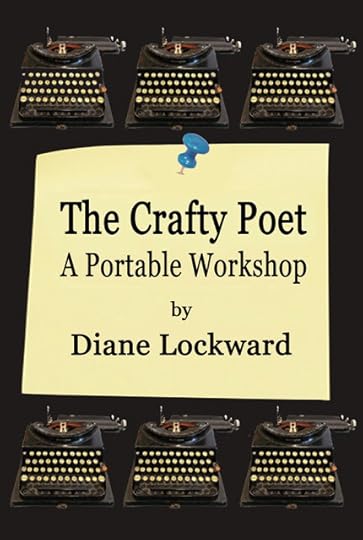
Click Cover for Amazon
The book is organized into ten sections:
Generating Material / Using Time
Diction
Sound
Voice
Imagery / Figurative Language
Going Deep / Adding Layers
Syntax
Line / Stanza
Revision
Writer's Block / Recycling
This book can be used by the individual poet studying and working independently at home. Or it can be used in the classroom or workshop.
I hope you'll soon find The Crafty Poet in your hands and that it will offer you much to think about. Of course, I also hope that it will stimulate you to write some new poems.
One of the nicest compliments I've had on the book so far came from my publisher who said that he'd had a hard time doing the edits as he kept wanting to stop to write a poem.
Click Cover for Amazon


July 31, 2013
The Crafty Poet: Sample Poem Contributors

In a previous post about The Crafty Poet, I bragged about the list of poets who contributed Craft Tips, Q&As, and model poems for prompts. Now I want to brag about the poets who contributed the sample poems written to the prompts.
Towards the end of putting the manuscript together, I sent out a call for submissions to all of the subscribers to my Poetry Newsletter. I created a website page with links to all of the past model poems and prompts. I subsequently invited others to join in.
The book contains 27 model poems and prompts. Therefore, I needed 54 sample poems since I wanted two sample poems for each prompt. I wanted sample poems that would illustrate the various possibilities the prompts might suggest.
Before I sent out the call, I was a bit worried that I might not get enough submissions. After all, some of the prompts were from newsletter issues that went back more than two years. However, the spots filled amazingly and gratifyingly fast.
I was thrilled to have all the spots filled within a few weeks. And I was thrilled with the quality of the poems I received. Sadly, there were many poems I had to turn away simply because the spots were already filled.
So here's the list of the 45 fabulous contributors of sample poems:
Joel Allegretti
Linda Benninghoff
Broeck Blumberg
Rose Mary Boehm
Bob Bradshaw
Kelly Cressio-Moeller
Rachel Dacus
Ann DeVenezia
Liz Dolan
Kristina England
Laura Freedgood
Gail Gerwin
Erica Goss
Jeanie Greensfelder
Constance Hanstedt
Penny Harter
John Hutchinson
Wendy Elizabeth Ingersoll
Tina Kelley
Claire Keyes
Laurie Kolp
Antoinette Libro
Charlotte Mandel
Joan Mazza
Janet McCann
Nancy Bailey Miller
Thomas Moudry
Drew Myron
Shawnte Orion
Donna Pflueger
Wanda Praisner
Susanna Rich
Ken Ronkowitz
Basil Rouskas
Nancy Scott
Martha Silano
Linda Simone
Melissa Studdard
Lisken Van Pelt Dus
Jeanne Wagner
Ingrid Wendt
Scott Wiggerman
Bill Wunder
Michael T. Young
Sandy Zulauf
July 22, 2013
Poetry Salon: Debra Bruce

I am happy to host today's Poetry Salon for Debra Bruce. I first met Debra on the Wompo Poetry Listserv. I then had the pleasure of meeting her in person at the West Chester Poetry Conference when we both served as panelists on a critical seminar exploring undervalued women poets. Debra's latest poetry collection is Survivors' Picnic, a collection filled with a variety of masterful form poems. Debra is also the author of three previous collections. She lives in Illinois and is a professor emeritus at Northeastern Illinois University.
Debra is going to speak with us about Survivors' Picnic.
DL: Tell us how you went about writing these poems and assembling them into a collection.
DEB: I wrote the poems over a period of 15 years, along with many others that didn’t make it into my book. I’m an embarrassingly slow writer, and during these years I was busy teaching full-time and raising my son. Sometimes I wrote in direct response to the events of my life—mothering, breast cancer survival, and the end of a long marriage. Sometimes I would get an idea for a project-poem or series—a sequence about the six wives of Henry VIII, for example, which budded while I was teaching the court poets of the 16th century—especially Thomas Wyatt. I wrote two of the poems—two wives—but couldn’t find a way to do the other four. Sometimes I wrote poems just to exercise in a specific form, which I love to do, trying my hand at the ballade, villanelle, and a few pantoums. And as I read during these years, I fell under the spell of writers like Kay Ryan, whose example enabled me to write some of what I consider my strongest poems. Reading Ryan made me feel that I’d been given permission to bask in sounds—internal rhyme, assonance, and alliteration—something that had been frowned upon during the “plain style” decades. Ryan also showed me how to be more oblique rather than direct or explicit—a good lesson for someone who had studied with Anne Sexton back in '73, as I was just starting out.
When I decided to put the manuscript together, I discovered poems that didn’t hold up, some that didn’t fit in, and a general repetition of sounds, images, and subjects. Several poems, even some that I’d published in good literary journals and that I personally liked, had to go. I’m glad I waited as long as I did because it enabled me to do this kind of winnowing, and I think the book is stronger for it.
DL: Tell us the story behind your cover.
DEB: When I published my earlier books, first with the University of Arkansas Press, and then with Miami University, I had a helpful staff to design covers for me. This time, with Word Press (Word Tech Editions), an independent press, I was on my own. Clueless, I started asking other poets, and someone suggested I check out the collection at Woman Made Gallery in Chicago, a great venue for women poets as well as visual artists. Suzanne Keith Loechl had done a series of empty dresses on clotheslines set against deeply colored, swirling landscapes. I had looked at hundreds of images online, and when I found her work, that was it. I was thrilled when she agreed to let me use her image. As it turned out, this painting, “I Dreamed I Could Dance,” had become part of a website Suzanne created to honor friends she’d lost to breast cancer. No wonder it spoke to me.
DL: How did you select the title for your book?
DEB: Titles have always been difficult for me. When I was married, my then-husband often came up with titles for individual poems and even books. My previous publishers had editors who had a knack for it, too. This time I was on my own. One of the poems in the book, “Annual Survivors’ Picnic,” felt like a “title poem,” but the wording wasn’t quite right for the whole collection—“annual” pins it down to a single event. Survivors’ Picnic sounded good, suggesting the shadow of fear that all survivors live with, and the deepening of life’s meaning and pleasure created by that shadow, as shade can deepen the beauty of color.
DL: What do you hope readers will take away from your book?
DEB: I hope readers will take away a phrase or line that they can’t shake out of their heads—the music of it as much as what it says. And if a reader has experienced something I’ve written about, I hope she or he will feel that I’ve articulated the experience just right—nailed it.
DL: Please choose a favorite poem for us and, if you like, tell us why you chose this one.
DEB: “Plunder” is a poem I would choose as a favorite because it makes music, which is of utmost importance to me. (Frost famously said, “All the fun’s in how you say a thing.) And it’s also a poem that can speak to many different experiences, though I had a specific experience in mind when I wrote it. I love poetry when it’s clear but not confined. Emily Dickinson has a powerful poem that starts, “I’ve dropped my Brain—My Soul is numb—,” which describes some kind of emotional or spiritual dark place or psychic freeze, describing it vividly and concretely without specifying what caused it.
Plunder
Now that your surgery’s
savagery’s smoothed over
and the calm you’ve put on is balm
for all, and in the interstices
between catastrophes you find yourself
enjoying joy;
now that your Why?
is wisely subsiding, knowing no one
knows why one grows gold
slowly and one’s bright green gets torched
overnight;
in this intensely present
tense, in its rush
of cherished perishables, you might splurge
skyward, spreading
your colors in a freefall
never dared before; or
with minimal fanfare slip
into the life you left, the least
predictable most delectable,
in whose midsummer noon you pop
a flip-top in thirst, and think…
and though you simply sip,
deeply drink.
Let's listen now to Debra's wonderful reading of "Plunder."
Please stay for the Reception. Help yourself to a glass of Malbec, some brie and cheddar on crackers, fresh fruit, and don't forget the Belgian chocolates.

Overheard at the Party: “Debra Bruce's poetry is a secret treasure—to be discovered and read and re-read. Every lover of language can partake of Bruce's passionate picnic.”—Molly Peacock
Before you leave, be sure to pick up a copy of Survivors' Picnic.
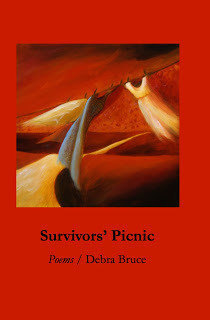
Click Cover for Amazon
July 17, 2013
The Crafty Poet: The Contributors & a Contest
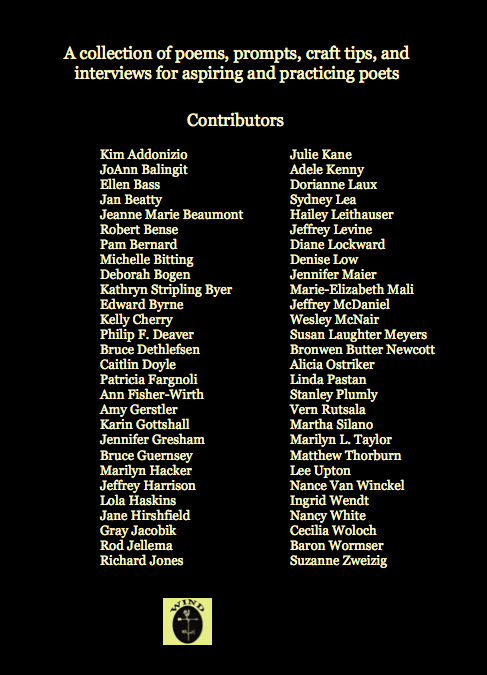
I am so very proud of the cast of poets who have contributed to my almost-here book, The Crafty Poet: A Portable Workshop. In fact, I think this is such an impressive list that my publisher and I decided to use their names on the book's back cover instead of blurbs. A total of fifty-six poets contributed the 27 Craft Tips, the 10 Poet on the Poem Q&As, and the 27 model poems that go with the prompts.
Among these 56 poets are 13 former and current state Poets Laureate. Now here's the contest: the first person to match up the 13 Poets Laureate with their respective states will win a free copy of the book. I'm going to switch comments to moderation, so post your answers in the Comments section. Once there's a winner, I'll post the correct answers and announce the winner.
An additional 45 poets contributed the sample poems written in response to the prompts. This is also an impressive list—and not surprisingly, the poems they contributed are also impressive. I'll post those names another time.
July 9, 2013
Ode to a Cronut

I love pastries. Last week my daughter told me about the newly invented Cronut. This delight was invented by the pastry chef at the Dominique Ansel Bakery on Spring St. in NYC. But its fans have spread far and wide. In fact, the pastry's fame has spread so far that some people refer to it as "a viral pastry." Half croissant, half doughnut, this pastry hybrid is filled with cream and topped with glaze. It is so delicate that it must be cut with a serrated knife.
The bakery produces just one flavor per month. The owner recommends that if you really want one of these cronuts—and there's a 2 per person limit—you should be outside in line by 7:15 AM, prepared to wait for up to two hours. The bakery prepares only one flavor per month. Just invented in May, the cronut so far has come in only three flavors.
The day after my daughter told me about the Cronut I heard two anchors on the morning news swooning over the confection, both saying it was the best they'd ever had. Now I deeply desire to have one myself.
And for some reason, I'm obsessing about the cronut. I can't get it out of my head. That, hopefully, means that at some point a poem will emerge—just in case you were wondering what any of this has to do with poetry. But it's also occurred to me that the cronut is itself like one of those good poems that fuses together two unlikely components and is constructed in layers.
So I've been dreaming up a few poetic challenges. See what you can do with any of these possibilities:
1. Write a poem about the Cronut.
2. Write a poem that fuses together two unlikely subjects.
3. Write a poem about your favorite pastry.

Line outside the bakery the morning the Blackberry Cronut
was released

The Blackberry Cronut
Check out the Cronut Facebook page. Be prepared to drool.
Check out the bakery page on Facebook. Here you'll find out all the history and controversy, yes, controversy, surrounding the cronut.
July 2, 2013
The Crafty Poet: Unveiling the Cover
My book, The Crafty Poet: A Portable Workshop, is moving right along. The galleys have been proofed and returned. Page numbers have been added to the Contents. And the cover has been designed.
In spite of having proofread the manuscript countless times before sending it off to my publisher months ago, I found some errors that I'd overlooked back then. Now I wonder how the heck did I miss that? and that? With this recent reading, each time I went through the manuscript I found a few more things I'd missed. Mostly small stuff like an extra space, but I want the book to be as close to right as I can make it. (I'm avoiding saying "perfect.")
Organizing this book was a huge challenge as it contains work from more than two years, work from this blog and from my Poetry Newsletter, work written by me and work written by other poets. In the Newsletter it doesn't matter if the poem and prompt coordinate with the Craft Tip, but for the book I needed to logically organize the material. I made a list of everything I planned to use in the book. Then I stared at that list for days/weeks until a plan began to form. That plan, of course, changed through multiple drafts, but once I had a plan, I knew I was going to get the job done.
Because the book includes writing contributed by other poets, the big challenge in editing/polishing was to achieve consistency of style throughout the text. Some writers, for example, put commas around "too" when it means "also." Other writers do not. Some writers use the period key to create an ellipsis. Others use Option plus the semi-colon key. Either is correct but the look is slightly different. I wanted all the ellipses to look the same. (I have come to hate the ellipsis.) Stuff like that was sort of crazy-making, but I'm still here. And I'm thrilled with the book and can't wait to have it here. That should happen this summer.
In the meantime, here's an advance view of the cover. I'm very happy with this. It feels just right for a craft book.

June 24, 2013
The Poet on the Poem: Sydney
I am delighted to have Sydney Lea as our guest today.

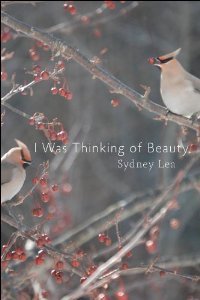
Sydney Lea is the Poet Laureate of Vermont. Retired after 43 years of college teaching, he is active in literacy and conservation efforts in northern New England. He founded the New England Review in 1977 and edited it until 1989. He has published ten volumes of poetry, most recently I Was Thinking of Beauty (Four Way Books, 2013) and Six Sundays Toward a Seventh (Wipf and Stock, 2012). He has also published a novel, a selection of literary essays, and three collections of naturalist essays. He is the recipient of fellowships from the MacArthur, Rockefeller, and Fulbright Foundations.
Today's poem comes from I Was Thinking of Beauty.
Click Cover for Amazon
Blind, Dumb
Ted was the logger, I the greenhorn professor,
Tommy the logger's teenaged son.
I needed distraction, so we took that hike together.
Toward evening a doe crashed past, haphazard.
Ted said, She's blind.
She showed as pale as a moose in the dead of winter,
which seemed foreign to me. But then everything did:
the weeks dragged by and my poor wife still lay under
the pall of coma. Our old car had flipped.
I stood and wondered,
how could the doe survive the coming cold?
The full dark loomed, and Tommy pled,
Can't we go for a gun? He didn't want to leave her
to starvation, predation, to that murder of ravens
perched low and bold.
My wife and I had quarreled. She sped away,
blanched by anger I tried to ignore
until the trooper called at the house to say
the Jeep had landed roof-down on Route 4.
On this later day,
the logger appeared to see what I couldn't see:
Not up to us to spare her, he drawled.
My every instinct wanted to disagree,
but as Tommy and I glanced up at the cruel
black birds in the trees,
I was the mute one. Dodging the frantic animal,
we could almost look through her ghostly hide,
scourged bloody by lashes of brush in her scrabbling circles.
Scavengers waited for quarry to die,
sat patient, preened.
I'd read no novel, no poetry that trained
my soul for this—or anything.
So I thought as I felt my uselessness in the scene.
What could I say? What could I do?
My vapid dream
was to start all over again, not having to know
some categorical, unspeakable things.
I'd always imagined words' restorative power,
but I'd witnessed beings who couldn't pass on
what had happened or how.
Words wouldn't help them. To see that so starkly stung.
Speechless, benighted, what had I to teach
a student now, much less a daughter or son?
Frost had unclothed the maple and ash,
so winter could come.
DL: The form of this poem strikes me as a happy marriage between tradition and invention. Tell us how the form evolved.
SL: I recently colluded with the Vermont Contemporary Music Ensemble in a concert; five composers wrote individual pieces that were responses to poems of mine. One of the composers, Erik Nielsen, said that “the hardest part about composition is talking about it.” I identify with such a contention. That said, I have some intuitive answer to your question about form—intuitive because, vague as this inexcusably is, there seems a way in which forms choose me rather than vice versa.
More or less strict forms, however unconventional (I rarely use received conventions), are enabling components for me. If I allow myself to play with formal alternatives, I can get away from thinking too hard about what I may “mean.” Paradoxically, that approach allows for such meaning—though I mistrust that term—the poem may contain.
In this case, my logger friend—who put small stock in self-revelation via language—imagined that physical exercise would take my mind off the fact that my wife was in coma. He was wrong, as the poem suggests. I nonetheless recalled his good intentions, and the first of the few words he spoke came to mind: “Ted said, She’s blind.”
A two-stress line.
It then occurred to me that most of the important things that would come in the poem would be equally terse; that is, my unconscious told me that, in a poem that has as much to do with the inadequacy of words as anything, the important material would be clipped in that fashion, right up to “so winter could come.”
Mind you, I didn’t know that would be a line at all, let alone the last; I was, as it were, led there, past “black birds in the trees,” through “my vapid dream,” and so on. The form was built around that “inspired” keystone.
DL: I deeply admire the wonderful, subtle sounds of your poem. There's some end rhyme, yes, but then there are also rhymes and near rhymes scattered throughout the poem, e.g., old, cold, bold; called, quarreled, drawled; preened, scene, dream. How did you make this music happen?
SL: My late friend Bill Matthews, who was not a formalist like me, once told me in conversation that he tended to like free verse when it sounded most like formal, and vice versa. Me too: hence the ongoing appeal to me of slant rhyme. And there is my ongoing obeisance to Frost, who, though far stricter in his formal allegiances than I am (or could be), nonetheless wanted the sound of conversation in his poems. I guess the looseness of my rhyming somehow goes in service of that aim.
DL: Your poem skillfully handles two narratives: the frame with the speaker in the woods and then the inner story about the argument with the wife that led to her accident. How did you go about fusing these two pieces? Were they always in the same poem? Do you consider one or the other the more important story?
SL: From the start, they were one and the same story, the understandably complex tale of the moment(s) I recalled. There was no narrative engineering involved. My wife was near death; I was on a hike with two others who were close to her; I was at the very awkward and daunting dawn of what would be a long professorial career; a blind deer showed up; I felt...what I felt. I just tried to get all that onto the page as straightforwardly as I could, trusting that honest recollection would have its own “poetry.” I always operate on that trust, in fact.
DL: Chekov said, "If you want to move your reader, write more coldly." I couldn't help thinking of those words as I read and reread your poem. The tone is so chilly but the poem is all the more effective because of that chilliness. How did you manage to keep out emotionalism and just let the details and images do their work.
SL: Well, I have always assumed that gushy sentimentality gets in the way of real sentiment. Once again, straightforward—even “cold”—recitation would carry the emotional freight I needed to make the poem other than a whine.
DL: There's irony in that the speaker who makes his living reading books and talking becomes "mute," then "speechless," and asks at the end, "What could I say?" He learns that there are "unspeakable things." It's also ironic that the professor gets schooled by the logger. Did the irony come into the poem inadvertently or was it crafted?
SL: What I have always admired in the Yankee old-timer is his or her capacity to know the difference between acceptance and resignation. The old-timer I refer to (and I have lost touch with his son, a sort of bridge figure between his dad’s emotional makeup and my own) is gone now; but as he once said, “If you can’t fix something, you get along with it.” He had had a far more dangerous and at times tragic life than mine, and I am sure, as he was a very bright guy, he often wanted to say something about the unsayable; but because it was just that, he kept his counsel. I have never attained that height of philosophic thinking, but his is the sort of model I imagine when I find myself, or find another writer, too lavishly singing the area in the opera called MeMeMe.
DL: I sense the ghost of Robert Frost in this poem. And although you do not name the setting, it feels like New England. What role, if any, have Frost and New England played in this poem?
SL: Yes, virtually all my poems are set in my home territory, New England north of Boston. There is no time spent in these villages and fields and woods that does not cause one, if he or she is a poet, and no matter what his or her taste and practices may be, to bring Frost to mind. Frost is not, maybe, my favorite poet, but he is surely the most influential on me.; Harold Bloom would imagine some “anxiety of influence,” then, on my part; but I feel, rather, real gratitude to this mentor: he has opened my eyes to things that my own (comparatively) weak eyes wouldn’t have caught.
*********************************
Readers, please enjoy listening to Sydney Lea read "Blind, Dumb."
June 19, 2013
Poetry Salon: Karla Huston

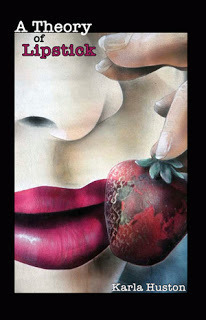
I first met Wisconsin poet Karla Huston online in a poetry listserv we both belong to. I later had the pleasure of meeting her at the 2006 Dodge Poetry Festival. We've met at each festival since that first meeting. I feel particularly excited about hosting this salon for Karla's first full-length collection as I had an opportunity to read and critique it a few years before it found a publisher. Although A Theory of Lipstick is Karla's first full-length collection, she has previously published six chapbooks.
Let's hear what Karla has to say about her book.
Diane: Tell us how you went about writing these poems and assembling them into a collection.
Karla: The poems were written over a long period of time—more than ten years for some. Others are more recent. I struggled assembling it, even though I have published lots of chapbooks. Maybe because this was my first full-length book, I wanted perfection, a big “yowza” of a book. I started with more than 100 poems. I read and reread them hoping for magic. I read about organizing manuscripts. I even tried Billy Collins' method of organization: throwing the poems on the floor and walking around in them in my stocking feet, picking them up to form an order
I also depended on the kindness of friends, especially Diane Lockward, who offered to take a look, finally giving the book sense and shape. Her suggestions were invaluable.
After it lingered for another couple of years, I finally took a new look, took courage and sent it to Scott Douglass, editor and publisher of Main Street Rag Publishing. Because I’d won his 2003 chapbook contest, he agreed to read it. To my great pleasure, he accepted it and suddenly, I had a book contract in my hands.
Diane: Tell us the story behind your cover.
Karla: The cover art was a simple matter of Googling images with lipstick; the art of German artist Christine Dumbsky came up in the queue. She loves poetry and was pleased to work with me. What I appreciate most about the cover is the image of the world painted inside the strawberry.
Diane: How did you select the title for your book?
Karla: The book should have been called Still Waiting for as long as sat in a drawer. But Chuck Rybak, UW Green Bay professor and friend, suggested the title from a poem in the manuscript. The poem, “Theory of Lipstick,” was a Pushcart Prize winner in 2011. I have several poems about lipstick in the manuscript so Chuck’s suggestion was perfect.
Diane: What do you hope readers will take away from your book?
Karla: A Theory of Lipstick is about desire, about pop culture, about women and aging—dog catcher’s wives, mothers, women looking out windows. It’s about junk drawers and birds. It’s also about having fun with language and sound, about play. I hope readers resonate with the poems and images.
Diane: Please choose a favorite poem for us and, if you like, tell us why you chose this one.
Karla: Perhaps one of the most difficult poems to read aloud because it’s so easy to get tongue-tangled, “Theory of Lipstick” was also a lot of fun to write. I have a lovely book on the history of lipstick; I researched lipstick colors and kinds (gloss, pot rouge, lip liner, the whole genre of lipsticks meant to plump lips, make them bee stung). I was fascinated by the fact that during World War II, women could afford little else but a new tube of lipstick. I had a very good time putting this together—one line, one image, one mouthful at a time.
Theory of Lipstick
Coral is far more red than her lips' red…
—William Shakespeare
Pot rouge, rouge pot, glosser, lip plumper, bee
stung devil’s candy and painted porcelain
Fire and Ice, a vermillion bullet,
dangerous beauty lipstick, carmine death rub, history
of henna. Fact: more men get lip cancer
because they don’t wear lipstick or butter
jumble of a luminous palette with brush made
to outlast, last long, kiss off, you ruby busser,
your gilded rose bud bluster is weapon and wine.
QE’s blend: cochineal mixed with egg, gum Arabic
and fig milk—alizarin crimson and lead—poison
to men who kiss women wearing lipstick, once illegal
and loathsome—then cherry jelly bean licked and smeared,
then balm gloss crayon, a cocktail of the mouth,
happy hour lip-o-hito, lip-arita, with pout-fashioned chaser
made from fruit pigment and raspberry cream,
a lux of shimmer-shine, lipstick glimmer, duo
in satin-lined pouch, Clara Bow glow: city brilliant
and country chick—sparkling, sensual, silks
and sangria stains, those radiant tints and beeswax liberty—
oh, kiss me now, oh, double agents of beauty
slip me essential pencils in various shades
of nude and pearl and suede, oh, bombshell lipstick,
sinner and saint, venom and lotsa sugar, lip sweet,
pucker up gelato: every pink signal is a warning.
Now let's gather around and listen to Karla read "Theory of Lipstick."
Please join us for Karla's book salon reception. Enjoy some beautiful fresh strawberries, a margarita, and some delicious guacamole with crackers.

Overheard at the party:
“From the title poem … to the linguistic highwire act she performs in “O Hair,” Huston writes the way her mother wore lipstick—“red was her color...and she was taking all of it with her”—this poetry is bright red, and the poet has firmly in her sights nothing less than everything.”—Philip Dacey
Click Cover to Purchase
Before you head for home, please get yourself a copy of Karla's book. And feel free to leave her a comment or a question in the comments section. Thanks for coming!
June 11, 2013
A Literary Memoir: Wesley McNair
In each of my monthly Poetry Newsletters, I include a book recommendation. The books I choose are always in some way related to poetry. The featured book might be a craft book or it might be a memoir. Or it might be a book that's related to art in general but which applies to poetry. I don't usually repost those recommendations here. However, the May book brought forth a number of emails from subscribers who thanked me for the title, said they hadn't heard of the book, but had then ordered it and were glad they had. So I thought I'd let my blog readers also know about the May book.
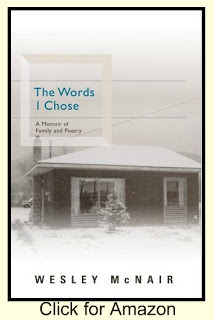
I love literary memoirs, especially ones by poets. Wesley McNair's The Words I Chose: A Memoir of Family and Poetry immediately went to the top of my list of favorites. In 175 pages, McNair covers his life from childhood to the current time. He is able to do this because he limits his focus to his growth as a poet. Of course, there are parts about his personal life—his difficult parents, his happy marriage to a woman with two sons—but he always returns to the writing life and how those other areas affected his development as a poet. Each chapter begins with a poem of his and then covers a phase of his life.
McNair pays tribute to the people who early on responded to his poems and sent him books. He covers the dark days, lonely ones, times of bone-crushing financial deprivation. For many years he was confronted with the problems of how to support a family, get an advanced degree, find time for poetry, and earn enough to live on. But he did it, always mindful of how all of that was laying the groundwork for poetry, how even the environment in which he lived was turning him into a narrative poet with a strong New England influence. Looking back on his life, he understands that all of the events and deprivations of his past contributed to his "transformation into an artist," that he was being "toughened…for the rounds of rejections…that are common to the writing life…," and that he was being given "a kind of gift, a source of [his] artistic development." He traveled a long and arduous journey, but one that led to being named the current Poet Laureate of Maine.
I love literary memoirs, especially ones by poets. Wesley McNair's The Words I Chose: A Memoir of Family and Poetry immediately went to the top of my list of favorites. In 175 pages, McNair covers his life from childhood to the current time. He is able to do this because he limits his focus to his growth as a poet. Of course, there are parts about his personal life—his difficult parents, his happy marriage to a woman with two sons—but he always returns to the writing life and how those other areas affected his development as a poet. Each chapter begins with a poem of his and then covers a phase of his life.
McNair pays tribute to the people who early on responded to his poems and sent him books. He covers the dark days, lonely ones, times of bone-crushing financial deprivation. For many years he was confronted with the problems of how to support a family, get an advanced degree, find time for poetry, and earn enough to live on. But he did it, always mindful of how all of that was laying the groundwork for poetry, how even the environment in which he lived was turning him into a narrative poet with a strong New England influence. Looking back on his life, he understands that all of the events and deprivations of his past contributed to his "transformation into an artist," that he was being "toughened…for the rounds of rejections…that are common to the writing life…," and that he was being given "a kind of gift, a source of [his] artistic development." He traveled a long and arduous journey, but one that led to being named the current Poet Laureate of Maine.
June 4, 2013
Girl Talk 2013: The Movie
I previously wrote about Girl Talk, an event I ran at my local library on Saturday, March 16. This year marked the sixth year in a row for the event. In my earlier post I described how the event is organized and detailed the work that goes into putting it together. I hoped then, and now, that someone out there might be inspired to run a similar event next March.
Each year, following the event, I have used the photos for a video. Here's this year's version. Enjoy with some popcorn.
Each year, following the event, I have used the photos for a video. Here's this year's version. Enjoy with some popcorn.