Diane Lockward's Blog, page 27
April 9, 2013
Looking for Inspiration?

It's National Poetry Month. Whether we're 30-day-challenge poets or once-a-week poets, we all want to get at least some new work underway this month. If you find yourself cursed with a lazy muse, try some of these sites for inspiration:
Poetry Challenge, by Robert Lee Brewer
30 / 30 Poetry Challenge 2013
Joanie Strangeland's blog
30 Poems in 30 Days , from NaPoWriMo
The Music in It: Adele Kenny's Poetry Blog
an inspiration word or phrase and a related poem for each of April’s thirty days
You might want to bookmark these links so that you can return to them after April is no more.


April 2, 2013
Supporting Poets and Poetry

Every poet in America knows that April is National Poetry Month. There are numerous poem-a-day challenges available online for those who want to and are able to take on the challenge of writing a poem each and every day in April. I've confessed here before that I'm just not an everyday kind of poet. I put myself at the kitchen table several mornings a week and I do something poetry-related every day. That something else might be revising, reading, listening, submitting, working on my Poetry Newsletter or blog, catching up on P&W and The Writer's Chronicle, or perusing poetry journals.
So I'm not going to take on the big challenge because I know I can't / won't do it. However, that doesn't mean that I'm not going to acknowledge Poetry Month. My plan is to attend some local readings, participate in a weekend revision workshop led by Baron Wormser at the Barred Owl Retreat in Massachusetts, and go the extra mile to support poets and poetry by purchasing as many poetry and poetry-related books as I can without ending up in debtors' prison.
I'm off to a good start. Here's what's already on my table:
Where the Dead Are, by Wanda Praisner
Anatomy of Melancholy, by Robert Wrigley
Kingdom Animalia, by Aracelsis Girmay
The Switching/Yard, by Jan Beatty
Survivors' Picnic, by Deborah Bruce
Charms Against Lightning, by James Arthur
On order and eagerly awaited:
Gloryland, by Anne Marie Macari
The World Keeps Turning to Light: A Renga by the State Poets Laureate of America, by Caryn Mirriam-Goldberg
Any suggestions for additional titles?
Here's a list of 30 Ways to Celebrate National Poetry Month, provided by the Academy of American Poets.
March 26, 2013
Tea and Conversation with Anne Marie Macari
On Sunday, March 24, I attended a poetry conversation and reading at the Bernardsville Public Library. This twice yearly program, Tea and Conversation, is hosted by its creator, Julie Maloney. The program includes both prose writers and poets. This time Julie hosted New Jersey poet Anne Marie Macari.
Julie began the event with an interview. She's a terrific interviewer who makes sure she's very familiar with her guest's work and has her questions mapped out but is flexible enough to alter them or add to them as seems appropriate. She first asked Anne Marie how she came to poetry. Anne Marie told us that one day her high school English teacher, who hadn't been doing poetry with her students, was absent. Another teacher, one who wrote her own poetry, covered the class and simply read Whitman aloud to the class. And that lit the fire. English teachers, please pay attention to that! No one came in and did a brilliant analysis of Whitman; someone came in and simply read him aloud.
Julie asked Anne Marie what gave her the courage to delve into dark places in her poetry. Anne Marie paid tribute to her predecessors: Sylvia Plath, Ann Sexton, Lucille Clifton. She said, "We don't write in a vacuum. We're part of a legacy."
Julie asked Anne Marie what she hoped people would take away from her work: Guts, the courage to face things, to do what you're afraid to do, to love.
When asked about her future plans, Anne Marie said she doesn't make plans. "The artist moves into the unknown." And she has no fear of that unknown.
We then moved to the reading part of the afternoon. Anne Marie read from Gloryland and She Heads into the Wilderness. She also read some poems from her forthcoming Red Deer, due out from Persea Books in 2015. The reading was followed by a Q&A with the audience asking the questions.
Thanks to Julie for bringing so many programs to writers. She runs a group called Women Reading Aloud. That program includes workshops, poetry with yoga, writing retreats to Spring Lake in NJ, and even a week-long retreat on an island off Greece. Check out Julie's website for more information.
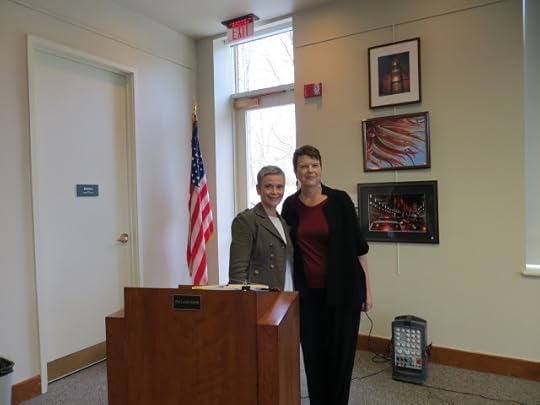
Julie Maloney and Anne Marie Macari
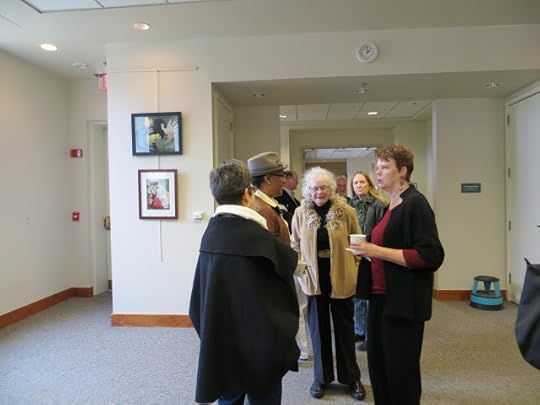
Anne Marie meeting and greeting people as they arrived
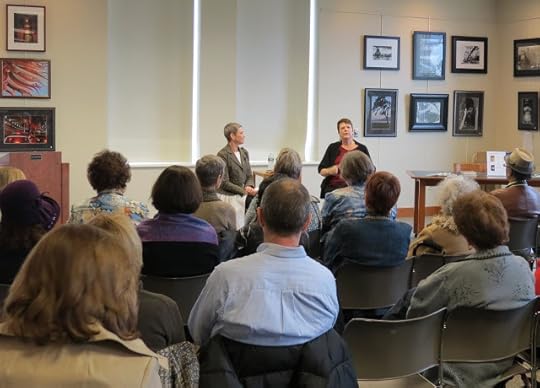
Julie interviews Anne Marie
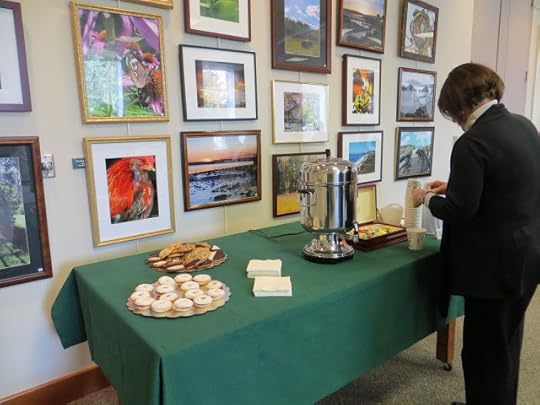
Julie and the library provide cookies, coffee, and tea
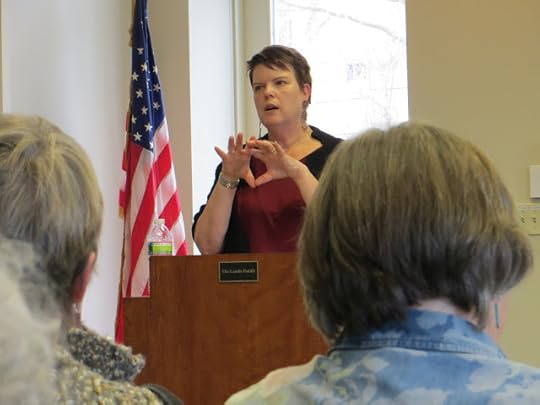
Anne Marie Macari Reads
Julie began the event with an interview. She's a terrific interviewer who makes sure she's very familiar with her guest's work and has her questions mapped out but is flexible enough to alter them or add to them as seems appropriate. She first asked Anne Marie how she came to poetry. Anne Marie told us that one day her high school English teacher, who hadn't been doing poetry with her students, was absent. Another teacher, one who wrote her own poetry, covered the class and simply read Whitman aloud to the class. And that lit the fire. English teachers, please pay attention to that! No one came in and did a brilliant analysis of Whitman; someone came in and simply read him aloud.
Julie asked Anne Marie what gave her the courage to delve into dark places in her poetry. Anne Marie paid tribute to her predecessors: Sylvia Plath, Ann Sexton, Lucille Clifton. She said, "We don't write in a vacuum. We're part of a legacy."
Julie asked Anne Marie what she hoped people would take away from her work: Guts, the courage to face things, to do what you're afraid to do, to love.
When asked about her future plans, Anne Marie said she doesn't make plans. "The artist moves into the unknown." And she has no fear of that unknown.
We then moved to the reading part of the afternoon. Anne Marie read from Gloryland and She Heads into the Wilderness. She also read some poems from her forthcoming Red Deer, due out from Persea Books in 2015. The reading was followed by a Q&A with the audience asking the questions.
Thanks to Julie for bringing so many programs to writers. She runs a group called Women Reading Aloud. That program includes workshops, poetry with yoga, writing retreats to Spring Lake in NJ, and even a week-long retreat on an island off Greece. Check out Julie's website for more information.
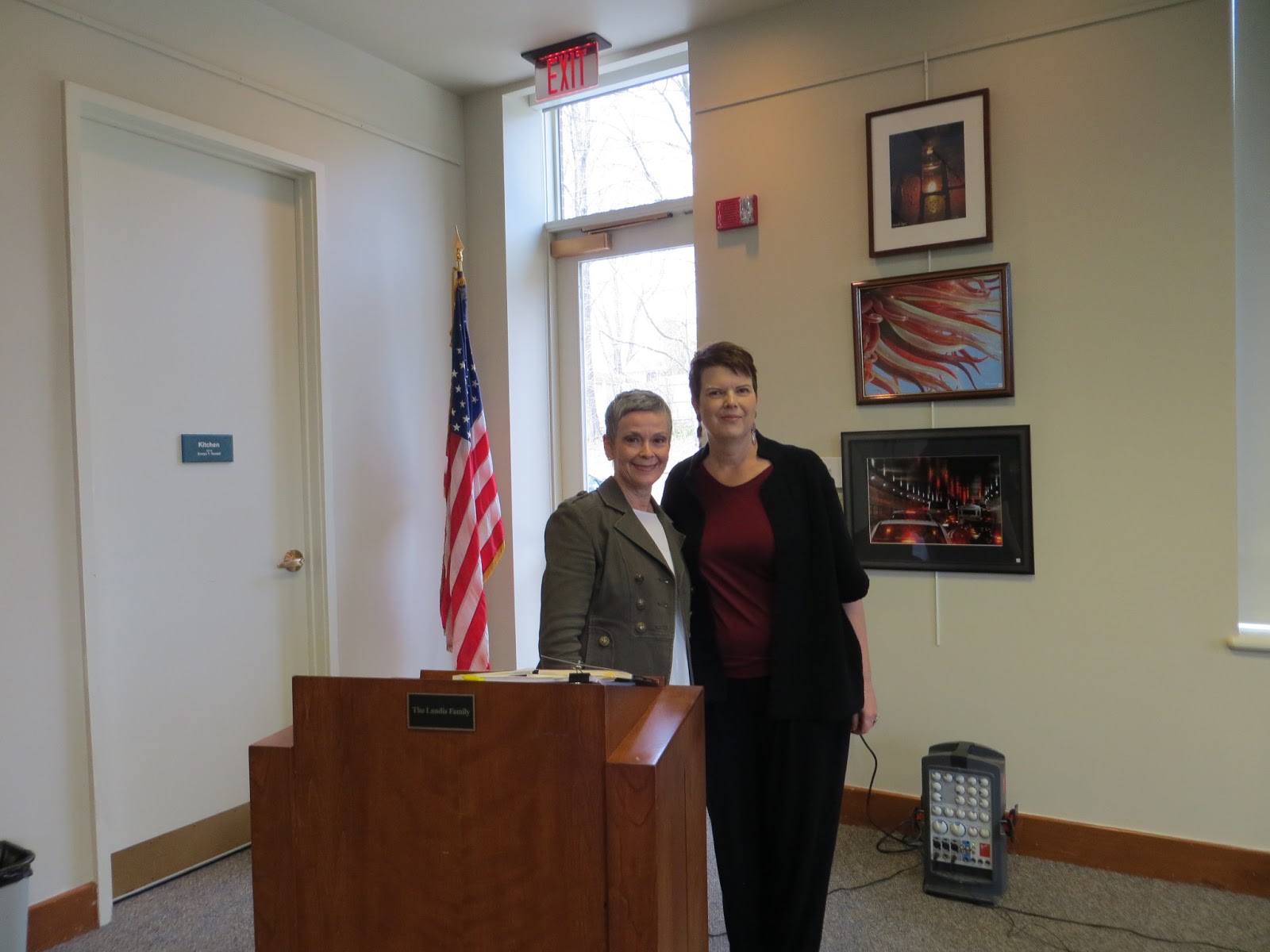
Julie Maloney and Anne Marie Macari
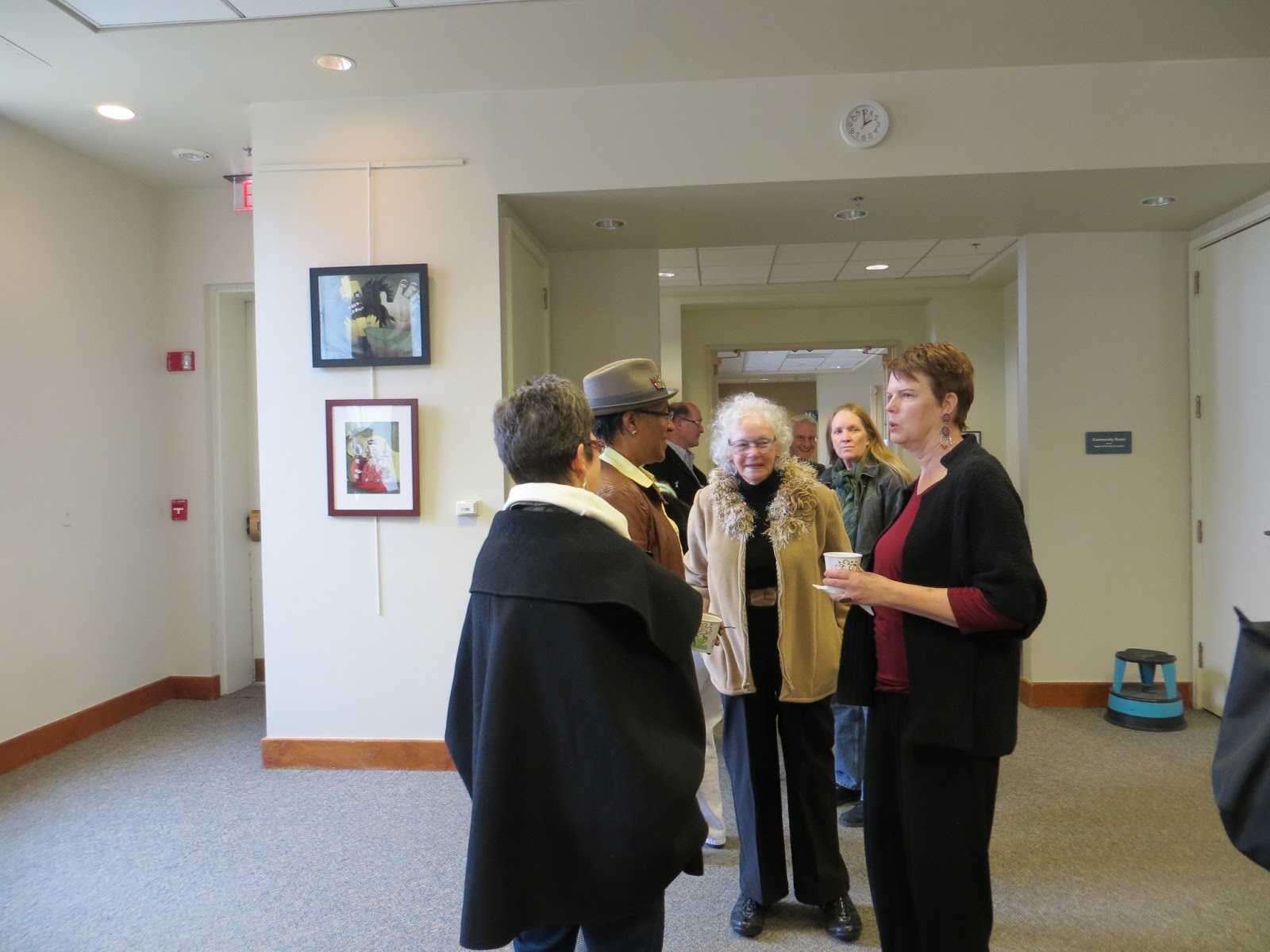
Anne Marie meeting and greeting people as they arrived
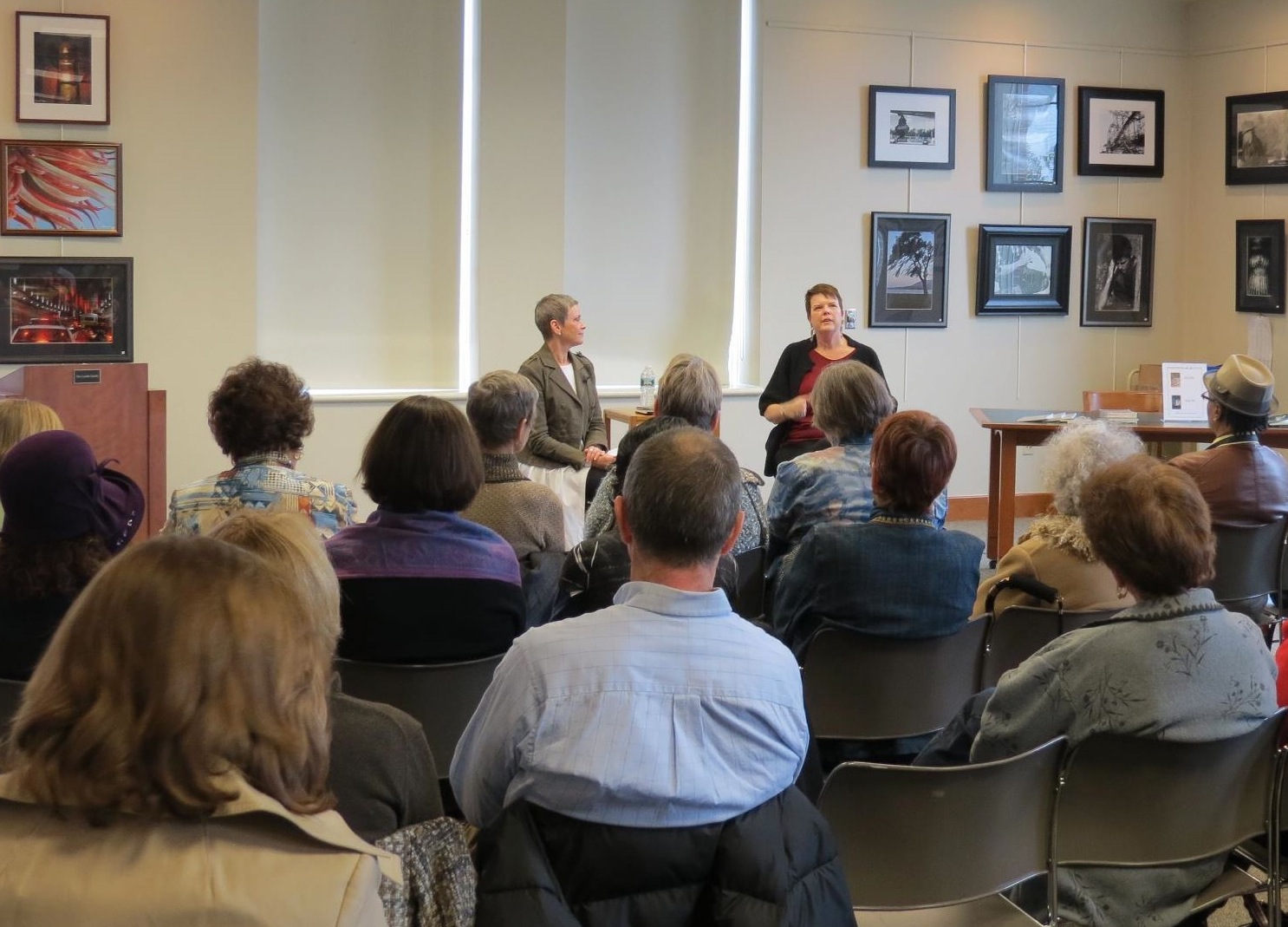
Julie interviews Anne Marie

Julie and the library provide cookies, coffee, and tea
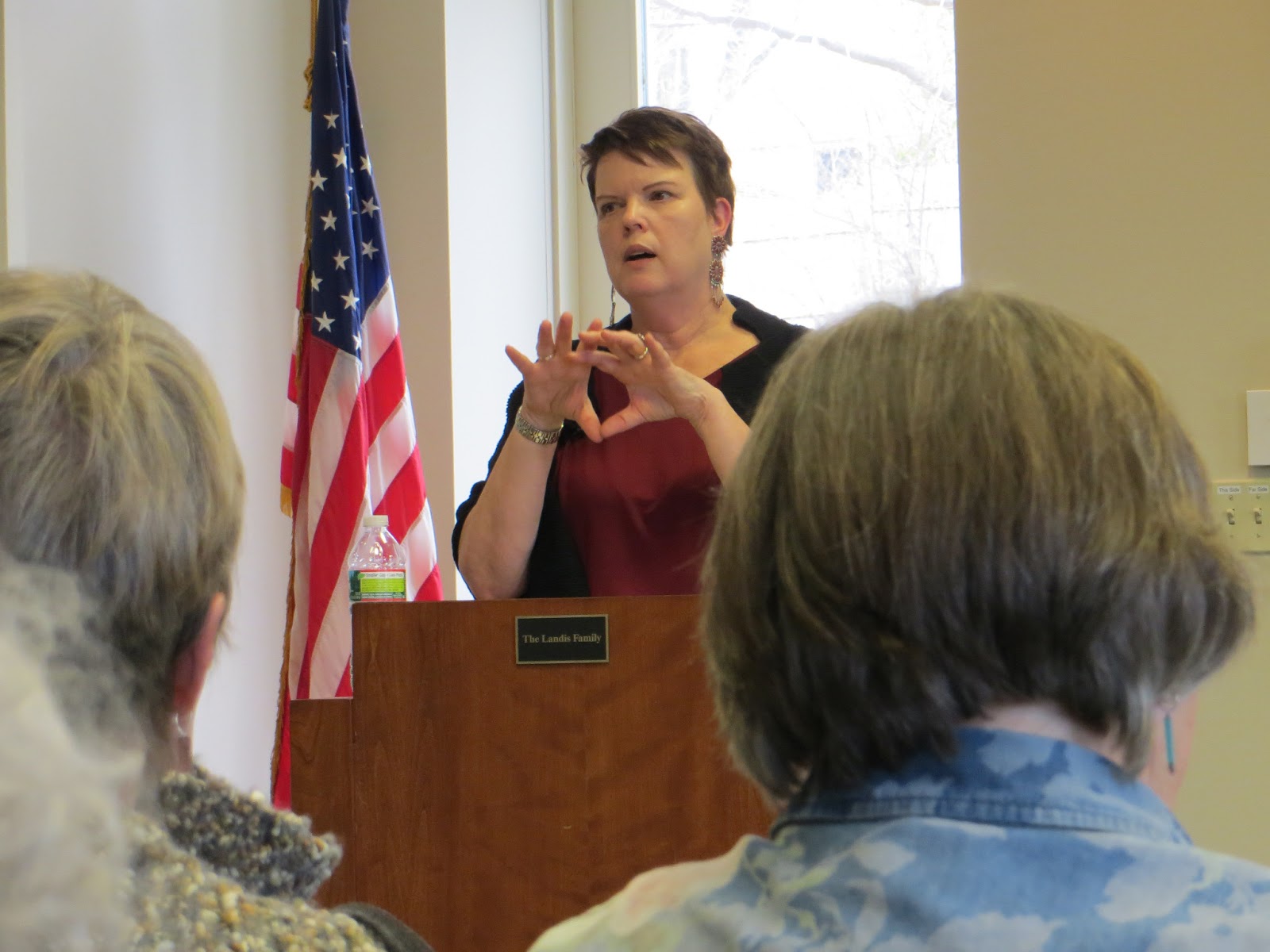
Anne Marie Macari Reads
March 19, 2013
Girl Talk Redux
This past Saturday was the 6th annual Girl Talk: A Celebration of Women's History Month. I began this event because I thought it would be fun. I've continued running it because it is fun. A lot of fun. People say, Oh, it must take so much time to put this together. I am not being modest when I say that it does not take much time to put it together. It's held at my local library, so I don't have to clean my house. I ask for volunteers to bake cookies and others to bring beverages. I always get more than enough. The library staff sets up the room for us and arranges for two volunteers to handle the book sale table.
My job includes inviting the women poets, this year twenty-nine. If you want to run a similar event—and I encourage you to do so—that's a good number if each poet reads one poem. Invite a few more than you really think is just right because invariably a few drop out. We lost three this year due to illness. Invite poets who live pretty close to the event site. There will be fewer dropouts if the weather is uncooperative. One year we had a hurricane. This year we had snow. Also, poets who live nearby tend to bring more guests for the audience.
I also do PR for the event. Not a big job as this can all be done online. The librarian who works with me on this event sends a press release to local newspapers. I also ask the readers to each reach out and invite guests.
Each year I include some new faces and voices. Some of these new readers are women who've asked to be included; some are women recommended to me. It would be lovely to have everyone back each year, but you need to rotate a bit to keep the event fresh and to keep the total to a reasonable number.
I divide the reading into two parts, with a 15-minute break in the middle. That gives everyone a chance to browse the books and buy some. For the first few Girl Talks I invited all the readers with books to include one title for sale. However, starting last year I limited the book titles to more recent ones so the sale would be more manageable for the volunteers. This seemed to stimulate more rather than fewer sales. Fewer choices make for easier decisions? To stimulate book sales, each year I contribute copies of a craft book or anthology for a lottery. For each book a person buys, she puts her name in the basket. At the end of the day, there's a drawing. This year I gave away five copies of Wingbeats: Exercises & Practice in Poetry.
I welcome the audience and introduce each poet. I do not give bios as I want the event to move along. However, bios are posted at the Girl Talk webpage.
Following the reading, the bakers go into the kitchen and bring out the cookies for the Reception. Our approximately 80 guests are all invited to stay and enjoy the cookies and engage in some poetry conversation. More books are purchased and books are signed. Guess who goes home with the leftover cookies? Me.
Here are some photos to give a sense of the day.

Book Sale Table. Visitors browsing and buying! What a lovely sight to see.

Crowd gathering before the reading. We filled the room. How lovely for poets to have a full room.

Poet Deb Gerrish who so graciously brought a beautiful rose for each reader. And baked!
And then brought beverages for one of the poets who couldn't make it. All in the midst of snow.

Jean Meyers waiting to read. I met her years ago in a Dodge Poetry Workshop.

Sandra Duguid signing her just released first book!
March 13, 2013

March 6, 2013
Sometimes It's Good to Be for the Birds

That is, if you're talking about Thrush Poetry Journal. This is a newish online journal, the child of poet Helen Vitoria. Departing from the more usual 1-4 issues per year, this journal appears every other month. Because of the increased frequency of the journal's appearance, each issue includes a limited number of poets. The current March issue includes 15 poets, each with one to six poems. And that's it. No essays, no reviews, no art. Just pure poetry.
Naturally, I'm delighted to be one of those poets. My poem Dreaming to Lionel Richie’s “Dancing on the Ceiling” is included. The muse for the poem was Philip F. Deaver's poem, Flying, which appeared on The Writer's Almanac back in 2005. Because I liked the poem, I saved it. You never know when you might need a poem.
I subsequently used Deaver's poem as the stimulus for a prompt in my Poetry Newsletter. As I often do, I wrote my own poem first. After all, I choose poems that do something I'd like to do. I like it when poems talk to each other, when one poem sets another in motion. Deaver's poem and the prompt will be in my forthcoming book, The Crafty Poet.
Thrush is attractively designed and Vitoria is working social media to the journal's advantage—and to the benefit of her poets and readers. She has a personal page and a journal page on Facebook and regularly posts notices and links to the journal and individual poems. This undoubtedly increases her readership and broadens exposure for the poets. The day this current issue went live her site received close to 3000 visits. Vitoria is undoubtedly also increasing the popularity of her online journal by giving a quick response to submissions. My acceptance came with a lovely personal note about the poem. I realize that not all editors can do this, but I appreciate it when it happens.
I also have a poem, His Two Arms, at Zocalo Public Square. This poem, previously published in my book, What Feeds Us, was taken by Zocalo more than a year ago. I'd sort of forgotten about it, so finding it there came as a nice surprise. The poetry editor, Stephanie Brown, took four of my poems. This is the last of that group. Brown said she liked this poem because it's rare to find a love poem by a woman about a man. Is it?
February 28, 2013
Who Is That Masked Poet?

Every time I check out a journal's guidelines and find a request to remove all identifying information from my submission, I feel mildly annoyed. It's not a huge big deal, but I find it sort of a pain to have to highlight and delete my name and address from each poem as I combine the poems into one file. This request is usually accompanied by a directive not to include a cover letter or credits.
Mostly what annoys me is the claim of objectivity and the desire to just take the best work while not being seduced by names or credits. Shouldn't an editor be able to rise above partiality and the allure of names? Shouldn't the editor be able to simply weigh and evaluate and respond to the work, even if the poet's name is there? I mean, really, isn't that what editors are supposed to do, that is, make objective judgments?
I just checked out the site of a new online journal. (Notice that I've removed its name so as to appear impartial!) This journal specifies that all names must be removed, etc., etc. However, the first issue of the journal consists entirely of pieces that were solicited by the editors. I guess that means they invited poets whose names and work they knew, right? Hm. Isn't there a contradiction going on here?
I know it's a rather standard procedure for new journals, print and online, to solicit work for the first issue. The goal is to set a high standard for subsequent issues. That makes sense to me and is unobjectionable. But to say thereafter that we don't care who you are sort of strikes me as hypocritical.
Perhaps I'm putting too fine a point on this, but I generally keep going when I'm asked to remove identifying information. It just seems silly to me. On the other hand, I think it's a good policy for a contest or a fellowship.
The other day I checked out a set of guidelines from a journal that had just put out a call for submissions. Unlike almost every other journal that uses online submissions, this one requires that the submitter submit each poem as a separate file. The editors say that's how they read the poems so that's the way they want to receive them. What a nuisance! I don't understand how or why receiving five poems in one file would preclude reading the poems individually, one at a time. I've even seen guidelines where the editor specified a font style and size. I've seen guidelines that specify which side of the page should contain the poet's name.
I read and heed guidelines, but when they're idiosyncratic, I usually begin to think that the journal is just not the right fit for my poems.
February 20, 2013
Just Another Poetry Scam

I wonder if any of you have received the same phone call I received last week. A guy called asking for Diane Lockward, the writer. I said that was me. He then explained that he worked for some TV station and the producers were planning to do a feature on a writer. They were going to select a writer who wasn't yet hugely famous and they expected to catapult that writer into huge fame. I was one of three candidates for this program. He did a lot of name dropping—Judge Wapner, Judge Judy, Jim Masters, Doug Llewelyn. He asked a few questions, but very few, about my writing. He asked me to go to this TV website and to view one of their videos. It was very nice. That, he said, was the sort of video they would do for me—if I were selected. He was quite a fast talker. A dangler of carrots.
Finally, I got to ask, Okay, so where does this go from here? He said I'd first be interviewed by phone by a board of eight. He said the other two writers had already been interviewed and we needed to move fast on this. I asked when I'd be interviewed. He said within 48 hours, maybe that very day. By now I'd been on the phone for almost 30 minutes and had already begun to think this was a cartload of nonsense. I wasn't sure if the guy even realized that I'm a poet although he did say that they (who?) liked my work because it wasn't offensive. Is that supposed to be good? He was vague about how he'd obtained my name.
He kept talking and talking, repeating what he'd already said. Then finally he slipped in something about they would make a DVD for me and I'd get 12 copies and could reproduce and distribute them. Hm. Who's going to pay for that, I thought. He asked if my time was flexible. If the Ricki Lake show called, could I hop on a plane to California?
Then he said they'd be investing $40,000 in me and I'd contribute just $5000. Really?? I then asked, Okay, let me be clear—are you saying I would have to give you $5000 right now? Answer: Yes. I then said there was no way that was ever going to happen and ended the call.
Could that scam possibly work on anyone? I hope not. Don't these people know that poets don't make that kind of money? If you get that call, don't let the guy even waste your time.
February 14, 2013
The Crafty Poet: A Progress Report
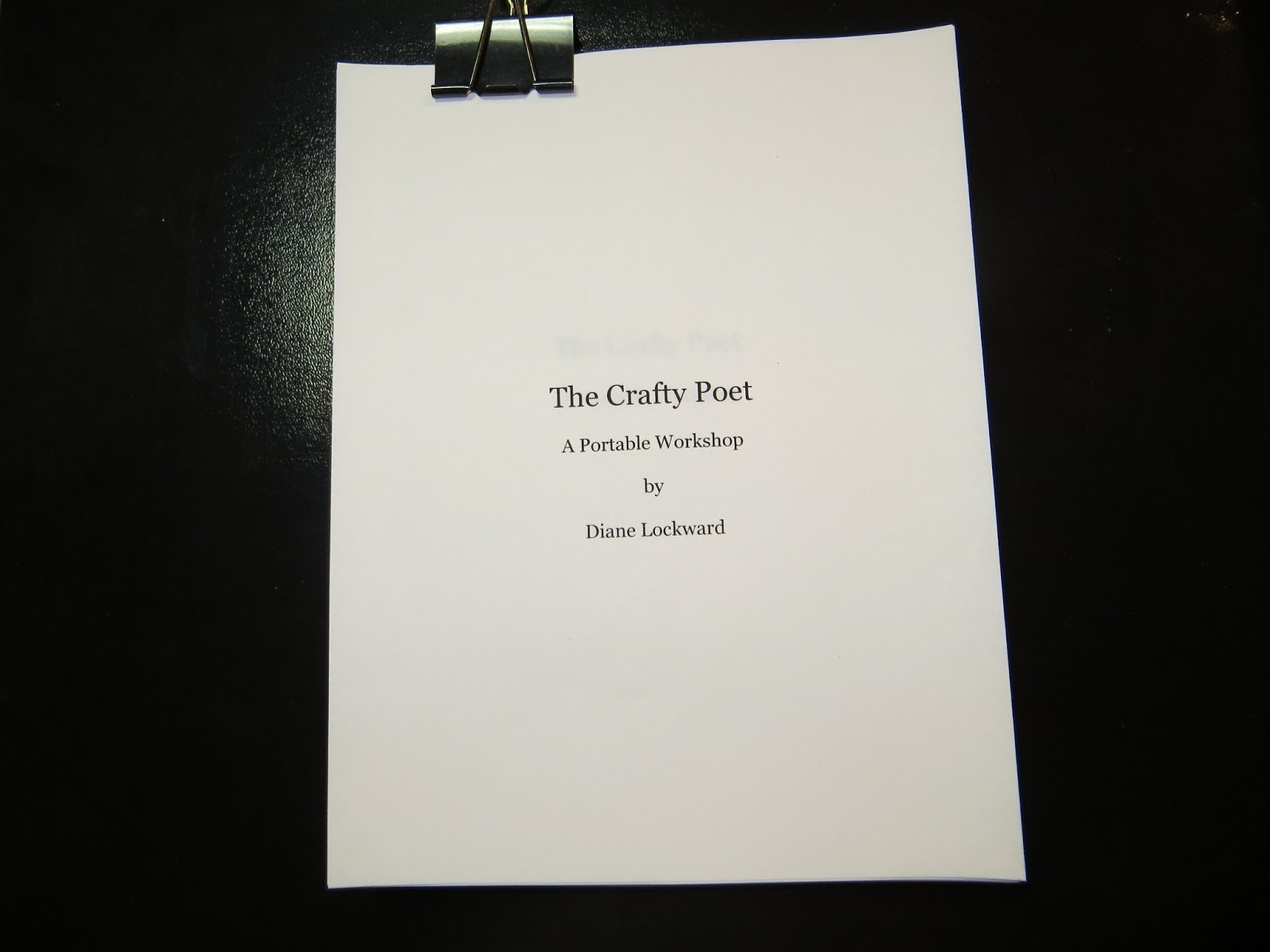
This morning it went sailing off to my publisher! At last. That is, the manuscript for my forthcoming craft book, The Crafty Poet: A Portable Workshop. This is the accumulation of about two and a half years of work, most of it culled from this blog and my monthly Poetry Newsletter. The challenge in doing this book was the organization of a good deal of material into a sensible whole. I spent a long time just staring at piles of paper on my kitchen table, thinking and thinking. Then weeks of outlining, rearranging, breaking one section into two, joining two into one, filling in some holes. Then the big job of compiling all the separate pieces into one humungous file on the computer. Then because I don't trust myself to proofread accurately on the screen, I printed out the whole thing and proofread, fixed, reprinted, proofread, fixed, etc. Numerous times.
While stylistic differences from one newsletter to the next don't matter, in a book they do. So I spent a lot of time making things consistent. What's the difference between "into" and "in to," "onto" and "on to." Did I want "line breaks" or "linebreaks," "free write" or "freewrite"? And oh my, which numbers should appear as numerals and which as words? Should numbered lists be indented or at the left margin? Some were one way, some the other. I had to take notes about how many line spaces to leave between different kinds of headings. Then go back and be sure I'd done it the same way from one section to the next. Finally, I reached the point where it seemed about as right as it was ever going to be and I said, Time to let her go.
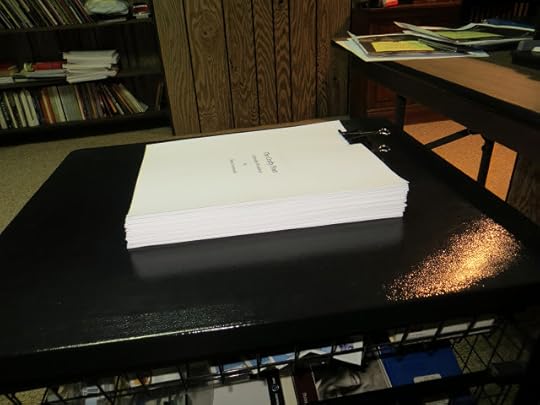
Side view. Look how plump she is!

That pile in the middle is all the previous print-outs. Obviously, I've gone broke on paper and ink cartridges. That pile does not include the finished manuscript.
This has been a long process—and still isn't over. I've spent months putting this book together. It's a different kind of challenge than putting together a book of poems. But it has been exciting and hugely gratifying. I have around 100 amazing poets in the book. I am so grateful to each one for his or her contribution. Names and contents to be released in a later post.
Now the manuscript is with my publisher and I will wait to get it back for some more proofreading after he whips it into shape. Yes, more proofreading! The book should come out this summer. In the meantime, it's back to poetry for me. And a celebratory dinner out tonight seems in order.
February 7, 2013
New Online Journals

Online poetry journals are proliferating. Seems like I'm routinely receiving notification of yet another one. A few of these notices are about former print journals that have converted to online, but most are about brand new journals. Not all online journals are created equal. Because anybody can start one and often for free, there is a broad disparity in quality. Submitter beware. Always thoroughly check out the journal before you submit. If you wouldn't be proud to have your work appear in the journal, don't submit.
A few caveats:
1. Avoid journals that are really blogs masquerading as journals. These reveal a lack of commitment and generally have limited archive space. If a journal doesn't archive issues, steer clear.
2. Especially avoid a journal that posts all poems on the same page and requires the visitor to scroll down. Most readers won't bother.
3. Avoid journals with dreadful color combinations and weird fonts. You want your work to be nicely displayed.
4. Avoid journals with overly complicated navigation. Readers don't want to have to jump through hoops to find your poems.
5. Gravitate toward journals that make their presence known by using Share Buttons and having Facebook and Twitter accounts. It amazes me that some online journals still haven't added these features. They're free and can dramatically extend the journal's reach. When I find a poem I really like, I like to hit the Share Button at the bottom of the page. A link to the poem then posts on my Facebook page and is available to all my friends.
Here's a list of some fairly new online journals that are worth taking a look at:
Birdfeast Magazine—2x
poetry only
reads all year
Linked Table of Contents allows for easy movement from one poem to the next
No Share Buttons
Flycatcher—1x
poetry, essays, reviews
submissions now open only by invitation but according to guidelines will open to all in February.
Facebook Share on home and TofC, but not on the poem pages
Four Way Review—4x
reads all year
poetry and fiction
no Share buttons
good navigation buttons
great audio with each poem
Heron Tree—1 poem per week
online but plans to print a bound issue yearly
poetry only
poems are posted weekly, on Sunday evening
link to the weekly poem opens a pdf page which I find a bit unwieldy
no Share Buttons
the museum of americana—4x
reads June and December only
work focuses on things americana—"showcases and/or repurposes historical American culture"
poetry, fiction, interview, reviews, nonfiction, art & photography
Share Buttons throughout issue
Sleet Magazine—2x
regular posting period not posted but is currently reading subs
includes poetry, fiction, interviews, and what they call "irregulars," i.e., cross-genre pieces
will consider previously published work
no Share Buttons
Thrush—6x
poetry only
open all year—accepts on a rolling basis
very quick response time
one print edition per year
No Share Buttons