Diane Lockward's Blog, page 29
November 21, 2012
New Issue of VPR

The Fall/Winter issue of Valparaiso Poetry Review was recently posted. VPR was one of the early online literary journals and showed that an online journal could publish strong work and make a real contribution to poetry. Editor Ed Byrne has done much to make VPR a highly respected online journal and one that has served as a model for others that have followed.
This issue contains poems by 35 poets:
Claire Bateman, Shari Wagner, Michael Dobberstein, Elise Hempel,
Philip Dacey, Susan Cohen, George David Clark, Kim Bridgford,
Greg McBride, Gary Fincke, Judy Kronenfeld, Joanne Lowery,
John A. Nieves, Mercedes Lawry, Laura Davies Foley, Scott Brennan,
John Ronan, Joannie Stangeland, Darlene Pagan, Mark Thalman,
Marilyn McCabe, Kate Fox, Doug Ramspeck, Amy Eisner,
Patricia Caspers, Rose Postma, Athena Kildegaard, Thomas Alan Holmes,
Elizabeth Harlan-Ferlo, Austin MacRae, Judith Harris,
Angela Alaimo O'Donnell, John McDermott
The featured poet in this issue is Thomas Reiter. Although I've never met him, he's a fellow New Jersey poet.
This issue also includes five book reviews.
And my poem, "How Heavy the Snow." It's in good company.


November 15, 2012
Good News Department

I have won a contest! My poem "Original Sin" has received First Place in Naugatuck River Review's annual contest for 2012. I rarely enter contests these days, but obviously I'm glad I entered this one. Although this poem, when I wrote it, made my whole body happy in that way the keepers do, I was still delightfully surprised when I received an email a few weeks ago informing me that the poem was a finalist and on its way to the final judge, Pam Uschuk, and would at the very least be offered publication.
Then this past Sunday I was reading when the phone rang and I wondered grumpily, Oh, who the heck is that and it better not be a robot. It wasn't. It was editor Lori Desrosiers. So I thought maybe second or third, but she clearly said First Place! I was quite literally speechless and kind of choked up.
The prize is a joy-inducing check for $1000 and publication in the 2013 winter/spring issue.
Naugatuck River Review is a journal for narrative poetry, but the sub-title of the journal is Narrative Poetry That Sings. I knew that my poem had a story to tell and I worked hard to make it sing.

Once again my involvement with someone else's work stimulated my own. Several months ago Vermont Poet Laureate Sydney Lea contributed a wonderful Craft Tip to my monthly Poetry Newsletter. I bought his most recent collection, Year of the Young (Four Way Books, 2011). The gorgeous rabbit on the cover reminded me of one of my childhood pets, an unfortunate rabbit named Snowball, a pet who'd left me a legacy of guilt. I worked out that guilt in the poem. And surprised myself in doing so, so I was gratified that the judge mentioned the element of surprise as something she admired in the poem. I think Frost had it right: No surprise in the writer, no surprise in the reader.
The finalists and semi-finalists are listed at the journal's website.

November 10, 2012
New Book in Progress

I have great news—a new book coming forth! Not a collection of my poems but a craft book for practicing poets. The Crafty Poet: A Portable Workshop was recently accepted by Wind Publications and is tentatively scheduled for release summer 2013.
Putting together the manuscript was this past summer's project. The book includes the craft tips from my Poetry Newsletter—all of them written by accomplished poets. It also includes the model poems and prompts based on those poems. Again, the poems are all by accomplished poets. The prompts, written by me, call attention to the various elements of craft in the poems and ask readers to practice those elements in a new poem of their own. I've also included the Poet on the Poem features that I have posted on my blog over the past two years. Each poem is followed by a 5-question Q&A between me and the poet. The questions are primarily focused on elements of craft in the poem. Finally, there are Bonus Prompts.
The principal challenge of writing this book was organizational. How to get all that material into some sensible kind of structure? I hemmed and hawed for days and days. I tried one plan and then another. At last I landed on the one that made sense. So it's now organized into 10 sections. Each section includes several Craft Tip pieces, each relevant to the section's concept. Each craft tip is followed by a model poem and a prompt. Each section concludes with a Poet on the Poem piece and a Bonus Prompt.
The subtitle, "A Portable Workshop," indicates the various ways in which this book might be used. Many of us can only work from home. We might not have been able to go for an MFA. Or we have done so and now want to continue our education independently. This book gives readers what they need to work on their own. It assumes that the reader already has an understanding of the basics of poetic craft and it builds on that knowledge. But the book can also be used in a group workshop or as a text in a classroom. It's portable and will go where you go.
This has been a new kind of venture for me, and I'll confess to being pretty excited about it. I'm especially happy about the number of astonishing poets who are part of this book. Now I'm refining the bios, obtaining permissions and writing the credits, and compiling a list of recommended books. There are a few more pieces to plug in, but I'm confident that I'll meet my deadline.
I'll keep you posted.

November 8, 2012
Storm Damage
I seem to have disappeared from the Blogosphere, but I'm still here.
First, as you must know, those of us in New Jersey got slammed with
Hurricane Sandy. I'm very lucky in that my house sustained no damage.
But take a look at this house just a few blocks away.
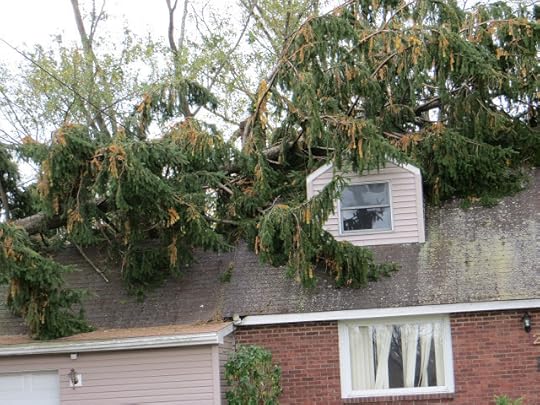
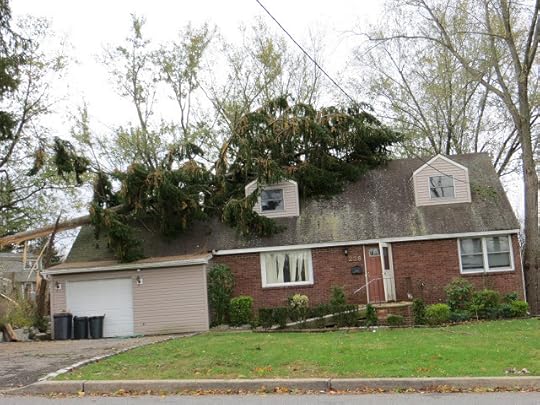
If you look to the left of the garage, you'll see where the tree trunk just snapped. But because the tree was so close to the house, the roof appears to have sustained minimal damage.
We lost lots and lots of branches that snapped off and fell, but fortunately we had recently removed two large dead trees and trimmed other living trees, so no trees crashed. As with last year's storm, leaves were still on trees, making them more subject to toppling.
The hurricane rolled in on Monday. At 7:15 that night the power went out. My husband had cleverly contrived to be in Florida—same stunt he pulled during last year's horrible October storm—so I was in the dark and on my own. At least it wasn't initially as cold as last year. Another lucky break was that we did not get the 12 inches of rain we were supposed to have received.
The next day I went to my daughter's house as she had not lost power. While there I could get on the internet and hear the sound of other humans and enjoy the light. But I didn't want to sleep there. What kept me sane at home was the Kindle Fire onto which I'd wisely downloaded a book. Since the Kindle is backlit, it was great for reading in the dark. Then I could get emails on my cell phone, but I don't have a smart phone so it was hard to send notes. Not a big deal.
Husband arrived home on Wednesday after a two-day delay. On Thursday at noon all things FIOS disappeared. No phone, no tv, no internet. I kept telling myself to be grateful that I still had heat and light while others had lost everything—and I was grateful. Still, it was frustrating to have had those things and then lost them again. All of that was restored late Monday afternoon.
Then yesterday we had the Nor'easter, Athena. Again, no damage here, but I really feel for the people who've already lost their homes and for those still without power. Also, some people in this area who'd had power restored lost it again. A big problem around here is getting gas. We're on an odd-even day plan which has helped a bit, but the lines are still very long as some gas stations have still not had their power restored and gas deliveries seem a bit spotty. Another smart move I made in anticipation of the hurricane was filling up, so I should be good for another week or so if I continue to hoard what I have in the tank.
Here's a picture of today's snow. Pretty, yes? But I'm sure I'm not the only one who thinks a second storm was a bit too cruel.

At least I've had a good start on cleaning out my bookshelves.

First, as you must know, those of us in New Jersey got slammed with
Hurricane Sandy. I'm very lucky in that my house sustained no damage.
But take a look at this house just a few blocks away.


If you look to the left of the garage, you'll see where the tree trunk just snapped. But because the tree was so close to the house, the roof appears to have sustained minimal damage.
We lost lots and lots of branches that snapped off and fell, but fortunately we had recently removed two large dead trees and trimmed other living trees, so no trees crashed. As with last year's storm, leaves were still on trees, making them more subject to toppling.
The hurricane rolled in on Monday. At 7:15 that night the power went out. My husband had cleverly contrived to be in Florida—same stunt he pulled during last year's horrible October storm—so I was in the dark and on my own. At least it wasn't initially as cold as last year. Another lucky break was that we did not get the 12 inches of rain we were supposed to have received.
The next day I went to my daughter's house as she had not lost power. While there I could get on the internet and hear the sound of other humans and enjoy the light. But I didn't want to sleep there. What kept me sane at home was the Kindle Fire onto which I'd wisely downloaded a book. Since the Kindle is backlit, it was great for reading in the dark. Then I could get emails on my cell phone, but I don't have a smart phone so it was hard to send notes. Not a big deal.
Husband arrived home on Wednesday after a two-day delay. On Thursday at noon all things FIOS disappeared. No phone, no tv, no internet. I kept telling myself to be grateful that I still had heat and light while others had lost everything—and I was grateful. Still, it was frustrating to have had those things and then lost them again. All of that was restored late Monday afternoon.
Then yesterday we had the Nor'easter, Athena. Again, no damage here, but I really feel for the people who've already lost their homes and for those still without power. Also, some people in this area who'd had power restored lost it again. A big problem around here is getting gas. We're on an odd-even day plan which has helped a bit, but the lines are still very long as some gas stations have still not had their power restored and gas deliveries seem a bit spotty. Another smart move I made in anticipation of the hurricane was filling up, so I should be good for another week or so if I continue to hoard what I have in the tank.
Here's a picture of today's snow. Pretty, yes? But I'm sure I'm not the only one who thinks a second storm was a bit too cruel.

At least I've had a good start on cleaning out my bookshelves.
October 23, 2012
Print Journals That Accept Online Submissions

Time to once again update the list of print journals that accept online submissions. The list has grown by two dozen journals. I anticipate a day when all submissions will be made online. I remain happy to save paper, envelopes, and stamps—and even happier about conserving gas. Thank you, Journals!
Journals new to the list (not necessarily new journals) are indicated with a double asterisk.
The number of issues per year appears after the journal's name.
The reading period for each journal appears at the end of each entry.
Unless noted otherwise, the journal accepts simultaneous submissions.
As always, please let me know if you find any errors here. And good luck.
Adanna: a journal about women, for women—1x
Jan 31 - April 30
Agni—2x
Sept 1 - May 31
The American Poetry Journal—1x
February 1 - May 31
**American Poetry Review—6x
all year
**Another Chicago Magazine—2x
$3 fee
check website to see if open for submissions
Barn Owl Review—1x
June 1 - November 1
**Barrelhouse—2x
check website to see if open for submissions
Bat City Review—1x
June 1 - November 15
Bateau—2x
all year
Bellevue Literary Review—2x
all year
Bellingham Review—1x
Sept 15-Dec 15
Beloit Poetry Journal—4x
all year
no sim
Black Warrior Review—2x
all year
Boston Review—6x
Sept 15 - May 15
Boulevard—3x
November 1-April 30
Breakwater Review—2x
November 15 for the January issue;
April 15 for the June issue
Caesura—2x
August 5 - Oct. 5
Caketrain—1x
all year
Carbon Copy Magazine—2x
May 1st through September 1st, November 1st through March
**The CarolinaQuarterly—3x
all year
The Cincinnati Review—2x
Sept 1 - May 31
Columbia—2x
September 1 - May 1
The Common—2x
Sept. 1-Dec.1 (all year for subscribers)
$1.50 fee
Copper Nickel—2x
August 15-October 15
January 31-March 31
Crab Creek Review—2x
Sept 15 - March 31
Crazyhorse—2x
all year
Cream City Review—2x
August 1 to 1 November
December 1 to April 1
CutBank—1-2x
October 1 thru February 15
**Ecotone—2x
August 15–April 15
$3 fee
Edison Literary Review—1x
all year
**Explosion-Proof Magazine—4x
submit@explosion-proof.net
all year
**Fence—2x
check website to see if open for submissions
FIELD—2x
all year
no sim
Fifth Wednesday—2x
no Jan, Feb, June, or July
The Florida Review—2x
August thru May
$3 fee
Fourteen Hills—2x
September 1 to January 1
March 1 to July 1
Gargoyle—1x
most recent reading period was June 1, 2011-August 1, 2011
**The Greensboro Review—2x
September 15 deadline for the Spring issue
February 15 deadline for the Fall issue
Grist—1x
August 15 - April 15
**Hampden-Sydney Poetry Review—1x
All year
Harpur Palate—2x
deadlines: Winter issue: November 15
Summer issue: April 15
Harvard Review—2x
Sept 1 - May 31
Hawk and Handsaw—2x
Aug 1 - Oct 1
Hayden's Ferry—2x
All year
pays
The Hollins Critic—5x
Sept 1 - Dec. 15
Hunger Mountain—1x
all year
The Idaho Review—1x
Sept. 1 to April 15
Iron Horse Literary Review—6x
rolling for 3-4 weeks at a time
check website for dates
Jubilat—2x
September 1 - May 1
Kenyon Review—4x
September 15 - January 15
no sim
Knockout Literary Magazine—1x
check website for submission dates
The Literary Review—4x
Little Patuxent Review—2x
check website for submission periods
The Los Angeles Review—1x
Submit to Poetry Editor: lareview.poetry@gmail.com
Sept 1 - Dec 1
**The Louisville Review—2x
all year
Lumina—1x
August 1 - Nov 15
The MacGuffin—3x
all year
The Massachusetts Review—4x
October 1 - April 30
Measure—2x
no sim
all year
The Mom Egg—1x
July 15 - Sept. 30
Meridian—2x ($2 fee)
all year
Mid-American Review—2x
all year
The Minnesota Review—2x
August 1–November 1
January 1–April 1
The Missouri Review–4x
all year
**National Poetry Review—1x
December, January, and February only or all year if a subscriber
**Natural Bridge—2x
August 1-May1
$3 fee
Naugatuck River Review—2x
for the Summer issue January 1 through March 1
for the Winter issue July 1 through September 1 (contest only)
New England Review—4x
no sim
Sept 1-May 31
New Madrid—2x
August 15 - November 1
New Ohio Review—2x
Sept-May (summer okay for subscribers)
New Orleans Review—2x
Aug 15 - May 1
New South—2x
all year
The New Yorker
weekly magazine
all year
Ninth Letter—2x
September 1 - April 30
**The Normal School—2x
September 1-December 1
January 15-April 15
$3 fee
Parthenon West Review—1x
Jan 1- May 1 (but on hiatus for 2012)
**Pleiades—2x
August 15-May 15
Ploughshares—3x
June 1 - Jan. 15
Poetry—11x
year round
no sim
Poetry Northwest—2x
September 15 - April 15
Post Road Magazine—2x
check website for submission dates
Potomac Review—2x
Sept 1-May 1
Prairie Schooner—4x
Sept 1 - May 1
no sim
Puerto del Sol—2x
September 15 - March 31
The Raintown Review—2x
all year
considers previously published
The Raleigh Review—1x
All year
Rattle—2x
year round
Redactions—1x
year round
Redivider—2x
all year
Red Rock Review—2x
No June, July, August, or December
no sim
Rhino—1x
April 1 - Oct 1
**Rockhurst Review—1x
Sept. 14 through Jan. 15
Rosebud—3x
All year
Sakura Review—2x
year round
Salt Hill—2x
August 1 - April 1
San Pedro River Review—2x
Jan 1 - Feb 1 / July 1-Aug 1
**Saw Palm—1x
July 1- October 1
Slice Magazine—2x
Feb. 1 - April 1
Smartish Pace—2x
All year
Sonora Review—2x
All year
**So to Speak—2x
feminist
August 15-October 15 for the Spring issue
January 1-March 15 for the Fall issue
**South Dakota Review—4x
All year
The Southeast Review—2x
All year
**Southern Humanities Review—4x
All year
Southwest Review—4x
No June, July, August
$2 fee
Sou’wester—2x
August 15 - May 15
Spinning Jenny—1x
Sept 15 - May 15
No Sim
The Stillwater Review—1x
deadline Nov. 15
poetrycenter@sussex.edu
**Subtropics—3x
September 1 - April 15
Sugar House Review—2x
All year
Tampa Review—2x
Sept 1 - Dec. 31
no sim
Tar River Poetry—2x
via email
Sept 15 - Nov. 1
no sim
Third Coast Review—2x
Sept 15 - April 30
**32 poems—2x
via email
all year
**The ThreepennyReview—4x
Jan 1 - June 30
Tiferet—1x
Sept 1 - December
Tinhouse Magazine—2x
September 1 - May 31
**Tuesday: An Art Project—2x
Check website to see if they are taking submissions
Upstreet—1x
Sept 1 - March 1
Versal—1x
Sept 15 - Jan 15
Verse Wisconsin—4x
All year
Washington Square Review—2x
August 1 - Oct 15
Dec 15 – Feb 1
Weave Magazine—2x
April 15 - July 31
West Branch—2x
Aug 15 - April 15
Willow Springs—2x
all year
Women Arts Quarterly Journal—4x
all year
Yalobusha Review—1x
check website for submission dates
**Yemassee—2x
All year

October 16, 2012
The Dodge Poetry Festival 2012
The 2012 Geraldine R. Dodge Poetry Festival was held this past weekend, October 11-14, in Newark, NJ. This was the second time that Newark hosted the event. For many years the biannual event had been held at Waterloo Village in Stanhope, NJ. Two very different settings—one urban, the other country. This year's festival in Newark was bigger than the one in 2010 and offered a larger number of poets and one additional day.
As I did last time, I worked as part of the Dodge staff. However, this year the assignments changed, largely because Dodge was sponsoring the book tent on its own since Borders has gone out of business. So I had one 3-hour book tent assignment. Not my favorite, and between that and a 2-hour assignment on Sunday at the Information table, I got to hear less poetry than in the past. Still, I had a good time and enjoyed running into lots of friends I hadn't seen in a long time.
My favorite assignment of the weekend was hosting the Adrienne Rich tribute reading on Saturday. This was held in Aljira, a really cool art gallery. About 50 people turned up and many of them were very willing to come up onto the stage and read a favorite poem.
On Sunday one of my assignments was Storytelling with Queen Nur and Dwight James backing her up with music. Now, to be honest, I would never ever have chosen to attend that event. After all, I was there for poetry. However, it turned out to be really quite wonderful. Queen Nur sings, tells stories, talks, and adds just a bit of dancing. Dwight plays a wide variety of African instruments, mostly drums. His music is unobtrusive, always enhancing, never overwhelming the stories.
My camera work was not at its best and halfway through Saturday my battery went dead. But I managed to get a handful. I hope they give you a sense of the festival.
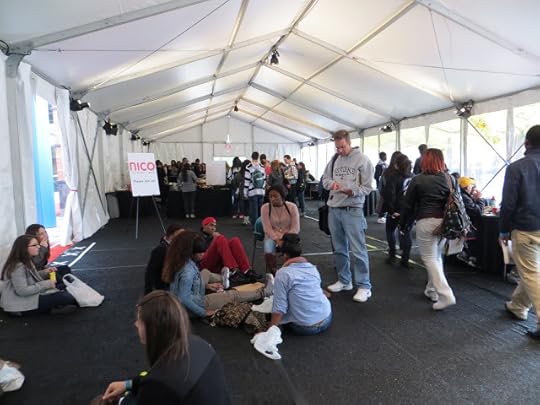
Friday was Students Day—tons of students. They swarmed the book tent and bought lots of books. That was truly a beautiful thing to see. Praise to all the teachers who brought their students to the Festival! For many students this was an experience they will always remember. You, Teachers, gave it to them.
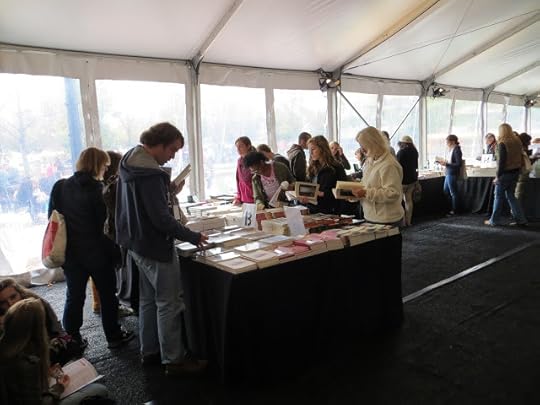
Students browsing the books. This picture was taken during a performance segment so really does not give a good idea of how many kids were there.
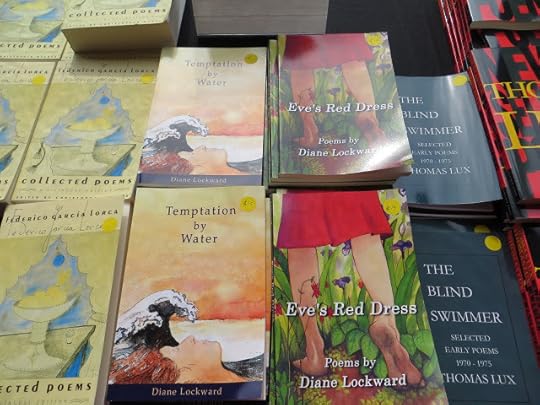
Oh! Look at this. Whose books could these be? Hm.
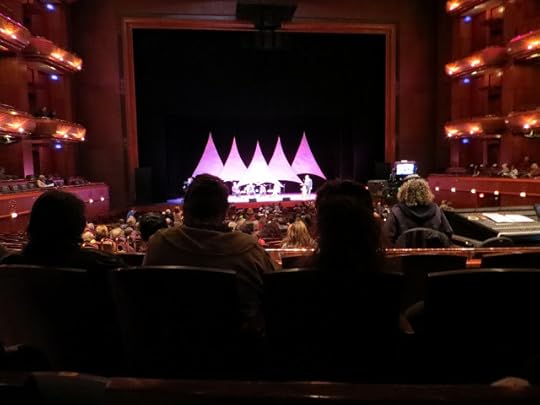
This is the Main Stage in the Performing Arts Center. On Friday this was filled to capacity. The balconies were overflowing. I had to go up three floors to find a seat.
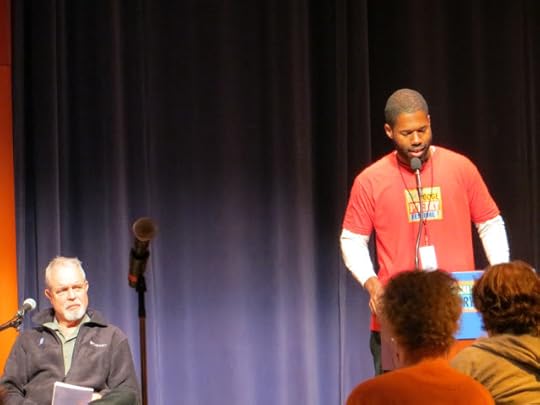
Kahlil Murrill introducing Joseph Millar
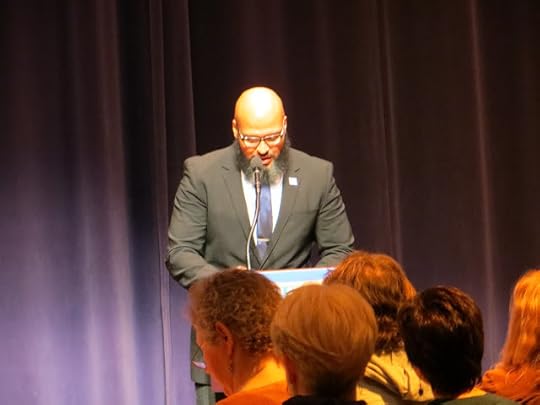
John Murillo in a reading with Rachel McKibbens and Joseph Millar
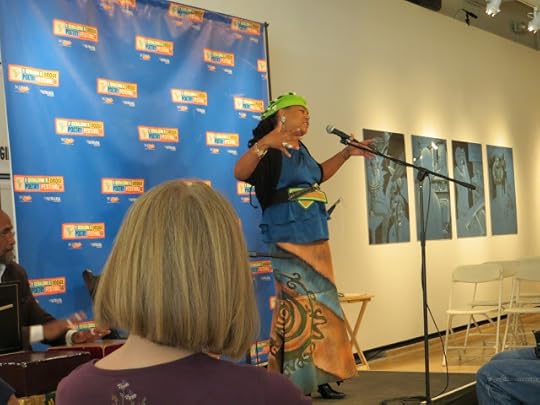
Queen Nur doing her thing
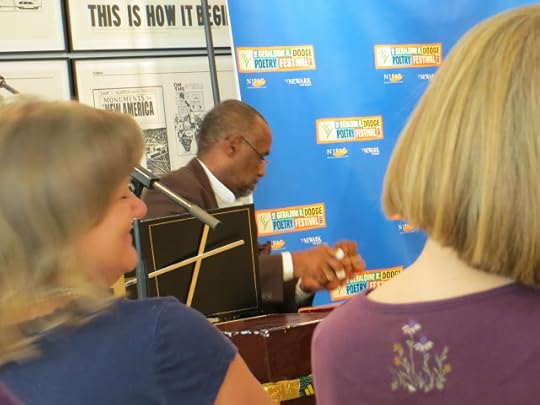
Dwight James with his instruments
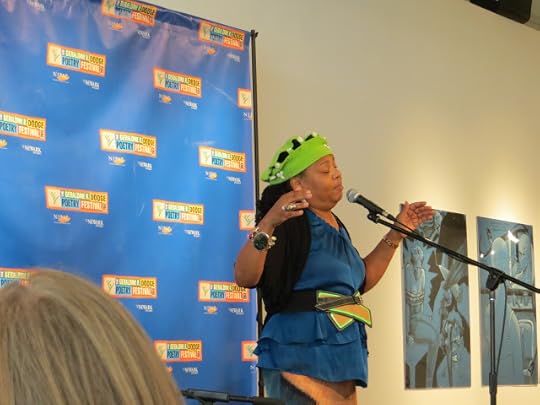
Queen Nur feeling the story

As I did last time, I worked as part of the Dodge staff. However, this year the assignments changed, largely because Dodge was sponsoring the book tent on its own since Borders has gone out of business. So I had one 3-hour book tent assignment. Not my favorite, and between that and a 2-hour assignment on Sunday at the Information table, I got to hear less poetry than in the past. Still, I had a good time and enjoyed running into lots of friends I hadn't seen in a long time.
My favorite assignment of the weekend was hosting the Adrienne Rich tribute reading on Saturday. This was held in Aljira, a really cool art gallery. About 50 people turned up and many of them were very willing to come up onto the stage and read a favorite poem.
On Sunday one of my assignments was Storytelling with Queen Nur and Dwight James backing her up with music. Now, to be honest, I would never ever have chosen to attend that event. After all, I was there for poetry. However, it turned out to be really quite wonderful. Queen Nur sings, tells stories, talks, and adds just a bit of dancing. Dwight plays a wide variety of African instruments, mostly drums. His music is unobtrusive, always enhancing, never overwhelming the stories.
My camera work was not at its best and halfway through Saturday my battery went dead. But I managed to get a handful. I hope they give you a sense of the festival.

Friday was Students Day—tons of students. They swarmed the book tent and bought lots of books. That was truly a beautiful thing to see. Praise to all the teachers who brought their students to the Festival! For many students this was an experience they will always remember. You, Teachers, gave it to them.

Students browsing the books. This picture was taken during a performance segment so really does not give a good idea of how many kids were there.

Oh! Look at this. Whose books could these be? Hm.
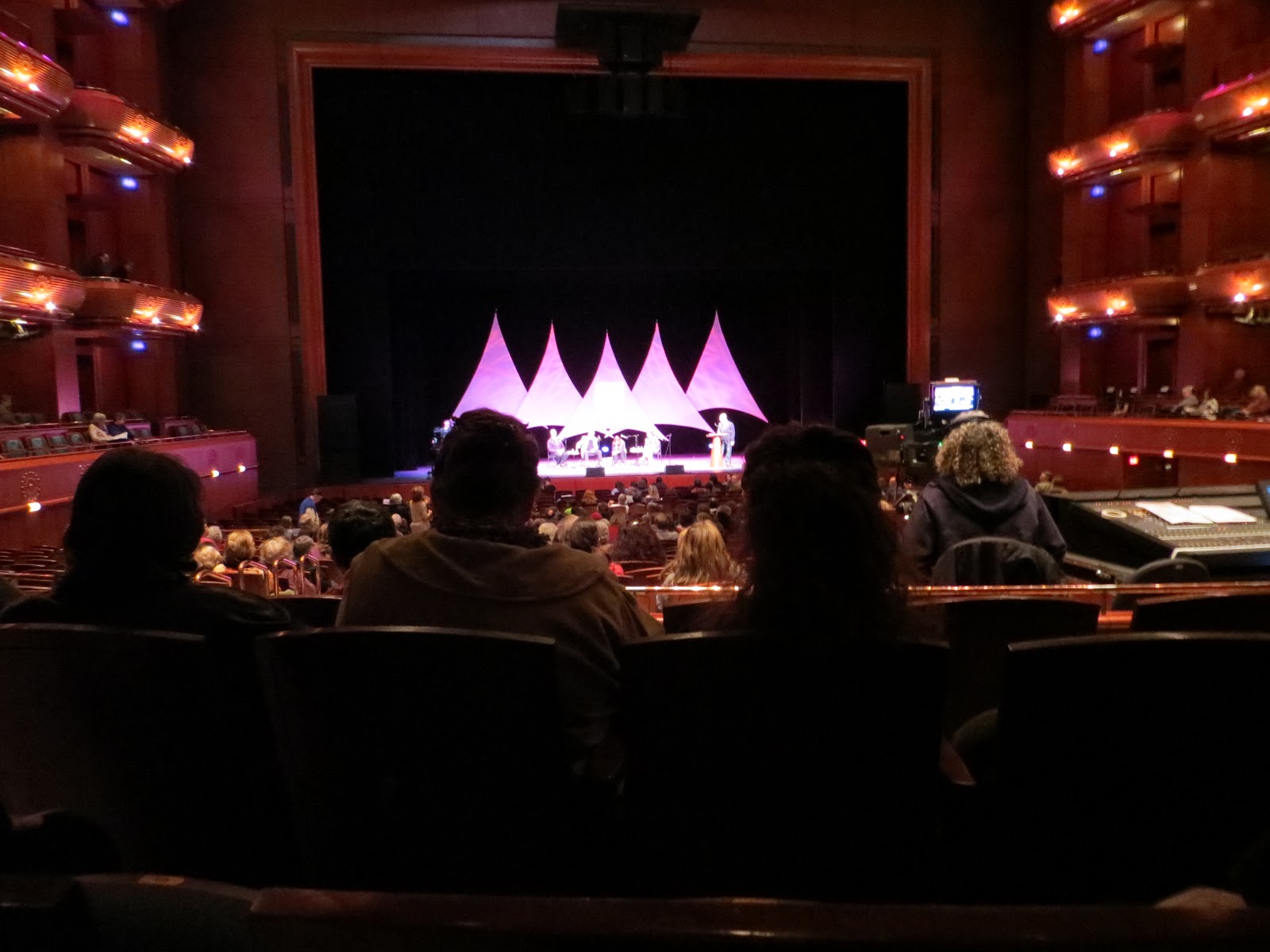
This is the Main Stage in the Performing Arts Center. On Friday this was filled to capacity. The balconies were overflowing. I had to go up three floors to find a seat.

Kahlil Murrill introducing Joseph Millar
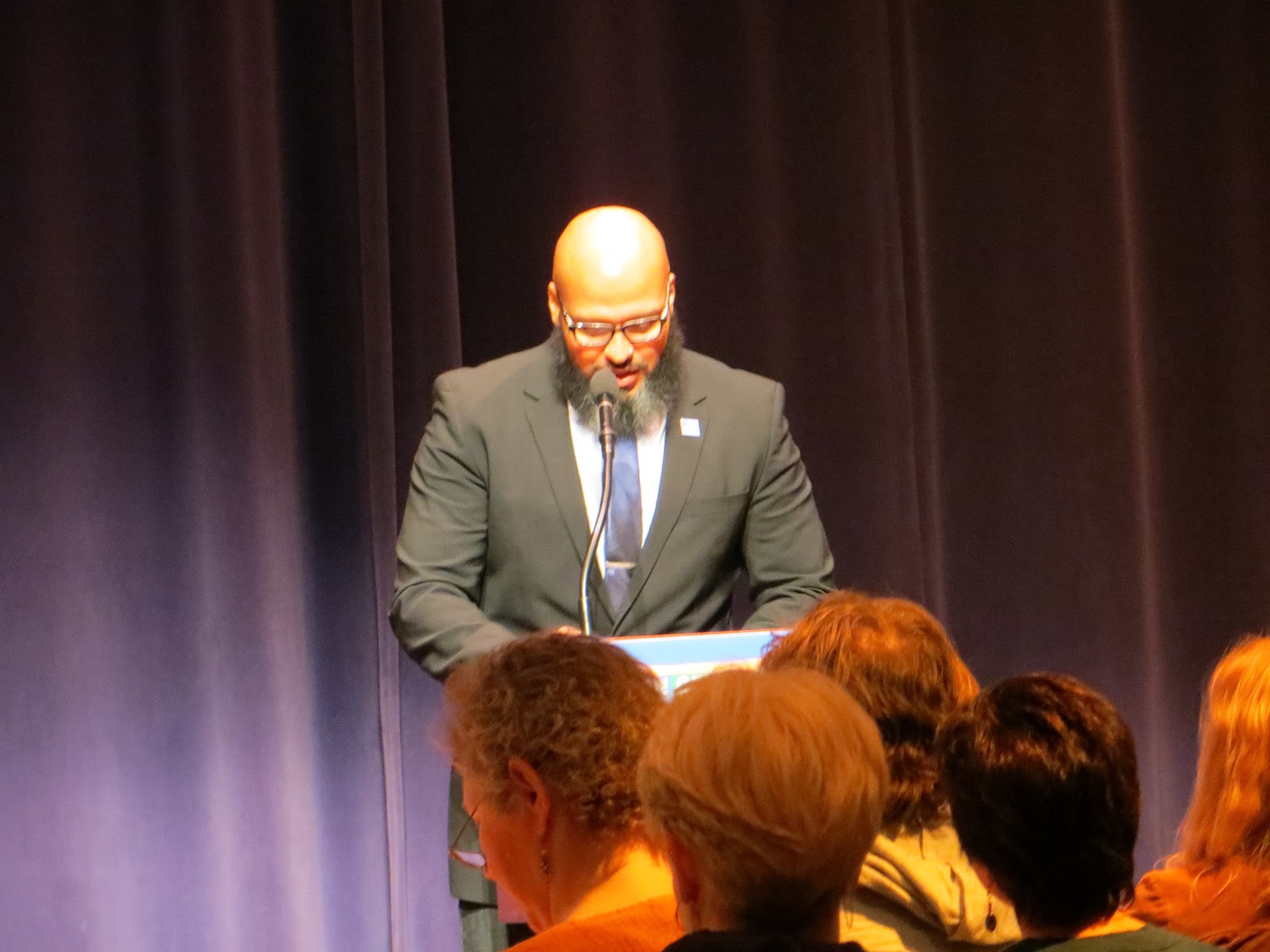
John Murillo in a reading with Rachel McKibbens and Joseph Millar

Queen Nur doing her thing

Dwight James with his instruments

Queen Nur feeling the story
October 6, 2012
The Poet on the Poem: Matthew Thorburn
<!--
/* Font Definitions */
@font-face
{font-family:Calibri;
panose-1:2 15 5 2 2 2 4 3 2 4;
mso-font-charset:0;
mso-generic-font-family:auto;
mso-font-pitch:variable;
mso-font-signature:3 0 0 0 1 0;}
/* Style Definitions */
p.MsoNormal, li.MsoNormal, div.MsoNormal
{mso-style-unhide:no;
mso-style-qformat:yes;
mso-style-parent:"";
margin:0in;
margin-bottom:.0001pt;
line-height:115%;
mso-pagination:widow-orphan;
font-size:11.0pt;
font-family:Calibri;
mso-ascii-font-family:Calibri;
mso-ascii-theme-font:minor-latin;
mso-fareast-font-family:Calibri;
mso-fareast-theme-font:minor-latin;
mso-hansi-font-family:Calibri;
mso-hansi-theme-font:minor-latin;
mso-bidi-font-family:"Times New Roman";
mso-bidi-theme-font:minor-bidi;}
.MsoChpDefault
{mso-style-type:export-only;
mso-default-props:yes;
font-size:11.0pt;
mso-ansi-font-size:11.0pt;
mso-bidi-font-size:11.0pt;
font-family:Calibri;
mso-ascii-font-family:Calibri;
mso-ascii-theme-font:minor-latin;
mso-fareast-font-family:Calibri;
mso-fareast-theme-font:minor-latin;
mso-hansi-font-family:Calibri;
mso-hansi-theme-font:minor-latin;
mso-bidi-font-family:"Times New Roman";
mso-bidi-theme-font:minor-bidi;}
.MsoPapDefault
{mso-style-type:export-only;
line-height:115%;}
@page WordSection1
{size:8.5in 11.0in;
margin:1.0in 1.0in 1.0in 1.0in;
mso-header-margin:.5in;
mso-footer-margin:.5in;
mso-paper-source:0;}
div.WordSection1
{page:WordSection1;}
</style>
<br />
<div class="separator" style="clear: both; text-align: center;">
<a href="http://4.bp.blogspot.com/-b_UPBkS8AHo..." imageanchor="1" style="margin-left: 1em; margin-right: 1em;"><img border="0" height="320" src="http://4.bp.blogspot.com/-b_UPBkS8AHo..." width="234" /></a></div>
<a href="http://www.matthewthorburn.net/"... Thorburn</a> is the author of two books of poems, <i>Every Possible Blue</i> (CW Books, 2012) and <i>Subject to Change</i> (New Issues, 2004). A third collection, <i>This Time Tomorrow</i>, is scheduled for release from Waywiser Press in 2013. He is the recipient of a Witter Bynner Fellowship from the Library of Congress, the <i>Mississippi Review</i> Prize, and two Dorothy Sargent Rosenberg Poetry Prizes. His poems have appeared in literary journals such as <i>The Paris Review, American Poetry Review, Poetry,</i> and <i>Prairie Schooner</i>. A native of Michigan, Matt has lived in New York City for more than a decade.
Today's poem comes from <i>Every Possible Blue</i>.
<br />
<div class="MsoNormal" style="line-height: normal; mso-margin-bottom-alt: auto; mso-margin-top-alt: auto;">
</div>
<div class="MsoNormal" style="line-height: normal; mso-margin-bottom-alt: auto; mso-margin-top-alt: auto;">
<div class="separator" style="clear: both; text-align: center;">
<a href="http://www.amazon.com/Every-Possible-... border="0" src="http://2.bp.blogspot.com/-lutp7EeJSAA..." /></a></div>
<div style="text-align: center;">
Click Cover for Amazon</div>
</div>
<b>Still Life </b>
<br />
<br />
—Pierre Bonnard<br />
<br />
That he would go back<br />
after hours to retouch<br />
the ones hanging in the gallery—<br />
he must have had an in<br />
with the guards—to get it <i>righter</i> <br />
if never right, you've heard<br />
before. How he'd revisit<br />
the light—bring it up<br />
or turn it down—just as I have<br />
returned to this morning<br />
all afternoon. They make me<br />
hungry, these two pears<br />
he must have hurried to paint<br />
so she could eat. A few green ideas<br />
about grapes. The apple<br />
shows off its high bald head.<br />
To be fascinated by fruit.<br />
Not fruit, but light. Imperfect mirrors,<br />
imitation mirrors. His broken<br />
pinks and reds, green and<br />
yellow mottle, this dash of white—<br />
no, <i>light</i>—no, canvas<br />
showing through. I almost catch<br />
my face there, looking back.<br />
I know this fruit. I've eaten it<br />
all my life, though this basket's<br />
new to me—a few brown twists<br />
of vine, uncertain transport<br />
but I'm moved. I'll say that.<br />
Made to speak. Such<br />
tenderness, his abiding<br />
affection for anything touched<br />
by light. And he needed<br />
so little. A few pieces of fruit.<br />
A window. The sky<br />
trying on every possible blue.
<b> </b><br />
<br />
<br />
<b>DL:</b> Tell us something about the impetus behind this ekphrastic poem. What compelled you to attempt to enter the painting, to repaint it with words?
<b> </b>
<b> </b><br />
<br />
<b>MT:</b> A few years ago, I took part in a weekend poetry workshop in Manhattan where we were given an assignment to complete during our lunch break: go find a place to eat and write, then come back with a new poem to share with the group. Faced with this deadline, I ducked into a nearby Chinese restaurant and turned—in a panic—to my go-to poetry prompt: write about art.<br />
<br />
I like poems that emphasize visual details and enable you to really see things—colors, shapes, light and shadow—so writing about paintings comes naturally to me. Sitting in that restaurant and staring at my blank page, I thought of Pierre Bonnard, one of my old favorites, and his light-filled interior scenes. I remembered, too, this sort of famous story about him: he had a habit of going back to his paintings to add a little more color, make something lighter or darker, or change some detail he wasn’t happy with—even after they were hanging in galleries or shows. I remembered Jane Hirshfield has a poem that describes this painterly form of revising as “Bonnarding.” Since I was working from memory, my poem doesn’t match up exactly with a specific painting of Bonnard’s, but I tried to convey the feel of his work and some of my feelings about it. As I say in the poem, after looking at and thinking about his paintings, I was “made to speak.”
<b> </b><br />
<br />
<b>DL:</b> I'm intrigued by the introduction of "she" in line 14. Why did you hold her back and then give her no further mention in the poem?
<b> </b><br />
<br />
<b>MT:</b> There’s that place where all the wonderful ambitions of trying to express yourself creatively run up against the practical business of everyday life, and that’s a place that always interests me. Whatever musical phrase or clever line break I’m just about to get right as I revise a poem, dinner still needs to be cooked, the dishwasher emptied. I still have to go to work every day. Being aware of this friction is partly a way of staying grounded, and it makes the act of writing a poem that much more meaningful. (Tess Gallagher’s wonderful poem “I Stop Writing the Poem” is about this, and about much more than this.) I guess I was imagining the same was true for Bonnard too: as a painter he may have seen these pieces of fruit as colors and shapes to be explored in paint, but to Marthe, his wife—she’s the “she” I had in mind—they were apples and pears, there to be eaten. I hope a little note of thoughtful tenderness comes through, too, in the way he hurries his work along so she can have her lunch. <br />
<br />
That’s all a very roundabout way of answering your question. Marthe appears in many of Bonnard’s paintings. These paintings aren’t portraits exactly, but they wouldn’t be the same without her. I suppose I thought she could nonchalantly appear in my poem too, fleetingly but in a way that felt important to me for the ballast it provides. Otherwise for me the poem is mostly concerned with what a strange thing it is to be so focused on one activity—in this case painting, being fascinated by light—and to feel that obsessive urge to get it right on the canvas.<br />
<br />
<b>DL:</b> While you make only one brief reference to the "she," you make ample use of repetition. Light and fruit both appear four times. Then you repeat sounds as in the rhyme of right, white, and light. The same sound is echoed in the assonance of I, ideas, high, life, vine, abiding, sky, trying. Tell us how you crafted these musical effects.
<b> </b>
<b> </b><br />
<br />
<b>MT:</b> I appreciate you noticing the music of the poem, because that’s something I strive for as a writer and admire as a reader. I love rhymes and off-rhymes that fall within lines, as well as assonance, repetitions and echoes, and all the rhythmic effects you can produce with patterns of long and short lines, or by using phrases and fragments of sentences.
I usually write and revise out loud when I’m working at home, so I can hear how lines sound. Of course I couldn’t do that in the restaurant, but surely did later on when typing up the poem and revising it. <br />
<br />
<b>DL:</b> As I read this poem, I feel as if I'm witnessing a mind at work, reaching and stretching for what it wants to say. I think your use of syntax is responsible for this effect. There's the reversed order in the first sentence which covers seven lines, several fragments, several sentences broken by the use of dashes, and a few declarative statements followed by their negation, e.g., "To be fascinated by fruit. / Not fruit, but light." Was all of this intuitive or crafted?
<b> </b><br />
<br />
<b>MT:</b> I love the way certain poems convey the sense of a mind at work, the poet working out her or his thoughts—saying something, hesitating, backtracking and correcting—as the poem moves forward word by word. That’s something I admire in my friend Stuart Greenhouse’s poems, for instance “Poppy-red.” And it’s something Elizabeth Bishop probably invented in her “Poem,” when she interrupts her own methodical, detail-by-detail description of a faraway landscape—it’s a poem about a painting—to exclaim, “Heavens, I recognize the place, I know it!” So I was definitely conscious of striving for a similar effect in different ways throughout the poem.<br />
<br />
But there’s also the fact that I was on the spot there, with a short window in which to get my poem down on paper, so what shows through in the poem is also my effort to get to the heart of the thing. <br />
<br />
<b>DL:</b> What made you choose the single stanza form?<br />
<br />
<b>MT:</b> I wrote the first draft of this poem quickly—for me, anyway—and so it felt like one long thought or breath. As I work on a poem I usually try different line breaks or stanza breaks until I find the form that feels right for that particular poem. Certain poems need some air and light to shine in between stanzas, to give the reader those pauses for breath or that little extra emphasis of a stanza break, as opposed to a line break. But here I wanted to hold the focus in this lingering moment, so it’s one long breath and then it’s done. Readers, please enjoy this recording of Matt reading "Still Life," along with some of Bonnard's paintings.
<br />
<div class="MsoNormal" style="line-height: normal; mso-margin-bottom-alt: auto; mso-margin-top-alt: auto;">
<span style="font-size: 12.0pt; mso-ascii-font-family: Calibri; mso-bidi-font-family: Calibri; mso-fareast-font-family: "Times New Roman"; mso-hansi-font-family: Calibri;"> </span>
</div>
<div class="MsoNormal">
</div>
<center>
</center>
<center>
</center>
<center>
<iframe allowfullscreen="allowfullscreen" frameborder="0" height="360" src="http://www.youtube.com/embed/0UtQn8c4..." width="640"></iframe></center>
<br /><div class="blogger-post-footer"><img width='1' height='1' src='https://blogger.googleusercontent.com...' alt='' /></div>
/* Font Definitions */
@font-face
{font-family:Calibri;
panose-1:2 15 5 2 2 2 4 3 2 4;
mso-font-charset:0;
mso-generic-font-family:auto;
mso-font-pitch:variable;
mso-font-signature:3 0 0 0 1 0;}
/* Style Definitions */
p.MsoNormal, li.MsoNormal, div.MsoNormal
{mso-style-unhide:no;
mso-style-qformat:yes;
mso-style-parent:"";
margin:0in;
margin-bottom:.0001pt;
line-height:115%;
mso-pagination:widow-orphan;
font-size:11.0pt;
font-family:Calibri;
mso-ascii-font-family:Calibri;
mso-ascii-theme-font:minor-latin;
mso-fareast-font-family:Calibri;
mso-fareast-theme-font:minor-latin;
mso-hansi-font-family:Calibri;
mso-hansi-theme-font:minor-latin;
mso-bidi-font-family:"Times New Roman";
mso-bidi-theme-font:minor-bidi;}
.MsoChpDefault
{mso-style-type:export-only;
mso-default-props:yes;
font-size:11.0pt;
mso-ansi-font-size:11.0pt;
mso-bidi-font-size:11.0pt;
font-family:Calibri;
mso-ascii-font-family:Calibri;
mso-ascii-theme-font:minor-latin;
mso-fareast-font-family:Calibri;
mso-fareast-theme-font:minor-latin;
mso-hansi-font-family:Calibri;
mso-hansi-theme-font:minor-latin;
mso-bidi-font-family:"Times New Roman";
mso-bidi-theme-font:minor-bidi;}
.MsoPapDefault
{mso-style-type:export-only;
line-height:115%;}
@page WordSection1
{size:8.5in 11.0in;
margin:1.0in 1.0in 1.0in 1.0in;
mso-header-margin:.5in;
mso-footer-margin:.5in;
mso-paper-source:0;}
div.WordSection1
{page:WordSection1;}
</style>
<br />
<div class="separator" style="clear: both; text-align: center;">
<a href="http://4.bp.blogspot.com/-b_UPBkS8AHo..." imageanchor="1" style="margin-left: 1em; margin-right: 1em;"><img border="0" height="320" src="http://4.bp.blogspot.com/-b_UPBkS8AHo..." width="234" /></a></div>
<a href="http://www.matthewthorburn.net/"... Thorburn</a> is the author of two books of poems, <i>Every Possible Blue</i> (CW Books, 2012) and <i>Subject to Change</i> (New Issues, 2004). A third collection, <i>This Time Tomorrow</i>, is scheduled for release from Waywiser Press in 2013. He is the recipient of a Witter Bynner Fellowship from the Library of Congress, the <i>Mississippi Review</i> Prize, and two Dorothy Sargent Rosenberg Poetry Prizes. His poems have appeared in literary journals such as <i>The Paris Review, American Poetry Review, Poetry,</i> and <i>Prairie Schooner</i>. A native of Michigan, Matt has lived in New York City for more than a decade.
Today's poem comes from <i>Every Possible Blue</i>.
<br />
<div class="MsoNormal" style="line-height: normal; mso-margin-bottom-alt: auto; mso-margin-top-alt: auto;">
</div>
<div class="MsoNormal" style="line-height: normal; mso-margin-bottom-alt: auto; mso-margin-top-alt: auto;">
<div class="separator" style="clear: both; text-align: center;">
<a href="http://www.amazon.com/Every-Possible-... border="0" src="http://2.bp.blogspot.com/-lutp7EeJSAA..." /></a></div>
<div style="text-align: center;">
Click Cover for Amazon</div>
</div>
<b>Still Life </b>
<br />
<br />
—Pierre Bonnard<br />
<br />
That he would go back<br />
after hours to retouch<br />
the ones hanging in the gallery—<br />
he must have had an in<br />
with the guards—to get it <i>righter</i> <br />
if never right, you've heard<br />
before. How he'd revisit<br />
the light—bring it up<br />
or turn it down—just as I have<br />
returned to this morning<br />
all afternoon. They make me<br />
hungry, these two pears<br />
he must have hurried to paint<br />
so she could eat. A few green ideas<br />
about grapes. The apple<br />
shows off its high bald head.<br />
To be fascinated by fruit.<br />
Not fruit, but light. Imperfect mirrors,<br />
imitation mirrors. His broken<br />
pinks and reds, green and<br />
yellow mottle, this dash of white—<br />
no, <i>light</i>—no, canvas<br />
showing through. I almost catch<br />
my face there, looking back.<br />
I know this fruit. I've eaten it<br />
all my life, though this basket's<br />
new to me—a few brown twists<br />
of vine, uncertain transport<br />
but I'm moved. I'll say that.<br />
Made to speak. Such<br />
tenderness, his abiding<br />
affection for anything touched<br />
by light. And he needed<br />
so little. A few pieces of fruit.<br />
A window. The sky<br />
trying on every possible blue.
<b> </b><br />
<br />
<br />
<b>DL:</b> Tell us something about the impetus behind this ekphrastic poem. What compelled you to attempt to enter the painting, to repaint it with words?
<b> </b>
<b> </b><br />
<br />
<b>MT:</b> A few years ago, I took part in a weekend poetry workshop in Manhattan where we were given an assignment to complete during our lunch break: go find a place to eat and write, then come back with a new poem to share with the group. Faced with this deadline, I ducked into a nearby Chinese restaurant and turned—in a panic—to my go-to poetry prompt: write about art.<br />
<br />
I like poems that emphasize visual details and enable you to really see things—colors, shapes, light and shadow—so writing about paintings comes naturally to me. Sitting in that restaurant and staring at my blank page, I thought of Pierre Bonnard, one of my old favorites, and his light-filled interior scenes. I remembered, too, this sort of famous story about him: he had a habit of going back to his paintings to add a little more color, make something lighter or darker, or change some detail he wasn’t happy with—even after they were hanging in galleries or shows. I remembered Jane Hirshfield has a poem that describes this painterly form of revising as “Bonnarding.” Since I was working from memory, my poem doesn’t match up exactly with a specific painting of Bonnard’s, but I tried to convey the feel of his work and some of my feelings about it. As I say in the poem, after looking at and thinking about his paintings, I was “made to speak.”
<b> </b><br />
<br />
<b>DL:</b> I'm intrigued by the introduction of "she" in line 14. Why did you hold her back and then give her no further mention in the poem?
<b> </b><br />
<br />
<b>MT:</b> There’s that place where all the wonderful ambitions of trying to express yourself creatively run up against the practical business of everyday life, and that’s a place that always interests me. Whatever musical phrase or clever line break I’m just about to get right as I revise a poem, dinner still needs to be cooked, the dishwasher emptied. I still have to go to work every day. Being aware of this friction is partly a way of staying grounded, and it makes the act of writing a poem that much more meaningful. (Tess Gallagher’s wonderful poem “I Stop Writing the Poem” is about this, and about much more than this.) I guess I was imagining the same was true for Bonnard too: as a painter he may have seen these pieces of fruit as colors and shapes to be explored in paint, but to Marthe, his wife—she’s the “she” I had in mind—they were apples and pears, there to be eaten. I hope a little note of thoughtful tenderness comes through, too, in the way he hurries his work along so she can have her lunch. <br />
<br />
That’s all a very roundabout way of answering your question. Marthe appears in many of Bonnard’s paintings. These paintings aren’t portraits exactly, but they wouldn’t be the same without her. I suppose I thought she could nonchalantly appear in my poem too, fleetingly but in a way that felt important to me for the ballast it provides. Otherwise for me the poem is mostly concerned with what a strange thing it is to be so focused on one activity—in this case painting, being fascinated by light—and to feel that obsessive urge to get it right on the canvas.<br />
<br />
<b>DL:</b> While you make only one brief reference to the "she," you make ample use of repetition. Light and fruit both appear four times. Then you repeat sounds as in the rhyme of right, white, and light. The same sound is echoed in the assonance of I, ideas, high, life, vine, abiding, sky, trying. Tell us how you crafted these musical effects.
<b> </b>
<b> </b><br />
<br />
<b>MT:</b> I appreciate you noticing the music of the poem, because that’s something I strive for as a writer and admire as a reader. I love rhymes and off-rhymes that fall within lines, as well as assonance, repetitions and echoes, and all the rhythmic effects you can produce with patterns of long and short lines, or by using phrases and fragments of sentences.
I usually write and revise out loud when I’m working at home, so I can hear how lines sound. Of course I couldn’t do that in the restaurant, but surely did later on when typing up the poem and revising it. <br />
<br />
<b>DL:</b> As I read this poem, I feel as if I'm witnessing a mind at work, reaching and stretching for what it wants to say. I think your use of syntax is responsible for this effect. There's the reversed order in the first sentence which covers seven lines, several fragments, several sentences broken by the use of dashes, and a few declarative statements followed by their negation, e.g., "To be fascinated by fruit. / Not fruit, but light." Was all of this intuitive or crafted?
<b> </b><br />
<br />
<b>MT:</b> I love the way certain poems convey the sense of a mind at work, the poet working out her or his thoughts—saying something, hesitating, backtracking and correcting—as the poem moves forward word by word. That’s something I admire in my friend Stuart Greenhouse’s poems, for instance “Poppy-red.” And it’s something Elizabeth Bishop probably invented in her “Poem,” when she interrupts her own methodical, detail-by-detail description of a faraway landscape—it’s a poem about a painting—to exclaim, “Heavens, I recognize the place, I know it!” So I was definitely conscious of striving for a similar effect in different ways throughout the poem.<br />
<br />
But there’s also the fact that I was on the spot there, with a short window in which to get my poem down on paper, so what shows through in the poem is also my effort to get to the heart of the thing. <br />
<br />
<b>DL:</b> What made you choose the single stanza form?<br />
<br />
<b>MT:</b> I wrote the first draft of this poem quickly—for me, anyway—and so it felt like one long thought or breath. As I work on a poem I usually try different line breaks or stanza breaks until I find the form that feels right for that particular poem. Certain poems need some air and light to shine in between stanzas, to give the reader those pauses for breath or that little extra emphasis of a stanza break, as opposed to a line break. But here I wanted to hold the focus in this lingering moment, so it’s one long breath and then it’s done. Readers, please enjoy this recording of Matt reading "Still Life," along with some of Bonnard's paintings.
<br />
<div class="MsoNormal" style="line-height: normal; mso-margin-bottom-alt: auto; mso-margin-top-alt: auto;">
<span style="font-size: 12.0pt; mso-ascii-font-family: Calibri; mso-bidi-font-family: Calibri; mso-fareast-font-family: "Times New Roman"; mso-hansi-font-family: Calibri;"> </span>
</div>
<div class="MsoNormal">
</div>
<center>
</center>
<center>
</center>
<center>
<iframe allowfullscreen="allowfullscreen" frameborder="0" height="360" src="http://www.youtube.com/embed/0UtQn8c4..." width="640"></iframe></center>
<br /><div class="blogger-post-footer"><img width='1' height='1' src='https://blogger.googleusercontent.com...' alt='' /></div>
September 29, 2012
Poetry: An Introduction
Click Cover for Amazon
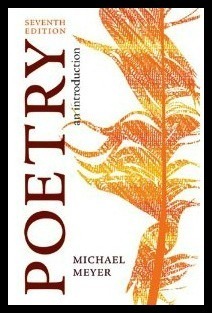
When I was a high school English teacher teaching poetry, it was a fantasy of mine that one day some other high school teacher would be teaching my poems. That's a fantasy that has happily come true several times. But I'm moving on and up to college now. My poem, Linguini, has been included in Poetry: An Introduction, a new college-level textbook from Bedford / St. Martin's.
At 864 pages, Poetry: An Introduction is a big book. Edited by Michael Meyer, this is the 7th edition of this book. It includes three different tables of contents: Brief Contents; Contents, which is much more extensive and includes poem titles and authors; and Thematic Contents for those who want to study poetry in thematic units. There is a wide range of poems, classic and contemporary.
The elements of poetry and forms and free verse are covered in the first eleven chapters. These are followed by close studies of four poets; a study of T.S. Eliot's "The Love Song of J. Alfred Prufrock"; a case study of the Harlem Renaissance; and five thematic case study chapters.
The book covers how to critically read and write about poetry and includes a detailed section on how to write a poetry research paper and document it using MLA guidelines.
Poems are included throughout the book, along with follow-up questions, assignments, and prompts. There is also An Anthology of Poems.
New to this edition is an expanded number of online resources for both students and teachers, including access to video interviews with writers. Scattered throughout the book are brief pieces of advice from the poets whose poems are included. This new feature should be especially appealing to students.
Everything a teacher needs to teach poetry is contained in Poetry: An Introduction . In fact, there's enough to last several semesters.

September 23, 2012
Poetry and Gerbils

Poet and publisher Paul Zimmer has a terrific article in the Sept / Oct issue of Poets & Writers. He covers his work as a publisher of poetry books going back to 1967. During those years he worked for three different presses: University of Pittsburgh Press, University of Georgia Press, and University of Iowa Press. He talks about the arduous process of reading manuscripts, selecting winners, and notifying poets with either good or bad news. He also mentions that during his years as a publisher he never once charged a fee. He talks about the methods he used to make such work possible, a job that must be getting increasingly difficult with the "current overpopulation of American poets"—a condition he compares to a "gerbil farm gone bananas."
What Zimmer regrets about this proliferation of poets and poetry books is the loss of selectivity. There is simply too much. Ironically, in spite of a plethora of poetry books to choose from, way too few readers and writers of poetry invest in poetry books. Here's an excerpt from the article:
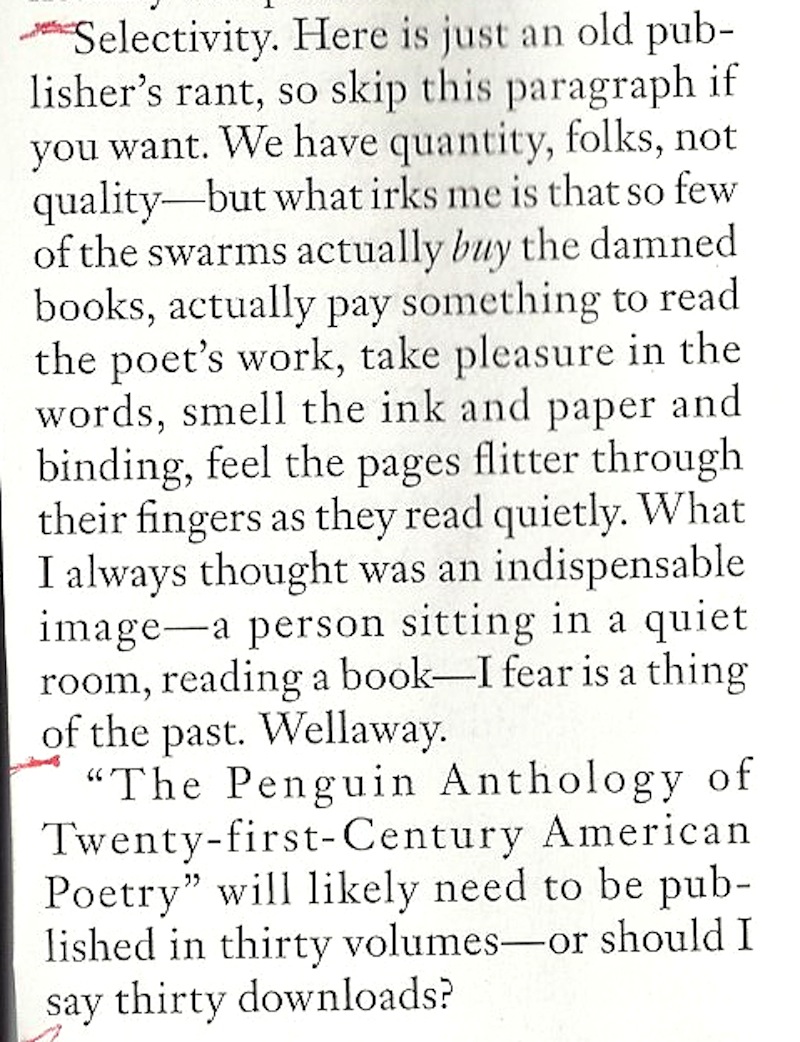
And yet Zimmer is not ready to give into despair. He adds, "I still feel poetry is the highest course for words, and that the spirit and impulse toward making poems is one of humankind's best chances toward possibly saving its hell-bent cantankerous butt." And he acknowledges that if he had it to do all over again, to work as a publisher and an editor, he would do it.
This all hit a chord with me. I have several times been asked by aspiring poets if I do mentoring (yes, I do). I ask the inquiring poet this question: "I assume that you're familiar with my work?" That question is a polite euphemism for "Have you bought any of my books and carefully read it or them?"
Too often the response to my question is some variation of this: "I've seen your work on the internet." When I ask what the person hopes to get out of being mentored, often the response is something like this: "I want to publish a book of my poems."
How can anyone possibly aspire to publish a book of poetry without first and for a long time avidly and regularly reading books of poetry? A poetry book is more than a bunch of poems. It's a collection of poems artistically arranged into some sensible order. An aspiring poet can learn about poem arrangement in a book only by reading books by other poets and studying carefully how it's done.
And one more thing: How can a poet expect other lovers of poetry to buy his or her book (should there ever be one) if he or she doesn't buy them? Does that make sense? Not to me, it doesn't.
The best teacher of poetry is a good poem. The best way to learn how to put a collection together is to study other collections. Aspiring poets are advised to invest in their education. Buy books of poetry. Support other poets. Otherwise, you might as well be raising gerbils.