Diane Lockward's Blog, page 24
October 28, 2013
The Good News Department
I've had a few good weeks for good news. I recently signed up for Poets & Writers Thursday e-newsletter. It comes each week and includes a fiction prompt, a poetry prompt, and a Best Books for Writers recommendation. Look what came this week!
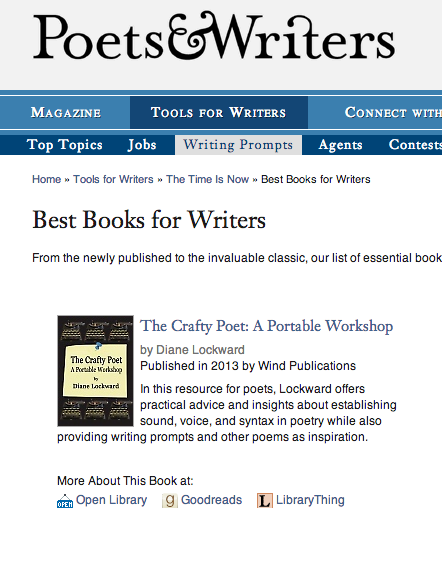
I am thrilled to have my book The Crafty Poet listed as a Best Book for Writers. This recommendation appeared not only in the newsletter but also at the P&W website where it will remain.
Then the book also received some local attention with an article in the online newspaper, The Jersey Tomato Press. The article is titled Crafty year round, not just for season of the witch: The Crafty Poet.
A few weeks ago I was invited by poet Adele Kenny to be a guest blogger at her blog, The Music In It. Adele posts a new prompt every Saturday and recently began inviting other poets to contribute a prompt. My contribution is The Word Chain Poem, which appears in The Crafty Poet. Adele also appears in my book with a Craft Tip on Imagery and a model poem from her collection, What Matters.
I was also happy to receive this lovely, unsolicited testimonial: "I was just at a
4 day retreat with two poet friends. Each of us had a copy of your
book. And we used several prompts. As a result we walked away with about
three new poems each and several revisions of old ones. Thank you for
your newsletter and your book!" How perfect is that? This is exactly what I want my book to do, i.e., provoke new poems and improve ones in progress.
And there's a book party coming up for The Crafty Poet on Sunday, November 10! Ken Ronkowitz, one of the contributors to the book, has posted the details and information about The Crafty Poet at his blog, Poets Online. Twenty poets from the book will be reading, including Ken and Adele. Ken has a sample poem in the book. I'll be baking cookies for this reading.
Also on the list of good news: two Pushcart Prize nominations. The first came from Rose Red Review for my poem, The Color of Magic, which appears in the current issue.
The second Pushcart nomination is for Original Sin from Naugatuck River Review. This poem appeared in the spring issue.
I like good news so much better than bad news. The best that can be said of bad news is that it makes us so much more grateful for the good news. And I am grateful. Thank you, Universe.


October 14, 2013
Poetry Salon: Charlotte Mandel

Charlotte Mandel is our guest today for the Poetry Salon. Her new collection of poems, Life Work, is her eighth book of poetry. Her previous books of poetry include Rock Vein Sky and two poem-novellas of feminist biblical re-vision— The Life of Mary, and The Marriages of Jacob. Charlotte began writing poetry in midlife, went back to school and earned her MA. She founded and coordinated the Eileen W. Barnes Award for older women poets and edited the anthology, Saturday’s Women. She recently retired from teaching poetry writing at Barnard College Center for Research on Women. Her awards include two fellowships in poetry from the New Jersey State Council on the Arts, the Woman of Achievement Award from NJ Business and Professional Women, and the 2012 New Jersey Poets Prize.
Diane: You have had a long career as a poet and have published several earlier books. Tell us how this book differs from those earlier books. Or do you see it as a continuation of that earlier work?
Charlotte: I come to my keyboard or notebook looking not for answers but for questions. The questions are wordless, the asker anonymous. To hear the questions, I must listen to silences within, and translate them into language. My early poems, begun in midlife, often show language working through a process of discovering my own voice. The poems in my first book, A Disc of Clear Water, focus intently on life experiences as wife-daughter-mother and pay close attention to nature. Those concerns have continued in my poems, with changes as my life and work evolved.
My later collections, Sight Lines and Rock Vein Sky, extended previous themes such as marriage and nature, but added poems catalyzed by terrorist acts, humanity’s sufferings from ongoing wars and environmental damage, themes that continue to resonate in my new book, Life Work. Loss of my husband after our long marriage informs the first part; a section is devoted to poems dealing with art and artists; other sections include poems such as “News of the Day Pantoum,” “Sight Loss,” and poems about joy in the birth of a new child.
Diane: Are there particular poetic techniques you like to use?
Charlotte: Often, I’ll work with received forms, or an original form may be developed by a poem during creation. The discipline enables my unconscious self to speak because my critical barrier self is engaged by concentration on details such as line order, syllabic count, rhyme. I discovered this ploy when working on my first sestina for a workshop class assignment. Freed by my absorption in the crossword puzzle aspect, a repressed childhood memory surfaced to become dynamic content. Metaphor, for me, evolves with the poem. To start with a conscious comparative notion may be useful as a way of honing language skills, and can produce an attractive invention, but it may have left out the quality of a silent source.
Diane: How did you select the title for your book?
Charlotte: “Life Work” is the title poem, a crown of seven linked sonnets, where the last line of the first sonnet becomes the first line of the second, and so on. The crown form requires the last line of the seventh sonnet to be the first line of the beginning sonnet. The poem takes off from a painting by Edouard Vuillard. Imagining the view of the young woman in the painting, I went into the progress of a young couple’s courtship and lifetime marriage. The poem became surprisingly autobiographical. The idea of “life work” is consistent with a retrospective of an artist’s paintings. Similarly, the concept seemed an accurate overview of the new collection. Poetry and life are intertwined in my book.
Diane: Tell us the story behind your cover.
Charlotte: My son-in-law, Vincent Covello, has created a marvelous garden at their country home in Long Island and takes beautiful photographs of the various areas. At present, we are completing a forthcoming book of his garden photographs opposite poems I’ve written in response. When seeking cover art for Life Work, I asked him for a photograph that would show a garden view that could evoke the book’s quality. I chose this one for its intrinsic beauty of color and place, and because I have loved to sit at that antique table writing in my notebook. This photo captures the sense of a path towards sunlight, green woods, and open sky.
Diane: What do you hope readers will take away from your book?
Charlotte: A poem is not fulfilled until it is shared by a reader or listener. I hope that the book may offer comfort by articulation of life experiences related to their own, that they may take pleasure in the sounds and images, as in music, to elicit impressions of their own. It is wonderful to discover that the work I have done in solitude may resonate with feelings and thoughts of another person.
Diane: Please choose a favorite poem for us and, if you like, tell us why you chose this one.
Charlotte: Writing this poem, “Crossing the Calendar Bridge,” helped me deal with an important year of transition. The poem, a sequence of three linked sonnets, begins as elegy, reenacts the start of my poetic self-discovery, and finds a way to transcendence.
Crossing the Calendar Bridge
i
The first New Year's Eve without your turning
in grateful wonder: “Lucky us, we’ve earned
another year.” The mirror on the wall
granted pardon: throughout life’s judgment-hall,
one question persisted: “Why am I here?”
Name: doctor, mentor, science pioneer,
father—and sorcerer who alchemized
state-of-loneliness into you-and-I.
We laughed at a third in bed—our snug down
quilt—perinyeh—in childhood mother-tongue.
Light as a ghost but warm, the featherbed
rises and falls with my uncertain breaths.
If I could say “he’s in a better place”
might I foretell his welcoming embrace?
ii
I did not always welcome his embrace.
Corralled in a split-level—breathing space
defined by husband/children schedules,
reassured by unwritten “good-girl” rules.
No studio: my clattery machine labored
under window with view of the neighbor’s
house wall. Marriage, like a boat poised at anchor
unswayed by flickering ripples of rancor,
kept us safe. Yet rhythm known in my bones
formed instrument, mute raised, like saxophone
riffs that tumbled into words. And we sang
off-key, happy, lyrics in differing language.
Our rhymes were true or near or simply free.
Five stages of grief compose an elegy.
iii
Five stages of grief line up for elegy:
deny - rant - reproach - barter - and agree
to let you go, to cease reenacting
hot/cold days/nights of vigil. To distract
mind from memory’s sweated matted strings,
loosen knots, twirl his-and-her wedding rings
doubled on one finger, kiss them for luck,
and recognize the shape of me, unbroken.
Not to muse “if only you were here”
as the glittering ball slides down Times Square.
Get past the calendar, switch off the screen
stop conjugating “is” as “might have been”
Yet how to tell the poem “don’t reminisce”
all moments lived are sparks to genesis.
Readers, please enjoy a glass of chilled Prosecco, some imported cheeses, crackers, and seedless green grapes.

Overheard at the party: “It is Mandel’s poems on her husband’s death I will remember above all this year for elegance and restraint. She chooses formal diction in verse to achieve a firm focus while allowing gifted flexibility within the lines. Our complex lives are richer for the clear beautiful eye of Charlotte Mandel—whether writing about a new sweater for an aged father or an estranged brother’s death, she grasps us out of our wilderness to say look at this truth, how language retrieves us from turmoil.”
—Grace Cavalieri
Please be sure to pick up a copy of Charlotte's book, Life Work.
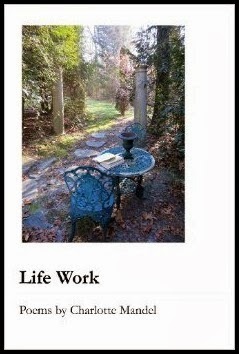
Click Cover for Amazon
October 6, 2013
The Poet on the Poem: Lance Larsen
I'm very pleased to have Lance Larsen as the featured poet for The Poet on the Poem. I think you'll enjoy his poem and his discussion of it. Then I'm also sure you'll want to get his new book, Genius Loci.

Lance Larsen’s fourth collection of poems, Genius Loci, was recently published by the University of Tampa Press. His earlier collections include Backyard Alchemy (2009), In All Their Animal Brilliance (2005), and Erasable Walls (1998). His work appears in such venues as Georgia Review, Southern Review, Ploughshares, Poetry, The Pushcart Prize Anthology, and Poetry Daily. He collects antiques, plays basketball, occasionally walks on his hands, grows daylilies, hikes, and loves Indian and Thai food. He sometimes collaborates with his wife, Jacqui Biggs Larsen, a painter and multi-media artist, who provided the art for the cover of Genius Loci. Since 1993 he has taught literature and creative writing at BYU, where he currently serves as associate chair. In 2012, he was named to a five-year term as Utah Poet Laureate.
Today's poem comes from Genius Loci.
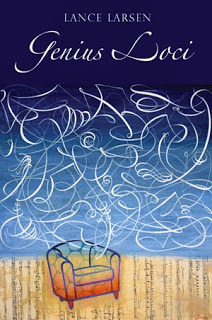
Click Cover for Amazon
To Jouissance
To spell you is to drown in vowels, to pronounce
you is to let guttural joy form in the back
of my throat, then roll forth,
like northern lights booming above a logging
camp in Michigan. Disappointed
in my metaphor? What did you expect from a man?
If only I had an estrogen factory of my own.
If only I could feel the fluttery,
everywhere she-pleasure you bring to lucky
women. I mean the buzz that overtakes
a new mother nursing in a booth at Denny’s,
eyes blissing out, body serenely electric.
I mean whatever state my cousin Erica falls
into when someone braids her hair
in the middle of church—simple Erica
who washes tables at McDonald’s
but can’t read a menu. She knows
enough to close her eyes and give pleasure
more room, knows enough to let purrs
bubble from her mouth, the liquid gold
on her head dividing into glorious threes,
my jealousy tripling. Do you sometimes
make exceptions and visit not just
the Ericas of the world, but the Erics?
I’m thinking of the twenty-something kid
last week who popped up from his seat
and ran to the front of the bus.
That’s my old man, he said, pointing
to the cement truck stopped beside us
at a red light. Hey Dad, I’m over here, look,
and Ernie, our glum undertaker of a driver,
broke the rules for once and swung
open the door at the intersection.
Surely you must have blessed that transaction:
grizzled duffer and tattooed boy leaning
towards each other, like a pair of gargoyles,
air crackling between them. The light turned
green, the afternoon sped up, and the duffer
said, Hey Tommy, nice hat, you ready
for bowling Saturday night?—take her easy.
Who can explain where the world ends and a son
begins, how molecules of longing map the body?
They waved, father and son, like they’d never
see each other again in this time zone.
And we watched: starved, eavesdropping citizens
of the bus, remembering some ecstasy
we fell into once and didn’t deserve, sitting
on our hands to keep from adding amens to the air.
DL: I admire this poem for the risks it takes. I'm struck, for example, by the audacity of titling the poem with a word that most likely almost nobody knows. Why an ode to "jouissance"?
LL: Ever since discovering the term in a French feminism class at Rice University, I’ve been fascinated by jouissance—the notion that women enjoy a less localized, more all-pervasive evolution of pleasure. How could I not be fascinated? It’s a pretty heady experience to read Cixous, Kristeva, and Luce Irigaray for the first time. My title might be off-putting to some, at least at first, but I’m old-fashioned enough to believe that readers, especially of poetry, have dictionaries attached to their bodies the way they have eyelashes and ears. The challenge was to write a poem that dramatizes the differences between male and female desire in such a way that the reader doesn’t need a dictionary at all. Whether I’ve pulled that off is a separate question. I’m not entirely clear now what got me to the title. Either I started with jouissance and canvassed my brain for the kind of sensory detail that would bring the term alive. Or I had these unshakeable sensory impressions and went looking for the appropriate catalyst that would allow Erica and Eric to co-exist in the same poem. While the conceptual dimension of a poem is crucial, the particulars are what provide ballast and launch: the sound of the words, the image, the metaphors, the syntax, the sublime grit that sticks a poem to the page.
DL: Tell us about your use of direct address and the function of the questions you pose to Jouissance.
LL: One can write moving odes in third-person, but these often tend towards a chaste distance poetically—observation rather than drama. I like the intimacy one gains with direct address. As one critic says—I think it was Barbara Smith discussing Gwendolyn Brooks’ “the mother”—if one can create a you that can hear and understand, one in turn creates an I worth listening to. Something like that. Apostrophe is one of the most shamelessly artificial of literary devices but it pulls us in nonetheless, and the great poets are not above using it. Think, for instance, of Keats in “Ode on a Grecian Urn”: “What men or gods are these? What maidens loth? What mad pursuit? What struggle to escape?” Most odes have a circular quality to them, an argument that moves away from the speaker then returns. Direct address helps to facilitate this movement of thinking on the page.
DL: Your speaker straddles the line between rudeness and kindness as he names his cousin "simple Erica" but then transforms her into the dispenser of pleasure, someone who "purrs" and has "liquid gold / on her head." Tell us about the craft that went into this balance.
LL: As a beginning writer I was driven by a search for felicitous language and image. While I’ve never abandoned these pursuits, I’m increasingly interested in shifts in tone and contradiction, in irony. I like flawed speakers who get themselves into a little trouble, as this narrator does. By condescending to Erica—it is very un-PC to use the word “retarded,” for example—he digs a hole for himself, which he then has to crawl out of. Of course, in his double mindedness, he introduces an Erica that is more contradictory and multivalent, more human, than if he had settled for a character of simple sweetness and light. In a way, the poem dramatizes the dangers of overthinking—that is, of privileging book smarts over more authentic primary experience. What is it Keats says in one of his letters? “Oh for a life of sensations rather than of thoughts.” In the end, the narrator ends up envying Erica for her life of sensation, for her ability to give herself to simple pleasures, pleasures which I hope the reader can taste in the language of the poem.
DL: At the midway point you skillfully turn the poem, moving from the feminine to the masculine. In effect, your speaker gets what he wants and makes Jouissance do his bidding. How did you contrive to make the poem turn so smoothly?
LL: I don’t know about jouissance doing his bidding. Perhaps that turn is more my lucking into something. In the middle of a draft, frustrated because I didn’t know what should come next, I noticed that the word “Eric” (which happens to be my middle name) was embedded in “Erica.” An obvious thing to most readers but it wasn’t to me. I love the story about Yeats reading final galleys of one of his books. In describing a woman’s face, he had written “mass of shadows,” but his phrase came back from the printer as “mess of shadows.” He was wise enough to keep the mistake. Poems often know more than their creators, and when we’re wise enough, we know when to keep mistakes and serendipitous accidents. The poem may turn smoothly, but this doesn’t mean we should trust it—at least not completely. Some readers may see this final move in the poem as a kind of male appropriation, which doesn’t bother me in the least. The poem is about vicarious experience. About being in one body and many bodies simultaneously. Or wanting to be. Though the poem ends in celebration, I’m well aware that it begins in lack. In other words, I’m open to an ironic and more skeptical reading.
DL: There's a formal elegance to this poem. You have eight 6-line stanzas and fairly even line lengths. At what point in writing the poem did you decide to use 6-line stanzas? What manipulations had to occur?
LL: I committed to six-line stanzas midway in the writing after I had much but not all of the poem’s language. This decision propelled the poem through an additional series of revisions. I tightened and re-configured, cutting whenever possible. I’m one who winnows and distills down. Regular stanzas invited me to see the poem as a series of crescendoes and pauses accumulating over two pages: how to make that progression as organic as possible? I always work for a mix of end-stopped and enjambed lines, which replicates breathing and movement, hesitation and lunge. I like this stage of revision, not unlike my father tying flies, which he used to do late in the evening. Without the close work of tweezers and magnifying glass, I know I’ve got little more than chopped prose. According to Sandra McPherson, a successful line holds at least two surprises. If one of my lines fails this test, if a stanza isn’t compelling in its own right regardless of the larger task it’s doing in the poem, then I have more work to do.

Lance Larsen’s fourth collection of poems, Genius Loci, was recently published by the University of Tampa Press. His earlier collections include Backyard Alchemy (2009), In All Their Animal Brilliance (2005), and Erasable Walls (1998). His work appears in such venues as Georgia Review, Southern Review, Ploughshares, Poetry, The Pushcart Prize Anthology, and Poetry Daily. He collects antiques, plays basketball, occasionally walks on his hands, grows daylilies, hikes, and loves Indian and Thai food. He sometimes collaborates with his wife, Jacqui Biggs Larsen, a painter and multi-media artist, who provided the art for the cover of Genius Loci. Since 1993 he has taught literature and creative writing at BYU, where he currently serves as associate chair. In 2012, he was named to a five-year term as Utah Poet Laureate.
Today's poem comes from Genius Loci.
Click Cover for Amazon
To Jouissance
To spell you is to drown in vowels, to pronounce
you is to let guttural joy form in the back
of my throat, then roll forth,
like northern lights booming above a logging
camp in Michigan. Disappointed
in my metaphor? What did you expect from a man?
If only I had an estrogen factory of my own.
If only I could feel the fluttery,
everywhere she-pleasure you bring to lucky
women. I mean the buzz that overtakes
a new mother nursing in a booth at Denny’s,
eyes blissing out, body serenely electric.
I mean whatever state my cousin Erica falls
into when someone braids her hair
in the middle of church—simple Erica
who washes tables at McDonald’s
but can’t read a menu. She knows
enough to close her eyes and give pleasure
more room, knows enough to let purrs
bubble from her mouth, the liquid gold
on her head dividing into glorious threes,
my jealousy tripling. Do you sometimes
make exceptions and visit not just
the Ericas of the world, but the Erics?
I’m thinking of the twenty-something kid
last week who popped up from his seat
and ran to the front of the bus.
That’s my old man, he said, pointing
to the cement truck stopped beside us
at a red light. Hey Dad, I’m over here, look,
and Ernie, our glum undertaker of a driver,
broke the rules for once and swung
open the door at the intersection.
Surely you must have blessed that transaction:
grizzled duffer and tattooed boy leaning
towards each other, like a pair of gargoyles,
air crackling between them. The light turned
green, the afternoon sped up, and the duffer
said, Hey Tommy, nice hat, you ready
for bowling Saturday night?—take her easy.
Who can explain where the world ends and a son
begins, how molecules of longing map the body?
They waved, father and son, like they’d never
see each other again in this time zone.
And we watched: starved, eavesdropping citizens
of the bus, remembering some ecstasy
we fell into once and didn’t deserve, sitting
on our hands to keep from adding amens to the air.
DL: I admire this poem for the risks it takes. I'm struck, for example, by the audacity of titling the poem with a word that most likely almost nobody knows. Why an ode to "jouissance"?
LL: Ever since discovering the term in a French feminism class at Rice University, I’ve been fascinated by jouissance—the notion that women enjoy a less localized, more all-pervasive evolution of pleasure. How could I not be fascinated? It’s a pretty heady experience to read Cixous, Kristeva, and Luce Irigaray for the first time. My title might be off-putting to some, at least at first, but I’m old-fashioned enough to believe that readers, especially of poetry, have dictionaries attached to their bodies the way they have eyelashes and ears. The challenge was to write a poem that dramatizes the differences between male and female desire in such a way that the reader doesn’t need a dictionary at all. Whether I’ve pulled that off is a separate question. I’m not entirely clear now what got me to the title. Either I started with jouissance and canvassed my brain for the kind of sensory detail that would bring the term alive. Or I had these unshakeable sensory impressions and went looking for the appropriate catalyst that would allow Erica and Eric to co-exist in the same poem. While the conceptual dimension of a poem is crucial, the particulars are what provide ballast and launch: the sound of the words, the image, the metaphors, the syntax, the sublime grit that sticks a poem to the page.
DL: Tell us about your use of direct address and the function of the questions you pose to Jouissance.
LL: One can write moving odes in third-person, but these often tend towards a chaste distance poetically—observation rather than drama. I like the intimacy one gains with direct address. As one critic says—I think it was Barbara Smith discussing Gwendolyn Brooks’ “the mother”—if one can create a you that can hear and understand, one in turn creates an I worth listening to. Something like that. Apostrophe is one of the most shamelessly artificial of literary devices but it pulls us in nonetheless, and the great poets are not above using it. Think, for instance, of Keats in “Ode on a Grecian Urn”: “What men or gods are these? What maidens loth? What mad pursuit? What struggle to escape?” Most odes have a circular quality to them, an argument that moves away from the speaker then returns. Direct address helps to facilitate this movement of thinking on the page.
DL: Your speaker straddles the line between rudeness and kindness as he names his cousin "simple Erica" but then transforms her into the dispenser of pleasure, someone who "purrs" and has "liquid gold / on her head." Tell us about the craft that went into this balance.
LL: As a beginning writer I was driven by a search for felicitous language and image. While I’ve never abandoned these pursuits, I’m increasingly interested in shifts in tone and contradiction, in irony. I like flawed speakers who get themselves into a little trouble, as this narrator does. By condescending to Erica—it is very un-PC to use the word “retarded,” for example—he digs a hole for himself, which he then has to crawl out of. Of course, in his double mindedness, he introduces an Erica that is more contradictory and multivalent, more human, than if he had settled for a character of simple sweetness and light. In a way, the poem dramatizes the dangers of overthinking—that is, of privileging book smarts over more authentic primary experience. What is it Keats says in one of his letters? “Oh for a life of sensations rather than of thoughts.” In the end, the narrator ends up envying Erica for her life of sensation, for her ability to give herself to simple pleasures, pleasures which I hope the reader can taste in the language of the poem.
DL: At the midway point you skillfully turn the poem, moving from the feminine to the masculine. In effect, your speaker gets what he wants and makes Jouissance do his bidding. How did you contrive to make the poem turn so smoothly?
LL: I don’t know about jouissance doing his bidding. Perhaps that turn is more my lucking into something. In the middle of a draft, frustrated because I didn’t know what should come next, I noticed that the word “Eric” (which happens to be my middle name) was embedded in “Erica.” An obvious thing to most readers but it wasn’t to me. I love the story about Yeats reading final galleys of one of his books. In describing a woman’s face, he had written “mass of shadows,” but his phrase came back from the printer as “mess of shadows.” He was wise enough to keep the mistake. Poems often know more than their creators, and when we’re wise enough, we know when to keep mistakes and serendipitous accidents. The poem may turn smoothly, but this doesn’t mean we should trust it—at least not completely. Some readers may see this final move in the poem as a kind of male appropriation, which doesn’t bother me in the least. The poem is about vicarious experience. About being in one body and many bodies simultaneously. Or wanting to be. Though the poem ends in celebration, I’m well aware that it begins in lack. In other words, I’m open to an ironic and more skeptical reading.
DL: There's a formal elegance to this poem. You have eight 6-line stanzas and fairly even line lengths. At what point in writing the poem did you decide to use 6-line stanzas? What manipulations had to occur?
LL: I committed to six-line stanzas midway in the writing after I had much but not all of the poem’s language. This decision propelled the poem through an additional series of revisions. I tightened and re-configured, cutting whenever possible. I’m one who winnows and distills down. Regular stanzas invited me to see the poem as a series of crescendoes and pauses accumulating over two pages: how to make that progression as organic as possible? I always work for a mix of end-stopped and enjambed lines, which replicates breathing and movement, hesitation and lunge. I like this stage of revision, not unlike my father tying flies, which he used to do late in the evening. Without the close work of tweezers and magnifying glass, I know I’ve got little more than chopped prose. According to Sandra McPherson, a successful line holds at least two surprises. If one of my lines fails this test, if a stanza isn’t compelling in its own right regardless of the larger task it’s doing in the poem, then I have more work to do.
September 29, 2013
Bits and Pieces of This and That

It must be fall. Writing news is coming in.
First, the local The Alternative Press (TAP), an online newspaper, did an article about my new book, The Crafty Poet: A Portable Workshop. Read it at TAP.
Then along came two very nice reviews of the book. The first, by Martha Silano, appears at Blue Positive. This is a thorough review of the book. I especially like how Martha, herself a fantastic poet, describes how she has been putting the book to use. She received the book just as she was beginning a poem-a-day challenge, so the timing was perfect. It made me happy to know that the book has provoked some new work from Martha's pen. Martha says ". . .this is a poetry exercise/craft tip book poets (and English instructors) only dream about. . ." Read the review at Blue Positive.
The second review is by Kelli Russell Agodon at Book of Kells. Kelli says, "What I like about this book is that it offers you poems, prompts and even interviews." Referring to the subtitle, she says, "The book is definitely a portable workshop that you can use by yourself or with a group." Good, that's just what I intended it to be. Read the review at Book of Kells.
I'm happy to have a poem in the new issue of Rose Red Review. This journal is in its second year and puts out three issues per year. Editor Larissa Nash does a very nice job with the journal which focuses on fiction and poetry related to fairy tales and magic. My poem is The Color of Magic.
I also have a poem in Prime Number Magazine. This online journal posts a very limited number of poems every other month, then gathers them into a print volume at the end of the year. The poetry editor is Valerie Nieman. My poem, By the side of the road, is followed by a one-question Q&A.
September 27, 2013
Invitation to a Poetry Reading
Calling all NJ poets and poetry lovers! Please join us this Sunday, September 29, for this Poetry Reading. Two NJ poets, Sandra Duguid and Charlotte Mandel, will read work from their new books. The books will be available for sale and signing. I'll be providing the introductions.
If that's not enough for you, there will be a Reception following the reading. With refreshments!
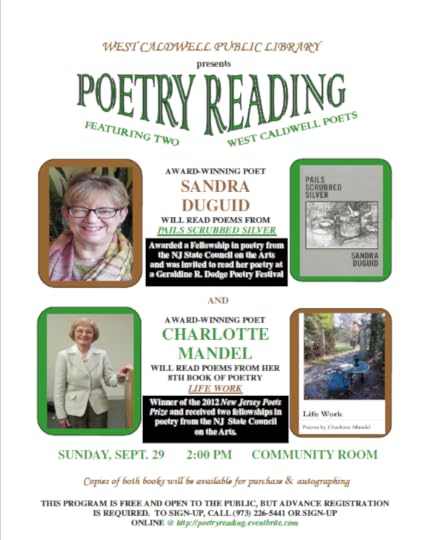
If that's not enough for you, there will be a Reception following the reading. With refreshments!

September 17, 2013
Print Journals That Accept Online Submissions 9/13

It's been just about a year since I last updated the list of print journals that accept online submissions. The list continues to grow, this time by seven journals. You'll notice that a number of the journals charge a fee for the online submission. Many submitters feel that a small fee is worth it as it saves paper, stamps, and a trip to the post office.
Journals new to the list (not necessarily new journals) are indicated with a double asterisk.
The number of issues per year appears after the journal's name.
The reading period for each journal appears at the end of each entry.
Unless noted otherwise, the journal accepts simultaneous submissions.
As always, please let me know if you find any errors here. And good luck.
Adanna: a journal about women, for women—1x
Jan 31 - April 30
Agni—2x
Sept 1 - May 31
The American Poetry Journal—1x
February 1 - May 31
American Poetry Review—6x
all year
Another Chicago Magazine—2x
$3 fee
Barn Owl Review—1x
June 1 - November 1
Barrelhouse—2x
check website to see if open for poetry submissions
Bat City Review—1x
June 1 - November 15
Bateau—2x
all year
Bellevue Literary Review—2x
all year
Bellingham Review—1x
Sept 15-Dec 15
Beloit Poetry Journal—4x
all year
no sim
Black Warrior Review—2x
all year
Boston Review—6x
Sept 15 - May 15
Boulevard—3x
November 1-April 30
Breakwater Review—2x
November 15 for the January issue;
April 15 for the June issue
**Burnside Review—every 9 months
$3 fee / pays contributors
Caesura—2x
August 5 - Oct. 5
Caketrain—1x
all year
Carbon Copy Magazine—2x
May 1st through September 1st, November 1st through March
The CarolinaQuarterly—3x
all year
**Cimarron Review—4x
all year
The Cincinnati Review—2x
Sept 1 - May 31
Columbia—2x
September 1 - May 1
Copper Nickel—2x
August 15-October 15
January 31-March 31
**The Cossack Review—3x
All year
Crab Creek Review—2x
Sept 15 - March 31
Crazyhorse—2x
all year
$2 fee
Cream City Review—2x
August 1 to November 1
December 1 to April 1
CutBank—1-2x
October 1 thru February 15
Ecotone—2x
August 15–April 15
$3 fee
Edison Literary Review—1x
all year
Fence—2x
check website to see if open for submissions
(must submit poems one by one)
FIELD—2x
all year
no sim
Fifth Wednesday—2x
no Jan, Feb, June, or July
The Florida Review—2x
August thru May
$3 fee
Fourteen Hills—2x
September 1 to January 1
March 1 to July 1
Gargoyle—1x
reads month of June
The Greensboro Review—2x
September 15 deadline for the Spring issue
February 15 deadline for the Fall issue
Grist—1x
August 15 - April 15
Hampden-Sydney Poetry Review—1x
All year
Harpur Palate—2x
deadlines: Winter issue: November 15
Summer issue: April 15
Harvard Review—2x
Sept 1 - May 31
Hawk and Handsaw—2x
Aug 1 - Oct 1
Hayden's Ferry—2x
All year
pays
The Hollins Critic—5x
Sept 1 - Dec. 15
Hunger Mountain—1x
all year
The Idaho Review—1x
Sept. 1 to April 15
Iron Horse Literary Review—6x
rolling for 3-4 weeks at a time
check website for dates
Jubilat—2x
September 1 - May 1
Kenyon Review—4x
September 15 - January 15
no sim
Knockout Literary Magazine—1x
check website for submission dates
**The Laurel Review—1x
$2 fee
Sept 1-May 1
The Literary Review—4x
Sept 30-May 31
Little Patuxent Review—2x
submission period varies—check website
The Los Angeles Review—1x
Submit to Poetry Editor: lareview.poetry@gmail.com
Sept 1 - Dec 1
The Louisville Review—2x
all year
Lumina—1x
August 1 - Nov 15
The MacGuffin—3x
all year
The Massachusetts Review—4x
October 1 - April 30
Measure—2x
no sim
all year
The Mom Egg—1x
July 15 - Sept. 30
Meridian—2x ($2 fee)
all year
Mid-American Review—2x
all year
The Minnesota Review—2x
August 1–November 1
January 1–April 1
The Missouri Review–4x
all year
**The Mom Egg—1x
June 1- Sept. 1
National Poetry Review—1x
December, January, and February only or all year if a subscriber
Natural Bridge—2x
August 1-May 1
$3 fee
Naugatuck River Review—2x
for the Summer issue January 1 through March 1
for the Winter issue July 1 through September 1 (contest only)
New England Review—4x
no sim
Sept 1-May 31
New Madrid—2x
August 15 - November 1
New Ohio Review—2x
Sept-May (summer okay for subscribers)
New Orleans Review—2x
Aug 15 - May 1
New South—2x
all year
The New Yorker
weekly magazine
all year
Ninth Letter—2x
September 1 - April 30
The Normal School—2x
September 1-December 1
January 15-April 15
$3 fee
Parthenon West Review—1x
Jan 1- May 1 (but on hiatus for 2012)
Pleiades—2x
August 15-May 15
Ploughshares—3x
June 1 - Jan. 15
Poetry—11x
year round
no sim
Poetry Northwest—2x
September 15 - April 15
Post Road Magazine—2x
February 1 to April 1 for the winter issue
June 1 to August 1 for the spring issue
Potomac Review—2x
Sept 1-May 1
Prairie Schooner—4x
Sept 1 - May 1
no sim
Puerto del Sol—2x
September 15 - March 31
The Raintown Review—2x
all year
considers previously published
The Raleigh Review—1x
All year
Rattle—2x
year round
Redactions—1x
year round
Redivider—2x
all year
Red Rock Review—2x
No June, July, August, or December
no sim
Rhino—1x
April 1 - Oct 1
Rockhurst Review—1x
Sept. 15 through Jan. 15
Rosebud—3x
All year
Sakura Review—2x
year round
**Salmagundi—4x
February 1—April 15
Salt Hill—2x
August 1 - April 1
San Pedro River Review—2x
Jan 1 - Feb 1 / July 1-Aug 1
Saw Palm—1x
July 1- October 1
Slice Magazine—2x
Feb. 1 - April 1
Smartish Pace—2x
All year
Sonora Review—2x
All year
So to Speak—2x
feminist
August 15-October 15 for the Spring issue
January 1-March 15 for the Fall issue
South Dakota Review—4x
All year
The Southeast Review—2x
All year
Southern Humanities Review—4x
All year
Southwest Review—4x
No June, July, August
$2 fee
Sou’wester—2x
August 15 - May 15
Spinning Jenny—1x
Sept 15 - May 15
No Sim
**Spoon River Poetry Review—2x
September 15 to February 15
The Stillwater Review—1x
Sept 1-Dec 15
Subtropics—3x
September 1 - April 15
No Sim
Sugar House Review—2x
All year
Tampa Review—2x
Sept 1 - Dec. 31
no sim
Tar River Poetry—2x
via email
Sept 15 - Nov. 1
no sim
Third Coast Review—2x
Sept 15 - April 30
32 poems—2x
via email
all year
The ThreepennyReview—4x
Jan 1 - June 30
Tiferet—1x
Sept - December
Tinhouse Magazine—2x
September 1 - May 31
Tuesday: An Art Project—2x
all year
Upstreet—1x
Sept 1 - March 1
Versal—1x
Sept 15 - Jan 15
Verse Wisconsin—4x
All year
Washington Square Review—2x
August 1 - Oct 15
Dec 15 – Feb 1
Weave Magazine—2x
April 15 - July 31
West Branch—2x
Aug 15 - April 15
Willow Springs—2x
all year
Women Arts Quarterly Journal—4x
all year
Yalobusha Review—1x
check website for submission dates
Yemassee—2x
All year
September 12, 2013
A Poem about a Poem Might Be a Poem for the Birds

Kwame Dawes, the editor of Prairie Schooner, has penned a blog piece entitled Memos to Poets: A Twitter Journey. This is a fantastic list of 110 tips for poets, all of them full of wisdom. I jumped on #4:
Only one poem about writing poems a year. They are all the same poem written when we have nothing to say.
I could not agree more with this. I am so sick of poems about poems. So many of them have been written that each new one feels like a cliché. Each time I come across yet one more, I groan, Oh no, not this again. I often just move right to the next poem.
Two offenses that particularly bug me:
Violation #1: The poem that titles itself with the word "poem." For example, we might find "Poem about Birds." What a lazy title! Such a title is evidence of a poet with a disengaged imagination. And am I such a stupid reader that I won't know this is a poem unless I'm told? Can't I tell just by looking at the poem that it's a poem? Isn't the appearance, the shape of a poem one of its distinguishing characteristics?
So what's this poet supposed to do with his or her dull title? Brainstorm a list of better titles.
Alternatives to "Poem": Meditation, Song, A Theory of, Musings, Contemplation, Daydream, Reflections, A Study of, Pondering, Ode to, In Praise of, A Curse Against.
Just constructing such a list might suggest new ideas for the poem as well as for the title. Perhaps the poet will decide, for example, that "Birds" is rather vague and focus the poem instead on Robins, Goldfinches, or Mourning Doves.
A few examples from the past: "The Lark Ascending" (George Meredith), "To a Skylark" (Shelley), "Ode to a Nightingale" (Keats).
John Frederick Nims got away with titling a poem "Love Poem." And what a great poem it is. But he did it, so you shouldn't.
Violation #2: The poem that appears to be about one topic, then towards the end announces itself as a poem. For example, the poet is writing a lovely poem of description. He's evoking the setting so well I almost feel transported. And then comes something like this: And that's why I decided today to sit here and write this poem about blah, blah, blah.
What a cheap way to end a poem. What an evasion. What a disappointment. What laziness. It's like one of those short stories that instead of offering a real resolution ends with the main character waking up from a dream.
This poet needs to continue to write that poem. Get into the spot where the flop begins and write some more. Spend days, weeks on it. No stopping until something is zinging and singing.
I should perhaps confess that my best traveled poem has the word "Poetry" in the title. Having done that once, I will never do it again. Why not? Because I've done it. Dawes allows you one poem about writing poems a year. I allow you one in a lifetime.
September 4, 2013
A Few Thoughts about Submissions

I recently came across The 10 Rules of Submitting to Literary Magazines at The BookBaby Blog. The author includes 10 solid pieces of advice. I was particularly interested in #3, probably because I think it's a mistake many of us make. I know I have. Here it is:
3. Send simultaneous submissions to similarly-tiered publications (in terms of prestige/influence)
"You don’t want to send the same poem to Tin House AND your friend’s fledgling online poetry journal. What if your friend takes the poem and publishes it immediately, and then you get an acceptance letter from Tin House later that same day before having a chance to notify them of the other acceptance? You’re gonna be bummed that the unknown online journal is publishing the poem—and there’s no way to tell editors “hey, thanks for accepting my poem—but before you publish it, can you wait a couple weeks to see if I hear back from Tin House?” By sending simultaneous submissions to publications of similar stature, you won’t find yourself in this situation."
In our zeal to get our work published, we may think that we're being smart by sending the same batch of poems to a top flight journal (the one we'd give an essential body part to get in) and to a mid-level journal and to one that's just okay (the safety journal). It's certainly not a bad idea to have backups in case you don't get into any of the top flight journals on your list. But the key here is "backups." Don't send to your backups at the same time you send to your favorites. Don't send to your number 2 and number 3 choices until after you've tried at least half a dozen really good journals. (I'm assuming here that we're talking about poems you believe are among your best work.)
I found myself in that creepy situation a few years ago. I'd been invited to submit to a state magazine that was doing a NJ artist feature in each of its monthly issues. So I sent the magazine some poems. At the same time, I sent the same poems to a journal I'd been dying to get into but so far had only been turned away from. I also sent to several other journals I liked. Well, the magazine replied within days that they were taking two of the poems. I then withdrew the poems from the other places I'd sent them. Except I neglected to notify the one journal that I really wanted to get into. I'm scrupulous about record-keeping and playing by the rules, but in this case I just flat-out messed up.
Several months later I received an email from the journal I was dying to get into and was told they'd accepted one of the poems taken by the state magazine. My chagrin was doubled. First there was the disappointment that I was going to have to say no. Then there was the mortification that I'd have to confess my error in failing to withdraw the poem. Now I ended up getting paid $100 per poem from the NJ magazine, but honestly I would have much preferred to have had the one poem published in the other journal and received just a contributor's copy. The editor was very nice when I apologized and explained my error. But guess what? I've submitted to that journal at least six times since and never made it through the door. I may have missed my one shot there.
I want to add one more thought here. That fledgling, poorly done journal just started by your friend? Or that one you'll take as a last chance sort of place? Don't send your poems at all to those places. If you believe your poems are really good, don't send them to a place where you won't be proud to have them appear. You'll be sorry later. It's not a good idea to just try to amass publication credits. It's wiser to be selective. Many a good poem has made it into a book without ever having appeared in a journal. Be selective.
And here's yet one more thought: If your poems have come back repeatedly, you just might be smart to take another close look at them and consider revising them. I took three such poems to a revision workshop recently, three poems I'll admit to thinking were pretty snazzy but which had suffered multiple rejections. With feedback from a group of good readers, I realized they needed more work. Pain in the neck? Yes, but also really nice to get all fired up about new possibilities. I spent several weeks reworking those poems, not just little stuff but deep revisions. I now suspect that one of them just isn't going to work. The other two are out to places I really want to be in.
August 21, 2013
Goodreads Giveaway for The Crafty Poet
There's a Goodreads Giveaway for The Crafty Poet in progress right now. It runs until September 4. Just click the "Enter to win" button below and you'll be eligible to win one free copy. Limited to US residents.
.goodreadsGiveawayWidget { color: #555; font-family: georgia, serif; font-weight: normal; text-align: left; font-size: 14px;
font-style: normal; background: white; }
.goodreadsGiveawayWidget img { padding: 0 !important; margin: 0 !important; }
.goodreadsGiveawayWidget a { padding: 0 !important; margin: 0; color: #660; text-decoration: none; }
.goodreadsGiveawayWidget a:visted { color: #660; text-decoration: none; }
.goodreadsGiveawayWidget a:hover { color: #660; text-decoration: underline !important; }
.goodreadsGiveawayWidget p { margin: 0 0 .5em !important; padding: 0; }
.goodreadsGiveawayWidgetEnterLink { display: block; width: 150px; margin: 10px auto 0 !important; padding: 0px 5px !important;
text-align: center; line-height: 1.8em; color: #222; font-size: 14px; font-weight: bold;
border: 1px solid #6A6454; border-radius: 5px; font-family:arial,verdana,helvetica,sans-serif;
background-image:url(https://www.goodreads.com/images/layo... background-repeat: repeat-x; background-color:#BBB596;
outline: 0; white-space: nowrap;
}
.goodreadsGiveawayWidgetEnterLink:hover { background-image:url(https://www.goodreads.com/images/layo...
color: black; text-decoration: none; cursor: pointer;
}
There's a Goodreads Giveaway in progress right now. It runs until September 4. Just click the Enter to win button below and you'll be eligible to win the free copy. Limited to US residents.
Goodreads Book Giveaway
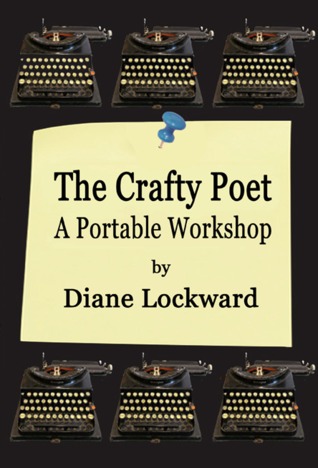
The Crafty Poet
by Diane Lockward
Giveaway ends September 04, 2013.
See the giveaway details
at Goodreads.
Enter to win
August 17, 2013
State Poets Laureate Contest Winner
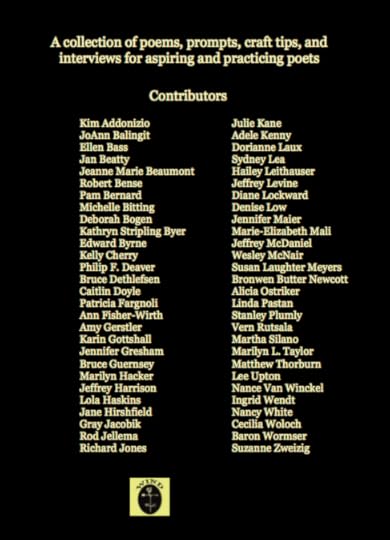
A few weeks ago I ran a contest connected to my new book, The Crafty Poet: A Portable Workshop, which includes contributions of poems and craft tips from 56 poets, 13 of whom are current or former state poets laureate. The contest required people to match the 13 with their respective states. The winner was Gary Glauber. The prize was one copy of the book. Gary's book is on its way to his house right now.
Here's Gary's winning list:
JoAnn Balingit – Delaware
Kathryn Stripling Byer – North Carolina
Kelly Cherry – Virginia
Bruce Dethlefsen – Wisconsin
Patricia Fargnoli – New Hampshire
Julie Kane – Louisiana
Sydney Lea – Vermont
Denise Low – Kansas
Wesley McNair – Maine
Linda Pastan – Maryland
Stanley Plumly – Maryland
Marilyn Taylor – Wisconsin
Baron Wormser – Maine
And here again is the back cover with the full list of 56 contributors:
Here's Gary's winning list:
JoAnn Balingit – Delaware
Kathryn Stripling Byer – North Carolina
Kelly Cherry – Virginia
Bruce Dethlefsen – Wisconsin
Patricia Fargnoli – New Hampshire
Julie Kane – Louisiana
Sydney Lea – Vermont
Denise Low – Kansas
Wesley McNair – Maine
Linda Pastan – Maryland
Stanley Plumly – Maryland
Marilyn Taylor – Wisconsin
Baron Wormser – Maine
And here again is the back cover with the full list of 56 contributors: