Diane Lockward's Blog, page 20
July 21, 2014
The Poet on the Poem: Alessandra Lynch
I am pleased to feature Alessandra Lynch in The Poet on the Poem. I found her poem, "Magnolia," in 32 Poems and was immediately captivated by it. I then tracked down the poet and she generously agreed to participate in the following Q&A.
 Alessandra Lynch is the author of two collections of poetry: Sails the Wind Left Behind, winner of Alice James Books’ New York/New England prize, and It was a terrible cloud at twilight, winner of Pleiades Press’ Lena-Miles Wever Todd Award, judged by James Richardson. She has received fellowships from Yaddo and MacDowell, and she was a recipient of a Barbara Deming Memorial Award. Her poems have appeared in numerous poetry journals, including The American Poetry Review, Blackbird, The Cortland Review, Crazyhorse, The Massachusetts Review, Ploughshares, The Virginia Quarterly Review, and Volt. She teaches in the undergraduate and MFA programs at Butler University and lives near an Indianapolisian canal with her husband poet, Chris Forhan, and their two sons, Milo and Oliver.
Alessandra's most recent poetry book is It was a terrible cloud at twilight.
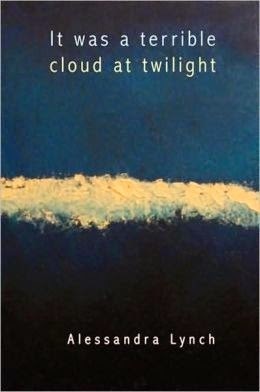 Click Cover for Amazon
 Magnolia
A wedding broke out in the magnolia—
fever of white gloves, distressed wind.
The bells hung upside down. They’d choked
on their own tongues.
Hung too, on unspeaking terms
with the air, I acknowledged the impasse--
I wore a dress of paralysis.
Then all her little white dresses lifted as one—
as though on signal—a four year old
girl tilting up her own dress in the living room, opening up
like an umbrella to her mother’s lover, her face, god I can’t
even imagine it, sweet and cold, methodical, desperate,
trying to woo him—.
Maybe I don’t want
a voice at all. All this mouthing in the magnolia--
thin cries
—too delicate
to tend.
I think of a sea and its glistening foams and cascades hundreds of miles off
and its whales’ limbic thudding through water, their intelligent eyes
bright with salt.
Rushed wind…
White rushing petals…
the ransacked
air.
DS: What ignited this poem? How did you get from the tree to the opening metaphor?
AL: When I write poetry, I work associatively (and swiftly)—through image and sound. I never know what will arise from my tapping into language and tinkering with images. I read every draft obsessively to heed the music. I never analyze what I’m doing until the very “last” drafts, or until someone asks me to analyze my work (a la Blogalicious!—I’ve learned much about my own poem through your questions). In this way, I feel I can trust that what appears on the page is coming from a deeper, more surprising place—the realm of poetry—than what my conscious mind alone might conjure.
Living just outside my bedroom window, there is a magnolia tree that blooms yearly—roughly five days’ worth of luminous white blossoms (at times they appear to be floating on air, detached from the branches). It grows so close to my window that it seems to be pressing into the room. Its leaves are dark green and shiny. I have had intimate views of yellow finches among its branches. One year, a robin built her nest in it, and I watched her fledglings hatch there. Magnolias have been around since the time of the dinosaurs and zillions of years before bees!
This magnolia is a tree I adore, a tree I turn to when I am despondent, a tree I marvel over for its leaves’ depth of glossy green, its supple blossoms’ ghostly glow. One day, I began marveling over how the blossoms looked like thin white gloves, the whole tree like a wedding party or a bride of sorts—hence, the “wedding” metaphor in the poem. I felt distress in the tree, too, for a number of possible reasons: the wind was harrying them, magnolia blossoms last briefly, and my associations with “wedding” are based mainly on my experience as a child of my parents’ harrowing divorce.
The verb “broke out” and the “fever of white gloves” suggest contagion and agitation. The bells image furthers the wedding motif, and bells “hung upside down” echoes the shape of blossoms; but these are bells that can’t express themselves, muted by their own nature. The magnolia has no voice or mode of “self-expression,” other than the quick change of blossoms to leaves to stark branches. The bells “choking on their tongues” could lead associatively to the speaker’s poor relationship with life or air—the essential element in the world that keeps us alive and enables us to speak. “The impasse” then has to do with lack of communication or blocked communication as in the bells and the speaker. This “impasse” is further embodied by the sibilant sequence—it underscores the “impasse” by keeping the reader stuck in that one hissing sound (perhaps spawned by the word “unspeaking”).
I think now of Robert Lowell’s marriage poem “Man and Wife” (pointing directly to problems in a marriage) and Gerald Stern’s “Magnolia,” in which there is a rather makeshift wedding depicted (“two tin buckets / of blossoms waiting for us”). I don’t know if those other poets’ poems rose through my blood on that day of looking, or maybe the magnolia tree inherently inspires such a connection to weddings or marriages—the blast of rich, voluptuous white, the heartbreakingly short-lived blossoms.
DL: I’m intrigued by your metaphor, “I wore a dress of paralysis.” Tell us about this metaphor and the surprising shift from the dress to the four-year-old girl and then to the whales.
AL: Perhaps “dress of paralysis” arose from the initial wedding metaphor—with its “white gloves,” but it also embodies the speaker’s inability to express, to break out of the “impasse” and to move words and/or life forth…. Still, it is a dress, and the implication could be that there is a vital, active life/female body encased by that dress. Perhaps this type of dress is a protective one. Don your “dress of paralysis” and you don’t have to speak and make yourself vulnerable. I believe that often we remain silent out of some kind of terror. I also think of how immobile trees can appear to be—almost paralyzed—when actually they are constantly in motion.
“All her little white dresses lifted as one” could bespeak magnolia petals upwardly blowing, opening a space or door into memory, expressing some kind of vulnerability—I feel the line as mysterious and ghostly. This line might have been triggered by “I wore a dress of paralysis” not only through the dress-image association but also through the psychological effect of an insight opening a door. This part of the poem becomes rather “chunky” typographically as there is an “opening up” or confessional quality to the language. That scene of the little girl flirting with her mother’s lover (the earlier “distressed wind” being part of the wedding could connect to this scene), and the various, complicated expressions on her face in the doing, ignite the speaker’s own desperation about voicing herself, which possibly opens her up to pain. Vulnerability is intrinsic to self-expression. The girl’s “tilting up her own dress” is a voiceless communication, a plea borne of a complex situation having to do with need and confusion…
The statement of not wanting “a voice at all” feels as though it solidifies a nascent theme of disconnection in this poem. Another nascent theme is surrender—surrender both as giving up and as releasing (uttering). “All this mouthing in the magnolia” could allude to the various metaphors speaking throughout the poem, as well as the blossoms and leaves of the tree which, to this writer, are some of the tree’s “mouths.”
The shift in the poem to the sea and its “glistening foams and cascades” is the speaker’s way of contending with the enormous responsibility and ensuing futility expressed in “too delicate to tend.” Thus, the speaker-poet adjusts her focus to the sea—a new association she has with the magnolia blossoms: the foams and cascades—the realm of whales? The speaker (and reader?) might find respite and comfort at this point in the poem in the beauty and power and distance of the sea and the whales. The enormous undersea beauty might counteract the speaker’s feelings of fracture, might wash away painful memories, but—alas!—the wind lives everywhere—land and sea—and a “rushed wind” makes not only the “foams and cascades” of the sea but also those of the magnolia tree; and here it disrupts this lulling sea-rhapsody, returning the speaker and the poem to the tree and its “fever of white gloves.”
DL: The sounds in your poem are lovely and subtle. For example, in stanza 2, you have “hung” and its repetition, “tongues,” and “unspeaking.” In stanza 3, you have “impasse,” “dress,” and “paralysis.” How deliberate was your use of assonance and consonance?
AL: My first drafts tend to be rife with imagery and music—it’s how my mind works, it’s how I’ve always invoked my poems. There’s nothing particularly deliberate about it—all of it’s unbidden. The music in language is visceral and mysterious and the truest mode of expression I know. All those sound sequences arose as I wrote the initial draft and remained throughout the drafting process. I probably had many other moments of music that weren’t as charged or intrinsic to the piece that I left behind on the cutting room floor (after doffing my hat to the work those lyrical passages helped me do). The music in language leads my mind, and I try my best to follow it and to recognize when the music is intrinsic to the image and to the emotional root of the poem versus when the music is decorative or just music for music’s sake (though, at times, poems need moments of the latter too).
DL: What is the function of your poem’s form? At what point in the drafting did you incorporate the indentations?
AL: Fairly early in the drafting (possibly the second draft), I began indenting (without consciously thinking about why or how—it just helped me feel a certain energy or life on the page). Now I see that I was probably following the feeling of agitation and augmenting the motif of air through the spaces. The indentations could also embody the expansion and contraction of breath in a distressed state or the structure or design of how magnolia blossoms appear on each branch. In earlier drafts, the indentation was more erratic and perhaps a bit melodramatic.
DL: In the closing stanza, with its three quick images, you return to the wind of the first stanza. Why that circling back? What made you decide to put the word “air” on its own line flush to the left margin?
AL: I guess that, ultimately, the speaker-poet did want to tend to the magnolia’s thin cries—on some level, I might have wanted to keep the magnolia and all that it represents alive to the reader. And, in so doing, I continued to give voice to those tongue-choked bells, that speaker in her dress of paralysis, the child who lacked language for all she was experiencing. Maybe the speaker-poet was compelled (however unwittingly) to continue facing the manifestations of her current distress, inasmuch as she swerved off to marvel over the whales. “Their intelligent eyes” could see what she was doing by swerving away from the magnolia! But in swerving, she dropped into the sea, realm of the unconscious, realm of deep inner truths. Maybe those eyes were the catalyst for her to return and confront her own pain and bewilderment again for a truer catharsis.
In terms of the last few breaths of the poem, I kept fiddling with the placement of “air” before deciding to keep it flush to the left margin. I wanted the feeling of “ransacking” to reverberate with all the other elements of the poem before settling on “air”—also, rhythmically, it felt too abrupt to have “air” on the same line as “ransacking”—and there was a sort of abandoned or neglected or stifled feeling I think I conveyed by isolating “air” in its own corner.
Ultimately, my writing process—including decisions about spacing and line breaks—is guided by intuition, certainly not a whole lot of consciousness or deliberation (those I reserve for writing other than poetry). These answers to your questions record notions that either came to me after the fact of writing or half-consciously guided me in the making of “Magnolia.” As Theodore Roethke says, “We think by feeling. What is there to know?”
Readers, please enjoy this recording of Alessandra Lynch reading her poem, "Magnolia."


July 13, 2014
Revision: Making Persian Carpets Out of Poems
.jpg) My July 1 Poetry Newsletter included a wonderful Craft Tip contributed by Connecticut Poet Laureate Dick Allen. Entitled “Sometimes, Beware the Good Poem,” the piece cautions against over-revising a poem.
My July 1 Poetry Newsletter included a wonderful Craft Tip contributed by Connecticut Poet Laureate Dick Allen. Entitled “Sometimes, Beware the Good Poem,” the piece cautions against over-revising a poem. Guilty! At least sometimes. This can happen for a variety of reasons. Sometimes the poem really isn’t good and I’m trying to put lipstick on it when I should just murder it and put it out of its misery. Sometimes the poem is good, but that’s all it is and I’m trying too hard to achieve greatness. Sometimes the poem is good, maybe even really good, one of my better ones, but it came so easily that I don’t trust it, so I give it a good beating. Sometimes I’m just stalling getting back to the blank page and beginning the next poem.
Allen calls over-revision “one of the greatest sins of contemporary poetry writing” and blames the sin on our “listening overly hard to suggestions from a mentor or other participants in a poetry workshop.” He issues this warning: “Over-revision tends to tamp down a poem, to suck out its life, to leave in it too little of its original passion.” And lest we be overly concerned with perfection, he reminds us that “legendary Persian carpets purposely contain an errant thread.”
Allen’s words clearly resonated with my newsletter subscribers, a number of whom wrote to tell me how good it was to read those words.
And yet shortly after the newsletter went out, I happened upon this from Stephen Dunn:
I'm an inveterate reviser. I'm just always doing that. In my lifetime, there have been a handful of poems that have been finished without much revision, but only a handful. I often go to Yaddo or McDowell in the summers and tend to generate a lot of work without worrying about completing it. Then I spend the next year refining those poems and getting them in shape. A fairly new experience that I’ve been having is revision as expansion. Most of us know about revision as an act of paring down. Several years ago, in looking at my work, I saw that I was kind of a page or page and a half kind of poet, which meant that I was thinking of closure around the same time in every poem. I started to confound that habit. By mid-poem, I might add a detail that the poem couldn't yet accommodate. That's especially proven to be an interesting and useful way of revising poems that seem too slight or thin; to add something, put an obstacle in. The artificial as another way to arrive at the genuine—an old story, really.
—from an interview in The Pedestal Magazine, issue 41, 2007
This also strikes me as good advice and not at all contradictory. We've all sucked the life out of some poems, but haven’t we all also written the poem that quit too soon? Haven’t we all abandoned a poem without ever having worked hard enough on it to discover its real potential, its real subject? Haven’t we gone in fear of obstacles?
And then we hear so much about compression, about reducing clutter, cutting out details, getting rid of this and that. How many times have you been told that “less is more”? So when someone tells us to add more, to expand, to keep going, we might be hesitant to pay attention.
But we should pay attention. We don’t want to kill a poem, but we also don’t want to fail to give it life.
The March Poetry Newsletter included Fleda Brown’s Craft Tip, “Putting Obstructions Along Your Poem’s Path.” Brown offers a number of terrific and specific suggestions for getting your poem to its full potential. Suggestion #3 has been useful to me:
Once you have something going, some inclination in a poem, pick a book of someone else’s poems. Choose a book whose poems draw you at the moment. Go through it and make a list of more than a dozen words that appeal to you. Make yourself use them in your poem. Since you already have your mind on the poem, the words you choose will magically relate, one way or the other.
What else can we do to “arrive at the genuine,” that is, to discover the poem’s potential?
Here are some strategies that I’ve found useful during revision:
1. Instead of taking the ten words out of an entire book, take them out of a single poem, one that has strong diction. Then plug those words into your own draft. Expand / revise as needed.
2. Find the lifeless part or parts. Open up space there and keep on writing. Freewriting can occur at any time during drafting and revising.
3. Go into the right margin of your draft and find 3 places where you could insert a negative statement.
4. Go into the right margin and write some kind of response to each line, perhaps its opposite, perhaps a question.
5. Go metaphor crazy. Add 10 metaphors or similes to the poem. Keep the keepers.
6. When you have several drafts and feel that the poem is getting close to done, experiment with stanza breaks. This will expose weak spots as well as unnecessary repetitions and excessive verbiage. Break the poem into quatrains. Then break it into 3-line stanzas, then 2. Don’t do this early in the drafting as it may incline you to write and revise to fit the form. Save until the end so that you find the form that fits the poem.
Then ask yourself, Have I left in the errant thread? And consider leaving it there.
July 3, 2014
The Crafty Poet: Group Reading 3
On Sunday, June 22, a group of contributors to The Crafty Poet: A Portable Workshop gathered at the Bernardsville Public Library for a group reading and discussion of the book. I consider myself very fortunate to have had three group readings for the book, each of them well attended, each of them a lot of fun. I also consider myself very fortunate that so many of my contributors have been willing and happy to travel a distance and give up a day in order to participate. I thank them!
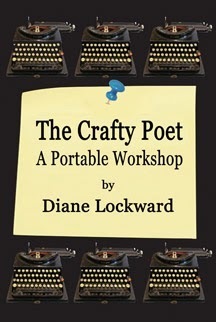 The book from which we read
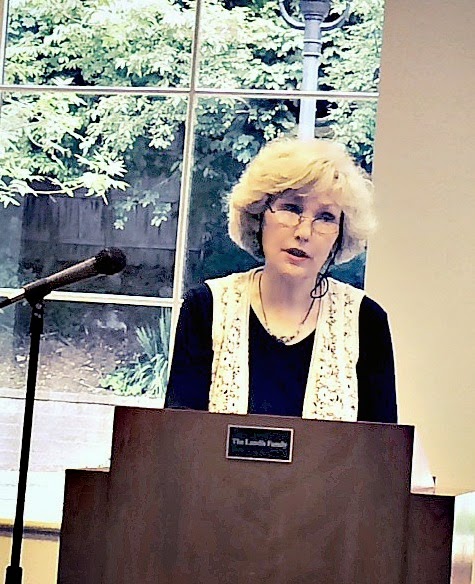 Me welcoming the audience and then discussing my Craft Tip, "Finding the Right Words"
 Ann DeVenezia reading her sample poem, "Waiting for My Friend," and discussing
the model poem and prompt which led to her poem
 Susanna Rich reading her 3 sample poems, "Radish," "The Snake Milker's Daughter," and "Gassing Up in New Jersey
 Tina Kelley reading her sample poems, "My Man, the Green Man" and "To the Inarticulate Man Who Tries"
 Michael T. Young reading his sample poem, "Advice from a Bat," a poem based on the prompt
for Amy Gerstler's "Advice from a Caterpillar"
 Joel Allegretti reading his sample acrostic poem, "In a Station"
 Gail Fishman Gerwin reading her sample acrostic poem, "Rosebuds Ungathered," and then "Behold"
 Ken Ronkowitz reading his sample poem, "Carpe Diem," and discussing
the role of cliches in the poem
 Adele Kenny discussing her Craft Tip, "Petals on a Wet, Black Bough," and later her model poem, "Snake Lady"
 Wanda Praisner reading her sample poem, "After Love"
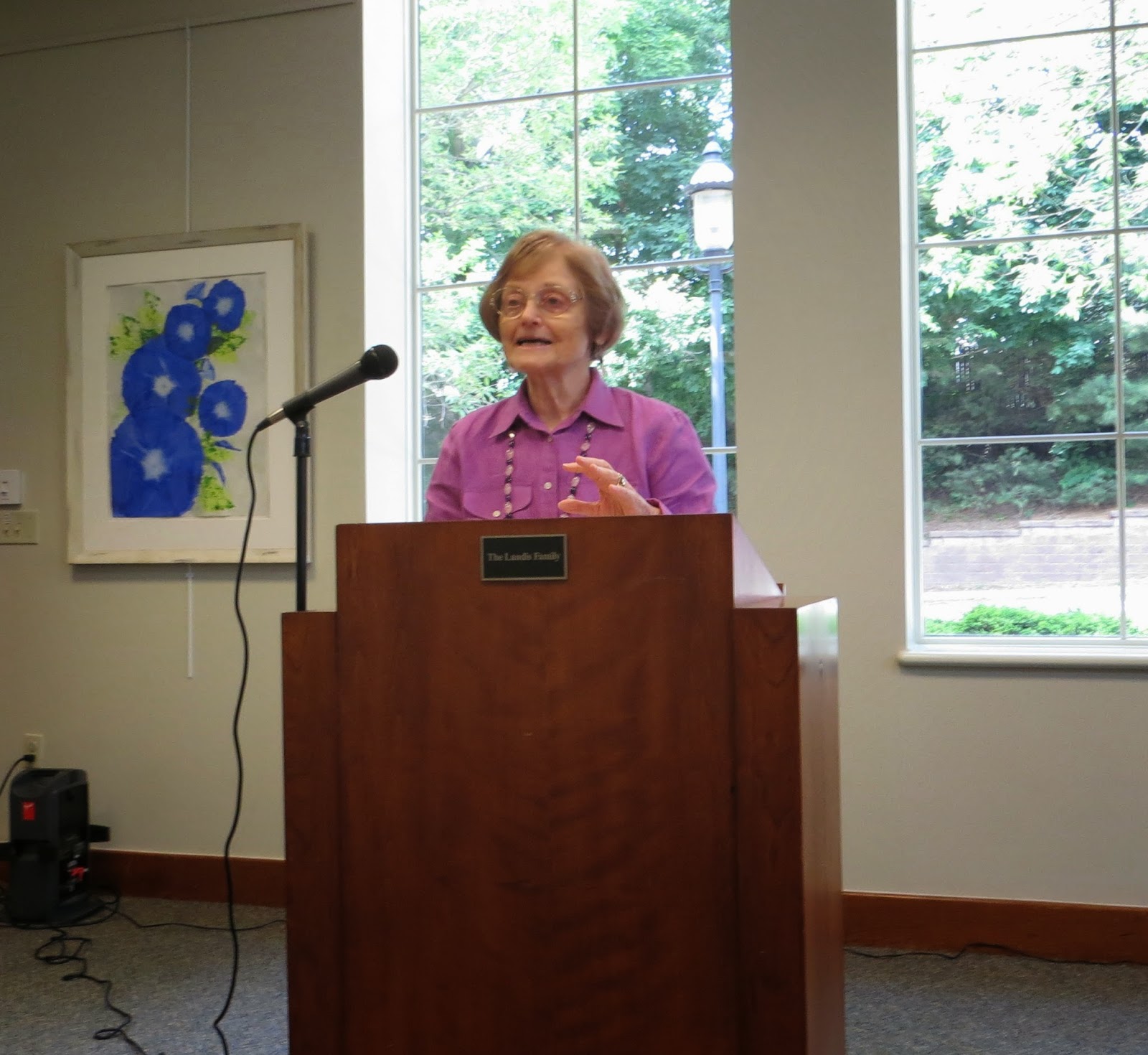 Charlotte Mandel reading her sample poem, "Flood Washed," a poem
modeled on one by Stanley Plumly
 Basil Rouskas reading his sample poem, "Scents of Summer,"
a poem which relies on the sense of smell
 Antoinette Libro reading her sample poem, "Baggage"
 Following the reading, we had a reception at which cookies were served and eaten.
The audience joined us and engaged in some conversation with the poets.
The S'Mores I made completely disappeared.It was a delicious day!
June 23, 2014
Promising New Online Journals
.jpg) bird online
bird onlineIt seems like just about every time I turn on my computer I receive a notice about another new online journal. Needless to say, since anyone can start an online journal—and often without expense—there's a good deal of disparity in the quality of these journals. Some are quite dreadful; others are very good. So it's important to check out the masthead to note the credentials of the editors and staff. Check out the Archives if there are past issues. Note the poets and poems that have appeared in past issues. Note the format of the journal. Is this one where you'd be proud to have your work displayed?
I've gathered a list of seven fairly new or brand new online journals that seem to be doing a great job. In order to get on my list, the journal had to meet certain criteria:
reveals identity of the editors is visually attractive and easy to read—no black background with white or colored fontsdoes not use a pdf formatdoes not post poems side by sidedoes not use a single page scroll-down format posts poems by a single poet on a single page or one poem per page has easy and clear navigation through the journaluses social media to promote the journal—ideally should provide Facebook and Twitter links for poems
Titles are linked to the website. Number of issues per year is indicated after the title. Reading period appears on second line.
Dialogist: Quarterly Poetry & Art—4x
all year
Driftless Review—2x
all year
Four Way Review—2x
November 1 – March 1 for spring issue; April 1 – October 1 for fall issue
Posit—3-4x
all year
Tinderbox Poetry Journal—4x
all year
Tupelo Quarterly—4x
all year but they close submissions once they fill the upcoming issue or reach 300 submissions. Check their Submittable page to confirm that submissions are open.
Waxwing Magazine—3x
all year
June 18, 2014
Group Reading for The Crafty Poet: A Portable Workshop
Please Join Us

Group Reading for The Crafty Poet: A Portable Workshop
Sunday, June 22
JOEL ALLEGRETTIANN DEVENEZIALAURA FREEDGOODGAIL GERWINTINA KELLEYADELE KENNYANTOINETTE LIBRODIANE LOCKWARDCHARLOTTE MANDELWANDA PRAISNERSUSANNA RICHKEN RONKOWITZBASIL ROUSKASMICHAEL T. YOUNGSANDY ZULAUF
Bernardsville Public Library1 Anderson Hill RoadBernardsville2:00 PM FreeRefreshmentsContact Madeline English: 908-766-0118Diane Lockward: dslockward @ gmail dot comDirections
June 11, 2014
Bringing Poetry to New Places
I love unusual venues for poetry readings. A friend of mine, Sondra Gash, had a beautiful house tucked away on a back road in Lebanon, NJ. During the years that she lived there, Sondra hosted a few poetry salons each year. She did this to support her poet pals and to support CavanKerry Press, the press that published her collection, Silk Elegy. One side of the house was all windows overlooking a babbling brook and lots of trees and vegetation. It was a perfect spot for poetry. Sondra invited poets and other kinds of artists for an afternoon of poetry and conversation. The salons were wonderful. Recently, though, Sondra and her husband made the difficult decision that it was time to sell the house and move to a retirement community.
So Sondra and Ira moved to Winchester Gardens in Maplewood, NJ. One of the enticements to move there was that the Social Director suggested that she could continue her salons there. After a period of getting used to her new digs, Sondra put together the first reading. She invited me and five other poets to gather on Monday, May 19 for an evening reading. I was stunned by the beauty of this senior residential community. The grounds were beautiful with tons of flowers and the buildings were big old stone structures.

Above is the Great Hall where the reading was held. The furniture was rearranged so that the audience could sit in rows. We had approximately fifty residents turn out for the reading. They were engaged and enthusiastic.
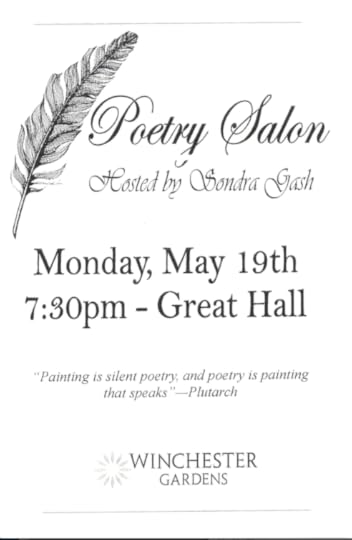
With the assistance of the Social Director, Sondra prepared a program brochure. Inside was a photo of each poet and a bio.
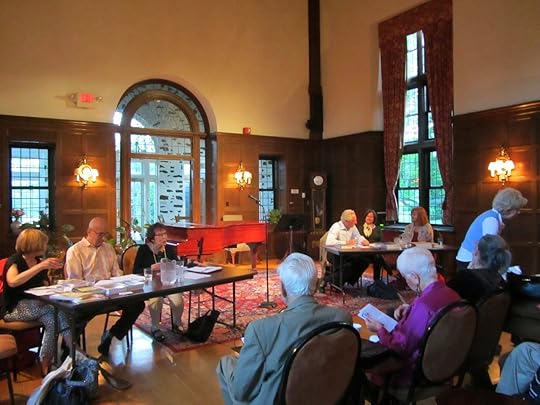
This is just before the reading got underway. Left to right are Gail Gerwin, Ed Ryterband, Sondra Gash, Howard Levy, Teresa Carson, and Joan Cusack Handler. I'm standing at the far right. As I was sitting waiting for the audience to arrive, I saw a familiar-looking woman walk in. Much to my surprise that was Rose Spear, a woman I used to teach with at Millburn High School. She was a German teacher; I was an English teacher. I went over and we got reacquainted. It was an unexpected pleasure to meet up with a former colleague. Then the reading go underway, each of us reading for approximately ten minutes. What a pleasure to read in such an exquisite room.
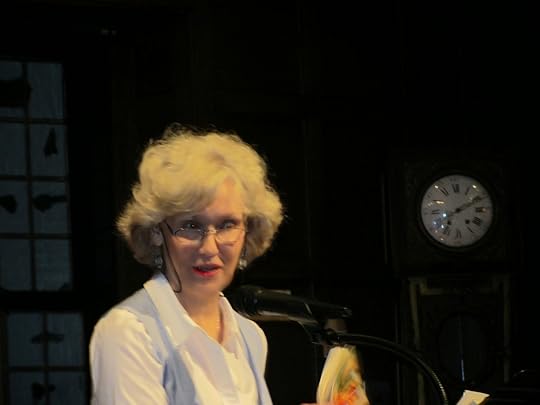
Me reading three poems. Following the last poet, Sondra led a Q&A which was very interesting. I had the impression that some of the seniors would like to try to write some poems of their own. Then cookies were passed around and we engaged in some conversation with those who chose to come up and chat with us.
I'm not ready to move in, but I would definitely like to go back for another poetry reading or to lead a workshop.
So Sondra and Ira moved to Winchester Gardens in Maplewood, NJ. One of the enticements to move there was that the Social Director suggested that she could continue her salons there. After a period of getting used to her new digs, Sondra put together the first reading. She invited me and five other poets to gather on Monday, May 19 for an evening reading. I was stunned by the beauty of this senior residential community. The grounds were beautiful with tons of flowers and the buildings were big old stone structures.

Above is the Great Hall where the reading was held. The furniture was rearranged so that the audience could sit in rows. We had approximately fifty residents turn out for the reading. They were engaged and enthusiastic.
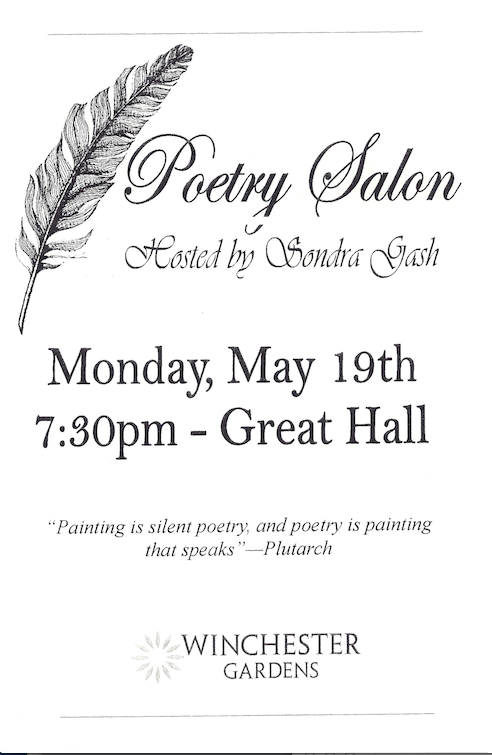
With the assistance of the Social Director, Sondra prepared a program brochure. Inside was a photo of each poet and a bio.
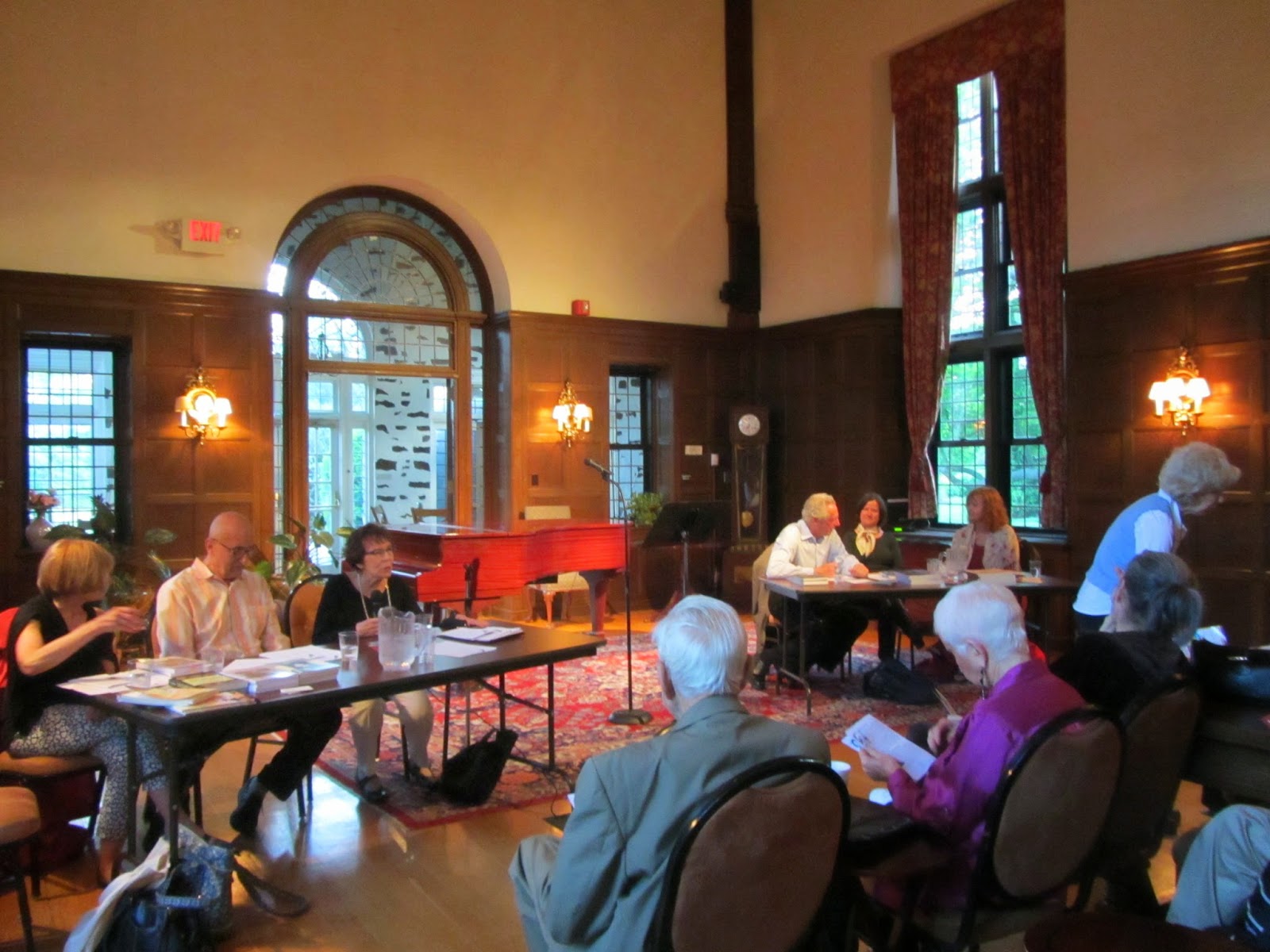
This is just before the reading got underway. Left to right are Gail Gerwin, Ed Ryterband, Sondra Gash, Howard Levy, Teresa Carson, and Joan Cusack Handler. I'm standing at the far right. As I was sitting waiting for the audience to arrive, I saw a familiar-looking woman walk in. Much to my surprise that was Rose Spear, a woman I used to teach with at Millburn High School. She was a German teacher; I was an English teacher. I went over and we got reacquainted. It was an unexpected pleasure to meet up with a former colleague. Then the reading go underway, each of us reading for approximately ten minutes. What a pleasure to read in such an exquisite room.

Me reading three poems. Following the last poet, Sondra led a Q&A which was very interesting. I had the impression that some of the seniors would like to try to write some poems of their own. Then cookies were passed around and we engaged in some conversation with those who chose to come up and chat with us.
I'm not ready to move in, but I would definitely like to go back for another poetry reading or to lead a workshop.
June 4, 2014
For Mothers Mostly But Not Only
 Click Cover to PurchaseMy poem "Nesting" appears in this year's issue of the Mom Egg Review. This is my first appearance in the journal and I must say that I'm very pleased. The journal has a lovely cover and is nicely done throughout. I haven't yet had a chance to peruse the entire issue, but I've read enough to know that I have a lot of good reading ahead. Kudos for editor Marjorie Tesser!
This year's issue includes more than 100 contributors. Not surprisingly, women poets far outnumber men poets, but men are welcome to submit as long as they stick to the somehow-related-to-mothers focus of the journal. Since every guy at one point or another had a mother, I'm surprised that more men don't appear within these pages. Perhaps they have felt discouraged by the journal's name. So here's a challenge to the guys: Submit this time around.
Be you woman or be you man, the new submission period just opened. Check out the Guidelines.
The 2015 issue will contain a special portfolio of poems that address the theme of compassionate action. This will be curated by poet Jennifer Jean who describes what she's looking for as follows:
We are interested in poems that explore, from different perspectives, the theme of Compassionate Action.
Mothers, and motherly nurturers, don't only feel for others in pain and strife—they take action. This compassionate action, whether large or small, often occurs at home or in small communities. It can also occur on national or global levels. Sometimes it doesn’t occur at all.
Poems might consider:
What compassionate actions have you witnessed? How have you surprised yourself? What must be overcome to find paths of action, and to bypass inertia? How can we encourage people to take compassionate action in their own lives?
Note that you may submit to either the General Poetry section or the Compassionate Action theme section, but not both. Note, too, that the journal also includes some fiction and creative prose. Book Reviews are posted at the journal's blog.
May 30, 2014
Summer Journals Q-Z 2014
Here's the third and final installment of the list of print journals that read during the summer months. Again, please let me know if you spot any errors or omissions. Good luck!
 No rejections allowed.
**Remember that the asterisks indicate that the journal accepts simultaneous submissions.Journal accepts online submissions unless otherwise indicated.
**Quiddity—2x
**The Raleigh Review—1x—July thru October
**Rattle—2x
via email
**Redactions—1x—by email–July 1-Feb 15
**Redivider—2x
**Rhino—1x—April 1-Oct 1
**River Styx—2x—May 1 thru Nov 30
snail mail
**Rosebud—3x
via email
**Sakura Review—2x
**Salt Hill—2x
August 1-April 1
**San Pedro River Review—2x
month of July
via email
**Saw Palm—1x—July 1-Oct. 1
**Smartish Pace—2x
**South Dakota Review—4x
**The Southeast Review—2x
**Southern Humanities Review—4x—Aug 2-April 6
via email or snail mail
**Southern Poetry Review—2x
snail mail
**Sugar House Review—2x—Jan 31-Oct 15
via email
**Tahoma Literary Review—4x
**32 Poems—2x
Threepenny Review—4x—reads thru June
**Turnrow—2x
snail mail
**Tusculum Review—1x
US 1 Worksheets—1x
snail mail
April 15- June 30
**Washington Square Review—2x—Aug 1-Oct 15
**West Wind Review—1x—July 1-Sept 1
**Women Arts Quarterly Journal—4x
**Yemassee—2x
Summer Journals A-F
Summer Journals G-P
May 28, 2014
Summer Journals G-P 2014
Here's the second installment of the list of print journals that read during the summer months. If you find any errors or have others to add to the list, please let me know. Good luck with your submissions.
 This mailbox is ready to receive good mail.
**Indicates that simultaneous submission is ok
Unless otherwise indicated, the journal accepts online submissions
**Grist—1x—June 15-Sept 15
**The Grove Review—2x
fee but pays
Hanging Loose—3x
snail mail
**Hartskill Review—3x
**Hayden’s Ferry—2x
**Hiram Poetry Review—1x
snail mail
Hudson Review—4x—April 1-June 30 (all year if a subscriber)
snail mail
**Lake Effect—1x
snail mail
Little Star Journal—1x
strong preference for snail mail
strong preference for no sim sub
Louisiana Literature—2x
**Lumina—1x—check in July
**MacGuffin—3x
via email attachment
**Madison Review—2x
Manhattan Review—2x
(prefers no sim but will take)
Measure—2x
metrical only
**Michigan Quarterly Review—4x
**Mid-American Review—2x
**Minnesota Review—2x—August 1–November 1
**Missouri Review—4x
**The Mom Egg—1x—June 1-Sept 1
**Nimrod—2x—Jan 1-Nov 30
snail mail
**Parnassus: Poetry in Review—2x
snail mail
Pinyon—2x
via email
**Pleiades—2x—Aug 15-May 15
**Ploughshares—3x—June 1 to January 15
**Poet Lore—2x
snail mail
**Poetry—11x
Summer Journals A-F
Summer Journals Q-Z
May 25, 2014
Summer Journals A-F 2014
It's that time of year again. During the summer many of us have more time to write and submit, but quite a few journals close their doors to submissions for the summer months. Do not despair. There are still many journals that do read during the summer and some that read only during the summer. This is the first of a 3-part list of those journals, all print. As in the past, several had to be removed this year as they have closed their doors permanently. But a few have been added.
I've added links for your convenience. I've also indicated the number of issues per year, the submission period dates, which journals accept simultaneous submissions, and which ones accept online submissions. If you find an error, please let me know.
 This mailbox only accepts Acceptances!
**Indicates that simultaneous submission is ok
Unless otherwise indicated, the journal accepts online submissions.
If no dates are given, the journal reads all year.
**American Poetry Review—6x-tabloid
**Another Chicago Magazine—2x—Feb-Aug 31
**Asheville Poetry Review—3x—Jan. 15-July 15
snail mail
**Atlanta Review—2x—deadlines June 1 & Dec 1
reads all year, but slower in summer
snail mail
**Baltimore Review—2x—August 1-Nov 30
**Barn Owl Review—1x—June 1-Nov 1
**Bat City Review—1x—June 1-Nov 15
Beloit Poetry Journal—3x
**Birmingham Poetry Review—2x
snail mail
**Black Warrior Review—2x—Aug 1-Oct 1
**Briar Cliff Review—1x—deadline Nov 1
**Burnside Review—2x
email sub ok
$3 reading fee /pays $50
**Caketrain—1x
email sub
**Chariton Review—2x
snail mail
**Cimarron Review—4x
**Columbia Journal—2x—March 1- Oct 1
**Columbia Poetry Review—1x—July 1-Nov 1
**Conduit—2x
snail mail
**Crab Orchard Review—2x—Aug 15-Oct 1 (special issue)
snail mail
**Cream City Review—2x—Aug 1-Nov 1
Field—2x—August 1-May 31
**The Florida Review—2x—Aug 1-May 31 (subscribers all year)