Diane Lockward's Blog, page 18
January 28, 2015
The Poet on the Poem: Chana Bloch
I'm delighted to have Chana Bloch as the featured poet for The Poet on the Poem.

Chana Bloch, the author of award-winning books of poetry, translation and scholarship, is Professor Emerita of English at Mills College, where she taught for over thirty years and directed the Creative Writing Program. Her latest book is Swimming in the Rain: New and Selected Poems, 1980-2015 (Autumn House Press, 2015). Her earlier poetry collections are The Secrets of the Tribe, The Past Keeps Changing, Mrs. Dumpty, and Blood Honey. Her work has been published in The New Yorker, Atlantic Monthly, The Nation, The New Republic, and elsewhere, as well as in the Best American Poetry and Pushcart Prize anthologies. Her book awards include the Poetry Society of America's Alice Fay di Castagnola Award for Blood Honey, selected by Jane Hirshfield, and the Felix Pollak Prize in Poetry for Mrs. Dumpty, selected by Donald Hall. She is the recipient of two fellowships from the National Endowment for the Arts, in poetry and in translation, a fellowship from the National Endowment for the Humanities, the Writers Exchange Award of Poets & Writers, two Pushcart Prizes, and the Discovery Award of the 92nd Street Y Poetry Center.
Today's poem comes from Swimming in the Rain: New and Selected Poems, 1980-2015.
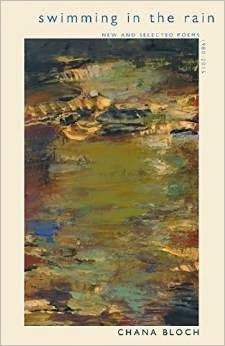 Click Cover for Amazon
Happiness Research
Rain over Berkeley! The birds are all out
delivering the news.
The evening is wet and happy tonight.
“Is there more to happiness than feeling happy?”
the moral philosophers inquire.
Research has shown
if you spot a dime on the sidewalk
you're more likely to tell the professor your life
is fine, thank you. The effect
generally lasts about twenty minutes.
Scientists are closing in on
the crowded quarter of the brain
where happiness lives. They like to think
it's hunkered down
in the left prefrontal cortex.
“Even in the slums of Calcutta
people on the street describe themselves
as reasonably happy.” Why not be
reasonable? why not in Berkeley? why not
right now, sweetheart, while the rain
is stroking the roof?
The split-leaf philodendron is happy
to be watered and fed.
The dress I unbuttoned is more than glad
to be draped on the chair.
DL: Research is clearly an important motif in your poem. How much actual research went into the writing of the poem? Which came first, the science or the love poem?
CB: Research on happiness by social scientists, neuroscientists and psycho-pharmacologists has grown at a phenomenal rate over the past two decades. I must admit that I can’t help reading the stuff. So it’s not by chance that I clipped and saved a review-article by Thomas Nagle in the New York Review of Books, “Who is Happy and When?” The moral philosopher Sissela Bok, who wrote the book under review, Exploring Happiness: From Aristotle to Brain Science (Yale UP), wants to know: What is happiness? How much should we value it? Questions I’ve often thought about.
I almost said that science came before love in writing this poem, but when I looked at the article again, I saw the illustration that first caught my attention—Rubens’ captivating portrait of himself and his young wife, “In the Honeysuckle Bower,” painted the year of their marriage. In both faces, the lineaments of gratified desire.
DL: What do you see as the function of the two quotations you’ve woven into the poem?
CB: I hope the quotes will draw the reader into the poem, just as they drew me into the review. They made me ask myself: How am I doing “on a scale of one to ten”? Contented, elated, exhilarated? Which suggests that I was ready to appear in the poem long before I made my appearance. In the version of “Happiness Research” I'd drafted a few years earlier, the scientists and the dime were already present, though not the inquiring professor. Sharing the page was “a Norwegian philosopher, 82, who recommends / daily swigs of cod liver oil / for despair:/ ‘It’s almost as good as garlic.’” That draft of the poem remained parked in a desk drawer until science and love revved up its engine.
DL: In stanza 4 you suddenly switch from third person point of view to a first person direct address to “sweetheart.” This and the rain “stroking the roof” move the poem from scientific to personal and intimate. At what point in your drafting did this risky shift enter the poem? How did you know it would work?
CB: Once I disposed of the cod liver oil and added the two quotes, the direction of the poem became clear. I knew I had the setting and the dramatis personae—our house (rain on the roof, a chair, and a split-leaf philodendron) and the two of us. I even had a come-hither line, which turns on the two senses of “reasonable”: the people in Calcutta are passably happy; let’s you and I be sensible. “Why not be reasonable?” might conceivably sound irritated, even reproachful, but the context makes clear that it’s playful, teasing, inviting. At that point I was more than glad to work on the poem. I was elated, exhilarated.
DL: You end the poem with a stunning sensual image. Tell us about your use of personification there, the dress that is “more than glad.”
CB: The dress, c’est moi. The truth is, I usually wore pants in those days, but a poem needn’t be true to fact so long as it is true to experience. In The Cortland Review and two beautiful broadsides, framed on my wall—the poem ended with the philodendron “doing its new green thing.” Once something is in print, I often can’t help wanting to change it. Working on Swimming in the Rain: New and Selected Poems, 1980-2015 gave me my chance. I decided that the happy plant was too nature-club-wholesome an ending for a seduction scene, so I revised and changed the order of the lines in order to end with the dress.
DL: Your first three stanzas each have five lines. Then you alter this pattern and give stanza 4 six lines and stanza 5 four lines. Why not stick to the established pattern?
CB: My poems often have an irregular number of lines in each stanza. Although I do write in couplets, triplets, or quatrains, I like to break the form depending on the demands of the poem. In stanza 4 I lay out my argument, so I need a little more room. And there’s a reason, too, for the quick denouement in stanza 5: so the couple can get down to business.
Readers, please listen to Chana reading her poem.
Please also visit Chana's poem, "The Joins," featured on Verse Daily on Tuesday, January 27, 2015.


January 20, 2015
Tidbits of This and That
 Click Cover for AmazonI am very fortunate to have received two new reviews for The Crafty Poet: A Portable Workshop. Both reviews are beautiful. And both came in December, like gifts. The first is by Christine Swint, posted at her site, Balanced on the Edge. Included in the review is this lovely comment:
Because there are so many poems by innovative, contemporary poets, The Crafty Poet is more than a portable workshop; it is an anthology of poems written in the kind of fresh, rich, and lively language we writers want to emulate. . . Read the full review HERE.
I was also tickled to see that Christine subsequently made good on her vow to get using the prompts for her own poetry and posted about her experience with the Sonnenizio, a form covered in my book. Read about it HERE.
The second review is by Christina Veladota and is posted at her site, maybesopoetry. She says, among other things:
The Crafty Poet: A Portable Workshop is an essential text for any poet. Diane Lockward has curated for us an abundant collection of inspirations and advice, and together with her many noteworthy contributors she succeeds in “making the day with nothing to say a thing of the past.” Read the full review HERE.
In publication news I have a poem, “Shopping at the Short Hills Malls,” in the December issue of The Cortland Review, one of the oldest online poetry journals and I think the first to include audios of each poet reading the poems. I’m particularly pleased to be in this issue as each editor was invited to solicit work from one poet. Editors were each asked to invite a poet whose poems they liked and who they felt was making some kind of contribution to the larger poetry community. My appreciation goes to editor Amy MacLennan, the Managing Editor.
I also have a new poem in the current issue of Valparaiso Poetry Review. While my publication in The Cortland Review was my debut there, VPR editor Ed Byrne has kindly included my work several times. The poem in the current issue is called “Sweet Images,” and is a form poem, a form I really liked working with.
Finally, I have a new poem, “And Life Goes On As It Has Always Gone On,” in the latest issue of the print journal, burntdistrict. Like most print journals, this one pays only with a contributor’s copy. But editor Jen Lambert also offered contributors with new books the opportunity to send a full-page ad. That was, to me, worth more than the minimal fee that a handful of journals are able to offer.
January 8, 2015
Harvest Time
 Poet David Kirby contributed a Craft Tip to my January 1 Poetry Newsletter. In his piece, “One Brick at a Time,” Kirby advocates the use of a journal. That’s not a new concept for most poets, but Kirby calls his a “bits journal,” and he advocates writing in it daily if possible, including lines, images, bits of conversation, song lyrics, etc.
He says, “If you don’t keep a bits journal, start today, and if you do, go back and have a look and see what you can use and what you might add. How you handle your bits journal is up to you, but I know I get antsy if my bits journal grows beyond twenty pages or so.”
Sounds like my pages of yellow-lined legal pads.
Kirby adds, “When that happens, it’s harvest time: I’ll look for bits that speak to each other, maybe three or four that might coalesce into a poem. It’s said that Walt Whitman had a box of a certain size that he filled with scraps of paper on which he’d written, and when the box filled, he’d pull out the scraps and look to see which ones would become a sequence and which he might use in another poem or return to the box.”
At this time of year, many poets count up the number of poems they wrote in 2014. I see their statistics on blogs and on Facebook. I don’t particularly like this bean-counting, especially when I’ve been bemoaning my lack of productivity and counting up the number of legal pads growing on my bookshelf.
So it’s harvest time for me! I’m excited about that (as evidenced by the use of an exclamation point). I have so much material to work with that surely I’ll find some gems in there and get a handful of decent poems.
That’s my writing goal for the opening weeks of 2015. I’m going to cut back on generating material for poems and start mining the already accumulated material for poems. I’ve thus far gone through two legal pads and dog-eared the pages that might lead somewhere. I’ve revised four very rough pieces into rough drafts of poems and typed up two of those.
I am a farmer of poetry.
While most advocates of journals advocate the kind you write in with pen or pencil, Kirby strongly suggests keeping yours on the computer: “That way, when one bit wants to cozy up to another, you just cut and paste.” He makes this a requirement for his students.
After I harvest what’s in the legal pads, I might make keeping a computer bits journal my next goal.
December 29, 2014
A Weekend Workshop in Delaware and a Book Contest Reading
Several months ago I was invited to be one of three final judges for the 2014 annual Dogfish Head Poetry Prize, a full-length book contest open to poets living in the Mid-Atlantic states. The other two judges were Gerry LaFemina of Maryland and Larry Woiwode, Poet Laureate of North Dakota. The contest was overseen by poet Linda Blaskey of Delaware. Linda and her team of readers culled the entries down to six manuscripts, then sent those to each of the judges who made the final selection.
Linda also invited me to spend a weekend in Delaware, the weekend of December 13-14, leading a group of poets in a workshop. I happily agreed. I drove to Delaware on Friday, was kindly put up in a hotel by the group of poets, and then spent three hours each on Saturday and Sunday with the best group of poets I’ve ever worked with, sixteen of them. We met in a spacious room in one of the Rehoboth Art League buildings.
 Building where we met for our workshopsLinda told me ahead of time that the group wanted some craft talk and prompts that focused on craft. So that’s what I went armed with. I did not use any material from The Crafty Poet as I’d been given to understand that most of the group already had the book. In fact, three of the poets are in the book! Many of the group members also knew me as they are subscribers to my Poetry Newsletter. We spent our time together reading some sample poems I’d brought and discussing the craft in them and then writing to prompts that zeroed in on a particular element of craft. We did some reading of the drafts with minimal critique, mostly appreciative noises.
 I alternated the craft prompts with ones that work well on those days when you have nothing to write about—and who doesn’t have some of those? The writing was wonderful and the group was incredibly supportive of each other’s work. I gathered that they have been working together and cheering each other on for years.
Saturday night was the announcement of the contest winner and presentation of his book. This event was held at the Dogfish Head Brewery in Milton, Delaware. It’s a real brewery, with all kinds of craft beers, a bar, tours, and a food truck. Since it’s located about 30 minutes away, one of the group members picked me up and another one drove me back to my hotel. Apparently, the owners are big poetry fans and have supported this contest for years. They gave a nice bag of goodies to me and to Gerry who also attended. We both joined the winner in a reading. Gerry read first and then me. Then Linda announced the winner: Lucian Mattison of Norfolk, Virginia. The evening ended with a reading by Lucian, the presentation of his prize which included a check and two cases of beer, and a signing of Lucian’s book, Peregrine Nation, published by Broadkill River Press.
 Part of the audience. That's the DE Poet Laureate JoAnn Balingit, with the scarf
 Gerry LaFemina
 Linda Blaskey introduces the winner, Lucian Mattison
 Winner Lucian Mattison reads from Peregrine Nation and pauses for a sip of beer
 Presentation of the AwardI returned home after our Sunday session, feeling invigorated by the weekend. It was a true pleasure and privilege to have worked with such a terrific group. I am very grateful to them for having invited me. I felt honored by the invitation. I salute this group for the support they give each other and for giving themselves the gift of a weekend of total immersion in poetry. I’m looking forward to seeing the poems that eventually emerge from the weekend. I'm sure that many of them will land in some very fine journals.
December 24, 2014
Yes, Virginia
 Each Christmas I like to revisit the following essay from the The Sun. My grandmother read it to me many years ago. I've always remembered it. If you don't already know this piece, I hope you'll enjoy it. I also hope you'll have a Merry Christmas if that's what you're celebrating. And I hope you'll have a wonderful New Year. Thank you for being a Blogalicious reader.
 Eight-year-old Virginia O'Hanlon wrote a letter to the editor of New York's The Sun, and the quick response was printed as an unsigned editorial on September 21, 1897. The work of veteran newsman Francis Pharcellus Church has since become history's most reprinted newspaper editorial, appearing in part or whole in dozens of languages in books, movies, and other editorials, and on posters and stamps.
Here's Virginia's letter:
"DEAR EDITOR: I am 8 years old.
"Some of my little friends say there is no Santa Claus.
"Papa says, 'If you see it in THE SUN it's so.'
"Please tell me the truth; is there a Santa Claus?
"VIRGINIA O'HANLON.
"115 WEST NINETY-FIFTH STREET."
Here's the reply:
VIRGINIA, your little friends are wrong. They have been affected by the skepticism of a skeptical age. They do not believe except what they see. They think that nothing can be which is not comprehensible by their little minds. All minds, Virginia, whether they be men's or children's, are little. In this great universe of ours man is a mere insect, an ant, in his intellect, as compared with the boundless world about him, as measured by the intelligence capable of grasping the whole of truth and knowledge.
Yes, VIRGINIA, there is a Santa Claus. He exists as certainly as love and generosity and devotion exist, and you know that they abound and give to your life its highest beauty and joy. Alas! how dreary would be the world if there were no Santa Claus. It would be as dreary as if there were no VIRGINIAS. There would be no childlike faith then, no poetry, no romance to make tolerable this existence. We should have no enjoyment, except in sense and sight. The eternal light with which childhood fills the world would be extinguished.
Not believe in Santa Claus! You might as well not believe in fairies! You might get your papa to hire men to watch in all the chimneys on Christmas Eve to catch Santa Claus, but even if they did not see Santa Claus coming down, what would that prove? Nobody sees Santa Claus, but that is no sign that there is no Santa Claus. The most real things in the world are those that neither children nor men can see. Did you ever see fairies dancing on the lawn? Of course not, but that's no proof that they are not there. Nobody can conceive or imagine all the wonders there are unseen and unseeable in the world.
You may tear apart the baby's rattle and see what makes the noise inside, but there is a veil covering the unseen world which not the strongest man, nor even the united strength of all the strongest men that ever lived, could tear apart. Only faith, fancy, poetry, love, romance, can push aside that curtain and view and picture the supernal beauty and glory beyond. Is it all real? Ah, VIRGINIA, in all this world there is nothing else real and abiding.
No Santa Claus! Thank God! he lives, and he lives forever. A thousand years from now, Virginia, nay, ten times ten thousand years from now, he will continue to make glad the heart of childhood.
December 15, 2014
Some Thoughts on Using Poetry Prompts
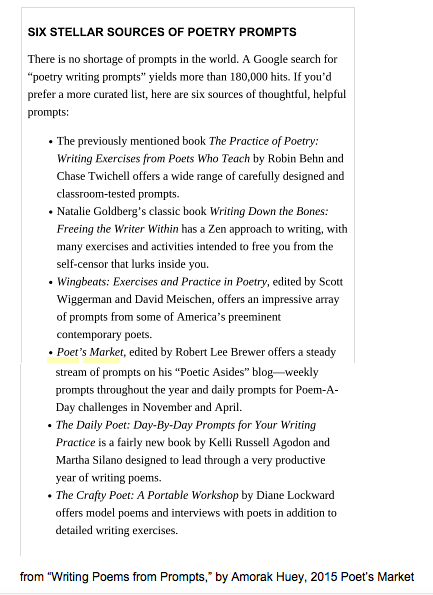
I was recently delighted to come across Amorak Huey’s article, “Writing Poems from Prompts,” in the 2015 Poet’s Market. The article made me happy because I’m a poet who enjoys the challenge of prompts. I know that not all poets do and some even dismiss them and say that “real poets” don’t use prompts. I know lots of real poets who do indeed use them, and I count myself among them. I find, as does Huey, that a prompt will push me in a direction I might not otherwise have traveled. I enter new territory, sometimes strange and surprising. I’m given ideas on days when I just don’t have any. Who among doesn’t have some of those days? I also like prompts because they often compel me to focus on some aspect of craft; thus, I grow as a poet. Huey quotes professor W. Todd Kaneko who says, “. . . I think writing prompts are most useful when they are based around an element of craft.” Me too. If you subscribe to my Poetry Newsletter, you already know that I agree with this. If you have my book, The Crafty Poet: A Portable Workshop, you know I agree that prompts are cool.
Huey’s article includes a list of five tips for using prompts effectively. My favorite tip is #3: “If one prompt is falling flat, combine it with another. The creative process benefits immensely from the friction of two disparate forces.” Read the entire article to get the other four tips.
The article ends with a “List of Six Stellar Sources of Poetry Prompts.” I was tickled silly to find The Crafty Poet included! Here’s the entire list, one blog plus five books. You might also consider this a list of suggestions for holiday gifts for your students, your pals, and yourself.
November 30, 2014
How Much Are You Willing to Pay?
 As you know, many print journals now use online submission managers such as Submittable for submissions. Many of these journals are no longer willing to accept snail mail submissions. That’s fine with me. Makes my life easier. In the past few years, several of these journals have begun to charge a submission fee, usually $2 or $3. Although some poets I know are very annoyed about this and some of them refuse to submit to any journal that charges a submission fee, I’m not particularly bothered by it. Seems like a fair trade-off to me. I don’t have to use up my paper supply, two envelopes, postage for the sending and the SASE, or gas going to the post office. At their end, the journals get a little compensation for printing out submissions or reading on screen.
 However, the other day I saw the name of a print journal that was new to me, so I checked it out. I’m not going to name it but will say that this journal publishes work by women only. The journal pays $50 for fiction and non-fiction and $35 for poetry. Great. I wouldn’t mind paying a small submission fee to a journal that compensates its authors. So everything looked cool until I got to the submission part. That’s where I saw the $15 reading fee! (Yes, I put an exclamation point there to register the jolt I got at such a fee.) And that’s for just three poems. Now keep in mind that there’s a difference between a submission fee and a reading fee. I’ll pay the former but not the latter, especially when the amount is so absurdly high. It’s tantamount to paying to be published. Another irritant: they read anonymously so all identifying information must be deleted. I know that some people like that. I find it annoying as it causes me the unnecessary step of deleting the information. I think editors ought to be able to be objective with or without names.
So I’ll keep my money and they can keep theirs.
Speaking of money—Many of you, I’m sure, are familiar with Erika Dreifus and her wonderful blog, Practicing Writing, which is always loaded with useful information for writers. It’s primarily geared towards prose writers, but poets will also find it useful. Every Monday, for example, Erika makes her readers aware of no-fee, paying markets. She also sends out a monthly e-newsletter, The Practicing Writer, which is similarly filled with wonderful, up-to-date information. In the current December issue, Erika includes a list of books suggested by authors who previously played some role in her newsletter. As one of those lucky authors, I recommended Still Writing: The Pleasures and Perils of a Creative Life by Dani Shaprio (Grove Press). Both the blog and the newsletter are terrific resources for writers. You can subscribe to Erika’s newsletter at either of the preceding two links. Just scroll down in the right sidebar.
Speaking of blogs—I have previously recommended Adele Kenny’s The Music in It, and I now reiterate that recommendation. Each Saturday Adele posts a poetry prompt. Each of her prompts contains some instruction and several model poems or links to them. Readers are invited to post their drafts in the Comments section where Adele generously comments on them. Recently Adele began occasionally inviting other poets to contribute a prompt. I’m happy to have been invited twice to do that. My second guest post, The Loveliness of Words, is currently posted at the blog. It’s excerpted from my book, The Crafty Poet: A Portable Workshop, and includes a wonderful model poem by Rod Jellema and a prompt based on the poem. Check it out and try the prompt.
Speaking of books—It’s time to order your holiday gift books. I hope you’ll consider The Crafty Poet: A Portable Workshop for the poets in your life.
November 12, 2014
Print Journals That Accept Online Submissions 11/14
 It's been more than a year since I last updated the list of print journals that accept online submissions. This list includes 14 additions. You'll notice that a number of the journals charge a fee for the online submission. Many submitters feel that a small fee is worth it as it saves paper, stamps, and a trip to the post office.
Journals new to the list (not necessarily new journals) are indicated with a double asterisk.
The number of issues per year appears after the journal's name.
The reading period for each journal appears at the end of each entry.
Unless noted otherwise, the journal accepts simultaneous submissions.
As always, please let me know if you find any errors here. And good luck.
Adanna: a journal about women, for women—1x
Jan 31 - April 30
Agni—2xSept 1 - May 31
The American Poetry Journal—1xFebruary 1 - May 31
American Poetry Review—6xall year
Another Chicago Magazine—2x$3 fee
**Apogee—2x
two submission periods—check website
Barn Owl Review—1xJune 1 - November 1
Barrelhouse—2xcheck website to see if open for poetry submissions
Bat City Review—1xJune 1 - November 15
Bateau—2xall year
**Bayou—2x
Sept 1-June 1
Bellevue Literary Review—2xall year
Bellingham Review—1xSept 15-Dec 15
Beloit Poetry Journal—4xall yearno sim
Black Warrior Review—2xall year
Boston Review—6xSept 15 - May 15
Boulevard—3xNovember 1-April 30
Breakwater Review—2x
November 15 for the January issue;
April 15 for the June issue
Burnside Review—every 9 months
$3 fee / pays contributors
Caesura—2xAugust 5 - Oct. 5
Caketrain—1xall year
Carbon Copy Magazine—2x
May 1st through September 1st, November 1st through March
The CarolinaQuarterly—3x all year
Cimarron Review—4x
all year
The Cincinnati Review—2x
Sept 1 - May 31
Columbia—2xSeptember 1 - May 1
**The Conium Review—2x
Jan 1-April 1
Copper Nickel—2xAugust 15-October 15 January 31-March 31
The Cossack Review—3x
All year
Crab Creek Review—2x
Sept 15 - March 31
Crazyhorse—2xall year
$2 fee
Cream City Review—2xAugust 1 to November 1December 1 to April 1
CutBank—1-2xOctober 1 thru February 15
Ecotone—2xAugust 15–April 15 $3 fee
Edison Literary Review—1x all year
Fence—2xcheck website to see if open for submissions
(must submit poems one by one)
FIELD—2xall yearno sim
Fifth Wednesday—2xno Jan, Feb, June, or July
The Florida Review—2xAugust thru May $3 fee
Fourteen Hills—2x
September 1 to January 1
March 1 to July 1
**The Fourth River—1x
July 1-Sept 1
**The Frank Martin Review—1x
all year
Gargoyle—1xreads month of June
The Greensboro Review—2x September 15 deadline for the Spring issueFebruary 15 deadline for the Fall issue
Grist—1xAugust 15 - April 15
Hampden-Sydney Poetry Review—1x All year
Harpur Palate—2xdeadlines: Winter issue: November 15Summer issue: April 15
**Hartskill Review—3x
all year
Harvard Review—2xSept 1 - May 31
Hawk and Handsaw—2xAug 1 - Oct 1
Hayden's Ferry—2xAll yearpays
The Hollins Critic—5xSept 1 - Dec. 15
Hunger Mountain—1xall year
The Idaho Review—1x
Sept. 1 to April 15
Iron Horse Literary Review—6xrolling for 3-4 weeks at a timecheck website for dates
Jubilat—2xSeptember 1 - May 1
Kenyon Review—4xSeptember 15 - January 15no sim
Knockout Literary Magazine—1xcheck website for submission dates
The Laurel Review—1x
$2 fee
Sept 1-May 1
**The Lindenwood Review—1x
Jul 15-Dec 15
The Literary Review—4x
Sept 30-May 31
Little Patuxent Review—2x
submission period varies—check website
The Los Angeles Review—1xSubmit to Poetry Editor: lareview.poetry@gmail.comSept 1 - Dec 1
The Louisville Review—2xall year
Lumina—1xAugust 1 - Nov 15
The MacGuffin—3xall year
**Mantis—1x
currently open for submissions
Send all poems to: mantispoetry@gmail.com
The Massachusetts Review—4xOctober 1 - April 30
Measure—2xno simall year
The Mom Egg—1xJuly 15 - Sept. 30
Meridian—2x ($2 fee)all year
Mid-American Review—2xall year
The Minnesota Review—2xAugust 1–November 1 January 1–April 1
The Missouri Review–4xall year
The Mom Egg—1x
June 1- Sept. 1
National Poetry Review—1x December, January, and February only or all year if a subscriber
Natural Bridge—2xAugust 1-May 1$3 fee
Naugatuck River Review—2xfor the Summer issue January 1 through March 1for the Winter issue July 1 through September 1 (contest only)
New England Review—4xno simSept 1-May 31
New Madrid—2xAugust 15 - November 1
New Ohio Review—2xSept-May (summer okay for subscribers)
New Orleans Review—2xAug 15 - May 1
New South—2xall year
The New Yorkerweekly magazineall year
Ninth Letter—2xSeptember 1 - April 30
The Normal School—2xSeptember 1-December 1 January 15-April 15$3 fee
**Parcel—2x
all year
Parthenon West Review—1xJan 1- May 1 (but on hiatus for 2012)
**Phoebe—1 print issue, i online
March 9 - Oct 31
Pleiades—2xAugust 15-May 15
Ploughshares—3xJune 1 - Jan. 15
**PMS—1x
Jan 1 thru March 31
(women only)
Poetry—11xyear roundno sim
Poetry Northwest—2xSeptember 15 - April 15
Post Road Magazine—2xFebruary 1 to April 1 for the winter issue
June 1 to August 1 for the spring issue
Potomac Review—2xSept 1-May 1
Prairie Schooner—4x
Sept 1 - May 1
no sim
Puerto del Sol—2xSeptember 15 - March 31
**Quiddity—2x
all year
The Raintown Review—2xall yearconsiders previously published
The Raleigh Review—1xAll year
Rattle—2xyear round
Redactions—1xyear round
Redivider—2xall year
Red Rock Review—2xNo June, July, August, or Decemberno sim
Rhino—1xApril 1 - Oct 1
Rockhurst Review—1xSept. 15 through Jan. 15
Rosebud—3xAll year
Sakura Review—2xyear round
Salmagundi—4x
February 1—April 15
Salt Hill—2xAugust 1 - April 1
San Pedro River Review—2xJan 1 - Feb 1 / July 1-Aug 1
Saw Palm—1xJuly 1- October 1 Slice Magazine—2xFeb. 1 - April 1
January 1 - March 1
Smartish Pace—2xAll year
Sonora Review—2xAll year
So to Speak—2xAugust 15-October 15 for the Spring issueJanuary 1-March 15 for the Fall issue
South Dakota Review—4xAll year
The Southeast Review—2xAll year
**The Southampton Review—2x
September 1 to December 1 and from March 1 to June 1
Southern Humanities Review—4xAll year
**Southern Indiana Review—2x
Sept 1-April 30
Southwest Review—4xNo June, July, August$2 fee
Sou’wester—2xAugust 15 - May 15
Spinning Jenny—1xSept 15 - May 15No Sim
Spoon River Poetry Review—2x
September 15 to February 15
The Stillwater Review—1xSept 1-Dec 15
Subtropics—3xSeptember 1 - April 15
No Sim
Sugar House Review—2xAll year
Tampa Review—2xSept 1 - Dec. 31no sim
Tar River Poetry—2xvia emailSept 15 - Nov. 1no sim
Third Coast Review—2xSept 15 - April 30
32 poems—2xvia emailall year
The Threepenny Review—4x Jan 1 - June 30
Tiferet—1xSept - December
Tinhouse Magazine—2xSeptember 1 - May 31
Upstreet—1xSept 1 - March 1
Versal—1xSept 15 - Jan 15
Verse Wisconsin—4xAll year
Washington Square Review—2xAugust 1 - Oct 15Dec 15 – Feb 1
Weave Magazine—2xApril 15 - July 31
West Branch—2xAug 15 - April 15
Willow Springs—2xall year
Women Arts Quarterly Journal—4xall year
Yalobusha Review—1x check website for submission dates
Yemassee—2x All year
November 6, 2014
My Poetic Sweet Tooth
 I recently learned that on October 9, John Hewitt, at The Writer’s Resource Center, made me Today’s Recommended Poet: "Diane Lockward is a poet, teacher and an active blogger. Her poetry is feminine and feminist. She is smart and funny. Her poetry probes the politics of family, motherhood, and food with affection and a bit of exasperation."
Temptation by Water 2010
What Feeds Us 2006
Eve’s Red Dress 2003
"You might want to read her blog entries about voice vs. tone here and here. She also has a poetry tutorial: The Crafty Poet: A Portable Workshop"
Thanks, John, for that sweet recommendation!
Then on October 25, I had two poems, "Service for the Murdered Boy" and "A Murmuration of Starlings," featured in the Saturday Poetry Series at As It Ought to Be. These two poems are anything but sweet—they are quite grim, but relevant to current events. Thanks to editor Sivan Butler-Rotholz for choosing my poems.
Several years ago I began to submit poems to online journals as I came to believe that all poets should have at least some online presence. I began to understand the several advantages of an online publication, e.g., the possibility of a wider audience than a print journal has, the possibility of the work reaching readers in other countries, the long-term presence of the work in the online journal's archives.
As social media became more and more in use among authors, it became apparent that it could be used to multiply the online journal's reach as readers hit the Like button and the Share button for Facebook and/or added a link to Twitter. Still, many of us held onto our affection for the printed word, the pleasure of getting into a comfortable chair and spending a few hours reading poetry on the page.
Now we can have our cake and eat it too! A number of online journals have gathered the work first published online and put it into a print edition. Some of these print anthologies gather all of the work of several years; others do a best-of anthology.
The most recent of these anthologies arrived in my mailbox this week. Katherine Riegel, editor of Sweet: A Literary Confection, has just edited the journal's first anthology: All of Us: Sweet: The First Five Years.
 Click for AmazonHere's the back cover's list of contributors.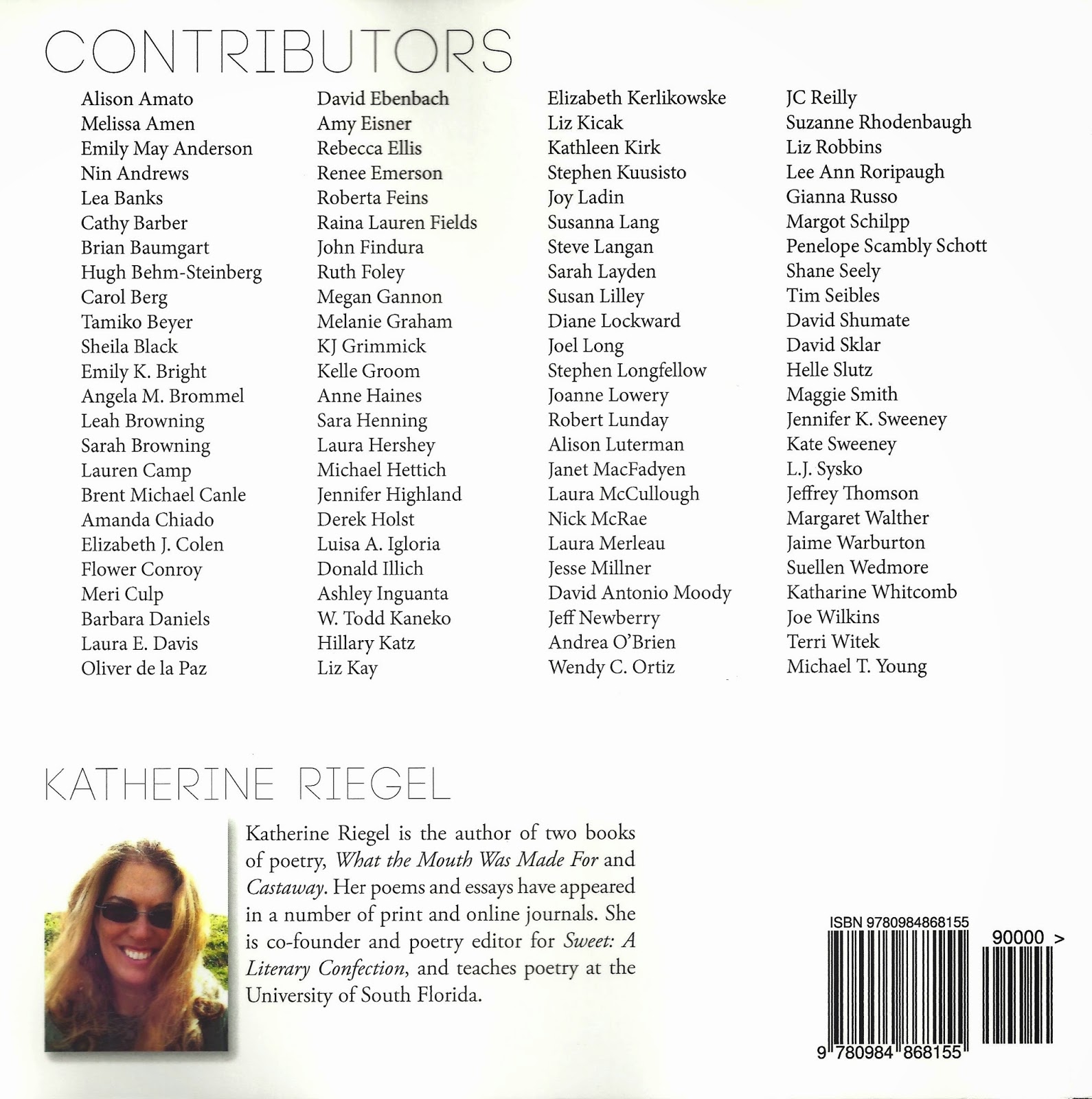
Some other online journals have also published print anthologies:
Pirene's Fountain—First Water: Best of Pirene's Fountain The best of the first five years, edited by Ami Kaye.
Valparaiso Poetry Review—Poetry from Paradise Valley. Selected work from the first ten years, edited by Edward Byrne. (currently unavailable)
Thrush Poetry Journal—Thrush Poetry Journal: An Anthology of the First Two Years. Includes all the work, edited by Helen Vittoria.
The Barefoot Muse—The Best of The Barefoot Muse. The journal has ceased publication but the best work of its five years of publication is preserved in this print anthology, edited by Anna M. Evans.
I like this trend and hope it continues.
October 30, 2014
Billy Collins on Craft
Last weekend I attended the Geraldine R. Dodge Poetry Festival. I not only attended, I also worked there. One of my assignments was to introduce Billy Collins at his craft talk on Saturday morning. This was held in the gymnasium of the North Star Academy, one of several charter schools in Newark. The room was packed.
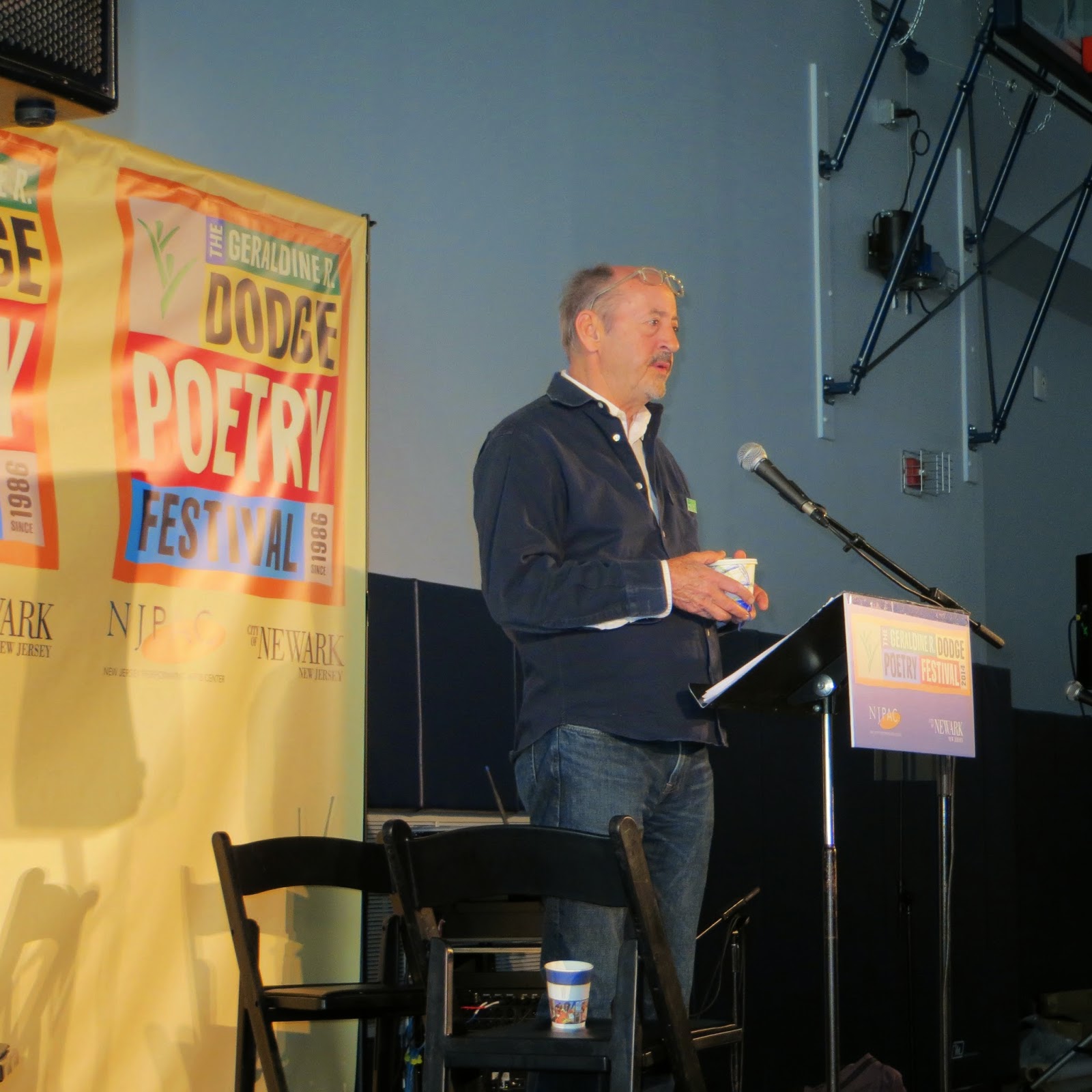 Collins began his talk with some thoughts about what poetry is. He offered the following:
“musical thought”—Thomas Carlisle
“emotion set to rhythm”—Thomas hardy
“meaning that moves”—Muriel Rukeyser
He then added that poetry is “all about the love of strangers.” And he asked, "How do you get strangers interested in your internal life”? He offered two ways:
1. Lies
2. Application of form—give formal pleasure to the reader
Collins added that the reader is not interested in your life; he’s interested in his own life.
To the earlier definitions, he added, “Poetry is a mixture of the clear and the mysterious.” It is a “home for ambiguity.” I love that last part.
When Collins began to talk about deal breakers, i.e., what makes him stop reading a poem, the talk had the ring of familiarity. I recalled that some of his thoughts had been included in an essay entitled “My Grandfather’s Tackle Box: The Limits of Memory-Driven Poetry,” published in Poetry, August 2001. Then I googled a bit and was reminded that he’d also discussed his deal breakers in his Introduction to the Best American Poetry 2006, an issue for which he’d served as Guest Editor. Excerpts from that essay, “75 Needles in the Haystack of Poetry,” appear here.
I’ll include one excerpt here:
“The word ‘cicada,’ for example, stops me in my tracks. Sorry, I simply cannot continue. Poems consisting largely of memories tend to leave me unfurled, particularly memories of family members—parents, grandparents, especially ones referred to as ‘Dad,’ ‘Mom,’ ‘Grandpa,’ and ‘Grannie.’ The same goes for poems that seem obsessed with some object associated with a dead person: Grandpa’s tool box, Mom’s ironing board, Dad’s fishing rod, and the like. . . . Too many poems seemed content to convey an experience followed by a reaction to it without factoring in the reader’s presumed indifference to the inner lives of strangers.”
(This entire essay also appeared in AWP’s The Writer’s Chronicle, September 2006.)
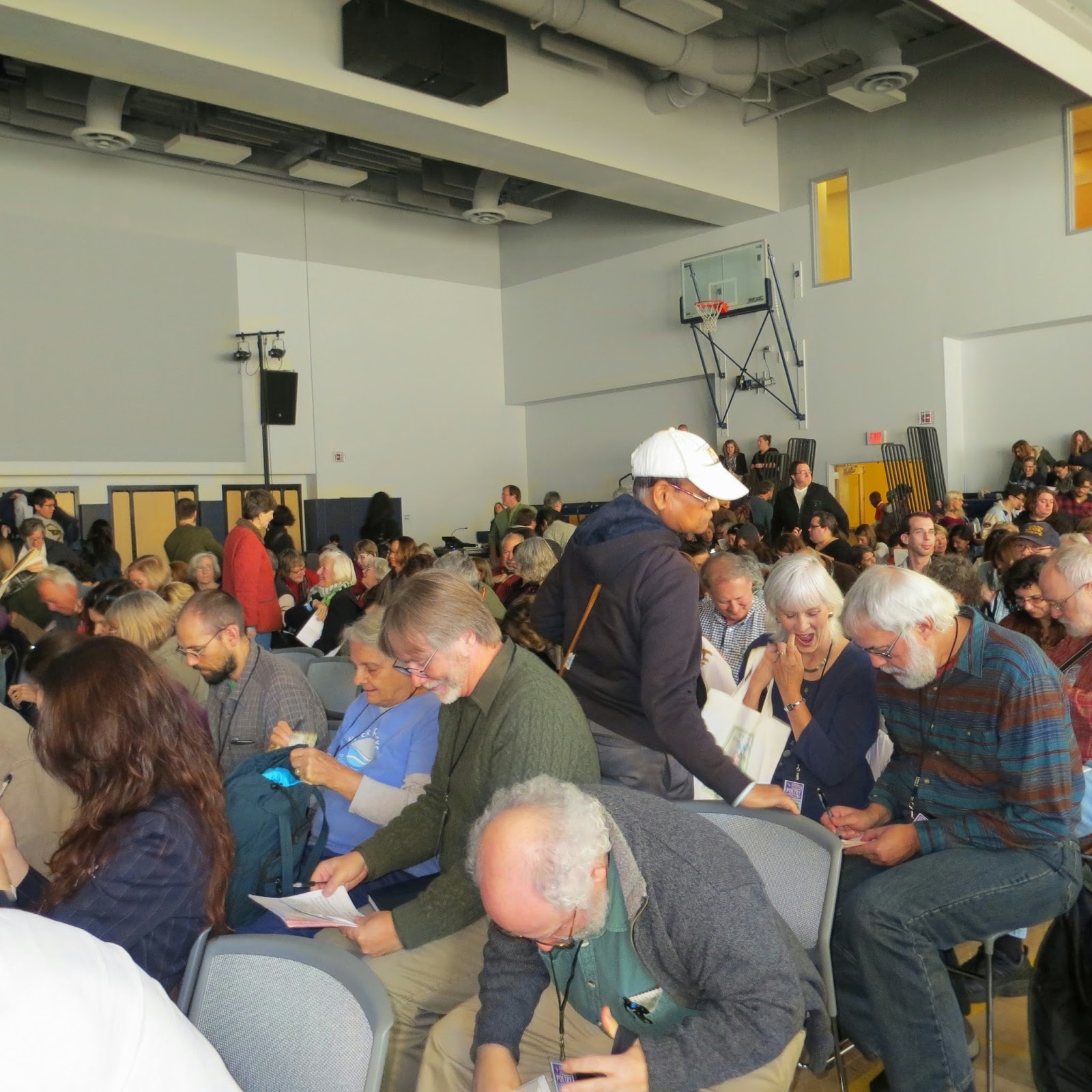
The talk was followed by a Q&A. Someone asked about prose poetry. Collins described it as “an opportunity to write poetry and prose badly at the same time.” Funny, yes, but I’m sure that raised a few hackles in the room. It’s one thing to say you don’t care for it or you don’t choose to write it, but to dismiss it altogether struck me as too firmly opinionated. Collins elaborated by saying that he values the line, that each one adds something to the poem, “And once you give up the line, you can’t use the word poetry.”
Someone else asked about performance poetry and it quickly became clear that that’s not Billy’s cup of tea either. He feels that the delivery is too emotional and that the performer does what the poem should be doing.
Now I need to get out my current manuscript. I think I have a poem in it that mentions a cicada.