Diane Lockward's Blog, page 14
October 20, 2015
Catching Up
 Looks like I’ve been slacking off here. That’s because I have been. However, I’ve been busy elsewhere doing other things.
I’ve just finished the first round of proofreading the galleys for my forthcoming poetry book, The Uneaten Carrots of Atonement. I sent the edits back yesterday morning and hope to get back another set of galleys for one last chance to pass my critical eye over the manuscript. If all goes well, the book should not be too far away.
Then I’ve also been busy all summer working on the sequel to The Crafty Poet: A Portable Workshop. It’s a ton of work to organize the material of the past three years, material compiled from my Poetry Newsletter and the Poet on the Poem series I run here on this blog. It now looks like the book will be ten sections, each with three Craft Tips, three model poems, three prompts, six sample poems, and one Bonus Prompt. The structure will be similar to the original Crafty but will be a bit expanded. My intention is that this new book will continue the work of the original Crafty but can also stand alone. I have all the material put together except for one last Craft Tip which I expect to receive in a few weeks.
Now I'm working on the bios. Then onwards to the Table of Contents, Index, and Credits. And I’m still revising and editing this new craft book, so a good deal of work remains to be done. Once I have the first draft in pretty good shape, I will put out a call for submissions for the sample poems. Stay tuned for that.
So it hasn’t been all lallygagging around and eating bonbons here.


September 9, 2015
Journals That Publish Poetry Book Reviews
Here is a list of journals, print and online, that publish unsolicited reviews of poetry books. I hope it will encourage you to write and submit reviews. I will periodically update this. If you spot errors, please let me know. You are welcome to suggest possible additions to the list, but keep in mind that I do not post scroll-down or pdf sites.
Feel free to share the link to this list, but please do not copy and reproduce the list at another site or copy and reproduce it in print.

Print Journals that accept unsolicited reviews
Adanna
American Poetry Journal
query J.P. Laughing Bear editor@americanpoetryjournal.com
Arts & Letters
query first al@gcsu.edu
Asheville Poetry Review
query editor Keith Flynn editor@ashevillereview.com
Bateau (500 word max)
may query info@bateaupress.org
Currently on Hiatus
Bone Bouquet
books published within the last 4 years
Borderlands
query borderlands_tpr@hotmail.com
Boston Review (microreviews—also appear online)
must query editors@bostonreview.net
Caesura
query caesura@pcsj.org
Carolina Quarterly
query cquarter@unc.edu
The Chatahoochee Review
must query in writing first
Chicago Review
Cold Mountain Review (1000-2000 words)
query coldmountain@appstate.edu
Colorado Review
Must query first creview@colostate.edu
Cream City Review
query the book review editor Cara Ogburn ceogburn@uwm.edu
Denver Quarterly
query kkelsey@du.edu
Florida Review (500 to 1000 words)
query flreview@mail.ucf.edu
The Georgia Review
must query first in writing
Gigantic Sequins
Green Mountains Review
query editor Neil Shepard gmr@jsc.vsc.edu
Hartskill Review
e-mail query to jhjalmerlind@gmail.com
Hiram Poetry Review
please query first poetryreview@hiram.edu
The Hudson Review
will not respond to e-mail queries; send the review Jan 1-March 31
Indian River Review—1000 words
Indiana Review
query inreview@indiana.edu
Iowa Review
publishes reviews in the print journal and online journal
Kestrel
Query kestrel@fairmontstate.edu
Keyhole Magazine—more than 200 words, no max
query editor Peter Cole peter@keyholemagazine.com
Lana Turner: A Journal of Poetry and Opinion
The Literary Review
query tlr@fdu.edu
The Los Angeles Review
lareview.bookreviews@gmail.com
no need to query—send review via email attachment
Louisiana Literature
query first lalit@selu.edu
Main Street Rag (600 word reviews)
e-mail the review to editor@mainstreetrag.com
do not query first
Mantis
Query: mantisreviews@gmail.com
Mid-American Review (400 word reviews)
query book review editor Mark Baumgartner mbaumga@bgnet.bgsu.edu
The Minnesota Review
may query Janelle Watson editors@theminnesotareview.org
Missouri Review
accepts online submissions for a fee of $3. Also accepts by snail mail, no fee.
New Delta Review
New Letters (300-800 words if single book review—samples online)
query by letter or try newletters@umkc.edu
New Orleans Review
query Book Review Editor Mary McCay mccay@loyno.edu
North American Review
must query first nar@uni.edu
Parnassus Poetry Review
Pleiades
must query Wayne Miller waynemiller5@yahoo.com
Poetry Flash
1450 Fourth Street, #4
Berkeley, CA 94710
query Attention: Joyce Jenkins, Editor/Publisher
Prairie Schooner
Puerto del Sol
query puerto@nmsu.edu
Red Rock Review
query richard_logsdon@ccsn.nevada.edu
The Saint Ann's Review
query sareview@saintanns.k12.ny.us
Saint Katherine Review
query Editor: Kathleen Norris knorris@stkath.org
The South Carolina Review
The Southeast Review (800-1000 words)
query book review editor Azita Osanloo serbookreview@gmail.com
Southern Humanities Review (max 1200 words)
Query shrengl@mail.auburn.edu
The Southampton Review
Sou’wester
So To Speak (brief review, maximum of 300 words)
query sts@gmu.edu
Sugar House Review
may query review editor Michael McLane editors@sugarhousereview.com
Sycamore Review
query first: sycamore(@)purdue.edu
Tarpaulin Sky (query not required)
reviews@tarpaulinsky.com
Texas Review
query eng_pdr@shsu.edu
Third Coast (500-2000 words)
Prefers reviews of first or second books, small presses
Do not query
Weave Magazine (500-800 words)
Willow Springs
query willow.springs@mail.ewu.edu
Yemassee
query first editor@yemasseejournal.org
Online Journals that accept unsolicited reviews
The Adirondack Review
Adroit (500-1500 words)
reviews published on their blog
Avatar Review (up to 1500 words)
Query contact.us@avatarreview.net
Big City Lit
Query first editors@nycBigCityLit.com
Black Heart Magazine (max 600 words)
Query
Blue Fifth Review (750-2000 words)
query editor bluefifth@gmail.com
Blue Lyra Review
query: bluelyrareview@gmail.com
Boxcar Poetry Review (500-1500 words)
reviews of first books only
query editor Neil Aitken editor@boxcarpoetry.com
Breakwater Review
query breakwaterreview@gmail.com
Catch & Release (max 1500 words)
The Centrifugal Eye (500-1500 words)
query editor Eve Anthony Hanninen: centrifugaleye@gmail.com
Cider Press Review (500 words)
The Collagist
Compose: A Journal of Simply Good Writing
query Suzannah Windsor, at editor@composejournal.com
interviews but no book reviews
Connotation Press
May query but not necessary—see online form
The Country Dog Review (interviews also)
must query first: countrydogreview@gmail.com
The Critical Flame
may query info@criticalflame.org
The Frank Martin Review
reviews appear on the blog
query frankmartinreview@gmail.com
Flycatcher Journal
query Chris Martin chris@flycatcherjournal.org
Free Verse (1000-1500 words)
query Jon Thompson jont@unity.ncsu.edu
Galatea Resurrects (no word limit/ no limit on pub date)
query and submit to editor Eileen Tabios: GalateaTen@aol.com
takes previously published and new
Glint Literary Journal
Gulf Stream Lit Mag (first books only)
query gulfstreamlitmag@gmail.com
Harvard Review
query editor Christina Thompson: cathomps@fas.harvard.edu
Literary Mama
books reviewed must focus on motherhood
send submission to reviews@literarymama.com
The Literateur (700 words)
Melusine
A women’s journal but men are welcome to submit
query first sub2melusine@gmail.com
Menacing Hedge
The Mom Egg (max. roughly 750 words)
Query first: info@themomegg.com
The Museum of Americana
Query first: themuseumofamericana@gmail.com
New England Review (500-1000 words)
digital NER
Offcourse (up to 1000 words)
query offcourse@albany.edu
The Pedestal Magazine
must query first pedmagazine@carolina.rr.com
Poemeleon (shorter reviews preferred)
queries are preferable to Cati Porter editor@poemeleon.org
Poets' Quarterly (500-2000 words)
Query: reviews@poetsquarterly.com
Prick of the Spindle
Prime Number Magazine (500 words)
Query for longer reviews Editors@PrimeNumberMagazine.com
The Quivering Pen (1000-2500 words
query: David Abrams thequiveringpen@gmail.com
Rain Taxi (500 words)
Raven Chronicles
Query: editors@ravenchronicles.org
Red Paint Hill Poetry Journal
Rougarou (500-800 words)
query rougaroueditors@gmail.com
The Rumpus
Scapegoat Review (800 words max, new books only)
Serving House Review (up to 5000 words)
Shattercolors (1200-8000 words)
Shenandoah
Query Book Review Editor Sarah Kennedy (skennedy@mbc.edu)
before sending reviews.
Smartish Pace
Swithback (500-2000 words)
Talking Writing (800-2000 words)
use form at the site to query
Terrain: A Journal of the Built and Natural Environments
Max 3000 words
32 Poems
1000+ words
Triquarterly
email with "query-review" as the subject line to TriQuarterly@northwestern.edu
Unsplendid
reviews of books of formal poetry
Valparaiso Poetry Review
Edward Byrne, editor
query VPR@Valpo.Edu
Whale Road Review (500 words or less)
send to whaleroadreview@gmail.com
Women in Judaism: A Multidisciplinary Journal
The Writing Disorder
In Addition, if you didn’t find what you need
NewPages also lists and links to publications that specialize in reviews.
NewPages also has an extensive list of online journals, many of which
run reviews. Links are provided.
Poets & Writers online has links to the websites of dozens of journals.
Places that publish pre-publication reviews
The following do not accept unsolicited reviews but assign books for review. Books need to be sent in advance of publication date:
American Book Review
ABR cannot accept reviews after a book is more than six months old, even though it's sometimes much longer before it actually appears in their pages. Send book as early as possible, preferably before the publication date.
American Book Review
School of Arts & Sciences
University of Houston-Victoria
3007 N. Ben Wilson
Victoria, TX 77901
americanbookreview@uhv.edu
Library Journal
wants pre-publication galleys 3 months in advance of publication date
Book Review Editor
Library Journal
160 Varick Street, 11th Floor
New York, New York 10013
Publishers Weekly
Publishers Weekly Poetry Reviews
360 Park Avenue South
New York, NY 10010
August 17, 2015
The Poet on the Poem: Lee Upton
I'm happy to feature Lee Upton in The Poet on the Poem here at Blogalicious.

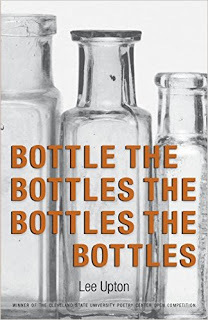
Lee Upton’s sixth collection of poetry, Bottle the Bottles the Bottles the Bottles, recipient of the Open Book Award, appeared in May 2015 from the Cleveland State University Poetry Center. Her poetry has appeared in many publications, including The New Yorker, Atlantic Monthly, The New Republic, Poetry, American Poetry Review, and in editions of Best American Poetry. Her collection of short stories, The Tao of Humiliation, was selected as one of the ”best books of 2014” by Kirkus Reviews, received the BOA Short Fiction Award, was a finalist for the Paterson Prize, and received starred reviews from both Kirkus and Library Journal. She is the author of fourteen books, including the novella The Guide to the Flying Island; the essay collection Swallowing the Sea: On Writing & Ambition Boredom Purity & Secrecy; and four books of literary criticism. She is the Francis A. March Professor of English and Writer-in-Residence at Lafayette College.
Today's poem comes from Bottle the Bottles the Bottles the Bottles.
 Click Cover for AmazonThe Clues
The woven reeds, the slats
in the middle of the path—
with the book bag, the shoe,
the empty basket.
Then, the mixed prints in the woods.
Hair shredded on a bush.
Fibers, red and black.
So much for forensics to do,
it wasn’t until well past two
that we found our way
to the end of the path.
There in a cottage
rocked the girl and her family,
sipping tea. Just over their heads
a wolf pelt rippled,
the eyes spinning
in the skinned skull
regarding that domestic economy.
Three generations:
the mother, once out of the story,
now back, with her own daughter,
plus her own mother,
plus two baskets of snacks.
And all of them—that girl and those women—
brimming with so much liberty
none of them even bothered
to turn to the wall and gloat
at that patch of furry kitsch:
Just look at us,
you son of a bitch.
DL: Your poem puts a new spin on the old tale of Little Red Riding Hood. Tell us about the inspiration for this new version. Why a detective story? What is the role of Red Riding Hood’s mother in your poem?
LU: Fairy tales are so incredibly long-lived and mystery-filled that I find myself attracted to drawing from them when I write. “The Clues” invokes the plot elements of “Little Red Riding Hood” and attempts a transformation of the version of the story that I know best. I wanted to re-imagine the story, allowing the child to save herself and triumph—without the woodcutter. Here the clues lead to a vision of survival, although there is a murder of sorts: the wolf has been skinned, his pelt pegged to the wall. It’s not enough, by the way, for the girl and her mother and grandmother to skin the wolf; they keep the pelt in view and as such display their own capacity for violence.
“The Clues” speaks—even if with an attempt at humor—to a common wish: to defend one’s self and those we love. At the end of the poem, the detectives come upon the unexpected: three generations of women, un-traumatized, celebrating their victory. Like any parent the mother must at some point send her child into the world, with warnings, and the child, like many children, will defy those warnings.
DL: I noticed the predominance of soft i sounds. That vowel sound appears in every stanza, usually multiple times. In stanza 1 there’s “in,” “middle,” “with”; in stanza 2 there’s “mixed,” “prints,” “in,” “forensics.” How consciously was this music crafted? What do you think it adds to the poem?
LU: I didn’t think about that specific form of assonance as I wrote, but I realize now—because of your question—that those sounds ushered me to the final word of the poem, and the little explosion of triumph and disgust and joy that occurs there.
I was aware of how insistent sound repetitions were as I wrote the poem, and I did read the poem aloud after I wrote the first draft. Repetitions draw the poem forward, and determined my choices. Most of the poem—its central drama and many of the sound effects— appeared in the initial draft. That’s highly unusual for me; I tend to write many drafts. Subsequent drafts for this poem amounted to adjustments more than full-scale revisions.
DL: I like how you scatter rhymes throughout the poem. The “shoe” at the end of stanza 1’s line 3 rhymes with “to do” at the end of stanza 2 and with “two” at the end of stanza 3. The “sipping” of stanza 4 is echoed in “rippled.” The “spinning” that ends stanza 4 is echoed in stanza 5’s “skinned” and stanza 7’s “brimming.” Then there’s my favorite: stanza 7’s “patch” and “kitsch” rhyme so forcefully with the poem’s last word, “bitch.” Tell us how you managed these rhymes. Also, ending the poem with a common curse strikes me as a risk, but one that works here. What do you think makes it work? Is it the rhyme?
LU: The insistent rhyming and assonance underscore for me the poem’s allegiance to the sonic qualities of fairy tales and nursery rhymes, the way repetitive sounds may, depending on context, create an uneasy but almost rollicking atmosphere. As for that final line: it gave me such happiness. I suppose “bitch” is a word that is problematic; I’m not reclaiming the word here. The word is used in a defiant, raw way, as a reminder of the power that the girl and the women have claimed for themselves. It’s difficult not to be preoccupied with violence. A portion of an earlier poem of mine, “Clairvoyance,” reflects on vulnerability and violence—with a different outcome than in “The Clues”:
Fog comes under a door. No.
It’s not fog, it’s smoke.
It’s churning, it’s water.
The noise is on the other side
of a wall, high in the wall.
Now the sound is off.
And then I realize:
I am inside a dream.
A woman is being beaten.
I can reach my hand out
and the world parts.
The dream is nowhere
but the woman is
in every part of the world.
Violence is familiar to us all, and maybe a great many of us live our lives like investigators who expect patterns to be replicated. But the investigative team’s expectation is upended in “The Clues.” The evidence would seem to lead to the discovery of a human corpse. But those clues, for once, have been misread.
DL: Your use of point of view is effective. The poem seemingly begins in objective third person, but in stanza 3 “we” emerges, the first person plural. This voice is that of the investigative team. The last stanza appears to be the words of the three women speaking as one voice. Tell us about these shifts.
LU: With those final words we’re inhabiting both the investigative team members’ minds—their own view of the three females’ perspectives—and the unspoken view of those three females. The girl and her mother and grandmother could have said those final words but “none of them even bothered / to turn to the wall and gloat.” Their disdain allows them to focus on pleasure and to save their words for one another. The poem emerges from a collective voice, but those final two lines break through the surface of that more distanced, puzzled, fact-bearing voice, and allow us into the minds of the women.
DL: I’m intrigued by the tone of the poem. It’s mysterious and exciting as the clues build up. It’s shocking and humorous at the end of the poem. I also sense some feminist anger there. Was the tone calculated or did it evolve and change organically?
LU: As soon as the final two lines arrived, they surprised me. I believed then the poem was alive—as if those lines ran backward and up through the poem and re-lit all previous lines. The women are brimming with energy, as full human beings not to be tampered with or condescended to. The wolf’s eyes are “spinning” at their boldness; we’re in the world of fairy tales where such things can happen. But if the skinned pelt is a reminder of the courage and cunning of generations of women, the wolf’s living eyes suggest that the wolf is never entirely destroyed.
Thanks so much for these thoughtful questions. Many thanks, too, to Fairy Tale Review, where “The Clues” first appeared.
August 3, 2015
New York Quarterly Reading at The Bowery Poetry Club
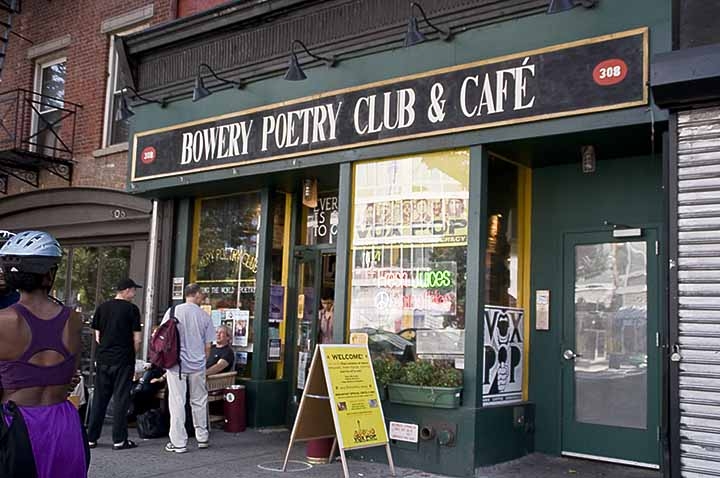
The New York Quarterly Monthly Reading Series: Ted Jonathan, guest host & emceeSunday, August 9, 2015 at 6:00 pmThe Bowery Poetry Club 308 Bowery (between Bleecker and Houston), New York, NY 10012http://www.bowerypoetry.com/ ¨ http://www.nyq.org
Admission is free!As eclectic as the city itself, The New York Quarterly Reading Series presents a variety of poetic voices from all walks of life—regardless of genre and school of thought—and geographically from across the country. Diverse and unique, the one thing these voices all have in common is that they have appeared in the pages of the New York Quarterly poetry magazine, so coming to a reading is just as exciting, unexpected, and open as turning a page in the magazine.
This month’s reading will feature:
Raymond Hammond Raymond Hammond is the editor-in-chief of the New York Quarterly Foundation. He is the author of Poetic Amusement (Athanata Arts, 2010) and works as an adjunct instructor at Keystone College.
Jenna Le
Jenna Le holds a BA in mathematics and an MD degree. Born in Minnesota to Vietnam War refugee parents, she now lives and works as a physician in New York. Le’s poetry collection, Six Rivers (NYQ Books, 2011), was a Small Press Distribution Bestseller. Her poetry, fiction, criticism, and translations have been published by The New York Quarterly, AGNI Online, Barrow Street, Bellevue Literary Review, Crab Orchard Review, Hayden's Ferry Review, Massachusetts Review, The Normal School Online, and The Village Voice. Le has been a Minnetonka Review Editor’s Prize winner, a 2-time Pharos Poetry Competition winner, a William Carlos Williams Poetry Competition finalist, a Michael E. DeBakey Poetry Award finalist, a Pamet River Prize semifinalist, and a Pushcart Prize nominee.
Diane Lockward Diane Lockward is the author of The Crafty Poet: A Portable Workshop (Wind Publications, 2013) and 3 poetry books, most recently Temptation by Water. Her previous books are What Feeds Us, which received the 2006 Quentin R. Howard Poetry Prize, and Eve's Red Dress. A new collection, The Uneaten Carrots of Atonement, is forthcoming from Wind Publications. Her poems have been included in such journals as Harvard Review, Spoon River Poetry Review, and Prairie Schooner. Her work has also been featured on Poetry Daily, Verse Daily, Gwarlingo, and The Writer’s Almanac. She is the Poet Laureate of West Caldwell, New Jersey, where she runs 2 annual events: Girl Talk: A Poetry Reading in Celebration of Women’s History Month and the West Caldwell Poetry Festival.
Douglas Treem Douglas Treem met poetry as a child in the works of Tennyson, Poe, and the Bible, and it has remained chief among his passions. His work has appeared in The New York Quarterly and his book Everything So Seriously was published by NYQ Books (2010). He has also performed in 8 of William Packard’s plays, including the final unfinished play that Packard was working on at the moment of his death. He lives and works in New York City and is the host of the NYQ reading series at the Bowery Poetry Club.
July 24, 2015
Letting the Rabbit Out of the Hat
 This is not the cover.I’ve blabbed my news to a handful of people but have not shouted it to the world yet, so here goes: I have a new poetry book coming forth! It’s called The Uneaten Carrots of Atonement, a title drawn from one of the poems. The manuscript was accepted several months ago by Wind Publications who has published all three of my previous poetry books and my craft book, The Crafty Poet: A Portable Workshop.
The revised manuscript has been sent in, blurbs are underway, and the cover art has been produced. The magnificent Brian Rumbolo who did the original art for the earlier three poetry books has also done the art for this new book. Again, he has used big bold colors and added a touch of play. I’m not going to reveal the cover just yet, but it’s pretty darn cool.
My last book, Temptation by Water, came out in 2010. Since then I’ve had one chapbook and the craft book published, so I haven’t been idle. But I’m excited to have another full-length collection of poems coming soon. Sort of like going home again after a long time away. I’m expecting to receive the galleys in a few weeks. My publisher has given me a publication date of late summer or early fall.
I’ll keep you posted. In the meantime, check out one of the poems, "Original Sin."
July 16, 2015
Poetry Readings: The Good, the Bad, and the Hideous

Back in 2010 I posted a piece called "What Makes for a Good Poetry Reading?" I recently took another look at that piece and decided to repost it five years later with a few additions. My experiences as both a reader and an audience member have made me well aware that readings are not created equal. Some are wonderful and some are quite the opposite. As a reader, when the reading doesn't go well, I ask myself, Why do I continue to do this? But when it does go well, I know why I keep doing it. Because it's fun and feels great. Fortunately, it goes well more often than it doesn't. In the hope of enhancing the likelihood of more good readings, I'm reposting some thoughts on the the role of the host, the poet, and the audience on how they can each contribute towards a successful reading.
The Host's Role
1. Good PR is essential. If no one knows about the reading, you can be sure no one will be there. If you're the host, you're obligated to spread the word as widely as you can. Even if the reading is part of a regular series, you should PR each reading as if it's special (because to the poet it is). Posters, newspaper notices, online calendars, websites, blogs, email lists. It's really disheartening for the poet to arrive and learn that the host never got around to promoting the event. No excuses, Host.
2. Try to make the room comfortable. Arrive early to check the room temperature and the mic if there is one. Arrange the chairs so that the audience is neither too close to nor too far from the poet. If all the people gravitate to the back of the room, threaten them until they move to the front. Likewise, if half sit on the far right and half sit on the far left, ask people to move in a bit. These little things make a big difference in the comfort level of the reading.
3. If possible, provide a good sound system unless the room is small. Don't expect the poet to shout her poems. I gave a reading a few years ago in a coffee shop that had no mic. Coffee machines, chimes on the door, change rattling. Not so cool.
4. Be sure you provide a space for the poet's books to be displayed. Announce to the audience that books are available. If they're at a sale price, mention that. Repeat that. Do your best to help the poet sell some books, especially if your honorarium is small or non-existent. Don't make the poet hawk her own wares. If possible, provide someone to handle sales and make change.
5. This is going to sound cranky, but I'm saying it anyhow. Don't allow audience members to put out their own books for sale. And don't put out your own books. Just don't create competition for your visiting poet, especially if the poet has traveled a distance. Double especially if pay is minimal or non-existent.
6. If you can't offer an honorarium, consider putting out a basket. I did a reading some months ago where such a basket was put out, but guess what! The host kept everything that went into it. I'd driven five hours and paid for a hotel.
7. If there's an Open, manage it. Manage it. Have guidelines and enforce them. Many a reading has been spoiled by an Open that got out of hand and went on endlessly. When this happens, some audience members are discouraged from returning and you end up with an audience of open readers who are there to hear themselves. A well-run Open can, however, be fun. Limit the readers to one or two poems. That's it. No negotiating. Got a haiku? That's one poem. Even if there are only two people reading in the Open, do not allow more than two poems each.
8. Anyone who arrives after the featured poet has finished reading should not be allowed to read in the Open. No exceptions. Something about good manners.
The Poet's Role
1. You can help with the PR. Post the reading at your website and blog and anywhere else you can think of. In addition to the preceding, notify people you know in the area that you'll be doing a reading and ask them to bring friends.
2. If the host neglects to put out your books, rectify that right away! I'm putting an exclamation point on that sentence because I have done a few readings where the host forgot about books and I was too timid to bring it up. Then I kicked myself all the way home. Now if the host doesn't ask for my books, I ask, "Where would you like me to put my books?"
3. If the host fails to announce that your books are available for sale and signing, then do that yourself. Don't browbeat the audience into buying your books—that's really unappealing—but you can mention once at the beginning and/or at the end that your books are on the table and offered tonight at discount and that you'll be happy to sign them.
4. Go prepared. Choose your poems before you arrive. I've heard a number of poets say they have to gauge the audience before they choose. Nonsense. That's just laziness. It's annoying and a waste of time for the audience to sit there while the poet fumbles through pages looking for what to read.
5. Time your reading ahead of time. You know how many poems will take up 30 minutes. Plan for that if that's the amount of time you have. Don't go beyond the time. Ever. And don't keep asking the host, How am I doing for time? How much time do I have left? Time for a few more poems? This makes the audience squirm. And if you've said, as you reach the end of your time, that you're going to read just two more, then read just two more. Don't toss in a third, no matter how much the audience seems to like you.
6. Try to stay for the Open. If people came to hear you, it seems polite to stay to hear them. If you're driving a distance and have to leave, let the audience know that that's why you're leaving.
7. Email a thank-you to your host, even if the turnout was disappointing. There are times when competing events or weather keep people away. Let the host know that you appreciate the invitation to read in her series. If the reading was a big hit, let your host know that you appreciate his efforts to put together a great event.
The Audience's Role
1. If you're in the audience and planning to read during the Open, please do not work on your own poem while the featured poet is reading. It's incredibly rude.
2. Do not give long preambles to your poem. Just read the poem.
3. Don't make announcements from the podium, especially ones about your own upcoming readings.
4. Do not stare at the featured poet while you're reading your poem. Read for the whole room.
5. If you possibly can, support the poet with the purchase of a book. It means a lot to the poet. Really.
6. Do not ever, and I mean ever, suggest a book trade to the featured poet. This is beyond rude and it makes for a very uncomfortable situation.
July 10, 2015
Bits & Pieces of This & That
 Click Cover for AmazonSince I've been posting features of poets for the past month, I've fallen behind in the bragging department. Time to catch up. Here's what got me excited and made me happy recently.
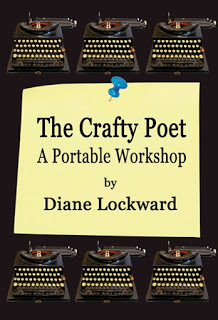
First, The Crafty Poet received two more nice reviews. As the book is zeroing in on its second birthday, I am very happy that it continues to attract attention and praise. The first review is by Philip Chase and appears in the 2015 issue of the Journal of New Jersey Poets. As that is a print journal, I scanned the review and posted it on my website. I am very fond of this opening sentence: "With plenty of practical advice, insightful interviews, useful exercise, and original poems from an array of voices and styles, Diane Lockward's aptly titled The Crafty Poet: A Portable Workshop is an invaluable tool for anyone looking to delve into the craft of creating poetry." The entire review can be found HERE.
The second review is by Linda Simone and appears online in Writer's Relief. This reviews begins with this nice sentence: "If you’re looking for the magic bullet to combat writer’s (or poet’s) block, The Crafty Poet, A Portable Workshop by poet Diane Lockward may be the book for you." Read the entire review HERE.
 Click Badge for eBookItI'm also happy to report that The Crafty Poet E-Book is doing nicely. On the generous recommendation of Scott Wiggerman and David Meischen, co-editors of Wingbeats and Wingbeats II, I used the services of eBookIt for the conversion. I have been extremely pleased with their service and recommend them to anyone looking to convert a print book into an ebook. While I had not expected them to do any editing, they did and my editor did a really great job. Then my rather complicated table of contents required manual inputting which they did for a very reasonable fee. I especially appreciated the open line of communication. Any questions I had were quickly answered. The cost of this service was recovered in less than the first two months of the book's availability. For each of the three months that the ebook has been available, it has been a bestseller. As a result, it has been given a fancy badge on its page. The Crafty Poet ebook is available at eBookIt, Amazon, B&N, and elsewhere.
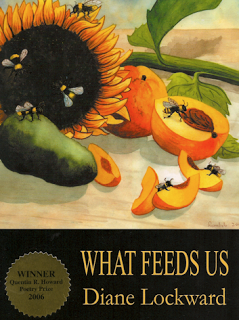 Click Cover for AmazonThen I had the great happiness and honor of having a poem featured by Garrison Keillor at The Writer's Almanac on Monday, June 22. Linguini was read by Keillor on his broadcast that goes out daily on 600 radio stations. The poem also went out via Keillor's daily newsletter. First published in Poet Lore, the poem later appeared in my second poetry book, What Feeds Us.
In the poem publication department, my poem "Thinking Like a Buddhist" appears in the current issue of Driftless Review.
Then I also have two poems, "We Were Such a Fine Plum Pudding" and "The Gift of a Rat" in the current issue of Compose Journal. This is a beautiful online journal that includes poetry, fiction, and art. The editors also do a great job of promoting the journal and the authors via social media.
My bad news is some nasty poison ivy on my arms which has me dousing my limbs in rubbing alcohol and spreading on copious coats of Wal-dryl. No more weeding for me.
July 3, 2015
West Caldwell Poetry Festival Featured Poet: Adele Kenny
 Adele Kenny is the author of several collections of poetry, most recently A Lightness, A Thirst, or Nothing at All. Her poems have been published in numerous journals and anthologies. She is the recipient of two NJ State Arts Council poetry fellowships, the first place Merit Book and Henderson Awards, a Merton Poetry of the Sacred Award, the 2012 International Book Award for Poetry, and Kean University’s Distinguished Alumni Award. She is the founding director of the Carriage House Poetry Series and the poetry editor of Tiferet Journal. One of her poems appeared on the marquee of the Rialto West Theater in NYC as part of the 42nd Street Art Project. She has twice been a featured reader at the Geraldine R. Dodge Poetry Festival.
A Lightness, A Thirst, or Nothing at All is a collection of 52 prose poems that are deeply rooted in imagery and metaphor. They contain complete sentences and deliberate fragments, speak the language of dreams, and give a nod to the surreal. They often include strange layers of language in which what appears to be abstraction isn’t. Lightness picks up the spiritual journey begun in the earlier What Matters and moves that journey forward.
Praise for A Lightness, A Thirst, or Nothing at All:
"Hardwired by Kenny’s gift for dimension and her profound understanding of the human spirit, the poems in this collection show us the healing power of attention and awareness. Kenny’s words move associatively (and swiftly) through image and sound, and she makes a particular music that is uniquely her own. Impelled by lyrical precision, these poems cast light on what we are learning, and what we already know, about ourselves. This collection contemplates the ways in which the “interior life and the outside world intersect” and is a must-read for anyone interested in looking beneath the surface of things. In addition, through the process of these poems, Kenny leads us to see that, as C. S. Lewis wrote of the spiritual journey, '… there must be a real giving up of the self.'”—Alex Pinto, Tiferet, Spring 2015
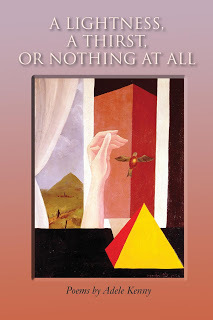 Click Cover for Amazon
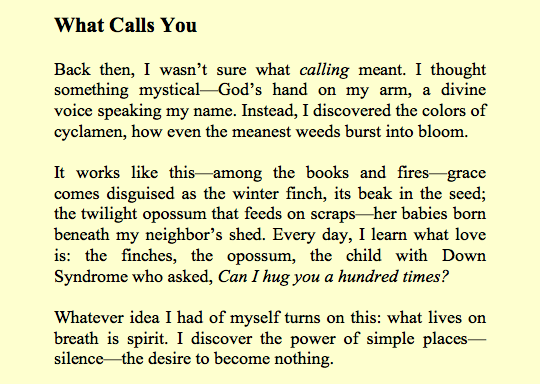
Adele sent us home with these suggestions for revision. Hopefully, you can put them to use on the poems you've written to the prompts offered by the other festival poets.
Often when I conduct poetry workshops, I give participants the following list, which is not a standard “prompt” but something I hope will be useful when you work on editing.
1. Try to write in the active, not the passive, voice. To do that, it can be helpful to remove “ing” endings and to write in the present tense (this will also create a greater sense of immediacy).
2. Be on the lookout for prepositional phrases that you might remove (articles & conjunctions too).
3. The great author Mark Twain once wrote, “When you catch an adjective, kill it. No, I don’t mean utterly, but kill most of them—then the rest will be valuable. They weaken when close together. They give strength when they are wide apart.” This is especially true in poetry. So ... as you work on a poem, think about adjectives and which ones your poem can live without. (Often the concept is already in the noun, and you don’t need a lot of adjectives to convey your meaning.)
4. Avoid clichés (and, while you’re at it, stay away from abstractions and sentimentality).
5. Show, don’t tell—through striking imagery, a strong emotional center, and an integrated whole of language, form and meaning.
6. Challenge the ordinary, connect, reveal, surprise! And … remember that a poem should mean more than the words it contains.
7. Create a new resonance for your readers, a lit spark that doesn’t go out when the poem is “over.”
8. If you take a risk, make it a big one; if your poem is edgy, take it all the way to the farthest edge.
9. Understand that overstatement and the obvious are deadly when it comes to writing poetry. Don’t ramble on, and don’t try to explain everything. Think about this: a poem with only five great lines should be five lines long.
10. Bring your poem to closure with a dazzling dismount. (Be careful not to undercut your poem’s “authority” by ending with trivia or a “so what” line that doesn’t make your readers gasp.)
Something to Try:
1. Take a look at a poem you’ve already written and apply the preceding items as a checklist for editing.
2. Go through your poem one item at a time and see if there are changes you can make.
3. After you’ve finished, compare your original version and the newly edited one. Is the edited version stronger than the original?
June 26, 2015
West Caldwell Poetry Festival Featured Poet: Therese Halscheid
Therese Halscheid was one of the six featured poets at the 2015 West Caldwell Poetry Festival.
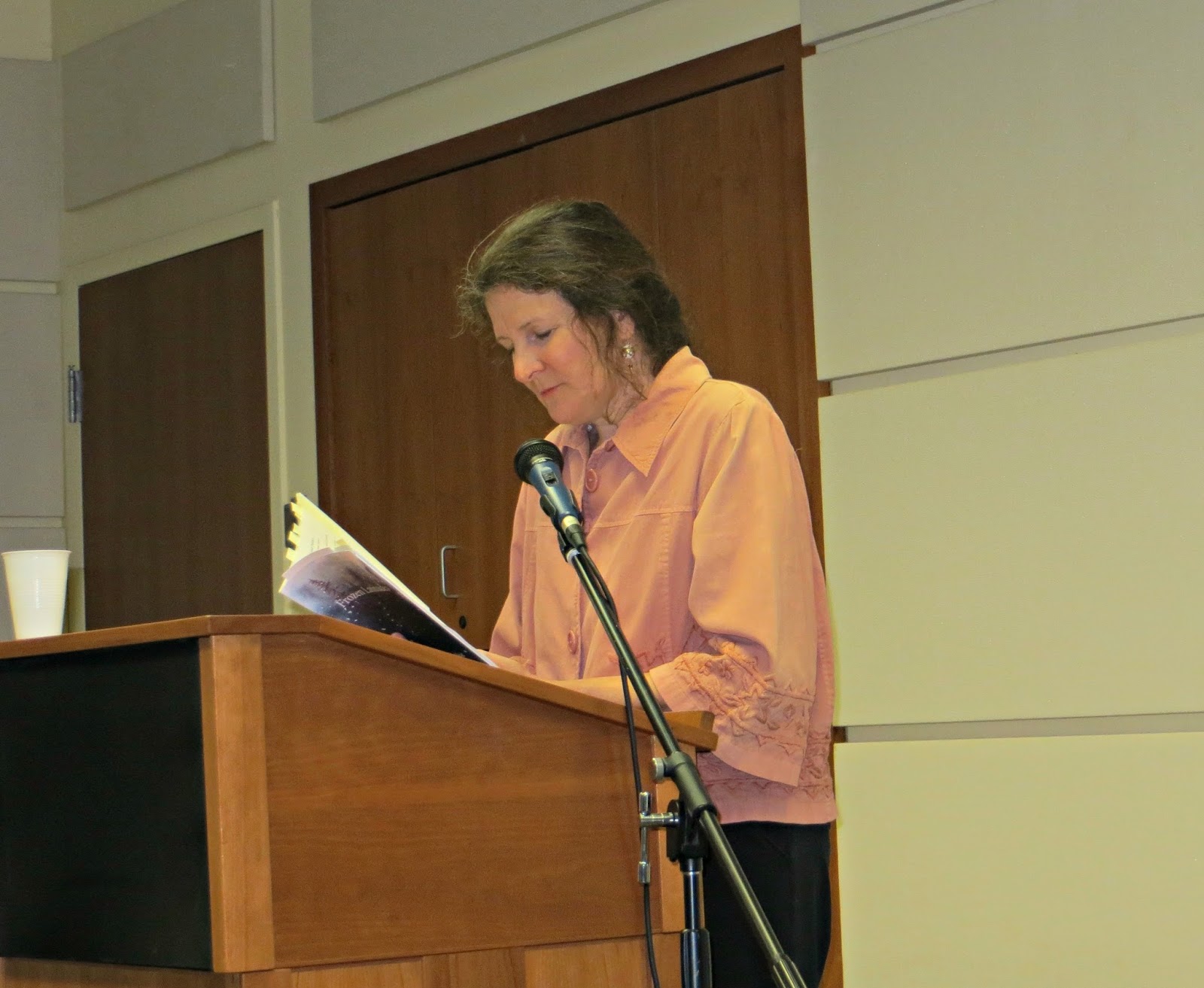 Therése Halscheid’s most recent book of poems is Frozen Latitudes (Press 53). Other collections include Uncommon Geography, Without Home, Powertalk, and a Greatest Hits chapbook. Her poetry and lyric essays have appeared in many journals, among them The Gettysburg Review, Tampa Review, Crab Orchard Review, and Natural Bridge. By way of house-sitting, she has been an itinerant writer for several years. Her travels have taken her from the Florida Panhandle to the Arctic north of Alaska, where she lived with and taught poetry to an Eskimo Inupiaq tribe.
Frozen Latitudes melds two journeys, where lives are at the very edge of survival. One is the literal location of Alaska where Halscheid lived among clans of an Inupiaq tribe, as well as in the frontier town of Homer. The second location is the place and time where her father’s life was frozen when, during heart surgery, he suffered brain damage. In this collection, the journey into the cold becomes a metaphor for a family struggling with dementia.
Praise for Frozen Latitudes:“'My lips, bright as scars, are parting / open with words,' writes Therése Halscheid. In these moving poems of loss, interwoven with vivid poems inspired by people and the landscape of Alaska, she composes resonant lines imbued with deep emotion."
—Arthur Sze, author of Compass Rose
Frozen Latitudes won Honorable Mention for The Eric Hoffer Book Award for Poetry. The collection is reviewed in the US Review of Books. Read the Review.
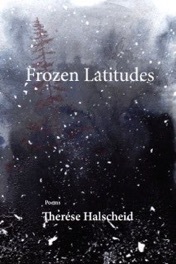 Click Cover for Amazon
Trash Day
This is how it really looked long ago….
This is myself back in time, a girl
with sallow skin, dragging metal cans to the curb,
notice how I stand for awhile that far from our house
watch how my lips, bright as scars, are parting
open with words so the great air can take them
out of their mystery --
see how my thoughts form the storms, how the morning sky
fills with dark sentences
always something about aphasia, his dementia,
something always about my father caught
so quiet inside me
that would rise in the wind to become
something readable.
I am only fourteen. But you can tell I look old
as if life is ending. Notice how my limbs droop so
willow-like over the trash, see how the cans
are all packed with food, know I am starving myself, I am
that full of my father….
These are our neighbors, each turning in their sleep as they wake,
each waking as they turn from their room to the window
watching the weather above them.
And this is an image of the whole town in shock.
See how they dread my gray hovering grief, just watch
as they walk, how they carry on with the endless clouds
I made weekly, correctly, so very awful and coming
into their eyes.
Here's the prompt that Therese challenged us all to try:
Select a topic that is risky for you and allow yourself to free-write about it. A few lines, a paragraph, a page, it does not matter. Just spend a few moments writing. Then go back to what you have written and circle a sentence or phrase. Lift it out. Using that sentence or phrase as a starting point, free-write again. This exercise is helpful in allowing you to experience how writing unfolds in layers. Note how you are moving from a surface experience to crisp details, from abstracts to images. You can try this again and again as a way to enter the heart of the matter, which then becomes powerful material for a poem.
June 19, 2015
West Caldwell Poetry Festival Featured Poet: Charlie Bondhus
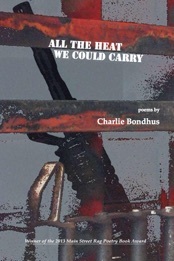
 Charlie Bondhus’s second book, All the Heat We Could Carry, won the 2013 Main Street Rag Poetry Book Award and the Publishing Triangle’s 2014 Thom Gunn Award for Gay Poetry. Previous publications include How the Boy Might See It (Pecan Grove Press, 2009), and two chapbooks, What We Have Learned to Love—winner of the Brickhouse Books 2008-2009 Stonewall Award—and Monsters and Victims (Gothic Press, 2010). His poetry appears in numerous periodicals, including Poetry, Tupelo Quarterly, Midwest Quarterly, CounterPunch, and Cold Mountain Review. He teaches at Raritan Valley Community College in New Jersey and is the Poetry Editor at
The Good Men Project
.
Charlie Bondhus’s second book, All the Heat We Could Carry, won the 2013 Main Street Rag Poetry Book Award and the Publishing Triangle’s 2014 Thom Gunn Award for Gay Poetry. Previous publications include How the Boy Might See It (Pecan Grove Press, 2009), and two chapbooks, What We Have Learned to Love—winner of the Brickhouse Books 2008-2009 Stonewall Award—and Monsters and Victims (Gothic Press, 2010). His poetry appears in numerous periodicals, including Poetry, Tupelo Quarterly, Midwest Quarterly, CounterPunch, and Cold Mountain Review. He teaches at Raritan Valley Community College in New Jersey and is the Poetry Editor at
The Good Men Project
.All the Heat We Could Carry is a collection of poems written primarily in the voices of a gay soldier returning from Afghanistan and his civilian lover. The poems alternate between the battlefront and the home front, exploring, as they do, questions of masculinity, commitment, and violence.
Praise for All the Heat We Could Carry:"All The Heat We Could Carry is a rare, brilliant and necessary book, offering a people who have lived well during the war a species of lyric night-vision, a camouflage night, wherein we are taught to field strip a rifle, but also to think about 'the soul, / a puff of wind / shot from the mouth.'" Our wars come home in these poems, through a prophet who’s seen hell, who now lives in the aftermath where all is refracted through the searing lens of wounded memory: 'the sun now heavy as a blood bag, where it is hard to tell / the difference between civilians and ghosts.' These poems move with precision from war to home and back, from stun grenade, body bag and bone saw to a garden in winter. If you want to know, or think you want to know, you must read Charlie Bondhus. If you want to know why, pay attention to the fifth section of his poem 'A Talent for Destruction.' Bondhus is a true poet, and this is among the best books I have read in a very long time."—Carolyn Forché
 Click Cover for AmazonHomecoming
Earlier you had written meabout the roadside bomb’soranges, blues, and pinks,which threw 200-lb men,wearing 80 lbs of equipment,into the hot, metal wallof an Abrams tank.When you came home in May,I had a planterof spiky bougainvillea on the porch;the first thing you’d see,a different kind of explosion.
We went to the bedroomto tend to your body, starvedfrom fifteen months of hard living.I smelled chemicals, felt shrapnel’s grit,saw the places you had been burned.You told me about the sliverof metal lodged in your right calf,bone deep, inextractable, that would notaffect your ability to walk or sitbut would always be there, much in the sameway there will always be warsomeplace, affecting our lives.
Lying naked beneath the whup, whupof the ceiling fan as you smokeon the porch, I think about flowers and bombs,the books I read on combat fatigue,and wonder if this thorn in your legis attached to a stem that runsthe length of your spine,exploding, in your head,a white phosphorous bloom.
Please give Charlie's prompt a try:
In the spirit of Sei Shōnagon's Pillow Book, make lists of quirky things. Things I wish I had never said. Red things. Things more embarrassing than nudity. Things to put off as long as possible. Things to die for. Acid things. Things that last only a day. Things that should not be seen by firelight. The lists might inspire poems...or perhaps they are poems themselves.
Charlie has generously offered to have this Call for Submissions posted here. Check it out.
From Charlie Bondhus for The Good Men Project: People of all genders are warmly invited to submit poetry (simultaneous submissions AND reprints fine!) to The Good Men Project, a website dedicated to discussing what it means to be a good man in the twenty-first century.
On average, the site gets 3.3 million unique visitors and 8 million page views per month, and each published poem gets featured on the site for several days, so this is a very visible venue! Oh, and the poetry section is listed as one of the "Most Personable Poetry Markets" on Duotrope!
Work dealing with men or masculinity is a plus, though our first standard is simply high quality poetry.
Submit up to 10 pages of poetry, as an attachment, to charlie@goodmenproject.com.
Guidelines Here