Diane Lockward's Blog, page 17
April 8, 2015
Featured Book: How I Lost My Virginity. . ., by Alexis Rhone Fancher
How I Lost My Virginity To Michael Cohen & Other Heart Stab Poems. Alexis Rhone Fancher. Sybaritic Press, 2014.
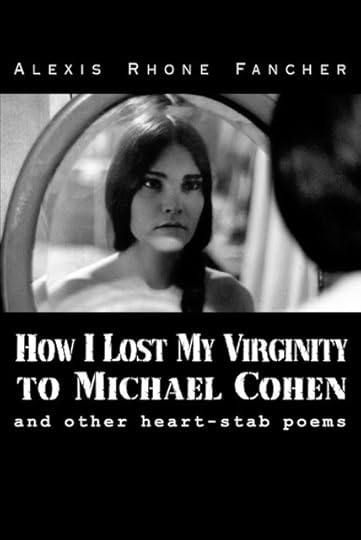 Click Cover for AmazonAlexis Rhone Fancher is the author of “How I Lost My Virginity To Michael Cohen and Other
Heart Stab Poems,” (Sybaritic Press, 2014). Her work appears in Rattle, The MacGuffin,
Fjords, Slipstream, and elsewhere. Her poems have been published in a number of American and international anthologies. Her photos have been published worldwide. She’s been nominated for several Pushcart Prizes and a Best of The Net award. Alexis is poetry editor of Cultural Weekly.
Description: Alexis Rhone Fancher's How I Lost My Virginity to Michael Cohen and Other Heart Stab Poems, is a gorgeous collection of erotic poems and black-and-white photos which chronicles her journey into the sensual world of sexual experience. Fancher's writing is sharp, insightful, beautifully composed, and will strike a chord with women and men of all ages. (Marie Lecrivain)
Blurb: I keep trying to remember what 19th century writer accused of impropriety replied crossly with words to this effect: These are writings for adults regarding adult experience. They are not intended for little girls for whom one prepares slices of buttered bread. Indeed. That goes triple for this collection. Reader, these are erotic poems, and I do not mean poems that muse upon the sensual suggestiveness of certain blossoming flowers. Regard yourself as forewarned. Alexis Rhone Fancher may very well be the lustiest poet in all L.A. (Suzanne Lummis)
Walk All Over You
The stiletto boots in the back of my closet are
restless, long to stroll the 3rd Street Promenade,
looking for a red silk bustier. A Louis Vuitton bag.
A lover who won’t let me down.
The stiletto boots in the back of my closet
want to party, want to grab my feet,
climb my calves, hug my thighs. They’re
ready for action. Ready to put on a skintight
Versace, and head for the club.
They want to clack on terrazzo floors,
totter from great heights, see the world.
Escape the flats, the Mary Jane’s, the penny
loafers, the two-toned, two-faced saddle Oxfords
that guard the closet door.
The stiletto boots in the back of my closet
want to walk all over you, punish you for
cheating, make you pay.
They have a short memory, don’t care
why they were banished or what you
did. They’re desperate to reclaim you,
dig their heels into your shortcomings,
make little marks up and down your libido.
Welcome you home.
They long to wrap themselves around
you, put you in a headlock, rake your thighs,
want to lead you into ecstasy.
Saran Wrap.
Whipped cream.
Wesson Oil.
Room service.
Remember?
My stilettos can’t forget you.
My stilettos can’t move on.
My stilettos want to forgive you.
Even if I cannot.
They bear the scuff marks
of your betrayal far better than do I.
The stiletto boots in the back of my closet
are negotiating their release, want me
to give you a second chance
to trample my heart.
Like the last time and the time before.
They want to get started, head out the door.
Who do you think gave me those boots,
anyway?
More Poems by Alexis Rhone Fancher:
Menacing Hedge
Ragazine
Click Here to Purchase
Click Cover for AmazonAlexis Rhone Fancher is the author of “How I Lost My Virginity To Michael Cohen and OtherHeart Stab Poems,” (Sybaritic Press, 2014). Her work appears in Rattle, The MacGuffin,
Fjords, Slipstream, and elsewhere. Her poems have been published in a number of American and international anthologies. Her photos have been published worldwide. She’s been nominated for several Pushcart Prizes and a Best of The Net award. Alexis is poetry editor of Cultural Weekly.
Description: Alexis Rhone Fancher's How I Lost My Virginity to Michael Cohen and Other Heart Stab Poems, is a gorgeous collection of erotic poems and black-and-white photos which chronicles her journey into the sensual world of sexual experience. Fancher's writing is sharp, insightful, beautifully composed, and will strike a chord with women and men of all ages. (Marie Lecrivain)
Blurb: I keep trying to remember what 19th century writer accused of impropriety replied crossly with words to this effect: These are writings for adults regarding adult experience. They are not intended for little girls for whom one prepares slices of buttered bread. Indeed. That goes triple for this collection. Reader, these are erotic poems, and I do not mean poems that muse upon the sensual suggestiveness of certain blossoming flowers. Regard yourself as forewarned. Alexis Rhone Fancher may very well be the lustiest poet in all L.A. (Suzanne Lummis)
Walk All Over You
The stiletto boots in the back of my closet are
restless, long to stroll the 3rd Street Promenade,
looking for a red silk bustier. A Louis Vuitton bag.
A lover who won’t let me down.
The stiletto boots in the back of my closet
want to party, want to grab my feet,
climb my calves, hug my thighs. They’re
ready for action. Ready to put on a skintight
Versace, and head for the club.
They want to clack on terrazzo floors,
totter from great heights, see the world.
Escape the flats, the Mary Jane’s, the penny
loafers, the two-toned, two-faced saddle Oxfords
that guard the closet door.
The stiletto boots in the back of my closet
want to walk all over you, punish you for
cheating, make you pay.
They have a short memory, don’t care
why they were banished or what you
did. They’re desperate to reclaim you,
dig their heels into your shortcomings,
make little marks up and down your libido.
Welcome you home.
They long to wrap themselves around
you, put you in a headlock, rake your thighs,
want to lead you into ecstasy.
Saran Wrap.
Whipped cream.
Wesson Oil.
Room service.
Remember?
My stilettos can’t forget you.
My stilettos can’t move on.
My stilettos want to forgive you.
Even if I cannot.
They bear the scuff marks
of your betrayal far better than do I.
The stiletto boots in the back of my closet
are negotiating their release, want me
to give you a second chance
to trample my heart.
Like the last time and the time before.
They want to get started, head out the door.
Who do you think gave me those boots,
anyway?
More Poems by Alexis Rhone Fancher:
Menacing Hedge
Ragazine
Click Here to Purchase


April 6, 2015
Featured Book: The Arranged Marriage by Jehanne Dubrow
The Arranged Marriage. Jehanne Dubrow. University of New Mexico Press, 2015.
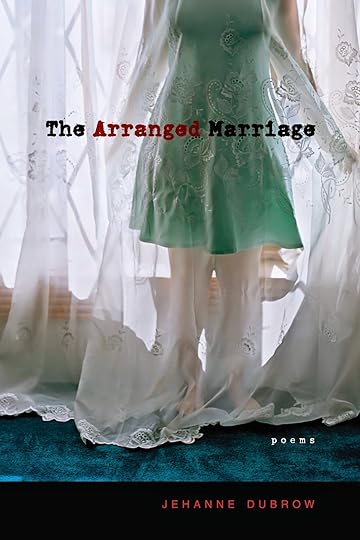 Click Cover for AmazonJehanne Dubrow is the author of five poetry collections, including most recently The Arranged Marriage (U of New Mexico P, 2015), Red Army Red (Northwestern UP, 2012), and Stateside (Northwestern UP, 2010). Her work has appeared in Virginia Quarterly Review, The New England Review, and Prairie Schooner. She is the Director of the Rose O’Neill Literary House in Maryland and an Associate Professor of creative writing at Washington College.
Description: With her characteristic music and precision, Dubrow delves unflinchingly into a mother's story of trauma and captivity. The poet proves that truth telling and vision can give meaning to the gravest situations, allowing women to create a future on their own terms.
Blurb: Here is a sequence of nuanced narratives, each anxiously circling arrangements of marriage, violence, and the shadows of history. Jehanne Dubrow has a storyteller’s gift for suggesting, with enviable economy of language, the complexities of our relationships with those we love and the inescapable past that surrounds us. Elegant, intimate, and unsettling, The Arranged Marriage is a terrific—an important—book. (Kevin Prufer)

More poems by Jehanne Dubrow:
PSA Annual Awards
Agni
Click to Purchase The Arranged Marriage.
April 4, 2015
Featured Book: Mr. West, by Sarah Blake
Mr. West. Sarah Blake. Wesleyan University Press, 2015.
 Click Cover for AmazonSarah Blake is the founder of the online writing tool Submittrs, an editor at Saturnalia Books, and a recipient of an NEA Literature Fellowship. Her poetry has appeared in Boston Review, Drunken Boat, and The Threepenny Review. Mr. West is her first book. Named After Death is her first chapbook, forthcoming from Banango Editions this summer. She lives outside of Philadelphia, Pennsylvania with her husband and son.
Description: Mr. West covers the main events in superstar Kanye West’s life while also following the poet on her year spent researching, writing, and pregnant. The book explores how we are drawn to celebrities—to their portrayal in the media—and how we sometimes find great private meaning in another person’s public story, even across lines of gender and race. This is a daring debut collection and a groundbreaking work.
Blurb: Mr. West transforms the poet’s fascination with the rapper into an amazing group of poems that explores what she knows or can find out about West, alongside her own life. The poems construct West as unmistakably human and larger than life—as much like as unlike the poet. The work is tender without being sentimental, funny without being cruel, and obsessive without being exploitative. It is a study in nuance and it is strangely moving. (Evie Shockley)
Seeing Kanye
Along the Juniata, the gray stones,
gray squares in the grass,
keep the hills from the road, keep them
where they are.
When we pass the stones,
like the Earth’s stitches,
I know we’re about to see a rock face
following a bend in the road,
where the strata bends like sound waves.
It’s clear God is below the Earth, not above—
his head, giant frame for the planet—
and he makes a sound that makes the Earth.
But first I thought of Kanye’s head
singing, singing, singing into that rock.
More Poems by Sarah Blake:
The Awl
Flavor Wire
Click Here to Purchase Mr. West
April 2, 2015
Featured Book: Love, Etc., by L.L. Barkat
Love, Etc.: Poems of Love, Laughter, Longing & Loss. L.L. Barkat. T. S. Poetry Press, March 2014.
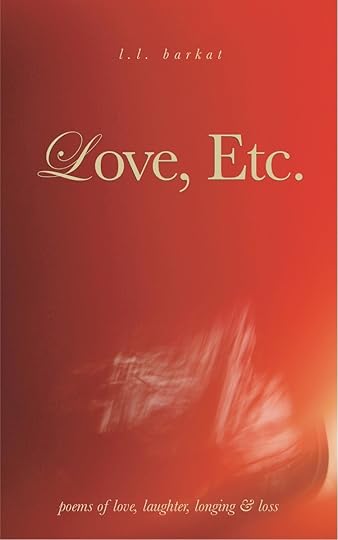 Click Cover for AmazonL.L. Barkat is the author of six books, including her most recent poetry collection, Love, Etc.: Poems of Love, Laughter, Longing & Loss. She is also the author of The Novelist: A Novella (an experimental fiction) and Rumors of Water: Thoughts on Creativity & Writing (twice named a Best Book of 2011). Her poems have appeared at Best American Poetry, VQR, and Every Day Poems. She is a staff writer for The Curator, a contributor for Makes You Mom, a writer for Huffington Post Books blog, and the Managing Editor of Tweetspeak Poetry.
Description: Love has many faces. From the sensual to the reflective, from the whimsical to the worrisome. Love, Etc. explores the mixed experiences of love, in language infused with Barkat’s signature sensual touch.
Blurb: Though subtitled poems of love, laughter, longing & loss, L.L. Barkat’s new collection, Love, Etc., is all longing to me—reaching repeatedly for the clarity that surely lies within life’s entanglements. These poems flirt and seduce. Wait patiently for mulberries and ghosts at the window. Make nests. Button and unbutton. Press the edge of the self. They imitate breath and the spaces between, the desires that get caught in the throat when only a picture, a word, a letter, or silence will do. (Tania Runyan)
Whispered
I should tell you
about my hands, small
and experienced.
The other night,
when my youngest daughter
said, as I tucked her into bed,
Tell me something. Tell me anything,
I turned off the light and whispered this:
when I cut the beets tonight,
the red water went all into
the lines on my hands—
so many lines.
More Poems by L.L. Barkat:
Every Day Poems
Tweetspeak
Click Here to Purchase
March 29, 2015
April Feature for Poetry Month

Beginning on Tuesday, April 2, I will be posting features for new poetry books. One every other day. Each feature will include the publication information, a book description, a blurb, a cover image linked to Amazon, a sample poem from the book, and additional links to poems from the book.
I hope you'll check out these new books and support the poets and their small press publishers. Treat yourself to a handful of new poetry collections. Is there any better way to celebrate National Poetry Month? Is there any better way to stimulate your own writing?
March 25, 2015
Girl Talk: A Poetry Reading in Celebration of Women's History Month
If you're in NJ or nearby, please join us for this reading, now in its 8th year.
Details and Directions

March 15, 2015
The Poet on the Poem: Tony Hoagland
I'm delighted to have Tony Hoagland as the feature poet for The Poet on the Poem series here at Blogalicious.
 Tony Hoagland is the author of five volumes of poetry: Application for Release from the Dream (Sept 2015); Unincorporated Persons in the Late Honda Dynasty; Sweet Ruin, winner of the Brittingham Prize in Poetry; Donkey Gospel, winner of the James Laughlin Award of The Academy of American Poets; and What Narcissism Means to Me, all from Graywolf Press. He is also the author of two collections of essays about poetry, Real Sofistakashun and Twenty Poems That Could Save America, and the chapbook Don’t Tell Anyone. His poems and critical essays have appeared widely in anthologies as well as in journals such as American Poetry Review, Harvard Review, and Ploughshares. His honors and awards include fellowships from the National Endowment for the Arts and the Provincetown Fine Arts Work Center. He has received the O.B. Hardison Prize for Poetry and Teaching from the Folger Shakespeare Library, the Poetry Foundation’s Mark Twain Award and the Jackson Poetry Prize from Poets & Writers. He teaches at the University of Houston and in the Warren Wilson MFA program.
 Click Cover for Amazon
Today's poem is "Give Me Your Wife." It first appeared in the Lascaux Review.
Give Me Your Wife
because I like her. I like
the signs of wear on her;
the way her breasts have dropped a little with the years;
the weathered evidence of joy around her eyes.
I like her faded jeans,
her hennaed hair;
her hips pried open by the child.
I find her interesting; her grey-eyed
calm of a resigned sea;
her stillness like a painting on the wall.
It’s not that you don’t care,
but after all, you’re just a man
who has been standing in
water up to his neck for years,
and never managed to quite
dunk his head entirely under.
So give me your wife. Recycle her.
Look at her mouth, like a soft dry rose;
the way she stands, at an angle
to the world.
She could still be kissed and joked with,
teased into a bed
with cool white sheets;
convinced to lie and be
laid down upon.
Happiness might
still find a place
for her.
Give me your wife
like you were
unbuttoning something
accidentally
and leaving it behind.
Then just drift away
and let me try.
DL: You begin with a 1-line stanza, followed by nine 3-line stanzas, then one 4-line stanza, and finally another 3-line stanza. What’s the logic behind this stanza arrangement?
TH: My decisions are motivated by the simplest possible reasons for arrangement—pacing and content—but the poem should probably be, and mostly is, in tercets, for their processional pacing. What is happening in the poem is a kind of ceremonial asking, which needs to have a rhythmical pace.
DL: You also use inconsistent line lengths. Line 1 is just six words with a total of seven syllables. Line 4 is eleven words, twelve syllables. Line 3 juts way out into the right margin. How did you determine your line lengths and breaks?
TH: Very organically, in semantic units, with the occasional but not too difficult enjambment. I believe in the poem as immersive dream; almost all decisions, many of them anyway, are devoted to clarity, and keeping the reader effortlessly inside the poem, in the dream of the poem, which should be like a ride down a river.
DL: Your title does double duty, serving as both title and part of the sentence that’s completed in the first two lines of the poem. What do you think are the benefits of this kind of title?
TH: Swiftness, quickness of immersion, and involvement. Poems that, like a horse, "get out of the gate fast," have a great advantage. This is especially true of what I call "relational" poems, poems that are making a direct and intimate address to the reader as well as the addressee of the poem, if different. I don't remember exactly the first time I saw a poem's title slide straight into its first sentence, but I remember thinking, "That's a cool thing."
DL: The poem has a distinctive voice, beginning with the bossy directive of the title. You use a first person speaker, a man who desires another man’s wife. You also use direct address to an auditor, the husband of the wife. Please talk about how you intended these two choices to affect the voice and the reader’s response to the speaker.
TH: I realize this positioning of speaker to the drama at hand will be off-putting to some—obviously for its presumptions about a woman or wife as a kind of property. In some of my poems, I deliberately choose a kind of initially aggressive stance as a way of making things interesting, but that is not the case in this poem.
After I wrote the poem some years ago, I showed it to one or two of my reader-friends and they were nonplussed by the premise. They were women readers, but hardly prudish persons, and so, although I liked the poem, I accepted their verdict of my obtuseness and put it away for a few years. It came out of the drawer much later, maybe when the Lascaux Review asked me for some poems. I had forgotten it, though I still liked it.
Nonetheless, I still believe that a poem has a greater duty towards (or legitimate interest in) actuality than ideological purity. Poems are not interesting for their political inoffensiveness—rather for their psychological verity—and whether we approve or not, men and women look at others as a kind of possession, often enough. If the psychological reality is there, why not write a poem that inhabits and explores such a stance—such a situation—to the fullest? If the observation that the virtues of a perfectly good woman or man are wasted on their spouse is a common thought—and who has not felt this?—then why not write a poem making that argument real?
And the poem—though it is "objectifying"—is a poem of observant praise, and also a somewhat resigned critique of men and women and their relations.
DL: The voice of the poem is also affected by the diction and imagery, both of which often seem in conflict with each other. For example, the speaker instructs the auditor, that is, the husband, to “Recycle” his wife. That word implies that she’s a reusable item. But in the next line the speaker describes the wife’s mouth as a “soft dry rose,” a delicate and appealing image though perhaps suggesting that the wife is past the bloom of youth. The wife is also described with such words as “interesting,” “weathered,” “faded,” and “resigned,” all of which make her sound over-the-hill and rather dull. But then “she could still be kissed and joked with, / teased into a bed // with cool white sheets; // convinced to lie and be / laid down upon.” These words and images make her sound desirable, though perhaps a bit credulous. Talk to us about your use of contrasting diction and imagery and the contribution they make to the poem’s voice.
TH: These tunings of diction and rhetoric for me are the essence of most poems that I like—whether it is Fanny Howe's poem "My Broken Heart" or Lawrence's "Bavarian Gentians." Tone is the greatest instrument of poetry and comes from the alloy, or fusion, of contradictions in our attitudes and experience. The bloom IS off our rose. That doesn't make us undesirable, or desire-free. In fact, a weathered body, face, consciousness can obviously be a marvelous—what shall I say?—asset? object? property? As Rilke says, we've earned our faces; or, as Kinnell says, "The wages of death are love." This poem acknowledges the existence of a kind of Eros which I hope we are all familiar with; not to be denied, but to be cherished, even if it is only in fantasy—and that is a whole other subject.
 Tony Hoagland is the author of five volumes of poetry: Application for Release from the Dream (Sept 2015); Unincorporated Persons in the Late Honda Dynasty; Sweet Ruin, winner of the Brittingham Prize in Poetry; Donkey Gospel, winner of the James Laughlin Award of The Academy of American Poets; and What Narcissism Means to Me, all from Graywolf Press. He is also the author of two collections of essays about poetry, Real Sofistakashun and Twenty Poems That Could Save America, and the chapbook Don’t Tell Anyone. His poems and critical essays have appeared widely in anthologies as well as in journals such as American Poetry Review, Harvard Review, and Ploughshares. His honors and awards include fellowships from the National Endowment for the Arts and the Provincetown Fine Arts Work Center. He has received the O.B. Hardison Prize for Poetry and Teaching from the Folger Shakespeare Library, the Poetry Foundation’s Mark Twain Award and the Jackson Poetry Prize from Poets & Writers. He teaches at the University of Houston and in the Warren Wilson MFA program.
Click Cover for Amazon
Tony Hoagland is the author of five volumes of poetry: Application for Release from the Dream (Sept 2015); Unincorporated Persons in the Late Honda Dynasty; Sweet Ruin, winner of the Brittingham Prize in Poetry; Donkey Gospel, winner of the James Laughlin Award of The Academy of American Poets; and What Narcissism Means to Me, all from Graywolf Press. He is also the author of two collections of essays about poetry, Real Sofistakashun and Twenty Poems That Could Save America, and the chapbook Don’t Tell Anyone. His poems and critical essays have appeared widely in anthologies as well as in journals such as American Poetry Review, Harvard Review, and Ploughshares. His honors and awards include fellowships from the National Endowment for the Arts and the Provincetown Fine Arts Work Center. He has received the O.B. Hardison Prize for Poetry and Teaching from the Folger Shakespeare Library, the Poetry Foundation’s Mark Twain Award and the Jackson Poetry Prize from Poets & Writers. He teaches at the University of Houston and in the Warren Wilson MFA program.
Click Cover for Amazon
Today's poem is "Give Me Your Wife." It first appeared in the Lascaux Review.
Give Me Your Wife
because I like her. I like
the signs of wear on her;
the way her breasts have dropped a little with the years;
the weathered evidence of joy around her eyes.
I like her faded jeans,
her hennaed hair;
her hips pried open by the child.
I find her interesting; her grey-eyed
calm of a resigned sea;
her stillness like a painting on the wall.
It’s not that you don’t care,
but after all, you’re just a man
who has been standing in
water up to his neck for years,
and never managed to quite
dunk his head entirely under.
So give me your wife. Recycle her.
Look at her mouth, like a soft dry rose;
the way she stands, at an angle
to the world.
She could still be kissed and joked with,
teased into a bed
with cool white sheets;
convinced to lie and be
laid down upon.
Happiness might
still find a place
for her.
Give me your wife
like you were
unbuttoning something
accidentally
and leaving it behind.
Then just drift away
and let me try.
DL: You begin with a 1-line stanza, followed by nine 3-line stanzas, then one 4-line stanza, and finally another 3-line stanza. What’s the logic behind this stanza arrangement?
TH: My decisions are motivated by the simplest possible reasons for arrangement—pacing and content—but the poem should probably be, and mostly is, in tercets, for their processional pacing. What is happening in the poem is a kind of ceremonial asking, which needs to have a rhythmical pace.
DL: You also use inconsistent line lengths. Line 1 is just six words with a total of seven syllables. Line 4 is eleven words, twelve syllables. Line 3 juts way out into the right margin. How did you determine your line lengths and breaks?
TH: Very organically, in semantic units, with the occasional but not too difficult enjambment. I believe in the poem as immersive dream; almost all decisions, many of them anyway, are devoted to clarity, and keeping the reader effortlessly inside the poem, in the dream of the poem, which should be like a ride down a river.
DL: Your title does double duty, serving as both title and part of the sentence that’s completed in the first two lines of the poem. What do you think are the benefits of this kind of title?
TH: Swiftness, quickness of immersion, and involvement. Poems that, like a horse, "get out of the gate fast," have a great advantage. This is especially true of what I call "relational" poems, poems that are making a direct and intimate address to the reader as well as the addressee of the poem, if different. I don't remember exactly the first time I saw a poem's title slide straight into its first sentence, but I remember thinking, "That's a cool thing."
DL: The poem has a distinctive voice, beginning with the bossy directive of the title. You use a first person speaker, a man who desires another man’s wife. You also use direct address to an auditor, the husband of the wife. Please talk about how you intended these two choices to affect the voice and the reader’s response to the speaker.
TH: I realize this positioning of speaker to the drama at hand will be off-putting to some—obviously for its presumptions about a woman or wife as a kind of property. In some of my poems, I deliberately choose a kind of initially aggressive stance as a way of making things interesting, but that is not the case in this poem.
After I wrote the poem some years ago, I showed it to one or two of my reader-friends and they were nonplussed by the premise. They were women readers, but hardly prudish persons, and so, although I liked the poem, I accepted their verdict of my obtuseness and put it away for a few years. It came out of the drawer much later, maybe when the Lascaux Review asked me for some poems. I had forgotten it, though I still liked it.
Nonetheless, I still believe that a poem has a greater duty towards (or legitimate interest in) actuality than ideological purity. Poems are not interesting for their political inoffensiveness—rather for their psychological verity—and whether we approve or not, men and women look at others as a kind of possession, often enough. If the psychological reality is there, why not write a poem that inhabits and explores such a stance—such a situation—to the fullest? If the observation that the virtues of a perfectly good woman or man are wasted on their spouse is a common thought—and who has not felt this?—then why not write a poem making that argument real?
And the poem—though it is "objectifying"—is a poem of observant praise, and also a somewhat resigned critique of men and women and their relations.
DL: The voice of the poem is also affected by the diction and imagery, both of which often seem in conflict with each other. For example, the speaker instructs the auditor, that is, the husband, to “Recycle” his wife. That word implies that she’s a reusable item. But in the next line the speaker describes the wife’s mouth as a “soft dry rose,” a delicate and appealing image though perhaps suggesting that the wife is past the bloom of youth. The wife is also described with such words as “interesting,” “weathered,” “faded,” and “resigned,” all of which make her sound over-the-hill and rather dull. But then “she could still be kissed and joked with, / teased into a bed // with cool white sheets; // convinced to lie and be / laid down upon.” These words and images make her sound desirable, though perhaps a bit credulous. Talk to us about your use of contrasting diction and imagery and the contribution they make to the poem’s voice.
TH: These tunings of diction and rhetoric for me are the essence of most poems that I like—whether it is Fanny Howe's poem "My Broken Heart" or Lawrence's "Bavarian Gentians." Tone is the greatest instrument of poetry and comes from the alloy, or fusion, of contradictions in our attitudes and experience. The bloom IS off our rose. That doesn't make us undesirable, or desire-free. In fact, a weathered body, face, consciousness can obviously be a marvelous—what shall I say?—asset? object? property? As Rilke says, we've earned our faces; or, as Kinnell says, "The wages of death are love." This poem acknowledges the existence of a kind of Eros which I hope we are all familiar with; not to be denied, but to be cherished, even if it is only in fantasy—and that is a whole other subject.
March 12, 2015
The Crafty Poet: A Portable Workshop / The E-Book

E-Book at Amazon
FREE Kindle app for smartphones, tablets and computers.
Print Book at Amazon
E-Book at B&N
March 2, 2015
Bay to Ocean Conference
This past weekend I drove to Maryland for the 18th annual Bay to Ocean Conference held at Chesapeake College in Wye Mills. I was one of three poets on the program, each of us leading a workshop. The other two poets were Sue Ellen Thompson and Sandra Beasley. Sue Ellen, who oversees the poetry part of the program, also moderated a poetry panel called “Should Poems Be Angry?”
I arrived in Maryland on Friday afternoon as the drive was too long for me to have made it the day of the conference, so I stayed two nights at the Hilton Gardens Hotel in nearby Grasonville. I made a great choice with that hotel as it was beautiful. My room was very big with two queen beds, a desk, fridge, microwave, tv, chair, desk, and a gorgeous view of the wharf and its yachts. I brought some drafts of new poems to work on so considered this weekend also a mini-retreat, and since it cost me more to go than I was paid, I also considered it a mini-vacation. How's that for rationalizing?
 My room—it was even bigger than it looks
 The view out my window—see the snow on the water?
Approximately 250 people attended the conference which was sold out weeks in advance. Most of the presenters were prose writers, approximately two dozen of them, so most of the attendees were also prose writers.
I had 14 poets in my workshop and we had a lovely session. I led the group through a freewriting activity which generated a lot of writing. Then we mined the material for the poem hiding in there. My hope is that new poems will emerge from the workshop and that participants left not only with a strategy they can re-employ on their own to generate new material but also with a handful of revision strategies.
I had a nice lunch with one of my poets who I’d met back in December. Then I attended a panel on poetry journals. After that I felt in need of some nap time, so headed back to my lovely hotel. After a substantial snooze, I again enjoyed room service for dinner. Eloise at the Plaza.
I headed home early Sunday morning and arrived there just as the snow was getting down to serious business.
I love doing workshops and was happy to have been included in this year’s conference.
Now I need to go write some angry poems. Maybe a curse poem.
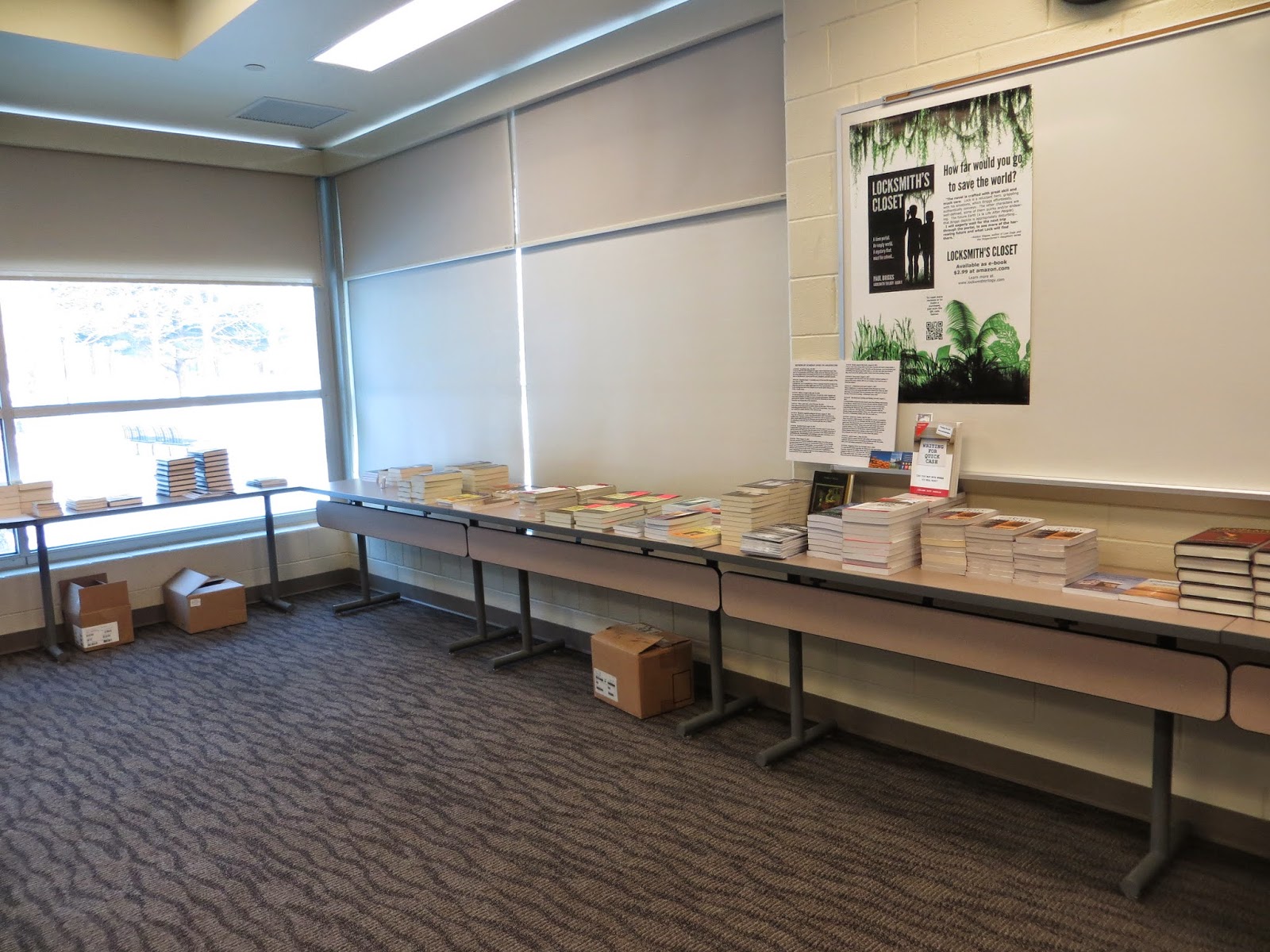 Bookstore—The Crafty Poet is festooned with orange post-its
February 9, 2015
Seven Snazzy Online Journals

While print journals struggle to stay afloat, online journals proliferate. That gives us poets lots of choices, but also means we need to make responsible choices. Online journals are not all created equal and, quite frankly, some of them are dreadful. There’s no sense in submitting your lovely poems to a journal you wouldn’t be proud to have them in.
Print journal editors always advise us to see and read the journal before submitting. The same advice holds true for online journals. Really, there’s no excuse for not carefully checking out an online journal before submitting to it. You can do it quickly and for free.
In 2013 I posted a list of the attributes I looked for in an online journal. What I said there still applies. I also posted a list of seven online journals that were then new and which I admired.
Now in 2015 I continue to prefer a real website to a blog, though blog sites have greater flexibility these days. If using a blog site, the editor should get a real domain name so that the url doesn’t include “blogspot” or “wordpress.” I also don’t want to see a lot of sidebar material that’s typical of a blog. That can and should be removed.
I really don't want to see a black background with a light font. That design is initially striking, but is difficult to read.
I like the Guidelines to be up to date. It’s frustrating to check out a journal, see that they are open now for submissions, put together a submission, then go to the Submittable page and discover that submissions are, in fact, closed.
I particularly dislike the occasional requirement that each poem be submitted individually. What a nuisance.
Likewise, I don’t care to have to remove my name and address. If the editors want to read blind, they can just cover up the id information. Mostly, though, I think that editors should be able to read objectively with or without names.
I really appreciate Share Buttons. I made a big point of that in my previous post. Still, two years later, I’m surprised to see that many online journals aren’t using Share Buttons. They’re free! And they can dramatically increase the journal’s reach and readership. With the click of a button, poets and readers can send a link to Facebook, Twitter, Google+, and elsewhere. I can’t imagine any sensible reason why a journal wouldn’t add them to each page of the journal.
Lastly, I like journals that maintain a presence on Facebook and Twitter. This should be regarded as free advertising space. Social media allows the editor to promote the journal, the poets, and the poems.
I’ve recently perused some newish online journals—or new to me—and am going to share seven of the ones that I find appealing, both for their aesthetics and their poetry.
Compose: A Journal of Simply Good Writing
Fiction, poetry, non-fiction, art
beautifully designed Table of Contents page
Share buttons
2x
Construction Lit Magazine
Poetry, fiction, interviews, social/political commentary, essays on architecture
beautifully designed journal
submission is via email
Share buttons
4x
Cumberland River Review
artwork and poetry, fiction, essays
reads Sept thru April
No Share buttons
4x
The Ilanot Review
would like to see a better url (without “wordpress” in it)
but they do remove the usual blog sidebars
issues are themed
Share buttons
2x
Menacing Hedge
poetry, fiction, interviews, reviews
No Share buttons
4x
Radar Poetry
poetry paired with artwork
interviews
audios
blind submissions
No Share buttons
4x
Utter Magazine
poetry, fiction, non-fiction, interviews
No share buttons
1-2x