Diane Lockward's Blog, page 23
January 13, 2014
Organizing a Poetry Book and Murdering Space

My last blog post, A Few Thoughts about Poetry Book Contests, received a really surprising response. First of all, it attracted close to 1000 visitors and is still getting new readers. It spread all over Facebook where it’s received a bunch of Shares and comments. The comments have been largely positive with most people finding my suggestions helpful and on target. Most, but not all. In fact, a few people took me to task. Such objections as I received were in response to just two of my nine thoughts.
Item #4 elicited some contentious commentary. To refresh your memory, here it is again:
4. Think carefully about your organization. Manuscript construction is so hard, but it really makes a difference. It’s the difference between a bunch of poems and a collection of poems. Keep asking yourself, why am I putting this poem here? that poem there? Can you articulate the reason for each placement? The poems should connect in some way. They should follow each other in a sensible order that still allows for surprises. Find some poet pals to work on this with you.
One reader at Facebook had this to say:
#4 is the one I think is absurd . . . I've never read a book of poems straight through from beginning to end, and I never will. Lockstep reading is for prose.
Absurd? To suggest that poets pay attention to organization is absurd? Certainly, people are free to read a poetry collection in whatever manner they wish to do so, but not reading from beginning to end results in an incomplete reading. The person who reads that way misses out on one of the pleasures of reading a poetry collection, that is, discovering how the poems relate to each other, how they illuminate each other, how each contributes to the whole. A collection is an artistic arrangement of the poems. Why miss out on that? And if you do want to read that other way, okay, but please don’t suggest that the rest of us are absurd.
If organization doesn’t matter, then you might as well be reading a journal. But even some journals, e.g., Poet Lore, take the time to artistically arrange the poems.
Don’t trust me on the issue of organization? That’s fine. But take a look at this terrific article, On Making the Poetry Manuscript, by Jeffrey Levine, the founder, publisher, and editor-in-chief of Tupelo Press. Levine reads thousands of manuscripts each year and leads the Tupelo Press Writing Conferences in various locations. He knows what he’s talking about.
The first section of Levine’s article is entitled "The art of the manuscript." Yes, art. Here’s his first point:
1) When organizing the manuscript, you aim to create nothing less than a work of art. As Robert Frost famously suggested (in so many words) if there are x number of poems in a book, the book itself is the final poem. You’ll want to think about what your book is “about,” and to include poems that carry those themes, that are somehow related, that “speak” to each other. Also, I find that it’s a good idea to tether poems together that are written more or less in the same creative period, lest they sound as though written by different poets—different versions of you. By this I don’t mean to suggest that a book need be written in any particular time-frame, but rather that the book include poems written during a period (a year, two years, five years, whatever) when your creative strategies have been consistent.
Read the rest of the article for an in-depth discussion on manuscript organization and a list of Nuts and Bolts.
Still not convinced? Then read Thinking Like an Editor: How to Order Your Poetry Manuscript, by April Ossman, former executive director of Alice James Books. This article appeared in Poets & Writers. It begins:
In my experience as a book editor, the biggest mystery to emerging and sometimes even established poets is how to effectively order a poetry manuscript. As a poet working on revising and re-revising my graduate thesis toward book publication, I didn’t have much idea either. Here’s why: Ordering a manuscript requires a different kind of thinking than line editing or revising your poems—a kind of thinking I hadn’t been taught. A poet I work with calls it “the helicopter view,” which I love. I think of ordering as a kind of three-dimensional thinking, as opposed to the two-dimensional thinking (like using tweezers under a microscope) necessary for line editing poems. Ordering requires seeing each poem from a distance, so that all its sides are visible; it also requires seeing the manuscript as a whole, so that you can decide how each poem and its parts might connect with others in a series.
It surprised me to get some negativity directed at my suggestion that organization matters, but it rather stunned me to see the amount of resistance to item #7. Here it is again:
7. Okay, now I’m going to be petty, but it’s time for everyone to know that you put only one space after a period. This has been the convention since word processors came in. When you persist in putting in two spaces, you date yourself as someone who learned how to type on a typewriter. This is especially bothersome in poems since open space denotes a pause. Bigger space, bigger pause. But did you mean to create that pause?
Some of the comments:
Number 7 is ridiculous, I agree.
This was really a helpful piece. (Though I'm stodgy enough to take issue with number 7! Learned to type on a typewriter...and proud of it!)
You're not supposed to put two spaces after a period??? Really???? I guess I do date myself but never realized that rule had changed. It's totally ingrained. I'm doing it right now!!!!!
I’m old enough to have those two spaces hardwired into my thumb, so when I'm through I do a search and replace.
(Good to repair, but why not just retrain that thumb to put in one space? Who's in charge, you or your thumb?)
Is it really true that you only put one space after a period? I don't know about that...
(You doubt it? You think I’m wrong about this? You think I'm making it up? Check any number of style guides.)
I call balderdash on one space after a sentence, too. For one thing, if I didn't want a pause, I wouldn't have used a period. For another, my monographs get 40 rods to the hogshead and that's the way I likes it.
(Balderdash?)
Hmm. I always put two spaces after a period. Does that make me identifiably and interminably old? Does that mean that someone will be all like, "That poet is ancient! I am so not going to take her manuscript! She learned to type on a typewriter!"
This last person, who isn't even old, subsequently added this:
Time to break out the the Depends, Geritol, and Boniva, finish book 5 and get that sucka out there! With spaces. Lots and lots of spaces!
(Mock if you like, but you’re still wrong if you’re using two spaces.)
Still not convinced? Then read this very thorough article posted at Slate, Space Invaders: Why you should never ever use two spaces after a period, by Farhad Manjoo, technology columnist for the Wall Street Journal.
It surprised me that some people were just unfamiliar with this rule. It’s really not even new. But even more bothersome is some people’s refusal to make the change. And worst of all is some people’s insistence that they are too old to change, too old to learn something new.
I hope I never get to be that person.
I mean, really, it’s one space. Get rid of it.


January 6, 2014
A Few Thoughts about Poetry Book Contests
 I recently judged the Lena Shull Book Contest for the North Carolina Poetry Society. I was sent 19 manuscripts to read (one was quickly withdrawn) and at last selected one by Becky Gould Gibson as the winner. The manuscripts were submitted anonymously, so I didn’t learn the identity of the winner until after I turned in my results. This was a time-consuming job, but one I enjoyed. I felt honored to have been invited to be the judge for the first year of this contest and flattered to think that someone trusts me enough to invite me to be the judge.
I’d like to offer a few observations which might be helpful to others planning to submit to some book contests. You should keep in mind that these thoughts come from one person who does not claim to be an expert but who has now judged a chapbook contest, been a first reader for several years for the Word Works Washington Prize annual book contest, and been the final judge for one book contest.
1. The appearance of your manuscript matters. Don’t use a huge font or a very small one and don’t use weird fonts. Secure the pages with a clip that is large enough to comfortably hold all the pages and that can be easily removed by the reader. Hopefully, the judge will be able to rise above a sloppy presentation, but don’t count on it. I found that the poorly prepared manuscripts lived up to their appearance.
2. Don’t overload the manuscript. If you have 70 poems in your folder, please don’t put them all into the book manuscript. More is not better. Choose your best work and have a good reason for putting the poems into one book.
3. Don’t frontload your manuscript, that is, don’t put all of your best poems at the beginning. After the reader gets through those poems, it’s all downhill from there. If you only have 6-10 “best poems,” it’s possible that you’re not yet ready to do a book. It might be best to spend some months reworking your so-so poems until they’re as good as your best ones. Of course, we all have our favorites. Spread those throughout the manuscript. The first priority is the order of the poems.
4. Think carefully about your organization. Manuscript construction is so hard, but it really makes a difference. It’s the difference between a bunch of poems and a collection of poems. Keep asking yourself, why am I putting this poem here? that poem there? Can you articulate the reason for each placement? The poems should connect in some way. They should follow each other in a sensible order that still allows for surprises. Find some poet pals to work on this with you.
5. This may be a personal preference, but it seems to me that generally a poetry manuscript works best with some sections. Give the reader a breather from time to time. And please, I’m begging you, don’t clump together all the thematically related poems. Don’t, for example, put all the dog poems into section 1, all the bird poems into section 2, and so on. This makes for tedious, predictable reading. Instead, create threads or strands and weave them throughout your manuscript.
6. While you want unity in your collection, you also want variety. Too much sameness quickly gets boring. Vary subject matter, tone, point of view, length of poems, shape on the page. If you write free verse, an occasional form poem provides variety and surprise. The opposite is true as well.
7. Okay, now I’m going to be petty, but it’s time for everyone to know that you put only one space after a period. This has been the convention since word processors came in. When you persist in putting in two spaces, you date yourself as someone who learned how to type on a typewriter. This is especially bothersome in poems since open space denotes a pause. Bigger space, bigger pause. But did you mean to create that pause?
8. If you don’t win, keep on trying. Figure out which are your weakest poems and as the year goes on and you write better poems, make substitutions. Rework your organizational plan. Keep trying. I’ll repeat that: Keep trying.
9. While you wait for the next round of contests, be sure to buy and read books by other poets you admire. I say buy because you’ll want to dog-ear pages and make margin notes. (Also, you’ll want people to buy your book someday, right?) Then study those books for organization. Study hard. Maybe even put together a group of like-minded people and study and discuss the same books, one at a time. This would be hugely useful and instructive. Do it.
December 28, 2013
A Pie As Lovely As a Poem
Christmas is over for this year. I’m not a big Christmas fan. Sorry. The shopping is awful. I never feel like I’ve selected the right gifts or enough of them. The house decorating feels onerous. And most Christmas music, for some reason, just makes me sad. Then I always feel like a bit of a freak because I'm not just loving the holiday season.
But this year went well and the holiday was lovely. I did almost all of my shopping online and I reduced the number of gifts given. We opted not to put up a tree since we weren’t having anyone over to see it. Instead, we just put up a little fake tree on the fireplace stoop. I didn’t listen to much Christmas music.
My daughter had us over for dinner along with my brother and sister-in-law from North Carolina, their single son, their married son and wife and two-year-old boy, and one of my sons. My daughter, who is just the most fabulous daughter ever, made an amazing dinner—filet prepared as a roast and served with mustard and horseradish sauce, sides of potatoes au gratin (not from some crummy mix but made from scratch!), roasted carrots, roasted broccoli, salad, and homemade popovers. I contributed a pimento dip with crackers and artichoke squares for the hors-d’oeuvres and two desserts—boccone dolce and peppermint chiffon pie in a chocolate krispy crust. Both desserts were quite spectacular, if I do say so myself.
 Chocolate Peppermint Chiffon Pie This is the very last piece of the pie which I intend to eat tonight. This looked even more delicious on Christmas when I made it. The chiffon has now settled just a bit. Hungry? Okay, here's the recipe:
A few tips: Make the shell first and put it in the fridge. In fact, it can be made hours ahead. For the chiffon filling, use the candies that are round and white with red stripes. Candy canes will also do. Crush in a processor. When you are heating the first six ingredients, take your time. The gelatin must be completely dissolved or the chiffon will not hold together as it should and you'll get some little jelly-like lumps. No fear, though, it will still be delicious. Finally, the egg whites and the heavy cream must be beaten until stiff. Otherwise, all is in vain.
Now I’d like you to write a poem about pie or some other tasty dish. Why? Because I’m co-editor of the upcoming Food and Women issue of Adanna Literary Journal. The submission period is open from now until February 1. Check the guidelines here. And then please follow them. (I know that sounds snippy, but it’s amazing how many people just ignore the guidelines and that usually means more work at the receiving end—unnecessary, annoying work. And you don’t want cranky readers, do you?) We are not reading anonymously, so be sure to include your contact information on each page of your submission.
Now get out your pen and get cooking.
December 22, 2013
Yes, Virginia
 Each Christmas I like to revisit the following essay from the The Sun. My grandmother read it to me many years ago. I've always remembered it. If you don't already know this piece, I hope you'll enjoy it. I also hope you'll have a Merry Christmas if that's what you're celebrating. And I hope you'll have a wonderful New Year. Thank you for being a Blogalicious reader.
 Eight-year-old Virginia O'Hanlon wrote a letter to the editor of New York's The Sun, and the quick response was printed as an unsigned editorial September 21, 1897. The work of veteran newsman Francis Pharcellus Church has since become history's most reprinted newspaper editorial, appearing in part or whole in dozens of languages in books, movies, and other editorials, and on posters and stamps.
Here's Virginia's letter:
DEAR EDITOR:
I am 8 years old. Some of my little friends say there is no Santa Claus. Papa says, "If you see it in THE SUN it's so." Please tell me the truth; is there a Santa Claus?
VIRGINIA O'HANLON.
115 WEST NINETY-FIFTH STREET.
Here's the reply:
VIRGINIA, your little friends are wrong. They have been affected by the skepticism of a skeptical age. They do not believe except what they see. They think that nothing can be which is not comprehensible by their little minds. All minds, Virginia, whether they be men's or children's, are little. In this great universe of ours man is a mere insect, an ant, in his intellect, as compared with the boundless world about him, as measured by the intelligence capable of grasping the whole of truth and knowledge.
Yes, VIRGINIA, there is a Santa Claus. He exists as certainly as love and generosity and devotion exist, and you know that they abound and give to your life its highest beauty and joy. Alas! how dreary would be the world if there were no Santa Claus. It would be as dreary as if there were no VIRGINIAS. There would be no childlike faith then, no poetry, no romance to make tolerable this existence. We should have no enjoyment, except in sense and sight. The eternal light with which childhood fills the world would be extinguished.
Not believe in Santa Claus! You might as well not believe in fairies! You might get your papa to hire men to watch in all the chimneys on Christmas Eve to catch Santa Claus, but even if they did not see Santa Claus coming down, what would that prove? Nobody sees Santa Claus, but that is no sign that there is no Santa Claus. The most real things in the world are those that neither children nor men can see. Did you ever see fairies dancing on the lawn? Of course not, but that's no proof that they are not there. Nobody can conceive or imagine all the wonders there are unseen and unseeable in the world.
You may tear apart the baby's rattle and see what makes the noise inside, but there is a veil covering the unseen world which not the strongest man, nor even the united strength of all the strongest men that ever lived, could tear apart. Only faith, fancy, poetry, love, romance, can push aside that curtain and view and picture the supernal beauty and glory beyond. Is it all real? Ah, VIRGINIA, in all this world there is nothing else real and abiding.
No Santa Claus! Thank God! he lives, and he lives forever. A thousand years from now, Virginia, nay, ten times ten thousand years from now, he will continue to make glad the heart of childhood.
December 10, 2013
A Trio of Holiday Gifts for Poets
Poets love nothing more than books. A book is always the right gift for a poet, and if it’s a poetry book, then it’s the perfect gift. We poets devour books of poems, but we also love craft books and prompt books. Why? Because we’re always honing our skills and always looking for new ideas for poems. So I have a trio to suggest for your poet pals. And don’t forget to be good to yourself as well!
Now some of you might wonder why I’d be recommending craft books other than my own. Here’s why: Most poets need and want multiple books on craft. We can’t get enough of them. My own shelves are loaded with craft books. Each one has something to offer that the others don’t. That’s certainly true of the three I’m about to recommend. Together, they should keep you and your friends growing and writing for a long time. I have them arranged here in what seems to me a logical order, from craftiest to promptiest.
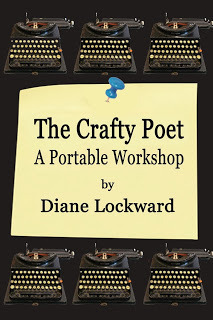 Click Cover for Amazon 1. The Crafty Poet: A Portable Workshop, by Diane Lockward, Wind Publications, 2013
This book includes craft tips, model poems, and prompts based on the craft elements in the model poems. In addition, each of the ten sections includes a Q&A with one poet about the craft elements in a single poem. Each section ends with a short bonus prompt that can be used over and over again. The material is organized by craft concepts such as Diction, Imagery / Figurative Language, Line / Stanza, and Syntax. Fifty-six poets, including 13 former and current state poets laureate, contributed the craft tips, model poems, and Q&As. An additional 45 accomplished poets contributed sample poems written to the prompts, two for each prompt. The book is craft-oriented and is ideal for classroom, workshop, or individual use. Of the three titles recommended here, this one places the most emphasis on craft.
Named a Best Book for Writers by Poets & Writers Magazine
In this resource for poets, Lockward offers practical advice and insights about establishing sound, voice, and syntax in poetry while also providing writing prompts and other poems as inspiration.
Comments:
I received your The Crafty Poet in the mail today and found that I was only a few pages in when I was compelled to go get a pen. Not sure why, since I just held it in my hand while I read, but I'm pretty sure it had something to do with sitting down to a feast without a fork.
—Jane Ebihara
Writers and teachers of writing: If you’re looking for a book that illuminates the nuances of poetic craft, then you’ll find The Crafty Poet to be a terrific teaching tool. It’s also a powerful text for individuals seeking to break through creative blocks. You’ll encounter model poems with accompanying prompts, interviews with poets, discussions of process and inspiration, and more.
—Caitlin Doyle
This book has a spectacular array of model poems and information from poets on how they see the craft. It will get you writing and it will help you keep on writing poems.
—Sheila Bender
Sample Bonus Prompt
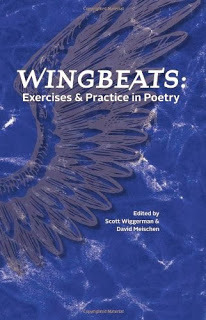 Click Cover for Amazon2. Wingbeats: Exercises & Practice in Poetry, edited by Scott Wiggerman and David Meischen, Dos Gatos Press, 2011
This is a collection of sixty-one prompts contributed by fifty-eight poets, including Naomi Shihab Nye, Ellen Bass, and Oliver de la Paz. The book is organized into seven sections under such concepts as Springboards to Imagination, Exploring the Senses, and Structure and Form. The exercises range from quick and simple to involved and multi-layered. Prompts include such intriguing titles as "Metaphor: Popcorn, Popcorn, Leaping Loud," "Aping the Masters: Poems in Imitation," and "My Mother's Clothes." The book's focus is on prompts, but most of them are preceded by some discussion regarding purpose and benefits; you will find some craft material included in those discussions. The contributing poets were asked to follow a suggested format, so you will find clear step-by-step instructions and sample poems that were written to the exercises. Ideal for the classroom, workshop, or individual writing space.
Comments:
Wingbeats is a fabulous toolbox of innovative and practical ideas that literally every teacher of poetry workshops and at every level, from elementary poets-in-the-schools through the graduate MFA, will find indispensable. Covering a vast range from image to sound to form, the exercises are all concrete and clearly presented—a marvelous way to mine the imaginations and experiences of today’s most dynamic poets. Invaluable!
—Cole Swensen
No teacher, no aspiring poet should be without the gentle guidance of this book.
—Gabriele Rico
This is sophisticated play. I found exercises that have taken me beyond my ordinary patterns and limitations. Wingbeats will get your pen moving.
—The Coachella Review
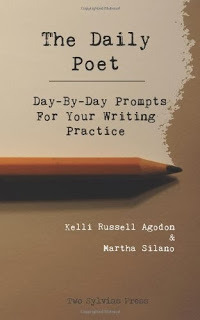 Click Cover for Amazon3. The Daily Poet: Day-by-Day Prompts for Your Writing Practice, by Kelli Russell Agodon and Martha Silano, Two Sylvias Press, 2013
The 365 prompts in this collection were all written by the two authors, both of them well-published poets. The book evolved out of several years of their regular writing dates during which they challenged each other with prompts. The book is arranged like a calendar with one prompt for every day of the year, though the user is free to skip around. Quite a few of the prompts begin with a reference to some historical event that occurred on that day. While the book is strictly brief prompts, many of them ask you to employ craft elements. This book is suitable for a beginning poet or one with a lot of experience but in search of some new ideas. It can be used in a classroom to supplement assignments, in workshop groups, or at home by the poet working alone.
Recommended by The Huffington Post Books:
. . . you could use The Daily Poet year after year and track how your writing evolves. Or you can just crack open the book, pick one out at have at it. They're all equally thought provoking.
Comments:
I see this as an investment in writing exercises for many years over as you can use the same prompt at different times and find it will take you different places. It's my recommendation that you add it to your own library and enjoy the journey.
—Michael Wells
The variety of prompts also encouraged creative exploration of topics I might not have considered fertile ground for poetry (candy cigarettes, anyone?). For me, this is the book’s greatest gift to its user: its power to dig deep inside the rabbit holes of your poet’s brain and/or subconscious and pull out work that might never have been pulled out without it.
—Molly Spencer
Whether you write to prompts on your own or you use them when you meet with writing groups or with a friend at a coffee shop, there is something here for everyone.
—Donna Vorreyer
Sample Prompt
If you need to select just one of these books, I hope I've given you enough of a description that you can choose. But what I really hope is that you will choose all three.
December 3, 2013
Bits & Pieces of This & That
The new issue of Valparaiso Poetry Review has now been posted. As always, you’ll find lots of good reading in this journal. This issue includes the work of 36 poets, one of whom is me. Here’s the entire list:
Elly Bookman, Jared Carter, Stephen Cloud, Kelly Cressio-Moeller, Barbara Crooker, Katherine Sanchez Espano, William Ford, Kate Fox, Kalima Hamilton, Kathleen Hellen, Elise Hempel, Graham Hillard, Edison Jennings, Michael Johnson, Jen Karetnick,
Sandra Kohler, Liz Langemar, Mercedes Lawry, Laurence Lieberman, Frannie Lindsay, Diane Lockward, Kim Lozano, David Mason, Rose McLarney, Judith H. Montgomery, John A. Nieves, April Ossmann, Colin Pope, Connie Post, Doug Ramspeck, Robin Richstone, Lee Rossi, John Ruff, Joannie Stangeland, Larry D. Thomas, Charles Harper Webb
My poem is Sinkholes. Check it out.
I was pleased to find my new book, The Crafty Poet: A Portable Workshop , as one of nine recommended titles on Poetry Super Highway’s Holiday Gift List. It makes me very happy to know that my book has made it into the hands of other poets and that they, in turn, are recommending it to still other poets.

 Click HERE for Amazon
I do a few back flips (mentally, that is) each time I hear that the book is stimulating the writing of new poems. This tweet from Julie Brooks Barbour put a smile on my face: "Thanks to The Crafty Poet by @Dianelock, I drafted a poem this morning."
 White Elephant Contemporary Poetry Gift ExchangeAs if all that weren’t enough good news, it seems that The Crafty Poet took part in the 3rd Annual White Elephant Contemporary Poetry Gift Exchange in Arizona, led by poet and teacher Shawnte Orion. Shawnte wrote about the event at his blog, Battered Hive. Here’s what he wrote about The Crafty Poet:
I also gave away a copy of Diane Lockward's portable workshop The Crafty Poet which includes insight and writing exercises from 56 top poets and two sample poems for each prompt so you can see what other poets come up with. I didn't read my poem that was one of the sample poems based on the Richard Jones’ prompt. But I did read Cecilia Woloch's “Fireflies” and Jeffrey McDaniel's
Compulsively Allergic to the Truth
I'm sorry I was late.
I was pulled over by a cop
for driving blindfolded
with a raspberry-scented candle
flickering in my mouth.
I'm sorry I was late.
I was on my way
when I felt a plot
thickening in my arm.
I have a fear of heights.
Luckily the Earth
is on the second floor
of the universe.
I am not the egg man.
I am the owl
who just witnessed
another tree fall over
in the forest of your life.
I am your father
shaking his head
at the thought of you.
I am his words dissolving
in your mind like footprints
in a rainstorm.
I am a long-legged martini.
I am feeding olives
to the bull inside you.
I am decorating
your labyrinth,
tacking up snapshots
of all the people
who've gotten lost
in your corridors.
Jeffrey's poem is one of the model poems in The Crafty Poet. It is followed by a prompt based on the poem and two sample poems written to the prompt.
November 25, 2013
The Poet on the Poem: Susan Laughter Meyers
I am happy to feature Susan Laughter Meyers as my guest on The Poet on the Poem. I am confident that you will enjoy her poem and her comments about it.

Susan Laughter Meyers is the author of My Dear, Dear Stagger Grass, released in August 2013 as the inaugural winner of the Cider Press Review Editors Prize. Her first book Keep and Give Away (University of South Carolina Press, 2006) received the South Carolina Poetry Book Prize, the Southern Independent Booksellers Alliance (SIBA) Book Award for Poetry, and the Brockman-Campbell Book Award. Her chapbook Lessons in Leaving (1998) won the Persephone Press Book Award. Her poetry has been published in numerous journals, including The Southern Review, Prairie Schooner, and Crazyhorse, as well as on the online sites Poetry Daily, Verse Daily, and Ted Kooser’s American Life in Poetry column.
Today's poem comes from My Dear, Dear Stagger Grass.
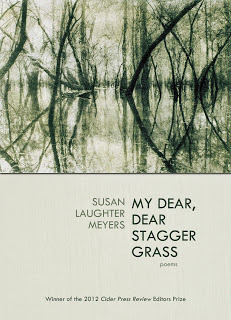 Click Cover for Amazon
Coastland
When the wind gets up and the water rises,
those who live on higher ground, at a distance
from the pinched smell of pluff mud,
from spartina marshes and swamps of cypress knees,
upland from the tannin-black tributaries
where through the bottoms, among the wet-footed
spider lilies, one barred owl
calls another, one to the other till there’s little left to say,
upland from the cottonmouth and the brown water snake
coiled and rooted by the tupelo
and the alligators logging across the slough,
upland from the deer hound pens full of yelps—
full of naps and pacing, full of cedar-thicket dreaming—
and the dirt yard’s milling of gray cats
and striped kittens yawning by the palmettos,
upland from the sea sky sea—the horizon
a fine line polished away—
from the shrimp boats shrinking smaller and smaller
on their way to their serious work of gathering,
from the smooth, quick balancing act
of the sun—heavy and orange—riding the waves,
upland from salt myrtle and the season’s second growth
of trumpet honeysuckle, those who live at a distance
from the band of quick, dark clouds blooming at sea,
upland from the bang and whirl, clatter
and shake of the wind when it’s up,
those who live on higher ground ask
of those who live by the flats and shoals,
the shallows and bogs, Why, and again, Why, O why.
DL: The diction in your poem is wonderful, e.g., pluff mud, spartina marshes, wet-footed spider lilies, salt myrtle, trumpet honeysuckle. How did you acquire all these succulent words? Did they appear in your first draft or did you add them to the poem during revision?
SLM: From the poem’s inception I knew during the whole process of writing it that I would be knee-deep in language and sound. Just now I went back to look at the first draft—there were twenty-six drafts—and from the start the poem included image after image from the natural world; but of the ones you pointed out, only the trumpet honeysuckle was in the first draft. By draft three, though, the pluff mud and spartina marshes were there, as well as the spider lilies—though they weren’t wet-footed yet. So it was an early, but gradual, process—the accretion of language and imagery—and it’s a boon to us poets that the names for native flora and fauna are rich in sound.
DL: I very much admire the way you've succeeded in animating the setting. Tell us how you created the sense of motion and energy that pervades the poem.
SLM: I wrote the poem not long after the active hurricane season of 2005, the year of Hurricanes Katrina and Rita among others. So the sheer energy of the storms was still with me. Despite the danger from hurricanes, the love for the lowlands and the wild beauty there persisted in my mind. More than once I’ve been in the situation of whether or not to evacuate—and if so, when—and it’s hard to leave, despite the danger. In the poem I wanted to show the attachment to the land, to a way of life, to the wild and even the less-than-beautiful aspects of the coastal plains.
Most of the images that came to mind as I was writing have their own motion of some kind—the snakes and alligators, the owls, the shrimp boats at work—that energy plus the force of the wind in the poem, always the wind—well, all of these, together with the fear, attachment, and uncertainty stirred up by the storm at hand, contributed to my own sense of agitation and unrest. And I hope that the swirling energy was conveyed.
DL: One of the feats of this poem is its syntax. How difficult was it to get one long sentence to sustain the entire poem? Tell us, also, about the function of the dashes.
SLM: I love what syntax can do in a poem, its ability to indicate not just sequence but also hierarchy and relationships, its role in manipulating the rhythm and pacing. Syntax is truly like a conductor leading an orchestra. Because “Coastland” consists of a sustained list, it felt natural for it to be one long, convoluted sentence. I wanted the movement of the poem to be somewhat like a spring that uncoils, a movement that seemed fitting for a poem of wind. As you can tell, too, I’m fond of dashes. I often use them to interrupt myself or to set off an explanatory phrase, sometimes for the extra-long pause that I’m aiming for. Other times I use them because I’ve already used commas, and further commas to set off the phrase or clause would simply be confusing.
DL: Your use of anaphora is hypnotic and all the more impressive because it occurs within one long sentence. The repetition of "upland from" and "from the" scattered throughout the poem adds speed and intensity. How did you decide how much was enough and not too much?
SLM: I did play around with that as I revised, but actually the frequency of those repetitions settled in sooner than I expected, probably because I kept reading the poem aloud. That’s the only way I can make those sorts of decisions, to hear the rhythms and patterns sounded out in different ways. While I’m reading my poems aloud, I hold my hand up close in front of my mouth as I read so that the sound bounces back to my ears. Then, and only then, can I begin to tell what is and isn’t working.
DL: Although there's no end rhyme, you make the poem sing with other sound devices—alliteration, assonance, consonance, and monosyllabic words. Tell us about the craft decisions that resulted in the poem's music.
SLM: I try to follow sound whenever I can. Thus, when I make diction choices, they’re often based on sound. The more I do this, the more it becomes natural to me. As a result, my ear is becoming more attuned to sound patterns. Reading the poem aloud comes into play, too. One example from the poem is those spider lilies mentioned earlier. In an early draft the image focused on “the spider lilies’ white thin stars,” referring to the narrow-leaved white flowers of native spider lilies that grow in swamps and along the edges of rivers. I liked the description of the flowers, but the image didn’t seem to do anything for the sound and rhythm of the poem. Eventually the wording became “the wet-footed / spider lilies,” which meant a loss of the flowers as stars but a gain of the rhythm and sound repetition in “wet-footed.” That’s the kind of change I’ll make for the sake of a poem’s music.
My reading directly affects my craft decisions, too. I seek out poems by other poets that are musical, hoping to learn from them. There are so many decisions to make! Thank goodness, many of them are ones we’re not even conscious of when we make them. Some of those good, unnoticed decisions derive from the bones of our writing practice—and old failed poems.
***************
Readers, please listen to Susan's reading of her poem.

Susan Laughter Meyers is the author of My Dear, Dear Stagger Grass, released in August 2013 as the inaugural winner of the Cider Press Review Editors Prize. Her first book Keep and Give Away (University of South Carolina Press, 2006) received the South Carolina Poetry Book Prize, the Southern Independent Booksellers Alliance (SIBA) Book Award for Poetry, and the Brockman-Campbell Book Award. Her chapbook Lessons in Leaving (1998) won the Persephone Press Book Award. Her poetry has been published in numerous journals, including The Southern Review, Prairie Schooner, and Crazyhorse, as well as on the online sites Poetry Daily, Verse Daily, and Ted Kooser’s American Life in Poetry column.
Today's poem comes from My Dear, Dear Stagger Grass.
Click Cover for AmazonCoastland
When the wind gets up and the water rises,
those who live on higher ground, at a distance
from the pinched smell of pluff mud,
from spartina marshes and swamps of cypress knees,
upland from the tannin-black tributaries
where through the bottoms, among the wet-footed
spider lilies, one barred owl
calls another, one to the other till there’s little left to say,
upland from the cottonmouth and the brown water snake
coiled and rooted by the tupelo
and the alligators logging across the slough,
upland from the deer hound pens full of yelps—
full of naps and pacing, full of cedar-thicket dreaming—
and the dirt yard’s milling of gray cats
and striped kittens yawning by the palmettos,
upland from the sea sky sea—the horizon
a fine line polished away—
from the shrimp boats shrinking smaller and smaller
on their way to their serious work of gathering,
from the smooth, quick balancing act
of the sun—heavy and orange—riding the waves,
upland from salt myrtle and the season’s second growth
of trumpet honeysuckle, those who live at a distance
from the band of quick, dark clouds blooming at sea,
upland from the bang and whirl, clatter
and shake of the wind when it’s up,
those who live on higher ground ask
of those who live by the flats and shoals,
the shallows and bogs, Why, and again, Why, O why.
DL: The diction in your poem is wonderful, e.g., pluff mud, spartina marshes, wet-footed spider lilies, salt myrtle, trumpet honeysuckle. How did you acquire all these succulent words? Did they appear in your first draft or did you add them to the poem during revision?
SLM: From the poem’s inception I knew during the whole process of writing it that I would be knee-deep in language and sound. Just now I went back to look at the first draft—there were twenty-six drafts—and from the start the poem included image after image from the natural world; but of the ones you pointed out, only the trumpet honeysuckle was in the first draft. By draft three, though, the pluff mud and spartina marshes were there, as well as the spider lilies—though they weren’t wet-footed yet. So it was an early, but gradual, process—the accretion of language and imagery—and it’s a boon to us poets that the names for native flora and fauna are rich in sound.
DL: I very much admire the way you've succeeded in animating the setting. Tell us how you created the sense of motion and energy that pervades the poem.
SLM: I wrote the poem not long after the active hurricane season of 2005, the year of Hurricanes Katrina and Rita among others. So the sheer energy of the storms was still with me. Despite the danger from hurricanes, the love for the lowlands and the wild beauty there persisted in my mind. More than once I’ve been in the situation of whether or not to evacuate—and if so, when—and it’s hard to leave, despite the danger. In the poem I wanted to show the attachment to the land, to a way of life, to the wild and even the less-than-beautiful aspects of the coastal plains.
Most of the images that came to mind as I was writing have their own motion of some kind—the snakes and alligators, the owls, the shrimp boats at work—that energy plus the force of the wind in the poem, always the wind—well, all of these, together with the fear, attachment, and uncertainty stirred up by the storm at hand, contributed to my own sense of agitation and unrest. And I hope that the swirling energy was conveyed.
DL: One of the feats of this poem is its syntax. How difficult was it to get one long sentence to sustain the entire poem? Tell us, also, about the function of the dashes.
SLM: I love what syntax can do in a poem, its ability to indicate not just sequence but also hierarchy and relationships, its role in manipulating the rhythm and pacing. Syntax is truly like a conductor leading an orchestra. Because “Coastland” consists of a sustained list, it felt natural for it to be one long, convoluted sentence. I wanted the movement of the poem to be somewhat like a spring that uncoils, a movement that seemed fitting for a poem of wind. As you can tell, too, I’m fond of dashes. I often use them to interrupt myself or to set off an explanatory phrase, sometimes for the extra-long pause that I’m aiming for. Other times I use them because I’ve already used commas, and further commas to set off the phrase or clause would simply be confusing.
DL: Your use of anaphora is hypnotic and all the more impressive because it occurs within one long sentence. The repetition of "upland from" and "from the" scattered throughout the poem adds speed and intensity. How did you decide how much was enough and not too much?
SLM: I did play around with that as I revised, but actually the frequency of those repetitions settled in sooner than I expected, probably because I kept reading the poem aloud. That’s the only way I can make those sorts of decisions, to hear the rhythms and patterns sounded out in different ways. While I’m reading my poems aloud, I hold my hand up close in front of my mouth as I read so that the sound bounces back to my ears. Then, and only then, can I begin to tell what is and isn’t working.
DL: Although there's no end rhyme, you make the poem sing with other sound devices—alliteration, assonance, consonance, and monosyllabic words. Tell us about the craft decisions that resulted in the poem's music.
SLM: I try to follow sound whenever I can. Thus, when I make diction choices, they’re often based on sound. The more I do this, the more it becomes natural to me. As a result, my ear is becoming more attuned to sound patterns. Reading the poem aloud comes into play, too. One example from the poem is those spider lilies mentioned earlier. In an early draft the image focused on “the spider lilies’ white thin stars,” referring to the narrow-leaved white flowers of native spider lilies that grow in swamps and along the edges of rivers. I liked the description of the flowers, but the image didn’t seem to do anything for the sound and rhythm of the poem. Eventually the wording became “the wet-footed / spider lilies,” which meant a loss of the flowers as stars but a gain of the rhythm and sound repetition in “wet-footed.” That’s the kind of change I’ll make for the sake of a poem’s music.
My reading directly affects my craft decisions, too. I seek out poems by other poets that are musical, hoping to learn from them. There are so many decisions to make! Thank goodness, many of them are ones we’re not even conscious of when we make them. Some of those good, unnoticed decisions derive from the bones of our writing practice—and old failed poems.
***************
Readers, please listen to Susan's reading of her poem.
November 16, 2013
The Crafty Poet Book Party
The book launch reading for The Crafty Poet: A Portable Workshop was held on Sunday, November 10, at the West Caldwell Public Library. We had a perfect day for it and a heart-warming turnout. A total of seventeen poets came to read. Here are some photos, in the order of the reading. I used the structure of the book to structure the reading.
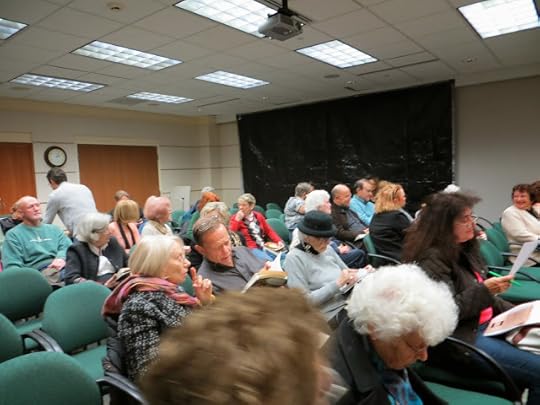
This is an early picture of the audience arriving. We had 52 people for an afternoon of poetry.
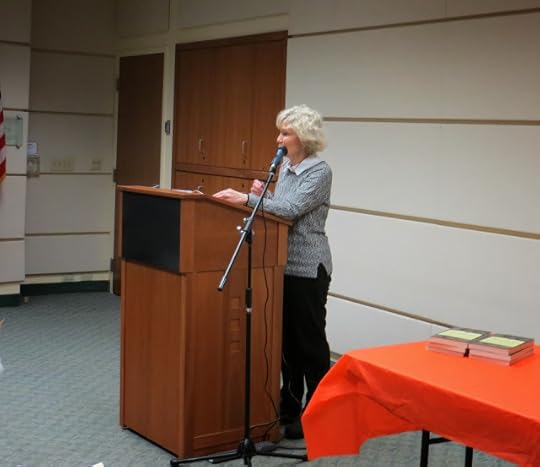 This is me, Diane, welcoming the audience and introducing the book.
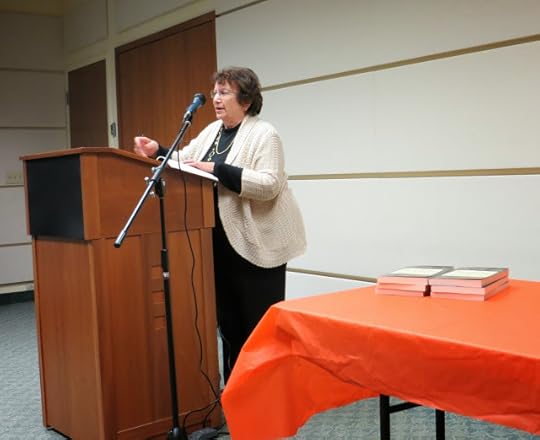 Section I. Generating Material / Using Time
Ann DeVenezia was our first poet. Here she reads "Waiting for My Friend," a sample poem
written to the prompt that accompanies Karin Gottshall's model poem, "More Lies."
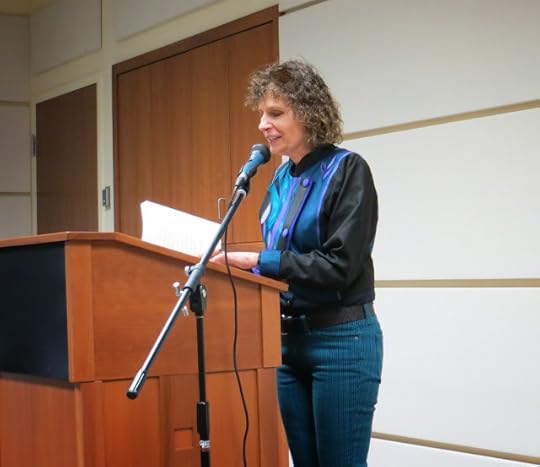
Section II. Diction
Susanna Rich reads "Radish," a sample poem written to the prompt that accompanies Rod Jellema's "Because I Never Learned the Names of Flowers." Susanna later also read "Gassing Up in New Jersey, Just Before Midnight."
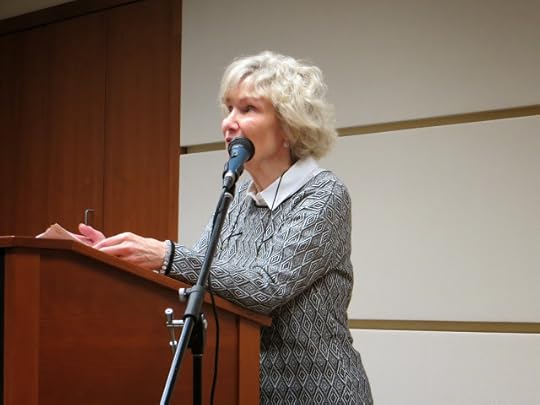 Me talking a bit about my Craft Tip, "Finding the Right Words." (I seem to be looking for them
on the ceiling.)
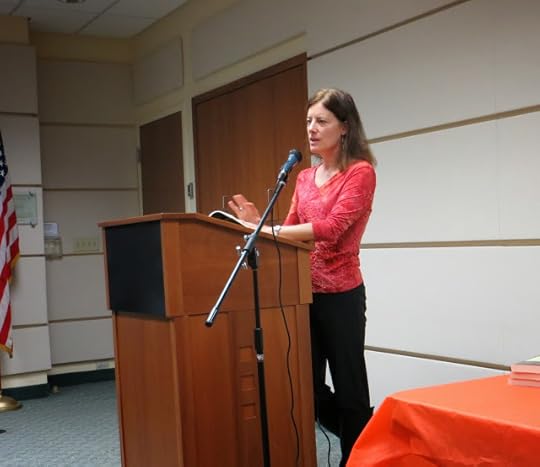 Tina Kelley reading "My Man, the Green Man," a sample poem written to the prompt
that accompanies Caitlin Doyle's model poem, "The Foley Artist's Apprentice." Tina later
also read "To the Inarticulate Man Who Tries."
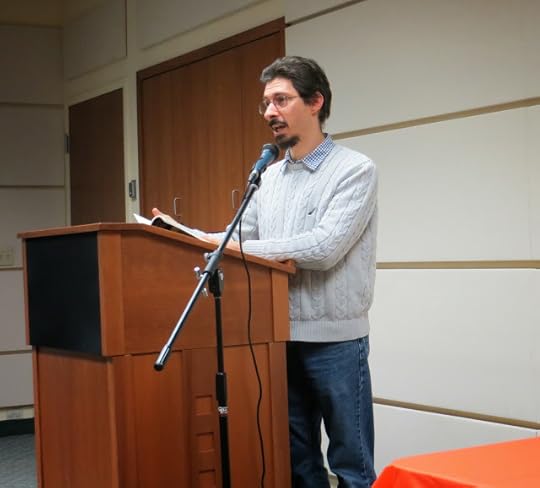
Michael T. Young reads "Advice from a Bat," a sample poem written to the prompt that
accompanies Amy Gerstler's model poem, "Advice from a Caterpillar."
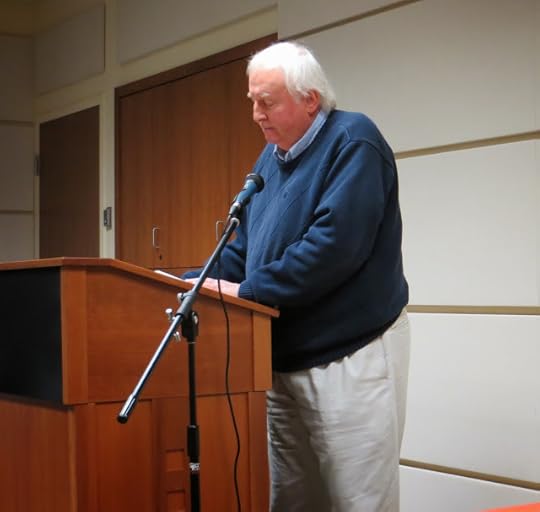 Section III. Sound Sandy Zulauf reads "Doctor Poets," a sample poem written to the prompt that accompanies
Suzanne Zweizig's model poem, "American Supermarket Idyll." Sandy will present his poem
and the book as a gift to his doctor on his next visit.
 Section IV. VoiceJoel Allegretti reads his acrostic poem, "In a Station," a sample poem written to the prompt
that accompanies Jeanne Marie Beaumont's acrostic, "After."
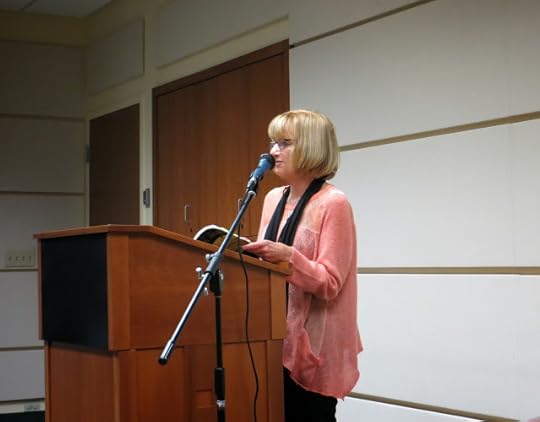
Gail Gerwin reads "Rosebuds Ungathered," another acrostic poem.
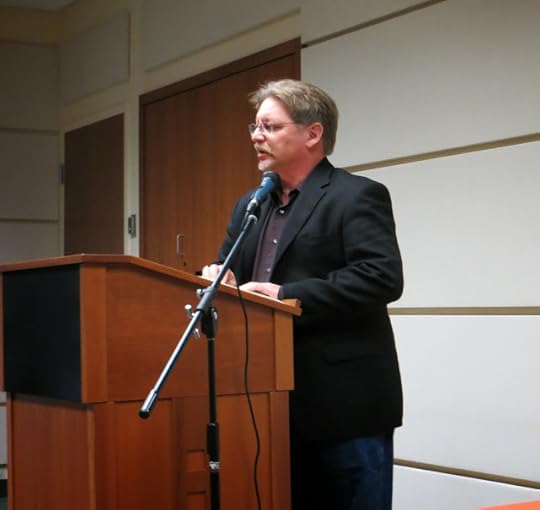 Ken Ronkowitz reads "Carpe Diem," a sample poem written to the prompt that accompanies
Jennifer Maier's model poem, "Post Hoc."
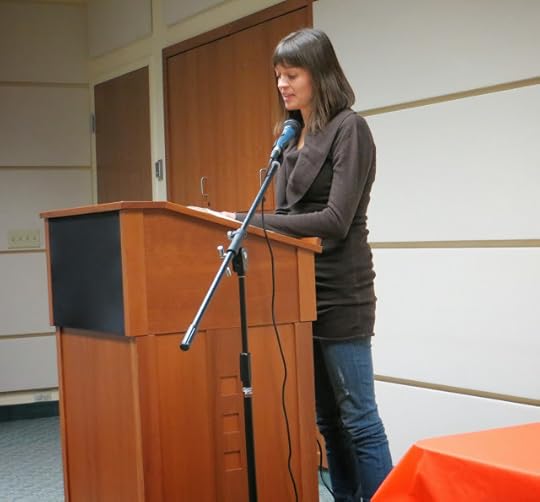 Section V. Imagery / Figurative LanguageBronwen Butter Newcott reads "Love," the model poem that begins this section.
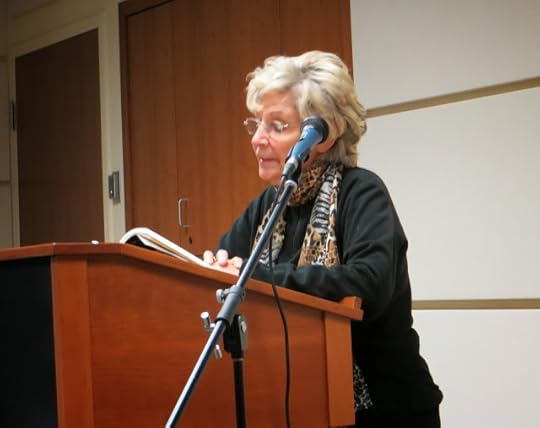 Wanda Praisner reads "After Love," the sample poem she wrote to the prompt for Bronwen's poem.
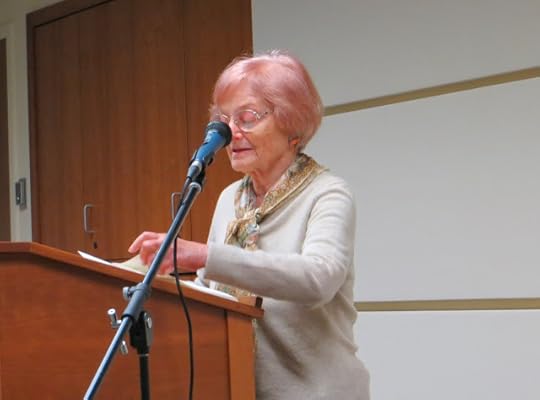 Section VI. Going Deep / Adding LayersCharlotte Mandel reads her poem, "Flood Washed," a sample poem written to the prompt for Stanley Plumly's model poem, "In Answer to Amy's Question What's a Pickerel."
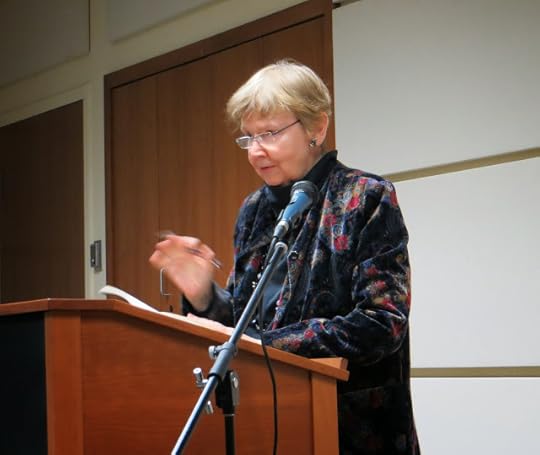
Broeck Blumberg reads "Grief Beyond Sorrow," her sample poem written to the prompt for Richard Jones' model poem, "White Towels."
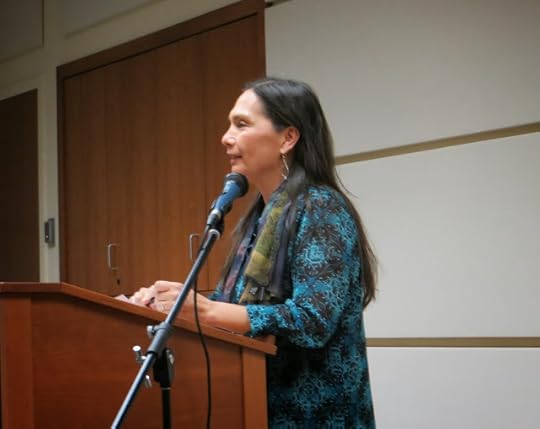
Section VII. Syntax Delaware Poet Laureate JoAnn Balingit discusses her craft tip, "The Promise of Syntax," and then reads one of her poems illustrating a syntactical device.
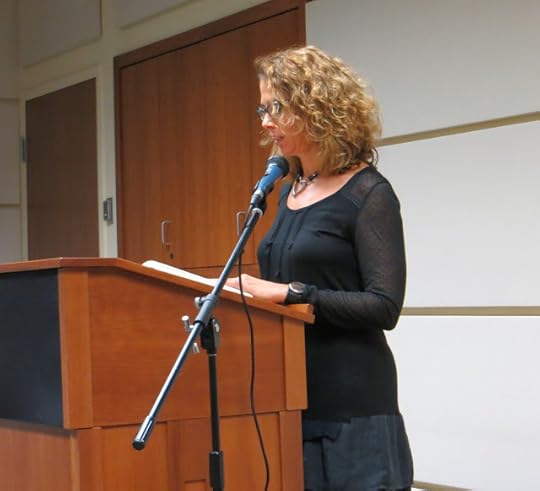
Section VIII. Line / StanzaMarie-Elizabeth Mali reads "Second Year of Marriage," the model poem that begins this section.
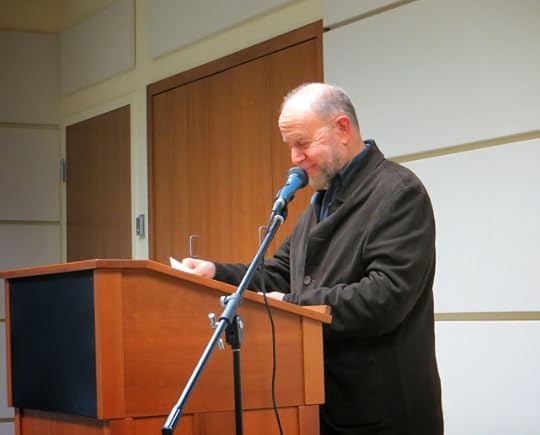 Basil Rouskas reads "Scents of Summer," a poem that he wrote using the prompt based on Marie-Elizabeth's poem.
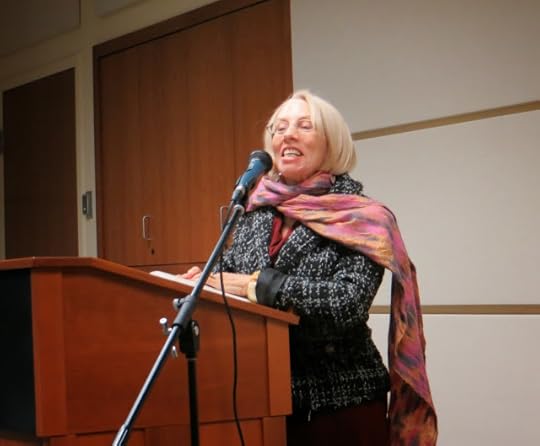 Section IX. RevisionLaura Freedgood reads "Breakfast in Patmos," a sample poem written to the prompt
that accompanies Adele Kenny's poem, "Snake Lady."
Section X. Writer's Block / RecyclingWe didn't have any poets present for this section, but we hope we sent everyone home
with lots of enthusiasm for revising poems and writing new ones.
Following the reading we had a reception with homemade cookies made by me—brownies, white chocolate chip and chocolate chip cookies, toffee delites, date nut bars, and lemon love notes. While people munched and talked poetry, I signed books which felt like a perfect way to end the party.
The Crafty Poet is available HERE.
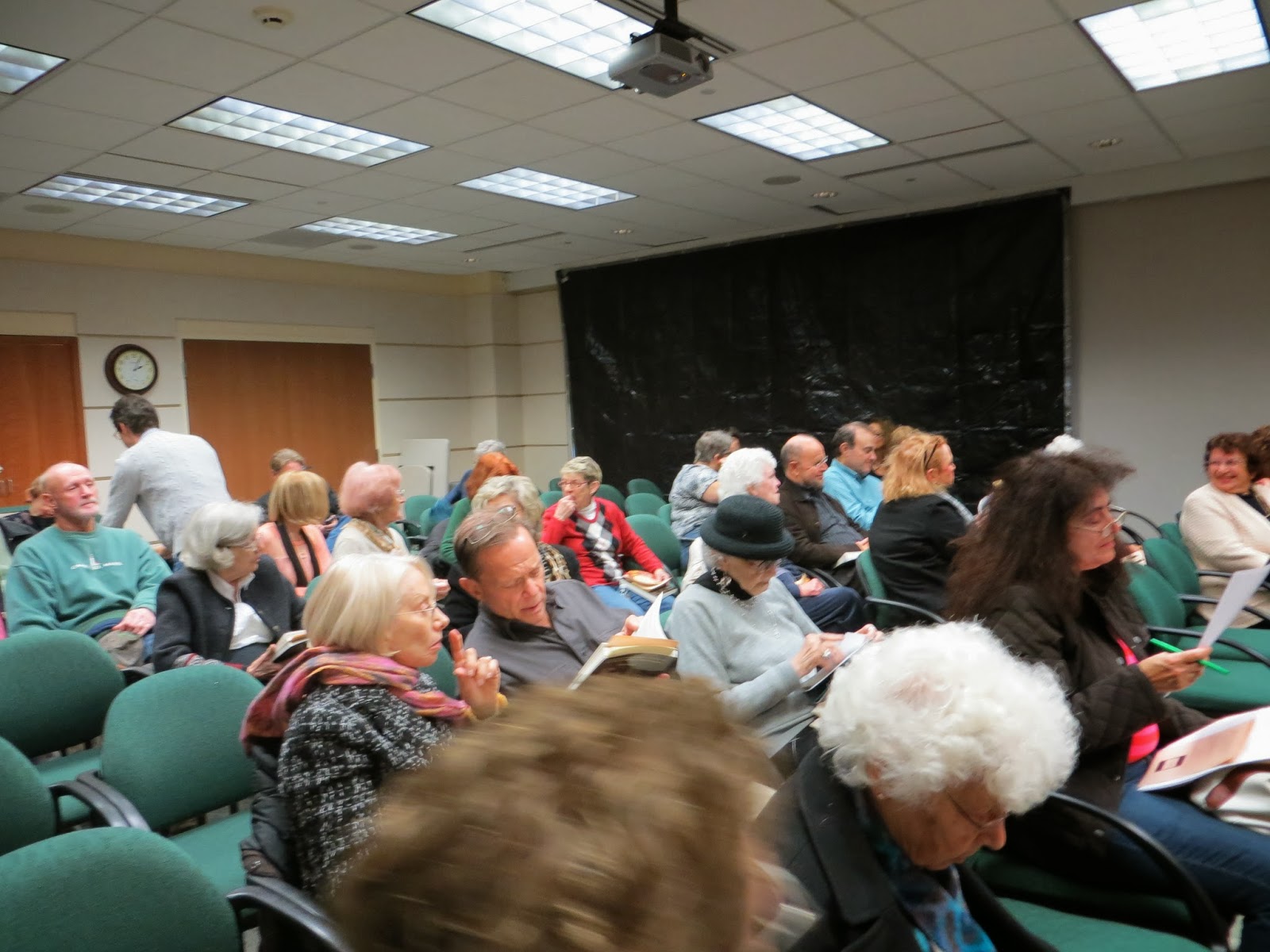
This is an early picture of the audience arriving. We had 52 people for an afternoon of poetry.
 This is me, Diane, welcoming the audience and introducing the book.
 Section I. Generating Material / Using Time
Ann DeVenezia was our first poet. Here she reads "Waiting for My Friend," a sample poem
written to the prompt that accompanies Karin Gottshall's model poem, "More Lies."

Section II. Diction
Susanna Rich reads "Radish," a sample poem written to the prompt that accompanies Rod Jellema's "Because I Never Learned the Names of Flowers." Susanna later also read "Gassing Up in New Jersey, Just Before Midnight."
 Me talking a bit about my Craft Tip, "Finding the Right Words." (I seem to be looking for them
on the ceiling.)
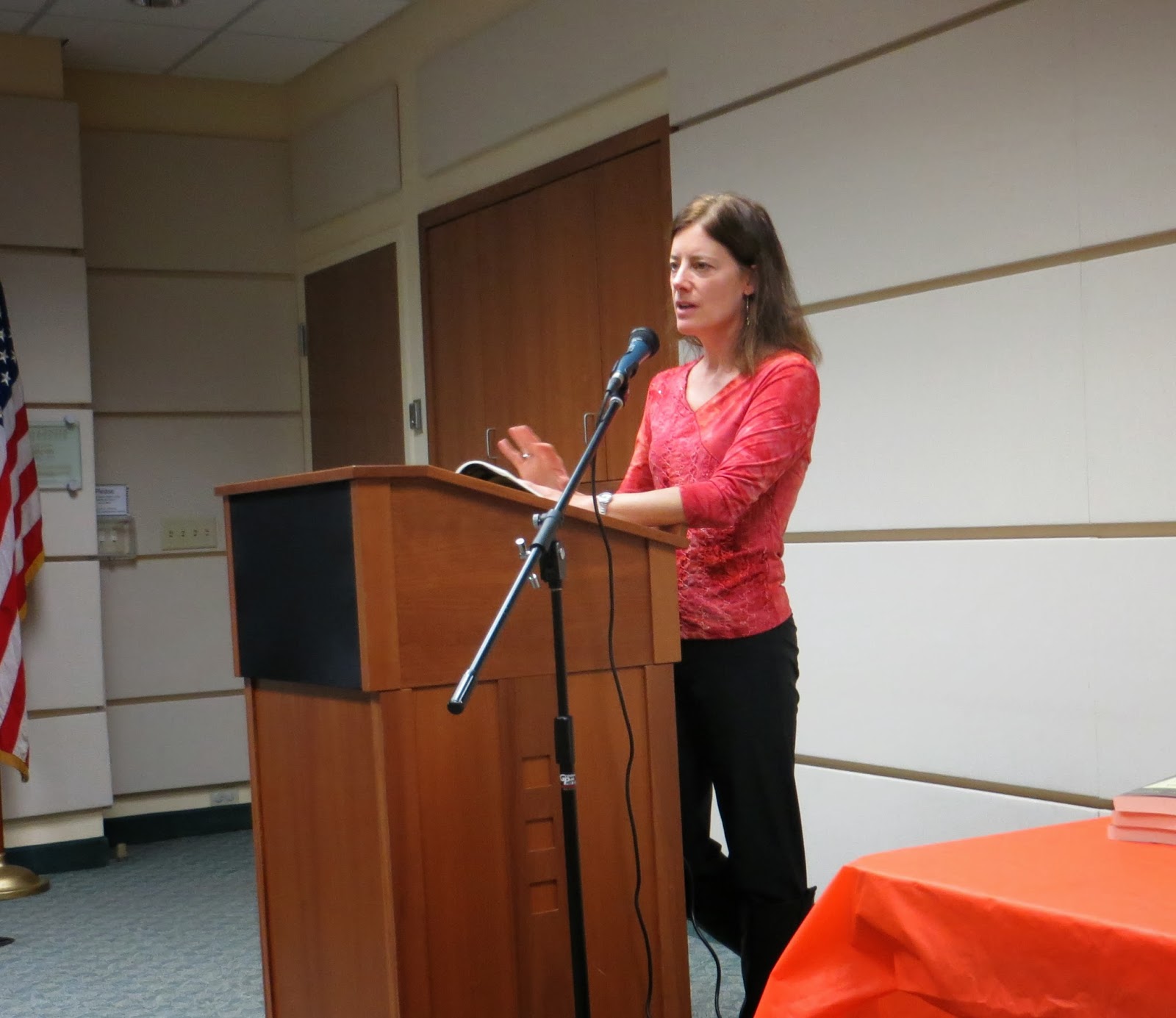 Tina Kelley reading "My Man, the Green Man," a sample poem written to the prompt
that accompanies Caitlin Doyle's model poem, "The Foley Artist's Apprentice." Tina later
also read "To the Inarticulate Man Who Tries."
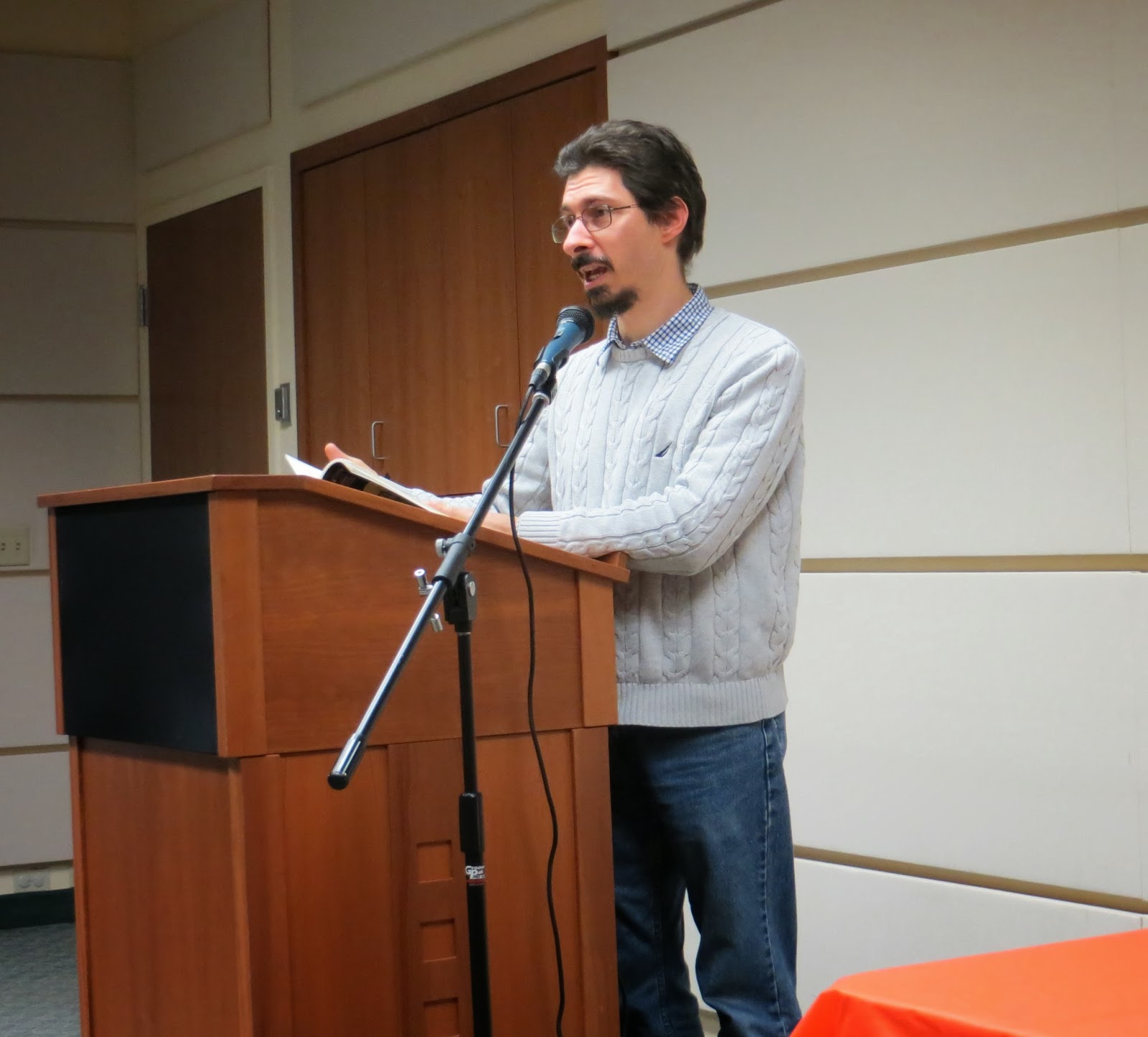
Michael T. Young reads "Advice from a Bat," a sample poem written to the prompt that
accompanies Amy Gerstler's model poem, "Advice from a Caterpillar."
 Section III. Sound Sandy Zulauf reads "Doctor Poets," a sample poem written to the prompt that accompanies
Suzanne Zweizig's model poem, "American Supermarket Idyll." Sandy will present his poem
and the book as a gift to his doctor on his next visit.
 Section IV. VoiceJoel Allegretti reads his acrostic poem, "In a Station," a sample poem written to the prompt
that accompanies Jeanne Marie Beaumont's acrostic, "After."

Gail Gerwin reads "Rosebuds Ungathered," another acrostic poem.
 Ken Ronkowitz reads "Carpe Diem," a sample poem written to the prompt that accompanies
Jennifer Maier's model poem, "Post Hoc."
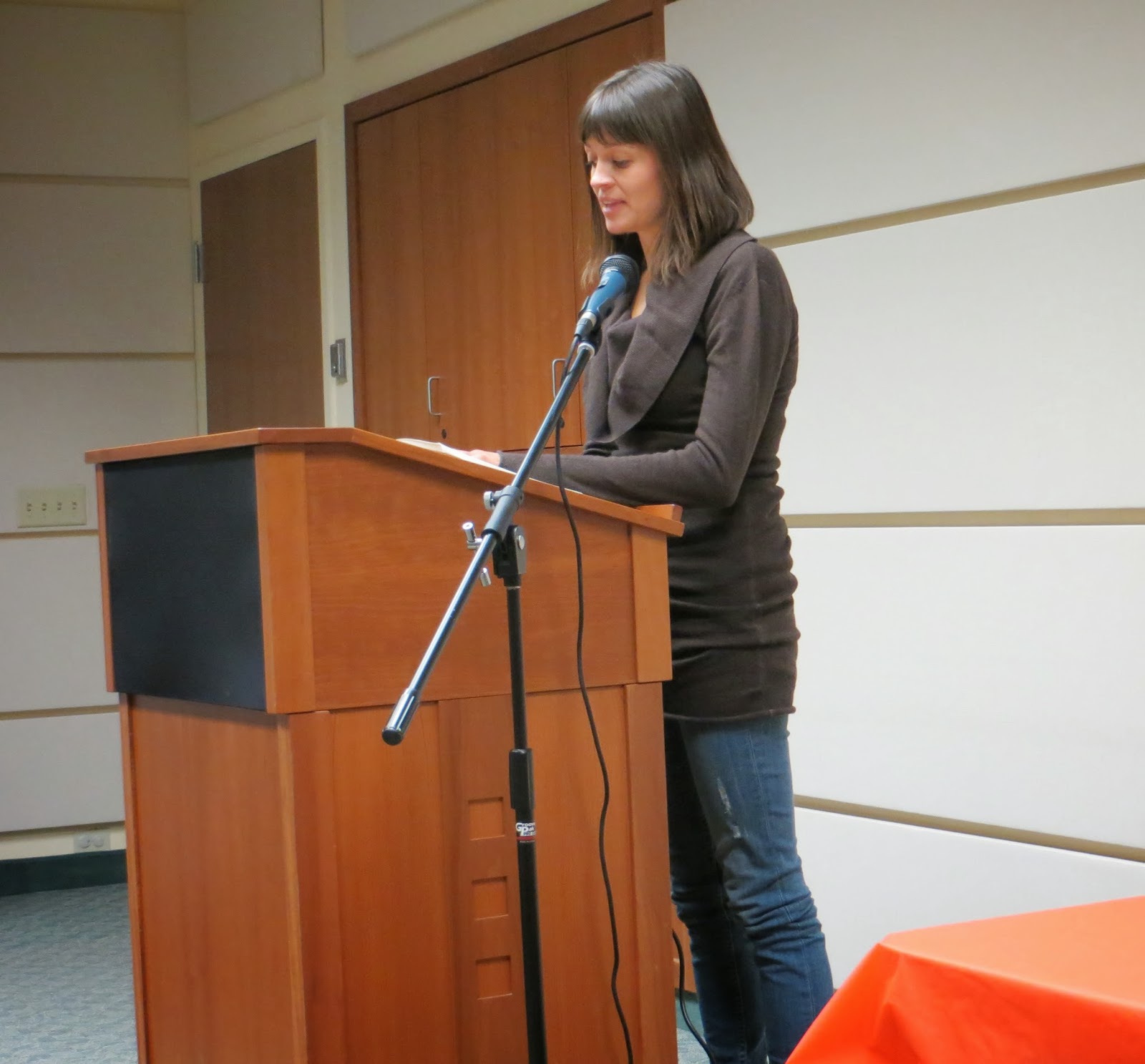 Section V. Imagery / Figurative LanguageBronwen Butter Newcott reads "Love," the model poem that begins this section.
 Wanda Praisner reads "After Love," the sample poem she wrote to the prompt for Bronwen's poem.
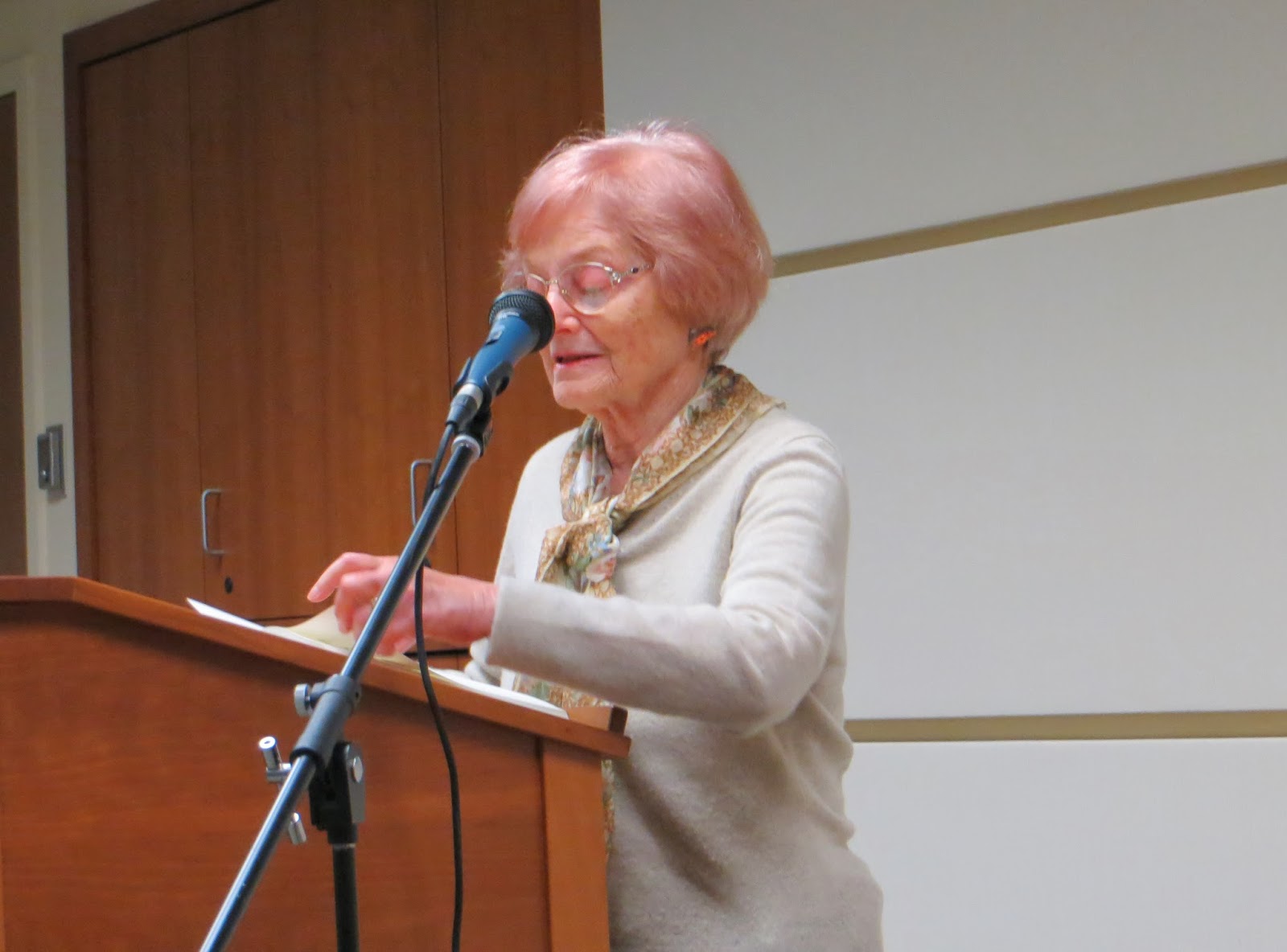 Section VI. Going Deep / Adding LayersCharlotte Mandel reads her poem, "Flood Washed," a sample poem written to the prompt for Stanley Plumly's model poem, "In Answer to Amy's Question What's a Pickerel."
Broeck Blumberg reads "Grief Beyond Sorrow," her sample poem written to the prompt for Richard Jones' model poem, "White Towels."
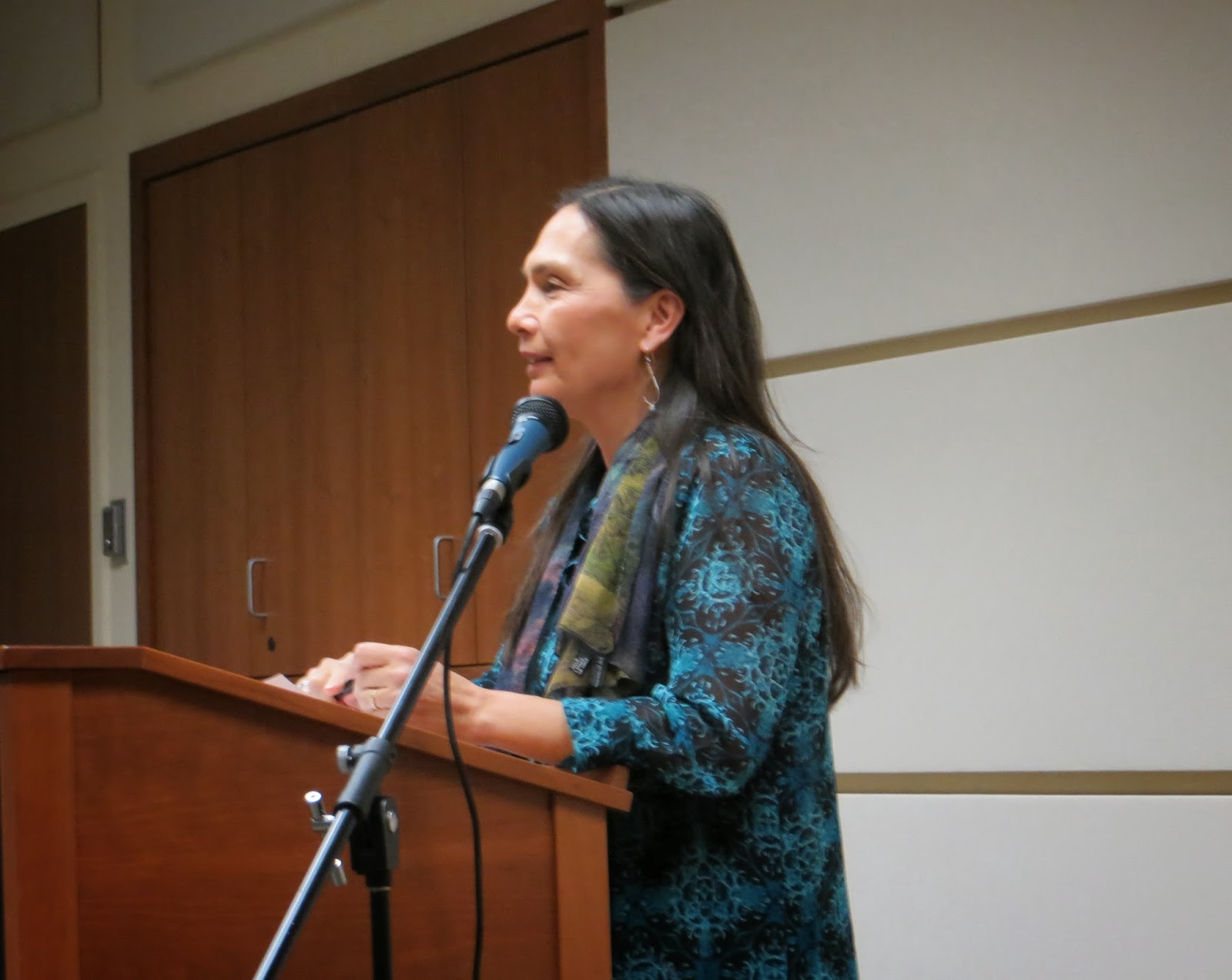
Section VII. Syntax Delaware Poet Laureate JoAnn Balingit discusses her craft tip, "The Promise of Syntax," and then reads one of her poems illustrating a syntactical device.

Section VIII. Line / StanzaMarie-Elizabeth Mali reads "Second Year of Marriage," the model poem that begins this section.
 Basil Rouskas reads "Scents of Summer," a poem that he wrote using the prompt based on Marie-Elizabeth's poem.
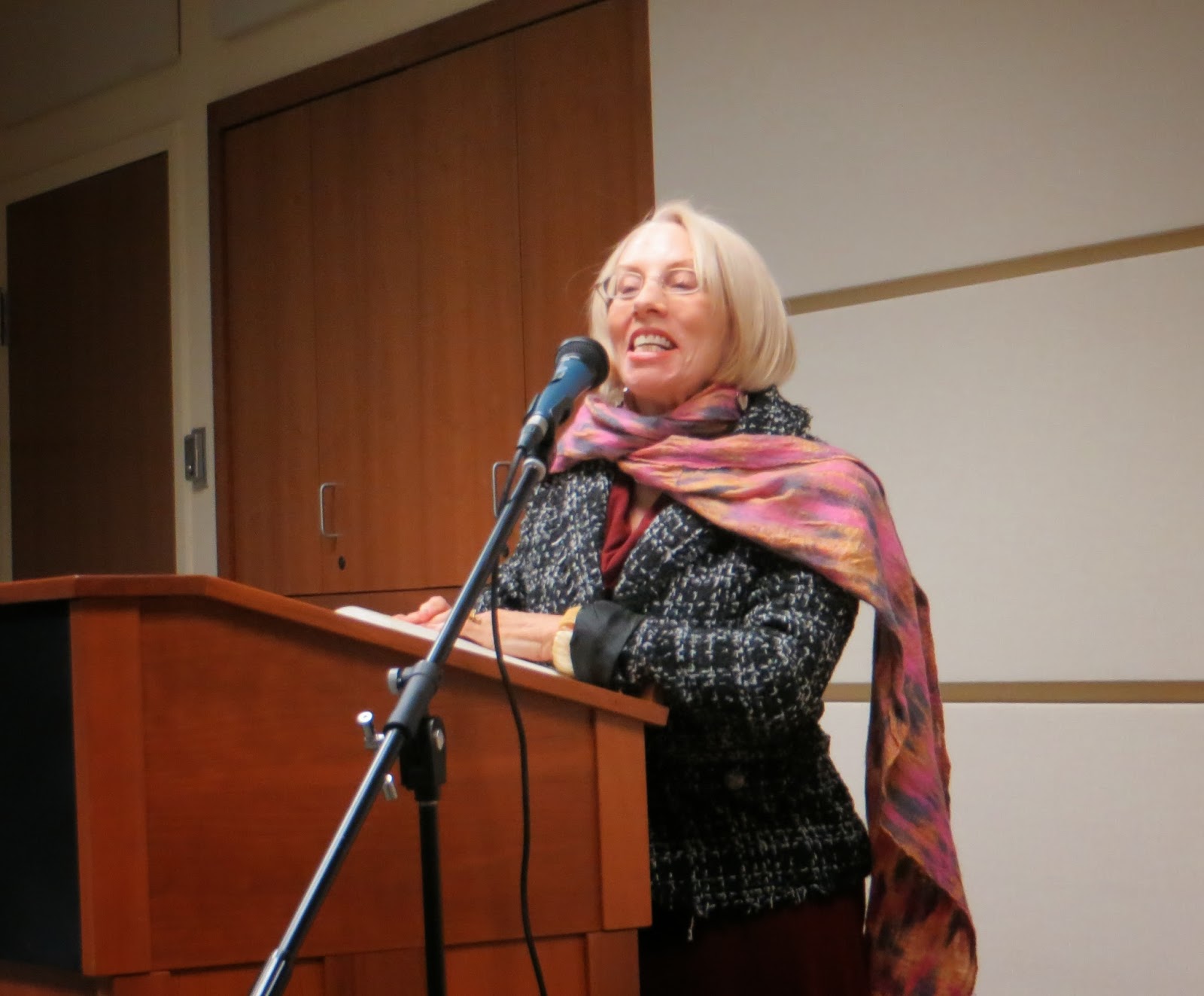 Section IX. RevisionLaura Freedgood reads "Breakfast in Patmos," a sample poem written to the prompt
that accompanies Adele Kenny's poem, "Snake Lady."
Section X. Writer's Block / RecyclingWe didn't have any poets present for this section, but we hope we sent everyone home
with lots of enthusiasm for revising poems and writing new ones.
Following the reading we had a reception with homemade cookies made by me—brownies, white chocolate chip and chocolate chip cookies, toffee delites, date nut bars, and lemon love notes. While people munched and talked poetry, I signed books which felt like a perfect way to end the party.
The Crafty Poet is available HERE.
November 11, 2013
Rejection Sunnyside Up

It happens to all of us, poets or otherwise, but more often to poets than to normal people. We get rejected. Someone slams the door in the face of our poems. Someone tells them they don't fit. There's no room at the inn. They're told to try again. They're wished good luck placing themselves elsewhere.
Part of the work of a poet is to put the work out into the world and hope it finds a good home. But before it does, the work usually comes slinking back several times. Nobody likes rejection, but it really shouldn't be a devastating blow. My submission mantra: It takes twenty rejections to get an acceptance. I don't mean of the same poem as I assume that we're all sending out multiple poems and to several different journals. Keeping my mantra in mind, that means that each rejection puts you one step closer to an acceptance.
While I don't like rejection, I generally don't get bummed out by it. There are many good homes out there; I look for another one. Just the other day I was going over my list of submissions. I went back several pages and came across a rejection that, in spite of my mantra, had annoyed me a bit because the editor had asked me to submit—and then rejected all six of the poems I'd sent. I tallied up the fate of those six poems. Here's what it looked like:
Two of the poems were accepted by Ithaca Lit. As a result of that publication, I was invited to be a guest editor for an upcoming issue. That turned out to be a wonderful experience.
Two of the poems were published by Connotation Press. One of those poems, a sestina, was subsequently accepted for a forthcoming anthology, Obsession: Sestinas for the 21st Century, edited by Carolyn Beard Whitlow and Marilyn Krysl, to be published in 2014 by University Press of New England (UPNE).
One of the poems was published by Innisfree Poetry Journal.
The sixth poem appears in the current issue of Rose Red Review and just received a Pushcart Prize nomination.
See what I mean? All six poems found homes elsewhere. Maybe the first editor didn't want or even like them, but some other editors did want and like them. Lesson? You know what the lesson is.
November 6, 2013
A Book Party and You're Invited
Please Join Us

Sunday, November 10
Book Launch and Reading
The Crafty Poet: A Portable Workshop
by Diane Lockward
Contributor Poets Reading
Joel Allegretti, JoAnn Balingit, Broeck Blumberg, Ann DeVenezia,
Laura Freedgood, Gail Fishman Gerwin, Tina Kelley, Adele Kenny,
Diane Lockward, Marie-Elizabeth Mali, Charlotte Mandel, Bronwen Newcott,
Wanda Praisner, Susanna Rich, Ken Ronkowitz, Basil Rouskas,
Nancy Scott, Michael T. Young, Sander Zulauf
West Caldwell Public Library
30 Clinton Rd.
West Caldwell, NJ
2:00 PM Free
Reception and Book Signing
973-226-5441