Jason S. DeRouchie's Blog, page 8
November 30, 2020
Zephaniah: A Bible Background Commentary
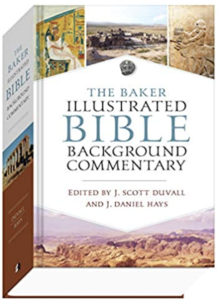
Those interpreting the Bible in the twenty-first century have the significant responsibility of building a bridge between the modern world and the ancient Word. Part of this process includes learning about the Bible’s historical and cultural context, most of which we can know from the Bible itself. Nevertheless, having ready-reference tools on hand can be very helpful when definition or other background information is needed.
Scott Duvall and Danny Hays teamed up again to edit the new Baker Illustrated Bible Background Commentary. I had the chance to write the short piece on “Zephaniah.” Apparently my first draft included more detail than they preferred, as the final version is significantly slimmed down from what I initially submitted. Nevertheless, I believe that this whole-Bible commentary should serve many as they seek answers to a passage’s historical-cultural context.
DeRouchie, Jason S. “Zephaniah.” Pages 676–79 in Baker Illustrated Bible Background Commentary. Edited by J. Scott Duvall and J. Daniel Hays. Grand Rapids: Baker Academic, 2000. /PDF/


November 28, 2020
How to Understand and Apply the Old Testament: Genre and Literary Units
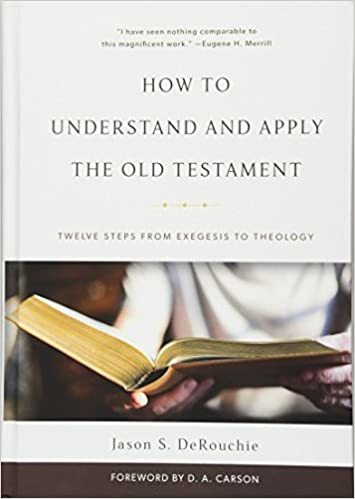
For the Church has posted their second and third blogs summarizing portions from my book, How to Understand and Apply the Old Testament. This first blog post summarizes step one in the exegetical process––Genre. Understanding genre is critical for rightly understanding the Bible’s message. As I explain in this blog article:
When assessing genre, the goal is to determine the literary form, subject matter, and function of your focus passage, to compare it to similar genres, and to consider the implications for interpretation. Genre refers to an identifiable category of literary composition that usually demands its own exegetical rules. In addition, different genres have different functions, with some existing to convey information or stir thoughts (e.g., laws and historical narratives) and others affecting and effecting certain behaviors, beliefs, and feelings (e.g., psalms and love songs). Accordingly, a misunderstanding of a work’s genre can lead to skewed interpretation. Our decisions at this point will color the rest of the interpretive process.
To read more from the article on Genre, click here.
The second blog post summarizes the step two of the journey from exegesis to theology––literary units and text hierarchy. Defining a text’s boundaries and distinguishing the primary from the supporting material is essential to rightly understanding a passage. I note in the blog post:
The limits of the passage could be a quotation, a paragraph, a story, a song, or even an entire book. The process of establishing literary units is not random, for the biblical authors wrote with purpose, logic, and order, creating groupings and hierarchies of thought to guide understanding. As a biblical interpreter, consider whether there is a clear beginning and end to your passage. Are there clues in the content and/or the grammar that clarify a passage’s boundaries? If you are unsure what any of this means, this blog post will help you out. Determining the boundaries of a passage can help you lead a Bible study, plan a series of Bible studies, or plan a preaching series. Before you can do any of these things, you have to know where to start and where to end.
For the whole article on Literary Units and Text Hierarchy, click here.
October 20, 2020
Creating a Text Hierarchy in the Hebrew Old Testament
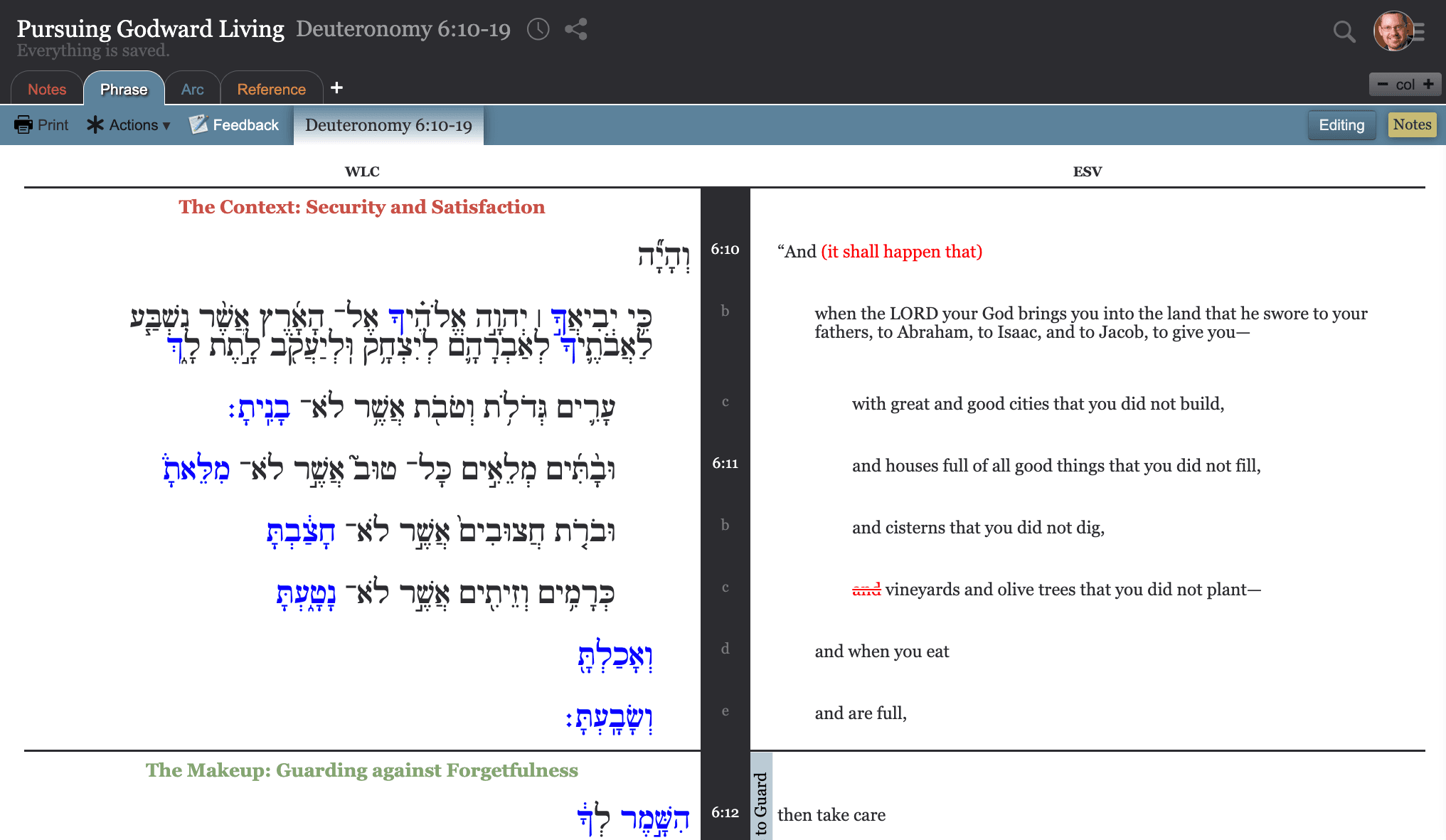
Biblearc.com is my top tool for visually tracking a biblical author’s flow-of-thought in order to determine a text’s boundaries, structure, and main idea. I use Biblearc.com’s phrasing module to create what I call a TEXT HIERARCHY of the thought-flow, and then I use the arcing module to visually identify the SEMANTIC RELATIONSHIPS between each of the clauses/propositions. I address my approach and these tools in three chapters within How to Understand and Apply the Old Testament:
Chapter 2: “Literary Units and Text Hierarchy”
Chapter 5: “Clause and Text Grammar”
Chapter 6: “Argument-Tracing”
The concept of Text Hierarchy grew out of my doctoral dissertation titled A Call to Covenant Love: Text Grammar and Literary Structure in Deuteronomy 5–11 (Gorgias, 2007). In this study I grew to recognize how the biblical authors use the Hebrew connector waw (often a coordinating conjunction) and asyndeton (i.e., the absence of any connection) to signal macro-structure within Hebrew prose. As a way of aiding my analysis, I generated text-hierarchies, which visually identify subordination and coordination in ways that highlight primary and supportive thought-lines. By creating a text hierarchy, the interpreter can demonstrate where units of text begin and end and which elements within that text are of greater significance than others from a grammatical perspective. The benefit of this method is that since it is a linguistic approach, it removes much of the guesswork when determining a passage’s main point, flow of thought, boundaries, and so on.
I recently gave a 50 minute guided discussion on this topic at Biblearc.com‘s Facebook Live page. For those wanting to learn how to create a text hierarchy in English or Hebrew, I encourage you to check out the video here. For PDFs of my Text Hierarchy and exegetical outline of Deuteronomy 6:10–19, follow this link.
//Video/PDF// Deuteronomy 6:10–19 Text Hierarchy and Outline
October 18, 2020
Interpreting Scripture and the Day of the Lord

DeRouchie, Jason S. “Interpreting Scripture: A General Introduction” and “The Day of the Lord,” The Gospel Coalition, 23 September 2020, https://www.thegospelcoalition.org/essay/interpreting-scripture-a-general-introduction/ and https://www.thegospelcoalition.org/essay/the-day-of-the-lord/.
*****
The Gospel Coalition has recently published 250 concise theology essays. You can read Phil Thompson’s announcement here.
I wrote two of them, and I offer my summaries below:
1. Interpreting Scripture: A General Introduction (Web / PDF)
This study clarifies why we must interpret Scripture, synthesizes what presuppositions should guide our interpretation, and offers a process for how to interpret. Scripture plays a foundational place in all of life, and Scripture itself stresses the need to faithfully interpret in order to stand unashamed before the Lord. Interpreting Scripture faithfully necessitates that we view Scripture as God’s Word, assumes that Scripture’s truths are knowable, requires that we respond appropriately, and demands that we engage in the task depending on God. The interpretive process is about personally discovering what God through his human authors intended the biblical text to mean and effect. It includes assessing, synthesizing, and applying God’s inerrant word by means of exegesis and theology––both the narrow activity of identifying and drawing out what God was actually saying through his human authors in specific passages and the broader activity of relating this message to God’s overarching purpose in redemption culminating in Christ, with specific application to our present situation. The move from exegesis to theology includes at least twelve interrelated steps: (1) genre, (2) literary units and text hierarchy, (3) text criticism, (4) translation, (5) clause and text grammar, (6) argument-tracing, (7) word and concept studies, (8, 9) historical and literary context, (10, 11, 12) biblical, systematic, and practical theology.
I hope the article is a blessing to you as you learn to treasure and understand God’s word more deeply.
2. The Day of the Lord (Web / PDF)
The Old Testament portrays the day of the Lord as punishment through overlapping images of cataclysm, war, and sacrifice; it highlights the day as renewal by emphasizing how God’s presence will rest on his people in the midst of a messianic Davidic reign. The New Testament then identifies Christ Jesus as the one who fulfills the ultimate day of the Lord, inaugurating it in his death and resurrection and consummating it at his second coming. For the elect, Jesus’s death signals the satisfaction of God’s wrath against sin, and his resurrection marks the start of the new creation. For non-believers, however, the day of the Lord’s wrath is still future, and it will come with cataclysm, war, and sacrifice, as the warrior God will enter into space and time to punish his enemy and to reconstitute right order, wherein he is exalted over all.
To read the rest of the article, click here.
I strongly encourage you to check out all the 250 essays. What a remarkable resource for the church worldwide! You can link to them here: https://www.thegospelcoalition.org/essays/.
September 20, 2020
How to Understand and Apply the Old Testament: A Blog Journey
For most, interpreting the initial three fourths of the Bible, the Old Testament, is a challenge. To help alleviate this problem, in 2017 I wrote How to Understand and Apply the Old Testament. Now, I am condensing each chapter from my book into a blog series on Midwestern Baptist Theological Seminary’s “For the Church” initiative. In total, there will be thirteen entries summarizing the introduction and each of the twelve main chapters the detail the journey from exegesis to theology. You can access the first post here. In this summary I lay out in broad terms the task of interpreting the Old Testament, the presuppositions that guide biblical interpretation, and reasons for why the Old Testament is important for Christians. I then overview the remainder of the book. This summary’s conclusion is my invitation to you:
Come with me on this journey of discovery and skill development. The following nine posts focus especially on the process of exegesis, whereas the final three posts will address theology. God-honoring worship is both the fuel and goal of every stage of biblical interpretation. So may your study result in practice and overflow in teaching that is filled with praise and proclamation—all for the glory of Christ and the good of his church among the nations.
You can access this blog here.
DeRouchie, Jason S. “How to Apply and Understand the Old Testament: An Introductory Journey of Discovery and Encounter,” For The Church, 14 September 2020, https://ftc.co/resource-library/blog-....
For other posts and resources related to How to Understand and Apply the Old Testament, see:
Andy and Jason Drive It Home: How to Understand and Apply the Old and New Testaments (May 18, 2017)
How to Understand and Apply the Old Testament: Twelve Steps from Exegesis to Theology (May 31, 2017)
Podcast Interview for How to Understand and Apply the Old Testament (Sept 6, 2017)
Lectures on How to Understand and Apply the Old Testament (June 24, 2019)
August 12, 2020
The Use of Leviticus 18:5 in Galatians 3:12

Though Christians often think of the book of Romans when Martin Luther and the doctrine of justification by faith come to mind, Luther himself claims to have fixated upon Galatians, calling it his very wife. At the heart of this important letter, Paul quotes Lev 18:5 and says, “The law is not of faith, rather ‘The one who does them shall live by them’” (Gal 3:12). In my latest article, I try my hand at explaining what Paul intends to communicate by quoting Lev 18:5. A summary of my conclusions runs as follows:
When Paul cites Leviticus 18:5 in Galatians 3:12, he is identifying how the Mosaic law-covenant, characterized as it was by “works of law” and not believing, brought death to all and that, therefore, “the law is not of faith.” The call to “do in order to live” set a context for Christ’s complete, whole-life obedience, even to the point of death (Rom 5:18–19; Phil 2:8), but that same call should have pushed sinful people to turn away from “doing” as a means to righteousness and life (see Lev 18:5; Deut 6:25; 16:20) and to start “believing” in the provision of right standing and empowerment God supplied through substitutionary atonement (see Rom 9:30–31; cf. 10:4). The Mosaic law-covenant bore a ministry of death and condemnation (2 Cor 3:7, 9), characterized as it was by a hard-hearted, faithless people pursuing righteousness apart from faith. All those in Christ must turn away from “works of law” to faith in Christ, because “it is evident that no one is justified before God by the law” (Gal 3:11; cf. 2:16).
To read the full article, click on this PDF, and enjoy knowing that both the Old and New Testaments agree that Christ, our righteousness, has fulfilled the demands of the Mosaic law.
DeRouchie, Jason S. “The Use of Leviticus 18:5 in Galatians 3:12: A Redemptive-Historical Reassessment.” Themelios 45.2 (2020): 240–59.
August 10, 2020
Counting Stars with Abraham and the Prophets

For centuries Christians have discussed who is and isn’t part of the new covenant community. On one side of the debate have been covenant theologians and on the other side are dispensationalists of various kinds. My article, “Counting Stars with Abraham and the Prophets: New Covenant Ecclesiology in OT Perspective,” offers a middle way seeking to bring clarity to this important issue. My conclusion is as follows:
Today—whether Jews or Gentiles, slaves or free, males or females—all become “offspring” of Christ and then of Abraham (Isa 53:10; Gal 3:28–29) only through union with Jesus by faith. The NT knows no new covenant community apart from this relationship; and, therefore, the church should apply the new covenant sign of baptism only to those who are reborn through faith in Christ. It is those in Christ who are “sons of God,” those who have put on Christ who are baptized, and those who are Christ’s who are counted “Abraham’s offspring, heirs according to promise” (Gal 3:26–27, 29; cf. Rom 6:1–4; 1 Pet 3:21).
To read the full article and see the glory of Christ in ways that you’ve maybe never considered, click on this PDF.
DeRouchie, Jason S. “Counting Stars with Abraham and the Prophets: New Covenant Ecclesiology in OT Perspective.” JETS 58.3 (2015): 445–85.
July 28, 2020
What I Learned the Day I Almost Killed J. I. Packer
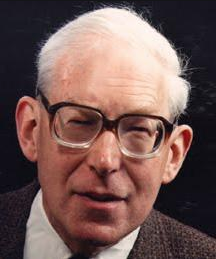
Great men inspire greatness, both in their lives and in their deaths. Such is true of James Innell Packer (1926–2020), whose life and ministry has forever marked my own. He and I only met once, and I have only read a handful of his books. But in this age, he is one who has shown me what it means to share in Christ, having held on to his original confidence firm until the end (Heb 3:14). J. I. Packer ever exerted a bold yet restful confidence in the authority and veracity of holy Scripture. He also loved Jesus deeply and cherished and proclaimed his substitutionary atoning work on our behalf. In a sea of contemporary voices, his stood out to me because it was ever matched by a gentle and lowly spirit that longed for holiness and that embraced weakness. I so deeply pray that, if God keeps me into my 50s, 60s, 70s, 80s, and 90s, I can humbly embrace Christ and remain faithful to his Word as Packer did unto his death.
For Packer, what was not yet has become more the already, as he passed from death to lasting life in the presence of his Savior on Friday, July 17, 2020, at age 93. But for the grace and purposes of our sovereign God, he could have died at age 70 as a result of my own youthful distraction. As a tribute to Packer’s enduring faithfulness, I want to thank the Lord for what he taught me through him that day so long ago.
***To read the rest, see my tribute to Packer at reformandamin.org.***
https://www.reformandamin.org/articles1/2020/7/22/whatilearnedthedayialmostkilledjipacker
July 20, 2020
The Addressees in Zephaniah 2:1, 3

The Lord has recently allowed me to publish another article on Zephaniah, this one related to the identify of the book’s audience:
DeRouchie, Jason S. “The Addressees in Zephaniah 2:1, 3: Who Should Seek YHWH Together?” Bulletin for Biblical Research 30.2 (2020): 183–207.
Abstract: Zephaniah 2:1 calls “the nation not longing” to bundle together in submission to the Lord, and 2:3 urges “the humble of the land/earth” to seek him increasingly. The identity of these vocatives significantly affects the book’s interpretation, but scholars generally offer one of three views on the proper referent(s): (1) Both 2:1 and 3 address Judah collectively as a rebellious nation. (2) 2:1 confronts rebellious Judah collectively, but 2:3 speaks to the enemy foreign nations. (3) 2:1 addresses rebellious Judah collectively, but 2:3 addresses the nation’s faithful remnant. After overviewing these alternatives and arguing that option three best captures the principal referents, this study argues (4) that Judah and its remnant are the primary but not sole addressees of 2:1 and 3, with the literary context suggesting that the prophet intended that other rebellious nations and their remnants see 2:1 and 3 as applying equally to them by extension.
Outline:
Introduction (183)
Initial Reflections on the Vocative Address (184)
The Nation Not Longing in Zephaniah 2:1 (184)
The Humble in Zephaniah 2:3 (187)
Different Views of the Identity of the Addressees (188)
Both Zephaniah 2:1 and 2:3 Address Judah Collectively as a Rebellious Nation (188)
Wilhelm Rudolph and Hubert Irsigler (188)
Marvin A. Sweeney (191)
Zephaniah 2:1 Addresses Judah Collectively as a Rebellious Nation, but 2:3 Addresses the Rebellious Foreign Nations (192)
Arnold B. Ehrlich (192)
Zephaniah 2:1 Addresses Judah Collectively as a Rebellious Nation, but 2:3 Addresses Judah’s Faithful Remnant (195)
Martin Luther, John Calvin, and the Majority View (195)
Judah and Its Remnant Are the Primary but Not Sole Addresses of Zephaniah 2:1, 3, Respectively (200)
Conclusion (207)
See also “A Number of Studies on Zephaniah.”
July 16, 2020
ANNOUNCEMENT: Red Sea Miracle II

The film will be showing LIVE ONLINE this coming Friday 17 at 7PM Central Time Zone. Purchasing a ticket for online viewing will make the film accessible for one week. There is a PRE-SHOW live with filmmaker Timothy Mahoney 20 minutes before the film starts.
Trailer link:
https://vimeo.com/430812214
Ticket Purchase Link:
https://live.patternsofevidence.com/index/the-red-sea-miracle-ii-1590109948152×985733283845137200
Synopsis of The Red Sea Miracle II:
THE RED SEA MIRACLE II continues to raise big questions about biblical miracles. Introducing the second film in a new two-part series by Patterns of Evidence’s award-winning filmmaker, Timothy Mahoney. How could thousands of feet of water be parted at the Red Sea? Or was the sea merely parted by the act of wind in nature, through a shallow Egyptian lake? Mahoney investigates these locations to see if any have a pattern of evidence matching the Bible. People of faith will be inspired and skeptics will have much to think about as Mahoney reveals two decades of documentary research including if divers found the remains of Pharaoh’s army on the seafloor. This cinematic journey leads him to inquire… “Do miracles still happen today?”
See Also This Earlier Post:
https://jasonderouchie.com/the-red-sea-miracle-ii/