Jason S. DeRouchie's Blog, page 7
April 15, 2022
The Long History of God’s Love for Africa

“The Long History of God’s Love for Africa.” April 07, 2022: www.desiringgod.org
In an episode of Ask Pastor John, Jason from Kampala (the capital of Uganda), asked Pastor John a pointed question regarding why Africans have suffered so much. He wrote:
Does God care for Africans? Providence has a long track record here. Throughout history we have been a beastly, deplorable, enslaveable race — constantly riddled with disease, famine, and suffering. How are we not to conclude that we are God’s least favorite race? Every day is pure struggle for most Ugandans. I know God promises to look after all people, but it still makes me wonder, why does he especially seem to hate Africa so much?
When I read those words, my heart grieved. It still does. Since I first heard them (and Pastor John’s four points of wisdom on the providence of God), I have longed to give voice more directly and explicitly to Scripture’s truths regarding God’s heart for all nations, including those from Africa.
The above begins my latest article. In it I show how the Scriptures reveal God’s deep love for Africa and how it is central to his kingdom purposes. My own journey of discovery began when I, as an Old Testament professor, started studying the book of Zephaniah, who was likely a black Judean prophet. My journey has taken me from Genesis to Revelation, and I hope this brief survey will help Jason in Kampala and others to recognize God’s love for Africa and to hope in God’s steadfast love toward all who are in Christ, whether from Africa or beyond.
/ PDF / Online / French Version PDF/ “The Long History of God’s Love for Africa.” April 07, 2022: www.desiringgod.org


January 29, 2022
OT Wisdom Overview Lecture

DeRouchie, Jason S. “Interpreting Old Testament Wisdom” (Christian Challenge Leader Training, Kansas State University, Jan 17, 2022).
Grasping the significance of the Old Testament’s wisdom literature is not just essential for understanding large swaths of the Bible but also for knowing how to live rightly in this world. I recently gave a presentation to college students that is part lecture and part Bible study overviewing the concepts and literature pertinent to wisdom in the Old Testament. To this end, I consider wisdom’s foundational principles, definition, and types and formats. I then provide different examples of interpreting wisdom literature by considering a dialogue (Job 1-2), a couple of monologues (Eccl 3:9-14; 11:7-12:1), and various proverbs. I hope the presentation will help anyone interested in learning about wisdom in the Old Testament.
(Audio / Notes / Handout / PowerPoint) “Interpreting Old Testament Wisdom”
The goal of learning about wisdom in the Old Testament is to grow in fearing God and treasuring Christ more. May God grant you this goal as you enjoy this presentation.
January 27, 2022
Zephaniah: Rejoicing In Hope (Lectures 1 & 2)

The annual Hugh D. Brown Lectures, Irish Bible College, Moira, Northern Ireland, Jan 13, 2022.
Over the past seven years I have given much time toward understanding Zephaniah. You can find some of the fruits of these labors here. Through this season, I’ve come to summarize Zephaniah’s message as being the “Savior God’s invitation to satisfaction.” More specifically, Zephaniah calls the faithful remnant from Judah and beyond “to seek the Lord together to avoid punishment and to wait for the Lord in order to enjoy satisfying salvation.” Recently, I was honored to give the annual Hugh D. Brown lectures at Irish Bible College, and for them I overviewed Zephaniah’s message and lasting relevance so that others may find satisfaction in the Savior God. In this first lecture I overview the setting for the Savior’s invitation (Zeph 1:1-18) and then consider stage 1 of this invitation to satisfaction (2:1-3:7). My goal in the second lecture was twofold: (1) Overview the charge to wait for the Lord (3:8–10) and the promises Zephaniah uses to motivate waiting (3:11–20b). (2) Consider how Christ fulfills Zephaniah’s vision of the Lord’s day and what that means regarding the timing and nature of the realization of Zephaniah’s hopes.
If you desire to understand Zephaniah and you seek to be satisfied in our Savior God, I hope you will enjoy listening to these two lectures. You can download the handout here. The audio and PDF links are below.
Lecture 1 (audio/PDF): DeRouchie, Jason S. “Rejoicing in Hope: Understanding and Applying Zephaniah, Lecture 1: Seek the Lord Together to Avoid Punishment” (Zeph 1:1–3:7).Lecture 2 (audio/PDF): DeRouchie, Jason S. “Rejoicing in Hope: Understanding and Applying Zephaniah, Lecture 2: Wait for the Lord in Order to Enjoy Satisfying Salvation” (Zeph 3:8–20).January 25, 2022
The Biblical Covenants in Salvation History – ETS – 2021

DeRouchie, Jason S. “The Biblical Covenants in Salvation History” (ETS Nov, 2021, Fort Worth, TX).
Understanding how the biblical covenants relate to each other is paramount to knowing how the Bible “fits together.” For this reason, at the 2021 annual meeting of the Evangelical Theological Society I gave this paper presentation about how the Bible’s storyline progresses through the historical covenants between God and his people. I argue that Jesus fulfills each covenant in different ways. The Adamic-Noahic covenant with creation establishes the crisis and context of global curse and common grace out of which the other covenants clarify God’s solution and saving grace. The Abrahamic covenant forecasts the hope of Christ and new creation through its conditional yet certain kingdom promises of land(s), seed, blessing, and divine presence. The remaining covenants clarify how God fulfilled these promises in two progressive stages. In the Mosaic covenant (stage 1) Abraham’s offspring is a single nation experience blessing and curse, which results in their exile from the promised land. The Davidic covenant recalls the promises of a royal Deliverer and declares the specific line through whom he will rise. Then the new covenant (stage 2) realizes these hopes in an already but-not yet way through the person and perfect obedience of Christ Jesus, whose kingdom work overcomes the curse with universal blessing, makes Abraham the father of many nations to the ends of the earth, and reconciles all things to God through the new creation. A time of question and answer follows the presentation.
Listen to this paper presentation by clicking here. Accompanying this lecture is a handout, and you can also access my paper by clicking here. May God use this paper to help you know how the whole Bible works together to communicate a unified message about Jesus and for his glory.
January 17, 2022
Greater is He: A Primer on Spiritual Warfare for Kingdom Advance

DeRouchie, Jason S. “Greater is He: A Primer on Spiritual Warfare for Kingdom Advance.” The Southern Baptist Journal of Theology 25.2 (2021): 21–55.
Spiritual warfare is one of those topics that Christians are interested in but nevertheless have many questions about. What sort of authority does God have over the powers of darkness? What authority does Jesus give the believer, and how does that relate to the devil’s practices? Can the devil work against both unbelievers and believers, and can believers be demon possessed? Should the church expect to exercise authority over demons like Jesus did during his ministry on earth? And most importantly of all, what does the Bible say about such things?
Dr. Jason S. DeRouchie seeks to address these questions and more in his latest journal article, “Greater is He: A Primer on Spiritual Warfare for Kingdom Advance.” He drafted an earlier version of this study to help elders among his previous church think through how best to minister to a rising number of demonized individuals among members and non-members alike and to help himself think through demonic challenges he faced during ministry trips in Africa. The article divides into the following six sections:
God is the supreme ruler and orchestrator of all things including supernatural, natural, and moral evil.God is stronger than the evil one, has decisively defeated him through Christ, and will defeat him entirely.Christ frees believers from enslavement to the devil and grants them both a new identity as sons and full eternal security in him.The evil one, the devil, works evil against both non-believers and believers.Christ has given Christians authority to battle evil, grace to persevere through it, and the promise of full deliverance from it.Christ is advancing his kingdom through his church.Among other things, this paper is a resource to help churches know how to understand issues of spiritual warfare. You can read the article by clicking here. May the Lord use this paper to bring greater help and hope to the church and this world as his kingdom is realized on earth as it is heaven.
DeRouchie, Jason S. “Greater is He: A Primer on Spiritual Warfare for Kingdom Advance.” The Southern Baptist Journal of Theology 25.2 (2021): 21–55.
December 31, 2021
Understanding and Applying Exodus 19:4–6

DeRouchie, Jason S. “Understanding and Applying Exodus 19:4–6: A Case Study in Exegesis and Theology.” Journal of Biblical and Theological Studies 6.1 (2021): 85–134.
This essay seeks to interpret Exodus 19:4–6 passage within its immediate and broader biblical context, understanding and applying it as the Christian Scripture God intended (Rom 15:4; 1 Cor 10:11; 2 Tim 3:16–17; 1 Pet 1:12). The study also supplies a case study in exegetical and theological inquiry following the twelve steps outlined in my book, How to Understand and Apply the Old Testament. These twelve steps fit within five broader categories and provide the following outline for this article:
Text: “What is the makeup of the passage?”Genre of Exodus 19:4–6Literary Units and Text Hierarchy of Exodus 19:4–6Text Criticism in of Exodus 19:4–6The Translation of Exodus 19:4–6Observation: “How is this passage communicated?”Clause and Text Grammar in Exodus 19:4–6Argument-Tracing in Exodus 19:4–6A Word and Concept Study from Exodus 19:4–6Context: “Where does this passage fit?”The Historical Context of Exodus 19:4–6The Literary Context of Exodus 19:4–6Meaning: “What does the passage mean?”Biblical Theology in Exodus 19:4–6Systematic Theology in Exodus 19:4–6Application: “Why does the passage matter?”Practical Theology in Exodus 19:4–6Recognizably, the nine steps of exegesis and three steps of theology are all interrelated, and distinguishing them is somewhat artificial to the process of interpreting the Bible. Nevertheless, using a single passage to walk through the twelve steps should help students understand better the various aspects of exegesis and theology that are necessary for rightly handling God’s word of truth (2 Tim 2:15).
Besides providing a helpful exegetical guide for students of the OT, the article contributes new insights into Exodus 19:4–6’s syntax and translation. The article also discusses Exodus 19:4–6’s function within the Bible’s storyline and import for soteriology and missiology.
To read the full article, click on this PDF and enjoy learning a method for interpreting Old Testament passages.
DeRouchie, Jason S. “Understanding and Applying Exodus 19:4–6: A Case Study in Exegesis and Theology.” Journal of Biblical and Theological Studies 6.1 (2021): 85–134.
December 30, 2021
Chipman’s SCRIPTURE STORYLINE
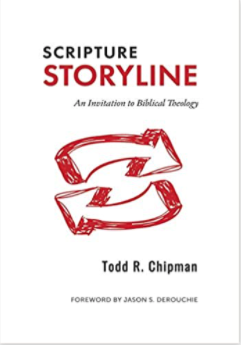
Chipman, Todd R. Scripture Storyline: An Invitation to Biblical Theology. Dallas: Fontess, 2020.
Are you looking for a Bible Reading Plan for the new year? Todd Chipman is my teaching pastor at The Master’s Community Church, and he also serves as Dean of Graduate Studies and Assistant Professor of Biblical Studies at Midwestern Baptist Theological Seminary, where I serve. Amid a flurry of new volumes on biblical theology, this new one distinguishes itself in the way it guides people through a year of Bible reading and supplies commentary on almost every chapter of Scripture while seeking to trace the storyline of redemption as it develops from the Old Testament to the New. I wrote the book’s foreword, which includes the following paragraph:
This book is a seasoned, pastoral invitation to biblical theology. It was birthed in the context of the local church yet was tested in the context of the academy. It seeks to show you how the storyline of Scripture progresses, integrates, and climaxes in Christ. It is a book that accounts for how the biblical covenants develop, how the New Testament authors use their Old Testaments, and how Jesus supplies the solution to all problems, provides the Yes to every promise, fulfills all hopes, and operates as the substance to which all shadows point. Chipman is a scholarly pastor and a pastoral scholar. He writes for the church and for Christian families that shape the church. His book shows the fruit of extensive, thoughtful, and faithful biblical study matched by the clear communication and convictional care of a master shepherd who is following the chief shepherd.
You can read the Table of Contents and the whole foreword here. Check out https://scripturestoryline.com/ and this new volume on biblical theology: Scripture Storyline. And don’t forget the KINGDOM Bible Reading Plan and KINGDOM Bible Reading Plan: Abridged as two other options.
Introduction to the Old Testament and Zephaniah

DeRouchie, Jason S. “Introduction to the Old Testament,” The Gospel Coalition , December 2021, https://www.thegospelcoalition.org/es...
DeRouchie, Jason S. “Zephaniah,” The Gospel Coalition , December 2021, https://www.thegospelcoalition.org/co...
Around one year ago, the Gospel Coalition published 250 essays overviewing all areas of biblical doctrine with a goal of serving the global church. I wrote two of these: (1) Interpreting Scripture: A General Introduction and (2) the Day of the Lord. You can access these articles here: https://www.thegospelcoalition.org/essay/interpreting-scripture-a-general-introduction/ and https://www.thegospelcoalition.org/essay/the-day-of-the-lord/.
Now, the Gospel Coalition is in the process of publishing a whole Bible commentary, book-by-book with introductory essays. I contributed the article titled “Introduction to the Old Testament” and the mini-commentary on “Zephaniah.” The commentary includes a very matured interpretation of the book in just 10 pages. In the introductory article, I briefly overview five critical issues pertaining to the Old Testament.
The Old Testament’s date and diversity. God’s sages, seers, singers, and sovereigns wrote the Old Testament under God’s Spirit from 1446–500 BC.The Old Testament’s canonical status. Here I argue that the ancients associated the canon concept with both an authoritative, normative body of literature (“canon as rule”) and the boundaries and shaping of that material (“canon as list”).The ordering of the Old Testament’s books. Here I note a couple of different ways others have ordered the Old Testament that differ from the typical English ordering. In particular, I highlight that the ancients regarded the Old Testament to contain a three-fold division consisting of the Law, Prophets, and Writings. The article mentions at least four significances that derive from considering these various orderings.The message of the Law, Prophets, and Writings, noting how they communicate a story in need of a sequel and fulfillment.The Old Testament’s message and function within the biblical canon. This concluding section maintains that the Old Testament’s authors wrote about Jesus and for the eschatological new covenant people of God.To read the rest of the article, access its web page here. In addition to my articles, there are around 250 essays on theology that you would do well to read. You can link to them here: https://www.thegospelcoalition.org/essays/.
December 29, 2021
10 Reasons Why You Should Read the Old Testament

If Christians are part of the new covenant, why should we seek to understand and apply the Old Testament (OT)? I’ll give 10 reasons why the first word in the phrase Old Testament must not mean unimportant or insignificant to Christians.
1. The OT was Jesus’s only Scripture and makes up three-fourths (75.55 percent) of our Bible.If space says anything, the OT matters to God, who gave us his Word in a book. In fact, it was his first special revelation, which set a foundation for the fulfillment we find in Jesus in the New Testament (NT). The OT was the only Bible of Jesus and the earliest church (e.g., Matt. 5:17; Luke 24:44; Acts 24:14; 2 Tim. 3:15), and it’s a major part of our Scriptures.
2. The OT substantially influences our understanding of key biblical teachings.By the end of the Law (Genesis–Deuteronomy), the Bible has already described or alluded to all five of the major covenants that guide Scripture’s plot structure (Adamic-Noahic, Abrahamic, Mosaic, Davidic, and new). The rest of the OT then builds on this portrait in detail. Accordingly, the OT narrative builds anticipation for a better king, a blessed people, and a broader land. The OT creates the problem and includes promises that the NT answers and fulfills. We need the OT to understand fully God’s work in history.
Further, some doctrines of Scripture are best understood only from the OT. For example, is there a more worldview-shaping passage than Genesis 1:1–2:3? Where else can we go other than the OT to rightly understand sacred space and the temple? Is there a more explicit declaration of YHWH’s incomparability than Isaiah 40, or a more succinct expression of substitutionary atonement than Isaiah 53? Where should we go to know what Paul means by “psalms, hymns, and spiritual songs” (Eph. 5:19; Col. 3:16)?
Finally, the NT worldview and teachings are built on the framework supplied in the OT. In the NT we find literally hundreds of OT quotations, allusions, and echoes, none of which we’ll fully grasp apart from saturating ourselves in Jesus’s Bible.
3. We meet the same God in both Testaments.Note how the book of Hebrews begins: “Long ago, at many times and in many ways, God spoke to our fathers by the prophets, but in these last days he has spoken to us by his Son” (Heb. 1:1–2). The very God who spoke through the OT prophets speaks through Jesus.
Perhaps the most foundational OT statement of YHWH’s character and action is Exodus 34:6: “The LORD, the LORD, a God merciful and gracious, slow to anger, and abounding in steadfast love and faithfulness.” The OT then reasserts this truth numerous times in order to clarify why it is that God continued to pardon and preserve a wayward people:
God’s grace fills the OT, just as it does the NT. Further, in the NT, Jesus speaks about hell more than anyone else. He declares, “Do not fear those who kill the body but cannot kill the soul. Rather fear him who can destroy both soul and body in hell” (Matt. 10:28). Thus, God is just as wrathful in the NT as he is in the OT.
Certainly there are numerous expressions of YHWH’s righteous anger in the OT, just as there are massive manifestations of blood-bought mercy in the NT. What is important is to recognize that we meet the same God in the OT as we do in the New. In the whole Bible we meet a God who is faithful to his promises to both bless and curse. He takes sin and repentance seriously, and so should we.
4. The OT announces the very ‘good news/gospel’ we enjoy.The gospel is the good news that through Jesus––the divine, crucified, and resurrected Messiah––God reigns over all and saves and satisfies believing sinners. Paul states that “the Scripture, foreseeing that God would justify the Gentiles by faith, preached the gospel beforehand to Abraham, saying, ‘In you shall all the nations be blessed’” (Gal. 3:8, emphasis added). Abraham was already aware of the message of global salvation we now enjoy. Similarly, in the opening of Romans, Paul stresses that the Lord “promised beforehand through his prophets in the holy Scriptures” (i.e., the OT prophets) the powerful “gospel of God . . . concerning the Son” that he preached and in which we now rest (Rom. 1:1–3, 16).
Foremost among these prophets was Isaiah, who anticipated the day when YHWH’s royal servant (the Messiah) and the many servants identified with him would herald comforting “good news” to the poor and broken––news that the saving God reigns through his anointed royal deliverer (Isa. 61:1; cf. 40:9–11; 52:7–10; Luke 4:16–21). Reading the OT, therefore, is one of God’s given ways for us to better grasp and delight in the gospel (see also Heb. 4:2).
5. Both the old and new covenants call for love, and we can learn much about love from the OT.Within the old covenant, love was what the Lord called Israel to do (Deut. 6:5; 10:19); all the other commandments simply clarified how to do it. This was part of Jesus’s point when he stressed that all the OT hangs on the call to love God and neighbor: “You shall love the Lord your God with all your heart and with all your soul and with all your mind. This is the great and first commandment. And a second is like it: You shall love your neighbor as yourself. On these two commandments depend all the Law and the Prophets” (Matt. 22:37–40). Reading the Old Testament is one of God’s given ways for us to better grasp and delight in the gospel.
Christ emphasized, “Whatever you wish that others would do to you, do also to them, for this is the Law and the Prophets” (7:12). Similarly, Paul noted, “The whole law is fulfilled in one word: ‘You shall love your neighbor as yourself’” (Gal. 5:14; cf. Rom. 13:8, 10). As with Israel, the Lord calls Christians to lives characterized by love. However, he now gives all members of the new covenant the ability to do what he commands. As Moses himself asserted, the very reason God promised to circumcise hearts in the new covenant age was “so that you will love the LORD your God with all your heart and with all your soul” (Deut. 30:6). Moses also said that those enjoying this divine work in this future day would “obey the voice of the LORD and keep all his commandments that I command you today” (30:8). Moses’s old covenant law called for life-encompassing love, and Christians today, looking through the lens of Christ, can gain clarity from the OT on the wide-ranging effect of love in all of life.
6. Jesus came not to destroy the Law and the Prophets but to fulfill them.Far from setting aside the OT, Jesus stressed that he came to fulfill it, and in the process he highlighted the lasting relevance of the OT’s teaching for Christians:
Do not think that I have come to abolish the Law or the Prophets; I have not come to abolish them but to fulfill them. For truly, I say to you, until heaven and earth pass away, not an iota, not a dot, will pass from the Law until all is accomplished. Therefore whoever relaxes one of the least of these commandments and teaches others to do the same will be called least in the kingdom of heaven, but whoever does them and teaches them will be called great in the kingdom of heaven. (Matt. 5:17–19)
It’s important to note here that, while the age of the old covenant has come to an end (Rom. 6:14–15; 1 Cor. 9:20–21; Gal. 5:18; cf. Luke 16:16), the OT itself maintains lasting relevance for us in the way it displays the character of God (e.g., Rom. 7:12), points to the excellencies of Christ, and portrays for us the scope of love in all its facets (Matt. 22:37–40). As Moses asserted, in the day of heart circumcision (Deut. 30:6), which we are enjoying today (Rom. 2:29), all of his teachings in Deuteronomy would still matter: “And you shall again obey the voice of the LORD and keep all his commandments that I command you today” (Deut. 30:8).
7. Jesus said that all the OT points to him.After his first encounter with Jesus, Philip announced to Nathaniel: “We have found him of whom Moses in the Law and also the prophet wrote” (John 1:45). Do you want to see and savor Jesus as much as you can? We find him in the OT. As Jesus himself said, “You search the Scriptures because you think that in them you have eternal life; and it is they that bear witness about me” (John 5:39; cf. 5:46–47). “And beginning with Moses and all the Prophets, he interpreted to them in all the Scriptures the things concerning himself” (Luke 24:27). After his resurrection, proclaiming the gospel of God’s kingdom (Acts 1:3), Jesus opened the minds of his disciples “to understand the Scriptures, and said to them, ‘Thus it is written that the Christ should suffer and on the third day rise from the dead, and that repentance and forgiveness of sins should be proclaimed in his name to all nations, beginning from Jerusalem’” (Luke 24:53).
A proper “understanding” of the OT will lead one to hear in it a message of the Messiah and the mission his life would generate. Similarly, Paul taught “nothing but what the prophets and Moses said would come to pass: that the Christ must suffer and that, by being the first to rise from the dead, he would proclaim light both to our people and to the Gentiles” (Acts 26:22–23). As an OT preacher, he could declare: “I decided to know nothing among you except Jesus Christ and him crucified” (1 Cor. 2:2). If you want to know Jesus more, read the OT!
8. Failing to declare ‘the whole counsel of God’ can put us in danger before the Lord.Paul was a herald of the good news of God’s kingdom in Christ (e.g., Acts 19:8; 20:25; 28:30–31), which he preached from the Law of Moses and the Prophets––the OT (28:23; cf. 26:22–23). In Acts 20:26–27 he testifies to the Ephesian elders, “I am innocent of the blood of all, for I did not shrink from declaring to you the whole counsel of God.” The “whole counsel of God” refers to the entirety of God’s purposes in salvation-history as revealed in Scripture. Had the apostle failed to make known the Lord’s redemptive plan of blessing overcoming curse in the person of Jesus, he would have stood accountable before God for any future doctrinal or moral error that the Ephesian church carried out (cf. Ezek. 33:1–6; Acts 18:6).
The Old Testament, while not written to Christians, was still written for us. With the NT the Scripture is complete, and we now have in whole “the faith that was once for all delivered to the saints” (Jude 3). This “faith,” however, is only understood rightly within the framework of “the whole counsel of God.” So may we be people who guard ourselves from blood guilt by making much of the OT in relation to Christ.
9. The NT authors stressed that God gave the OT for Christians.Peter asserted of the OT prophets, “It was revealed to them that they were serving not themselves but you” (1 Pet. 1:12). The OT authors understood that they were writing for a future audience––Christians identified with the NT church.
Similarly, Paul was convinced that the divinely inspired OT authors wrote for NT believers, living on this side of the death and resurrection of Christ. “For whatever was written in former days was written for our instruction, that through endurance and through the encouragement of the Scriptures we might have hope” (Rom. 15:4; cf. 4:23–24). “Now these things happened to [the Israelites] as an example, but they were written down for our instruction, on whom the end of the ages has come” (1 Cor. 10:11).
Accordingly, the apostle emphasized to Timothy, who was raised on the OT by his Jewish mother and grandmother (Acts 16:1; 2 Tim. 1:5), that the “sacred writings” of his upbringing “are able to make you wise for salvation through faith in Christ Jesus” (2 Tim. 3:15). People today can get saved from God’s wrath and from the enslavement of sin by reading the OT through the lens of Christ.
People today can get saved from God’s wrath and from the enslavement of sin by reading the Old Testament through the lens of Christ. This is why Paul says in the next verse, “All Scripture is . . . profitable for teaching, for reproof, for correction, and for training in righteousness, that the man of God may be competent, equipped for every good work” (3:16–17). New covenant believers can correct and reprove straying brothers and sisters from the OT, when read in relation to Christ, for in it we find many “profitable” things (Acts 20:20)––a “gospel of the grace of God” (20:24)––that call for “repentance toward God” and “faith in our Lord Jesus Messiah” (20:21).
Based on this fact, NT authors regularly used the OT as the basis for Christian exhortation, assuming its relevance for Christians (e.g., 1 Cor. 9:8–12; Eph. 6:2–3; 1 Tim. 5:18; 1 Peter 1:14–16). Because we are now part of the new covenant and not the old, there are natural questions that arise regarding how exactly the Christian should relate to specific old covenant instruction. Nevertheless, the point stands that the OT, while not written to Christians, was still written for us.
10. Paul commands church leaders to preach the OT.The last of my 10 reasons why the OT still matters for Christians builds on the fact that Paul was referring to the OT when he spoke of the “sacred writings” that are able to make a person “wise for salvation” and the “Scripture” that is “breathed out by God and profitable” (2 Tim. 3:15–16). Knowing this colors our understanding of his following charge to Timothy:
Preach the word; be ready in season and out of season; reprove, rebuke, and exhort, with complete patience and teaching. For the time is coming when people will not endure sound teaching but having itching ears they will accumulate for the themselves teachers to suit their own passion, and will turn away from listening to the truth and wander off into myths. (2 Tim. 4:2–4)
For Paul, Christian preachers like Timothy needed to preach the OT in order to guard the church from apostasy. While we now have the NT, we can, and indeed must, appropriate the OT like Jesus and his apostles did for the good of God’s church. Paul stresses that those who unhitch themselves from the OT put themselves in danger of falling away from God.
December 9, 2020
New Release: 40 QUESTIONS ABOUT BIBLICAL THEOLOGY
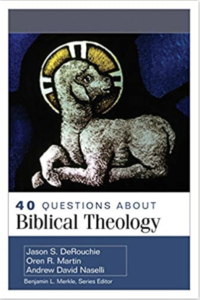
DeRouchie, Jason S., Oren R. Martin, and Andrew David Naselli. 40 Questions about Biblical Theology. 40 Questions. Grand Rapids: Kregel, 2020.
I am an Old Testament scholar who treasures the Lord Jesus, and because of this I delight in the discipline of biblical theology, which studies how the whole Bible progresses, integrates, and climaxes in Christ. I recently co-authored an introduction to the discipline with two friends who specialize in different disciplines: Oren Martin (Systematic Theology) and Andy Naselli (New Testament).
What Is Biblical Theology?
Biblical theology is a way of analyzing and synthesizing the Bible that makes organic, salvation-historical connections with the whole canon on its own terms, especially regarding how the Old and New Testaments progress, integrate, and climax in Christ.
What Is Distinct about This Volume?
S tructure:
The 40 Questions series is so beneficial because people can choose to read the whole book cover to cover or they can simply find the question that most interests them and read the answer, which almost always comes in 10 pages or less. Not only this, if you just want to know the gist, every chapter ends with a summary, which is then followed by five questions for personal or group reflection.
Content:
Our volume stands out because it not only defines biblical theology and explores proper method but also illustrates and applies biblical theology with numerous examples. We have chapters that trace themes from Genesis to Revelation (e.g., the covenants, serpent, the people of God, the Law, the Temple, mission, land, resurrection), while others overview how later Scripture uses earlier Scripture (e.g., the use of Exod 15:2 in Isa 12:2; the use of Isa 40:13 and Job 41:11a in Rom 11:34–35; the use of Lev 18:5 in Gal 3:12). We also have chapters that consider how biblical theology helps us teach and preach the OT, how Christians relate to OT promises, how biblical theology should impact the Christian life, how a church can teach biblical theology, and what should motivate us to engage in it.
Perspective:
We truly try to faithfully overview the different systems that conservative evangelicals have employed for articulating how the whole Bible holds together (i.e., dispensational theology and covenant theology). Nevertheless, we also practice a redemptive-historical, Christo-centric approach to Scripture that we believe is faithful to the Bible’s own claims and makeup, that is reformed and baptistic, and that aligns with what evangelicals in the west are now terming progressive covenantal theology.
What Are the 40 Questions?
Part 1: Defining Biblical Theology
What Do We Mean by “Biblical Theology”? [Naselli]
What Is Scripture’s Storyline? [DeRouchie]
How Does Biblical Theology Help Us See and Celebrate Christ in the Old Testament? [DeRouchie]
Why Must Biblical Theology Analyze and Synthesize How the Old and New Testaments Progress, Integrate, and Climax in Christ? [Martin]
How Should Biblical Theology Trace a Theme’s Salvation-Historical Progression? [Naselli]
How Should Biblical Theology Consider Continuity and Discontinuity between the Covenants? [Martin]
How Should Biblical Theology Track Promise and Fulfillment? [Naselli]
How Should Biblical Theology Approach Typology? [Naselli]
How Should Biblical Theology Approach How Later Scripture Uses Earlier Scripture? [Naselli]
Part 2: Comparing Different Approaches to Biblical Theology
What Are Different Ways That Evangelicals Do Biblical Theology? [Naselli]
What Must We Presuppose to Do Biblical Theology? [Martin]
How Does Biblical Theology Compare to Other Theological Disciplines [Martin]
How Do Biblical Theology and Systematic Theology Differ and Work Together? [Martin]
What Role Does Authorial Intent Play in Biblical Theology? [Martin]
Does the Bible Have One Central Theme? [Naselli]
Is the Order of the Canon Significant for Doing Biblical Theology? [DeRouchie]
How Does Dispensational Theology Understand Biblical Theology? [Martin]
How Does Covenant Theology Understand Biblical Theology? [Martin]
How Does Progressive Covenantalism Understand Biblical Theology? [Martin]
Part 3: Illustrating Biblical Theology: Tracing Themes
How Does Harry Potter Illustrate Biblical Theology? [Naselli]
What Role Does “Mystery” Play in Biblical Theology? [DeRouchie]
What Is a Biblical Theology of the Covenants? [DeRouchie]
What Is a Biblical Theology of the Serpent? [Naselli]
What Is a Biblical Theology of the People of God? [DeRouchie]
What Is a Biblical Theology of the Law? [DeRouchie]
What Is a Biblical Theology of the Sabbath? [Naselli]
What Is a Biblical Theology of the Temple? [Naselli]
What Is a Biblical Theology of Mission? [DeRouchie]
What Is a Biblical Theology of the Land? [Martin]
What Is a Biblical Theology of Resurrection? [DeRouchie]
Part 4: Illustrating Biblical Theology: The Use of Earlier Scripture in Later Scripture
How Does Isaiah 12:2 Use Exodus 15:2? [DeRouchie]
How Does Matthew 2:15 Use Hosea 11:1? [DeRouchie]
How Does Romans 11:34–35 Use Isaiah 40:13 and Job 41:11a [Naselli]
How Does Galatians 3:12 Use Leviticus 18:5? [DeRouchie]
How Do Genesis 1–3 and Revelation 21–22 Relate as the Bible’s Bookends? [Naselli]
Part 5: Applying Biblical Theology
How Does Biblical Theology Help Us Teach and Preach the Old Testament? [DeRouchie]
How Should a Christian Relate to Old Testament Promises? [DeRouchie]
How Should Biblical Theology Impact the Christian Life? [Martin]
How Can a Church Teach Biblical Theology? [Martin]
What Should Motivate Us to Do Biblical Theology? [Martin]
What Are Others Saying?
“This volume is a wonderful entry point into the vast and complex field of biblical theology.” —Benjamin L. Gladd, Reformed Theological Seminary, Jackson, MS
“The authors have used every means at their disposal to make this the kind of reference book in which every aspect of biblical theology is presented in a format that makes the information easy to find.” —Graeme Goldsworthy, Moore Theological College, Sydney, Australia
“40 Questions About Biblical Theology is a terrific resource to keep coming back to.” —Nancy Guthrie
“This book helps us see how the whole Bible fits together and points to and is fulfilled in Christ.” —Peter H. W. Lau, OMF International
“Get this book, because it not only teaches you biblical theology, but also leaves you with a growing appetite for God’s Word.” —Conrad Mbewe, Kabwata Baptist Church, Lusaka, Zambia
“This lucid and engaging 40 Questions volume is a comprehensive guide to biblical theology’s definition, presuppositions, major themes, and applications.” —Brian S. Rosner, Ridley College, Melbourne, Australia
“DeRouchie, Martin, and Naselli have written a beautifully clear introduction to biblical theology. Their interdisciplinary collaboration gives the book both depth and breadth.” —Thomas R. Schreiner, The Southern Baptist Theological Seminary, Louisville, KY
“These pastor-scholars have composed a primer to biblical theology that answers some of the most puzzling questions in the field.” —Dieudonné Tamfu, Bethlehem Baptist Church and Bethlehem College & Seminary, Yaoundé, Cameroon
“Readers will not escape the intense urge to worship the Triune God as they grow in their understanding of the great salvation that Messiah Jesus has accomplished!” —Frew Tamrat, Evangelical Theological College, Addis Ababa, Ethiopia
“This book is a valuable resource for all those who want to know Scripture better.” —Stephen J. Wellum, The Southern Baptist Theological Seminary, Louisville, KY
“This is an outstanding resource for the study of biblical theology.” —Miles V. Van Pelt, Reformed Theological Seminary, Jackson, MS
More about the Book
Fred Zaspel interview (of DeRouchie, Martin, and Naselli) for Books at a Glance (11/17/2020)
Jason Allen interview for Preaching and Preachers podcast (11/23/2020)
Mike Brooks interview for For the Church (12/9/2020)
35-Page PDF Sample