Jason S. DeRouchie's Blog, page 2
July 31, 2025
Book Announcement––Zephaniah: The Savior’s Invitation to Satisfaction
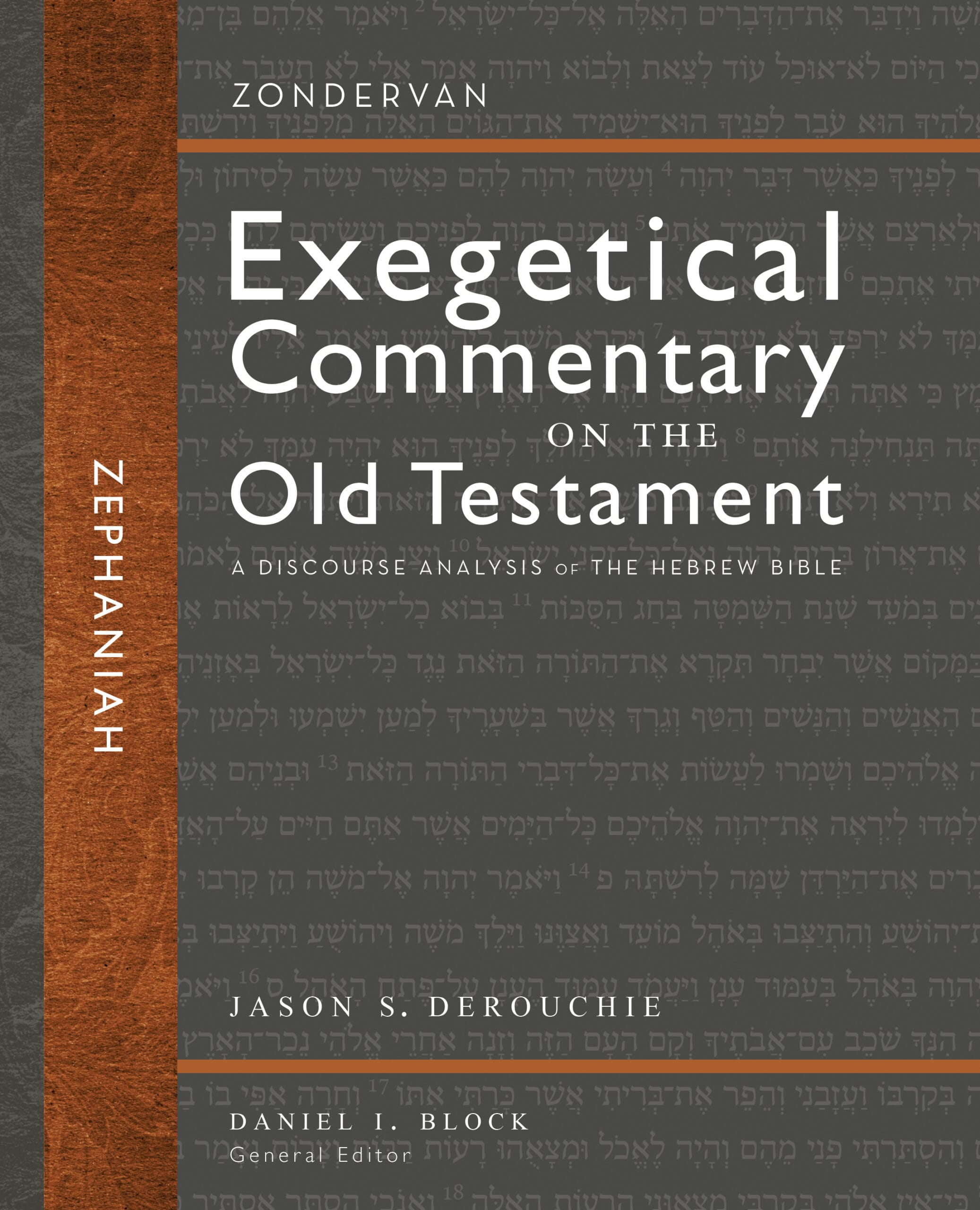
The book of Zephaniah contains some of the Bible’s most vivid portraits of the day of the Lord both as punishment and renewal. It calls God’s people to seek the Lord together to avoid punishment and to wait on him to enjoy salvation. This is what I argue in my new commentary: Zephaniah, ZECOT (Grand Rapids: Zondervan Academic, 2025). Zephaniah is the Savior’s invitation to satisfaction, and this study interprets the book within its close, continuing, and complete biblical context. It seeks to clarify how Zephaniah was among “all the prophets” who spoke both of Christ’s sufferings and the glories that would follow (Acts 3:18, 24). Zephaniah declared the saving grace that is now ours in Christ (1 Pet 1:10–11), and I hope preachers and teachers will give time to engage this 53 verse book so as to see, savor, and then say the lasting message for the church. See this video for an overview of the commentary.
The post Book Announcement––Zephaniah: The Savior’s Invitation to Satisfaction appeared first on Jason DeRouchie.


July 23, 2025
Jesus Will Gather the Scattered: Zephaniah’s Vision of the Global Church
All the nations you have made shall come
and worship before you, O Lord,
and shall glorify your name. (Psalm 86:9)
With these and similar words, David and other psalmists foretold a great missional ingathering associated with the days of the Messiah. Other prophets like Isaiah also announced how Jesus would draw to himself a multiethnic worshiping community who would declare in that day,
Give thanks to the Lord,
call upon his name,
make known his deeds among the peoples,
proclaim that his name is exalted. (Isaiah 12:4)
And with words directed toward the messianic servant:
I will make you as a light for the nations,
that my salvation may reach to the end of the earth. (Isaiah 49:6)
We could multiply to the hundreds similar Old Testament passages.
In our day, the very gospel that the prophets promised — the good news coming from God concerning his Son (Romans 1:1–3) — is spreading, saving, and satisfying some “for God from every tribe and language and people and nation” (Revelation 5:9). Jesus’s triumph over death and his Spirit’s empowerment of his followers ignited this outward kingdom advance (Matthew 28:18–20; Acts 1:8), and today these Old Testament prophecies are being fulfilled.
What an amazingly glorious God we have who would save and satisfy sinners who believe, all through the substitutionary triumph of his Son. And how amazing that every new salvation among every people group on the planet is fulfilling predictions the Sovereign Lord made thousands of years ago.
Hope for Missions in Unexpected PlacesThe Old Testament speaks not only about the Messiah but also about missions. Jesus’s Scriptures announced that “repentance and forgiveness of sins would be proclaimed in his name to all nations, beginning from Jerusalem” (Luke 24:47), and “to [Jesus] all the prophets bear witness that everyone who believes in him receives forgiveness of sins through his name” (Acts 10:43).
Speaking about his fellow Jews, Paul noted that “the prophets and Moses said . . . that the Christ . . . would proclaim light to our people and to the Gentiles” (Acts 26:22–23). And Christ has done and is doing just this as faithful followers become his “witnesses in Jerusalem and in all Judea and Samaria and to the end of the earth” (1:8; cf. 1:1; 13:46–47). “From Jerusalem and all the way around to Illyricum,” Paul “fulfilled the ministry of the gospel of Christ” (Romans 15:19), operating as one of Jesus’s chosen instruments to carry his name “before the Gentiles and kings and the children of Israel” (Acts 9:15). And as the church today joins Paul in proclaiming Christ, we “fill up the word of God” (Colossians 1:25, author’s translation), realizing in our day the kingdom’s advance as the ancient prophets predicted.
Have you considered looking to the Old Testament prophets to understand better God’s heart and purpose for missions? This essay considers how Zephaniah, one of these ancient spokesmen for God, “proclaimed these days” of the church (Acts 3:24). We will see how Yahweh promised to gather and transform a multiethnic remnant of worshipers — the offspring of some that God once scattered across the earth in punishment.
Who Was Zephaniah?Zephaniah was one of Yahweh’s prophets — a heavenly ambassador sent to enforce God’s covenants with his people. Through the progress of history, God has established formal relationships with different groups to fulfill his saving purposes climaxing in Christ. These covenants are always built upon promises and responsibilities. Whether addressing the covenant with creation through Adam and Noah or those redemptive covenants associated with Abraham, Moses, David, and ultimately Jesus, the Lord’s prophets have instructed, confronted, and motivated God’s covenant partners. Zephaniah prophesied during the days of Judah’s King Josiah (ca. 640–609 BC; Zephaniah 1:1), and this prophet assisted the king in battling rampant idolatry and in bringing spiritual reformation. Zephaniah urged a remnant from Judah and other lands to seek Yahweh together to avoid punishment and to wait on Yahweh to enjoy lasting salvation.
Zephaniah had a royal lineage (his great-great grandfather was the reformer King Hezekiah, Zephaniah 1:1), which clarifies why he knows so much about the wickedness of Judah’s leaders (1:8–9; 3:3–4) and why he is so interested in international affairs. He is aware of the activities of Philistia, Moab, Ammon, Cush, and Assyria (2:5–15), and he expresses hope that God will one day fulfill the promises he made to Abraham to overcome the universal curse by blessing all the nations of the earth (3:9–10; cf. Genesis 12:3; 22:17–18).
The prophet also appears to have been a black Jew with a biracial heritage linked to Cush (his father’s name was Cushi; Zephaniah 1:1), which was the center of ancient black Africa. This clarifies why Zephaniah shows a unique interest in Cush, highlighting its devastation (2:12) and using it as the sole example of international salvation (3:10). It is out of this context that his vision for missions becomes most clear.
Zephaniah’s Day of the LordAs a “seer” (1 Samuel 9:9), Zephaniah saw the darkness in the hearts of many of his contemporaries, and he foresaw the dark clouds of judgment that were encroaching over the earth. God was preparing to replace the old order with the new during what he later calls “the day of the Lord” (Zephaniah 1:7, 14). This “day” is less an extent of time (e.g., a 24-hour period) and more an event in time. Moreover, it is not only a day of punishment, portrayed through images of cataclysm, conquest, and sacrifice; it is also a day when God will renew the entire creation.
The Day of the Lord as Re-creationThe prophet’s opening words imply creation’s reversal and movement from life to death, for God speaks of a great ingathering of four creatures in opposite order to their creation in Genesis (Genesis 1:20–28; cf. Hosea 4:3).
“I will surely gather everything
from the face of the earth,” declares the Lord.
“I will gather man and beast;
I will gather the birds of the heavens
and the fish of the sea,
and the rubble with the wicked.
I will cut off mankind
from the face of the earth,” declares the Lord. (1:2–3, author’s adapted translation)
Jesus likely alludes to this text when he predicts his future return as the agent of God’s wrath: “The Son of Man will send his angels, and they will gather out of his kingdom all causes of sin and all law-breakers, and throw them into the fiery furnace” (Matthew 13:41–42). As in the days of the flood (Genesis 6:7), Yahweh would remove the wicked “from the face of the earth.” And having overcome his enemy, God will have opened the door to generate a new creation.
One Ingathering, Two PurposesThe old-covenant prophets use forms of the verb “to gather” to speak of two parallel end-time realities: (1) Yahweh will “gather” the faithful remnant through a second exodus restoration (Micah 2:12), and (2) he will “gather” the world’s wicked for battle (Zechariah 14:2) and punishment (Isaiah 24:22; cf. Hosea 4:3). This latter purpose appears in Zephaniah 1:2–3 and then shows up again later in the book, accompanied by the parallel verb “assemble.”
“Therefore, wait for me,” declares the Lord,
“for the day when I rise up as witness.
For my decision is to gather nations,
to assemble kingdoms,
to pour out upon them my indignation,
all my burning anger;
for in the fire of my jealousy
all the earth shall be consumed.” (3:8, author’s adapted translation)
God’s faithful remnant from Judah and other lands must patiently anticipate the day of his rising as covenant witness because (“For”) Yahweh still intends to gather people groups (“nations”) and political powers (“kingdoms”) for punishment. Our God “acts for those who wait for him” (Isaiah 64:4).
Significantly, along with using the verbs “gather” and “assemble” in the context of future punishment (Zephaniah 1:2–3; 3:8), Zephaniah later uses the same verbs to speak of the anticipated new exodus — the great global “ingathering” for salvation. In 3:18 he employs the verb “gather” in this positive sense, and then Yahweh declares,
Behold, at that time I will deal
with all your oppressors.
And I will save the lame
and assemble the outcast,
and I will change their shame into praise
and renown in all the earth.
At that time I will bring you in,
at the time when I assemble you together;
for I will make you renowned and praised
among all the peoples of the earth,
when I restore your fortunes
before your eyes. (3:19–20, author’s adapted translation)
Yahweh’s ingathering to punish and his ingathering to renew are both associated with the single day of the Lord. This fact, along with how the verbs “gather” and “assemble” occur with both realities, suggests Zephaniah perceived one ultimate ingathering with two purposes. This seems to be Jesus’s interpretation when he declares, “Before [the Son of Man] will be gathered all the nations, and he will separate people one from another as a shepherd separates the sheep from the goats” (Matthew 25:32).
When and How Does the Ingathering Occur?We turn now to consider how Zephaniah’s hopes of a great ingathering relate to modern-day missions. When and how is Zephaniah’s future ingathering for punishment and renewal fulfilled? He and later biblical authors clarify how the ingathering for curse and blessing are worked out in space and time.
Many Colors and Cultures Praising GodOne reason why the remnant from Judah and other lands must wait for Yahweh is because God intends to restore and renew an international remnant of faithful peoples.
Wait for me . . . for at that time I will change the speech of the peoples to a pure speech, that all of them may call upon the name of the Lord and serve him with one accord. (Zephaniah 3:8–9)
It is in this second reason for Godward perseverance that the prophet clarifies his hope for an international community of disciples who would find refuge in God.
Some “peoples” (plural) from the nations and kingdoms in verse 8 will not be destroyed in Yahweh’s fires of wrath but will instead be transformed into worshipers of the living God. Yahweh will purify their “speech” (Greek = “tongue/language”) so that they will together call upon Yahweh’s name and serve him (3:9; cf. Revelation 7:9–10). To call on Yahweh’s name (cf. Zephaniah 3:12) is to outwardly express worshipful dependence on him as Savior, King, and Treasure (see Psalm 116:4, 13, 17).
The prophets often linked calling on Yahweh’s name with the day of the Lord and God’s future work in the messianic era (Isaiah 12:4; Zechariah 13:9). For example, after Joel notes Yahweh’s promise to pour out his Spirit on Yahweh’s day (Joel 2:28–29), the prophet adds,
The sun shall be turned to darkness, and the moon to blood, before the great and awesome day of the Lord comes. And it shall come to pass that everyone who calls on the name of the Lord shall be saved. (2:31–32)
The cataclysmic imagery parallels Zephaniah’s portrayal of the day of the Lord (Zephaniah 1:15), and the phrase “call on the name of the Lord” is identical to Zephaniah’s language (3:9). What Zephaniah adds is that crying out to Yahweh will be accompanied by transformed “speech” (Greek = “tongue”) and a remarkable unity among those God saves.
Reversing Babel’s CurseZephaniah portrays this new creation and international speech change as the reversal of past punishment.
From beyond the rivers of Cush my worshipers, the daughter of my dispersed ones, shall bring my offering. (Zephaniah 3:10)
The prophet portrays the offspring of those once scattered as priests bringing offerings to the Lord from the northeast region of Africa. Genesis first speaks of this territory as the end of one of the four rivers flowing from Eden (Genesis 2:13), so the prophet is likely implying that the descendants of those once exiled from the garden are now spiritually following the rivers of life back to their source to enjoy fellowship with the great King. This is an apt portrait of the multiethnic community that will enjoy Yahweh’s presence in the consummate new creation (Revelation 22:1–2; cf. 5:9–10; 7:9–10).
Furthermore, this region of Africa and the people associated with it were named after Cush, Noah’s grandson through Ham. Cush’s son Nimrod built ancient Babel (Genesis 10:8–10), from which Yahweh dispersed all the peoples of the earth.
[The place] was called Babel, because there the Lord confused the language of all the earth. And from there the Lord dispersed them over the face of the earth. (Genesis 11:9)
From this point forward, Yahweh’s saving blessing would have to cross both geographical and ethnological boundaries, and this is exactly what is promised to happen through Abraham and his offspring (Genesis 12:3; 22:17–18).
The Hebrew word used in Genesis 11:9 for “the language” God confused is the same as that translated “speech” (or “tongue”) in Zephaniah 3:9. And when it says that God “dispersed” the peoples, it uses the same word for “my dispersed ones” in Zephaniah 3:10. Indeed, these are the only two biblical texts that conjoin the terms for “speech/language” and “disperse/scatter.” Earlier, Yahweh announced Cush’s demise (2:12), but now he predicts Cush’s rise (3:9–10). The very people group that built Babel, resulting in Yahweh’s scattering of humanity and the formation of nations, will now have a remnant offspring whom God will gather as worshipers, initiating a new universal people of God and reversing Babel’s curse.
Birth of a Multiethnic CommunityLikely alluding to Zephaniah 3:8–10, John recalls Caiaphas’s prediction about Jesus:
[He died] for the nation [of Israel], and not for the nation only, but also to gather into one the children of God who are scattered abroad. (John 11:51–52; cf. 10:16).
The church today, made up of believing Jews and Gentiles in Christ, is the gathered community that was once scattered.
Luke supports this conclusion by portraying Jesus’s death and exaltation and the early outworkings of the Great Commission as initiating the fulfillment of Zephaniah 3:8–10. Several scholars argue that Luke’s account of Pentecost alludes to Genesis 11:1–9 and portrays the church’s birth as the beginning reversal of the tower of Babel punishment. Others go further, arguing that Luke draws on Zephaniah 3:8–10 to structure his early narrative. Note the following three features:
First, In the context of explaining a mission of making worshipers “to the end of the earth” (Acts 1:8), Peter’s Pentecost sermon in Acts 2:17–21 cites Joel 2:28–32, which depicts the day of the Lord as cataclysm and mentions “calling on the name of the Lord,” just as Zephaniah does (Zephaniah 3:8–9; cf. 1:15). Yet present only in Zephaniah 3:9–10 is the vision of transformed “speech” (LXX = “tongue,” glossa) and united devotion, both of which Luke highlights when detailing the outpouring of “tongues” (glossai, Acts 2:4, 11) and the amazing kinship enjoyed by the early believers (2:42–47).
Second, Luke stresses how God saved devout Jews “from every nation under heaven” (2:5) to prepare the context for the global ingathering that follows. Nevertheless, ancient Cush (known as Ethiopia in the New Testament) is not listed among the nations from which came the Jews and proselytes who heard the 120 “telling in our own tongues the mighty works of God” (2:10–11). Despite having Zephaniah 3:9–10 in mind, Luke leaves this group out because he sought to portray God’s saving the Ethiopian eunuch (Acts 8:26–40) as directly fulfilling Zephaniah’s prediction that worshipers from the region of Cush would lead the ingathering of the nations to Yahweh at the end of the age (cf. Isaiah 56:3–8). This Cushite politician is the first Gentile convert mentioned in the book of Acts!
Third, The birth of the church at Pentecost and the salvation of the Ethiopian eunuch are “last days” events (Acts 2:17; cf. Isaiah 2:2–4) that fulfill what was to happen “at that time” of Yahweh’s great day (Zephaniah 3:9–10). With this in mind, Luke’s citation of Joel 2 stresses how cataclysmic darkness would precede the day of the Lord (Acts 2:19–20), and this suggests that the cataclysmic events associated with Christ’s passion (e.g., Luke 23:44–45) signal that his substitutionary death fulfilled for the elect Zephaniah’s envisioned punishment of Yahweh’s ingathered enemy (Zephaniah 1:2–3; 3:8). Furthermore, Jesus’s victorious resurrection climaxing in the ascension marks the day of Yahweh’s rising as covenant witness (3:8) to ignite the global ingathering for salvation (3:9–10). The only passages in Scripture where “witness” (martus) or “testimony” (marturion) occur with “rising, resurrection” (anastasis) are Zephaniah 3:8 and Acts 1:22 and 4:33. Hence, I conclude that Jesus’s death and resurrection initiate fulfillment of the international punishment and renewal that Zephaniah associated with the day of the Lord (Zephaniah 3:8–10).
In broader fulfillment of Zephaniah’s hope for renewal in 3:9–10, the New Testament clarifies that Jesus’s first coming marks the beginning of the end of the first creation and initiates the new creation, which corresponds to the new covenant (2 Corinthians 5:17; Galatians 6:15; Hebrews 8:13). In this age, missions has resulted in Jews and Gentiles in Christ together making up one people of God, the church (Galatians 3:8, 14, 29; Ephesians 2:14–16). Jesus is shaping this international community into “a kingdom and priests” “from every tribe and language and people and nation” (Revelation 5:9–10; cf. 7:9–10). In fulfillment of Zephaniah 3:10, we as priests are offering sacrifices of praise (Romans 12:1; Hebrews 13:15–16; 1 Peter 2:5) at “Mount Zion and . . . the heavenly Jerusalem” (Hebrews 12:22). Nevertheless, we await the day that the “new Jerusalem,” in which we are seated with Christ in the heavenlies (Ephesians 2:6; Colossians 3:1), will descend from heaven as the new earth (Revelation 21:2, 10; cf. Isaiah 65:17–18). In that day, our journey to find rest in Christ’s supremacy and sufficiency (Matthew 11:28–29; John 6:35) will culminate in lasting satisfaction with the absence of all curse (Revelation 21:22–22:5).
Already-But-Not-Yet DayZephaniah saw the single “day” of restoration happening progressively. This already-but-not-yet view of the future is evident most clearly in 3:16–18, which I translate,
In that day [when Yahweh rises as a witness], it will be said to Jerusalem,
“Do not fear! O Zion,
may your hands not grow slack.
Yahweh your God is in your midst.
As a Mighty One, he will save!
May he rejoice over you with merriment;
may he renew you by his love;
may he celebrate over you with song!
Those tormented from an appointed time I have gathered.
They were away from you; a burden was on her, a reproach.” (Zephaniah 3:16–18)
Zephaniah 3:10 portrayed the international “daughter” of those once scattered bringing offerings to Yahweh. In 3:16–18, the transformed Jerusalem stands as the center of King Yahweh’s end-time reign and thus the locus of his international community’s identity. The multiethnic peoples from 3:9–10 now inhabit the new Zion as the new Israel of God (Zephaniah 3:13–14; cf. Galatians 6:16). Most significant for our purposes is that, in this future day, the unidentified divine messenger will declare that God has already mustered those he has redeemed (“I have gathered,” 3:18) but that the remnant’s full deliverance is still to come (“he will save,” 3:17). Indeed, there remain enemies that could cause them fear, so the future prophet will urge the faithful neither to be afraid nor to act fearfully (3:16). In this new context, they will bear witness to Yahweh’s excellencies “among all the peoples of the earth” (3:20).
Zephaniah foresees the days of the church. Already the great King has gathered and is keeping his own, but only in the end will he fully save, satisfy, and sing over them. Do you now hear the promised prophetic voice, urging you to step fearlessly onto the front lines of the kingdom’s advance? With missionary zeal for ingathering, Jesus implores,
Pray earnestly to the Lord of the harvest to send out laborers into his harvest. . . . Behold, I have given you authority to tread on serpents and scorpions, and over all the power of the enemy, and nothing shall hurt you. . . . Some of you they will put to death. You will be hated by all for my name’s sake. But not a hair of your head will perish. By your endurance you will gain your lives. (Luke 10:2, 19; 21:16–19)
Gathering the ScatteredZephaniah was among “all the prophets” who foretold Christ’s sufferings and the church’s rise (Acts 3:18, 24; 1 Peter 1:10–11). In his first coming, Christ served as the object of God’s wrath for his chosen people, and by this he sparked a global mission movement that continues today. Yet soon missions will be no more, for Christ will appear a second time fully to save and satisfy his own and to operate as the agent of God’s wrath against the wicked (Hebrews 9:27–28). Thus, “the Son of Man will send his angels, and they will gather out of his kingdom all causes of sin and all law-breakers, and throw them into the fiery furnace” (Matthew 13:41–42). Indeed, with echoes of Zephaniah (Zephaniah 1:7, 18; 3:8), both Paul and Peter affirm that the Lord Jesus will come in blazing vengeance on his enemies, consuming the current heavens and earth (2 Thessalonians 1:8–9; 2 Peter 3:7, 10). Thus, while in one sense the day of the Lord has begun for the chosen people, bringing the dawn of the new creation (2 Corinthians 5:17), in another sense the day of consummate ingathering is still future for both God’s saints and enemies (Matthew 25:32–33; Luke 3:16–17).
Between Christ’s first and second appearings, the reigning, saving, and satisfying God has commissioned the church to make disciples of all nations (Matthew 28:18–20; cf. Acts 1:8). As ambassadors for Christ, we implore others to be reconciled to God while there is still hope (2 Corinthians 5:18–20). The time to repent will be no more when the Son of Man has “gathered all the nations” and separated “people one from another as a shepherd separates the sheep from the goats” (Matthew 25:32).
When he consummates the new creation, Christ will forever remove tears, death, mourning, crying, and pain; he will lastingly satisfy and declare as sons those he saves; and he will condemn the wicked to eternal torment (Revelation 21:1–8). Then the “great multitude . . . from every nation, from all tribes and peoples and languages” will cry out, “Salvation belongs to our God who sits on the throne, and to the Lamb!” (7:9–10). In that day, missions will be no more, but praise to God will indeed radiate across the miles and through the ages as “the kingdom of the world” will have become “the kingdom of our Lord and of his Christ” (11:15).
With every advance of the kingdom, God fulfills ancient prophecies for a day of gospel light and global praise (e.g., Psalm 86:9; Isaiah 42:6). In this era, the church is on a mission of rescue. May the saved and surrendered proclaim Christ by suffering and sharing, by word and deed (Colossians 1:24–29). Long ago, God scattered our forefathers in punishment, but in these last days, he is gathering an omni-ethnic community of worshipers to call on his name (Zephaniah 3:9) and to “proclaim that his name is exalted” (Isaiah 12:4; cf. 1 Peter 2:9). Until missions ends and worship remains, let us strive to take part in realizing the saving hopes of prophets like Zephaniah.
***
This article originally appeared at https://www.desiringgod.org/articles/....
For reflections on the significance of Luke 24:46–47 for Luke’s purpose in both his Gospel and in Acts, see Brian J. Tabb, After Emmaus: How the Church Fulfills the Mission of Christ (Crossway, 2021).
See Jason S. DeRouchie, “‘Him We Proclaim’: Paul’s Motivation, Means, and Mandate for Missions in Colossians 1:24–29,” The Master’s Seminary Journal 36, no. 1 (2025): 65–87. For a biblical-theological overview of the theme of missions from Genesis to Revelation, see Jason S. DeRouchie, “By the Waters of Babylon: Global Missions from Genesis to Revelation,” Midwestern Journal of Theology 20, no. 2 (2021): 6–30; cf. Jason S. DeRouchie, “God Always Wanted the Whole World: Global Mission from Genesis to Revelation,” Desiring God, December 5, 2019, https://www.desiringgod.org/articles/....
This essay regularly refers to God by his personal name, Yahweh, which he has disclosed through his various covenantal relationships in Scripture.
The prophet likely preached in the fall of 622, after the Book of the Law was found in the temple but before the king’s spiritual reforms had fully taken effect (see 2 Kings 22–23). For the author’s argument for this particular date and for clarification on why it is important, see Jason S. DeRouchie, Zephaniah, vol. 32 of ZECOT (Zondervan, 2025), 7–9.
Cush had good dealings with Judah in the centuries preceding the prophet (e.g., 2 Samuel 18:21; Jeremiah 38:7; 39:16). For more on Zephaniah’s ethnic heritage, see DeRouchie, Zephaniah, 64–66; cf. Gene Rice, “The African Roots of the Prophet Zephaniah,” Journal of Religious Thought 36 (1979): 21–31. For more on God’s heart for black Africa, see Jason S. DeRouchie, “The Long History of God’s Love for Africa,” Desiring God, April 7, 2022, https://www.desiringgod.org/articles/....
Cf. Zephaniah 1:8–10, 15–16, 18; 2:2–3; 3:8, 11, 16.
Jason S. DeRouchie, “The Day of the Lord,” The Gospel Coalition, https://www.thegospelcoalition.org/es....
Where the author has “gather,” the ESV translates “sweep away.” For the author’s rationale, see DeRouchie, Zephaniah, 79–80; cf. Jason S. DeRouchie, “YHWH’s Future Ingathering in Zephaniah 1:2: Interpreting אָסֹף אָסֵף,” Hebrew Studies 59 (2018): 173–91.
Cf. Matthew 3:12; Luke 11:23; John 15:6.
Following the Greek translation of the Old Testament, I have “as witness” (le‘ed), but the ESV, following the Hebrew, has “to seize the prey” (le‘ad). The difference is a single vowel. Scripture commonly portrays Yahweh as “witness” or “accuser” in judgment contexts (e.g., Genesis 31:50; 1 Samuel 12:5–6; 20:12; Job 16:19; Jeremiah 42:5; Micah 1:2; Malachi 3:5). In contrast, the term “prey/plunder” is rare, and Scripture never uses it as something Yahweh claims for himself (see Genesis 49:27; Isaiah 33:23). Therefore, knowing both the majority’s rebellion and the minority’s repentance, he will justly sentence by acting as a legal witness and judge.
On the new-exodus theme in the prophets, see Isaiah 11:10–12:6; 35:8–10; 43:18–19; Jeremiah 16:14–15; 23:3–8; Zechariah 10:8–12; cf. Isaiah 2:2–4; 43:5–7, 18–19; 60:1–7; 62:10–12; Jeremiah 3:16–17; ; Hosea 3:5; 11:1, 10–11; Micah 7:15; Zechariah 8:20–23. For more, see Rikki E. Watts, “Exodus,” New Dictionary of Biblical Theology, ed. T. Desmond Alexander et al. (IVP Academic, 2000), 478–87.
The author has replaced the ESV’s “gather” with “assemble,” following the ESV’s own translation of the Hebrew in 3:8.
Cf. Matthew 13:29–30, 47–48; Luke 3:16–17.
Centered in modern Sudan (cf. Jeremiah 13:23), Cush was one of the most southern and western kingdoms of the Old Testament age (Esther 1:1). The rivers are likely the White and Blue Nile (see Isaiah 18:1–2).
Cf. Galatians 3:8, 16, 29.
For more on this theme, see DeRouchie, “By the Waters of Babylon.”
Cf. Matthew 12:30; Luke 11:23. In John 11:51–52, John uses the verb form of the noun “gathering” from Zephaniah 3:8. The old Greek of Zephaniah 3:10 does not translate the entire Hebrew line but has only, “From the ends of the rivers of Ethiopia they [i.e., the peoples from verse 9] shall bring offerings to me.” However, Symmachus, the last of the rival Greek versions of the second century AD, uses in Zephaniah 3:10 the same Greek term for “scatter” (diaskorpizo) found in John 11:52 and reads, “Beyond the rivers of Ethiopia, those beseeching me — the children of those scattered by me — will grant to me a gift.”
When portraying Jesus’s triumphal entry in John 12:13–15, the Gospel writer further alludes to our prophet by conflating Zephaniah 3:14–15 with his citations of Psalm 118:25–26 and Zechariah 9:9. This implies that John saw Jesus’s saving work in Jerusalem to be realizing, at least in an initial way, Zephaniah’s hopes for Yahweh’s reign and saving presence at the day of the Lord. For this argument, see Christopher S. Tachick, “King of Israel” and “Do Not Fear, Daughter of Zion”: The Use of Zephaniah 3 in John 12, Reformed Academic Dissertations 11 (P&R, 2018); Jason S. DeRouchie, “Zephaniah, Book Of,” Dictionary of the New Testament Use of the Old Testament, 890; DeRouchie, Zephaniah, 298–301.
E.g., Jud Davis, “Acts 2 and the Old Testament: The Pentecost Event in Light of Sinai, Babel and the Table of Nations,” Criswell Theological Review 7, no. 1 (2009): 29–48; Craig S. Keener, Acts: An Exegetical Commentary; Volume 1: Introduction and 1:1–2:47 (Baker Academic, 2012), 1:840–44.
Jerry Dale Butcher, “The Significance of Zephaniah 3:8–13 for Narrative Composition in the Early Chapters of the Book of Acts” (PhD diss., Case Western Reserve University, 1972); DeRouchie, Zephaniah, 245–48.
He is indeed the sinless substitutionary lamb whose sacrifice satisfies God’s wrath against us, thus securing the forgiveness of our sins (Isaiah 53:7, 11; John 1:29; 2 Corinthians 5:21; Galatians 3:13).
See J. Bergman Kline, “The Day of the Lord in the Death and Resurrection of Christ,” Journal of the Evangelical Theological Society 48 (2005): 757–70; Dane C. Ortlund and G. K. Beale, “Darkness over the Whole Land: A Biblical Theological Reflection on Mark 15:33,” Westminster Theological Journal 75 (2013): 221–38.
Cf. Isaiah 2:2–3; Zechariah 8:20–23; Galatians 4:26.
For more on the inaugurated and final glories of Christ and his church realizing Zephaniah’s vision of renewal at the day of the Lord, see DeRouchie, Zephaniah, 42–47.
My translation differs significantly from the ESV. For justification of my interpretive conclusions on 3:16–18, see DeRouchie, Zephaniah, 281–90.
Prophetic materials often associate the multiethnic, redeemed community with the transformed Jerusalem/Zion (e.g., Psalm 87; Isaiah 2:2–4; 4:2–6; Jeremiah 3:17; 33:16).
The ESV places Zephaniah 3:18 in the future, but the Hebrew more naturally reads (using qatal), “I have gathered.” Perhaps more than any other verse in the book, 3:18 offers many interpretive challenges. For a full discussion and conclusions, see DeRouchie, Zephaniah, 286–90.
For this interpretation of the statement “I will give you for a name and for praise among all the peoples of the earth” (Zephaniah 3:20, author’s translation), see DeRouchie, Zephaniah, 295–97.
For more on this theme, see DeRouchie, “Rejoicing Then and Now: Pleasures on the Day of the Lord (Zeph 3:11–20),” Bibliotheca Sacra 181.3 (2024).
Cf. 2 Timothy 4:8.
See also Matthew 13:47–48; 25:32–33; 2 Thessalonians 2:1–4; Hebrews 10:24–25.
John Piper notes, “Worship is ultimate, not missions, because God is ultimate, not man. When this age is over, and the countless millions of the redeemed fall on their faces before the throne of God, missions will be no more. It is a temporary necessity. But worship abides forever.” John Piper, Let the Nations Be Glad! The Supremacy of God in Missions, 3rd ed. (Baker Academic, 2010), 15.
The post Jesus Will Gather the Scattered: Zephaniah’s Vision of the Global Church appeared first on Jason DeRouchie.
July 20, 2025
The Christians’ Exalted Life: A Sermon on Ephesians 2:4–7
(Audio Download / PDF / SoundCloud) DeRouchie gave this message on 7/20/2025 at the Sovereign Joy Baptist Church plant in Liberty, MO.
*****
Pray with me…. Nature can point us to amazing truths about God and how he handles the world. David looked up and proclaimed, “The heavens declare the glory of God” (Ps 19:1), and Solomon drew lessons for sluggards from the ant (Prov 6:6). Isaiah compared God renewing our strength to mounting on wings like eagles (Isa 40:31), and Jesus gave hope to our anxious souls by pointing to the lilies and the sparrows (Matt 6:28; 10:29–31). Our passage in Ephesians 2 clarifies the impact of the unleashing of God’s immeasurable saving power on the world, and to ready us, I want you to consider the force of a volcano.
I was nearly seven on May 18, 1980, when the world was shocked by perhaps the greatest cataclysmic event of the century––the eruption of Mt. Saint Helens. A magnitude 5.1 earthquake triggered the largest landslide in recorded history that exposed the magma chamber. This led to a lateral blast of hot gas, steam, and rock debris and a massive ash plume that reached 15 miles into the sky and spread ash across most of the western United States. Powerful mudflows caused by the volcano’s explosion rapidly cut through old, hard volcanic rock, creating in just three month’s Loowit Canyon, over 100 feet deep, and Step Canyon, even larger at 600 feet deep. Imagine the force! Less than two years later, a further avalanche of mud created by the melting of a thick snowpack in the crater cut channels through debris at speeds of 40 miles per hour and carved individual canyons 140 feet deep in a single day (March 19, 1982).
Volcanoes unleash forces strong enough to overcome the greatest of earth’s obstacles, transforming everything in their wake. Yet volcanic force is measured not by internal energy but by impact. A 0 to 8 ranking on the Volcanic Explosivity Index is marked by how much ash, lava, or pumice was ejected, how high the eruption column was, and whether the outburst was gentle, explosive, or cataclysmic. Scientists rarely try to assess the actual “power” exerted because accurately calculating the total energy release is difficult to do in real-time or even retrospectively. Energy is released in various forms like heat, ground deformation, seismic activity, and kinetic energy of ejected material, and precisely quantifying each component is challenging. So, scientists classify volcanic activity according to observable effects; the greater the impact, the greater the power.
In Ephesians 1:19 Paul expresses his longing that Christians would know “what is the immeasurable greatness of [God’s] power toward us who believe.” From one perspective, the greatness of God’s power is immeasurable, yet Paul still believes that we can know this power’s greatness. What is immeasurable in relation to its innate scope and force can be known in relation to its impact. In our passage for today, beginning in 2:4, Paul speaks of God’s “great love” as the essence of what God unleashed upon the world––an unmeasurable force in the universe, yet one whose impact is so transforming and unparalleled that it testifies to the matchless nature of the power of God’s love in Christ.
Paul wants “the great love with which [God] loved us” (Eph 2:4) to cut canyons into our souls, changing the topography of our lives forever and shaping new pathways for love and obedience. God’s powerful love unleashed forces strong enough to destroy spiritual obstacles that no other powers could overcome. “We were dead in our trespasses” (2:5). “We were … by nature children of wrath, like the rest of mankind” (2:3). “But God, being rich in mercy, because of the great love with which he loved us … made us alive together with Christ” (2:4–5). In 1:19 Paul spoke of “the immeasurable greatness of God’s power.” Later, Paul will pray that we will “know the love of Christ that surpasses knowledge” (3:19). We will never grasp the full power of God’s love for us in Christ, but we can measure its impact as it makes old creatures into new and shapes new pleasures and hates, joys and sorrows that now align with the heart of God. The mere fact that those who were dead are made alive testifies to the wealth of mercy that explodes into the world, overcoming God’s wrath and reversing the course of our lives from a trajectory of eternal death to one of eternal life.
Read with me Ephesians 2:4–7…. The unleashing of God’s great love has had an unparalleled impact in our existence. God’s great love has powerfully given Christians exalted life in Christ. Our passage today describes this exalted life, addressing it from two sides: (1) the essence of our exalted life (2:4–6) and (2) the goal of our exalted life (2:7).
The Essence of Our Exalted Life (2:4–6)The Source and Generation of Our Exalted Life (2:4–5)We open considering the source and generation of our exalted life. The conjunction “but” marks progression in Paul’s thought. “We … were by nature children of wrath, like the rest of mankind. But God …” (2:4). With the word “but,” the apostle signals movement beyond the old age and from initial creation to new. “But God” marks a shift in redemptive history––from shadow to substance, from promise to fulfillment, and from anticipation to realization.
Since the fall and exile of Adam in the beginning, every human is conceived outside the garden––spiritually dead, inhabiting darkness, and justly under God’s curse. Thus, Paul recalls the pre-Christian state of the Ephesian church when he says in 2:1, “You were dead in the trespasses and sins in which you once walked.” Then, in 2:3, he highlights that this truth stands for all believers: “We … were by nature children of wrath.” God had told Adam, “In the day that you eat of [the fruit] you shall surely die” (Gen 2:17). And from the point of his rebellion and God’s punishment forward, the curse of death has affected and infected all humanity from generation to generation, making us sinners who sin. There isn’t one mere human who was not by nature a child of divine wrath, and this is why Paul adds at the end of 2:3: “like the rest of mankind.”
Yet the very one who willed that Paul be “an apostle of Christ Jesus” (1:1) and who “has blessed us in Christ” (1:3), indeed the very God who “in love … predestined us for adoption as sons” (1:4–5) has erupted into our world, and nothing will ever be the same. “But God.”
We’re told “God … made us alive together with Christ.” However, to heighten the drama and awaken praise, Paul first elaborates on the makeup of the power that changes our lives. “But God, being rich in mercy, because of the great love with which he loved us … made us alive together with Christ” (2:4). “Mercy” here contrasts with “wrath” at the end of verse 3 and expresses the overwhelming compassion or kindness God had toward us, even, as verse 5 says, “when we were dead in our trespasses.” Prior to the foundation of the world, before human rebellion and its consequence, God “in love … predestined us for adoption” (1:4–5). And in the ages leading up to Christ’s coming, this same divine “great love” for us generated a massive reservoir of wrath-overcoming mercy that would burst upon us in the proper moment. “When the fulness of time had come, God sent forth his Son … to redeem those who were under the law, so that we might receive adoption as sons” (Gal 4:4–5). ‘The time is fulfilled,” Jesus said, “and the kingdom of God is at hand; repent and believe in the gospel” (Mark 1:15). In Christ’s first coming, the love of God for sinners exploded upon the world in a wealth of molten mercy and “made us alive together with Christ” (Eph 2:5).
Look up at Ephesians 1:20: God worked the immeasurable greatness of his power toward us “in Christ when he raised him from the dead and seated him at his right hand in the heavenly places, far above all rule and authority and power and dominion, and above every name that is named, not only in this age but also in the one to come.” God’s love was like molten mercy, infused with catastrophic, death-destroying potential, just awaiting the right time to erupt onto the earth’s surface. And all this divine affection that was building throughout the ages finally went public when God raised Jesus from the dead and installed him as king of the universe. The explosion of love generated for Christ an exalted life, manifest in his preeminence over all created things. Thus, we read in 1:22 that through the manifestation of his power in Christ’s resurrection and session, God “put all things under his feet and gave him as head over all things to the church.” You cannot measure the amount of God’s power embodied in his love (cf. 3:19), but you can consider the fact that its explosive impact placed Jesus above all created things, enjoying all authority in heaven and on earth (Matt 28:18). The implications of this are vast, especially when you recognize that this authority is, according to the end of verse 22, “to” or “for the church”––to our benefit.
But it is in 2:1–10 that Paul unpacks the explosive impact of God’s powerful love for Christians. “God … made us alive together with Christ.” That “God … made us alive together” highlights that the Ephesian Christians and Sovereign Joy Christians join some from every tribe and language and people and nation” as those who have been made new. That “God … made us alive together with Christ” emphasizes that only in relationship to him do we experience life. As Paul says in Romans 6:4, “We were buried … with him by baptism into death, in order that, just as Christ was raised from the dead by the glory of the Father, we too might walk in newness of life.”
To say that we are “made alive” means that what is true of us “by nature” gets changed. Whereas we were “by nature children of wrath” (2:3), we now become by nature reborn, not of the old, cursed creation but of the new creation in Christ. This new life or rebirth is also known as “regeneration,” the process by which God spiritually transforms people, giving new, spiritual life to those who were previously spiritually dead and enabling them to respond in faith and love. Left to ourselves, we were dead, having no true spiritual life and thus no ability to get out of the tomb. Dead people can’t move toward God; dead people can’t desire what is good and what is right. They are dead, unable to get out of their tombs. “But God!” As when Jesus cried out to Lazarus, “Come forth!,” God lets his volcanic love in Christ explode on us in power, effectually calling our names. “Stephanie, Megan, Lynne, Taylor, Edward, Charles, come forth!” And this effectual call by the Spirit infuses life where it was lacking. It incinerates our resistance and lets us hear God’s Word, see his beauty, and request and receive his forgiveness. This powerful manifestation of love overwhelms our souls, moving us to feel remorse over our sin, embrace Jesus as Savior, surrender to his lordship, and enjoy new life and a new pattern of living. The great physician heals the sick and restores those once wounded (cf. Deut 32:39), thus making us new.
In Jesus, God made us alive, with new hearts beating for the living God and new spiritual senses oriented with new tastes and hungers, new hates and longings, aligning with the ways and delights of God. We hear that Jesus died for sinners, and our hearts awaken with hope. We see a need, and we want to see it met. We no longer live only for ourselves but recognize that we are part of God’s greater story and purposes. We see beauty, goodness, and truth and savor them. We run from evil and cling to good. Christ’s love changes the course of our souls, making us look and feel and act new. The impact of his volcanic love is not yet complete; we still speak harshly, respond anxiously, react sinfully. But God has already “made us alive together with Christ––by grace you have been saved” (2:5).
Paul will give more details related to our exalted life. But he first intrudes a parenthetical comment: “by grace you are saved.” He fronts “by grace” to emphasize the amazing, undeserved kindness of God’s saving love. It is “by grace,” not by works, meaning that if God did not decisively enter the middle of history in Jesus, our state of death would have continued. By grace Jesus effectually called our name and made us alive when we once were dead. This is indeed a “glorious grace with which he has blessed us in the Beloved” (1:6).
Paul says, “By grace you have been saved” (2:5). The shift from “we” to “you” places focus not on believers in general but on the Ephesian Christians and all Gentile believers like them who have been recipients of this explosive manifestation of God’s love. That God’s saving love moves beyond the Jews to those of other nations only adds to the glorious nature of this amazing grace.
Finally, Paul uses a verbal construction that shows how Christians are presently enjoying a state of salvation that was secured in the past with lasting results. I would translate it “by grace you are saved” or “by grace you are in a state of salvation.” That we “are saved” gives definition to what Paul means by asserting that God “made us alive.” But from what are we saved? This question points us back to our condition before God’s love erupted into our lives.
2:1: We are saved from spiritual death in our trespasses and sins. This death was like a prison from which no power in creation could free us. But when God’s molten mercy exploded into our lives, it destroyed the fortress of death, freeing us to new life.2:2: We are saved from following the ruler of the authority of the air. The ESV calls Satan the “prince of the power of the air,” but the terms are the same as those in 1:21, which declare that God’s powerful love placed Jesus higher than “all rule and authority.” Jesus’s saving work has freed us both from sin’s penalty and Satan’s power. Jesus is greater, has already disarmed and shamed the rulers and authorities of the spiritual realms, and will one day free us from their presence.2:3: We are saved from following the passions of our flesh. In our old state related to Adam, we “lived in the passions of our flesh, carrying out the desires of the body and the mind.” We had rebellious, sinful cravings and carried them out. But Jesus saves us from such enslavement. We no longer need to give to lust, idleness, prejudice, worry, or greed. The works of the flesh are now combatted by the desires of the Spirit, and having been made alive in Christ, we are freed to walk in newness of life (Rom 6:4).2:3: We are saved from God’s wrath and condemnation. There is no greater enemy of humanity than God himself. Hell exists because he is a good judge, not a bad one. Justice is about giving people what they deserve, and mankind’s greatest injustice is not giving to God what he deserves––wholehearted, life-encompassing loyalty. Therefore, God, as a good judge, affirms our sin and counts us under his wrath. “But God, being rich in mercy, because of the great love within which he loved us, even when we were dead in our trespasses, made us alive together with Christ” (2:4–5). “God shows his love for us in that while we were still sinners, Christ died for us…. There is therefore now no condemnation for those who are in Christ Jesus” (Rom 5:8; 8:1). There is only one way to be saved from the eternal sentence of conscious death; the explosive love of God must forcefully cut canyons through the hardness of your heart and allow saving mercy and grace to awaken life and make you new. If you are spiritually dead today but find yourself longing for life, repent and believe the good news I am proclaiming, and you will be saved.The Details of Our Exalted Life (2:6)God’s great love has powerfully given Christians exalted life in Christ. Verses 4–6 are describing the essence of this life. So far, in verses 4–5, we have considered the source and generation of our exalted life. Verse 6 now explains its details. Paul further clarifies our gracious salvation and what it means that we were made alive. “And [God] raised us up with [Christ] and seated us with him in the heavenly places in Christ Jesus.” Paul’s language recalls 1:20, where he said that God’s powerful love “worked in Christ when he raised him from the dead and seated him at his right hand in the heavenly places.” 1:20 does not use the language that God made Christ alive; instead, it only says God raised him and seated him by his side. This suggests to me that being raised and being seated in 2:6 is detailing further what God means by having made us alive.
Jesus represents the church in both his death and resurrection. In his death he receives God’s wrath in our place. Yet because he himself never sinned, death could not hold him. So, God raised Jesus from the dead and even elevated him in the ascension to God’s right hand. Now, Paul says that in Jesus’s being raised and seated, God raised and seated all Christians as well, placing us with Christ “far above all rule and authority and power and dominion.” Notice how 1:20 says that God sat Jesus “at his right hand in the heavenly places,” but 2:6 says only that God sat us “in the heavenly places in Christ Jesus.” Paul is likely highlighting not only our union with Christ but also that Christ’s relationship to the Father is still unique; we are seated in Christ whereas he is seated at the Father’s right hand.
Often Paul speaks of the hope of our future resurrection. “He who raised the Lord Jesus will raise us also with Jesus and bring us with you into his presence” (2 Cor 4:14; cf. Rom 6:5–8; Phil 3:11; 1 Thess 4:16–17). But here and in Colossians he also speaks of our resurrection as something that is past; already our new identity and position are real. Thus, he can say, “[You were] buried with him in baptism, in which you were also raised with him through faith in the powerful working of God, who raised him from the dead” (Col 2:12; cf. Rev 20:5). That we are presently raised with Christ has significant implications. I will state three:
If we are raised and seated in the heavenly places with Christ, who has all authority over all created powers both visible and invisible, then we can rest with confidence and trust today, regardless of how crazy life may be. Jesus is in charge, we are with him, and he is for us. No purpose of his can be thwarted, and all that happens is under his jurisdiction; he is on the throne at God’s right hand. The days may be dark and the oppression thick, the tears may flow while sleepless nights persist, but Jesus is greater than he who is in the world (1 John 4:4), he wields his power for the church (Eph 1:22), and he will make all things right.If we are raised and seated with Christ, who has all authority in heaven and on earth, then we operate on earth as ambassadors, sanctioned with heavenly authority. On Peter’s profession of Christ’s Lordship, Jesus said, “On this rock I will build my church, and the gates of hell shall not prevail against it. I will give you the keys of the kingdom of heaven, and whatever you bind on earth shall be bound in heaven, and whatever you loose on earth shall be loosed in heaven” (Matt 16:18–19). Because we are united to Christ who has all authority, those in Christ now walk with authority to stand against evil powers (cf. Luke 10:18–19) and to declare whose lives or actions align with Christ and whose do not (Matt 18:15–20). Today Ryan and Joyce and Cael and Abby affirmed our Sovereign Joy Member Covenant. In doing so, you pledged “to submit your Christian discipleship to the service and authority of this body and its leaders, even as this church promises to oversee your discipleship.” You made that commitment of mutual oversight because you are seated with Christ in the heavenlies and now bear heavenly authority and responsibility (cf. 2:19; Phil 3:20).If we are raised and seated with Christ, then we should live on earth maintaining our heavenly identity and citizenship. Hear Paul in Colossians 3:1–2: “If you have been raised with Christ, seek the things that are above, where Christ is, seated at the right hand of God. Set your minds on things that are above, not on things that are on earth.” We must remember who we are and whose we are. “No soldier gets entangled in civilian pursuits, since his aim is to please the one who enlisted him” (2 Tim 2:4). Or as Peter says, “Beloved, I urge you as sojourners and exiles to abstain from the passions of the flesh, which wage war against your soul. Keep your conduct among the Gentiles honorable, so that when they speak against you as evildoers, they may see your good deeds and glorify God on the day of visitation” (1 Pet 2:11–12). May others recognize our heavenly identity as we live on earth.The Goal of Our Exalted Life (2:7)God’s great love has powerfully given Christians exalted life in Christ. Paul described the essence of our exalted life in 2:4–6. Now he clarifies its goal. Why did God make us alive together in Christ, saving us by grace? Why did he raise us and seat us together in Christ? Verse 7: “so that in the coming ages he might show the immeasurable riches of his grace in kindness toward us in Christ Jesus.” The love of God in Christ that graciously saves sinners is the greatest power our universe has ever known. This is clear because the impact of this love will last forever, redounding through the ages. God’s “great love” (2:4) manifest in a wealth of “mercy” (2:4) and an “immeasurable greatness of … power” (1:19) will produce a lasting demonstration of “the immeasurable riches of his grace in kindness toward us in Christ Jesus.” In chapter 1, God “in love … predestined us for adoption … to the praise of his glorious grace” (1:5–6). He redeemed us through Jesus’s blood “according to the riches of his grace” (1:7), and he purposed that those hoping in Christ “might be to the praise of his glory” (1:12) and redeem possession of our inheritance “to the praise of his glory” (1:14). The climactic purpose of God’s saving work in Christ is to elevate a display of his grace for all eternity. Our gracious rescue becomes the means of his greatest renown.
And in that day, when we are not distracted by cares or ailments or relational tensions and when all our senses are transformed and our memories work perfectly––in that day our joy will be full because we will more fully and increasingly “know … what is the immeasurable greatness of his power toward us who believe” (1:18–19). We will see rightly and be completely and forever satisfied. The amazing volcanic grace of God that erupted in Christ will have finally transformed all things, and we will properly recognize that the life we enjoy in Christ with no evil, tears, friction, or pain is fully and wholly to the praise of his glorious grace. The immeasurable power of God’s great love will be fully magnified, thus completing our joy. God’s great love has powerfully given Christians exalted life in Christ. Thanks be to God. Come, Lord Jesus.
The post The Christians’ Exalted Life: A Sermon on Ephesians 2:4–7 appeared first on Jason DeRouchie.
July 16, 2025
Purposeful Redemption: A Sermon on Ephesians 1:7–10
https://jasonderouchie.com/wp-content/uploads/2025/07/DeRourchie-Epheisians-1.7-10.mp3
(Audio Download / PDF / SoundCloud) DeRouchie gave this message on 2/9/24 at the Sovereign Joy Baptist Church plant in Liberty, MO.
*****
Happy Father’s Day. The book of Ephesians opens by declaring “grace to you and peace from God our Father and the Lord Jesus Christ” (Eph 1:2). On this Father’s Day we get to revel in a current of amazing grace that has its headwaters sourced in the abundant, ever-replenishing love of our heavenly Father.
We pick up today in Ephesians 1:7, which directly builds on the declaration that ended last week’s sermon. Look with me at verses 5–6; here Paul declares that God predestined us for adoption through Jesus Christ “to the praise of his glorious grace, with which he has blessed us in the Beloved.” Grace is God the Father’s undeserved favor toward his adopted children, and verse 6 proclaims four beautiful truths about this grace: (1) It’s praiseworthy or worthy of admiration. (2) It’s glorious, displaying the very holy nature of God; central to God’s being is a loving disposition even toward the ungodly. (3) Grace is how God blesses us; we are saved by grace alone, and without grace there is only curse. (4) God’s grace only comes to us in the Beloved.
Jesus has already showed up many times in the letter, but Paul’s common title for him is the Christ, using the Greek rendering of the Hebrew term Messiah, in whom Old Testament hopes for salvation rested. In verse 1, Paul is an apostle of Christ, and the Ephesian church are those faithful in Christ. In verse 2, Paul brings grace and peace from Christ, the very one whom verse 3 says has God as his Father and in whom we are blessed. Verse 4 notes that in Christ we were chosen, and verse 5 asserts that through Christ we are adopted. But now, in verse 6, rather than saying that we are blessed in Christ the text declares we are blessed in the Beloved.
In the Old Testament, “the Beloved” is a title given to God’s people, who will specifically enjoy his help through his Messiah at the end of the age. Thus, the New English Translation of the Septuagint renders Deuteronomy 33:36, “There is none like the God of the Beloved; he who rides upon the sky is your helper.” And in Isaiah 44:2, “You will still be helped; do not fear, O Jacob my servant the Beloved Israel who I have chosen.” How will God help his people? He will do so through his messianic Servant, who represents the people perfectly and bears their identity (49:3, 6). The end-times people can be counted as children of the heavenly Father because Jesus, the perfect Son, is God’s Beloved.
Having drawn attention to Christ in this special way, what follows are three assertions that clarify the evidence of God’s blessing that comes to us in the Beloved. Look at verse 7: “In him” (that is, in the Beloved) we have redemption. Then in verse 11: “In him” we have obtained an inheritance or, perhaps better, been selected as God’s portion. And finally, in verse 13: “In him” you were sealed with the promised Holy Spirit. We have here three proofs of God’s blessing toward us in God’s Beloved Son. His perfect uprightness (= Jeshurun) resulted in his enjoying the covenant love of God, which is now directed toward us who belong to him. This Father’s Day we get to revel in praiseworthy grace, glorious grace, blessed grace, all of which comes to us in God’s Beloved Son.
In verses 7–10, one sign of God’s blessing toward us is that, in the Beloved, God graciously redeems us. The text has three parts:
The essence of our redemption (v. 7)Evidence of our redemption (vv. 8–9)The end of our redemption (v. 10)We will see that for God to redeem us means that he pardons our sins, and God pardons us as part of his gracious plan for universal peace. This is my main idea: God pardons us as part of his gracious plan for universal peace.
Read along with me beginning in 1:7…. Pray with me….
The Essence of Our Redemption:Our Pardon in Christ (v. 7)
Paul begins in verse 7, “In [the Beloved Son] we have redemption.” The apostle uses a legal term for the rightful release or liberation of someone or something once bound, whether as a slave under hostile control (e.g., Exod 21:8; cf. Rom 8:23) or as one regarded as a criminal (Heb 11:35). Paul consistently employs this term “redemption” to refer either to the declaration of freedom from bondage to sin and God’s wrath that believers presently enjoy (Rom 3:24; Col 1:14; cf. Heb 9:15) or to the complete freedom we will enjoy in the future day when there will be no more tears, death, or curse (Eph 1:14; 4:30; cf. Luke 21:28). We were all enslaved to sin’s power, awaiting the just sentence for sin’s penalty. “The wages of sin is death” (Rom 6:23). We were already spiritually “dead in the trespasses and sins” in which we walked (Eph 2:1), and as such we were “by nature children of wrath, like the rest of mankind” (2:3). Eternal hell exists not because God is a bad judge but because he is a good judge. Justice means giving someone what they are due, and a failure to give an infinitely glorious God the honor he deserves demands an infinitely equal punishment––eternal death.
Yet into our darkness and dismal future the Father sent his Beloved Son to die in our stead and by this to free us from our sentence of death. Thus, Paul here says, “We have redemption through [Jesus’s] blood.” The apostle assumes here that you and “I heard the old, old story, how a Savior came from glory, how he gave his life on Calvary to save a wretch like me.” Paul assumes that you and “I heard about his groaning, of his precious blood’s atoning,” and he believes that we’ve repented of our sins and won the victory. “O victory in Jesus, my Savior forever. He sought me and bought me with his redeeming blood. He loved me before I knew him, and all my love is due him. He plunged me to victory beneath the cleansing flood.”
Paul here speaks of the great exchange wherein our sins are placed on Christ, and his perfect righteousness is counted as ours. “As one trespass [from Adam] led to condemnation for all men, so one act of righteousness [by Jesus] leads to justification and life for all men” who are in him (Rom 5:18). “For our sake God made him to be sin who knew no sin, so that in him we might become the righteousness of God” (2 Cor 5:21). The blows Jesus bore and the blood he shed are the sole means by which we can be saved. The redemption in Christ only comes through his suffering unto death, as the full force of God’s wrath was poured on the Son so that ungodly men and women like you and me could be freed from sin’s penalty and sin’s power.
This is why Paul now defines what he means by “redemption.” “In [the Beloved] we have redemption through his blood, the forgiveness of our trespasses.” In Colossians 1:14 Paul says the same thing but uses the term “sins.” Both “trespasses” and “sins” refer to the violation of God’s standard that demands punishment. You and I owed the all-glorious God our perfect, unstained loyalty, yet we have failed to pay him his due. Yet we who “were dead in our trespasses and sins” (Eph 2:1), “God made alive together with [Christ], having forgiven us all our trespasses, by cancelling the record of debt that stood against us with its legal demands. This he set aside, nailing it to the cross” (Col 2:13–14). In Christ––that is his Beloved Son, God graciously pardons us.
Like a massive debt that has been absolved, God forgives an ocean of violation and offense. If you’re a father today or if you’re offspring of a father, consider the breathtaking scope of sins from which God has redeemed those in the Beloved: addiction, adultery, anxiety, apathy, argumentativeness, arrogance, backbiting, bestiality, bitterness, blasphemy, boasting, carelessness, cheating, coarse joking, covetousness, a critical spirit, cowardliness, cross dressing, deceit, disobedience, dishonoring parents, dissension, division, divorce that’s unlawful, drunkenness, enmity, envy, evil thoughts, faithlessness, fear that’s misplaced, fits of anger, foolish talk or action, fornication, gossip, greed, gluttony, hating God and others, haughtiness, heresy, homosexuality, hypocrisy, idolatry, immodesty, immorality, impurity, insolence, jealousy, laziness, lawlessness, lovelessness, lust, lying, malice, materialism, mercilessness, murder, neglect of God’s Word, occult activity, orgies, passivity, pornography, prayerlessness, prejudice, pride, procrastination, profanity, quenching the Spirit, rebellion to authority, resentment, reveling, rivalry, rudeness, ruthlessness, sedition, seduction, self-harm, selfishness, self-righteousness, sensuality, sexual immorality, slander, sloth, sorcery, stealing, strife, swindling, theft, transgenderism, unbelief, unforgiveness, ungodliness, unrepentance, unrighteousness, unholiness, vanity, witchcraft, workaholism, worklessness, worry, wrath. And this is just a beginning list of what Jesus, God’s Beloved, came to save us from by his blood.
Are the fathers in this room happy that you can be forgiven? Are those who have fathers in this room relieved that you can be redeemed? Paul stresses elsewhere that we are “justified by [God’s] grace as a gift, through the redemption that is in Christ Jesus…. Since, therefore, we have been justified by his blood, much more shall we be saved by him from the wrath of God” (Rom 3:24; 5:9). Brothers and sisters, this is amazing grace.
Indeed, as the apostle now says, this pardon was “according to the riches of [God’s] grace” (Eph 1:7). To speak of “the wealth of God’s grace” points to the immeasurable amount of favor he has stockpiled in his heavenly storehouses (cf. 2:7 with 1:18; 3:8, 16). Our redemption manifest in the forgiveness of our trespasses stands in conformity with or in alignment with these riches of grace. The measure of grace we enjoy in Christ is an overflow of the wealth of heavenly grace that God has poured out. The damn has broken, the flood gates are opened, and our once parched, wilting souls are now receiving the unending, ever-replenishing life-giving saturation of saving grace. God pardons us as part of his gracious plan.
Evidence of Our Redemption:Our Perception of God’s Purpose in Christ (vv. 8–9)
Not everyone in this world enjoys the precious pardon of sins. It’s only those who are in the Beloved Christ. Paul now offers one proof for us as to whether we are indeed in him––we will perceive God’s plan in Jesus. Verse 8 notes that the riches of grace that birthed our forgiveness were indeed “lavished upon us,” which highlights again the immeasurable vastness of grace at God’s bestowal.
Next is the phrase “in all wisdom and insight,” and there is question whether this modifies what follows or what precedes. The ESV translators were apparently divided. In the main translation they put a comma before “in all wisdom and insight,” thus connecting it with what follows and saying that it clarifies how God’s wisdom and insight gave rise to his revealing a mystery (also NIV, NASB). But see if your Bible includes a footnote in verse 9 after the initial phrase “making known”; in my ESV the translators highlight that the phrase could relate to what precedes, thus clarifying that the grace God lavished on us is seen in our own wisdom and insight into God’s plan (also NLT, CSB, NET). I think this latter option is more likely because in 1:17 Paul prays that his hearers would enjoy “a spirit of wisdom and revelation in the knowledge of [God].” Similarly, in 5:18 Paul wants his readers to be wise, and in Colossians 1:9 he likewise prays that the believers would “be filled with the knowledge of [God’s] will in all spiritual wisdom and understanding.” So, as I look at the text, I think the comma should go at the end of verse 8.
One proof that you and I enjoy God’s saving grace is that we are growing in our understanding of his plan for history culminating in Christ. The Lord has taught us, and we have heard and learned from the Father and come to Jesus (John 6:45; cf. Isa 54:13). We thus have wisdom and insight––a personal experience of knowing how the reigning God eternally saves and satisfies sinners who believe and does so through the life, death, and resurrection of Jesus (cf. Jer 31:34).
The beginning of verse 9 clarifies how we have this understanding. God has lavished his grace upon us in all wisdom and insight by “making known to us the mystery of his will.” The phrase “making known” refers to God’s revelation that results in us having new spiritual sight. Thus, in verse 18 Paul will pray, “having the eyes of your hearts enlightened, that you may know what is the hope to which he has called you, what are the riches of his glorious inheritance in the saints.” The revelatory language is like how Paul speaks in 2 Corinthians 3–4, where he says of most Jews of his day: “Their minds were hardened. For to this day, when they read the old covenant, that same veil remains unlifted, because only through Christ is it taken away. Yes, to this day whenever Moses is read a veil lies over their hearts. But when one turns to the Lord, the veil is removed” (2 Cor 3:14–16). For believers, “God, who said, ‘Let light shine out of darkness,’ has shone in our hearts to give the light of the knowledge of the glory of God in the face of Jesus Christ” (2 Cor 4:6). And now “we all, with unveiled face, beholding the glory of the Lord, are being transformed into the same image from one degree of glory to another” (3:18). This is the proof of our redemption to which Paul points.
Next, we see what God had made known: “the mystery of his will, according to his purpose, which he set forth in Christ” (Eph 1:9). Throughout the New Testament, the term “mystery” refers to something that was partially known in the Old Testament era but is now more fully understood in the New. The Old Testament is loaded with promises and predictions about Christ’s coming, about his tribulation and triumph, and about the universal work of salvation he would ignite. Yet it is only in his coming that the full picture becomes clear. Like a good mystery novel that is filled with clues that are not fully recognized or understood until the last chapter, God waited for Christ’s appearing to clarify how all the earlier clues related to each other. And now that Jesus has come we have a better sense of God’s purposes in the world, for God has made them known to us.
Specifically, the revelation of God’s mystery relates to the latter-days or end-times work of God through Jesus. Later in this letter, Paul unpacks the revealed mystery and its significance for the Ephesian believers, and he would have expected that what he says later would impact a second or third reading of chapter 1 for those like us who would give sustained and intentional thought to his message. For example, in 3:4–6 he says,
When you read this, you can perceive my insight into the mystery of Christ, which was not made known to the sons of men in other generations as it has now been revealed to his holy apostles and prophets by the Spirit. This mystery is that the Gentiles are fellow heirs, members of the same body, and partakers of the promise in Christ Jesus through the gospel. (Eph 3:4–6; cf. v. 9)
He then refers to the mystery in 3:7 as “this gospel,” and in 6:19 he asks the church to pray that he would be able to boldly “proclaim the mystery of the gospel,” for which he is presently in chains.
One evidence that you are redeemed is that you have personally experienced God’s curse-overcoming, universe-reconciling work in Jesus. You’ve seen that Christ is King; you’ve embraced that he is the only Savior; you’ve repented of your sins, have surrendered to him as Lord, and have joyfully affirmed that you are now part of his mission of reconciling the world to God. If the word of the cross is no longer foolishness to you and if Christ Jesus has indeed become to you “wisdom from God”––your “righteousness and sanctification and redemption” (1 Cor 1:30), then you have proof that indeed you are among the redeemed. God pardons us as part of his gracious plan for universal peace.
The End of Our Redemption:Universal Peace with God in Christ (v. 10)
In verse 7 Paul clarified the essence of our redemption: our pardon in Christ. Then verses 8–9 supplied evidence of our redemption: our perception of God’s purpose in Christ. Now in verse 10 we see the ultimate end of our redemption. What is its goal? God’s plan for universal peace with God in Christ. God pardons us as part of his gracious plan for universal peace. This is the passage’s main idea.
Out of the abundance of God’s grace, he redeemed us, evidenced in our perceiving his purposes set forth in Christ. These purposes, which verse 4 highlighted began before the foundation of the world, are now said in verse 10 to be part of “a plan for the fullness of time.” In Galatians 4, Paul says, “When the fullness of time had come, God sent forth his Son, born of a woman, born under the law, to redeem those who were under the law” (Gal 4:4). Similarly, Mark highlights how Jesus kicked off his earthly ministry by “proclaiming the gospel of God, and saying, ‘The time is fulfilled, and the kingdom of God is at hand; repent and believe in the gospel’” (Mark 1:15). Before the foundation of the world, God had a plan, and from the moment he set space and time in motion, history has been progressing toward a climax that the Sovereign God has determined––a plan literally “for the fullness of the times.” In 3:9 Paul calls it “the plan of the mystery hidden for ages in God who created all things.” Every epoch in the history of the world––from Adam and Noah to Abraham to Moses to David to Jesus to us…. every age has been predetermined and participates in one great end that Paul now declares in the latter half of verse 10––“to unite all things in [Christ], things in heaven and things on earth.”
Within this book, “heaven” and “earth” are not simply two opposites brought together to represent the whole universe (= a merism). Paul’s focus is indeed universal, but in Ephesians the heavens are a place from which God reigns yet also in which spiritual powers are in rebellion against him––rulers and authorities that Christ came to put in order. In 1:21 we read that Christ’s place at God’s right hand in the heavenly places is “far above all rule and authority and power and dominion.” Also, in 3:10 God’s purpose is that “through the church the manifold wisdom of God might now be made known to the rulers and authorities in the heavenly places.” Finally, in 6:12, Christians are said to wrestle not “against flesh and blood but against the rulers, against the authorities, against the cosmic powers over this present darkness.” God ordained a world where such evil forces exist in the heavenlies so that he might put all of them under Christ’s feet (1:22).
With this, in the earthly sphere, from the time God dispersed the nations at Babel until Paul’s day, ethnic distinctions had separated the “haves” from the “have nots,” the blessed from the cursed, and the remnant of believers from the rebel of the world. Yet Jesus came to overcome the alienation of humanity from God and of Jews from Gentiles. Listen to what Paul says in 2:14–16:
For he himself is our peace, who has made us both one and has broken down in his flesh the dividing wall of hostility by abolishing the law of commandments expressed in ordinances, that he might create in himself one new man in place of the two, so making peace, and might reconcile us both to God in one body through the cross, thereby killing the hostility. (2:14–16)
God’s plan in Christ has always been to bring unity and harmony where the fall caused friction and alienation. God’s “plan for the fullness of the times” has been “to unite all things in [Christ], things in heaven and things on earth.” Or, as my main idea statement is worded: God pardons us as part of his gracious plan for universal peace. The book of Ephesians clarifies how the fragmented and alienated universe becomes centered and reunited in Christ and how Jesus, the Beloved of the Father, becomes the focal point of the new creation.
When we summarize the book as “pursuing peace with power,” it’s this type of peace––a universal reconciliation with God wherein people and all creation are once again at peace with God and wherein God is at peace with them. This is what verse 10 means by “unity.” In Christ’s first coming, his death satisfied God’s wrath against all who believe, and his resurrection “disarmed the rulers and authorities” (Col 2:15). In Jesus’s first coming, God’s saving plan reached an initial climax, our pardon became secured, the eradication of enemy hostility became certain, and our future redemption and hope for universal peace became clear.
Yet this peace will only be fully realized because in Jesus’s second coming he will overcome all his enemies, casting them into eternal torment. The universe will be made right only because full justice will be served. And this means that either your sins will have been forgiven in the Beloved Son or your sins will be punished on the last day. To unite all things in Christ, God will magnify the beauty and abundance of his saving grace to those he redeems by punishing those who have been unwilling to receive redemption. God’s justice demands that he punish either the sinner or the substitute. We are saved by grace alone through faith alone in Christ alone for the glory of God alone. Jesus alone is the way, the truth, and the life (John 14:6). So, if you fail to surrender to King Jesus’s Lordship, you will incur the full force of his fury when he reconciles all the world to himself. There will be no more time for surrender.
If you are an unbelieving father today, I urge you to turn to Jesus as your Savior and Lord. If as an unbeliever you came from a father today, I am praying that the eyes of your heart may be enlightened and that the saving grace of God would be lavished on you in all wisdom and insight. If you pray for pardon and commit your life to Jesus, you can experience redemption through his blood, the forgiveness of your sins. Today you can be redeemed from an eternity of bondage and brokenness by an all-Sovereign, all-loving Father. Will you receive this joy?
Finally, brothers and sisters, the saving grace of God to you in the Beloved is real. As we saw in verse 6, this grace is praiseworthy, it’s glorious, and it’s your only means for blessing. If God has lavished wisdom and insight on you and if you already know the joy of forgiveness, let your heart praise the Father’s name as we move into communion, reflecting on the riches of God’s grace packed into your redemption through Christ’s blood. And if today you find yourself longing to enjoy redemption, ask God to forgive your sins and to reconcile you to himself through Jesus’s blood. God pardons us as part of his gracious plan for universal peace. Today is the day of salvation. Amen.
The post Purposeful Redemption: A Sermon on Ephesians 1:7–10 appeared first on Jason DeRouchie.
June 6, 2025
How Did Jesus View the Old Testament?
by Jason DeRouchie, Tom Kelby, and Jack Yaeger
https://jasonderouchie.com/wp-content/uploads/2025/06/geartalk-humble-skeptic.mp3 TranscriptJY: Welcome to GearTalk, a podcast on biblical theology. Today we’re doing something a bit different. As we mentioned last week, Jason DeRouchie is taking the summer off from GearTalk. However, we figured out a way to keep him around for another week. We’ll be kicking off our Summer of Story series in the weeks to come. Today, however, we’re replaying a podcast Jason recorded with Shane Rosenthal on the Humble Skeptic podcast titled, “How Did Jesus View the Old Testament?”
Jesus’ understanding of the first three quarters of the Bible should matter to all Christians. He had a biblical theology, and understanding his views proves critical in developing our own biblical theology. We want to rightly understand how the Bible progresses, integrates, and climaxes in Christ. Today’s podcast, again originally aired on the Humble Skeptic, will help us do that.
SR: Hey there, welcome back to the Humble Skeptic Podcast. I’m Shane Rosenthal.
According to Luke 24, after his resurrection, Jesus walked with two of his disciples on the road to Emmaus, and during that journey, we’re told that, quote, “beginning with Moses and all the prophets, he interpreted to them in all the Scriptures the things concerning himself.” So what passages did Jesus likely have in mind as he discussed the Hebrew Bible with these two disciples?
Joining me to discuss this question is Jason DeRouchie, who is research professor of Old Testament and biblical theology at Midwestern Baptist Theological Seminary. He’s also the author of How to Understand and Apply the Old Testament and Delighting in the Old Testament.
On this episode, I’ll primarily be talking with him about a chapter he wrote for the book, 40 Questions about Biblical Theology. In this chapter, he observes that, quote, “the only Bible Jesus had was what we call the Old Testament, and he said that it was about him. Therefore, according to Jesus, when we faithfully understand the Scriptures, what we will see in the Old Testament is a message of the Messiah, his death and his resurrection, and the global mission he would generate. To him all redemptive history points, and through him God fulfills all previous promises.”
So when I first had the opportunity to speak with Dr. DeRouchie, I asked him to discuss those comments in more detail.
JD: Well, here at the culmination of Jesus’ time on earth, he declares after his resurrection to his disciples that he had come to fulfill everything that was written in his Bible—the Law, the Prophets, and the Psalms, which I believe is an echo of the three parts of Jewish Scriptures: the Law, the Prophets, and the Writings.
Then he opened their minds to understand the Scriptures, and then Jesus in his own words gives us what it means to understand them. If we understand his Old Testament rightly, what we will arrive at is this: “Thus it is written that the Christ should suffer and on the third day rise from the dead, and that repentance and forgiveness of sins should be proclaimed in his name to all nations beginning from Jerusalem.”
So we have the suffering and sovereign Messiah and global missions. So when I approach the Old Testament, that is the synthesis of the message I’m anticipating to find, because Jesus tells me that’s what I should see.
SR: Isaiah 49—Yahweh himself says it’s too small a thing for this redemption to atone for the sins of Israel. This is going to go to the ends of the earth.
JD: Absolutely. And Luke himself in Acts 26 alludes to that exact text in verses 22 and 23, when he identifies Paul declaring, “I’m telling you nothing but what the Prophets and Moses said would come to pass,” and then it’s this restatement of Jesus’ own words. Acts 26:22 and 23, where he says that the Christ must suffer, and by being the first to rise from the dead, he would proclaim light both to our people and to the Gentiles.
So once again, that synthesis of Jesus’ Bible—where is it heading? What is it ultimately declaring? It’s declaring a suffering and triumphant Messiah and the mission, a global mission that he alone would spark.
SR: And you certainly see that suffering aspect as you continue forward in Isaiah’s prophecy as you move from 49 down to 52 and 53. This is the Lamb who is bearing our sin and taking our guilt and then also being cut off from the land of the living and seeing light.
JD: That’s exactly right. That’s such an amazing picture that God was pleased to crush him, Isaiah 53:10, that he might become a sacrifice for guilt. And then Isaiah 53:11 just goes further where the Prophet just declares that the righteous one counted many righteous and he bore their iniquity. Our sins upon him, his righteousness counted for ours—it’s 2 Corinthians 5:21. He became sin who knew no sin, so that in him we might be regarded, counted, enjoyed, the righteousness of God.
And then he’s dividing spoils in a victory celebration. This same one who was just cut off and is laid in the grave with the wicked. So there’s death, burial, atonement, resurrection—it’s all there in Isaiah 53.
SR: you also say in your essay in this book that Jesus teaches this idea that he is the major subject of Scripture. He talks about this in various texts, not just in Luke 24 as he’s walking on the road to Emmaus. What are the places in the New Testament we can go to see Christ’s own way of pointing us to the fact that he’s the center of the Old Testament?
JD: Oh, we have texts like John chapter 5. It’s such a beautiful text where he declares, “You search the Scriptures”—John 5:39—”search the Scriptures because you think that in them you have eternal life, and it is they that bear witness about me. If you believed Moses, you would believe me, because he wrote about me.”
That is an amazing declaration on Jesus’ part. Matthew 13:17, or restated in just a little bit different way in Luke 10, where he says that many prophets and kings longed to see what you see, but they didn’t see it, meaning they saw that he was coming, and yet they couldn’t grasp him like we are able to grasp him.
I think of 1 Peter chapter 1, not spoken by Jesus, but reflecting on such realities, when Peter said, “The very grace that is ours was proclaimed by those prophets of old as they searched and inquired carefully, inquiring to know what person or time the Spirit of Christ in them was foretelling when predicting the sufferings of Christ and the subsequent glories. It was revealed to them that they were serving not themselves but us.”
As I read that text, what I’m seeing is that people like Isaiah were searching and inquiring carefully to understand more about the person and the time of the Messiah’s coming.
Paul said that he was set apart as an apostle, Romans 1, to declare the gospel of God. So it’s good news that comes from God that was promised beforehand by the prophets in the sacred writings. So the very prophets themselves were the agents, the Scripture that is the Old Testament was the vehicle, it was a gospel concerning the Son, the coming of Christ. The good news that was hoped for is now realized. That which was shadow now becomes substance, that which was promised is now fulfilled. That’s what Jesus brings.
SR: Don’t you think that a lot of places, if you pop into an average church on an average Sunday, you’re going to get moral lessons from the Old Testament, but this theme of Christ in the Old Testament is harder to find. Would you agree with that?
JD: Well, I would. I think that not only is the fact that it’s three-fourths of our Bible that is even further removed from the church, and people are just less familiar, and it takes more interpretive work to rightly handle that part of Scripture. And so yes, I think it intimidates many, but may the Lord awaken increasingly a generation that recognizes that this was Jesus’ Scripture, and he, by his grace, becomes the means by which we can read it rightly.
I’m thinking about Paul in Romans 16, how he says a secret, a mystery that was kept hidden for long ages has now been revealed, disclosed to us in the very sacred writings that we call the Old Testament. That’s all there. The hope of the gospel is all there, and now, like Paul, in light of the resurrected Son of God, we should never read our Old Testament in the same way.
SR: Yeah, and the sermons that you find in the book of Acts tell that same story. They’re preaching Christ and all that he accomplished by means of Old Testament passages, right?
JD: It is exactly right. You think of Acts chapter 3—Peter declares what God foretold by the mouth of all the prophets, that his Christ would suffer, he has fulfilled.
SR: Now, we’ve already talked about a text like Isaiah 53, but what other texts come to mind when you think of this idea of a suffering Messiah?
JD: That’s good. I’m going to jump all the way back. It begins in the garden. It begins in Genesis 3:15, when a single male offspring of the woman—he, it’s a single masculine pronoun—is associated with the woman who will ultimately bruise the head, a death blow to the serpent himself while enduring a bruise to his heel. Already from the very beginning of Genesis, before God even declares his judgment on man and woman, he’s anticipating a single individual who will rise and enter into great battle against the evil one himself, the one who has been a murderer from the beginning, who comes to steal, kill, and destroy. One will come, like Adam should have been, but unlike Adam, because where Adam failed, he will succeed. He will truly be the guardian, and he will overcome that power, and the implication is by that victory, the curse will go in reverse and give rise to global new creation blessing.
Jumping ahead—we could go to a number of other texts in the Pentateuch—but I just want to think about the Psalter. In the Psalter, it opens up with this blessed man: “Blessed is the man,” and then that’s Psalm 1:1. Psalm 2 has numerous allusions back to Psalm 1, and Psalm 2 ends with “blessed are those who find refuge in him.” Who’s the him? It’s this reigning, anointed one—we would translate that as the Messiah—who’s standing next to Yahweh. And my understanding is that the blessed man is not us; the blessed man is the Messiah. We get to Messiah, who stands in our stead, who himself went where we couldn’t go.
He is a new Joshua figure, who now not only is commanded to meditate—he is meditating on the law day and night, and all the nations are raging against him. And it’s intriguing that Psalm 2 is cited in Acts chapter 4. Peter is praying to God, and he’s saying, you know, who is it that killed the Messiah? And he says, “Why did the nations rage and the peoples plot in vain? The kings of the earth set themselves and the rulers were gathered together against you, against the Lord and against his Messiah,” for truly in this city there were gathered together against your holy servant Jesus, whom you anointed, oh God—Herod was there, Pontius Pilate was there, along with the Gentiles and the peoples of Israel to do whatever your hand and your plan had predestined to take place.
In the Psalter, we see a testimony of the tribulation and triumph of the Messiah. What we begin to see are these cycles of great animosity against the king, who endures intense suffering, and then comes on the other side victorious. And then after he comes out victorious, a community is birthed—there’s brothers, an entire generation that are following him and praising him. And it all begins in Psalm 1 and 2 where the nations are raging against the anointed, and then God declares, “You are my son; today I have begotten you.” Paul cites that text in Acts 13 in direct relationship to the resurrection. So there has been aggression from the nations standing against the Messiah, and it’s happening to this day. Oh my, is it happening. There’s aggression all around us, and the beast is trying to win, and yet Revelation declares victory will be ours, because first it was the victory of the Lamb.
SR: One text that comes to mind for me, in addition to Isaiah 53 and Psalm 2, is Zechariah 12, where you find Yahweh himself saying, “They will look upon me whom they have pierced.”
JD: Zechariah’s vision of the Messiah as one who brings forth new creation, who will reign on the very throne of God in the temple of God—it all comes about by this great battle, a singular battle that is anticipated, that includes Israel standing against Yahweh himself and standing against his priestly royal instrument.
As you already said in Zechariah 12 verse 10, God declares, “I will pour out on the house of David and the inhabitants of Jerusalem a spirit of grace and pleas for mercy,” so we have God saying he is going to alter the hearts of people and pour out grace and mercy when they look on him whom they have pierced. They shall mourn for him, and then just a few verses later, “On that day there shall be a fountain opened for the house of David and the inhabitants of Jerusalem to cleanse them from sin and uncleanness.” So it is a beautiful picture there of what is going to be accomplished.
God himself is going to endure piercing. It’s similar language to Psalm 22, where you have this declaration, “They have pierced my hands and feet.”
SR: Or Isaiah, where it says he was pierced for our transgressions.
JD: Exactly. It is this graphic image of the type of realities that we see portrayed exactly in crucifixion, and it is the hope of the gospel.
SR: And that’s why the church’s mission today is not to be the gospel, but to proclaim the gospel that was achieved by Christ. I mean, that’s the trajectory that you find in Psalm 22 and Zechariah. I mean, Psalm 22—you talked about this where you had this language that Jesus himself quotes on the cross: “My God, my God, why have you forsaken me?” And it’s a prophecy of the fact that this Messiah’s hands and feet would be pierced, but it ends with, if you go down to verse 29, for example, of Psalm 22, “All the earth shall come and worship.” That’s the trajectory, which we see in the book of Acts. I mean, you find the death, burial, resurrection of the Messiah, and then you have the announcement that starts from Jerusalem to Judea to all the ends of the earth.
JD: That’s it. Just two verses before that in verse 27, “All the ends of the earth shall remember and turn to the Lord.” Remember what? Remember what Psalm 22 is declaring—this cross and resurrection experience. And then it says, “All the families of the nations shall worship before you.” That’s just Revelation 5 and Revelation 7 worked out right there in Psalm 22.
SR: Or even the promises that God made to Abraham in Genesis, you know, “Through your seed, all the families of the earth shall be blessed.” That was the original mission.
JD: That’s right. And yet, just like Paul says in Galatians 3, verse 8, “The gospel was preached beforehand to Abraham saying, ‘In you shall all the nations be blessed.'” The promises were made to Abraham and to his offspring, 3:16. It doesn’t say “and to his offsprings,” referring to many, but “to his offspring,” that is Christ. And then, verse 29, “If you are in Christ, you become Abraham’s offspring, heirs according to the promises.” All who are in Jesus inherit all the promises of Abraham.
SR: So if you’re united to the head, you become a co-heir with Christ because of his victory, his achievement.
JD: That’s exactly right.
SR: What Old Testament passages would you say hint at Christ’s resurrection? We’ve already talked about the suffering servant of Isaiah 53, who’s laid in the grave and then sees light. But what other texts would you point us to?
JD: Jesus himself pointed to the story of Jonah. And Jesus points back to that—just as Jonah was in the belly of the whale for those three days, so must the Son of Man be in that belly.
Beyond that, you have a text like Hosea chapter 6, where Hosea, who has already identified that Israel the people will become not God’s people—that’s one of the names that are given to Hosea’s daughter: “Not my people,” Lo-ammi. And this “not my people,” though… The vision is that those who are not God’s people will become God’s people. And Paul in Romans 9 cites Hosea chapter 1 and identifies, we’re talking about multi-ethnic inclusion, not just Jews, but Gentiles who were not God’s people becoming God’s people.
And it’ll happen, we’re told in Hosea chapter 3, through a second exodus that’s led by Yahweh their God and David, this Messianic King. In that context, we read of Israel that they will be saved in two days. Indeed, they will rise in three days, Hosea chapter 6. And I think that this is an image. How are the people of God going to rise out of their grave? They’re going to rise ultimately through this victory of the Messiah.
We could also go further back. We could go to Deuteronomy. Deuteronomy 32:39 says, “I am Yahweh, that is my name. See now that I am he, and there is no God beside me. I kill and I make alive. I wound and I heal.”
Now, in the book of Deuteronomy, exiled Israel’s ultimate curse is portrayed as their destruction. But that’s why it’s significant that after it says, “I kill, I make alive. I wound and I heal.” Because healing comes after wounding, we know that becoming alive comes after the dying. So God is here envisioning what Deuteronomy 30 then unpacks as ultimate restoration, a new covenant that is directly associated with a prophet like but better than Moses, who will mediate this new work of God.
SR: And that “I am he” language that you find there in Deuteronomy 32 comes up again and again throughout Isaiah, and also happens to be the basis of all the “I am” statements that Jesus himself makes in the fourth gospel—like when he declares, “I am the resurrection and the life.”
JD: That’s right.
SR: And so when you put all that together with the fact that in John 11, he brings his friend Lazarus back to life, it becomes clear, doesn’t it, that we’re not just dealing with some kind of prophet. This is the very one who has the power of life itself.
JD: Yes. I’ll add one more using the—maybe I’ll add two more, using the imagery of Paul. Two of the images that he uses commonly for resurrection: water, as in baptism, and a seed having to die in the ground and becoming new creation.
It seems to me very likely based on texts like 1 Peter that portrays the flood as baptism or Paul in 1 Corinthians 10 who portrays the Red Sea as a baptism. Right. What we have here is a judgment ordeal—in the language of Meredith Kline, a water ordeal—where God himself declares judgment against his enemy, and yet through this judgment come some who are saved, be it Noah and his family or Israel as a people. There is a new creation dawning through the flood. There is a new creation dawning through the birth of Israel in the waters, and both of them, typologically, as pointers, these events anticipate something greater.
I’d just go back one step further. I mentioned the seed in the ground. This wasn’t brought up by me, but it’s significant that it’s on day three, a third day resurrection. That’s what we need to find—not only that the Bible, the Old Testament, tells us that Jesus would rise, but that he would rise on the third day, according to the Scriptures. We saw that in Hosea 6. We see the potential third day resurrection already anticipated in Genesis chapter 1. This is original creation in contrast to new creation that Jesus brings. When is it that we first see signs in the terrestrial sphere of new creation that a seed that was once dead has become alive? It’s on day three. This is when the plants sprout on day three in the original creation week. And it may be one small sign that Paul has in mind in 1 Corinthians 15 when he identifies the growth of a seed as the start of new creation and identifies it with the resurrection of Jesus.
SR: There’s a line in the book of Hebrews, isn’t there, about Abraham receiving back his son Isaac? And in a sense, it was a kind of resurrection. And that too was a third day. He told his servants that they would be back after three days. Do you see anything significant about that?
JD: I do. Genesis 22 is a beautiful text, and it includes both the suffering and the triumph, the imagery. But it was a three days’ journey we were told from when Abraham left with his son Isaac and with his servants. And then they arrive at Moriah, which 1 Chronicles tells us is the very place where Jerusalem is established, where David builds the first altar that becomes the temple mount and ultimately foreshadows the very place where Jesus would die.
But like you said, Abraham, who knew—God told him sacrifice your son, Isaac, whom you love. Abraham also knew in the previous chapter, Genesis 21, that God said it was through Isaac that your offspring—that is the ultimate offspring of promise, Messiah Jesus—would be reckoned. It’s going to happen through Isaac, which Abraham knew that whatever happens at Mount Moriah is going to result in something greater. So he said to his servants, “I and my son will go and sacrifice and then we will return.” And the writer of Hebrews rightly says Abraham believed in the resurrection.
SR: So you’re talking in your book about the way that biblical theology highlights Old Testament characters and events, not as ends in themselves, but in a way that anticipates and helps to clarify the Messiah’s coming work. Can you talk about that?
JD: Yeah, what I’m wanting to highlight there is that there are throughout the Old Testament what theologians often call types. And these types are persons like Moses or events like the exodus or institutions like the temple, all of which in some way anticipate the coming of Jesus.
So Moses—we’re told in Deuteronomy 18, we’re looking for a prophet like Moses, and then it specifies it’s specifically a covenant-mediating prophet, just like you were set apart at Mount Sinai to stand between me and the people. So too, this greater prophet will be one who mediates a covenant. That’s why I don’t believe any Old Testament prophets fit the bill. All of them were merely covenant enforcers. Jesus alone becomes the covenant-mediating prophet.
SR: Yeah, in the days of that new covenant that Jeremiah said would not be like the covenant made at Mount Sinai.
JD: That’s right. It’s going to be better because the law is going to be internalized and ultimately it’s going to magnify God through the people’s obedience
SR: and through the forgiveness of sins that would be communicated. And everyone will be enjoying that forgiveness in this new covenant.
JD: So an event like the exodus—the exodus is a type that anticipates the greater exodus. And in Luke chapter 9, it’s the only place in the New Testament where the term “exodus” shows up. My ESV translates it “departure,” but Moses and Elijah are on the Mount of Transfiguration with Jesus talking with him about the exodus that he would undergo in Jerusalem.
SR: Yeah, he’s about to accomplish a departure, which is weird because you don’t usually accomplish a departure, but if you translate that as you say, the exodus, this is the ultimate exodus. He is the Paschal Lamb that is slain, and that’s how the people enter into the new promised land. And as he says throughout the gospel of John, you know, he is the living water. He is the bread from heaven. Those things were the temporal pointers, the indicators, but he is the reality to which all those things point.
JD: He is the reality. So you just mentioned a number of institutions—the Passover Lamb, we could add the temple. In John, Jesus is the temple. That’s an institution.
Now, one element you drew up in your question was in what way are these types not only pointers, but how do they clarify? My point in bringing that up—often when types are talked about, they are only referred to as pointers. They are prophecies, predictions that God set in motion in space and time in order to anticipate the work of Christ. My point in talking about how they clarify and not only anticipate is that when we come to Jesus and we learn that he accomplished an exodus in Jerusalem, we are given the account of the first exodus to better understand what Luke is saying when he identifies that Jesus did an exodus, or when Paul says in 1 Corinthians 5 that he is indeed the Passover Lamb.
We can’t, once we arrive at the antitype, at the substance that the shadows pointed to—we can’t say we don’t need the shadows anymore. Yes, the shadows have passed, but what I mean by clarifying is that we still need all of Scripture in order to rightly understand who Jesus is and the work that he accomplished. We need the first exodus event in order to provide clarity about what Jesus is doing as an exodus, but then we also need Jesus’ work as the ultimate answer to give clarity, more clarity to what the whole purpose of the first exodus was about.
SR: Exactly.
JD: So in my chapter on mystery in “40 Questions,” I talk about how the patterns, these types in the Old Testament, they set up a system that still needs resolution, and I think the New Testament sends us back to the Old Testament to understand the relationship of the patterns and how we’re supposed to read them ultimately for the glory of God and the exaltation of Jesus.
SR: Now in John 1:18, we’re told that, quote, “No one has ever seen God. The only God, who is at the Father’s side, he has made him known.” And similarly in his letter to the Colossians, Paul refers to Jesus as, quote, “the image of the invisible God.” And texts of this kind lead you to conclude that, quote, “whenever Yahweh becomes embodied in a human form in the Old Testament, we are most likely meeting the pre-incarnate Son.” So what Old Testament passages come to mind when you think of Yahweh appearing in a human form?
JD: In the story of the three visitors to Abraham,
SR: Genesis 18—
JD: That’s right, the two visitors are angels, but the other figure is there. And the text just says “Yahweh said,” it’s when he talks, it’s Yahweh’s words.
SR: This is the same individual whom Abraham had just said, “Let a little water be brought so that you can wash your feet.”
JD: That’s right. This is an embodiment of one whose very identity is like Yahweh. In Joshua chapter 5, we see Joshua right on the cusp of the Promised Land. And one shows up. And Joshua says, “Are you for us or for them?” And he says, “No, I’m the commander of the army of Yahweh of hosts.” And then “Take off your sandals, for the place you’re standing is holy ground,” in echo of Exodus 3. This individual demands—it’s like he’s embodying the very holiness of the Lord.
And we could jump ahead to a text like Isaiah chapter 6, where “I saw the Lord seated on the throne.” And these heavenly beings were flying around saying, “Holy, holy, holy is Yahweh Almighty. The whole earth will be full of his glory.” And then in John chapter 12, what we’re told is Isaiah saw Jesus’s glory. So it leads me to think that at least many of these manifestations are nothing less than Christ himself.
SR: One of my favorite scenes is Genesis 32 where Jacob has a mysterious wrestling partner show up in the middle of the night. And at the end of that ordeal, he says, “I have seen God face to face.” So what you’re saying is that if it’s God in human form, and you combine that with the language we find in the gospel of John—”No one has ever seen God, except for the one who is at his right hand has made him known”—so anytime you see an embodiment of God in the Old Testament, that must be or is more likely to be Jesus in the Old Testament.
JD: It seems to me, yes, that it needs to be that it likely is a manifestation of the divine Son. It takes me all the way back to Exodus 33, where Moses himself says, “Let me see your glory.”
SR: And he says, “You can’t handle the glory.
JD: You can’t handle the glory.” So at one level, we have to say that if people are seeing God fully embodied, then it has to be the Son, not the Father, according to the gospel.
SR: Would you read that into Genesis 3 in light of what we’ve read? you know, in Genesis 3, we’re told that Adam and Eve heard the sound of the Lord walking in the garden. So apparently he has feet and he can walk, and then they hide from his presence because they’ve just committed sin. So do you think that we should at least think about that possibly being the pre-incarnate Christ since it seems to be an embodiment of God?
JD: It certainly could be. That’s possible. I mean, Jude 5 says who was it that saved Israel out of Egypt? he says, Christ. Jesus led you out of Egypt. We have to have some category that’s able to understand that the second person of the Trinity led the exodus. And I think in that instance, it’s that this person is bound up with this category of the arm of God, the arm of Yahweh. How is it that God… It’s fleshed out all the way through Isaiah, and it culminates in Isaiah 53 verses 1 and 2, where the very arm of God is the very one who suffers on behalf of the many. It’s the arm of Yahweh who grows up like a shoot before Yahweh himself, and who experiences great oppression at the hands of the nation, and then suffers on behalf of the many and brings victory. That arm is none other than the second person of the Trinity. The servant Israel, personally, the Messiah himself.
SR: You know, along those lines, one of my favorite passages is from Isaiah 59, where God looks around and sees that there’s no one to help, no one to intercede. And so then his own arm brings them salvation.
JD: And then that very arm dresses for battle with this armor that Paul builds on in Ephesians—
JD: Oh, right. Yeah.
JD: —chapter 6, the armor of God is none other than the armor of the Messiah straight out of Isaiah.
SR: And so, yeah, I totally agree with you. So the belt of truth and the breastplate of righteousness, we should think of as objective—this is Christ’s righteousness that I wear.
JD: That’s exactly the very means by which he accomplished his victory, his perfect righteousness, his belt of truth, his embodiment of all that honors God—is what allowed him to gain that vindication, that declaration of righteousness at the resurrection. And that’s what we are wearing, and it’s what we stand against the devil with. We stand in with such armor.
So numerous images of Yahweh in the Old Testament, I argue in that chapter, that they set us up to celebrate, to see and to savor the divine Son, because Jesus is the one who makes this God known to us. And as John says, we have seen him, we have heard him, the one who is the only begotten of the Father, full of grace, full of truth.
SR: And that language that you find throughout the Old Testament with the angel of the Lord, basically the messenger of Yahweh, the one sent by Yahweh—is the very language you find on the lips of Jesus throughout the fourth gospel again, where he says, “I’m the one sent by the Father.” So he’s basically identifying as that same one, right?
JD: That’s really good. Really good. Yes.
SR: One last question I’d like to put to you before we conclude, and that’s how does the study of biblical theology help us to celebrate Christ as we attempt to apply the moral instruction we find in the Old Testament to our lives today?
JD: Well, this is huge. The Old Testament is loaded with ethical imperatives, whether in the Mosaic law or in the wisdom literature. And I believe we should never approach the Old Testament apart from Christ. It’s not only that the Old Testament points to him—and that’s what much of this episode has been about—it’s that we don’t enter into the Scripture rightly; we should not apart from him. We need grace to engage in every ethical imperative. And therefore, when we’re told by Moses, “Love the Lord your God with all,” and then we see that Jesus reaffirms that in a text like Mark 12, we have to do so in light of, and only in light of the beautiful pattern that Jesus has set that Abraham and Moses never had. Jesus in his life sets a perfect pattern of what living for the glory of God looks like. “Not my will, but yours be done.”
But much more than a pattern. Jesus provides power for our living. And how does he do that? he provides us pardon. I should not approach my pursuit of holiness apart from blood-bought grace. God’s grace does not make my working unnecessary. God’s grace is what makes my working possible. He shapes our will, our desire. He’s the one who shapes our work, our activity, every behavioral change, every overcoming of sin in our lives. It’s blood-bought. And so I think the pursuit of ethical imperatives in the Old Testament is done in a context of radical glorifying to Jesus because at the cross and through his resurrection, he purchased our pardon and he purchased promises. And that frames our entire pursuit of holiness.
SR: And this is why you point out that Second Timothy 3:15 talks about the fact that the sacred writings—there referring to the Old Testament—are able to make you wise for salvation through faith in Christ. Again, Jesus is the point. It directs our attention to him, and now we live a life of gratitude, honoring Christ and following his new commandment of loving and serving one another.
JD: That’s exactly right. He has used another section of Peter. He has given us all that we need for life and for godliness. We have a living hope. And we can only rightly appropriate the Old Testament, not only as a document pointing to Christ, but when we approach the Old Testament through Christ, from Christ, he operates as a lens for right reading and he also operates as the very generator of right living.
JY: Thank you for joining us for GearTalk. Today’s podcast originally played on the Humble Skeptic podcast. Go check it out. For resources related to biblical theology, visit handstotheplow.org and jasonderouchie.com. In addition to ongoing work like GearTalk and trips to train pastors and leaders, we’re working on a number of exciting new projects. To donate to the work of Hands to the Plow, visit handstotheplow.org.
The post How Did Jesus View the Old Testament? appeared first on Jason DeRouchie.
May 26, 2025
Ethiopia Trip With Hands to the Plow
by Jason DeRouchie, Tom Kelby, and Jack Yaeger
https://jasonderouchie.com/wp-content/uploads/2025/06/new-geartalk-template-3.mp3 TranscriptJY: Welcome to GearTalk, a podcast on biblical theology. Today Tom and Jason focus on Hands to the Plow’s recent trip to Ethiopia.
JD: Welcome to GearTalk. This is Jason DeRouchie and I’m here with Tom Kelby after his first trip to Africa. Welcome back, Tom.
TK: Thanks. It’s really good to be back and I’ve been back long enough now. I feel like I’m adjusted to the side of the world that I’m on. So it’s really good. I won’t fall asleep during this podcast.
JD: This is good. Well today we have a little bit of vision casting. We’re hoping that our listeners will stay attuned just to learn more about what God has been doing in Africa and specifically in Ethiopia. This trip that Hands to the Plow just got to take. And then with that to talk about summer plans, Tom, for both you and I as we switch gears. That’s kind of funny to say on our podcast. As we alter the course of our lives here for a little window and give our listeners a little in-road into how we’re going to be spending our time and what the podcast is going to look like. So that’s where we’re heading today. And why don’t we start there, Tom, before we even talk about Africa? Why don’t we take a little glimpse into the summer?
TK: I think that’s great. I think for both of us this has been a priority. We’ve loved it. Given your rhythm of life, it’s been a good thing for you to take summers off. So that’s a starter I guess, Jason, is you’re not going to be doing GearTalk this summer.
JD: That’s right. Come June, I will take a break from GearTalk and focus fresh attentions. Our church is preaching through the book of Ephesians and I have a number of messages lined up that I’m going to be preparing for. I also have a book on missions that I am—I’ve been shaping for several years. I didn’t even know that I was shaping it, but as I’ve been presenting relevant material in overseas contexts, I’ve seen God shaping a book that has some distinctiveness to it with respect to a whole Bible theology of missions and then addressing a number of practical issues that those seeking to make disciples across cultures are constantly facing, be it prosperity theology or wrestling with the promises of God, theological education on the ground and how it can work in nontraditional contexts, how people can be thinking about it in local churches and equipping leaders. And then areas like spiritual warfare that are so apparent across the world—in our naturalistic culture of the West it’s downplayed often but it’s just as apparent—and so wrestling, trying to help us think about how does the Bible consider the absolute sovereignty of God and his relationship to the problem of evil and all that Satan is at work doing, whether in pain like persecution or sickness or in false teaching and how we think about confronting it as war. So a book on the kingdom’s advance, and then I finally, after decades of work in the book of Deuteronomy, get to switch attention this summer and into the fall into the book of Deuteronomy to continue work on the Pillar Old Testament commentary on this amazing book that was one of Jesus’s favorites, indeed one of the prophets’, Old Testament prophets’ favorites, cited most often as these Old Testament preachers were engaging their audiences. So that’s a little bit of a taste for my ministry update. Tom, how about you? What are you going to be focusing on and what’s GearTalk going to look like?
TK: Well start—I’ll start there. GearTalk is going to look a little bit like it did last summer. We did something we called a summer of stories and we lined up either students of Jason’s or co-workers and had them look at a story from the Bible and how it fits into this grand story of the Bible progressing, integrating, climaxing in Christ. So we’re going to have a summer of stories. I’m really looking forward to it. I will miss doing this with you, but it will—summer’s going to go quick. It always does. Both of us have lots of family things—you didn’t mention that, but I’m sure you have some family vacations coming up too, which will be sweet—and we will as well. Just this morning got a call from my little grandson and wants to know if I’m going to his tee ball game. So that’s a couple hour drive, but both my wife and I felt like—
JD: Priorities.
TK: This is a big deal. We got to go to tee ball.
JD: There we go. I love it. I love it. And Tom, you’re planning to begin to engage some more research and writing, so tell us about that.
TK: I am. So my dissertation was on book one of the Psalms, which I’ve spent quite a bit of time in even prior to the writing the dissertation, but the preacher’s guide we have to the book of Psalms, I would like to update that. I love our preacher’s guides. I feel like they’re a real help, but there’s just a lot more there that I would like to add to and go through book one. I don’t know how far I’ll get, but that’s something I’d like to work on. We have a couple other things we’re working on which will be revealed Hands to the Plow-wise, which we’re going to be kind of rolling out here in the months to come. Can’t announce some of these things yet, but we’re really excited about those and you’re going to be hearing about those shortly. But as far as my writing goes right now, in the book of Psalms, some other things possibly, but that would be the one first and foremost. Also been just focusing a little attention on book two of the Psalms, and so that would be Psalms 42 to 72 and how those are fitting into the whole story being told in this five-book book, and that’s been fun for me—fun to kind of move forward in the Psalter. So that’s where I see just putting some time.
JD: Love it. Well I am eager to see what the Lord allows both of us to accomplish. I pray that it will be for the good of his church and for the sake of his name. You, Tom, have traveled much of the world, but God had never let you engage Africa, and Hands to the Plow is a discipleship organization and very often we are crossing cultures in mission, and you got to engage in mission in Africa’s horn and got to go with a team to meet people and to visit places that I love and I’m so glad that you recently got to go. And I thought it would be great for our listeners to hear a little bit of nitty gritty of Hands to the Plow in action in another part of the world. So I would love if you could walk us through your experience, even leading up—what were you anticipating? you had a great team to go to—highly equipped hearts for Jesus, many of them international, just having taken a number of international trips. They were just mature and ready. As you were leading up to the trip, what were your thoughts and how did this team make you excited?
TK: In taking a trip like this, a team is really so critical because it can be a downfall of any ministry—heart motives or just a carelessness. And I would say from Mark Maloney, our ministry manager, said he setting up the team and really organizing the details, so having full confidence in the arrangements of this trip as he’s working with our partners in Ethiopia, to each member who went, the care they took in preparing. So we went through the section of the Old Testament—the second section, it would be our second gear as we’re laying it out in our six gears—the Prophets. But we had several training sessions just going through this section and then using our picture-based curriculum, just working through this stuff so we would be ready when we got there to help these brothers and sisters as they’re working with the church there. And then we also worked through the book of Hosea as a sample of a book in the prophets—this is the sort of things the prophets are doing. So even before we went, I was excited about the caliber of the team that went and the heart of preparation for people going. The whole team really pulled together and that made for a sweet experience. Won’t say it was easy. I think every member was battling some level of sickness while we were there, and so just heard from a number of people while this was a hard trip, but everybody would follow that up very shortly with but a really good trip.
JD: So, on this trip you had a couple pastors, you had a director of women’s ministries and her husband who’s a medical doctor, you had a doctoral student, and was there anybody else? Is that cover—
TK: And then Mark Maloney who’s our ministry manager?
JD: Yep, our ministry manager. So a very well-equipped team. And you get to fly—you all met up in Chicago, you had a thirteen and a half hour trip ahead of you, you land in Addis, the capital of Ethiopia, and you’ve been many places in the world, Tom. How did getting off that airplane in Addis and your first tastes of this major African city—what thoughts were on your mind? Similarities, differences? And then you got to meet one of our chief contacts, pastor Fekadu, your first sense of him as you enter into this week?
TK: And his son Barnabas, who was with us all week. Even backing up before that, just kind of a funny story, which you would be well aware of—we went with quite a few duffel bags full of gear and different items, and this sounds like this is the third of our trips in a row where staying at the hotel we were in in Chicago, the driver showed some degree of dismay and shock at the number of bags we brought, and just watching Mark navigate that to get us everything to the airport—thinking I’m so thankful for this brother we have with us that the Lord grants us favor. All our bags made it, and I would say landing there, I was expecting certain things and saw a lot of what I was expecting, but it was different also. And I think that’s true of anybody who travels—you can think you know something based even on demographics, like say a country is Islamic or a country was a former Soviet bloc nation or something like that, but each place is unique. Getting there, clearly poverty is a major problem, but something interesting about the city is they’ve done a lot to cover up the poverty, I would say. So walls in the city, for instance, where if you’re driving through the downtown or the city, you won’t see some of the reality that’s right there, but you might not notice it. Right.
JD: And some of that is—even a significant part of that has happened only in the last year as begging has been outlawed, as many people have been displaced, moved out of homes they’ve been in even for decades, in order for the government to establish parks and to attempt to really elevate the infrastructure within the city to bring it into a note where the capital on the African continent. But it’s also come at great cost to the people of Ethiopia and most specifically those living in Addis, the majority poor.
TK: I think that’s anywhere we go, just praying Lord, help me see what I need to see, because the very quick perception I might have somewhere like wow, this is so clean or this is so beautiful, I might be missing the reality of that place. And that would be a picture of it there, certainly. It is one of the reasons you had wanted our team to take a trip outside of the city, and so we did that on our first day there and went to another—they would call it a small area. It depends where you’re from how small it might seem
JD: A little bigger than Spooner, Wisconsin.
TK: A little bigger than Spooner, Wisconsin is true, but that was good because it gives you a taste of this is the side of Africa without the walls covering it up.
JD: Right. So you see 85% of the country is agrarian, and you get outside that city and you begin to see how most of Ethiopia is living. You see the huts, you see the large farms, you see in the area where you were, I imagine, mountains and jungle-like settings and lots of people.
TK: Lots and lots of people. And that’s the amazing thing about our Lord is he knows these people and he cares about these people. And I would say that this is really significant for us—we can have a tendency, I think, to forget about places that are very different from us or that we perceive are very different from us and not enter into their struggle. But love of neighbor has to extend for a believer beyond just loving those who are close to me. And so being able to see an area—and we certainly can’t be everywhere, but say Lord, how can I help? What part can I play in places that you’ve opened doors for me? So one of the things we did was we hosted just a one-day marriage conference led by Andrew Mountain, my pastor.
JD: I love it. It’s just beautiful what God has done in this region, roughly two and a half, three hours west of Addis Ababa in Ambo. In the last two decades, nearly a hundred churches have been planted in a context that prior to this was traditional religions, worship of demons, and God has entered in, captured hearts and made people new. And I just love that the Lord equipped Andrew to speak to marriages on the ground, giving words of life from the word that God had purposed that these people would hear and grow and receive.
TK: And it’s one of the beautiful things—we can all have a nervousness about going to a new people group and just thinking they’re so different from us, but realizing very quickly they’re not that different. And watching Andrew, for the very first time in his life, work with a translator, and he was just Andrew. He did it the way that I would have expected—with excellence and integrity and humor and a winsomeness that draws people in. And he’s talking to these couples—so pastors, leaders—about their marriages, able to get them praying together, speaking together about their marriages, and then with a really good heart, praying with them and challenging them on what—why aren’t you talking about certain things? How can we make a change in this area? And it was just really fun, Jason, to watch them engaging with each other. It’s almost like then our team and Andrew disappeared from the room as they’re focusing on their marriages.
JD: Beautiful. And this is in a context that even professing Christians have often not had much training in biblical manhood, biblical womanhood, the interrelationship of a husband and a wife, biblical complementarity, what proper headship is, what it means to be the glory of the man for the man, his function of leading, for the woman what submission looks like—it just hasn’t been taught. And because of that there’s been twistedness, abuses, wrong perception. And I praise the Lord that his word can run and how beautiful that an American pastor simply opening up the book in one English translation could communicate through an interpreter in a way that works in another culture, because that’s how God is—the unchanging God able to speak throughout time to all peoples in all cultures, a word that is steady and true and faithful and sure. And God used Andrew to minister to these couples, likely in ways that they have never been ministered to before.
TK: And he started in Genesis 1—why God made people to bring his image into all the earth—and kind of work through Genesis 1, had couples reflect together: is this happening in your marriage? How can this happen? Had us work through Genesis 2. It was just sweet, brought us—it was a crash course in biblical theology of marriage. Really sweet.
JD: Love it. So you’re on the ground and you got to connect with a missionary family, Matt and Miranda, and their host of children, and they are—
TK: —and pony—they have a horse now.
JD: All right, they have a horse. So they are newly planted along with Barnabas, who you already mentioned, who is joining them as a missionary on the ground in this new area. And share with us a little bit about their ministry and their vision for now reaching these nearly 100 church plants and equipping the church leaders in faithfulness.
TK: One of the awesome things about being in the body of Christ is seeing people that the Lord has put something in them and wired them a certain way that you can have at the same point an amazement that Lord, you put something in them for them to make it here and not only make it—like they’re gonna thrive. And I would say that our whole team came away looking at this couple and their children that not only is this family making it, they are thriving, and that can only be because of the grace of God poured into their life. So even things like just them having a horse and being able to laugh about it and laugh about the kids and the things they love to do. But they have a vision which I would say is not a short-term vision—it’s a long-term vision for bringing change, and they’re working hard to get all the necessary paperwork and things to be working with the national church there. And character-wise—you’ve known that longer, I’ve known him from before the trip just briefly—but seeing them there, seeing the witness they have, this is a really good example of why we want to support missionaries on the ground. They’re getting a lot done.
JD: Yes. I mean the vision that they have matches that of pastor Fekadu. It’s holistic. At the core it is faithful doctrine, but it overflows in a life that is transformed, a joy that is pervasive, and so—Christian school, how to farm as a good steward of God, a Bible training school for all these churches that are needing increasingly equipped leaders. And like you said, this family is uniquely equipped. They’ve already had extensive ministry on the continent of Africa. They’ve gained greater training, and the kids, like you already mentioned it, the kids are just amazing that they can enter into this brand new culture and they are all in and honoring their dad and mom, working hard to love one another, establish relationships across culture, and it is beautiful to see. May God bless their ministry.
So you got to worship together. What was it like for you on that Sunday morning, Tom, to worship in that African congregation?
TK: It was far more exuberant than you might see at a more Scandinavian church in the upper Midwest, I would say. And it’s interesting—like so I’ve spent a lot of time in Bangladesh, it very different from there. Different instruments. I think worship in song was a lot longer than a lot of us are used to, and it was really sweet.
JD: I appreciated that you were able to send us that podcast of your whole team reflecting on pastor Nate’s message that morning. What a good word from—I think it was the gospel of Luke on Zacchaeus and Jesus’s pursuit of him. If you haven’t listened to that podcast, I encourage you to go back and hear those reflections. I just rejoice that you got to worship with brothers and sisters. It’s just amazing that God can receive praise through different vessels in different cultures, and it is honoring to him and it is beautiful to him. And what a gift to be able to worship with saints all over the world.
TK: Amen. And again, as I said with pastor Andrew, pastor Nate—he is preaching and he disappears because it’s God’s Word. And you and I were reflecting before we started recording today—just Nate has an ability to say what is in the text very clearly, sitting right on the surface, but I can miss it. And say oh wow, that’s such an obvious point. And it is the point. It was there all along. I just—I was really blessed by all parts of that morning, but the message was really good and challenging for me. I loved it.
JD: Love it. So you leave this—it’s a good-sized town, Ambo is—you travel back through rural Africa and you get to the main capital. We have a city of well over a million people, and you get to minister in a local church to men and women from numerous tribes literally in the country and different heart languages. So share with us a little bit about what a week on the ground teaching the developing leaders curriculum—what does the schedule look like during that week and how were the teams set up and what was it like for you to partner in this new context of ministry?
TK: Yeah, so I don’t actually know the population of Ambo, but pastor Fekadu said estimates for Addis are in the 10 million range right now. It’s so much like so many of these major cities in the world—how do you count? There’s just people everywhere. But we had—we got back on Sunday night, had Monday where we were able to do a little visitation and make plans and see the ministry pastor Fekadu is doing among the poor, which was really sweet to see. Then Tuesday we had pastors coming in from all over—pastors and leaders—in several languages, but we would be teaching. It’d be translated into two major languages, and we divided up our team. Pam took the women, which clearly they love her. Kelly, our illustrator Mark’s wife—she went last year, and the ladies had to stop and FaceTime her, and it was really sweet. It was like they’re like, we’re not doing this without you, Kelly.
Love it. So that was really fun. But then we just divided up—myself and Pam’s husband Barry, we led the group of Oromo speakers, and then the Amharic speakers were between pastor Andrew and pastor Nate, and then Jonathan Lumley and Mark Maloney also had an Amharic group. And so we had probably in the mid-eighties, I would say, of participants going through three days of a picture-based curriculum with translators and then going through the book of Hosea—of this is how the prophets work. So that’s the basics. You can ask me any questions about kind of how we did it, but I would say that part felt a lot like teaching in, for instance, Bangladesh—people seeing things in God’s Word and at first a wondering maybe about why are we teaching using pictures, and then a really leaning into and absorbing, okay, this is giving me the big idea, and an embracing of it. So that’s kind of what we did and just spent the day going through God’s Word, then eating together, and did that Tuesday, Wednesday, Thursday, half of Friday.
JD: With the prophets, you have half the text is narrative—Joshua, Judges, Samuel, Kings—and the other half is what we more commonly think of as prophetic literature, dealing with books Jeremiah, Ezekiel, Isaiah, and the twelve minor prophets. So share with us a little bit—as the Ethiopian leaders were walking through first the story books and then the more traditional prophecy books, how were they responding? How was it landing on them in fresh ways? What did you see happening?
TK: The ones who had gone through the Law—so the group, so the Oromo speakers had not gone through the Law. That hadn’t been translated last year, and we’re just wanting to go through the different sections of the Bible, showing how they progress, how they integrate, how they climax in Christ. Well, the ones who hadn’t gone through the Law, it definitely took some catch-up to get there, but how were they responding? I think they were loving being able to picture in their minds this is what the Scriptures look like. I’ll often talk to people and say, Jesus didn’t have a Bible—there was no book that he could carry around with all the Old Testament in it, but he definitely had, if you want to say it, the books in his mind, and he had them arranged on a bookshelf, kind of like he could picture where he’s taking a book out on the shelf. And we said, really, that’s one of our goals is for you to be able to picture the Scriptures, the Old Testament Scriptures, and where things fit in the story, like you’re again taking a volume off the shelf and saying yep, I know these books. I’m actually looking at my books, Jason, as I’m talking to you right now, and I have them arranged similarly—like books are from certain categories, and so if I’m looking for something, I’ll go over to that section of my bookshelf. And so it was really fun watching them get these categories back. And something all our classes did—I think it was Jonathan and Mark and Nate and Andrew really started, and they said you need to do this—they had all the participants teach the pictures back to them, and it was really fun seeing they did not miss any of the pictures and what they’re teaching—a lot of day, which I think is one of the big things, especially cultures that learn by—learn a lot by rote learning, like just memorizing, which would be a lot of the context I’ve been in before. That’s something I wasn’t surprised about. I was expecting it. But it seems like a lot of learning methods that people have had where maybe they’ve been preached to and they’ve listened a lot, but they haven’t been encouraged to ask questions and to think critically about things in the same way that a lot of other cultures—and their strengths and weaknesses to all of this. But it was fun to see them approaching the text from a different way and being able to teach the pictures back to us in their own words.
The section Scripture called the Prophets brings up something unique, I would say, to Africa and this section, this portion of Africa certainly, which is these pastors are all dealing with a category of preachers who come, who are more itinerant—they move around—but who would call themselves prophets. And so when you say this is a section of the Old Testament called the Prophets, right away it leads to questions about what about prophets who come into our churches or come into our towns? How should we think about them?
JD: And that’s an issue that there are spheres of the evangelical church in the West that address those issues more than others, but the majority church isn’t even thinking in those categories too often. But as you said, in this part of Africa, it’s a major issue.
TK: Oh, it was—I knew it was major, but I didn’t know it was a dominant thought for these people.
JD: In fact, throughout Ethiopia itself, there are mainly three offices, and deacon is not one of them. It’s you’re a pastor or you’re an evangelist or you’re a prophet, and these are recognized, appointed positions. And as you said, the prophet can often be an itinerant speaker, and if, as is common, he’s associated with prosperity theology and money, then all of a sudden he becomes a massive danger for the church at large because he is not speaking as one who has enjoyed the very counsel of God but instead speaking falsely, twisting, misguiding, misdirecting, and it’s a major problem in the Ethiopian church. And having discernment about how to understand modern-day prophecy is massive. So how did you talk about such things, Tom? And what have the leaders on the ground in Ethiopia even requested of Hands to the Plow?
TK: Yeah, great questions. I think one thing that all of us—we knew going in this would be a major issue, but one of the things we wanted to make clear in teaching was even though prophets as far as people traveling to different cities and villages is a major concern, we want to be able to engage this section of Scripture, the Prophets, and not mix our categories. So we wanted to be able to not just switch topics and say let’s talk about modern-day people calling themselves prophets, but we want to carefully teach this section of Scripture as we will the rest of the Scriptures, Lord willing. And we taught the Law because long-term, the help for any area of pastors, elders, God’s people is that they know God’s Word and it resides deep in their heart and they have a confidence in what God has said. And so even if you’re saying we’re not talking about prophets in that modern traveling sense, it’s in the back of our mind that this is—teaching carefully through God’s Word is one of the ways that we do address this.
JD: And it’s fascinating—go ahead.
TK: Oh, I was—good. That said, though, we definitely did then say we will address this, though, and we will talk about it specifically.
JD: It’s fascinating that as you engage the Old Testament Prophets—that that is the Law, the Prophets, the Writings, that second category—you’re faced with a operation of prophecy very comparable to what we see in the New Testament. Not only prophetic covenant enforcers who are truly messengers of the heavenly court and engaging with a word that is both covenantal and trans-covenantal—and by that I mean they’re operating as old covenant prophets within the framework of Moses’s word as their guide, but they’re also speaking words that are for the new covenant era. They are speaking words of Scripture that are to reach men and women in multiple cultures and in multiple times as the Word of God. But then there’s also another subset of prophets that were apparent in Israel—those, for example, the school of the prophets that was following Samuel. The question is Saul—King Saul among the prophets?—because he began to speak with prophetic utterances like others in the region there. This seems to me to be very comparable to the distinctions that we see in the New Testament. The apostles were end-times prophets whom God used as new covenant enforcers to give clarity regarding the book—these are words from the heavenly courtroom, ambassadors of the heavenly king who are preaching. And then there are other prophets in the New Testament that seemed to be validated—for example, Paul in 1 Thessalonians 5, he can just quickly say don’t quench the Spirit and do not despise prophecies. And the challenge, though, that he says immediately is but test everything, and in the process hold fast to what is good, abstain from every form of evil. So as we see in 1 Corinthians 4, there’s this evaluation that’s being done, and I think that was already apparent in the Old Testament era. They were evaluating the lower-level prophets who were not speaking covenantally to everyone within the covenant, nor were they speaking trans-temporally to people across time, but they were speaking specific words for specific people in specific needs. We see that in books like Kings, and we see false prophets being confronted within the prophetic literature itself as Isaiah and Jeremiah and Ezekiel and the twelve others confronting false teaching, those who were proclaiming to speak a word that ultimately was not from and so these are very practical issues that the church needs to wrestle with. And I’m glad that you were both able to call people back to the book because that is our foundation—the unswerving standard upon which everything that is proclaimed has to be weighed—and yet also be able to recognize, okay, this is a contemporary pastoral challenge that these brothers and sisters are facing, and we need to be able to address it biblically.
TK: And you can imagine what it would feel like if you are a pastor in, for instance, a rural area and you’ve not had the opportunity to go to a seminary, you met the Lord, you love the Lord, you’ve done the best you can study-wise, you’ve been appointed a pastor, you’ve been faithfully leading, but somebody comes into town who, as far as just a personal charisma, far outstrips you, and people are drawn to this person because he has a wealth that you will never have. These pastors were talking about people who will be coming to an area and the church site where they’re going will be sold out—people will be buying seats in the place months in advance. So you can just imagine what that feels like when that sort of spiritual weight, even if it’s not true, but comes into an area, how much diminishment you might really feel and the struggle you have as your people will be tempted to follow after this person.
JD: Yes, yes. So what are some of the takeaways, Tom, with respect to helping the church in Ethiopia that you brought back with you?
One takeaway is I am thankful for ministry partners. So the pastor Fekadu, as with other places we’re working, having somebody who knows people on the ground and works with lots of churches and hopefully has a similar vision—that’s so vital because we aim to help the churches, not to impose something, but recognizing a value in teaching God’s Word. Certainly the way we’re doing it is not the only way to present God’s Word, but being able to see that what we’ve seen in other areas, teaching using pictures and then following it up with going through biblical books and looking at real examples, that this really was a help and a blessing. They uniformly were saying when can you come back? We are so excited to go through the next set. And they were already asking questions about the books in the Writings—okay, if this is what the Prophets are doing, what, for instance, is Daniel doing? Because it’s in the Writings. How is it different? And so it was really fun seeing categories really being formed in people as they’re thinking. So looking at that and saying continuing what we’re doing. And I just like to say if you’re hearing this and you’re saying I’d like to be a part of that, we would love it if you would be praying and joining with us financially because it takes a lot to translate materials and produce materials and go and do this. And so we’re so thankful for those who are joining us. So thank you for doing that.
Secondly, the leaders there asked us if we would produce some materials that would help in areas they are recognizing we are struggling with these areas. One is the area of prophets—and you could add even the title apostle to the mix as well—so someone comes in claiming a level of authority over local churches. How do I think about that? And then also—it was good talking to the women, but they are, rightly so, wondering how should we think about our place within the church? As is—what does Scripture say about us as potential elders or pastors? Is that things Scripture permits or does not permit? Are we allowed to be leaders in the church and how would we define that? So I was able to, with the women and pastor Fekadu at Pam’s request, come in and really speak on that, and they appreciated that. They just said we haven’t had a lot of teaching that has walked us through the Scriptures of how we are supposed to think about our role in the church. But working on some of these things—so not only going through the curriculum we have but providing some things that are more country-specific, I would say. Not only for this place, because I’ve seen these same issues other places, but certainly the Prophets one had a strength in Ethiopia that I have not seen other places.
JD: Sure. So if you’re listening, pray with us that God will help us serve this church in Ethiopia faithfully as we seek to equip them with further resources that can guide them into the word. And if you want to know more about Hands to the Plow, our doctrine, our delight, then go to handstotheplow.org and you can check out our ministry, our statement of faith, and the work—understand further the work that God is doing. So any final word, Tom?
TK: Yeah, I think final word is we’re working hard to get works translated. Mark Jaeger and the team at DKY in Minneapolis have made these landing pages access by QR code so people in-country can access translated materials. So getting resources—whether they’re presently on handstotheplow.org or new ones or just a wealth of things, Jason, that you’re doing, jasonderouchie.com—it’s our joy to be translating these and getting these available there. Again, I’m looking at my bookshelf thinking of the wealth of resources we have to us while so many places don’t have any resources, and it is a joy to be able to at least be part of an answer in that regard. So we’re trying to work hard, and again, if you want to give towards that, we would love to work with you.
JD: Awesome. Well thank you for sharing, Tom, and thank you listener. May the Lord bless you and may God work for the fame of his name throughout all the nations. Bye-bye.
JY: Thank you for joining us for GearTalk. To download resources connected to biblical theology visit handstotheplow.org or jasonderouchie.com. If you’d like to support projects like you’ve heard about today visit handstotheplow.org.
The post Ethiopia Trip With Hands to the Plow appeared first on Jason DeRouchie.
May 25, 2025
Yahweh is Your Keeper: A Sermon on Psalm 121
(Audio Download / PDF / SoundCloud) DeRouchie gave this message on 5/25/25 at the Sovereign Joy Baptist Church plant in Liberty, MO.
*****
On July 13, 2024, then former US President Donald Trump survived an assassination attempt while speaking at a Pennsylvania rally leading up to the 2024 presidential election. Twenty-year-old Thomas Crooks fired eight rounds from an AR-15-style rifle that shot Trump in the upper right ear, killed one audience member named Corey Comperatore, and critically injured two others. Crooks’ concealment by trees and the slope of a warehouse roof allowed him to remain significantly out of view of the Secret Service, and a shortage of snipers meant not as many agents were on the roof, thus reducing the surveillance coverage. Many officials regard this incident to be the most significant security failure by the Secret Service since the attempted assassination of President Ronald Reagan in 1981.
Following the assassination of President William McKinley in 1901, the United States government authorized the Secret Service with a mission to protect––to protect the President and other dignitaries, to safeguard places where the nation’s highest elected leaders live and work, and to secure events of national security importance. The mission of protection includes not only physical protection during work and travel but also counter-surveillance, potential threat assessment and mitigation, collaboration with other agencies, advanced planning, and cutting-edge security technologies. Figures like the president are permanently protected with agents continually assigned to them, and this protection extends beyond the president and his immediate family to the protection of other major leaders. Yet even in a nation like ours, protection can fail, and grievingly in this instance, one precious image bearer’s life was tragically lost.
Turn to Psalm 121, which is all about how and why God promises to be our security detail––guarding, watching over, and keeping his own with a protection that will never fail. I think of how the patriarch Jacob (= Israel), after hearing Yahweh promise, “I am with you and will keep you wherever you go,” said, “If God will be with me and will keep me in this way that I go, and will give me bread to eat and clothing to wear, so that I come again to my father’s house in peace, then the LORD shall be my God!” (Gen 28:15, 20–21). The certainty that Yahweh would keep him made Jacob willing to follow Yahweh wherever he would lead.
The great priestly blessing opens, “May the LORD bless you and keep you” (Num 6:24). Jesus, too, in his high priestly prayer in John 17, requested for his followers, “Holy Father, keep them in your name, which you have given me, that they may be one, even as we are one. While I was with them, I kept them in your name, which you have given me. I have guarded them, and not one of them has been lost except the son of destruction, that the Scripture might be fulfilled” (John 17:11–12). Psalm 121 uses the verb “help” twice and the terms “keeper” or “keep” six times, clarifying that this passage concerns hope in divine protection. May the Lord ground our souls in such hope today. Follow along with me as I read Psalm 121…. Pray with me….
The Setting for Yahweh’s Preserving GracePsalm 121 is the second of 15 psalms titled “a Song of Ascents.” The psalms come in triads, with the first of each cycle usually expressing the worshiper’s distress, the second declaring his hope, and the third highlighting his arrival in the presence of God. The idea of “ascent,” therefore, is less about climbing altitude and more about seeking the Lord, who is elevated and ruling on high.
This psalm occurs in the Psalter’s Book 5, which addresses God’s completed kingdom being realized in Jesus (chs. 107–150). When Jesus says in Luke 24:44 that “everything written about me in the Law of Moses and the Prophets and Psalms must be fulfilled,” he refers to predictions like those we find in Book 5.
Book 4 portrayed God’s kingdom in exile, with the people separated from God’s life-giving presence (chs. 90–106), but Book 5 portrays from numerous perspectives a movement out of slavery into salvation, out of darkness due to rebellion into a new freedom from sin and a life of hope. Through several cycles of psalms, Book 5 clarifies how God will use the tribulation and triumph of a single individual to bring life, hope, and a future to many. Psalm 1 referred to him as the Anointed One or Christ, and Psalm 110 calls him David’s “Lord” who now sits enthroned at God’s right hand until his enemies are made his footstool (110:1). But he ascended to God’s presence only after enduring his own trial through death. Psalm 120 opened with him asserting, “In my distress I called to the LORD, and he answered me.” And now in Psalm 121, this troubled king declares his trust that Yahweh will help him and then promises his people that Yahweh will keep them. God helped Jesus, so he will keep you. This is the main point of today’s sermon, and it’s captured in the two parts of our passage: (1) Yahweh helped Christ (vv. 1–2) and (2) Yahweh will keep all who are in Christ (vv. 3–8). “Blessed is the man,” and “blessed are all who find refuge in him” (1:1; 2:12).
Yahweh Helped Christ (vv. 1–2)Christ’s Posture (v. 1)The psalm opens declaring Christ’s posture––he’s looking up to his source of help. The ESV’s translation could lead one to see the hills as the cause of the psalmist’s travail––a place of danger that leads him to question his source of help. More likely, however, the hills (or mountains) represent Yahweh’s strength and the place of Yahweh’s abode, where he reigns over all things on behalf of his people. Look with me at Psalm 123:1: “To you I lift up my eyes, O you who are enthroned in the heavens!” And in Psalm 125:1–2: “Those who trust in the LORD are like Mount Zion, which cannot be moved, but abides forever. As the mountains [i.e., hills] surround Jerusalem, so Yahweh surrounds his people, from this time forth and forevermore.” At this point in the Psalter’s story, Babylon has already destroyed the earthly Jerusalem. So, the “Mount Zion, which cannot be moved, but abides forever,” must be the heavenly Zion, where Yahweh sits enthroned. The songs of Ascents find their goal in this presence of God.
In verse 1, Christ, the troubled king, calls himself to look upward to his source of help––“Let me lift my eyes to the hills from where my help will come.” Yahweh helps the one who presses deeper in and higher up … past the pain, past the trial, through the lingering shadows to the One who is ever able and present to help in time of need (Heb 4:16)! “In the days of his flesh, Jesus offered up prayers and supplications, with loud cries and tears to him who was able to save him from death, and he was heard because of his reverence” (5:7). Jesus looked up to God for help, and he found it.
Christ’s Confidence (v. 2)Having noted Christ’s posture, verse 2 highlights his confidence. There is no self-reliance in this text. Facing his earthly trials, our suffering savior needed help and knew from where it would rise. “My help comes from the LORD, who makes heaven and earth.” The Psalms regularly refer to Yahweh as Christ’s help. Thus, David prays for his future savior: “May he send you help from the sanctuary and give you support from Zion! … O LORD, save the king!” (Ps 20:2, 9). And elsewhere the righteous sufferer petitions, “I am poor and needy; hasten to me, O God! You are my help and my deliverer” (70:5).
Rendered LORD in all caps (ESV), Yahweh is God’s proper name. Its form points to God’s sovereignty as the causer of all things whose purposes are never thwarted, even when darkness wreaks havoc on our souls. Emphasizing this greatness, Christ now adds that Yahweh is the one “who makes heaven and earth.” As Psalm 148 clarifies, these poles represent all things visible and invisible in the universe, with the heavens being not only the sun, moon, and stars but also the angels, and the earth including whales and snow, the Himalayas and cherry trees, stallions and cormorants, kings and commoners (cf. Col 1:16).
The ESV translates the verb with the past-tense “made,” but the form is a participle, stressing not God’s past creation in the beginning (cf. Ps 89:12; 102:26) but his continual creating throughout time. Presently he clothes the grass of the field with lilies (Matt 6:28–30) and feeds the sparrows (10:29–31), and it’s because he is generating and governing all things that he can help us whenever we need.
Blessed is he whose help is the God of Jacob, whose hope is in the LORD his God, who makes heaven and earth, the seas, and all that is in them, who keeps faith forever; who executes justice for the oppressed, who gives good to the hungry. The LORD sets the prisoners free; the LORD opens the eyes of the blind. The LORD lifts up those who are bowed down; the LORD loves the righteous [ones]. (Ps 146:5–8, ESV amended)
“Whatever the LORD pleases, he does, in heaven and on earth, in the seas and all deeps. He it is who makes the clouds rise at the end of the earth, who makes lightnings for the rain and brings forth the wind from his storehouses” (Ps 135:6–7; cf. 147:8–9). These are all present-time realities that God is generating moment by moment as he “upholds the universe by the word of his power” (Heb 1:3). “He gives to all mankind life and breath and everything,” and “in him we live and move and have our being” (Acts 17:25). Truly “from him and through him and to him are all things. To him be glory forever” (Rom 11:36).
But if Yahweh is indeed this strong and active in world affairs, he would be not only Christ’s source of help but also his decisive source of trouble. “Consider the work of God: who can make straight what he has made crooked? In the day of prosperity be joyful, and in the day of adversity consider: God has made the one as well as the other” (Eccl 7:13–14). “I form light and create darkness; I make well-being and create calamity; I am Yahweh, who does all these things” (Isa 45:7).
Citing Psalm 2, Peter stressed how in killing Jesus, “Herod and Pontius Pilate, along with the Gentiles and the peoples of Israel,” were doing only what “[God’s] hand and [God’s] plan had predestined to take place” (Acts 4:27–28). Before his betrayal, Jesus prayed, “My Father, if it be possible, let this cup pass from me; nevertheless, not as I will, but as you will” (Matt 26:38–39). We know “it was the will of the LORD to crush him” (Isa 53:10), and Jesus would fulfill the will of his Father (John 10:17–18). What, then, does it mean that God was Christ’s help, when the sovereign one purposed that Jesus be betrayed, beaten, bloodied, and killed? Was God really Jesus’s help?
Absolutely, God was there through every verbal curse and every blow, displaying his worth, comforting Jesus’s heart, and reminding him of the joy that was set before him (Isa 53:10–11; Heb 12:2). Indeed, the very one who intended Jesus to die also purposed to raise him from the dead so that every ungodly sinner who believes might be justly given new life with no condemnation (Acts 5:30–31; Rom 4:24; 6:4; 10:9; 1 Thess 1:10). In Psalm 121, Christ trusts that Yahweh will help and keep him, and this Yahweh did. Yet God’s aid came not in keeping Jesus from death but in keeping him through death. Christ’s triumph was through tribulation; his crown came by means of the cross, and his vindication secured salvation for all who find refuge in him. This understanding of God’s help informs how we read the rest of this psalm, each of us who is called with God’s keeping care to “take up his cross and follow [Christ]” (Matt 16:24).
Yahweh Will Keep All Who Are in Christ (vv. 3–8)The Importance of Being in ChristUpon celebrating his assured victory, Christ now promises his people that God will also keep them. But the implication of Yahweh’s keeping us is fully dependent on whether we are in Christ by faith. Within the Psalter, “blessed is the man,” and “bless are all who find refuge in him” (Ps 1:1; 2:12). Yahweh promised Abraham, “In your offspring shall all the nations of the earth be blessed” (Gen 22:18). But outside of the individual seed, there is only curse. We are sinners; Christ alone is the savior. Just listen to Paul in Romans:
We “are justified by [God’s] grace as a gift, through the redemption that is in Christ Jesus” (Rom 3:24).“You must consider yourselves dead to sin and alive to God in Christ Jesus” (6:11).“The wages of sin is death, but the free gift of God is eternal life in Christ Jesus our Lord” (6:23).“There is therefore now no condemnation for those who are in Christ For the law of the Spirit of life has set you free in Christ Jesus from the law of sin and death” (8:1–2).“For I am sure that neither death nor life, nor angels nor rulers, nor things present nor things to come, nor powers, nor height nor depth, nor anything else in all creation, will be able to separate us from the love of God in Christ Jesus our Lord” (8:38–39).Are you in Christ today? Your future hinges on how you answer this question, for it is only in Jesus that “all the promises of God find their Yes” (2 Cor 1:20). “Be warned, O rulers of the earth. Serve the LORD with fear, and rejoice with trembling. Kiss the Son, lest he be angry, and you perish in the way, for his wrath is quickly kindled. Blessed are all who find refuge in him” (Ps 2:10–12).
If you are in Christ, trusting him even today for the forgiveness of your sins and the fulfillment of all God’s promises to you, then because God helped Jesus, he will also keep you. This leads us into the next unit, which has two parts, the first denials (vv. 3–4) and the second affirmations (vv. 5–8). Both clarify the significance of being in Christ.
What Yahweh Won’t Do (Negative Implications) (vv. 3–4)In verses 3–4 we learn two things Yahweh won’t do for those in Christ: (1) he won’t allow you to stumble to your destruction (v. 3a), and (2) he won’t ever stop watching over you (vv. 3b–4). Having experienced God’s sustaining grace, Christ turns to his followers in verse 3 and says, “He will not let your foot be moved” (v. 3a). Scripture never uses this figure of speech to refer to physical staggering, tripping, or loss of balance. Instead, the language is always metaphoric for someone who is or anticipated being overcome by enemies (Pss 66:9; 94:18; cf. 16:8; 21:7; 55:22; 62:2, 6; 94:18), destroyed by personal sin or weakness (17:5; 38:16; cf. 112:6; 125:1), or devasted by divine judgment (Deut 32:35). Therefore, in saying, “He will not let your foot be moved,” Christ is promising that God would help his saints to persevere. He is not pledging the absence of pain or even failure, but he is indicating that, amid seas of adversity, the elect will keep believing, keep hoping, keep trusting, not because of their own doing but because of the preserving hand of God (cf. Pss 94:17–18; 125: 1–2).
As Jesus declared, “My sheep hear my voice, and I know them, and they follow me. I give them eternal life, and they will never perish, and no one will snatch them out of my hand” (John 10:27–28). Anticipating how Peter would deny him, Jesus says, “Simon, Simon, behold, Satan demanded to have you, that he might sift you like wheat, but I have prayed for you that your faith may not fail. And when you have turned again, strengthen your brothers” (Luke 22:31–32). True believers will stumble, but when they do they fall toward the cross rather than away from it. You will not stumble off the path into destruction, for God has promised to keep your foot secure. Our sure confidence that we will remain with God tomorrow is God himself through the grace he supplies in Christ. Thank him. Remain dependent on him and plead for his sustaining grace.
Next, along with king Jesus assuring us of our perseverance, he highlights that God is ever watching over our lives. “He who keeps you will not slumber. Behold, he who keeps Israel will neither slumber nor sleep” (121:3b–4). “Israel” likely refers to all who are in Christ, the new people of God, the church. As Peter would say, “You are a chosen race, a royal priesthood, a holy nation” (1 Pet 2:9). The church in Christ is God’s new Israel (cf. Gal 6:16).
Whereas verse 3 says, “He who keeps you will not slumber” now, the Hebrew of verse 4 stresses that “he who keeps Israel” will never slumber nor sleep (cf. Ps 44:22–23). Our God is always awake, is always aware, and is always watching over his children (contrast Baal, 1 Kgs 18:27 and “Pray to the Gods of the Night”). When the relationship is strained, God is with you and will guide your steps. When you’re worried about bills, God knows and will supply. He promises: “Fear not, for I am with you; be not dismayed, for I am your God; I will strengthen you, I will help you, I will uphold you with my righteous right hand” (Isa 41:10; cf. 43:2–3). Whether your sleepless nights are filled with diaper changing, with paper writing, or with tears and prayers for yourself or for others, God is with you with all the energy and grace you need. Believe his promises and look to him at any hour––in the light or in the night. Yahweh’s keeping grace for those in Christ ensures that he won’t let your faith lastingly falter and that he will not grow weary in his care (Isa 40:28). God helped Jesus, so he will keep you. Take hope in this.
What Yahweh Will Be and Do (Positive Implications) (vv. 5–8)Finally, our passage speaks positively, affirming what God will be and do for all who find refuge in Jesus. Six times these last six verses describe Yahweh as a “keeping” God. It’s this verb that clarifies how the one making heaven and earth is our security detail. He is “watching over, protecting, guarding, keeping, preserving” his own at all times. Can you believe this today?
You may have come longing to provide for your family but recognizing that your present job is not paying the bills. You need summer work, yet no positions have opened. Your newborn is repeatedly sick, keeping you away from the Word and Christian fellowship for which you deeply long. You are weary from school, weary from your job, weary from the demands of little voices. Your tired of your spouse’s exhaustion, your kids’ disobedience, your parents lack of care. Your conscience is guilt-ridden because your proneness to wander is so consistent––wandering eyes, wandering thoughts, unhealthy desires, sick motivations. You lack discipline and drive. You lack desire for the Word, desire to pray. You long for more time to play or sing or draw or serve, but the season in life does not allow for it. You feel the emotional toil and spiritual drain of pouring out. You feel the weight of caring for little children and aging parents, the burdens of loving struggling kids and of longing for reconciliation or for progress where there is none. You long to marry but find the maturing of relationship hard. You struggle with signs of your own selfishness and need for growth. You long for a child, yearning to be a parent, but God has so far not bestowed this blessing. Will you trust the living God amid such trials, believing that all these are part of his perfect plan to conform you into the likeness of his Son? As with Christ, God’s keeping hand does not always protect us from harm, but his keeping does mean that he will be with us and will unquestionably preserve us through harm. Can you believe this today? Will you persevere in your hope? From where will your help come? “The LORD … will not forsake his saints. They are preserved forever, but the children of the wicked shall be cut off” (Ps 37:28). Once we are reborn in Jesus, the life we enjoy will never end, for Yahweh is our keeper.
Next, Jesus tells us that Yahweh is our “shade,” under whose shadow we find both rest and joy (Ps 91:1). Verse 6 figuratively portrays the sun and moon as powers that would seek to destroy. Faced with similar challenges, Christ earlier pled: “Be merciful to me, O God, be merciful to me, for in you my soul takes refuge; in the shadow of your wings I will take refuge, till the storms of destruction pass by” (57:1). And having experienced rescue, the delivered king then cries, “You have been my help, and in the shadow of your wings I will sing for joy. My soul clings to you; your right hand upholds me” (Ps 63:7–8).
With such hope, Paul wrote, “We are afflicted in every way, but not crushed; perplexed, but not driven to despair; persecuted, but not forsaken; struck down, but not destroyed” (2 Cor 4:8–9). We are talking here about God’s promise to be ever present for you. From dawn to dusk, from light to night, in the rays of the sun or in the reflections of the moon, you experience nothing that can alter God’s favor for you or your future in his presence. “He has said, ‘I will never leave you nor forsake you.’ So, we can confidently say, ‘The Lord is my helper; I will not fear; what can man do to me?’” (Heb 13:5–6). “The LORD is your shade on your right hand” (Ps 121:6), so don’t fear!
Right now, Yahweh is for you. And verses 7–8 conclude by stressing that he will remain so into the future. “The LORD will keep you from all evil; he will keep your life.” From the midst of his desperation, Christ prayed, “You who have made me see many troubles and calamities will revive me again; from the depths of the earth you will bring me up again” (71:2). Then, upon his rescue, he proclaimed, “Even though I walk through the valley of the shadow of death, I will fear no evil, for you are with me; your rod and your staff, they comfort me” (23:4). Now, we who find refuge in Christ pray to our Father in heaven, “Lead us not into temptation, but deliver us from the evil one” (Matt 6:13). Jesus had prayed, “I do not ask that you take them out of the world, but that you keep them from the evil one” (John 17:15). So, Paul promises, “The Lord is faithful. He will establish you and guard you against the evil one” (2 Thess 3:3).
The devil may assault with his flaming darts (Eph 6:16), seeking to steal, kill, or destroy (John 10:10). Indeed, you may enter direct combat, wrestling “against the rulers, against the authorities, against the cosmic powers over this present darkness” (Eph 6:12). But as you take up the full armor of God, you rest knowing the One for you is greater than he who is in the world (1 John 4:4; cf. Rom. 8:31; Eph 1:21). God is both your picnic shelter and your bomb shelter. “You will be delivered up by parents and brothers and relatives and friends, and some of you they will put to death. You will be hated by all for my name’s sake. But not a hair of your head will perish. By your endurance you will gain your lives” (Luke 21:16–19; cf. Matt 10:28–31). “Some of you they will put to death…. But not a hair of your head will perish.” Such is the hope for all who are in Christ. God helped Jesus, so he will keep you.
Finally, in verse 8 God promises steadfastly to keep our daily cycles of life, both “your going out and your coming in from this time forth and forevermore” (v. 8). Every trip to the store and every return from the library; when you go to work or when you return from T-ball; both in the mundane and in the memorable, Yahweh promises to keep his own. God helped Jesus, so he will keep you. He is watching over you now, and he will protect your soul from lasting rebellion and from eternal damnation.
ConclusionToday we have heard the word of Christ. Our fighter verse urges, “Let the word of Christ dwell in your richly, teaching and admonishing one another in all wisdom, singing psalms and hymns and spiritual songs with thankfulness in your hearts to God” (Col 1:16). In Psalm 121 Christ’s word expresses trust that Yahweh will help him, and then it promises us who are in him that God will also keep us. God helped Jesus, so he will keep you.
God’s protection of us is not a secret service. We are to know him, believe in him, see him, and sense him with us always. And he will never fail at his protective mission. Take comfort in the safety God supplies. As Jesus said, “Whoever believes in me, though he die, yet shall he live” (John 11:25). Take hope today.
The LORD bless you and keep you; the LORD make his face to shine upon you and be gracious to you; the LORD lift up his countenance upon you and give you peace. (Num 6:24–26; cf. John 12:25; 17:12; 2 Thess 3:3; 2 Tim 1:12; Jude 24–25)
J. Alec Motyer, Journey: Psalms for a Pilgrim People (Downers Grove, IL: InterVarsity Press, 2009), 20–21.
Christopher Ash, The Psalms: A Christ-Centered Commentary, 4 vols. (Wheaton, IL: Crossway, 2024), 4:332.
Psalm 87 already told us how peoples from many nations would gain new birth certificates declaring that they were born in the transformed Jerusalem. With this, Psalms 117 and 118 brought the nations into Israel when they said: “Praise the LORD, all nations! Extol him, all peoples! For great is his steadfast love toward us, and the faithfulness of the LORD endures forever…. Let Israel say, ‘His steadfast love endures forever’” (Pss 117:1–2; 118:2).
The post Yahweh is Your Keeper: A Sermon on Psalm 121 appeared first on Jason DeRouchie.
April 11, 2025
Life Under the Sun: Ecclesiastes, Part 1
by Jason DeRouchie, Tom Kelby, and Jack Yaeger | Solomon's Writings
https://jasonderouchie.com/wp-content/uploads/2025/04/gear-talk-nov-1st-2.mp3 TranscriptJY: Welcome to GearTalk, a podcast on Biblical Theology. What do we do with the Book of Ecclesiastes? Are these the words of a pessimist? How can a book like this bring help to the followers of Jesus? Today, Jason and Tom talk about this remarkable book, and the great help the Preacher’s perspective brings to God’s people.
TK: Welcome to GearTalk, I’m Tom. I have Jason with me. Good morning, Jason.
JD: Good morning, Tom. Good to be back.
TK: Today we are talking about—well, we’ve been, we’re kind of setting up a series on things Solomon wrote—and we’re talking about the Book of Ecclesiastes. We introduced this last week. Jason, I think for a lot of us, if we read maybe notes in a study Bible, we’re sometimes going to see words that we don’t have a category for. We don’t use them in any context. We maybe don’t even know how to pronounce them. So there’s two before we start, and if we can—I know we touched on them last week—but I’m going to pronounce them the way they appear when I read them in English. And if you, if you can just say, “Yep, this, well, this is actually how we might pronounce it,” or what it means and what to do with it. How does that sound?
JD: Sounds good.
TK: Alright, so frequently,when we’re encountering Ecclesiastes, we’ll read something that looks like—when I read it in English—it looks like Qoheleth. What is that and how do we pronounce it?
JD: Well, you just pronounced it. Qoheleth is the title, a vocational title of the main speaker in this book of Ecclesiastes. Sometimes it’s rendered the Preacher as in the ESV. In the NIV, he’s called the Teacher. But this term Qoheleth, it’s from the verb qahal, and it’s in a participial form, a feminine participle, but it doesn’t mean that it’s a feminine person. Vocational titles are usually grammatically feminine, and so we have this one who assembles. That’s very literally, qahal is the term to assemble or to gather, and it’s the term that stands behind our word for the church, the gathering. In Greek, it’s rendered ekklesia, which is where we get the term “Ecclesiastes” from. It goes from Greek into Latin into English, but—so the term Qoheleth, or sometimes Qohelet, is the title for the main voice who’s giving us all this poetic wisdom. The sage in this book whom I want to argue is not a pessimist, but a realist and godly wise man. Qoheleth. The Preacher, the Teacher.
TK: And could you imagine if someone’s using this in their preaching and teaching, being able to faithfully teach through this book and never having to use Qoheleth as a name?
JD: Yes, absolutely. I think using the language of the Preacher or the Teacher is absolutely fine. But it can help our people to know that part of his title is that he’s one who gathers. It’s that he’s actually one who—like, what does a teacher do? He doesn’t only show up ready to teach, he has to have the people present. Otherwise it’s not teaching. And so part of his role was actually to be an assembler of those who are ready to learn. And—but whether we call them the Assembler, or the Preacher, or the Teacher, I think all of those are fine. And I don’t think in our preaching, we would ever have to use this term, Qoheleth. Just explain what it means, and then use the main term that’s ever found in your—that’s found in the English translation from which you’re preaching.
TK: Okay, second term that we might see, and the way it’s spelled out, we talked about it last week, but it’s spelled out and it looks like hebel, H-E-B-E-L in the English transliteration. So, get us there, how do we pronounce this, and what would you argue this word means?
JD: So, hebel, and without a line under the—actually with, sorry—the B sound is a soft B. So, it sounds like a V, and so it’d be pronounced—sometimes it’s even spelled H-E-V-E-L—and, but hebel by—at the base meaning—it just means a vapor, breath, breeze. It’s—but then the question becomes, and that’s the term that stands behind the main heading, the main motto in the book, in the ESV, it’s “Vanity of vanities, all is vanity. Or in the NIV, “Meaningless, meaningless, utterly meaningless.” It’s this term, and it’s repeated over and over again. At base, it means breath or vapor, but the question becomes, Tom—oh, and I’ll just add this, it is the name for Adam and Eve’s son who was murdered by Cain. His name was, we call it, Abel, but in Hebrew, it’s just Hevel. Hevel. That’s his name. And I think that’s actually standing behind this book, that part of the purpose of this book—and even repeating it in this Life Under the Sun, in this Cursed Age—is wrestling with, like, if we just pause and consider, how are we to understand Abel’s life? Was it vain? Was it meaningless? Or is it just a life we can’t understand? Why God would take him out so quickly, allow him to die so unexpectedly? Or is it that his life was so fleeting? And those are three different, sorry, four different possibilities for how people actually interpret this book. When we say that this—everything is a vapor, everything is a breath, do we mean it in the sense that it’s actually empty? There’s not much to it, namely vain. Or do we mean it’s actually empty in the sense of pointless? Or do we mean that it’s like a vapor that’s fleeting? It’s here and then it’s gone. So that “Temporary, temporary, all is temporary.” Or do we mean that it’s a vapor or a breath in a way that it can’t be grasped? Like it has no content, I go to to reach out for it and I can’t get a hold of it. In what way does the Preacher in this book intend us to understand that everything is like Able? Everything is a vapor. What does he mean when he says it? And it could mean something more negative, emptiness, pointlessness.
TK: Vanity, the way we’d use that, yep.
JD: Or it could mean something more potentially neutral, where it would be enigmatic, hard to grasp, a mystery, or fleeting, something that is here and then gone. And I want to propose that even as we’re entering into today’s podcast, that we look at Ecclesiastes 11 and look at verses seven and eight. Verse eight in Ecclesiastes 11 ends with the statement, “All that comes is a vapor, is vanity” in my ESV. And in what way is all that comes this breath? What does he mean? Does he mean pointless? Does he mean empty of meaning? Does he mean fleeting? And I think this passage helps us see a number of things that what the author means by this word, hebel—namely vapor or breath—what he means by it is not meaningless, is not pointless, is not futile. What he means is not even temporary, but something else. So let me just read these verses, Tom, as we enter in to wanting to get our minds around the wisdom of this sage. “Light is sweet, and it is pleasant for the eyes to see the sun.” Sweetness and pleasantness, Tom, are not words of emptiness and pointlessness. There is meaning here, there is content. “Light is sweet, and it is pleasant for the eyes to see the sun.” I’m going to come back to this verse, I hope, at the end of our podcast. But my point at this moment is simply to say, this is not a life without meaning. This is not a life without essence, joy, substance. No, there is a sweetness that can come when you encounter light. There is a pleasantness that can come when you have eyes to see the sun. Now, in my ESV, it says, “so,” but I don’t think that’s a good conjunction at all, because this is the conjunction “for” or “because.” And later in the podcast, I want to unpack the logic, but I’m just going to read it now as I think it should be read. “Light is sweet, and it is pleasant for the eyes to see the sun.” Why? “For, if a person lives many years, he ought to rejoice in them all. But let him remember that the days of darkness will be many. All that comes is vapor.” Now, he says the days of darkness are many. That’s not fleeting. That’s not temporary. That’s many, many dark days. Days when we can’t see the sun. Days when we hope for light and it’s not visible. But there is a sweetness to seeing light. Not only because it means the darkness has passed, but it readies us for future days that will be many when the darkness will persist. The fact that there is darkness, that’s a statement of meaning. This is not fleeting. This is not empty. No, it’s many dark days. And yet, it says the person who lives many years—those aren’t fleeting years, those are many years—ought to rejoice in all of them. And we’re going to consider the logic of that passage later, but my point is that whatever he means when he says, “All that comes is a vapor,” it can’t mean meaningless. No, his life is filled with meaning. His life is not vain and empty. No, there’s substance to it. And this life is not fleeting, temporary. So don’t even worry about the pain because it’s just gonna pass. No, it’s many days of darkness. And so what else could this term mean? When he says, “All that comes is breath, all that comes is vapor.” And as I said last week, I’m gonna propose that what he’s talking about is the mysterious reality of God’s providence. All that comes is beyond what we are able to grasp, mentally, physically, in our soul. We don’t understand all of God’s ways. So even as we’re entering in here, one of the verses that is on my mind, one of the passages is at the end of Romans 11, “Oh, the depth of the riches and the wisdom and the knowledge of God! How unsearchable are his judgments, how inscrutable are his ways!” We can’t fully evaluate them. We can’t dig into the depths of all that God is doing. For every one thing that we understand, God is doing a thousand things more, both through the joys and the pains of this life. “Who has known the mind of the Lord? Who has been his counselor? Who has given a gift to him that he owes us back, that he should be repaid? For from him and through him and to him are all things, to him be glory forever.” I think that that’s the theology that stands behind the backdrop of this book. And so I want us to enter in with this mindset that everywhere the ESV says “vanity,” everywhere the NIV says “meaningless,” I say no, that’s not what this Preacher means by vapor or breath. What he means is I can’t fully grasp all of God’s ways, and God intends it to be that way for a purpose. And I want to get inside of this sage’s wisdom to understand what is that purpose of God so that in a world that doesn’t always make sense, I know how to live, in a way that pleases God and that works for my joy. That’s where I think the Preacher is going, and that’s where I want to lead us today.
TK: Perfect. And we talked about this last week. There are certainly—you will see times where people would see the author here as a pessimist, or the Preacher as a pessimist, and you are clearly not arguing that direction.
JD: Correct. He recognizes that this is a broken world. And so by that I mean—I’m saying he’s not a pessimist, he is a realist. This is a hard world, this cursed world we live in. And it’s hard for believers and non-believers alike. And I believe that the sage in this book is a believer who’s living in a very real world, the kind of world where you and I are living in, Tom, where those that we love turn from God, where those that we love get sick and die. Indeed, like the animal dies, the person dies. And it’s hard to understand God. How do we free ourselves from this curse? We are so ignorant about what’s coming next. We wake up thinking all is well, and by the end of the day, there’s tears in our pillow. And that is just real life. We wake up to celebrate our daughter’s birthday, and we find out about one more person, a close friend who just died in a car accident, or just passed away through cancer. That’s a story that I’ve lived, and it’s the real world. It’s when we seek to adopt a child, and we’re not allowed to bring that child home, where the womb gets filled with a baby, and all of a sudden, halfway through pregnancy, that baby dies. This is a hard world to try to understand. How do we keep going ahead? How do we move in faith, trusting in this God? What are we supposed to do? How are we supposed to respond? And why is God doing things the way that he is? I think that that’s the world this Preacher is wrestling with. And that’s what makes this book so relevant for believers today.
TK: All right. Well, this really helps, Jason. So take us from this spot then, kind of the spot you’ve started, and take us where we’re going.
JD: All right. Well, just a basic outline of the book. You have the title up front, often called a prologue, in 1:1, where we just find out that these are the words of the Preacher, the son of David, king of Jerusalem, and then we have the epilogue, or the conclusion, in 12:9–14. So there’s a frame. There’s the title, and there’s the conclusion, and then we move one step in, and we see this repeated refrain, this motto, “Everything that is, is breath, or vapor.” Everything. And we see that in 1:2, and then at the very end of the book, in 12:8, we see the repetition of that statement. Then we move one tier in, and we see in chapter 1, it opens with a poem, and chapter 12 ends with a poem. So there’s this intentional structure with introduction and conclusion, then the framed refrain, and then a poem with the front end and the back, and then in the middle, from 1:12 all the way to 11:6, we get both this Preacher’s investigations of life and the conclusions he draws from his investigations. That’s how I see the structure of this. So from 1:12–6:9 are his investigations—he’s asking questions—and then from 6:10–11:6, he’s clarifying his conclusions. So we’re going to be looking both …
TK: So you could almost divide the book in half.
JD: Yes, you can, I think, divide the book in chapter 6, in half. We get the statement in 6:9, “This also is breath, this also is vapor and a striving after wind,” or as I said last week, a shepherding of wind. And I use that language very intentionally, and we may bring that out later in this podcast. But then you get these transitional statements, “Whatever has come to be has already been named by God. It’s known what man is and that he is not able to dispute with one stronger than he,” it sounds like Job. “The more words, the more breath, the more vapor. And what is the advantage to man? For who knows what is good for man while he lives the few days of his vapor life, which he passes like a shadow? For who can tell man what will be after him under the sun?” Those two questions, Tom, get us, I believe, to the heart of this book. What does it mean that everything is vapor? It means that—first question, who knows what is good for man while he lives the few days of his vapor or breath life? Who knows? What’s the best decision? In the end, it’s so hard to know. Choice after choice, we’re having to make decisions, and we ultimately don’t know what’s best, but we’re trusting the one who does. Second question, who can tell man what will be after him under the sun? We can’t predict what’s going to happen in the next generation, let alone what’s going to happen in the next week. All of a sudden, this morning, I find out there’s Korean forces, North Korean forces, joining arms with the Russians to battle Ukraine. All of a sudden, the heightened world tension has risen, and right at the time when US government can’t focus on anything but the presidential election.
TK: Right.
JD: And we don’t know what’s going to come next week, but we know who holds next week in his hands, and that this book is getting to that core issue. So, that is, everything in this world is an enigma. God’s ways are unsearchable. His judgment is inscrutable. He’s not asking us for counsel. He’s calling us to trust, to fear. And that’s where this book is going to lead us at its core. All of the questions that the Preacher raises lead him to say, “We don’t know what’s going to be tomorrow. God has left us ignorant on so much. It’s even a struggle to know what decisions to make. And yet, this I tell you, fear God. Fear God. It’s the beginning of wisdom.” So Tom, if we could open our Bibles to chapter 2, this is where I want us to start. And it really, I’ve got a three part outline today, the need for realism. This is the Preacher’s call. Be realistic about reality. Number two, he’s going to give us a rationale for that kind of thinking. Why should we approach life in a realistic way? What benefit is that going to be toward us? The right rationale. And then, in the end, the proper response in the midst of this world. So this is a world view book, and this is going to be a world view podcast as we consider the Preacher’s message.
TK: That’s—I think this is terrific, really helpful. Before we get there, why would he, as—so, we talked last week, we said this is Solomon, likely. Why is he choosing this title and not choosing Solomon?
JD: I’m not absolutely certain about that, Tom, but I think there’s enough signals for us to know that it’s him. And it elevate—one possibility is that it turns our attention off the man and focuses more on the role.
TK: That’s what I was thinking.
JD: That Solomon’s own life is a mess. And he’s now coming, though, as the God-appointed leader of Israel, to assemble those who are ready to learn to gain from his own wisdom.
TK: That’s good.
JD: And so it focuses more on him as the assembler on the task of laying out wisdom for people so that we maybe don’t get distracted by, “but isn’t this Solomon?” So we enter in to chapter 2. He says something in verse 11 that I want to use. Right after he’s identified how great his kingship was and how he sought to find purpose in so many things. He says in Verse 11, “I considered all that my hands had done and the toil I had expended in doing it, and behold, all was enigma.” A shepherding of wind. He couldn’t grasp what he was seeking. And there was nothing to be gained under the sun. Now this is a striking statement. Nothing to be gained under the sun. The qualifier is under the sun. It doesn’t mean that there’s nothing to be gained, but it means in this world there’s nothing to be gained. If there’s anything to be gained, then it has to be related to a different world, not this world under the sun. And that’s where he goes in the very next verses. “So I turned to consider wisdom and madness and folly. What can the man do who comes after the king? Only what has already been done. Then I saw that there is more gain in wisdom than in folly, as there is more gain in light than in darkness.” Now this is striking. There’s nothing to be gained under the sun, but there is gain in light. There’s nothing to be gained under the sun, but there’s more gain in wisdom than in folly. The very fact that there is more of anything—more gain in one thing than in another—clarifies we are talking about a meaningful world, not a meaningless world. There’s measures of gain, but under the sun, no gain. But if there’s still gain in wisdom, and there’s gain in light, then that gain must be related to a world other than the world under the sun, that you and I can actually participate in even as we live in this cursed world. That we can have gain, but it’s a gain that reaches beyond this cursed world to, I would propose, the next. That is the vision of the Preacher. He then says, “The wise person has eyes in his head, but the fool walks in darkness.” So under the sun, there are certain individuals called the wise who can see light. But the fool is always in darkness, even though he’s living in the same world. Now, both the fool and the wise, he’s going to go on immediately and say, “I perceive the same event happens to both of them. They’re both going to die.” That’s part of central to under the sun theology. It’s that death is reigning in this world, and the life of Abel is the chief example of that. He is living in the age of death. “On the very day you eat of it, you will die.” Adam and Eve’s sin brought destruction into the created sphere, and the culmination of that destruction is death. And it’s something that comes to believer and non-believer alike. And it’s something that infects and affects everything that we might pursue. Job, title, wealth, big library—and that library could be books, it could be videos, it could be music—a large wardrobe, a fancy car, all of it? No gain, no ultimate gain. Why? Because it’s going to rust, it’s going to break down, it’s going to come to an end. And so it raises the question, what’s the point? What’s the point? And he says there is more gain in wisdom than there is in folly. There is more gain in light than in darkness. I turn now, Tom, to chapter 7.
TK: Can I stop you before you? You used a word there. When we talked about striving after wind, and you said shepherding.
JD: Yes.
TK: So can you just tell us, was that intentional? Or what’s your thought there?
JD: It truly is intentional, Tom. The many—what I’m going to draw attention to here is something I haven’t seen pointed to by many others. But the root, in Hebrew, as in English—every word has a root. And the root that stands behind this word rendered “striving,” or in the NIV, it’s “chasing after wind”—striving after wind, chasing after wind—the root is the same root for the term “shepherd.” Shepherd, as in to shepherd sheep. So, this term, this phrase, “A shepherding of wind,” is repeated some seven times in this book—or a related phrase. And it raises the question: What does he mean? And it’s the comparison, though, to “All is vapor.” In what way is it vapor? Vapor—a chasing after wind, a striving after wind, or a shepherding of wind. And so we see this phrase repeated, and it’s associated continually with this key word: hebel—vapor, breath. And I think it’s helping to give clarity. In what way are we to understand it? It’s not that it’s meaningless, that is, empty. It’s not that it’s here and gone, fleeting. It’s that I can’t grasp it. It’s like trying to get control—life is like trying to get control of the wind, to guide it where I will, to oversee it. And I can’t oversee it. That’s not my role in this world. God has made me such that I am not the shepherd of my life. But when we come to the end of this book, in chapter 12, it’s the only other place outside of these phrases where this term, this root, shows up again. And it says: “The words of the wise are like goads, like nails firmly fixed are the collected sayings; they are given by One Shepherd.” So I think that this is a very intentional wordplay. Wisdom finds its source in One Shepherd—which I think, at one level, is shorthand for God himself—because he is the One, he is the source of all wisdom. But this phrase, “One Shepherd,” only occurs elsewhere in Scripture in relation to the Messiah, in relation to Jesus. In Ezekiel 34 and in Ezekiel 37, it specifically speaks of how God calls himself the Shepherd. But when he talks about the One Shepherd, this is the one Messianic, royal, Davidic ruler whom he will raise up to oversee the covenant of peace—the everlasting covenant with his restored people. And it’s this title, “One Shepherd,” that Jesus claims in John 10. He is the One Shepherd, and he has sheep that are not of his fold. And in the context, it becomes very significant because he says, “My sheep,” and that would include both ethnic Israelite sheep and Gentile sheep—nations’ sheep. “My sheep hear my voice. I know them. They follow me. I give them eternal life, and they will never perish. No one can snatch them out of my hand.” So he’s obviously talking to sheep that are concerned about their protection, that are living in a world where there are enemies all around, where they have no control. And Jesus is saying: “I’m the One Shepherd who’s in charge of all. I am the Shepherd, and if you’re my sheep, you will hear my voice, and I will know you, and you will follow me.” And I think he has the Book of Ecclesiastes in mind. Wisdom finds its source in the One Shepherd. So in a world that doesn’t make sense to us—where, for us, it’s like trying to shepherd wind—I can’t get my hands around it. I can’t grasp it. It’s continually frustrating, and broken, and sad, and grieving. In that world, part of our responsibility is to recognize that we are simply to trust and follow the One Shepherd, who is shepherding all things well from beginning to end. So, that repeated refrain—“All is breath or vapor,” that is, all is enigma, all is a mystery, a shepherding of wind—I think those two phrases are working side by side to give clarity to a central meaning of this book.
TK: That’s really good.
JD: So, Tom, we’re going to, we turn to chapter 7. We learn that there’s no gain under the sun, nothing to be gained under the sun, but there is more gain in wisdom. Now we read in verse 11, “Wisdom is good with an inheritance, an advantage to those who see the sun.” But it’s only the wise who have eyes in their head to see the sun. But those who see, for them, wisdom is good because it’s accompanying an inheritance, a future. And then it says, “For the protection of wisdom is like the protection of money, and the advantage of knowledge is that wisdom preserves the life of him who has it.” So the preservation of life in a broken world, in a book that is saying, death comes to the wise, death comes to the fool. In that context, there is a preservation of life that can happen. It reminds me of Jesus saying, “Some of you they will kill, but not a hair of your head will perish. That is the wisdom of this godly sage. The very next verse moves us into the second half of this realistic world. First half, nothing is to be gained in this life, but wisdom provides gain for the future. That’s where our inheritance lies. Second principle of realism, God has made the world crooked, and this making of God makes it impossible for us to fully grasp his purposes. Here’s what we read, Tom, verse 13 and 14. “Consider the work of God. Consider the work of God. Who can make straight what he has made crooked? In the day of prosperity, be joyful. And in the day of adversity, consider, God has made the one as well as the other. So that man may not find out anything that will be after him.” So, two things to draw attention to. First, the absolute sovereignty of God in the theology of the Preacher. “Consider the work of God. Who can make straight what he has made crooked?” This cursed world has been made so by God. As we read in Romans 8, where mataiotes shows up, this Greek translation of the term for hebel, “the creation was subjected to futility. And it was subjected, though, in hope.” So, it’s not Satan who subjects the world to futility in hope, nor is it mankind having the ability to, through their sin, subject the world to futility in hope. No, this is, this passive points to God as the subject. God subjected the world to this context of enigma. Frustration, frustrated mystery. God subjected it to that, but he did so in hope. In 11:5, it says, “You do not know the way the spirit comes to the bones of the womb—in the womb of a woman with child, so you do not know the work of God who makes everything.” And the God who makes everything in this passage, in 7:13–14, is the God who makes prosperity and the God who makes adversity or evil. “In the day of prosperity be joyful, and in the day of adversity, consider this: God has made the one as well as the other, and he’s done so that man may not find out anything that will be after him.” God is creating moment by moment this world in a way that forces us to be faced with a dilemma. I don’t know what’s going to happen next. I can think I know, but if I say, “Come, let us go to this town tomorrow,” we should say, “If God permits, we’ll go to this town tomorrow.” Because our very life and breath is held in the hands of God. We should embrace every opportunity to enjoy a Chipotle burrito and celebrate a child or a grandchild’s birthday. In the day of prosperity. Rejoice! But when the car accident or the loss of job or the miscarriage or the cancer come, we should not say this is catching God off guard. No, we should recognize this, too, comes from the hand of our Creator. He is still in charge. He is still on the throne. And because of that, I can have hope. If my pain is not causing God to—his purposes to be thwarted, if his purposes are standing, then I can be certain that in my crying out to him, out of my desperation, that his purposes won’t be thwarted. But if Satan is somehow thwarting the purposes of God in my pain, then how can I be certain that God’s going to be able to help me in my need? The theology of the Preacher is that God is absolutely in charge, and this should cause us to tremble, because it forces us to recognize our smallness. And we, so that it says, “that man may not find out anything that will come after him.” A few—in the very next chapter, in 8:17, he says, “I saw all the work of God,” both the good and the bad, “I saw all the work of God, that man cannot find out the work that is done under the sun. How much ever man may toil in seeking, he will not find it out. Even though a wise man claims to know, he cannot find it out.” That is the world that we are faced with, the realistic world, that there is gain in wisdom, but not gain in this life. And that God has made the world crooked such that we are left ignorant of the totality of his purposes. We are left small in this world. We are left dependent. We are left radically needy. That is the realistic world. And so then we are faced with the challenge. We can either cry out to him for help, or we can spurn him and go our own way. But regardless, we can’t control what’s happening today or what’s happening tomorrow. And so it raises the question, why would God do it this way? And that leads us to the second point that I want to consider. But I’ll invite you here, Tom. Any reflection?
TK: The thought that I’m making a choice here, how am I going to live under the sun? That phrase—I think you say in an article—you wrote that phrase under the sun appears 29 times in the book. So that idea that I can’t choose the nature of this world, and I can’t stop it from being what it is, that what God designed this life under the sun to be. But even if I reject God, I still lack the ability to shepherd the wind. I cannot say, I’m going to walk my own path. The Preacher is saying, you still lack this ability. You cannot do this. It makes us as dependent—like you said, small creatures say, “I have no other choice than to live in this world that you gave us, but I need something that is more powerful than me to be able to joyfully live in this world. I need a shepherd.”
JD: I need a shepherd. And I need to not be seeking to flee from him but to seek to follow him.
TK: I’m thinking all of us have arranged details in our mind that if only this happens or when this happens, then I will be happy or then I will be able to prosper. Take your pick, whatever your plan was. We arrange all the puzzle pieces the way we want them to be arranged, thinking this time I will get it right. And then something happens that’s different than we thought. Is it possible to walk this life with joy? Is it possible to shepherd this wind in such a way that I can prevent any of those things from happening?
JD: Those are the fundamental questions of the book, and it shows why this Preacher is actually talking about our reality. He is at the end of his life, having had all that the world could offer, and yet recognized it was like shepherding wind for me. I have been forced to make a decision, and now he’s calling the reader to make that decision as well. For this podcast, Tom, I’m going to draw attention to just one more verse, and then we’ll pick up here next week. But I’m going to go back to chapter 3. Right after the Preacher just notes, in this world where God makes everything, he says, “For everything there’s a season, a time for every matter under heaven: a time to be born, and a time to die; a time to plant, and a time to pluck up what is planted; a time to kill, and a time to heal; a time to break down, and a time to build.” There are times to weep, but even in this cursed world, there are times to laugh, “a time to mourn, and a time to dance; a time to cast away stones, and a time to gather stones together; a time to embrace, and a time to refrain from embracing; a time to seek, and a time to lose; a time to keep, and a time to cast away; a time to tear, but also a time to sow; a time to keep silence, and a time to speak; a time to love, and a time to hate; there is a time for war, and there is a time for peace.” And within his theology, God is the maker of all. And so now we come to verse 14, and he’s reflecting on what God is doing in this world, and he says this, “I perceived that whatever God does,” including making things crooked, “I perceived that whatever God does endures forever.” It’s lasting, meaning you and I can’t change it. Nothing can be added to it. He’s the ultimate mover. He’s the decisive agent in all things. Nothing can be added to it, nor can anything be taken away from it. And then here’s the answer key for us, Tom. At least the start of an answer. Why does God make the world broken such that you and I feel so small and can’t understand why God is doing the things the way that He is? God has done it …
TK: I’m just reading, “God has done it so that people fear before Him.”
JD: So there’s the revealed will of God in making the world like he has. And just to recall, the fear of God is the beginning of wisdom. And it’s the wise who have eyes in their head with the ability to see the light. And so light in this book is going to—it’s really being used if the fools are all walking under the sun in darkness. What it means is that light is figurative for the goodness of God. Grace is pouring out upon the world, but only the wise are able to see it as grace. Only the wise are able to see that God is in charge. And the beginning step toward being wise is to fear him. If you can fear God, the eyes of your heart are being opened. But what Paul says is a world filled with sin, a world filled with recklessness. Romans chapter 3, it says “there is no fear of God before them.” They don’t fear God. That’s the problem with the world. And in doing so, the eyes of their hearts are dark, and they don’t recognize the amazing grace of God in helping us look small, so that we can recognize that he is big. He is glorified as the great helper. We are fully satisfied as that helper meets us in timely need. He sets up this world so that we are forced on a cyclical pattern of life to look to him, to fear him, to trust him. We are forced to either flee and remain in the darkness and just either put our hole in the ground and suppress the truth, acting like all is well, or that I’m in control of everything, that I have the end of my destiny, or that this life is all that there is, or we’re on the other side, given the opportunity to fear God. “I perceive that whatever God does, he has done it so that people fear before him.” What God has made crooked, no man can make straight. “In the day of prosperity, rejoice. In the day of adversity, know this: God has made the one as well as the other, so that people do not know what’s coming next.” God has done it so that people will fear him. And just as an entrance into the Book of Ecclesiastes, this is step one in the most fundamental aspect of all of human existence. We are small, God is great, and we need to fear him. Not fearing him in a way that calls us to flee, but fearing him in a way that moves us to long for what would happen if we fled. Recognizing him is the only source of help, the only source of hope, the only one who can satisfy us in a broken and cursed world. This is the message of the Preacher in this book, and there’s so much more to consider, but he’s not only portrayed the realistic world we live in, he’s given us his first rationale. Why would God oversee the world the way that he does—this real, beautiful, but broken world—why would he do it? So that we would fear before him. And so I pray that God would help all of our hearts increasingly fear him. Not in a way that moves us to flee, but in a way that forces us to follow a reverential trust that he is in charge and that in Christ he is for us. So that when we see—face a rebellious child, a chemically imbalanced sibling, a miscarriage in a daughter, a loss of job in a father, a debilitating sickness in a grandmother, a failure of a pastor, we say, “Oh God, help us fear you. Where else can we go? You alone hold the words of eternal life. We can’t understand this world that you are making. But where else can we go? You are the only answer. And greater are you than he who is in the world. So we will hope in you in the midst of this curse. We will hope in you in the midst of this brokenness. Though we do not have answers, we will fear God.” And it will move us then to not flee from him. It will move us to follow him. And it will free us, as we’re going to see next week, to find joy. It will free us to find joy even in the cursed world. Grounded in the fact that we have a God who is for us, and who has created a future for all who fear him.
TK: I was talking to a mentor of mine when I was pastoring. And I called him one day, and I described a situation, and things in the church were going bad in this area, just facing a difficulty. And I called him up and I said, “Have you ever faced this before?” And he laughed, not in like a cruel laugh, but yeah, he said about five times. And then he said, “It’s gonna go bad.” And then he just paused and he said, “You’ll make it, it’ll be okay.” And it was weirdly exactly what I needed to hear at that moment. You know, because what I’m looking for kind of is that what’s the perfect wisdom that prevents this sort of thing from ever happening, calling in the midst of a crisis and somebody saying, “Yeah, I faced that. All of them have been deep and hard and you’re gonna make it, it’s gonna be okay. But don’t think the okay-ness is making it go away.” You do have to walk through this, you know, this life under the sun. But able even to see that God had shepherded him through it was hope in that situation.
JD: Amen. That’s a good word.
TK: Well, thanks for listening today. Jason, thanks for sharing. This has been really, really helpful and I look forward to next week.
JD: As do I, Tom. Thanks.
TK: Okay.
JY: Thank you for joining us for GearTalk. For more resources related to Biblical Theology, visit handstotheplow.org or jasonderouchie.com. Be sure to check out our show notes for links to resources on both sites related to Ecclesiastes.
The post Life Under the Sun: Ecclesiastes, Part 1 appeared first on Jason DeRouchie.
The Link Between Chronicles and Psalms
by Jason DeRouchie, Tom Kelby, and Jack Yaeger
https://jasonderouchie.com/wp-content/uploads/2025/04/geartalk-dec-3rd-2024.mp3 TranscriptJY: Welcome to GearTalk, a podcast on Biblical Theology. Today, we consider the connection between Chronicles and Psalms. More specifically, Jason and Tom interview Lance Kramer regarding his research demonstrating a connection that ties these two books together. Jason and Tom recorded this interview with Lance in San Diego, where all three were attending the Evangelical Theological Society annual meeting. The interview was recorded outside, so be prepared for some background noise.
TK: Welcome to GearTalk, Tom and Jason here. Jason, who do we have sitting with us?
JD: We’ve got my good friend Lance Kramer. He has been on the podcast in the past, and we are delighted to have him with us now.
TK: Yeah, Lance actually came to do a half-hour podcast with us, and it was like 47 hours or something like that.
LK: I learned from the best.
TK: That would be you and I, Jason.
JD: Yeah, that’s right. Well, friends, you may hear some waterfalls in the back. We are actually—Tom and I are in San Diego at the annual meeting of the Evangelical Theological Society, and just outside of our hotel is this little park area. And so there’s some extra noise, but we’re hoping that we can stay focused and that you’ll be able to pick up what we have for you. And we’re looking forward to it.
TK: So maybe starting—we have Lance with us for several reasons. One is it’s just really great being with a brother who loves the Lord and expecting we’re going to hear more from him with Hands to Plow things in the future. But Lance, maybe you could give us a couple thoughts about what you’re doing here at these meetings and what you’re hoping to get for yourself.
LK: Yeah. Yeah. The first meeting that I ever went to is as a seminary student. And when I first came, I was not sure what to expect, you know? I knew that there was academics. I knew they were presenting papers, but I wasn’t quite sure how it all worked. And I was also at the time kind of wrestling with, do I want to go towards academic ministry? Do I want to be in the pastorate? Kind of had open hands with the Lord, and this was sort of a vision casting moment.
TK: What is academic ministry compared to pastorate? How would you say they’re different?
LK: So, on one level, some would say that they’re distinct from each other, but I see them as overlapping. So, it’s more of a matter of emphasis than a matter of distinction. And so, the academic ministry tends to emphasize more of the dealing more deeply in terms of the academy and engaging with what scholarship is saying in a more intentional way, and pastoral ministry less oriented towards that and bringing the Word to God’s people on a regular basis and discipling them more hands-on. But I really see them as interconnected with each other. I can’t imagine doing academic ministry apart from and thinking of it as anything other than discipleship.
TK: You’d get in trouble if you do disconnect them.
LK: Yeah, I think it’s really bad. I’m trying to think of a better word than bad.
JD: But share with us a little bit about your present role and what brings you to ETS now.
LK: Yeah, so I now—in coming to an event like this, when my heart was awakened to being a part of this through classes at Bethlehem College and Seminary as a seminary student, my role now, I’m the director of our evening programs at Bethlehem College and Seminary. I teach primarily in those programs, though I do classes in other programs as well. And I see this as a time of having that kind of academic aspect being stoked and hearing from others and seeking who are the people that are writing on the things that I’m thinking about. Are there any insights I might gain from them? But really, ultimately, when I come to this sort of event, I’m especially here for the people, and to meet with people and encourage each other and be encouraged by them, as I have already been with you, brothers, and spur each other on in the depth of thinking in the Scriptures and the kind of ways that that will help push me academically in ways that it’s easy to let slide. And so, this is sort of that refreshing moment that the Lord often stirs in my heart. I often come home and I tell my wife, my heart is so full from having conversations with Tom Kelby and Jason DeRouchie and these brothers. And not all the papers are that way. I won’t say that, but sometimes it’s difficult to hear some of the papers that are presented. But these moments of fellowship are especially what I’m here for.
JD: So for those that don’t have a sense for what the annual meeting of the Evangelical Theological Society actually is—even as a helicopter goes right over our heads—just give a little bit of a sense for those that are interested. What are we going to taste over the next three days of meetings? What is the dynamic? How many people? How is the structure? Main speaker events and then the smaller breakout sessions. What are we talking about compared to, say, a conference—a pastoral focused conference like the Gospel Coalition or the Bethlehem Conference for Pastors and Church Leaders? Many of our listeners may be more familiar with those types of gatherings. How is this different?
LK: Yeah, this is, I would say, on one level, it’s much broader in terms of the people who are participating and the—it’s not as broad as the secular world might be in terms of dealing with the Scriptures. So we’re all evangelicals. We would all sign a dotted line that says that we believe in the inerrancy of Scripture, we believe in the triune God. But apart from that, you can be a part of this group. And you have, I don’t know—actually know the exact numbers. I don’t know if you have—it’s 300, 3,000, I mean, sorry. That’s what I meant to say. 3,000 scholars who gather and they have been working on ideas and they’re presenting those ideas in the form of papers to other scholars for feedback and for getting some of their ideas out there, not only for potential pushback, but also, I think, to see if there’s any ways that they can influence people’s thinking over certain concepts or passages of Scripture or theological ideas or sometimes in the church history sections and so forth. So it’s all of the dynamics that you might think about that happen in a seminary, the kinds of classes that you would take.
JD: Different disciplines.
LK: The different disciplines all represented in various ways with current research that people are doing in that area. And so you have three days in which you have multiple papers being read at the same time. You kind of choose which one you want to go and listen to that you think is most beneficial, you’re most interested in, that might be most influential for your own research. And then along with that, there’s a general theme or topic that each conference has. And this one is engaging with global Evangelicalism. And so there’s plenary sessions as well—I think there’s three, right? That people will speak on typically that engage with that topic on a broader scale. And many of the smaller papers, not all of them, but many of them will be oriented around that topic as well as we seek to engage with each other in pressing on each other in scholarship.
JD: So, Tom, you’re presenting a paper this week, but it’s not related to global Evangelicalism. And many of the papers are that way. They just go their own trajectory and that’s fine. This is your first paper at ETS where you’re not an official student anymore. But you are drawing on some work you did in your dissertation. Just share with us what you’re going to be presenting on.
TK: So, typically, you’ll have a title of your paper. It’ll show up in the little printout thing people pick based on a title. So, my paper is titled, “Seeing the Psalmists as Seers: Evidence Connecting the Psalms to Prophets and to Prophecy.” And what I’m really highlighting is that in the biblical text, there is a push to see the authors of the Psalms as prophets. Not just poets, not just songwriters, but the emphasis is that they’re prophets and that their words are presented as words of prophecy more in keeping with what you’d find in, for instance, the Latter Prophets—Isaiah, Jeremiah, things like that. Rather than these are just songs from people directed toward God, these are words from God, obviously coming from people. But how should that impact then how we interact with the Psalms? And think about how people used the Psalms in either the Old Testament—people who had the Psalms—or in the New Testament.
JD: It’s interesting as we think about comparing the Psalms to a book like Isaiah. We’ve talked about this in the past, but if we enter the four Servant Songs, the outer two are biographical—where the prophet is simply speaking in the voice of Yahweh about the servant himself, but the middle two servant songs are autobiographical, where the servant is himself giving voice. So here we have Isaiah as the author, but he’s writing a song that’s in the voice of the Messiah, the eschatological Messiah himself. And the entire book has a heading. “These are the visions of Isaiah the son of Amoz that he saw during the reigns of four major kings in Judah.” And you’re comparing the Psalters’ use of superscriptions, headings, over the Psalms in a very similar way, where the psalmists—and there’s multiple named psalmists in the Psalter—that these psalmists are known from elsewhere, all to be counted as prophets.
TK: And they’re not primarily described as poets, for instance, again, or songwriters. So that thought of then what they wrote. So Isaiah—you talked about him—his book, when I encounter it, I’m looking at the entire work as a word from God for his people, not selecting a little portion of it. Like, oh, these two verses are the prophecy. But we often do that with the Psalms. So something’s quoted in the New Testament. Peter quotes Psalm 16 in Acts chapter 2, something like that, and we might say these two verses are prophetic portion of Psalm 16, and I don’t think that fits with the biblical evidence. To treat that psalm like that, I think we need to treat it like we would treat any other book of prophecy.
JD: Sure. In the same way—
TK: So front to back.
JD: Right. Front to back. In the same way that when the New Testament authors quote other books, and we don’t say they’re just cherry-picking the right words, but they’re actually looking at it in a complete context. In the same way that it’s not just a couple of verses out of Psalm 16 that happen to be pointing to Jesus, but it’s the entire Psalm where Jesus is the subject of that event that’s being described, and that Peter notes David was operating as a prophet, and foretelling, knowing that God had promised that he would have a son on the throne, foretold the resurrection. That’s the idea that you’re pointing to.
TK: One that most Christians would be familiar with, the start of Psalm 22, “My God, my God, why have you forsaken me?” That thought, I can take that just by itself and say, “Jesus is feeling forsaken when he’s on the cross,” and certainly there’s a true thought there, baked into that, but saying, wait a minute, he wants me to think of an entire prophetic word, and he would have the entire context of that Psalm in mind, not just that one verse.
JD: And not only the immediate context to the psalm itself, but even the broader context, as the Psalter is working its way through, you have the suffering and the triumph declared in Psalm 22, and then he says, “I’m going to declare your greatness among my brothers,” and we see that praise elevated in Psalm 23.
TK: So even when somebody is just saying his words, “Why have you forsaken me,” to be able to say in his mind, I know very clearly based on the prophecy, he sees the victory in his mind.
JD: Already.
TK: Already. And he’s giving voice to it even only when he seems to be talking about defeat.
JD: Right. So even in mentioning just one part of the entire psalm, he’s calling the reader to look ahead and see the triumph that’s coming.
TK: Yeah.
JD: Now, Lance, you’re not presenting this week, but there’s a reason you’re not. Right. Because your life has been full in your final capstone PhD course called the Dissertation Seminar where you have been envisioning what the next year, year and a half of your life is going to be devoted to writing this major book. So I want to dive in a little bit. You’re fresh off this extended course where you have sought to set a vision for where this book is going to go. And I would love for you to be able to share with us a little bit about where you’re at on the front end of writing a book. It’s not the first book that you’ve written. This is the second book that you have worked on. And so the process isn’t completely new, but it’s still always daunting at the front end of a book. And so share with our readers a little bit about what you’re particularly going to be working on as you’re on the front end of dissertation writing.
LK: Yeah. Yeah, I’m especially feeling it having turned in that last prospectus assignment, feeling how big this is, and wondering if maybe it’s too big.
JD: You can talk to your doctoral father about that later.
LK: We’ll chat.
TK: We have two people in the same—Lance and I are in the exact same spot. We’re sitting with our doctoral father, actually by a fire in San Diego. Both of us super thankful, Jason, for—the Lord brought you into our lives. But I was laughing yesterday—I’ll just say this before—I had so many—not so many, but several times where I submitted a chapter, and Jason would be the first person who’d see it. And I’d get an email back later and it’d be, “Thomas, I got to page 12 and I can go no further.”
JD: Not “Tom,” not, “Hey bud,” “Hey bro.” It was, “Thomas.”
TK: It’s what I got from my parents, so “doctoral father” is the right thought.
JD: So Lance, I was trying to think what I might be calling him.
LK: I don’t have a longer name.
JD: We’re going to be reaching out, I think, to his grandfather’s name that he now has as his middle name. It will be, “Marvin. I got to page 12. What are you thinking?” Anyway, so Lance, share with us a little bit about where God is leading you in this book, what you’ve even discovered in the last many weeks as you’ve been trying to put this thing together. What are you going to be working on?
LK: Yeah. In general, my goal is to try to understand how the author of 1 and 2 Chronicles, which I’ll call “the Chronicler,” is quoting the Psalms in his book. He quotes three Psalms, compiles them together in 1st Chronicles 16, Psalm 96, Psalm 105, and portions of Psalm 105 and Psalm 106. Then he quotes Psalm 132 at the end of Solomon’s Prayer in 2 Chronicles 6. And then I think it’s a quotation in 2 Chronicles 20 when Jehoshaphat is leading Israel into war and the Levites are singing, “He is good for his steadfast love and endures forever.” And I think those—it interconnects those texts. And I think I’m hoping to wrestle with how to think about that Levitical worship that David instituted and handed off to Asaph and his brothers to teach Israel on how they’re to understand their history and how they’re to live on this side of the coming of the Messiah and yet after the return to the land in this post-exilic world that they’re in under Persian rule.
TK: Can you—so we say that a lot, like post-exilic or things like that. So what—help us—what’s the exile you’re talking about?
LK: So in the Scriptures—in Israel’s history—we see foretold by Moses and Deuteronomy in the curses and then lived out in their lives as we read Joshua, Judges, Samuel and Kings of Israel’s continual rejection of Yahweh, of their unwillingness to follow the Mosaic law, their hard-heartedness that eventually showed itself in their worship of the idols of the nations around them, that developed into their own even greater and greater sinfulness, and as that kind of exponentially grew in even in the kings that followed David—both the northern tribe and the southern tribe—that northern Israel was exiled by Assyria. And then after that, the tribe of Judah—the kingdom of Judah at that time—the second—the southern kingdom was exiled by Babylon.
TK: So post-exilic is after that.
LK: That’s right. So the pre—if you mark the exile as a moment of history, you kind of gauge by pre-exile would be prior to the end of Kings. The exile would be that period Esther and Daniel lived in, and then after the exile would be in the times of Ezra and Nehemiah when Cyrus declared for them to return to the land, rebuild the temple, in which the Chronicler is writing in.
TK: Okay. So the Chronicler, he somehow has Psalms that he’s able to access. And your question is related to what’s he doing with these Psalms.
LK: That’s right. That’s right. And as I’ve read scholarship, as I’ve engaged with the commentaries and thought about the flow of thought in thinking through how he’s using these Psalms, I think I have something to add in terms of the outlook of those Psalms that he quotes in relationship to the narrative and that he’s showing us. So at the height of David’s reign, he’s subjugating his enemies, the enemies of Israel all around him. There is—
TK: So now we’re pre-exile. The height of David’s reign. Yep.
LK: And he—there’s a level of peace that he’s bringing to Israel. And in that moment, he brings the ark—he moves the ark. And that ark narrative is one of the first narratives in Chronicles that he begins with. And it culminates in him establishing—eventually establishing worship in Israel that he gives to Asaph and his brothers and setting up the Levites as singers in Israel.
JD: So this is one of the significant differences of Chronicles from Kings, is whereas 1 Samuel is filled with the entire reign of Saul and David’s interactions with Saul—so David’s anointing, David and Goliath, David’s fleeing from all of Saul’s terror—all of that is skipped over in a matter of eight verses, if I remember right, in 1 Chronicles …
LK: Ten.
JD: I was thinking Saul was maybe right at the end of 9, but maybe you’re right.
LK: It is right at the end of 9 with his genealogy.
JD: So Saul’s genealogy is at the end of chapter 9, and then we just jump into David’s reign immediately, and then there’s this significant focus right from the start of his role as overseer of Israel’s worship with a vision of building the temple. And it’s not just about structures, the structure, physical structure of the temple that he’s concerned about. He’s concerned about the entire worship practice. And so, 1 and 2 Chronicles has significant—a significant amount of material focused on worship proper. And it includes this use of Psalms. And in fact, the vast majority of 1 Chronicles of David’s—that’s describing David—is centered around his preparation for the building of this temple as he’s sort of setting up Solomon to accomplish it. And the description that’s used—in fact, actually I was going to point out when you’re talking about the Psalmists as prophets—as seers—I think that’s the perspective of the Chronicler. I mean, he describes in 1 Chronicles 25:1, he says—he calls—says what they’re doing with their liars and musical instruments and so forth, is that they’re prophesying, right? And he, I don’t, that’s not just taken out of nowhere, right? And we actually, I think, see an example of that, that in 1 Chronicles 16 when he quotes these Psalms—from David to Asaph and his brothers—that I think we are seeing in these Psalms an eschatological, a prophetic outlook from these Psalms that anticipate an eschatological era.
TK: Can you—so eschatological, can you just give that a word we would use normally?
LK: Yeah, a future outlook that is—has a sort of culminating aspect to it.
JD: And specifically related to the age of the Messiah.
LK: That’s right, yes.
JD: Like it’s associated with the age of the Messiah.
LK: Yeah, that’s right.
JD: So it’s a future orientation. And I just want to pause and help our readers begin to—our listeners, think about the significance of this. I think it was back in the 1980s. Bruce Waltke had an article—was it in the 80s, Tom?
TK: It was in the 80s.
JD: So he had this article where he was talking about the interpretation of the Psalter. And he broke it down into four different stages. And he said that when David originally wrote his Psalms, he was only thinking about himself. And then as kings—as David died and other kings began to sing David’s music, they began to apply the royal figure in the Psalter to themselves. But Waltke said that it was then when you get to the post-exilic period—which is where we’re at right now with the writing of Chronicles—that it’s only at that stage that readers of the Psalter—singers of these Psalms—began to—when there is no king on the throne now, because the Northern Kingdom has fallen, the Southern Kingdom has fallen, and they’re back in the land, but Persia is in charge—that it’s in this period that now people are beginning to sing the Psalms with an eye toward this eschatological King and Kessiah. But what is so fascinating in Chronicles is that it’s attributing the Psalms that they’re singing to David and saying David himself was already writing with this vision of eschatology, this vision of a future day. Could we just start maybe in Psalm 16 and tell us some of the things that you’re seeing where you’re talking about the Chronicler is reading the Psalter to be pointing in a certain way, but it’s attributing these Psalms to David. And so what are you seeing?
LK: Yeah, so in 1 Chronicles 16, I think you said Psalm 16.
JD: I meant, yeah, 1 Chronicles 16.
LK: I think that the clearest place where you can see it is at the end of the Psalm. But I think even from the beginning in Psalm 105 and 106—so he begins this compilation of Psalms together by quoting the first, I think it’s 15 verses, of Psalm 105, which is a—Psalm 105 and 106 together are what you call historical Psalms, and they portray Israel’s history, both of which would focus on the Exodus and wandering period of Israel leading up to the Promised Land, but do it from very different angles. Psalm 105 is a praise psalm of Yahweh that is highlighting—in this historical psalm—of Yahweh’s faithfulness, I think, to the Abrahamic covenant, in fulfilling it for Israel and bringing them into the land. And point after point in the story of Israel, it’s highlighting Yahweh’s steadfast love and his faithfulness in bringing to that point. But if you think, in terms of Psalm 105, as in conjunction with Psalm 106, you see a very different picture. And in Psalm 106, the whole psalm is a lament psalm. Or not a lament, that’s the wrong word. It’s a psalm about repentance, and the sin that they’ve committed all throughout that exact same history, and the inability, I think, as the psalm progresses, of Moses and Phineas and Aaron and even the Psalmist himself at the beginning of the psalm to be able to intercede and mediate on behalf of the people in such a way that it actually leads to their faithfulness. So Psalm 105 highlights Yahweh’s faithfulness, and Psalm 106 highlights the people’s inability to be faithful. And at the very end—which is the very first verse of Psalm 106 and the very last verses of Psalm 106—is quoted here by the Chronicler, saying, this is what came from David.
TK: So Lance, can I just jump in right here? Going back to that conversation we had about Psalm 22, would you make the argument that if they’re quoting the first or the last verse, the Chronicler is sending a signal, “I’m thinking of a lot more than just this.”
LK: Yes, I think so. I think absolutely so. And actually, that’s one of the main areas I think I’ll be able to contribute to the scholarship because I rarely see anybody engage with it. There—nobody engages with recognition of the Psalms next to each other and in light—reading in light of each other in terms of the scholarship—105 and 106 going together. They often will be dismissive. They’ll say something like, “Well, it wasn’t articulating the kinds of things that he needed. It didn’t fit his context that he was writing in, and so he didn’t use it.” But I think especially when you, if you jump ahead to 1 Chronicles 17, when David is describing the covenant, he’s praying back to Yahweh after Yahweh establishes this covenant with him—the Davidic covenant with him—he references the Exodus explicitly. And I think it’s one of those places where we see the Chronicler—we’re meant to read this composite psalm in connection to the Psalms as a whole, in first—the whole of Psalm 105, the whole of Psalm 106, and I think given the fact that it also quotes Psalm 96, I wonder if we’re meant to read it in light of Book 4 altogether. And that Book 4 is possibly completed, and that’s what David is handing to Asaph and his brothers, is Book 4 of the Psalter. So I’m still thinking about that a little bit, but it will—that’s the direction I’d like to go, if I’m right. And it really helps shape the message that he sees when you combine this kind of eschatological outlook from this quotation with the Davidic covenant in 1 Chronicles 17, with what he anticipates where this eschatological salvation is going to come through. And so in Psalm 106 here, the first verse of the psalm is this psalmic refrain, “Oh, give thanks to the Lord for he is—give thanks to Yahweh for his good, for his steadfast love endures forever.” And then, at least in the ESV, it jumps back almost like it’s back in the narrative, David giving a command, “Say also,” and then this part. Or maybe it’s Asaph and his brothers speaking it. But I think the flow actually ties it very closely with verse 34. I don’t think we’re meant to see it as a distinct part of this Psalm. I think it’s all meant to be read together. Such that at the end of this song, as they recollect the faithfulness of Yahweh to them, as they recollect this call of praise from Psalm 96, and the greatness and goodness of Yahweh, and he as king, we see at the end in this prayer that the Chronicler is showing us originated from David, that Israel was meant to pray. “Save us, O God of our salvation, and gather and deliver us from among the nations, that we may give thanks to your holy name and glory in your praise. Blessed be Yahweh, the God of Israel, from everlasting to everlasting. And then all the people said Amen and praised Yahweh.” And you can hear there the assumption of an exile. And most of scholarship recognizes that assumption.
TK: Are you saying that because of the statement among the nations?
LK: Yes, that’s right. “Gather and deliver us from among the nations,” as though the exile has already happened. And most of scholarship reads that, which is, I think, why even the ESV maybe sets it apart and says clearly this is the Chronicler trying to meet the needs of his audience in bringing them into the story, helping them to identify with their ancestors in Israel, but giving them their prayer, that they’re to pray, since the fullness of the restoration hasn’t happened yet because they’re still under Persian rule.
TK: Right.
LK: And I think that what the Chronicler—I don’t totally disagree with that, but I think what the Chronicler is doing is saying that David himself instructed Asaph and his brothers to teach us from the very beginning that this was meant to happen, that we were meant to anticipate our own exile and to pray, before it even happened, that Yahweh would save us from it.
JD: So, in declaring that, you are saying nothing new in the sense that Moses had already told Israel, the exile is coming, “You’re going to go off to the land,” excuse me, “You’re going to go off to the land, and sin and be more stubborn then than you even have during Moses’s day.”
LK: Right.
TK: Jason, you can take a drink from your $47 water. Yes, some water.
LK: Liquid gold right there.
TK: It’s liquid gold. Was it amazing?
JD: Absolutely amazing. Springs of gold. So, Moses had already foretold to Israel that the exile was coming, that Israel would sin more after his death than they had even during his death. And his favorite words while they were around was that they were rebellious, stubborn, and unbelieving. But what you’re noting here is that David is the Psalmist, and he’s writing a psalm as if the exile has already occurred. He is writing as a prophet, and it reminds me a little bit, Tom, of the way Psalm 20, as an interlude in Book 1, has David himself praying for the king—for a different king other than himself—and joining the people and praying that God would deliver that future king when that day would come, because David recognized already that his hope—his own hope in his own day—was fully dependent on that future victory of the coming king. And in a psalm like Psalm 106, which 1 Chronicles 16 tells us is coming from David, we have a foreshadowing of the coming exile, and David once again pleading as if even a part of that group. Like identifying himself with those who need to be saved from the world. That God would show up and deliver out of exile. And that’s the very context of the Chronicler now, who’s in the midst of exile, or in—there’s a little bit of an overlap. There’s been a physical return to the land, and so we could call it the post-exilic period, but there hasn’t been a spiritual change in the people.
TK: Part-wise, they’re still in exile.
JD: They’re still a spiritual exile, separated from God, and they’re in need of the reconciling one. So Isaiah had already foreseen this distinction when he talked about Cyrus would allow you to return to the land, but we need the servant to bring that reconciliation with God and restore right relationship with the king. And so David is here—and it’s as if the Chronicler is—he’s not just reading David, as if this is an eschatological reading strategy. The words themselves require a post-exilic context, but the context attaches it to—or I should say the words require a future deliverance from exile, but the context attaches those words to David himself.
LK: I think so. And the Davidic Covenant. The promise that Yahweh makes to David of this future faithful son who will sit on the throne forever. The global impact that David recognizes with respect to that covenant in his prayer back to Yahweh, I think, is intentional on the Chronicler’s part to tie this Psalm—which has a global view to it—in the worship of the nations that will come, that happens in Psalm 96 of Yahweh is King. And those kinds of thematic overlap that you see between this Psalm and the Davidic Covenant, and David’s response to it is striking. I mean, in fact, there has been more recently a couple of people who have recognized, I think rightly, that this Psalm actually contains within it major themes of the whole book such that I wonder—I have to decide whether or not to argue for this in the dissertation or not—but I wonder if the Chronicler in quoting Psalm 105 and 106 as historical Psalms, of setting Yahweh as King in the center and tying it to the Davidic Covenant, the very beginning of the book, containing the vast majority of the major themes of the book, already within this Psalm, that he’s actually helping us to read Israel’s history through these Psalms. And to understand the reason why he’s writing what he writes is bound up in the meaning of this Psalm that he puts forward to us. And I think we potentially see that, for instance, in this psalmic refrain that we see in—that’s the quotation of Psalm 106:1, that gets repeated in the book. It’s embedded. As the narrator himself says it, right immediately after this, as David kind of finalizes this process before the Davidic Covenant, we see it surrounding Solomon’s prayer in 2 Chronicles 5–7. We have a psalmic refrain before that and afterwards, embedded into the narrative. And we see it later on when dealing with the later Solomon in the divided kingdom, that the kings of Judah are connected to David explicitly. They’re displayed as doing the kinds of things that David did. And that psalmic refrain shows up with Jehoshaphat in 2 Chronicles 20. And so my thinking—one of the other aspects I’m hoping to contribute—is in analyzing this psalmic refrain, which is, I think, the beginning of the conclusion of this first psalm.
JD: And specifically, the refrain is, “Oh, give thanks to the Lord, for he is good, for his steadfast love endures forever.”
LK: And especially that last line, “for his steadfast love endures forever,” is what’s repeated.
TK: And you’re making a claim here. You would be saying, if I’m hearing you correctly, it’s not he has a statement that he finds pleasing to himself, and he’s just applying it. He’s applying it as the Psalmist applied it.
LK: I think so.
TK: So it’s not like, “Wow, I like that statement too, I’m going to use it.”
LK: That’s right.
TK: It’s, “No, I’m using it as the Psalmist used it.”
LK: That’s right. So for instance, you’re talking about David recognizing the exile. David’s prayer right before he dies, as he’s anointing Solomon as king, and he prays for the people and for Solomon—he portrays them as still being in, as sojourners. He portrays them in his own day as sojourners in the land. So he says in verse 14 and 15 of 1st Chronicles 29, “Who am I, and what is my people, that we should be able thus to offer willingly? For all things come from you, and of your own have we given to you. For we are strangers before you and sojourners, as all our fathers were,” which I think is a reference to the Patriarchs. “Our days on the earth are like a shadow, and there is no abiding.”
TK: So he’s acting like they’re not in the land.
LK: Well, he’s functioning as though the fullness of what was expected has not come to pass. And so Israel is still waiting, it’s still anticipating a greater appreciation of the land and the blessing that’s in it, a greater life with Yahweh in the temple. That even now in the building of—right before, he’s commissioning Solomon, Solomon is going to build this temple, “We’re sojourners.” I mean, it’s striking that—and it’s not the Chronicler—I don’t think it does justice to the text to say the Chronicler simply is kind of overlaying his own perspective over David in order to encourage the people, but I think that undermines the very encouragement that he would be bringing to them, and that is that David himself anticipated the life that you live right now, David anticipated, and we must sing with him of where our hope is found.”
JD: It makes me think of Psalm 95 cited in Hebrews 3, where you have, “Oh come, let us sing to the Lord; let us make a joyful noise to the rock of our salvation!” The Psalmist is calling a people to gather. But then you move through the Psalm, and you get down, “Today, if you hear his voice, do not harden your hearts, as at Meribah, and as on the day of Massah in the wilderness, when your fathers put me to the test and put me to the proof, though they had seen my work for 40 years, I loathed that generation and said, ‘They are a people who go astray in their heart, and they have not known my ways.’ Therefore, I swore in my wrath, ‘They shall not enter my rest.’” And then the writer of Hebrews, reflecting on that, says, “Okay, it’s clear that Joshua had not ultimately given them all that they were expecting, that the psalmists recognized a greater rest to come.”
LK: Right.
JD: And what you’re saying is that David is writing from that perspective, seeing—at that time in ancient world history, there was a power vacuum. Egypt had waned. Assyria had not yet risen. And so Israel became the power, the superpower of the ancient world. And I think of 1 Kings 4:21–22, where it explicitly says that the promised land that had been declared to Abraham from the river of Egypt all the way to the Euphrates had been claimed by Solomon. And before Solomon, he simply inherits what David had already secured. And yet, already, it’s as if David is thinking about the promises given to Abraham and just recognizing that Romans 4:13, “God had promised that he would inherit the world.” And David is saying, “We’re just not there. This is not all that we expected.” I think of hyper-preterists—full preterists—who want to say that even now, all the promises, all the prophecies of Scripture have been completely realized. And I just have to say, even as we’re sitting here in very much of a paradise, this is not it. There is a shadow that covers all of this world. And David recognized it in 1000 BC, and we should still recognize it today. As Peter says, he is writing to “the exiles of the dispersion.” Our citizenship is not here. It’s in the heavenly Jerusalem that is our mother. And David already saw that trajectory and noted, even in his day, we need the Messiah and we need his complete kingdom.
LK: That’s right. That’s right. That’s right. And it’s amazing, as you think about this language of sojourning and exile that’s applied to the church in the New Testament, that, in a sense, these songs are our songs as well. This side of the cross, we have seen the great exodus begun, right? That we have been taken out of the kingdom of darkness and transferred into the kingdom of his beloved Son. The movement has started, and yet we are on a journey, as the author of Hebrews portrays us. We are yet exiles on our way back to that Promised Land, such that the new heavens and the new earth, when Christ returns again, he has begun this exile and now is leading us through His Spirit, in this second exodus, through the wilderness to this Promised Land to come. And David, I think, recognized that as well.
JD: And yet, unlike for Israel, for those who truly share in Christ, we will hold firmly to the end the confidence that we had at the beginning. We will not fall in this journey. And so, we rest in our Savior by faith in a definitive, fully accomplished redemption that is not finally realized but is fully secure and, in that sense, fulfilled, accomplished. And we can hope, in a world that still has shadows, in a world that is still broken, that, “Please save us, O God, out of the nations,” is indeed being realized. That’s right. Yep. When you had first proposed this idea of engaging with Chronicles, I thought, first of all, I thought, “Oh man, I don’t want to become a Chronicles scholar.” But basically because I’ve always thought, “Oh man, this book, it’s so hard to get through. You get through Samuel and Kings, and you just repeat it all over again.” And I knew that that wasn’t actually true, but not to be living in this text for the last few years. And to see the voice of the Chronicler in the message that he has for us, I’m more excited than ever to be a Chronicles scholar. And to see the highlighting of David in anticipation—in his own anticipation of this David to come—his son who would fulfill the covenant Yahweh made with him, who would bring about this eschatological salvation, who himself would live the life that Israel was meant to live, that the new Adam that would obey in the wilderness, who would be a man of the Book, who would stand firm against the serpent, and who would accomplish this for us. And for us now to have experienced that reality in the cross of Christ, and in his resurrection, and now in union with him as the one who has gone before us, to run this race with him, to walk through the wilderness led by the Spirit, being equipped—having been given the Holy Spirit in our hearts like Ezekiel said he would, such that we can walk in his statutes, that we can obey, that we can live a life of faith that results in love and obedience to him. And not perfectly now, but in the wilderness—in our testings, as we go through this wilderness—we are able to overcome and stand firm and hold fast in faith to Christ as we look towards the end in the age to come, that it is ours already, even as now we live through this wilderness experience that he himself lived through on our behalf.
JD: You really get a sense of the continuity of Scripture. David had this hope as a remnant believer. The Chronicler had this hope as a remnant believer. And now we are—you get that heightened sense of, wow, this is truly Christian Scripture. And Chronicles fits so well at the end of Jesus’s Bible, heightening this hope that is to come. And you get to the end of Chronicles and you turn the page and you hear “Jesus, the Messiah, the son of David, the son of Abraham,” and the story is being all tied together.
LK: That’s right.
JD: And that’s the foundation of our hope still today.
LK: Amen. Amen.
TK: Well, Lance, thanks for taking this time. Jason and I sprung this on Lance last night. And it would be—it would be great to talk more, because I know you have a lot more thoughts on Chronicles, but blessings to you as you do this work. Pray that it will serve the church well. \
LK: Amen. Amen. That’s my hope and prayer as well.
TK: Yeah. And it will be encouraging to your soul.
JD: And may that continue to refrain, that the steadfast love endures forever, just carry you to the end of seeing this book realized for the sake of the church. And for the sake of Christ’s name.
LK: Amen.
JY: Thank you for joining us for GearTalk. For resources related to Biblical Theology, visit handstotheplow.org or jasonderouchie.com.
The post The Link Between Chronicles and Psalms appeared first on Jason DeRouchie.
Life Under the Sun: Ecclesiastes, Part 2
by Jason DeRouchie, Tom Kelby, and Jack Yaeger | Solomon's Writings
https://jasonderouchie.com/wp-content/uploads/2025/04/geartalk-nov-7th.mp3 TranscriptThe post Life Under the Sun: Ecclesiastes, Part 2 appeared first on Jason DeRouchie.